On Safari: The Real Maasai

On Safari: The Real Maasai

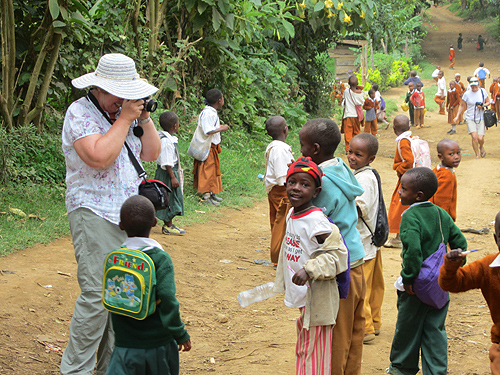
Caroline Barrett meets Maasai school kids.
We’ve had some terrific game viewing, but yesterday was to broaden our experience of Africa: there is so much more than animals.

A vacation, time-off, a holiday – they all evoke images of a breezy, sunny beach, lazing on a hammock swinging softly near a smartly uniformed attendant serving margaritas. That’s not a safari. While there are outfitters who promise exclusivity, rests in the woods with little of a schedule, that’s not what the vast majority of people who come here expect.

They expect above all, wild animals, and there’s no doubt the vast majority of travelers here are animals lovers. And they don’t expect a lazy hammock swinging softly in the breeze. They expect to be roused earlier than normal, herded on schedules into vehicles, and long, long drives over bumpy, dusty roads.

No pain, no gain. In the end the view of the pride of lions with the furry youngsters monkeying around validates the effort. But the effort is considerable, and travelers know that.

So I’ve tried throughout my career to maximize my travelers’ fortitude. And today I think represents a great success. We didn’t start until 9 a.m. Our bumpy ride was but a few kilometers. But the view we got at the end of the day I consider as important as a pride of lion playing.

We spent the day with the “middle class” if you will, of modern Africa.

More than 2/3 of all Maasai in the three countries in which they live are hard working, modern people who live in tight-knit communities that probably remind most of my older visitors of America’s deep south as World War II was ending.

Houses are modest but functional with plumbing and electricity, many in some disrepair for wont of better and expensive maintenance, roads that are horrendous, but communities that take pride in their history, their businesses and above all, their schools.

They are teachers, store owners, taxi drivers, business people and of course, tourism service providers. The Maasai community that we visited on the slopes of Mt. Meru has not lived a nomadic existence herding cows and goats for nearly 200 years.

After being briefed by the village chairman whose wife served us coffee and tea in her garden, we were escorted by a young man studying economics in a local college and who spoke excellent English. He explained that there were around 4500 people in the village. “Village” is a political term in modern Tanzania, similar to a town in America.
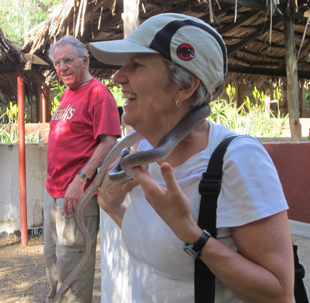
Phil Lopes studies Mary Critchlow's new necklace.

We saw people working in their farms, women carrying large bundles of wood on their heads, successful men proudly stacking the cement blocks of their better houses and were also escorted to the edge of the village where “traditional houses” existed in a sort of village remembrance of their heritage.

And much of the tour was spent at the primary school. The headmaster brought us into an older class and gave them the opportunity of asking us questions. Among those asked were, “Are you married?”, “How did you get here?”, “Where are you from?”, and “What do you do?”

After each of us explained what we did, the Headmaster asked how many of the classroom of about 50 students would also like to become a such-and-such, an invariably most of the hands were raised enthusiastically.

Until Phil Lopes said he was a politician. There was a pause from the Headmaster until Phil prompted him to ask, “Why don’t you ask how many want to be politicians?”

Enthusiastic laughter and hands-up response.

From Ngeresi village we went into town and had lunch at a local diner, the kind most of the working, modern Maasai in Arusha use for lunch during the work week. The choice of fish, beef, chicken or beans and rice; served with rice, ugali or chapati was unanimously considered a good, solid meal. The cost? $2.10 each.

We ended the day at a couple other Arusha area attractions including the Meserani Snake Park, where the Maasai Charles guided us in front of the several dozen snake cages describing how quickly death came from each bite… Well, a lot more actually, like the type of toxic, how bites are treated and why people get bitten.

The Maasai we met and who befriended us today actually call themselves “wa-Meru” rather than Maasai, to distinguish themselves from the traditional (archaic: “primitive”) ways of their ancestors. But their language and their not so distant ancestry is the same, and I have hired Maasai driver/guides here — some of the best I’ve ever had — who herded goats on the distant Serengeti as a young boy calling themselves “Maasai,” and then developed a careers in Arusha town calling themselves “wa-Meru.”

The Vice President of Kenya was a Maasai. The CEO of Kenya Airways is a Maasai. Prominent Maasai fill Africa’s boardrooms. But it isn’t just the most modern and the most primitive. The men driving my clients around Tanzania, explaining the intricacies of acacia dependence on giraffe or the complexity of Tanzania’s new constitution, or discussing the problems of a their children during the teen years of texting – they, too, are Maasai.

It was a long, productive, nonanimal day and I’m now doubly encouraged to give these wonderful clients the finest game viewing in the world. I hope they felt the day worthwhile, a day that might have changed their notion about what a Maasai is.
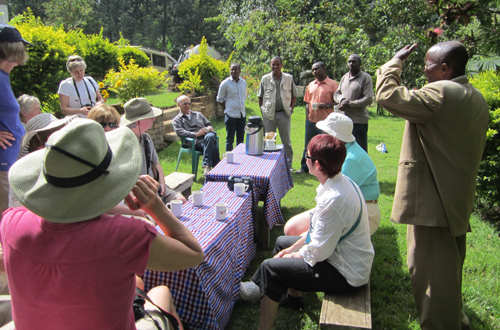
The Ngeresi Village Chairman briefs my group at his home on Maasai development.
Mama Africa

Mama Africa

By Conor Godfrey

Over the past week I’ve made it out to Silver Spring, MD, for a few great African films.

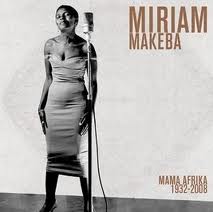
Opening night of the festival featured “Mama Africa” – a cinematic eulogy to the late great South African mega star Miriam Makeba. Find the English language trailer here.

If you don’t dance in your seat I would probably just give up the ghost.

As noted in this Reuters’ review, the worst thing one can say about the film is that it would have been even better had she been alive to comment on her own life.

Miriam was involved with the making of the film up until her death in 2008.

The rest is put together with help from archival footage and interviews with a dozen former band-members, friends and relatives.

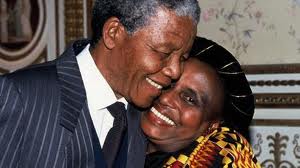
Makeba with Nelson Mandela

In Miriam’s case, this includes many of modern Africa’s founding fathers like Sekou Toure and Julius Nyerere, famous Black panthers like Stokely Carmichael, and world-class musicians from all over the world.

Renown South African Trumpeter Hugh Masekala (Also Miriam’s first husband and lifelong friend) fills in a lot of her early history. (Find an upbeat anti-apartheid track from Hugh here.)

She was born into crushing apartheid township poverty in the 30s, and even spent six months of her first year in jail with her mother who had been sentenced for selling homemade beer.

Her rise was meteoric once discovered.

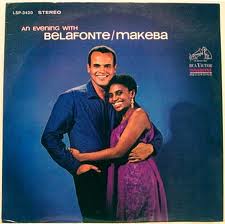
After being caught in the film “Come Back, Africa”, filmed secretly and smuggled out of South Africa by Lionel Rogosin, she was discovered by Mr. Harry Belafonte.

Belafonte went on to introduce her to the greats of the American music scene. She would eventually sing at JFKs birthday, and record with stars like Nina Simone, Desi Gillespie, Paul Simon, and tons of international stars.

She held seven passports and 10 citizenships at the time of her death.

Before the film, I really only knew her mega hits, like “Pata Pata.”

(Or find the song live in concert here.)

During the film, she actually says she wishes that some other song, with more meaning, had become her defining hit.

I suppose there is some irony in the vocal anti-apartheid singer who’s smash hit was, in her words, “a nonsense dance song.”

But there were plenty of more substantive hits as well.

Director Mika Kaurismäki featured songs like the Khosa wedding song “Qongqothwane”, known as the “The Click Song” by English speaking South Africans.

She introduced the song in the movie by saying that “the colonizers have to call it “The Click Song” because they have trouble pronouncing “Qongqothwane” with the right clicks.

One of my favorite pieces of concert footage was “Oxgam.” This particular piece shows her potent smile to good effect.

After all, she essentially had her pick (more like pickS) of husbands wherever she went.

Find the more emotional, slower Makeba in “Khawuleza.”

I also had the pleasure of seeing my old haunts in the Fouta Jallon region of Guinea when the film explored Makeba and her husband Stokley Carmichael‘s exile in Guinea.

After the two wed, all of Makeba’s U.S. dates and deals were cancelled in protest of Stokley’s activism.

At that point, a number of African countries, including Guinea, vied for Africa’s peripatetic daughter to come live with them as she still could not go home to South Africa.

In general, the film was a beautiful tribute to a pan-African hero, a tireless activist for justice in South Africa, and one hell of a voice.

Good luck finding it though – stay tuned here.

The Desert Speaks –
Tuaregs in the News

The Desert Speaks –
Tuaregs in the News

By Conor Godfrey
(Hello to all Jim’s readers! The actual Answerman is off finding answers in Southern Africa, so I have been asked to amuse and entertain for the better part of March—I will do my upmost.
Jim and I share some interests and opinions, and diverge quite a bit in others, so I hope you enjoy a brief change, and please feel free to leave comments or email me at [email protected] if there is an issue you would like to see covered.)

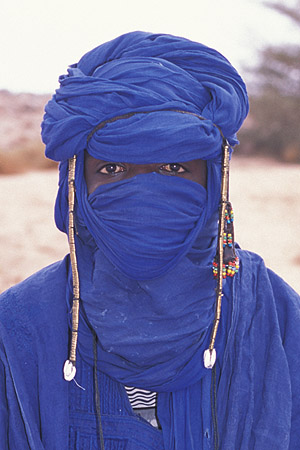
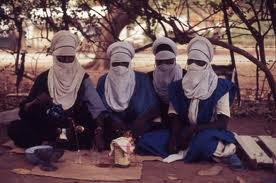
The Blue People, the People of the Veil, the Tuareg: to the people-groups that live south of the great desert, these veiled nomads are known as warriors, slavers, merchants and cattle raiders, and have been doing all of the above ever since the camel was introduced to N. Africa around 0 B.C.

For the last millennia, the Tuaregs have controlled the five most lucrative trade and smuggling routes across the Sahara – after all, the 1.2 million Tuaregs that roam the Sahara are more intimate with the desert than we are with our kitchens and bedrooms.

E.g. We call the sandy expanse from Algeria to the Red Sea the Sahara Desert; the Tuaregs see this as dozens of different deserts, each with its own name depending on its aridity, elevation, vegetation, etc…

This interlocking web of deserts goes by the name “Tinariwen”, in Tamasheq, the main dialect of the Tuareg people.

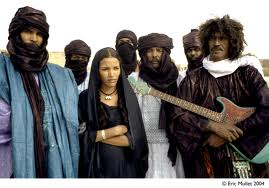
Tinariwen is also the name of a Tuareg band that won the Best World Music Grammy last week.

The band Tinariwen is what I imagine the Sahara Desert would sound like if you gave it an acoustic guitar and a drum.

“Tenere” – the Tamasheq word for the true, deep desert, is the band’s ancestral and spiritual home. Have a listen here.

They were even on the Colbert Report when they were promoting the music Festival au Desert in Timboctu. NPR calls them the best acoustic rock group of the 21st century.

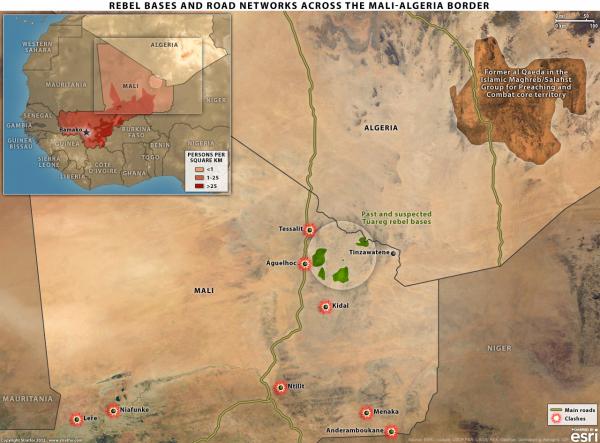
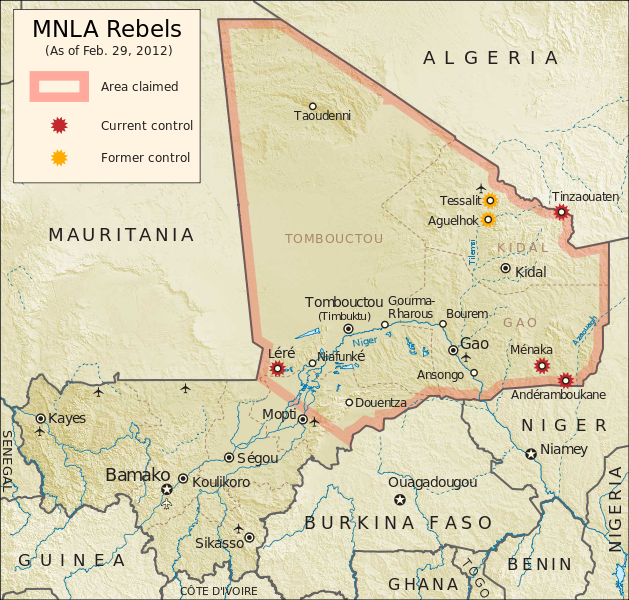
There was, however, another reason the Tuaregs were in the news last week. While Tinariwen was sporting their best Boubous to collect their prize, other Tuaregs were rolling over strategic towns in Northern Mali and skirmishing with the Malian army (See map of conflict on the right.)

The ‘rightness’ and ‘wrongness’ of this conflict (and the other Tuareg rebellions over the last century) is very difficult to parse, and probably immaterial.

When African states in the Sahel gained their independence in the 1960s from, in this case, France, they attempted to assert control

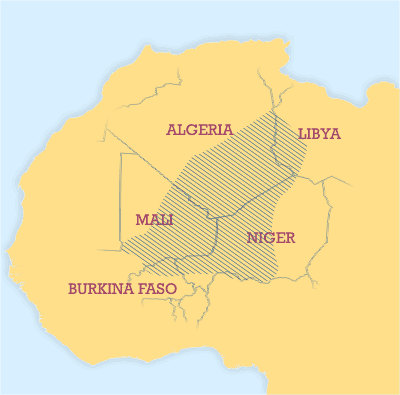
Tuareg Area
over their desert interiors, putting them in conflict with the Tuaregs who refused to acknowledge imaginary lines drawn in the sand (literally)

At the same time, the trans-African trade was increasingly moved by sea, making the two thousand year old caravan routes less and less profitable.

The Tuaregs turned their dessert expertise toward less savory commerce– hostages, drugs, and guns for hire—which put at least some Tuaregs in contact with al-Qaeda and other nefarious groups.

The Tuaregs are NOT Islamic extremists – their brand of nomadic Islam is heavily blended with millennia old animist traditions, and would probably give a hard line Islamist a heart attack.

Tuaregs that do come in contact with al-Qaeda do so for pragmatic, financial reasons.

Also, the various governments abutting the Sahara have every incentive to play up the al-Qaeda – Tuareg link because the U.S. then shells out cash and personnel for military and anti-insurgency training.

(It did not help the Tuareg case that 800 Tuareg warriors fought alongside Moammar Gadhafi’s troops in the recent civil war.)

The Indigo people are a relic of the pre-nation state era; a trans-national people so intimately tied to their land that modern borders are not only unenforceable but totally irrelevant.

Ironically, Tuareg champions are now adopting the modern world’s nationalist rhetoric to express their people’s aspirations.

Malian Tuaregs and some non-Tuaregs have formed the National Movement for the Liberation of Azawad… Azawad being the local name for the Tamasheq speaking regions of Mali, Niger, and Algeria.

The Associated armed group has been renewing the armed struggle for a Tuareg homeland since late January, 2012.

In many ways the Tuaregs have a more coherent cultural and geographic claim to nationhood than many of the modern world’s balkanized republics. Said another way, they are arguably as distinct from their Southern neighbors as the South Sudanese were from their Arab neighbors to the North.

It is difficult to watch some of the last trans-national nomads locked in a losing struggle with the modern world.

As many of the world’s nation states splinter along civilizational lines (Iraq and Syria, Sudan(s), Nigeria, etc… ), and identity politics grows stronger in developed and developing world alike, I wonder the Tuaregs were not simply ahead of their time in thinking that national boundaries were just imaginary lines in the sand.

Can’t Do It Here? Try Uganda.

Can’t Do It Here? Try Uganda.

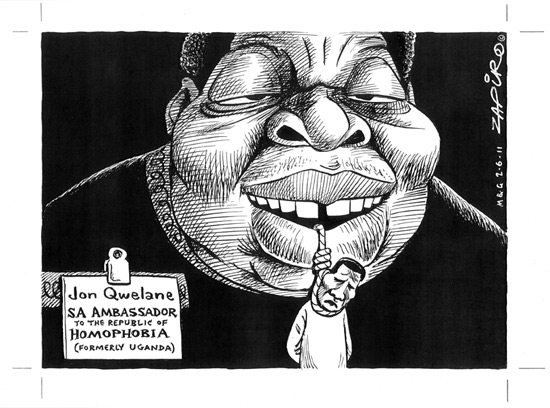
By South African cartoonist Zapiro.
The reemergence of the draconian Ugandan anti-gay legislation isn’t just a tedious clarion alarm. It shows that as the world’s economy improves, vital human rights concerns subside from the limelight.

It also shows how lasting wrong-minded movements once elevated to celebrity status in Africa can survive, as compared, say, to America.

Despite many of your complaints about my sarcasm and cynicism, I truly believe in America and get my sustenance from the ultimate outing of truth, here. But that’s not the case in many places in the developing world like Africa. Once launched into the heavens, it’s much more difficult to bring an errant issue down to a safe earth landing in East Africa than here.

David Bahati is the poster child for Church Street (sorry, I mean “K” street). He’s the puppet Ugandan legislator that does the gofer work for American conservatives who found an entry into Uganda after Bill Clinton’s many overtures to the country more than a decade ago.

His travel to and from America, hosting in America, and coaching as a politician came right from America’s extreme right. He introduced a bill in the Ugandan parliament in 2009 that was ultimately withdrawn because of its draconian provisions including execution for some prosecuted gays.

It is simply the American right using Uganda as a place to do what they can’t do, here.

The bill was withdrawn because of a huge public outcry worldwide. But last week Bahati reintroduced the bill, and immediately thereafter as if scripted from source, the Ugandan government supported the bill by reducing the greatest possible punishment from execution to life imprisonment.

That is the margin that the American coaches think will win the day. And they might be right.

The world’s state of happiness is improving, exception the Greece affair. The nearly two million signatures on on-line petitions against the 2009 bill set a precedent that already we know won’t be achieved this time around.

A coalition of East African clerics hopes to achieve a petition with a measly “5,000 signatures.”

Even as Uganda itself has achieved little additional political stability, its economy is no longer dive bombing. What I’d really like to see are Bahati’s emails and phone records, as I’m absolutely sure his moves are being orchestrated from here.

The right in America is on a roller-coaster right now, and each time Santorum’s head appears above the rising waters, they gloat, and I’ll bet, pick up the phone and tell Bahati, just as they would tell Santorum, it’s now or never.

They’ve got a better bet going with Bahati.

And unfortunately, Ugandan activitists are being clobbered not just by American righties but South African righties as well. Same dynamic: can’t do it at home, do it where you can when you can.

Jon Qwelane was appointed South Africa’s ambassador to Uganda last year. He was subsequently convicted of hate speech (anti-gay) in South Africa, but his ambassadorship continues. South Africa has a long tradition of gay rights, and it’s embodied in its constitution. I wouldn’t doubt an “evil axis” of K-street and aberrant South African diplomats.

So this time the Ugandan putsch is without finesse. Last time it went through Parliament several times like a ballerina pas-de-deuxing through a china shop, as quietly as possible then finally petered out after a huge international outcry.

This time several days ago, only a week after Bahati reintroduced the bill, the Ugandan Minister for Ethics and Integrity initiated a massive public campaign to arrest gays.

In fact he personally marched into a convention of presumed LGBT and took over the podium, announcing arrests as activists ran to the corridors.

Since 2009 the Ugandan parliament has been riveted with controversy, descent and wide movements of subservience to a growing executive followed by courageous acts of trying to assert their increasingly diminishing power. But the net result, today, isn’t good.

I think this time the anti-gay bill will pass. Fortunately, it won’t mandate execution for being LGBT, just life imprisonment.

Santorum won’t win. Bahati will.

Wudst Time Just Move On

Wudst Time Just Move On

Yesterday I listened painfully to a brilliant African jurist try so hard not to be condescending to a rabid American academic who characterized himself as a “strict constitutionalist.” Some Americans are so stuck in the past. We just can’t see the world whipping past us leaving us in history’s dusts.

So what does one do when in an unusual situation you’re unexpectedly driving across the country on a workday? Listen to NPR’s Talk of the Nation, and the program yesterday afternoon was fabulous: “Should the U.S. Constitution Be An International Model?”

According to the host, Neil Cohen, the program evolved from the tremendous criticism from the right of Supreme Court Justice Ginsburg’s Cairo interview recently where she dared to suggest Egyptians might want to consider other alternatives to the U.S. Constitution when writing their own new one. (After the first two minutes in Arabic, the interview changes to English, stick with it.)

As Slate.Com’s David Weigel posted, the interview “disturbed the balance of the universe.” (The onslaught of rightest invective was so intense there are concerns Congress may try to impeach Ginsburg.)

Headling yesterday’s NPR program was Cape Town professor, Christina Murray. Murray was instrumental in designing the South African and Kenyan constitutions. She was among an exclusive group of global “experts” hired by both countries to assist each in creating a modern form of government.

I would have loved to have listened to Murray and those of similar learned dispositions (like Yale prof Akhil Reed Amar who was also on) talk forever about what I’ve come to realize are two of the world’s newest and now best constitutions. Then perhaps a week later we could start discussing the process of how experts like them were chosen, what motivated the revolutionaries in each country, etc.

But that’s not America, today. Media like NPR feel (under the heavy boot of Congressional funding) a national responsibility to impede intellectual development by giving equal air time to the ignorant. The result is always … nothing but further honing of irreconcilable first principles. Tiring and trite.

The vast majority of intellects studying government systems, today, understand that different cultures emerging in a new world where the ability to protect unique heritages and folkways is at last secure, will have different needs. Like Kenya and South Africa.

The vast majority of intellects studying politics, today, recognize that just as we moved from the diode to the transistor to the computer chip in a mere quarter century, there’s absolutely nothing wrong with altering a bit rules of governance first thought up in 1797.

Yet NPR’s foil to reality on the show, Roger Pilon of the ultra rightest CATO Institute, hogged air time to say the same thing again and again: Raw American 18th century democracy is primae facie the best form of self-governance because the only necessary social objective is to have as little government as possible.

What does a professor say in response to such immature, tautological hogwash? It causes pauses, and that wastes more time. And it transformed Prof Amar into someone who sounded like he was explaining to a four-year old why it was OK that the robin gobbled up the worm.

We’ve got to move on, folks. Murray and Amar and virtually all but one of the callers knew this. The 30+ rights enshrined in the Kenyan constitution offended Pilon who explained he was pretty offended by several of our own Bill of Rights, because “we really don’t need them” arguing that “freedom” means we have “infinite rights” anyway.

I need a plaster. But please, click on the link above and listen to the show. You can turn down the volume when old man Pilon talks.

So kudus to NPR for bringing on Murray, who I hope some day will be nominated for a Nobel Prize. She’s still young and vibrant, and her body of work is exceptional. The constitutions of Kenya and South Africa will be the models for future governments well through this century.

And if we can just get beyond the sludge of our own intransigent ignorance, perhaps even for us.

An Incredible Production!

An Incredible Production!

We’ve got another hit musical in the making: nuclear war over Tehran, American righties swinging from Egyptian guillotines, evil ladies wresting control of revolutions. Time to buy your season ticket.

The pointers in north Africa are swinging towards war: Egypt’s predictable predicament with the West cocks Israel’s war machine. This isn’t good.

Egypt’s prosecution of a number of Western NGOs allegedly for funding “destabilization” is the trigger. What? A revolution isn’t exactly stable. The notion that outside groups promote revolution at the peril of revolution is nonsensical.

Americans especially don’t understand revolution, not even their own distant one. Framing all regime changes in the history of our own relatively simple revolution more than two centuries is a mistake. We tend to think there are very few outcomes of a revolution: the good or the bad.

Only recently did American schoolbooks talk about the loyalists that supported the King. The idea that neighbors and friends and even relatives might have opposed the outcome at some earlier point doesn’t register. Too complicated.

But just reschedule your entertainment to include a few popular musicals like Les Miserables or Evita. A revolution unleashes all sorts of competing forces and until a lasting and dominant one prevails, all sorts of messes occur. Anything can happen.

In Egypt few were talking to the Muslim Brotherhood as it systematically garnered more and more control of the situation. Last year it was only al-Jazeera that early on regularly interviewed and reported on the Brotherhood. Barring any major disruption, the Brotherhood will soon become Egypt’s ruling force.

The 19 NGOs under prosecution are mostly American but also include one important German organization, and they’ve all been in Egypt for years. Some of the higher profile Americans, including the son of one of Obama’s cabinet secretaries, has taken sanctuary inside the American embassy. If their trial proceeds too far I can imagine SEALs attempting a rescue of those currently taking sanctuary in the American embassy in Cairo. Flashbacks to the Iranian revolution.

“The prosecution could hardly have been better designed to provoke an American backlash,” the New York Times writes this morning.

Situations like this are rarely logical, but they are predictable. I’m not suggesting that we should not have aggressively supported the Egyptian revolution, but perhaps this gives you a greater insight into why Russia and China want to try to screw a Syrian genie back into the bottle.

Societies like theirs are poorly prepared for the unprepared. In that competition, America wins the gold. And our unprepared for mistakes rattle the whole planet: CDS, anyone? Gambles sometimes lose.

In brilliantly reporting this morning NPR discovered that the person behind the Egyptian prosecutions is a woman holdover from the Mubarak regime, who apparently always distrusted Americans.

A revolution allows these types of sleeper ideologues to emerge and flourish. Imagine what chaos might ensue if Egypt’s military tries to interfere.

Yet Democratic Senator Patrick Leahy seems poised to stop Egyptian aid if the trials proceed.

Add to this fluid situation a pinch of Iranian nuclear power, an obsessively conservative Israeli regime and an American election and you have all the ingredients for a major war. A century from now, perhaps it will be the most popular musical on Broadway.

Which is Worse: Shooting or Listening?

Which is Worse: Shooting or Listening?

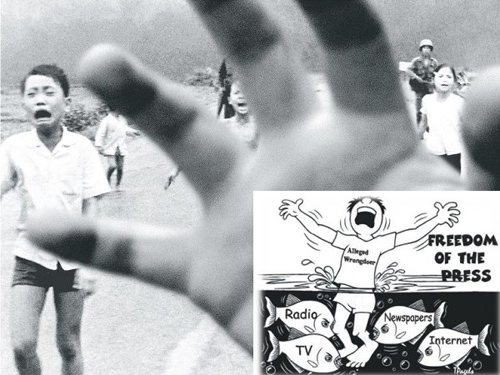
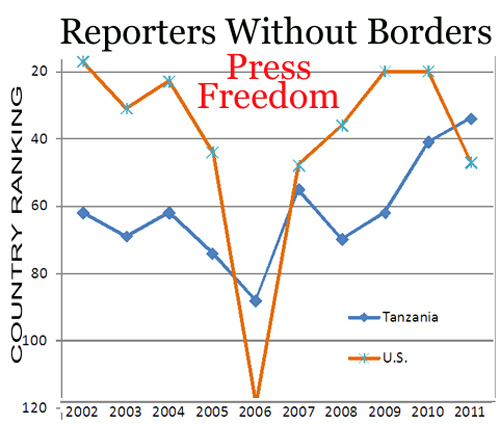
Is shooting journalists better than tuning in Rush Limbaugh? Tanzania has a freer press than the U.S., according to this year’s report from Reporters Without Borders (RSF). Hmm.

This year’s RSF report is the tenth year running that ranks all the countries in the world in terms of “press freedom”, although I think that’s far too simplistic a characterization. Please read on.

Over this nascent first decade the group has tried again and again to refine its method of determining press freedom, and this year’s is the most complex of all. It’s no longer just how many journalists have been shot to death, but things like how “effective” the media is in terms of honest reporting and self-censorship.

That’s the reason, for example, that Fox News helped sink the United States so low, 47th.

“Free” is not exactly the right word, here. But there is a singularly important lesson to be learned from the fact that this year Tanzania is ranked 34th and the U.S. 47th in freedom of the press, by what reporters widely support as their outstanding global advocate.

And that lesson might be that you can have too much of a good thing.

The media in America has exploded in the last decade, especially with cable television and satellite radio, not to mention us bloggers. There’s so much news that maybe, just maybe, there’s less aggregate truth. RSF incorrectly characterizes this as “freedom of the press.”

America’s position plummeted below most advanced countries in 2006, guess why? Weapons of mass destruction. Bush administration outright lying, suppression of whistle blowers, and probably most importantly, the wholesale buy-in by media across the whole spectrum of these lies and half-truths.

So the incredible and powerful foolery of America’s press ended up, from RSF’s point of view in 2006, being equal to the killing and beating of a couple journalists in Uganda and Kenya during their turbulent political events that year.

And what about all those reporters who were convinced – and convinced us – that the housing market, hedge funds and derivatives, were just honky-dory?

There are plenty of media outlets in America truthfully reporting that there has been steady growth of private sector jobs in the last 18 months. Freely reporting the truth.

But there are also many outlets, some very effective like Fox News airing again and again the Republican Radio Address by Mark Rubio saying just the reverse, propagating an untruth. Freely reporting falsehoods. Or choosing not to report truths.

Today the Labor Department announced jobs numbers in the U.S. that knocked to the floor most economists. Good, surprising — so surprising a cynic could be motivated. But instead, excellent media outlets like On Point Radio hardly mentioned it at all. Because … American media is currently obsessed with the election.

RSF analyzes all these failings as “less freedom.”

In Tanzania there is so little media, what exists is rather moderate if benign. Tanzania’s media is heavily self-censored, and not necessarily because of government threats, but just because it’s so incredibly small.

Most Tanzanians get their news from Kenya where the media is much larger, and where the media doesn’t report a lot about Tanzania. So the sum total of bad stuff or stifled stuff or self-censored or just got-it-wrong stuff in Tanzania, percentage-wise, is less than in America.

So we have less truth in America than Tanzania?

Hmm. Yes, but we have enormously more truth available to us to find than Tanzanians if we can just decide which newspaper, which cable show, which magazine, which blogger to read, and therein lies the critical understanding.

An interesting point, isn’t it? Whether we’re southsiders in Chicago or urban cave dwellers in Dar-es-Salaam, the vast majority of us all want to know the truth of what’s happening in our society.

On the one hand I’m thrilled that someone, RSF, is at last being courageous enough to deal with “truth.” Like PoltiFact and FactCheck and good high school teachers should. But on the other hand, I fear RSF is working with an emulsion not a solution.

Tanzania’s collected sum of radios, TV, blogs, newspapers, magazines is a pinhead compared to America’s Rushmore. Even if everything that was ever reported in Tanzania were completely false, it wouldn’t begin to equal the amount of false reporting in America.

In America if Romney wants to pretend he didn’t mean he doesn’t care about the poor, there are ample millions of ways for him to do so. Not in Tanzania. There’s not enough distribution for spinning a mistake. You could think of this as a blessing in disguise. But it also means that the powers-that-be and want-to-be have fewer recourses to manifest their power. Like sending police out to shoot journalists.

RSF is saying that shooting journalists could be better than tuning in Rush Limbaugh.

Hmm.

What Price is Too High?

What Price is Too High?

More than a million and a half viewers have watched the mountain gorilla YouTube. Is this the reason Rwanda has raised the permit price to $750?

I’m absolutely infuriated by this hike. The added revenue is not going to gorilla research, and the bulk of it is not going back into any kind of conservation whatever: it’s going to a very corrupted, dictatorial and inhumane Rwandan government.

There’s no way Rwanda will open its books so that we can see exactly where that $750 goes. The country has become one of the world’s worst human rights violators, thumbing its nose at virtually all organizations demanding public accountability. I’d speculate that $750 is divided something like this:

$125 for gorilla and other conservation
$125 for country-wide development
$150 for security and incarceration of political dissidents
$150 for unnecessary pet projects of political bigwigs
$300 into the pockets and Swiss bank accounts of high officials

Second, this absurd cost to spend an hour with a wild animal continues the transformation of the planet’s wildernesses into a playground exclusively for the rich.

And thirdly, it coopts wilderness conservation from a scientific orientation into a commercial one insensitive to the needs of the Rwandan people, and in fact one which tacitly supports their oppression.

EWT sent some of the very first tourists up Karisoke during the first mountain gorilla visits in 1979. The permit cost was $25. There was one organization involved in the project and Rwanda was anything but a stable, modern country.

Today Rwanda is probably the most modern country in East Africa. Fiber cable has been laid or is being laid to carry the most advanced technologies to virtually every corner of this tiny country. The Rwandan economy – benefitting from a hugely disproportionate amount of foreign aid as a result of the ‘94 genocide – is booming.

And gorilla permits now cost 30 times what they originally did and there are more than a dozen foreign wildlife organizations working in the area. And, very importantly, the population of mountain gorillas has more than doubled to just under 800.

That population is probably near its maximum, because the habitat isn’t large enough for more. I’m sure that many scientists will disagree, but I’ll cynically suggest they are circumscribed by their own over-field population encouraged by Rwandan officials.

I’m sure throughout Africa there is more habitat suitable for mountain gorillas than there currently are mountain gorillas, but in Rwanda specially and alone, I think we’ve reached the maximum. The gorilla density in the Rwandan Virungas has exceeded its natural carrying capacity specifically to encourage tourism dollars.

The evidence of this is the growing size (numbers of individual per family) and the acceleration of family amalgamation and the growing examples of multiple silverbacks in the same family.

Humans in Rwanda are also overpopulated. But the state of the Rwandan people is far from being 30 times better than in 1979. There have been notable improvements in the eradication of some poverty and general overall economic development, but personal liberty and freedom of expression have been squashed like a gorilla stepping on a mushroom.

I’ve watched that YouTube video multiple times. I’ve listened to the person narrating the experience drift with his personal excitement into a world of inaccuracies that he either considered inconsequential or artistically fanciful, as proof we as tourists are being fashioned as the weapons against the local population, and as paymasters of the world’s worst dictators.

The excitement of the tourist in that video is still to me critically important. I’ve now trekked to see the gorillas more than 50 times and I will bring others, still again. Whatever else it may be, it is a haven of natural balance and beauty and every time some tourist bonds with it, we can hope her priorities have been realigned to saving the earth.

But just as we walk the Great Wall or paddle down the Tambopata, we must more than ever be cognizant of exactly what we’re doing, and I don’t mean shooting a video.

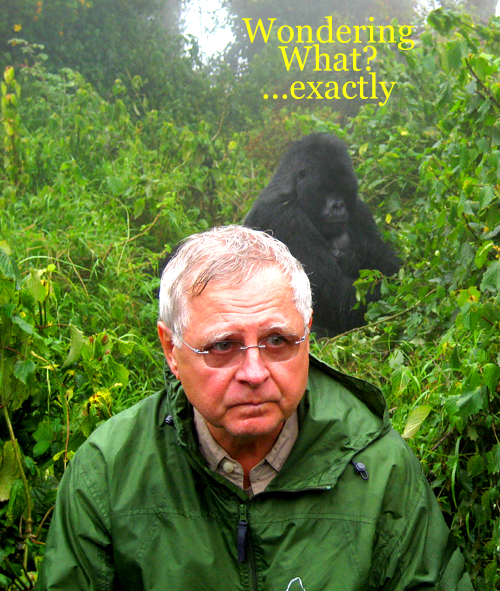
I mean wondering where the money we paid ends up. I mean wondering why people who aren’t as rich as we are can’t as easily experience the most natural and pristine parts of our earth. I mean wondering why our clawed Victorian bathtub holds gallons of steaming water while the family of the man who cleans it for us is searching for a teaspoon of clean water to drink.

To me, developing the awareness of this awful conundrum in the so-called “wild” is the most important experience of all. It’s a very personal decision. For me as a guide, the absurdity of the cost provides an easier platform for me to help my clients achieve this special awareness. So not yet is the price too high. But what is too high, then? I don’t know. That’s my own, the guide’s conundrum.

Giants of Gender Equality

Giants of Gender Equality

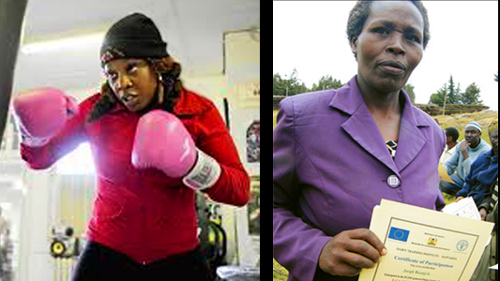
Did you hear about women’s boxing coming to the Olympics? Did you hear about women businesspeople becoming village elders in Kenya?

Issues today are global, and it’s fascinating to see their actual quantitative positions relative to the developed and developing world. Wealth inequality, for example, seems to be gaining much greater traction in the developed world, where people are much richer, than in the developing world.

Gender equality, in contrast, is gaining much greater traction in the developing world, where people are much more segregated by race and gender, than in the developed world.

I hadn’t heard that women’s boxing was coming to this summer’s Olympics before the NPR report this weekend. And I have to admit that the instant reaction wasn’t one of liberation. When I finally saw Franchon Crews’ biceps I no longer felt an iota of wrongness or inappropriateness to the idea and was left with just a feeling of oddness.

This in contrast to my positive feelings when I read that a business woman in a rural area outside a secondary city of Kenya became Kenya’s first woman village elder.

(The fact is that Kenyan men in general probably feel the same way towards Catherine Cherop and Franchon Crews, respectively, as I feel toward Franchon Crews and Catherine Cherop!)

When I first began working in Kenya forty years ago, women were hardly seen except toiling in the fields and carrying water. In several cases I met families where one of the wives couldn’t speak the language of her husband and probably would never learn it.

When a large rural school (all boys, always back then) announced they had hired my wife as the first ever woman teacher, they rebelled, struck classes and warned her that she would be killed if she walked through the classroom door.

The position of “elder” throughout all of traditional Africa is near synonymous with councilman or alderman, and it was always a man. In fact in almost all the African languages I know, “elder” is translated directly as “old man.”

Among traditional Maasai, to become a senior elder you must first be a junior elder, and to become a junior elder you must become circumcised and then dedicate 5-7 years as a warrior protecting the stock… (among other things).

From the colonial era through modern independent societies, the evolving community political institutions simply assumed a modernized version of the traditional institutions. In today’s Kenya, village elders in the more modernized less traditional communities are now appointed by higher governing authorities.

You apply for the position the same way you’d apply to be appointed to the school or county board; there are some elections, but many are appointed by higher elected officials or higher governing bodies.

Kenya is implementing a new constitution that mandates almost a third of all public elected and appointed officials be women. Of all the radical and creative components to the new constitution, this one drew very little opposition and reflects now several generations of free education irrespective of gender.

But unlike the much longer transition here in America towards gender equality, older Kenyans living today remember as I do that women weren’t just excluded from important positions in the community, but that they rarely appeared!

This enormous change while not a suprise on reflection, to many older Kenyan men causes the same pause I felt when reading about Franchon Crews.

Catherine is the first at the village level! It may seem odd, but the higher up the political hierarchy you go, the more women have already appeared in prominent positions. Kenya has already had a number of elected women Members of Parliament, has had one woman run for president and a number in the top tiers of the judiciary.

But it’s at the grass roots that culture moves slowest, and Catherine’s revolutionary step is in that sense more notable than if she filed to run for president of the country.

It’s another great part of the wonderful story of Kenya’s cultural leaps and bounds. You can read much more about Catherine by clicking here.

Field of Nightmares

Field of Nightmares

Young Uganda school boys amazingly won the all-African baseball championship and thereby an invitation to the U.S. for the Little League World Series in Williamsport this past summer. But they didn’t come. The American consulate in Kampala denied them visas.

So the day before yesterday, the Canadian little league winners who were scheduled to play the Ugandans in the first round last August, played the Ugandan kids in Kampala. And lost.

In times past, which means before 9-11, the Ugandan schoolboys would have gotten visas. But the sloppiness of their application process, and the fact that they didn’t have the money to hire someone locally who could have helped them, doomed them from the start. If I can’t say it was wrong of the U.S., I must just lament how the world has changed.

Personally aghast at what had happened, Phillies super star shortstop Jimmy Rollins bankrolled the Canadian Little League winners who flew into Uganda last week with Rollins. Rollins wasn’t the only American to help the Ugandan kids. The team had long been coached and funded by American, Richard Stanley, who owns several AA minor league teams in the U.S.

The heart-breaking story is a simple one. The goodwill and extraordinary charity, including not only from stellar individuals like Stanley and Rollins but also from several branches of the U.S. government that funds much of school sports in Uganda, all were trumped by …

… national security.

And who is to say it should have been otherwise? We know how children particularly in Uganda’s part of the world have been coopted, or more truthfully brainwashed, by hideous forces like the Lord’s Resistance Army. We know that as unlikely as any of them might have been active terrorists, that the enormous love that would have been showered on them as individuals from unsuspecting Americans could have been so easily manipulated into odious ways.

None of this might have posed an imminent threat, but the level of resources that would suddenly have had to have been dedicated to monitoring the affair and its endless aftermath was simply “beyond budget.”

Do I really believe all that malarkey? Of course not. They were children, easily contained, easily watched. All you had to do was photograph and fingerprint. It’s an absurd and heart-wrenching story.

What exactly was the State Department worried about?

It seems that the principal concern was that birth dates and names didn’t register with the personal interviews of the applicants by the U.S. consulate in Kampala.

African kids change their names all the time, and few know when they were born. That discrepancy is an honest one that would never occur if a double-agent or dedicated terrorist tried to get into the U.S.

Even Stanley said he accepted the State Department’s decision. And a filmmaker instrumental in publicizing the Ugandan kids’ great baseball story, Jay Shapiro, agreed, too, with the Americans’ decision. They’ve both caved.

A kid with a mitt won’t take down the Twin Towers.

Is this a reflection on the Obama administration, on the budget, on the paranoia of America?

All the above.

King, Racism & Obama

King, Racism & Obama

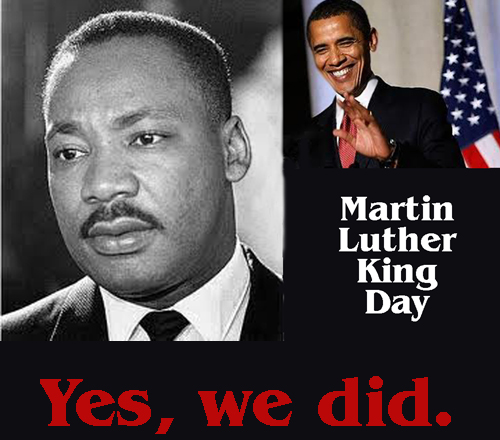
EWT is closed today but most businesses are open. Many African friends believe this is racism. Is it?

Martin Luther King Day is one of ten federal holidays, but in the United States it’s quite possible to have a near normal workday even on a federal holiday. The stock market, the post office and banks (which require a federal charter) are closed. But in many places — particularly in America’s south — life and work goes on nearly normal.

One of the most vocal opponents of gazetting the MLD holiday was Senator John McCain, the last Republican presidential candidate.

MLK Day is one of only two federal holidays celebrating acclaimed individuals. The other is Presidents Day. Neither holiday is observed as universally as the other eight federal holidays. Today about a third of American businesses that close on the weekends close on MLK Day, and about half on Presidents Day. So can we really claim that businesses which remain open today are racist?

Yes, of course. Particularly in today’s horribly politically charged environment. There can be no more telling confirmation of this than the behavior of anti-Obama forces, today. From the right comes the most vitriolic yet inane criticism of Obama ever sullied a sitting president. From my point of view, there is no other explanation. Obama is the catalyst.

I am a white man who has spent the majority of his life in black societies. I am witness to the change that King’s type of philosophy has made in Africa and at home.

What I most remember of King’s turbulent last days was unbelievable violence. My most vivid memory is as a very young journalist penned under a burning El Stop in downtown Chicago while the city raged in reaction to King’s assassination.

I remember gun fire was a regular sound in my low-rent apartment in Washington, D.C. during the summer of 1968. Or the unending sirens and tear gas around my apartment in Berkeley that fall.

King is duly revered for radically changing American society with non-violence. Yet what I remember most is fire, bullets and ambulances.

All of that was a long time ago, approaching a half century, two generations. Trauma has a way of finding its small berth among the many more ordinary memories of earlier life. My teenage years were lived in Jonesboro, Arkansas in America’s south.

Of the more than 1000 students in my public middle and high schools, there was not a single black. Less than a decade after I graduated I returned to Jonesboro for a wedding and learned that almost half the town was black.

I lived in Jonesboro for five years. I went to school, groomed pretty dogs at a vet’s, shopped on main street, sipped sodas at the donut shop, cheered at school sports matches, went to church socials. I remember regularly seeing only one black, Bessie Mae, our maid.

I left that society for the turbulent 60s, then left the turbulent 60s for Africa, and when I returned how things had changed!

King’s philosophy of non-violence, like Gandhi’s and to a much lesser but significant extent Mandela’s, were not eras of no violence. There was incredible violence, and this violence — as with the sizzling El Stop that nearly fell on me — will be blazoned in our memories forever. But with time we’re able to reflect that that violence was the reaction to those heros’ methodical, unswerving actions for a freer, fairer society.

Those movements as a whole were not violent. But the reactions to them were hideously violent, and then sometimes the frustration of the oppressed boiled over, and Chicago or Watts burned. But mostly it was not that. Mostly it was unarmed hundreds of thousands if millions of peaceful demonstrators being tear gassed and shot by police. It was violence in one direction most of the time.

And why? Because it was the desperation of those who knew they were going to fail. I really believe there is more good in the world than bad. Justice ultimately prevails. But the unjust will hang on for as long as they can.

I come from a deeply rooted Chicago family in the northern State of Illinois, the home of Abraham Lincoln. My father was sent from Chicago to Jonesboro, Arkansas, in the South to start a factory owned by an Illinois company to avoid the growing union movement in the North.

One of the first things my father did was pack up us three young kids in the car and drive us into the cotton fields west of Memphis. He stopped the car, said never a word, and made us watch for what seemed like an eternity black share-croppers toiling in the summer sun in a field owned by a white.

Try as I may, those faceless share-croppers and Bessie Mae are the only blacks I remember as a teenager even though I was part of a small minority, living in the midst of them.

Today, my President is black. My Attorney General is black. My closest friends — many in Africa – are black. My rare return to Jonesboro encountered many blacks. Memories created of life, today, are no longer monochrome or technicolor, they’re just wonderfully vivid.

Social justice does prevail. What King taught us is that nonviolence can achieve liberation and justice. But what he didn’t say was that nonviolence works only after provoking incredible violence against it.

Today, in America, ethnic, religious, political and racial tensions are seething. Economic stress brings out the worst in us. It would seem like there could be no harder time to stop work, but we must. We need time to stop, to reflect, to have a day of peace.

Happy Birthday, Martin! You’d have been 83, today!

Which Witch Wins Winston?

Which Witch Wins Winston?

A Nigerian witch is coming to America to save us! Not sure she’ll make it in time for the conservative bigwig meeting this weekend in Texas, but that’s where she’s headed!

Yesterday, 14 people were rounded up outside Durban, South Africa, and charged with cold blooded murder of a 60-year grandmother who the gang claimed was a witch.

Witch-cleansing has not yet come to America. We’re still in the witch advocacy stage, and like so often American subintellectual naivete will likely be subsumed violently in witchy acts before we loosen gun control laws further so we can eliminate the yet-to-be determined vermin.

How liberally sarcastic, Jim! Alright, alright, cut off the vigilantism at the pass, and bring on Helen!

Nigeria’s notorious witch hunter, Helen Ukpabio, is coming to Houston’s Liberty Gospel Church. A call has gone out far and wide to us afflicted to join “Lady Apostle” Helen in March. In order to attend her assembly we must own up to suffering from one or more of:

– untimely deaths in the family
– barren and “in frequent” miscarriages
– health torture
– chronic and incurable diseases

… or if you’re doing OK healthwise, you can also qualify as a sufferer of:
– bondage
– bad dreams

… and if you’re healthy, not abused and sleep like a kitty, perhaps things aren’t going so well at work:
– lack of promotion with slow progress
– facing victimization and lack of promotion

… or ok, you’re healthy, not abused, sleep like a kitty and have a secure job, but maybe you just blow that paycheck every Friday, you suffer from:
– financial impotency and difficulties

No? You actually save a bit of your paycheck. Praise the Lord! Well, undoubtedly you might still in your heart of heart suffer from:
– stagnated life with failures, or an
– unsuccessful life with disappointments

All the above are caused by “witches, mermaids or other evil spirits.”

And Helen has come to exorcize them from us! Hallelujah!

All levity aside, Helen is a monster. Her church in Nigeria has through bribery or who knows what (certainly nothing supernatural) been able to cause mayhem in less educated communities, has kidnapped children deemed being “witched” by parents, and yet has been exonerated by Nigerian magistrates. The account of this victim is heart-breaking.

My point is that something as bizarre as this finds a place anywhere there is sustained suffering when victims reach their wit’s ends. And as many of the suffering credentials Helen purports above show, it’s almost always economic suffering.

Yes there are many situations of witchcraft in Africa, but also in Appalachia and close to where I grew up in the Ozarks. Anywhere where hard work and earnest direction leads nowhere.

And it’s very enlightening to realize that Helen’s outreach has reached Texas. That place where so many jobs were created under Governor Oops.

It might be fun to poke at Helen, but it’s time to get rid of her. And not by some hocus pocos, but simple social compassion. Like, maybe, more stimulus? Jobs bill? I better stop. I feel that mermaid spirit creeping in.

Pets, For the Love of Money!

Pets, For the Love of Money!

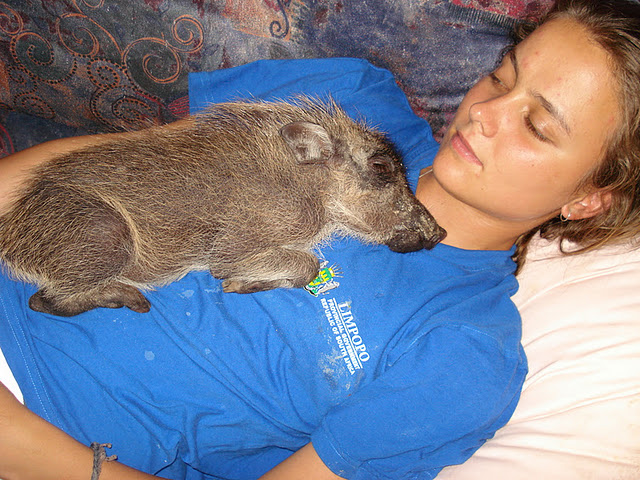
Jess DuPloy with her new pet warthog on New Years Day in South Africa.
I can’t think of a single animal in Africa, not one, that someone didn’t make a pet out of. And some were extremely dangerous, and many ended up killing “master.” So why are we so obsessed with taming the wild?

I think there are two completely different reasons.

The first I’m sure comes to mind to everyone: a pet that bonds with you trusts you. In today’s world, especially, where there is so little trust between people and institutions, trust is cherished possibly to an extreme.

Many animal lovers will expand this into a variety of more universal themes. John Balzar, Senior Vice President of the Humane Society of the US says that pets “teach us about humility and empathy and loyalty. Their eyes hold the spark of life, the same as ours.”

That’s actually a lot less romantic than some get. But however you cut it, this notion of pure love and loyalty is really one of trust. And we need trust, and if we can’t get it from Mitt or Herb, then we definitely need to get a Lassie. That sounds sarcastic, but it’s filled with truth.

The other reason is less prosaic. It’s become a major part of the developed world’s economy, and PetSmart and PetCo and a thousand other pet cemeteries and pet pharmacies and pet devices have exploited our need for trust. They have mined our innate need to consume.

I walk my Lab, Morgan, in the dark in the morning, long before America is awake. It’s now quite dark. So I went first to PetSmart to buy some kind of light that would hang from his collar and was given a mind boggling choice, and I finally chose a red light, because I didn’t think a white light would be as noticeable. But I didn’t realize until I got in the car that it was in the shape of a heart.

Not that there’s anything wrong with that, but I then went to PetCo and they had a great simple rectangular light that snapped onto the collar. Yes it was white, but by now I had been commercially maneuvered.

When the first dark day came I started with the PetCo white snap-on. Only, it snapped-off, as my Lab loves to dig to China whenever he senses a vole in the area. He’s never gotten a vole, but I’ve seen it run away from him when his head is completely buried in the hole he’s dug. Snap-on bites the dust.

So on went the heart-shaped red light. Well, this one doesn’t just shine, it sparkles. I didn’t feel warm and snugly, I felt like a migraine was coming on. Heartless, now, we walked in the dark.

And $20 had been thrust to the wind.

It reminds me of several years ago when our first feral cat began to approach me, and I spent long summer hours enticing her with food, until now she sits endlessly on my lap purring constantly. But this took a long time, and part of the process was to fashion her a place outside when she was in a winter’s transition.

I took our animal traveling cage and outfitted it with a heating pad and waited anxiously to see if the cat would domesticate herself.

Getting up early one morning, I noticed movement in the cage, got my camera and below is what I so joyfully discovered.

Accept, or Die. Nigeria, today.

Accept, or Die. Nigeria, today.

Nigeria is blowing up. There’s martial law in four of its 36 states, bombings and other violence is escalating, and religious war threatens to inflame shaky Chad, Niger and even Mali.

Economic instability always, always produces political instability, and Nigeria as one of the leading world oil producers has economic graphs with low and high points that are remarkable for their spread, showing extreme potential and extreme fragility.

During the relatively prosperous years of most of the last several decades, the country has developed significantly. In fact its economic development sped right past its social and cultural development, and this led in its own way to serious corruption that only recently was considered its greatest challenge.

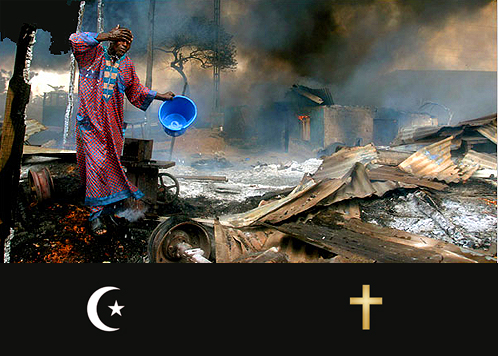
No more. Nigeria’s challenge right now is to avoid self-annihilation. And tiresome as it seems, it is the classic battle between Christians and Muslims. One which permits no compromise. Accept, or die.

I’ve spent my whole life in Africa watching religion tear apart Africa and mostly as a battle between the world’s two greatest religions, Christianity and Islam, and now I even have to enduring watching it creep into the daily life of America.

One wonders what would happen if youth’s greater perception of the impoverished theologies of the world took hold. How fast can we hope this will develop? Yet if suddenly, miraculously, religion were removed from the bombs of the world, would something else take its place, like ethnicity or poverty?

That’s a question way too complicated to think about right now. In Nigeria, Boko Haram, the underground, illegal but increasingly organized terrorist group proudly affiliated with al-Qaeda, takes responsibility for much of the violence, today. Sharia oriented, today they demanded all Christians leave the Muslim north.

And Nigeria is far more developed than neighboring countries like Niger and Chad which also suffer from Christian/Islam battles. Many Nigerian Muslim clerics are screaming for peace, recognizing that all Nigeria has gained economically is at stake. But the economic gains, the level of prosperity, may not have been enough fast enough to help these clerics get their messages accepted.

The fuel inflaming this always simmering religious battle is the economy. The President of Nigeria has begun to eliminate fuel subsidies, and the scale of the reaction is unprecedented, even in this turbulent country. Many think these will now be rolled back, but it may be too late.

Religious conflict, pricked by economic decline, is happening round the world. In the more developed west fortunately the tone of the religious conflict is moderated into a less violent social/cultural one. Instead of Jesus fighting Mohammed it’s abortionists fighting evangelicals, but in the end it’s all the same.

It’s intolerance, a battle empirically governed by those who have the money and power and are fearful of losing it. When will we ever learn…

African View of Iowa Caucus

African View of Iowa Caucus

Many Africans view the Iowa caucus as not very democratic, governed less by voters expressing preferences than by the media, polls and money.

Me, too.

Nairobi’s heavily listened to radio station, Capital FM, called today’s elections in Iowa “peculiar.” Finding it amusing that “voters .. gather late on Tuesday in church basements, school auditoriums and even in some private homes” the radio station said it was one of the “quirkiest but most important electoral events” for the United States.

I think that most of the educated world has developed a notion of democracy that is much more realistic than we have in the U.S. Pure democracy, which might today be akin to California’s referendums or even simple issue questions that participants endorse or condemn by a simple internet vote, is itself confused by how that “simple issue question” is formulated to begin with.

Democracy is a messy process, however you look at it. Voting fraud, which is not an issue in America, is a grave issue throughout much of Africa. But undemocratic influencing of voting has reached its apex in America, today.

Much of Africa receives its news about America from world sources, since local resources don’t allow foreign correspondents. BBC-Africa Service, News24 (from France) and Radio Netherlands all have services directed at Africa and often produced in Africa by Africans.

The BBC-Africa service has provided the most coverage of the American election. In a video interview with a university professor in Iowa, BBC-Africa claimed that issues were hardly important in today’s election in Iowa, but rather how much attention the winner would get, how it would then effect him/her in the polls and most of all, how much money will then flow into his campaign coffers.

Money for campaigns overwhelms most Africans. Consider that the amount of money this election will likely receive from PACS and superPACS ($2 billion) exceeds the entire national budgets of many African countries. And that could be doubled by individual small contributions.

You can’t help but agree that money is one of America’s most important democratic tools. I don’t think Africans think this necessarily wrong, particularly if it’s fairly managed (which it may not be, now, after recent Supreme Court cases), but what sticks out like a sore thumb is how brazen Americans are that their system is more democratic than others.

“I don’t think Europe is working in Europe. I don’t want Europe here,” Mitt Romney was quoted in fin24, a conservative South African business journal which was nevertheless mocking the idea that Europe isn’t working.

Of course Europe is working for Europeans, and frankly I believe the parliamentary system delivers democratic choices cleaner and quicker than ours.

America is descending from supreme everything, and that’s not all bad. But hopefully we can learn from those in the world ascending, like many in Africa. Becoming jingoistic as suggested by the Romney quote doesn’t aid our transition.