Top Ten 2011 Africa Stories

Top Ten 2011 Africa Stories

Twevolution, the Arab Spring [by Twitter] is universally considered the most important story of the year, much less just in Africa. But I believe the Kenyan invasion of Somalia will have as lasting an effect on Africa, so I’ve considered them both Number One.

1A: KENYA INVADES SOMALIA
On October 18 Kenya invaded Somalia, where 4-5,000 of its troops remain today. Provoked by several kidnapings and other fighting in and around the rapidly growing refugee camp of Dadaab, the impression given at the time was that Kenyans had “just had enough” of al-Shabaab, the al-Qaeda affiliated terrorism group in The Horn which at the time controlled approximately the southern third of Somalia. Later on, however, it became apparent that the invasion had been in the works for some time.

At the beginning of the invasion the Kenyan command announced its objective was the port city of Kismayo. To date that hasn’t happened. Aided by American drones and intelligence, and by French intelligence and naval warships, an assessment was made early on that the battle for Kismayo would be much harder than the Kenyans first assumed, and the strategy was reduced to laying siege.

That continues and remarkably, might be working. Call it what you will, but the Kenyan restraint managed to gain the support of a number of other African nations, and Kenya is now theoretically but a part of the larger African Union peacekeeping force which has been in Somali for 8 years. Moreover, the capital of Mogadishu has been pretty much secured, a task the previous peace keepers had been unable to do for 8 years.

The invasion costs Kenya dearly. The Kenyan shilling has lost about a third of its value, there are food shortages nationwide, about a half dozen terrorist attacks in retribution have occurred killing and wounding scores of people (2 in Nairobi city) and tourism – its principal source of foreign reserves – lingers around a third of what it would otherwise be had there be no invasion.

At first I considered this was just another failed “war against terrorism” albeit in this case the avowed terrorists controlled the country right next door. Moreover, I saw it as basically a proxy war by France and the U.S., which it may indeed be. But the Kenyan military restraint and the near unanimous support for the war at home, as well as the accumulation of individually marginal battle successes and outside support now coming to Kenya in assistance, all makes me wonder if once again Africans have shown us how to do it right.

That’s what makes this such an important story. The possibility that conventional military reaction to guerilla terrorism has learned a way to succeed, essentially displacing the great powers – the U.S. primarily – as the world’s best military strategists. There is as much hope in this statement as evidence, but both exist, and that alone raises this story to the top.

You may also wish to review Top al-Shabaab Leader Killed and Somali Professionals Flee as Refugees.

1B: TWEVOLUTION CHANGES EGYPT
The Egyptian uprising, unlike its Tunisian predecessor, ensured that no African government was immune to revolution, perhaps no government in the world. I called it Twevolution because especially in Egypt the moment-by-moment activities of the mass was definitely managed by Twitter.

And the particular connection to Kenya was fabulous, because the software that powered the Twitter, Facebook and other similar revolution managing tools came originally from Kenya.

Similar of course to Tunisia was the platform for any “software instructions” – the power of the people! And this in the face of the most unimaginable odds if you’re rating the brute physical force of the regime in power.

Egypt fell rather quickly and the aftermath was remarkably peaceful. Compared to the original demonstrations, later civil disobedience whether it was against the Coptics or the military, was actually quite small. So I found it particularly fascinating how world travelers reacted. Whereas tourist murders, kidnapings and muggings were common for the many years that Egypt experienced millions of visitors annually, tourists balked at coming now that such political acts against tourists no longer occurred, because the instigators were now a part of the political process! This despite incredible deals.

We wait with baited breath for the outcome in Syria, but less visible countries like Botswana and Malawi also experienced their own Twevolution. And I listed 11 dictators that I expected would ultimately fall because of the Egyptian revolution.

Like any major revolution, the path has been bumpy, the future not easily predicted. But I’m certain, for example, that the hard and often brutal tactics of the military who currently assumes the reins of state will ultimately be vindicated. And certainly this tumultuous African revolution if not the outright cause was an important factor in our own protests, like Occupy Wall Street.

3: NEW COUNTRY OF SOUTH SUDAN
The free election and emergence of South Sudan as Africa’s 54th country would have been the year’s top story if all that revolution hadn’t started further north! In the making for more than ten years, a remarkably successful diplomatic coup for the United States, this new western ally rich with natural resources was gingerly excised from of the west’s most notorious foes, The Sudan.

Even as Sudan’s president was being indicted for war crimes in Darfur, he ostensibly participated in the creation of this new entity. But because of the drama up north, the final act of the ultimate referendum in the South which set up the new republic produced no more news noise than a snap of the fingers.

Regrettably, with so much of the world’s attention focused elsewhere, the new country was hassled violently by its former parent to the north. We can only hope that this new country will forge a more humane path than its parent, and my greatest concern for Africa right now is that global attention to reigning in the brutal regime of the north will be directed elsewhere.

4: UGANDA FALTERS
Twevolution essentially effected every country in Africa in some way. Uganda’s strongman, Yoweri Museveni, looked in the early part of the last decade like he was in for life. Much was made about his attachment to American politicians on the right, and this right after he was Bill Clinton’s Africa doll child.

But even before Twevolution – or perhaps because of the same dynamics that first erupted in Tunisia and Egypt – Museveni’s opponents grew bold and his vicious suppression of their attempts to legitimately oust him from power ended with the most flawed election seen in East Africa since Independence.

But unlike in neighboring Kenya where a similar 2007 election caused nationwide turmoil and an ultimate power sharing agreement, Museveni simply jailed anyone who opposed him. At first this seemed to work but several months later the opposition resurfaced and it became apparent that the country was at a crossroads. Submit to the strongman or fight him.

Meanwhile, tourism sunk into near oblivion. And by mid-May I was predicting that Museveni was the new Mugabe and had successfully oppressed his country to his regime. But as it turned out it was a hiatus not a surrender and a month later demonstrations began, twice as strong as before. And it was sad, because they went on and on and on, and hundreds if not thousands of people were injured and jailed.

Finally towards the end of August a major demonstration seemed to alter the balance. And if it did so it was because Museveni simply wouldn’t believe what was happening.

I wish I could tell you the story continued to a happy ending, but it hasn’t, at least not yet. There is an uneasy calm in Ugandan society, one buoyed to some extent by a new voice in legislators that dares to criticize Museveni, that has begun a number of inquiries and with media that has even dared to suggest Museveni will be impeached. The U.S. deployment of 100 green berets in the country enroute the Central African Republic in October essentially seems to have actually raised Museveni’s popularity. So Uganda falters, and how it falls – either way – will dramatically alter the East African landscape for decades.

5: GLOBAL WARMING
This is a global phenomena, of course, but it is the developing world like so much of Africa which suffers the most and is least capable of dealing with it. The year began with incessant reporting by western media of droughts, then floods, in a confused misunderstanding of what global warming means.

It means both, just as in temperate climates it means colder and hotter. With statistics that questions the very name “Developed World,” America is reported to still have a third of its citizens disputing that global warming is even happening, and an even greater percentage who accept it is happening but believe man is not responsible either for it occurring or trying to change it. Even as clear and obvious events happen all around them.

Global warming is pretty simple to understand, so doubters’ only recourse is to make it much more confusing than it really is. And the most important reason that we must get everyone to understand and accept global warming, is we then must accept global responsibilities for doing something about it. I was incensed, for example, about how so much of the media described the droughts in Africa as fate when in fact they are a direct result of the developed world’s high carbon emissions.

And the news continued in a depressing way with the very bad (proponents call it “compromised”) outcome of the Durban climate talks. My take was that even the countries most effected, the developed world, were basically bought off from making a bigger stink.

Environmentalists will argue, understandably, that this is really the biggest story and will remain so until we all fry. The problem is that our lives are measured in the nano seconds of video games, and until we can embrace a long view of humanity and that our most fundamental role is to keep the world alive for those who come after us, it won’t even make the top ten for too much longer.

6: COLTAN WARS IMPEDED
This is a remarkable story that so little attention has been given. An obscure part of the Dodd-Frank Wall Street Reform Act essentially halved if not ultimately will end the wars in the eastern Congo which have been going on for decades.

These wars are very much like the fractional wars in Somalia before al-Shabaab began to consolidate its power, there. Numerous militias, certain ones predominant, but a series of fiefdoms up and down the eastern Congo. You can’t survive in this deepest jungle of interior Africa without money, and that money came from the sale of this area’s rich rare earth metals.

Tantalum, coltran more commonly said, is needed by virtually every cell phone, computer and communication device used today. And there are mines in the U.S. and Australia and elsewhere, but the deal came from the warlords in the eastern Congo. And Playbox masters, Sony, and computer wizards, Intel, bought illegally from these warlords because the price was right.

And that price funded guns, rape, pillaging and the destruction of the jungle. The Consumer Protection Agency, set up by the Dodd-Frank Act, now forbids these giants of technology from doing business in the U.S. unless they can prove they aren’t buying Coltran from the warlords. Done. War if not right now, soon over.

7: ELEPHANTS AND CITES
The semi-decade meeting of CITES occurred this March in Doha, Qatar, and the big fight of interest to me was over elephants. The two basic opposing positions on whether to downlist elephants from an endangered species hasn’t changed: those opposed to taking elephants off the list so that their body parts (ivory) could be traded believed that poaching was at bay, and that at least it was at bay in their country. South Africa has led this flank for years and has a compelling argument, since poaching of elephants is controlled in the south and the stockpiling of ivory, incapable of being sold, lessens the funds that might otherwise be available for wider conservation.

The east and most western countries like the U.S. and U.K. argue that while this may be true in the south, it isn’t at all true elsewhere on the continent, and that once a market is legal no matter from where, poaching will increase geometrically especially in the east where it is more difficult to control. I concur with this argument, although it is weakened by the fact that elephants are overpopulated in the east, now, and that there are no good strategic plans to do something about the increasing human/elephant conflicts, there.

But while the arguments didn’t change, the proponents themselves did. In a dramatic retreat from its East African colleagues, Tanzania sided with the south, and that put enormous strain on the negotiations. When evidence emerged that Tanzania was about the worst country in all of Africa to manage its poaching and that officials there were likely involved, the tide returned to normal and the convention voted to continue keeping elephants listed as an endangered species.

8: RHINO POACHING REACHES EXTREME LEVELS
For the first time in history, an animal product (ground rhino horn) became more expensive on illicit markets than gold.

Rhino, unlike elephant, is not doing well in the wild. It’s doing wonderfully in captivity and right next to the wild in many private reserves, but in the wild it’s too easy a take. This year’s elevation of the value of rhino horn resulted in unexpectedly high poaching, and some of it very high profile.

9: SERENGETI HIGHWAY STOPPED
This story isn’t all good, but mostly, because the Serengeti Highway project was shelved and that’s the important part. And to be sure, the success of stopping this untenable project was aided by a group called Serengeti Watch.

But after some extremely good and aggressive work, Serengeti Watch started to behave like Congress, more interested in keeping itself in place than doing the work it was intended to do. The first indication of this came when a Tanzanian government report in February, which on careful reading suggested the government was having second thoughts about the project, was identified but for some reason not carefully analyzed by Watch.

So while the highway is at least for the time being dead, Serengeti Watch which based on its original genesis should be as well, isn’t.

10: KENYAN TRANSFORMATION AND WORLD COURT
The ongoing and now seemingly endless transformation of Kenyan society and politics provoked by the widespread election violence of 2007, and which has led to a marvelous new constitution, is an ongoing top ten story for this year for sure. But more specifically, the acceptance of this new Kenyan society of the validity of the World Court has elevated the power of that controversial institution well beyond anyone’s expectations here in the west.

Following last year’s publication by the court of the principal accused of the crimes against humanity that fired the 2007 violence, it was widely expected that Kenya would simply ignore it. Not so. Politicians and current government officials of the highest profile, including the son of the founder of Kenya, dutifully traveled to The Hague to voluntarily participate in the global judicial process that ultimately has the power to incarcerate them.

The outcome, of course, remains to be seen and no telling what they’ll do if actually convicted. It’s very hard to imagine them all getting on an airplane in Nairobi to walk into a cell in Rotterdam.

But in a real switcheroo this travel to The Hague has even been spun by those accused as something positive and in fact might have boosted their political standing at home. And however it effects the specific accused, or Kenya society’s orientation to them, the main story is how it has validated a global institution’s political authority.

Vicious Village Visit

Vicious Village Visit

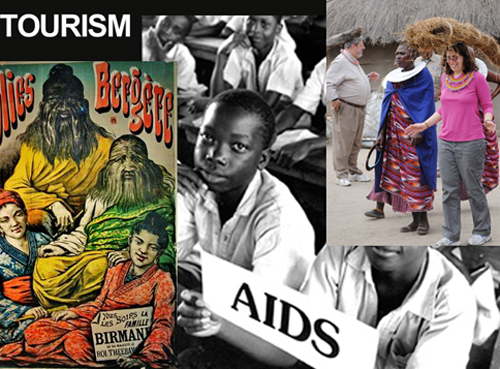
Why do so many safari travelers want to “see a village?” A Paris exhibition may help explain the ugly urge of many travelers to witness depravity.

The market for village visits is so strong that even today, when traditional villages just don’t exist, they are being reconstructed, and thousands of visitors return from Africa every day believing they have seen “an African village” in exactly the same way conservatives leave church each Sunday believing Satan is a Muslim.

In the early boom days of photography safari travel (1960s and 1970s) “visiting a village” was an absolutely essential ingredient of any trip and I admit having arranged hundreds. “The Invention of Human Zoos” is a brilliant exhibition in the new Quai Branly museum that helped me to understand why.

“Act I” of the exhibition chronicles the excitement and amazement of Europeans who “discovered” such new and different peoples around the world starting in the 15th century. This “otherness,” as the exhibit calls it, was a driving force for early exploration.

Brazilian Tupinambas prostrating before Henri II in Rouen in 1550, Siamese twins in the Court of Versailles in 1686, Inuits overdressed before Frederik II in Copenhagen in 1654, and the famous “Noble Savage” Omai that Captain Cook brought to England from Tahiti in 1774 were some of the first and most famous.

There was no community exhibitionism in these early moments. It was just exhilaration at finding something so different from yourself! I hope this at least partly explains myself as a young “explorer” anxious to show clients African villages in the early days.

Omai was real; Kenyan villages in the Northern Frontier were real in the 1970s.

As the age of exploration matured, “Act II” of the exhibit details how this surprise at “otherness” grows defensive. Surprise doesn’t last. The reality sets in that this “otherness” isn’t very pleasing, because it’s filled with misery. But what to do? Go out and civilize the world when we’ve got so many problems to deal with here at home?

So “otherness” becomes “wrong” or “bad” or “evil.”

Circuses, traveling villages and freak shows worldwide marketed this rationalization by “blurring the difference between the deformed and the foreign.” Soon “physical, psychological and geographical abnormalities” sold tickets.

By the 1980s and certainly 1990s Africa was developing as fast as information technology. Primitive people weren’t primitive, anymore. But primitive and “savage” and “diseased” and “deprived” were the “physical, psychological and geographical abnormalities” that could still get tourists to pay.

So easily predicted these “villages” suddenly existed right next to very swank tourist lodges and camps. “Maasai villages” which in their original form never existed longer than the rains which fell on them for a single season, suddenly were in place for decades.

“Act III” of the exhibit describes the Crystal Palace, Barnum and Bailey, Paris Folies Bergères and Berlin’s Panoptikum where visitors are thrilled by “acts of savageness” from supposed aboriginals, ‘lip-plate women’, Amazons, snake charmers, Japanese tightrope walkers and oriental belly dancers, all of whom were “made-up savages” – professional actors, not real individuals.

Exactly as in Africa, today.

One of the real catastrophes this produces in Africa is that real depravity is created where it would otherwise not exist. When traditional villages moved regularly, as most did and certainly the Maasai and Samburu always did in the early days, opportunities for disease were lessened.

Imagine today’s so-called “Maasai village” outside Samburu Lodge or Serena Lodge after one year, two years, five years and then ten years without adequate septic systems.

(The final “Act IV” is more oblique and less relevant to Africa, I think. The extreme circus and freak show begins to merge “otherness” with physical abnormality. Indeed, the rise of Felini may be an important phenomenon worth examining, but its relevance to visiting a village in Africa is slight.)

There is, however, an Act IV today in Africa.

There is this inexplicable, basest urge by travelers to Africa to see “primitive” and “depraved” and the market reigns with these reconstructed villages more than ever. If there weren’t tourists paying to see them, they wouldn’t be there.

Thousands of safari travelers, egged on even more by immoral tour companies, regularly “want to see a village.”

What do travelers really mean when they ask for that? What they mean is that they want to see poverty, disease and depravation. In a nutshell, suffering. First off, why the hell would you want to see something like that? To disabuse yourself that it might not be true?

Alas the danger with that generous presumption.

Any half educated idiot walking into one of these should be able to tell by the facility of languages the “chief” commands, the perfect and untattered costuming, rushed routine and proforma narratives, that this is a show, not a lifestyle.

So that at least subconsciously the visitor can return at least subconsciously unconvinced that suffering exists. Or has to. Or that he has any responsibility to end it.

I was absolutely incensed recently by the “Mad Travelers” Kevin Revolinsk’s “Visit to a Maasai Village”. It’s below disgusting; it’s despicable. Yet this is a popular guy, widely published and validated by much of the established media like the New York Times and National Geographic.

And I’m sure there are many more examples as Revolting as Revolinsk.

Don’t be fooled, traveler. The misery is there, beyond your imagination. But it doesn’t exist in the flies unnecessarily flitting on the poor little kid’s face, but with the internal pain of the mother who plasters a bit of cow dung on her child’s head just before the tourists arrive… because she can’t get a job in the city.

Let’s end Act IV.

Africa’s Biggest Street Party

Africa’s Biggest Street Party

If you thought Rio’s Carnival or New Orleans’ Mardi Gras were big parties, take two: Nigeria’s Calabar festival’s climax is tonight and is the biggest music/costume/dance festival in Africa!

Calabar Carnival is the biggest gigantic collection of visual and sound culture in Africa. The scheduled events are so many that it takes 32 days of performances, which peak December 26 with the morning cultural parade and then December 27 with the Grande Finale.

Africa’s Biggest Street Party begins November 30 with the Holiday Tree-Lighting ceremony and ends with the Thanksgiving Ceremony on New Years Day.

Music and visual arts dominate, and everything is judged, prizes galore. About a dozen international musicians perform, and perhaps one of the most famous in the past was Haitian Wyclef Jean, who aroused the crowd by his impromptu performance “we have no terrorists in Nigeria” which unfortunately is not the case, particularly this year.

But with Africa’s other great festival, The Festival au Desert in Mali, essentially emasculated by area terrorists, Calabar now reigns supreme as West Africa’s greatest music festival. It’s significantly distant from the troubles in either Nigeria’s contested Muslim north or oilfields. Nevertheless it’s a pity that Africa’s extraordinary west African music has been so hampered by terrorism.

Preliminary contests earlier in the year shortlist 5 African bands which then come into town to perform in the grand finale contest. And these aren’t normal bands. Each “band” has up to 2,000 members!

And there are 10,000 “band members” involved in today’s Grande Finale march. The performances ends with individual performances by each of the bands, and then all 10,000 of them singing together!

Throughout the month-long event hundreds of organizations sponsor numerous other performances and activities including workshops and seminars focused mostly on all aspects of producing modern entertainment.

But there are also seminars on greening consumption, global warming, modern politics and virtually anything a sponsor wishes to do providing it can link to the current festival’s theme. This year, “Endless Possibilities.”

Up to 100,000 spectators and participants are in Calabar, today, although only 15,000 who can afford the ticket price of $30 get into the main stadium where the Grand Finale parade and blasting final band contest occurs. Watching separately will be 50 million views from around Africa broadcast by Nigerian television.

Trucking to Nowhere

Trucking to Nowhere

With Africa youth unemployment as high as 50% should African governments replace funding universities teaching liberal arts with those exclusively teaching employable skills like accounting?

With the Florida State budget in a nosedive, should Florida tax payers redirect support for liberal arts universities to vocational colleges?

Voice of America reported recently that Uganda’s president, Yoweri Museveni, told an academic awards ceremony that the curriculum they were awarding was wrong. We call this letting the fox into the chicken coop. But in spite of all my other criticisms of this dictator, he moves into stark relief a question that plagues us as well.

We need truck drivers in the U.S. right now. We are still in a serious recession. Should state governments support vocational schools teaching truck driving and mechanics, or liberal arts dissecting Proust’s inner motivations?

Most of Africa is growing robustly. It needs and can often instantly employ accountants, engineers, skilled machinists and similar vocations. Should African budgets support departments of philosophy at their universities when there are as many philosophy positions opened in equatorial Africa as snow flakes on the streets?

It’s a harder question for Africa than us. We can make more policy mistakes and still come out on top. We also have infinitely more resources, and so for us, the answer should be: Support both. Despite the depth of the recession, even Mr. Tea Party knows that American innovation is born of stimulated imaginations more likely to be pricked by Proust than tossed by trucks.

Unfortunately conservatives don’t think. So the trend in the U.S. right now given the recession is to favor vocational over liberal arts. But in America I see this as a passing fancy, due to die with the Republicans very soon.

Besides, even right now if Rick Scott is successful in redirecting Florida’s educational budget towards vocational rather than liberal arts institutions, it’s unlikely he will completely gut funding the University of Florida.

Museveni, on the other hand, is implying just that: that government support – crucial to the very existence of Uganda’s Makerere University – will end unless teaching “Conflict Resolution” ends. (The university politely replied that it would study the matter.)

Uganda is the perfect contemporary society to observe the ultimate outcomes for many conservative social policies. Museveni accomplished this, for example, not so long ago by taking the issue of same-sex marriage to the point of suggesting these couples be executed.

Constrained by far fewer resources, most African societies have nevertheless developed multi-tier, varied cultures and sustained multiple approaches to both economic and social development, unlike Uganda. But they do exist in starker contrast. The rich are richer, relatively, and the poor are poorer. The divisions between the African truck driver and African philosopher are vast compared to here.

For a moment, step back from the philosophical and other fundamental (like economic) arguments that may drive these competitions for public resources. I think there’s more common sense to be applied here than intellectual strain.

I believe the principal driver of these resource competitions isn’t “the greater good” but rather a desire to divide and conquer. What we should be doing is mending the chasm between driving a truck and reading Proust, between studying conflict resolution and learning accounting.

Those like Scott and Museveni who facilely solicit public support for what they can easily argue are exigencies of stressful times are actually the devils in the details it seems so easy and even compassionate to accept. But there’s so much more to it.

The simple and so much better perspective is that we don’t want to divide then obliterate one of the options; we want to preserve both. Pointless to drive a truck to nowhere.

Weary World Not Rejoicing

Weary World Not Rejoicing

Nigeria thumbs its nose at the U.S. and U.K. on gay rights, Japan uses nuclear clean-up funding to hunt whales, 4 more rhinos killed in the lowveld and Durban’s in the bottom of the dirty coal tank. Oh, did I forget that Europe’s coming apart?

The weight of organic and inorganic problems on this, man’s planet, seems so stultifying at the moment that any sense of urgency any single problem might legitimately beget is evaporating like a thin pond of ice in a very cold winter.

The mind suffocates.

Over the last decade or so I’ve looked to Africa as a leading indicator of where the world is going, and it’s often not been promising, but it’s proved pretty accurate. The latest, and perhaps the final reasonable global indicator, was what I called early on twevolution and which later developed into the Arab Spring.

Many have argued it was the logical extension of the end of the Cold War, which was the logical extension of an incomplete resolution of two world wars, which was the logical extension of attempts to dominate the industrial revolution.

But remove the mechanisms of logic as drivers of the inevitable next stage, and the fundamental cause is revealed as ethnicity, or more generally, distrust of others not like you and your family. It’s the old who gets the biggest piece of the pie thing.

So, today, when we’re making 9″ instead of 10″ pies, there is even less than ever, even though the more that used to be we now understand was a fanciful creation of those who already had most. Alas, there really weren’t many 10″ pies: just a lot of TV images of the same few.

So if there’s any good news at all it’s that finally we’re fighting about reality.

Britain, Hungary and the Nordic countries may ultimately be looked upon by history as the diseased parts of the European body that finally took down the whole creature. A dysfunctional and incomplete European Union is worse than no union at all.

Japan and Asia’s intractable obsession with consumption of rare earth forms like tigers and rhinos and whales is destined to lay the planet wasted of such things in just a few years. Then what comes next for them: in place of tigers, rhinos and whales, will they start consuming Inuit, Slavs and transsexuals?

And what is the “brink of destruction” that we seem to push just a bit further away year after year as the world gets hotter and hotter. Ever see the horrible movie Waterworld?

None of this will change, if we as individuals don’t stand up and shout, “We’ll take less!” Any odds on that one?

And that’s one cold, dismal Friday morning on earth in the (is it the?) 21st century.

Bachmann or Else!

Bachmann or Else!

From India frustrated T-Partyers unable to maneuver the legislative process to eliminate civilization have just discovered a powerful new tactic. Release deadly snakes into IRS offices, guaranteeing at the very least a temporary pause in tax collections.

I have not taken the event more out of context than most T-Party dialogues. The perpetrator was actually protesting a new Indian regulation outlawing traditional snake charmers. And I have no doubt south Georgia T-Partyers will spin this to their warped intellects.

It was only last month that a 22-year old tried to illegally buy a black mamba in the woods of southern Georgia at 2:30 in the morning. Obviously frustrated that he couldn’t find one on Amazon.com he nevertheless found a ready seller. Must happen all the time, but we found out about this one, because the kid got bit.

We’ll never know for sure if he was always a redneck, but he absolutely was when medivaced to a Jacksonville hospital. His life was saved. The snake is loose.

A half dozen times annually some idiot in the U.S. breaks a battery of laws buying or selling an African mamba. For the life of me I can’t figure out why. What kind of imbecile wants to keep such a killer?

Mambas don’t make good pets. I know. I had to sweep them out of my house at the start of the first rains or risk being swept into the next world. I have a hard time understanding people who keep non-venomous snakes as pets, but good grief, why would you want a killer?

Has to be a macho thing. Unless you think you could create a seemingly serendipitous moment serving Assam tea cakes at an afternoon guild party to knock off a maiden aunt. Why else?

Mostly a macho thing. I’ve known several wonderful reptile scientists in my life, and by the time they become real worthy herpetologists, they were no longer macho-driven, but as kids, that’s usually what motivated them. Dares to do-s.

And then there’s the whole matter of it being illegal. You cannot own, sell or buy an African mamba, green or black, in the U.S. without a permit generally reserved for zoos and medical research facilities. So this dare gets even more thrilling, because it’s illegal.

Florida is running amok with killer snakes from Africa because of imbeciles playing God.

Get a life!

Animals are Not People

Animals are Not People

Time and again men and women unable to foster human relationships create them with animals whose only ability to resist is to kill them in return.

I love animals and always have. I expect someone watching me play with my lab/hound mix would ascribe all sorts of human characteristics to the relationship, and undoubtedly while playing or petting or observing, I can’t help but see “Morgan” in human terms.

But I won’t buy a cemetery plot for him. I won’t subscribe to PetMeds while monitoring his blood sugar and I’m even adverse to putting gooey tick repellent on him. He isn’t human. He’s a pet.

Throughout my career in Africa I’ve encountered numerous researchers who cross the rational limit of thinking of animals as humans. The most flagrant examples are those ascribed to elephants: how they return to where close relatives have died, how they sacrifice their own well-being for another individual.

Balderdash. These are human behaviors that while I concede we can never scientifically measure in an animal with the clarity that I suppose, I trust my intuition on this one. I even question whether pain as we humans understand it is anywhere similar to what animals experience.

Critics will contend I’m setting up situations that allow for animal cruelty, but that, too, is balderdash. I have a hard time understanding why people swat flies with such vengeance or unload aerosols into gardens or are amused at young boys firing beebee guns at the nearest squirrel. I have serious questions about the morality of hunting animals for sport.

But to think of an animal as a child, or parent, or human friend, is to diminish the radiance of our own place in the biology of the world. It’s a terrible shortcut for trying to understand the complexities of life and does significantly more injustice to that life form than accepting it for what it is.

And it’s so absolutely clear to me whether it’s an old man, doting spinstress, recluse or young career-minded couple that has traded procreation for a more balanced 401K – all of whom embrace their dog with the ridiculousness of human attractions — are doing so entirely, utterly and selfishly to assuage their own inadequacies, and at the horrible expense of the meaning of that dog, the beauty of its form in the biomass in which we also participate.

There are so many negatives to anthropormorphizing animals, but one overriding one is that whatever faux emotion is created in the human master, it probably decreases that person’s empathy to humans in need. It likely distracts the master from the misery of his servants.

And, then, ultimately the price is paid, in an inevitable and ultimate way.

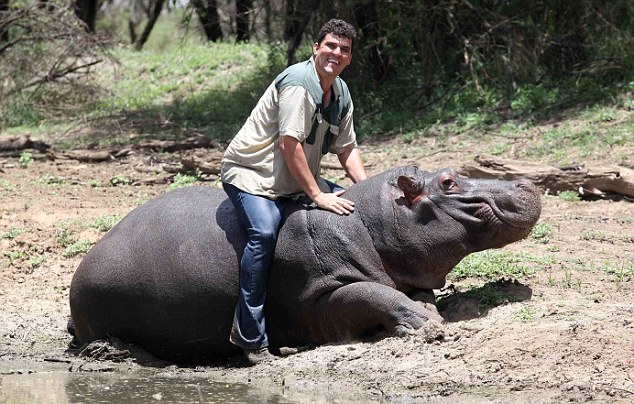
Last month a famous relationship between a hippo and a man came to an end when the hippo killed the man.

The jolly guy, a stellar citizen and former military officer, was a farmer who adopted an estranged baby hippo. (As I once adopted an estranged baby baboon.) He raised it with tender loving care. (As I raised mine.) But when baby turned adult, when the full sense of the creature came to the fore, he couldn’t give way. He claimed again and again, to over a quarter million viewers on YouTube, that everything was just fine.

“Humphrey’s like a son to me,” Marius Els told his local South African newspaper. “He’s just like a human.”

Marius Els, 41, had no son, no viable human relationship with a child. Why doesn’t matter, but nor should he have tried to create that relationship as a shortcut with an animal. The hippo bit him multiple times, then pulled him into the river and drowned him on November 14.

Our 1st Thanksgiving in Kenya

Our 1st Thanksgiving in Kenya

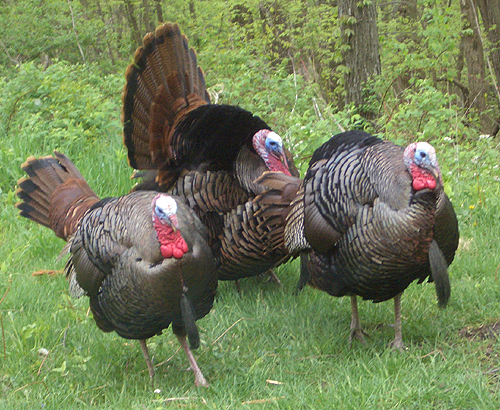
Wild turkeys outside my office in Galena.

One of the hardest things to leave behind when Kathleen and I first moved to Kenya many, many years ago was Thanksgiving.

No matter what your religion or politics, Thanksgiving is a major American holiday, all-American so to speak. And even before a third of our society was obese, it was a day of gluttonous consumption. You were just proving how well off you were, even if you weren’t.

So when we finally got settled in a very remote village 3 days travel from Nairobi we immediately began making plans for Thanksgiving. We sent out messages through the bush grape vine that we wanted two turkeys.

Most people had never heard of turkeys, and it was a great mystery to Jozani, our house boy/translator/money market manager and cook. Although he cooked chicken well for us, he was part Maasai, and fowl was taboo.

He could understand we Mzungu eating chicken. Mzungu had eaten chicken ever since Britain had a king. Many Africans back then accepted without aversion all sorts of habits the white people had carried with them into Africa. So chicken was OK. He often burned to a crisp our chicken, but he cooked it.

So when we first asked him to find a turkey, I’m sure he had no idea what it was, because he enthusiastically immediately replied that of course he could find us two turkeys. Jozani never said no. If he said no or asked further what I meant, either I might get angry with him (he thought) or make his day far too simple. So he said, of course bwana, he would find and cook for us two turkeys for our American holiday of giving thanks.

I’m not sure how many Thanksgivings passed before Jozani announced one morning with great pride that two turkeys had been found and were coming. At rather extraordinary expense. I had completely forgotten about it but apparently I was the only one who had. That same morning on the walk to the school where I taught, every one was asking me when the turkeys would arrive.

In fact a week or so later, two hours before the turkeys actually did arrive, a holiday was declared at school, and the children lined up as they did for morning assembly to greet the turkeys.

It was hard for me to call these fowl turkeys. They were young birds, true, but they looked more like weasels than turkeys. After close inspection I did approve them, paid the king’s chicken ransom, and turned them over to Jozani to rear. I think we had 5 months or so before Jozani had to cook them.

Turkey dinner turkeys are supposed to grow fast, remarkably fast. The wild turkeys that now live outside my office take more than a year to get large, and two years before the Toms are really large, but turkey dinner turkeys can reach massive maturity (12 pounds) in 5 months. What a ridiculous hope.

At first I was going to name them, and to do that, it was necessary to know their gender. Jozani insisted, however, that they had no gender, so we left them unnamed.

They grew, but not as fast as they ate. They became bold and strong and rather offensive, chasing anyone who came into our compound until one day I saw Jozani walking around the house with a large flattened stick.

“What is that for?” I asked him as he was scrambling eggs.

“It is to beat the turkeys, bwana, they are growing rude.”

They were growing rude. They would try to come into the house and peck at the screening when we refused. Jozani didn’t stay the night, and you’d think that a day time bird would go to sleep. But they seemed to freak at the dogs in the area that barked when hyaenas or jackals were in the neighborhood so gobbled the night away.

The time finally came to roast the birds. Jozani was equivocal. He had decided they were wizards incarnate. And of course it’s either impossible or catastrophic to kill a wizard. But we had invited nearly several dozen colleagues in a wide area to celebrate this so important holiday called Thanksgiving. So I let Jozani know that I’d kill the birds if he wouldn’t.

He killed the birds. And sort of defeathered them.

Kathleen spent days making stuff – or more correctly, like Jozani think he was making stuff. Like Stuffing. Which Jozani felt was the epitome of evil. Throwing a chicken in a frying pan was one thing, but “dressing” a fowl and doing such wizardry things as sticking bread and wine in its hollow stomach sack must have seemed extraordinary.

It was a grand holiday evening. Candles which we now use for effect was all we had. The smell of savory rice, good wine that someone had managed to bring up from South Africa, wondrous puddings and breads infused the evening of delight with the merriment of the finest of Thanksgivings.

And as if on queue it began to rain. The start of the rains had been delayed for all sorts of mysterious reasons, and there was concern that it would become a drought. But lo and behold, that late November evening in far western Kenya, the rains arrived just as the two turkeys did.

The rains proved much more successful than the turkeys. They looked OK if a bit shrunken. But the meat had the texture of something already worked into a piece of clothing. There was a not knife to be found capable of slicing it. We set it aside for a later soup.

So everyone was happy. Our guests probably because of the wine and Kathleen’s remarkable savory rice. Jozani because we didn’t eat the wizard. And the world because the rains had come. So though I don’t know to this day where our two Kenyan turkeys came from, nor for that matter where they went (there was never a soup), I know it was because of them that we celebrated Thanksgiving far, far from home.

Columbus Day Holiday

Columbus Day Holiday

Today is Columbus Day in the United States, a federal holiday.

All but a handful of states suspend many elective services, schools are closed, all banks in all states must be closed, and there’s no mail delivery. The holiday was proclaimed in 1937 on the 400th anniversary of the arrival of Christopher Columbus into the Americas.

Many large cities, including New York, have huge parades. Over the years the celebration has taken on an ethnic tone, celebrating Italian heritage.

Oiled Men vs. Oil Men

Oiled Men vs. Oil Men

I went to bed last night with a sore throat caused by a horrible oil spill disaster near the Nairobi airport and woke to learn that hundreds had died, thousands more had burned and the still unfolding story needs to be told again and again to the west. Read on, if you can.

My luxury Norfolk Hotel is about nine kilometers as the crow flies from the disaster site. In that mere 5½ miles live up to 1 million people, and there are no high-rises. Nearly 90% of them in the slum only 1 mile from the airport where the fire occurred.

They live in the most miserable conditions imaginable. When I first wrote my novel, Chasm Gorge, I described a Nairobi slum but tried to focus on its better aspects. The way slum dwellers help each other, creative methods by which they eke out a living, and most of all their unbelievable tolerance of their suffering.

That was ten years ago. Today the slums are three or four times larger. The popular film Constant Gardener brought world attention to the slum, Kibera, that was the model for my description. Kibera is one of 8 slums around Nairobi, and if one dare compare one slum with another, probably the best one to live in.

How many people live there? I can’t find out. The Kenyan government can’t find out. At least 2 million, but perhaps 3 maybe even 4 million. The last good census of slum dwellers was more than ten years ago. It was so flawed, I think people just gave up. Ten years ago I would never have imagined the situation would have reached the tragedy of today.

YET…
…the tolerance for suffering continues.

We know in America what happened in the 1960s was at least partially the result of popular uprisings against the abhorrent conditions found in Cabrina Green in Chicago or Watts in Los Angeles. And those conditions compared to what is found in Nairobi today are simply incomparable.

Here’s what happened yesterday. An oil pipeline bringing super gas refined in the coastal city of Mombasa and flowing at 590,000 liters/hour ruptured around 9 a.m. The pipeline runs under a slum. This was the third major Kenyan oil pipeline spill since 2009. And frankly, compared to the other two, it was small. (Probably less than a half million liters were lost before the pipeline was shut down.)

But it has been raining unusually in this dry season in Nairobi, and the oil made its way to a river that now flows through the slums. When residents realized from the smell what it was, they frantically began trying to collect it from the top of the water.

Someone’s cigarette dropped on the river. The fire exploded back up the line towards the pipeline rupture, and in its way was the slum. In seconds, tin shacks were ashes. Giant plumes of toxic smoke filled the air. Some residents on fire jumped into the river, but it was burning. Old manholes on sewers that have been stuffed and inoperable for decades blew into the air like rockets, giant fire spraying from them.

The official death toll as I write this is only 130. It will be much more. Hundreds are missing.

That’s the tragedy.

Now, can you imagine what would happen in the U.S. or Britain or Australia if something like this occurred? Well, guess who was the star guest interviewed on all the Kenyan TV channels this morning? The director of the pipeline company. But no one felt he should be blamed. Even the tweets and comments by people who live in the slums have exonerated him.

Everyone needs gas. They think he was doing the best job he could. As a result, he was totally honest about how bad the maintenance is on the pipeline, how much less the government has actually given him to operate it than he needs.

Did the Governor of California walk into Watts as it burned? Or the mayor of Chicago strol down burned out Wabash Avenue after the fires following the King assassination? Of course not.

But here the Prime Minister of the country and virtually every major political officer was in the slums this morning talking with residents, promising better conditions, pleading for the calm which already exists.

In Kenya and all the developing world on this planet, suffering is a way of life. When people ask me how possibly we can help, my answer has been steadfastly the same for decades and decades:

First, put your own house in order. If we cannot muster the human compassion to take care of our own uninsured, unemployed and immigrant populations, how can we possibly help others?

Second, forget about little charities, church bake-outs and tiny missions building little huts in the desert. This is all wasted energy. It makes us feel good, but it doesn’t do a damn thing for the developing country. This is because the solutions – whatever they are – must be massive.

I really believe, though, this is possible. I believe we can sweep away the TParty and similar thinking people into the dustbin of history. Human compassion is greater than human ignorance, as great as that ignorance currently seems to be.

So, Americans, start at home. Not with a greater tithe to your church, but with a renewed commitment to your society and government, and a willingness to sacrifice for the good of those less fortunate. And when elements in your society appear intransigent in face of this simple dictum, punish them. Force them to respond with higher taxes on them, stiffer regulations.

Make them share the happiness they achieve through other’s sorrow.

I know there is a knee jerk reaction to find a website to contribute to the “Nairobi fire.” But what about the Pakistani floods? What about your own floods?

The suffering in the world which is a result of poverty is structural. It can be changed. Start at home with the kingpins refusing to change, because we are at the top, we can make the most difference worldwide by simply doing our job at home.

Of The Thousands Who Try …

Of The Thousands Who Try …

It’s hard to imagine the personal stories of the Somalis fleeing their homeland. And contrary to popular opinion, they aren’t just peasants. Many are professionals desperate for nothing more than just an ordinary life.

We all know by now of the 1500-2000 people who daily are arriving the refugee city of Dadaab, Kenya, fleeing death and destruction in next door Somalia, an unprecedented human exodus from a land wrought by drought and war.

But the media leave us with the impression that everyone running away from Somali is a destitute subsistence farmer or shepherd. I imagine most are. But there are also thousands and thousands who are accountants and lawyers, businessmen, teachers and computer techies, skilled individuals of countless professions.

The peasant farmer deserves no less help than the accountant. But the accountant is more skilled, has more savvy. Knows that there are better places to be than Dadaab.

With a bit of saved money, and usually nothing more than a cell phone with a new SIM card (that costs about 50¢) each time he enters a new country, the educated person can pursue a journey to a better place.

I know this. Because I was personally involved in helping a single professional refugee fleeing the 1994 Rwanda genocide. At the time I first thought he was remarkably unique. But in assisting him I learned there were nearly a thousand others like him hiding in Nairobi, waiting for the kind of help I was able to give to only him.

Today, as a result of the war and famine in The Horn, at least 1500 refugees per month have been entering South Africa, according to Abdul Hakim, a Somali leader living in South Africa. Some suggest it’s even more.

According to Natalia Perez of the International Organization for Migration (IOM), in the first quarter of 2011, 7200 asylum-seekers were documented entering South Africa at the Beitbridge border with Zimbabwe.

South Africa is the obvious choice for any skilled person fleeing Somalia. Its economy is 20 times larger than the rest of sub-Sahara Africa combined. Its politics are free and generous. Until recently, anyway, refugees were welcomed with open arms.

It’s nearly 2000 miles as the crow flies from Dadaab to the Beitbridge border post, and no refugee flies. In between are at least three countries, some times four depending upon the route, and these countries are hostile to refugees no matter what their skills.

Clearly the person who navigates as a fugitive through multiple layers of police and other officials, who knows how to get foreign currencies to buy bus and train tickets, who speaks multiple languages, who is able to find food and shelter for a subterranean journey that could take months… is no peasant farmer.

She or he is an educated, skilled professional. Ultimately, South Africa will be remarkably enriched by this flood of professionals into its country. But all at once, at a time of a depressed global economy, the stress may have become too profound on South African society.

The country’s open policy is changing.

Although officially denied by South African officials, we have to believe the multiple reports that at least an unstated policy change has occurred. South Africa’s borders are tightening, and this has caused a pushback into lands no skilled refugee would choose to make home.

Zimbabwe is no place of refuge, and there are as many as a thousand Zimbabweans monthly trying to get into South Africa. But Zimbabwe is the natural transit point for asylum seekers from the north wanting to enter South Africa.

Zimbabwe is not a country known for its gentle care. But in a deft political move that gives this ruthless country some cover, Zimbabwe has allowed the UN Refugee Agency (UNHCR) to set up a camp inside Zimbabwe as refugees at Beitbridge find it harder to get into South Africa.

Right now, there are 646 mostly Somalis being held there as if in a prison, picked up by Zimbabwean authorities as they are bounced back from South Africa.

Above Zimbabwe is Tanzania. UNHCR’s Mozambique head told a refugee newspaper last week that nearly a thousand refugees have been stopped at the Tanzania border with Mozambique and are now being held in a nearby prison. He said there were about 50 young children among those now being detained.

If true, Tanzania is violating a number of world treaties and customary human rights practices and could be prosecuted at the World Court.

I think of the one story I know so well of the man I helped in 1994. His story ended fabulously. He lives in the U.S. as a computer scientist, has a wonderful home and three lovely children. The only sadness in the memory is that he was but one of a thousand I had seen.

Today, there are tens, maybe hundreds of thousands.

How soon will it become millions?

China Builds & West Saves Africa

China Builds & West Saves Africa

NPR’s fabulous story this morning about Kenya and China begs repeating what I’ve been saying for so long: watch China carefully and learn without embarrassment. The world may do better, then.

Frank Langfitt’s reporting on Morning Edition was superb. (And so much better than NPR’s former African correspondent, Ofeibea Quist-Arcton, who has been reduced to the new “West African Correspondent” where she continues to do a bad job, there.)

Langfitt did a yeoman’s job telling a decade’s story in less than 15 minutes. But there were a few things of importance that were neglected.

In May last year I wrote about the “Flame Tree Road“, which was then 8 lanes growing to 11 and is now, as Langfitt reports, 16 at some spots. Last September I wrote about China’s port plans in Kenya, and just a few months ago, Conor Codfrey reported the somewhat jaded views of western businesses about all of this. Two years ago I reported China was suddenly in Kenya looking for oil. Langfitt recapped it all, very well.

China is entirely and pitifully practical. And that is the crux of the difference between her and the west.

The west pontificates at best, fools at worst, and has been doing so for centuries.

The three C’s that governed Livingstone’s life and fund-raising, “Civilization, Commerce and Christianity” more or less governed until just this decade virtually everything the west ever did in Africa. China is also a “C” but like any efficient businessman, they’ve reduced the three C’s to a more productive two: “China & Commerce.”

China’s premise appears in stark relief for those of us who know Africa. Damn Kenya’s dwindling forests, we need the wood to build things. Forget about Kenya’s wetlands, they have no oil. And as for its wildlife, the only good rhino is one without a horn.

Poaching of both elephants and rhinos has increased substantially with the Chinese presence in East Africa, and there have been regular reports of Chinese apprehended in East Africa with poached ivory or rhino horn.

More worldly: Damn the millions under the Yangtze dam, discard the two centuries of Tibetan Buddhism, consider an enemy the enemies of your neighbors and do anything for a quart of oil.

Did I say we can learn from this?

Yes, absolutely. Because this policy reeks of the desperation of perfected capitalism, and that is the world’s economic system. Knowing it doesn’t mean you love it.

Ever since Livingstone’s three C’s, the west has spent enormous resources in trying to justify and work through the inherent contradiction between capitalism and goodness, trying in effect to claim there wasn’t an inherent contradiction. Realpolitik was the west’s first foray into diplomatic reality and succeeded to some extent because its American minister had a thick foreign accent. But Realpolitik has faded recently as Christianity and other ideologies like “hard work” and “marriage” have ascended.

The Chinese just love Glen Beck.

Africans are getting worried now that this pure intention of China is without a soul. Langfitt’s reporting this morning encapsulates in a few minutes volumes of recent articles and endless conversations on Kenyan radio talk shows.

After all, the west gave Kenya its religions. China is giving it its roads. There’s a very interesting future out there.

Getting Ready for the Next One!

Getting Ready for the Next One!

Near the Hilton Hotel, Nairobi.

“Getting ready for the next one!” a Kenyan friend of mine told me this weekend. He sells billboard space.

The weekend’s successful end threw into stark contrast the saner religious leaders in Africa and their woealmostbegone American counterparts. Most modern religious Africans – and there are many, Muslim and Christian and may other denominations – despise hocus pocus. Americans thrive on it.

It’s such a switch from the stereotype of not too long ago where yes the American tourist was anxious to see lions but really wanted pictures of a “village” because all the primitiveness and … well, hocus pocus, of Africa was so thrilling.

Maybe one day it was, but ain’t no more.

Now in all fairness, if you really head into the boondocks, somewhere akin to Backwater, Appalachia, you might certainly find some old woman who knows exactly what part of her dead frog will relieve you of an undesired suitor.

But modern, mostly young African churchgoers have no time for American hocus pocus, (even though with pleasure they take their money).

Harold Camping, the now famous Prophet of Doom, founded and headed Family Radio, an impressive network of 68 radio stations with hundreds of thousands of duped American followers. But what is less known is the many radio stations and other services he funded in Africa.

According to London’s Guardian newspaper Camping spent more than $100 million worldwide of his followers’ money on radio stations, billboards and posters, financed by the sale and swap of radio stations in the U.S.

I snapped a photo of a billboard in Nairobi and an even bigger one in Dar, placed at the most expensive place in all of Dar, the matutu and bus terminal.

Kenyan religious leaders and radio station owners, funded by Camping, distanced themselves from the doomsday prediction long ago. They placed displays ads in newspapers around Kenya starting a year ago when the billboards first appeared. The most common one read:

“We wish to inform our viewers, listeners, partners and well wishers that we are not in any way or form affiliated to the US evangelical Christian broadcaster Harold Camping or family radio.com.”

(Of course that isn’t true. They got their money from Camping. But then obtuseness is a religious art.)

Kenyan religious leaders then went on to say certainly there would be a Judgment Day, but don’t alter your schedule for the first week of June.

There is, of course, a serious side to this so far jocular story. While most Africans like most Americans recognized the ruse for what it was, some didn’t. And those like Camping who were to be the saved ended up the lost. But to be lost in Kenya or other parts of the impoverished world desperate for hope is a much worse situation than Harold Camping likely finds himself in this morning.

And that leads to another less jocular aspect of this story. WHY do Americans surrounded by the best tools in the world to discover truth believe in such incredible nonsense? Why is an American so incredibly gullible?

It’s Monday. A week before vacation stretches before us. We’ll leave that to another day.

Three Men Out

Three Men Out


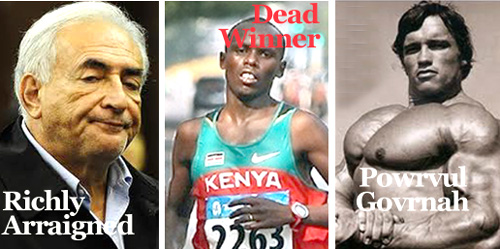
Say what you believe and believe what you say. Without that credo society breaks down. The cants include Schwarzenegger, Strauss-Kahn, and Wanjiru. These three headliners are respectfully American, French and Kenyan.

They are stars: political and commercial, and sports heroes. Wanjiru at the prime age of 24 was the world’s greatest marathon runner, and he killed himself yesterday when his wife found out about his affair.

Nairobi’s Capital FM radio station put it poetically: “[His] existence was intertwined by the sad pointer [of a] tortured genius, choosing to express himself through an excellent natural gift and reckless abandon in equal measure. Enigmas who no one, even himself knew.”

Gimme a break.

Nothing quite as poetic with the Terminator or Emperor Pretender. In fact once you leave dynamic African society, scandals don’t seem to be scandals, anymore.

My greatest personal disappointment was with John Edwards.

I’m a numbers guy. It’s very hard to get a handle on how many committed couples have affairs. It’s just too all-over-the-place. So-called “respected journals” like The Journal of Couple and Relational Therapy say 50%.

But that’s a European group, and I think their main interest is selling their books and therapy.

Although it’s been a decade since any American university studies, that’s what I’d believe: Judith Treas, a sociologist at the University of California-Irvine, concluded 11 % and pronounced, “There isn’t any evidence of an infidelity epidemic.” The numbers were more or less the same as a University of Chicago study in 1994. Michael Kinsey concurred.

And so that leaves me and my cohorts in grey society all quite ordinary, in a grand majority of all the less influential and colorful bodies on earth. Oh, but wait! Zuma! Jacob Zuma!

The President of South Africa makes no bones about his affairs. He doesn’t have to. He just marries them, and right now, they number 12. It poses great difficulties when he travels on State visits. The Maitre D’ doesn’t know who to put on the place card.

I’m not the only person who’s made fun of the President’s polygamy. In South Africa it’s a serious issue. And the fact he doesn’t have to cheat, he just marries again, doesn’t mean the man “Says what he believes and believes what he says.” Zuma’s in a ton of trouble in that regards.

So is sexual infidelity, which breaks the credo, public infidelity? If you lie to your partner, do you lie to your constituency? to your clients? to your business partners? to your children? to your supporters?

Is this just a goofy topic… or a real issue?

National Enquirer readers want to know.