Afternoon Tea with King Kong

Afternoon Tea with King Kong

I know most of you go on safari to see animals, but how about to be stepped on by them? Right, would you like to be stepped on by an elephant during your safari? It can be arranged.

Zambia’s biggest, arguably best and certainly most famous game lodge, Mfuwe Lodge, presents a special opportunity to its residents from October – December. You can be squashed by elephant.

The lodge is a truly wonderful place, near a river in Zambia’s best game park. By today’s standards, it’s fairly if even value priced. The problem has nothing to do with the politics in the area; Zambia’s politics is a constant clutter of insignificance. It’s not because of AIDS or too many mosquitoes or anything of the sort.

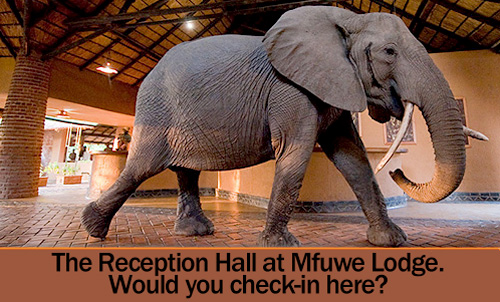
It’s because: “Elephants march through hotel lobby … on their migration trail!.”

That report by London’s Daily Mail was first published in October, 2008, nearly three years ago. And the lodge hasn’t figured out a way to stop it, yet.

I called the lodge Tuesday morning and spoke to Client Relations Manager, Lucy. She confirmed that the elephants came last year and are expected this year. When I asked her if it wasn’t dangerous, she replied:

“I’ve been here for 4 years and nothing’s happened. When they come through we make sure that the guests are out of the way.”

Don’t they break things in the lobby? I asked. “If the juice is out, they might come and drink a glass of juice.” How many? I asked. Well, the original family is 10, but now there’s a second family that also strolls through the hotel.

Mfuwe Lodge has been around for as long as Luangwa welcomed tourists, which is many decades, but it was rebuilt five years ago. The story goes that they didn’t realize they had built the hotel right on a “migration route” for elephants.

Well it’s not exactly a migration route. It’s just that the new hotel layout cuts off a grove of wild mango trees (loved by elephants) from the greater surrounding bush.

Ele would not normally walk through a building, no matter how attractive was the fruit stand on the other side. But Luangwa is not and is not supposed to be a normal place. This is where walking safaris were pioneered by Norman Carr years ago. And the tradition has been preserved to the present time. The animals here are much more acclimated to people than elsewhere in Africa.

I consider that a danger. It’s a danger that once advised may not be considered serious enough to change your travel plans, and to be sure, if you want to walk among wild African animals, this is probably the safest place in Africa to do so. I don’t recommend walking with animals, anywhere. Note that Luangwa is a great place for traditional vehicle safaris.

The walks in Luangwa are led by trained, armed guides. Presumably check-in at Mfuwe does not include an elephant gun rack.

But if you stay at Mfuwe Lodge when the wild mango are ripe enough for the ele (usually the first of October through the end of the year), they’ll most likely be joining you for tea.

The Mfuwe Lodge elephants are clearly habituated to people. So are zoo elephants, but I’d be hard pressed to find a single zoo director in the world that would allow patrons to get this near them.

It’s a mistake that’s been fortunate enough to have had no consequences, yet. Don’t you be there when it does.

How is Your Kenyan Landlord Doing?

How is Your Kenyan Landlord Doing?

This house in a Nairobi suburb costs 3-4 times what it would cost in Houston.
Get this: it’s now cheaper to buy a three-bedroom house in Houston than a comparable three-bedroom house in one of Nairobi’s better suburbs. Rich Kenyans know this, and they are now entering the U.S. market as significant players.

Joseph Wang’endo of Nairobi’s Realty Capital Agency says more and more of his time is spent brokering homes in the U.S. to Kenyan investors.

According to Wang’endo, a typical $150,000 bid at auction for foreclosed property in Houston will render a home similar to those now being sold in Nairobi’s Lavington suburb for $400-450,000.

He says that most buyers are not usually individuals who want to live in the U.S., but rather Kenyan investors or limited liability companies who then become the landlords for a rental property that he says can generate nearly $3,000/month in income.

Kenya did not have a housing bubble. Its growth slipped at the worst part of the world recession, but it never went into a recession. Today, growth in Kenya is zooming up higher than ever.

This is not unlike most of the emerging nations of the world.

How come?

I won’t pretend to be an economist, and I’ll let you reference that body of work (in the same way you try to find a quote in Shakespeare), but here’s my basic understanding.

1) The emerging economies are much more plastic (possibly, dynamic) than the larger economies. They can change quickly. The tea industry might be the biggest supplier to the GDP one year, and then cell phone manufacturing the next. It takes less time to create infrastructure for any given industry, and the work force supplies new industries faster and better.

2) Governments like Kenya are more socialist. They worry more about growth and citizen well being than national debt. Total Kenyan national debt is around three-quarters or higher of the GDP. Public debt is routinely at 50% or higher and the additional external debt is another quarter or more of GDP. [In the U.S. we make no distinction between locally held “public debt” and foreign-held “external debt” as done in the developing world. This is because developing world currencies are not convertible into developed world currencies like the dollar or Yen or Euro.]

The current American debt is a little bit more than half our GDP.

3) America goes into its highest debt during a recession, to stave things from getting worse. Emerging nations like Kenya reach their highest debt usually during boom times, when the government is trying to send the rocket economy even higher.

This story is not news to the Americans who need to know.

Today’s major newspaper in Nairobi, the Daily Nation, published this story about Kenyans buying into the American real estate market this morning (Kenyan time, 6 hours ahead of New York).

By 8 a.m. (EDT), the second comment left after the online story was from “a licensed real estate broker/investor in Charlotte NC” inviting readers to contact him by email.

I’m not suggesting that the American economy, which is 225 times bigger than Kenya, should pursue the same economic policies. But ….

Kenyans might.

DOT on! Flyers Rejoice!

DOT on! Flyers Rejoice!

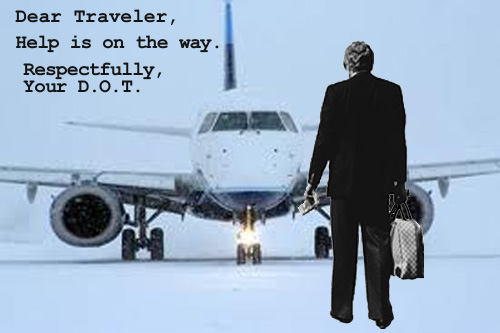
At last! You will finally know how much the airline ticket costs, you will be justly compensated for being bumped or delayed, you can change your mind up to 24 hours after buying a ticket, and more! Am I dreaming?

No. This is what good government regulation means, something that we’ve not had since Reagan fired the air traffic controllers, deregulation buried a lot of good airlines, and big business subsumed what used to be a fun thing to do, fly.

(And imagine, it’s taken the Obama administration nearly 3 years to do this.) The rules were adopted by the Department of Transportation (DOT) in April and come into effect, today.

Well, part of the rules. The airlines objected so incessantly, their lobbyists unrelenting, that at the risk of Congress intervening the Obama administration has delayed implementation of some of the rules until January 1.

Here’s the breakdown: first the rules that go into effect TODAY:

BUMPED
At last U.S. passengers will be fairly compensated, as in Europe. If you’re bumped from a flight you can demand compensation of twice the value of your ticket, if the airline figures out another way to get you to your destination within three hours. This compensation is capped at twice the ticket value or $650, whichever is lower. If the delay is more than three hours, you can demand four times the ticket value up to $1300.

DELAYED BEFORE BOARDING
Unfortunately, a “Passenger’s Bill of Rights” similar to what exists in Europe where specific rules exist to compensate delayed passengers didn’t make it through the lobbying process this time, and I really see this as a terrible flaw in the new regulations.

Compensation for delay remains entirely up to the airline, and in many cases, to the gate clerk handling the actual flight. Flyers advocacy organizations, like FlightMole, have reported recently, however, that airlines seem to be more generous now than in the past, possibly to avoid restarting this debate that they just won. But there are no hard and fast rules. You’ll still have to duke it out at the airport.

DELAYED AFTER BOARDING
Here’s where we won. If a flight sits on the tarmac for three hours or more after the passengers are boarded, the airline will be fined $27,500 per passenger! Now this requires some rumination. That’s a huge fine, even for the airlines. What’s the point?

Not to pay down the national debt. The point is that the flight will now likely be canceled rather than sit forever on the tarmac. Their argument until now was that the flight left (the gate) on time. This rationale released them from their own policies regarding delayed compensation.

No more. It’s now cheaper for them to cancel the flight and compensate you (using their own rules) than pursuing the charade of the delayed flight pulled away from the gate.

EXTRA SERVICE FEE TRANSPARENCY
This actually gets much better in January (if weirdo Congress doesn’t intervene) but today ALL fees must appear up-front on the airline’s website. You are supposed to know precisely how much they intend to charge for that 4-day old tuna sandwich once you get on board. Baggage fees, cancellation fees, must all be clearly shown.

I checked on the American Airlines site. It took quite a while, after actually booking a flight, to get the baggage regulations and I gave up trying to find the cost of the tuna sandwich.

I expect this is going to take a while. DOT is probably doing a better job than I did this morning, and I imagine they’ll be talking a lot with the airlines this week.

But the best regulations, which were initially to start today, have been delayed until JANUARY. Here’s their breakdown, so that you can keep pressure on your Congressman not to mess with them.

JAN 1: TRUTH IN ADVERTISING
I could almost cry. I’ve been screaming about this for years and years. Airlines will no longer be able to advertise a “$99 fare to Las Vegas” when the ticket price you finally pay is over $200, because of fees and taxes. From January on, an advertised fare has to be what you end up paying, taxes and all.

American Airlines has probably been the most egregious in this regards. Almost every AA ticket has an incredible fuel surcharge on it. To Africa, for instance, the fuel surcharge can be $400 roundtrip, so they can advertise a $990 roundtrip ticket to Nairobi that ultimately becomes over $1600, once their fees and taxes are applied.

And American spread the disease masterfully. American doesn’t actually fly to Nairobi, they use their partner from London, British Airways, even though the flight is called and numbered American Airlines (code-sharing).

But British Airways does fly from many American cities through London to Nairobi. So how on earth was it going to compete in the American “capitalistic” market if it didn’t show that its fares were just as cheap as American’s?

So the fuel surcharge and other hidden fees game spread all around the world.

Now (well, in January if Congress doesn’t intervene), this kind of unfairness will be over. The ticket to Nairobi will read $1600 from the getgo.

This is major, and long, long overdue. How on earth can you function within a capitalistic system when you don’t know how much something costs?

JAN 1: PURCHASE INTEGRITY
#1: Right to Cancel: Provided you buy a ticket at least a week in advance, you’ll have 24 hours to change your mind about the purchase for a full refund. This is actually something the airlines have accorded travel agents forever, but now it doesn’t matter how you buy your ticket, you can change your mind if you have second thoughts up to 24 hours after the purchase.

#2: No Increase after Purchase: What? Airlines haven’t been able to get more money out of us after we’ve purchased the ticket, have they? Yes, they have. It’s not that they call you up and politely say, “Mr. Heck, I’m sorry, but we undercharged you for that flight to Cleveland. We have to charge you $20 more.”

What happened was more subtle. That special advertised on the web for $99 roundtrip Cleveland (which became $218.70 after fees and taxes) sold out almost the moment it went on the web. Running planes to Cleveland at that amount is a sure flight path into bankruptcy. So, the airline would cancel your flight altogether.

Sometimes, all they did was change the time by a few minutes and give it a new number.

You would get a polite call with many regrets and assurances that your credit card was fully refunded to the penny. Now, Mr. Heck, would you like to go to Cleveland? We have a flight leaving a few minutes later that is available. Oh, sorry, it’s $50 more though.

No more. Done and gone (well, as of January if Congress doesn’t intervene).

JAN 1: PROMPT NOTIFICATION OF DELAYS
Delayed flights are often known hours earlier than they’re announced. Here’s an example. A snow storm in New York delays or cancels the United flight from Newark to Santa Ana, a daily weekday nonstop that then turns around and comes back to New York.

This is a 6-hour flight on a 737 and there aren’t a lot of other flights into Santa Ana to begin with, so it’s not like United could redirect another aircraft there easily. But common practice has been to get the passenger to the airport even when the delay is known long in advance, and continue to process the flight as if it were on time.

To be fair, this wasn’t just meanness. United probably hoped its genius flight controllers could figure out some way to get another aircraft in their earlier. But now, if the airline registers a delay internally and that delay is more than 30 minutes, passengers must be advised immediately.

There’s more, and it’s all good. If you’re a frequent traveler, you might want to spend a weekend with DOT’s Aviation Consumer website which has all the qualifications and rules neatly laid out.

But the bottom line is a big HURRAY to Ray Hood, the DOT and the Obama Administration for forcing our airlines to be a little bit fairer!

And be vigilant, flyers! Congress can still thwart the whole thing before January first!

Dictators Weekend Out

Dictators Weekend Out

Joburg’s main newspaper is spot on: the downfall of Libya will “put a new spring” into twevolution. And old hags dealing with aging revolutionaries no longer passes muster: Uganda, Eritrea and Al-Shabaab are in a vaudeville skit as the age of pictures begins!

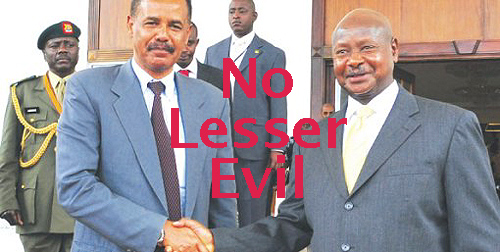
Two of Africa’s dwindling dictators spent a nice weekend together in Kampala. Yoweri Museveni, Uganda’s dictator, and Eritrean President Isaias Afeworki, are two of the most disliked people in Africa.

Museveni is cracking down on his people like never before. Afeworki is already under UN sanctions, and a resolution currently before the Security Council could effectively strangle him (although China is not yet on board).

Museveni’s crimes are methods of keeping himself in power. Afeworki’s crimes are too, but have drawn more world attention because of his funding of al-Shabaab, al-Qaeda in the Horn of Africa, which until recently controlled nearly two-thirds of Somalia.

Museveni and Afeworki are old school guys: “The enemy of my enemy is my friend”-school. Ethiopia, from whom Eritrea wrenched independence in 1993 and who remains its most bitter enemy, is an ardent supporter of the transitional government in Somalia battling al-Shabaab for control.

But wait, wait! Uganda is on the same side as Ethiopia, isn’t it? Here’s the truly unbelievable irony: Although the African Union has armed troops supporting the transitional government in Somalia, only Ugandan and Burundi soldiers remain from the original force which was much larger and included Kenya.

Uganda is by far the dominant force. So Uganda is supporting the enemy of al-Shabaab ostensibly more than any other African government.

And Uganda paid dearly for it last November, when al-Shabaab blew up two sports bars in Kampala packed with people watching the world cup. Nearly 80 people were killed.

So what’s going on, here? Where’s this enemy-is-my-enemy thing? Why is the president of a country ripped to shreds by a suicide bomber from a movement supported by Eritrea, welcoming the president of Eritrea?

The headlines say they are mending fences.

I don’t think so. Museveni has probably killed as many or more of his citizens than the November bar bomb did. And Afeworki has only a few more civil disturbances to go before he’s indicted by the World Court.

These are two aging dictators who nobody else likes. They don’t have any other friends, and as Libya crumbles, the prospect of their own tenure needs some mutual self-esteem reenforcement. These are not nice guys “working out differences.”

They are bad leaders lagering against twevolution.

Pink is for Power

Pink is for Power

Twevolution is like the recovery. It comes with a blast, planes off, has its ups and downs, and societies with major unresolved issues caught in the middle turn messy for a very long time. It might be time to scratch Uganda off your tour list for the next generation.

Political parallels to economic conditions are easy to make, hard to explain. Think of it this way: Down there in the nadir of the global recession anybody still standing had hope. High hope. They looked to the sky and found jobs and freedom.

As the Egyptians pummeled Tahrir Square with rocks, TARP and stimulus seemed to have righted the sinking ship. This was the time! Ireland was saved, so could Libya! Nothing could get worse and everything would get better. This adrenalin powers a lot of people to do a lot of things.

But now, something bad is happening. It’s not going according to plan. We listen to leaders blame tsunamis and other leaders, but we know the sickness is deep. The revolutionary wonders, does he really want power in a future that looks so grim?

So true or not that things are bad and the future is bleak, this is what protesters in Uganda feel, now. At the risk of over generalizing for an important point, I remain continually amazed at how fatigued African’s psyche becomes with convoluted politics compared to an American’s.

And I don’t mean to suggest that Americans’ attitudes are healthier. Not at all: It would probably have been much better for us and the world if we had left Iraq a long time ago. We might be the stubborn bullies, and Africans the practical realists.

Uganda is in the doldrums of despair. It’s a lousy place to live in, and not a good place to visit. A little while ago it was darn right dangerous to travel to Uganda, and who knows, it might become so, again. But right now, the horizon isn’t so fiery as very, very grey.

Uganda’s dictator is growing crazy with his apparent successes; he wouldn’t have acted this way only a year ago. A group of presumed businessmen supporters visited him yesterday, and he shouted at them like a disturbed headmaster. Supporters. He lashed out at supporters.

Last week, Uganda’s Minister for Security Muruli Mukasa told the media that protesters were terrorists and that the Ugandan opposition is using “Twitter, Facebook and YouTube to wage a campaign against the security forces and to psychologically prepare the people, especially young people, for armed insurrection”.

Well as a matter of fact, that’s right. But the fact the minister is now turning what used to be a successful tool against him into a tool he can use to beat them up means the tide has changed. The Ugandan government is gaining control.

Protests continue, don’t get me wrong. Major protests are scheduled for next week against electricity rationing and a specter of a massive protest against the dictator for turning a water cachment forest into a sugar cane field is imminent.

This is not a place tourists should visit. Just several days ago a couple hundred ardent, well-dressed demonstrators including a number of high profile opposition politicians, began a peaceful protest that prompted live ammunition fire from police, then a suburb drowned in tear gas.

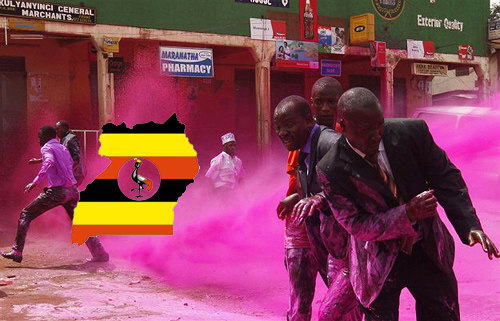
But then as if to turn the war into a birthday party, Ugandan police sprayed the retreating demonstrators with pink paint.

It’s not the first time pink paint has been used in Uganda. In fact, its purpose was to quell the demonstrations against the draconian ‘Kill the Gays’ bill that remains pending in the legislature but for the moment is going nowhere. The symbolism is obvious.

Perhaps they just had a lot of pink paint left over. Maybe the increasingly brutal regime is equating gays with all activists. Whatever, it’s a sign that things are ugly but not getting uglier. The protests are smaller and failing. The government believes that either dissent is waning, or that they can handle it just fine.

The point is reached, as it was in Zimbabwe decades ago, when crazy dictators become so firmly in control that not even a world economic recovery can pry them from power.

Society begins to depend for its simple day-to-day existence on the growing tentacles of dependency, from the dictator to his minions. As he becomes less and less accountable, he begins dishing out favors and money that replaces hard work and profit. Remove him at your peril.

I hope this is a premature analysis for Uganda. We should know, soon. Meanwhile, stay clear.

Bail Out The Joker!

Bail Out The Joker!

Bailout! Bailout! All Hail the Bailout! Germany for Greece! France for Ireland! EU for Iceland! U.S. for Goldman Sachs! And now! South Africa for itty bitty Swaziland! Is this really necessary?!

Swaziland is a round little hilltop surrounded by South Africa and Mozambique, smaller than New Jersey, with a GDP under $6 billion. Its main industry is absolute King Mswati III who keeps those jobs churning away by building palaces.

There are also casinos.

The King’s piggy bank doesn’t clink, anymore. The IMF refused to bail him out. He turned to South Africa, pleading … jobs.

“A lot of companies are closing down because government has not paid them,” said Hezekiel Mabuza, vice-president of the Federation of the Swaziland Business Community (FESBC).

The king buys a lot locally. He gets good credit.

FESBC has a membership of 500 small businesses, and so far over 50 have closed down because government has failed to pay them for supplied goods and services.

Swazi is one of the most undemocratic countries on earth. Dissent while not sledge hammered away is often harshly suppressed. The country has more or less stagnated as the South African umbrella blooms all around it.

The country’s deficit began exploding in 2009 and hasn’t stopped since, for all the same reasons countries all around the world are having problems: half the debt is basically due to reduced tax revenues and the other half by profligate government spending that continually expected higher tax revenues.

We did it on wars. Greece did it on fata cheese (actually I have no idea why Greece did it). Swazi did it mostly on “Mswati’s profligate lifestyle, which includes building a dozen or so palaces and frequent overseas trips and shopping excursions for his relatives, 13 wives and estimated 27 children.”

Needless to say, South Africans aren’t exactly happy with their government’s announcement.

On the face of it, it seems ridiculous. Bailout an international Play Boy? But calm down. There is method in this madness.

Because it isn’t ridiculous, or South African leaders wouldn’t be taking so much heat for standing their course. Nobody likes Mswati. But if Swazi were abandoned and the fairyland imploded, there would be a flood of refugees into South Africa at a cost that would easily exceed the bailout.

South Africa’s reasonable rationale is that if they increase this joker’s allowance sufficiently, they will stem the tide of misery that would flow from his subjects into South Africa.

It is the same rationale that applies worldwide. Bail out the people who made those bad mistakes because they’re all “too big to fail.” Without their continued nastiness, all their mess becomes yours to sort out, and that would be worse!

The point is, it’s true.

Swazi has a single university, not bad for a rural backwoodsman cousin to South Africa’s plethora of higher institutions. And rightly so, a large portion of the national budget is for the university. Only this year, it hasn’t received a penny.

So it’s closed down. Swazi can’t afford any more of a brain drain, and there are reports of faculty bailing in droves to South African institutions.

Funding for AIDS education, public health and insurance for preschool children is all gone. If you live in Swazi and have AIDS, a young child with pneumonia or a broken foot, you’ll probably make your way into South Africa, now.

So it makes imminent sense that South Africa plug the dyke.

It’s amazing that so many people just don’t understand these bailouts. Whether it was our own, or Europe, or now South Africa with Swaziland, there’s no altruism here. It isn’t a bunch of pussy footing do-gooders with reckless abandon of their own ethics.

It’s cold hard facts. If you don’t do it, it will be worse for you in the future. That simple.

And another thing. A major cause of all the bailouts, ours and Europe’s and even Swazi’s, is largely ours to blame.

Swazi had no mortgage bubble, no goony debt swaps, but its banks engaged in the same reckless lending folly that our banks engaged in.

Money was fast and loose worldwide. And guess who has the most money and the most money managers showing everyone else how to manage money?

Shedding Light

Shedding Light

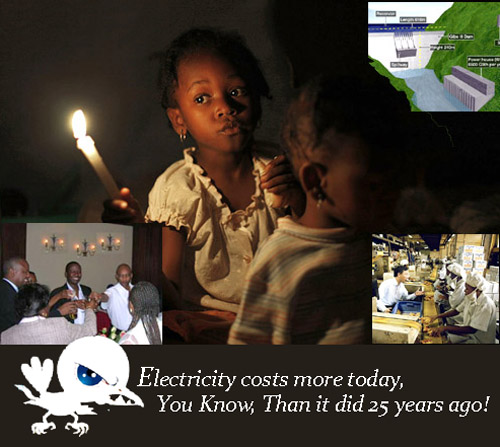
The Ethiopian dam, Gilgel Gibe III, will be 2000′ wide, 734′ high, hold a reservoir 81 sq. miles large, become Africa’s largest hydroelectric plant and some say the planet’s greatest ecological catastrophe. Save the wild, or turn on the lights?

For the mid-term at least (25 years), it will provide enough electricity for all of Ethiopia’s grand development plans with lots over to help neighbors Kenya and Uganda.

It will dam the Omo River above Kenya’s Lake Turkana. This is one of the most remote places in Africa. I floated the Omo as early as 1981, and the peoples who live along it have not changed much since. I often tell tourists that the “village” they want to see near their Mara camp is either hocus-pocos or a living museum, and that only in remote areas of Ethiopia and The Sudan can truly primitive people still be found.

The Omo disgorges into the giant desert Lake Turkana. About the size and shape of Lake Michigan, Turkana is a remnant of a prehistoric Nile river system, and no rivers flow out of it, now. It’s surrounded by harsh desert.

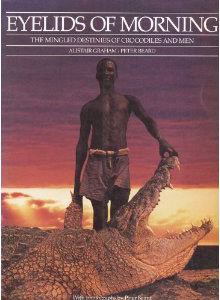
The Turkana people who live around it fish and farm seasonally, in a tight belt right around the lake itself, as rainfall is scarce. But the seasonal floods of the Omo are enough for some agriculture, and the lake is rich with fish: the world’s largest crocodiles live here. Peter Beard’s book Eyelids of the Morning shows a croc from here that is 28′ long.

Of course all of this is in jeopardy, now.

Leading the fight against the dam is the California-based International Rivers. They successfully spearheaded a drive that resulted last month in UNESCO and other UN agencies warning Ethiopia it could lose all sorts of funding if it continues with the project.

International Rivers claims that a half million traditional peoples along the Omo and into Lake Turkana will be catastrophically effected. It calls the Omo River the “umbilical chord” for Lake Turkana.

Seasonal farming based on the seasonal floods of the river (very much like the Nile), fishes, wildlife and plants are all doomed if the dam is built, IR claims. In addition to less fresh water in a desert desperately in need of it, the salinity of Lake Turkana will increase to toxic levels.

The dam itself is estimated to cost $1.55 billion. Another quarter billion will be needed for transmission lines.

Initially this was financed by the African Development Bank and the World Bank. But starting several years ago, the environmental impacts seemed so grave western agencies began bailing out of the project. The financing has been taken over by China.

The dam is about half completed, now, mostly with Ethiopian money spent and Chinese funds promised, and it cannot proceed without further cash, so it’s up to China, now. IR and several international organizations are now pressing China to end its participation.

Last month, an Ethiopian journalist who did little more than report all the above, was thrown in jail.

This is a high wire game.

If IR claims are even partially correct, it is Kenya that stands to be most impacted. Turkana’s life-giving water is one of the few reasons the area in Kenya’s far north has not succumbed to the current famine.

But Kenya just signed an agreement with Ethiopia to buy the electricity from the dam.

Africa needs electricity. And presuming for an instant that the Kenyan authorities understand the ramifications, and that there is a real possibility that their northern villagers will be critically compromised, they have still decided to support the project.

Africa needs electricity. Nairobi’s reservoirs have almost refilled with unusual rains. But power outages still occur. The city is growing like a morel. Industry is exploding. Africa needs electricity.

Do we stop the dam, save Turkana and condemn Kenya and Ethiopia to reduced development? Ethiopia’s Prime Minister Meles Zenawi, not your nicest character, nevertheless put it succinctly:

“The views of western critics are ironic as Ethiopian facilities are infinitely more environmentally and socially responsible than the projects in their countries, past and present,” he said.

Meles claims the western world is in a conspiracy “to condemn African peoples to extreme poverty.”

Africa needs electricity. Should we stop this, and then fund their nuclear power plants? Or massive solar or wind or other projects that can’t even get traction at home?

“They are concerned about butterflies’ lives, but not human diseases,” Meles says of us.

Numerous organizations have rallied around IR to defeat the dam. Even the palaeontologist Richard Leakey has pointed out that some of the world’s most treasured archaeological sites will be compromised.

Which to save? The past, or the future?

Beware Andrew the Crusader Harper

Beware Andrew the Crusader Harper

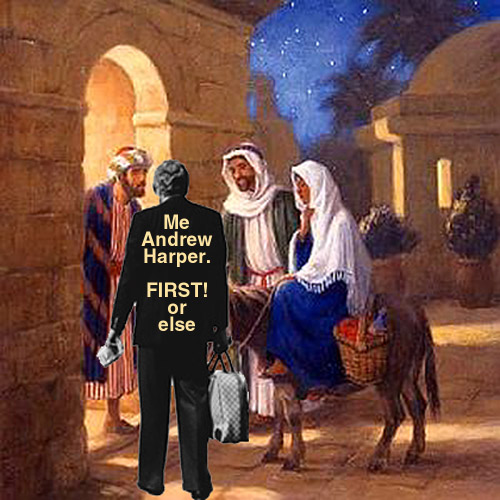
Andrew Harper’s sissy-fit earlier this year about Nairobi’s best hotel, the Norfolk, because they refused to give him an early check-in (that he didn’t pay for) was just another little annoyance of his that I usually ignore. But now my own clients are asking me to respond, so here goes.

Bit by bit, blog by Huffington Post blog, my irritation with Andrew Harper’s remarks was never great enough to warrant a response. What I noticed was that in 2008 and 2009, when he launched big time his travel company, his critiques started to turn into infomercials.

But, you know, a lot of us (and I include myself) are travel commentators and analysts with travel companies, so there’s no lack of owners recommending themselves. But I’d put myself and many others in the good guy group, people like Rick Steves. I really think we achieve a balance despite our vested interests.

I don’t feel qualified to speak generally about Harper, but I do feel eminently qualified to say what I’m going to say based upon his recent remarks about East Africa:

Beware Andrew Harper when planning a safari to East Africa.

I often caution travelers not to embrace any single guidebook, any one internet site or any single authority or single personal referral when planning their travel, and to recognize that each may provide some insights but that each can also come bundled with inaccuracies and other flaws.

Think of it this way. If you had to tweet the absolute best time to visit your own home town, what would you say? Stutter, stumble, toil and trouble is a good sign. There’s too much to qualify.

A good analysis, travel or anything else, is careful about broad generalizations, mindful about seasons and unique conditions that might be totally off base if applied to someone traveling at a different time or in a different way.

But in East Africa, Harper has lost this care. Of the nearly 1200 safari properties in East Africa, he’s reduced his recommendations to a single company, &Beyond. &Beyond’s good, don’t get me wrong. But it is rarely worth the prices they command, and in fact several of their properties are very poorly located especially for certain seasons. And there are many companies that rival or exceed their standards (Sanctuary Retreats, Lake Duluti Lodge, Bush ‘n Beyond, and some of the Cheli & Peacock properties to name but a few which quickly come to mind, and this is hardly exhaustive).

So what caused Harper to reduce this huge cornucopia of wonderful safari lodges down to the few managed by &Beyond?

I think I know. They’re the most expensive, and they treated him nicely when he last visited them.

Neither of these two reasons is inherently bad. And as I said, &Beyond is good, but clearly Harper isn’t doing his homework and more importantly, an event he himself referred to clearly outs him when it comes to any value he may now possess regarding recommendations in East Africa.

Harper went to East Africa last year and began his trip at Nairobi’s best hotel, the Norfolk. He arrived before the stated check-in, and his room wasn’t ready.

He blew a fuse. He claims that the early check-in had been guaranteed, but Fairmont does not guarantee early check-ins. What they guarantee is what most larger chains do, that the request will be put into the computer record, a sort of priority waitlist.

Harper knows this, we all do! But he simply couldn’t understand why Fairmont would deny such an important critic an early check-in.

(Perhaps it was because, as is often the case, the Norfolk is full up with Heads of State, concert pianists, billionaires and fancy journalists.)

And given what Harper’s now earning from his travel company, I can’t understand why he just didn’t prepay for the early check-in like the rest of us do (including Heads of State, concert pianists, billionaires and fancy journalists).

So he laid into the hotel, unliterally. He threw down the gauntlet and stomped away like a kid who wasn’t allowed to join the ballpark game.

He moved to, and now recommends instead of the Norfolk, Giraffe Manor for a Nairobi stay. First I must say how much I love Giraffe Manor, and what a great job Mikey Carr-Hartley has done since purchasing it several years ago. It’s a fabulous place. As are all the Carr-Hartley properties.

But it’s no substitute for the Norfolk, because of where it’s located. It may be a great addition, but it’s not in Nairobi! It’s no substitute for a good hotel in the city.

The Norfolk is in town. Giraffe Manor is out of town. At the best of times (maybe 2 a.m.) it’s still 40 minutes from town. For the rest of the day traffic can separate them by an hour. The Norfolk positions you for town activities, like the museum, shopping, people gazing, dining, etc. Giraffe Manor is a retreat from all of that.

Harper is simply way off base in his criticisms of The Norfolk. He’s more correct about the mayhem of Nairobi town, but if that’s his gripe, he shouldn’t have stayed at Giraffe Manor, either. Hit the airport and fly directly into the bush. It’s a pain getting to either of them from the airport these days.

Harper tried to list specific complaints, about plumbing and air-conditioning, for instance. He’s right on. But don’t expect you won’t incur such annoyances at every place in East Africa at some time or another, &Beyond and Giraffe Manor included.

That’s East Africa, as compared to Europe for example. It’s a reflection of constant power outages, inferior craftsmanship and materials, and bad roads. It’s a good object lesson in the difference between the standards of expectations in East Africa versus southern Africa. And in the course of an overall safari, it’s hardly noticeable and rarely happens. The fact this litany of irritations all happened to Harper during a single stay at the Norfolk is suspect.

But whether you believe me or believe Harper about the standards of the Norfolk, there’s no way anyone with half a keyboard and dial-up can’t easily prove him absolutely wrong on much of his general commentary about East Africa.

Here’s Harper’s basic introduction to East Africa, corrected with my italics as you go:

“Wildlife-viewing is generally excellent throughout the year in the Masai Mara and Ngorongoro Crater. However, game-viewing opportunities peak from January-April in the southern Serengeti and from June-October in the northern Serengeti. This variation is due to the Great Migration of several million wildebeest, zebra and gazelle. (Gazelle don’t migrate.)

…”The herds gather in the south to feed on the immense grasslands and to give birth to their young. When the food supply is exhausted (only when and because the rains stop) and the newborns are strong enough to travel (that doesn’t matter, they go whether the young are strong or not) they begin to head north and west (and northeast), passing through the Grumeti area from May-July (and a lot of other areas but &Beyond just happens to have a camp in the Grumeti area).

…”By August, (normally only about half) the herds have reached the northern Serengeti, where they cross into Kenya’s contiguous Masai Mara to enjoy its lush grazing. In November (or October (2009) or December (2010)), they begin the 200-mile (roundtrip 200-mile) trek south to the plains of the southern Serengeti, where the grass is once again lush after the seasonal rains. There the epic cycle begins anew.

…”The times to avoid in Kenya and Tanzania are the long rains. (Northern Tanzania has only ONE rainy season. Kenya and only north of the equator has two rainy seasons: long and short. Just look at the welcome sign to the Serengeti National Park which describes this on a sign about 10′ high) in April and May and the short rains in November. The rest of the year, you can typically expect cool nights and warm, sunny days broken by occasional afternoon and evening showers. (There’s been no measurable rain in the Serengeti in September or October for the last half century since good record-keeping began.)

…”In recent years, however, weather patterns have become notoriously fickle. (No cigar, buddy, not as fickle as your mounting inaccuracies.)

OK, OK, there’s some nit picking above, and, in fact, that’s my problem. Take any one paragraph, and it will pass over my bitten lip. Take any one blog about East Africa, and it’s foolish and silly but not worth the time to answer. I even passed on the Norfolk blog last December.

Believe it or not, I even passed on his February blog about the Serengeti, carried in the Huffington Post about the Serengeti highway.

The post is crammed with dated ideas, wrong facts and poorer generalities. But it was the final paragraph that really ticked me off:

“Of course, African people have a right to development. But the Serengeti is Nature’s equivalent to Chartres Cathedral. And if it is not possible to preserve the world’s greatest national park, then what, ultimately, will remain? “

This patronizing, slimy (is it racist?), egocentric condescending nonsense begs all sorts of really important questions many of us have been trying to deal with for years. Harper has proved he has no capacity to judge the “world’s greatest national park” any has moved into vendetta mode.

But I let it sit until recently a client contacted me and asked what I thought, since I still recommend the Norfolk.

What we have here is a man whose ego was pricked by a global hotel chain, Fairmont, and who has lost his cool. Honest critique has been replaced with … infomercials.

I’m not alone, by the way. You can go to the blogs and forums of excellent traveler sites such as Gallivanter, Inworldguide and Flyers.

Here’s one short one that sums them all up:

From BLG on Flyer’s:
“As far as the Harper services are concerned, I was a member for many years and I dropped my membership — didn’t feel like I was getting much that I couldn’t find for myself online, and I was not a fan of their in-house travel agency… I kind of feel like those services have been somewhat obsoleted by the plethora of great internet sites.”

Beware a crusader, especially one crusading for himself.
Blood for a Buck

Blood for a Buck

Almost a generation ago, John Le Carre wrote the block buster novel which became a film, Constant Gardener, about mega “pharmas” illegal testing of experimental drugs on witless Africans. Only a few years before publication, Pfizer has now admitted to having done just that in Nigeria.

Carre’s story focused on an aid agency physician driven to discover why his lover had been murdered: (She was about to become the whistle-blower against the pharma.) Carre’s story was more about deceit and corruption of British officialdom than the drug companies per se.

Pfizer announced in February that it would pay $75 million to victims and families of victims in Kano, Nigeria, who were illegally administered its never licensed drug, Trovan, for the treatment of meningitis.

Versions of the drug had been approved for use worldwide treating sexually transmitted diseases, but never for meningitis. Pfizer had been unsuccessful obtaining testing permits in the U.S. and elsewhere. So illegally and immorally, it began testing on African children.

Pfizer administered the drug to around 200 Nigerian children in 1996. Eleven died and scores others were paralyzed for life. Not long after the publication of Le Carre’s novel, suits were filed in both Nigeria and the U.S.

Pfizer fought the litigation tooth and nail, in both Nigeria and the U.S. Stateside the suits finally reached the U.S. Supreme Court, which in 2007 ruled that litigation in lower courts could continue, something Pfizer had fought for years.

The Nigerian government then announced it might pursue criminal charges.

This is exactly what Le Carre was writing about, and while illegal drug testing in Africa can’t be called exactly widespread, it is spread enough to be very, very troubling.

Two activists, Sam Burcher and Dr. Mae-Wan Ho, have spent much of their lives documenting illegal pharma testing in the Third World.

They broke the story of illegal testing of genetically modified rice serum in Peru by the California-based company Ventria Bioscience. They’ve also documented numerous illegal testing practices in India, and how drugs banned from sale in the U.S. are then sold to countries with less rigid regulation, mostly in the Third World.

Fired up by the Constant Gardener, a widely shown BBC Documentary, and concern by Pfizer employees in Nigeria that they actually would be brought to trial, the company rapidly moved in 2008 to close the issue.

Pfizer offered to pay the eleven families in Nigeria $175,000 each, a pittance by U.S. standards and a royal ransom by African standards.

Outcries continued until the final $75 million settlement in February, which also ended all U.S. litigation. Again, a pittance by American standards, an unbelievable treasure by African ones.

To date according to This Day in Nigeria, more than 3 years later, Pfizer has paid four families $175,000 each. That’s it. There is a building in the first stages in Kano which Pfizer says it’s constructing for medical research in the area, and which will cost $25 million. That’s it. Four payments to families and a shell of a new building.

According to Pfizer, the slowness of the implementing the settlement has to do with thousands more applications for compensation than is realistically possible.

That’s probably true. But that’s Pfizer’s problem, not the aggrieved families.

Pfizer concedes. And so it’s requiring DNA testing to determine those individuals and individual families who truly qualify for the money.

This, of course, is nonsense. Unless the medical records have been destroyed (an offense under Nigerian as well as U.S. law), Pfizer should have no problem determining who is who.

Understandably, victims and their relatives are reluctant to allow a pharma to do anything with their bodies, much less something as suspect as swabbing the inside of your mouth.

And so the beat goes on. Big against small. Rich against poor. Clever against the simple, the exploited, the wasted and discarded. For a healthier planet? No, for a buck.

Tourists Stranded, Tanzania Tainted

Tourists Stranded, Tanzania Tainted

Hundreds of travelers headed to Tanzania remain in limbo this morning as a result of a high profile controversy involving one of Europe’s most prestigious hotel chains, a controversy ensnared in the Serengeti Highway debacle.

Late last month ASB Tanzania Investments, the owners of The Kilimanjaro Hotel in Dar and Bilila Lodge in the Serengeti, announced Hyatt would be taking over from Kempinski. In May they had announced Kempinski had withdrawn from managing the Zamani Resort on Zanzibar, and that hotel continued to operate with local management until this week.

But Hyatt has announced it is taking over only the Kilimanjaro hotel in Dar.

Email addresses, phones, websites have disappeared for Bilila Lodge and Zamani Resort.

What are tourists doing when they arrive these places, now? I can’t imagine Bilila abandoned; I was there only a few months ago. It’s a palace in the wasteland, a luxury convention resort. But no one answers phones or emails.

No notification was given those who were confirmed into the properties, nor to their agents or tour operators. Reserved travelers are in limbo.

Kempinski has referred questions about deposits and nonrefundable payments to Hyatt, but Hyatt insists it is managing only The Kilimanjaro.

For the moment, I’d advise travelers to quickly book something else in this High Season if they can, and then to read the story of High Intrigue that follows.

And shame on Kempinski for leaving Tanzania in such shambles.

But I think I know why.

Kempinski has only been in Tanzania for 4 years. Bilila Lodge opened on July 9, 2009. It is widely assumed that the president of Tanzania, Jakaya Kikwete, has (or had) a sizable investment in the three properties.

He was often seen at Bilila on retreat, where one of the suites was always held in ready for him. His over-the-hill inaugural speech for the lodge far exceeded the parameters a normal politician would dane to use.

Why?

It was no coincidence that this was just about the time that the Serengeti Highway project came together.

And it wasn’t just a highway project. It was a plan for an entirely new center of the park probably financed by two billionaires, Paul Tudor-Jones of the U.S. and Roman Abramovich of Russia.

Tudor-Jones already owns the Grumeti Reserves, now managed by Singita, and Abramovich is a long-time fan of Tanzania and frequent visitor to Grumeti.

Grumeti, Bilila, and the planned new center for the Serengeti, are all remarkably close to one another, and would have been a stone’s throw from various points along the Serengeti Highway.

The Serengeti Highway has been shelved. Opposition grew and grew and UNESCO dealt a final blow, just as it had done with Zamani several years ago.

With swaggering disregard for law, Kikwete had maneuvered Kempinski into paying $10,000 for a historic site within Stone Town that Zamani was to be relocated to … at hundreds of millions of dollars. UNESCO was appalled, and warned (like it did later with the Serengeti Highway) that World Heritage status would be removed.

In the economic hay days when Kikwete wrapped Kempinski into his devilish plans, he essentially ignored UNESCO. But as tourism contracted, as his own country was shaken by controversial elections, UNESCO’s warning was not so much powerful itself, as a final conclusion to what all good folk believed world wide, including in Tanzania.

The threats to the fragile history of Zanzibar and the ecosystem of the Serengeti were paramount, but it became clear in the leaned down years following the global recession that general tourism was threatened by his schemes.

Kikwete has backed away, entirely. Some of his ministers now become the fall persons for his folly.

Kempinski finally had enough. It left. Rather quickly, actually, and not at all like a European gentleman leaving a cocktail party.

I suppose what’s most important, is that this miserable attempt to profit from Tanzania’s special environments and history, is over.

What is left, though, is for Kempinski to come clean. And to apologize not just for its misguided interests in the beginning, but for the appalling way it’s left.

Will Kibaki Lead Obama?

Will Kibaki Lead Obama?

President Obama can learn something from President Kibaki. Kibaki has a plan, a bold and risky one to be sure, but one what that might solve an urgent Kenyan problem. Did you hear that, Obama? Bold. If risky, bold?! To solve a problem?

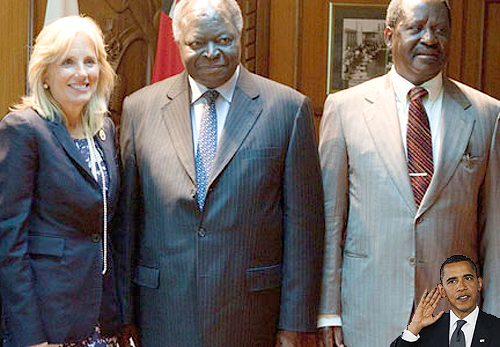
Yesterday Kenya’s two leaders, President Mwai Kibaki and Prime Minister Raila Odinga, together warmly welcomed the U.S. Vice-President’s wife, Jill Biden. Dr. Biden was in Kenya to assess the growing famine and refugee problem in Kenya’s north and Somalia.

That problem is spiraling into a serious catastrophe, even as rain falls. As I’ve written many times in this blog, the famine is not mainly a result of drought, but of the increasing war in Somalia.

Today, one of the most reliable news sources for Somalia (actually based in the U.K.), Shebele News, reported that “calm returned to the Mogadishu city as almost of its districts are in the hands of Somali forces after Al shabaab fled the capital.”

While gauging the fight in Mogadishu is very difficult, I think because al-Shabaab also claimed the opposite, that we can believe the former. Al-Shabaab rarely makes any statements, and this rout of the Somali capital would be the latest in a number of setbacks for them.

Presuming this situation to be true, it definitely gives President Kibaki an opportunity to do something bold, and he has done so.

Yesterday he told Dr. Biden that Kenya would enter sovereign Somali territory to “set up feeding camps” there.

Not quite an invasion, but close. And offering to do something this radical would help to move the problem a little further away from sovereign Kenya. It would also give cover to the international aid agencies and donor countries who dare not appear to invade any new place right now.

The risk is that all of our assessments of the weakened state of al-Shabaab are incorrect. It was al-Shabaab that bombed two bars in Kampala last fall, killing nearly 80 people, in retaliation for Uganda’s support of the African forces in Mogadishu.

So this is risky. And what’s more, normally such a national policy would require Parliament to sign off on at least the funding. But Kibaki, like Obama, is not exactly on the friendliest terms with his legislature.

But Kibaki, unlike Obama, is grabbing the reins and whipping the horses into action. Nonaction is not an option. He is leading, and leading is risking, will always be challenged by those who don’t want to follow, and must often pierce sovereign territory.

Kibaki should be wildly applauded.

Perhaps, Dr. Biden can find a moment in her busy schedule when she gets back to chat with Obama.

Of The Thousands Who Try …

Of The Thousands Who Try …

It’s hard to imagine the personal stories of the Somalis fleeing their homeland. And contrary to popular opinion, they aren’t just peasants. Many are professionals desperate for nothing more than just an ordinary life.

We all know by now of the 1500-2000 people who daily are arriving the refugee city of Dadaab, Kenya, fleeing death and destruction in next door Somalia, an unprecedented human exodus from a land wrought by drought and war.

But the media leave us with the impression that everyone running away from Somali is a destitute subsistence farmer or shepherd. I imagine most are. But there are also thousands and thousands who are accountants and lawyers, businessmen, teachers and computer techies, skilled individuals of countless professions.

The peasant farmer deserves no less help than the accountant. But the accountant is more skilled, has more savvy. Knows that there are better places to be than Dadaab.

With a bit of saved money, and usually nothing more than a cell phone with a new SIM card (that costs about 50¢) each time he enters a new country, the educated person can pursue a journey to a better place.

I know this. Because I was personally involved in helping a single professional refugee fleeing the 1994 Rwanda genocide. At the time I first thought he was remarkably unique. But in assisting him I learned there were nearly a thousand others like him hiding in Nairobi, waiting for the kind of help I was able to give to only him.

Today, as a result of the war and famine in The Horn, at least 1500 refugees per month have been entering South Africa, according to Abdul Hakim, a Somali leader living in South Africa. Some suggest it’s even more.

According to Natalia Perez of the International Organization for Migration (IOM), in the first quarter of 2011, 7200 asylum-seekers were documented entering South Africa at the Beitbridge border with Zimbabwe.

South Africa is the obvious choice for any skilled person fleeing Somalia. Its economy is 20 times larger than the rest of sub-Sahara Africa combined. Its politics are free and generous. Until recently, anyway, refugees were welcomed with open arms.

It’s nearly 2000 miles as the crow flies from Dadaab to the Beitbridge border post, and no refugee flies. In between are at least three countries, some times four depending upon the route, and these countries are hostile to refugees no matter what their skills.

Clearly the person who navigates as a fugitive through multiple layers of police and other officials, who knows how to get foreign currencies to buy bus and train tickets, who speaks multiple languages, who is able to find food and shelter for a subterranean journey that could take months… is no peasant farmer.

She or he is an educated, skilled professional. Ultimately, South Africa will be remarkably enriched by this flood of professionals into its country. But all at once, at a time of a depressed global economy, the stress may have become too profound on South African society.

The country’s open policy is changing.

Although officially denied by South African officials, we have to believe the multiple reports that at least an unstated policy change has occurred. South Africa’s borders are tightening, and this has caused a pushback into lands no skilled refugee would choose to make home.

Zimbabwe is no place of refuge, and there are as many as a thousand Zimbabweans monthly trying to get into South Africa. But Zimbabwe is the natural transit point for asylum seekers from the north wanting to enter South Africa.

Zimbabwe is not a country known for its gentle care. But in a deft political move that gives this ruthless country some cover, Zimbabwe has allowed the UN Refugee Agency (UNHCR) to set up a camp inside Zimbabwe as refugees at Beitbridge find it harder to get into South Africa.

Right now, there are 646 mostly Somalis being held there as if in a prison, picked up by Zimbabwean authorities as they are bounced back from South Africa.

Above Zimbabwe is Tanzania. UNHCR’s Mozambique head told a refugee newspaper last week that nearly a thousand refugees have been stopped at the Tanzania border with Mozambique and are now being held in a nearby prison. He said there were about 50 young children among those now being detained.

If true, Tanzania is violating a number of world treaties and customary human rights practices and could be prosecuted at the World Court.

I think of the one story I know so well of the man I helped in 1994. His story ended fabulously. He lives in the U.S. as a computer scientist, has a wonderful home and three lovely children. The only sadness in the memory is that he was but one of a thousand I had seen.

Today, there are tens, maybe hundreds of thousands.

How soon will it become millions?

The Absolutely Phenomenal Rat!

The Absolutely Phenomenal Rat!

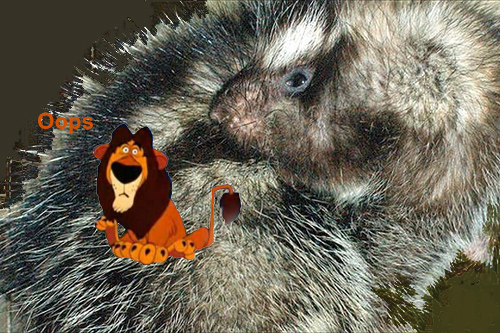
Porcupines are common in East Africa, but more often we thought we saw only smaller ones that we presumed were juveniles, even though they always seemed to be alone. On closer inspection, they turned out not to be porkies, but giant crested rats! This week we learned how fascinating this creature is!

A famous East African scientist published a few days ago the remarkable story of this little creature, putting it on a pedestal of evolution well above many other animals.

I often explain on safari that if you reduce all goals in life to one, it’s defense – how to survive all the external efforts to destroy you. Africa has an amazing array of animal defenses from the sheer savageness of the honey badger to the heavy coat of the waterbuck that tastes so bad no one wants to get near it.

But this little creature, Lophiomys imhausi, has a defense that tops most others. Even at the first level, that its predators appear to get sick just looking at, scientists had trouble figuring out what was going on. But then, like the waterbuck, it was discovered that the creature’s hair was toxic to most of its predators.

The waterbuck secretes a musky oil. At first that’s what everyone thought the crested rat was doing, too, but it wasn’t. Its story is a remarkable lesson in extraordinary convergent evolution!

Little Porky chews a poisonous bark (that somehow doesn’t effect him), his saliva somehow reduces the soup in his mouth into a powerful poison, then he licks it onto his back.

And his back – those otherwise nondescript “crested hairs” – are made in such a unique way that they are specifically designed to absorb this specific concentrated poison.

And – critical to it being a successful radiated defense in natural selection – the poison doesn’t usually kill, just makes the predator very, very sick. So the predator not only won’t go near it, again, but can transmit this learned caution to siblings and offspring.

Imagine this. There were separate, ultimately converging evolutionary tracks: first, the ridiculously otherwise useless evolution of the hair structure; second, chewing of a plant but not for food so a craving by the creature to imaginatively but only partly consume something; third, (and I think most remarkably), the evolution of a poison in a plant where the creature lived that was just the right molecular structure that it wouldn’t kill but make very sick this creature’s predator; and fourth, the creature’s digestive system evolved to be immune to the poison in sync with its not wholly consuming it.

Wow. And there are probably many more lesser obvious biological evolutionary processes at work, too.

Consider that all these developments happened independent of one another, and essentially by chance. The only way any of this is comprehensible is to grasp the sense of time given this creature and its antecedents to create themselves.

That’s to me the greatest marvel of evolution: the backwards understanding of the length of time needed to let all these chances happen.

Of course there are evolutionary processes more complicated than this: what we call “malaria” is actually a sequential interaction of metamorphosing creatures (sort of caterpillar to butterfly types of life forms) that perfectly disrupt and destroy metabolic processes in humans.

But the crested rat is right out there to see! And in the panoply of seeable animals, this is pretty swift stuff!

I always knew not to mess with porky, so I never messed with Little Porky either (Jonathan’s petting not known), but I always presumed it was for the same reason: spines like the porkies. At a distance when light is shined on it (it’s a nocturnal creature), its crested back hairs erect just like porkies do.

But up close, which I’ve been able to do only once, the similarities are lost. They’re really hairs, not spines, and the overall creature is smaller. A porcupine can be 3 or 4 times larger when puffed up in defense.

Yet they both act the same way! Confronted, they turn towards you and raise those weapons on their back!

This amazing puzzle has been brought to us thanks to a famous scientists whose life has been dedicated to East Africa, Jonathan Kingdon. His library of books on Africa biology is large and includes field guides that guides like me have been using for years.

Kingdon told journalists that he kept crested rats as pets when he was a child growing up in East Africa. Finally, he decided, he had to figure out this incessant licking it always did, and simultaneously, why dogs that might see his pet would back away in horror, sometimes foaming up with saliva.

Now we know. One more little but absolutely amazing puzzle of life solved!

And thanks, too, for friend and client Mike Samars, for pointing me to this story.

USA to Follow KEN?

USA to Follow KEN?

Politicians the world over are a lot smarter than we give them credit for. Take Kenya, for instance. Wednesday a new political party was announced, a reaction to the public’s intense dislike of current politicians. Should we follow Kenya’s lead?

The new party in Kenya is the United Democratic Front (UDF). Wow, that blew me away. At last, a truly representative group of savvy (all) men who are united in their respect for voter’s wishes. Now that’s a change. And they’re going to be in the front, too!

Sensitivity to the complexity of issues doesn’t mean you don’t need good marketing. I think these three-letter wraps are perfect. In the airline industry we’ve used three-letter codes for years to designate airports.

ORD is Chicago. LOL is Derby, Nevada. ACK is Nantucket. This helps us remember where we’re going to, if of course, we were sure we were going and that there would be an FAA (Fair trAffic Actors) to assist us.

Although the announcement yesterday was greeted by throngs of people nearly overflowing the covered bus stop at Uhuru and Kenyatta avenues, it was hard to figure out exactly what the new party stood for. Fortunately, Google helped with a simple UDF search.

The UDF clearly stated “it’s commitments to the people of Kerala to rise to their aspirations for Growth and overall development along with a peaceful living for the entire section of society.”

Now there’s a mission statement.

An obvious error in today’s main newspaper in Nairobi reported, “The UDF… is linked to some politicians associated with the G7 grouping.“. I and most of Kenya are unable to explain this, but we are waiting for them to add another digit or letter.

Perhaps, though, with my long experience following politics in Kenya, I can make an inference as to really why this new party was formed.

The two principle leaders of the UDF, crossing their waving hands in the photo above, are (left to right, or vice versa depending upon which photoshop or political analyst you use) is Prime Minister Uhuru Kenyatta and suspended Higher Education minister William Ruto.

I for one would be concerned that their travel schedules might disrupt their local policy planning. They are traveling back and forth to The Hague quite a lot, since they are both indicted by the World Court for crimes against humanity, and the vast majority of the Kenyan people refused to allow them to wiggle out of that one.

And then there’s the possibility that Ruto will go to jail (in Kenya). The question with Ruto is whether he will go to jail in Kenya first, or the Netherlands first. That’s why the PRE (“president”) suspended him from his cabinet position.

Both men have crossed existing party lines and old ethnic barriers to form this new party. This carries on the tradition they began during the turbulence following the 2007 election when (allegedly) they both recruited thugs often not in their own tribe to shoot police, club clergy to death and set fire to buildings.

Now the question comes home. Should we follow Kenya’s lead? Perhaps Senator David Vitter could start a new WTF party. He might go to jail, soon, too.

And then there’s that other senator, Joe Lieberman self suspended from the DEM but unwilling to join the GOP for GOK (God Only Knows).

That’s a team, now! Vitter and Lieberman, or Lieberman and Vitter, just like Ruto and Kenyatta (or Kenyatta and Ruto).

Amazing, isn’t it?

Rain No Gain Only Pain

Rain No Gain Only Pain

Folks, it is drizzling near Dadaab. And it shouldn’t be. This is normally a dry season. We’ve got to understand again and again that this terrible famine is man made. It is not the work of God.

Yesterday I listened and watched to report after report, including from Kenya itself, decrying the “60-year drought.”

There is no 60-year drought in Kenya. What there is, by the way, is more important: a famine of extreme proportions. But it is not caused by drought. And all the western journalists flying into the dusty desert for the first time aren’t checking facts.

Even if we hadn’t missed a rainy season in March, even if the rains had been normal, I dare say even if the rains had been above normal, we would have had this famine.

The Dadaab refugee camp is not overflowing with starving people because there was no rain. There is no drought that caused this.

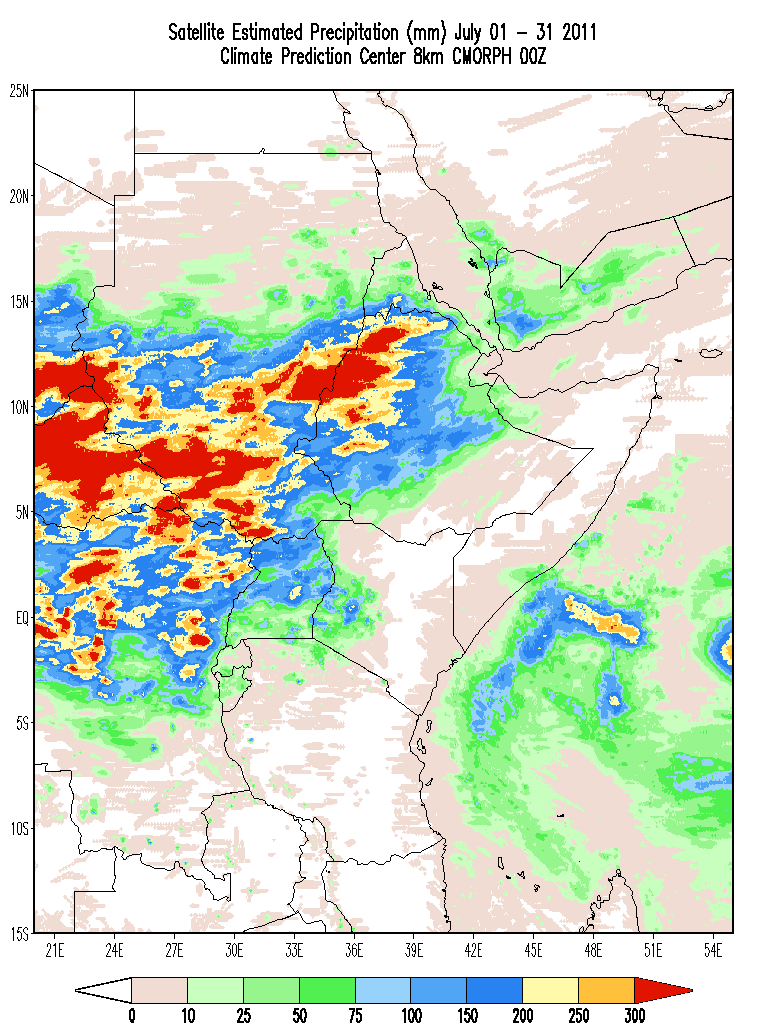
Here is NOAA’s report of rainfall in the area for the month of July just past. This is the area to which all the foreign correspondents are flying in northeast Kenya, southern Somali. In a normal year, these areas would be completely white. From about the end of May to the middle of November, for the last hundred years, not a drop of rain falls.

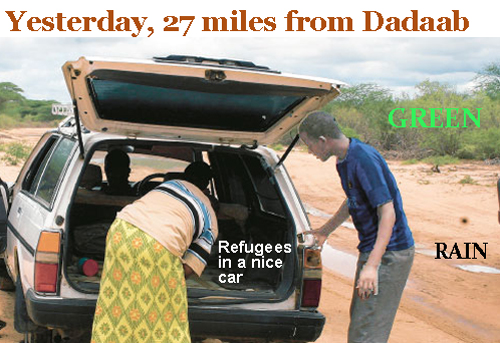
And now, it seems at least for the moment, it’s raining. Study the picture above. It was taken by Agence France Presse yesterday near the Kenyan town of Liboi, which according to GoogleEarth is about 27 miles northeast of the misery center of Dadaab.

There are pools of water. There is green grass. There is an automobile, although the AFP caption for the picture reads “Somali immigrants repair a tyre 2km inside Kenya enroute to Liboi. There are few who can afford to pay up to $150 to travel from the capital Mogadishu.”

Here is NOA’s prediction of expected rain for next week. Good news, of course. White overlaid by brown and even green shades showing pretty intense drizzle for the desert in a dry season.

What seems to be happening this year is a shift due to climate change of the rainy season that usually occurs March – May, to now. The March-May period was dry.

But understand this, please: A single missed rainy season cannot possibly cause such misery. Unless..

…there’s a vicious war just now getting worse… there’s a world recession that has so increased food prices that normal development aid is collapsed into fractions of its worth… there is political tension in the area so that bumper harvests (in Tanzania) are being prevented from shipment to the areas in need.

All the above are true. Add the real stress caused subsistence farmers who are disconnected from their normal planting routines by climate change, and you have … famine.

There is real, significant, terrible famine. We are approaching a half million people starving in the area of Dadaab … where it may be raining.

Uniquely as always, Jeffrey Gettleman of the New York Times, is reporting the truer story. And he is located exactly where the famine is really being caused. And that is not Dadaab. It’s in the heart of the battle for Somalia.

Gettleman makes the same mistake everyone seems to be making: calling a huge area “the worst drought in 60 years” which, sorry to have to repeat, it isn’t. But this is buried deep in his story which is otherwise right on. He explains the catastrophe as a political one, not a climate-made one.

A number of you have emailed me asking me for advice regarding how you can personally contribute best. I’m not the one to ask. Click here for better recommendations than I will give you.

My recommendation is one you probably won’t expect.

Become political and support leaders who understand a world order. Spend significant resources to defeat T-Party like mentalities that refuse to ameliorate world suffering with even a penny of the rich.

This famine is man made. I’m not for an instant suggesting that American conservatives have caused the war which caused the famine. Quite to the contrary, if anyone caused it, it was Bill Clinton.

His sheepish retreat from dealing with the mess in Somali because of the political flack he got from BlackHawk Down is the main reason for the problems, now. Almost 20 years ago, we now see the damage of short-term political gain.

This isn’t a left or right issue. It’s an issue of simple long-term compassion. Unless we get our heads screwed on right and steadfastly so, there’s going to be famine at Thanksgiving in the rain forest.