Last of the Matriarchs

Last of the Matriarchs

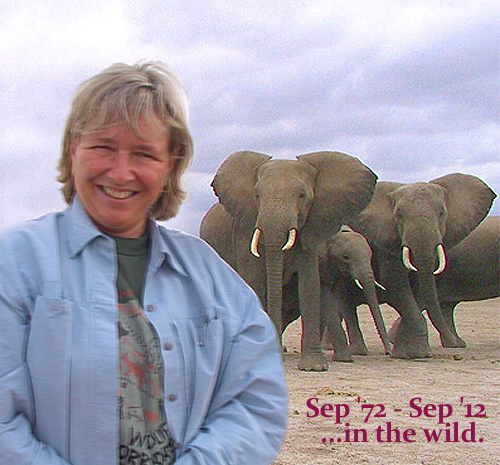
This month marks the 40th anniversary of a celebrated field researcher, Cynthia Moss. Ms. Moss began her field research in 1972 where she remains today, among the elephants of Amboseli in Kenya.

Moss was the 4th untrained volunteer woman who turned up in the field in the 1960s and early 1970s and became famous worldwide for big game conservation. Her species was elephant. The three who preceded her by a few years were Jane Goodall (chimps), Dian Fossey (mountain gorillas) and Birute Galdikas (orangutans).

What the four have in common is chutzpah. Only Galdikas had any higher science education. Moss had a higher education degree in philosophy, but the other two had no science education above secondary school.

The first three all obtained their first posts in Africa from the famous paleontologist Lewis Leakey who Vanity Fair argues chose them less for their potential as field researchers as for their amorous attachments to Leakey. Read the outstanding book by Virginia Morrell, Ancestral Passions.

Moss on the other hand seems to have been the only of the four recruited for potential field ability. Her mentor is the dean of elephant research in East Africa, Ian Douglas Hamilton.

Moss began studying elephants in what at the time and ever since has been one of the best elephant habitats in Africa, Amboseli national park in Kenya.

The four ladies popularized big game especially in America and harnessed enormous support for African conservation by bringing to life in very anthropomorphic ways their favorite animal. They would not have succeeded, today.

Not only were they untrained in biology or field research, none are very nice. They all operated as little dictators in their neck of Africa, and except for Moss, their science – especially their early science – was nothing short of grade-schoolish.

But it took several generations of researchers following them before that was understood. Today none of the four except Moss is cited for their research, but they are all rightfully honored for opening America’s eyes to the plight of big game conservation in Africa.

And without opening America’s eyes, there would not have been enough check books to open to fund the body of research and protection which has truly saved their favorite animals.

South Africans in particular are very sensitive about this, because good big game research had been going in southern Africa for nearly a century before these four wholly untrained “entertainers” hit the seen and captured America’s treasury.

But South Africa even before the excesses of extreme apartheid had never been able to attract the interest of American animal rights activists. Probably they didn’t want to.

In addition to being an inward society for centuries, South Africans had mistrusted Americans for a long while. There was never the chemistry between the two societies that would have enticed an American public to become Africa animal sensitive.

So East Africa was the perfect place for them. (Galdikas ultimately ended up in Malaysia.) Just coming out of the colonial era, no good extended animal research had been conducted of East Africa’s big game or primates.

Notably the great scientist, George Shaller of the Bronx Zoo, studied mountain gorillas that still today is considered to have been better research than Fossey’s. And he preceded her by several years. But Shaller never stayed anywhere very long.

That was what all four women did best: Stay.

Except for Fossey who was murdered in revenge for her likely racist attitude to Rwandans, the other three spent long lives with their chosen animal. In so doing they published popular books, were increasingly interviewed on television and invited as popular speakers throughout America. Like today’s better known animal people such as Jack Hanna, they were much more entertainers than scientists.

Moss was the only of the four who significantly contributed to science, and it’s probably the reason she’s the least known. The other three made their initial marks in personality scandals or with brash claims about their animals that have long since proved incorrect. Moss, a few years younger and later to the scene, conducted meticulous research with methods that are still used today by young researchers.

I had my own personal battles with the three in Africa, because they were all in the beginning defiant of tourism. Each was so protective of their distant escape to Africa, they shunned rich people’s donations rather than agree to welcome them into the field.

I as the guide was considered the facilitator of this disrespect and violation of their little self-proclaimed kingdoms. Guides were easier to blame and a lot less rich than the clients

That changed radically over time as it became apparent tourism was part and parcel to funding African conservation research. Today there is no important NGO that does not coordinate laymen tours to their areas of funded research.

Nevertheless, the personal animus developed between myself and all three African research ladies is still hard to ignore. At the time their sabotaging of some safari dear to my heart and essential to my bank account was tantamount to war in the field. I concede now, though, that without their personal and truly remarkable chutzpah East African conservation would likely be in a considerably worse state right now.

Moreover, I’m no more trained in tourism or guiding than they were in animal research. So despite our feuds, we can truly all be wrapped up into the same amateur motivation that drove us all: an intense love of Africa.

And this particular anniversary of Ms. Moss’ 40 years in the field is the easiest of them all to celebrate, since of all four women, her dedication has been the most sincere and has produced the most true science.

Happy Anniversary, Cynthia! As the last of the great matriarchs, none will assume your place, unlike the thousands of matriarchs you have nurtured and saved in the African wild.

Better Science on a Better Horizon

Better Science on a Better Horizon

Two new monkeys discovered in Africa since 2003 suggest the continent is becoming more peaceful and interaction with scientists from the west has become healthier.

First seen in the jungles of The Congo in 2007, the lesula monkey (Cercopithecus lomamiensis) has now been studied enough to announce its discovery as a previously unknown species.

In 2003 in high forests of southern Tanzania, the kipunji (Rungwecebus kipunji) was discovered, and the latest discovery before that was the sun-tailed monkey in Gabon in 1984.

Both of the most recent discoveries were in areas in Africa inaccessible until only recently. Ironically, they were not inaccessible five decades ago – quite to the contrary. But with the advent of The Congo wars and decreased western aid after the collapse of the Cold War, much of accessible Africa became inaccessible or too unstable for field science.

I think it significant that before these two most recent discoveries, the sun-tailed in Gabon was in 1984 just before the collapse of the Cold War.

The most recent discoveries provide science with much more than just another listing. The odd behavior of the kipunji and the very unusual forest floor niche occupied by the lesula add surprise to previous understandings of African monkey ecology. DNA analysis, particularly with the kipunji, has aided immensely with the determination of biological divergence with other primates including man.

The lesula was first seen in 2007, subsequently documented, and this month the discovery published by John Hart. John, who along with his wife Terese, are veteran African field scientists. They are best known for their work with okapi and more recently, bonobo. Most of their adult lives have been spent in The Congo, but their published work recently has accelerated.

Where they are, now, in The Congo is not exactly a tourist destination. But the agreement of not just the Kinshasa government but local authorities and militia commanders has allowed the Harts much greater security and access. They have recently been awarded global funds to create a new jungle national park.

This would have been unheard of ten years ago. The Congo is far from pacified, particularly areas just to the south of where the Harts are now working.

But compared to only a decade ago, you might be forgiven for tagging the Harts’ field a honeymoon destination. This because of intensified United Nations (Security Council) involvement in The Congo, proactive diplomacy by world powers, and particularly with regards to The Congo, the exceptional work of the Obama administration embodied in the Dodd-Frank act.

The concerted efforts of global authorities and the proactive involvement of the United States during the last 3-4 years in The Congo and Somalia in particular has brought back hope that these chaotic and violent places may yet regain their legacy as truly an African paradise.

Have we turned a corner in African peace and global sanity?

Ask me November 7.

To Preserve & Protect

To Preserve & Protect

African unrest this week and Tuesday’s attack in Libya are profound indications that democracy is as nuclear as uranium.

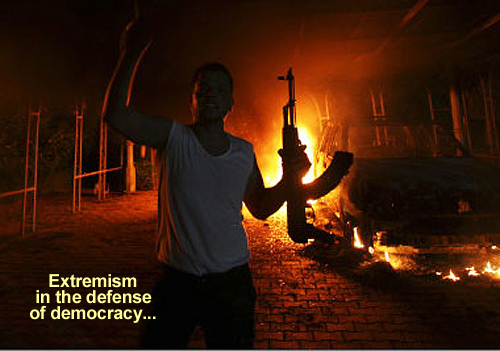
The attack of America’s Benghazi consulate was likely coordinated by an al-Qaeda affiliate to mark the 9-11 anniversary. But were the growing protests prior to that just coincidence? Even more eery, was the film by a mysterious American extremist posted on YouTube castigating Mohamed coincidental?

Conspiracy is a nasty game but there are some dangerous fingerprints on that video. The maker has disappeared. New and technologically immature Afghanistan was able to block it from being seen by its population, but vastly more savvy Egypt didn’t.

And much more to the point, how does such symbolism evoke such violence?

The same way white pointed hats in the older South played judge and jury in a single night. Or the way presidential candidates threaten bureaucrats with summary lynching. Or the way Rush Limbaugh raises the blood pressure of 5 million brainwashed Americans every day.

Democracy is not just the freedom to choose your leaders, but the freedom to choose bad and evil leaders, and even the freedom to choose war mongers and genocide organizers. Evil is evil in part because it fools the good into thinking it’s something else.

That’s what’s happening with the growing crowds of protestors in the Mideast, now, throngs of desperate people looking for a fight, anything to blame their misery on.

When strongmen held Egypt and Libya at bay, just as strongmen today in Uganda or Zimbabwe, dissent of any kind is eliminated. Yet these dictators are often tolerated by the world and held to some mythical threshold of human rights violations, some trigger line of so much blood spilled.

We forgive without question their mercenary capitalism that allows them to achieve untold wealth at the expense of their poor. But we kick into action when slow death is replaced by quicker, more violent deaths. And perhaps there’s no other way. We can’t be everyone’s brother’s keeper.

But our mistake is the belief we are ourselves immune to such folly. We, too, are fooled. We, too, are impoverished by our elite leaders.

Consider this. The arsenal of weapons including shoulder-fired missile grenades that blew up our Benghazi consulate are available right now for you to buy on eBay, and while the vast majority of the world forbids their ownership by private citizens, you can receive them legally by UPS in Colorado and Texas.

Democracy, like conspiracy, is a nasty game. It doesn’t always turn out the way you’d like.

Education Needed on This

Education Needed on This

Teacher strikes in Africa and around the world mark a critical point in the global recession.

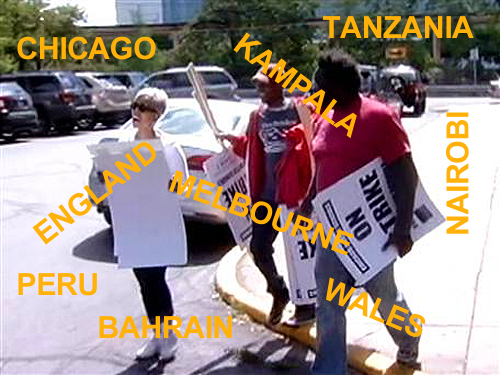
In Kenya the country’s entire educator workforce is on strike, from primary school through university. Last month’s teacher strike in Tanzania has been suspended only temporarily, and in Uganda teachers are poised to walk off the job in the next few weeks.

But there are also actions or looming actions in England and Wales, Australia and of course in my home city of Chicago. Teachers are also threatening work action in Peru and South Africa. Teacher leaders have been jailed in Bahrain which could once again destabilize that city-state.

What’s going on? There’s just too many educator work actions in too many widely different places to suggest anything like coincidence.

The Chicago strike is not about pay; the Kenya strike is about pay; and from the Mideast to Asia the range of issues is as wide as the geography. But in the end it is all about the bottom line. It’s all about the cost of education and the widely presumed notion that it isn’t working well.

I have no idea if education is working well in London or Sydney or Bahrain, and I’m pretty convinced it’s not working as well as it should in Chicago or Nairobi. But actually when you stand back from the globe and look at the turmoil, not even that seems to be the point!

Education is among the last of public services to be hurt by a global recession. When an industrial plant closes, usually a sizeable chunk of the workforce is let go all at once. Not so with education. You can’t close schools wholesale. Instead you inch up the class size, reduce the scope of services and month after month squeeze the teachers for a little bit more.

If the squeeze goes on for long enough it pops. And that’s what’s happening, now.

Conservatives around the world see this as an opportunity to trim excess and improve delivery. Progressives see just the opposite, an attempt to balance a wider social imbalance on an already stressed system.

But that’s not the point of this blog.

When such diverse societies in so many places in the world begin battles with their educators over such a range of issues, it means that globally society is really being stressed to new and maybe dangerous points.

There is a way out of this. And put aside for a minute the enormously different issues from one school system to another across the world. Education distress worldwide is an indicator that in sum the global recession isn’t easing; it’s getting worse.

There are models to turn this around: In France, China, Australia and the U.S., stimulus is being exercised. It’s important to note how different is the extremely conservative politics and society of Australia compared to the socialist politics and society of France; and how different the U.S. and China are in so many ways.

Yet these four countries have all used or are using now stimulus, and they are all much better off than countries like Britain and Peru which have opted for austerity.

The laws of economics trump all other laws.

Many African countries are on the cusp of having to make the decision about stimulus or austerity, because when the developed world tanked into recession, they actually benefited for a few years. Their decisions about stimulus vs. austerity are only now being legislated.

They should take heed carefully. The U.S. did it correctly; Britain did not. If we can get enough of the world to realize this and follow suit, then the education wars won’t be followed by wars in health care, civil and national defense.

Bringing Handguns into Kenya

Bringing Handguns into Kenya

Pastor Jim wrote:
Jim, I travel to Kenya once a year for a month. I go into areas that are not safe, expecially in turkana, Kisumu, and Nairobi, ect.. Can an American get a permit to bring in a handgun and then leave with it?

Dear Jim,
Ever since Kenya banned hunting in 1978, it’s very difficult to enter the country with any kind of gun. Permission must be requested through the American embassy, and that is the first big obstacle. Even after the embassy requests the permit on your behalf, it is unlikely that it will be granted unless your profession is one that normally requires weapons (such as a policeman), or unless you are ultimately transiting to another country like Tanzania that allows hunting.

But much more than that, Jim, if you ever had to use your gun, you would probably end up in jail in Kenya, even if the use was in self defense. The gun laws in Kenya are extraordinarily strict. Use even in self-defense is limited. And the embassy would give you no support.

Kenya is in the midst of fighting terrorists, and any individual attempting to bring in a weapon for whatever reason is suspicious.

I travel often to Kenya. I have businesses there. I haven’t been to Kisumu for a while, but I do get into the Northern Frontier. I have never been armed.

– JIM

No More Mali than Madagascar

No More Mali than Madagascar

The increasing destruction of Madagascar’s environment is no less critical to mankind than the destruction of libraries and temples in Mali.

Two scientific studies completed last month now confirm that the incredible rate of Madagascar deforestation is so severe now that the runoff erosion is “smothering local coral reefs.” This is the first time that the well reported rape of Madagascar’s biomass now extends into the oceans.

Westerners know Madagascar for its lemurs, and that is a perfect “mediator” species of the country’s serious political ailments. I coin this phrase, “mediator” species, because lemurs haven’t suffered nearly as much as a species as the vast majority of Madagascar’s reptiles, other animals, plants and birds.

I think this is because much of the Malagasy population is educated and its politicians are as cunning as they are violent, and they all know that if lemurs start to decline the way trees have, that much more attention would be focused on the country’s horrible politics.

Consider this: 98% of all of Madagascar’s land mammals are endemic like lemurs, found nowhere else. Add to this 92% of its reptiles, 68% of its 9000 plant species and two-fifths of its breeding bird population – all endemic. All seriously threatened.

Madagascar’s problem, like Afghanistan’s and Mali’s, is political. I would be the first to point out an economic or forest-human conflict, and much in the press and even the academic media suggests this.

It’s not true. The rape of Madagascar’s biomass has not produced any short-term economic benefit to its population, because the proceeds from the sale and destruction principally of its forests have been siphoned off by corrupt officials and foreign companies. It isn’t trickle down economics; it’s trickle away economics.

The little that remains of the country’s polity and corruptible government does everything in its power to protect lemurs. But little to protect anything else. I wrote earlier how global capitalism has now found numerous insidious ways to exploit the last of precious, endemic Madagascar.

And Madagascar’s Shakespearean if As-The-World-Turns incendiary politics never becomes quite violent enough to attract world attention, either, even though it is starting to destabilize the entire society and keep tourists away. Much of the political shenanigans, in fact, is comical. I wouldn’t be surprised if the warring opponents are in cahoots to reap rosewood profits.

It’s time the world attends to Madagascar, the same way it “attends to” Afghanistan and Mali. Mankind is as much the marvels of the planet as the marvels of human history.

Kenya Great But Don’t Go

Kenya Great But Don’t Go

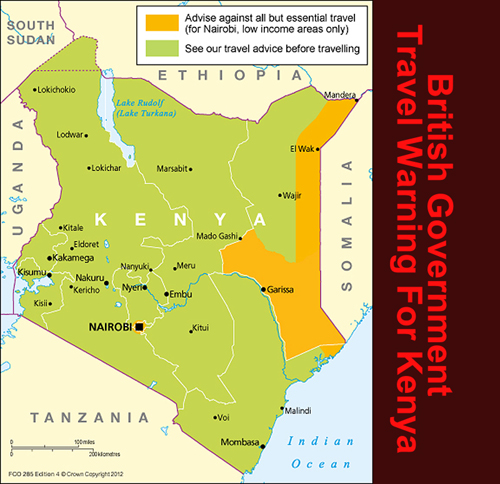
Good news in Kenya is causing extreme turbulence and many countries are cautioning their citizens about traveling there, now.

It’s heart-wrenching, because Kenya depends so much on tourism. It’s complicated, because the potential for disrupting foreign vacations comes specifically from a series of successes in Kenya’s military operation in Somalia and its growing role in the global war against terror.

Britain, France, Australia and Canada among several dozen other countries all issued new advisories to their citizens this week, indicating that travel to Kenya has become increasingly problematic. (The U.S. did not, and that oversight continues a long history of poor and misleading travel advice coming out of Washington.)

All countries said the same thing: don’t go to any part of the northern coast of Kenya including Kismayu and Lamu, and if you travel to Nairobi city, avoid a number of the poorer areas, specifically named.

The reasons for this stem from two major events this week:

A radical cleric in Mombasa was assassinated in a drive-by shooting. As I wrote at the time Sheik Aboud Rogo was a well-known supporter of al-Shabaab, al-Qaeda in Somali, and one the remaining likely fugitives of a number of high-profile terrorist events.

As I said I believe the shooting was done by the very people Sheik Rogo supports as an attempt to incite violence and disrupt Kenya. It worked. Kenya’s second largest town and only port exploded in violence earlier this week.

Secondly, after nearly a year, the Kenyan military is about to invade Kismayo, the final stronghold of al-Shabaab. It’s Somalia’s modern port, largest organized city and the capital of pirates and terrorists the world over. The economy of Kismayo alone is estimated at ten times that of the rest of Somalia.

This week the Kenyan navy continued an unending bombardment of the port, taking out its airport and confirming the death of at least two major al-Shabaab leaders. The Kenyan air force has been dropping leaflets on the town explaining to citizens where and how to flee once the ground fight begins.

After Kismayo falls, al-Shabaab has nothing left but disparate mostly now ungoverned guerilla fighters, and clearly what they will do is attempt strategic acts of terrorism. The Kenyan coast – where 50% of all its tourist revenues are generated – is within day’s walk of Somalia.

And the poor neighborhoods of sprawling, gigantic Nairobi are perfect hideouts for fugitives. This year a number of grenade attacks have already occurred there that were linked to al-Shabaab.

But if you’re a Kenyan, and despite a lot of civil and political turbulence right now (including several major public sector strikes), you’re incredibly hopeful and aggressively behind the government. The march to the historic spring elections under a new and brilliant constitution will become a model for much of Africa.

But fate has dealt Kenya, with its geography and its rapid development, a terrible roll in the world’s struggle to end terror. It’s stepped up to it, and I think it will prevail.

But as much as I support Kenya and hope for its ultimate success and glory, I cannot do anything other than advise potential travelers not to go there, now.

Elephant Friends or Human Foes?

Elephant Friends or Human Foes?

The Times article about escalating elephant poaching rebroadcast by NPR this morning needs more discussion, especially if you’re a sympathetic American.

Jeffrey Gettleman described in exquisite detail typical of his outstanding reporting the rapid increase in elephant poaching in remote places like The Congo.

It was an excellent piece of journalism, mainly because Gettleman pulled no punches. He let others explain his conclusion that the culprits are existing governments and renegade militias, and that the problem wouldn’t exist if China weren’t getting rich.

Unfortunately Americans often don’t read that far into an article, and when reduced by the NPR report this morning, some of these very important conclusions were terribly skimmed over.

I often feel ashamed as an American of our knee-jerk reactions to animal cruelty, for example, when it prompts us to greater action than people cruelty in Africa. And this is the perfect example.

Read Gettleman through to the end, don’t listen to NPR, and then think about it carefully.

Elephants today are nowhere near as threatened as they were in the 1980s when selling ivory in most parts of the world was legal. Then the only impediment to wiping out the species was the impoverished and usually corrupt African government that made it illegal to steal ivory from their wilderness.

But once out, the free market reigned most cruelly. And it was easy to get out. The wife of the president of Kenya, the country that suffered the most rapid decline in elephants, was a kingpin in the market. And there were no extradition treaties for ivory.

Ivory has been considered an exceptionally precious commodity in Asia for literally thousands of years, and that hadn’t changed in the 1980s and hasn’t changed, now. It’s an exceptional media that allows intricate sculpture yet holds its form through unusual strength and goes through subtle and beautiful color changes with age.

Like so much in nature, it is so much more beautiful than anything synthetic.

Tanzanian researcher Charles Foley also argues that the OPEC oil crisis of the 1980s prompted Mideasterners to cache their funds in durable commodities like ivory, and to be sure, many of the poaching syndicates were ultimately traced to the Mideast. That was the middleman to Asia.

The problem wasn’t solved until the world came together and created a global treaty that banned the sale of ivory, CITES. It is that treaty still in force today that is no longer functioning.

And the reasons it’s no longer functioning reveal a deep human neglect that is much more profound than neglecting to protect an animal. There are two equally culpable parties: China and The West.

CHINA’s BLAME
Hillary Clinton is today in China making the case for the first: CITES was successful because China and all of Asia (at the time, critically important Hong Kong) was on board. Today, China is ignoring CITES.

And the market for ivory in China is unbelievable. There are literally hundreds of thousands if not millions more rich Chinese than existed in the 1980s, and as their own economy falters and the world seems momentarily less secure, their passion for ivory has renewed geometrically.

In the 1980s ivory rose to $100/kilo. Today in China carved ivory trades as high as $1000/ounce.

When there is such an incredible demand, where an ounce of a product that comes in 100-pound tusks is greater than the average annual income of an African living in central Africa jungles, imagine the temptation to kill the thing.

China’s inability to curb its effete greed, its inability to develop an art culture that doesn’t lay waste a living thing, is essential to understanding this dilemma.

WEST’s BLAME
The West’s culpability derives mostly from its obsession with terrorism and it is a sweet-and-sour story to be sure.

To our credit America is eking away much of the under-the-table and immoral politics of our past history with Africa, and so is much of Europe. The new Dodd-Frank regulations of how American corporations can obtain precious earth metals from Africa has strangled many African warlords. Reparations by several European countries for the most patent sins of colonialism has reversed a century of denial.

But our continued military involvement in Africa, escalated by Obama especially in Somalia and the central African region, has in its military successes turned warlords and militias on the run into elephant killers.

Starved of precious metals like coltan, turned tail by increasing military losses, African guerillas like the remnants of the Lord’s Resistance Army are now fueling their dwindling operations with the ivory trade. And with the market so ready, it’s an easy call for them.

And worse, the ostensible victors in these military skirmishes, especially the Ugandans, have now been documented by Gettleman of using the military equipment given to them by America to slaughter elephants.

I have no doubt that Obama and his advisers believe that the military successes in central Africa and Somalia are worth the loss of elephant.

So do I.

And that’s the profound understanding you’ve got to acquire from this complicated story. Be patient. Condemn the elephant slaughter, support Hillary in stiff arming China to return with fervor to CITES, but don’t do anything else.

Don’t send a new $100 to Save the Elephants, because you believe the organization which does fantastically good work in Kenya can save an elephant from the Lord’s Resistance Army in central Africa selling to a fanatical China. It can’t.

What will impede the current slaughter is reducing terrorism, making China adhere to CITES, reducing the market value of ivory to something fathomable vis-a-vis an African’s annual wage. And these solutions aren’t easy ones and there is no better way to effect them than to support an American foreign policy on the right track for the first time in a generation.

Nor will elephant poaching be stopped by more guns in anti-poaching, as Gettleman brilliantly reports. It will stop in stages as man’s inhumanity to man stops. It will stop as slowly as greed is reversed and compassion grows.

And plausibly, that might never happen. But if we lose central African elephants we might gain an equally valuable lesson: no animal will be saved in this world, before man saves himself.

Death Becomes Them

Death Becomes Them

There are many different kinds of poaching and some I actually sympathize with. But a particular type of child poaching in Kenya is uniquely tragic.

Poaching is hardly confined to Africa. The legendary boar poachers in my childhood home of Arkansas, or deer poachers in my neighboring state of Wisconsin have fed grand literature as much as poor folks. And it’s hard to jail a man who is trying to do nothing more than feed his family.

And much of African poaching fits into that category. Yes, it’s against the law. And without a corrupt-free justice system fledgling societies will themselves become poached by the rich and powerful.

And sometimes worse, it involves fragile species and ecosystems like mountain gorillas in Rwanda or a rapidly declining lion population in Kenya’s Mara.

But when the poaching is essentially the way a man feeds his family, it’s very hard to pursue the grander mission. A gorilla poacher on Sabyinyo is not going to eat the gorilla, and the single elephant poacher in The Selous is not going to barbecue elephant. But a market of the rich and powerful is eager to convert their loot into potatoes and mash.

Western Kenya is a diverse environment characterized mostly by dwindling wetlands and forests a part of the greater Lake Victoria ecosystem. It is a densely populated and still rural part of East Africa where some of Kenya’s greatest working poor live.

Historically farmed, there are now too many people competing for too little water and nutrient land.

Numerous aid organizations have been trying to lift rural western Kenya out of its abject poverty. A Netherlands NGO, ISCOM, has been working for a number of years to develop rice farming in the area and it’s working. The area’s rice production is increasing and its population is definitely benefitting.

But not quickly enough.

The area’s rich biomass is concentrated mostly in birds. Kenya’s nearby Kakamega Forest is only 17 square miles and has more than 300 species of birds and 400 species of butterflies. This is roughly twice as many species as found where I live in northern Illinois, which is 1500 times larger.

Many of the birds are endangered but more to the point, child poaching of birds is now near epidemic because of the use of easily acquired pesticides used for the area’s agriculture.

Children lay traps for the larger birds like the openbill and other large storks as well as raptors, by lacing the bird’s traditional food source with poison.

It’s like hunting turkey out of season by lacing berries with D-Con.

The new problem, of course, is that these very strong pesticides don’t only kill the bird, but can very easily kill the person who feasts on them, much less directly infect the hasty child that handles them.

The real culprit here is Furadan. I’ve written about Carbofuran, the proper chemical name, before. It’s a deadly and unnecessary American produced and marketed pesticide now banned in the U.S. but laying waste the developing world.

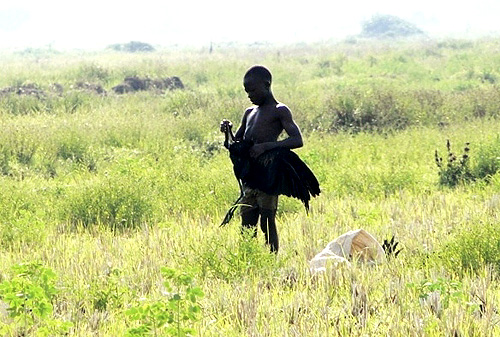
The latest tragedy was reported yesterday by a Kenyan researcher in the Bunyala rice area. It was nonconfrontational. The kid didn’t realize he was doing anything wrong. He carried a large sack with the poached bird and from the picture appears proud to readily display his catch.

The cheap pesticide marketed by American and European companies to Kenya because they can no longer sell it at home is used by the kids to lace rice that lures the birds. But with the openbill stork shown in the photo above, the bird doesn’t usually eat rice. It eats snails.

A 12-year old is not likely to carefully dust only the rice with Furadan. A 12-year old is not likely to make sure the rice doesn’t get wet or fall into the wetlands. Many types of birds are being poisoned in Bunyala by this Darth Vader chemical.

The researcher believes the kids are intentionally sent out by adults as a way for the adults to evade prosecution.

Perhaps. But it may also be a way the adults feed the kids.

African Perspective on Romney

African Perspective on Romney

No surprise that Africans don’t like Mitt Romney. But what is surprising is that they take Obama’s reelection as a given. Romney is not considered a serious candidate.

Or possibly Obama is considered invincible, and those of us at home know this is really not the case. But why do Africans think so?

The birther issue reborn a few days ago, Romney’s callous remarks about his ancestors owning slaves as reason he understands black people, and last night’s clumsy if crude endorsement by Clint Eastwood are all the types of news stories that quickly make it into the African press.

And frankly, those Romney snippets don’t portray a serious candidacy but one so far on the fringes it can appeal to only a very small group of people.

That’s, of course, where Africans are wrong, as is much of the world. Americans are credited with superior everything – superior economy, superior entertainment and superior government. But that, too, is wrong. And Romney’s appeal – however limited foreigners might think it – clearly appeals to a large portion of America.

In my opinion, it isn’t an America foreigners can’t know, it’s one they choose not to know.

There’s so much angst in the world right now, the notion that there is not a shining beacon on the hill is just something an African, for instance, would rather not believe.

The South African press in particular has been covering the election campaign quite extensively. The issue of most interest this week got little attention in the American media.

A reporter for Yahoo News, David Chalian, was caught unawares on a live webcast in conjunction with ABC News at the Republican Convention. As Hurricane Isaac approached New Orleans he remarked to a guest at his side, “Feel free to say, ‘They’re not concerned at all. They are happy to have a party with black people drowning.'”

Chalian was immediately fired by Yahoo, and that has stirred widespread disbelief that the American system is so unforgiving of impoliteness, particularly when the impoliteness happens to be true.

In a comment left after a South African report of the incident, ‘Pointman’ summed up all the other many comments that today flood South African newspapers about the story:

“The journo was most probably right. Remember the Republican party’s response to Katrina and the flooding in New Orleans- all those Black people (and whites too) stranded after the inundation and no help anywhere for days.”

“I agree,” then commented ‘Cocolucho.’ “The republicans only seem to care about bible wielding whites and no one else, which is funny cos they are such hypocrites.”

“Most White Americans including those that fired him,” added ‘Tsatsatsa’ “share the very same sentiments.”

“Americans are racist,” declared ‘DJ-Winner.’ “They go as far as calling that country a safety heaven. Safety heaven, my foot.”

‘MommaC’ said, “Shouldn’t have been fired for telling the truth.”

The comments are flooding the South African press, today. They are essentially dismissing the seriousness of people who really still question Obama’s nationality, who take Romney’s remarks about women and ancestors and abortion with hardly a grain of salt, and who would fire a reporter for what he thought was an offline remark which also happened to be true.

They are dismissing the Romney candidacy as no real threat.

Don’t be so sure.

Sheik Aside

Sheik Aside

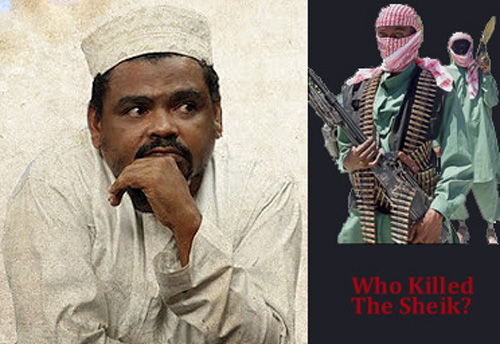
Tuesday’s drive-by killing of the jihadist cleric Aboud Rogo in Kenya marks a small if hopeful turning point in the troubled East African coast.

Real evidence will never emerge so we are left to speculation, but blogs, rumors and common sense seem to converge this time: the murder was specifically intended to stoke religious and ethnic violence.

It did at first, but only at first, and the city did not even fire up like Watts in 1965 or Tottenham only a year ago.

This doesn’t mean that the embers remaining aren’t nuclear. But to me it seems a clear indication that Kenya’s invasion of Somalia, the global “War Against Terror,” and Christian/Islamic confrontation has peaked. In a weak and uncertain way, logic tells me things are going better.

Sheik Rogo was a fiery and provocative cleric, openly recruiting young Muslims in his Mombasa madrassa for al-Shabaab. For years he’s been associated with a number of jihadist attacks in East Africa, including the bombing of the American embassy and several high profile attacks on the coast, including the terrible bombing of an Israeli resort.

He was killed Tuesday in a carefully planned and masterful drive-by attack. The attack car which has not been found, the lack of any leads by police, the particular place the shooting actually began, and the high caliber bullets found at the site and not easily available in Kenya, all point to a very carefully organized murder.

The sheik has been confined to the Mombasa area virtually since 2002 when he surrendered his passport to Kenyan authorities. He remained charged with numerous counts of terrorism, and his legal battles in Kenya are legendary.

But he has never actually been brought to trial, and Kenya has resisted extraditing him to the U.S. for instance, for fear such action would provoke Mombasa’s radicals. So instead Kenya did what a western country can’t discipline itself to do: nothing.

African patience was winning out. The sheik’s prominence peaked. His support was waning. In the most virulent political battle on the coast going on right now, a move by a new but powerful Islamic political party to secede from Kenya, the sheik had no involvement. In fact, it appeared he’d been excluded.

Western detractors tried to pin the assassination on America or the Kenyan police, claiming each was no longer tolerant of the protracted legal battles against the sheik. I seriously doubt this. Obama’s War on Terror is going just fine, in part because people like Rogo have been marginalized. Better to have him contained in Mombasa than Guantanamo.

It’s much more likely that the dying powers in Somalia saw the sheik as a sacrificial lamb. Recruits from his madrassa to al-Shabaab are less important, now that al-Shabaab is being routed.

I think the sheik was killed by a sheik. Disquieting, yes, but when the fighting turns inwards the battlefield grows smaller.

Terrifying Silence in Kenya

Terrifying Silence in Kenya

An awful restraint hangs like a veil over Kenyan journalism today, as civil disturbances continue in Mombasa and Wajir.

In neither area is the trouble as widespread as some international media have reported: the heavily read International Business Times reported “absolute chaos in the city” of Mombasa, which is absolutely untrue.

In fact the disturbances are pretty confined to a four-block area. And in Wajir, the curfew comes as a preventative measure, not in response to growing turmoil.

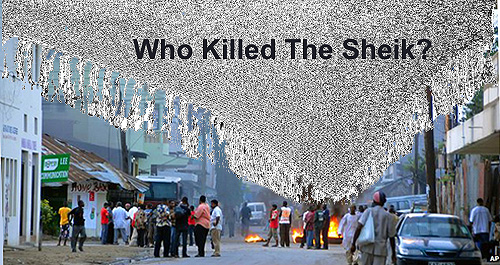
Nevertheless, I’m concerned at how the mainstream Kenyan press is suppressing coverage. The Mombasa disturbances are as a result of a radical Muslim cleric, on bail but not allowed to leave Kenya for terrorism related charges, being killed by unknown gunmen Monday.

In Wajir two different ethnic groups are in the middle of a spat of revenge killings.

These are two extraordinarily different types of social unrest. The Mombasa trouble is linked to the global war against Islamist terrorism, of which Kenya is an enthusiastic supporter having invaded Somali last October.

The Wajir trouble is ethnic, sparked by dwindling resources.

But my concern is that rather than deal with it robustly as Kenyans normally do, the intellectual center in Nairobi is simply not discussing it.

The city’s major newspaper is providing coverage, but it’s off page one, and the Daily Nation’s battalion of excellent bloggers has ignored both issues completely. But the city’s energetic radio stations, which also provide online coverage, said nothing about Mombasa, today.

The situation in Mombasa is much more serious than Wajir, because of its impact on tourism. Mombasa is where a dozen charter flights weekly arrive with European tourists for Kenya’s world-famous white sand beaches. Half of all Kenyan tourists never see an animal; they’re beach bums.

This will undoubtedly be seriously effected, just as bookings for the important end of the year holiday season become finalized.

And I would be one of those travel consultants who would be telling his clients to go elsewhere this year.

So that’s the likely explanation for the press’ restraint. But it’s not worthy of Kenya’s strong history of truth-seeking and long legacies of critical discussion and self-introspection.

If Kenya falls into denial to deal with its problems, it will surely fail. There are extremely important questions to be explored about the current travails in Wajir and Mombasa.

The most obvious is who killed Sheik Aboud Rogo? It was a typical 1930’s Chicago gangster drive-by assassination. The sheik was speeding in a car taking his wife to a doctor’s appointment when gunmen sped up behind him and sprayed the car, killing him.

One could immediately speculate it was America, trying for months to get the Sheik out of Kenya for trial elsewhere. But it is much more likely a completely internal crime, a Kenyan battle that involves the new and complex politics of leading up to the March elections.

A near internecine battle between the front-runner in Kenya’s presidential race, Raila Odinga, and an arch rival, Miguna Miguna has stirred ethnic and religious unrest throughout the country as Miguna goes campaigning. Miguna has interjected Islam/Christian – Terrorism/Anti-Terrorism into the national debate which disarms many in Kenya’s political elite.

It’s a touchy issue to be sure, but Kenyans have never shied away from dealing with the big issues head on.

Until now.

Three Times Nostalgia

Three Times Nostalgia

Not too many years ago, the Mt. Kenya Safari Club was the magic that made a safari. Today it’s just another resort off the Thika Superhighway.

Bidding has opened for 95 of the quarter million dollar residences on the Mt. Kenya Holiday Homes resort, located hardly spitting distance of the Safari Club. Each of the ultra modern 3- or 4-bedroom homes in two or three stories has a fireplace, and is powered and heated by solar panels.

The 123-acre complex is being marketed to city dwellers who long for a second country home, in a perfect location for weekend hiking, bird watching, trout fishing, horseback riding and that occasional golf.

There will be a perfectly manicured 9-hole golf course, and the entire complex is secure by a big game proof electric fence and mini-moat to keep out those wandering buffalo. But if you yearn for wild animals like zebra, lion, elephant and so forth, don’t worry. The resort is just south of the Sweetwaters Ole Pejeta private reserve, famous for its abundant big game.

When Kenyan safaris first became popular to Americans in the 1970s, trepidation was introduced into hard-earned holidays, and the “adventure vacation” was born. And to be sure back then, we knew lots less about malaria and how to prevent it, many of the roads were hardly tracks, and most of the night time lodging was in very basic tented camps with shared toilet and shower tents.

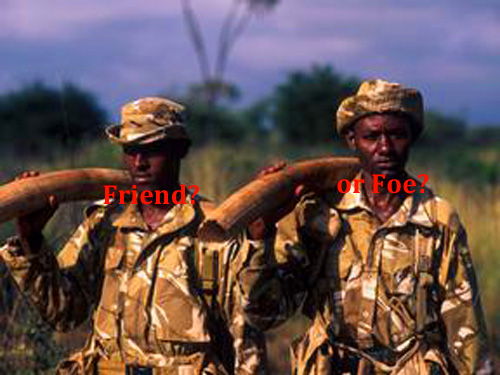
More than once I took my safaris far enough into the bush that we would encounter locals who had not often seen visitors. It was never certain how these meetings would develop: friend or foe. And about the same time police were being appointed to far out places, and it was always certain we’d be delayed for a bribe.

And quite different from what you might expect, the game was hard to find. There was actually more of it, of course, but it was very skittish of people. It wasn’t really until the 1980s that Kenya’s highland game was approachable enough to take good pictures.

So what game we did encounter evinced the old “fight or flee” syndrome. On my very first safari at the age of 21 on my very fast game drive I was charged and hit by a rhino. In my first decade as a safari guide I had tusks through floorboards, was rolled in my tent by an elephant, escape charging lions, had a woman faint to a bellowing buffalo and watched two lovely ladies scream while being charged by a hippo.

And every day was very dusty and very dirty and the evening’s ice cold water for showers was manna from heaven. And even the finest Chicago debutante appeared at the evening camp fire looking like Miss America.

In those days you didn’t race over to Kenya and back for a 12-day jaunt. Most safaris were 22-26 days long. And by the third week, I would definitely notice “adventure fatigue.”

That was when we’d arrive at the Mt. Kenya Safari Club.

Frankly, in the 1980s, the Mt. Kenya Safari Club was hardly more than a nice Holiday Inn on well landscaped grounds built around a central Victorian mansion. The fact was that there were similar homes in the Kenyan highlands, but kept well under the radar, because they were owned by old white colonials still lying low. So to a visitor the Mt. Kenya Safari Club was the most unexpected and amazing jewel in the crown of an adventure safari.

It cost about three times what other night’s lodging cost. The plumbing always worked. Usually, there was hot water. The food, all local, was fabulous, and the old colonial woodworking, Victoria furniture and servants clicking heels became a sort of Colonial Theme Park.

There was a Members’ Dining Room ostentatiously separated from the guest dining room, and membership (open to all) cost about $500/year. The President of Kenya was one of the few black members at the time. (He was one of the few who could afford it.)

So your richest and most resplendent clients were advised before departing home that William Holden, the principal investor of the Club, would welcome their “membership.” And by so doing on those few nights under Mt. Kenya, you would remove yourself from the grand guest dining room and be escorted by the Maitre D’ into the exclusive members’ lounge.

Back then $500 was about a third what a 25-day safari cost! Using the same metric, today, you can actually make the entire down payment on a 4-bedroom, 4-bath luxury home with a fireplace!

The grand if palatial public areas of the original Safari Club were all deep wood plastered with big game trophies. The Club was originally designed as a hunter’s retreat by William Holden and friends. As photography safaris grew much more popular, the board had no trouble pivoting into the modern age.

Today the Safari Club is a Fairmont Hotel. Its revenue stream is now less than 50% from tourists, attracting Kenyans from the city for a weekend holiday.

And no longer unique, there is nothing here different from other nearby resorts like the new Mt. Kenya Holiday Homes except some very precious nostalgia.

Renewing [or not] The Strongman

Renewing [or not] The Strongman

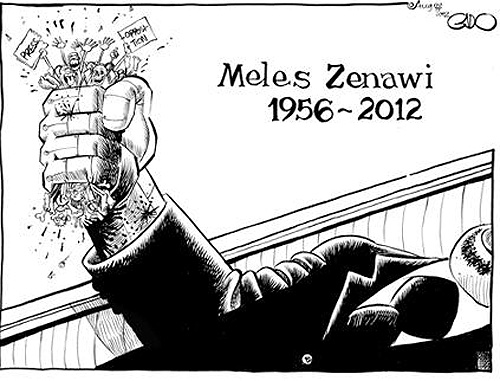
Last week’s death (unusually of natural causes) of Ethiopia’s strongman Meles Zenawi is an unique opportunity for America to reflect on its impact in East Africa, if not the whole of the developing world.

Meles was one of the most ruthless dictators in the world. He was also heavily supported (argue, “propped up”) by the Obama administration. This contradiction was justified because Meles was also instrumental in the War on Terror.

America’s Wars on Communism and Terror and Drugs have governed our policies in Africa for more than a century. The question, now, is whether we are mature enough of a society to throw off these archaic shackles usually described as “self-interest.”

    Cycle One: The War on Communism

In 1960-1962 during the presidency of John Kennedy democratic movements throughout the Congo were quashed and its leaders assassinated paving the way for the continent’s most famous and longest serving tyrant, Mobutu Sese Seko.

    Cycle Two: End of The Cold War

In 1993-95 during the presidency of Bill Clinton democratic movements in the Congo and Rwanda were abandoned to chaos paving the way for seemingly interminable war and ethnic conflict.

At the time the rationale for abandoning Africa to dictators and mayhem was that there was nothing consequential to America in Africa at the time worth fighting for. The Cold War was over

    Cycle Three: The War on Terror

Today, 2010-2012, under the presidency of Barak Obama strongman regimes in Rwanda, Uganda and Ethiopia have received huge amounts of military and development aid paving the way for ruthless dictatorial regimes violating all sorts of human rights.

Today’s rationale is that the War on Terror is going pretty well, and especially well in The Horn of Africa.

Lesser acknowledged but well known is the American Right’s involvement in all three of these cycles. Until the current cycle it was principally from church missions and was admittedly less significant. But during this latest cycle, the involvement of DC’s Church Street and other evangelical groups most prominently in Uganda has been well reported.

The contradictions are explosive:

The most incredible one is that while President Obama has inched his own country away from homophobia quite successfully, his administration piles enormous support on the Ugandan regime which is still trying to pass legislation that will execute gays for being gay and imprison nongays for not revealing that someone is gay.

And there are many more: no military involvement in Libya or Syria, but already a brigade of green berets in Uganda and the CAR; and tax to death or forbid U.S. corporations from extracting coltan and other precious metals from the troubled DRC, but laden Rwanda with extra development aid to build local industries that do just that.

This is not a Right or Left affair, although it seems to always be initiated by Democrats and then massively supported by Republicans that follow. And it is not a Left versus Right affair, either. The fact that Democrats in power are essentially promoting the same thing as evangelic Christians funding movements in African backrooms is clear this is not a Left verus Right affair. It’s a power thing.

It’s ends justify the means. It’s Kissinger’s self-interest dogma. It’s we do what works best for us, irrespective of morals, ethics or human rights. It’s been the way of the world for centuries.

And so we endure Cycle Three: Museveni in Uganda, Kagame in Rwanda and whoever will be Meles’ successor in Ethiopia are all ruthless dictators. Together with American drones, the War on Terror proceeds just hunky-dory.

All hail the African Strongman.