David? Debby?

David? Debby?

Yesterday’s prickly article in Science that there aren’t as many species going extinct as you thought might be because we’re using drones to nuke rhino poachers.

The journal Science is no teenage blog. The rigors of getting published in magazines of this caliber are legend, and the author, Dr. Nigel Stork, comes well credentialed. He’s the Deputy Director of the Griffith School of the Environment, not just one of Australia’s top schools but a global leader.

So what did Dr. Stork say? Something that alarms alarmists, that right now there’s no reason for alarm.

Stork’s comprehensive data study concluded that species are not going extinct as quickly as commonly thought. There is not, as Richard Leakey convinced me years ago, a Sixth Great Die-off happening, now.

Five times before Leakey’s pronouncement in the 1980s, Planet Earth has suffered a massive die-off of species. We know the reason for several of these, including the giant rock that pummeled Yucatan and accelerated the end of the dinosaur era. Another of the reasons millions of years before was when bubbles of deadly methane trapped deep within the earth were released by earthquakes.

While I can’t put my finger on any study suggesting otherwise, it really has been a widely accepted notion that if not an actual “Die-off” that we were losing species right left and center. Organizations such as Global Issues live not die by pronouncing organic holocaust.

Stork says stand back and take a deep breath. He’s not saying everything is as good as it should be, just that it isn’t as bad as popularly believed.

And to his credit he portends Armageddon if global warming isn’t curbed.

The article made me think about East Africa, of course. I thought of the several species of antelope that have gone extinct in my lifetime, the decline in lions, the ups and downs and right now downs of elephants, and the real loss of a number of smaller forest creatures.

Yet I then had to remind myself of how many new species have been discovered within that period. Now this isn’t like new births replacing deaths, of course. But it may indicate that a balance of sort exists that we were just ignoring.

It’s hard to accept that belief. When we get broadsided by Konza Cities and Mega Malls and highways through forests. But scientifically, it may just be true.

Conservation of known species is today a tremendous art and the technologies that have been employed to nurture our biodiversity are sometimes, well, extraordinary.

Take drones, for instance.

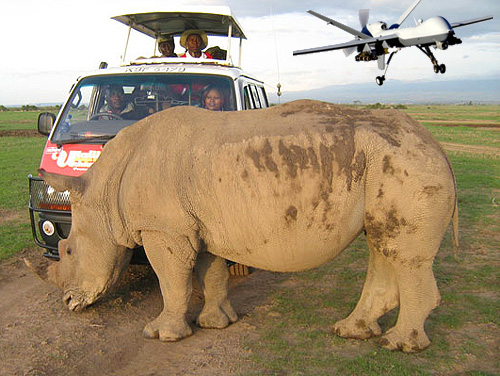
Now that the Somali war is winding down, what do you do (if you were Uncle Sam) with all those robotic airplanes flying all over the place? You start an internet campaign to raise money and buy one of them to fight rhino poaching!

And what a steal it was! The drone cost less than $40,000, but keep in mind how fast drone depreciate and this one had none of the bells and whistles of the better models, like missile launchers and laser sprays.

They weren’t particular about the color, either.

Kenya’s most successful rhino conservancy, Ol Pejeta, explained that the drone was purchased “used” from the U.S. company UASUSA Tempest, and that another U.S. company, Unmanned Innovation, will launch it and provide the ground-based monitoring equipment. No comments from these guys since they’re classified.

I’ve always felt that one of the best ways to justify wars is to give away a few bombs. Discreetly, of course.

Now though the campaign to raise enough money is done, Ol Pejeta will let you donate more and you might win the contest to NAME THE DRONE!

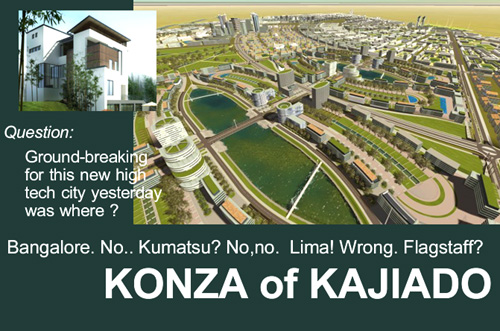
Konza of Kajiado

Konza of Kajiado

Ground breaking my eye, what happened 35 miles from Nairobi yesterday was nothing less than the Big Bang.

“Kenya’s Silicon Valley” they call it: 37,000 luxury homes and apartments, 70 acres of high-tech complexes, highways and public tennis and golf courts, several universities, high speed rail to Nairobi, 4-lane superhighways, buried electricity and fibre optics.

I know I sound like a very old man, but I can’t believe it. “Konza City” was born yesterday, and if it stays on track, by 2020 it will rival the most advanced tech cities in India and create more than 200,000 new high-skilled tech jobs.

Not only will it have call centers that we all know and hate so well serving us as likely as Proschnik in St. Petersburg, but it will have dynamic research facilities building on Kenya’s promising lead in expensive cell phone technologies, as well as medical and agricultural research facilities.

Its developers champion “green technology” and so there will be considerable solar polar.

The Kenyan’s call it a technopolis. The World Bank has funded the $330 million high speed railway that will connect the area to Nairobi, and planning is already well underway. The first rails will be laid in 2014.

But private investors are contributing up to $1 billion to a variety of areas, from private home construction to tech factories to malls. Already smaller Nairobi investors are vying for placement for car shops and grocery stores. $1 billion dollars in Kenya is easily equivalent to $100 billion in America.

More than 250 global companies have already pledged involvement, including Huawei, Samsung, RIM, and Danish Technologie.

The estimated private plus public investment that will have been spent by 2020 is expected to exceed $10 billion, which is an equivalent $1 trillion in the U.S.

I am astounded, and I admit somewhat skeptical. But I was equally skeptical only ten years ago regarding what Kenyan planned to do by today. Today its highways are reducing country-wide congestion, its education system has leaped forward, and a variety of new technologies are performing very well.

But Kenya has to get its political act together to truly manifest this dream. It has to at least achieve the level of transparency and accountability that exists today in India, or in a completely different fashion, the stability and control of a China.

Right now neither of those directions are certain. I’m encouraged that multinationals like Samsung are willing to invest heavily, but this dream will take multiple Samsungs.

The troubles confronting Kenya this minute are formidable, starting with the yet completed pacification of its neighbor, Somalia, to the still top-heavy and corrupt political leadership.

But it is getting better, and the election on March 4 will tell us a lot about whether dreams like Konza are real dreams or pipe dreams.

Voodo & Algebra

Voodo & Algebra

No time for nostalgia in Africa: The continent’s development is so fast, its demographic so young, kids are spinning like tops. It’s fabulous and scary.

We old folk simply get dizzy. Kids like dizzy. And we old folks should be very careful about criticizing this seemingly directionless enthusiasm. When the top finally stops spinning it’s going to land somewhere with a very loud thump.

Richard Engel of NBC news expressed it in a most dire fashion Sunday on Meet the Press when he said that African youth — and youth in general in the developing world — are looking away from America towards China.

He’s right. In fact I thought almost everything Engel said on Meet the Press was right, and he got clobbered by my age-peers for saying so, or just ignored. But Engel is right on. Democracy is just a tool in the basket of social organization, and right now, it’s not the most attractive one to African kids.

Imagine if you were a just cognizant self-aware Kenyan teenager when Bush invaded Iraq, your main city of Nairobi was a massive jumble of stick buildings and sewered-over roads, your school hardly had pencils and all you and your buddies could afford were pirated CDs of MnM from China.

And today your city of Nairobi has skyscrapers and 8-lane highways, thanks to the Chinese who all you had to give them was your oil; your school has computers and you have a Smartphone, thanks to the Chinese who all you have to give them was your oil; and you’ve started your own rap group that will be performing next month at the famous music festival in Zanzibar.

Thanks to spnsorship from the Chinese who are funding the electricity in Stone Town, and all the Tanzanians had to give them was their gold.

Well, before you grow old enough to analyze all this, who would you be thanking?

Engel is right. America and the west has disengaged, not intentionally not because Obama and Hillary aren’t doing infinitely better than Bush or Condoleezza, but because youth moves faster, and today, Africa is youth.

Social organization is only one thing.

Cultural organization is equally fascinating.

Eighteen-year-old Adrien Adandé of Benin is a decent enough high school student. But after turning in his history term paper and the school bell rings, he chooses rather than join his buddies in the locker room to gear up for the school’s winning soccer team, he’ll do voodoo.

“My friends tease me and call me a fetishist,” he explains. “Others keep away from me, fearing I might harm them with my amulets. But I stand by what I do. I can combine my studies and my vocation perfectly.”

We often look back at our own youth and marvel at how things have changed. Nostalgia often gets the better of us, and we pine for the past, and the past is uniformly slower, more tranquil and seemingly less demanding of our energies.

Imagine African youth, today. They aren’t even old enough yet really to look very far back, but every second backwards is like an epoch in time. The transformation is too fast for nostalgia. Cultural takes time to form.

Radio Nederlands quoted a 23-year-old Benin philosophy student who explains Adrien’s voodoo as a means for youth to anchor themselves: “With globalization [and] the expansion of the so-called revealed religions… young people have turned away from” modern culture.

The “Market” understands. The “Market” moves faster than governments.

One of the most suddenly successful marketing and media firms in Africa is Instant Grass, which is devoted to helping vendors sell to youth. But its reports – free from its site – outdo western university Ph.D. studies on what is happening to youth, today, in the developing world.

“The rise of the Internet and mass media has also confused identity further with Western/African-American culture having a strong influence. The reaction of African youth is to create an eclectic culture that embraces both MTV and traditional practices and thinking that flits effortlessly between the two.”

Ergo, voodoo and algebra.

This is an absolutely astoundingly colorful and awesome dynamic to watch. And I truly believe the outcome will be positive. There is simply too little egocentrism in African youth, today, to result in limits to personal freedom. Dictators are gone.

But be prepared for something that isn’t necessarily the democracy of America. And there’s nothing at all wrong with that.

King, Racism & Obama II

King, Racism & Obama II

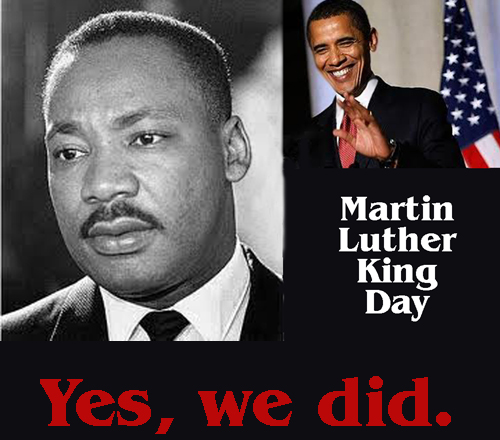
Today is one of the most important benchmarks in the American calendar, the Martin Luther King federal holiday. When I look back a year, I see progress towards greater social justice all over the world.

It isn’t uniform, of course. What’s transpiring in north Africa seems at this moment a step backwards. The misguided South African ruling party toys with national catastrophe. Central Africa is more turbulent than ever, and the entrenched and wicked leaders in Uganda and Rwanda seem hell-bent on those countries’ global isolation and backwardness.

Dr. King was the most profound proponent of radical change by and strictly by non-violence. That means his version of social change must come either within the existing system or through non-violent civil disobedience.

It is hard to imagine how Mali, Uganda or the eastern Congo will be moved forward by non-violence.

But even during Dr. King’s days civil disobedience was not without violence. Was the threatened doctors’ and nurses’ strike in Kenya to be non-violent? Technically, yes, but thousands would have died. The many various teacher strikes throughout Africa this year were all non-violent per se, but children denied their only substantial meal of the day became sick.

What I most remember of King’s turbulent last days was unbelievable violence. My most vivid memory is as a very young journalist penned under a burning El Stop in downtown Chicago while the city raged in reaction to King’s assassination.

I remember gun fire was a regular sound in my low-rent apartment in Washington, D.C. during the summer of 1968. Or the unending sirens and tear gas around my apartment in Berkeley that fall.

King is duly revered for radically changing American society with non-violence. Yet what I remember most is fire, bullets and ambulances.

Today President Obama is inaugurated for the second time. Our first African American President, some of whose relatives still reside in Kenya. The racist opposition to him remains strong. Powerful white elected representatives in Congress still engage in racial slurs and oppose him simply because he’s not white.

During his first term he battled mounting opposition to reverse his election on the grounds he wasn’t a native born American, despite his native State of Hawaii publishing nearly a million official copies of his birth certificate.

The horrible individual gun violence which has occurred in America during his first term, in cities like my native Chicago, and in horrific incidents like Sandy Hook and Aurora is due certainly in part — perhaps large part — to the growing ethnic and social divides that cleave America apart.

King’s philosophy of non-violence, like Gandhi’s and to a much lesser but significant extent Mandela’s, were not eras of no violence. There was incredible violence, and this violence — as with the sizzling El Stop that nearly fell on me — will be blazoned in our memories forever. But with time we’re able to reflect that that violence was the reaction to those heroes’ methodical, unswerving actions for a freer, fairer society.

And that the victims of that violence, whether a young student protestor clobbered by a policeman’s baton or an innocent six-year old school child gunned down by a madman embodying the evil of his society, are the heroic soldiers in a more just war than those who fire on enemies to wear medals.

Today, my President is black. My Attorney General is black. Dozens of colleagues, friends, employees and clients are yellow and orange and black, and this compared to my father’s generation would have been all but unbelievable. The world has changed for the better.

Happy Birthday, Martin! You’d have been 84, today!

Surge Then Peace?

Surge Then Peace?

When’s the last time the U.S. fought a war in a foreign land that ended with a better society and government for those people and greater peace for all the world?

Yesterday.

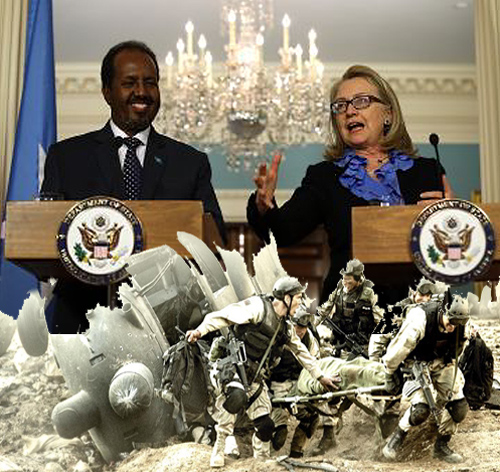
But before that, you have to go back to World War II. But yesterday the U.S. officially recognized the existing Somalia government after 21 years of on-and-off direct conflict.

Although far from tranquil or totally stable there is today a globally recognized Somali government for the first time since 1991, piracy is ending, farmers are planting, schools are open and the economy is growing. None of this since 1991. All this precisely because Obama “surged” our militarism there for the last two years.

He surged a war and won.

Applause?

Them’s the facts, Ma’am. The catastrophe began with Bill Clinton’s cowardly response to Blackhawk Down and then a few years later, the Rwandan Genocide. Clinton escaped a couple close calls with oblivion as President, and I for one think he’s culpable for the last several decades of terrorism in the world. (With a good measure of French obstructionism as well.)

A sweet irony that his wife yesterday was the person in the spotlight recognizing Somali peace.

But Clinton and French responsibility for igniting global jihad had a significant catalyst with the end of the Cold War.

So many African countries were nothing but pawns in the Cold War. They were treated like ivory pieces on a chessboard, spit-polished when they advanced one sides game and ignored to the point of being sacrificed when they didn’t. The frontline battle was in Somalia and neighboring Ethiopia for 20 years before Blackhawk Down.

The U.S. and westerners pulled the puppet strings on Somalia, and Russia with occasional Chinese lace pulled the strings in Ethiopia.

Tens of thousands – maybe hundreds of thousands of people died in regular old tank wars on deserts with no more value than the sand that defines an egg timer. So for 40 years “Somali society” if it still exists was pulled and shoved and bombed and tortured as some unexplained pendulum flinging between good and bad.

The epoch Americans remember most is the one just ended: the epoch of terror when Obama’s surge in Afghanistan forced al-Qaeda principals to flee to Africa. After a short stint in Yemen they went to Somali where their much greater skills and far superior dedication to ideology gave them the tools to conquer the rat pack of warlords that had controlled what had been Somalia with the residue of weaponry left by the end of the Cold War.

The prize in that stealthy battle was the port city of Kismayo, the throne of the pirates, and the loot this provided al-Qaeda rebirthed them with new weapons, new roads, new infrastructure and alas was born, al-Shabaab.

Obama gives no quarter to his enemies. But he doesn’t like public wars. So with more equipment and better technology and not a few real American boots on the ground, America began battling al-Shabaab.

It was just the continuation of the Texas Ranger pulling up his red bandana to disguise his face and sticking his badge in his pocket so he can hunt down the Dallas bank robber who fled into Arkansas. But when it became clear that this clandestine operation wasn’t enough, well, he hired Kenya.

The Kenyan Army invaded Somalia in October, 2011.

Well, that did the trick!

So now the al-Qaeda principals – what’s left of them – have fled into the interior and north of Africa. But don’t worry. The French talk better than we do in that part of the continent, so they’re taking control, now.

I’m of two minds about all this. The world – the whole wide world, including shipping and fishing lanes and air space – it’s all much, much more safe and peaceful today because of Obama’s surge against terror.

But my second mind is whiplashed by the memories of the Cold War, and how we used African societies as pawns in a game that was cruel and devastating to them.

It all remains to be seen. And perhaps my sarcasm is little more than spite of days gone bye.

Perhaps today is better.

Ripped Off Paradise

Ripped Off Paradise

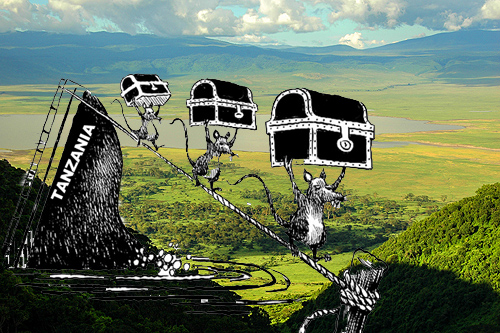
Paradise is being abandoned. Tanzania’s Ngorongoro Crater, its greatest single tourist attraction and one of the most pristine areas on earth, is in the midst of a political crisis that threatens normal tourism there.

Officialdom in Tanzania is rarely much more than organized crime, but even that can be better than the mayhem currently being reported in and around the crater.

Tuesday one of the “good” committees in Tanzania’s mostly corrupt parliament called on the government for “urgent action” to resolve a crisis that jeopardizes tourism and the environment in ways we’ve seen before, and in ways that are getting tiring and tedious.

There are no principal government officials left at Ngorongoro Crater National Park. The Director, Conservator of the National Park, the Chief of Security and many important chairman of various committees have all … left. This was prompted last month when the Tourism Minister basically told them to scram:

In a diatribe reminiscent of Mitt Romney’s disavowal of Massachusetts Heath Care, tourism minister Khamis Kagasheki warned last month that Ngorongoro officials would all be sacked.

So instead of waiting to get the boot, they left with the entire wardrobe.

Two immediate problems are likely. The first is that collection of fees is turning dirty. Many driver/guides will have more trouble getting in and out of the crater without excessive bribing. The second is that the local Maasai – stressed by a couple years of near drought – will flood the crater floor with cattle and the rangers – absent of a master – will do little about this illegal action.

If the trend isn’t stopped, then it will ultimately develop into a third more serious affront to this beautiful place: Poaching. Whenever the crater loses its shawl of organization, poaching skyrockets and often organized by the rangers.

This all started several years ago when Tanzania’s president organized several NGOs to look into helping the Maasai at the crater organize their cattle farming in a better way.

Suggesting something similar to a giant co-op, the President’s plan was grand on mission and scant on details. The mission was OK: vets and stockades and abattoirs and everything else that modern cattle farming needs.

And a ton of money was thrown at the project. And it has all evaporated.

This is nothing new in Tanzania, of course, and last month’s diatribe by Minister Kagasheki suggests there’s a still in his pocket. But it’s quite unusual that such an important tourist destination would be left completely rudderless, and this is Tanzania’s main tourist destination!

It’s another woeful sign that while many of Tanzania’s African neighbors are moving steadfastly towards more modern, transparent governments, that Tanzania is still stuck in the mud of a crater rainy season.

“Paradise Lost” is not something the casual tourists visiting Ngorongoro, today, will notice. Tanzania has been so corrupt for so long that somehow it moves on in spite of it, and tourist professionals know better than any how to manage the system.

But the need for careful ecological management of the crater is real and right now is MIA. This means over time the biomass will suffer.

It’s one thing when we conservationists in Africa deal with the daunting problems of human/wildlife and wilderness/development conflicts. These are tough, real issues. It’s quite another to have to deal with the Keystone Cops in control of Ft. Knox.

Waiting for March 4

Waiting for March 4

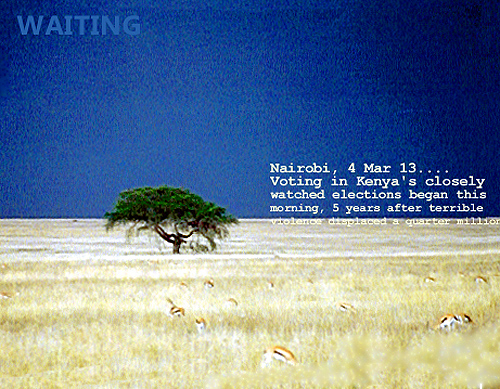
The starting bell will ring and ring and ring madly throughout Kenya Thursday for the start of the awesome 2013 elections. And then deathly silence follows for 6 terrifying weeks.

The economy has already stopped. Donors and outside investors alike have literally stopped all financial transactions. Schools will close so their buildings can be used for voting. Parliament disappears. The current president goes on vacation. The world waits.

I think it’s instructive that in this high tourist season, when wintry westerners flock to Kenya’s unmatched coral coast, some coastal hotels have shut down. Occupancy is so low, companies won’t reveal what it is.

Everyone waits for March 4, the election. Will March 5 be another beautiful African day, or something else?

I began this blog specifically to disseminate the news of Kenya’s last election in 2007, when the peaceful if paradisaical safari destination erupted in terrible violence. More than 1300 people were killed in a few weeks and nearly a quarter million displaced.

It was a near apocalyptic bump on the road to a modern democracy. The quick resolution of the contested election was unexpected and brilliant, a power sharing agreement which has held for five years between the radical opponents.

But now that tentative extra-constitutional arrangement is over. The country must rally round a timely and sustainable definition of itself for the foreseeable future. New forms of self-government, new civil rights, new judiciaries – all radically transformed from 2007.

The election is the culmination of one of the most historic transformations of a society in five years I think ever in the history of mankind. That sounds grandiose, I know, but it’s true.

The country’s financial and educational development in five years is preposterously positive, the GDP nearly reaching 5% growth per year. The visible transformation of Nairobi is unbelievable. If you went on safari in 2006 you won’t recognize the city now.

Its skyscrapers, 8-lane superhighways, Benz’ and BMWs will make you think you’re in L.A. Well, at least that’s the first impression. The layers of difficulties under this pretty veneer are daunting.

And the social transformation is more formative. The new constitution is incredibly just and creative. Educational advancement has skyrocketed. Per capita income is on a steep rise. A national Gallup Poll conducted only several months ago shows enormous confidence and security by Kenyans:

Across the country, Gallup concludes, individuals feel that their “Life Situation” will improve by a monster 50% in just the next few years.

The outcome of the primaries at the national and major regional level is a foregone conclusion for the six major political parties. Despite the parliamentary appearance of Kenya, the new constitution places huge power in an executive president, so like in the U.S., the presidential election is by far the most important.

(This, by the way, was a great disappointment to me. Executive presidencies are 20th century stuff in my book. As democracies mature, aggressive collections of diverse political parties each holding realistic power will guide societies better.)

The front runner is the current prime minister, Raila Odinga. The polls are definitive but the margin of error is big and not too far behind is Uhuru Kenyatta, trailed well behind by the third contender, William Ruto.

There is no questions that of the three, Raila Odinga is the man, the right man. He was denied his place in 2007, but he ended his fight gracefully to share what he had rightfully won to stop the violence, and he’s spearheaded Kenya’s transformation.

His two nearest opponents – Uhuru and Ruto – are thugs, both indicted by the International Criminal Court for instigating then organizing and paying for the violence of 2007.

It couldn’t be a clearer choice from the outside. From the inside it is woven into the deep power of ethnicity, the ancient clansmanship of Africa. Loyalty to family is something we all suffer, but in Africa it is seared into the soul.

March 4 is a day for Kenyans to choose between ideas and family: Ideas that I’ve written about for the last several years which put Kenya in the global forefront of human rights and justice. And family which knows nothing but to fight.

How would you vote?

Death Knell for al-Qaeda

Death Knell for al-Qaeda

The death knell of the al-Qaeda of Osama bid Laden is gonging in Mali. France is bombing al-Qaeda into oblivion. This is likely the last time you’ll ever hear of the al-Qaeda that blew up the Twin Towers.

The battle today is fierce. There is absolutely no question that this is Afghanistan 2003 in Mali. And I’m convinced that France will win.

Revolutionary guerrillas are never bombed out of existence, whether they’re Mao’s Red Brigade or al-Qaeda in the Maghreb. Guerrillas who survive extermination surface elsewhere, in other revolutions and later wars as many of the old al-Qaeda are Taliban today in Afghanistan.

But al-Qaeda as an organized terrorist force will be no longer and I don’t think anything near as powerful will reemerge in this political epoch. The Taliban, for instance, in either Afghanistan or Pakistan has little power outside its own turf, and that’s what differentiates them from al-Qaeda.

In addition to nine-eleven, al-Qaeda organized a number of global attacks, including the horrible subway massacre of London, the U.S. embassy bombings in East Africa, a Philippine Airlines bombing plot, the Bali massacre, the World Trade Center bombing, tourist hotel bombings on the Kenyan coast, the attempted Manchester airport raid, the shoe bomber, the UPS package bomber, and the attack on the U.S.S. Cole, and this lengthy list doesn’t even include the successful attacks in Afghanistan and Pakistan.

The reach of al-Qaeda has never been seen before al-Qaeda. That doesn’t mean there haven’t been as effective revolutionary movements, just that none except al-Qaeda were truly global. That’s the difference, and I think that global reach of a single terrorist organization will end when the Mali war ends.

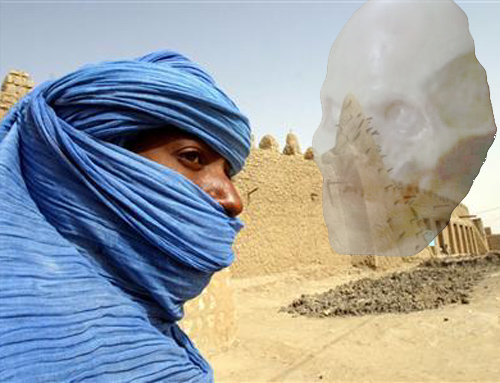
What happened in Mali was long expected. The country sits on the bottom of the Sahara Desert, and a huge portion of its north is little more than sand. But for centuries this sand has been ruled by the Tuaregs, a tribe of powerful horseman and cattle traders who controlled the lucrative desert routes that connected North Africa and Europe with the countries on the Atlantic Ocean.

The Tuaregs had never truly succumbed to modern government oversight. And their revolutionary nature, matured in the 21st century with leaders who were schooled in the west and armed by enormous weaponry left from the overthrow of Ghadafi, took over northern Mali more than 9 months ago.

The area is the size of France, and Tuaregs demanded an independent country. It would be nonsense, by the way. As camel thieves and rogue marauders to desert oases, the Tuaregs will never develop on their own. They need development just like peoples everywhere, and nobody in the world – including China or Russia – was going to recognize a country composed of desert tents.

This was the feeling of the very moderate Mali government, a government that was heralded by democratic giants the world over. Even in this blog, written in March by Conor Godrey, there was a sense that the Tuareg “rebellion” would be negotiated down to helping them better than they had been by the Mali government.

But what happened was that al-Qaeda was looking for a new home. I’ve written before about the putsch against al-Qaeda organized by the U.S. and the west.

We pushed them from Afghanistan to Yemen to Somali to the jungles of central Africa, and ultimately into Mali.

We pushed them with local militaries, like the Kenyans, and unbelievably advanced technologies like drones.

Guerilla terrorists flee before making a last stand. Their ideology demands little honor of the sort traditional battles value. When defeated, they run to make a stand another day, and they run to places where they have an opportunity of control. For example, the desert.

So the Tuaregs were usurped by al-Qaeda. There was a period in March and April when several groups negotiated among each other and agreed on an uncomfortable assembly of Islamic law and order. But it didn’t last, really. The land of the Tuaregs, which literally for centuries was ruled by their desert mavericks, was now in the hands of al-Qaeda.

And the Mali government response was weak. So weak that even as the world was calling for serious military intervention, the Mali government balked. Finally its own soldiers mutinied, the weak government collapsed and there was no formal opponent to the new Islamic soldiers ruling its north.

The Security Council, unanimous across its many different state ideologies, authorized military action. The most progressive nearly communist governments and institutions also recognized the need for military action.

This is because Mali is the heart of West Africa. If al-Qaeda establishes a toehold here, Nigeria, Ivory Coast and even Morocco may be threatened.

But France felt waiting until the UN got its act together would be too long. Friday, they started bombing.

Britain has provided air craft for transport. The U.S. has provided transport, intelligence, and undoubtedly, drones.

The Afghan war was bungled by an inept American administration. France is not inept. Since Afghanistan and with lessons learned from it, the western world has been stealthy until now. It is no longer.

The only explanation is that this will be the last and decisive battle against al-Qaeda.

Is African Big Game Hunting Ending?

Is African Big Game Hunting Ending?

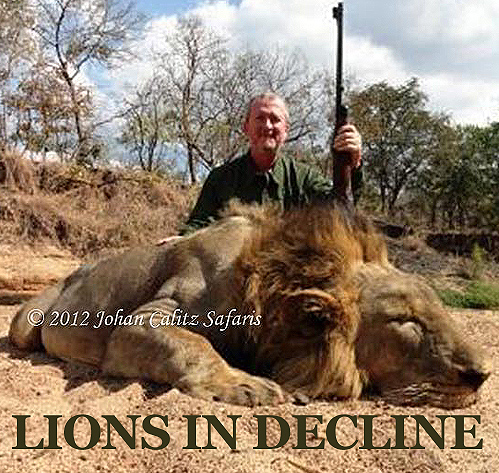
Zambia’s decision yesterday to ban the hunting of cats is electrifying and marks a new movement against big game hunting in Africa.

The tourism minister told the BBC, “Tourists come to Zambia to see the lion and if we lose the lion we will be killing our tourism industry.”

From my point of view the announcement is actually more important than Botswana’s announcement a month ago to ban all hunting, but taken together, this is striking.

Despite Botswana’s wild game biomass probably exceeding Zambia’s (and this is absolutely true with regards to elephant), Zambia probably has more cats, and for sure it right now has much more big game hunting.

Next to Tanzania, Zambia is the most sought after country in the world by big game hunters. This is because it still has very large tracts of land open to all types of big game hunting.

Botswana banned hunting lions in 2002, severely restricted its other hunting quadrants in 2007 and in 2009 essentially closed all the good hunting areas in the Okavango. So the announcement last month to end big game hunting everywhere in Botswana for good was actually an incremental move.

Zambia has actually encouraged hunting to the point of government involvement in hunting trade shows. Yesterday marks an incredible and fairly abrupt about face. Why?

I don’t want to get into the argument of whether hunting is truly a conservation technique or not, because in its purest form I actually believe it is, and I know that riles a lot of people. And I’m no hunter. But properly sanctioned hunting can essentially do what the South African rangers do in Kruger National Park: cull.

While earning the government a hefty dime for letting a foreigner do the job for them.

But we don’t have to argue that. Although that’s the theory under which virtually all African countries sanction big game hunting, I can’t think of a single one – South Africa included (with the current rampant increase in corruption there) – where anything, much less hunting, is done the way it’s supposed to.

So instead of 1 or 2 elephants hunted out of quadrants assigned by the government per season and overseen by licensed big game hunters, you have dozens of elephants, antelope, lions and anything else that moves, blasted to smithereens often by unlicensed amateurs with little regards to the stated conservation policies.

All it takes is bribing the right officials, and if not that, the local communities near the productive hunting areas. Big game hunting in Africa today more resembles the business of poaching than it does Ducks Unlimited.

Maybe, maybe with the Zambian announcement yesterday we can say this is changing.

Hardly a week ago the head of Zambia’s big game hunting government bureaucracy was fired along with 4 close officials. The official reason was for “irregularity in awarding [hunting] licenses.”

I think the current Zambian government, relatively new and among the better in years, discovered as it dug into the dirt under the animals a den of iniquity. I really think that Zambia’s move is an incredibly laudable one and should be seen in terms of government transparency rather than conservation.

Nothing is ever clear in Africa, and to be sure, the increase in poaching and decreases in some large animals – especially cats – forces the accountant to begin analyzing the cost/benefit ratio of hunting versus tourism.

And in that one, tourism has been winning for at least the last decade. The cost of hunting had been much greater than any form of non-hunting tourism. But with today’s incredibly up-market safari properties, a wildlife photography safari can be just as expensive as a hunting safari.

With just as many taxes for the government.

In any case, we now have three of Africa’s most famous big game countries (Kenya, Botswana and Zambia) either completely restricting big game hunting or severely so.

It’s a very important milestone in the history of Africa’s big game.

Good News From Africa

Good News From Africa

Four of my most important stories for 2012 were basically great, good news! Exciting discoveries in science in Africa, growing strategies for peace in Africa’s troubled regions, and my having guided an old friend and client, the Don of American zoo directors, Les Fisher!

These are my 6th to 10th Top Ten Stories. To see a list of all The Top Ten, click here.

#7 : China Partners with U.S. for Peace in Sudan
The world’s two most diametrically opposed societies have struggled uncomfortably ever since shaking hands during the Nixon administration in the 1970s. Whether it be over world wars and conflicts, climate change, human rights – you name it, we’ve been at odds.

But this year the two adversaries teamed up to make peace in The Sudan. This is terribly exciting.

Two years ago South Sudan became its own nation after years of civil war with The North. That in itself was amazing, and in no large part because of enormous initiatives by the Obama administration.

But the border between the two has never been completely demarcated. And it goes right through the most productive oil fields in the area, and so border disputes spilled over into outright warfare.

China and the U.S. got together and stopped it. Period.

It is an amazing geopolitical development, because the U.S. is heavily invested in The South, and China, in The North. But rather than parry their positions, they negotiated them for peace.

Unfortunately, trouble persists in both countries not due to this grander conflict. Darfur remains troubling for The North and The South’s northwest states are close to open rebellion.

But the grand deal signed earlier this year between the two hostile siblings of the once singular Sudan state remains laudable.

#8 : Breakthrough Discovery for Malaria Eradication
The devil is in the details to be sure, and despite a generation of unprecedented research and global aid, malaria finds ways to evade suppression. But this year a new genetic discovery might finally herald a definitive way to eradicate this disease that is so devastating in Africa.

Malaria is such a tough candidate for making a vaccine against because it’s really seven different types of life forms. True, it’s only one of the stages that infects us, but that one has proved terribly difficult to fight against.

If we could simply interrupt the change of life forms from one to the other, we’d do the trick. And now, a new genetic discovery gives us a guide towards finding out how to do that. It’s complicated, but perhaps the most promising new science regarding malaria in my life time!

#9 : African Arms Dealer Finally Prosecuted in U.S.
It’s no secret that you can’t fight a war without a gun. But the west – and especially the U.S. – and Russia have suppressed this evident fact because their war machine economies are so important to their overall economies.

And what’s even more embarrassing is that several of the most prominent arms dealers have lived as foreign visitors on extended friendly visas for some time in the U.S. The presumption has to be that the U.S. felt some advantage for letting them stay here.

So it was striking that finally the Obama administration actually began to prosecute arms dealers in a way past administrations, including back through Clinton and Reagan, declined to do.

Viktor Bout, a Russian, was convicted after a full court press by the Obama administration, suggesting more such prosecutions are on the way. This is an African story, because that was the turf on which Bout played, heavily involved in the most recent wars in Liberia and Sierra Leone.

#10 : Les Fisher Goes on Safari at 91 years old
The Don of African Zoo Directors who helped pioneer some of the first American adventure travel in Africa took a group of small friends on a not-so-easy safari into Botswana in the hot season.

I’ve guided Dr. Les Fisher on at least a dozen safaris over the years, and we’ve been in some of the most remote parts of Africa, together.

As I recall this was his 5th “Last Safari Ever!” At 91 that’s hard to argue, but it was hard to argue at 90, too!

Stay tuned.

#6: Wherefor Old Man?

#6: Wherefor Old Man?

Over my lifetime the study of man’s evolution developed as explosively and quickly as NASA’s mission to the moon. But unlike NASA’s manned space flights, the science of early man just keeps rocketing out to the very edge of time.

This is my 6th most important story for Africa in 2012. To see a list of all The Top Ten, click here.

Did scientists in 2012 at long last, after decades of quibbling and backstabbing as well as serious argument, finally find our direct human ancestor?

When I think back to when I was boy and that the sum total of all knowledge about early man was Mary Leakey’s discovery of the “Nutcracker Man” (Australopithecus boisei), it’s absolutely astounding to think of how much more we know, today.

In sixty years we’ve learned 6 million years worth of old man treasures. It’s mind blowing. Back in 1959 when I read about Mary Leakey’s discovery in the “Weekly Reader” it probably contributed enormously to the fact my life would be dedicated to Africa.

Scientists had found proof that we humans had evolved from much more primitive beings who roamed a pristine earth almost a million years ago. (Later science would become more accurate and determine that Nutcracker was closer to two million than one million years old.)

Everyone thought back then, scientists included, that this skull represented some creature that was our direct ancestor. Scientists had already discovered early giraffes and Mastodons and Sabre Tooth Tigers, and with few exceptions all these old creatures seemed to be precursors to ones that lived around us right now.

How that’s changed! Since Mary Leakey’s discovery, about 10,000 other unique hominin species fossils have been found! And we know there were at least 2 dozen different hominin species, not just one. All of them but our precursors died out, went extinct.

That incredible notion, that there were “men” species as diverse and unable to interbreed as the different kinds of antelope on the veld or different kinds of whales in the ocean was absolutely astounding. Imagine old Nutcracker man walking around the veld, competing maybe fighting maybe running from, other early men who were so different from him genetically that they couldn’t interbreed.

With time we learned how many of these competing hominin there were. Maybe 6, or 13, or 27 as scientists made more and more discoveries. With time we could paint a picture of an earlier earth with all these guys, some much smarter, some much more agile, some much stronger, all competing in a world that was growing increasingly colder and less fecund.

Scientists came up with all sorts of exciting presumptions. Perhaps the reason Nutcracker’s species didn’t survive and evolve long enough to become us was because Homo Erectus ate him up!

Perhaps the reason that Neanderthal with a brain size much bigger than Homo Sapiens succumbed to our species was because early Homo Sapiens had a better language capability, because our early ancestors had a larynx and Neanderthal didn’t, so could make 250,000 more sounds than Neanderthal!

No one back in 1959 would have imagined such a rich and complicated evolutionary history.

And now, it seems, we come almost full circle.

Over the years all sorts of presumptions have been made regarding which of all these species of early man finally evolved into us. For a long time it was presumed that Homo Erectus was the real progenitor: Peking Man. His brain size was 950 cc (ours is around 1300 cc) but most importantly, he has been found almost all over the world – he migrated.

Then there were scientists arguing that an even more primitive version, Homo Habilis, was the true precursor. This theory was boosted not too long ago when scientists determined through DNA analysis that all men living today on earth came from a small band of individuals who left Africa only 50,000 years ago during a period of severe climate stress.

Peking Man was nearly a million years out of Africa. So he had to have died off.

And there were other candidates, recently ones like the recent announcement of an Ethiopian skeleton of Ardipithecus kadabba.

Some of them, like the Neanderthal, may have actually been smarter and better adapted physically to earth than we are. So we didn’t necessarily survive just because we were the best thinker or strongest builder or cleverest fighter. But ultimately we are the “best” in some composite sense masterfully explained by natural selection.

But the greatest irony you can imagine has brought the story full circle. A far distant cousin to Mary Leakey’s first breakthrough discovery of early man, may indeed be our most direct ancestor.

Sediba, found near Johannesburg nearly ten years ago but encased in stone so it took this long to extract the fossil, may be our closest paleontological relative and the reasons why have flipped the science on its head.

There’s something very uncomfortable with the notion that the very first old man fossil ever found, predating all sorts of creatures that would evolve with different kinds of brain and teeth and fingers and toes – all a massive evolutionary explosion of mankind’s remarkably varied attempt to survive – turns out to … be the one. The real direct ancestor to us.

The chance seems just so slim.

Or is it?

#5 : Ivory Towers

#5 : Ivory Towers

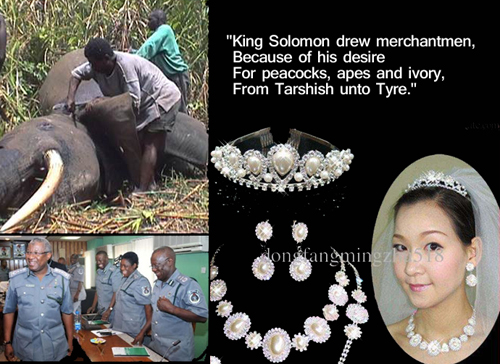
Big game poaching is not new, never abated to the point of becoming incidental, but 2012 was a year in which poaching got dramatically worse. Why? And what to do?

My #5 Top Story of 2012 is the complex and very sad chronicle of Africa’s big game under enormously new onslaught. To see a list of all The Top Ten, click here.

First, a little perspective. Elephant being the biggest and least manageable of Africa’s big wild animals are understandably the barometer of poaching in general, even though virtually all types of African animals are poached. But as goes GM, so goes the economy; the metrics of elephant poaching more or less represent poaching in general.

And lacking good statistics it remains fair to say that the poaching today is nowhere near as massive as it was in the horrible 1970s and 1980s when elephant were almost extirpated. There are still lots more elephant, today, than at the end of the 1980s.

I’m very disturbed, though, by how the media has exaggerated the situation. There’s no need for exaggeration. The truth is bad enough. But it results in the media totally ignoring some fabulous successes with anti-poaching, especially with quelling the market for ivory.

And I have previously brought up the very uncomfortable idea that poaching in East Africa is the same as culling in South Africa. This complex notion can, indeed, be argued that there’s no better possible situation than the status quo. That doesn’t make it right, by the way.

So while the quantitative problem of poaching today pales in comparison to the 1970s and 1980s, and the public has been unnaturally jigged up by sensational media in particular, the qualitative aspect of poaching today is, indeed, much worse than before.

There are two main differences with the decimation of elephant in the 1980s and today: today a lot of poaching is by individuals, or small bands of unorganized friends, in very ad hoc ways as opposed to the large corporate poaching of the past. Secondly, there’s every indication that poaching is being used as a politically global football fully open to bargaining.

The involvement often at the global level of very powerful institutions … like banks is new and horrifying. In America in particular the “lay-off more bank regulation” which has followed the cavity they caused in the global economic order is allowing the important and rich middlemen that transit the animal part from its home country to its market country to flourish.

And on the more patent political level, “national security” is becoming a determinate in establishing a de facto level of poaching rather than the moral argument which prevailed in the past, so that the previous presumption that elephant poaching was immoral is being usurped by the argument that it contributes to terrorism.

It’s unfortunate we don’t have good summary numbers. Asia, especially Thailand and India, and South Africa compile good numbers on elephant populations and poaching. But no one else does.

We can scrape up numbers for individual ecosystems, like the Serengeti, but even simply combining the Serengeti with its Kenyan neighbor, the Mara, grows difficult to impossible.

The main reason for this is that most African countries do not want researchers to know the real numbers.

But there are enough “scraped up” numbers, anecdotal reports, public scandals and especially confiscated attempts at ivory shipments to give us a reasonable view of what’s happening.

In the last few years Tanzania has hired and fired more wildlife officials and Ministers with wildlife portfolios than Liz Taylor did with husbands: Researchers as well as local Tanzanians are growing increasingly fed up with corruption and obfuscation.

Because while most of Africa’s elephant population is happening in Tanzania, so is it the pinnacle of East African safari tourism. There is less empathy locally in non-South Africa Africa for wild animals than from us, outside. But when considered in the context of tourism, there is widespread consensus that poaching is bad.

So why, then, is it getting worse?

My opinion is that the global economic recession is principally to blame, but not for the evident reasons you might think.

Africa did fairly well overall during the recession. As did Asia. But the five years since the market collapse have nonetheless massively impacted African and Asian economies, most notably by increasing the gap between rich and poor.

Huge numbers of Tanzanians, like huge numbers of Chineese, have become extraordinarily rich over the last five years. Even as Dar’s slums have exploded in size and China’s rural populations have suffered a decline in standard of living.

Asia and China in particular is the principal market for poached game, especially ivory. And East Africa and Tanzanian in particular is the principal source. It’s a marriage made in hell.

According to the African Wildlife Trust, “The vast majority of the illegal ivory …is flowing to China… China’s economic boom has … push[ed] the price of ivory to a stratospheric $1,000 per pound on the streets of Beijing.”

We don’t know for sure how this devolves to the individual poacher trying to sell his illegal cut on the streets of Morogoro, but the best estimates is that a typical 20-kilo tusk nets the poacher 2-3 years annual wage. And most elephants have two tusks.

In an economic environment where the untrained, unskilled adult is struggling with farming in climate change and squeezed by increasing dry goods prices, the allure of poaching is real. Combine this with a growing sentiment among urbanized people worldwide that there are too many wild animals, a market in China controled by individuals with no empathy whatever for big game preservation, corrupt local officials on the take, and you have all the ingredients for tacit acceptance of this otherwise illegal trade.

So that’s my take: bad economic times with rich Asians richer wanting to buy ivory, and rich Tanzanians richer wanting to broker it. And a rapidly growing Africa that simply has too many elephant.

What to do?

Groan if you will, but there are no simple answers. We’ve entered an extraordinarily complex era in African development, particularly in East Africa. Increased poaching is a part of this, but understanding that as a complicated, nettled component of contemporary African society much less global capitalism is necessary before anything at all can be done.

#3 & #4: So Well but The South

#3 & #4: So Well but The South

2012 demonstrated more than any other year that African countries are doing better economically and advancing faster socially than their counterparts in The West, their former colonial masters. Except, I’m afraid to say, the giant in the hut, South Africa.

My #3 Top Story of 2012 is the explosive narrative of African progress, and the #4 story is the significant exception, South Africa. To see a list of all The Top Ten, click here.

“Africa isn’t just a place for safaris or humanitarian aid. It’s also a place to make money,” says New York Times columnist Nicholas Kristoff. The well respected author then went on to site dozens of statistics showing Africa out pacing the world economically.

Clearly the average African is neither as comfortable or well off as the average American. But that’s not the point. The average African is mountains higher in comfort and well-being than his parents, and there is every indication that his children will share that euphoric experience.

This is, of course, a generalization but I feel a fair one. Including Somaliland, there are 56 countries in Africa. Perpetual doom and gloom persists in Zimbabwe and the Central African Republic. Increasingly bad news in 2012 plagued Angola, Uganda, Rwanda, Chad and Mali. So my generalization applies to the rest.

This positive view stands in marked contrast to America, where the generation to generation comparison is dismal. The graph projected out another generation or two actually has parts of Africa catching up with American median income.

The World Bank explains this succinctly as a wealth of new natural resource discoveries. Like oil and gold.

But that’s hardly the end of the story. The new-found wealth in the ground is a necessary foundation, just as rich soil was to early Americans and oil was to the 1960s Arab in the Emirates.

But on that foundation is blossoming some exciting non-natural discoveries, in high tech and alternative energy, in natural products manufacture and a score of other industries.

It was poorly reported but extraordinary this year that South Africa bailed out Europe. That’s right. South Africa paid $2 billion into a world monetary fund to help with the Greek and other European bailouts. Economically, the First World took charity from the Third World.

And Africa has no qualms about embracing the best of capitalism, thank you. Walmart was welcomed into South Africa with a warmer embrace than most mid-sized towns in the United States provide the retailer.

But after the hugs and kisses were over, Walmart submitted to a labor agreement that Americans working for Walmart would die for. Why are they able to do this in Africa, and not in America?

And “thing development” is progressing no less fast than social and “thought development.”

Consider the media, (I am). A respected global media watchdog claims that Tanzania has a freer and better media than the U.S. This is because of the worst of American media, which pulls down the overall ranking.

But the worst of American media, Fox News, Rush Limbaugh and sorts, have made mincemeat of the truth, have thrown civility to the wolves and turned making money into a first principal that cares little about the effects of its nearly sadistic approach to the public need.

In defense some of us Americans would point to many exceptional online services like Wired and Mother Jones and The Nation (and dozens more), and as you examine those “good” media you’ll find out the reason is the same as for Tanzania’s position: youth.

America is aging less than gracefully and its right-winger lying mentality is very much linked to old guys. So perhaps Africa has an intrinsic advantage, since such a large portion of its population is young relative to America’s.

Yesterday was historic for the American Congress: 78 women in The House and 20 women in the Senate. This reverses a trend begun about a decade ago where women in elected office began to decline.

But in Kenya that would be mandated at 145 in The House and 33 in the Senate! Mandated?! Yes, Kenya’s new constitution requires that a third of all elected officials be women, almost doubling in one fell swoop what it’s taken America more than 200 years to accomplish.

The new Kenyan constitution, modeled but improved on South Africa’s new constitution, is quickly becoming a model worldwide. Simple and common sense things like religion banned from schools and institutionalized affirmative action that adjusts to ethnicity and gender as society continually changes puts Kenya on a markedly higher moral plane than America.

I think above all other things socially, though, is the new African attitude towards justice. America is petrified with the concept of sharia Law, for instance if applied in the new Egypt. But Americans understand little of this and can’t even see how any set of laws can be molded to virtually any social model.

Our own Supreme Court has bent and twisted, upheld and struck down, and essentially remolded and unmolded society again and again. American laws on such things as drug possession (marijuana), abortion, gambling and even incest and slavery have gone all over the chart!

There was no direction from the “Founding Fathers” on those issues part and parcel to modern day life. And the irony is that so many Americans think otherwise, that there is some Founding Father out there guiding our every move.

The new Kenya justice will be an amalgam of Islamic sharia and British common law. Some feat, eh? But beautiful and adjusted to the realities of its new society.

But Kenya recognizes – like so much of the world, America excepted – that there is a global morality, today. That there is a worldwide foundation for such things as basic human rights.

Four of Kenya’s most prominent citizens have submitted to charges filed against them at the World Court in The Hague. Voluntarily they will go to The Netherlands for their trial. Now it needs to be said, of course, that these criminals (as I think they are rightly charged) would likely not do so if the Kenyan public hadn’t forced them to. And that is the majesty and beauty of the situation.

An important aside: recently convicted in the World Court, former Liberian leader Charles Taylor in pleading for leniency in his sentencing for war crimes pointed out that he was convicted of crimes no different from those of George Bush in Iraq.

The justices gave no reply.

This was not the case for our own great Justice Ginsberg who dared to speak the truth in Cairo, when she told the Egyptians that maybe the U.S. constitution wasn’t right for them.

The onslaught of criticism that followed, the incredible vitriol from the right, wasn’t just humiliating to us Americans, it was … well, barbaric. It was truly like German Goths grumbling over Roman progressives. Ginsberg is of course right, and fortunately she rather than Senator Kruz is what Egyptians will and are considering for their own new, progressive societies.

But alas, it’s not all good news for Africa. Africa’s behemoth is South Africa. Its economy is multiples of the rest of the entire continent combined. Its history is as complex and fascinating as our own. And hardly 20 years ago it reformed itself into one of the most progressive, moral societies on earth.

But now, things don’t look so good.

Residual racism and neo-apartheidism are sprouting across its non-black societies. I don’t think this is because it was always destined to be so, that there was some kind of intransigent ethic among whites that would eventually surface again, like an old whale on its last sound.

Rather, it’s because the current president has made it so. Jacob Zuma is a joke.

He’s vain, and easily set off by criticism. He’s so wrapped up in himself, he’s let the country wander leaderless. He’s patently ignored the courts, acted like a banana republic dictator and all the while the country spiraled downwards.

Many local experts, white and black and left and right, are beginning to see him not so much a central actor separate from the times, but rather the embodiment of something greater:

The implosion of the ANC, the freedom fighter party that won the battle against apartheid and whose marshal was Nelson Mandela.

I think this is true, and that’s why this is my fourth most important story of 2012. Yet it’s with hope that I also see Zuma coming to an end sooner than the constitution would mandate, and of the ANC moving restlessly to get its act together. It may, however, be too late.

So the year ends on an incredibly positive note for the continent as a whole, but a seriously cautionary one for its grand marshal.
#1 & #2: Whites Fight on Black Soil

#1 & #2: Whites Fight on Black Soil

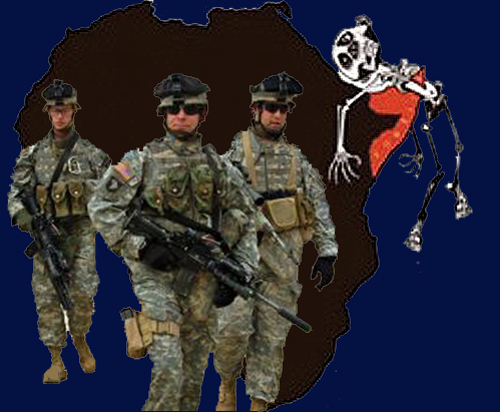
2012 goes down in history as the first time a modern African military defeated then occupied a terrorist state. Somalia fell to Kenyan soldiers. Except that there’s a lot more to it than that.

My #1 top story for 2012 in Africa is the “pacification” of Somalia by the Kenyan armed forces, and #2 is the less obvious reason why. To see a list of all The Top Ten, click here.

The #2 story, the “less obvious reason why” the Kenyans conquered Somalia is the enormous covert military operations by the west, particularly the U.S. and France.

That assistance actually does include boots on the ground, but the Green Berets and French Foreign Legion are stealthy. They’re only rarely seen.

And while their presence has been most notable in the Somali war, they’ve been seen elsewhere, especially in central Africa in The Congo. About a 100 U.S. forces arrived publicly in Uganda for that effort. The French have a lot more in northern Africa.

These two top significant events on the continent last year have enormous implications globally but of course even greater ramifications locally. But I’d suggest that in a worldwide context they are among the top events of the year.

Somalia has been an anarchic geopolitical unit for 20 years. The implosion began when Bill Cinton abandoned a United Nations effort to hold the country together in 1993, what is commonly known in America as “Blackhawk Down.”

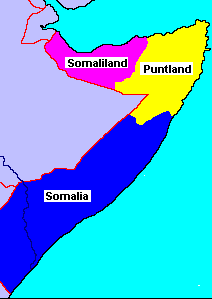
The country quickly broke apart into ethnic and clan-based tiny warlord states originally fueled by the weaponry left by Blackhawk Down. That later was sustained by piracy and other black-marketteering. Although two northern parts, Puntland and Somaliland, managed to organize themselves into something more stable and less onerous than the old Taliban Afghanistan, the majority of the country remained ruled by local warlords.

The Russians left Afghanistan in 1989 and shortly thereafter the country was ruled by the Taliban which welcomed the gang of Thugs led by bin Laden. This was a turning point in global power, a specific outcome of the end of the Cold War.

Perhaps the world was so tired of conflict that the west in particular grew inward desperate for periods of no war. Be that as it may, no president in the history of the U.S. has so dropped the ball on world peace like Clinton did, then.

His early nineties retreat from Africa caused all sorts of mayhem, from the Rwandan war to the Nairobi and Dar embassy bombings. He has since apologized, and some of his advisers at the time say he had been distracted from the growing turbulence in Africa by the Monica Lewinsky affair and subsequent impeachment.

I believe that radicals like bin Laden were emboldened by the subsequent mayhem. The Rwandan holocaust preceded by the implosion of Somalia was a calling card to bin Laden. A few years later, he blew up the American embassies in East Africa.

A few years later, he blew up the Twin Towers.

Terrorism reigned.

And so it has ever since. And America’s extraordinary response, the military involvement in Afghanistan and Iran hasn’t worked. Obama knows this. Like suburbs hiring trained snipers to kill deer eating their city park roses, Bush tried to eradicate terrorism with firepower.

All it did was blast it to the sides: Africa. Deer aren’t as dumb as you think. They sense the sniper’s limits and move out. For a while the city park’s roses bloom magnificently, but roses on the periphery don’t do so well.

For example, Somalia. Bush shotgunned Afghanistan, then Iraq, and many of bin Laden’s thugs were routed elsewhere. Not too many years later they ended up in Somalia after a short stint in Yemen. The al-Qaeda became al-Shabaab and conquered the warlord states of southern Somalia. What had been Afghanistan under the Taliban was now Somalia under al-Shabaab.

One and the same.

So Kenya especially began to suffer the same way all the countries bordering Afghanistan suffered. It starts with refugees. That is a problem of enormous magnitude, aggravated in Kenya’s case because the camps were located in its far and remote northeastern frontier.

And quite apart from the strain of such a responsibility economically and socially, the camps become conduits for terrorists to enter Kenya. Shortly Kenyan bus stops and churches were being blown up by suicide bombers.

So a little more than a year ago Kenya announced it would mount a military operation into Somalia. George Bush failed getting Pakistan to do the same in Afghanistan. Obama succeeded with Kenya. At first we all laughed out loud. But we were wrong.

At first the Number One News that Kenya has pacified Somalia seems so good. Part of it is. A multiple generational war is ending. Good, right? Yes, of course when any conflict ends.

Mop up continues, but when the Kenyan army captured the town of Afmadow we knew it would only be days before Kismayo fell to the courageous Kenyans. As it turned out it was months but it did finally fall and today Kenya occupies most of what only a year ago was troubled Somalia.

Today, Somalia has an effective government and the capital of Mogadishu – while not exactly a tourist haven yet – is peaceful. Kenya, on the other hand, is increasingly troubled.

I believe Kenya is too advanced and mature a society to succomb the same way Afghanistan/Pakistan, Yemen and Somalia did. Yes, folks, Kenya is more socially atune and politically savvy than Pakistan. I’m hopeful that the current bombings and other violence will slowly end as the new constitution is cemented with elections in March.

But this is deja-vu squared, no matter how you cut it. We routed world terrorists out of Afghanistan and they feld to Yemen. We routed world terrorists out of Yemen and they went to, and settled in for a quite a while, Somalia. Now that they’re routed out of Somalia?

The unpleasant conclusion is that for the time being, they’re in Kenya, and so Kenya is not a good place right now to visit.

Obama and Hollande seem to think the terrorist can just be chased into oblivion, and oblivion to them is currently beyond Kenya somewhere else in Africa. Are you following what’s happening in Central Africa, today? Or Mali? Or Nigeria?

I’ve been very skeptical about this policy. I’m not sure the west has enough resources to chase every terrorist into oblivion. I wonder if it’s time to let up.

But I’m uncertain. As uncertain as Clinton and Mitterand in 1994 must have been before a million people were slaughtered in Rwanda.