Which Death is Worse?

Which Death is Worse?

Margaret Thatcher’s belief that there is no society, only individuals means that yesterday’s bombings in Boston is relatively insignificant news.

After all, there were more than four thousand times more (4000x) individuals killed last year by terrorism in the rest of the world compared to the United States.

But, of course, Margaret Thatcher’s statement isn’t true.

There is more than individuals. There is society.

And there are societies that, for lack of a better word, are considered more “civilized” than others, where “civilization” includes lack of violence, and most certainly, lack of violence against innocents.

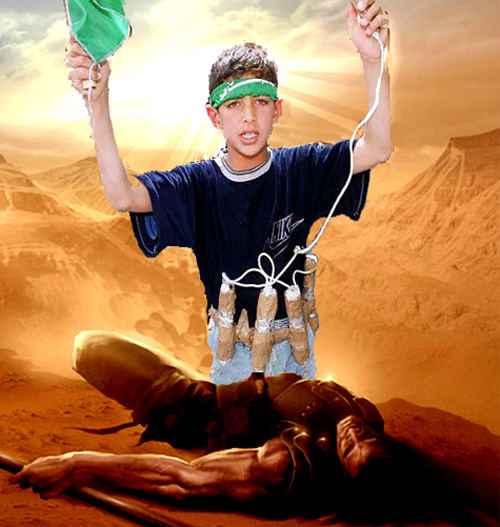
Terror is David’s ultimate weapon against Goliath.

Goliath is an impermeable military fortress. David is the suicide bomber disguised as an immigrant laborer that Goliath needs. Because there are so many immigrant laborers in Goliath’s world, David is relatively meaningless … until he blows himself up and takes down a few “innocent” Goliaths who happened to be wandering near.

That gets attention.

Numbers don’t. It doesn’t matter that it was 15 unnamed adults, children, clerics, wives and pregnant mothers in Garissa, Kenya, but only one 8-year old boy and two unnamed adults in Boston.

It shouldn’t have happened in Boston. It’s no surprise it happened in Kenya. Boston is more civilized than Kenya.

Moreover, as an American an attack on my country is more painful to me than an attack in Kenya. I come to work each morning in part affirming my beliefs and trusts in my society, convinced my society is working hard to be just.

This seems senseless. Weren’t there other ways the bombers could have expressed their dismay and dissolution with what they perceived as unjust?

They feel that way in Kenya, too.

And in Iraq and Pakistan and Argentina and nearly every other place in the world, even Australia.

Something is wrong with mankind and it isn’t with the bombers. There are too many bombers for too many vastly different reasons in too many vastly different places on earth.

Should weapons of any kind be illegal? Can we destroy every gun and bullet and bomb on earth?

What a silly notion. They’d still strangle us.

Should Big Brother be allowed to monitor us all? Do you know how many CCTV surveillance cameras are clicking away right now in London?

Kenya doesn’t have as many. Boston will, soon.

A good Pd.D. thesis for a student of political science would be to show a definite collaboration between the number of CCTV cameras and terrorist killings. More cameras, more police, less killings.

More cameras, more police to enforce a system terrorists feel is unjust motivates terrorists to become even more clever, more deadly. More individualistic.

Maybe Margaret Thatcher was right.

The Impoverished Kenyans

The Impoverished Kenyans

Left: President Uhuru Kenyatta, scheduled to go on trial for crimes against humanity in July. Next in line: Vice-President William Ruto, scheduled to go on trial in May.
Poor Kenya. The world waits to see if the new president and vice-president will travel next month to The Hague to stand trial for crimes against humanity. Kenyans elected these men free and fairly. They chose alleged murders to lead them.

As a businessman in tourism I wait for more signs. As a devoted student of Kenya, I’m depressed and frightened. Like everyone in the world who knows Kenya, we wait with baited breath for the start of the scheduled May and July trials of the Vice-President and President.

Kenyans are polite and on edge. They are proud that they didn’t devolve into violence as during the last election, proud of the new judicial system that validated the election, but on pins and needles waiting like everyone in the world for the next chapter in this country’s history.

That comes next month when Vice-President William Ruto is scheduled to begin his trial for having arranged and financed killer squads following the 2007 elecetion. President Kenyatta’s trial is set to begin in July.

“If the International Criminal Court is right,” writes Daily Nation columnist Makau Mutua, “the two funded death squads to kill, maim, and loot each other’s folks. Mr Ruto only subordinated himself to Mr Kenyatta because he couldn’t win [the national election] on his own.”

Mutua goes on – as many others have – that this unlikely team of arch enemies is together for only one reason: they are both alleged organizers of mass murder.

There’s nothing particularly sensational in this thriller, the Joker elected mayor. It struck me as a storyline that would likely be rejected by Hollywood for being sorely uncreative. The difference, of course, is that this is real.

And the sad part is not the fates of these two men. The sad part is that Kenyans elected them, freely and fairly.

Incredibly, Kenyans couldn’t come up with anyone else. And although it’s true I supported Kenyatta’s principal rival, Raila Odinga, nearly anyone of the other 6 challengers who contested the election would have been infinitely better.

Anyone who watched even a snippet of either of the two election debates would see what great people Kenya has as potential leaders. But none but Uhuru and Raila had the financing (and ethnic support) to be viable candidates.

That was the main reason I (and many, many others) supported Raila: none of the other challengers had a chance, and the outcome proved it. The remaining six challengers got less than 8% of the vote.

Kenya is peaceful. In fact as Somalia improves, Kenya becomes more and more peaceful. Raila has met with Kenyatta. They are photographed laughing together, working to “keep Kenya peaceful.”

I received an email from an owner of a lodge near Mt. Kenya, Sunday, which implores me to write good things about Kenya, to beef up its tourism:

“Would it not be a good idea to now send out a positive email concerning Kenya? It seems to me that people prefer to spread bad news all the time.

“Kenya is an amazing country with lovely people and I am sure if you compared the crime rate with the UK and considered the poverty people combat every day here in Kenya, the UK would not come out looking too rosy itself!”

UK leaders are not accused of crimes against humanity. The Kenyan president and vice-president are.

On Safari: Among the Great Herds

On Safari: Among the Great Herds

Friday Lunch
It was Bingo in Barafu today as we drove into the locus of the great migration, probably seeing a couple hundred thousand animals before the day was over.

This is always the easiest time of the year to find the largest single migratory group of wildebeest. It’s never the most dramatic time (which is the river crossings later on), but I prefer now because you see so many more animals.

And because there are so many babies. In fact, the herd has suddenly grown a quarter larger as nearly every mature female calves.

And set on a veld that is so spectacularly lush and colored by multitudes of wild flowers, it’s hard not to understand why this is my favorite time.

Nevertheless, finding “the migration” (which means a significantly large portion in one group) is not as easy as it seems.

The animals move with the most nutrient grasses, which grow where it rains. So finding the migration is as easy as exactly predicting the weather!

But we had intelligence that placed the migration in the Gol Kopjes, north of Naabi Hill. That in itself was a bit unusual, tad too far north and east for this time of the year. But clearly they were not around Ndutu, where “normally” they would have been, and yesterday our encounters with them after Olduvai to Lemuta suggested our intelligence was correct.

Mind you, there were wildebeest almost everywhere we looked or traveled in the southern quarter of the Serengeti/Ngorongoro. But the smaller scattered herds of maybe 200-400 were not a big enough or uniform enough group to be called “the migration.”

We headed to Naabi Hill, slipping and sliding as to be expected after yesterday’s incredible late afternoon downpour. On the way, we saw a family of three cheetah, a mother with two older cubs.

They were fat and sassy and not likely to hunt now, except that a juvenile Grant’s gazelle separated from its family group was trying to get back to it, and the cheetah were in the way!

I couldn’t believe how daring that young gazelle was, and it provoked one of the cheetah who gave it half chase. And that’s all it took for the gazelle to disappear into the sunset, apparently giving up whatever family ties prompted its initial reaction.

We saw another cheetah with full belly when we finally reached the Gol and then a lioness atop a kopjes, when we hit an empty but green plain filled with flies. That and confirmation of the droppings that lots of wilde had been there recently made us realize we were on the right track.

It was a lot further than I expected, given the intelligence we had, but the herds had obviously moved. Our intelligence was 3 days old and the herd was actually another 10k north and east of where I expected them to be.

But there it was, a “hot dog” shape of wildebeest perhaps 20-25 kilometers long and 3-4 kilometers wide. It lay north to south on the far eastern side of the Serengeti nearly touching Loliondo.

The northern-most portion was in the Barafu Kopjes, ridiculously far north for this time of the year. And the southern-most portion was … well, where we had stopped for lunch yesterday, at Lemuta.

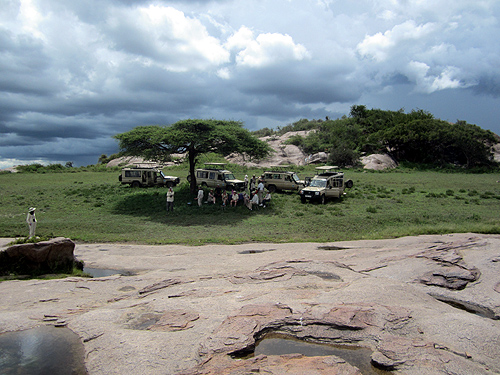
We stopped for lunch on a high kopjes overlooking the veld. It was an incredible accomplishment finding this amazing spectacle, the greatest in the world, and everyone realized the long drive necessary to reach this point was worth it several times over.

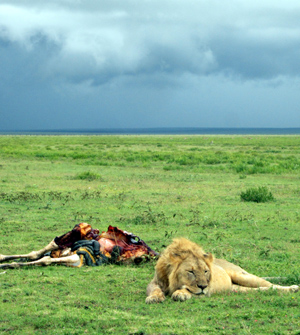
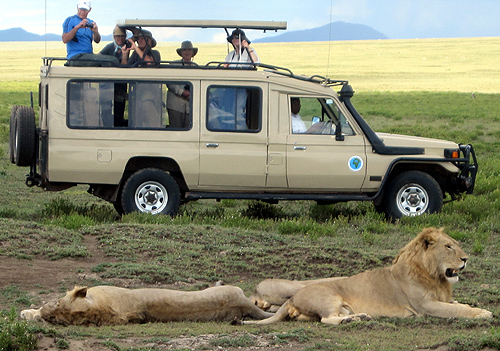
The rest of the afternoon we spent cruising through the herds and making our way home. And towards the end of the day, we came upon the same four brother lions we had seen yesterday, and two of them were lying beside partially eaten ostrich!

I still have to think about this one. Lion don’t eat ostrich. Lion don’t defeather birds, and the ostrich feathers were in a pile. Lion don’t eat ostrich heads or bills, and those together with most of the necks of both ostrich were nowhere to be seen.

Seemed to me it had to be hyaena and our four brothers just got irritated with the fact the kill had come so close to them. Their bellies were still full from their kill several days ago. I’m sure they ate some of the bird, but most of it lay “unused.”

It was a fantastic, successful day!

On Safari: Into the Wilds

On Safari: Into the Wilds

2 Lions
This is one of my favorite days on safari, as we spend most of our time off-roading in the far southeastern corner of the Serengeti positioning ourselves to find the great herds in the next few days.

We left the crater just after breakfast, and there was heavy mist on the rim as we drove around the northwest side past the down road which has been closed for reconstruction. The road then swings around to the west for about 4 kilometers of beautiful driving on the north side of the giant alter-crater.

Like so much of the veld today, it was lush and green, but I saw only a smattering of zebra and wildebeest. The road then rises briefly over the lip of the alter-crater before dropping onto the north side of the crater towards the Serengeti.

Whistling thorn acacia reappear, so therefore do giraffe! Lots of zebra suddenly, and as we descended, more and more giraffe. As we approached the road to Olduvai Gorge, large numbers of wilde and zebra mixed in with Thomson’s Gazelle covered the veld.

I hesitated thinking this was part of a large hunk of the migration, but sure was tempting to think so. Fortunately I said nothing and it ended before we actually drove into Olduvai Gorge.

After our fascinating tour of the visitors center and museum and special visit to the site where Mary Leakey found Australopithecus bosei, we continued off-road onto the grassland plains towards Shifting Sands.

We passed several Maasai herders, and I noticed they were now ranching sheep as well as goats. Saw lots more wild animals and right around shifting sands the wilde population seemed pretty dense.

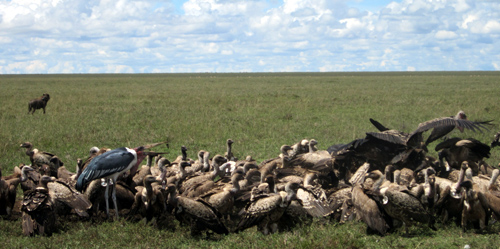
We continued overland towards Loliondo, stopping at a kopjes near Lemuta for lunch. On that hour or so drive from Shifting Sand, we stopped several times to photograph kills covered with birds, golden jackal, and several baby wilde that couldn’t have been more than a couple days old judging from the length of their umbilical chord.

Lunch on a Lemuta Kopjes is always a highlight of the trip. The views are astounding, and the entire veld was peppered with animals. This was an important clue, by the way, that would help us tomorrow in locating the largest hunk of the migration.

But it was getting on, and we had a ways to go to Ndutu Lodge, one of my favorite. So we changed direction and began heading southwest to the lakes area of the Serengeti. Passed numerous eland that ran before we were within a mile of them!

Photographed lots of hyaena just waiting on the outskirts of water holes for some thirsty beast to drink. And we ran into four brother lion who had killed a day before perhaps, with giant bellies so large they could hardly walk.

We reached the main road and took a breather so people could photograph themselves under the “Welcome to the Serengeti” sign, and the drivers who had been working so tirelessly since early this morning could rest a little.

Then we started the last 25k to our lodge following Olduvai Gorge to Lake Ndutu. Halfway there it started to rain, and then thunder and lightning, then hail and then the rain became so heavy and the wind so dangerous we had to stop for a short time.

We literally couldn’t see because the sheaves of water falling from the sky were so severe.

I’ve lived through countless East African rainy seasons. I remember one of my camps blown away, of lodges and tented camps flooded. And perhaps it’s just the emotions of the moment, but it sure seems like the rain is harder, more and longer than in previous years.

We reached the Ndutu Forest just as the rain abated and got to our lodge around 7 p.m. It had been an 11-hour day, filled with tons of animals, extraordinary scenery and (lots of) rain. Until we had reached the main road to the Serengeti, about 40 minutes from our lodge, we hadn’t seen a single other vehicle other than our own four.

This is the Africa I love the best, and today reached all my expectations.

So Many Birds

On Safari: Animal Paradise

On Safari: Animal Paradise

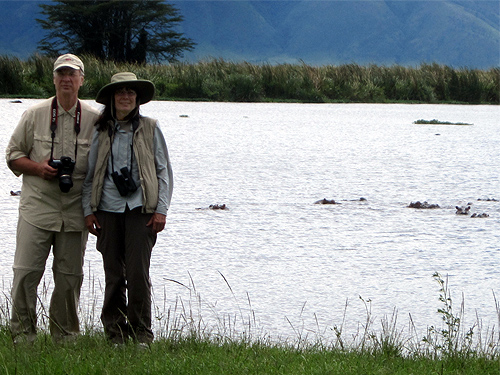
Mark Zmijewski & Jennifer Jones in front of a hippo pool where we had our lunch in Ngorongoro Crater.
Our game drives in Ngorongoro Crater were exceptional, but in the course of my career they always seem to be. It’s an absolute wildlife paradise.

We actually visited the park twice, because our game drive to Lake Manyara was prevented by terrible floods. But the crater although beautifully green had wonderful roads and tracks and we had no difficulty on two consecutive days.

I get very upset when I hear people say they shouldn’t come to East Africa during the rains. That’s when they should come! The first half of the year is the wet season in northern Tanzania, and this is when the migration is most easily seen, when all the baby animals are being born, and when the veld is most beautiful.

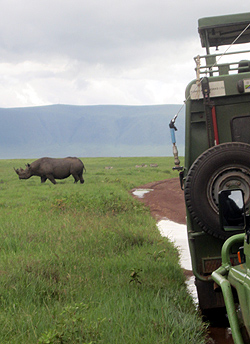
And we lucked out in spades this time. On our first day we saw 7 free-ranging black rhino, and on the second day we saw two, but on the second day we saw them up close and personal!

We saw dozens of lion. The crater has among the highest density of lion of any wilderness in Africa, probably around 100 for the 102 sq. mile wilderness.

We saw the giant eland, probably thousands of zebra and wildebeest, and likely more than a thousand buffalo.

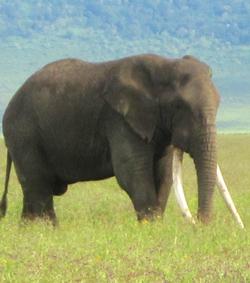
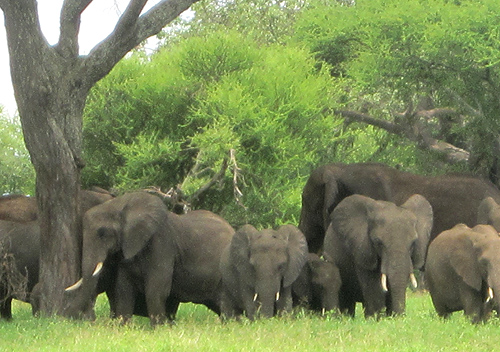
But I was specially pleased with how close we got to some of the last big tuskers that exist on earth.

During the horrible years of elephant poaching in the 1970s and early 1980s, a group of young males with very large tusks entered the crater for protection. The geology of the crater made the corporate poaching of those years virtually impossible.

The crater isn’t a good habitat for elephant. Elephant are browsers that prefer leaves and branches and bushes, but the crater has little of that – it’s almost all grass.

But they adapted and adjusted to eating grass. And so they were saved while their cousins and siblings were decimated by poachers.

During those poaching years small tusks, or no-tusk elephants were passed over as the professionals sought the elephants with the largest tusks. Soon the global population of elephant was reduced to small tusked animals.

But the guys in the crater survived. They’re dying off, now, since they’re well into the 60s. And unfortunately, even after poaching ended, they didn’t leave the crater to mix with global herds, and the few females that now enter the crater don’t seem to interest them!

So it looks like these magnificent tusks will die when they do.

On Safari: Fatal Blow to Manyara

On Safari: Fatal Blow to Manyara

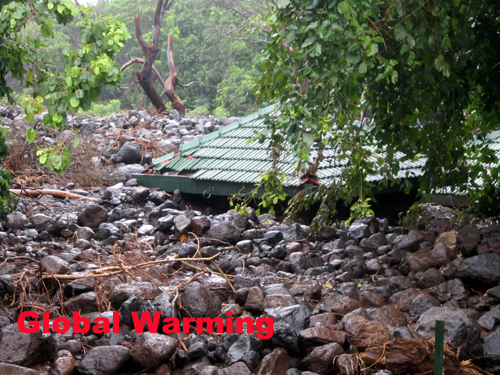
Global warming is devastating earth, and it ruined a day on safari and possibly ruined one of Tanzania’s best game parks for a long, long time.

Worldwide weather is become more and more extreme. In East Africa we have more droughts that are drier and more floods that are heavier, and the frequency at which both occur is mind-boggling.

The developed world is of course no less susceptible, but we have more resources to deal with it. When Super Sandy crushed America, we were able ultimately to deal with it by rebuilding.

But the developed world just doesn’t have those resources.

Four days before we were to visit Lake Manyara National Park, unbelievable rain causing flash floods that no one could have anticipated swept off the Great Rift Valley over the park and poured into the entry gate.

A beautiful visitor’s center with its wonderful little museum, gift shop and toilets were submerged in mud and when the water receded, covered and surrounded by boulders that had fallen from the Rift.

Four days before we were trapped by the same heavy rains in Tarangire National Park, as the only bridge to the outside world had been submerged by a raging river.

I quickly chartered airplanes to fly us the short distance from Tarangire to our next destination, Gibb’s Farm, but my four vehicles and drivers had to wait by the river until the waters subsided.

We knew the waters had subsided somewhat when we were ready to visit Manyara, so we decided to head out to the park early in the morning. It was dry enough, although the scene was so sad.

All the public buildings were buried in rocks and mud. But the road into the park was now dry, and so I thought we’d be able to visit this gem. But the ranger said no. They were too concerned that another flash flood was in the brewing.

So instead we went into Ngorongoro, enjoying an unexpected second game drive in this wonderful park (see tomorrow’s blog for information about those game drives).

We couldn’t have chosen a better place to stay for this trauma than Gibb’s Farm. It’s one of my favorite places on all safaris, and I use it as a base for visiting both Manyara and Ngorongoro Crater.

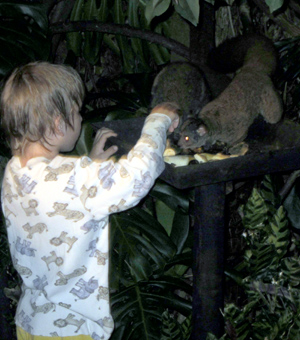
So we were there for three days. And one of the most wonderful moments came not with anyone in my group, but with many of them watching a 7-year old guest, Eli, as he closely encountered bush babies.

Gibb’s puts out fruit every night at 7 p.m. to attract the local bushbabies (greater galago). They’re a wonderfully curious primate with a very loud voice!

But no one but Eli ever tried to pet them. And guess what? They seemed to like it!

On Safari: Tarangire at its Best

On Safari: Tarangire at its Best

Tarangire proved as exciting as I expected, and we dodged the heavy rain, and as a result we achieved the optimum experience of the year for this wilderness.

You can go on safari virtually at any time of the year to East Africa and with good planning have the most memorable trip of your life. But if you’re willing to gamble a bit – which my clients don’t realize I’m always doing with their trip – then you can bingo out marvelously, and that’s what happened to us in Tarangire.

I like traveling during the rains, and I try to do so just before the heavy and debilitating rains start, and that’s the gamble. And in fact this year heavy rains have started .. early, and so stay tuned to see how the rest of the trip might unfold.

But what it means for Tarangire is that the most beautiful landscapes in Africa have been created. The great sand rivers flow, the white tissue paper flowers explode in the beautiful grasses next to the yellow hibiscus and purple mini-dahlias and the landscapes in the sky are overwhelming: sculpted by a storm forming over there and giant cumulus over there.

And, most importantly, the animals are at their supreme. Everybody’s fat and sassy. So we saw the four grand lion brothers with big bellies and magnificently washed black manes. We watched a male leopard stretch out his own belly in the morning sun. And of course for Tarangire, we watched and watched and watched elephants playing and fighting and vying for position.

We’ve been here hardly a full day and our elephant count is approaching a thousand. At this time of the year when fewer tourists come and the veld is fulsome with food, there are many playful babies and many great bulls fighting to mate.

And Tarangire is anomalous, magnificently wonderful for its sheer numbers of ele but they become so dense particularly now that their normal behaviors begin to break down.

Families mix readily. Teenagers form gangs and often wander far from the family, and I often wonder how they matriculate properly. With normal behaviors young males are kicked out of the family between 10 – 12 years old, and they must immediately associate with an older male that teaches them how to behave.

This was discovered sadly several decades ago when authorities in the Pilanesberg reserve in South Africa imported a score of young male ele who hadn’t been matriculated by older males. They killed quite a few of the other animals before they were corralled in and scientists began to study what had happened.

And that was when it was learned how important the mentoring of a younger male by an older male is. But in Tarangire the groups are so dense and the age groups often segregate together that I just wonder if there’s been any science about mentoring in conditions like these.

The roughly 3700 ele in the “northern sector” of the park are mostly resident. And we saw nearly fifty hardly fifty yards from the park entrance as they were mingling about staff quarters. These are wholly habituated animals that rarely leave the park, much less this small area.

But as we moved south to our camp, we saw the truly wild and magnificent wilderness elephant. On two occasions (since we were using the same tracks) a tailless female stopped us and really threatened us.

My clients behaved wonderfully. Not a whisper was said, and when she asked us to back up, we did slowly. But we persisted within her area of irritation, and eventually each time she let us pass.

But altogether we’ve seen nearly a thousand, playing in relatively deep pools at the side of Silale swamp, wallowing in mud, mounting in courtship, trumpeting playfully and in the expected aggression that is generated by so many animals living so closely together.

As you’ve read in other blogs, I think there are too many elephant in East Africa. And the sad part of the story were all the dead forests growing further and further from the main transit passes in the south. Trees killed by elephants: forests turning into savannah.

And of course the growing human/elephant conflict, perhaps the single greatest issue in the natural history world of East Africa today.

But like any gamble, the gamble nature is presently taking sustaining so many elephants is exciting to behold. We only hope the outcome is not a loss, but a win. And frankly, I don’t know either how to call how it will be, or how it could come to be.

But we experienced it, because we gambled with the weather and so far won.

On Safari: Never Discount Junior

On Safari: Never Discount Junior

There are few true big game reserves so close to large metropolitan cities as Arusha National Park, and it’s holding its own against an onslaught of peripheral farms and shops.

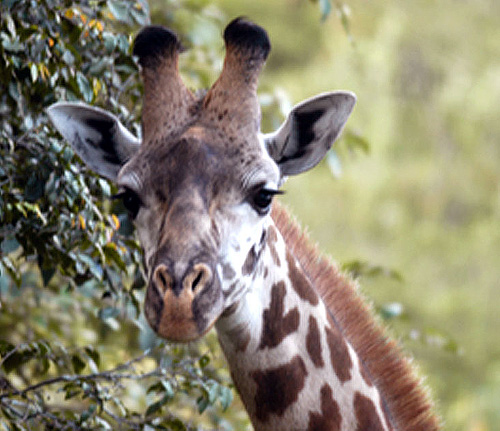
The park was exceptionally green and beautiful and lived up to its reputation for us as “Giraffic Park.” We probably saw 100 giraffe in the course of the afternoon game drive.

There are no cats, and elephants use it strictly as a corridor. We saw evidence of elephant but no animals. What we did see was the usual and beautiful groups of zebra, waterbuck and warthog, with the frequent peppering of lovely bushbuck in the sides of the forested hills.

But we also had a stroke of incredible luck and saw quite a few smaller forest creatures, including the spectacular colobus monkey with its gigantic white flowing tail. We saw a family of 20 grouped in a single tall tree in the distance – in the middle of a low bushland that I’m sure was of little interest to these strictly arboreal monkeys.

But perhaps they were enjoying afternoon tourist sightseeing!

And the grand find of the day was the red-flanked duiker. I personally haven’t seen one of these in Arusha for over ten years, and it’s just the type of species that is threatened both by elephants destroying the forest and human development on the outskirts.

We caught only a glimpse of it, but everyone in my car did see it, and it was really a joyous event recognizing that the forest is still holding its own. We also saw quite a few suni, another smaller but less endangered rodent/antelope and of course, the ubiquitous dik-dik.

But the farms are encroaching, and we literally drove on the edge of a corn farm on one side of the road and a meadow with giraffe and waterbuck on the other. There were regularly spaced new blue tents throughout the field, with machete armed lookouts to protect the crops.

That’s the challenge of Africa’s wilderness, today, to become relevant, meaningful and productive to African populations. Arusha’s holding its own, and it was a lovely first game drive in Africa for my clients.

And what’s more: never discount the little bits of wilderness that remain, either because the pressure to develop them is so large or because their size jeopardizes their being able to sustain real biodiversity.

The pressures on Arusha are enormous. And with extreme weather, like last year’s drought, I become certain that it won’t survive. Then the rains return and the wilderness flexes its muscle and shows us animals (the duiker) we haven’t seen for years.

Nature is resilient. That shouldn’t make us less vigilant, but we should respect and admire its own healing itself.

Arusha National Park is the perfect example of this.

On Safari: Bridge into the Past

On Safari: Bridge into the Past

We began the safari at one of the most beautiful and historic places near Arusha, Tanzania, the old Ngare Sero estate. People woke this morning to the wonderful clatter of cloud forest sounds of monkeys and giant birds.

Ngare Sero was built long ago as a home for hunters. It’s situated beautifully on the foothills of Mt. Meru about a mile high and benefits from rain much of the year and the beautiful clear streams that come off Africa’s 5th highest mountain.

Rebuilt for the discriminating tourist about a decade ago, clients enjoy the original manor house’s large verandah which overlooks the beautiful lake. In the thick forests which surround the lake are families of colobus monkey, the gorgeous black-and-white monkey with a white tail that looks like it comes from a horse!

These primates are among East Africa’s best “leapers” rivaling the great eland of the vast Serengeti plains. They can leap 40 feet from the top of a giant podacopurus onto wild mango and giant figs. We happen to be here now at the most wonderful time to watch colobus, since all the trees are in top fruit.

The forests also include lots of sykes monkey, which are larger and more subtly colored. Giant silvery-cheeked hornbill whose size and massive beak and horn are truly trumped by their very loud and raucous call.

So together with the deep grunts of the colobus and the frantic cawing of the hornbill, the beautiful whistles of the red-winged starling and chatter of the white-eared barbet, this is truly a bit of African paradise, the way so much of East Africa used to be.

But walk over the old bridge between the manor’s estate and the outside world, and you’ve emerged onto modern Africa: dense farms, convenience stores, and last night almost until midnight we listened to the screaming ranting of a local evangelist celebrating Easter Monday. During the day we’re close enough to the main Moshi/Arusha road to hear the trucks, and the cheers and boos of a local soccer match.

So civilization has definitely arrived. But this beautiful little alcove of ancient Africa is a wonderful way to begin anyone’s imagined adventure, and in this case, a real glimpse into Africa’s past!

Tomorrow we travel to the great national park of Tarangire. Stay tuned!

By All Means Peace

By All Means Peace

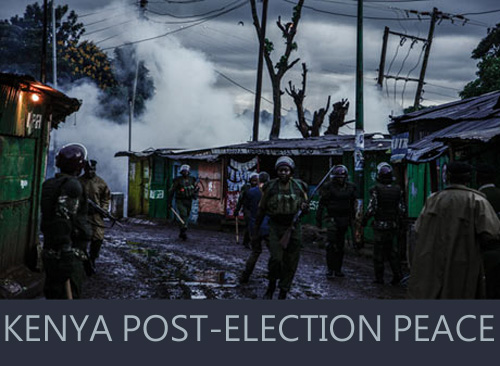
Only a couple violent incidents following Saturday’s court decision upholding Kenya’s election. Peace is predicted, specifically because the architects and instigators of the deadly violence following the 2007/2008 elections are now the country’s president and vice-president.

Uhuru Kenyatta is the country’s new president. William Ruto is vice president. The two are indicted for crimes against humanity. Whether it be the poor judgment of Kenyan voters or its manipulation by evil leaders, doesn’t really matter anymore. It’s done.

Five years ago when 1300 people were killed and nearly a half million displaced (a quarter of which remain so) Kenyatta and Ruto according to the World Court indictment used their vast fortunes and complex communication network to organize thugs and criminals to kill and terrorize.

They no longer command thugs and criminals. Today, they command the Kenyan army.

A generation or more of Kenya’s social progress has been lost.

It’s the ultimate prerogative of democracy to install in power those who should not be: To make liars, cheaters, crooks and even murderers Heads of State. And in this case in Kenya, I honestly believe as did its exemplary Supreme Court, that if not the majority at least the plurality of Kenyan voters truly wanted this outcome.

And the insult to righteousness is that not even a tiny minority of Kenyans ought to have voted for Uhuru Kenyatta. Kenyatta is the richest man in East Africa, now the 4th president of Kenya and son of the first, and one of six unique Kenya individuals indicted by the World Court for crimes against humanity.

On April 9 he becomes the second sitting African Head of State (after Omar al-Bashir of The Sudan) to be on trial for the gravest sins against his fellow men.

How could Kenyans have elected him?

There are two widely accepted reasons. The first is Kenya’s horrid tribalism, which perhaps I wrongly thought its youth had all but discarded. Kikuyu Kenyatta’s chief rival in this election was Raila Odinga, a Luo from western Kenya.

The Kikuyu and Luo are the arch enemies that define Kenya tribalism. It was Raila’s father, Oginga Odinga, and Kenyatta’s father, Jomo Kenyatta, who fought one another in the bush then in Parliament to be the first to rule an independent Kenya. Jomo prevailed then jailed Oginga.

That was a half century ago. Most of us simply could not believe that the last half century of human development in Kenya, which outperformed all historical standards, would not produce a new generation of Kenyans who would emerge from these hateful trapping of tribalism.

Now nothing seems to have changed. Each tribe so fears the other that they will do anything to achieve power over the other. There are more than 40 tribes in Kenya, and Uhuru’s deft manipulation of democracy in this exercise was to choose his vice president from a third tribe that ensured a solid plurality against the Luo.

It mattered little that his choice was one of the most evil and corrupt men in Kenya, William Ruto, a fellow indicted by The Hague as well. The Kikuyu Kenyatta/Kalenjin Ruto team, bedeviled as historical enemies nevertheless controlled the numbers, and the numbers make democracy.

The second reason seems less likely to me, but Kenyan analysts seem sure of it:

There may have been a popular backlash against the World Court’s indictments and of western nations’ not so subtle messages to Kenya that they better not elect a criminal.

The U.S. was particularly blunt: Obama said he hoped Kenyatta wouldn’t win. The U.K. – Kenya’s national mother and principal benefactor – said it would not allow Kenyatta or Ruto to visit Britain. (Both have now congratulated the new leaders.)

So Kenyatta crafted an election strategy, replete with his billions of carefully placed media shillings, charging “foreign interference,” a phrase guaranteed to garner votes.

I may be just as naive about this as I was about the presumption that tribalism was water over the dam, but frankly the Kenyans I know are heartsick with the outcome. These are Kenyans that are young, well educated and truly a rainbow of tribes.

But like the courageous kids who started the revolution in Egypt, or the intellectuals who thought they crafted the New South Africa, or any of the bloodied stakeholders dedicated to good change in places like Tunisia much less Russia or Broward County, democracy has a wicked way of exploiting change by crushing it.

Revolution is no certain remedy. And democracy is often little more than a facilitator for the evil that provokes revolution in the first place.

Peace, maybe.

Kenya’s new constitution, its youthful society and progressive economy, is 100% 21st century. This election is the failure of that new generation to manifest itself, take control. It is a government of a society of the 1960s.

Kenyatta’s government will be in power for at least the five years given it by the new constitution. But some think it’s in for the generations that were just lost.

Africa Art This Instant

Africa Art This Instant

Contemporary African art has had a niche among American collectors for several decades, but young artists in Africa are abandoning traditional media completely, and wholeheartedly embracing strictly digital art.

I have several precious oil canvasses bought decades ago in Africa which have been fortunate enough to appreciate in value commensurate with the unique quality. But it’s time to move on. The best young artists in Africa are no longer taking out a canvas and mixing colors with a brush. They’re doing it digitally.

Certainly digital art includes filmmaking, which we tend here at home to separate out as an entire media in itself. But it is by no means the end-all and be-all of African digital art, which includes all varieties of media translated through digital media.

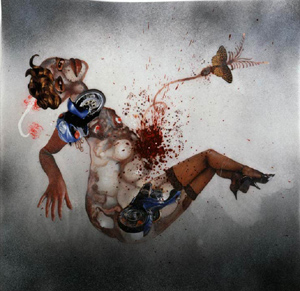
Kennyan Wangechi Mutu is renowned for her dramatic female figures. Mutu’s work has been featured in some of the finest museums and galleries in the world including the San Francisco Museum of Modern Art, Tate Modern in London, and the Centre Pompidou in Paris.

Egyptian Miriam Ibrahim (one of her most famous pieces is shown at the bottom of this blog) describes her passion for digitally altering her portrait photography as one of a “deviantart.” Her often haunting portraits suggest women beset by overwhelming fears, oppressed and lost.

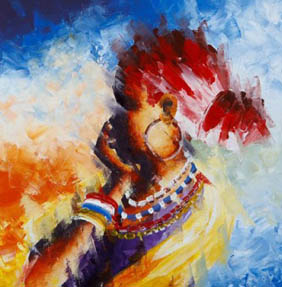
Saidi Ray begins and often ends with traditional acrylics but he sells the finished work not as pieces of canvas but as digital art. From Tanzania, he takes what only a few years ago would have been considered quite traditional primary color renditions of traditional subjects, like native tribes, and whisks them into modern media, a contemporary surrealism.

But of them all Kenyan Mutua Matheka epitomizes the ultimate in digital art: instagram. (His signature piece titles this blog.) His remarkably creative and powerful images are as expansive or focused as the movements of your fingers spreading on the iPad. Above all, Mutua represents what African art has become today.

For many more examples from artists across the continent, click here.

Techtonic in Nature

Techtonic in Nature

Separate but Equal: A chilling phrase used throughout history to justify such barbaric ideas as apartheid and reenforce the power of the status quo has now been applied to African wilderness in an attempt to save lions. It’s more naive than offensive.

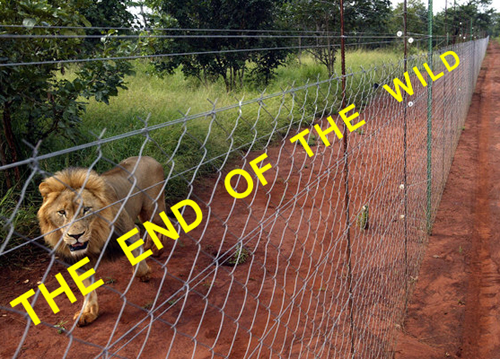
Sorry to be such a drag on your week, but when the world’s greatest carnivore scientists conclude that the only way to maintain healthy populations of wild lions is to fence them, somebody’s got to remind them that then they’re no longer wild.

One of the greatest field researchers ever, Dr. Craig Packer of the University of Minnesota, led a team of 46 researchers that published this succinct and piercing recommendation earlier this month.

Lion populations have been declining for some time, and the study confirmed many earlier studies and reports that the decline is directly linked to lion/human population conflicts.

(There are, by the way, too many big cats in zoos.)

The March publication in Ecology Letters Online will become the definitive treatise on lion declines. Its cram-packed data is perfectly if masterfully compiled leading to a vastly understated conclusion that is tectonic in nature:

Fences.

The study acknowledges “fencing has so far only been widely employed in a few African countries because of aesthetic objections, financial costs and the impracticality of enclosing large-scale migratory ungulate populations.”

Presuming the local African has serious “aesthetic objections” to fencing strikes me if not racist patently patronizing, so let’s move on:

Packer et al conclude that it would cost $2000 per square km to preserve lion at about half their potential densities in the wild unfenced, as compared to about $500 per square km to sustain populations at 80% of their “wild” potential fenced.

This means it would cost about $30 million to fence Tanzania’s largest reserve, The Selous, and then an additional $22 million annually to manage that fencing.

In a cash strapped and aid-dependent economy, these numbers are mind boggling. I don’t doubt their veracity but when compared with the needs of human villages in the same areas in which lions now thrive, there is no chance this will be embraced locally.

That defaults the solution to foreign donors.

How do lions rank in the following list of priorities?

Water, Food, Electricity, Sanitation, Health, Education not to mention anti-poverty.

Finally, it isn’t just wildebeest or elephant migrations that are essential to the wild as we know it. It’s less dramatic and more subtle elephant and buffalo migrations, which need massive corridors to maintain healthy populations.

You might, indeed, fence lions and wildebeest and zebra. In fact Botswana did so, and it crashed their wilderness in the mid 1980s, leaving today a nice place to visit but hardly the wild that existed back then, with possibly a third of the animal populations deciminated.

But you can’t fence elephants, and buffalo are problematic. So are we talking about a “wild ecosystem” for lions that excludes anything over, say, two tons? Is this not as dramatic an alteration in what the “wild is” as one without lion?

An equally powerful if nuanced conclusion from this study is that social policies by governments like Tanzania and Mozambique which have struggled to allow indigenous populations to coexist with the wild, is a bad idea … (at least for the animals):

“Negative conservation impacts of human land use can often be [read: “should be”] minimized by restricting conflicting activities to separate areas rather than by encouraging their co-existence.”

A third of the Serengeti/Mara/Ngorongoro ecosystem is the Ngorongoro Conservation Area, which allows traditional Maasai to continue living and using the land. Similar policies exist in Mozambique and Uganda on wide tracts of wilderness.

These are not recent policies generated in any way as a response to human/wildlife conflicts. Rather, they were policies forced by the reality that humans with a right to ownership of the “wilderness” have been living there for eons.

Adopting Packer et al’s policy in this regards heralds back to the Trail of Tears, the justification at the time for which was much more noble than protecting a wild beast.

As Packer said with not but a bit of irritation to the New York Times:

“Let’s get real, here.” (Although in quite a different connotation.)

Packer is an outstanding scientist. But he’s a rather poor humanist, and with this study, either nihilistic or simply frustrated. By the way, he’s likely right, too.

What this means simply is that the wild is ending. Zoos are as capable of guarding a species’ survival as the wild can. Biodiversity on typical macro levels is in grave danger, and that may indeed bode ill for the world.

But the wild is ending. And ending the wild cannot be stopped if mankind doesn’t rev up into high gear, first, its own human development.

And that, Johnny, is the real story. There is no separate but equal. There is only togetherness.

The only possible solution to fixing lions’ lives is to fix people’s lives, if not first at least at the same time.

Terese & Goliath

Terese & Goliath

The widely publicized elephant poaching is mostly gross exaggeration when compared to the corporate poaching that nearly extirpated them in the 1980s but nonetheless a terrifying example of how mens’ wars exploit the natural world.

I’ve written before how the current elephant poaching is being sensationalized by the media as something much larger than it really is. Elephant populations in almost every part of Africa continue to increase, even though poaching is also increasing.

This dynamic is quite different than in the 1980s. And the reason is simply that the scale of poaching then was exponential compared to now.

The near extirpation of the species then led to the world-wide CITES treaty which was instrumental in stopping, and reversing, the poaching.

Today’s poaching is different, but no less terrifying: Until recently, anyway, it was confined to individual bands of men – not corporately organized mobile slaughter houses. It was motivated by individuals’ survival, not market driven or as an OPEC hedge.

One or two tusks were hauled to local markets, not tons lifted by helicopters to Yemen. And the poachers are generally individuals who pocket the loot and disappear, not by organizations that return again and again to better their last bottom line.

But the increase in poaching – however slight compared to the 1980s – has been enough to stimulate the black market. And small-band, individual crime that characterizes the majority of elephant poaching today is transforming into something much worse in certain areas.

I only hope the telling of this story will not fuel the hype. Jeffrey Gettleman of the New York Times first reported the situation last September. Unfortunately the wider media took the sensitive report and exaggerated it, presuming what was happening in the jungles of The Congo was the same that was happening in Tanzania’s national parks.

It is the lazy inability by buzz-word, snapshot media to separate the two phenomenon that so disturbs me. And I continue to presume that the former situation described so well by Gettleman does not represent a significantly new threat to the species. And certainly the one-off poaching by ad hoc bans of survivalists doesn’t, either.

Nevertheless, a report we received this weekend from the famous primate researcher, Terese Hart from the depths of The Congo, suggests what Gettleman reported in September is increasing and spreading.

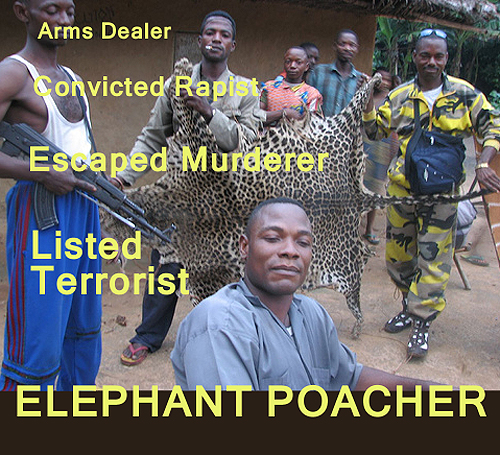
Hart describes with the courage of an MGM lion and in near legalistic detail how a convicted war criminal escaped poor detention and has organized a serious elephant poaching band in the depths of The Congo’s jungle where she works.

Everyone should read her blow-by-blow account: Click here.

The story illustrates the unsung courage of many local Africans wholly dedicated to conservation, of the potential effectiveness of The Congo government’s military (a story in itself), and how the wanton neglect of the developed world dumped weaponry into the hands of thugs.

Hart is a renowned researcher. She’s become now nothing less than a crusader, and many of us worry for her safety.

The sad fact of Hart’s story is that nothing is going to change unless major powers like the United States take ownership of their wanton neglect and aggressively begin cleaning up the loose weaponry of the world.

Simultaneously with powers like China aggressively stopping the trade in illegal ivory.

And until that action formula reaches The Congo, elephant may not be in as much danger as Terese Hart.

All Hail The Chief

All Hail The Chief

Kenya’s future is in the hands of a man little known outside Kenya: Willy Mutunga. The 65-year old Chief Justice will render his High Court’s decision on the recent election Saturday morning.

The country’s tension is building, its currency is falling, and protests are being prepared not just to follow the court’s decision, but right now to protest strict measures the government has imposed to ban public demonstrations.

But despite all this tension, Willy Mutunga can legitimately claim to have the trust of most Kenyans.

The Chief Justice has a long history of democratic activism, including a long stint in jail under the former dictator, Daniel arap Moi. His choice by Parliament was one of the easiest and least contentious of all appointments mandated by the new constitution.

His demeanor throughout the proceedings contesting the March 4 election has been exemplary. He’s been transparent, ordering live broadcasts of the deliberations.

And he’s given himself and the other five justices of the high court five days of full deliberations to make a decision.

Many would argue that is hardly enough to wade through the hundreds of petitions, reaves of evidence and uncountable allegations flinging between the two camps of president-elect Uhuru Kenyatta and aggrieved challenger, Raila Odinga.

And while that may be true, Mutunga knows all too well that this episode in Kenya must be brought to a conclusion.

Every day that passes without a court decision affirming Kenyatta’s election, confusion and complexity builds. Who is running the government? It’s not clearly known, as the former president Kibaki is dead silent.

Office holders under the last regime, which supposedly has ended, are becoming more and more vocal and partisan. Today, the attorney general petitioned Mutunga to consider that the “government” believes Kenyatta is the president.

If too much time passes whatever is left of the Kenyan government will be replaced by anarchy. Mutunga knows this, so he specifically advised the nation when the decision will be made: Saturday morning.

“I have given most of my life to a better Kenya and if taking it is what will be required to consolidate and secure our democratic gains … that is a price I am not afraid to pay,” Mutunga said recently, revealing the many death threats he’s received.

It may be this widely disseminated statement that has elicited the public trust. Death rates are rampant. Social media is beyond the pale. It is hard to underestimate the vitriol and anger in Kenya, today.

And frankly, I don’t think Mutunga and his court will render a decision on the evidence. The evidence is too voluminous, too contentious, too imperfect. It would take months to determine the ballots that were mismarked or miscounted. This will have be a ruling from the hip.

The ruling will be on whether the election authority which pronounced Kenyatta the victor with less than 10,000 votes of 12.2 million cast should be honored, or whether it should be denied and a new election process started.

The easiest thing to do is simply affirm the outcome. After all, all the parties in the election had expressed unqualified support for the election body which made the call. The Constitution gives this body wide latitudes of decision-making.

But not affirming the outcome seems more rational. Ballot counting was an unqualified mess; all sides agree on this. The .07% margin of victory is therefore a ridiculous conclusion.

But not affirming the outcome requires the court to suggest a remedy, a new election or run-off, all within its power but which then essentially emasculates all the months and years of institutional preparation Kenyans had invested in the election.

I predict the court will rule the election invalid. But I’ve been sorely wrong predicting events associated with this election, and no matter what the court does, Kenya’s greatest challenges are yet to come.

Walkabout

Walkabout

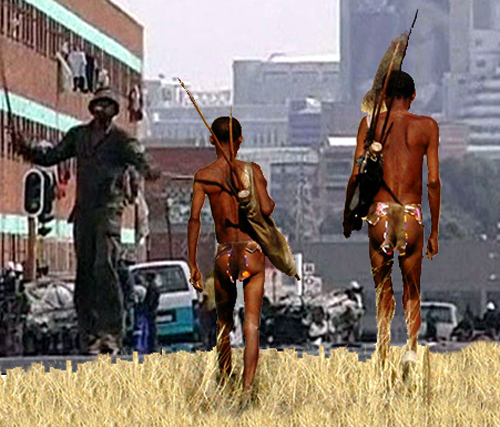
The Botswana bushmen have finally been excluded from their homeland, having lost the final skirmishes in more than a century of battling to retain their right to a traditional life in the Central Kalahari Reserve.

As of today, Botswana’s ancestral San people may only enter the reserve on month-long permits, one third the stay allowed foreigners entering the reserve for tourism. The news was reported today by a respected African publication in London.

The Botswana government claims the exclusion policy is for environmental protection and Bushman community development, but tourism has become increasingly popular in the area, and … diamonds have been found, there.

The forced removal of peoples from their ancestral homelands is hardly new. The removal of Maasai from ancestral homelands in the Moru Kopjes in 1972 led to an immediate expansion of the Serengeti National Park that substantially and almost immediately increased animal populations, making the area more attractive for tourism.

Perhaps the most egregious of forced native removals were native Americans in the late 19th and early 20th centuries, horribly summarized in what is commonly known as the Trail of Tears.

The difference with today’s situation with Bushmen in Botswana, and the next most recent similar situation with Maasai in Tanzania, is that the Bushmen seemed to have prevailed with a 2011 High Court decision that aggregated a number of earlier decisions securing use of their homelands.

But the Botswana government simply ignored its own high court orders and has continuously refused aboriginal people entry into the reserved and harassed those who snuck in.

The government’s defiant policy has succeeded in part because the numbers of Bushmen in the area seeking traditional rights in the Kalahari has plummeted in the last decade. There were likely 5,000 Bushmen in the Kalahari 50 years ago; today there are probably fewer than 1,000.

Numbers are down because — as the government is eager to show — many Bushmen have taken advantage of government education and training programs that result in their abandoning the traditional life style.

In the last few years I’ve encountered San people working in the Kalahari in tourist camps and have admired their wit as well as their intellect. Clearly at least for those few individuals, they had no desire to return to the bush.

Last June South Africa gave a state funeral to a famous Bushman who had worked his entire life for the betterment of his people. But as with himself and his children, that was principally to educate them in modern schools and find them modern, urban jobs.

Contemporary, modern opportunities for Botswana people are considerably better than for most other Africans from other countries on the continent. Botswana’s economic situation while challenged during the global recession is far superior to most of the rest of Africa, because of its rich endowment of diamonds and other minerals.

So the question devolves simply into whether the government – the wider community – knows better what’s good for certain individuals than they themselves claim. And whether the trade-off, ancestral land for a good-paying job and healthy lifestyle, is worth it.

The age-old argument applies to peoples round the world, from such diverse theories of eminent domain to gun control. Exclusion from ancestral lands is certainly at the extreme end of this spectrum, but fundamentally is no different from any individual liberty restriction.

How far can a government go restricting individual liberties and still be moral?

The removals of the Shoshone, Yavapai and Navajo in the United States were certainly no less egregious than the Bushman from the Kalahari.

Is it just that we pine for the old days? Or are we afraid of our own power, even if it will better a peoples? Or as with native Americans, that we really don’t care what happens to them?