NPR’s series this week on rhino poaching is probably worth paying attention to. Here’s some background before listening today to All Things Considered:
Be cautious. John Burnett’s terrible reporting for NPR on elephant poaching not too long ago set me ablaze. He fouled up the numbers completely, came from the wrong perspectives and reduced a complicated issue to hardly a cartoon.
PBS was just as bad, but had redeeming parts. The February production that included Aiden Hartley going undercover in Dar-es-Salaam to document that trade in illegal ivory was brilliant, but their numbers and back stories that introduced the stealth section were poor if not patently untrue.
So why am I directing you to another American public media production about animal poaching?
Because the synopsis presented over the weekend by reporters Frank Langfitt and Gregory Warner sounds good. Both reporters are more experienced than the reporters assigned to the elephant story.
Because many, many bloggers and experts – not just me – were highly critical of the elephant reporting by NPR and PBS earlier. Some of that noise had to get through.
Because basic facts, which have been buried in scandalization for years, are already out in the story and look good: In the whole summary, I did not hear once any reference to rhino horn being used as an aphrodisiac. It isn’t, but this reference has peppered stories of rhino poaching since time immemorial, a racist and horrible injustice to the bigger story.
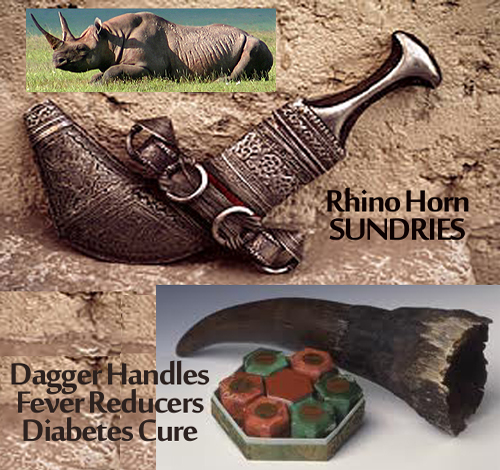
Rhino horn is in demand — as with ivory — in Asia but for medicinal, holistic beliefs in its curative powers. Used for centuries as a fever reducer, newly rich Asians (mostly Vietnamese) buy tiny erasure-size blocks of compressed horn to cure everything from diabetes to hangovers.
For the poacher in East Africa, though, the main market is Yemen, Djibouti, Eritrea and thereabouts, where rich businessmen buy the horn to polish it as a dagger handle.
In the ATC story summary we heard this weekend, Langfitt and Warner conceded that even after poaching there are still enough rhino births annually to continue increasing the population.
(Media that they are, however, they’re unable to avoid teasing us with scandal, claiming that at current rates this will not be the case by 2017. I doubt that.)
And they have drilled into the attempts at real solutions, including horn cutting and controlled rhino farming and harvesting.
So unlike the huge bulk of elephant reporting these last several years which has been terribly incorrect, and of which NPR and PBS have contributed to messing up, this one might be different.
Anthropomorphization of African animals is one of my pet peeves, but it’s Mother’s Day for god’s sake! Here is my best attempt at doing exactly what I don’t think anyone should!
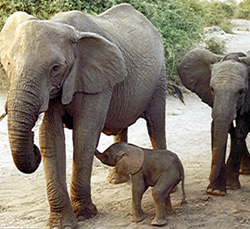
The Mother of Mother’s has got to be the elephant, because from the moment of puberty to the moment of death this poor sop is pregnant and nursing. Elephant are one of the few mammals that can lactate while pregnant or in estrus.
So the moment she emerges from childhood … it’s over, that’s it. No more fun and games.
No nicotine breaks. No awards banquets: after all she never retires. No vacations, no birthday parties except for her unending own deliveries and no chance for getting over to the TJMax sale to celebrate the end of stretch marks, because she’s always pregnant.
So as a result she usually has more than one kid to take care of, and then the girls never leave home, so you can imagine what it’s like leading a fussy group of ladies that includes children, granddaughters, great-granddaughters and sometimes even great-great-granddaughters out shopping.
From about 12 to 65 years old, and then finally it’s over. Completely over. She’s dead. She’s not a mom, then a soccer coach then a board member then a grandmom, because she’s just always a mom. Until she’s a corpse.
Elephant are…
The Queen Mother.
The other two biggest Moms are rhino and hippo. Rhino might never be moms, because they fight off like the dickens every suitor that comes along. Perhaps they understand the outcome if they don’t.
A real rhino loser will be pregnant about every seven years: not bad. And as she gets older and bigger (and wiser?) she gets stronger and stronger and will probably kill any guy who tries to get near her. Some poorly trained researchers think she’s protecting the kid, but I know she could care less.
Rhino are …
Truculent Mothers.
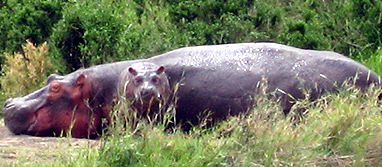
Hippo, on the other hand, are absolute ditzes. Eh, pregnant? So what? Hippo forget they’re pregnant and birth under water where the poor infant nearly drowns before finally bubbling up to the light of day.
Then, overcome by guilt and apprehension, the mother starts protecting the infant like the crown jewels .. for a short while. But sometimes she smothers it: of course accidentally it’s just that it’s so tiny, easily under 200 pounds. Then, pretty soon she forgets she’s got it and they both wander back into the unscrupulous pod of blubber of dozens of similar creatures hating and fighting with one another.
Hippo are …
Ditzes.
Moving up the ladder of cognitive grazing we come to those who prefer ruminating to birthing.
Unlike the big moms, this group has a pretty well defined cycle of pregnancy and birthing and mom responsibilities, but the problem is that it, too, never ends. But unlike the Queen of Mothers, they get several months respite every year, then the whole damn cycle starts over!
They’re feeling pretty good having dumped the teenagers, maybe go out with a few other ladies for a quick afternoon cocktail, and who’s there but Jolly Joe. Just a bit tipsy (can’t deny them the brief interlude from a life filled with dire responsibilities) they take a quick fling, then what d’ya know, they’re all pregnant, again.
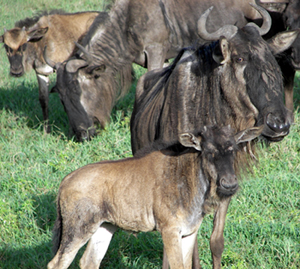
And so it goes. For the rest of their lives, which fortunately aren’t as long as the elephant’s. Then when the newest junior comes along, he’d better keep up or it’s over. A little zebra colt or wildebeest calve that loses its mother has basically lost its life.
By Nancy Haley on safari with Jim.You can darn well bet the house that no other zebra or wildebeest is going to take care of that irresponsible little twirp. He got lost, that’s his problem. Mom gives an effort at searching the playgrounds, but not for long. I mean, golly, can’t a girl have some time to herself?
Wildebeest and zebra are ..
Floozie Moms.
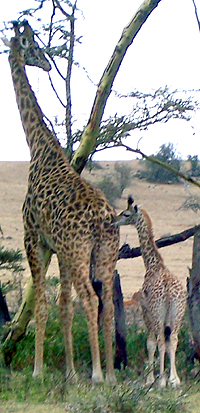
Then there’s the giraffe, the enigmatic ponderous long-necked thing. How can you expect something whose eyes are so far from the ground to put anything as small as a child into focus?
The poor thing drops 6 feet into the world to begin with and there’s no way she can pick it up: it’s too far away. Fortunately, the amount she can bend and the length of her tongue are capable of tasting it to make sure it’s real, but after it’s up, and she lifts her head up into the sky, again, well, it’s basically forgotten.
So if that little critter needs a drink she better stay close. More than once I’ve seen a mother giraffe abandon her offspring for the slightest fright: like one of my improperly dressed clients who didn’t realize there were no hair dryers. Fortunately for the little tyke it can start eating after only a couple months, because you can be darn sure mom’s not going to serve breakfast.
Giraffe are …
Aloof Mothers.
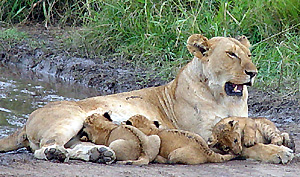
Then we have those considered to be the kings of jungle: the cats. The problem with cats is that they’re like rabbits. They like to be pregnant.
Problem with lion is that evolution lagged their personalities. The poor lion mother has only four tits but gives birth to 5-7 cubs virtually every year, with glee I might add. And she keeps smiling as 3-4 are immediately starved out!
Lion are …
Distractable Mothers.
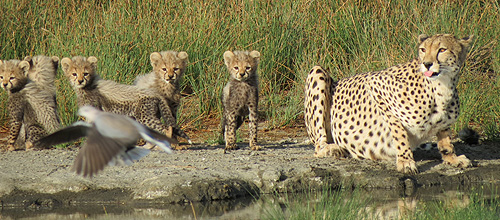
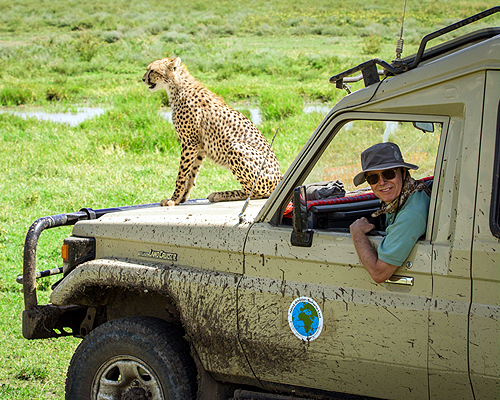
Cheetah, on the other hand, are real workhorses. There’s this one female cheetah around Ndutu which has successfully raised 5 or 6 cubs over several consecutive years. (See Mary Critchlow’s wonderful picture at the bottom of this blog.)
This is astounding, particularly when you realize that the cubs – unlike other cats – have to follow mom a day after being born. No den for these young’uns! Get ‘um up and working!
Cheetah are..
Demanding Mothers.
Alas to our own neck of the woods. At this point my distaste for talking about animals as people breaks down a little. But only a little! By Dan Peron on safari with Jim.
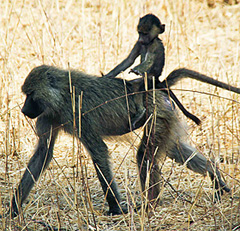
Baboons are bothersome at all stages of life. And the incredible tolerance the mothers have for the constantly misbehaving kids is amazing. And do they ever misbehave! My wife and I raised a baby baboon when we lived in Kenya, so I know personally. One little baboon could lay waste an entire African village.
As they grow up they’re absolutely incapable of shedding this cavalier attitude towards the possibility of Utopia. And they tolerate and foster it among one another. So Mom will most happily provide carriage for even the most malevolent little devil.
Baboon are…
Lenient Mothers.
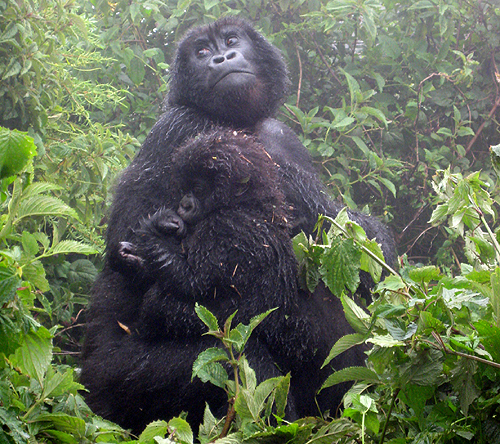
And then those big chumps in the woods. Gosh it’s hard not to compare one of them to my brother. Everything is so similar to us: the way they cuddle and fight and play. Play seems to be the thing. I know lots of animals look like they’re playing, but I don’t think so. They’re just running around. By Chris Benchetler on safari with Jim.
Gorillas play. Sometimes with the tourists or researchers watching them, and once a big silverback Daddy who didn’t like this cross cultural interaction came charging out of the forest like a freight train and swung the kid beside me up into the air with his huge arm even as he was running, and the kid nearly went into orbit.
Mom screamed. I couldn’t tell if it was out of fear or anger, or both, as she scrambled up the tree and pulled junior into her breast.
Gorilla are…
Affectionate Mothers.
So there you have it. My first foray into the absurd, unlikely and totally unrealistic universe of animals that don’t exist. But then when younger, we often held that view of our own moms. By Mary Critchlow on safari with Jim in Ndutu.
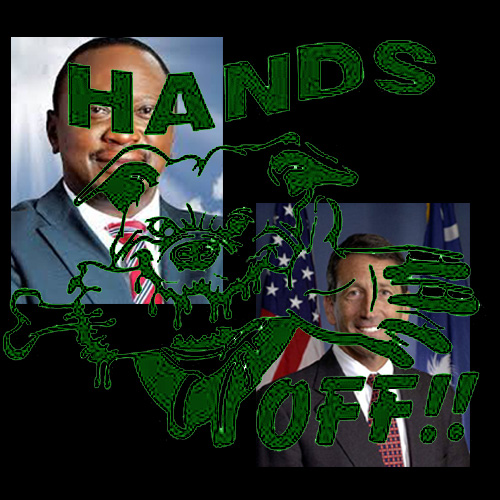
The tenacity of Rightists that so inhibits U.S. progress is becoming true worldwide, and no better example than the imminent diplomatic earthquake over Kenyan leaders’ indictment by the World Court.
The phrase is not mine, but Richard Dowden’s, one of the world’s most respected African analysts, Director of Britain’s Royal African Society.
Dowden’s brilliant summary and analysis of the Kenyan Mess published today is required reading for anyone who’s trying to understand this incredible “mess.”
And his conclusion is “Right”-on: the minority (in the world as in Kenya) who are “elite … simply do not recognize that they are subject to the law. Politically powerful, exceedingly wealthy and above the law,” people like Kenyatta, Cameron or Limbaugh just ignore legal and social realities, carving a world in their selfish images.
(Read Dowden. I do not intend to quote him out of context, and the quote above he wrote strictly with regards to the Kenyan leaders on trial, but I think it a fair if liberal extraction of his meaning.)
Dowden’s analysis is no more brilliant than his summary, which is a tough nut to crack. Before I further try to summarize Dowden you must have an understanding of the ICC (International Criminal Court) which has indicted the President and Vice-President of Kenya for crimes against humanity.
The U.S. does not recognize the ICC. Nor does China, India and 38 other countries. But the majority of the world does: 122 countries including Canada, Australia, all of South America and almost all of Europe.
Another 28 countries, including Russia, have “signed on” to the ICC Treaty while not yet ratifying it. In so doing they agree to the abide by the treaty (including arresting indicted criminals on behalf of the Treaty who are not their own citizens) without yet allowing prosecution of their own citizens.
The Court was only formed in 2002. There is a much older cousin, the International Court of Justice (ICJ) formed in 1945 and designed strictly to adjudicate disputes between countries. All countries that belong to the UN automatically accept the ICJ.
Both courts are located in The Hague and share some facilities.
In 2007 Kenya blew up after a contentious end-of-year election. About 1300 people were killed and a quarter million displaced (of which more than a 100,000 remain so). The violence threatened Kenya’s relative stability and the west’s toehold in the continent:
Kenya was and probably remains the closest African ally to both Britain and the U.S. Strategically critical to the War on Terror (especially in Somali) and to both countries’ defense posture in the Red Sea (bases and warships in Mombasa), Kenya was the platform on which democracy and western capitalism were and are being promoted by the west onto the continent as a whole.
Britain, the U.S. and recently retired UN Secretary General Kofi Annan formulated a brilliant peace agreement that after a troubling six weeks brought Kenyan society back to peace, resulted in five years of growth and stability and the creation of one of the world’s best, new constitutions.
Part of that lengthy and complicated agreement was that those responsible for the killings and massacres should be brought to trial. The agreement gave Kenya the option of running the trials itself, or if it didn’t want to, allowed the ICC to run them.
Kenya through its parliament decided to wave its right to hold the trial and agreed to cooperate with the ICC.
Lo and behold, guess what the ICC found?
That two of its rising political stars, who recently became the country’s President and Vice President, were principally responsible for the killings and massacre.
Oops.
You know it’s interesting. In the old days what tangled up the west in its own ideology was its support of South American and Mideast dictators who held none of the west’s lofty morals. And these guys often used the west’s weaponry freely given them back on the west!
But now what you have is the west denying its own lofty morals!
David Cameron, Prime Minister of Britain, and Jacob Zuma, President of South Africa, both lead countries who have signed on to the ICC. President Zuma traveled to Nairobi to be an honored guest at Kenyatta’s inauguration.
This week Cameron welcomed indicted Kenyan president Uhuru Kenyatta to a conference about Somali in London.
Today Kenyatta announced in a wildly aggressive press conference that the UN Security Council better vacate his indictment with the ICC.
Also today, Fox Newser Stephen Hayes, given a platform in U.S. News and World Report, says that the ICC should drop the charges against Kenyatta.
I think that says it all. The Right Worldwide is unified, but why? You can argue that Cameron is hamstrung by Kenya’s importance in the Somali situation, and you can argue that Zuma is crazy.
But why would Stephen Hayes take a position?
Because The Right (Kenyatta + Cameron + Zuma + Hayes, let me also add Sanford) are all miserable failures who through “elitism” and (likely unscrupulous) wealth have manipulated elections to become powerful men. And The Right does not unlock its jaw once clamped.
They are all also in minorities, but there seems to be no organized majority to defeat them.
Back to unedited Dowden:
“The fact is that the Kenyan elite … simply do not recognize that they are subject to the law. Politically powerful, exceedingly wealthy and above the law, no state official would dare touch them.”
Equally applied to miscreant U.S. bankers and right-wing U.S. politicians. How many bankers have gone to jail? Or even lost their job? Which man was yesterday elected a Congressman who is indicted for having misused public funds for his affair in South America?
Good grief. They just can’t be gotten rid of. And so what happens when Vice-President Ruto decides not to go to The Hague for his trial on May 28, or when President Kenyatta decides to take a pass on his date of July 9?
It’s likely there is a greater percentage of Chinese who wish to end the ivory trade and save elephants than there are Texans who believe in evolution.
Think about that, please.
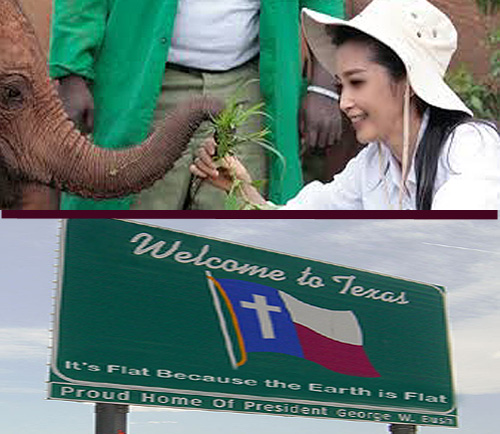
Yesterday, the Chinese actress Li Bingbing – who has 20 million followers and counting on her social media – made a highly public visit to an elephant orphanage in Nairobi and then called on her fellow Chinese to stop buying ivory.
She joins a growing list of Chinese celebrities aggressively supporting conservation issues, and it makes me so damn mad the way current media again and again is blaming the Chinese for a crisis they’ve also made up: elephant decline.
The same organization for which Bingbing is an honorary ambassador is also one of the few to use realistic numbers regarding elephants. You might have heard of this organization: the United Nations.
The press statement released with Bingbing’s conference referred to “data [that] shows that 17,000 elephants were illegally killed in 2011.”
Contrast that with CNN that described the “slaughter of elephants” at an “alarming rate” and blamed it on the Chinese.
As I’ve pointed out again and again in this blog, animal poaching is horrible. Using the UN’s numbers (see link to the report, below) there are probably a half million or more elephant in Africa, today, and a low estimate of their annual reproductive rate increases that population automatically by 25-35,000 annually.
There are too many elephant. Elephant/human conflict is Africa’s single-largest conservation problem. So even with the illegal poaching, the troublesome population is growing larger and larger every year.
And the notion that it is all due to the Chinese is racist.
Yes, most of the illegal ivory goes to Asia, but Asia is not China. There is huge market in Thailand almost equal to all of China, and another huge market in South Korea. Anyone ever talk about those countries? And a huge portion of the Chinese market comes in through Hong Kong, which is as little Chinese as possible. The next conduits are Indonesia and the Philippines.
But do we ever hear negative things about those capitalist ally mean guys?
This whole made-up story about the imminent doom of elephants is horrible enough in itself. The elephant problem is not with its likely demise, but with the demise of our entire conservation efforts in Africa as young populations of modern Africans get sick and tired of being stepped on by animals preserved for rich foreigners.
Go ahead and let the beast bulldoze your child’s primary school at night and decimate your watermelon crop, so that South African tourism chains can charge $800 per American per night to see them picking their teeth and wagging their tails the next morning.
Look folks, we’ve got to climb down from inaccurate media that’s turning real world conflicts into soap operas. I’m so exasperated not just with CNN, but a whole range of media, each one feeding on the American public’s craven need for apocalypse.
The best factual report about the elephant situation you can read by clicking here. Be patient and refresh your viewer often, because it’s a huge report with many charts and tables and it’s created for CITES by CITES and the UN. Unfortunately it’s skewed towards the apocalyptic angle, for political reasons anticipating the upcoming CITES battle about sales of regulated ivory. But its numbers are solid and absolutely support my ranting and raving.
It’s a real problem, but we aren’t thinking about it correctly or working to resolve it. We’re just using it to titillate us.
Yesterday’s deadly grenade attack in Arusha isn’t simply an indication of escalating religious tensions in Tanzania, but of the same escalating individual malevolence evident in the Boston massacre.
In neither incident do I believe there is any kind of organized group involvement, despite FOX News, Representative Stephen King or the other crazies on Meet the Press yesterday. Both cases seem to me to be engineered and implemented by wayward souls.
Wayward souls that have access in Boston to deadly technologies from Google searches. Wayward souls in Arusha who can trade a bushel of tomatoes for a grenade at practically any market in Africa.
It’s all the same. Neither is worse or more terrifying than the other. The higher tech move by the Boston duo was more deadly, just because American society is more sophisticated than Tanzanian.
Escalating religious and ideological tensions in America and Tanzania have been evident for years, and I agree with Arusha’s MP Godbless Lema that governments need to proactively address the schisms growing in their societies:
“”Religious fundamentalism is a reality in this country, but the government does nothing,” Lema said angrily outside the church, as police cordoned off the area.
Lema is one of the few honest, aggressive stars of Tanzanian politics. Like the minority of American politicians who want to address the Boston massacre with better schools and counseling and more jobs, rather than creating more fictitious global enemies, Lema knows the media speculation of the cause is absurd.
The ideologically bankrupt in a society will always point to the outside to explain a cancer within.
Since colonial times Tanzania has been one of the most Catholic countries of Africa, a product of King Leopold’s mid 19th Century conference that divided the colonial African world up by religion, so that missionaries didn’t duplicate their work.
One of the greatest historical ironies of Africa was that during the socialist policies of early independent Tanzanian in the 1970s to be a member of the Tanzanian communist party you also had to be a Catholic.
The amalgamation of Zanzibar with mainland Tanganyika in 1964 was like mixing holy water with myrrh. Since time immemorial Zanzibar was ruled by the radical Islamists of Oman, and even though it’s been given considerable autonomy, tensions have never fully eased with the mostly Christian mainland.
In October a respected Sheik in Arusha was hospitalized after an explosive device was set in his home. That was followed by church bombings in Zanzibar.
And so the cycle goes on and on, individual anger and want having found a convenient battle.
The Tanzanian government today arrested five Saudis, conveniently of a Muslim sect that is mostly disliked in Zanzibar, and charged them with terrorism.
Absurd, of course. This was the same Tanzanian government who employs the Arusha police commissioner who took 2½ hours to get to the church that was bombed Sunday morning, a half hour after the Vatican’s emissary attending the ceremony had been whisked out of the country.
The Honorable Lema is right. Governments do little today, in either America or Tanzania, to mend social schisms. Let’s just blame outsiders.
Obamacare is about to have a profound effect on American tourists who purchase travel insurance. But first, the truth about travel insurance:
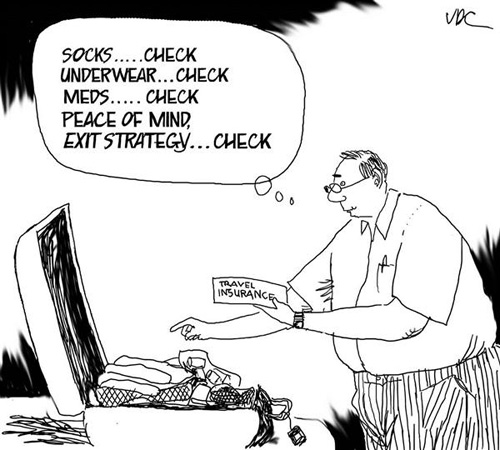
(If you know everything you care to know about travel insurance, already, skip down to the little cartoon to get to the meat of this blog, how Obamacare will effect your travel costs.)
Like every kind of insurance you buy in America for yourself or your household, multiple companies are involved, and multiple companies get rich off your premium, which is expensive. A good contrast with us is Britain.
Britain’s single-payer health insurance system, as well as one of its travel insurance systems — both provided by the government — cost individuals using them a tiny fraction of what American consumers pay. A Brit can cover himself for all the normal travel hazards American insurers include for about £75 annually for all their trips (about $120).
Whereas Americans must pay insurers approximately 5-6% of their desired coverage limits per trip.
Most travelers who purchase travel insurance do so for the component of coverage that will repay them the loss they would otherwise suffer if they must cancel after their nonrefundable payment deadline. And as you know payment deadlines with travel are well in advance of the trip.
The variety of conditions that apply to this is huge: all companies will repay you if you must cancel because you suffered an accident. The increased benefits from that point — say because you fell ill due to a pre-existing condition, or because your parents fell ill, or because of a terrorist incident, or because the travel company holding your money went bankrupt, or because you had a business reversal, or … for no reason whatever – are all available at higher premiums.
Premiums start around 3% of the amount you choose to cover yourself for. Average premiums are around 5.5%. Coverage for “cancellation for any reason” can exceed 25%.
Americans spent nearly $1.8 billion on travel insurance in 2010, up from $1.6 billion in 2008, and $1.3 billion in 2006, according to the US Travel Insurance Association.
But USTIA may be low-balling the amount: The IBIS research organization reported last month that it expects revenue will exceed $2.7 billion within five years.
It used to be that the bulk of sales came from older travelers concerned with aged parents, but that’s changing dramatically. I’m personally amazed that current research suggests the largest single demographic is 18-34 year olds.
This likely is the result of so much educational exchange abroad, which requires mandatory and considerable insurance. Underwriters, however, are suggesting more varied reasons, including aged parents from a generation whose parents were much older to begin with.
The usual way a traveler purchases insurance is from the same source from which they purchased the travel: The travel agent or tour operator.
The first level of commission earned by that agent or tour operator, the final seller, is around 30%. Yes, you read correctly, nearly a third. More often than not and particularly with unbundled homogenous products like cruises and airline tickets, the amount the agent earns from selling insurance rivals or exceeds that earned from selling the actual travel product.
But that’s only to the final seller. Everybody in the chain of sale earns well.
TravelGuard is one of the oldest and most respected travel insurance companies. Our own experience with it over decades has been positive.
But TravelGuard sells its policies in bulk to “National Union Fire Insurance Company of Pittsburgh, PA” which is actually located adjacent its parent company in New York to whom it resells its bulk purchases from TravelGuard. Its parent company is AIG.
Ever heard of them?
AIG is the principal global company underwriting travel insurance. American Express is number two. You will not see either of their names on any policy you’ve ever bought or ever will.
I’m not proud to say that in all the years of selling travel I’ve always cringed a bit while also biting my tongue when selling travel insurance. I understand entirely the “peace of mind” it affords the traveler, but it’s a royal ripoff.
Not for that ad hoc traveler who just happened to buy a big trip for the first time in her life just before her folks died. So individually, it’s hard not to recommend.
But for the common traveler who after retirement takes a couple trips annually for maybe 10-15 years, he’s gambling that one in a dozen will result in a need for unexpected cancellation. That seems like a reasonable number, but I doubt it.
Figures are near impossible to come by. The United States Travel Insurance trade group claims its surveys indicate that 1 in 8 adult travelers had issues that lead them to cancellation, and that about 1 in 6 actually filed claims.
But that’s the rub. We don’t know how many claims are paid, how many denied, how many negotiated. The travel writer Damien Tysdal recently listed “six” common reasons that travel insurance claims are denied, suggesting quite a few claims are ultimately denied.
I know that AIG got a bit of egg on its face for financial derivatives, but I got to think that travel insurance isn’t quite as tricky for them.
So how is Obamacare going to effect all this?
Travel agents who have been routinely selling travel insurance, such as EWT, were contacted this week by salespersons with the travel insurance companies. These were supposedly confidential calls to advise travel agents that the Affordable Care Act may disqualify them from selling future travel insurance.
It boils down to provisions in the act that limit all insurance by secondary agents to sales by state. So if you’re a travel agent in New York, you should be able to continue selling travel insurance to your New York customers, but not to anyone out of state.
EWT like many companies has a nationwide client base. Although the rep contacting us said the issue is “still with legal” and that they are “looking for loopholes” it sounded pretty certain: travel agents will now only be able to sell travel insurance to people who reside in the same state that they do.
Here’s what I think will happen:
Travel agents will be cut out of the loop, just as airlines and hotels cut them out more than a decade or two ago. This will mean that consumers will increasingly buy travel insurance on the internet.
And – as with all Obamacare – travel insurance costs ought to come down. In part this will be because more of the sales will be individual online sales, and this will generate more competitive pricing. Right now I think travel insurance pricing is elevated because of the dynamic of travelers buying their insurance from the travel agent who sold them the travel product.
So basically it’s good news for consumers, bad news for travel agents.
Investors in new shopping malls for Kenya and Nigeria are expecting a first-year return of 12% and a long-term return of 25%, led by savy South African banks.
Business plans for Africa have always astounded Americans. I’m mostly familiar with the tourism sector, and ROIs (return-on-investments) of less than a third are not considered worth the risk. And the risk is substantial.
And the risk hasn’t for a long time been either political or health, which is what most noninvestors think. Those types of risks have diminished regularly over the years, because of two radically different trends.
The first is simple: Africa is developing. It was never banished to the dustbin of underdevelopment, forever. Roads, schools, factories, hospitals, cinemas, community infrastructure – they have all developed at a faster clip over the last generation than was ever the case when the developing world was getting built.
The second is intriguing: businessmen like tourists have become increasingly immune and enured to politics, even violent politics. With the notable exception of global bad guys like al-Qaeda, turbulent societies somehow manage to court – not scare away – businessmen and tourists.
Egypt is the best example. That society is currently in literal upheaval, yet there were more than 8 million tourists there last year, and “tourist incidents” in Egypt have been fewer since the revolution than prior to the revolution.
It seems that both sides in a local fight have increasingly recognized the importance of foreign tourists and investment.
So what is the main risk, then?
That you’ll come up with something successful. Yes exactly: that your investment begins to pay off.
This totally counter-intuitive notion is what lays bare most poorly prepared investors in Africa. The African playing field is so small by comparison with the home turf from which most investors come, that the amount of investment is usually quite modest.
And that means if you hit on something great, there are lots of bigger guys watching from behind, and they’ll swoop down the moment those high returns actually come in.
And this is inevitably what’s happened over the last generation. A relatively small investor builds a lovely little lodge aside a national park, and the moment there’s positive cash flow, a South African tourism chain eats it up.
Now there’s nothing particularly wrong with this if the investor’s game is to make a little bit of money. And it works specially well for small investments, especially as I described above with small tourism ventures.
But the problem is that while the indicator for a tourism investment is positive cash flow, that doesn’t immediately translate into high return. The originator needs to have the fortitude if foresight to wait for that high return, but the temptation offered by the big guys is often considered just too much to pass up.
African investors’ greatest risk is that they don’t wait for that high return. And it’s often not “won’t wait” but more realistically “can’t wait.” Rarely does a single investor create something wholly unique.
There are lots of tourists lodges being built. Lots of shopping malls. Lots of gas stations. Lots of plumbing fixtures.
If you don’t take the offer the big guy gives you, he’ll buy up your competitors and smother you.
There’s nothing novel in this dilemma. What’s different in Africa is that the quantitative size difference between the Joe who took the first step and his buy-outer is massive. All the leverage is with the big guys.
It’s a simple equation derived of the modern truism that the rich have become richer as the poor have become poorer.
In 2009 Chinese investment in Africa exceeded the U.S.’ By the end of this year, Chinese investment in Africa will exceed the combined investment of Europe and the U.S.
Today’s final detailed explanation by Kenya’s Supreme Court of its decision to affirm the March presidential election makes me doubly angry with Bush vs. Gore.
The clear consensus by much more scholarly analysts who have rushed out their initial impressions is pretty negative, that the detailed decision is “disappointing.”
But quite to the contrary, it helps me understand how insidiously deceptive a political system is where the final say presumably rests with a collection of appointed sage elders with so little obligation to anyone or anything that they can neutrally discern the facts and subsequently convey justice.
By the way, there was nothing very revealing in the 113 pages, and a little bit for everyone including the critics of democratic methodology and the critics of corruption. I’m no legal scholar, but let me paraphrase the decision this way: don’t rock the boat.
The “rule of law” sounds good, but over America’s much longer history than Kenya we can often find definitive failed justice from the top. And that’s not wholly unexpected since it’s usually the most contentious and/or complicated issues that rise to the top, and it’s just statistically unlikely that the right decision will always be made.
And an incorrect Dred Scott decision foments war. The incorrect decision of our own Supreme Court in Bush vs. Gore arguably paved the way for two prolonged, unbelievably expensive and totally unjust wars.
America has a long enough history that it just seems statistically inevitable that some pretty horrible top court decisions would be made. But this, in effect, was Kenya’s first major decision.
And like America in Bush vs. Gore, the justices’ action put the man who likely lost the election in the winner’s seat: In Kenya by not altering the decision by the election authority (despite massive illegalities) and in America by stopping a recount of votes.
In Kenya it was passive justice; in America it was active justice; but in both it put the wrong man in power, invalidating democracy.
As in Bush vs. Gore, there were plenty of tidbits the justices couldn’t ignore: like the wanton corruption acquiring voting technology and the inability of the corroborating registration system to affirm exactly who had voted.
They even encouraged the Kenyan prosecutors to indict the “tender team” that designed and acquired the voting technologies that massively failed.
Just as the justices in Bush vs. Gore acknowledge that hanging chads if reconciled could alter the outcome.
So I don’t think we can rack this one up to the “statistical” likelihood that all profound decisions will not always be correct. There’s more to it.
In Kenya it means one of two things:
1. The justices were biased towards the flawed outcome, however wrong it was; or
2. The justices felt their meaning for existence was not sufficient enough to alter the status quo.
In America it was clearly Number 1, because they did alter the status quo by stopping the recount. In Kenya it’s hard to say.
But both situations demonstrate how weak the “rule of law” is in Kenya and America towards assuring a just outcome. Because the “rule of law” in both cases wasn’t. Law didn’t rule. Something else did.
And don’t be fooled by rationalists who argue that green is black, that intonation is meaning, that interpretation rather than implementation governed the situations. Legal opinions coming out of the whazoo drown in semantics. Get yourself into that clear air of what’s right and what’s wrong.
I believe that the “rule of law” achieves justice.
There was not “rule of law” in either Kenya or America. In both cases the justice system failed. And not just “statistically” so; intentionally so. Something else prevailed over justice. It’s called…
Power. And unlike the very essence of justice, it has no limits.
Thanks to Sheila Britz of New York for this!What do the President of Botswana and I have in common? We have both sustained cheetah injuries this year! His to his face. Mine to my car.
The Botswana government confirmed today that President Ian Khama had been scratched by a cheetah and had received several stitches in his face. Not a wild cheetah, but a caged cheetah that the president was obviously observing, and nothing serious enough to announce it until the press asked about it, today.
And it probably wasn’t even intentional. Cheetah differ from other cats in that their claws can’t retract.
Cheetah are interacting with tourists (and presidents) more and more. In each of the last two years I’ve had cheetah jump on our car to the terror and delight of my clients.
Earlier this year as we were approaching the edge of the migration in the Serengeti, we encountered a family of four cheetah: big mama looking somewhat weary at her three terrible teens: three 6½-month old not-quite-cubs-any-longer.
Because cheetah are the most harassed of all the cats in the wild, they love anything that doesn’t try to eat them … like tourists. I suspect, though, that if there were another animal in the wild except man that didn’t bother and pester them, they’d come purring over like a lap cat with affection.
Cheetah eat faster than any other cat, because if they don’t, they’ll have the food taken away … by bigger cats like lion and leopard, by hyaena, even by jackal and big birds. It’s a stressful life.
So when something just comes along to look at them, they’re most accommodating if not presumably relaxed by the notion that a man – the greatest hunter and threat to all living things – wants to be its friend!
After all, the enemy of my enemy is my friend, right?
Not to mention that a car is pretty high off the flat veld. Jump up on it and you’ll achieve a view far superior to that stumpy little termite mound.
All cats display innate curiosities, particularly as cubs, so when our vehicle stopped at the edge of the migration to watch the antics of the family of four cheetah last March, they were distracted to watch us.
With a head cocked unnaturally to the side of a slithering body that moved sideways around the front of my car, Number One opened his mouth in his pitiful little hiss, stopped, sat down on his haunches and then jumped up on the hood.
Numbers Two and Three meanwhile jumped on the two tires mounted on the backside. And yes, the roof was up and open!
Cheetah began this behavior years ago in all the national parks and reserves where they were protected. As tourism increased driver/guides naturally would try to encourage cheetah onto their car, for the obvious thrill it provides the client.
Rangers and scientists then complained that the growing number of cars around cheetah were disrupting their hunts, and guests should stay well away from them.
This was – at the time, and now – balderdash. I have no doubt that there were hunts disrupted, and we should be extremely mindful of not approaching cheetah on the hunt, but my experience has always been that in the vast majority of situations driver/guides do not disrupt hunts. It’s much more rewarding for a client to see a cheetah hunt than a cheetah tail.
Rather, it was just rangers and scientists pining for the good ole days when everything was pristine and wild. I think that was in the Pleistocene.
In our case, we were the only cars we’d seen the entire morning, and we were in a very, very remote area of the Serengeti. We had four cars, and as soon as the cheetah jumped on mine, the others stayed back.
Number One began admiring himself in my rear view mirror. I could easily have touched him, but everyone – cheetahs and tourists – were having such a grand time I didn’t want to disturb them.
Like cat cubs anywhere, the three of them were suddenly all over the roof, the hood, the tires, tumbling and not quite as sure footed as the mother who had run away and was calling them to no avail.
As Number Two decided to tightrope from the backside under the opened roof to the front, and tottered a bit, there were audible gasps from my clients.
All well and good, until Number Three decided to chew apart the rubber lining we put between the roof and the top edge of the car, to seal the roof when it’s pulled closed. And this was the rainy season and I fully expected the afternoon shower later in the day.
So that did it. I hissed back, and he hissed at me while Number One started to eat our radio antennae. At that point I started shouting and waving my hat and everything else I could find, and finally, reluctantly, the three kids jumped off the car.
Invisible fences for pet dogs are common in the U.S., but they’re used with opposite purpose in Africa: to keep the unwanted out.
Africa’s big game parks are mostly huge tracts of uninhabited wilderness but increasingly sophisticated agriculture and ranching impinges on many of the borders. There is the obvious social/political human/animal paradigm to work out, and it is becoming contentious.
But to the extent the wild game parks are to be preserved, there’s always been an easy, inexpensive way to demarcate Africa’s national reserves and make them nearly impenetrable by outsiders.
These “invisible fences” are not manufactured like an American dog collar, although they’re often easily manipulated, and they have kept nicely divided wild animals from domestic stock and farmers for generations.
The best known of these is the tsetse fly. Tsetse no longer transmit human sleeping sickness but they continue to carry bovine sleeping sickness. Wild animals are immune to it; cows, sheep, goats and horses aren’t.
(Recent genetic research identified the specific gene that makes domestic stock susceptible to tsetse, but Africa is a long way from creating a practical therapy for domestic stock based on this.)
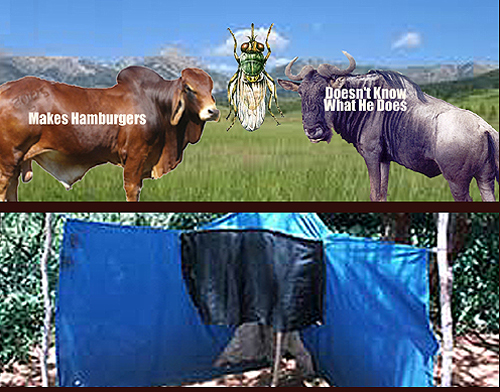
Tsetse must carry a kamikaze gene, because they’re easily fooled into killing themselves. Simple fabric traps of alternating blue and black, and sometimes white added, layered with pesticide is a certain end to tsetse wherever the trap is laid.
Strategically placing these traps produces an invisible fence. Lodges, camps and ranger stations in wild areas mark their perimeter this way, becoming tsetse free.
In fact tsetse could easily be eradicated completely this way, but park authorities don’t want to do this. That would also eradicate the invisible fence.
Hoof-and-mouth disease, as well as anthrax, are incomplete natural fences. Wild animals do succumb to them, but not as readily as domestic stock.
That was why Botswana authorities in the 1980s began erecting elaborate electric fences and moats to separate the wild from domestic lands. The project is considered successful since it safeguards Botswana very important cattle industry. But it does so at the expense of about a third of its wild animal population.
But until now there was one other disease that was a certain invisible fence between many of Africa’s great herbivores like wildebeest and domestic stock: a virus known as the “Malignant Catarrhal Fever Virus” (MCF).
This herpes-type MCF is a world-wide virus of significant concern to ranchers, and it’s been long studied. The developed world learned that sheep carry the disease very much like wildebeest without easily succumbing to it, but that sheep readily transmit the disease to cows, which then fall quickly.
So strategies for dividing sheep from cows employed aggressively in the 1950s led throughout the developed world to a managed situation where MCF wasn’t eradicated but didn’t cause a lot of trouble.
But it’s different, today, in Africa. The wildebeest population is rife with MCF. In fact nearly every female wildebeest tested carries it. There are many ways the disease can spread, including a slight risk through airborne transmission, but the principal way seems to be when the female wildebeest calves.
The birthing fluid lost in calving is saturated with the virus. When the herd moves on, the ground retains the virus for a very long time. There is even a suggestion that new grass which subsequently grows in the area contains the virus.
In the old days, when there was less developed agriculture in Tanzania, ranchers “would migrate with their livestock elsewhere because there was still ample land, but now there is nowhere to go,” Dr. Moses ole Nasselle told the Tanzania Daily News this week.
Ole Nasselle leads a team of professionals in the Serengeti ecosystem that announced Monday they had produced a vaccine against MCF.
The competition for land is intense in Africa. One of those playing fields is the continent’s great national parkland.
Last night a prominent African businessman chastised Obama for “disengaging” from Africa, even as American military involvement grows ominously large.
Obama as reflecting the “United States” is a curious shadow box of a troubled society. Are we (is Obama?) pulling inwards, constrained (perhaps by Congress?) to few good acts except our own security?
Yes to the first question, and the answer to the second question doesn’t matter.
“We are witnessing a gradual and continuous U.S. retreat from Africa,” Dr. Mo Ibrahim said last night in an acceptance speech for an award from an organization heavily funded by Obama’s Nobel Peace Prize winnings.
“I take the expansion of [AFRICOM] and the growing U.S. military presence sort of creeping down into sub-Saharan Africa as a further continuation” of American militarism, claimed Andrew Bacevich at the Carnegie Council last week.
Dr. Ibrahim is one of Africa’s richest men, commonly known as the “Father of Africa’s Mobile Phones.” Bacevich is a highly respected analyst, author of “The New American Militarism.”
“There is no question that Africa is moving forward,” Ibrahim continued, pointing out the extraordinary GDP growth of the continent, even through the global recession.
“ Everywhere in Africa you see Indian, Chinese, Brazilian businesses,” he said. But no American business except Coca Cola. Africans as a result are beginning to feel a bit uneasy about the United States.”
Read: “suspicious”
Note that Ibrahim didn’t include Europe in the panoply of foreign businesses racing into Africa, and Europe like America is in the forefront of the current global financial earthquake. I think it fair to include Europe in this analysis; it’s not just Obama, not just America, but the traditional developed world.
Which is turning inwards and becoming militaristic obsessed only with its own security.
That’s a very dangerous path to cut. It doesn’t work. It makes things worse: Look at Chris Hayes’ MSNBC show last night: click here.
In his book and his speech, Bacevich recognizes 9/11 as when America (“developed world” including Europe) pivoted from grand economic and social engagements with the rest of the world to become militaristic.
“The George W. Bush administration tacitly acknowledged as much in describing its global campaign against terror as ‘a conflict likely to last decades’ by promulgating the doctrine of preventive war,” Bacevich explains.
The doctrine of preventive war, as much a social upheaval and resource greedy policy as The Monroe Doctrine was nearly two centuries years ago, has consumed America. And it has consumed America just after American bankers and immoral financial trainers consumed society with the 2008 depression. We’re sort of on a mobius strip of unstoppable self-destruction.
Several weeks ago France conceded that its short several week involvement in Mali will likely extend to years. Remind you of something? Mission accomplished?
“… the violent pursuit of violent Islamists continues with no end in sight,” Bacevich laments.
I don’t think this policy of ‘the violent pursuit of violent Islamists’ would be quite as controversial if we didn’t have domestic flight delays, sinking education, wholly stalled government, and a basic social ennui that clearly now even extends to our private sector.
We define ourselves principally in “private sector”-speak. Capitalism cannot survive in today’s global economy, unless it’s global.
The world is moving on, and a lot of that movement is in Africa. There’s nothing very surprising about this. It was the fertile, untilled economic continent, and it’s now being tilled. By Brazil. By India. By China.
By the new economic bullies on the block.
But America sits idle. American businesses won’t invest, at home or abroad. America is consumed by its own terrorized concern that it is marked for doom.
Today’s developing world health crisis is not malaria, or HIV, or infant mortality… it’s tuberculosis. And a University of Cape Town scientist knows what to do about it.
Tuberculosis is an infectious disease that most Americans associate with the pre-World War era. It attacks the lungs, essentially disrupting the normal physiology that keeps the lungs clean and clear of too much fluid.
Prior to the discovery of antibiotics the famous “TB Asylum” was the only way to manage the disease, which was basically to quarantine victims from the main population and put them on forced bed rest, in the hopes the body could fight off the bacterium itself.
Antibiotics proved completely effective in treating TB, and only in poorer or remote areas where treatment was difficult was the disease still found.
By the 1970s TB in America was considered an unusual disease. In Africa it had always been an unusual disease.
But the double wallop of the emergence of HIV and the diminishing efficacy of overused antibiotics allowed TB to reappear. What’s important to realize is that TB is a developed world’s disease. It was brought to Africa by the developed world.
Like smallpox which wiped out large numbers of native Americans, TB is now wiping out large numbers of Africans.
TB increased in America in the early 1990s, because that was the height of our HIV infection. As soon as a handle on managing HIV was mastered by the end of the 1990s, TB in America dropped noticeably.
But in Africa the increase continues, despite a similar drop in HIV infections as in America. In fact in sub-Saharan Africa TB is now considered a greater threat than HIV.
There’s a number of reasons for this. The foremost is that TB is a relatively “new” disease in Africa with relatively “old” treatments available. The link with HIV is much more substantial in Africa than elsewhere. And the appearance of the disease was so sudden and so large that the disease seems to be getting the better of newer drugs to treat it.
The many new approaches to treating the disease which are readily available in the developed world often exceed available resources in the developing world.
Our CDC refers to “throwing the kitchen sink” at the disease as a recommended therapy. Basically this means treating the patient with a variety of drugs in the hopes of overwhelming the growing resistance of the disease to numerous antibiotics.
In Africa that’s often too expensive and too impractical for many of Africa’s very rural and poorly developed areas.
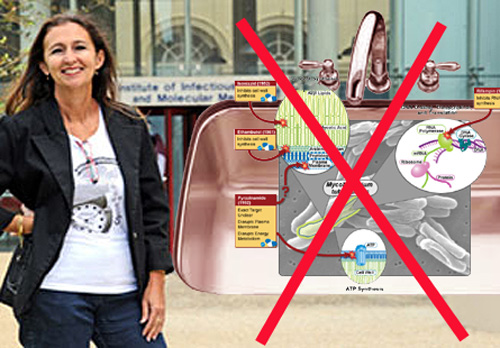
South African scientist Valerie Mizrahi from the University of Cape Town’s Institute of Infectious Disease and Molecular Medicine understands the complexity of the problem better than any person.
Taking a holistic approach to treating the disease on the continent, Dr. Mizrahi realizes that education about the disease to enhance prevention may for Africa be its single-most important therapy, and that training local doctors and scientists who have a vested interest in their communities is a close second.
To be sure, her scientific research on the microorganisms and medicines involved with TB is stellar, too. But her holistic approach was today recognized with a $6 million prize from one of the world’s foremost scientific laboratories, the Institute de France in Paris.
“For me, the most gratifying part of it is that the award committee recognized my commitment to, and passion for, developing people,” Mizrahi said.
So many problems effecting Africa as the younger sibling in a global family require truly holistic approaches, in a way that the developed world just can’t seem to understand with its bulging arsenal of technology and funding.
There are few kitchen sinks in Africa to throw at anything.
So TB is likely going to be around Africa for a very long time: like malaria, until the elusive vaccine is discovered. And managing rather than curing the epidemic is the key to successful public health in Africa, and Mizrahi is leading the charge.
The great rice fields of western Kenya are ready for harvest. But the battle that will determine who eats the rice is only now playing out. It’s man versus bird, and the rules of engagement are not pretty.
This is such a perfect example of the folly of man trying to tinker with nature. I’ve seen it play out time and again in America mostly by campaigns against “invasive species” which have essentially proved laughably unsuccessful.
But a time comes when human society gets itself properly organized and funded, to do such things as eradicating malaria, and then the consequences are considerable:
The eradication of malaria, typhus and other mosquito vector human diseases was successfully accomplished in America by the end of World War II through the use of DDT. The ramifications of that continue.
We all know about the near extinction of the bald eagle, and how DDT so weakened the outer shells of bird eggs that many species were threatened. But the effect on the environment was much greater than just an effect on avifauna. Scientists continue to argue, today, that DDT is a carcinogen that effects a wide range of species, and will do so for centuries.
But it did succeed in accomplishing its mission. Although there’s some concern malaria could reappear in America, today, because of global warming, certainly we can conclude that America has been essentially malaria-free since the 1950s.
So it is a cost-benefit argument. Today, most African governments argue that DDT should be allowed greater use than current world treaties allow. Today the use of DDT in Africa “within confined buildings” is allowed, but the widespread spraying that effectively ended malaria in the U.S. outdoors is prohibited.
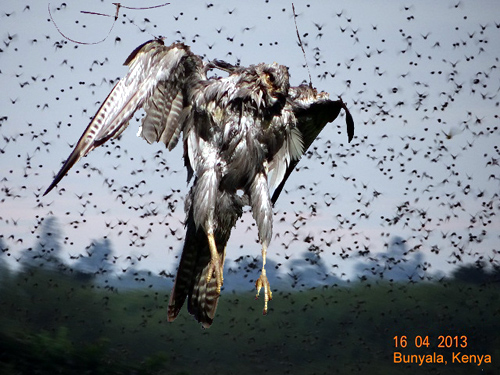
This weekend a conservation organization working in western Kenya reported that the raptors it works to protect were being poached then preserved as scarecrows in order to protect rice fields from a pestilent bird, the quelea.
An important UN agency calls quelea “Africa’s most hated bird.”
The small, sparrow-like creature lives in enormous flocks. On my last safari about a month ago we encountered them just as they began to nest in Tarangire National Park. It’s as thrilling a sight as spotting a leopard in a tree.
The “mumuration“ of quelea is not unique. Many birds do this, though most simply as a precursor to mass migration. The quelea does it … to eat.
The dark clouds of quelea descend on farmer’s fields more powerfully than locusts, and a 10-acre rice field can be laid bare in an hour.
Consistent with nature’s laws, as more and more farms in Africa concentrate grain production like rice and wheat, and as the equatorial regions of Africa get wetter with global warming and these fields grow larger…
…so do the flocks of quelea.
Farmers in western Kenya have found a deterrent they like. Poach a raptor that eats quelea, and hang it in the field preserved.
A live raptor makes a kill and is satisfied for a whole day. Its effect on mumuration is short. A scarecrow raptor – at least so far – produces a longer effect.
Of course there’s no reason not to believe the quelea will pretty quickly learn how they’ve been tricked. But for the time being, it seems to work.
And so … raptors are now threatened. And the easiest way to kill a raptor today in western Kenya is with the easily obtained, relatively inexpensive and terrifying pesticide, Furadan. I’ve written about this scourge in western Kenya, before.
It’s particularly aggravating because the drug is American made and marketed, but banned here in the U.S. That’s a global disconnect I feel verges on racism.
Because we’re using Kenya as an experiment, again. Just as we do for human medical drugs. As if this is a dispensable part of god’s kingdom.
My greater point, though, is that it won’t work. Nature can’t be bullied. We can’t tinker with nature, whether it’s trying to remove garlic mustard from prairies or kudzu from highways or curing bees of a virus or massacring deer to end CWD.
It doesn’t work. It never has.
We must learn in this world to accommodate nature not try to control it. I don’t for a minute suggest we shouldn’t battle locusts over millet fields in Senegal or quelea over rice fields in Bunyala.
But the battle must be with nature’s own. An organic battle, if you will. Or at the very least a much more highly regulated pesticide industry: Pesticide use today is out of control and dangerous to humankind. Furadan is devil’s brew.
Is a successful evolutionary adaptation to become subsumed by a more successful species? A famous anthropologist will suggest as much in his new book due out this fall.
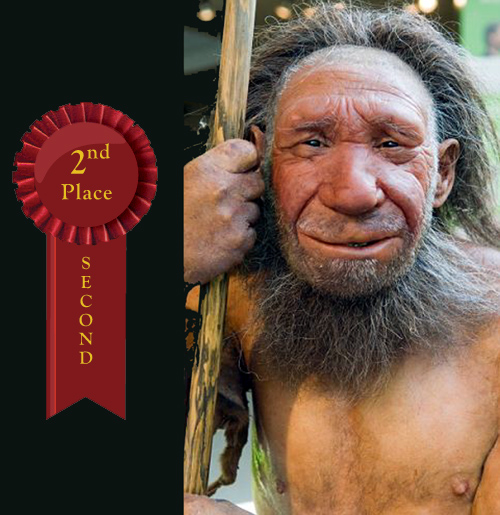
University of Wisconsin professors John Hawks and Zach Throckmorton will soon publish the definitive conclusions of the hectic paleontological research on Neanderthals that has consumed the last decade.
The science is not disputed. It’s derived from a bounty of Neanderthal fossils, but more importantly from the DNA which led to a complete Neanderthal genome last year.
More than 80% of the world’s population outside sub-Saharan Africa have a genetic makeup that is about 3% Neanderthal. Why not sub-Saharan people, too? Because that’s where the dominant hominin species originated from, which ultimately subsumed the only other hominin species extant, the Neanderthal, to become the last surviving human species on earth.
Us.
That wealth of scientific evidence led to all sorts of exciting discoveries, but none as exciting as trying to finally conclude what happened to these big guys.
Their brains were larger than ours, and there’s some dispute that the brain/body weight ratio wasn’t much different. But clearly they were highly successful creatures who mastered the challenging climate of northern Europe, probably better than those who conquered them: us.
I use the term “conquered” loosely. While there was a time that we thought one might be eating the other, so to speak, the general consensus today is that interbreeding, and not organized clan fighting, did them in.
The question, of course, is why did the interbreeding subsume them, instead of them subsuming us? Why were we the more successful creature?
But wait, wait! Hawks implies the inverse: he suggests that the Neanderthal was successful from a natural selection point of view, because natural selection preserved his best traits in us: the 3% of our genetic makeup that is all that’s left of these poor sops:
“I love that because it makes the Neandertals into the evolutionary success story they really were. They succeeded by becoming part of us,” Hawks paraphrases in his blog.
Is this just a word game? I think so. Hawks is a superb scientist and fabulous story teller, and I can’t wait to read the book. But this is mostly PR and a bit of a philological twist-up.
Neanderthal were subsumed by homo sapiens sapiens – and not the reverse – because we are the more successful organism. Now in the long history of early hominins Neanderthal ranks pretty much at the top, but in the contest between us and him, he lost.
That’s not evolutionary success despite the implications in Hawks’ statement. And I don’t think it’s arguable that those of us with 3% Neanderthal genes are hybrids. That’s not enough divergence to be a hybrid. It might be just enough for me to become this nit-picking, ornery and untrained bully about science. But it just doesn’t rank hybrid.
So watch for Hawks’ book, it should be fabulous. But let’s keep him more scientific even if it does mean less entertaining.
A major fight if not an actual civil war is about to erupt in northern Tanzania, as Maasai prepare to battle government authorities in Loliondo, according to a BBC report this morning.
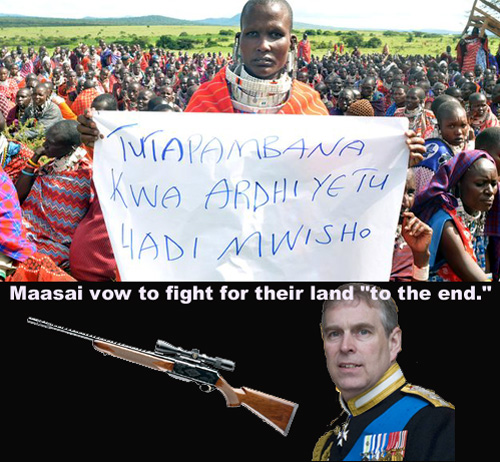
The dispute is over a Tanzania government decision to evict 30,000 Maasai from traditional grazing lands near the Serengeti National Park so that the area can be leased to a Dubai Hunting Company.
The story was first reported globally by the Christian Science Monitor earlier this month and went viral, mobilizing Maasai throughout the area.
The company, the Ortello Business Corporation (OBC), is a gigantic, jet-setter hunting company that has set up a mini city in northern Tanzania each mid-year for the last 20, for high profile hunting clients including Prince Andrew and most of the royal families of the Emirates and Jordan.
When I move near the area while still in the Serengeti National Park, my Tanzania cell phone beeps then displays the message, “Welcome to the Emirates.” They even bring cell towers.
The Arab operators of the area get free, undisputed access into and out of Tanzania. They have built a private airstrip on which modified 747s land direct from Dubai. Private security disallows anyone – including Tanzanian officials – from crossing their perimeter.
Until now, the under-the-table operation which has undoubtedly made many Tanzanian politicians very rich, has been slow to gain public attention. The Maasai have been battling the operation for years, although until now it’s been seen as the classic hunting/non-hunting battle over wilderness lands.
That changed dramatically when the government announced last year that it was adding about 580 sq. miles to an area still not fully surveyed but presumed to be around the same size. The doubling of the area is particularly aggravating to conservationists, because it would be a closed portal between the hunting area directly into the protected Serengeti National Park.
But more importantly to the Maasai, it means up to 30,000 will be evicted. Some claim as many as 48,000. The evictions more than 20 years ago that first set up the hunting block did not provoke a Maasai outcry.
That was probably because the Maasai were not as educated, not linked into social media and were at the time in their own battles with other Maasai just across the border in Kenya in internecine land disputes.
Until this incident, the controversy was confined mostly to photography safari tourists accidentally entering the Arab-held lands. Tourists at the prestigious &Beyond Klein’s Camp, for instance, would occasionally come across shot animals.
Community Based Tourism companies, including Dorobo, Hoopoe and Kibo Safaris that attempted to establish ventures with the Maasai often ran afoul of the Arabs.
But today it’s quite different. “There is no government in the world that can just let an area so important to conservation to be wasted away by overgrazing,” Khamis Kagasheki, the Minister of Tourism told the press last month.
The public nature of the government’s battle with activist Maasai is new. It seems to me they think they’ll win, either in the arena of public opinion, or against the Maasai spears.
The government is still reeling from the defeat to build the Serengeti Highway.
The characterization of the government action as enhancing conservation by protecting land that is currently being misused (over grazed) I see an indication the government feels that hunting is no longer as anathema to the public as it was just a while ago.
The activist NGO, avaaz, is promoting a world-wide petition with 2 million signatures to convince President Kikwete to nullify the decision. But based on public ministerial statements over the last month, the government will not be moved this time.
Maasai evictions from wilderness lands are not new. Likely the reason for the greatest spectacle on earth, the Great Wildebeest Migration, is that nearly 20,000 Maasai were evicted from the Moru Kopjes in 1972 that is now an essential wildebeest corridor within the Serengeti National Park.
I personally had a very educated and articulate Maasai friend killed in a battle with Tanzanian rangers two decades ago. So battle with the Maasai is not new, either.
But there’s something much different this time. Perhaps global awareness, perhaps the power of the social media – I’m not sure. But I am sure that if the government persists…
 NPR’s series this week on rhino poaching is probably worth paying attention to. Here’s some background before listening today to All Things Considered: