Is South Africa a “Welfare State or A Developmental State?”

Is South Africa a “Welfare State or A Developmental State?”

By Conor Godfrey, on March 18, 2011

Near the end of Jacob Zuma’s recent State of the Nation address, he made the point, “[South Africa is] building a developmental and not a welfare state..”

Welfare vs. Developmental State. This intrigues me.

Selling South Africa as a developmental state is tough; currently 30% of South Africa’s 50 million people receive some type of social assistance grant—this could be child support, old age support, veteran and disability benefits, etc…

The number of beneficiaries has skyrocketed in recent history—up 300% since 2000.

This led opposition politician Mario Oriani-Ambrosini, of the Inkatha Freedom Party, to claim that “South Africa is a welfare state which dreams of becoming a developmental state.”

But what is South Africa to do?

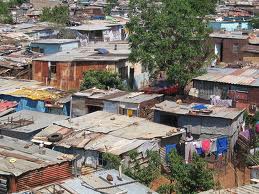
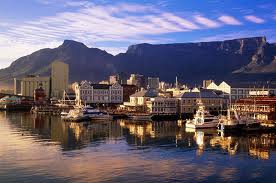
In 1994 when Nelson Mandela took his long walk to freedom South Africa was two countries—one was among the world’s most developed, and the other among the least.

That is still largely true.

In fact, South Africa is more unequal now than in 1994. (Commentators often point out that inequality usually increases as economic growth increases.)

The Two South Africas
How could the African/Colored/Indian populations just snap their fingers and compete with the white populations who had benefited for so long from schooling, finances, geography, access to political power, skills training—everything?

Thus the South African state began a long term black empowerment strategy that, in its current manifestation, is referred to as the Broad Based Black Economic Empowerment Codes (BEE for short).

This required, and still does require, a degree of intervention in economic and state affairs that would be unthinkable in most other countries.

Almost everyone—conservatives or liberal, Afrikaner or Black, Malay or Indian—agrees that South Africa is a special case, and needs to target previously disenfranchised populations with additional help.

The agreement stops there. How much assistance, for how long, and under what conditions, remains extremely contentious.

***(Last week I was speaking with a South African living in the U.S. who told me that South Africa has had ‘one man, one vote, one time’ for more than 15 years, and if Black business can’t compete yet, then they never will… If I may be allowed a slight exaggeration, that would be similar to telling a Black American family in 1878 that they had been free for 15 years, and now they should be able to compete freely and equally in business and society.)***

Americans have been sharpening their arguments on the role of the government for centuries, but I am not sure our tired tag lines on big and small government relate to a situation like South Africa’s.

There are certainly vulnerable, historically disenfranchised communities in the United States— but it’s all a matter of degree.

The side-by-side nature of South African inequality also makes the situation incredibly volatile. Black townships where most of the population lives far below the poverty line exist only kilometers away from affluent, mostly non-black neighborhoods (not unlike parts of the U.S.).

How can the ANC, whose control of the government depends on massive support from poor, black voters, withdraw social support from Black communities that see everyday how ‘wealthy’ the other South Africa is?

Even if the ANC government thought that money would be better spent on job creation initiatives, or education, or health, projects that might reduce dependency, I don’t see how it would be politically feasible for South Africa to transform itself from a welfare to a developmental state.

In that is the case, South Africa needs to achieve the 6% or 7% growth necessary to bring down unemployment without breaking the social safety net.

I’ll stop here, because at this point readers can just turn on CNN for the rest of the arguments. African political problems really aren’t that foreign after all.

So You Want to Write on Africa…

So You Want to Write on Africa…

by Conor Godfrey on March 17, 2011

I was going to continue exploring why some people, or states, support pariah regimes (this time with a more sympathetic view towards the supporters), but I was side tracked by a wonderful article from GRANTA magazine entitled “How to Write About Africa”. (The article is actually from a while back)

Please read it. It is not so long, and it will make you laugh, and maybe cry a little on the inside.

“How to Write About Africa” is a spoof how-to for would be journalists or novelists writing on Africa.

It offers advice like; “Never have a picture of a well-adjusted African on the cover of your book, or in it, unless that African has won the Nobel Prize.

An AK-47, prominent ribs, naked breasts: use these.”

These are taboos; “ordinary domestic scenes, love between Africans (unless a death is involved), references to African writers or intellectuals, mention of school-going children who are not suffering from yaws or Ebola fever or female genital mutilation”.

One last excerpt.

After forbidding would-be writers to discuss normal African family life or run-of-the mill dreams and ambitions, the author states that…”Animals, on the other hand, must be treated as well rounded, complex characters.

They speak (or grunt while tossing their manes proudly) and have names, ambitions and desires.

They also have family values: see how lions teach their children?

Elephants are caring, and are good feminists or dignified patriarchs. So are gorillas.

Never, ever say anything negative about an elephant or a gorilla.”

You get the idea.

In the last few years I think serious journalists have begun to realize their Africa play book was not only out of date; it was absurd.

African authors, inventors, artists and other public figures have brought actual African perspectives to the fore, and BBC and RFI programs on Africa now routinely feature African commentators. From time to time BBCs African perspective podcast is quite good.

I remember the first time an African-American friend of mine took me through Disney movies and pointed out how all the lazy, slovenly but good natured characters with bad diction had southern African American accents, all the hyper, overly risky and violent prone characters had Latin American accents, and suspicious, shifty eyed traders inevitably sounded Middle Eastern.

I wondered how my entire childhood this blatant negative stereotyping escaped me….

(By the way- Disney heard this criticism loud and clear, their modern stuff has been much better. But if you haven’t been given this tour, go back and check out the classics like Jungle Book, Dumbo, Aristocats, Aladdin, the Little Mermaid…you will cringe.)

I get that same feeling now when I read articles on Africa that fit the GRANTA piece’s spoof advice.

But Africa writing has come a long way in the last five or so years…

This is what New York Times writing on health looked like in 2004.

This is the tone of 2010.

This is what an article on African education looked like in 2004.

This is what it looked like in 2010.

I am obviously cherry-picking from hundreds of articles, but in my opinion these are reasonably representative samples.

When you read the 2004 pieces you might say- “well how can someone talk about this awful situation, be it health or education, in a positive way?”

That is not the journalist’s job. The state of health and education in many African countries was, and still is, in need of serious work.

But in 2004 the journalists rolled around and wallowed in the helplessness and misery of it all.

The 2010 pieces touched on the barriers to health and education, and then went on to evaluate what people are doing about it.

In other words, I am not asking that people write only positive articles about Africa, simply that they use the same intellectual and investigative tools that they apply to other regions of the world.

A nuanced description of the problem- a 3d portrait of some of the people it affects—a briefing on the obstacles—and an overview of how people/institutions are dealing with it.

Spare me the wallowing.

As always, I am exempting the horrible situations in some conflict zones where misery over-rides other aspects of life. These are, thankfully, few and far between.

What Does Success Look Like?

What Does Success Look Like?

by Conor Godfrey on March 15, 2011

What do you get when you spend no money on defense, and instead funnel the vast majority of your budget into developing your population, including huge tranches on universal health care and education?

What if you also embrace intense multiculturalism, and reach out to historical trading partners in India, Europe, Africa, and the Middle East.

Don’t stop there.

What if you also invest heavily in employment absorbing sectors like tourism, ICT, and light manufacturing, thereby creating jobs for your educated and diverse population?

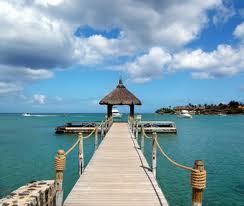
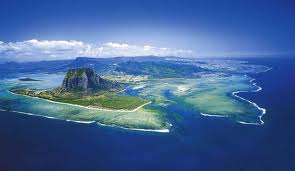
Well then, you would be Mauritius, the African island nation of 1.3 million souls that sits approximately 800 kilometers off the coast of Madagascar.

This week award winning economist Joseph Stiglitz wrote an essay in Slate Magazine about the Mauritian miracle entitled, ‘The Greatest Country on Earth.”

In it he lauds the vibrant Mauritian democracy, their 30 year stretch of ~ 5% GPD growth, relative social equality, and above all, the choices made by successive Mauritian governments since independence from Britain in 1968.

Mauritius deserves the kudos. My only issue with Dr. Stiglitz’s essay was his framing of Mauritius’ successes in terms of U.S failures.

Although he recognizes that the U.S. cannot act like an island nation of 1.3 million (by forgoing a military for example), he spends a fair bit of the essay mocking the U.S. for its inability to empower Americans without causing some sort of financial meltdown.

This makes for provocative reading, but the comparison seems forced to me—scaling is not just a logistical obstacle, it changes the nature of the problem.

A health system that works for 10 people, will not necessarily work for 100 people, even if you increase all the inputs by a factor of 10.

Leaving that aside—what lessons can other African countries, and the U.S. for that matter, take from the Mauritian Miracle?

Versatility.

I have been combing a variety of sources, and talking to a few specialists at work, and it seems that more than any one decision, Mauritian nimbleness has been responsible for its success.

A few historical examples courtesy of Harvard School of Business:

When Slavery was abolished in the British Empire, Mauritian leaders encouraged indentured labor to emigrate from India.

When trade barriers sprung up to make sugar less competitive, Mauritius did two things:

1) They successfully lobbied the EU for trade preferences on sugar, and

2) they read the writing on the wall and immediately started diversifying their economy away from sugar and into light manufacturing.

When those preferential trade terms disappeared for sugar and textiles, Mauritius quickly lowered the corporate tax rate and took advantage of historical connections to India to encourage direct investment in new sectors.

Mauritius exhibits nimbleness in other ways too.

They are part of the Southern African Development Community, the Indian Ocean Community, la Francaphonie, and the League of Portuguese Speaking countries.

This openness creates opportunities that more insular countries do not have.

Mauritian investment in education and human capital means the population can easily re-tool for new sectors and new initiatives. (Though literacy is still only 88%; high for Africa, but not high enough)

The U.S. could use some of this international nimbleness…I read a great essay years ago in Foreign Affairs that argued that the United States’ biggest advantage in the 21st century would be immigration, if policy makers would only take advantage of it.

Immigrants not only start more businesses than non-immigrants, they also bring local knowledge of foreign markets, demand new goods and services from the U.S., and keep the U.S. from falling into a demographic sink hole like Europe.

If U.S. policy makers worked to empower immigrant communities in the U.S. and attract the best and brightest immigrants from other countries, we would vastly improve our international flexibility and competitiveness.

Other African countries have problems that Mauritius does not have—but that does not mean they can’t learn from Mauritius as well.

South Africa now suffers from an incredibly rigid labor market, with major industries surviving on government subsidies.

Their automotive sector is prestigious, but is it economically viable?

Maybe they need to look Eastward to their Island neighbor and invest in forward looking sectors. (I think their new budget attempts to do exactly that.)

Countries fractured by large cultural fault lines such as Nigeria and Cote d’Ivoire could look toward Mauritius as an example of profiting economically from their participation in different cultural orbits.

The people groups in Northern Cote d’Ivoire could benefit from Southern Cote d’Ivoire’s historical associations with partners in Ghana and Togo, while the groups and businesses in Southern Cote d’Ivoire could benefit from Northern Cote d’Ivoire’s relationships with Mali and Burkina Faso.

Obviously this is far easier said than done.

Taking advantage of multi-culturalism requires a centrifugal force at least as powerful as the forces pulling identity groups away from each other.

Countries with economies dependent on a single resource could follow Mauritius’ lead and create incentives for FDI in diverse sectors.

I don’t mean to be glib- investing in the future while meeting the real needs of millions of current citizens is a nigh impossible task.

But that is why each and every success story deserves a good hard look, including small African Islands.

South Sudanese Safari Anyone?

South Sudanese Safari Anyone?

by Conor Godfrey on March 10, 2011

In the last month, South Sudan has asked neighbors and the international community for teachers to staff universities, for money and logistical help for demobilization, disarmament, and rehabilitation of combatants, for ideas on a new national anthem, for help with their financial sector and several hundred other large and small matters that require more or less immediate attention.

All of these requests did not surprise anyone.

One request did surprise me though– South Sudan also asked for $140 million to begin rehabilitating their game parks as a top investment priority.

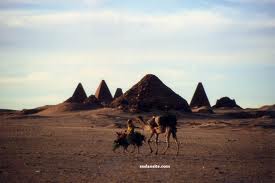
North Sudan

When you think of Sudan, what comes to mind: inhospitable desert, war crimes, tense referendums, oil, refugees, weapons, etc….

Let me offer a few new associations for the soon-to-be-independent South Sudan—jungle, wetlands, teeming with wildlife, and a migration comparable to the Serengeti.

South Sudan is home to one the largest wetlands anywhere—the Sudd—or barrier, in Arabic.

South Sudan

This massive wetland and the Sahelian swathes that border it have traditionally supported all manner of charismatic animals including elephants, lion, hippopotami, and crocodiles, as well as lesser known (at least to a laymen like me) fauna such as the Nile Lechwe (an endangered species of antelope), Tian, Reedbuck, over 400 species of migrating birds, and amazingly, a population of around 1.2 million White-Eared Kob.

The Boma Plateau, adjacent to the Ethiopian Highlands, also supports important populations of wildlife.

In 2007, the United States Agency for International Development and several other international donors worked with the Wildlife Conservation Society to conduct aerial surveys of Southern Sudan, essentially to confirm that the 30 years of intermittent fighting had indeed decimated animal populations.

Against all hope, they found many populations alive and well. Elephants, hippos, and other meaty animals had indeed suffered, but many had weathered the storm.

Elephants have dropped from somewhere in the neighborhood of 20,000 to around 6,000.

Zebra are all but gone, and Heartebeest numbers dropped about 95% in total. Many of the animals that survived did so by hiding out in the Sudd, where swampy conditions provided a measure of isolation.

South Sudan needs tourism revenue worse than most countries.

Currently, 98% of South Sudan’s revenue comes from oil. Production will peak in the very short term before beginning a 20-30 year decline after which the wells will simply dry up.

I would value expert opinions on the viability of a real tourism industry in S. Sudan; is there an adventure market that will relish the ‘untapped’ feel of a safari in South Sudan, will private companies invest long term in such an unstable environment, will oil extraction finish off the animals the war never managed to reach?

Most importantly, how can a country with so much human need spend the required sums on wildlife preservation?

In late 2010 National Geographic ran an interesting short piece on the relationship between the multitudes of identity groups in S. Sudan and the wildlife.

The author claims that history has forged a deep bond between people and wildlife in South Sudan.

For centuries, slavers and poachers, often the same people, came into modern day South Sudan to take away slaves and Ivory.

This linked the elephant and human populations groups together as victims in the minds of the tribes.

More recently, both people and animals took refuge in the deep bush or in the swampy Sudd wetlands to avoid the violence, once again creating a bond between human and animal, this time as fellow displaced persons.

This claim interests me quite a bit—that story resonates emotionally, and has certain logic to it, but my experience in Africa has been quite different.

In West Africa, people viewed wildlife as a nuisance, and from my brief experience in East Africa, it seemed like farmers and pastoralists felt the same way.

I came away with the impression that romanticizing wildlife was a privilege for those whose crops weren’t being eaten.

I digress.

To wrap up, whether or not South Sudan can preserve this habitat for tourists seems immaterial to me. It is one of the most important wildlife habitats on the continent.

Send them the $140 million.

North African Film Reviews: Bab’Aziz; The Prince Who Contemplated his Soul, and Outside the Law

North African Film Reviews: Bab’Aziz; The Prince Who Contemplated his Soul, and Outside the Law

by Conor Godfrey on March 3, 2011

Every Thursday in February the Smithsonian Museum of African art opened their galleries for the North African Film Festival, highlighting films from Egypt, Tunisia, Morocco and Algeria.

I would accuse the Smithsonian of war profiteering, but I suppose they had this planned long before Tunisian president boarded his plane for Saudi Arabia.

My favorites this month were Bab’Aziz;The Prince Who Contemplated his Soul, and Outside the Law.

These are as different as two films can be; the first is a beautiful fairly tale that unfolds ever so slowly across the rolling sand dunes of southern Tunisia, while the other is an urban, visceral, action packed guerilla war epic with an elevated body count.

However, I think both put you in touch with the modern fabric of N. African life; one with the whimsical fantasy and mysticism of Sufi Islam, and the other with the legacy of pain and resistance that I have been told figures quite prominently in North Africa’s public consciousness.

Bab’Aziz (The Prince Who Contemplated his Soul)
Director: Nacer Khemir
Writers: Tonino Guerra (collaboration), Nacer Khemir
Stars: Parviz Shahinkhou (Bab’Aziz), Maryam Hamid (Ishtar)

This movie is filled with music—not just the energetic, haunting Dervish music that various wandering souls sing or play throughout the film, but also the music of the wind over the dunes, or the cackle of a fire.

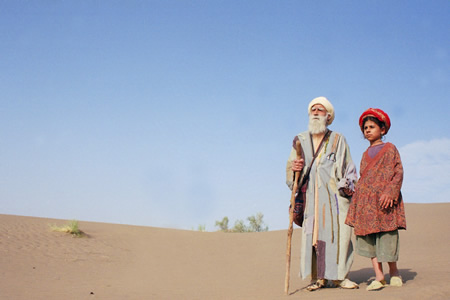
Many reviewers called Bab’Aziz a “visual poem”. The entire movie centers on the Journey of Bab-Aziz, a blind dervish, and his spirited granddaughter Ishtar, as they trek through the desert in search of a gathering of dervishes that takes place once every 30 years.

As Bab-Aziz reminds Ishtar and the viewers throughout the movie, no one knows where the gathering is to be held, but everyone who has been invited will eventually find their way there.

This set up mirrors the quote from the Hadith, or sayings of the prophet, that opens the film—“There are as many paths to God as there are souls on the Earth”.

A quick refresher on Dervishes.

Dervishes are Sufi Muslims following an ascetic path, or Tariqa (Interestingly enough, in the West African Fulani language spoken where I spent my Peace Corps days in the Fouta Jallon, Tarika means tale or narrative.)

Their origins are most likely Iranian and/or from the Indian subcontinent, but today Dervishes are most closely associated with Turkey and to a lesser extent North Africa.

Much like Christian monks, Dervishes can belong to any number of orders whose garb and rituals may vary.

In general, Dervishes take a vow of poverty and seek spiritual purity and enlightenment through humility and dedication to religious principles.

Back to my thoughts on Bab’Aziz.

Time seems suspended as Bab’Aziz and Ishtar wander through the dessert.

The desert becomes a transformative space where normal rules are suspended, and the Dervish aesthetic predominates.

People from the real world that wander into this transformative space throughout the movie are crushed and humbled by the immensity of the desert, and eventually driven onto the invisible path beneath the desert sands that winds, seemingly aimlessly, toward the gathering of dervishes and the unseen conclusion of whatever it was that drove that soul into the desert in the first place.

Young Maryam Hamid puts in a fabulous performance as Ishtar, the grand-daughter, and the supporting cast plays their bit roles well enough to let the “visual poem” unwind without distractions.

Some of my companions found this film beautiful, but slow.

I am sympathetic to that critique in so far as the there is almost no ‘action’ in the film, but it takes time to suffuse the audience with the music and silence of the desert. I think director Nacer Khemir hopes that viewers leave this film feeling crushed and humbled, but with the feeling that somehow they too are on a path.

Outside the Law
(Hors la Loi)

Director: Rachid Bouchareb
Writer: Rachid Bouchareb
Actors: Jamel Debbouze (Saïd), Roschdy Zem (Messaoud), Sami Bouajila (Abdelkader), Chafia Boudraa (their mother), Bernard Blancan (Colonel Faivre)

Do not take a first date to this movie. Outside the Law is 220 minutes of non-stop high drama, with nary a smile for comic relief.

That being said, it is one of the best guerrilla war epics I have ever seen.

The film is also very controversial in France.

Its release drew thousands in protests in Southern France where the war in Algeria still raises temperatures on both sides.

The film opens with a split screen. On one side, jubilant scenes of V-E day in Paris, French women are kissing members of the resistance in the street, and De Gaulle is congratulating the French population on throwing off the tyranny of the Nazi oppressors, while on the other side of the screen, the French military and pied noirs (European Colonists living in Algeria) are massacring peaceful protesters on May 8th, 1945 in the Algerian town of Setif.

This same message is repeated in a myriad of different ways throughout the film.

How can the French, who have just thrown off the chains of oppression themselves, not recognize the righteousness of the Algerian cause?

How can they not see that they have become the oppressors?

In one seat gripping scene, the three brothers at the center of the film kidnap a French colonel who had distinguished himself in the resistance during the Nazi occupation.

They compliment the colonel on having fought on the right side, the side of justice, during the occupation, and ask him to make the same decision again; to fight on the side of justice, in this instance, against la gloire de la France, rather than for it.

The colonel’s decision will ripple through the lives and deaths of the film’s cast for the remainder of the film.

I am neither French nor Algerian, and do not feel entitled to the gut wrenching emotion that this conflict evokes in those whose lives were touched by it…but this film made me feel it anyway.

The New Weapon of Mass

The New Weapon of Mass

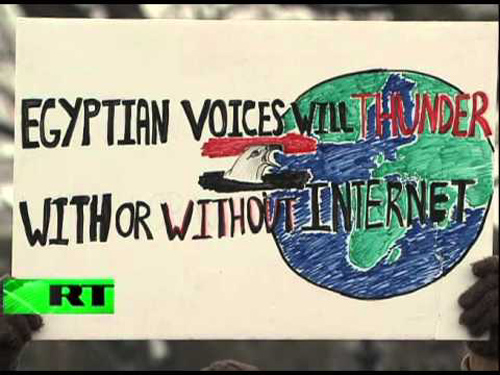
But it was already too late when Egypt shut down the internet.
The regime was taken by surprise.
Twevolution organized the streets before the switch was thrown.
There was a time when power came as a chariot. There was time when power came as a nuclear device. In my life time it came as stealth bombers, napalm and drones. Could it be that in the generation now following me that power comes as … the internet?

The twevolution sweeping Arabia which as I’ve written actually first matured further south is succeeding because of the masterful manipulation of information by revolutionaries who are willing to sacrifice themselves to affect significant change, which so far means booting out the dictator.

Read the fascinating blog I posted Tuesday about the software developed in Kenya that is the foundation of the information manipulation in the current twevolution.

Armaments were insignificant in the outcome of the Tunisian and Egyptian twevolution. The regimes were changed with really very little loss of lives and little destruction of property. How’s this possible?

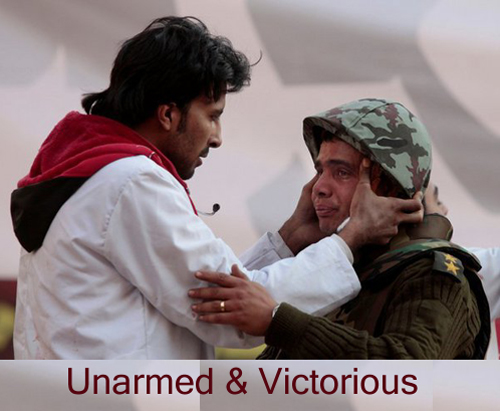
In both cases, because the trustees of the armaments — the soldiers — who absolutely could have caused a huge loss of life and lots of destruction refused to shoot. When challenged by the unarmed masses in such numbers, they backed down.

This didn’t happen in 1956 in Hungary, or the “Czech Spring” of 1968, or 1989 in Tianamen Square.

Were the protesters then less committed? Were their ideas less compelling?

No, there just weren’t enough of them, and the growth in their support happened too slowly. The regimes in power were capable of faster reactions than the protesters. Regime weapons appeared on the scene faster than the people.

Today, that’s not the case. The crowds appear out of nowhere, it seems, although actually they are carefully organized through the internet and mobile phones. By the time they appear, they have virtually won the battle. They outperform at the starting line.

They look, from the beginning, like they are the winners.

That’s the key to mass protest. Defenseless, the only counter to hard weaponry is the sheer volume of numbers. And that’s what the IT savvy in this twevolutionary age can do.

In Libya the difference is that those fighting the people are mostly mercenaries being paid a king’s ransom. The protest has become a fight and it will likely get bloodier. But when it stops, the outcome will be the same as in Egypt and Tunisia.

You see, I believe that people are basically good. And that their inherent desires are communal and compassionate. And that when these inherent desires are repressed, they don’t just go away. They ferment and ultimately bubble out as an outburst.

As they have often in the past, but too often then crushed to smithereens. But not today, perhaps never again. The internet is the manifestation of hundreds of thousands, millions, of individual wills. Armies are made of people, and soldiers know when they’re outnumbered.

It doesn’t matter that they may outgun the defenseless. When soldiers know they are in the minority, they defer and defect.

The problem in the past has been the masses have been unable to organize effectively enough to manifest as the majority, even though they might have been.

The Nazis came to power by default, not political success. The apathy of the non-Jew Germans was cultivated by aggressive information manipulation as it existed then by the Nazis. The organizational immaturity of the Jewish populations and their sympathizers couldn’t confront the more mature organization of the Nazis. And this deficiency was reenforced by similiar inefficiencies and incapacities of greater Europe. The situation was ripe for evil to prevail.

It wouldn’t happen today, in today’s internet world, where the free and unfiltered flow of information reflects the basic good of the people faster than any organized regime can stunt it.

See why China tries to censure the internet? Even that is going to fail.

Now what comes next is as frighteningly unknown as it’s going to be exciting to behold.

Twevolution coming to East Africa?!

Twevolution coming to East Africa?!

Tomorrow’s presidential election in Uganda will either be the most unread news story in Africa, or the start of Twevolution in East Africa.

The current autocrat is expected to win handily, despite election fraud, unfair international support and his highly undemocratic style of overlording that is often brutal. But if he doesn’t … win handily … CNN might have another place for Anderson Cooper to visit.

The election battle is down to Uganda’s two most famous politicians and arch rivals, Dr. Kizza Besigye, otherwise known as the perpetual loser, against the incumbent, Yoweri Museveni, otherwise known as dictator.

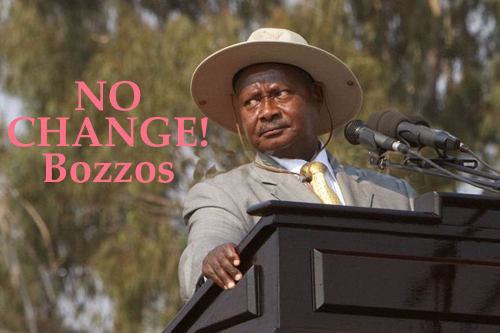
If Museveni wins he will be starting his fifth term and heading towards his 26th year of ruling Uganda. If he wins it’s in part because of long-term support of the American Right. (Get this: his campaign slogan right out of the dimwits of CStreet is, “No Change!”)

Here’s the problem. Kids don’t like grownups telling them what they can and can’t do when they reach their mid twenties.

This is essentially the reason for the Twevolution that’s sweeping the continent. African youth today are sharp, educated and infinitely more connected with the world than the old folks overlording them. That’s particularly true of Uganda.

I’m not saying that youth inherently believe in term limits, but they viscerally know how not changing political rule impedes and inhibits development.

Uganda is rapidly becoming the most backwards country in all of East Africa, when once upon a time, shortly after independence, it was the star. As if slapping this truth into its neighbor’s cheek last week, next-door Rwanda hosted an all-African conference that named Uganda the worst of the five regional East African nations in its capacity to develop.

In fact of all Africa’s 58 countries, Uganda was ranked 21st. That’s pretty awful when you consider that half of Africa’s countries are unstable or at war. (Tanzania, by the way, was 20th. Rwanda was 5th and Kenya was 4th. What was most startling of all, troubled little Burundi was ranked 13th!)

The report was chaired by one of the most respected Africans alive, Grace Machel, the widow of the former president of Mozambique.

Uganda’s youth knows this. And it seems that up to 85% of them are likely to vote tomorrow. In fact international observers on the ground expect a 75% turnout according to a leading newspaper in Uganda, although as many as 140,000 of those registered names may be dead, and 400,000 of them foreigners technically ineligible to vote.

So if the election is close … there is plenty of fodder for fire. The ironic thing is that it’s not expected to be close.

I’ve written before how Museveni is the darling of the American political right. They have been supporting his draconian efforts to do things America can’t, like ban abortions and make homosexuality a capital offense.

I haven’t been able to track it down carefully enough, so it simply remains a hunch right now that American Rightists along with their UK counterparts are stonewalling the World Bank from blocking aid funds that Museveni has been using to beef up his campaign.

The report that’s drawn my attention was published by a fiery, independent on-line publication in Uganda last month.

There’s no doubt that Museveni has used donor funds (including ours) for his campaign, which is one of the reasons he’ll probably win tomorrow. There has never been such a modern, expensive election in Africa before. And it’s been almost all one-sided: for Museveni. TV, ads, billboards, flyers, robocalls — you name it, right out of American campaigning.

It’s also been public that America and the UK are blocking efforts by NGOS like the World Bank from stopping this. The question is, who specifically in the U.S. is doing this?

Anyone out there that would like to prove me right, please go to work!

So with such huge funding support, with an economy that isn’t doing so badly, with enormous pride in the recent discoveries of oil and the relatively recent successful ending of the wars in the north, Museveni has the odds, even with a half million illegal voters.

But if his margin is less than the number of dead and foreign (half million) out of 7.5 million expected to vote, then watch out for Twevolution.

Peace is IN!

Peace is IN!


There were people hurt. There were people killed. But the victims were not the losers in a fight, because…they didn’t fight. They protested. Peacefully. Martin Luther King would have been proud. The successful Egyptian revolution was one of peaceful protest.

I know you’ve seen pictures of bloodied faces and bodies being carried, and tear gas wafting through the scene. But please keep in mind there were millions of people protesting. The “death toll” is around 400 and a significantly large proportion of these were actually outside Cairo where (a) there are far fewer educated people and (b) any kind of meaningful protest means anything at all.

Americans have a difficult time analyzing and gauging political change, because our own system is so befuddled by confusion. Take the health care issue, for example. To me and I hope the vast majority of sane onlookers, this is a baby step towards a society that guarantees the health of all its citizens. But I don’t have to remind you of how many think radically differently.

So we tend to listen to change that is evident and obvious and immediate, and I think we also sort of fear it. We are worried that change will take away or at least restrict the rights we currently enjoy, which are wonderfully substantial. So for the vast millions of Americans who still don’t know who Mubarak is much less Elbaradei or Wael Ghonim, they pay attention only when something of ultimate drama happens: death. That’s what TV is made of.

But the fact is that there were very, very few deaths compared to the demonstrations that took place. This is remarkable. Imagine the hundreds of thousands of unarmed and determined individuals who so believed in human rights that they stood upright against heavily armed security forces. Who were ready to sacrifice their safety for an idea. Fortunately, a ridiculously small proportion had to. In fact, it’s something of a testament to the restraint of the security forces and particularly the army that so few were hurt.

I remember my own days as a youthful protester in the 1960s, unarmed as the Egyptians were, charged by police as the Egyptians were, tear-gassed as the Egyptians were, shot at as the Egyptians were. And our few friends who were hurt and died were unarmed, as the few Egyptians who were hurt and unarmed.


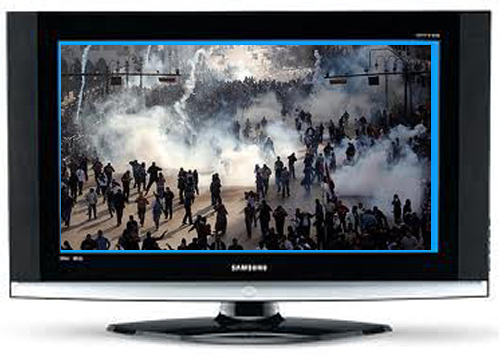
There are literally hundreds of videos like the one above, showing hundreds and thousands of protesters, unarmed, demonstrating against highly armed government forces. But by their sheer numbers and naked sacrifice, they won. They’ve won round one.

In America especially we tend to focus on the violence of any event, for two main reasons: it’s wrong, and it makes good TV. But what every person must take so far from the Egyptian revolution is that given the hundreds of thousands of people involved, the millions ultimately, the amount of violence was unimaginably small.

It’s hard for Americans to imagine a dictator falling with so little violence. We are told our wars are waged against dictators, and the level of violence that follows our policy is legend. The number of our own soldiers killed much less locals in Afghanistan and Iraq to topple that regime numbers in the tens if not hundreds of thousands.

We can’t believe Egypt has changed regimes with fewer deaths in a month than America sustained monthly in Afghanistan and Iraq for years.

But it’s true. Grasp it and embrace it. Only good will come out of this. There will be many skeptics and cynics out there now saying, “Yes, but what will come next?” I’m not so naive as to suggest this revolution is over, completed. But I’m idealistic enough and optimistically hopeful enough to command the axiom that only good can come out of the power of peace.

Revolution on TV

Revolution on TV

So what’s more important: water or security? Egypt is as critically important to East Africa as to America, but it is America that is consumed with watching real-time developments there.

The infamous 1917 Balfour Declaration, which is arguably one of the diplomatic starting points for the current drama in Egypt, was not a singular British act. A series of British treaties about the use of the Nile River was thrust on East African countries about the same time as well.

The notorious 1929 treaty, and the brazen 1959 treaty (I say “brazen” because by 1959 Britain had already decided to give independence to most of East Africa) ceded the use of Nile waters, which arise in East Africa and flow through it, to Egypt.

Water use may be the most critical development tool left in the world. Yet as it stands now, Egypt has successfully enforced its treaties with East Africa, effectively denying Tanzania, Kenya, Uganda and the Sudan, sovereign use of the river.

Everyone in East Africa knows that a new Egyptian regime, particularly a democratic one, will be more disposed to reconsidering these one-way, counter-intuitive agreements.

So what happens in Egypt could have a much greater impact on the lives of East Africans than the lives of Americans.

Americans don’t have to worry about water. So we have found other things to worry about, the principal being terrorism. What happens in Egypt now is an intriguing chess came the outcome of which we fear will effect our security.

Yes, probably, but not as much as how it will effect the use of water in East Africa.

So why are Americans so much more consumed with what’s happening in Egypt than East Africans?

Because like so much in American life, we have turned the event into one of entertainment, and that it seems is our paramount endeavor.

And because the rest of the world struggles more. They know on a daily basis how to deal with true threats and denials of basic needs.

In America, today, nothing gets learned except as entertainment. Everything from new cancer drugs to space discoveries is presented as a movie. Incidental perhaps to what are truly our daily needs like a meal and a few breaths of fresh air, we have become so well off that to get our attention about anything we need good graphics and Dolby surround sound.

And this is also why we’re so obsessed with “security.” Because security guarantees uninterrupted entertainment.

I confess. I’ve got Aljazeera streaming in the office right now, and I flip between CNN and MSNBC waiting for the figurative pyramids to fall. And then?

Anti-America Sentiment Grows

Anti-America Sentiment Grows


As Egypt’s struggles continue anti-American sentiment grows in places as far away and dear to me as Kenya. Some of this is envy of the powerful but some of it legitimately derides an unfair world order.

Yesterday a widely read blogger in Nairobi associated with one of its main talk radios warned Kenyans of “the rude awakening that has visited the people of Egypt” that their leaders have been “serving a foreign master’s agenda.”

And that master was, among a few others, America.

With bitterness that verged on vitriol, Solomon Gichira writes, “We all know one or two reasons as to why the world came running to our rescue after the 2007/8 election crisis… because they feared losing supplies from our flower or dairy industries among others. However, they will never package their interests that plainly.”

Gichira is referring to the massive intervention by mainly the U.S. and Britain following Kenya’s fraudulent 2007 elections. Led by Kofi Annan the international rescue of Kenya included more than $10 billion and supported first a power sharing deal between the two rival candidates for president and a range of incentives that led to Kenya’s new, excellent August 2010 constitution.

Gichira is dead wrong when he gets specific yet important because he represents a huge swath of public opinion in the educated developing world. Moreover, his general contention is right: world powers don’t do anything altruistically; it must be in self-interest.

U.K. and U.S. interests could care less if Manchester flower markets don’t have enough roses. A more important reason, “strategic interest” in polispeak, is Kenya’s geopolitical position in the war on terror. Kenya’s often superficially irritating actions in this regard, like allowing Omar al-Bashir into the country, detaining radical mullahs without trial, and letting military equipment sneak overland into the South Sudan, are all applauded silently in the halls of Westminster and Washington.

And Kenya’s overt actions with regards to the South Sudan and its constant border squabbles with whatever is left of Somali receive constant praise from the west.

These are the west’s true interests. But Gichira is right: it is an agenda dictated from abroad, one that is not necessarily wholly in Kenya’s interests.

Gichira’s account of the modern history of Egypt and its neighbors leaves something to be desired, but he basically underscores the botched handling of the “Jewish question” and the poor way that both Israel and subsequently Palestine were created by world powers. He rightly conveys in my opinion how Britain deftly relieved itself of Jewish prejudice by exporting it to the Middle East where it ferments worse today.

And he’s right on when berating Britain and France’s manipulation with the U.S. in the security council of the nascent Arab revolutions to overthrow potentates like Farouk, how this led to anti-American sentiment and Cold War support by Russia. That led, by the way, to those “revolutionary” regimes being subverted still again … just by the east, instead of the west.

So basically while I think like so many revolutionary enthusiasts Gichira misuses facts at his peril, his conclusions reflect the feelings of many of us progressives in the west: Developing world peoples have been mistreated mostly by being ignored, and when not ignored, by being used for “self-interest.”

The problem is that I don’t know how this could ever have been different. Big guys bully small guys. That’s our world order. And try as we do to elevate this morality, we just haven’t been able to yet.

“What is not told to the ordinary reader is that the Camp David agreement” Gichira writes “brought with it huge American goodies to the Egyptian leadership” including “financial and military support” and “America’s blind eye to oppression and suppression of any conscious or dissenting voices” in Egypt.

And so now for “the US and Tel Aviv administrations, the chicken have finally come to roost.”

Gichira now tells us that we will “painfully watch as you lose your Mubarak. Not to your well equipped American-Anglo-French-Jewish military muscle, but to the unarmed power of a dissenting population that has had enough of your meddling. At that point, you will remember that the silence Egyptians over these years of your misdeeds and myopic interest was not anything like an acceptance but a big lie.”

Powerful stuff.

I don’t like feeling the whipping boy in a geopolitical contest of David vs Goliath, but I am the American and Gichira is the Kenyan. In the global context of world history, I am the villain simply because I’ve been the privileged, and Gichira is the victim, simply because he’s been the less privileged.

I could apologize for my ancestors’ misdeeds, but I don’t know what would have been better, so I can’t apologize. I don’t know that there would have been a better way.

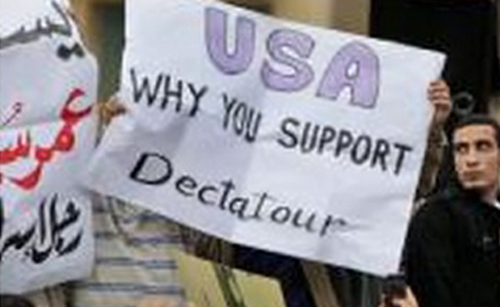
But what I do know now, thanks to the transparency and intellectual stimulation that gives rise to voices like Solomon Gichira, is that we can begin to act responsibly in a global way, right now. We can stop any overt or tacit support of the Mubarak regime. We can let the streets play out, because now, those Egyptians, like Gichira, are totally capable of handling their own affairs.

Let them come to power, and then let them deal with us. We, too, were once revolutionaries.

Twevolution in Egypt!

Twevolution in Egypt!

As this blog goes to press millions are at Tahrir Square just ending prayers. This mostly and remarkably peaceful revolution is a new kind. No longer revolution, but Twevolution!

Click here! This is a live twitter feed of the Revolution!

Peaceful attempts to topple governments in my lifetime have been mostly failures. The one possible exception was the toppling of Peru’s President Fujimora in 2000 although it was not just the people in the streets but Peru’s other arms of government including its military that wanted him gone.

But in all the other cases, government change only came after tremendous violence often involving foreign governments.

This appears to be different. Really different.

Woe to Boeing and Lockheed, but it seems that fighter bombers might have been replaced by….

Twitter. Facebook. YouTube and so much more!

The amateur video which follows was picked up by AlJazeera and probably did more than any other video to really fuel the revolution. It shows the first street confrontation on January 28 between protesters and police, finally won by the protesters.

The video below was created a week earlier by a single, courageous woman pleading with everyone to join her in protest. She challenges watchers with the memory of Mohammed Bouazizi, the Tunisian who self-immolated himself.

Peaceful protest in the past seemed to be destined for failure. How many bodies must fall in front of a tank before the phlanx of bodies succeeds? Buddhism and nonviolence has thus had a checkered history.

But until now, Buddhism and nonviolence lacked a winning tool.

There is an answer to “how many bodies” and Tahrir Square may just have them at this very minute. There is a calculus where not even a nuclear bomb can suppress a united protest.

When NBC reporter Richard Engel was asked on a live internet feed Wednesday night what strategy the anti-government protesters could possibly employ to counter the armed and carefully organized thugs fighting them, he hesitated, but then answered enthusiastically, “Information!”

That’s it! America is discombobulated by competing media pretending to report social will but actually governed by a need to produce entertainment. So even while we are in possession of the greatest technology skills and assets in the world, and while those were used to elect our first black president, I see them mostly coopted by our commercial priorities.

But not a place like Egypt. Desperation is very subjective. It’s completely fair to say that many in the U.S. feel as desperate trapped by the socio-economic system as Mohammed Bouazizi felt within his Tunisian society before he set himself on fire. But as that first video by that courageous young woman explains, there are alternatives in this highly connected world to removing yourself from society.

Mohammed’s action galvanized the desperation in his society. But not with steel and bullets, just with … Nielson Ratings!

Finally enough voices fell in line that their universal message could not be defeated even by overwhelming force.

Alive in Egypt is a consolidation site of videos, audio and tweets.

More skilled videos being created from around the world about the revolution can be found at Mibazaar.

“We Are All Khalid” is among Facebook’s most influential pages.

There are hundreds of sites like this one, and this one.

Was it Richard Engel who said it? This is the Information Revolution?

Egypt Picture Hard to Read

Egypt Picture Hard to Read

Because there are so many tourists in Egypt, and because there’s no legal requirement that tour companies honestly reveal the scope of their operations, it’s very difficult to get an accurate picture of tourists and tourism right now. But here’s my best try.

Before the trouble last week, the U.S. State Department reported there were about 50,000 Americans in the country, of which 3-5000 were tourists. Since January 25, probably 6-7000 of those have left, of which 1500 may be tourists. That leaves around 3500 tourists and 43,500 nontourist Americans in Egypt right now.

And I venture to say they will not be hurt. No one likes what’s happening in Tahrir Square, now, but the violence in the country is localized. Savvy tourists will remain safe.

About a third of the 6-7000 Americans who have been able to leave did so aboard U.S. government supplied evacuation charters. But most of the travelers on the U.S. government charters were not tourists; they were government workers and U.S. residents living in Egypt.

Two-thirds of the Americans who have evacuated seemed to have done so on commercial flights.

Since 2800 Americans had previously registered with the U.S. State Department as intending to visit Egypt now, I estimate there were about 5000 American tourists there when the trouble started last week.

Tourist registration with foreign consulates is a service all countries provide, but in recent times it’s mostly large tour companies that register their clients, rather than individuals, and it’s usually hardly a third to a half of the actual tourists who travel.

In the best of times true tourist numbers are very hard to get. This is because no U.S. or foreign agency reports the numbers of people entering or leaving a country in real-time. The U.S. is the best for reporting inbound tourists on a quarterly basis. But Egypt, for example, reports suspicious statistics only once annually.

What irritates me is that in the absence of being able to get this hard information, media turns to professional tour companies. This is a terrible mistake, because most tour companies (especially American ones) grossly inflate their actual production and often to the great pleasure of host countries.

Yesterday, for instance, in a single dispatch from Moscow reported in Britain’s Daily Mail the Russian state news agency RIA Novosti reported a ridiculous 45,000 Russians touring in the country at the moment. In virtually the same paragraph, Konstantin Shvartser of the Pegas Touristik said there were only 18,000. And in a continuation of the numbers folly, he then claimed only 18 Russians altogether want to leave the country, now.

USAToday reports on tourism by surveying well-known American tour companies like Abercrombie & Kent and Grand Circle.

But those (good) companies won’t reveal their numbers, and the fact is that the majority of American tourists traveling to Egypt these days don’t use established tour companies like these, so what’s happening to their customers is really rather insignificant to the bigger picture.

Most travelers to Egypt, today, book through the internet often directly with Egyptian companies. It’s likely, in fact, that as many Americans book Nile cruises with British companies as with American companies.

In trying to gauge the “real situation” imagine being a resident of Washington, D.C. or Watts in L.A. during the riots of the 1960s. The longer the crisis continues, the more basic services become strained of course. But unless you actually walk into the midst of the trouble, until strained services reach a critical point, you’re probably going to be OK.

Officially, most foreign nations have advised their citizens to avoid central Cairo and Alexandria. But many European countries, including Britain, have advised tourists who find themselves elsewhere (such as Sharm el-Sheik or Luxor) to remain until travel to international airports becomes easier and safer.

Most Nile cruises have stopped sailing, although we also know that large companies like Sonesta (which owns 5 ships), Sofitel and Hilton are continuing to provide services (food, shelter) to passengers who were onboard when the trouble broke out.

“Living conditions in Cairo and the risks to foreigners are not quite as bad as they may appear in the media,” writes the only excellent coverage I’ve so far found, in today’s Huffington Post.

So the bottom line is that the vast majority of foreigners, including tourists, remain in the country and have had enough time to position themselves in a safe way. Commercial flights continue to operate at the Cairo airport.

I am no expert on the MidEast, and I have been wrong in predictions before. But as one experienced traveler voice, I don’t see what’s happening in Egypt right now as dangerous for the tourists or foreign residents who unfortunately find themselves there.

Patience for Tourists in Egypt

Patience for Tourists in Egypt

So far, so good for tourists stranded in Egypt. There are 30-50,000 tourists currently trying to leave Egypt, and their itinerary isn’t exactly what they thought.

They shouldn’t try to leave. They should hunker down like the majority of tourists, there, now.

In near lockstep with the delicate balance of the American government, tourists had initially decided to wait-and-see. Large American tour operators like Isram Travel and Abercrombie & Kent sent out bulletins assuring the world that their tourists were doing just fine.

But when the conflict stretched over last weekend, curiosity turned to ennui and finally real concern. And when the tourists tried to leave and couldn’t, the panic button was hit. That happened to thousands yesterday and may have been a mistake.

I’ve been in a number of conflicts as a tourist during my life time of travel. Most of the time the thing to do is … hunker down and wait it out. (Not always, but it is the thing to do this time in Egypt.) Patience, not a tourist attribute, has to be summoned up then cultivated for as long as it might take.

This is not another Rwandan genocide or Balkan War. This is a popular uprising that looks surprisingly disciplined. Until that “look” changes, stay put tourists!

Egypt gets between 15 and 16 million tourists every year, and right now is the highest of the high seasons. It is likely there are several hundred thousand tourists in the country right now. The U.S. State Department believes there are at least 5000 Americans currently touring Egypt, and possibly twice that number.

Desperate tourists don’t make good decisions. Those panicking and trying to leave are mostly being disappointed. Their chances of leaving aren’t good, and it will be extremely expensive. Much more expensive than “hunkering down.”

Television reports, of course, laud those who made it out. Because a lot of television can’t make it in to tell those stories. And of course there will be headlines about the odd act of violence at a tourist hotel … something that likely might have happened with a revolution or not.

The majority of tourists in Egypt right now are doing the right thing: stay there and wait it out.

At any given time, there are as many as 50,000 American in the country, including teachers, engineers and technicians working on the Suez Canal and many involved in the oil and gas industries.

Regina Fraser who hosts the PBS show “Grannies on Safari” may have enjoyed being interviewed by CNN but by yesterday she wanted out.

Regina was on a cruise ship on the Nile, and remains there unable to get to Cairo. At any given time there can be as many as 150 cruise ships sailing between Luxor and Aswan carrying as many as 15-20,000 tourists.

Egypt’s tourism contributes enormously to its economy. (Estimates vary from 5% according to the World Tourist Organization, the as much as 10% according to the Egyptian Tourist Board.) It is one of the last value markets for tourism of any kind to Africa, where a ten-day trip is available for under $2,000. This is half to a third the average elsewhere on the continent.

And most importantly, so far, no tourists have been harmed. In fact the opposite seems to be true. When I was a young kid traveling the world the last place to find a young single woman was Egypt. But Emma Vielbig, 19, was traveling alone in Egypt last week when the trouble started.

Like any kid, she ventured into the streets and tear gas. She got caught in mayhem but was rescued by some anonymous fellow on a motorcycle who grabbed her shouting “You’ve got to get out here” and motored her back to her hostel.

Few would plan a vacation into a revolution. A vacation is supposed to be at least a good measure of R&R. But a revolution is what’s happening in Egypt, and so far, tourists are not being redefined. They remain tolerated onlookers, cash heavy foreigners, but so far, safe.

There is an important lesson for all of us who travel. The situation in Egypt was mostly a surprise. It has much to unfold yet. But so far, tourists are safe. All they have to worry about is their own impatience.

What does Egypt mean?

What does Egypt mean?

Egypt’s popular rising by a better educated generation reflects a global interconnectivity that transmits the will of the people as effectively as bar photos. But do Americans in particular understand what these people really want? I don’t think so.

Cries of “Freedom!” are easily translated from most any language, but “democracy” is another word altogether. Americans have consistently reported on African uprisings as “democratic movements.” Some are but most aren’t.

Sunday’s announced results in the Sudanese referendum – long expected – is hardly a step in the democratic process many claim. It’s a step in a process that secedes power in Khartoum to a political group that has been working for it throughout my life time, and in my opinion, well earned. But there is no room in this process for competing views about governance.

And whether or not the northern tribes will receive the fair attention proscribed in the new South Sudan constitution remains to be seen. Unlike truly democratic societies where law is the foundation of governance, that isn’t at all certain in the new South Sudan.

The first spark of popular uprisings in Africa began long ago in South Africa, and ever since the regime changed in 1994 Nelson Mandela’s party, the African National Congress, has been firmly in control and often in defiance of democratic ideals like freedom of the press.

Following the horrendous genocide in Rwanda in 1994, the populist uprising of Watutsi mostly in exile in Uganda stormed into the country and took control. Paul Kagame was the military general that led the attack, and he has remained president ever since. In the last election, his opponents were either jailed or killed.

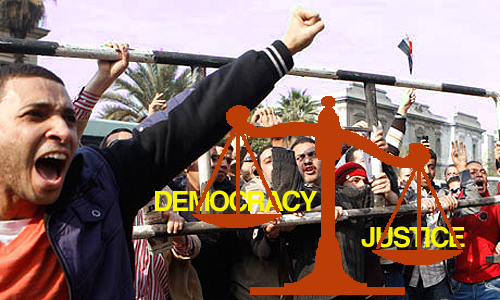
Yet South Africa, Rwanda and now the South Sudan are definitely fulfilling the aspirations of the people who brought them to power. Those aspirations can be summed up in a single word, justice.

Americans misinterpret democracy for justice. We also tend to believe that democracy is more absolute than justice. Nothing could be further from the truth.

The filibuster in the Senate is a case in point. Manifestly not democracy, it prevails nonetheless as just. Ditto for the electoral college, or the ability of our courts to reverse a popular referendum.

The people in the street may be screaming for freedom and democracy to get the attention of CNN, but what they really want is … justice.

And that’s what makes the recent uprisings in Tunisia and Egypt, and likely soon elsewhere in the Arab world, to be so problematic. Wealth and opportunity cannot be redistributed as quickly as a Hosni Mubarak can be toppled from power.

And so it’s a matter of how patient the revolutionists will be. Africa is legend for the patience of its people, and that’s why I remain completely optimistic in the future of South Africa and most of Africa in general.

The big question, then, is whether Egyptians have the same patience as South Africans and Kenyans. It’s a very big continent: I just don’t know.

State of the Union, State of Africa

State of the Union, State of Africa

As I listened to President Obama last night, I thought of the State of Africa, and I realized that real hope for future justice in the world is squarely with Africa, today, not America.

Many will consider me foolish: yesterday was a day of tear gas, rioting and general upheaval in much of north Africa. But what I see are people uprising, renewed and respirited. And what I heard last night was Obama snuffing out new spirits in America.

Africa has been in the throes of radical change ever since apartheid in South Africa fell almost 20 years ago. Economic catastrophe today is the motivation that carries the spirit of liberty from South Africa to Tunisia. There’s nothing odd about that.

Economic catastrophe has always been a reason for political change throughout the history of civilized society, and so it should be, since it is often caused by the older society unable to adjust to newer social realities.

In Africa this has led to radical changes in the political organizations in South Africa, Kenya, Liberia, Senegal, Madagascar, Sudan, Cote d’Ivoire and the Comoros. I’m not suggesting that the direction of this change is yet fully understood or right now universally good. But it is all fueled by people power. And that all by itself, is good.

Respirited mass movements lead to real recalibration of society. Former winners become losers and former losers become winners. The cocktail party phrase that social change can be a win-win situation is premature. There is too much injustice and prejudice in the world still for that to yet be fully possible.

But it doesn’t mean that the new losers are relegated to the same misery that the former losers might have suffered. In Africa, in fact, it means that the powerful just become a little less powerful. Kenya’s former dictator, Daniel arap Moi, enjoys a wonderful retirement, safe and comfy and in fact respected by a wide section of Kenyan society.

But his ouster by the people of Kenya led to a series of events that has heralded in a new populist who is likely to radically alter the Kenyan economy currently defined by legions of poor. No single movement or leader is capable of changing the science of economics. But Raila Odinga is likely to elevate the condition of Kenya’s poor in the next decade far beyond what I could have imagined, and no doubt at the expense of the rich and powerful.

Who will by all standards, still be rich and powerful. Just not as rich and powerful as before.

This is precisely what happened and continues to happen in South Africa. It began a generation ago, as the richest and most powerful emigrated to the tune of 1800 per month starting in the 1980s, as they realized their lofty positions could not be sustained in a modern African society.

Throughout Africa, populist movements are ushering in more just and equitable societies.

In America, Obama was that symbol as well in 2008. But he failed. He is far behind his times.

Obama’s message is one of unity, and in all fairness, this is no surprise. He has been extremely true to his theories. But that was not what brought him to power. What brought him to power was a massive belief that real change would occur in America.

That may be our fault, not his, but he was complicit. He accepted the mantle of change. He now revels in the temerity of those who condescend to answer a robo phone poll. But he seems too steeped in the past to be pried from his 19th century politics, constrained by dead heroes like Abraham Lincoln, so great for their times but as outdated today as a buggy wagon.

I look at Africa, and my heart beats fast and hopefully. I listen to Obama and grow depressed.