Goma Solution

Goma Solution

Starve Rwandan and Ugandan dictators of any aid, significantly beef up the UN peace-keepers in Goma, allow the “Arab Spring” to develop and let the chips fall where they may.

That’s my solution for the Goma catastrophe.

It surprised me that Goma has stayed in the news. I’m not sure why, as the current crisis is probably less severe than multiple other ones in the past.

But suddenly there are Congressmen, movie celebrities and evening nightly news casts all talking about the catastrophe of Goma. Yesterday morning NPR featured a story and that was followed by an excellent hour of OnPoint featuring a Goma resident as panelist who writes the blog I have closely followed for several years.

This is so surprising but too overwhelming to explain. Anyway, we’ve got the attention that has been lacking for nearly 20 years.

Goma in particular and the Kivu province in eastern Congo of which it is the only large city has been an ungovernable cauldron of unspeakable violence, bubbling with untold natural resource riches, for more than two decades. The question is – and always has been – how to achieve the peace to release its mind-boggling riches.

While technically a part of the country of the Democratic Republic of the Congo (DRC), not since the ruthless and crazed dictator Mobutu has the DRC effectively governed, there. The city and the province are controlled alternatively by thugs, crazies on drugs, and ruthless militias all competing for the vast wealth under its soil.

The UN has had a peace-keeping force in Goma almost continuously since the Rwandan genocide. It’s had some success, but as demonstrated last week when a tiny militia of only 1500 rolled into Goma, the UN force is too weak to provide real security.

There are three players in Goma’s world, each with their own story:

RWANDA
Susan Rice is an important component in “what to do with Goma” and it’s not good news for her. I’ve never liked Susan Rice. My feelings probably originate with the fact she was Clinton’s closest adviser on African affairs, and she shares blame for much of what is happening, now.

Clinton could have prevented, at least for a time, the Rwandan genocide of 1994 but he specifically refused to do so. He has since apologized. Rice has been less forthcoming, although she was the person advising him. The presumption is that she concurred with if not crafted the decision.

The genocide and its aftermath resulted in more than a million Rwandan Hutus fleeing into Goma and Kivu. There they stayed, prospered as warlords and gangs that later became known as the Interahamwe soon posing a real threat to the Tutsi in control of the Rwandan government.

American guilt has never been so expensive. The amount of money the U.S. poured into Rwanda is absolutely mind-boggling. The stated mission was to provide security for Rwandans, especially from the Interahamwe, and to create a life style that has proved truly the envy of any African anywhere in east or central Africa.

But all this has happened at extraordinary cost, and there is no strategic need for America to do this, and the result has been to create a western country-oasis in central Africa.

No other country in Africa has fiber optic cable laid to its most remote locales. No other has a satellite “Museum of Photographic Arts.” No other African country offers a completely free 12 years of primary and secondary education to virtually every child.

The quality of medical care in Kigali hospitals rivals South Africa. Every Rwandan family is guaranteed at least one cow. The government intends that every single school child get a free laptop, with 32000 having been distributed before this year.

This is not a typical African country. It is a construct of western guilt. And it has created a monster:

Paul Kagame as president has imprisoned and assassinated every whisper of opposition. To him Goma and Kivu become a threat to him if they grow stable, as they will most certainly be ruled mostly by Hutus and at the very least provide sanctuary and training for his enemies.

From Kagame’s point of view, the only alternative to promulgating instability in Kivu is to give it to him lock, stock and barrel.

UGANDA
Uganda is the thug in the triad. Uganda’s western border is much longer with Kivu than little Rwanda. The Mountains of the Moon separate the two, but they are hardly a buffer to the experienced militia of the area, in fact they provide sanctuary.

Uganda like Rwanda has benefitted from the black-marketeering of rare earths in Kivu, and the current ruthless dictator president, Museveni, is a Tutsi. It’s abhorrent to him that his neighbor be ruled even moderately by a Hutu. And even more abhorrent that he be cut out of such rich black market rewards.

American support of the Museveni regime is even more embarrassing and immoral than its support for the Rwandan regime. I’ve written tomes on the horrible history of American involvement in Uganda’s repressive regime.

THE CONGO (DRC)
It’s ironic that the legitimate governing authority is the least important of the triad. The DRC has become an incredibly corrupt country. The president stacked the last election’s ballot boxes in almost comic ways yet succeeded. But the world recognizes the DRC as the legitimate governing authority, and so anything the world does will have to include it.

The U.S. is adrift in the jungle, still guilt ridden and not acting properly. The worst of American history is repeating itself. We are creating colonial proxies for our incorrectly presumed interests, regardless of the legitimacy of those powers and their history of human rights abuses.

We are propping up Museveni in Uganda and Kagame in Rwanda the same way we propped up the Shah of Iran and the Contras of Nicaragua. Will we never learn?

And with regards to Goma it paints us into an untenable position of broker between dictators. The actual people of Kivu, the students of Goma, the radio stations and attempts at free press, have no faith in America.

It is time to let the chips fall where they may, but our responsibility to redeem our malevolent past means we must first reduce Rwanda and Uganda to a natural state, a state without American blood money.

I don’t doubt that in the 4-5 years this will take that the turbulence in Goma and Kivu will escalate, and that absent the paymaster, Rwanda could teeter on new genocide. We can counter the worst of this by putting all our own chips in the UN basket, by considerably beefing up the UN forces and giving them a more aggressive mandate to maintain peace.

But it’s time to stop trying to master puppets whose strings slip from our hands with our tears. We are so terribly terribly sorry.
The Democratic Challenge

The Democratic Challenge

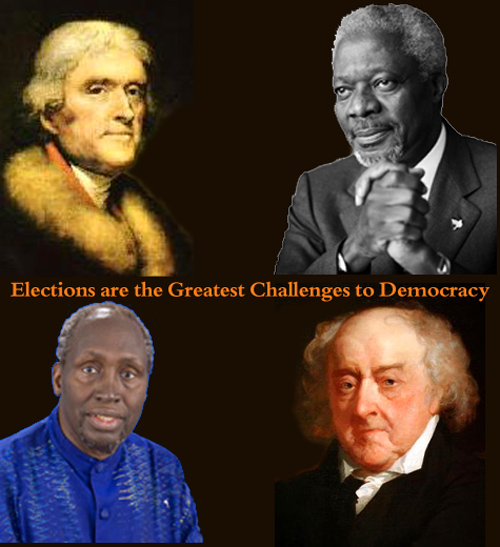
Two of Africa’s wisest old men have echoed the same cautions that America’s founders gave a young democracy about its elections. Beware: Bad elections are the greatest threats to democracy.

Yesterday Kofi Annan and Ngugi wa’Thiongo focused on the upcoming Kenyan elections as a marker for world democracy and reflected on America’s distortion of elections as something to be avoided by younger countries.

Annan is a well-known world figure, one of the most prominent Secretary Generals the United Nations has ever had. Like Jimmy Carter who remained remarkably active after leaving office, Annan’s role in global negotiations has never ceased. In fact, it was Annan who led the Kenyans out of the mire of the violence following their last election in 2007.

Ngugi has adopted America as his home after a career as a professor at Yale and New York universities. He is currently the Distinguished Professor of English and Comparative Literature at the Univ. of California in Irvine. Until 2004 he lived intermittently between Kenya and the U.S., and in Kenya is heralded as a famous revolutionary and writer.

What Americans obsessed with their own election need to know is that huge new parts of the world, especially in Africa, are adopting democracy and America’s form of democracy to govern their young societies.

This is a major change from hardly a generation ago when just as many new countries were adopting forms of Chinese communism or heavily top-down managed socialism. It’s a testament of course to the end of the Cold War, but also of the preeminence of capitalism in the global economy.

Old countries like China might be able to fiddle with capitalism and not disrupt their mechanisms for governing, but new countries can’t. The power of the economy is so critical with emerging countries that it often trumps other moral and social issues.

A case in point was Ngugi’s violent condemnation yesterday of Kenya’s decision to use English as the predominant language for governance. Ngugi is Kikuyu, the main tribe in Kenya and was imprisoned as a freedom fighter under the British. He is himself a master of the English language but he has written scholarly novels in Kikuyu, and he believes preserving multiple languages is critical to an advanced society.

It is something of the inverse argument in America as to whether Latinos should be validated by a greater use of Spanish in government.

Arguing that the current Kenyan leaders are “child abusers” for denying “mother tongues” Ngugi says, “To have a mother tongue … and add other languages … is empowerment. But to know all the other languages and not one’s own is enslavement.

“The post-colonial government and the entire [Kenyan] elite have chosen enslavement over empowerment,” he concludes.

The problem, of course, is that the violence that followed the 2007 elections turned ethnic. It is completely understandable that current politicians wishing to avoid anything much beyond a dull election want to steer clear of languages that are specifically ethnic.

In America as in Kenya when one person speaks a language that another person doesn’t understand, enormous suspicions arise, conjecture becomes almost as credible as fact-checking, and literally all hell can break lose. Unlike in Canada or Belgium where multilingual democracy flourishes, in most of the world multiple languages breed distrust.

(N.B. What puzzles many in the Kenyan situation, though, is why English was chosen rather than Swahili. Swahili belongs to no specific tribe and so is clearly universal among East Africans. The problem is that Swahili is a lingua franca and suffers thereby from a sore lack of precision. Tanzania tried to use Swahili as the formal language for many years, slowly giving way to English. It’s near impossible in Swahili to say succinctly, “Federal zoning regulations with regards to clean and safe landfills will preempt county council laws with regards to individual ownership.”)

(N.B. continued: Swahili in my view, by the way, is one of man’s most wondrous cultural achievements of the last several centuries, creating poetry of nearly every statement while maintaining a universal morality far superior to many popular western notions about right and wrong. But that’s another blog, and in this case I think Ngugi is wrong.)

Annan didn’t mention language, but in virtually everything else the two scholars said yesterday there was agreement.

Annan who is Ghanian was in Kenya yesterday. He referred to his fears that money is buying power in Kenya, as in the world over. “The infusion of money in politics … threatens to hollow out democracy,” Annan told CNN in September.

Annan understands the importance of capitalism in the world, today, but he also sees it as a threat to democracy. Many of us wait expectantly for his treatise on how the twain should ever meet, but for the time being I suppose we should presume he simply wants aggressive regulation.

In Kenya today he sees a brazen challenge to its young democracy by its rich leaders. Four of Kenya’s richest men and political leaders, including the son of the first president Jomo Kenyatta, are on trial in The Hague for inciting the violence of 2007.

Yet two of them, Uhuru Kenyatta and William Ruto, are running for president. (Not yet officially, but in Kenya “officially” comes quite close to the actual election.)

Annan sees this occurring not because the Kenyan people want it to, but because these individuals are so powerful, and because they are so rich.

Ngugi concurs: “Unregulated money in politics undermines …confidence in democracy… The explosive growth in campaign expenditures … strengthens fears that wealth buys political influence.”

American politicans’ penchant for personal stories about their early impoverishment is mostly malarkey or at best irrelevant to their current control of wealth. The vast majority of successful American politicians are rich. The cost of entering politics defies many startups. Over $1 billion will be spent by candidates and their surrogates in the current U.S. election.

Both men see the poor, the less privileged, the disabled and geographically disenfranchised as likely a majority of African voters that can be deftly ignored in a modern election:

Ngugi: “Too often, women, young people, minorities and other marginalized groups are not given a full opportunity to exercise their democratic rights.”

Democracy is today widely popular throughout new African countries and embraced as the best way to protect and govern themselves. But the messages that Ngugi and Annan delivered yesterday to a promising young African country resonant here at home just as much.

Democracy is never achieved; it’s simply strived for. America has used democracy for nearly two and a half centuries, yet the corrupting power of money, the difficulties of implementing democracy to a multi-lingual population, and the ease with which the underprivileged can be disenfranchised are threats as great today as they were in the 18th century.

Nor any greater a threat in Kenya than here.

Clash of the Faithful

Clash of the Faithful

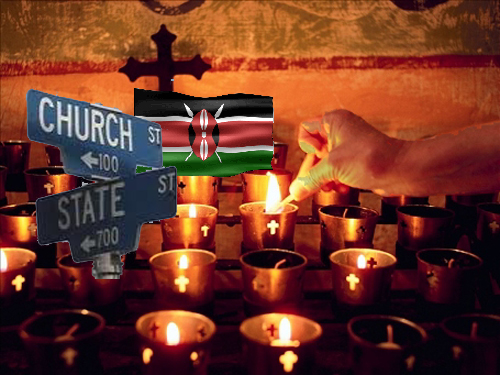
A colonial benchmark is struck in Kenya as Parliament considers banning religious organizations in publically funded schools. The Catholic Church has initiated a massive campaign to counter Parliament’s likely move which I doubt will be successful.

The Education Bill is one of the most striking features of Kenya’s rapid move to implement its new and modern constitution. If successful the bill will effectively wrest the last bit of control religious institutions have on Kenya’s public primary and secondary schools.

Currently up to a quarter of Kenya’s rural primary and secondary schools maintain a religious character as a legacy from colonial times. The state normally places and pays for the teachers and in most cases (but not all) the administration, and the church maintains the infrastructure and controls much of the school day including extra-curricular activities. It is specifically these religious activities that clash with Kenya’s new constitution that Parliament is directed to implement.

Most of these schools are on property owned by the church, and one of the more contentious debates expected is whether the new Kenya will use its modern power of eminent domain to effect ultimate jurisdiction over the existing land and school structures.

Education has been the top priority of every African government since modern governments existed, and regardless of their political and social persuasions, virtually every African country’s education was built on religious foundations.

The British explorer David Livingstone created the sound bite for colonial development in the 1830s: Civilization, Commerce & Christianity. The Three C’s were implemented by a mixture of privately funded missionary work and rapid education funded by the colonial powers.

The two were inseparably intertwined in the 19th Century, whether that was German Lutheranism, British anti-Catholicism or French, Belgium and Portugese Catholicism. Education is expensive, and the colonies had neither a legacy of any type of education or the wherewithal to fund secular educational services.

Besides in the colonial days it was only America that had struck a secular course for its society and America had no African colonies.

When my wife and I first went to Kenya it was to teach. We were hired and paid by the Kenyan government, but assigned to a large 800-student boys boarding school in a remote location in western Kenya that the then Kenyatta government had little interest in supporting. The Catholic Church stepped in, providing almost all of the funds for St. Paul’s Amukura Secondary School and a Headmaster and Assistant Headmaster that were both priests.

The priests essentially ran every component of the school, from sports to curriculum, although a national examination that determined matriculation often governed what the curriculum should be.

The Church, not the government, solicited aid from abroad to fund the schools science laboratories, build and maintain the infrastructure that allowed hundreds of rural boys to board at the school, provide a small dispensary and in many cases scholarships for the most needy.

That has changed significantly over the years, with the government now mandating virtually everything but after-school hours’ programs. Kenya’s rapid development has meant that many boarding schools and the high costs associated with them changed into day schools, but where boarding is still necessary the Church remains the paymaster.

Extracurricular activities, boarding where it continues, and the land on which the schools still sit are the contentious issues before Parliament.

It is the Catholic Church that has the most to lose, and it is pulling no punches in its drive to dissuade Kenyan legislators from further diluting its influence.

If Parliament continues on the track predicted, “…our schools will start producing Godless creatures and the society will be ruined,” Kisii Catholic Bishop Joseph Mairura told reporters this weekend.

The issue is especially sensitive right now as Kenyan Christian churches suffer violent terrorist attacks presumed to be in retaliation for the government’s invasion of parts of Somalia controlled by Islamists.

Public sentiment is charged. The comments left after Sunday’s weekend stories that the leadership of the church is going to fight Parliament’s moves were divisive and angry.

Is a certain Church/State separation the right move for Kenya now at a time of stressed government resources?

It depends on how much faith you have.

Black Gold

Black Gold

As the U.S. and Europe teeter with their economies their investors are turning to Africa where energy companies are growing rich overnight.

Fed up with the failures of austerity in Europe and the even greater failures of politics in the U.S., giant multinationals are directing investment out of their home turfs to Africa. Facilitated especially by new Chinese technologies for deep drilling, huge new reserves of oil and especially natural gas are being discovered almost daily in Africa.

Literally overnight western companies like Tulow, Royal Dutch Shell, Cove Energy, ENI, Galp Energia, the BG Group and Eskom have seen share prices skyrocket with their new African discoveries.

Global analysts think this presages a major shift in geopolitics in the not-so-distant future. Steve Levine of the trendy new quartz.com online business journal thinks that by 2020:

“.. oil prices could average $80 a barrel, Gulf monarchs … could face unrest, Mozambique—yes, Mozambique—could become one of the most important petro-states on the planet, China could more congenially assume a top rung among global powers. And the US could untether itself from some tyrants.”

What I think Levine and others fail to underscore is that we already have a Third World African energy giant, and we have had it for more than a generation, and it’s not doing so well.

Nigeria is a mess, and the $64 trillion dollar question is will that also be the outcome for Tanzania, Kenya, Mozambique, Uganda, Angola and the others.

Nigeria’s oil, gas and other natural reserves rival many states in the Mideast. Civil war, rampant corruption, now Islamic extremism and a failure to develop basic infrastructure have stymied any meaningful development over the last 30 years.

Nigeria’s manifold problems have not just inhibited Nigerian development, but scared off many global energy companies grossly reducing investment and extraction.

Uganda’s new oil finds are suspended while the county battles multinationals in the courts over royalties.

And Tanzania’s new-found energy wealth is tied up in a series of new energy laws that simply can’t get through Parliament. And Kenya – struggling beautifully but ardently to implement a new constitution, hardly has time for such trivialities as trillion dollar oil reserves.

But that, actually, is a reason things might go OK for East Africa. Unlike the now drunken uncle Nigeria, these countries aren’t just waving in outsiders with no requirement except that they lace the doorman’s hand.

The reason for the stall in Tanzania’s multinational contracts is because of the immense new pressure being exerted on its Parliament by … we-the-people. Centered on new energy finds, the power of young legislators and activists around the country to create a fair energy law is unprecedented in this sheepish country whose population until now has jerked its knees whenever its leaders whistled.

And Kenya has become one of the most sophisticated democracies in Africa. Its only delay, truly, is because such heavy lifting as implementing a new and brilliant constitution must come first.

Each country is different, of course, but my take is that African democracies are maturing so fast that they are now fully capable of creating welcoming capitalist environments for these giant multinationals that will ultimately benefit them mightily. Thirty years ago, Nigeria just wasn’t mature enough.

To be sure this is a serious generalization that needs careful parsing. And don’t give it to the multinationals to do; don’t presume that they always know what’s best. Ask BP Shell and the other multinationals that struggle in Nigeria. Many wish they’d never started.

But once invested giant multinational energy companies get caught up in their own ideological web that won’t let the little spider move on even as the web gets torn to shreds. While a few multinationals have left Nigeria and Belarus, most wouldn’t walk away from their huge capital investment, even when the returns weren’t worth it.

This led to all sorts of horrible things. Horrible returns to investors, yes, but corruption and graft on huge scales that to this day continues to stymy Nigeria.

I don’t think that will happen, again. Thanks not to the greed of the multinationals, but to the sophistication of Africa’s young emerging democracies, today.

And I for one think that Kenya and Mozambique will be the leaders and shakers. Tanzania could turn out well, too. Right there are reserves of oil and natural gas that are almost a fifth of the existing reserves in the Mideast.

And if Angola and Uganda throw off their despicable governments – which could indeed happen – then the oil well overflowith.

Last of the Matriarchs

Last of the Matriarchs

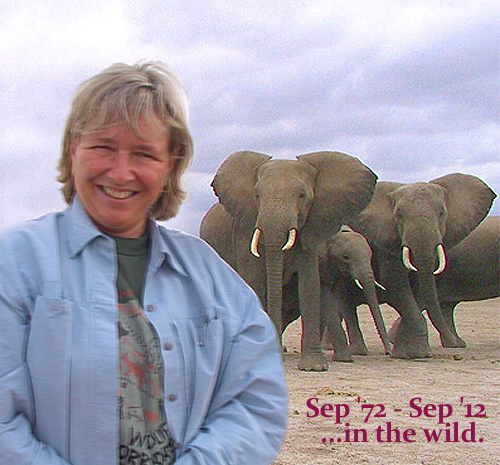
This month marks the 40th anniversary of a celebrated field researcher, Cynthia Moss. Ms. Moss began her field research in 1972 where she remains today, among the elephants of Amboseli in Kenya.

Moss was the 4th untrained volunteer woman who turned up in the field in the 1960s and early 1970s and became famous worldwide for big game conservation. Her species was elephant. The three who preceded her by a few years were Jane Goodall (chimps), Dian Fossey (mountain gorillas) and Birute Galdikas (orangutans).

What the four have in common is chutzpah. Only Galdikas had any higher science education. Moss had a higher education degree in philosophy, but the other two had no science education above secondary school.

The first three all obtained their first posts in Africa from the famous paleontologist Lewis Leakey who Vanity Fair argues chose them less for their potential as field researchers as for their amorous attachments to Leakey. Read the outstanding book by Virginia Morrell, Ancestral Passions.

Moss on the other hand seems to have been the only of the four recruited for potential field ability. Her mentor is the dean of elephant research in East Africa, Ian Douglas Hamilton.

Moss began studying elephants in what at the time and ever since has been one of the best elephant habitats in Africa, Amboseli national park in Kenya.

The four ladies popularized big game especially in America and harnessed enormous support for African conservation by bringing to life in very anthropomorphic ways their favorite animal. They would not have succeeded, today.

Not only were they untrained in biology or field research, none are very nice. They all operated as little dictators in their neck of Africa, and except for Moss, their science – especially their early science – was nothing short of grade-schoolish.

But it took several generations of researchers following them before that was understood. Today none of the four except Moss is cited for their research, but they are all rightfully honored for opening America’s eyes to the plight of big game conservation in Africa.

And without opening America’s eyes, there would not have been enough check books to open to fund the body of research and protection which has truly saved their favorite animals.

South Africans in particular are very sensitive about this, because good big game research had been going in southern Africa for nearly a century before these four wholly untrained “entertainers” hit the seen and captured America’s treasury.

But South Africa even before the excesses of extreme apartheid had never been able to attract the interest of American animal rights activists. Probably they didn’t want to.

In addition to being an inward society for centuries, South Africans had mistrusted Americans for a long while. There was never the chemistry between the two societies that would have enticed an American public to become Africa animal sensitive.

So East Africa was the perfect place for them. (Galdikas ultimately ended up in Malaysia.) Just coming out of the colonial era, no good extended animal research had been conducted of East Africa’s big game or primates.

Notably the great scientist, George Shaller of the Bronx Zoo, studied mountain gorillas that still today is considered to have been better research than Fossey’s. And he preceded her by several years. But Shaller never stayed anywhere very long.

That was what all four women did best: Stay.

Except for Fossey who was murdered in revenge for her likely racist attitude to Rwandans, the other three spent long lives with their chosen animal. In so doing they published popular books, were increasingly interviewed on television and invited as popular speakers throughout America. Like today’s better known animal people such as Jack Hanna, they were much more entertainers than scientists.

Moss was the only of the four who significantly contributed to science, and it’s probably the reason she’s the least known. The other three made their initial marks in personality scandals or with brash claims about their animals that have long since proved incorrect. Moss, a few years younger and later to the scene, conducted meticulous research with methods that are still used today by young researchers.

I had my own personal battles with the three in Africa, because they were all in the beginning defiant of tourism. Each was so protective of their distant escape to Africa, they shunned rich people’s donations rather than agree to welcome them into the field.

I as the guide was considered the facilitator of this disrespect and violation of their little self-proclaimed kingdoms. Guides were easier to blame and a lot less rich than the clients

That changed radically over time as it became apparent tourism was part and parcel to funding African conservation research. Today there is no important NGO that does not coordinate laymen tours to their areas of funded research.

Nevertheless, the personal animus developed between myself and all three African research ladies is still hard to ignore. At the time their sabotaging of some safari dear to my heart and essential to my bank account was tantamount to war in the field. I concede now, though, that without their personal and truly remarkable chutzpah East African conservation would likely be in a considerably worse state right now.

Moreover, I’m no more trained in tourism or guiding than they were in animal research. So despite our feuds, we can truly all be wrapped up into the same amateur motivation that drove us all: an intense love of Africa.

And this particular anniversary of Ms. Moss’ 40 years in the field is the easiest of them all to celebrate, since of all four women, her dedication has been the most sincere and has produced the most true science.

Happy Anniversary, Cynthia! As the last of the great matriarchs, none will assume your place, unlike the thousands of matriarchs you have nurtured and saved in the African wild.

Renewing [or not] The Strongman

Renewing [or not] The Strongman

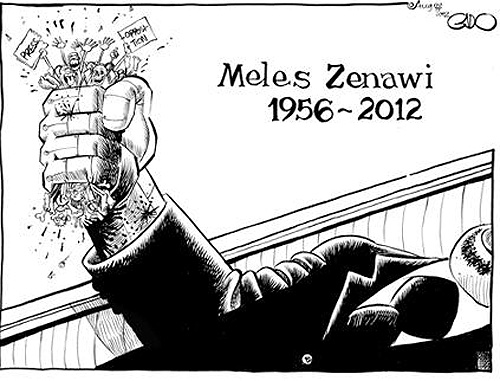
Last week’s death (unusually of natural causes) of Ethiopia’s strongman Meles Zenawi is an unique opportunity for America to reflect on its impact in East Africa, if not the whole of the developing world.

Meles was one of the most ruthless dictators in the world. He was also heavily supported (argue, “propped up”) by the Obama administration. This contradiction was justified because Meles was also instrumental in the War on Terror.

America’s Wars on Communism and Terror and Drugs have governed our policies in Africa for more than a century. The question, now, is whether we are mature enough of a society to throw off these archaic shackles usually described as “self-interest.”

    Cycle One: The War on Communism

In 1960-1962 during the presidency of John Kennedy democratic movements throughout the Congo were quashed and its leaders assassinated paving the way for the continent’s most famous and longest serving tyrant, Mobutu Sese Seko.

    Cycle Two: End of The Cold War

In 1993-95 during the presidency of Bill Clinton democratic movements in the Congo and Rwanda were abandoned to chaos paving the way for seemingly interminable war and ethnic conflict.

At the time the rationale for abandoning Africa to dictators and mayhem was that there was nothing consequential to America in Africa at the time worth fighting for. The Cold War was over

    Cycle Three: The War on Terror

Today, 2010-2012, under the presidency of Barak Obama strongman regimes in Rwanda, Uganda and Ethiopia have received huge amounts of military and development aid paving the way for ruthless dictatorial regimes violating all sorts of human rights.

Today’s rationale is that the War on Terror is going pretty well, and especially well in The Horn of Africa.

Lesser acknowledged but well known is the American Right’s involvement in all three of these cycles. Until the current cycle it was principally from church missions and was admittedly less significant. But during this latest cycle, the involvement of DC’s Church Street and other evangelical groups most prominently in Uganda has been well reported.

The contradictions are explosive:

The most incredible one is that while President Obama has inched his own country away from homophobia quite successfully, his administration piles enormous support on the Ugandan regime which is still trying to pass legislation that will execute gays for being gay and imprison nongays for not revealing that someone is gay.

And there are many more: no military involvement in Libya or Syria, but already a brigade of green berets in Uganda and the CAR; and tax to death or forbid U.S. corporations from extracting coltan and other precious metals from the troubled DRC, but laden Rwanda with extra development aid to build local industries that do just that.

This is not a Right or Left affair, although it seems to always be initiated by Democrats and then massively supported by Republicans that follow. And it is not a Left versus Right affair, either. The fact that Democrats in power are essentially promoting the same thing as evangelic Christians funding movements in African backrooms is clear this is not a Left verus Right affair. It’s a power thing.

It’s ends justify the means. It’s Kissinger’s self-interest dogma. It’s we do what works best for us, irrespective of morals, ethics or human rights. It’s been the way of the world for centuries.

And so we endure Cycle Three: Museveni in Uganda, Kagame in Rwanda and whoever will be Meles’ successor in Ethiopia are all ruthless dictators. Together with American drones, the War on Terror proceeds just hunky-dory.

All hail the African Strongman.

Good News Somalia

Good News Somalia

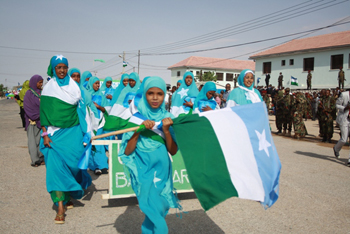
Puntland is a part of northern Somalia which celebrated 14 years of stability and largely peace on August 1 with parades in the capital of Garowe.
Yesterday clan leaders from around Somalia adopted the first truly national constitution in 40 years. All we need now is an end to the global recession.

There is a lot of trouble in Africa right now, and a lot of it is in Somalia. While the 825 delegates prepared to adopt its historic first constitution in 40 years, two suicide bombers were “detonated” by security forces just outside the building in which the clan leaders were deliberating.

A respected Kenyan journalist quipped, “The Somalia constitutional conference ended with a bang!” His column was a very positive and very optimistic view of the situation in Somalia.

In fact, Onyango-Obbo suggested Somalia may be on a path to a representative democracy far superior to the majority of the soldiers in the African Union’s peace-keeping force in Mogadischu who come mostly from Ethiopia and Uganda:

“History is capricious and has a cynical sense of humour. If the constitution, referendum and subsequent election are pulled off, Somalia might have a freer election than either …Uganda or Ethiopia…”

Africa has a way of fooling us about its future, and Onyango-Obbo might be onto something although I think his characterization of a “cynical sense of humor” might just be plan old irony.

The Somali constitution is strictly Sharia-based, and of course that’s not going to go down well with America’s right. But get this. The constitution also allows abortion and bans female circumcision.

There is nothing specific in the Koran, or the Bible, which forbids either abortion or female circumcision. Clerics over the centuries, and the Catholic Church in particular, have added dogma to the original poetry. It is the interpretation not the literal text that is so contentious, today.

What the Somalis may have demonstrated is that you can take almost any ancient code of behavior and reduce it to is most basic moral principles and still create a modern, contemporary society.

So whether it is a Christian society or one based on Sharia law, it’s quite possible to arrive at similar governments in a modern society.

The reluctance to do this, by Al-Qaeda on the one hand or Christian evangelicals at home on the other, is what causes conflict and belies superficial morality as something usually much simpler like racism.

A peaceful and successful Somali nation has a long list of necessary predicates well beyond just stopping suicide bombers from killing legislators. The Kenyan army has yet to displace the pirate kings of Kismayo. There are nearly a million refugees living just outside the political borders in Kenya. And global warming couldn’t have a more dire effect on the people on planet earth than Somalia.

And this cauldron of political, social and even geological and meteorological turbulence seems these last few months to be spreading across much of the continent, after just a few years of such positive progress.

And that’s why I mention the need for the end of the global recession. Everything it seems in the world is economically based. When economies are improving, so do the politics and societies in general. In fact, with improving economies, strategies to deal with global warming emerge more easily.

So read Onyango-Obbo’s positive take on Somali. Cross your fingers for an European stimulus and re-elect Obama. There are a few other things to do, too.

But then in a few years, Somalia in the lead, Africa will turn better.

Clinton’s Congo Collapses

Clinton’s Congo Collapses

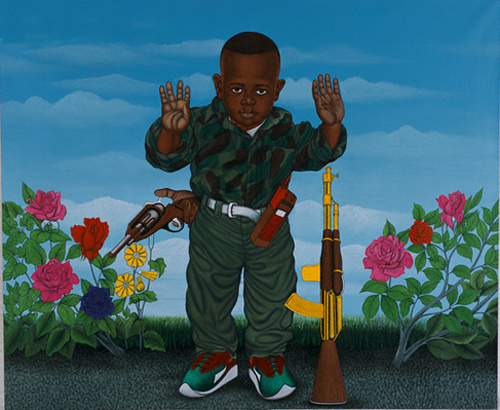
2004 Painting by Cheri Samba
The UN’s actions in eastern Congo to stop the escalating war might work for the moment, but they are useless down the line without an American pivot in Rwanda.

America was drawn into this mess because of the political weakness and inept statesmanship of Bill Clinton.

As time accelerates off those years Clinton comes into sharp focus as a politician par excellance but a pragmatic leader without vision. He road a wave of latent 1960s American aspirations that he was unable to fulfill domestically.

So when Blackhawk Down undid his lofty rhetoric about the global arena, he cowered like a dog who had wandered unintentionally into a mad neighbor’s yard. And he failed to recover quickly enough to stop the 1994 Rwandan Genocide.

Instead, a year later he and other equally timid western leaders began an extraordinarily expensive cleanup, which like BP in The Gulf was cleverly crafted as a great humanitarian accomplishment.

The big then hidden problem was that cleanup included the enthroning of Paul Kagame, the single greatest cause of the Congo flareup, today.

And because the American economy was growing gangbusters, technology was exploding with one grand surprise after another, and America was wallowing in the presumed glory of having won the Cold War, Clinton was capable of assuming greatness just for being around at the right time.

It was inevitable that his terrible neglect – specifically of Kagame’s own obvious vision for Tutsi domination of the region — would one day return to haunt us all … and that day is today in The Congo.

A significant UN Peacekeeping force has been successfully challenged by M23, a powerful warlord army, in Kivu Province in the eastern Congo, and today the local population is being displaced as if Katrina had descended onto middle earth.

The tinderbox will explode at any minute. The only half-rational functioning society in Kivu, the main town of Goma, is due to either fall or be wiped out and the UN sent running.

Yesterday, UN Secretary General Ban Ki-Moon called the leaders of The Congo and Rwanda, the two greatest arch adversaries on earth, to beg for peace. They won’t give it to him.

I’m not sure how to undo a generation of politics predicated on Clinton’s cowardice, but one thing is certain. The U.S. and Europe must stop the unchecked and often unaccounted for support of Rwanda’s merciless dictator, Paul Kagame.

Kagame is front and center in the conflict, a likely billionaire as a result of it, and a fanatic who believes that ethnic conflicts are irresolvable. He has jailed his opponents, likely assassinated them abroad, and struck terror through his population.

And he is funding the war in The Congo, with U.S. and European aid money.

But the U.S. and Europe are stuck trying to justify the past and simply can’t pivot out of their culpability. The U.S. and Europe promote policies of ethnic reconciliation that cost millions but go nowhere, and support Kagame for lack of any alternative because they were the ones that put him in power.

You know, it’s time to own up to our mistakes. We’ve got to step out of a history of governance entrenched in the notion that the past was always right.

America’s vision — Clinton’s plan — for reconstructed Rwanda isn’t working. It’s like culling deer. You might save the roses where you cull, but the problem only then gets worse on the periphery where culling didn’t occur.

The periphery of Kagame’s power is Kivu, the sore that festers and will soon burst. Kagame’s American vaccinations give him immunity so he can wade into the puss and extend his power westwards.

The conflict in the eastern Congo is so complex and daunting that a blogpost seems useless without deep background. Much of what I believe rests on personal experience and a formidable body of often conflicting intelligence and analysis. In fact, probably the only evident truth about The Congo is that its complexity is its undoing.

Study Jason Stearns: His book, Dancing in the Glory of Monsters, was published last year, and I have used above the Samba painting that tops his invaluable blog, Congo Siasa.

Recalibrate your support for Kagame, America. Clinton’s shame is old news.

Circumcise or Die

Circumcise or Die

Kenyan rappers are being prosecuted for hate speech in the run-up to March’s election. We don’t prosecute MnM but these guys should be clamped.

There is a wide range of laws prohibiting hate speech around the world. We in the U.S. are among the most liberal but developed cousins like the U.K. have rather sophisticated laws prohibiting it.

Most people would agree that there should be no freedom to shout “kill” or “fire” but the dispute begins when crazies picket the military funeral of a fallen hero with signs and chants, “God Hates Fags!” It should be regulated, just like hedge funds.

The theory is pretty simple. “God Hates Fags!” is not the same as “Kill the Gay!” We all so stipulate. But (1) is our sophisticated media delivery purporting the same idea, or (2) is there evidence that raising the tempers of these warped supporters will trigger violence?

Yes to both counts, your honor.

In Kenya three of the country’s most popular rappers, millionaires (in shillings) for the sales of their CDs and one even a gospel singer, have now sold tens of thousands of copies of songs that clearly incite the same ethnicity that nearly brought the country down in fire in 2007.

Although the firecrackers that started the holocaust was the age-old friction between the haves and have-nots, the rightests and the leftists, the pyres were ethnic. It always seems to be that way: the poor versus the unpoor in Ireland; the oppressed versus the rulers in Arabia.

I began blogging at that time, because it was an unbelievable undoing of Kenya. The silver lining came 3-4 months later as Kenya was forced to recreate itself from the ashes, and the recreation has been nothing short of magnificent.

The design is done. The scaffolding is being torn down as the structures are in place, and the election that will complete the process is on March 4.

Click here to listen to this most egregious rap. You’ll have to scroll forward about 2min 16sec to get to the actual song that was sold as a CD.

This Kikuyu rapper is trashing the leading candidate for president in the March election, from the arch rival tribe of the Luo. We had hoped the ethnicity would now be incidental, but it isn’t. It is for the younger generation, but not for the older.

It doesn’t help, either, that the Kikuyu’s choice is Uhuru Kenyatta, the son of the Father of the Nation, Jomo Kenyatta. It doesn’t help because Uhuru is currently on trial in The Hague for Crimes Against Humanity. There is evidence that he was personally involved in torching the country in 2008.

It’s Kikuyus’ failing they won’t come up with anyone better, but a stark statement about how many of them still feel about democracy and other such foolish notions. Many, many Kikuyu would rather blow up themselves and the country to boot than lose power.

And now it seems one of their spokesman is a gospel rapper.

Here is some of the song, Uhuru ni Witu (Uhuru is Ours) by gospel rapper, Kamande wa Kioi, as translated by one of the thankfully many younger Kenyans who despise what’s happening, Amkeni Ndugu Zetu.

(Important background reminders: “Uhuru” is Uhuru Kenyatta, presumed candidate for President and son of the father of the nation and on trial in The Hague. “Raila” is Raila Odinga, the current Prime Minister and front runner in the current campaign for President, a Luo.)

“I bring you a message from all Kikuyu musicians. This is a message from God. Uhuru is the Moses of the Kikuyu nation. He is meant to move Kikuyus from Egypt to Canaan. Do not agree to be divided. Let all votes go to him. He is ours. He is anointed by God, poured oil on.
“Raila, there is a call.
“You thump your chest about Hague, is Hague your mother’s? There is a curse from God. Philistines who do not circumcise cannot lead Israel. When Abraham stressed God, he was told to go get cut, even you General of Migingo, your knife is being sharpened.”

Kikuyus circumcise; Luos don’t.

I can’t image a more egregious lyric. Wa Kioi is not especially young, I imagine he’s in his late 30s. He may be on the dividing line between Kenya’s inspired and educated youth and the Old Guard, but his influence extends far and wide. Many young people of all tribes listen to him; he’s a super star in Kenya.

Together with two others the country’s election oversight board has now charged them with hate speech under a criminal code that requires jail time if convicted.

And there’s a horrible twist to the story as it plays out in Kenyan courts. Wa Kioi’s clever lawyer asked the court to read aloud some of the lyrics of the song under question. Court is held in English, because of the many tribal languages in Kenya.

The lawyer chose a portion which was simply repeating Bible scripture, and as it was translated into English, the court room broke into laughter. The intention, of course, was to fool the court and it seemed a successful ploy:

A second-rate digital media story about the testimony was picked up by major global news sources as if it, too, were gospel.

But hopefully Kenyans won’t be fooled, especially its youth. And hopefully, this so-called man of faith will be slammed behind bars to contemplate the Golden Rule.

Whose Creation of the World?

Whose Creation of the World?

A Congolese ballet currently moving through Europe’s summer festivals strikes a remarkable difference between American and European compassion to Africa. Maybe compassion per se.

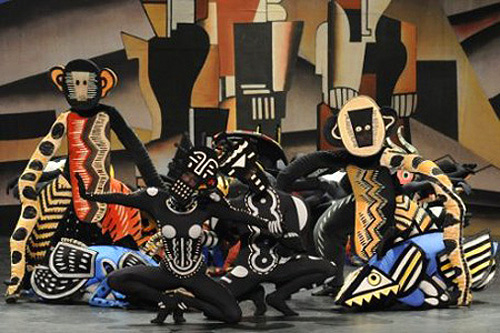
Congolese choreographer Faustin Linyekula is currently restaging a near century’s old ballet called “The Creation of the World” that was first produced in France between the world wars. At that time it was widely called “The First Negro Ballet” since its depiction of emerging humankind was black, and as such, included pioneering black performers at a time when blacks worldwide were pretty much confined to trumpets and drums.

It became impossible then, and remains impossible now, to view this ballet as anything more than white people’s fantasies about black people’s existence. Racism in its most theoretical forms.

The ballet’s storyline is basically biblical, but the world that emerges is not flowering with white lovers under a perfectly formed apple tree. Instead, mankind births into something rather depressingly horrible: skin without bodies, torsos without hearts, and babies in abject suffering. Essentially, mankind without a soul.

And in the Bible’s remarkable way of accepting suffering as simple destiny, it prevents the viewer from leaping to any remedy. There is no hope things will get better in the ballet. The story ends in misery.

Linyekula’s thundering question is “How could they not see the suffering?” The English translation was made by Radio Netherlands after Wednesday’s performance in Amsterdam, and it’s right on.

More exactly Linyekula means why did they not react to the misery during the colonial age, and now, why are non-Africans not assisting Africa more than they are?

The question begs the question about compassion. And it’s logical that those who are responding most compassionately (Europeans) will also be challenged more often (than Americans who are doing less) that they are still not doing enough. That’s what Linyekula is trying to do: tug on the European’s guilt, egg them on to even greater compassion.

“The Creation of the World” wouldn’t succeed in America, today. Like anything troubling, there is a threshold of assumed responsibility, and I believe Europeans have a greater tolerance for heavy lifting in Africa than Americans. A greater compassion.

It would take me a book to dissect the cultural facts of current European antipathy to immigration vis-a-vis its greater compassion to mankind as a whole than American’s. But I do believe that:

Americans are fast losing their compassion, compassion for almost anything but themselves. Whether Europeans in contrast are growing more compassionate and tolerant is hard to measure on its own, but in contrast to America they most certainly are, despite the wave of anti-immigration sentiment polluting Europe, today.

The ready measures of this regarding Africa specifically are foreign aid and private investment, government engagement (military or otherwise) and free trade agreements. In all these areas, Europe is racing past America despite Obama’s attempts to stay even.

Europe is in a much worse economic situation than America. Why, then, is Europe reaching out to Africa more than America? The first reason is because of America’s current obstructionist Congress. But there are deeper reasons as well.

Europe is closer to Africa than America, so trade and investment is easier. It has more immigrants from Africa and it has a more pressing problem of refugees from Africa than America. But there’s an even more important reason in my view: there’s more guilt.

Few societies in the world used and profited from slavery as much as America, and we all know where they came from. But that’s perhaps too long ago for any residual guilt to move us in any contemporary fashion to greater compassion. The colonial period in Africa which emerged as slavery was being ended was dominated by European powers and lasted for a very long time. It’s not “so old.”

That was a mostly wretched period in world history. Parliaments in Portugal, Belgium and France have all apologized and paid reparations for their society’s unjust colonial involvements. The Catholic notion of repairing past wrongs by dropping a penny in the church’s collection box is a very European notion.

(And, by the way, it often works and has a much greater impact than lovely speeches about morality and compassion.)

To be fair, though, the production is not being swallowed whole in Europe. Linyekula actually extended the ending of the original production exaggerating the “misery.”

A respected French arts critic, Marie-Valentine Chaudon, asks “Does Linyekula go too far” implying European disinterest with the African suffering she accepts was in large part caused by the colonial period.

Perhaps. But what saddens me is that “maybe too far” in the European mind is outright “extra-terrestrial” in America’s, today. And while I’m no dance critic, I think the art Linyekula clearly has turned for political and social purpose is extremely valuable.

And I sorely wish we in America could achieve the same level of self-inspection with regards to racism, with regards to our lack of compassion.

Surprise in the Sahel

Surprise in the Sahel

By Conor Godfrey
On the morning of March 22nd Malians woke up to discover that 20 years of stability and progress had been, temporarily at least, hijacked by a group of mutineers turned putschists led by a Captain Amadou Sanogo.

This was a punch in the stomach with no warning.

When I was evacuated from Guinea after a similar Coup in 2009, we traveled north through Upper-Guinea to Bamako, Mali.

On the Guinean side of the border, one gets shaken down every 50 kilometers by aggressive soldiers manning checkpoints on a sorry excuse for a main road.

As soon as you cross to the Malian side of the border, the road quality improves 200%, and the soldiers manning periodic checkpoints are friendly and helpful.

It was like a different planet.

This small anecdote conveys the crux of the sahelian surprise – this landlocked country with minimal assets was successfully bootstrapping itself out of desert poverty.

It was also a poster-child for the fruits of reasonably good governance.

This coup was not the result of long simmering ethnic tension, or gross mismanagement; it was a pseudo-spontaneous overflow of frustration by a group of junior officers and enlisted soldiers in Bamako.

More of an isolated mutiny that got out of control.

The explanations for the coup are all over the news: here and here you can find good articles on the acute causes.

See my previous post on Tuaregs.

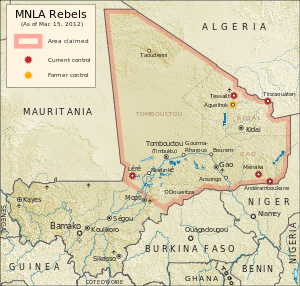
Essentially, there has been a full-fledged rebellion in the north of Mali since January, led by a Tuareg outfit known as the Movement for the Liberation of the Azawad (one of many Tuareg campaigns over the last few centuries….they are only called rebellions once there is an actual State to rebel against — I suppose.)

These rebels have inherited military equipment and wherewithal from the Tuaregs that fought alongside Gadhafi, and are essentially outgunning and outmaneuvering the uniformed Malian army.

The junior officers doing much of the fighting (and dying) in the North feel the Malian government has mishandled the rebellion, accusing them of sending poorly armed and equipped soldiers to face hardened and well armed rebels.

This issue is also magnified by the growing resentment of the Southern Malian population (where the overwhelming majority of Malians live) toward the rebellious Tuaregs in the North.

Most Malians are looking for a strong response.

(Whether this constitutes “support” for the coup is difficult to tell: here is a very intriguing set of posts by “Bamako Bruce” claiming widespread disenchantment with the previous government.)

Regardless, if soldiers continue to loot stores and government buildings, nebulous support from some Malian youth will likely evaporate.

I am going to go out on a limb regarding the outcome of this crisis, and I expect you all to write in angry comments if I am wrong…

My prediction is that this is going to blow over.

The coup leaders did not secure the backing of the necessary socio-political elements of Malian society (religious leaders, senior military figures, opposition groups), and now find themselves increasingly isolated.

Malians were enjoying the fruits of democracy (albeit slowly), and have no appetite for violence or prolonged instability.

They are simply pissed off that their government cannot get a handle on the conflict with the Northern rebels.

On that front, the Tuareg rebellion has done so well that there are now signs the rebel leaders want to negotiate from a position of strength and secure more autonomy and other perks before their success triggers the use of overwhelming force by Mali (perhaps financed and armed by international friends).

All of this spells a negotiated solution.

The coup leaders will try to secure a golden parachute by leveraging their ability to prolong the instability, and some of them may get one.

The rightful president of Mali, Mr. Amadou Toure (now either in hiding or under arrest), was due to leave office in weeks anyway, and will likely agree to leave power as scheduled and collect his prize from the Mo Ibrahim Foundation.

He will inevitably promise all sorts of populist goodies on his way out knowing that his successor will have to deliver on them.

This will pave the way for elections that will elect a candidate promising better equipment and training for the army, thus defusing the tension that brought the coup in the first place.

Of course, things could go south quickly as well.

Read this short piece of analysis by a risk consulting group.

While I think that the Executive Analysis scenario is unlikely, there are several points where my more positive projection could break down.

These mainly concern rebel and government choices regarding winding down or scaling up the conflict in the North.

The Malian government may need (strategically or because of popular pressure) to bloody the rebels before negotiating.

After all, the Tuareg rebels have claimed so much land in this campaign that they might be tempted to do so again the next time they are feeling aggrieved or restless.

This scenario could give the military government more time to maneuver, as it will be difficult to respond effectively to the rebellion if everyone is focused on elections.

My views are not necessarily the majority position. A darker prognosis can also be found here at African Arguments.

Mali is headed in the right direction. This, I think, I hope, is just a painful bump.

P.S. The Coup leader received military and intelligence training in the U.S.

On Safari: The All Good Cape

On Safari: The All Good Cape

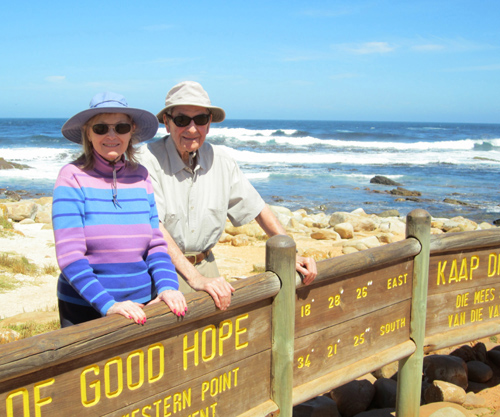
Dr. Lester Fisher, Dir. Emeritus of the Lincoln Park Zoo, with Barbara Shaffer
at the Cape of Good Hope as we began our safari in southern Africa.
I like to begin all southern African safaris in Cape Town, despite it being rather distant from game viewing areas and in spite of its constantly rising costs. As one of the most beautiful cities in the world it portrays so much of what young, modern Africa is becoming.

We spent four nights and five days in The Cape before heading to Botswana for game viewing. It was warm for March, several days in the lower 90s. But fortunately one night of heavy rain turned everything on, like a light switch, and the last of The Cape’s summer flowers and fragrances filled the peninsula.

One day was for the city itself. As with any world class city, I had to pare down the attractions to fit our time. I begin with a walk through the Company Gardens which is laden with history, sated with beauty and ringed with museums.

Nothing exciting was happening in any of the museums except the Slave Lodge, which had a special exhibit about Mandela. The Slave Lodge is one of the more sobering museums in the city, but without some understanding of how slavery affected and was a part of South Africa for so long, you really will never understand the present.

From there we visited what I think has become my favorite Cape Town museum, District Six, but this time I learned how important a guide is, and how fascinating and surprising the experience can be there.

District Six is a “living museum” whose guides are actual persons who were among those evicted from this historic quarter of Cape Town during the most pernicious period of apartheid, the 1960s. Residents who were fourth generation Capetonians were given sometimes less than a week to leave before the home their great-grandparents had built was bulldozed to make into an all-white section of the city.

Prior to the bulldozing, the area was classified as “coloured” meaning it was of mixed races. This could be white and black or Indonesian and Indian, or Malay and white. But it was a close knit, historic, politically dynamic and highly educated community, thrust suddenly into the dustbin of history.

The guides are what make the museum so incredible as they describe not just their lengthy history before the eviction but their lives afterwards and then after the end of apartheid. The story is usually a three-part drama that ends in pretty hopeful and inspiring ways.

But this time the guide we got, a politically active ANC undergrounder at the time he and his family were uprooted from nearly a 100 year history in the community, spent most of his time complaining to we visitors of the current affirmative action policy of the South African government.

Very interesting.

Obviously, the several centuries of apartheid that plagued the Old South Africa is going to take time to remedy, and I doubt there are many who feel that affirmative action is a wrong course of action. But the guide, a District Sixer and therefore a coloured, felt that affirmative action was displacing the opportunities of his family at the expense of blacks. “I’m not anti-black,” he insisted; “I’m just anti black behavior.”

That cliche has rung the world round and been exposed as hyperbole of the greatest sort, and it was a bitter sweet experience for me personally, who has been to the museum so many times, to see this crack in the hopefulness of the New South Africa.

Another day was spent at the Cape of Good Hope, and I can’t remember once before when there was no wind at the top of the Flying Dutchman that overlooks the sea that Dias and de Gama rounded centuries ago. But that was our fortune to be sure! Hardly a breeze, in fact, no clouds and one of the most spectacular views in the world. That day is the day we see the jackass penguins (recently politely renamed “African penguins”) at Boulders, and they’re absolutely some of the funniest things in existence. I like to sneak into the parking lot several blocks from the national park, the “swimming beach” and watch the kids swimming with them!

Another day was spent at Kirstenbosch, with free time to ride up Table Mountain and view the city from Signal Hill. What an amazing place Kirstenbosch is, and how indescribably beautiful. I say that because it isn’t just the gardens themselves which are spectacular, but that incomparable setting below Table Mountain. We nearly cried as our guide was walking us through pastures of bloom and stopped to say hello to an old man who had carried the ashes of wife to a certain point in the gardens that she so loved.

And finally we spent a day in the wine country. You’d be surprised that there really isn’t time to visit more than say two wineries. For one thing, the drive is so spectacular that you don’t want to get off the highway, with the jutting Cederberg mountains framing one beautiful vineyard after another.

I chose vineyards that don’t take tour buses. (We were driving ourselves around in rental cars.) That way you can get incredible attention and detail from the vinter as the wines are described, and real interaction when there are only a small number of people sampling the treasures. I particularly like Rustenberg Winery with its 19th century Victorian garden that is so spectacular as well!

True animal people as we are, part of the day for the wine country was spent at the Eagle Rehabilitation Center associated with the Spier Winery. Nearly half of the Cape Vultures, an endemic species, have been lost to poisoning, and that’s one (but by no means all) of the center’s missions. We got there in time for the 4 pm raptor demonstration and watched a number of beautiful birds flying around, landing on our arms and heads!

The Cape is so wonderful that I just could never see stepping into a game park in southern Africa without first stepping into this wonderland!

Justice Over Politics

Justice Over Politics

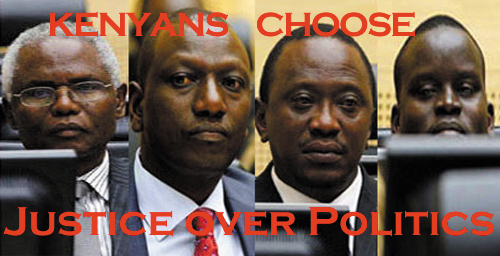
Not just free trade, but free justice! Africa once again leads the world into a new age. Today, major Kenyan politicians seem to have submitted to the World Court to face charges of crimes against humanity.

They include Kenya’s Deputy Prime Minister, Uhuru Kenyatta, and son of the founder of the country. Also included is a former kingmaker and government minister. The president’s Chief of Staff during the troubles of 2007 is also charged, and finally, a nonpolitican altogether, a radio personality who perhaps unwittingly caused rampant violence.

At 130p local Kenyan time, the World Court at The Hague confirmed the charges and announced the trial will begin.

The Hague is 6000 miles from Nairobi. Nevertheless, over the last two years, those accused have traveled back and forth with their teams of lawyers, have submitted to questioning and accepted the jurisdiction of the court to adjudicate their futures.

Can you imagine Carl Rove standing trial in The Hague for fixing the Florida count, or Rumsfield and Cheney for trumping up WMD? Or for that matter, Deng Xiaoping for the massacres in Tiananmen? More exactly, the slavic genocide of Radovan Karadzic was prosecuted by the World Court, but only after years of undercover missions that caught him as he ran from justice.

Can you imagine any of the world’s notorious criminals willingly submitting to The World Court? The U.S. and China even refuse to recognize it!

This historic day is the first time that powerful men in a distant foreign land willingly go to trial to defend themselves against a prosecution by an entity that claims to represent … The World.

For anyone who doesn’t follow Kenyan politics, this seems nothing short of absurd.

The decision by the World Court is about the violence which followed the disputed 2007 presidential elections in which 1300 people were killed, but perhaps a quarter million injured or displaced, and which included some horrific acts of ethnic violence.

The charges claim that these individuals orchestrated the ethnic violence with money, with direct orders and with violence themselves.

For over a year Kenyans debated whether or not to try the accused in Kenya. Parliament was twice deadlocked. There were demonstrations, pro and con. Ultimately, the Kenyan populace deferred the issue to The World Court.

Why on earth would still popular politicians willingly submit themselves to a foreign justice that could incarcerate them for the rest of their lives? Because Kenyans want it that way.

Alright, why on earth do Kenyans want it that way?!

Because Kenyans know – and I dare say even some of the supporters of these accused truly believe that their flawed system of politics is self-destructive, and that only by excising some of its components might … freedom reign.

And there is an absolute analogy with the political situation in many parts of the world, including my America: Try as we might to reform campaign laws, try as we might to impose term limits, try as we might all to restrict lobbying … try as we do to wrest control from an elite of politicians and businessmen and politically appointed justices, time and again we lose.

The only way to move out of this self-perpetuating status quo is to … move out! Is to eliminate the barriers to justice in the same way we so proudly eliminate the barriers to free trade. No preconditions but a simple due diligence that to whomever we submit there will be fairness.

This is nothing short of a pipe dream, I know. To think it might occur in America in my life time is thrilling but probably idiotic. Nevertheless, the new age of the twevolution of Africa and the Mideast is not a flitting moment in history.

It will continue, and years from now if there is peace in the world, this day and the Kenyans who created it will be forever cited as moments of political brilliance.

King, Racism & Obama

King, Racism & Obama

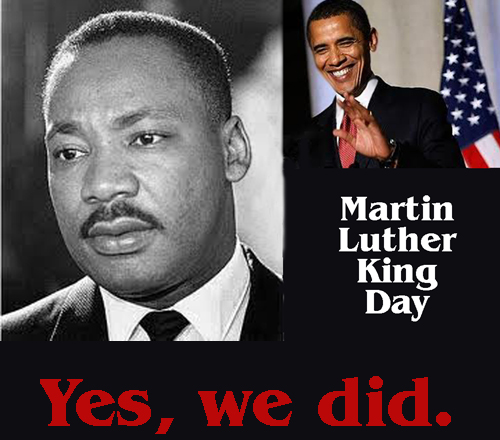
EWT is closed today but most businesses are open. Many African friends believe this is racism. Is it?

Martin Luther King Day is one of ten federal holidays, but in the United States it’s quite possible to have a near normal workday even on a federal holiday. The stock market, the post office and banks (which require a federal charter) are closed. But in many places — particularly in America’s south — life and work goes on nearly normal.

One of the most vocal opponents of gazetting the MLD holiday was Senator John McCain, the last Republican presidential candidate.

MLK Day is one of only two federal holidays celebrating acclaimed individuals. The other is Presidents Day. Neither holiday is observed as universally as the other eight federal holidays. Today about a third of American businesses that close on the weekends close on MLK Day, and about half on Presidents Day. So can we really claim that businesses which remain open today are racist?

Yes, of course. Particularly in today’s horribly politically charged environment. There can be no more telling confirmation of this than the behavior of anti-Obama forces, today. From the right comes the most vitriolic yet inane criticism of Obama ever sullied a sitting president. From my point of view, there is no other explanation. Obama is the catalyst.

I am a white man who has spent the majority of his life in black societies. I am witness to the change that King’s type of philosophy has made in Africa and at home.

What I most remember of King’s turbulent last days was unbelievable violence. My most vivid memory is as a very young journalist penned under a burning El Stop in downtown Chicago while the city raged in reaction to King’s assassination.

I remember gun fire was a regular sound in my low-rent apartment in Washington, D.C. during the summer of 1968. Or the unending sirens and tear gas around my apartment in Berkeley that fall.

King is duly revered for radically changing American society with non-violence. Yet what I remember most is fire, bullets and ambulances.

All of that was a long time ago, approaching a half century, two generations. Trauma has a way of finding its small berth among the many more ordinary memories of earlier life. My teenage years were lived in Jonesboro, Arkansas in America’s south.

Of the more than 1000 students in my public middle and high schools, there was not a single black. Less than a decade after I graduated I returned to Jonesboro for a wedding and learned that almost half the town was black.

I lived in Jonesboro for five years. I went to school, groomed pretty dogs at a vet’s, shopped on main street, sipped sodas at the donut shop, cheered at school sports matches, went to church socials. I remember regularly seeing only one black, Bessie Mae, our maid.

I left that society for the turbulent 60s, then left the turbulent 60s for Africa, and when I returned how things had changed!

King’s philosophy of non-violence, like Gandhi’s and to a much lesser but significant extent Mandela’s, were not eras of no violence. There was incredible violence, and this violence — as with the sizzling El Stop that nearly fell on me — will be blazoned in our memories forever. But with time we’re able to reflect that that violence was the reaction to those heros’ methodical, unswerving actions for a freer, fairer society.

Those movements as a whole were not violent. But the reactions to them were hideously violent, and then sometimes the frustration of the oppressed boiled over, and Chicago or Watts burned. But mostly it was not that. Mostly it was unarmed hundreds of thousands if millions of peaceful demonstrators being tear gassed and shot by police. It was violence in one direction most of the time.

And why? Because it was the desperation of those who knew they were going to fail. I really believe there is more good in the world than bad. Justice ultimately prevails. But the unjust will hang on for as long as they can.

I come from a deeply rooted Chicago family in the northern State of Illinois, the home of Abraham Lincoln. My father was sent from Chicago to Jonesboro, Arkansas, in the South to start a factory owned by an Illinois company to avoid the growing union movement in the North.

One of the first things my father did was pack up us three young kids in the car and drive us into the cotton fields west of Memphis. He stopped the car, said never a word, and made us watch for what seemed like an eternity black share-croppers toiling in the summer sun in a field owned by a white.

Try as I may, those faceless share-croppers and Bessie Mae are the only blacks I remember as a teenager even though I was part of a small minority, living in the midst of them.

Today, my President is black. My Attorney General is black. My closest friends — many in Africa – are black. My rare return to Jonesboro encountered many blacks. Memories created of life, today, are no longer monochrome or technicolor, they’re just wonderfully vivid.

Social justice does prevail. What King taught us is that nonviolence can achieve liberation and justice. But what he didn’t say was that nonviolence works only after provoking incredible violence against it.

Today, in America, ethnic, religious, political and racial tensions are seething. Economic stress brings out the worst in us. It would seem like there could be no harder time to stop work, but we must. We need time to stop, to reflect, to have a day of peace.

Happy Birthday, Martin! You’d have been 83, today!

King Mswati III

King Mswati III

By Conor Godfrey on April 27, 2011
The worst ruler on earth gets a classy invite.

Up until yesterday, I had successfully avoided learning anything about the royal wedding in Great Britain.

(Full disclosure—I once argued at a family dinner with several small children present that we needed to overthrow the princess culture that dominated the minds of our young women at an early age—I may be an outlier.)

I failed because the royal wedding sneaked in the back door—through Africa.

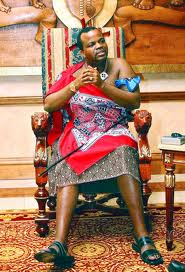
King Mswati III of Swaziland

It turns out that King Mswati III of Swaziland has received an invitation, and will be attending the show with 50 of his closest friends.

It’s a little bit like a reward for being the worst ruler on the planet.

King Mswati III has an impressive record…other would-be governing catastrophes would do well to study his techniques.

Let’s have a look at King Mswati’s resume:
1. Swaziland has the highest AIDS rate in the world
2. 50% of adults in their 20’s have HIV
3. Life expectancy is 32 years
4. 60% of people live on $1.25 or less a day

Money is not so much a problem though—all 51 members of the royal entourage will be sleeping at the Dorchester Hotel for about 500 pounds per night during the wedding festivities.

King Mswati III in England

King Mswati’s personal fortune (estimated at more than 70 million Euros) is also put to good use beating and jailing protestors.

Labor unions, teachers, and the country’s president have all been targets during the recent unrest.

This makes me angry enough to go through the futile effort of finding someone to blame (besides Mswati III himself of course).

First—South Africa and the other members of the Southern African Development Community.

If governments continue to hide behind pan-African solidarity to avoid cleaning house, then a few bad apples like King Mswati III are going to make pan-African-ness synonymous with rotten.

South Africans are great with political cartoons—here is one that describes how I feel about Zuma’s mediation efforts.

The next culprit is unfortunately colonialism.

As you know, the colonial powers did not have near enough people to rule the colonies directly.

They were forced to empower local power brokers and co-opt traditional checks and balances on tribal authority.

This created a class of rapacious local elites who became the oppressors, conscriptors, and tax collectors on behalf of their colonial masters.

Swaziland was in the British colonial orbit for almost all of the colonial period, excluding a brief period when South Africa administered Swazi affairs.

Eventually, the British claimed Swaziland as a autonomous protectorate, and thus empowered the local autocrats to maintain the status quo.

As in most now independent African countries, once the pressure mounted, Britain fled Swaziland in disarray and left radical parties to take control.

In the 1970s, after a sweeping “electoral” victory, King Sobhuza disbanded the democracy that had haphazardly come into being in 1968.

The ‘electoral’ interlude emasculated traditional checks and balances, and the restored monarchy had more power than their royal ancestors would have dreamed of!

None of this really matters though, and I do not pretend to have a perfect understanding of the nuances of Swaziland’s colonial experience.

At present, the problem is that King Mswati III is quite possibly the worst national ruler on the planet, and I think that the country seems too small and insignificant for anyone to do anything about it.