So far, so good for tourists stranded in Egypt. There are 30-50,000 tourists currently trying to leave Egypt, and their itinerary isn’t exactly what they thought.
They shouldn’t try to leave. They should hunker down like the majority of tourists, there, now.
In near lockstep with the delicate balance of the American government, tourists had initially decided to wait-and-see. Large American tour operators like Isram Travel and Abercrombie & Kent sent out bulletins assuring the world that their tourists were doing just fine.
But when the conflict stretched over last weekend, curiosity turned to ennui and finally real concern. And when the tourists tried to leave and couldn’t, the panic button was hit. That happened to thousands yesterday and may have been a mistake.
I’ve been in a number of conflicts as a tourist during my life time of travel. Most of the time the thing to do is … hunker down and wait it out. (Not always, but it is the thing to do this time in Egypt.) Patience, not a tourist attribute, has to be summoned up then cultivated for as long as it might take.
This is not another Rwandan genocide or Balkan War. This is a popular uprising that looks surprisingly disciplined. Until that “look” changes, stay put tourists!
Egypt gets between 15 and 16 million tourists every year, and right now is the highest of the high seasons. It is likely there are several hundred thousand tourists in the country right now. The U.S. State Department believes there are at least 5000 Americans currently touring Egypt, and possibly twice that number.
Desperate tourists don’t make good decisions. Those panicking and trying to leave are mostly being disappointed. Their chances of leaving aren’t good, and it will be extremely expensive. Much more expensive than “hunkering down.”
Television reports, of course, laud those who made it out. Because a lot of television can’t make it in to tell those stories. And of course there will be headlines about the odd act of violence at a tourist hotel … something that likely might have happened with a revolution or not.
The majority of tourists in Egypt right now are doing the right thing: stay there and wait it out.
At any given time, there are as many as 50,000 American in the country, including teachers, engineers and technicians working on the Suez Canal and many involved in the oil and gas industries.
Regina Fraser who hosts the PBS show “Grannies on Safari” may have enjoyed being interviewed by CNN but by yesterday she wanted out.
Regina was on a cruise ship on the Nile, and remains there unable to get to Cairo. At any given time there can be as many as 150 cruise ships sailing between Luxor and Aswan carrying as many as 15-20,000 tourists.
Egypt’s tourism contributes enormously to its economy. (Estimates vary from 5% according to the World Tourist Organization, the as much as 10% according to the Egyptian Tourist Board.) It is one of the last value markets for tourism of any kind to Africa, where a ten-day trip is available for under $2,000. This is half to a third the average elsewhere on the continent.
And most importantly, so far, no tourists have been harmed. In fact the opposite seems to be true. When I was a young kid traveling the world the last place to find a young single woman was Egypt. But Emma Vielbig, 19, was traveling alone in Egypt last week when the trouble started.
Like any kid, she ventured into the streets and tear gas. She got caught in mayhem but was rescued by some anonymous fellow on a motorcycle who grabbed her shouting “You’ve got to get out here” and motored her back to her hostel.
Few would plan a vacation into a revolution. A vacation is supposed to be at least a good measure of R&R. But a revolution is what’s happening in Egypt, and so far, tourists are not being redefined. They remain tolerated onlookers, cash heavy foreigners, but so far, safe.
There is an important lesson for all of us who travel. The situation in Egypt was mostly a surprise. It has much to unfold yet. But so far, tourists are safe. All they have to worry about is their own impatience.
Not just Gabby shot, but now David murdered in certain part because of the hatred created by the American Right. There are two things I just don’t understand: (1) how can anyone deny this obvious link, and (2) how could we possibly have let these happen? Who will be next?
Wednesday afternoon one of the finest, gentlest and most articulate Ugandans to have lived was beaten to death in his Kampala home with a hammer. Kato was Uganda’s most prominent gay rights activist.
Kato’s death, like Gabriel Gifford’s attempted assassination, was not random. They were both likely done by crazed individuals, but individuals directed if not wholly inspired by hate speech from the American Right.
The incredible attempts by Americans including President Obama to deny this represents a dangerously irresponsible lack of common sense, if not a terrible act of cowardice.
We all know the connection of the American Right to Gabby’s shooting. And hold on! “American Right” is not a person, it is not Sarah Palin. But Sarah Palin is a part of the “American Right,” thousands of individuals and countless organizations who have irresponsibly implied violence (if not called for it outright) against individuals opposing their views.
Val Kalende, the head of a major Ugandan gay rights organization told South Africa’s Pambazuka News shortly after the murder, “The Ugandan Government and the so-called U.S Evangelicals must take responsibility for David’s blood!”
Reporter Leigh Phillips of the European Union on-line publication EUObserver reported today that some EU States have now “threatened to cut aid funding to [Uganda] as a result of the [anti-gay] legislation, which was introduced after a group of American right-wing Christians travelled to the country in March 2009 to hold anti-gay rallies.”
You can read my own accounts of this terribly developing story, including lots of links and videos at “Trail of Hate Rounds the World”.
I am especially saddened and angered by President Obama. Both in his State of the Union address last week, and in a message deploring Kato’s death he refused to link the heated American Right rhetoric to the acts.
I can understand the special importance that a leader of such power has in reducing tensions – especially deadly ones – but in the State of the Union Obama specifically stated “There is no connection” between heated rhetoric and Representative Gabriel Gifford’s attempted assassination. Not to affirm a connection was wrong of Obama. But to affirm the lie that there is no connection is despicable.
His message about Kato was more circumspect. Denial comes only as inference in what was not said. Better, but no cigar.
With no cap on the lunacy from our leaders, denial of the causal relationship between the American Right’s rhetoric and violence has gone viral in America. We are once again burying our heads in the sand of deceit and fantasy.
This senseless violence will end only when the American Right changes the tone of public debate. And that tone is not – as often suggested – equally created by “both sides.” It is an American Right phenomenon. Only they can end it.
As I listened to President Obama last night, I thought of the State of Africa, and I realized that real hope for future justice in the world is squarely with Africa, today, not America.
Many will consider me foolish: yesterday was a day of tear gas, rioting and general upheaval in much of north Africa. But what I see are people uprising, renewed and respirited. And what I heard last night was Obama snuffing out new spirits in America.
Africa has been in the throes of radical change ever since apartheid in South Africa fell almost 20 years ago. Economic catastrophe today is the motivation that carries the spirit of liberty from South Africa to Tunisia. There’s nothing odd about that.
Economic catastrophe has always been a reason for political change throughout the history of civilized society, and so it should be, since it is often caused by the older society unable to adjust to newer social realities.
In Africa this has led to radical changes in the political organizations in South Africa, Kenya, Liberia, Senegal, Madagascar, Sudan, Cote d’Ivoire and the Comoros. I’m not suggesting that the direction of this change is yet fully understood or right now universally good. But it is all fueled by people power. And that all by itself, is good.
Respirited mass movements lead to real recalibration of society. Former winners become losers and former losers become winners. The cocktail party phrase that social change can be a win-win situation is premature. There is too much injustice and prejudice in the world still for that to yet be fully possible.
But it doesn’t mean that the new losers are relegated to the same misery that the former losers might have suffered. In Africa, in fact, it means that the powerful just become a little less powerful. Kenya’s former dictator, Daniel arap Moi, enjoys a wonderful retirement, safe and comfy and in fact respected by a wide section of Kenyan society.
But his ouster by the people of Kenya led to a series of events that has heralded in a new populist who is likely to radically alter the Kenyan economy currently defined by legions of poor. No single movement or leader is capable of changing the science of economics. But Raila Odinga is likely to elevate the condition of Kenya’s poor in the next decade far beyond what I could have imagined, and no doubt at the expense of the rich and powerful.
Who will by all standards, still be rich and powerful. Just not as rich and powerful as before.
This is precisely what happened and continues to happen in South Africa. It began a generation ago, as the richest and most powerful emigrated to the tune of 1800 per month starting in the 1980s, as they realized their lofty positions could not be sustained in a modern African society.
Throughout Africa, populist movements are ushering in more just and equitable societies.
In America, Obama was that symbol as well in 2008. But he failed. He is far behind his times.
Obama’s message is one of unity, and in all fairness, this is no surprise. He has been extremely true to his theories. But that was not what brought him to power. What brought him to power was a massive belief that real change would occur in America.
That may be our fault, not his, but he was complicit. He accepted the mantle of change. He now revels in the temerity of those who condescend to answer a robo phone poll. But he seems too steeped in the past to be pried from his 19th century politics, constrained by dead heroes like Abraham Lincoln, so great for their times but as outdated today as a buggy wagon.
I look at Africa, and my heart beats fast and hopefully. I listen to Obama and grow depressed.
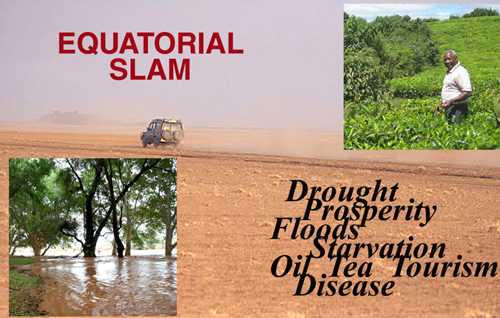
We are just beginning to understand how severe global warming impacts the equatorial regions like East Africa. We know that Vanuatu may flood away, but we now suspect that important parts of East Africa will both blow and flood away, too.
Short rains in specifically defined areas of East Africa failed the end of last year. For those areas, which include large parts of Laikipia (Samburu) and Kajiado (east of Amboseli, parts of Tsavo), crops have failed and hoofed stock losses are projected at more than 20%.
This follows last year’s record floods, which followed a three-year minidrought during which 80% of pastorliasts’ hoofed stock was lost.
Meteorologists are beginning to see a pattern in this jumble of devastating weather. Radical and extreme weather is likely now the “norm” across the equatorial regions of the world, including East Africa.
Much of East Africa is booming economically, especially Kenya, and a large component of this growth is agriculture. Yesterday, Kenya’s Tea Board reported record earnings of nearly $1.3 billion in 2009. This moved tea production above cut flower production ($995 million) and tourism ($850 million).
But unfortunately for Kenya and distinct from its neighbor Tanzania, its agricultural zone is especially vulnerable to global warming. The equator runs right through Kenya, about 40 miles due north of Nairobi. This invisible line seems to be the marker for catastrophe from global warming.
For most of my life, we expected a serious drought in East Africa about every ten years, and when it came, it was widespread and devastating. I remember a drought in the eighties when safaris were hard pressed to find anything but dying cats. An all-day game drive in the crater resulted in one dying hyaena.
Wild animals are particularly resilient, and we know now much better than we knew then that animals know where to go to survive in serious droughts. And men, too, are resilient. A single horrible blow every ten years was expected and unsurprising.
What is happening now is altogether different. Think of the equatorial regions like a blue, red and green quilt. The red areas get drought again and again, sometimes harder than other times but multiple times. The blue areas get hit less far less than the red areas, but often enough, but are then followed by extreme floods. And the remaining green areas are basically wetter than they’ve been in the past.
As you would expect the red drought areas are semi-arid, and these are the areas of the hoofed stock, the pastoralists like the Maasai. Multiple droughts as is happening now is destroying the resilience these people have evinced for milennia. It’s one thing to weather disaster once every ten years. Every 2 or 3 years means whatever seeds were laid by the last grass have completely blown away, along with whatever top soil was left.
But the greatest surprise is that in areas that were normally even more arid than Maasailand, floods are now a regular occurrence. Turkana, far north of Samburu, accustomed to 1 or 2″ of rain annually received nearly 30″ of rain last year. Everything pooled and melted, and now in the throes of a drought, there is little left up there but dust.
Everything is happening so fast, it’s very hard to predict how East African society will adjust to these extremes. Except one thing seems more and more clear: the lifestyle of the pastoralist is doomed.
At least a year’s warning is often possible. The opposing phenomena of El Nino, inevitably followed by La Nina, can predict what is going to happen.
El Nino is the increase in the ocean temperature. About a year after El Nino is diagnosed, heavy rains and floods tumble on parts of East Africa. La Nina is the decrease of temperatures following El Nino, but a decrease below what is normal. About a year after La Nina, rainfall decreases throughout East Africa, causing the specific area droughts over semi-arid land.
The El Nino phenomenon occurred about once every decade in the past. La Nina never occurred. Now, El Nino comes four or five times a decade, always followed by La Nina.
If this becomes a pattern, agricultural production, pastoral life styles and wilderness areas like big game parks, will be rattled to the core.
Another large component of East Africa’s explosive growth is Chinese investment, mostly in infrastructure to develop natural resources like oil. Which is used for factories and automobiles. Which produces more greenhouse gases. Which causes more global warming, more and longer El Ninos and more La Ninas.
This is all happening so quickly in the context of developing economies, that it seems completely unstoppable, even though we possess the science to stop it. The tipping points have been endlessly discussed in the developed world: Cap-and-trade, green technology, electric cars.
But to a Maasai herder surviving day-to-day, or a land owner with oil in the ground in Kenya and three kids who want to go to an expensive university, these are not compelling topics.
The question is, will the land flood away or blow away before enough cash can be acquired to compensate for its loss?
I heistate to underestimate the remarkable resources of the young East Africa, but this challenge looks pretty grim.
Do you sacrifice a small group of ancient people to promote a larger society? We put Indians onto reservations. Should the Kenyans evict 36,000 Ogiek from their forest?
It’s one thing for an activist to threaten you and your grandchildren with no clean water. It’s another when your kitchen faucet stops dripping.
That’s what’s happening in Kenya, today, right now. Even while giant factories are blossoming like mushrooms in my backyard after a morning drizzle. It’s happening right now as 12-lane highways are creeping across the country.
The water rationing schedule announced each week in the newspapers is as ordinary as a TV guide.
And all the needed water comes from one place: the Mau Forest. It’s the only indigenous forest in Kenya, and by our standards for instance, terribly small, only 675,000 acres, an area about the size of Rhode Island.
The Mau provides 7-10 million people with not only clean drinking water, but water for factories and cleaning. Moreover, the recent reduction of the forest has contributed to mud slides and soil erosions that has been devastating.
The Mau has sinisterly been eaten away for nearly a hundred years. British colonials recognized its rich soil and confiscated huge portions for their settlers. Independence only deepened the problem as corrupt politicians confiscated more.
The deposed dictator Daniel arap Moi may own as much as 300,000 acres of what was once Mau Forest, now tea estates.
Kenya is the world’s largest tea exporter. Take it from me, it’s the best tea in the world!
Then, during the political violence following the 2008 election, hundreds of thousands of people fled to the hills. And those hills were largely the Mau. As many as 100,000 people began to squat in the Mau.
Then came the Developed World’s haughty solutions to global warming. In Copenhagen in 2009, then Cancun in 2010, developed countries proposed not reducing their own greenhouse emissions right away, but rather a sort of Global Cap-and-Trade policy without the Cap called “REDD’’ — Reduced Emissions from Deforestation and Forest Degradation in Developing Countries.
$30 billion to the developing world by 2012, and $100 billion more by 2020. Kenya’s portion, if it ever comes: a few hundred million. But that’s sizeable to Kenya, and in order to get it, Kenya has to preserve the Mau. There’s no other forest it can “trade”.
Colonial land grabbing, corruption politician land grabbing-cum-tea development, internally displaced persons and REDD. And not a drop to drink.
Now what.
In what is really a radical, radical move, the Kenyan government has decided to evict everyone from the Mau. All those colonial land-grabbers, some of the modern politicians with tea farms, all the displaced persons from political turbulence, buying all the previous land owners and squatters new land somewhere else, at billions and billions of shillings (that will still be less than the compensation from REDD).
And, the 36,000 Ogiek who have lived there for a number of generations.
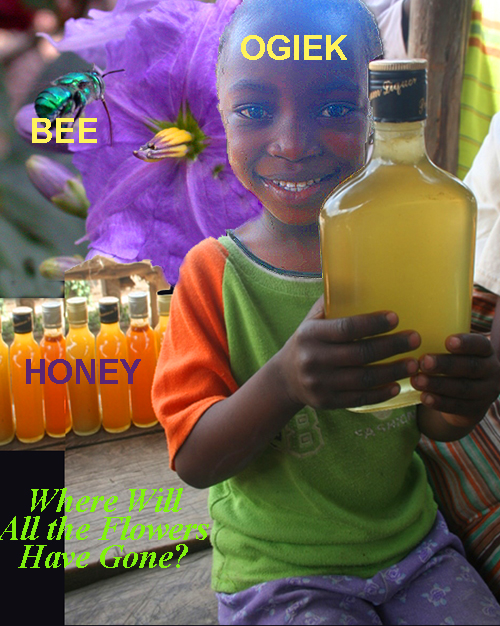
The Ogiek are forest people. The generation before the current one was almost entirely hunter/gatherers and bee-keepers. The Ogiek were themselves displaced from arguably better forests around Kenya in the 1930s by British land grabbers. But when they moved, they took their lifeways with them.
But the Kenyan government policy is without qualification. Everyone goes. Including the Ogiek. And, their bees?
No one is wondering about the bees. Unlike temperate forests here at home, forests in Africa rely much more on pollination and cross-pollination to survive. The diversity of the forest biomass is much greater in the equatorial parts of the world like Kenya. Without a constant diversity, the forests collapse.
The diversity is dynamic to some extent, a sort of constant evolution of new species and sub-species. Quite apart from the morality of evicting the Ogiek, the longest living residents of the Mau, what about the bees?
Money talks. REDD talks. Bees don’t.
Great video below about Ogiek and bee-keeping. Stick with the first 30 seconds which have nothing do with Ogiek or bee-keeping.
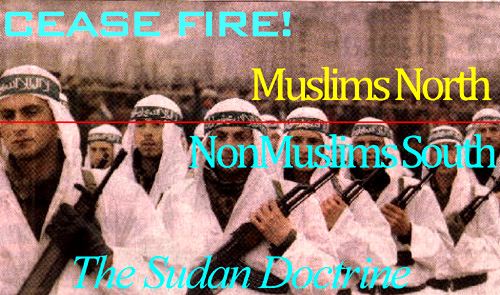
Until now many efforts towards peace in troubled parts of Saharan Africa have focused on fomenting coexistence betweenf Islam and competing religions. What the Sudanese referendum says is that coexistence of Muslim and non-Muslim ideologies won’t work.
When the election in The Sudan ends this weekend and shortly thereafter South Sudan declares itself sovereign, Muslims will be in power the north and non-Muslims in the south. But that’s not the end of it.
I expect a migration is going to begin in both directions between the two entities not so dissimilar to what happened in the Hindi/Muslim breakup of India and Pakistan (later, Bangladesh) after World War II. In fact the Sudanese migration began when it became apparent that the process was going to end in partition. More than 50,000 immigrants already turned up in the south in just the last few months.
This migration won’t be as large as the one following India and Pakistan’s partition, because there aren’t as many people to begin with. But it will be substantial enough to notice. And it will further polarize the individual societies at each end.
In America we often read about the religious competition as between Islam and Christianity, but that’s not the case. The perception comes mostly from the large presence of Christian missionaries and aid societies in The South, but the fact is that the majority of The South is not Christian, despite a half century of Christian proselyting.
Neither do I think it fair to call it “animist” as is often read as much as “Christian”. In fact, the two are often combined. I don’t think it fair-minded to say “animist” because that label carries a ton of derogatory inferences from the colonial era.
The fact is that most southern Sudanese are not religious in any regards by modern standards. They revere their family ancestry and create religious ideologies often unique to very small geopolitical areas.
Christianity is probably the largest single recognized religion in the south, but it is far from being a dominant ideology among the majority of southern Sudanese.
What it is truest to say is that the majority of southern Sudanese characterize themselves as anti-Muslim. And this characterization of oneself as anti-something, rather than something-something, is telling.
It is the basis for the conflict not only in The Sudan, but in Chad, Mali, Spanish Sahara and to a lesser extent elsewhere throughout the Saharan belt of the continent.
Religious ideology always tries to dominate government, even at home in America. Less modern societies are less capable of keeping this motivation at bay in part because emerging societies need forms of government that will be readily and quickly accepted by their people.
Muslim ideology with its male-dominated, polygamous hierarchy fits perfectly into many more traditional African societies. This week a Nairobi newspaper published a feature article on how the well-known and very traditional Maasai tribe was accepting Islam in surprising numbers.
The current president of Sudan, Omar al-Bashir, is a deft survivor of a number of court schemes and military coups, and his current long reign can be linked directly to his decision to make Islam’s Sharia law the law of Sudan in 1983. There’s no question in my mind that this is what has kept him in power since.
And quite unlike a legalistic foundation — even one as entrenched as I feel the U.S. constitution is — the opportunities for amending law in Muslim formulated societies are infinitely less. Some may argue impossible.
This draws a line in the sand, (and in the case of the Sudan, that line goes right through the oil fields). Muslim above the line. Non-Muslim below the line.
There is a huge problem in dividing up the world by religious ideology. It tends to divide not only ideas and faith, but wealth and health. But as with India and Pakistan, the motivation to minimize conflict was a vital one that has been served more or less well, even while they haven’t exactly become bosom buddies.
So if this experiment with The Sudan is successful, which I think it will be “more or less”, then a new formula may emerge for reducing Africa’s troubled conflicts.
Violence is largely an “American” thing. Not African, not Chinese, although some of the worst violence in mankind’s history has occurred there. But organic violence, violence allowed free reign to grow, is distinctly American.
Rep. Gabrielle Giffords (D-Ariz.) and others murdered in Tucson is why I say this.
If you’re reading this instead of the billions of other blogs about Giffords, it’s because you know my life has been spent in Africa. And when it hasn’t been in Africa, I spend a lot of time talking to other people who aren’t African about how Africa isn’t really as violent, isn’t as murderous, isn’t as corrupt as … well, America.
And here’s why.
First, let’s start with just the ultimate violence: killing. In my lifetime, Americans have been involved (either as the killers or the killed) in killings in the world more than any other nationality.
Add up the Rwanda genocide, the slaughters in the Congo, the political killings throughout China and North Korea, the secret killings in Argentina and Chile, the Balkan slaughters, and the ongoing and endless civil wars in the Horn of Africa.
It still doesn’t equal the involved killings in all the American wars of my lifetime. Likely it doesn’t even add up to the involved killings of the Korean and Vietnam Wars.
In the generation before me, this supreme total wasn’t America’s. It was Europe’s, with the holocaust and the Balkan genocides such as Armenia. (A close second was the prolonged killings of the Stalin regime.)
Not Africa. Not then, not now.
Violence as a true act of self-defense is a bitter morality. But during my lifetime violence in self-defense (WWII) has morphed into violence as preemption.
I don’t think that Giffords’ accused murderer was a sane activist. But he was influenced by the hate and vile (vitriol, as the Puma County Sheriff explains) of the Right.
Fact: Sarah Palin removed her website of “targeted” Congressional seats, where crosshairs were used to designate the Congressional districts the tea party should beat, within hours of the Giffords’ shootings.
Sarah Palin knew it was inflammatory. Removal so quickly was an admission it was wrong to begin with.
A number of other sites came down quickly from the Right as well.
Likely there will always be violence. Poorly brought up, abused, neglected children often turn violent. Abused, neglected, tortured and impoverished adults often turn violent. I believe society should try to rectify all this, but even without doing so, in the past these unhinged people did not direct their violence against Government.
So often it was against women, wives and daughters.
So often it was against other ethnic races, immigrants, other religions, people who aren’t like you. Sometimes it was against animals, or glass because it makes such a clatter shattering. Sometimes it was random.
But in my generation, in America, it’s turned from all of those to… Government.
That’s new. We have never had as many Timothy McVeigh or Jared Lee Loughner wannabees as before. There were some. Nearly one out of every four American presidents has been assassinated. But nowhere near as many Oklahoma Public Buildings, or Maryland State Buildings, or airplanes, or churches… or public officials “targeted in crosshairs” as today.
A junior Congressmen from Idaho didn’t have a body guard when I was child. It didn’t take me two hours to check-in at O’Hare. I wasn’t allowed to bring an unconcealed gun into the Davenport city council meeting, or into my Econ 101 lecture at the University of Iowa as a part of my “right to self-defense.”
Sarah Palin isn’t the cause. She’s just another symptom. She transferred her violence from herself to the public at large. Society couldn’t make her happy. So better than beating a grandchild, she beats Government. There’s a certain bitter-sweet logic to this. And by the very nature of her public scope, she transfers this violence to millions.
We can’t live without Government. We can’t live without Big Government. And we can’t live without Big Government doing a lot more than just “defense.”
Government is Society, Community, the Group of Us. By our neglect of Society, Community, the Group of Us, we have become our own targets. We have become socially suicidal. Americans have put themselves in the Crosshairs.
East Africa is booming, so many of the stories of 2010 were terrifically good news. But there were the tragedies as well like the Kampala bombings. Below I try to put the year in perspective with my top ten stories for East Africa for 2010.
1. Populace democracy grows.
2. Terrorism grows, as does the battle against it.
3. Huge stop in the mercenary purchases of Coltan.
4. Momentum for peace in the runup to establishing a new South Sudan.
5. Tourism clashes with development, especially with the proposed Serengeti Highway.
6. New discoveries of fossil fuels produces new wealth and a new relationship with China.
7. Gay Rights grow public but loses ground.
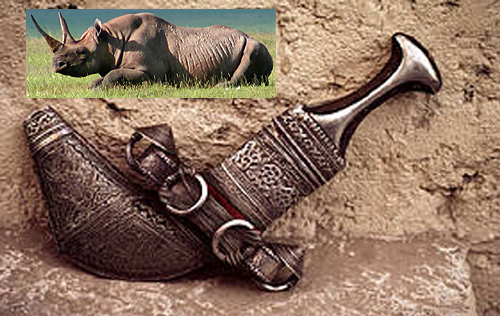
8. Rhino poaching becomes corporate.
9. Hot air ballooning’s safety newly questioned in game parks.
10. Newest early man discoveries reconfirm sub-Saharan Africa as the birthplace of man.
#1: POPULACE DEMOCRACY GROWS
Theoretically, all the East African countries have operated as “democracies” except for the torrential years of Idi Amin in Uganda. But the quality of this democracy was never very good.
Tanzania was a one-party state for its first 20 years, and that same party continues to rule although more democratically today. Kenya, Uganda, Rwanda and Burundi experienced one dictator after another, even while democratic elections at regional levels challenged the executive.
But the end of the Cold War destroyed the alliances these developing countries had with super powers. Purse strings were cut, and political cow-towing ended. All of them moved towards a truly more democratic culture.
And in 2010 huge leaps were made in all the countries towards more truly representative government. The most important example by far was the overwhelming passing of the new constitution in Kenya in a national referendum where more than 75% of registered voters participated.
And like the U.S. election which followed shortly thereafter, and like support for national health care in the U.S. and so many other issues (like no tax cuts for the rich), Kenyan politicians dragged their feet right up to the critical moment. They tried and tried, and ultimately failed, to dissuade Kenyans from their fundamental desire to eliminate tribalism in government and more fairly distribute the huge wealth being newly created.
I see this as People vs. Politicians, and in this wonderful case, the People won!
And there was some progress as well in Tanzania’s December election, with the opposition growing and its influence today moving that country towards a more democratic constitution.
(It was not so good in Rwanda or Uganda, where stiff-arm techniques and government manipulation of the electoral process undermined any attempt at real democracy.) But the huge leap forward in Kenya, and the little hop in Tanzania, made this the absolute top story of the year.
#2: TERRORISM GROWS
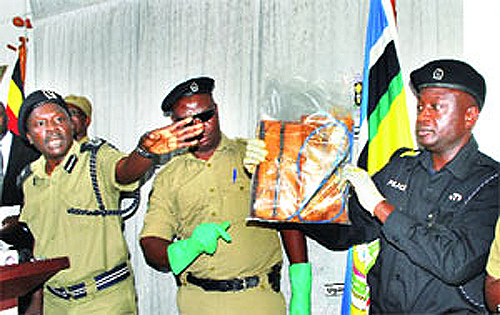
Four smaller bombings in Nairobi’s central business district over the year were eclipsed by two horrible simultaneous bombings in Kampala bars on July 11 while patrons were watching the world cup. Police display an unexploded suicide vest.
Al-Shabaab, Al-Qaeda in Somali, claimed responsibility. And throughout the year Shabaab grew increasingly visible along the Kenyan border as its power in Somali increased.
I’ve written for a long time about how the west has had its collective head in the sand as regards terrorism and Al-Qaeda in particular. Long ago I pointed out that the locus of Al-Qaeda terrorism had moved to the horn from Afghanistan, and this year proved it in spades.
The country with the most to lose and most to gain in this war on terror is Kenya, because of its long shared border with Somalia. And the year also marked a striking increase in the Kenyan government’s war on terror, and with considerable success.
With much more deftness and delicacy than us Kenya has stepped up the battle against Al-Shabaab while pursuing policies aimed at pacifying any overt threats to its security, by such brilliant moves as allowing Omar Bashir into the country and not arresting him (on an international U.N. warrant). As I said in a blog, Kenya Gets It, and the story is therefore a hopeful one.
The Dodd-Frank Act is our victory!The Congo Wars continue but are abating, and in large part because of a little known provision in the Dodd-Frank Wall Street Reform Act which now makes it almost impossible for major corporations in the U.S. to buy the precious metal Coltan on the black market.
A black market which has funded perhaps Africa’s most horrible war for more than a generation. Hundreds of thousands – perhaps millions – have been killed and raped, and more than 20,000 children conscripted into brutal wars, funded by purchases of Coltan and other precious metals by Intel, Sony and Apple.
It certainly wasn’t just this little legislative move. The U.N. peace-keeping force, fabulous diplomatic initiatives by Uganda and a real diplomatic vigilance by the U.S. all were instrumental. But the year ended with the least violence in the region in more than two decades.
#4: SOUTH SUDAN
I may be jumping the gun on this one, because the referendum to create a new country, the South Sudan, is not scheduled to occur before next month. But the runup to the referendum, including the registration process, while labored looks like it’s working.
Allied loosely with the Congo Wars, the civil war between the North and South Sudan had gone on for generations until a brokered peace deal five years ago included the ultimate end to the story: succession of the South into a new country.
The concept is rife with problems, most notably that the division line straddles important oil-producing areas. But in spite of all of this, and many other ups and downs along the way, it looks to me like there will be a South Sudan, and soon. And this year’s new U.N. presence in Juba, donor-construction of roads and airports, all points to the main global players in the controversy also thinking the same.
The creation of a new state out of a near failed one is not the be-all or end-all of the many problems of this massive and powerfully oil-rich area. But it is a giant leap forward.
#5: THE SERENGETI HIGHWAY & TOURISM
Last night NBC news aired a segment on the Serengeti Highway controversy, elevating an East African story into American prime time. Good.
But like so many reports of this controversy, the simplification ran amok. NBC’s reporter Engels claimed the motivation for the road was to facilitate rare earth metals like Coltan (see above) getting into Chinese hands more quickly.
While there may be something to this, it’s definitely not the main reason, which is much more general and harder therefore to fight. As I’ve often written, the highway as planned will be a real boon to the Maasai currently living to the east of the Serengeti, as much if not more than to the Chinese.
And as far as I know, Maasai don’t use Coltan.
Roads bring commerce and may be the single quickest way to develop a region. This region is sorely in need of development and recent Tanzania politics has aligned to the need for this regional development.
The highway is just one of many such issues which came to the fore throughout 2010 in Kenya and Tanzania. Concern that the west is just interested in East Africa as a vacation destination with no regards for the struggle for development, has governed quite a few local elections this year.
The whole concept of tourism may be changing as the debate progresses. I believe very deeply that the Serengeti highway as proposed would hinder rather than help development. But as I’ve pointed out, alternatives are in the works.
And the real story of which the highway story is only a part, is how dramatically different East Africans have begun to view tourists in 2010.
#6: NEW RESOURCE DISCOVERIES ALTER GEOPOLITICS
For years I and other African experts have referred to East Africa as “resource-poor.” Kenya, in particular, had nothing but potash. Boy, did that change this year!
Although only one proven reserve has been announced in Kenya, several have begun production in Uganda and we know many more are to come.
China has announced plans for a pipeline and oil port in northern Kenya at a cost of nearly $16 billion dollars, that’s more than twice the entire annual budget for the Kenya government! Deep earth techniques have matured, and China knows how to use them.
More gold has been found in Tanzania, new coal deposits in Uganda, more precious metals in Rwanda… East Africa is turning into the world’s rare earth commodities market.
A lot of these new discoveries are a result of technology improving: going deeper into the earth. But 2010 freed East Africa from the shackle of being “resource-poor” and that’s a very big deal.
#7: GAY RIGHTS ON THE HOOK
African societies have never embraced gay rights but as they rapidly develop, until now there was none of the gay bashing of the sort the rightest backlash produces in the U.S. U.S. Righties manipulating East Africa.
That changed this year, and in large part because of the meddling of U.S. rightest groups.
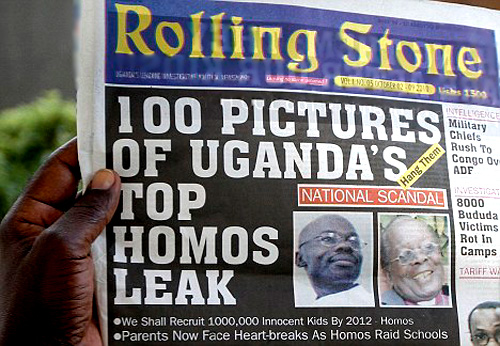
In what appears to now have been a concerted many year effort, support from U.S. righties is leading to a vote in Uganda’s parliament that would make homosexuality a capital offense, and would jail for long terms those who failed to out known gays.
This extreme is not African, it is American. Mostly an insidious attempt by those unable to evince such insanity in their own society to go to some more manipulative place. The story isn’t over as the vote has yet to occur, but it emerged and reached a crescendo this year.
#8: RHINO POACHING EXPLODES
Poaching is a constant problem in wildlife reserves worldwide and Africa in particular. Rhino are particularly vulnerable, and efforts to ensure safe, wild habitats have been decades in the making. Dagger from rhino horn.
This year, they seemed to come apart. It’s not clear if the economic downturn has something to do with this, but the poaching seems to have morphed this year from individual crimes to corporate business plans.
This leap in criminal sophistication must be explained by wealth opportunities that haven’t existed previously. And whether that was the depressing of financial goals caused by the economic downturn, increased wealth in the Horn of Africa where so much of the rhino horn is destined, or reduced law enforcement, we don’t yet know. But 2010 was the sad year that this poaching exploded.
#9: IS HOT AIR BALLOONING SAFE?
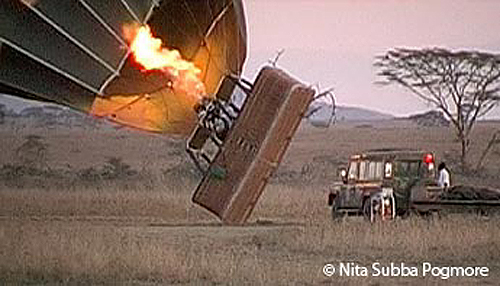
Hot air ballooning in Africa’s two great wildernesses of the Maasai Mara (Kenya) and the Serengeti (Tanzania) has been a staple of exciting options to visiting tourists for nearly 30 years. That might be changing. Is it Safe?
A terrible accident in the Serengeti in early October that killed two passengers and injured others opened a hornet’s nest of new questions.
After working on this story for some time I’ve personally concluded 2010 was the year I learned I should not step into a hot air balloon in East Africa, at least for the time being!
#10: EARLY MAN WONDERS
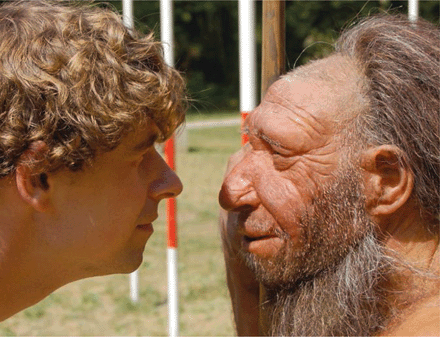
There were not quite as many spectacular discoveries or announcements about early man this year as in years previously, but one really did stand out as outstanding and you might wonder what it has to do with East Africa! Representation by Tomislan Maricic.
DNA testing of Neanderthal proved that early man from Africa didn’t wipe them out after all, but absorbed them into the ever-evolving homin species.
And that absorption, and not massacre, happened outside Africa to be sure. But it finally helps smooth out the story that began in Africa: It’s likely that Neanderthal were earlier migrants from Africa, and absorption was therefore easier, physiologically and biologically.
It’s a wonderful story, and fresh and exciting, unlike the only other major African early man announcement about Ardi which was really a much older story, anyway.
****************
HAPPY NEW YEAR to all my loyal readers, with a giant thank you from me for your attention but especially your wonderful comments throughout the year. See you next year!
Zambia's First Lady Leads the Charge!
Women have risen with modern African society faster than a Robbie Gould 50-yarder!
Every time I blink my eye something radical changes in Africa. The rises in the power of women may be among the most astounding. Feminism as a movement was American and French, but in the last generation America has been left in the wake of gender equality movements elsewhere in the world, including Africa.
No statistics or dull charts this time, other than to remind you that the current star is Ellen Johnson Sirleaf, President of Liberia, the first freely elected woman executive in Africa.
(Elisabeth Domitien was Prime Minister of Central African Republic from 1975-1976 but that was a job her dictator father appointed her to, and Agathe Uwilingiyimana was Rwanda Prime Minister for less than a year in 1993-1994 just before the genocide, again an appointed executive position rife with political overtones and no real power.)
But what caught my attention this time after I unblinked my eyes was how sports stadiums are now filled with women in Africa!
I remember the All African Games in Nairobi in August, 1987. A new set of stadiums that could hold more than 100,000 people had been built, and not a single woman appeared! Honestly, not one!
How different it is today, representing this meteoric rise in the power of women in Africa over only a single generation.
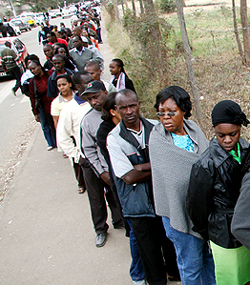
I recently watched the string of fans coming out of the Nairobi stadium following a soccer match, and it had to be nearly a third women. And quite unlike at home, it isn’t mixed. The women go all together, sit together, cheer together, even (presuming) if their SigOth or Partner is somewhere else in the stands!
In a (very interestingly) unattributed article in today’s Nairobi newspaper, the Daily Nation, the reporter-in-hiding declared that sports matches “regularly play host to a bevy of colourful and distinctively feminine fans” who are “skimpily dressed” and he (I’m sure it was a HE) didn’t mean Michael Phelps.
Kenya’s change is amazing, but even more amazing is that it seems to have outpaced the southern countries, where gender equality has been at least a part of the constitution and legislation for a longer time.
That isn’t to say it’s not moving fast down there, too, though!
Women “can be found in the rowdier stands such as the famous ‘Russia’ section of the National Stadium in Gaborone [Botswana] dancing, singing and hurling insults… just like men,” the anonymous author claims.
Malawi’s chief marketing manager for football (soccer), Casper Jangale, told the article, “In the early 2000s many matches …often ended in violence,” which discouraged women fans, but that that’s changed. Jangale now advises sponsors that at least a quarter of the fans are now women.
And in Zambia, football is the prime past time of both First Lady Thandiwe Banda and the wife of the vice president, Irene Kunda.
One thing the African woman will never be able to do that American women already are doing at Chicago Bears’ games: tail-gating brat fests at minus 10!
The Obama Administration has been balancing American interests in The Sudan deftly and with amazing success. “Winds of War”, George Clooney and Ann Curry might have jeopardized these efforts.
“Winds of War”’s principal success is the message that genocide is likely following next month’s referendum for the south to secede from the north. But the horrible conclusion taken from this is the simplistic and incorrect notion that violence can be prevented.
Entertainment comes in many forms but at the core of most entertainment is the reduction of ideas or situations to attract an audience. Well-prepared bait creates happiness or sadness, fear or comfort, other deep emotions like feeling enlightened, so that you’ll come back to the entertainer and buy more, later.
This is not how the history of The Sudan should be spread among the world. It’s just much more complicated than a 1-hour television special.
At the best, in pure reductio infinitum, we can say “at least it’s increased interest.” Clooney seems like a wonderful person. At least Ann Curry thinks so, as much of the special was about Clooney, not The Sudan.
Both Curry and Clooney expend a lot of effort explaining why so much of this story is about Clooney, rather than The Sudan. He is “using his celebrity” to help. I’m not sure he hasn’t. But I’m worried.
The danger of mobilizing the world to an issue like the upcoming Sudanese election by entertainers is that the results will be misunderstood. If trouble occurs, we’ll believe we understand exactly why. In this case: because it was preventable and we didn’t prevent it. That was the single message Clooney and Curry conveyed, again and again.
Preventing violence following the January 11 referendum for the south to secede from the north is virtually impossible in my opinion. But this does not mean that a new country, South Sudan, won’t be established, or that a better peace and situation that now exists won’t occur.
Violence after the referendum can’t be stopped, for the same reasons that terrorism can’t be stopped. In The Sudan as in the subways of London and airports of Seattle, mass destruction waits only for the actions of a single possibly random idiot or ideologue, take your pick.
Throughout “Winds of War” constant comparisons were made to the Rwandan genocide. This is simply straight out wrong. Effective foreign military force was already in Rwanda and could have been quickly and easily augmented, and specific policies in the U.S., France and the UN decided against doing so. It was a single wrong decision.
Sudan 2011 is not Rwanda 1994. The Sudan has genocide going on right now in Darfur. The world has come for better or worse to accept this genocide so long as it stays below a certain threshold.
The UN has (as of October) 9451 military personnel from India, Pakistan, Bangladesh and a variety of African countries, spread out over a country that is 100 times bigger than Rwanda, which is basically validating the level of existing genocide.
(Important FootNote: No UN presence is near the town of Abyei where the violence after the January 11 referendum will likely begin. That – I believe – is intentional. Take it from there. If that dried out prairie brush fire can be contained, perhaps the suburbs around San Diego can be saved from the inferno.)
The Rwandan UN Force was heavily European, commanded by a Canadian general over a country that until the genocide began was at peace. He tried – unsuccessfully – to convince a world black-eyed from BlackHawk Down that genocide was imminent and could be prevented. He was right, and the “world” was wrong.
That metric cannot be applied today to The Sudan.
Instead, what I believe the Obama Administration and EU is working towards in southern Sudan is an acceptable threshold of genocide as exists right now in Darfur.
Not an entincing trailer to a film, is it?
Of course it isn’t! It’s a hard pill to swallow. And what’s worse, except through WikiLeaks we can’t admit it. But it may be the only way to incrementally ratchet down Sudan’s century of genocide. Rwanda’s ethnic hatred can be pretty simply explained: two different competing tribes whose animosities were accentuated by a racist colonial era. All we had – and have to do there is keep the genie in the bottle until sanity matures.
Sudan’s 30 or 40 tribes have been massacring one another for two millennia. Fueled by incompetent colonial powers, by enormous resources of oil, and by the visceral global ideological powerhouses of Christianity and Islam. We can’t even get the world to agree there shouldn’t be genocide! Every nation from China to the U.S. wants the oil, wants the religious allegiances and should we begin talking about the continent’s water source known as the Nile?
The Sudan is so important, so fundamental to the peace and stability of all of Africa, that a one-page synopsis or one-hour TV special has the enormous potential of screwing up everything.
The proposed border areas between the north and the new South Sudan will have violence, I just don’t see any other prospect. It will begin in Abyei. This is where so much oil is found. But we’d like to keep the violence in this oil-rich area at levels contained, just as the violence currently in the oil-rich Niger Delta of Nigeria seems contained. If this can be managed, then a society in South Sudan can emerge as it’s emerging in Nigeria.
“Winds of War” stokes the fire. If Clooney’s message achieves ultimate success, when the gunfire begins later next month in Abyei, America will send troops to stop it, and will become as deeply mired in conflict there as we are in Afghanistan.
It’s not working in Afghanistan. It won’t work in The Sudan.
More:
Click here for Frank Lagiftt’s excellent NPR report.
Below for as usual an unbiased report from Al Jazeera.
In this age of belt tightening and budget angst the impoverished State of Kentucky is going to give $37½ million dollars to a wacko anti-science group to build a creationism theme park.
Sub-Saharan Africa is the cradle of mankind. The earliest known hominid, our direct evolutionary ancestor, is at least 6 million years old. Olduvai Gorge, where so much of these marvelous discoveries were made, is top on my list of things to see on safari.
Natural selection is not immediately intuitive. It takes some study. But once you get into it, the rush is unbelievable! The majesty of living things, and man’s unique position within that, is awesome. Complexity and simplicity seem to merge in an array of life forms that is unbelievable.
No doubt what many describe as art which consumes and inspires is relational to the patterns and designs of the natural world. “Beauty” is natural engineering at its finest. To me much of the greatest beauty of the world is in Africa, where it just stands to reason, so much of it began.
Roll your cursor back and forth over the graphic below. African flower mantids have so remarkably adapted to African flowers that without a graphic like this one you’d never in a million years find them! This is beauty, complex mathematics and natural selection all rolled up into a powerful single lesson.
I’ve labored for years with people and clients who don’t believe that natural selection explains life on earth, most of whom squander in the cartoons of creationism. Only 39% of Americans believe in evolution. This is worse than embarrassing. There is no other educated population in the world with such a miserable statistic.
And the number is increasing, not decreasing. We’ve countered the limited beliefs of the critics fact-by-fact. We’ve politely and consistently tolerated the position of those arguing against evolution, giving “equal voice” to nonsense. I know, now, how wrong that was.
Creationism is wrong. It’s a lie. It’s perfectly legal to believe lies, so I’m not so insane as to suggest that people who believe lies should be somehow punished. But the time has come to firmly not reward them.
Kentucky already has a Creationism Museum that commercially is doing very well. It’s not certain and will never be known if its financial success is for the same reason that people used to pay to go to freak shows, or if there really are believers in support. But either way, institutions like it should not be subsided by public funds.
In other words, I guess we can tolerate lunacy but we sure ought not support it.
The weakness with which scientists, teachers and politicians have defended such concepts as natural selection against fringe idiots has produced a terrible legacy. Natural selection is just one of many issues like woman’s rights and child poverty and national health care that have suffered in my lifetime because their advocates have cowered to baseless critics.
Our legacy of poor defense has resulted in the U.S. dropping from Number 1 when I was in high school to 18th of 36 nations whose high school students graduate on time.
And those who do graduate are getting dumber and dumber.
As you enter the gates of the United States Grand Canyon National Park, you can purchase in their shop a “guide book” that says the Grand Canyon was formed by Noah’s flood and is only a few thousand years old.
In the last year alone, the Texas State Board of Education has ordered text books used in public schools there to question the American separation of church and state, to remove Thomas Jefferson as an influential political philosopher, to study the “unintended consequences” of Affirmative Action and Title IX, to replace “capitalism” with “free-enterprise system” and to describe the U.S. government as a “constitutional republic” rather than “democratic.”
This is the state of education in America. It has struggled to reach this nadir for more than a generation. We have allowed it to sink, because we haven’t defended with the vigor of certainty that which is science.
There is a lot of talk these days about compromise and purism. We made a mistake in my life time by tolerating as equals those who disbelieved evolution.
I don’t know if there’s time to turn it around. But if there is, there can be no compromise on the struggle. Thanks to http://dududiaries.wildlifedirect.org/.
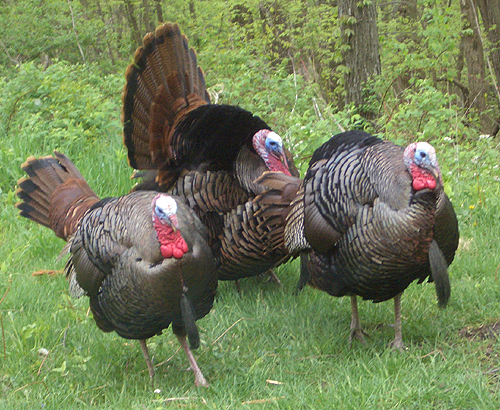
Wild turkeys outside my office in Galena.
One of the hardest things to leave behind when Kathleen and I first moved to Kenya many, many years ago was Thanksgiving.
No matter what your religion or politics, Thanksgiving is a major American holiday, all-American so to speak. And even before a third of our society was obese, it was a day of gluttonous consumption. You were just proving how well off you were, even if you weren’t.
So when we finally got settled in a very remote village 3 days travel from Nairobi we immediately began making plans for Thanksgiving. We sent out messages through the bush grape vine that we wanted two turkeys.
Most people had never heard of turkeys, and it was a great mystery to Jozani, our house boy/translator/money market manager and cook. Although he cooked chicken well for us, he was part Maasai, and fowl was taboo.
He could understand we Mzungu eating chicken. Mzungu had eaten chicken ever since Britain had a king. Many Africans back then accepted without aversion all sorts of habits the white people had carried with them into Africa. So chicken was OK. He often burned to a crisp our chicken, but he cooked it.
So when we first asked him to find a turkey, I’m sure he had no idea what it was, because he enthusiastically immediately replied that of course he could find us two turkeys. Jozani never said no. If he said no or asked further what I meant, either I might get angry with him (he thought) or make his day far too simple. So he said, of course bwana, he would find and cook for us two turkeys for our American holiday of giving thanks.
I’m not sure how many Thanksgivings passed before Jozani announced one morning with great pride that two turkeys had been found and were coming. At rather extraordinary expense. I had completely forgotten about it but apparently I was the only one who had. That same morning on the walk to the school where I taught, every one was asking me when the turkeys would arrive.
In fact a week or so later, two hours before the turkeys actually did arrive, a holiday was declared at school, and the children lined up as they did for morning assembly to greet the turkeys.
It was hard for me to call these fowl turkeys. They were young birds, true, but they looked more like weasels than turkeys. After close inspection I did approve them, paid the king’s chicken ransom, and turned them over to Jozani to rear. I think we had 5 months or so before Jozani had to cook them.
Turkey dinner turkeys are supposed to grow fast, remarkably fast. The wild turkeys that now live outside my office take more than a year to get large, and two years before the Toms are really large, but turkey dinner turkeys can reach massive maturity (12 pounds) in 5 months. What a ridiculous hope.
At first I was going to name them, and to do that, it was necessary to know their gender. Jozani insisted, however, that they had no gender, so we left them unnamed.
They grew, but not as fast as they ate. They became bold and strong and rather offensive, chasing anyone who came into our compound until one day I saw Jozani walking around the house with a large flattened stick.
“What is that for?” I asked him as he was scrambling eggs.
“It is to beat the turkeys, bwana, they are growing rude.”
They were growing rude. They would try to come into the house and peck at the screening when we refused. Jozani didn’t stay the night, and you’d think that a day time bird would go to sleep. But they seemed to freak at the dogs in the area that barked when hyaenas or jackals were in the neighborhood so gobbled the night away.
The time finally came to roast the birds. Jozani was equivocal. He had decided they were wizards incarnate. And of course it’s either impossible or catastrophic to kill a wizard. But we had invited nearly several dozen colleagues in a wide area to celebrate this so important holiday called Thanksgiving. So I let Jozani know that I’d kill the birds if he wouldn’t.
He killed the birds. And sort of defeathered them.
Kathleen spent days making stuff – or more correctly, like Jozani think he was making stuff. Like Stuffing. Which Jozani felt was the epitome of evil. Throwing a chicken in a frying pan was one thing, but “dressing” a fowl and doing such wizardry things as sticking bread and wine in its hollow stomach sack must have seemed extraordinary.
It was a grand holiday evening. Candles which we now use for effect was all we had. The smell of savory rice, good wine that someone had managed to bring up from South Africa, wondrous puddings and breads infused the evening of delight with the merriment of the finest of Thanksgivings.
And as if on queue it began to rain. The start of the rains had been delayed for all sorts of mysterious reasons, and there was concern that it would become a drought. But lo and behold, that late November evening in far western Kenya, the rains arrived just as the two turkeys did.
The rains proved much more successful than the turkeys. They looked OK if a bit shrunken. But the meat had the texture of something already worked into a piece of clothing. There was a not knife to be found capable of slicing it. We set it aside for a later soup.
So everyone was happy. Our guests probably because of the wine and Kathleen’s remarkable savory rice. Jozani because we didn’t eat the wizard. And the world because the rains had come. So though I don’t know to this day where our two Kenyan turkeys came from, nor for that matter where they went (there was never a soup), I know it was because of them that we celebrated Thanksgiving far, far from home.
A Better Way?Brilliant idea! Foreign judges on a Supreme Court!
The idea is not so out-of-the-blue. The newly adopted Kenyan constitution stipulates that foreigners may be appointed as judges to high courts.
Here’s the logic. Kenyan society is so divided ethnically that no mathematical wizard’s computations can come out with a formula for a Supreme Court fair to all sides. The obvious solution: have judges that don’t belong to any of the ethnic groups!
The fact Kenya is having this discussion I believe means they are moving forward very fast towards a truly multi-ethnic society. Certainly the young people are not as fettered to their ethnicity as the older generations, but it is the older generations who remain in power.
The idea was suggested yesterday by Martha Karua, an MP from a Kikuyu district. What’s significant is that she was once the country’s Justice Minister. This idea is no joke.
The Supreme Court as created by Kenya’s newly adopted constitution will function very similarly to our own.
Quoted in Kenya’s Daily Nation today, Ms. Karua said the presence of “three foreign judges would instil a sense of neutrality even if the major political parties engage in horse-trading in the appointment of judges to the Supreme Court.”
She pointed out that two commissions that were created after the 2007 election violence to determine its causes and suggest remedies were composed of foreigners. The Commission of Inquiry on Post Election Violence (CIPEV) included a former police commissioner from New Zealand and a lawyer from the Democratic Republic of the Congo.
Several years ago I attended a lecture by the brilliant biologist, E.O. Wilson, who was at the time unveiling his new compendium of Darwin’s works. In response to a question from the audience, Wilson suggested the reason there was so much opposition to the teaching of evolution in secondary schools was because Americans were so tribal.
Think about it.
We may not be divided by ethnicity, but our ideological divisions today are as great as those between any Kikuyu or Luo, or Jew or Christian.
What Wilson was saying is that when divisions become tribal, rational compromise and dialogue between the tribes is futile.
What Karua is saying is the same.
Recognizing the problem is the first step to solving it. And imaginative Kenyans have once again come up with something truly brilliant.
My nominations to the U.S. Supreme Court would include Martha Karua herself, the venerable South African judge Richard Goldstone, and Abdullah Gül, the current president of Turkey. Yours?
It’s relentless, this media pursuit of scandal and contretemps. Ahmed Ghailani is innocent of murder and hundreds of thousands of media points in the U.S. explode with the news while I can hardly find a mention of it in East Africa where his alleged evil killed so many people.
What’s going on? Aren’t the East Africans, who watched 242 people killed and 4000 wounded in August, 1998, furious that this guy’s been exonerated?!!
(Oh, has he been exonerated? No, oh, well is he being released? Isn’t he coming for me!!!???)
And it’s not just a simple news story. Every single file is laced with “setback”, “slap-in-the-face” or in the Huffington Post’s words, “mixed result.”
News is not being reported, it’s being made by the reporters.
250 people were killed and more than 4000 wounded in Kenya and Tanzania when U.S. embassies were simultaneously bombed by Al-Qaeda in August, 1998. That’s a fact.
Ghailani was involved, he’s admitted it. There were probably 20 or 30 people involved. That’s a fact.
We know a lot about Ghailani. He was born in Zanzibar at a time that country was being run like a Maoist state, totally closed to outsiders. He was further radicalized in Pakistan, has admitted to delivering information and weapons materials to the embassy bombers, was picked up in Pakistan in 2004 by the Pakistani military and rendited to secret CIA camps before finally being interned at Guantanamo.
His single conviction of conspiracy in the murders carries a sentence of up to 20 years, but so long as the U.S. declares itself in combat with Al-Qaeda, he will be held as an enemy combatant.
So what’s all the fuss about?! This guy is not going to do anybody any harm any more.
The fuss is about making news. I’m not saying this doesn’t rank as news, it just doesn’t rank at the level it’s been and is being reported.
As a member of John Stewart’s rally I was terribly disappointed when Stewart ended a great show on the mall with a poor soliloquy about how the news from every corner is zealous and exaggerated.
Well, in this case, Stewart’s analysis is right on.
This morning I could find only one major mention of Ghailani’s story in East Africa’s media, in Tanzania’s major newspaper and even there it was buried deep inside. The big rags in Nairobi didn’t even print it; it was ladled on-line with Prince Henry’s wedding.
East Africans were the ones killed, maimed and made homeless! Aren’t they furious!?
No. It’s not important news, anymore. Sputnik’s not news. The guy’s spending the rest of his life behind bars and he was a secondary accomplice, anyway.
America has blown out of the rational world a thing of the past. What about the mining scandals in Tanzania? What about the drug lords recently named in Kenya’s government? What about the Al-Qaeda operative just last week arrested by Kenya on its border with Somali?
Why doesn’t America care about this news?
Because it doesn’t sell little purple pills.
It’s beyond me. We command so much technology that has become so competitive for selling the little purple pills that we look for any immediate rush we can find, the reactive word, anything to shock.
Move On, America. You’re being drowned in the past and fired up by little men wanting to sell purple pills. Move On!
Americans are just as tribal as Africans. This week’s elections prove it. But while Americans may curse and protest, our visceral feelings don’t manifest into actual bloodshed. That’s the difference with much of Africa.
A good friend and 25-year old Africaphile who recently completed a stint with the Peace Corps in Guinea where ethnic violence is now erupting sent me the dispatch below. His heartfelt concerns built by nearly two years of working in an isolated village, learning the language and customs and making friends, now seem swept away by his inability to explain what’s happening, now.
Conor’s angst if anger is the same that drives ethnic violence. Those of us who have “fallen in love” (Conor’s words) with distant places and peoples come remarkably close to adopting aspects of that foreign society that attract us. We touch the same sphere of that complex culture as those who were born into it.
But we’re on the outside. We can sit on the sphere and enjoy something, then remove ourselves perhaps when something turns ugly. We both might feel the same thing. It’s just that we aren’t contained within the sphere like they are. We can release our grip and float away.
Conor puts it this way (excerpted from below): I do not understand the fear of isolation in the same way, the fear or being shut out of the network that I owe my history and existence to. Therefore I do not understand the surge of belonging that electrifies every contact with those on the outside of the fence.
From my distant perspective, it’s the same awful panic that drives the old Delaware widow to elect someone who wants to privatize social security. Or the right-thinking Libertarian who stamps his foot on the head of someone who disagrees with him. These are puerile, unintellectual feelings. They lead to my loving Norwegian Methodist aunt hating her Jewish landlords.
Conor writes (excerpted from below): I thought I understood ethnic identity….I thought I understood what the potential for violence smelled like, what it looked like in schools, and what it felt like when you walked through the market or hitch hiked a motorcycle ride to the next town…..
I obviously do not.
The main difference between Conor Godfrey and his Guinean friends is that he isn’t Guinean. He is not forced into the ultimate defense: attack the other, go on the offense.
Click here for a YouTube video of the current violence, then read the rest of Connor’s dispatch:
* * * * * * * * * *
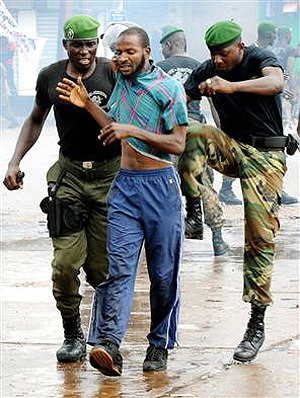
Every day hundreds if not thousands of Fulani flee their homes in upper-Guinea for the safety of Fouta Jallon, the heartland of the Fulani people. They are both victims and victimizers of the neighboring Mandingo with whom they had lived peacefully for some time.
Guinea’s electoral crisis has resulted in a standoff between two remaining candidates representing these two largest ethnic groups in Guinea. Ethnic fault lines, previously well concealed beneath a web of inter-marriage, common faith, and necessary interaction, have reemerged into yawning chasms across which none save the artist or truly pious dare cross.
I left Guinea a year ago last week. As soon as my plane landed in the U.S. I began to mock the so-called experts who, I felt, read from outdated West African script as they warned of impending implosion in Guinea.
Did they know Modi M’Biliri Barry, my host father? Had they met Ousmane Diallo, my polyglot Peace Corps trainer who never had a bad word for anyone , or the Nene (mother) in Fataco that sold cassava dipped in hot pepper at recess in the courtyard, or seen Fulani and Mandingo students share benches in school, or chase the same girls on the beach in Conakry?
Because if they had—they would not, could not, suggest that Guinea shared anything more than a border with countries such as Liberia and Sierra Leone, whose blood soaked late 90s have come to define ethnic barbarism.
How many people like me have fallen in love with diverse, integrated peoples in far away corners of the world, only to look back with horror as dormant identities in those same friends surge from obscurity, thousands of times more potent than peace time associations?
After a U.S. friend with his Kenyan wife visited Rwanda’s genocide museum in 2006, they both expressed to me wonder at the intensity of feeling that could drive human beings to leave all empathy behind. But as violence then gripped Kenya a few months later that same woman’s facebook page was inciting violence in her home country from an ocean away, urging people to round up Luo and “do away with them.”
The educated Guinean ex-pats I now speak with in The States rarely seem any better. The same family that opened up their homes to their diverse neighbors last year is now a dues paying member of the their group’s most intolerant fringe, cum sudden majority, willing to believe all manner of nonsense about certain members of their community.
The exceptions are beautiful. Grand Imams in most major Guinean cities have issued stern and touching warnings against reprisals and generally appealed for peace and reason. Some of the most prominent musicians from all over West Africa recently got together to put this song together; it asks, in stirring and beautiful verse, and in all the right languages, for peace and unity in Guinea.
I also know that individual Guineans, of all groups, in Labe and in Kankan, in New York, Paris and Montreal, and all over West Africa, are praying for Peace….but my impression is that they are the exceptions that prove the rule.
The collective unconscious I belong to does not go nearly as deep, nor nearly as far back as the Mandingo or Fulani communities, but it should go deep enough to remember European’s genocide inducing arrival to the new world, or our subsequent enslavement of millions of souls, or the other countless atrocities that have been perpetrated in the name of constructed identities by people of every race, creed, and color…..yet I don’t.
I am watching, from afar, the subversion and transformation of Guinean society as if this has never happened elsewhere, somehow unfazed by the stunning regularity with which this process unfolds across time and geography.
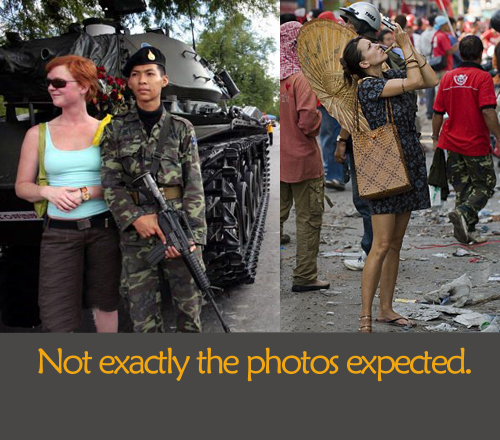 So far, so good for tourists stranded in Egypt. There are 30-50,000 tourists currently trying to leave Egypt, and their itinerary isn’t exactly what they thought.