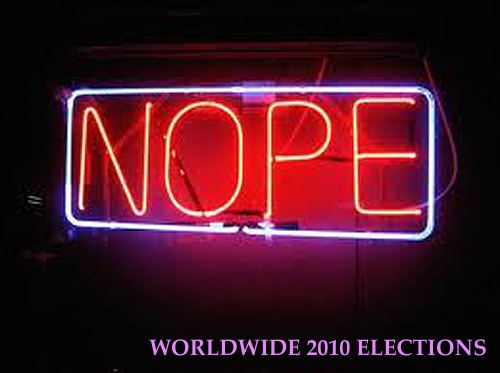
Worldwide people have used elections to express dissatisfaction. That’s the limit of a democratic vote. You can’t say what to do, just that what’s being done isn’t OK.
At home and in Tanzania, ruling coalitions suffered very seriously without losing complete control. The level of political slaughter is relatively the same, for example, in Tanzania as here, and that really suggests that worldwide democracy is manifesting in about the same way.
Here Democrats got slaughtered in sheer numbers of votes cast and office holders shown the door, yet managed to keep control of the Senate while pretty firmly rejecting any new “Tea Party” force in national life other than as a political spoiler.
In Tanzania the balance of power was much more off center to begin with, but the ruling Chama Cha Mapinduzi (CCM) Party lost more than 20 seats in a Parliament where they had held 185 out of 239 seats. Their presidential candidate, incumbent Jakaya Kikwete, was returned with probably around 65% of the vote, but this was compared to more than 80% the last time.
And Tanzania’s opposition consolidated, and fringe parties as with the “Tea Party” in the U.S. made loud noises but few gains.
The “economy-its-stupid” doesn’t work in the developing world, where growth is better than ever, unemployment is shrinking and business expanding. So why such similar outcomes?
Worldwide, people are dissatisfied.
Even when things, as in Tanzania, are doing pretty well. So why?
It’s a fascinating answer, if you’re willing to believe me. I think the wave of dissatisfaction emanates from The States and that it’s really more impatience than disapproval.
News, blogs, entertainment and money are dominated by the U.S., Europe and China in that order, worldwide. China remains essentially a closed society. Europe is the heady intellectual with a thousand different personalities.
Only the U.S. remains a cohesive culture – at least in the eyes of the rest of the world. And so in that old sparkling car adage, “So goes the U.S., so goes the world.”
Tanzanians used the same tool they share with Americans, a vote, to act the same way Americans acted. They voted, No.
We never learn what the No vote means in democracy. The vast number of voters don’t vote against their incumbent because he voted for Health Care and then scribble on the ballot, “Need torte reform, interstate markets and an increase in the eligibility age.” They simply choose the one alternative given them. And unfortunately, few voters care, really, what that opponent will do once elected.
They just want to say, I’m dissatisfied.
And that’s what they did in Tanzania as in Wisconsin.
It’s a terrible curse of the theory of democracy. You’d like to think we had multiple choices, multiple ways to express ourselves. But we don’t. And when the world’s most powerful culture wants to say “No”, so does the rest of the whole wide world.
Unable to do it at home, U.S. Righties do it in Africa.The gay bashing which became gay beating two weeks ago in Uganda was widely reported worldwide. But not enough has been said about the U.S. Christian right which fomented the violence in the first place.
In September I wrote that the “C Street Players” – a list of prominent leaders and politicians on the U.S. far right – were implicated in rigging the re-election of the Ugandan MP who introduced draconian legislation to punish gays and people who knew people were gay.
Fortunately that bill was tabled by Uganda’s president after substantial pressure from the west.
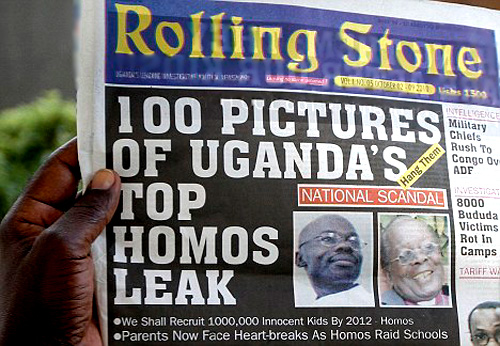
But the evil continues. A rogue newspaper, not registered (and were it anything but a gay basher tabloid would have been viciously suppressed by the Ugandan regime), incited incredible violence earlier this month by naming the country’s “Top 100 Homos.”
It’s really impossible to know if American money is behind this new tabloid, and in a sense, it doesn’t really matter. Hate on the level C Street brought to Uganda in the first place, which promulgated legislation that couldn’t possibly get even rightest attention in the U.S. (execution for certain gays), was intense enough to start these brush fires.
Fewer than 2000 copies of the Ugandan Rolling Stone issue were circulated, but that seemed enough to cause something of a cultural rampage in the capitol. Shortly thereafter, the real violence began. Four gays were seriously beaten, others injured, scores intimated.
This is a terrible story, but I actually believe the more terrible story is how effective the American Christian right is now in East Africa.
Much of this current violence can likely be traced to Lou Engel, an American evangelical, who received permission to hold a kill-gays rally on the campus of Uganda’s most prestigious university, Makerere. More than 1300 people attended that rally in May.
As reported then in the Huffington Post Engel was a picture perfect conservative rabble rouser. To the American press he disavowed any animus towards gays and even any knowledge of the bill before the Ugandan legislature.
But once at the rally his tuned changed significantly and he was dispensing hate with incredible efficiency. He seemed to know that the five-year long fight for an anti-gay bill in Uganda so beautiful maneuvered and heavily funded by the U.S. Christian right was in trouble.
So his response was to say incredibly vicious things. “…he whipped up bizarre fears of evil gays lurking in schools in Uganda” according to Wayne Hudson in that Huffington article, along with screaming that Uganda was “ground zero” in the fight against gays.
This is what the American right does: lie, then use that lie to engage the deep-set anger of those foolish enough to consider it. Once engaged, the anger is finally corrupted to any use they wish.
Senators De Mint and Coburn will never succeed in punishing people in the U.S. for being gay, and not even Lou Engel could preach such nonsense here. So…
…they go to Africa, where the angers are greater and deeper, and they shift their lunacy for power there.
Mark Jordhal, a blogger friend in Kampala wrote me recently:
“The proposed bill found fertile ground here and, frankly, if you asked out on the streets at least 90% of Ugandans are fully in favor of the bill. The only thing that kept it from coming to be was the fierce international response and the fact that a third of Uganda’s national budget comes from foreign donors. Five years from now when that money is replaced by oil revenues, the story might be much different.”
Here at home there’s a glimmer of light that the ton of negative lying campaign ads are actually having a backlash effect.
I hope in the end Ugandans themselves will realize how they’re being manipulated, and manipulated not by some foreign power preaching an ideology, but by demons preaching hate, who have little concern for Ugandans themselves.
At last! A music festival that treats AfroPop as a melting Good Humor Thing. Last weekend’s Malawi Music Festival did it right.
The music of Africa has never been just drums and air blown through hollowed out animal horns bashed away on xylophones. And in Malawi, they just proved it!
Human voice in vibrant, distinctive exhalations is something the west has successfully adopted into its own music for centuries. And for the last generations good African musicians have been sticking punk into reggae!
Malawi hasn’t been a place for great African music festivals. In the past it was South Africa, Nigeria and Mali, more or less in that order. And South Africa will always dominate African music. But Nigeria is too complicated and Mali is now too unsafe.
So taking up the slack this year was Malawi’s Lake of the Stars. And what I particularly liked about it was they didn’t pretend to be AfroPop. This ridiculous notion that AfroPop is something discovered homegrown, sort of like a baobab tree, is nonsense. Modern African music has been a very recent work in progress, including so-called AfroPop, and is heavily influenced by the west, Britain especially.
The Lake of the Stars featured this perfectly. Not only were the great African stars included, but also western stars whose music is considered heavily influenced by African artists.
It is a two-way stage.
I’ll let you decide as you enjoy:
Peter Mawanga, a home-grown Malawian about as far away from AfroPop as Chicago is from Dakar. Great music. And his video really shows how modern life works its way into times of old.
Nyali is fantastic. This video explains specifically how they are trying to mix African culture into (in their words) “modern instruments” and music. What I find really interesting is a definite Arab cum-Egyptian vocal style.
Fabulous reggae by Malawian Chiozo. And the lyrics of this song explain why modern music anywhere, even Africa, will always be influenced by the west, for it was the west that conscripted Reggae and turned it into Chiozo’s style. (Go on YouTube to hear a blastful of Chiozo singing Frank Sinatra!)
Representing Big Time, the Noisettes, one of the UK’s 6th most popular bands according to Entertainment Weekly, came to the lake with their remarkable mix of reggae and early rock. The band has morphed from wild and crazy to a style that today evokes a close kinship with African love songs.
Now I’m not sure I like this. Oliver Mtukudzi-Raki : traditional African songs mixed (sometimes too mixed) into mixtures of mixed modern instrumentalism. It’s too mixed up for me, but he’s incredibly popular.
Sam Duckworth: Get Cape Wear Cape Fly. After a run-in with a conservative British politician several years ago, the British rock star Sam Duckworth became a converted political radical. His free concerts for poverty eradication at home and abroad have gained him international billings, but Africans feel some of his earliest music (D.A.N.C.E., in particular) shows a deep African affiliation.
There weren’t too many traditional performers, but here’s one. Aly Keita is from the Ivory coast and is famous for making his own xylophone-like instrument as a modern version of an ancient African hollow flute drum.
I hope like me, many of you won’t like this. But the point is that from the earliest bands in Africa, disco prevailed: Reverend and the Makers. Disco to me it is, no matter how interrupted the tempo or beautiful the video. AND disco will forever be in the African soul.
The epitome of the amalgam of Africa and the west is Afrikan Boy. From Nigeria, he’s made it big in the U.K., and now sends it all back home.
Zimbabwean Tinashe is widely considered to be the next rising star. This particular video is before he was signed by Island Records. You can go on YouTube to see how they polished him up, but I think this original is better.
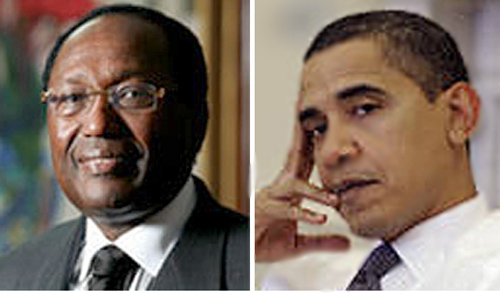
Kirubi vs. Obama. In change and hope, that is.This sounds cheeky, but a blog by a Kenyan yesterday has inspired me more than Peter Baker’s interview of Obama. Anybody disagree?
Peter Baker’s in-depth interview of Obama published Tuesday in the New York Times really depressed me, and so what does a progressive American do when depressed? Obviously, read a Kenyan blog!
The Kenyans did only a little bit better than so-so in the recent Commonwealth Games, and Chris Kirubi’s blog pulled in readers with a “don’t worry it was great” congratulations before continuing on a lengthy discourse of what makes excellence.
I began to wonder if I were reading the text of one of my middle school teachers? It was pure American idealism. So different from what in my opinion is the state of America, today, as shown in Baker’s interview. It seems that in America, hard work and vision just doesn’t mean a lot any more.
Whereas in Kenya, hard work is really paying off with a surging economy and exploding modern culture. And Kenya’s Vision 2030 is one of the most ambitious and yet likely to be achieved goals any nation has ever set.
Here’s some of Kirubi’s blog:
“When I look at the lives of these athletes one thing I admire is their attitude and determination to excel. This got me thinking. What if we were to embrace the same spirit and adopt this attitude, determination in every aspect of our lives and businesses? Wouldn’t we be far off than we are now?
As a society we’ve accepted the incredibly durable myth that some people are born with special talents and gifts, and that the potential to truly excel in any given pursuit is largely determined by our genetic inheritance.
This is not so.
Excellence for me is derived from working and building what you have. It is not an inherited trait which determines how good you become at something, but rather how hard you’re willing to work.
Bear in mind that excellence comes at a price and you must be willing to pay that price.
If you want to be really good at something, it is going to involve relentlessly pushing past your comfort zone, along with the frustrations, struggles, setbacks and failures that you encounter. In the end, becoming really good at something you’ve earned through your own hard work can be immensely satisfying.
Remember that you have the remarkable capacity to influence your own outcome and that each time you fail is a chance to begin again this time more intelligently.
As my friend and renowned motivational speaker, Azim Jamal once said, “obstacles are part of the journey of life. When we keep our eye on the goal, obstacles are not threats. In fact, they become opportunities to create breakthroughs.”
A lot of hot air, and very little to fight about.Sporadic election violence breaking out throughout Tanzanian cities is not a harbinger of any October 31 disaster. It’s not like Kenya in 2007.
Last week the most pronounced violence ever to hit Arusha town occurred when proponents of two opposing political camps tried planting their flags in the city market area. Police moved in to break up the heated exchange and proponents began pelting the police with stones.
The police responded with tear gas that at first actually attracted more brawlers into the fight, which did last several hours. The incident was over before nightfall and remains the most severe violence so far.
In Dodoma, Tanzania’s technical capital city, police began arrests yesterday afternoon of suspects they claimed were planning more election violence. The strict laws in Tanzania give police the right to hold such persons without charges for an indefinite period of time.
Unlike in Kenya three years ago, these are not issue-driven incidents. They are basically thugs and bullies whose local differences vary greatly from region to region. The difference between the various national parties in Tanzania is actually quite small with regards to substantive issues.
That was not the case in Kenya, where stark differences separated the people’s socialist candidate, from the ruling elite’s business candidate.
Another important difference is that Tanzania’s election on October 31 will not be close. It may be closer than 2005, when current president Jamaya Kikwete won by more than 80 percent of the vote. In fact a poll released yesterday stunned the nation when it suggested Kikwete’s margin this time may be less than 15%. But by most analyses, it will be considered a landslide.
The trigger for the massive Kenyan violence was an election so close that like Bush/Gore, the victor arose from the power extant. It was simply too difficult to untangle the closeness to obtain a rational, undisputed outcome.
And the final, possibly most important difference, is that there is no single hotbed of dissent in Tanzania, as in the massive Kenyan slums of Nairobi. It was there in Kibera and other slums surrounding Nairobi that the violence burst. There are no massive concentrations in Tanzania of populations who feel disenfranchised from the status quo.
So don’t worry as you read growing accounts of Tanzanian election violence. I don’t yet see any possibility of widespread reaction to the election two weeks from Sunday.
While America groans about the economy, frenzied business in Nairobi on Wednesday.I know it’s hard for my current and past East Africa safari clients to think of that culture as competitive with our own, but watch out, America, you’re missing the obvious. And by the way, how did you celebrate the Chinese National Day yesterday?
The development in the underdeveloped world is staggering. It’s as staggering as America’s faltering. Once at the top of every metric, today America health care is last among the most developed countries, consistently behind all other developed countries in education, and a continuing slip for more than a decade in personal incomes.
Our consumption increases faster than our production. Bad dynamic. We need to sheath our pride and look to Kenya and China.
These two countries in my life time were once considered abjectly impoverished and underdeveloped. Today they are rocketing into the new world with a potential impact much greater than America’s.
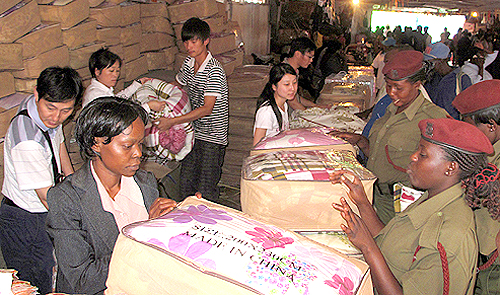
Yesterday, Kenya celebrated the Chinese National Day with elaborate ceremonies in Nairobi. While America was congratulating itself on its constipated legislature passing a law that did little more than slap China on its wrist for currency manipulation, thousands of Kenyans attended a Chinese trade fair in Nairobi on Wednesday, wholesalers buying from manufacturers – it was a madhouse.
The wife of my transport manager in Arusha has a suddenly prosperous business selling Chinese textiles and clothing throughout Tanzania.
And China is getting deep oil, natural gas and precious minerals from areas in East Africa that North American companies abandoned about ten years ago, before China had developed the deep-earth technologies.
The lethargy in America today with local politics, the fatigue with a failing economy and the general overall cultural malaise is a disease of complacency and over confidence.
It’s this presumption that we were always TOP and always will be.
Wake up, America. One of the few metrics we continue to command is military spending and number of wars. And those of us with some experience in the outer world can only keep screaming about what we know: “Foreigners are doing better!” Much better. So it isn’t a problem with the world; it’s a problem with America.
Should we care?
Of course I’m happy for East Africa. But I’m American. I’m not chagrined that I’m being bettered, I’m astounded that we refuse to learn from abroad. That we continue to shoot ourselves in the foot, rather than dare to step forward into a new world.
And that new world is one of Chinas and Kenyas, and if we’re to cure our malaise, we need to look to them.
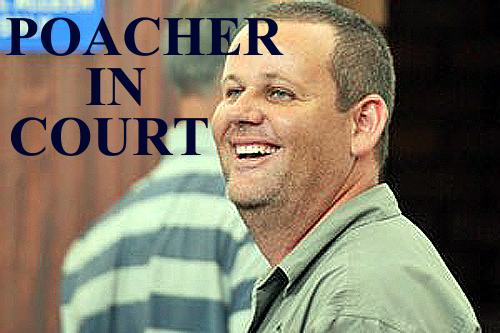
Manie du Plessis, mastermind of grand poaching syndicate.Eleven professional WHITE people have been arrested and charged with rhino poaching in South Africa. The outcry from their colleagues is deafening and revealing. The story is fascinating.
I’ve written continuously that during hard economic times, poaching increases. Poaching is a relatively easy occupation, a job, a gig, when none others are available. The market is always there: in Yemen, especially, but also in Asia.
The mind set of those who buy poached ivory or poached rhino horn or poached bear feet is pretty simple: these are animals, which like trees to make our houses, are to be used by man. The final consumer feels no remorse and as evidenced by the many street window apothecaries in Kuala Lumpur, does not consider it a crime.
Quite to the contrary, the seller of poached animal products sincerely believes in their medicinal or symbolic value, and often claims that the legal restrictions strongest in the areas where the animal is actually killed are affronts by arrogant cultures.
And the archetypal culprit who kills the animal is usually an individual African down on his luck.
Well, guess what. There’s more to it. What wildlife conservationists have been telling us for years was underscored last week when 11 professional South Africans including veterinarians, professionally licensed hunters and respected local community officials were indicted for a huge poaching ring that South African police spokesman Vishnu Naidoo said was linked to “hundreds of rhino poaching incidents.”
The eleven respected wildlife professionals arrested in a multi-agency sting in South Africa last week included game farmer, Dawie Groenewald; his wife, Sariette; licensed veterinarian, Karel Toed and his wife, Maria Toed; licensed veterinarian, Maine du Plessis; and professional hunters, Tollman Room Erasmus, Dallied Gouws, Nordus Rossouw, Leon van der Merwe and Jacobus Marthinus Pronk; and a game farm employee, Paul Matoromela.
Naidoo told the press Thursday that the suspects are believed to be the “masterminds” behind South Africa’s poaching scourge, which has claimed the lives of 210 rhinos already this year.
White rhinos are flourishing in South Africa. There are many scientists, in fact, who claim there are too many and that culling should be considered in some places. (This in contrast to black rhino which remain seriously endangered. The horns, however, are not differentiated on the black market.)
CITES is the international treaty designed to stop such poaching, and it does a pretty good job. Its mandate, too, is quite simple. Have enough countries in the world sign a treaty that forbids the trade of certain animals across its borders.
That suffocates the market and means that the animal killer becomes much less important than the syndicate of criminals that distributes the animal product as contraband.
That’s why CITES is so important. The many parts of the distribution chain become criminalized, and ultimately when all parts particularly in the Far East are aggressively pursued by legal authorities, then the market dries up, and killing the animal becomes pointless.
Because killing the animal is the easiest thing to do.
A lot has been written about South Africa’s tourist boom this year, linked to the successful World Cup. But the truth is that when football enthusiasts are removed from the numbers, we’re still at revenue levels around 2004, 20% below where they were in 2007.
Game farms in South Africa, from where this particular atrocity was apparently managed, are kind of down on their luck at the moment. Farming a protected animal and butchering it for the black market was an opportunity these “professionals” felt they couldn’t pass up.
We don’t know if these 11 Afrikaners had lost their insurance, or couldn’t pay their kids’ college tuition, or had farms being foreclosed. I don’t know if any situation of this sort would garner them sympathy from you, any more than the poor African in Tanzania who poaches a wildebeest for food might.
That is the other side of the market, the darker one. The side that drives people to the crime. The side that is much harder to remedy.
The other fascinating part of this story is the local reaction. I am privy to an exchange of private emails among professionals in South Africa that I consider somewhat appalling. And there is plenty in the public blogosphere you can google.
Other … whites .. are reacting with ridiculous fury, as if whites would never do such a thing. As if poaching like this is something only the uncivilized black would do. Here is a piece from just such an email I received this weekend:
“Hello —– ,
I am APPALLED, SHOCKED, DEVASTATED, DISAPPOINTED, BLOODY ANGRY!!!!!!! How DARE these people, in positions of trust and responsibility, and WORST OF ALL, our own people, from whom we would LEAST EXPECT this uttterly disgusting and traitorous behaviour.”
The presumption that the criminals involved in poaching are not usually “our own people” unsheathes a terrible racism. It isn’t the animal killer who is most responsible. It is the transporter, contraband arranger and most guilty, the purchaser. These criminals have much more culture in common with Manie du Plessis than the unnamed black man in Tanzania.
And they are much more responsible for poaching in the first place.
Kudus to the South African police and wildlife agencies that managed this sting. Spread the world that poaching is on the rise and that aggressive police action worldwide is required. And most importantly:
Forget that these guys were white. And if you can’t, we’ve got a lot more blogs to write but it isn’t about poaching.
The puppet, David Bahati, and the puppeteer, Sen. Jim DeMint. Can we not stop this insanity?Polarization, craziness, lies near insanity does not a physical mark make. Until vigilantes bash heads in Cleveland and my safari clients are tortured in Ugandan prisons.
It hasn’t yet happened, but I have reason to worry. Yesterday, I blogged that we should take note of the violence occurring by Kenyan vigilantes as a trend developing here at home, and today we hear that the Ugandan MP promoting a bill to execute gays and imprison any who know of gays (including tourists) rigged his recent re-election.
David Bahati is the crazy, and the confident of President Yoweri Museveni of Uganda, and “Christian brother” of Sen. Jim DeMint (R-SC). Like so much vicious anger in the world, today, he’s the puppet of the American Christian Right.
His story, and his puppetry, is not news. Click here for a video condensing all the news in which he’s been involved for the last several years.
Basically, since our legion of crazy rightists has conceded they probably won’t be able to execute gays at home, they’ve decided to pour resources into Africa so it can be done, there.
If Bahati’s bill becomes law, and I have safari clients trekking gorillas in Bwindi National Forest (like I did last week), and those clients innocently remark about something gay-related, they could be arrested! And god (is there one?) forbid, if one of them mentions that he/she is gay, he/she could be arrested and executed!
And all of this, the polarization, craziness, lies near insanity, AND Cleveland vigilantes AND Ugandan homophobes all comes from the United States’ Christian Right, and pointedly, the “Family” who resides in “C Street” in D.C.
Bahati’s reelection was challenged by someone who was sane, Charles Musekura, who had strong support for a number of reasons not least of which is that most sane Ugandans don’t think you should execute gays!
But Bahati had the money. We can guess from where. And he had the tricks, too:
Michael Mubangizi, a respected reporter for the Ugandan Observer, reports that the recently concluded reelection campaigns including Bahati’s were rigged. They were rigged in quite simple ways. People were selling ballots that were then counted with names that didn’t exist. Up to 5,000 ballots illegitimate ballots may have helped to reelected Bahati.
Led by Sen. DeMint (R-SC), this “movement” that claims the moral high ground is one of the most evil social phenomenon ever seen in the world. I just can’t understand for the life of me why they are so prominent and hold so much power.
Just as I cannot understand why there are vigilantes in Cleveland.
But these machinations of hate are something that we must all try very hard to understand, whether in Cleveland or Uganda. They aren’t just wrong, they’re crazy. Their perpetrators aren’t going to be convinced by logical argument.
And as evidenced by Bahati in his recent reelection, nothing legal or sane alone is going to stop them.
Here is a list of the most prominent C Street players. Unless we stop them, this insanity will continue:
Chuck Colson, Watergate felon
Rep. Bart Stupak (D-MI)
Rep. Chuck Pickering (formerly R-MS)
Rep. Frank Wolf (R-VA)
Rep. Heath Shuler (D-NC)
Rep. Joe Pitts (R-PA)
Rep. Mike Doyle (D-PA)
Rep. Mike McIntyre (D-NC)
Rep. Zach Wamp (R-TN)
Sen. Bill Nelson (D-FL)
Sen. Chuck Grassley (R-IA)
Sen. Jim Inhofe (R-OK)
Sen. Jim DeMint (R-SC)
Sen. John Ensign (R-NV)
Sen. Mark Pryor (D-AK)
Sen. Mike Enzi (R-WY)
Sen. Sam Brownback (R-KS)
Sen. Tom Coburn (R-OK)
Everywhere in the world crazies are sprouting from the misery of the economic downturn. And we should take note particularly with what’s happening in Kenya.
Kenya may be the most dynamic emerging society in the world. It ended a mini-revolution with an imaginative coalition between radically different sides, then passed a new, modern constitution that in my opinion is an universal model for morality, human rights and dignity.
These clarion democratic ideals have empowered even the weakest sections of its society, as they should. And the weakest sections of a Kenyan society are far weaker than here, for example!
But poverty in Kenya is a strata quite different from in the U.S. A huge portion of that half of its population still lives relatively calmly in subsistence, not in dependence of society as American poor, do.
But a growing portion of Kenyan poor are amassing in bulging slums surroundings its cities. And in these cesspits of humanity, political awareness and higher education combine in volatile ways.
That was why there was such violence after the contested election of 2007, an election which pitted two very different men against one another. It is very fair to call that an election one of the poor against the rich.
(It is also why the resolution of that conflict was so astounding. Of all the opposites in society, none is as irreconcilable as rich vs. poor.)
Rich versus poor is a pretty simple concept. In Kenya, as this fire burned, it morphed into Luo versus Kikuyu, tribe against tribe. An economic controversy has all sorts of academic qualifiers. Ethnic ones don’t.
What was a panoply of issues with lots of gray between, became black and white. A rich man could argue that the poor will get richer faster if they let him get richer, first! And the poor could argue that their drain on society impedes the rapid growth enjoyed mostly by the rich. So each side is blurred. Each side attracts advocates from the other.
But you can’t change the way you’ve been born. A Luo can’t convince his neighbor the Kikuyu that they share physical genes. That battle was demarcated by god.
That hate is more than visceral, it’s innate.
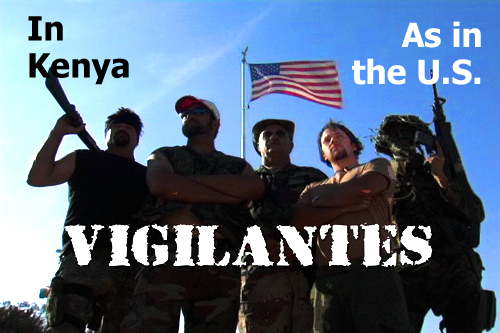
And it has lead in Kenya to vigilante groups springing up throughout the country. This is now Kenya’s greatest social problem.
And when one vigilante group grows very powerful and successful, a remarkable transformation albeit transitory occurs: Society as a whole begins first to tolerate, then later, embrace the thugs. It’s so simple, so nice. No complicated qualifiers, just a mafia leader to tell us what to do.
Mungiki is Kenya’s mob. Born in the slums, its leaders now live in grand houses and control huge businesses. From time to time the government indicts them, or even brings them to trial, and most of the time juries find them guilty of nothing. It started as a Kikuyu-based vigilante group. But today it reins across different cities the way mobsters did in the first half of America’s 20th Century.
There are places in Kenya where it’s impossible to become an elected official without the support of the Mungiki. And you know what that means.
And there are more and more wannabees around the country. Two days ago in a remote area of western Kenya, far from Nairobi and the Mungiki and modern life, 50 youths calling themselves “Sungusungu” stormed a village and hacked to death four people, then trashed their homes.
Sungusungu claims it was avenging the recent murder of a Kenya Assemblies of God church pastor, Mr Michael Onchong’a Nyakundi.
Yes, religion is an easy infusion into these vigilante movements. Ever watch the movie where the mob leader regularly goes to mass?
Kenya has an advantage in this stage of its development that America didn’t have during the years of prohibition. It has more facts, more history, more outcomes that proved how counterproductive the mob was over the long run. Kenya knows from America’s history that vigilante society is self-destructive and ultimately puts itself out.
And while these may be somewhat illusive concepts, they’re real enough I believe to help Kenya get through this period faster than we did in America.
Yusuf Makamba: No Democracy in Tanzania.The Tanzanian election is less than two months away and is really heating up. Yesterday, debates were banned!
Opposition candidates are furious, of course, and blogs and articles in the U.S. especially are denouncing Tanzania’s authoritarianism as wrong and archaic. I agree, but I also wonder if the squeaky clean critics understand how they’ve contributed to the mess.
Yesterday’s announcement by the CCM secretary general, Mr Yusuf Makamba, that forbid all party candidates from debates (on television, but there weren’t any scheduled anywhere else) is certainly because the election is unexpectedly moving away from the party central command.
But another reason is more philosophical: the power of opposition in a modern world, the power to … lie.
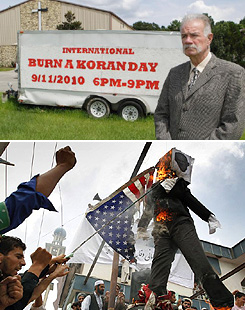
There is no better example than here in the US of A. Death Panels. A President Born in Kenya. No Global Warming. Weapons of Mass Destruction. And to wit: The Millennium Trade between Burning the Quran and Moving The Mosque.
Lies foul up democracy. Everyone agrees lies are bad, but it’s the bad guys who profit from them. And in this viral internet age, lies can be assumed truths for critically long times. Sometimes, forever.. as those who embrace them lager themselves against being called out.
Democractic Lies gain special traction in bad times when people are so angry. Like now.
Maybe, just maybe America can weather this extreme moment of national lying. But a young and uneducated country like Tanzania maybe can’t.
It’s been a long while since Tanzania has had a real opposition; in fact, almost never. Following the surprise resignation of the country’s first president, Julius Nyerere, after more than twenty years in office in 1985 there was a spark of opposition. It faded quickly.
Today Yusuf’s CCM controls 206 of the 232 seats in Tanzania’s parliament. That’s almost 90%, and the renegades in opposition rarely make it through a single term.
But this time it’s different. Mostly because of what was left of an angered media the government partially shut down, a number of scandals have become public.
Every Tanzanian newspaper is read mostly online, so these scandals went viral:
And local issues, including the proposed Serengeti highway in the north, became contentious issues between the party and opposition candidates.
It was only just before the last election that the Tanzanian government allowed opposition parties. Its legacy is a single-party state.
Yusuf holds as much power as any elected leader. A small cadre of mostly past elected leaders constitutes what we used to call the “central committee.” Yusuf and this group call virtually all the shots in Tanzania.
But democracy is pushing through this old style politics. I feel the internet age makes it inevitable.
It would just be helpful to emerging societies like Tanzania if the veterans of this age-old ideal of democracy had citizens who acted on The Truth, not The Lie.
Africa grows increasingly Muslim while America grows increasingly anti-Muslim. Two steps forward to an embrace, then a terrible slip. Here’s my depressed take.
This time Fox News and MSNBC all agree on the facts: Muslims from around the world have joined forces with Sarah Palin et al, or for that matter all right-minded religious persons, to condemn the planned burning of the Muslim holy book by a little church in hicksville Florida later this week.
My first impression is, ‘Jesus Christ! What the hell is going on, here?!”
Jesus would answer: ‘Books are made of paper. Paper comes from trees. We are losing forests in Africa at the rate of an entire country of Jamaica every year. Don’t waste paper.’
Or he might answer: ‘There’s a bigger fire in Afghanistan.’
Or: ‘One out of eight people in America, one out of three people in the world, is hungry right now.’
We are all of us roped into hyperbole and symbol kicking and screaming. There are no tangible issues, here: it’s not a matter of raising enough money for food or finding enough water to put out the fire of war; it’s an …idea.
And then, we grudgingly concede that the reason we want food or water, is to allow us to produce beautiful ideas. And since those of us without food or water can’t think, it’s left to us comfortable ones to think for them. So back to our ideas to govern a fair distribution of man’s food and water.
So my second, forcibly contained impression is: ‘Grow Up!’
Part of America, today, is like an aberrant teenager. Comfortable to the point of decadent, fearful that his/her relationships have the tensile strength of butter, this side of America is thrashing back against itself, against its own ignorance and frustration with not having allocated enough free time for homework.
Yet this part of America claims the moral high ground. In fact, America’s highest point is not Mt. McKinley, it’s the Christian Church. It reaches way up there. It says it touches God.
This blog by an average Joe in the world’s largest Muslim country speaks the language of the American Right. And it throws that language right back into their pitiful little faces.
I am angry that once again we are distracted by nebulous ideas that have literally captured the world, even those that desperately need food and water. Some argue that these distractions are just entertainment, a necessary psychological relief from death and destruction.
No. They are the harbingers of death and destruction. Get a grip, America. Go back to your cookbooks and fix-it sheds. Make something. Stop destroying.
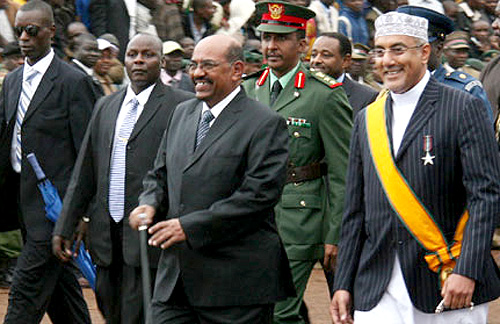
Sudan's President, Omar al-Bashir, (center) at the Kenyan ceremonies.Several of you asked for a translation of the beautiful music, Daima Kenya, posted Friday. Others, including NPR, might profit from a translation of a little bit more.
Kenya’s weekend parties were glorious, beyond glorious. And I’ve provided a translation of its unofficial national anthem, Daima Kenya, below.
Swahili translations are very difficult. It’s much easier to translate NPR’s irresponsible reporting.
Some day I won’t start these tirades with the qualifier that “I love NPR,” but I do. I think they’ve just stretched themselves too thin trying to report from Africa. The files are glaring for what they don’t say.
Friday and Saturday I listened with pleasure when NPR headlines reported the Kenya celebrations. So Sunday when headlines reported that Sudan’s President had snuck into the dignitaries box to watch the “promulgation”, my interest peaked.
But in fewer seconds than it takes to close this browser, they managed only to say how displeased President Obama and Kofi Annan were. No further explanation.
There’s an old African expression that goes something like, if you’re prostrate on the ground a tiny little thing right in front of you will obscure the tree that’s crashing down on top of you.
Bashir should have been arrested when he entered Kenya. In fact, the decision to allow him to attend must have been very last-minute, because he didn’t fly into the ordinary international airport, where presumably police and immigration officials have him on a most-wanted list.
Instead, he suffered the indignities of a tourist on a longer flight and smaller cabin by flying into the tiny Wilson Airport which doesn’t handle jets.
Bashir has been indicted by the criminal court in the Hague, no less a world legal authority than Kofi Annan’s United Nations. There is a warrant for his arrest in most countries including Kenya. Virtually all sane minded people – and that definitely includes the Kenyans – agree that he’s a criminal who should be tried for crimes against humanity, specifically in Darfur.
Although The Sudan shares a border with Uganda, Bashir didn’t attend this month’s Organization of African Unity conference, because the Ugandans said they would arrest him.
No one even thought to ask if he were invited this weekend. Since he hadn’t been allowed next door into kissin cousin’s Uganda for the OAU, it was unthinkable!
At least for far, far away radio networks.
I very much respect the International Court and I wish that America would sign on to it, rather than sequester itself with those other moral pillars like China. Bashir should be tried and convicted.
But in January there is going to be a very important election in the southern Sudan, in which we all hope (especially the southern Sudanese) that they will cede from greater Sudan and become a separate nation.
This would end two generations of civil war, stop the unbelievable horror of militias like the Lord’s Resistance Army which have plagued the southern Sudan and Uganda for 30 years, and bring a modicum of peace to this tortured area.
So far, because of Kenya, Bashir has gone along with the process. This in itself is absolutely astounding. And it would not have happened without Kenya’s constant political involvement. And it will not happen if Bashir, as the leader of Africa’s largest land country filled with much of its oil, does not agree right up to the moment that new borders are demarcated and different flags raised simultaneously.
Get the picture? NPR is just radio.
Now to the next translation.
Swahili is an incredibly melodic language, essentially because there are five classes of noun which more or less begin with the same letter, and most every adverb and adjective that refers to that noun must also start with that letter. So you usually have this beautiful sentence with every word sounding a little bit like every other word in the sentence.
That’s music or a poem, and to translate that into a language without that uniformity of sound is really very difficult. Yet that’s really most of the beauty of Daima Kenya: it’s poetic melody.
Really, you can enjoy – you can feel — the message just by listening to the sounds.
So here’s a straight translation:
VERSE 1 Umoja ni fahari yetu
Undugu ndio nguvu
Chuki na ukabila
Hatutaki hata kamwe
Lazima tuungane, tuijenge nchi yetu
Pasiwe hata mmoja
Anaetenganisha
Unity is our pride.
Unity is indeed our strength.
Hatred and racism
We can’t afford.
Everyone is needed
To rebuild this country
Every single person.
CHORUS Naishi, Natumaini,
Najitolea daima Kenya,
Hakika ya bendera
Ni uthabiti wangu
Nyeusi ya wananchi
Na nyekundu ni ya damu
Kijani ni ya ardhi
Nyeupe ya amani
Daima mimi mkenya
Mwananchi mzalendo
I live, I hope,
I’ll always work for Kenya.
Our flag is my beacon:
Black for the people,
And red for the blood.
Green for the land,
And white for peace.
I’ll always be a Kenyan:
Citizens us all.
Verse 2 Kwa uchungu na mateso
Kwa vilio na uzuni
Tulinyakuliwa Uhuru na mashujaa wa zamani
Hawakushtushwa na risasi au kufungwa gerezani
Nia yao ukombizi kuvunja pingu za ukoloni
For the pain and suffering,
For all the sadness
We won our liberty.
Those heroes of old
Who were shot and imprisoned:
Their purpose was
To break the yolk of colonialism.
Verse 3 Wajibu wetu
Ni Kuishi kwa upendo
Kutoka ziwa Mpaka pwani
Kaskazini na kusini
Our purpose now is
To live with love:
From the lake to the coast,
North and south.
Kenyan John Cardinal Njue is leading a national boycott of taxes.The conflict between church and state is an abrasive one in the U.S. as it is in Africa. But even as in Kenya when the church is on the right side, it doesn’t belong in the room.
The nearly three centuries of western religious involvement in Africa has had mixed success. There have definitely been periods where religious activism has helped Africa develop, but in the main I think it has had a negative net effect.
And today in Kenya, Christian activism threatens the finely tuned and arduously developed political movements that are otherwise directing Kenyan society down the right path.
This is such a touchy subject that I feel before explaining the previous statement, I need to highlight the good work that has been done by Christian activism.
Outstanding clerics like South Africa’s Desmond Tutu and Nigerian Cardinal Ekandem played sometimes pivotal roles in the peaceful developments of their societies. And during troubled times, such as Kenya’s 1990 street riots, the churches not only offered sanctuary but sanity to a disturbed society.
I don’t believe that Liberia could have survived as it did resulting in the promising situation found there today without a bevy of Christian religious leaders shoring up the little of sane society that was left after Charles Taylor was forced out.
But right now Christian activism is dangerously far too politicized in Africa, and Kenya provides the best example.
Kenya is holding a referendum for a new constitution in August. This is the end of a lengthy process of reconciliation between two warring political factions which caused the violence that followed the December, 2007, elections.
Those elections were so close, and certainly now proved so fraudulent (on both sides), that a clear winner couldn’t be determined. The slums of Nairobi erupted, and violence overtook much of the country. By the time the smoke settled more than 1300 people had been killed, and more than 150,000 displaced.
But credit to those in charge with serious help from Kofi Annan, Britain and America, the two factions formed a coalition government that works well, today. And part of the agreement required that a new constitution be adopted, which at its core would better regulate and adjudicate elections in the future.
That constitution will certainly pass. The process by which it was written was often tortuous but mostly transparent, and every segment of the Kenyan population contributed.
And now, the Christian church coalition opposes the constitution. And this is not just a tacit opposition, but an aggressive one. Every Sunday pulpit has a ranting cleric telling its parishioners to vote NO.
No matter that a NO vote will disintegrate Kenya. The church is opposed to a section – a small section in the constitution that allows for abortion in certain life-threatening situations. (And secondarily, it is opposed to the establishment of Mahdi courts, Islamic courts, for civil cases in Islamic areas, and when requested by all the litigants.)
Like the American right – which is openly and actively funding the church campaign against the constitution – there is little interest in the wider and much more profound issues like executive power and taxes. They cling to this one moral issue as paramount. Paramount to destruction.
And today, the church announced it would organize the country to not pay taxes, if the current legislature raises its salaries.
Now believe me, the move by the current legislature to raise salaries is patently wrong. The country like the rest of the world is in recession and piling up debt. The new constitution, if passed, will disallow legislatures to set their own salaries as they do, now.
And the current Finance Minister, who must approve by integration the bill in the legislature into his overall budget, appears dead set against doing so. In that regards, it’s a mute issue.
But the churches are ringing the church bells in opposition – what could be properly described as unnecessary opposition.
Church involvement in Kenya is not just irritating because of the positions taken. Recently, a coalition of more than 100 Christian organizations, the Micah Network, announced ”a strong statement that the church has no option but to be fully involved in making a difference to reduce carbon emissions and the impact of climate change on particularly the poor and disadvantaged” and “particularly to be lobbying governments to implement legislation to reduce carbon emissions.”
– (Summarized in a blog published by A Rocha Kenya on July 31.)
Wow. I totally agree. Well, I mean with the thing about climate change.
But NOT when it is framed as a Christian (religious) issue, as was elaborately done here. To embrace this methodology would suggest that unless something has a Christian stamp of approval, it’s not vetted enough, not sufficient to become public policy.
So it’s not just a matter of issue: abortion, on the one hand, or climate change, on the other. Christian organizations have every right to support or oppose public policy, but it is dangerous when that position includes “lobbying governments.”
Government is always acts of compromise. Religion is just the reverse. I’m hardly the first to suggest the two should be separated.
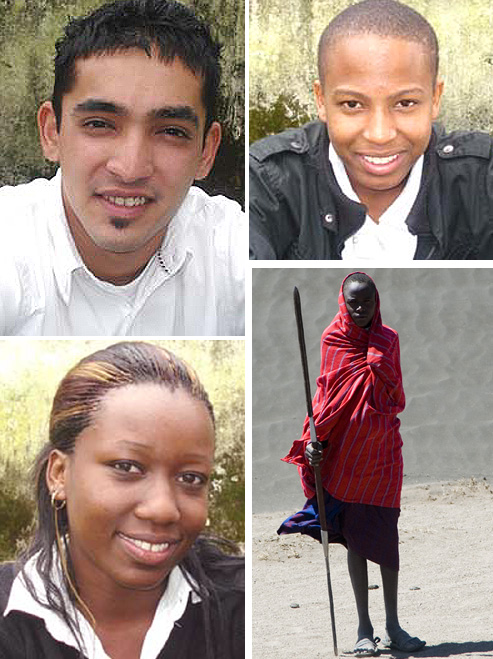
Clockwise from bottom left: Zita Kamwendo, Ranaf Makhani, Jimmy Masaua and Unnamed Herdsboy.It’s high school graduation time! A time for celebration, parties and boasting! Here’s a selection of graduates from Tanzania. I’d like to know which you’d like to meet.
These four kids have been born and raised in northern Tanzania, but their stories are replicated continent-wide.
Headed to the University of Cape Town’s engineering school is Jimmy Masaua. He won the top Cambridge exam award in geography. (The Cambridge exams are used more in Africa than SATs for college-bound students.)
Jimmy is destined for a busy career. Tanzania’s infrastructure is set for an enormously rapid development with the new discoveries of oil, gas and gold.
And Zita Kamwendo won the top Cambridge exam award in business studies. She’s headed to either Rhodes or Wits universities in South Africa and wants to become a lawyer. Zita is currently working at a hotel in Arusha, a city which has been growing rapidly and unlike so many cities, in a beautiful way.
Ranaf Makhani, in his own words, wants to be “The savior of Tanzania’s economy (possibly).” He was the top performer in the Cambridge exam’s economics division. He’s headed to the London School of Economics. Ranaf’s humor of “possibly” saving Tanzania’s economy is filled with truth. Many people believe Third World needs an economic revolution to stabilize.
And then, there’s the unnamed herdsboy.
There are probably ten unnamed herdsboy for every Jimmy, Zita or Ranaf. He’s nondescript. His name changes with his dreams. He doesn’t want to be an unnamed herdsboy, but he’s poor. He went to school for as long as his family could support him doing so, which wasn’t for long. There’s nothing glamorous about his life. He’s often sick and usually hungry.
But tourists want to meet him. Tourists want to meet him much more than they want to meet the truly promising kids: Jimmy, Zita or Ranaf. I’ve never understood this.
Africa’s young and well educated kids tower above their western world counterparts. No matter how privileged they may have been, how lucky to have been born into a family with some modicum of wealth, the efforts they put into their studies and upbringing are goliath compared to a typical American kid.
But who cares? Not American tourists. American tourists prefer to meet the unnamed herdsboy. They especially want to see him in his filthy village. After all if you can afford a safari, you probably have your own Jimmy, Zita or Ranaf.
The herdsboy agrees to meet tourists, because they sometimes give him food. Otherwise, he mostly covets their wealth, and then despises himself for doing so, and then becomes very angry.
Jimmy, Zita and Ranaf are destined for glorious futures well deserved and earned with an obsession that a typical American youngster might bring to PlayStation3.
Unlike Jimmy, Zita or Ranaf, the unnamed herdsboy is destined for a miserable, short life. Except for one possible career usually open to him. As a tourist, you wouldn’t want to meet him once he embarks on his job, so make sure you visit his village early.
Nairobi's famous cartoonist, Gado.I have little doubt that the Gulf Oil Spill may become the most catastrophic environmental disaster of my life. I hope it will focus your attitudes towards the Third World.
Caution: I don’t expect to get oil on my hands, or for my livelihood or retirement to be profoundly changed. Nevertheless, I know it will impact me in more serious ways than any other environmental disaster in my life time.
I expect this is true of most Americans. Those who live in the Gulf region will obviously be much more greatly impacted than I will, or those who farm sheep in Montana. But no other disaster – the Oakland earthquake, the Valdez spill, Mt. St.-Helens, Katrina, the Easter Sunday twisters, the Yosemite fires – will have as serious or lasting an impact.
It will likely have an impact on how I vote. It may even have an impact on how I shave or use lights at night.
This is major. Then, why, is there so little – if any interest at all, by East Africans?
The news has been duly reported. But there’s been no local comment, and not a single blog in a blogsphere that is hypercharged and overly active.
But there has been one, very important, cartoon. See above.
I think East Africans see America’s horror at the gulf oil spill as globally hypocritical and markedly irrelevant to their way of life.
Both these views are essential for us to understand. In no way am I suggesting that we should not be horrified by the spill; or that we shouldn’t change our ways because of if. But just for a moment, let’s see what this personal horror reveals of us to the Third World.
GLOBALLY HYPOCRITICAL
There are so many estimates flowing around right now as to the economic impact of the spill that it’s too early to turn the disaster into numbers. And I know the numbers will be huge. But you don’t have to be a statistician to make valuable comparisons with numbers in East African which are already known.
The gulf oil spill disaster will be hard pressed to reach the impact on Americans that the 1991 civil war in Somalia and subsequent rape and destruction of its Red Sea coast has had on Somalians.
Remember that the 1991 civil war in Somalia was a direct result of the end of the Cold War and the abandoning of East African states as proxies by the U.S. and the Soviet Union. We as Americans are responsible for that.
(Most of the details which follow were first published by Andrew Mwangura last week in Pambazuka.)
More than 200,000 fishermen have lost their livelihoods on the Somali coast, and the biomass of the world’s fifth most diverse fishery is being destroyed by illegal fishing by First World corporations and by illegal nuclear and toxic waste dumping in Somali waters.
The 200,000 fishermen were the bulwark of more than a thousand Somali coastal villages, which have been either eliminated or transformed into pirate villages increasing allied with al-Qaeda.
UN documents quoted by Mwangura report the first evidence of people dying from toxic waste dumping was in the village of Eel-Dheer in central Somalia when dark blue long barrels of a toxic material washed ashore in April, 1992, leaking an oily liquid. That was less than a year after the U.S. abandoned Somali following Blackhawk Down. Within a few years Eel-Dheer no longer existed. Everyone was dead or had left.
The UN analysis of the “oily liquid” confirmed that it was nuclear waste. Several other incidents have happened since, the latest in 2005.
In mid 1998 a 45km long and 5-7km wide oblong of dead fish washed ashore just south of Mogadishu to Warsheekh. Less spectacular but regular dead fish “oblongs” appear across the Somali, Eritrea and northern Kenyan coasts.
Further out to sea, but still well within the 12-mile international limit that theoretically still belongs to Somalia, ECOTERRA describes how First World countries are raping with impunity the rich biodiversity of the Somali Red Sea. Constrained by their own countries’ environmental laws, and even more often breaking international laws in an area unlikely to be well monitored, these vessels are decimating the Red Sea of tuna, mackerel, swordfish, grouper, emperor, snapper, shark, shrimp, rock-lobster, dolphins, sea turtles and sea-cucumbers. They have diminished the extraordinary population of dugong to near extinction.
According to ECOTERRA, the fishing vessels which have been systematically raping the Somali waters since 1991 (in order of greatest number) are from Italy, France, Spain, Greece, Russia, Britain, Ukraine, Japan, South Korea, Taiwan, and India.
Except for India, these are all first world nations.
According to the High Seas Task Force (HSTF), there were over 800 such fishing vessels in Somali waters at a single time in 2005. That year, High Seas estimated that more than US$450 million in fish value was taken from Somalia.
Surveys commissioned by the UN prior to 1991 in a larger report trying to document a peaceful Somali economy estimated there were 200,000 tons of sustainable fish per year that could be harvested from Somali waters. High Seas estimates that 300,000 tons is now being harvested annually.
(Hugh Seas, ECOTERRA and Mwangura make compelling arguments that current Somali piracy is essentially the former Somali fishing industry forced into attempts to control its rightful grounds.)
MARKEDLY IRRELEVANT
This is a lot easier to explain but harder to fully comprehend. Simply refer back to Gado’s cartoon above. Unlike us well off Americans, a person’s security in East Africa hardly exists day-to-day. Third World people are beset by so many problems that another natural disaster is simply not unusual.
They make do after earthquakes, revolutions and droughts, often in unseemly if creative ways. Kenya and Uganda have recently announced very promising oil and gas discoveries that the Chinese are developing at a speed unimaginable.
Japan has announced a $1.2 billion dollar project to build an oil pipeline from the southern Sudan to the yet-to-be built port (by the Chinese) on Kenya’s island of Lamu. (Or in place of the island, probably.) The risk for an accident or environmental catastrophe is much greater than for the more than 4000 oil rigs currently sitting in the Gulf of Mexico.
But it doesn’t matter. The cost-benefit ratio isn’t great enough to stop Third World peoples from doing anything they can to make tomorrow better than today. Cost-benefit is calculated in hours and days, not years or decades. It reflects an individual’s life, not the life of our planet.
Until the vast majority of the world, its poor peoples, see a future worth saving, the planet is doomed. And right now, their future doesn’t look very promising.
Watching the brown pelicans dying on a CNN short, I found myself viscerally effected by this spill in a way I hadn’t expected. I know that it will effect my life. So now take that feeling and try to imagine an East African who carries that feeling with him every moment of every day.
 Worldwide people have used elections to express dissatisfaction. That’s the limit of a democratic vote. You can’t say what to do, just that what’s being done isn’t OK.
 It’s a fascinating answer, if you’re willing to believe me. I think the wave of dissatisfaction emanates from The States and that it’s really more impatience than disapproval.