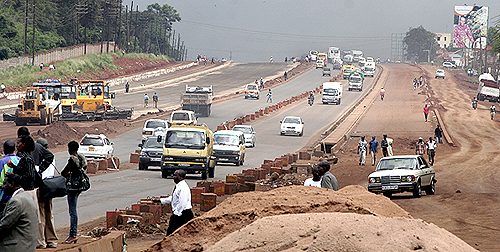
All (12-lane) roads lead to Nairobi.Three years ago China started building roads all over Kenya, including an 8-line highway between Thika and Nairobi. It’s now 30 miles of 12 lanes!
(Stop! Yes, the Kenyan wilderness away from Nairobi is still beautiful and healthy. You still will find lions in the Kenyan wilderness. Not to worry, there.)
In the few short years since the Chinese road building boom started throughout Kenya, the growth of the satellite suburbs has exploded. People saw roads finally being built (rather than the money for cement bloating the pockets of politicians) and began to realize they really could live cheaply outside the city and still work there.
It’s the same dynamic China has been grappling with for nearly two decades of incredible growth. I, for one, can’t understand how on earth it’s going to work, but I’ve heard that China is doing pretty well.
Once all these cars get to the city, what will they do?
Kenya’s main newspaper, The Daily Nation, reports 1000 new cars are being purchased to be used in the city EVERY MONTH.
I’ve written elsewhere how you have to avoid arriving Nairobi’s international airport on any weekday morning, because the traffic is so congested that it takes up to two hours to move a mere 11 miles from the airport to the city center.
That’s not going to change. The great roads that China is building simply feed into the city. There are plans for a ring road to circle away those cars not intending to come into the city, but most of them are trying to get into the city, not around it.
The city center isn’t big enough!
This seems like a massive failure of urban planning. I’ve questioned the Chinese motives, because they are combing Kenya for oil and other business opportunities. But then, again, did anyone see Shanghai recently?
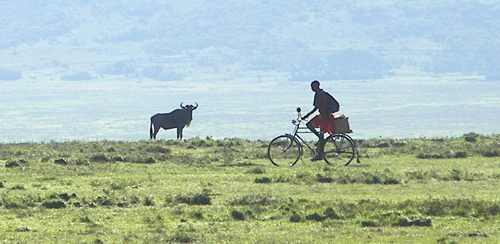
Wildebeest survive, but Maasai must move on.A remarkable study released yesterday by wildlife experts in East Africa that details the effects of the 2007-2009 drought unintentionally and benignly predicts the end of Maasai culture.
Reading way between the numbers of surviving zebra and elephant, I see an imminent end to Maasai pastoralism, the foundation of Maasai culture.
But first to the survey itself, remarkable for its professionalism and swiftness. Led by the Kenyan Wildlife Service, assisted by Tanzanian partners and professional wildlife organizations, it represents one of the finest and most complete ad hoc aerial animal counts I’ve ever seen.
The news was not good, but it was not expected to be better.
Nearly 60% of Maasai domestic stock and almost 50% of wild herbivores were lost in the greater Amboseli/Kilimanjaro/Natron wildlife dispersal area. (Elephant were hardly effected.)
The area studied is one of the most important tourist areas in East Africa. Included is Amboseli National Park, Arusha National Park, the eastern part of the Ngorongoro Conservation Area (NCA) and a number of protected private as well as hunting reserves that form a huge rectangle straddling the Kenyan/Tanzanian border just southeast of the Serengeti.
It is the second most highly visited tourist area (after the Maasai Mara, Serengeti and western NCA).
But tourism is becoming less and less important. There is so much human habitation in and nearby this area: The main Arusha/Nairobi road goes right through the middle. The northern reaches of the Moshi and Arusha municipal areas are found here. The heavy agricultural areas of western Kilimanjaro and Manyara border the study area.
So the modern human/animal pressures are great, but even more importantly, within the majority of the area Maasai pastoralists live freely. There is a dynamic argument going on today in East Africa regarding the efficacy of continuing to presume that Maasai culture will remain traditional enough that large numbers of Maasai can continue to coexist with big game.
I think this survey answers that question with a definitive “No.”
Pastoralists suffered on the same scale as all the wild animals tourists come to see. Nearly 60% of the Maasai’s stock of a quarter million cows and goats was lost. Wild herbivores like wildebeest and zebra will repopulate fairly quickly. Cows and goats can’t, not because their reproductive systems are that much slower, but because their reproduction is essentially managed by the Maasai.
Unlike wild animals that die in areas where there is no grass, a large portion of the surviving Maasai stock herds was nurtured through the drought by supplemental food sources, and not sufficiently so. So the stock herd that survives is much weaker and sicker than the remaining wild animal herds.
With an abundance of grass, now, wild animals are like to have several years of massively reduced infant mortality as the populations refill the ecological holes caused by the drought. Not so with Maasai stock. The over grazing that has plagued Africa’s farm stock dispersal areas for years has taken its toll. There has been massive loss of top soil, enormous erosion and farm stock dispersal areas are not growing grass in the same healthy way the protected wild life areas are.
Moreover, the toll on the Maasai families was severe. As precious as the stock is to a Maasai pastoralist, modern necessities are pressing on his day-to-day responsibilities. School fees. Potable water. Malaria control. Tse-tse eradication.
Addressing these human necessities compromises reinvigorating the farm stock.
What I think this survey shows is that the Maasai pastoralism is no longer sustainable in the climate change era we’ve now entered. For this so-called “drought” – definitely so in the area just under study – was not as wide spread as past droughts. It was more severe in many areas, but it wasn’t as universal. That’s what drought is, today, in a climate change environment.
And that in itself provides opportunity for modern man. And while it’s hard in this short space to explain the chain of events that would lead a Maasai pastoralist to abandon his herding for a bank teller job, that’s exactly what it shows.
I really don’t know if this is good news or bad news. But it is certainly news.
American religious fanatics are in East Africa announcing the end of the world and that the Kenyan draft constitution is blasphemous. What’s wrong? Not enough to do at home?
There’s no better object lesson on the futility of debate in America, today, than the stance taken by religious extremists. You can’t argue something that’s a lie except by calling it a lie, and that ends the discourse.
The result simply divides those listening into those who believe the lie and those who are calling out the lie.
And now these intellectually bereft righties have opened up a new battle front in East Africa. While I doubt it will work, their success in East Africa could be catastrophic. Several American religious groups are funding the “No Campaign” against Kenya’s Draft Constitution.
In July the Kenyan population votes on a referendum for a new constitution. The process of creating this draft constitution has been much more laborious and contentious than Obama’s health care legislation, but it represents a fabulous consensus among Kenya’s very fractured politic.
All the sane governments of the world are praising Kenya and the process that created the draft. The U.S. is pouring in considerable funds to help publish the draft and distribute it among the Kenyan population.
It’s a very fair constitution. Like all big legislation (and this is the biggest) it will be modified and reworked with time. But as a start it’s wonderful and should put an end to the potential for violence in the next election.
A powerful coalition of Kenyan churches opposes the draft and is campaigning for a “No” vote, which will throw the country into turmoil. Their justification? The draft constitution allows abortion.
Article 26 empowers doctors to end a pregnancy if it endangers a woman’s life.
The American-funded campaign in typical American extremist end-all-argument fashion extends the Kenyan churches complaint into a patent lie, claiming that the draft constitution allows “abortion on demand.”
Friday, Jordan Sekulow, head of Pat Robertson’s Center for Law & Justice, told the Associated Press that the draft constitution “..opens the door to abortion on demand.”
(“Tens of thousands of dollars” have already reached Kenya according to Sekulow’s blog on his site. In addition thousands of brochures printed by New York’s National Right-to-Life Committee are today being circulated in Nairobi.)
The American Center for Law and Justice (ACLJ) is a non-governmental public interest law firm founded in 1990 by the controversial televangelist Pat Robertson well-known for claiming that the Haitian earthquake was because the Haitians made a pact with the devil.
ACLJ gets its word out in Kenya particularly through the Christian Broadcast Network, which spends millions to achieve prime broadcast space throughout Africa.
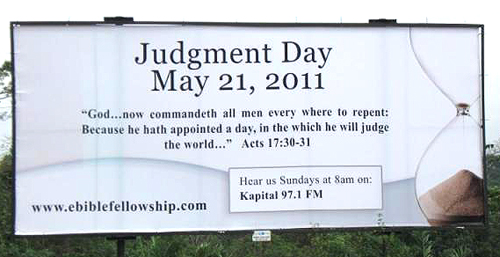
I’ve often wondered why Christian fanatics spend so much energy in Africa. Consider the Electronic Bible Fellowship located in Sharon Hill, Pennsylvania. Their most recent campaign is to alert the world that it is ending on May 21, 2011. Their technique is by erecting billboards. Here is the list of where their seven billboards are located:
Kumasi and Accra (Ghana); Dominican Republic, Addis Ababa, Maseru (Lesotho), Jamaica, and Dar-es-Salaam.
In the U.S. – where they live, or at least where they live until May 21 next year – they only use “moving” billboards – that is, signs on automobiles and RVs.
My brain is just too strained trying to figure this one out. Why do American religious fanatics do crazy things in Africa? I know there’s a reason.
And the best answer I can give right now is in Swahili. Sorry. But really, you don’t have to understand Swahili to laugh at this great Tanzanian comedian and his TV clip about the Dar billboard which eBible erected over a busy bus and matatu station in the center of Dar. Pull the timer button to just over 3 minutes to get to the segment where he “interviews” distraught Dar citizens who work under the billboard.
The damn theologians are screwing it up, again. This time in Kenya.
Kenya’s only hope for a peaceful and prosperous future lies in passing the July referendum approving the new constitution. After months of wrangling and horse trading, Kenyan politicians whose differences are much greater than Pope Benedict’s and Joseph Smith’s, have finished the draft. It goes to the people for a YES or a NO in July.
Guess who says NO?
Here’s the list:
.
.
Failed Presidential Candidates;
Demagogues;
Terrorists;
Politicians who will soon be named by the criminal court in the Hague as fomenting the last round of violence in Kenya after the 2007 elections;
and..
.. Kenyan theologians. Why?
Church leaders oppose the fact the Constitution doesn’t outlaw abortion. (Knowing that hot-button issue is alone too flammable, they have also publically opposed the adoption of “kadhi” or local culturally defined magistrate courts that in certain locals have a religious tincture : i.e., Muslim. But their overwhelming gripe is that abortions aren’t outlawed.)
On my safaris I praise African church leaders as instrumental in bringing not only peace but sanity to the continent. I explain that while I’m not religious, without people like Desmond Tutu and much less well known theologians, Africa would be a sinking ship.
But like everywhere in the world, Kenyan theologians have become politicized. It’s truly amazing to me.
Today, there is little difference between Pope Benedict, Representative Stupak or Canon Peter Karanja in Kenya. They have lost their religious mission and are stinging their way into the political process with the vengeance of a scorpion.
What the hell has happened?
I don’t remember as a kid the extreme tension that exists in the world today between the “Church” and “The State.” As a kid, in fact, the only recollections I have were the arcane references to it by my 8th grade history teacher.
And that was in Annie Camp Junior High School in Jonesboro, Arkansas, about as deep into the Bible Belt Belly Hole as you could get.
But the separation of Church & State was simply a given: a fundamental divide that was only mildly inconsistent with our opposition to the other guys in the Cold War.
“Having participated in three meetings with the government, we note with sadness that the greatest hindrance to a resolution of the contentious issues is not legal technicalities but rather the lack of political will,” said a statement read by Karanja, on behalf of 17 Kenyan denominations, yesterday.
He said that the draft consitution “faces a blanket rejection by Christians at the referendum.” And he urged all theologians in the country to preach as much to their parishoners.
If that happens the Church may have saved the sinners contemplating abortion, but they will have doomed the nation and culture of Kenya for decades. Every life they think they will have saved will be paid for handsomely by the mayhem that will wreck the country.
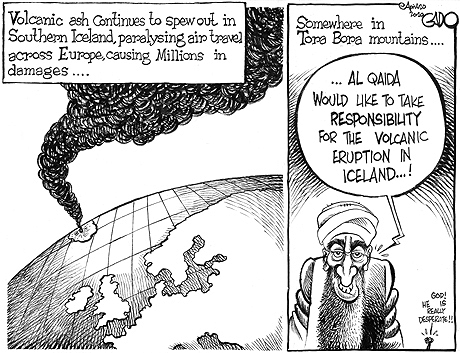
Daily Nation cartoon by GADO.Al-Qaeda is failing; Iran and North Korea are still threats, but not as imminently so, yet Americans are addicted to fear. So we’re turning inwards, dangerously so. We should take a lesson from Africa.
Sunday al-Qaeda militants crashed the Kenyan border at Liboi in the middle of the night, trashed the Ali-arif and Abdi-adoon hotels, and left a bomb that didn’t go off before retreating to Somalia. Not a single mention of it in the Kenyan press.
Was this an oversight? Was it poor judgment by the news editors in East Africa who instead were talking about the ash cloud over Iceland and the new constitution in Kenya? Or the horrible trash collections in Dar? Or the ongoing corruption in Tanzanian road building? Or more failures searching for oil?
No, because all of those issues were more important than the border crashing Al-Qaeda thugs in Liboi. Their bomb didn’t work! They posed no more of a threat to Kenya or the world than some errant middle schooler in Hamburg who can get his internet fingers on the design of a nuclear weapon.
But can you imagine how the growing group of American righties might think of this?
We thrive on paranoia. I just came back from six weeks in Africa to a culture of unbelievable accusations by the American fringe. Only one was new, but the old charges that Obama is taking away our liberties (and guns), that the new health care legislation will kill us, that bank regulation is bank bailout I had managed to forget. Once away from America, they seem impossible to believe.
But there they were, again. Palins, Bachmans, crazies crowding the media. Unbelievable. We trade in reasoning so that we can stay on edge: be afraid.
Here’s a great contrast between Africa and America, and the best example I can find for Americans to scale it down and learn from Africans.
Kenyans’ take on the Icelandic volcano is shown in the cartoon, above. A decrepit Osama bin-Laden trying to resurrect himself by taking credit for the volcanic eruption.
Fringe Americans’ take on the Icelandic volcano:
http://www.youtube.com/watch?v=yzVZ6UxN9qs
Which is more realistic? Which contributes better to our handling of terror, much less our handling of ourselves and our truly imminent responsibilities.
Woe, America. Watch out. Have you ever heard of the kite spider?
Any Westerner visiting the West African bush will most likely report that two things surprised them the most—the number of people with cell phones, and the number of video clubs.
Villages that boast narry a pump or health clinic will often have a video club.
The video clubs are simple affairs.
Some entrepreneurial soul scratched up enough money for a generator, small television, and a supply of horrible American action movies poorly dubbed into French.
(Thus propagating the belief that while people are all martial arts experts)
My Village Video Club in GuineaWhile Chuck Norris and Jean Claude van Dam drew a steady crowd every night in my village, the films that packed the video club to the rafters were the local films in Pulaar ( largest local language in Guinea).
There is a huge market for local stories tackling indigenous themes across the continent.
The African film scholar Mbye Cham observed that “…cinema by Africans has grown steadily over this short period of time to become a significant part of a worldwide film movement aimed at constructing and promoting an alternative popular cinema, one that is more in harmony with the realities, the experiences, the priorities and desires of the society which it addresses.”
The presence and popularity of these local films in my tiny Guinean village is indicative of a continental trend.
Digital technology now allows film-makers and musicians to avoid the costly hurdles of professional production.
Nigeria’s Nollywood puts out more films every year then Hollywood or Bollywood using these low cost techniques.
The Africans who manage to find financial backing for a major production often do well on the film festival scene for one or two years before their movie tumbles into irrelevance.
While digital technology makes production affordable, it tends to produce low quality films with stilted acting.
Most Nollywood films tell hackneyed rags to riches story pivoting on a supernatural object or being.
They remind me of the plot repetitions in American soap operas or reality T.V. spin offs.
I think this is just the beginning.
As Lucy Gebre-Egziabher says in her article on the effect of digital technology on African film, “…we must acknowledge and learn from the achievements of these new directors. They have demonstrated that producing African films, in general, is a viable business and have elicited healthy investment from Africa’s conservative business sector”.
The strength of this market will inevitably improve production quality.
Amateur producers who tackle relevant local themes in new and creative ways will be rewarded by more sales and more investment, while producers who fail to improve will plateau.
For those who live in the New York area and have never seen African film written and directed by Africans—take an afternoon between April 7th and 13th to see the world through African eyes.
This week the African Film Festival kicks off in New York City, at the Walter Reade Theater in Lincoln Center. (April 7th- 13th ).
The 19th annual festival explores the theme “Independent Africa”, as 17 different African nations celebrate their independence in 2010.
This exploration will include a mélange of classic and contemporary African cinema and art, as well as a series of panel discussions on current trends in African visual arts.
The general public can pay per film or event ($9-$12), or buy an all access pass ($99) at the Walter Reade Theater box office.
The festival program offers a wide variety of shorts and feature length films written by Africans living on the continent as well as in the diaspora.
Here are a few of the critics’ favorites:
From a Whisper: Director and script writer Wanuri Kahlu’s From a Whisper won the coveted ‘Best Narrative Feature” award at this year’s Pan-African Film Festival in Los Angelus. The film explores the 1998 bombing of the U.S. Embassy from an African perspective.
L’Absence and Burning in the Sun: Both of these films examine the experience of an African emigrant returning home. I find these stories fascinating across all cultures, but particularly in Africa. What does home mean to these emigrants when they return? How does total immersion in Western Culture affect the emigrants African identity?
Sex, Okra, and Salted Butter: Another decorated African film that delves into the immigrant experience. In Mahamat-Seleh Haround’s comedy, a traditional Cameroonian man must deal with the flight of his wife, the discovery of his son’s non-traditional sexuality, and life in Paris’ black community.
I note these films because of their critical acclaim, but there are over 40 films on the program. Many of these films make their U.S. debut this week.