Vested Interest

Vested Interest

With one month to go, President Obama admonished Kenyans to hold a peaceful election. Obama wasn’t just preaching the word. Critical U.S. policy is predicated on a successful Kenyan election outcome.

There was nothing surprising in Obama’s one-month-to-go pep talk. But as I listened to it, I realized it was powered by the deep behind-the-scenes U.S. African foreign policy that has driven so much of African history in the last few years.

The routing of al-Qaeda, the pacification of Somalia, the fugitive chase of the LRA, the massaging of Rwanda hegemony, the less successful use-and-throw-away Uganda geopolitics, the deep skies of drone assassinations – it’s all a remarkable mosaic of clever and intricate U.S. policy.

And Kenya is the linchpin.

Unfortunately, the policy is driven overwhelmingly by Obama’s hunt of terrorists. That’s a fine thing to do, don’t misunderstand me, but developmental imperatives seem to get attention only when the greater objective of wiping out the terrorist prevails.

So that the “war on poverty” is far subservient to the “war on terror.” This is short-term strategy.

Kenya is fundamental to this policy. America rebuilt Kenya’s military and notably the product looks mighty good. Compared, for example, to Mali or Nigeria or Afghanistan, the Kenyan military forged enough independence and local celebrity identity that it functions better than anyone could have imagined only five years ago.

And there seems to be no dichotomy between the military and civilian authorities, as in Pakistan, for example, or Egypt. America has created a fighting arm in Kenya that is totally beholding to its brain.

That’s good, yes. And from Obama’s point of view, more importantly, it’s been effective.

Now comes the election, the ultimate validation of a non-revolutionary society, of a stable politic based on “strong institutions” and “just government.”

No country in the world today can achieve what America did in 2000: institutions so strong they prevailed even while being irrational. That’s what happened when the Supreme Court effectively – with no precedent or authority whatever – wound down the mechanisms of challenge and handed victory almost willy nilly to the man who had lost.

And the defeated graciously walked away to become a billionaire.

That standard is unattainable by any but America. But Kenya can come near enough to validate the policy that sustains that potential. If it doesn’t, Obama policy in Africa will in a blink no longer be validated. If Kenya unhinges itself by Bronx Cheering the very institution on which Obama policy is founded, then everything the U.S. has done in Africa is lost.

Somali could tear apart, again. Militias in the jungles of The Congo would rearm and reform. The Arab Spring could become Arab Hell. Terrorism would be reborn.

It sounds like an exaggeration.

Should the Past Burn Away?

Should the Past Burn Away?

The Mali war has reignited an old debate: should precious artifacts always be returned to the motherland, or should they be kept in safety by the greater, more stable powers of the world?

Yesterday France returned to Nigeria in an elaborate ceremonial handover several confiscations of ancient Nok Arts, prized terra cotta sculptures of Nigerian empires of the 6th century. Over the last several years Yale University has begun a near complete repatriation of the Hiram Bigham artifacts the explorer took from Machu-Picchu in the early 20th century.

And while Paris remains replete with Egyptian artifacts like the obelisk acquired especially during Napoleon’s reign, France is slowly repatriating these, too.

And then comes Mali.

Without ancient artifacts from foreign lands such august institutions as the British Museum would be near meaningless. Chicago’s Field Museum would be emasculated. Taipei’s National Palace Museum would be crushed. And the Louvre – my goodness, Le Louvre, would be nothing more than a home for the Mona Lisa.

But is it right that such national treasures be housed away from the Motherland?

The treasures of Timbuktu rank right up there with the pyramids and Inca kings. In fact, many believe they are the most precious artifacts the world has.

This is because among its mosques and building relics are housed many of the world’s oldest written manuscripts. The oldest registered manuscript – at least before the current war – was dated from 1204. It included texts not just on world religion but astronomy, women’s rights, alchemy and medicine, mathematics and linguistics.

Timbuktu was a natural place for such ancient manuscripts. For several millennia before the modern age it was the crossroads of two major trade routes: the Saharan camel route with the Niger River.

But it was not until the 16th century when the area was arguably at its prime that a famous and wealthy scholar, Mohammed abu Bakr al-Wangari, established a “library” of ancient scrolls and documents. He spent the last 30 years of his life collecting these treasures, and when he died in 1594 they were inherited by his seven sons.

Collection and restoration continued for the centuries thereafter, but without a strong centralized government it was haphazard and often random. Timbuktu’s most prominent families became identified with their libraries of ancient texts.

By the turn of the 20th Century it was estimated that more than a quarter million books, notes, drawings and other relics of the past were being lovingly preserved by literally thousands of Timbuktu’s 100,000 residents.

UNESCO became deeply involved years ago, and in 2005 a huge portion of its cultural restoration budget was dedicated to Timbuktu alone.

But because the manuscripts – the most precious treasures of all – were still legally in the hands of individual families, UNESCO cleverly over the years poured its funds into the remains of ancient mosques and mausoleums. Slowly over time these attracted manuscripts.

Still the vast majority of texts were aggressively retained and often hidden by individual families. In 2005 South Africa convinced many of them to stop burying ancient parchment in the sand whenever trouble arose, and began a library.

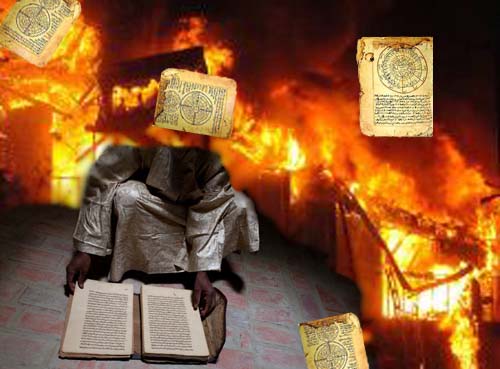
That extraordinary effort went up in flames as the Islamists left Timbuktu last week.

One of the most visible of the many libraries was Timbuktu’s Ahmed Baba Institute for Higher Studies and Islamic Research. When the Islamists first took over Timbuktu, the adroit director managed to convince one of the leaders of the importance of the texts to Islamic law.

Then, over the next months, he smuggled 28,000 of the most precious manuscripts out of the building. When the Islamists left, they burned what was left.

How much has been lost? Inventory is still going on, but the point is that most of these remarkable documents are still in private hands, libraries and collections of various Timbuktu families.

Is it time that such precious relics of humankind be removed to safer places? Or at the very least removed to Bamako and protected there?

Voodo & Algebra

Voodo & Algebra

No time for nostalgia in Africa: The continent’s development is so fast, its demographic so young, kids are spinning like tops. It’s fabulous and scary.

We old folk simply get dizzy. Kids like dizzy. And we old folks should be very careful about criticizing this seemingly directionless enthusiasm. When the top finally stops spinning it’s going to land somewhere with a very loud thump.

Richard Engel of NBC news expressed it in a most dire fashion Sunday on Meet the Press when he said that African youth — and youth in general in the developing world — are looking away from America towards China.

He’s right. In fact I thought almost everything Engel said on Meet the Press was right, and he got clobbered by my age-peers for saying so, or just ignored. But Engel is right on. Democracy is just a tool in the basket of social organization, and right now, it’s not the most attractive one to African kids.

Imagine if you were a just cognizant self-aware Kenyan teenager when Bush invaded Iraq, your main city of Nairobi was a massive jumble of stick buildings and sewered-over roads, your school hardly had pencils and all you and your buddies could afford were pirated CDs of MnM from China.

And today your city of Nairobi has skyscrapers and 8-lane highways, thanks to the Chinese who all you had to give them was your oil; your school has computers and you have a Smartphone, thanks to the Chinese who all you have to give them was your oil; and you’ve started your own rap group that will be performing next month at the famous music festival in Zanzibar.

Thanks to spnsorship from the Chinese who are funding the electricity in Stone Town, and all the Tanzanians had to give them was their gold.

Well, before you grow old enough to analyze all this, who would you be thanking?

Engel is right. America and the west has disengaged, not intentionally not because Obama and Hillary aren’t doing infinitely better than Bush or Condoleezza, but because youth moves faster, and today, Africa is youth.

Social organization is only one thing.

Cultural organization is equally fascinating.

Eighteen-year-old Adrien Adandé of Benin is a decent enough high school student. But after turning in his history term paper and the school bell rings, he chooses rather than join his buddies in the locker room to gear up for the school’s winning soccer team, he’ll do voodoo.

“My friends tease me and call me a fetishist,” he explains. “Others keep away from me, fearing I might harm them with my amulets. But I stand by what I do. I can combine my studies and my vocation perfectly.”

We often look back at our own youth and marvel at how things have changed. Nostalgia often gets the better of us, and we pine for the past, and the past is uniformly slower, more tranquil and seemingly less demanding of our energies.

Imagine African youth, today. They aren’t even old enough yet really to look very far back, but every second backwards is like an epoch in time. The transformation is too fast for nostalgia. Cultural takes time to form.

Radio Nederlands quoted a 23-year-old Benin philosophy student who explains Adrien’s voodoo as a means for youth to anchor themselves: “With globalization [and] the expansion of the so-called revealed religions… young people have turned away from” modern culture.

The “Market” understands. The “Market” moves faster than governments.

One of the most suddenly successful marketing and media firms in Africa is Instant Grass, which is devoted to helping vendors sell to youth. But its reports – free from its site – outdo western university Ph.D. studies on what is happening to youth, today, in the developing world.

“The rise of the Internet and mass media has also confused identity further with Western/African-American culture having a strong influence. The reaction of African youth is to create an eclectic culture that embraces both MTV and traditional practices and thinking that flits effortlessly between the two.”

Ergo, voodoo and algebra.

This is an absolutely astoundingly colorful and awesome dynamic to watch. And I truly believe the outcome will be positive. There is simply too little egocentrism in African youth, today, to result in limits to personal freedom. Dictators are gone.

But be prepared for something that isn’t necessarily the democracy of America. And there’s nothing at all wrong with that.

King, Racism & Obama II

King, Racism & Obama II

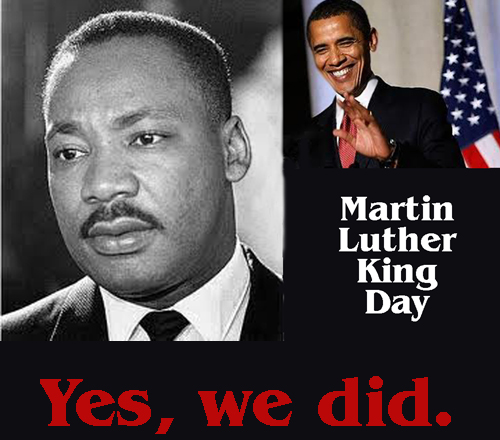
Today is one of the most important benchmarks in the American calendar, the Martin Luther King federal holiday. When I look back a year, I see progress towards greater social justice all over the world.

It isn’t uniform, of course. What’s transpiring in north Africa seems at this moment a step backwards. The misguided South African ruling party toys with national catastrophe. Central Africa is more turbulent than ever, and the entrenched and wicked leaders in Uganda and Rwanda seem hell-bent on those countries’ global isolation and backwardness.

Dr. King was the most profound proponent of radical change by and strictly by non-violence. That means his version of social change must come either within the existing system or through non-violent civil disobedience.

It is hard to imagine how Mali, Uganda or the eastern Congo will be moved forward by non-violence.

But even during Dr. King’s days civil disobedience was not without violence. Was the threatened doctors’ and nurses’ strike in Kenya to be non-violent? Technically, yes, but thousands would have died. The many various teacher strikes throughout Africa this year were all non-violent per se, but children denied their only substantial meal of the day became sick.

What I most remember of King’s turbulent last days was unbelievable violence. My most vivid memory is as a very young journalist penned under a burning El Stop in downtown Chicago while the city raged in reaction to King’s assassination.

I remember gun fire was a regular sound in my low-rent apartment in Washington, D.C. during the summer of 1968. Or the unending sirens and tear gas around my apartment in Berkeley that fall.

King is duly revered for radically changing American society with non-violence. Yet what I remember most is fire, bullets and ambulances.

Today President Obama is inaugurated for the second time. Our first African American President, some of whose relatives still reside in Kenya. The racist opposition to him remains strong. Powerful white elected representatives in Congress still engage in racial slurs and oppose him simply because he’s not white.

During his first term he battled mounting opposition to reverse his election on the grounds he wasn’t a native born American, despite his native State of Hawaii publishing nearly a million official copies of his birth certificate.

The horrible individual gun violence which has occurred in America during his first term, in cities like my native Chicago, and in horrific incidents like Sandy Hook and Aurora is due certainly in part — perhaps large part — to the growing ethnic and social divides that cleave America apart.

King’s philosophy of non-violence, like Gandhi’s and to a much lesser but significant extent Mandela’s, were not eras of no violence. There was incredible violence, and this violence — as with the sizzling El Stop that nearly fell on me — will be blazoned in our memories forever. But with time we’re able to reflect that that violence was the reaction to those heroes’ methodical, unswerving actions for a freer, fairer society.

And that the victims of that violence, whether a young student protestor clobbered by a policeman’s baton or an innocent six-year old school child gunned down by a madman embodying the evil of his society, are the heroic soldiers in a more just war than those who fire on enemies to wear medals.

Today, my President is black. My Attorney General is black. Dozens of colleagues, friends, employees and clients are yellow and orange and black, and this compared to my father’s generation would have been all but unbelievable. The world has changed for the better.

Happy Birthday, Martin! You’d have been 84, today!

#3 & #4: So Well but The South

#3 & #4: So Well but The South

2012 demonstrated more than any other year that African countries are doing better economically and advancing faster socially than their counterparts in The West, their former colonial masters. Except, I’m afraid to say, the giant in the hut, South Africa.

My #3 Top Story of 2012 is the explosive narrative of African progress, and the #4 story is the significant exception, South Africa. To see a list of all The Top Ten, click here.

“Africa isn’t just a place for safaris or humanitarian aid. It’s also a place to make money,” says New York Times columnist Nicholas Kristoff. The well respected author then went on to site dozens of statistics showing Africa out pacing the world economically.

Clearly the average African is neither as comfortable or well off as the average American. But that’s not the point. The average African is mountains higher in comfort and well-being than his parents, and there is every indication that his children will share that euphoric experience.

This is, of course, a generalization but I feel a fair one. Including Somaliland, there are 56 countries in Africa. Perpetual doom and gloom persists in Zimbabwe and the Central African Republic. Increasingly bad news in 2012 plagued Angola, Uganda, Rwanda, Chad and Mali. So my generalization applies to the rest.

This positive view stands in marked contrast to America, where the generation to generation comparison is dismal. The graph projected out another generation or two actually has parts of Africa catching up with American median income.

The World Bank explains this succinctly as a wealth of new natural resource discoveries. Like oil and gold.

But that’s hardly the end of the story. The new-found wealth in the ground is a necessary foundation, just as rich soil was to early Americans and oil was to the 1960s Arab in the Emirates.

But on that foundation is blossoming some exciting non-natural discoveries, in high tech and alternative energy, in natural products manufacture and a score of other industries.

It was poorly reported but extraordinary this year that South Africa bailed out Europe. That’s right. South Africa paid $2 billion into a world monetary fund to help with the Greek and other European bailouts. Economically, the First World took charity from the Third World.

And Africa has no qualms about embracing the best of capitalism, thank you. Walmart was welcomed into South Africa with a warmer embrace than most mid-sized towns in the United States provide the retailer.

But after the hugs and kisses were over, Walmart submitted to a labor agreement that Americans working for Walmart would die for. Why are they able to do this in Africa, and not in America?

And “thing development” is progressing no less fast than social and “thought development.”

Consider the media, (I am). A respected global media watchdog claims that Tanzania has a freer and better media than the U.S. This is because of the worst of American media, which pulls down the overall ranking.

But the worst of American media, Fox News, Rush Limbaugh and sorts, have made mincemeat of the truth, have thrown civility to the wolves and turned making money into a first principal that cares little about the effects of its nearly sadistic approach to the public need.

In defense some of us Americans would point to many exceptional online services like Wired and Mother Jones and The Nation (and dozens more), and as you examine those “good” media you’ll find out the reason is the same as for Tanzania’s position: youth.

America is aging less than gracefully and its right-winger lying mentality is very much linked to old guys. So perhaps Africa has an intrinsic advantage, since such a large portion of its population is young relative to America’s.

Yesterday was historic for the American Congress: 78 women in The House and 20 women in the Senate. This reverses a trend begun about a decade ago where women in elected office began to decline.

But in Kenya that would be mandated at 145 in The House and 33 in the Senate! Mandated?! Yes, Kenya’s new constitution requires that a third of all elected officials be women, almost doubling in one fell swoop what it’s taken America more than 200 years to accomplish.

The new Kenyan constitution, modeled but improved on South Africa’s new constitution, is quickly becoming a model worldwide. Simple and common sense things like religion banned from schools and institutionalized affirmative action that adjusts to ethnicity and gender as society continually changes puts Kenya on a markedly higher moral plane than America.

I think above all other things socially, though, is the new African attitude towards justice. America is petrified with the concept of sharia Law, for instance if applied in the new Egypt. But Americans understand little of this and can’t even see how any set of laws can be molded to virtually any social model.

Our own Supreme Court has bent and twisted, upheld and struck down, and essentially remolded and unmolded society again and again. American laws on such things as drug possession (marijuana), abortion, gambling and even incest and slavery have gone all over the chart!

There was no direction from the “Founding Fathers” on those issues part and parcel to modern day life. And the irony is that so many Americans think otherwise, that there is some Founding Father out there guiding our every move.

The new Kenya justice will be an amalgam of Islamic sharia and British common law. Some feat, eh? But beautiful and adjusted to the realities of its new society.

But Kenya recognizes – like so much of the world, America excepted – that there is a global morality, today. That there is a worldwide foundation for such things as basic human rights.

Four of Kenya’s most prominent citizens have submitted to charges filed against them at the World Court in The Hague. Voluntarily they will go to The Netherlands for their trial. Now it needs to be said, of course, that these criminals (as I think they are rightly charged) would likely not do so if the Kenyan public hadn’t forced them to. And that is the majesty and beauty of the situation.

An important aside: recently convicted in the World Court, former Liberian leader Charles Taylor in pleading for leniency in his sentencing for war crimes pointed out that he was convicted of crimes no different from those of George Bush in Iraq.

The justices gave no reply.

This was not the case for our own great Justice Ginsberg who dared to speak the truth in Cairo, when she told the Egyptians that maybe the U.S. constitution wasn’t right for them.

The onslaught of criticism that followed, the incredible vitriol from the right, wasn’t just humiliating to us Americans, it was … well, barbaric. It was truly like German Goths grumbling over Roman progressives. Ginsberg is of course right, and fortunately she rather than Senator Kruz is what Egyptians will and are considering for their own new, progressive societies.

But alas, it’s not all good news for Africa. Africa’s behemoth is South Africa. Its economy is multiples of the rest of the entire continent combined. Its history is as complex and fascinating as our own. And hardly 20 years ago it reformed itself into one of the most progressive, moral societies on earth.

But now, things don’t look so good.

Residual racism and neo-apartheidism are sprouting across its non-black societies. I don’t think this is because it was always destined to be so, that there was some kind of intransigent ethic among whites that would eventually surface again, like an old whale on its last sound.

Rather, it’s because the current president has made it so. Jacob Zuma is a joke.

He’s vain, and easily set off by criticism. He’s so wrapped up in himself, he’s let the country wander leaderless. He’s patently ignored the courts, acted like a banana republic dictator and all the while the country spiraled downwards.

Many local experts, white and black and left and right, are beginning to see him not so much a central actor separate from the times, but rather the embodiment of something greater:

The implosion of the ANC, the freedom fighter party that won the battle against apartheid and whose marshal was Nelson Mandela.

I think this is true, and that’s why this is my fourth most important story of 2012. Yet it’s with hope that I also see Zuma coming to an end sooner than the constitution would mandate, and of the ANC moving restlessly to get its act together. It may, however, be too late.

So the year ends on an incredibly positive note for the continent as a whole, but a seriously cautionary one for its grand marshal.
Us versus U.S.

Us versus U.S.

Easily 20 children are violently murdered in Africa every day. Ten Afghan kids were just violently murdered a few hours ago. Why are Americans so uniquely horrified at the events in Newtown?

My daughter is a teacher in the Brooklyn, and as I heard the news Friday I was viscerally distressed in a way I’m not when reporting deaths in Africa. Why?

The explanation is terror. That word has come to assume new meanings in my lifetime, but essentially it means a feeling of intense fear without explanation. Humans don’t like unexplained things, and especially unexplained fear.

When we as Americans read of the murdered African children we feel no terror. First, it is far away, not just geographically but psychically. It’s in a place that we believe is less civilized, much poorer and less capable of protecting itself, and often Americans believe organized by corrupt governments.

The implication is that such horrific events are to be expected in Africa.

But not in Newtown, Connecticut. It’s only 45 miles from New York. It’s an affluent community with layers of security. Its leaders and politicians are all nice, upstanding people, working for the better good.

So it makes no sense in Newtown. We think it makes sense in Baragoi, Kenya, or Otitie, Nigeria but not in Newtown. And even if it didn’t make sense in Africa, Africa’s too far away to matter to us.

What matters to us, is us.

And it’s precisely our definition of “us” that goes to the heart of the matter. Americans so far don’t want to define “us” as much larger than a small community of their own family or neighbors. So they certainly can’t extend the “us” to Africa.

That inability to expand the definition of “us” is partially the cause of the Newtown tragedy and even of the tragedies elsewhere in the world and as far away as Africa.

No sane, decent person anywhere in the world would continence the violence in Newtown or Otitie. And there are fair and just ways to prevent such violence. But prevention in even its mildest form and no matter for what purpose – even prevention from buying bacteria infected food from a grocery store – is only possible when individuals give up some of their own rights.

And that’s where America is so far behind the rest of the world, even Africa. We are so obsessed with individual rights and so terrified that some authority will force us to do something we don’t want to, that we are steadfastly reluctant to sacrifice for the better good of the community.

And it has a horrible corollary. When a handful of men in turbans blow up the World Trade Center, our response is to blow up two entire countries wholesale with their civilizations in a vengeful response. We can’t parse the hundreds of millions of individuals who are “foreign” into the myriad levels of good and bad.

Osama is Afghanistan is Iraq. It’s all one thing: We have to think of society as groups of “us”es with no variation within.

Gun control is an obvious partial solution to America’s epidemic of mass murders. By the way, that’s the same partial solution for stopping African carnage. Since most of the world’s weapons are manufactured in Russia and the U.S., it’s a rather simple coalition.

But gun control – much more than protection against bacterial infected salmon – requires an expanded definition of “us.” Sadly, I just don’t think my America is mature enough yet for that.

I hope I’m wrong. But I know until we can achieve such a small step for ourselves, the chance of our participation in assisting the world order as a whole is next to nil.

In-Depth Tourism

In-Depth Tourism

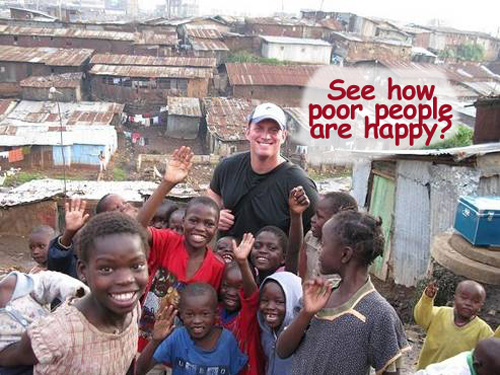
Death, destruction, despair and poverty … all for an attractive price! For less than $30 per person you can be guided into Kenya’s most famous slum! Kibera Tours dot com. “Experience a part of Kenya unseen by most tourists: KIBERA The friendliest slum in the world!”

The half-day sightseeing trip in Nairobi promises to visit an orphanage and school, a bead factor and a typical Kibera house before the piece de resistance: the biogas center: “a fantastic view over Kibera and picture-point. You can see that also human waste is not wasted here.”

This is disgusting. Tourism at its worst and most exploitive, revealing the basest inclinations of ourselves and reenforcing ridiculous notions that poverty doesn’t exist at home.

Kibera is the largest of Nairobi’s 7 or 8 slums, which slip around the city in endless tin and fumes. Not even the Kenyan government census can estimate the size, but the best guesses I’ve seen put the slums at several million people compared to the residents in the city at around 3½ million. The slums are a dissimulating fraction of greater Nairobi and would be an incessant inferno in the developed world.

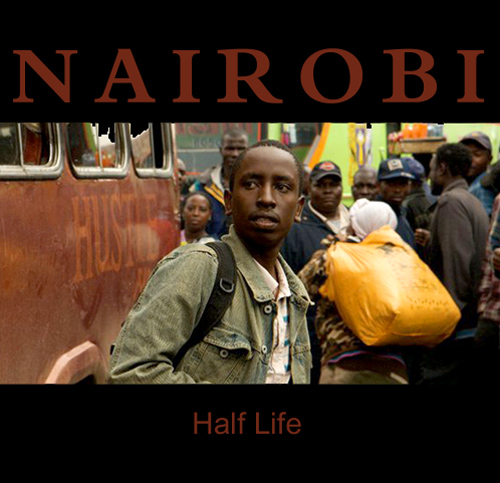
But in Africa they maintain an unusual tranquility. To be sure crime is endemic (see the film, Nairobi Half Life) and ethnic feuds that plague Kenya from top to bottom can produce particularly vicious moments here, but unlike slums in the developed world there is no boiling cauldron of the poor ready to murder the rich.

Nairobi slums are often stepping stones from poverty, completely unlike the imprisonment of slums in the developed world. Emigrants from impoverished rural areas without proper education or training live for a few years in the slums and develop the minimal skills needed to work in the modern world.

Then they move up and out. Not yet has Kibera fashioned a whole class of people forever imprisoned like the old Harlem or Cabrini Green in the U.S., or the Cape Verde barreos of Lisbon. Kibera will indeed become another Cabrini Green if something isn’t done this generation. But for the moment, the slums are relatively too young to have become a blighted institution.

Nevertheless, they look the same. And the nuance I argue above is not something that can be seen on a short visit. But slum tourists don’t come looking for hope.

What do they come looking for? Why does a tourist pay to come here?

I’ve asked myself the same question time and again. It’s identical with the wish to “see a village.” That quoted remark, of course, is an euphemism for seeing dirty bomas with mud huts and animal excrement. Fortunately, by the way, such villages are rare to find, anymore, at least along East Africa’s normal tourist circuit. What has replaced them are sedentary replications intended to make money from tourists.

Why do tourists pay to see them, even though they are clearly not authentic?

Even though outstanding African economic growth and potential is in fact a topic often found on the pages of the Wall Street Journal, I still hear from parents, “I want my children to see the way the other side lives.” Or “I think it’s important we see how fortunate we are.”

You don’t have to come to Africa to “see how the other side lives.” In some places like southwest Wisconsin near where I live, or the Ozarks or Appalachia, or the residual slums of our urban cities, real poverty and its resultant despair and destruction is no less than Kibera’s.

America’s “Kiberas” are not as widespread or large as Kenya’s, that’s true. But this is not a fortune of chance. It’s the result of a human civilization that wants to give everyone a modicum of happiness, that cherishes human rights.

That’s what America was mostly about, and it’s now what the world is mostly about. Kibera’s existence is our failing, just as Cabrini Green was and Appalachia still is.

Poverty is so complicated that it easily befuddles, and I think that’s part of the tourists’ desire to see Kibera or “a village.” They want to simplify the complicated. They don’t want to see poverty as something relative, but clearly defined and for sure, Kibera is.

But there is the same, absolutely identical misery, disease and angst in the unemployed, castaway homeless veteran on the streets of New York as any child walking the mud paths of Kibera.

Kibera, or the imagined dirty African village, or the homeless veteran need not exist. In a world where you and I assumed our basic human responsibility to our neighbor, there would be no Kibera.

So I believe the single-most important reason tourists want to “experience poverty” in Africa is to believe the same identical thing doesn’t exist at home. Or isn’t as bad. Or isn’t as extensive.

If one child is poor; if one veteran is homeless, it’s wrong.

And finally — possibly even worse — the delusional tourist wants to find a smiling child who is dying, so that they can believe that poor is OK, that homeless can also be happy, that death smiles.

It’s OK to live in a multi-million dollar mansion and it’s OK to dab yourself with Chanel. But it’s not OK to live a world that allows Kiberas to exist. Kibera’s existence is our fault; the collective fault of an unjust world order. The children of Kibera can just as easily be the children of Trenton.

It’s not OK to go through life with the fantasy that Africa is besmirched and cursed and that Kiberas exist only in Nairobi and Shaker Heights exist only in Cleveland.

And it’s not OK to think that poor is OK, anywhere. There is no happiness in being poor or homeless, whether in Kibera or 49th Street.

Don’t come to Africa to validate your own fantasies.

Out of This World

Out of This World

Evangelical preachers have long been on the list of greatest scam artists but five Nigerians with active churches in the U.S. take the cake!

“God is good,” says Forbes magazine, “especially if you’re a Nigerian pastor.”

Two with special attachments to Texas and other blind congregations that vote against their medicare benefits, hate blacks and throw the last bits of money they have at these jokers, are David Oyedepo and Chris Oyakhilome.

They’ve most recently been ensnared in a loud African debate over why so many pastors own private jets.

Forbes estimates Oyedepo’s worth at $150 million and Oyakhilome’s at $30-50 million. Oyakhilome actually has a greater presence in the U.S. than Oyedepo and it totally befuddles me that people will write him checks.

Oyakhilome runs Christ Embassy. There are a number of affiliate churches in the U.S., many in Texas and almost all of them in the south, and many directed to American youth on college campuses.

“Oyakhilome’s diversified interests include newspapers, magazines, a local television station, a record label, satellite TV, hotels and extensive real estate. His Loveworld TV Network is the first Christian network to broadcast from Africa to the rest of the world on a 24 hour basis,“ Forbes revealed.

His regular “rivals” throughout America’s south garner millions and millions.

He recently plead no-contest to a $35 million money laundering scheme that siphoned cash from his network of churches into foreign bank accounts. The individual stories are beyond laughable. It’s absolutely incredulous that people believe him.

Take the most recent $5000 “disappearance” of church cash which he tries to pin on another jet-setting millionaire Nigerian pastor, Chris Okotie. (Forbes says Okotie’s estimated worth approaches $10 million. Guess that’s not enough.)

One American Christ Embassy church member “lamented” that these factitious warring evangelical pastors are “soiling our image.”

Why do so many people, in Africa and in the U.S., supports these crooks?

The question is really not so different from why do these same people vote against their own self-interest, deny that Obama was born in the U.S., disbelieve global warming and think evolution is a plot by bad men to deny the existence of god.

So it’s a fun exercise in exasperation, but there’s little to do about it. It isn’t as if these guys aren’t exposed. They’re exposed in all sorts of publications, and not just headliners in Forbes. The good Nigerian press is constantly on them.

But the attempt to unmask them is the very stuff they use to build their support. There is such distrust in the world of our given institutions, like government and the media, that clever artisans can twist allegations into alleged lies and be believed.

So I suppose in the end we are responsible. We’re responsible for allowing our established institutions to degrade to this point, and to having neglected social education to the point that good people are unable to see the obvious fraud for themselves.

I think Africans are awakening compared to Texans, though, and it may be why so many of them are redirecting their efforts here, out of Africa.

Why are Africans awakening and the citizens of Houston aren’t?

Send me your answers. Make them brief.

Too Much Gaga?

Too Much Gaga?

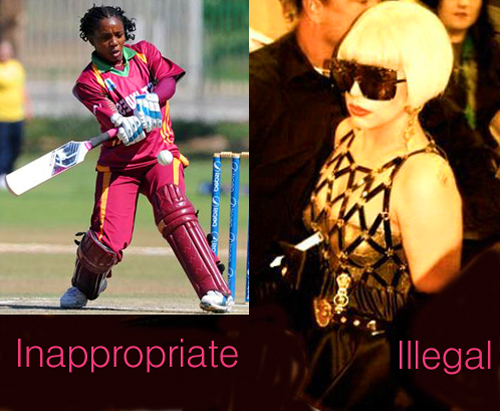
Africa is presenting some electric perspectives on western world hypocrisy, and I challenge anyone to explain it otherwise. Lady Gaga and cricket.

Lady Gaga’s presentation, lyrics (when there are some), causes and overall demeanor is basically that of an entertainer with a progressive set of political and social beliefs. She supported President Obama in the most recent election, is something of a humanist and a vociferous supporter of gay rights.

Her performances are downright eccentric if anarchic. I think it fair to say she’s a champion of free will.

But today in South Africa where’s she’s in the middle of a very popular performance tour, she’s getting entangled in her own beliefs in a way that would never occur in the western world.

Her concert’s ban on photographing any part of her performance may, indeed, be a violation of the new South African constitution. (As it should be, and as it should be everywhere at any time.)

The South African National Editors Forum has called on Gaga to “at least meet with us” to discuss her possible violation of the constitution, but she declined.

“Previous accepted practice at such events [as the Gaga concert] has been for accredited news photographers to be allowed to take pictures during the first three songs and then to withdraw,” SANEF continued. This time, though, Gaga says Nono.

It’s a long established practice, of course, in the west that concerts and other entertainer-centered performances be treated just like the Sunday NFL Game of the Week, a copyrighted and owned piece of intellectual property that includes virtually all images and graphics.

But the new South Africa, and from my point of view the only moral position, is that when an entertainer achieves “public domain,” then it’s a free-for-all. That’s defacto the situation, anyway. Not Gaga or Ted or Obama or Ricky Martin can keep pirated videos, photographs or sound tracks out of the public domain.

And there’s no way that journalists can report on this without referring to them.

Gaga is steeped in western hypocrisy.

And then there’s the first ever woman to head a national cricket board appointed Sunday in Kenya.

Jackie Janmohamed became one of the first cricket umpires licensed by the world cricket authority in 1989, and she’s been fighting for women in cricket ever since. Cricket is one of the most conservative of world sports, dominated almost exclusively by men.

Unlike press freedom at entertainer’s concerts, though, women in sports is much more accepted in the U.S. than in much of the rest of the western world. And we can specifically and clearly thank Title 9 for this, a series of federal laws passed in 1972.

But unlike Kenya on Sunday, America together with virtually all the rest of the western world limits the heads of governing sports institutions to the same gender of that institution. In other words, America has no Baseball Commissioner for both men and woman’s baseball … as Kenya now does for the even more conservative game of cricket.

“Unisex” in sports has come to Africa. But not to the west.

Lady Gaga and cricket. Just another day of Africa leaving the west behind in its (stadium) dust.

Thanksgiving Holiday

Thanksgiving Holiday

Today is Thanksgiving in the United States. (Canada celebrates it earlier.) Thanksgiving is one of Canada and the U.S.’ major holiday celebrations, characterized by copious amounts of food featuring seasonal recipes and lots of sweets. The traditional meat served at the feast is turkey.

The two-day holiday originates with the first permanent settlers to the New World, people who called themselves pilgrims fleeing England’s restrictive laws on religion and who arrived the northeast coast of America in between 1620 and 1621.

They faired poorly in the beginning until two local native Americans, Wampanoags of the Algonkian-speaking clans, both of whom spoke English (because one of them had previously traveled to England in 1605) befriended the settlers. The “Indians” taught the pilgrims how to farm and build homesteads, and the summer planting season was so successful that the pilgrims invited the Indians to a “Thanksgiving” harvest dinner in November, 1621.

Click here for much more information about the history and meaning of Thanksgiving by a native American school teacher, who dispels not only the myths about the “primitiveness” of native Americans, but also about the pilgrims’ history and beliefs.

Statistics are Just Cosmetic

Statistics are Just Cosmetic

The American demographic is changing, the earth is heating up, and lipstick is the only way to understand how well Africa is doing and how far behind America is falling.

A U.S. presidential election provides an incredible snapshot of America, because so much data and polling and social introspection goes on. Much of it confirms my long-stated beliefs that America is yet impeded by racism and sorely crippled by under education.

And that means much of America just doesn’t accept reality. Like global warming. Or like how Africa is becoming so modern, innovative and holds the potential to outdistance America on a number of fronts.

I’ve written about energy, for instance, and the aggressive use of solar and biofuels; I’ve written about the many inventions like the competitors to iPhones; I’ve written about software development and imaginative financing.

And now I’m writing about a topic I know so much about: cosmetics.

A new Kenyan beauty products company is achieving some unique success and might well enter the American market. We often criticize foreign-made products (particularly from China) because they often have a great price advantage. An advantage sometimes associated with inhumane labor practices or outright government subsidizing.

Not the case with SuzieBeauty. Her products might cost less than Lancome but it’s not because of slave labor. It’s because the division of wealth on earth is so skewed that the “richest” in places like Kenya are still less rich than in America. But that not by as much as you probably think!

SuzieBeauty is a perfect example of how American accomplishments are being exploited and enhanced faster by non-Americans than they are by Americans.

Suzie Wokabi is the founder of SuzieBeauty, and she’s Kenyan, of course. But she spent some time in the U.S. where she graduated from college and then joined the fashion industry. She became certified for media make-up and then worked for five years in New York before returning to Africa in 2007.

There and then in Africa, educated and experienced by everything wondrous in America, she really blossomed.

SuzieBeauty’s main standard-size bright colored lipstick costs about $10. A similar lipstick from MAC in the U.S. costs $15. This 50% difference is true through almost all of the beauty products offered by each company. One Kenyan and one American.

There are several interesting things about this.

The U.S. government says that the average wage of a working person in American in 2011 is $42,979.61. According to the Kenyan government the average wage of a working person there in 2011 was under $1000. (According to the CIA it was $1700.)

The big difference between the Kenyan government’s own determination and the CIA’s has to do with many factors, most notably the exchange rate which organizations like the CIA weight over longer periods of time. But regardless, either figure when compared to the American one suggests a society in Kenya of abject paupers. And it’s these numbers that teachers often use in high school much less college.

Africa and most of the third world have been growing so rapidly over the last several decades (as high as 10% per year, compared to developed countries 3-4%) that their societies have become radically divided economically.

The difference between Kenya’s richest and Kenya’s poorest is nowhere near as great as between America’s richest and poorest, but that’s because America’s richest are off the charts. But the difference say, between the top fifth-or-sixth of Kenyans and the bottom fifth-or-sixth is a chasm compared to that metric in America.

And that stat applies to most developing countries. And to be sure that’s an enormous problem. In Africa that metric is most pronounced in South Africa, where the country is fairly rich but huge portions of its population are abjectly poor. The labor unrest and social disturbances plaguing the country right now reflect this division.

Redistribution of wealth is a hot topic in the U.S., and one that few politicians are ready to embrace. But it is taken for granted in the developing world, because it’s understood without it their societies will explode.

But the point of this blog is not to lobby for redistribution. It’s to demonstrate that America’s top 10% and Kenya’s top fifth-or-sixth are not chasms apart. They’re about 50% apart, the difference of the cost of Suzie’s lipstick and Mac’s.

And that’s a remarkable fact, because only ten years ago it was probably 100%, and twenty years ago it was probably 1000%.

The developing world benefits from the youth of its societies which are unbridled by hundreds of years of law to be sure, but which are also unfettered by custom. But most of all the developing world is willing to experiment and explore new if radical social constructs which old places like America are so afraid to do.

You’ll never hear Kenyans talk of “founding fathers” or restricting their social responsibilities to what men in wigs 200 years ago thought was right.

SuzieBeauty’s mission goes well beyond value for stock holders. It includes “…innovative research …training and education, social responsibility and environmental awareness.”

Not your normal lipstick manufacturer. I can hear Kenya smacking its lips right now!

A Real Kenyan Oscar

A Real Kenyan Oscar

The Kenyan entry for this year’s “Best Foreign Film” continues an incredible story about East Africa’s blindingly fast social changes and overwhelming tragedy in the struggle to become a modern society.

It isn’t just that “Nairobi Half Life” tells a powerfully realistic story of urban Kenya, but that the story is finally “being told” by Kenyans.

Rather like the Olympics, Oscars often cite a film as coming from a certain country even though the film is actually made by outsiders. Case in point is Slumdog Millionaire, which raised India out of the Bollywood marsh into the real global film world, even though the film was financed, directed, screen played, tecked and in many cases (excluding the lead) acted by British.

The main problem is financing. Even what the Iowa State Film board would consider a low-budget Indie film is a fortune in Kenya. So financing is likely to always come from film capitals like LA or London.

But this year the Kenyan entry for “Best Foreign Film” is almost exclusively Kenyan except for its financing. The techies, actors, supporting personnel and most importantly, the director, are all Kenyan. This will be David Tosh Gitonga’s second foray into big screen directing.

His first — as assistant director of the tear-jerking, soul uplifting, smile plastering masterpiece “1st Grader” – is absolutely one of the best films I’ve ever seen.

Both films portray a real and rapidly changing Kenya. “The First Grader” is set in rural Kenya right after the government declared education a universal and free right. The star is a wonderful old Kenyan who in his 80s is impoverished but proud particularly of his history as a freedom fighter. Unable to read a letter he receives from the government, he shows up the first day of the new term at a primary school in order to learn how to read.

Much more sinister but just as true and realistic, “Nairobi Half Life” follows a young rural Kenyan who migrates to Nairobi to become an actor. But like so many rural immigrants into the city, he is subsumed by the underbelly of a giant modern African metropolis, made hostage to the crime and drugs of its slums.

The film has been shown only at festivals and through a limited release in Germany but film goers are ecstatic. And its promise comes from the very respectable Durban Film Festival where lead actor Joseph Wairimu received the Best Actor Award.

It was not too long ago when Kenya produced nothing but wildlife films. And no criticism intended, they were extremely good.

But what is happening in Africa, and especially in Kenya, is truly mind bending for those of us who have lived and worked there through much of the last half century. But we can’t begin to imagine how it must be effecting Kenyans themselves.

Every single Kenyan is impacted in the tornado of change: The old, like the character in “The First Grader” and the young, like the lead in “Nairobi Half Life.” And unlike what we westerners consider the classic literature explanations of East Africa, Out of Africa is neither real and hardly any more relevant to what happens every day in Kenya now.

Good luck Kenya!

Old Man or Best Loser?

Old Man or Best Loser?

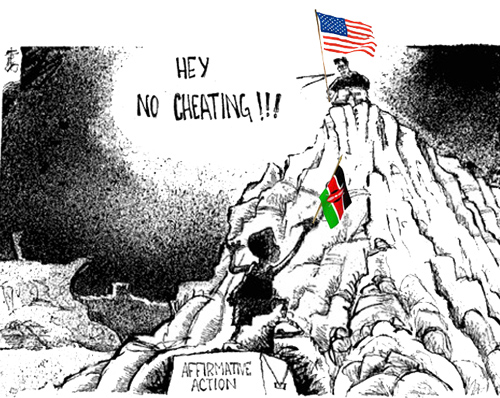
Our Supreme Court considers reigning in contentious affirmative action policies just as Kenya implements the policy in an extreme way.

Last week CNN reported that “race-conscious admissions” as a policy for determining university admission “appeared to be in trouble.” The report filed by Bill Mears suggested that Anthony Kennedy’s swing vote on the conservative court could preserve the general policy while striking down the specific plan from the University of Texas under particular review.

However broad or narrow this particular decision might be, there is no question that affirmative action in the U.S. is in decline, even as there is near unanimity among academics as well as commercial managers that policies which create diversity are over time very beneficial to everyone.

America stepped into affirmative action gingerly and took a long time to fully embrace it. That has lasted about a decade or slightly longer, and it now seems as though we’re gingerly stepping away from it.

Kenya on the other hand is going from a society almost exclusively managed by men to a forced society where at least one-third of the country’s power elite must be women in the course of a single election.

Although the debate and legislation has been confined to the make-up of Kenya’s government, there is little doubt that a one-third female Kenyan government will if not actually legislate rules for the private sector will certainly powerfully effect it.

Unlike the possibly too careful approach by America, I’m worried that Kenya’s might be too uncareful. The new constitution now being implemented is the driving force. The problem is that this very difficult section, which mandates the one-third rule, has only now begun to be addressed, less than five months before the next election.

Most legislators and public commentators promote the obvious way, which has become known as the “best loser rule.” When, for example, less than a third of the new legislature elected is female, then some of the duly elected male winners will be somehow automatically replaced by women closest to having won.

But how this metric will be calculated remains to be determined. Which district will be the sacrificial lamb and which female candidates will then be elevated? Will it be determined by actual votes or percentages or pro-rata?

The complexity of the issue is so great some argue it is too great to solve before March, when the next election occurs. Seventy, or one-fifth of the new National Assembly, will be appointed. This unappointed one-fifth was intended to be reserved for noncompetitive leaders like wise diplomats or career unionists who are appointed by the executive and National Assembly.

One argument suggests all seventy should be reserved for women, but then what if the gender level is still not achieved?

That’s probably a bad idea, since the unappointed legislators is itself contentious, a holdover from Kenya’s former constitution intended above all to achieve stability after a close election by allowing the narrowly won to beef up their control. Plus if applied in its purest, the appointments of legislators would themselves have to follow the affirmative action rule which was must be applied on its flipside, too: there can’t be more than a two-thirds gender dominance.

The issues in the Supreme Court University of Texas affirmation action case are no less or more complex than Kenya’s gender rule. But the scope of each is hugely different. And it represents the level of risk each society is now willing or not willing to take.

In the global arena today, America moves like an old man afraid of falling. Kenya jumps with abandon like a kid on a trampoline. The risks of failing govern America. The passion for more Olympians governs Kenya.

The Democratic Challenge

The Democratic Challenge

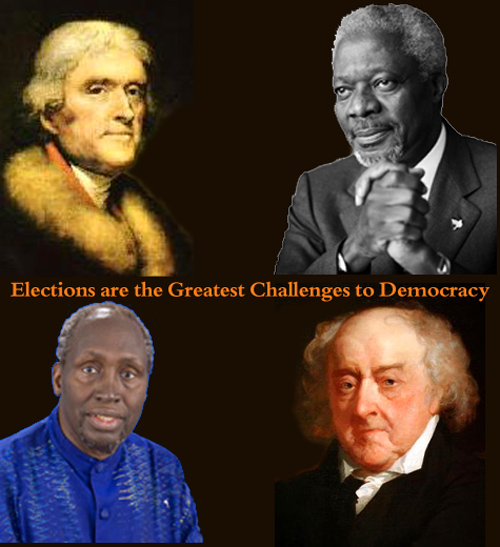
Two of Africa’s wisest old men have echoed the same cautions that America’s founders gave a young democracy about its elections. Beware: Bad elections are the greatest threats to democracy.

Yesterday Kofi Annan and Ngugi wa’Thiongo focused on the upcoming Kenyan elections as a marker for world democracy and reflected on America’s distortion of elections as something to be avoided by younger countries.

Annan is a well-known world figure, one of the most prominent Secretary Generals the United Nations has ever had. Like Jimmy Carter who remained remarkably active after leaving office, Annan’s role in global negotiations has never ceased. In fact, it was Annan who led the Kenyans out of the mire of the violence following their last election in 2007.

Ngugi has adopted America as his home after a career as a professor at Yale and New York universities. He is currently the Distinguished Professor of English and Comparative Literature at the Univ. of California in Irvine. Until 2004 he lived intermittently between Kenya and the U.S., and in Kenya is heralded as a famous revolutionary and writer.

What Americans obsessed with their own election need to know is that huge new parts of the world, especially in Africa, are adopting democracy and America’s form of democracy to govern their young societies.

This is a major change from hardly a generation ago when just as many new countries were adopting forms of Chinese communism or heavily top-down managed socialism. It’s a testament of course to the end of the Cold War, but also of the preeminence of capitalism in the global economy.

Old countries like China might be able to fiddle with capitalism and not disrupt their mechanisms for governing, but new countries can’t. The power of the economy is so critical with emerging countries that it often trumps other moral and social issues.

A case in point was Ngugi’s violent condemnation yesterday of Kenya’s decision to use English as the predominant language for governance. Ngugi is Kikuyu, the main tribe in Kenya and was imprisoned as a freedom fighter under the British. He is himself a master of the English language but he has written scholarly novels in Kikuyu, and he believes preserving multiple languages is critical to an advanced society.

It is something of the inverse argument in America as to whether Latinos should be validated by a greater use of Spanish in government.

Arguing that the current Kenyan leaders are “child abusers” for denying “mother tongues” Ngugi says, “To have a mother tongue … and add other languages … is empowerment. But to know all the other languages and not one’s own is enslavement.

“The post-colonial government and the entire [Kenyan] elite have chosen enslavement over empowerment,” he concludes.

The problem, of course, is that the violence that followed the 2007 elections turned ethnic. It is completely understandable that current politicians wishing to avoid anything much beyond a dull election want to steer clear of languages that are specifically ethnic.

In America as in Kenya when one person speaks a language that another person doesn’t understand, enormous suspicions arise, conjecture becomes almost as credible as fact-checking, and literally all hell can break lose. Unlike in Canada or Belgium where multilingual democracy flourishes, in most of the world multiple languages breed distrust.

(N.B. What puzzles many in the Kenyan situation, though, is why English was chosen rather than Swahili. Swahili belongs to no specific tribe and so is clearly universal among East Africans. The problem is that Swahili is a lingua franca and suffers thereby from a sore lack of precision. Tanzania tried to use Swahili as the formal language for many years, slowly giving way to English. It’s near impossible in Swahili to say succinctly, “Federal zoning regulations with regards to clean and safe landfills will preempt county council laws with regards to individual ownership.”)

(N.B. continued: Swahili in my view, by the way, is one of man’s most wondrous cultural achievements of the last several centuries, creating poetry of nearly every statement while maintaining a universal morality far superior to many popular western notions about right and wrong. But that’s another blog, and in this case I think Ngugi is wrong.)

Annan didn’t mention language, but in virtually everything else the two scholars said yesterday there was agreement.

Annan who is Ghanian was in Kenya yesterday. He referred to his fears that money is buying power in Kenya, as in the world over. “The infusion of money in politics … threatens to hollow out democracy,” Annan told CNN in September.

Annan understands the importance of capitalism in the world, today, but he also sees it as a threat to democracy. Many of us wait expectantly for his treatise on how the twain should ever meet, but for the time being I suppose we should presume he simply wants aggressive regulation.

In Kenya today he sees a brazen challenge to its young democracy by its rich leaders. Four of Kenya’s richest men and political leaders, including the son of the first president Jomo Kenyatta, are on trial in The Hague for inciting the violence of 2007.

Yet two of them, Uhuru Kenyatta and William Ruto, are running for president. (Not yet officially, but in Kenya “officially” comes quite close to the actual election.)

Annan sees this occurring not because the Kenyan people want it to, but because these individuals are so powerful, and because they are so rich.

Ngugi concurs: “Unregulated money in politics undermines …confidence in democracy… The explosive growth in campaign expenditures … strengthens fears that wealth buys political influence.”

American politicans’ penchant for personal stories about their early impoverishment is mostly malarkey or at best irrelevant to their current control of wealth. The vast majority of successful American politicians are rich. The cost of entering politics defies many startups. Over $1 billion will be spent by candidates and their surrogates in the current U.S. election.

Both men see the poor, the less privileged, the disabled and geographically disenfranchised as likely a majority of African voters that can be deftly ignored in a modern election:

Ngugi: “Too often, women, young people, minorities and other marginalized groups are not given a full opportunity to exercise their democratic rights.”

Democracy is today widely popular throughout new African countries and embraced as the best way to protect and govern themselves. But the messages that Ngugi and Annan delivered yesterday to a promising young African country resonant here at home just as much.

Democracy is never achieved; it’s simply strived for. America has used democracy for nearly two and a half centuries, yet the corrupting power of money, the difficulties of implementing democracy to a multi-lingual population, and the ease with which the underprivileged can be disenfranchised are threats as great today as they were in the 18th century.

Nor any greater a threat in Kenya than here.

Redistributed Marriage

Redistributed Marriage

We should be incensed by the privileged often American tourist to rural Africa who characterizes want and poverty as some kind of pristine Garden of Eden that should just be left alone.

After her “first visit to Kenya,” a recent American tourist asked in her blog: “The Maasai culture and traditions are pure, so why would you want to change them?”

The question makes me scream: because the Maasai want iPhones, and sleeper posturepedic mattresses, and Brita filters, and slim notebooks and a hope for a better life. Anything wrong with that?

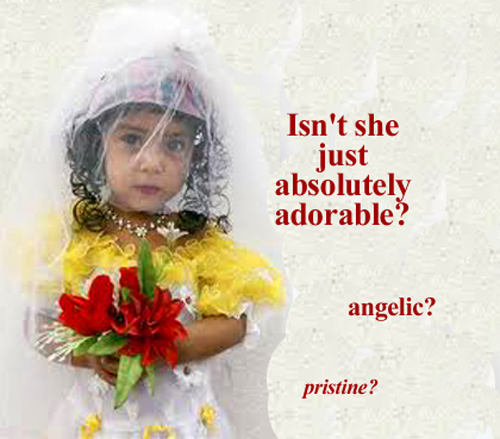
Today, the UN and hundreds of other organizations worldwide, celebrate the Day of the Girl Child which specifically condemns child marriages and which pointedly teases out much of American conservative ambiguities about freedom and individual rights.

Most forced wedlock for girl children occurs in Asia, but a close second is sub-Saharan Africa and specifically in East Africa’s still deeply rural areas.

“Some people sell their daughters at a tender age so they can get food. It’s common but people are silent about it,” a rural Kenyan told Reuters TrustLaw.

The Reuters TrustLaw story interview also described Somali traditions intended to preserve virginity prior to wedlock by arranging very young child marriages.

Now to some that may seem all so noble, right?

Such practices as female circumcision, child marriage and prostitution, and even child slavery are time and again reported in equivocal ways.

“Here’s a troubling fact: 60 million girls world wide are forced into marriage before the age of 18…,” that American tourist wrote in her blog, “But when it comes to cultures that practice child marriages, not everyone agrees that change is a good thing.”

Exactly who is everyone? A few locals you photographed on your $10,000 safari while being completely incapable of speaking to them them in their own language? Might their smiles had something to do with the 200 shillings you gave them for the shot?

I concede there are issues specifically relating to children that teeter on that sharp fence separating individual from human rights and perhaps this contributes to why some Americans believe that poverty and deprivation is fated to “just be left alone.”

Few argue that each child is different, capable of assuming independence at earlier or later ages. The UN and many organizations, though, set 18 years as the first age societies should presume a child is fully able to assume whole responsibility for herself.

Only a few generations ago, that was absurd. My grandmother married at 13 years old, a lost immigrant from Croatia. If she had not married she would likely have died in the mayhem that followed the flow of thousands of immigrants out of Ellis Island.

But that’s the point. That was more than 100 years ago. Although communities in Bangladesh or Mogadishu may not seem much different today than Ellis Island was at the turn of the 20th century, the global awareness of poverty and deprivation has increased enormously.

Fortunately, we all now care more about one another than ever before, if for no other reason than we’ve the tools to see further and deeper, everywhere.

The resilient human spirit, which burns greater in my opinion among the poor and deprived, will find moments in even the most awful situations for satisfaction and happiness. The beautiful nostalgia of my own boyhood may indeed not be so different from that of a successful African businesswoman of her own childhood in a rural hut.

But the effrontery of we privileged to wonder if earlier she might have chosen to remain deprived and under privileged is astounding. I believe it’s evil. It’s racist and the result of greed, a fear that to make things better for others means they will be made worse for ourselves.

Redistribution. Shudder at that word.

And the point there is that redistribution is only the beginning. With more of the world raised from deprivation, the productive capacity will be so remarkably increased that there will be more for all.

So get a grip. Redistribute some of that wealth that got you to Kenya to the poor little Maasai girl who would very much like to visit you in Columbus.