Can You Be Too Right?

Can You Be Too Right?

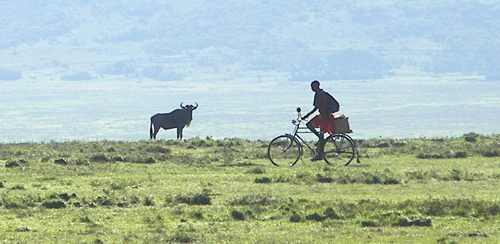
Wildebeest survive, but Maasai must move on.
As worldwide petitioners against a Loliondo Maasai eviction approached two million, an important meeting with government officials ended today without resolution.

Last May I blogged about this sad story in partial error, resulting in my concession that the blog had enough misleading information to be adjusted. The incomplete discussion of the problem remains a serious part of this story.

The controversy remains: the Tanzania government wants to evict 40,000 Maasai from traditional lands to increase a hunting concession for Dubai businessmen and princes.

The error so many of us participated in last May was reporting the controversy as an immediate crisis.

And that escalation of reportage has worsened. Respectable media reported today that the evictions have already begun. They haven’t.

We were led to our mistakes last May by the organizers of a very successful petition campaign on behalf of the Maasai, which has exceeded its wildest expectations by the way.

In May the organizers of the petition broadcast an urgent appeal for signatures based on an exaggerated claim that the government was imminently prepared to forcibly oust the Maasai.

Several of my readers pointed out to me this wasn’t true. The problem was real – and continues – but the immediacy was overstated and the government had set no deadline for forced eviction.

The situation is the same today.

Numerous legal maneuvers have been going on in Tanzania for some time, long before the petition campaign began. These continue today.

This past weekend, a report in London’s Guardian attributed to another report from Survival International elicited comments from the organizer of the petition which were exaggerated and went viral.

The story even emerged as a headliner in America’s normally very careful electronic media, Salon.

This is a complicated and serious story, and the media (including at first, me) just doesn’t seem to know how to handle it correctly.

Survival International, in fact, has a good time line of the real story. Click here.

The government’s policy came to the fore five years ago. There have been ups and downs, and based on today’s useless meeting in Dodoma, I’d say the government is losing the battle of waiting it out, and that’s good.

And it’s so good that many of my readers and others worldwide have signed the petition. But like a previously exaggerated social meeting campaign, Save the Serengeti, the movement starts to become more important than the issue.

Save the Serengeti absolutely contributed to stopping the building of the Serengeti highway (when it was in its first iteration, Stop the Serengeti Highway) but in no way alone despite its self-promoted appearances. Moreover, when building the highway was stopped, the campaign didn’t.

The real development of this Maasai story is simpler. Under increasing pressure to abandon once and for all the government’s policy to evict the Maasai from Loliondo, the government has offered a cash payment in compensation to 40,000 Maasai.

The offer is for approximately two-thirds of a million dollars or about $15 per person evicted, in addition to previous offers of new land that theoretically equals or exceeds the land that would be confiscated.

Today’s meeting in Dodoma was to discuss this new offer, and as expected, Maasai leaders rejected it.

Undoubtedly this new emergence of the controversy benefits the Maasai, and that’s good, too. It’s just not … well, exactly right to think of it as immediate to this prolonged problem.

Meetings occur all the time between government officials and Loliondo Maasai. Ridiculous moves like $15 per Maasai evicted should hardly be considered starting new or more serious confrontations.

Yet even in Arusha some thought so. Last night an arsonist started a terrible fire in Arusha that caused some to wonder if it was in protest of the Dodoma meeting about the Maasai eviction.

I received several requests to write this blog. I’m extremely thankful for my readers’ sensitivities to this problem. I’m glad that we’re all “on the side” of those benefiting from the exaggeration of the problem.

But ultimately it’s the facts that matter. It’s the facts we need to be vigilant about, not the hysteria.


Right To The Core

Right To The Core

dresscartoonThe whole damn world is turning conservative, but Kenyans are fighting back! The current battle is over miniskirts!

Last Wednesday while waiting for a bus at a stop in Nairobi, a woman was screamed at by passing matatu (private taxi cab) operators for wearing a miniskirt.

The protest grew rapidly and soon the woman was on the curb stripped naked. Kenyan authorities condemned the stripping and promised prosecution, but nothing’s happened so far.

Immediately Kenyan society cleaved in two.

#MyDressMyChoice versus #NudityIsNotMyChoice.

The good side, the left choice above as usual, is composed of virtually all Kenyan elites and most modern educated people, and that’s mainly because miniskirts have come back in fashion big time in Africa.

Young kids populate schools in them and old ladies wear them trying to look young. From Nigeria to South Africa, miniskirts are in.

Typical of the good side are the oft repeated arguments that men’s reactions to scantily dressed women are reflections of their misogyny, dress codes presumed necessary for women are never applied to men, and that the constitution protects however a woman wants to dress.

Typical of the bad side is the universal presumption that dressing scantily is an invitation if not outright challenge for sex, politely presented in its obverse:

“Cinderella didn’t need to take off her dress to get Prince Charming. Neither do you.”

As expected the clergy clusters in the right corner and politicians cluster in the left.

Here’s what I find so interesting and absolutely encouraging about the whole kerfuffle:

In Zimbabwe or Georgia, that poor woman wouldn’t just have been stripped naked but raped and killed and we would have heard nothing about it.

In all of Uganda and even for some high school cheerleaders in America, miniskirts are already banned by authorities, so there’s no debate.

Need I mention radical evangelists of the Christian and Muslim faiths who find common ground here?

Kenya is dealing with this in a transparent and public way, and the voices of the correct side, the left side, are not being suppressed nor are they growing. In such a situation, reason will ultimately prevail.

In many conservative communities in America, in many right-leaning American cities and certainly in spit drooling revivals among many American evangelists, the story isn’t so hopeful.

Seeing Is Believing

Seeing Is Believing

osborneMachariaGDP isn’t the only thing growing in Africa. Young Africans’ popculture is quickly overtaking America’s and Europe’s.

One of Nairobi’s most talented artists is Osborne Macharia. His K63 Studio is a sought after commercial enterprise by everything from chic weddings to fast cars.

I thought I’d leave you this week with some of his digitally enhanced photos, which evoke enormous reaction from me.

man-ipulation- Osborne Macharia
man-ipulation
– Osborne Macharia

The modern young progressive African guy is having trouble. His machoism is continually suppressed … by his peers, by his mentors and mostly, by himself.

Traditional African culture is as misogynistic as you can get. Polygamy doesn’t say it all, by a long shot. Whether a traditional family was rich or poor, the woman did all the work, and I’m not talking about house chores. She toiled the land, harvested the crops, sold the crops, distributed the crops … and raised the kids while submitting to the man’s every whim.

This generation of kids is several or more generations from that life style, but it’s still a much greater difference between their grandparents than ours, for example.

One of the residues of a progressive, educated man trying to fit into the modern world — or so it is widely believed — is that the man becomes too submissive and grows easily manipulated by every woman who gives him a glance!

Kwangare- Osborne Macharia
Kwangare
– Osborne Macharia
Income disparity in modern places like Nairobi is — I hate to admit it — greater than here at home. This is the real festering soul of Africa, not ebola or terrorism or even poverty per se — but the difference between men like Kwangare and those who cause Nairobi’s traffic jams wrecklessly driving their hundreds if not thousands of Mercedes every day.

I see it as a fundamental problem of successful capitalism overlaid rapidly developing cultures that are so out-of-control dynamic like in Kenya.

We’re in a state of affairs right now in places like Kenya where the disenfranchised and displaced are so suppressed that the country as a whole is just shrugging its shoulders and ignoring the inevitable. The poor sot who works all day for a dime then goes home to an 3-room apartment shared by his extended family, that in turn shares a bathroom with four other apartments … well, you get the picture.

Eventually resignation turns into desperation: exhaustion becomes revolution.

xNews- Osborne Macharia
xNews
– Osborne Macharia
Freedom of expression and freedom of the press in places like Kenya is being applied to an exaggerated fault, just like it is, here. The kids in Nairobi make fun of it all the time.

In America, today, we’re so inured to the ridiculous concept of objectivity that it no longer offends us that Anderson Cooper invites a “panel of experts” that includes a climate change denier … to be “fair and balanced.”

Well it happens too all the time in the Kenyan media, and Nairobi youth in particular see it as a caricature of substantive problem solving.

I can see in the bony neck and starved face of Osborne’s Gender Based Violence piece a continuation of the gender conundrums of the first piece above, Man-ipulation.

The woman in this picture is an amalgam of a peasant, a witch and a modern gal. Although the three reside in radically different places in Kenya’s rainbow culture, although their education differs widely, they are still equally suppressed and abused.

Gender Based Violence-Osborne Macharia
Gender Based Violence
-Osborne Macharia

And like our own situation recently to the fore in the NFL, it’s deeply engrained and horribly facilitated by the so-called modern cultural kingpins.

This brilliant piece was commissioned by Oxfam, one of Europe’s largest aid organizations.

I would have liked Osborne to have moved even beyond Man-ipulation and Gender Based Violence and deal with the most egregious of all gender-based discrimination in Africa, that against the LGBT community.

Next door Uganda is ready to hang every gay, and very similar sentiments have been raised in Kenya’s own Parliament. There is a vibrant and courageous LGBT community in Nairobi. I’m sorry Osborne doesn’t see fit to represent them.

Hope in the Delta-Osborne Macharia
Hope in the Delta
-Osborne Macharia
Hope in The Delta could be from any of a multitude of different places in ecologically stressed Africa, from the Kalahari desert to the oil rich jungles of Nigeria.

In these places the aboriginal peoples are mostly ignored, as they have been since colonial times. Their development is compromised by a constant struggle between modern resource extraction and traditional life-ways.

And you can guess who wins that battle.

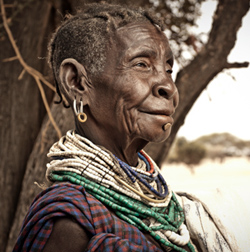
I think that Osborne by depicting an old lady who has somehow found contentment if even amusement as she stares over her pillaged land has captured both the patience and quiet self-confidence of Africa’s forgotten aboriginals.

It’s a melancholy that’s so easily taken advantage of, but at the same time it’s a spirit that’s remarkably enduring.

Shake Not Stirred-Osborne Macharia
Shaken Not Stirred
-Osborne Macharia

Nothing very deep about this beautiful piece created to promote one of Nairobi’s very popular and increasingly important fashion shows.

This one featured super models from Nigeria and China.

So that’s one Osborne Macharia. Young, fantastically talented and courageously outspoken!

Enjoy your weekend. I hope you’ll be thinking about Africa when you do!

You Can Take it With You

You Can Take it With You

residentinskyWhy are air fares going up so fast? Because travelers are rich.

Air fares have been used by all of us in all areas of the travel industry as predictors or leading indicators of travel in general. That’s because they are bought more through reactive responses to instant offers than the considered thinking of some measure that usually goes into planning a vacation.

That type of reactionary buying reveals the nature of you, the consumer, better than anything.

“Air fares are high, because planes are full,” reports a frequent flying expert.

Fuel prices are at historic lows, but air fares are up 17% over last year according to the LA Times and there’s absolutely no indication they’re going to go down anytime soon.

Why? Didn’t you recently hear from your favorite media pundit that the “recovery” isn’t widespread? What about Europe’s “new recession?” Isn’t China in a muddle?

Yes to all the above, but planes are full, because flying is expensive, and the rich are doing just fine thank you.

This is capitalism at its sweetest. What it illustrates is a turf war between the bullies. American Airlines versus GE Capital. Cathy versus the Chinese Communist Party. There are a lot of very rich people in the world, and air travel and vacations are becoming their exclusive purvey.

The reaction is widespread in all the industries that make vacations. In the one I know the best, East African safaris, prices are going up after a ridiculous dip caused by the now widely accepted irrational fear of ebola.

Before the ebola scare our industry prices hit a new high. That wasn’t because there weren’t good deals, there were and still are. But just fewer of them. The excellent mid-market companies like Sopa and Serena in East Africa and the Drifters and Kwandos and lower end Sun Internationals and Proteas in the south are still offering excellent prices.

But there’s many fewer of those than there used to be. Fewer in capitalism means less capacity and less capacity in a balanced market means higher prices, but that isn’t happening to the lower ends of the travel market in Africa.

Rather, there are more and more luxury, high-end properties whose prices are moving upwards.

The low and midmarkets are struggling.

If you’re a budget consumer looking to go on safari, you better move fast, because your choices are diminishing and in the current climate might not even exist in a few years!

But if you’re one of those Etihad Airlines passengers who just spent $20,000 (one way) for a 3-room suite on a flight from London to Dubai … no worry. You really don’t have to know how to work your personal wide-screen TV or microwave: you get a butler, too.

Veteran’s Day

Veteran’s Day

VeteransDAyToday is a controversial American holiday. Many of us are reluctant to celebrate America’s wars. Yet we can’t ignore the life stories of those who have become conflated with them.

During my life time, which began just after World War II, America has fought far too many wars. I supported Obama to end some of them, but instead he’s ratcheting up the War in Iraq, again.

In my new novel, Chasm Gorge, I tell a story of an American president starting still another war.

For someone like myself it’s an intellectual challenge to praise the soldiers who fight America’s wars.

America’s armies, today, are radically different than when I was a boy.

Today America’s fighting forces are entirely voluntary (with the subtle distinction that “reserve” soldiers, those who have technically retired or enrolled mostly as home guards are now being routinely called upon as active troops).

This differs radically from WWII and before, when the bulk of our armies were conscripted from young men. It was a mandated responsibility for young men approaching their third decade to be prepared to serve in the military if called.

The transition to an all-volunteer force was accomplished fairly easily by raising soldier pay and benefits. As America became more of a war fighting country, the rich also become more powerful, the poor parts of society enlarged, and so becoming a soldier was actually a good job choice.

Much of America’s armies, like ancient Rome’s and Persia’s, are opportunities for the oppressed and downtrodden to break out of an endless cycle of hopelessness. It’s therefore hard to criticize these young people for joining the American military.

The least advantaged are often those who their society takes the greatest advantage of. I morally condemn in the strongest sense most of America’s past and present wars. But my heart goes out to the vast majority of Americans who fought them, like my father.

ZimZam OldNew BlackWhite

ZimZam OldNew BlackWhite

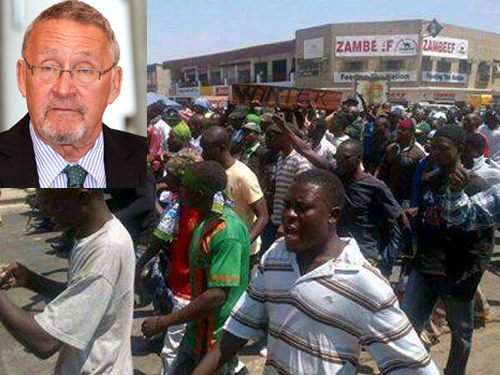
ZambiaTurbulenceThis morning two countries just above South Africa are suddenly and surprisingly tense. There is potential for serious violence in Zambia and Zimbabwe.

Other than that both countries begin with the letter “Z” there’s little else at first glance that seems similar about them beyond sharing the Zambezi river as a common border. But I think the sudden climate in each reflects a connection between them we didn’t realize before.

In a nutshell the problem in Zambia is the sudden death of its unusually popular president and the ensuing power struggle that includes the completely unexpected if remote possibility that a white man will come out on top.

In Zimbabwe nothing can be explained without Robert Mugabe, and the old and clearly sick dictator is being besieged from all sides: his party, an ever resurgent opposition and … even his wife.

Both situations have resulted in near lock-downs of their capitols. Clearly, violence is developing.

“Violence will never be the answer,” was the lead editorial in Zim’s ruling party newspaper Friday. Which, of course, means it will be.

In fact, the ruling party stoked the flames a few paragraphs later by stating, “…violence in crisis areas is not pushed by ideological pundits, but criminals hiding under a political or religious umbrella.”

Convoluted as usual by a lack of proper diction and reason in equal measure, it’s still quite clear that Zim’s ruling elite is getting a call to arms.

“Lusaka is in lockdown mode as most roads are closed today and tomorrow” ostensibly for the funeral of the recently dead president.

‘Who Cares?’ the first comment following that report today in one of Zambia’s main newspaper goes on to ask, pointing out that what really matters is “what is happening at the parliament gates,” i.e., the succession fight.

The sudden death of a popular and powerful leader in Zambia, and the apparent final demise of a decrepit and very sick old dictator right next door, are happening in tandem. Is this just all coincidence?

Well, probably, but I’ll tell you my imagination might not be completely to blame here. The current Acting President of Zambia is Guy Scott, a white man. Click here to read my first blog about his coming to power.

Like similar situations in democracies throughout the modern era, Scott as Vice President was a know-nothing, powerless figurehead who accompanied international missions mostly for needed amusement. George Bush refused to believe he was an official when a Zambian delegation visited the White House.

As Acting President he normally has no more power than an Acting Anything, which as we all well know in politics or business is a stand-in for the real thing expected sometime soon.

And so it seemed with Scott. Until last week. Here’s how that changed:

“… suddenly there was an announcement on national television that, Acting President, Guy Scott had dismissed PF Secretary General, Edgar Lungu from his position…[and]… replaced Lungu with Chipili Member of Parliament, Davies Mwila.

“The announcement was greeted with spontaneous riots and protests … and a thick nationwide atmosphere of disaffection.

“Diplomats quickly revised Zambia’s security rating from ‘peaceful transition to crisis.’”

The chess game that is always African politics is seen as some simply as Scott’s attempt to keep his opponents out of contention, the most important of which is the late president’s son.

But I think he’s setting himself up as a compromise candidate. He’s stoking the flames to become the hero who puts out the fire.

How does this parallel with Zimbabwe?

A once little known fact that has received wide attention recently is that Scott is actually a friend and vital supporter of the Zimbabwean dictator, Robert Mugabe, who among all of his most vicious detractors was hated most by the white farmer he displaced.

Mugabe is clearly on the descent, certainly physically but I think at last politically. When your wife challenges you in public, beware.

But if Scott prevails, then so might Mugabe’s dreams for succession?

Would you ever have thought the survival of the black demon Mugabe depended upon a once little known white man next door?

Tanzania Tittering

Tanzania Tittering

ZittoKabweTanzania’s power cabal is pressing the lid tightly on a pot of boiling discontent, but young revolutionaries are up to bat. Game on.

Three issues are exploding: fraudulent mining contracts, authorities complicit with smuggled ivory, and the ramming through of a bad new constitution.

Tuesday, Dar police surprised the world much less Tanzanians by actually arresting the country’s two top gas and oil officials for failing to comply with a subpoena issued by young bloods in the Parliamentary opposition.

There had been a delay between the actual issuing of the subpoena and the ultimate arrests, and in Tanzania’s Shakespearean politics it’s hardly more than speculation as to why. Here’s my best take:

Serious pressure on Tanzania started in mid-October when the consortium of European Union donors suspended more than a half billion annual dollars of development aid.

This was no surprise. A year ago I suggested it would happen.

I believe foreign aid from the EU and the U.S. is often given for political reasons much more than for the development reasons championed, and huge amounts of cash for which there is no accounting is the reason there is so much corruption in Africa.

(That’s changing. It’s embarrassing that the U.S. has not yet joined the EU in the suspension of aid.)

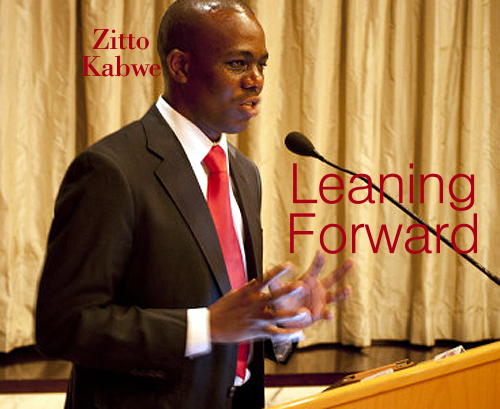
We aren’t sure when the subpoena was issued, but the crusader who pushed it through Parliament is a powerful, young business educated progressive from the main city on Lake Tanganyika, Kigoma.

Zitto Kabwe set up a website in his name devoted to the fraudulent mining issue in July. The subpoena was probably issued sometime shortly thereafter.

That particular controversy – one of a dozen such fraudulent stories coming out of Tanzania’s incredible new-found wealth in gas and oil – was of a secret government agreement to cede more than two-thirds of all oil and gas revenue to the foreign investors.

That’s at least twice the norm and when compared, for example, with several contracts that neighboring Kenya has issued with foreign mining companies, almost three times the regional average.

Kabwe said his crusade opened up when a local blogger, Ben Taylor, discovered the fraudulent deals which had been held secret by the government.

Taylor’s account was immediately published in an excellent Africa wide media publication, African Arguments that got continent-wide attention.

Then, new reports of increased ivory smuggling facilitated by the same officials who engineered and profited from the fraudulent mining contracts hit the news this week.

The lid on the boiling pot of discontent might still be pressed tightly down, but it’s getting hotter. The gas and mining officials were hauled in this week. The kingpins will likely be out on bail by tomorrow.

“This scandal is too big. We are not ready to see all this money end up in the pockets of a few officials,” opposition politician David Kafulila told Deutsche Welle.

Add to all of this a growing controversy over Tanzania’s so-called new constitution. Widely opposed by the public because it really isn’t new, doing little more than enshrining the ruling party’s near autocratic power, the government has vowed to move ahead with the national referendum in April.

That controversy has spilled over into the streets and Sunday one of the principal architects was almost stoned and beaten in a forum held in Dar-es-Salaam to promote the government’s position.

The government doesn’t appear to be backing down. Today, the unpopular prime minister condemned the protesters, maverick legislators but mostly the EU for withholding aid, arguing it would hurt “the common man.”

We’ll see who it hurts sooner than you think.

Letter From America

Letter From America

DividedGovernmentLETTER TO MY AFRICAN FRIENDS

Here’s what happened Tuesday in America:

An antiquated governing system flipped between two irreconcilable ideologies, because those ideologies are so far apart that compromise isn’t possible.

Many of you – I’m thinking particularly in Kenya – want to replicate America’s governing system. Don’t. It was great for the 19th and 20th century, but it doesn’t work in our high-tech, globalized 21st century.

Yesterday’s politicians and media analysts are absolutely right that “America is yearning for compromise” but they’re absolutely wrong that “now there’s hope the two sides will work together.” Our political structure has evolved to prevent compromise, so while we all want it, we’re not going to get it.

Since about a generation ago, “left” and “right” have moved too far apart from one another to be able to compromise within our system of government. This isn’t a failure of democracy, it’s a failure of the governing system to reflect democracy.

So gridlock will continue. Obama will stick to his positions and no substantive laws will be passed, or he will concede Republican positions. The two sides won’t each “give a little.” Neither side can: the positions are simply too far apart. So all legislative outcomes will simply be reflections of one side or the others ideology.

My ideologies and Ted Cruz’ are irreconcilable, but we are both gaining support. There is nothing left of the middle in America. I’m not sure this is in itself bad. The “middle” is often nothing more than a “muddle.” In many places in Europe widely divergent clearly opposing parties manage functional government through a parliamentary system. America is unable to.

Obama’s presidency is failing, because he still believes in legislative compromise. He still believes that he is the leader of everyone in America, and that idea means that he’s the leader of no one.

Whether it be on human rights, national security and wealth distribution, compromise isn’t possible: The difference in opinion is too great.

Today’s American elections are structured to achieve a knockout punch. Last night was a big Republican win. The Democrats will have their turn, again, and then the Republicans again, while America sinks further and further behind China and India and much of you in Africa.

“Sinks” in terms of economy, yes, but also in terms of culture, education and human rights.

The demons are three: an executive presidency, the rules of candidate campaigns and a little understood process called gerrymandering.

By the way, the American public as a whole is much more unified than our elections make it seem. In Tuesday’s election, “ballot initiatives” and “referendum” – policy questions put to the electorate as a whole – received massive support : redistributing wealth (“minimum wage”), protecting human rights (“anti-discrimination”), decriminalizing the poor (“legalizing marijuana”) among many others.

But under America’s system, today, these are rarely allowed to come before the voters and often then only as recommendations to their legislators rather than methods of creating law.

And under our broken system of government, the public’s will can’t be manifest well. So while the public passed those few referendum, at the very same time they elected powerful legislators who promised to oppose those exact same referendum.

So … nothing gets done. Gridlock or schizophrenia, doesn’t matter.

You in Africa have a unique opportunity to see how wonderful democracy has been for a long time in America. Use your fresh ideas to figure out a way to sustain it. We’re failing, here.

Election Day Night Whatever

Election Day Night Whatever

VotedEhElection Day in America is of no interest whatever in Africa, completely unlike the elections two years ago. Do Africans know something we do, too?

Two years ago the African press was filled with American election news. Yesterday and today I could hardly find a single story.

“A handful of toss-up US Senate races this week could hold the key to whether the stock market glides through the year-end in a typical post-midterm election rally,” from South Africa’s MoneyWeb on-line business service is typical of ‘that’s about it.’

Not even blogs, exploding about the American election two years ago, were interested.

To virtually every African, of whatever politics or economic class, the outcome of today’s election in the United States means virtually nothing.

The only relevant if annoying interest is whether there will be a clear outcome, and that muddy situation seems of interest only to high-end investors in Africa:

Reminding readers of the situation with George Bush and the uncertain election then, MoneyWeb worries that an uncertain outcome in the Senate will make the markets volatile.

Uh-huh.

Kenyans’ election commission leaders will actually be on hand in the U.S. to witness the election.

“There is a lot to learn from this election. As you know, America has very advanced electoral institutions that can be very helpful to us in our quest to improve the way we conduct our elections,” the commission’s chairman said today in Washington.

So one must ask: to what avail?

Democracy isn’t what it used to be, in my opinion. My views, your views, figure less than ever in what is happening in our country or community.

My reasons for this are probably yours, too: if it isn’t that I’m being swayed or fooled, lied to or tricked by fancy ads and robo calls and well groomed former leaders under lights, I’m just too darn fed up with the whole thing.

Nothing seems to change. Not for my way or your way. The old guys are still in power.

Hillary vs Bush? Wow, now that’s a fresh of breath air, ain’t it?

Finding 2 Million

Finding 2 Million

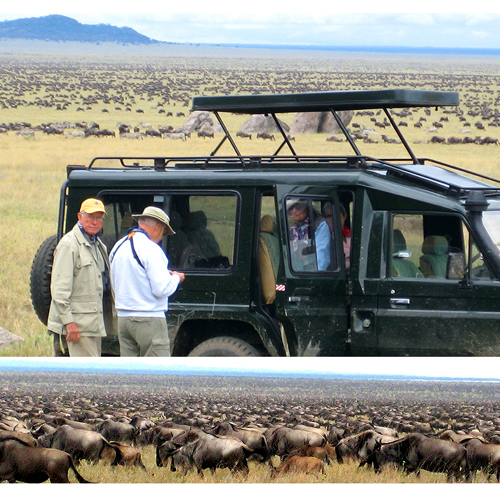
GolApr8The great wildebeest migration is the greatest wildlife spectacle left on earth and the main reason that visitors come to East Africa. Things are changing.

“The wild beest migration is unexpectedly … back around Central Serengeti,” Tanzania Adventure Safaris newsletter reported a few days ago.

“As there have been good rains this year… the herds [are] moving all the way down to the short grass plains … when they would not be expected.”

The migration occurs in the Ngorongoro/Serengeti/Mara ecosystem, roughly a 200-mile vertical oval east of Lake Victoria. About 3/4 of this area is in Tanzania, and the remainder in Kenya as the Mara.

There are now numerous wildebeest migration watcher sites, such as “Herdtracker,” all of which I’ve found biased, incomplete or irregular at some point when I checked. Geared mostly to the particular camps or companies with which the site is associated, a snippet of where the migration is, is generally truthfully reported, but the overall picture is never explained.

With two million animals involved, there really isn’t a focal point for the migration. Moreover, at various times during the annual year’s migration, the great herds may be cleaved into halves or quarters traveling sometimes in nearly opposite directions.

Predicting where and when a safari can intersect the great migration was never an exact science but always a pretty good bet. The two million migrating herbivores involved eat virtually nothing but grass and grass grows when it rains and rain cycles were quite predictable.

In the north, in Kenya’s Maasai Mara, it rains almost every day of the year except in October and the beginning of November. The grass, though, in the higher elevations of the Mara isn’t quite as nutritious as the grass in the far south of the Serengeti. So even though grass is growing almost all the time in the Mara, if there is better grass to the south, that’s where the herds will go.

The circle of rain is like a big hula hoop with Lake Victoria as its center. The great herds move with the edge of that circle as it contracts into Lake Victoria until finally they get diverted to the last place in the area where it’s raining, the north of the ecosystem, Kenya’s Maasai Mara.

Sounds simple, eh? All you have to do is predict when the rains will stop. The herds then move north, sometimes frantically depending upon how quickly the rain turns off down south.

So a really safe bet was to visit Tanzania’s Serengeti really any time in the first half of the year (although February and March were always a sure bet), and Kenya’s Maasai Mara in July – October (although August and September were considered the best).

Didn’t happen this year.

This October much of the central and southern Serengeti received up to four inches of rain. Normally there would be no rain at all.

Two things are happening:
AnnualRain20141NOA
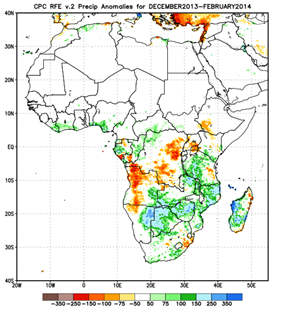
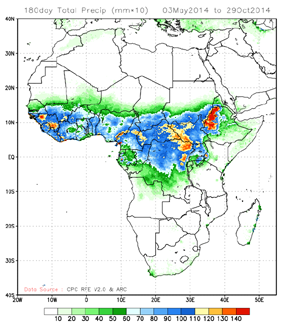
First, rains are much heavier than normal during the historically normal rainy season. You can see that from the NOA chart to the right. Green is a 100% increase over normal, so twice as much as usual.

Second, the rainy season itself is growing. You can see that from the second NOA chart just below the first. Green is a 50% increase over normal. Blue, which shows through much of the equatorial region, is a 100% increase.
RainySeaonRain2014

More rain and a longer season is going to keep the wildebeest for a longer time in Tanzania’s Serengeti and delay their arrival and hasten their departure from Kenya’s Maasai Mara.

Is this a trend, or just something unusual for these past few years?

According to the Stockholm Environment Institute (weADAPT), one of the few professional meteorological organizations to study East African climate:

“…there has been an increase in the number of reported hydrometeorological disasters in the region, from an average of less than 3 events per year in the 1980s to … 10 events per year from 2000 to 2006, with a particular increase in floods.”

weADAPT and most organizations are concerned mostly by how this effects people, and the news in that regards isn’t good. Malaria, for one thing, will increase with increased temperatures and precipitation.

But the wildebeest and zebra love it. Their numbers are increasing, more and more grass is growing, and with time they’ll be spending more and more of their time in Tanzania rather than Kenya.

But at the same time as the rains increase there will be less of a need “to herd.” The animals may just start wandering, because wherever they wander, there will be food to eat.

The hard-wired aspect of wildebeest migrating — which we normally see as files of running animals — isn’t going to change or adapt as fast as global warming. We’ll always see them running, and it’s a magnificent sight!

But as it rains more and more, they might not have to.

Happy Halloween, Ebola Sir

Happy Halloween, Ebola Sir

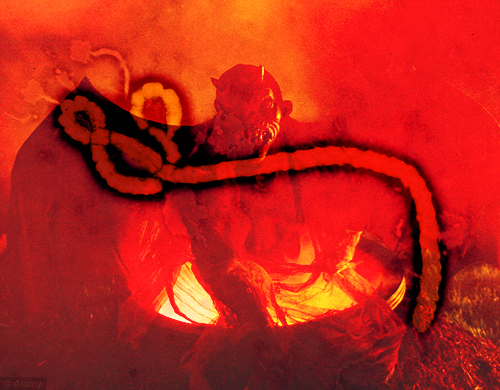
halloweenebolaNot even the outstanding basement haunted house that I so successfully ran when my children were in middle school can begin to achieve the truly absolutely unbelievable fears of ebola stoked by despicable American politicians.

“An epidemic of fear can be as dangerous as an epidemic with a virus.”

Maine health-care providers, led by the executive vice-president of the Medical Association of Maine issued that quote, in response to Maine’s T-Party governor’s abrasive and ignorant actions against a health care hero who just returned from West Africa.

A third-grader banned from attending her Milford, Connecticut grade school because she just returned from a wedding in Nigeria where she was the flower girl, had to get a court order to go back to school.

Louisiana Governor Bobby Jindal sent out letters to recent returnees from West Africa who were planning to attend this weekend’s convention in New Orleans on tropical medicine, advising them they shouldn’t come.

A Strong, Maine, elementary school teacher was ordered into a 21-day quarantine because she just returned from her vacation in Texas!

Not only did parents panic when the principal of the Hazelhurst Middle School in Mississippi returned from vacation in Zambia, so many pulled their kids out of school, it closed!

“Principal Lee Wannik had returned to school a day early from a recent trip to Africa, where the Ebola virus has been spreading fairly rapidly. Principal Wannik has just returned from attending the funeral of his brother in Zambia, Africa. A meeting was held Tuesday, October 14 in the school’s auditorium, to try to calm parents and officials who wanted the principal to leave permanently.”

Zambia is thousands of miles away from the epidemic, further than London, with no viral epidemic outbreak there and no history of ever having had one.

The day after the parents pulled their kids out of school, the rumor spread
that the principal actually had ebola.

Tuesday Nigerian applicants to a community college 60 miles from Dallas showed their rejection letters to the press: Elizabeth Pillans, the Director of International Programs, confirmed that “Navarro College is not accepting international students from countries with confirmed Ebola cases.”

The applicants who revealed the letters are from Nigeria, which is “ebola free.”

The DeKalb County (part of Atlanta) Georgia K-12 school board issued the following statement yesterday:

“…no new students from Ebola-affected West African countries, including Liberia, Sierra Leone, Guinea, and other affected areas in the United States will be enrolled or allowed to attend classes on school campuses without proper medical documentation and approval by the Superintendent.”

Yesterday Dallas County Judge Clay Jenkins, notable for supporting the grieving family of Thomas Duncan who died of ebola there, told the press:

“…my wife who was in tears [was] told that she can’t work in the [school] cafeteria by some other moms because she might have Ebola, because I might have Ebola, therefore my child might have Ebola, [and] maybe they all need to leave school.”

There’s more: London’s very somber and highly respected Guardian Newspaper ran the following headline this week:

“Panic: the dangerous epidemic sweeping an Ebola-fearing US.”

Follow the link above so that you can read how American Airlines flight attendants locked someone in an airline bathroom because she vomited, how a journalism department at Syracuse University disinvited a Pulitzer-Prize winning reporter because he had been in Liberia, and on and on and on.

Let’s stop. Drill down into each of these and you drill into a conservative, often T-Party community. I’m not saying this is wholly restricted to Republicans. My own democratic governor up for re-election is acting just as immature.

But we’ve got to fight back. The gloves need to come off. The divide is clear. We can’t be polite or shy. The more conservative an area is, the more likely it’s been fomenting this hysteria.

I’ll leave it to others to study why. Meanwhile, I’m pleading with you to join me in calling out the brazen fear-mongers wherever you see them.

Fight back. Inject some sanity back into America next Tuesday.

Between Black & White

Between Black & White

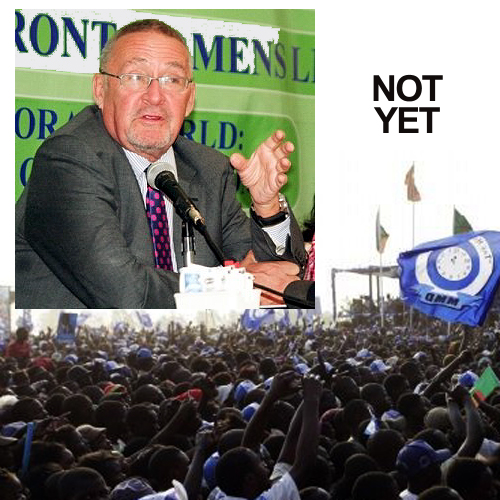
NotYetScottWhite fear of black in America is profound but black fear of white in Africa is even more profound.

Currently of Africa’s 53 countries, only one is being led by a white man, and that came as a great surprise to most in the world, and in fact, to him.

Or did it?

Guy Scott was a close friend for many years of the president of Zambia, Michael Sata, who died early yesterday morning in a London hospital.

Scott’s Ph.D. in agriculture, his birth in Livingstone and his outspoken dedication to remaining essentially unmeaningful except as a symbol gave the former president all sorts of political hedges and foreign notice.

So Sata’s rise to power was never without Scott at his side, and much of Zambia saw this very unusually blended team as just what the country needed four years ago. And so it proved so.

Not because of what Scott brought to the team, but specifically because what he didn’t.

Many vice presidents around the world have no power. It’s a peculiar anomaly of the executive type of democracy that the man designated to replace the dead leader has so little to do or say until that tragic moment comes.

Yet it comes quite often. Presidents of democracies have a very high fatality rate, and not just from assassination. Many don’t achieve the position until they’re quite old and sick. That was the case with Sata, and many wonder if certain Zambians allowed Scott to be put on the ticket as vice president for that very reason.

African executive democracies are almost all much more executive than in America. Each time Sata left the country, he had the power to appoint an acting president, and it was never the white face.

In the last several years Zambia like many African countries has been actively implementing piece by piece a new constitution. Zambia moved faster and faster as Sata got sicker and sicker, but Tuesday the race ended with Sata’s death.

One of the pieces currently up for consideration would eliminate the requirement of the old constitution that limits the president only to persons whose parents were born in Zambia.

Among the reasons this is so contested is because Michael Sata’s son, the very popular current mayor of the Zambian capital of Lusaka, was born to a Sata wife from Malawi.

The mayor, known commonly only by his first name Mulenga (just to avoid muddying the waters), is technically no more eligible than Scott to run for president, but he commands a very powerful political wedge in current Zambian politics.

Scott was born in Zambia in 1944, but his parents were born in Scotland. The Sata/Scott team headed a very popular political party in Zambia, brought to power in no small part because of anti-Chinese sentiment that swept over this fairly industrialized country the last few years.

Chinese investment in Zambia is as intense as anywhere in Africa, but the Chinese ran into hurdle after obstacle when trying to quell the power of Zambian unions.

In his recognized lack of power, Scott often remarked disparagingly about the Chinese as the perfect mouthpiece for his powerful boss. What Scott said was presumed to be what Sata believed, even as Sata negotiated more and more Chinese investment.

They were a perfect team.

The moment Sata died and Scott was confirmed the interim president yesterday, Zambia’s incessant talk of coups heated up:

“…it is a period for the people of Zambia to reflect as to whether this is the kind of constitution we want [or one] that could provide a different scenario all together,” Scott’s African lawyer told the press yesterday in what many consider setting the stage for a herculean political battle.

Sata loved Scott but not so much his son, Mulenga, who hates Scott. The political opposition hates them all, and their leader has already announced he will run for the president.

In my opinion Scott isn’t qualified to be any country’s leader. His crass remarks about Chinese and his oft-stated support for the neighboring and ruthless dictator, Robert Mugabe, disqualify him in my view. He served a cute purpose for a while.

But also in my opinion a white face couldn’t make it yet in any African country. This is where America stands above Africa: Obama may be facing some of the most racist obstacles to governing of any man alive, but he did ascend to highest office.

In Africa, not yet.

Good Ebola Travel Policy

Good Ebola Travel Policy

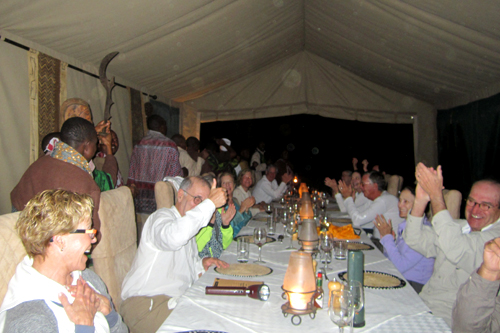
campdinnerAfrican travel companies are rethinking their ebola policy, putting their money where their mouth is, and offering unconditional refunds.

Embracing science and the history of past ebola outbreaks, companies mostly so far in East Africa are advising customers that deposits will be refunded without penalty if WHO declares an outbreak in an area in which they operate.

WHO’s designation, “outbreak,” differs from isolated cases of the sort experienced in Dallas and New York. An “outbreak” is multiple confirmed cases in separated, multiple areas. There is no history or other evidence suggesting that isolated cases lead to outbreaks.

Among the first this weekend to change their policy was Great Plains Conservation, which operates three luxury camps in Botswana and three in Kenya.

“Many of our guests are really worried about Ebola. One can’t really blame them given the media hysteria surrounding the story. We believe this will sort itself out in time as the world mobilizes to tackle this head on,” Jacqui Usher explains as the lead-in for the policy change.

The Great Plains policy will refund all monies held – no questions asked – if an ebola outbreak occurs in Kenya or Botswana.

Moreover, Great Plains has now announced that even if there is no outbreak, customers can get all their money back within 16 weeks of arrival. Most African camps require an up-front, nonrefundable 15-20% at the time of booking.

And within those 16 weeks should a customer grow weary of coming, Great Plains will roll any monies held for the customer to new booking dates up to a year in advance.

This is the gold standard of sensible ebola policy. This is spot-on reasoning, bold marketing and honest communication with consumers. No legalize or other lengthy pontificating qualify this extraordinary situation we currently find ourselves in: a hollow fear of something that will simply not happen.

Yesterday in Mwanza, Tanzania, the blood tests of a man who had died suspiciously of symptoms identical to ebola tested negative for the virus.

The possibility, though, that the man had ebola had spread like wildfire through this large Tanzania city on Lake Victoria last week. Health care workers responded in force, a public health campaign was initiated, associates of the man were quarantined and even if the man had tested positive, the spread of the disease would have been stopped in its tracks.

The Mwanza response is what is lacking in West Africa, and the reason that the disease is still spreading there.

Great Plains may be the gold standard and the first company to play it straight with consumers, but it has been resoundingly joined by others:

“Gamewatchers Safaris understands travelers’ sensitivities about planning a holiday almost anywhere in the world during an Ebola outbreak,” Jake Grieves-Cook, former head of the Kenyan Tourist Organization and now owner/operator of Kenya’s Gamewatchers Safaris explains in the lead-in to his new policy, which is similar to Great Plains’.

Great Plains and Gamewatchers were among the very first, but by no means the only companies to announce revised changes, yesterday. It’s going to be very difficult, now, for any African travel company to sit on its hind and not join this sensible movement.

And the result? Consumers will be assured that the African travel companies really believe what science and medical experts have been saying all along:

Ebola is hard to get, and relatively simple to stop spreading except in very unique areas like the three countries in West Africa just ravaged by generations of war.

Don’t Vote

Don’t Vote

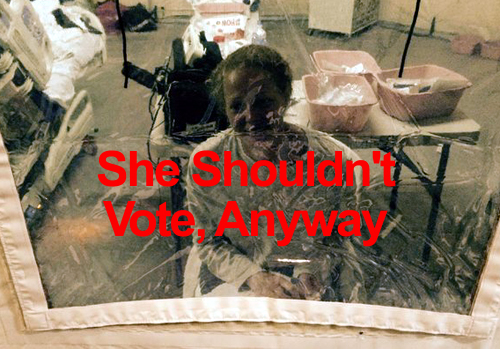
sheshouldntvoteThe depths to which some Americans have descended in an hysterical attempt to protect themselves against ebola has become immoral.

The airport quarantines of health workers arriving from West Africa is dead wrong. It will impede the health services and trade, which West Africa must have to recover, and many more people will die.

In a worse case scenario, the situation which had become better will slide into worse, and the threat to Americans will increase substantially. The policy is self-destructive.

Then why is this happening?

Politics. American politics has become so corrupt our democracy is now impotent. The electorate has lost the ability to analyze issues and is controlled by false claims and fearful media.

Governors Quinn, Cuomo, Scott and Christie are hardly bar chums.

Yet they walked in lockstep to solicit their electorate’s hysteria, because they are all about to lose power, and they are getting votes however they can.

Of course their actions reveal an electorate – if they’re correct – that’s slum ignorant. Are you truly so ignorant? Or like me, do you feel helplessly manipulated?

My own governor, Illinois Pat Quinn, is no angel but I did plan on voting for him as “the lesser evil.” His challenger, Bruce Rauner, is no alternative for a progressive like myself.

So I now have no choice but not to vote for either. This is hardly democracy at work.

But it is at least myself acting on the truth that I know:

The four governors that enacted this barbarian policy are killing people in West Africa and not increasing the protection or health of their own citizens.

In fact, the policy endangers their own citizens’ health and well-being.

This political act against self-interest is what has been happening to America for a generation. Whether it is the senior voting to end Medicaid or the food server voting to end a minimum wage, Americans have been brainwashed with a thousand false ideas to act against what they know is best for themselves.

And now this toxic social personality threatens the lives of thousands.

Facts be damned. Scream don’t think. The man will do anything to stay in power.

I can’t keep him out. But I won’t vote him in.

Bad Ebola Cancellation Policy

Bad Ebola Cancellation Policy

badvacationThings are calmly down, slides in travel are reversing, and African tour companies are once again shooting themselves in the foot.

In the last ten days a wave of African travel companies have issued new cancellation policies addressing a perceived fear by potential travelers of ebola, which does absolutely nothing except increase fears.

As far as I can tell it began with one of southern Africa’s most reputable and larger companies, Wilderness Safaris.

Wilderness is a holdover from archaic marketing days and still doesn’t sell directly to the consumer, so it sent a rather petulant email to agents worldwide that began by deriding the notion that ebola in West Africa could effect holidays as far away as East and southern Africa.

But then sighing through the internet, the company issued a new policy that said it would cover any difference in lost cancellation fees from nonrefundable payments not refunded by the travelers own insurance company.

Sounds pretty good, doesn’t it? It didn’t take long for a whole bunch of companies throughout the continent to follow suit.

It’s meaningless – at least for Americans – and in my opinion is totally counterproductive.

First, why it’s meaningless:

Read the revised policy’s fine print. (1) WHO must declare an “outbreak” in the country in which the safari is scheduled. (2) The traveler must then apply first to his own travel insurance company for refunds of monies on deposit. (3) Whatever the insurance company doesn’t cover, this widely adopted policy will not refund cash but rather a credit for future travel, which is limited by time and other conditions depending upon the specific company.

(1) There is currently much more ebola in the United States then in any sub-Saharan country. WHO has not declared an “outbreak” of ebola in the United States. That is a strategic-specific term that precedes an actual “epidemic” and it requires multiple cases in multiple locations. So to begin with, a single case say in a game park in South Africa will not trigger this policy.

(2) I’m not completely knowledgeable about the travel insurance available to other than Americans, but in the United States there is not a single travel insurance company that covers a travelers’ decision to abort their trip because of ebola or any other public health emergency. In the U.S. normal travel insurance provides benefits strictly for accidents and other health conditions befalling the traveler him/herself.

(A few very expensive policies cover terrorism, and consumers can spend an enormous amount of money for “cancel for any reason” but for most travelers these rare policies are prohibitively expensive.)

In other words, normal travel insurance bought in the U.S. will not provide benefits for a public health emergency in the country scheduled to be visited.

Refunds of part of your deposited trip, and not others, essentially mute out the first refund: Few Americans traveling to Africa will deposit on a trip there without also buying their air fare. There is no indication whatever that any airline will issue any refund for a travelers’ decision to cancel because of a public health emergency.

(3) As most established travel agents and operators worldwide know, most local African companies are quite liberal in extending nonrefundable date-specific services for almost any reason. In other words, most travelers are able to reschedule their previously deposited trip to a later date with no penalty for any reason, much less ebola.

For Americans, then, there is absolutely no benefit whatever from the newly expressed policies.

Most American consumers are a bit more savvy than Africans believe their geography quotient may be. I think most consumers will see this for what it is: a marketing gimmick. Gimmicks don’t help sales.

Consumers who consider the policy more substantial than a gimmick will actually be further deterred: Creating policies that on their surface seem beneficial to the potential traveler only if an outbreak actually occurs suggests that company is conceding that an outbreak is possible.

When the risk is nil. Consider that several of the last ebola outbreaks occurred in Uganda, a popular East African safari country. It never turned into an epidemic, and Uganda’s health-care system countrywide is below average compared to most other sub-Saharan countries.

Consumers – especially in America where two of its largest cities now have had locally developed ebola (Dallas and New York) – are recognizing however slowly that sub-Saharan Africa is actually less risky to visit than the Cowboys’ new stadium or the Statue of Liberty.

African travel companies have always been a little bit behind the times. This stupid policy does nothing but reignite irrational fears.