OnSafari: You Need an Agent

OnSafari: You Need an Agent

AirportFor years I’ve derided travel agents as unnecessary middle persons. I’m rethinking some of this.

So is Lufthansa, and probably soon Delta. Once completely dependent upon travel agents, these two mega airlines are soon going to charge you if you use an agent or consumer website like Expedia.

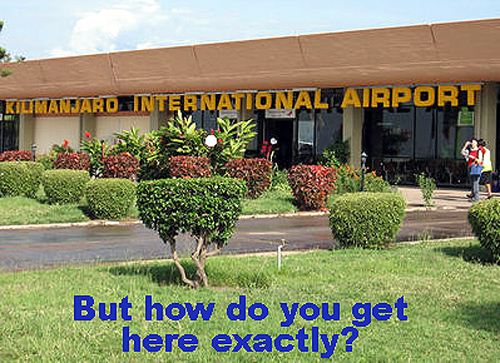
I’m in Vienna, half way through my journey back to Africa. Vienna has no flights to Africa, but Austrian Airlines is part of the Star Alliance. I connect here to Istanbul and then to Kilimanjaro.

This is not a routing that United’s MileagePlus originally offered me. I had to tell them. (It’s a regular schedule offering, now, but when I first booked nearly a year ago, it wasn’t shown.)

My own travel agent skills, and the SABRE GDS booking system that we have in the office is what led me to this option.

A normal consumer without access to a GDS couldn’t do this.

GDS’s are children of the original private airline computer systems. In the late 1970s airlines were among the first companies to use computers. The larger airlines leased their computer systems to scores of other airlines and travel agents and they were called GDS (Global Distribution Systems).

For example, SABRE was the American Airlines’ system. AMADEUS was the system founded by the main European airlines.

GDS are much less user friendly but much more powerful than say, Expedia. They can be quite costly to.

GDS can duplicate Expedia methodology: give me the options for flights and costs for where are you going to from where, but their power is greatly reduced by doing so.

Rather, the savvy user must know before beginning a session what the likely “routing” will be. The GDS is most powerful when asked step-by-step to display every possible option.

The professional using a GDS day-in and day-out discovers the tricks and shortcuts and learns the complex fare building that were Expedia to attempt would result in too many options for its users. So consumer sites like Expedia hewn these options down by algorithms based mostly on expected consumer price points.

By doing so, they often miss the boat. There are easily several hundred different connecting possibilities when traveling from Chicago to Kilimanjaro. Neither Expedia nor MileagePlus would have presented me with the journey I’m currently taking, which I constructed myself using a GDS.

Here’s another excellent example:

At last look, there were 281 different “through fares” between Chicago and Kilimanjaro. That means a single ticket, a single fare on some airline or another starting in Chicago roundtrip Kilimanjaro.

But if you build an air fare say with two fares: one to Europe then a second one to Kilimanjaro, the options are enormously greater. Just to London, for example, there are 650 fares published today, and then 362 fares from London to Kilimanjaro.

Delta in correct conjunction with three other airlines produces what I think is the best fare and best schedule to fly from the U.S. to Kilimanjaro … where I’m going.

But to arrive at this “correct conjunction” you must start with a Delta non-code-share to Paris, then pickup Kenya Airways to Nairobi, then PrecisionAir to Kilimanjaro. On the return you can use either KLM to Amsterdam or reverse the PrecisionAir/Kenya Airways/Delta outbound.

There is no existing consumer booking system that will create this itinerary. You can call an Expedia agent, for example, and tell them what you want, but they won’t be able to find this possibility.

Not even the Delta site will generate this Delta fared itinerary. I have no idea why. It could be that the GDS is capable of finding the loopholes in the complicated airline “fare ladders” constructed by complex agreements between different airline companies. It might also be that Delta just doesn’t want you to pay that cheap a fare.

Keep in mind, though, that this isn’t just to get a cheaper ticket, the obsession of the American consumer. It’s also to discover the best schedules.

I’m a safari guide, a poor travel agent by default. But a good travel agent who understands flights to more of the world than just Africa can be very valuable today. Their problem is that airlines no longer give commissions, and their professional service isn’t free.

One of the awful hazards of the internet is that it empowers the consumer to think she’s as good as the professional.

Not if you want the cheapest and the best schedule from Chicago to Kilimanjaro!

Forming The World Order

Forming The World Order

bashiratsummitOne of the most difficult things for anyone or any thing to do is cede control … to give away your authority to someone or something else. South Africa did that, today, and the United States in an identical situation in March refused to.

In my estimation, this makes South Africa more modern, more moral and presents a future more promising than the U.S. The world is becoming increasingly interconnected and interdependent upon every part of itself.

A global society with ultimate authorities will some day be an absolute certainty. The societies which embrace this future and now work towards it will be the movers and shakers in it.

Those who refuse may decay.

Omar al-Bashir, the dictatorial leader of The Sudan, was in South Africa earlier today attending the African Union summit in South Africa. A court ordered his arrest on an indictment from The World Court for crimes against humanity, because South Africa is a signatory to the World Court Treaty.

But minutes before the order was issued, Bashir jetted out of the country.

Bashir was in New York in March for the opening session of the United Nations. Although numerous organizations and individuals petitioned various U.S. courts to have him arrested, no court issued a warrant because the United States is not a signatory to the World Court treaty.

So he stepped onto a world stage and addressed the opening as all World leaders are allowed to do. He legitimized his ruthless rule. Obama could have cooperated with the World Court, even without a formal treaty, but he elected not to.

The situation in South Africa was not without controversy. Before The Court ordered his arrest, it ordered that he not leave the country while it deliberated the case.

The current government of South Africa headed by President Jacob Zuma was caught off guard, as it has continually been throughout Zuma’s troubled reign.

Having little choice but to play with the court that, in fact, has kept Zuma somewhat immune to the ramifications of his scandals, the South African government aruged that Bashir was technically not in South Africa, but in the nether world of the Africa Unity Summit, and therefore South African laws didn’t apply.

The Court adjourned for an hour at noon South African time after a morning of deliberation. In that hour Bashir was sped away from the summit in a black limo to a nearby South African airbase, where his plane’s engines were running.

He leaves behind him another Zuma scandal: Zuma heeded the call by the Court to deliberate the question, but essentially just ignored the earlier order to keep Bashir in the country until a decision was reached.

Bashir is under indictment by The World Court for crimes against humanity mostly in Dafar.

On Friday, the South African government urgently appealed to the court in The Hague to rescind their arrest warrant while Bashir attended the African summit.

Saturday, The World Court refused and a local South African court then ordered Bashir to remain in the country while it deliberated on numerous motions from South African citizens.

It’s not uncommon for Heads of State, including George Bush, to avoid international travel because of fear of being arrested in a foreign country.

Bush and Cheney avoided travel to Canada and Switzerland shortly after the end of the Bush presidency because of numerous lawsuits filed against them for the fraudulent war in Iraq.

Bashir has avoided almost all travel since being indicted, this because the majority of the world subscribes to the World Court. In March, however, he traveled to New York to address the opening session of the United Nations, having received assurances from the Obama administration that he would not be arrested.

The U.S. is not a signatory to the World Court convention, as virtually every African country is. Moreover, the Obama administration believes that peace in South Sudan is critical and dependent upon Bashir’s cooperation.

At the time, The World Court, which is a child of the United Nations but technically no longer linked to it, requested the UN to arrest Bashir. Ban ki-moon declined, answering that he lacked such authority.

It was a terrible travesty of human rights that Obama and Ban ki-Moon allowed the ruthless dictator to address the world assembly.

It’s arguably a greater travesty that President Zuma picks and chooses which court orders he will obey at home, but the overall situation and outcome in my estimation puts South Africa as a whole in a much more moral situation than the U.S.

Accepting authority is never easy. But without a world authority in the near future there will be no authority for anyone.

Don’t Mix!

Don’t Mix!

pantherchameleonFascinating field research in Madagascar has finally explained a long-held mystery about panther chameleons: there’s more than you think!

Panther chameleons are very likely among the most popular reptile pets in the world, particularly in America. They’re native to northern Madagascar where their habitat is seriously threatened, but there are so many pet panthers in the world and so many breeders the species was not considered threatened.

But this crafty little creature might have fooled scientists, after all!

It may not be a crafty little creature. It might be 11 different crafty little creatures! And one of them, say that blue one with turquoise stripes and beady orange eyes — yes, it, indeed, may be seriously threatened!

Field scientists from the University of Geneva, working on a hunch motivated by a curious practice of the commercial reptile breeding trade, are suggesting that there’s not a single panther chameleon with lots of different colors.

Rather, contends Prof Michel Milinkovitch, there are 11 separate species whose very rare hybridization always produces an infertile offspring.

For years chameleon breeders and commercial traders have known that chameleons of different colors ought not be mixed up:

“Due to the extreme color differences of the species, we use locale info to identify the wide variety of panthers. This helps in keeping locales pure when breeding and avoids unwanted crosses,” is one breeder’s subtle way of saying don’t mix and match. You won’t get any little creatures tapping around your breederie if you mix red with blue. “Unwanted crosses” probably have never happened in the pet store.

For years and years no one’s questioned this mystery even though it’s been well understood that color differentiation is geographical.

It seems to me that this could have been a high school science project, but it’s taken all this time before adult scientists finally decided to test the hypothesis that color differentiated species.

It does. Two drops of blood from each of 324 panther chameleons across the upper part of Madagascar revealed in DNA analysis 11 separate species of creatures.

“Each of the new chameleon species requires individual management, given that they each constitute a different part of the biodiversity of the whole,” Prof Milinkovitch chides scaly pet owners around the world, and he’s right of course.

His report goes on to suggest that the harvesting of panther chameleons from Madagascar, which the government currently caps at 2,000 annually, needs to be more minutely regulated, as certain of the species might be in more trouble than others.

On the one hand this is a marvelously wonderful story that expands even more our understanding of Madagascar’s incredible biodiversity.

On the other hand the government of Madagascar seems incapable of stopping the entire deforestation of its island nation and it just emerged from a long period of violent civil strife. Who’s going to care about these little guys, anyway?

Remember, every new paint that you add to the mix makes the color duller. Remember that curious grade school fact: mix all the colors together and what do you get? White, how boring!

Poof! Thar She Goes!

Poof! Thar She Goes!

PoofEleNo, do not believe that the elephant population in Tanzania has declined 60% in 5 years. Read the science not the headlines.

A couple weeks ago the Paul Allen Foundation and the Frankfurt Zoological Society turned over their elephant census numbers to the Tanzanian government.

The Tanzanian Minister for Natural Resources and Tourism then held a press conference to announced the results:

A total head count of just over 40,000 elephant. Actually I had to add up his numbers which he released piecemeal, but not even clever Tanzanian politicians can alter arithmetic.

The last census, also conducted in part by the Frankfurt Zoological Society, put the country’s 2009 elephant population at around 110,000.

A 60% decline.

Some of the more sexy conservation organizations like NatGeo reacted like a London Daily Mail:

100,000 elephants killed” NatGeo reported in 72-pica type (or its relative equivalent in my 13″ CRS).

Still believing that some NatGeo products are better than the “Alaskan State Troopers,” a few reputable news media like Britain’s Guardian echoed the “catastrophe.”

The Washington Post cited the press conference as proof of a “catastrophic decline.” (This one really bothers me.)

Moving a tad closer to the truth, some better organizations were more measured:

The Wildlife Conservation Society in its ‘Response to … Elephant Census’ first noted the hefty increase in elephant numbers in the north of the country before three paragraphs down reporting the numbers in Ruaha, which is the component that brought the overall census numbers so low.

The Frankfurt Zoological Society, the lead organization for almost all wildlife conservation in Tanzania, was equally measured in reporting the results.

Like WCS it noted the success with elephant populations in the north before reporting the dire figures but further qualified them by suggesting there was hard evidence from the “carcass ratio” in The Selous that indicated “unnaturally high mortality“ not necessarily related to poaching.

Oooooo….

“Government, Wildlife Experts and Conservationist [are] baffled by the sudden disappearance of more than 12,000 large elephants from Southern Tanzania even though they were neither poached nor died,” reported the Arusha Times.

Oh, my goodness, it’s Babu at work. This is getting spooky isn’t it?

Here’s what’s happening, folks.

These elephant statistic are at long last some of the most reliable numbers ever obtained in elephant counting. I have often written about how confused and contradictory elephant censuses have been.

Many other more credential organizations have, too.

Maybe now, thanks to the Paul Allen Foundation, we’ll start getting it right.

It was Allen’s $900,000 which paid for this census, and it was the most exact, most scientific census of African elephants north of the Zambezi ever done.

But there are 2 major problems with concluding “a catastrophic decline” from the first set of reliable numbers we’ve ever had, beyond the simple common sense that reliable numbers can’t be compared with unreliable ones to make any conclusion:

First, this well done census was confined to protected or near-protected wildernesses. There are vast areas of Tanzania, particularly not far from those characterized as having the most “catastrophic” decline, that are not densely populated and perfect habitat for roaming elephants.

Second, the areas of Tanzania that have been very carefully studied pretty well for almost a century, the northern wildernesses, showed an increase in populations in the same study period.

Those northern areas are much more densely populated by people, with all their problems and daily activities and everything else that contributes to human/elephant conflicts. If there is any place where poaching can be documented, it will be in these areas.

I disagree vehemently with those who claim the human unpopulated vast wildernesses of Ruaha and Rukwa are prime poaching areas because nobody can see you do it. Balderdash. They can’t see you do it in the middle of the Serengeti National Park, either! At least not when you do it with the skill of a real poacher.

These guys aren’t going to waste their resources on the long-distance, sparsely populated, thorntree forests of the vast interior. They may, in fact, be less watched there, but it will be exponentially harder to poach then transport the goods to market from Ruaha than from Tarangire.

So thank you FZS and Paul Allen for at long last starting us on the right track, but those flashy so-called scientific organizations with their hands out … time’s up.

I just can’t wait for the 2019 census!

Freedoms Crumbling

Freedoms Crumbling

VaderPilatoNo wonder that stability may trump Africa’s expanding democracies. Just look at Mosul or the Boko Haram held areas of Nigeria.

Today a popular rap singer was arraigned by a Lusaka magistrate for “defaming the president” of Zambia even though such a specific law doesn’t exist.

Pilato’s rap depicts the president as an oaf who spends much of his time drinking.

Pilato is very popular, very political and shows a definite sophistication of complex issues. This rap, for example, berates a political merger between two previously antagonistic political parties.

But the hook which gave his rap such a wide audience was the accusation of drunkenness. Drunken old men in rural Africa are the bane of their families, a condition closely associated with dementia.

It’s understood that age and dementia are not willful situations but nonetheless divine the good old men from the bad old men: prosecutor, judge and jury be damned.

So prosecutor, judge and jury respond, waging their own powers in equally questionable ways. A judge arraigned Pilato, today, but who knows for what. A prosecutor will now have to trump up charges, and a jury may assert its legitimacy by adjudicating violations of nonexistent laws.

From my untrained ears, Pilato doesn’t seem to be a specially powerful artist. Acting as if he’s a threat to society, makes him one and only because of that.

Last week at the inauguration of the new president in Nigeria, local journalists so accosted President Mugabe of Zimbabwe that his office later called them Boko Haram.

The video of the SaharaReporters’ encounter is particularly illustrative.

In my view, the so-called journalists were offensive. I’m hardly a supporter of Mugabe, who I consider one of the most devilish leaders Africa has ever seen.

I believe there are times when journalism should work with politics. I remain a devotee of Angela Davis and Herbert Marcuse. But this incident in Nigeria is not one of them.

These reporters had little interest beyond making headlines of themselves. “There is no democracy in Zimbabwe!” the woman journalist yells after persistently being unable to get Mugabe to answer her question, “Is there democracy in Zimbabwe?”

So with Pilato, no there’s not “too much” freedom of speech. But with the Nigerian journalists, yes they exercised “too much” freedom of speech.

There are ignorant rich, and there are ignorant poor, and technology is thrusting them backwards into the age old irresolvable battles between religions and tribes.

Neither side understands the facts, yet the IT technologies of iPads and iPhones present them constantly with situations requiring immediate reactions.

There is a reason that ISIS bans most technology. It wants to control the culture and the first step in controlling anything is to neutralize or pacify it. Many in Mosul as in the Boko Haram areas of Nigeria actually prefer such pacification to confrontation. My father did.

Democracy doesn’t exist without confrontation. Open societies need it. But when it reaches the level that technology brings it to, today, it’s like fusion. It expands under its own power and becomes uncontrollable and unpredictable.

When confrontation is such that it provokes a yearning for less freedom than more, when stability becomes society’s first priority, Darth Vader arises again.

Excessive Force

Excessive Force

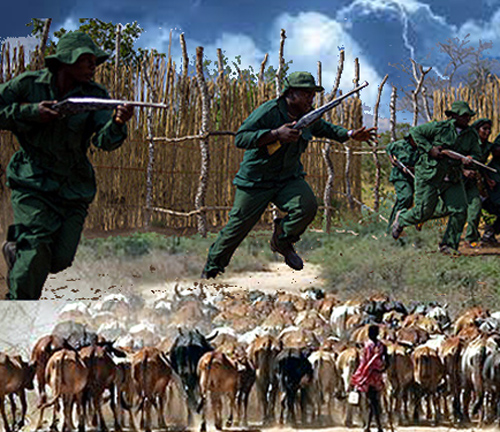
RangersGunManyaraNot just in Dallas or Cleveland, “Excessive Force” is a top news story in Tanzania where four Lake Manyara park rangers were arrested last week.

The rangers got into a confrontation with herders bringing cattle into the park, which is illegal.

The rangers tried to impound the cattle for trespassing on national park lands, then claimed that up to 30 villagers attacked them with traditional weapons provoking them to fire modern weapons in self-defense.

Several villagers were wounded, and one 34-year old man was killed.

Only the Arusha police commissioner issued any statement and that simply that four of the rangers were arrested for using excessive force. Tanzania national park authorities issued no comments.

East African media, though, unlike here at home was reluctant to publish the story. One of Tanzania’s smaller, independent newspapers published it only on its on-line edition, which when I checked this morning had received less than 400 views.

The reporter discovering the story, Hazla Quire, resorted to filing his news through friends on Facebook: John Mrosso: June 6 posting.

By the end of last week only the Chinese news agency, Xinhua, had picked up the story and distributed it in East Africa but notably not in China.

Incursions by local herders into national park lands are increasing throughout Tanzania as the competition for good grazing increases. It’s particularly stressful during times of drought.

I was in this remote part of Lake Manyara National Park in April, and we saw several small herds of cattle in the deep forests just after the park gate about 10k west of &Beyond’s Tree Lodge.

The private lands leading up to the gate are relatively prosperous by village standards in East Africa. Densely populated the farms here produce several types of grain and a lot of rice irrigated by waters related to Lake Manyara.

But there had been an intense although short drought in February. I think the rice was doing OK but the grains were stunted. Heavy rains had just begun and several farmers were trying to plant all over again, their normally planted first-of-the-year crops lost.

Herders were suffering more, because it takes only a few weeks of drought before all available private grassland is grazed out. As this happens more and more with climate change, grassland rejuvenation is trumped by the erosion that occurs with the first rain.

Whereas inside the national park wild animals have achieved a balance with the grassland that is more resilient to a drought. It takes only a few days of rain and the grasslands inside a national park begin to rejuvenate.

East African park rangers are among the better educated, better paid security forces in the country. Consider that regular police often miss paycheck after paycheck. This isn’t the case with park rangers who are heavily subsidized by foreign NGOs.

They are also well armed and otherwise well equipped and well trained. Like police here at home, their actions are being captured on mobile devices and provoke the debate over “excessive force.”

This is not a debate about the issues of the confrontations. I, for one, believe that much of Africa’s wondrous wilderness is protected for us rich foreigners with very little benefit to the local population, and that’s a massively important debate.

As is why Baltimore’s waterfront has received so much money for development but little more than one CVS store has been built in west Baltimore.

But those are not the issues at hand: the police have been given a job however morally compromised: it’s their sworn vocation.

I think they used far too much force in many of the incidents surfacing recently in America. But what about in Tanzania last week in Manyara?

In a less developed society where arrest is often tantamount to conviction, one would naturally surmise that the four rangers were guilty of the use of excessive force, but not necessarily.

Arresting the rangers was likely the only way to defuse the volatile situation. I think it highly unlikely that anything further will come of this.

What is now more unclear than ever is whether more cattle will intrude the remote western forests of Lake Manyara.

Sanctity of Belief

Sanctity of Belief

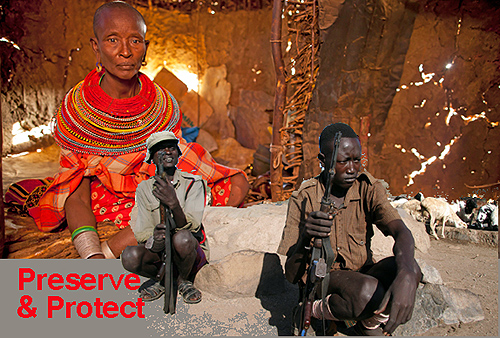
preserveprotectCanada has just embraced a preservation of native values, whereas Kenya seems forced to aggressively ban them.

A remarkable investigation published today in Nairobi shows the enormous difficulty that traditional societies have preserving their life ways in the modern world.

Kenyan Anthony Kuria concludes his excellent investigation:

“Children are meant to enjoy the purity of an untainted childhood, have the opportunity to go to school as well as the privilege to freely enjoy and experience the simple things in their lives. Finding alternatives to [“Beading”] is, therefore, an imperative.”

“Beading” by Samburu people in the north of Kenya is a practice closely associated to FGM and forced marriage. Kuria is modern. The people he was interviewing were not.

Samburu land is an area I know well, and I’ll be returning to it in February with another group of loyal travelers. It’s one of the most beautiful areas in the world, very similar to America’s great southwest. And like America’s great southwest, much of it is not particularly hospitable to humans.

Several generations ago the traditional people who lived here – the Samburu, Turkana, Rendile and Boran among others – were strictly shepheds. This is a near universal life way of people all the way from lower Egypt down to the equator who survive in very arid conditions.

The cattle munch what little greenery exists, and there’s not much. So the cattle are forever wizened and probably sick, but they are the critical ingredient for survival of these near-desert people.

The people don’t eat the cattle, they concoct a yoghurt made from the blood and milk of the herd that is probably among the most nutritious health foods on earth! (I have tried it only once and do not expect to duplicate the experience.)

The goats are kept to support the cattle: when a baby cow is born, the mother’s milk is the most nutritious, so it is kept for the people. The calve is taken away from the mother and raised on the less nutritious goat’s milk.

This simple survival method has worked for millennia for millions and millions of people. But in my life time radical changes have beset Africa. The arid lands are now rich with oil and other minerals. Even leapfrogging fossil fuels, many remote parts of the near deserts of Africa now support massive solar and wind farms.

This rapid change dislocates traditional peoples and their values. “Beading” was part of a lengthy process of ritual in the traditional Samburu tribe, linked to FGM and forced marriage, that probably was as critical to the survival of the Samburu as were cattle.

But it’s not just that it has changed, it must change.

In today’s modern Africa those who linger in the past are tread upon, ignored or miserably manipulated. They become the pawns in terrible conflicts, as today we see in Samburu where ancient enmities between various tribes are exaggerated by modern weaponry and instant communications.

Modern police often find themselves in the crossfires.

FGM and associated practices like “Beading” have been outlawed in many African countries for a number of years, but enforcing these laws has – until now – been intentionally lax:

“Jail sentences only last a few days or weeks after which they are released on condition that they will not violate the rights of the girls again,” Kuria reports.

The main reason enforcing “modernity” is so hard in places like Kenya is because in the modern world, not the traditional world, tribal practices are deemed wrong and immoral. That’s a near unbridgeable divide.

Were development to occur more rapidly: were more good schools built more quickly, more good roads laid, more electricity provided, then the preeminence of “modern” becomes inviolable. But that isn’t the case yet in much of Samburu.

Not until deep oil wells or huge solar farms are cut into the landscape does real development come along. That brings its own controversies among modern Kenyans, just as among modern Americans.

“Beading,” FGM and forced marriage ought not be condoned. But to ban them without providing modern alternatives to the people who still embrace them is as equally wrong as to allow them in our more enlightened world.

Matatu Kindness!

Matatu Kindness!

matatumadnessWonderful news out of Africa to end your week: #matatukindness.

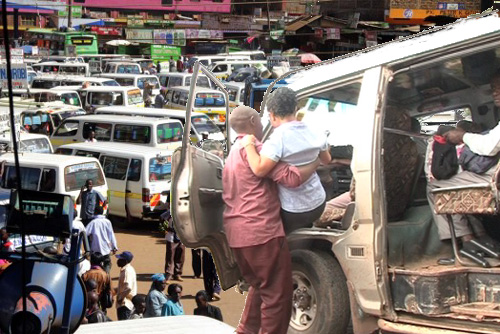
Matatus are private taxi/limos in East Africa’s big cities. They are so much cheaper than a regular taxi and so much more dependable than public transport that by one account they handle more than 90% of Nairobi city’s passenger transport.

Some like me have argued that it is free enterprise gone wild, because there are never enough matatus, so the demand is extreme.

But this is African capitalism, not Adam Smith’s. High demand doesn’t necessarily mean high prices. Even the most desperate clerk trying to get to work or the most dedicated teacher trying to get to school will refuse to pay more than she feels justified.

This stressful and never-ending battle between “tout” (the guy in the matatu calling out its route to potential travelers, deciding if someone is too big to fill the remaining tiny space available, and negotiating, collecting and providing change for payment) and the passenger is one of the most dynamic and pervasive African-capitalist transactions in East Africa, today.

I actually think it effects the price of airline tickets and Mercedes C class.

Imagine a car park with 600 too many vehicles somehow nearly stacked on one another and filled to the brim with human life, and the “tout” arguing with the last passenger for the last available space (with 60 other passengers screaming behind her) over whether it should be 100 shillings or 95 to Limuru.

She usually wins.

That’s life in the big city. But this absolutely essential commodity, transport, creates a working class of people that are pretty adamant in what they should pay for things.

Little sympathy goes to the poor matatu owner, driver and tout. That’s understandable when the media uncovers huge matatu mafia magnates. In Swahili transliteration it became Mungiki, which lingers even today in certain parts of the Rift Province as real organized crime.

The current president of Kenya, Uhuru Kenyatta, had been charged in the World Court with a variety of crimes linked to his involvement with Mungiki.

But in the last several years the Kenyan government has managed to separate a lot of Mungiki from Matatu, and to be sure, there are many small, independent matatu owners.

One of them, Josphat Mwangi and his tout, James Njau, have caused a marvelous stir in the mayhem of matatus. For nearly two years, now, they leave the market high prices of rush hour for a short time so that they can transport for free disabled persons.

One of Kenya’s struggling but persistent local organizations is the National Council for Persons with Disabilities.

Hardly two or three generations ago, most Africans born with a disability were killed. Even today a stigma is attached disabled persons that makes survival except in the more developed cities problematic.

“We at the council have persons with disability forming half of our staff [who] were resigning … because of transport challenges,” said the council chairman, Dr. David Sankok.

So enter Mwangi and Njau. No special devices or special cars. Just leave the market at its highest bid, carry the deserving person into a seat in your matatu, pack their wheelchair or other implements then transport them for free.

Neither Mwangi or Njau have spoken publicly. They don’t have time. There’s another fare waiting for Kinoo!

Reckless & Barbaric

Reckless & Barbaric

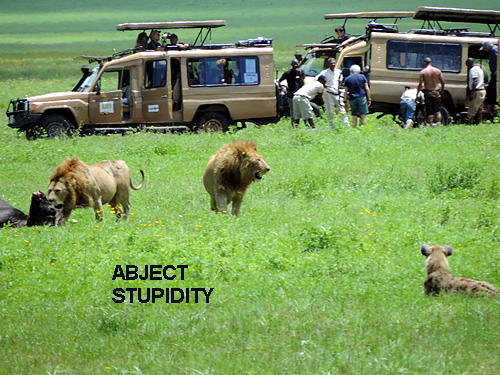
abjectstupidityThe young American killed yesterday by a lion in South Africa was as irresponsible as the lion park she was visiting.

Fatalities and serious injuries to visitors to these improperly named “parks” is exponentially greater than in the real wildernesses of Africa. I see these obscene facilities as modern gladiator stadiums built specifically to create the mauling of humans.

The yet-to-be-named 22-year old was in a sedan car in the Gauteng Lion Park just outside Johannesburg. (At the time of this writing, the website for this very popular facility was crashing or was taken down. Its address is http://www.lion-park.com/.)

The park places signs throughout the driveways telling visitors to keep their windows closed. This woman was photographing the lion through her opened window when she was attacked.

The Gauteng Lion Park is one of Johannesburg’s most popular attractions. In fact “open zoos” are among South Africa’s most popular attractions countrywide. The one just outside Johannesburg when last reported had around 80 lions. The next largest park of this kind is in Port Elizabeth.

The density of predators in these parks is between ten and one hundred times the natural density of predators found in the wild. It’s darkly, hopelessly laughable that people visit these places, take photographs, then claim they’ve seen wild animals in Africa.

Last year 60 Minutes did a fabulous expose on this place. Shadowing one of the human keepers, the investigation revealed not only the inhumane nature of the park from the animal’s point of view, but that the park was breeding lions for “canned hunting.”

Canned Hunting is one of the most barbaric attractions of South Africa (and Texas, by the way). Big, naturally wild animals are raised from birth and tamed, then released to be shot by idiots who pay to do so.

Admittedly, I sometimes wonder even on one of my real safaris into Africa’s real wildernesses how visitors lack any respect for the vagaries and exigencies and chances of the wild.

Less than a year ago I was in the crater when through my binocs I saw a car changing a flat tire … quite normal, by the way. But it was right in front of a pride of lions. And hyaenas! And they were eating a kill!

Not only were the guides changing the flat endangering themselves, but they seemed from the photo I took to have completely neglected their clients, who were wandering about as well!

There were multiple ways they could have changed the tire without exposing everyone and themselves to danger, beginning with something simple like moving a car between the lions and the car… or, hey here’s a thought: call the rangers!

These two situations are perfect examples of the reckless and feckless attitude so many people have to the wild.

Large animals can be tamed, to be sure. But they will never earn a degree from Final Touch. Their normal behavior, like an elephant making a turn, can be deadly.

But more to the point, wild animals can be tamed to a point, but that point is never a safe one. Hollywood may judge the risk worthwhile. Circuses are more controversial.

But really wild animals like lions make no sense on our planet except when they’re wild. Altering their behavior is dangerous.

In the crater, where far too many people ride around in cars pretending to be in the African wilderness, a transition occurred more than a half century ago where the animals became much less fearful of people. That’s good … for tourism, but bad … for wild animals.

Degrees of tameness can now be seen throughout all of Africa’s wilds. I personally am most frightened of those areas where the tameness is greatest, like the crater. That’s where the unpredictability of wild is most frequently tempted by voyeurs of the wild.

In South Africa today there are more lions in these private parks than in South Africa’s excellent true protected wildernesses.

And yet, if you believe TripAdvisor, these are the places to be!

For idiots. Animal haters. Voyeurs. And scam-med travelers.

Should Obama Visit to Kenya Go On?

Should Obama Visit to Kenya Go On?

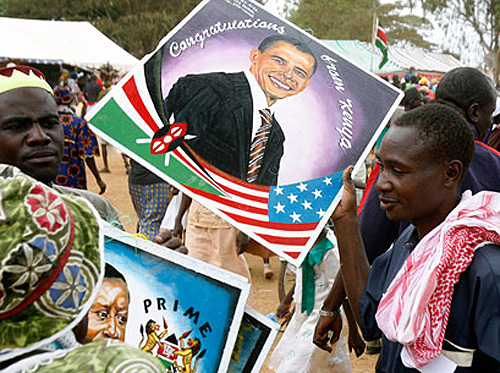
obama-kenya-2Obama’s end-of-July one-day visit to Kenya is causing as much controversy as Bruce Jenner’s to the New York Gym. Why?

People leaning left like Robert Rotberg writing in Politico have a litany of reasons topped by a presumption it’s too dangerous. To me that proves many on the left are as dangerously myopic as they claim people on the right are.

Those on the right see it as an opportunity to prove the birther theories.

Even many Kenyans are shocked by the cost and expected mayhem that will result from the single-day visit.

The White House announced the visit several months ago. The principle reason given was that Obama will attend the 6th annual Gobal Entrepreneurship Summit, which is traditionally hosted by developing nations whose economies are showing significant promise.

Like Kenya.

I think that announcing the date of his visit several months in advance is tempting fate, and I wouldn’t be surprised if his arrival an departure details changed at the last minute. But there are many diplomatic reasons that Obama needs to visit Kenya, now.

First is that he’s already visited Tanzania. Tanzania and Kenya are the Tweedle-Dee and Tweedle-Dum of East Africa, but security at least until recently has always been better in Tanzania if for no other reason than it’s a few hundred more miles from Somalia.

But visiting the poorer cousin scoffs the successful one and Kenya’s security has definitely improved.

At the time of the Tanzanian visit the president of Kenya was under indictment by the World Court for crimes against humanity. Those have now been dropped removing that very significant diplomatic barrier.

Kenya’s role in the “liberation of Somalia” and thus a necessary component of Obama’s pursuit of world terrorists was singularly important, entirely supported by the U.S. Kenya was in effect the U.S. proxy. It’s understandable Obama wants to validate this relationship.

After nearly a decade of monopolizing Kenyan investment, the Chinese have retracted somewhat. This gives the western world important entres they didn’t have just a year ago. Coupled with the GES conference, Obama’s hard-core reliance on capitalism necessitates he recognize this situation.

Finally, I’ve never felt Obama mastered his position of power as he should have. He will go down in history as a weak president. I’ve also felt his spirit was robust, it’s just that he was entrapped by the enormity of the institution. For example, he appointed Elizabeth Warren to oversee his most significant reformation of the financial system even while retaining as his closest advisors the people she is most critical of.

So, perhaps more hopefully than realistically, I see Obama visiting Kenya as a rebuff to his own administration’s ridiculously layered and duplicate travel advisories on Kenya. I know that tourists don’t have an extra $60 million to drop out for their security, but still, if the President can go, why shouldn’t you?

In some form esoteric or otherwise I think Obama wants to deliver this message.

So it makes sense, diplomatically and psychologically, and with the power of a reinvigorated CIA and chance changes in scheduling, a net plus for everyone.

So I’m certain it will happen. My ultimate source for this opinion is Mama Sarah, Obama’s step-grandmother and closest living relative in Kenya. He’s visited her before, but …

she expects him, again.

You Say Africa’s Corrupt?!

You Say Africa’s Corrupt?!

fifa_500Was South Africa the first African country to host the World Cup because it was Africa’s richest and corruptible?

South Africa was awarded the 2010 World Cup after a surprising vote in 2006 by FIFA and strong support by the then FIFA vice president Jack Warner.

The U.S. indictment Tuesday alleges that two South African co-conspirators (#15 and #16) handed Warner a briefcase of cash composed of multiple $10,000 stacks and separately connived with FIFA officials in Switzerland to divert $10 million allocated to helping South Africa prepare for the match to Warner’s personal control.

The two illegal acts of bribery and corruption, according to the U.S. indictment, secured Warner’s support and vote.

Warner later resigned from FIFA, although he kept his positions at the top of the football mafia in his native Trinidad and Tobago. In the last several years he’s been arraigned several times for various corruption charges.

He had been in jail in Trinidad earlier this week, faces more indictments from the current FBI probe, but had been released by a Trinidad judge for “exhaustion.” Hours after his release from “exhaustion” he held a raucous rally of political supporters which included the 72-year old in feverish dancing:

“’If I have been thieving FIFA money for 30 years, who give me the money? How come he is not charged?’ the 72-year-old declared.

He then charged the U.S. FBI with “only going after Third World Countries.”

It’s much easier to contain and arraign someone who is in Zurich than Trinidad.

South African officials, of course, have denied all the allegations. But the leading contenders for co-conspirator #15 or #16, including Danny Jordaan, a newly elected mayor and high-ranking ANC official, have been stone mum.

Like Brazil, South Africa’s World Cup experience was a disastrous financial experience. Like Brazil, extralegal procedures to displace people and condemn needed land and space were only controversial outside the country itself.

The cup is supposed to be played soon in Qatar, a country in a desert where summer temperatures are above 120 F. Qatar is richer, per capita, than either Brazil or South Africa, but the “slave labor” being used to build its massive stadiums for the cup have been reported now for quite a time.

The scandals surrounding FIFA officials are hardly new, either. FIFA officials regularly go in and out of jail. The organization is run like a fiefdom the same way the Olympic Committee is run, but at least until now no one cared.

This is because the prestige of the World Cup, like the Olympics, is extraordinarily huge. The outcome, the Games, trump everything that runs up to them.

The ends justify the means.

South Africa is terribly implicated although no South Africa has been yet indicted. But the story coming out about FIFA is less about South Africa than FIFA, and basically that South Africa like Brazil finally achieved enough wealth to play with the big guys.

And the Big Guys are not African.

I’ve argued for years that the charge that Africa is corrupt is a racist one, because while certainly true at some level, the scale of corruption in Africa can’t begin to reach the scale of corruption in the United States and other western countries.

Whether it’s another Dennis Haestert, Bernie Maddow, Michael Milken, or dozens if not thousands of lobbyists and PACS and corporate “deals” corruption is not an African disease, it’s an American and western disease.

And now maybe that the western world’s most cherished “not-for-profit” organization is being unmasked for what it really is, maybe now the world will admit what a bum rap Africa’s been given.

None Too Many

None Too Many

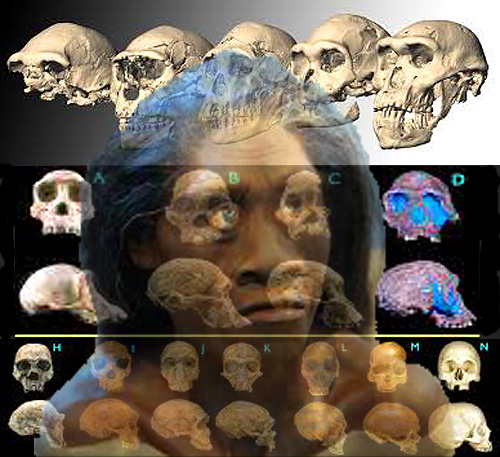
nonetoomanyAn exciting early man discovery published today in Nature may hopefully reverse the insane tide of opinion that hominin evolution is singular and linear.

Clearly we, homo sapiens sapiens, are the end game in a multi-million year evolution that moved step by step from one ancient creature to another, a “linear” evolution into ourselves.

But that doesn’t mean that the “family” of early men wasn’t much broader, with all sorts of other linear evolutions going hither and yon, all dead-ending but us.

I refer to doubters as “insane” because while there are wondrous moments in science where intuitive notions prove wrong, in this case intuitive is really all we need.

All the Kings of The Ecological Hills, sharks, elephants, lions, super viruses, so-called “invasive species” like garlic mustard, and yes, even cock roaches … all of these “kings” did not arrive on a singular path from times long ago.

They all had multiple ancestors, many of which evolved into dead-ends. It’s just totally counter intuitive that we – the “King of Kings” – didn’t arrive on our throne the same way.

Early early man scientists, however, had so little to work with that it really didn’t even occur to them that there could have been other post-ape, post-preman creatures, just like there’s a whole lot of birds. The few discoveries in hand spanned a period of time that could, indeed, suggest one evolved into the other: that all of them seemed in one evolutionary track.

With more and more discoveries, however, this became less plausible, particularly among the post-Australopithecine hominins.

Australopithecine creatures predate homo creatures, and the principal morphological differences are the teeth and brain size. Whether or not some Australopithecine is ancestral to some homo, both are considered incapable of having evolved into modern apes or orangutans … but they are definitely ancestors to us, or to other hominins that went extinct.

That’s the controversy: which is it? Are there other early hominins that went extinct, or is every individual early man fossil we’ve found so far a certain step in the evolutionary ladder to us?

The question really died about 15 years ago when virtually every early man scientist back then espoused a “branching” or multiple ladders theory. Those other ladders never made it to the top: their final species went extinct. We made it.

Homo erectus, in particular, was often cited as one of those dead-ends that got pretty close biologically and socially to us. He migrated all over the earth. He made tools and recent discoveries suggest he used fire.

Then he disappeared hundreds of thousands of years before we appeared.

Meanwhile, all sorts of varied homo hominins more recent than any Austraolipithecine were being discovered: heidelbergensis, floresiensis, habilis, rudolfensis and neanderthalensis. Add us (homo sapiens) and erectus and you have 7 different species, none of which were presumed ancestral to the other.

(Some scientists added others like ergaster and gautengensis, making it 9 or more.)

And then (!) there were some other early manlike creature discoveries, post Australopithecine, that were so taxonomically different they were marginalized as hominins that might even be something else:

Orrorin tugenensis, Paranthropus aethiopicus, Paranthropus boisei and perhaps the most controversial of all, Paranthropus robustus.

If you considered these to be hominin, then there were at least 11-13 or more different hominin species, none of which was ancestral to the other.

That sounded, and still sounds, right to me. As I’ve often said, with time I imagine we’ll add to this list.

Then come these scientists who find some discoveries in Georgia a few years ago which were striking for being among the most complete skulls, and for so many skulls.

The scientists’ assessment at the time was that everything that they had found was a homo erectus and they extrapolated from other details of their discovery that really homo erectus was the only hominin species predating homo sapiens!

The old question was ressurrected.

Well, time has passed and criticism has mounted and basically the consensus that has emerged is that yes, probably there are fewer different hominin species than many once suggested, but that the Georgia finds are woefully insufficient to suggest there weren’t at least some different simultaneous homo species!

And today’s publication in Nature really helps return to this belief: Scientists working in Ethiopia report the discovery of an Australopithecine (remember, the homin creature that predates homo) that was contemporary with “Lucy” (Australopithecus afarensis) but way too different to be like Lucy, so a completely new species of Australopithecine!

Since Austraolopithecine predate homo this suggests that if there are multiple Australopithecine then it’s completely plausible there are multiple homo.

Done for the moment. (Hardly for the term: Stay tuned!)

Junked Java

Junked Java

climatechangecoffeePerhaps this will help Senator Inhofe wake up: coffee.

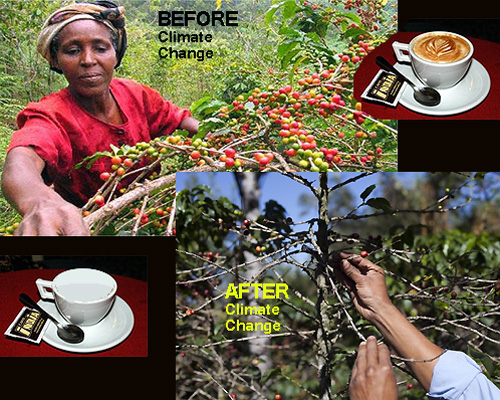
Coffee prices are escalating in part because coffee production worldwide is taking a nose dive.

Some of the finest coffee in the world comes from the Kilimanjaro highlands. Or did. According to Reuters, “hundreds of farmers in the region are abandoning … coffee and cotton.”

The Reuters report is less provocative as to why than the Union of Concerned Scientists: “Climate change is threatening coffee crops in virtually every major coffee producing region of the world.”

UCS explains that coffee in particular is very sensitive to a slight increase in temperatures. Coffee also requires more stable climates with regular amounts of precipitation.

All that’s changing, and particularly in the Kilimanjaro highlands. The Tanzanian government announced a 29% decline this year in coffee production.

Farmers didn’t need the study released recently by a prestigious university in South Africa correlating the decline in coffee production to an increase in the highlands’ night time temperatures.

“Coffee beans are no longer profitable as my harvests keep on falling,” a villager in the Kilimanjaro highlands told Reuters: “I need fast-growing crops I can sell for a quick income.”

Coffee is a long-term agricultural investment. It takes at least three years, and usually five, for a new coffee tree to produce beans. After that it can continue producing for up to 50 years, but the orchard requires lots of water and constant tending.

The South African study documented an increase of a little more than 2 degrees F over a decade, enough to reduce the harvest by a third.

Large numbers of farmers throughout the East African highlands are therefore abandoning coffee for quick growing and quick selling vegetables … and flowers. The “cut flower” industry is growing in leaps and bounds in East Africa as the demand for them grows in Europe. Major European airlines now make their scheduling decisions more on the cargo of cut flowers than on passengers.

Many other farmers are turning to crops like sunflowers and casava which are less sensitive to climate change.

For the time being the crop changes will not likely effect the Tanzanian economy. The cut flower market like coffee requires high initial investment but pays off much more quickly.

Demand for food throughout Africa grows by the minute, and Tanzania remains a net exporter. The agricultural sector of its economy is growing the fastest.

So perhaps the major effect of this current news will be on Senator Inhofe, reported to love his coffee … even during droughts and floods and tornadoes.

A Simple Named Holiday

A Simple Named Holiday

MemorialDayIt’s Memorial Day in America, similar to the Remembrance Days celebrated in many parts of Africa.

America’s holiday is intended to honor the memories of U.S. soldiers who have fought our wars. Similarly, African Remembrance Days are usually in homage to freedom fighters for independence.

America’s Memorial Day honors all dead soldiers, so in that regard our own revolutionary fighters are to be honored, too. But it began as “Decoration Day” right after the Civil War, following a petition by recently freed slaves to honor the Union soldiers who had freed them.

After World War I, it was changed to “Memorial Day” and extended as an honor to all soldiers in all conflicts.

As a young boy it was a big red-white-and-blue festival. We decorated our little red wagons and bikes, just as we would hardly a month later for July 4th. And in those days we were remembering mostly the two Great Wars: defensive wars.

Since then my own personal regard for Memorial Day has diminished. The numerous wars my country has begun since the 1960s have been unfair and unjust. And with the end of the draft when I was in university, the military has changed radically. It no longer represents society as a whole.

Today, the military is composed either of young people who can’t get any other kind of job or who need the benefits once their service is finished, or avowed militarists.

Politicians today use the military not to protect our freedoms but to protect their positions in power.

I do stop during the day and think of my relatives in the Great Wars. I think of the way the country ultimately came together to fight world tyranny.

But that was all a long time ago, before I was born. In my life time, there is little in America’s wars to be proud of. They are mostly memories I wish I didn’t have.

I do empathize with the poor soldier, but I honor her/him no more than those who marched in Selma or the hundreds of thousands of unnamed heroes who still offer their lives for human rights in Baltimore and Ferguson.

So it is a complicated day with a much too simple name.