Safari Snaps!

Safari Snaps!

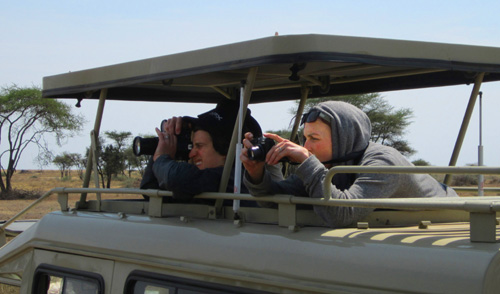
Ski pro Chris Benchetler and new wife, snowboard pro Kimmy Fasani, were dressing like they were on the slopes not the Serengeti! But guess what, it can be cold!

No matter how hard I try, no matter how much our literature tells people to DRESS FOR COLD, most every traveler just presumes that Africa will be hot and uncomfortable. Sometimes, it is. But often, it isn’t! Chris and Kimmy were decked out in all their sponsors’ attire (which, by the way, is quite good). But quite a few of my other travelers were cold!

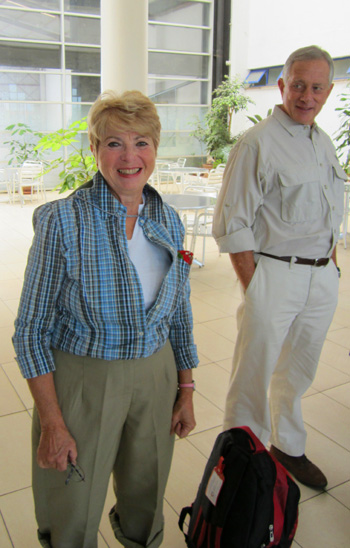
Now on the other hand, get this. True to form and all our warnings, one out of twelve of my travelers arrived without luggage! Ellen Sirlin had also been foiled by the unusual 9/11 baggage restrictions in Heathrow, so she didn’t even have a survival bag.

So Ellen and I went out on the streets of Nairobi and spent around $65 on a safari wardrobe for her! Well, I should say the beginnings of a safari wardrobe. Take a look at the left at Ellen’s “safari attire.” With only a few hours, she mustered a sewing kit, scissors and an iron and turned some raw stuff we found on the street into a rather stunning look.

David Heiman is admiring her … in clothes that came with his luggage.

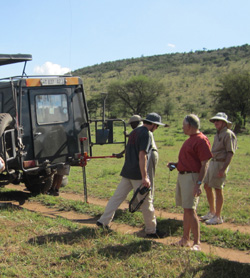
We’ve had way too many flats already this safari, 4. I normally get one or two. Tumaini says it’s because he decided to try a new brand, and well, obviously it didn’t work.

Traditionally safari tires were tubed. That’s because they’re easy to fix that way. But lately we’ve all been buying the new tubeless, and they really ride a lot better. But of course, each puncture in them is a lot more difficult to fix than on a tubed tire.

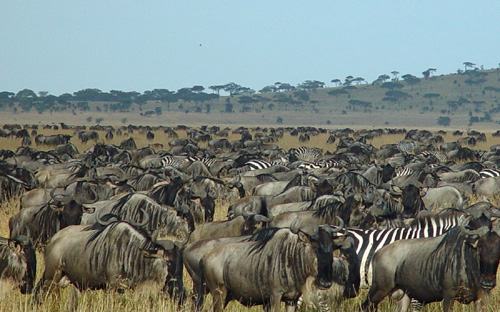
Another thing: travelers understandably always want to know how long it’s going to take to get from point A to point B. Well, you can see from this photo, the right answer is “it depends.”

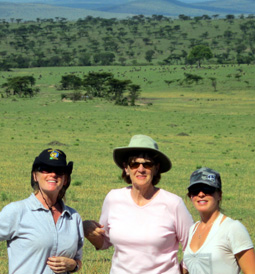
Sue MacDonald, Margy Gelfenbein and Kimmy Fasani posed for me in front of the migration in northern Tanzania. I’m not a very good photographer and just have a tiny snapshot camera, so I have to explain that the micro dots in the distance are the migration!

But note how green the veld is, and how beautiful the travelers are!

Mustering the Migration

Mustering the Migration

It’s very hard to know how much to push yourself on safari, and it’s difficult for the guide to know how much you really want to. Today we found the migration in northern Tanzania – it was an absolutely Number Ten experience. But it was psychically expensive.

We left camp at 815a and we returned at 645p. The object of the day was to find the migration. The safari plan is to experience the migration at the end of the trip, in Kenya’s Maasai Mara, but a couple people were leaving the trip early and the simple drama of the notion we could see the migration earlier in Tanzania compelled everyone to try.

The rains have been unusual. (Hardly news, eh?) If they weren’t the vast bulk of the migration would have been out of Tanzania by the end of July at the latest. And it wouldn’t normally begin to return until a little bit later than now.

But as I’ve often written, global warming has a net increase in wetness to the equatorial regions. It’s sometimes hard to understand when all that’s in the newspapers is the “worst drought in 60 years” but consider our own situation in America. Texas has the “worst drought in 60 years” but the majority of the country has been unusually wet. Ditto for East Africa the last few years running.

The terrain in northern Tanzania is identical to Kenya’s Maasai Mara. Same altitude, same rolling hills, same rivers and creeks, and when wet, same beautiful grasslands. So for the last few years, the migration has often lingered longer in northern Tanzania or returned earlier from Kenya.

In fact, what I think is actually happening is neither. I think the range of the northern migration is spanning out south to north. That means less of a concentration anywhere, but a larger area of thick wildlife.

Whichever it is, quite a few Tanzanian companies have bet it’s going to continue. Once up north we passed six new semi-permanent camps erected at great expense far from a southern supply source, to cater to travelers wanting to “see the migration” in Tanzania.

Where we believed from on-the-ground info the migration could be seen was 150k from our camp on Mukoma Hill in the central Serengeti. The roads up to the area weren’t bad, so it mean we’d have a day of about 6 hours just traveling (3 there and 3 back), albeit through game areas.

But if we were to keep focused it meant we had to race right bye other great things!

We were out of camp hardly more than 20 minutes when we came upon a pod of hippo in the Seronera River. People began to click away, and my driver, Tumaini, knew that he had to keep them moving if we were to reach the northern Serengeti early enough to enjoy it. So he hurried people along.

Right around Seronera the veld was remarkably green. In fact, I presumed it would continue green and damp all the way north and so I began to worry what effect this unusual weather might play on the traditional March/April migration safari. But hardly before I was done worrying, we had entered a prolonged period of dryness, typical for this time of the year.

That dry swath continued all the way from the western road junction past Lobo almost to Balaganjwe. But then near just south of the Balaganjwe west of the Megogwa Hills the veld turned beautiful lemony yellow. Grass was everywhere, and so were wilde! This was about 10k south of the Sand River gate into Kenya (Maasai Mara).

We then used the Tanzanian park services’ new roads and tracks to follow the Sand River northwest to where it merged with the Mara right on the border. Kenyan travelers will know this as the “Mara Bridge” area. There were wilde everywhere, on both sides of the river. We watched a river crossing over the Sand River which was quite exciting.

Except for the green veld this far south, everything else looked pretty normal. The Sand River was dry at times, and the Mara though flowing nicely was not unusually high. We didn’t see many crocs; I had the impression they’d already eaten, but there were many nooks and crannies of the rivers that caught hunks of dead wilde with lots of birds.

In addition to the migration, my travelers saw for the first time both eland and topi. We’ll likely get them both in the crater later on, but it was an unexpected bonus for many.

We were diverted from lunch, once again on this safari!, by lion. A beautiful tree we had picked out at a distance on a hill that gave us great views had already been taken by four beautiful, fat and sassy young lion. Some great pictures!

So after lunch we went a little bit further but then had to turn back in order to get home in time. So all told, we had about three hours of great migration viewing.

But it was a very, very long day. And given that most of the veld is normal, that meant very dusty and very bumpy. Parks services fix roads right after the rainy season, but now with intermittent and often heavy rains at unusual times, the roads grow bad more often than before. And there’s either not enough money or willpower, or both, for the parks to maintain the roads more often.

I know that at least half my travelers this time wouldn’t have done it otherwise. Roger, Chris and Kimmy, and Sue were pretty ecstatic about the day. And it’s a hard call to make for the guide to even bring up the subject, because inevitably there are going to be travelers who join the pack when they really don’t want to.

But all told I was pretty satisfied. It was a truly beautiful sight. Nowhere near as crowded with other tourists and vehicles as in the migration areas in Kenya. But do we presume this will happen all the time, now?

As a betting man, I’d say yes. But wait for our report on the migration in Kenya, which ends this safari! Getting to this area of northern Tanzania is costly, time consuming and for some, stressful. In the end is it worth it? Stay tuned.

Ho-Hum Just a Routine Day on Safari!

Ho-Hum Just a Routine Day on Safari!

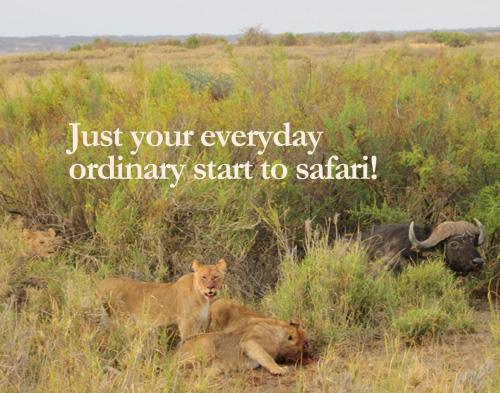
Bumpy road, alkaline dust, wind in your face. And a honey badger, some impala, hartebeest, elephant, a serval in a tree killed by a leopard and a family of 11 lion taking down a bull buffalo.

Anyone who only reads first paragraphs might be misled.

It was hardly an ordinary start. We lucked out big time. Sue MacDonald kept saying “I don’t believe; can you believe it?” And as is often the case with great game drives, it was basically luck and not strategy that took us to this extraordinary beginning.

Following the first couple days in Nairobi for our normal political and cultural touring and to shake as much jetlag as possible into the congested throngs of people we walked through on the street, we flew into the southwest Serengeti, to Ndutu Lodge. Yesterday there were two others besides our group, and today we’re alone. This is because of the common knowledge that the migration which is centered here in March and April is long gone.

But what so many television special driven tourists don’t reflect on is that animals and wilderness does not follow a TV schedule. It goes on year-round. Sure there will be times that will basically provide more animals than others, but there are very special things that happen at all the different times of the year.

I’ve written before about the discovery of the buffalo virus that was leading to more lion kills and lion deaths, but even so lion killing a buffalo is no easy task. I don’t think a lion even considers taking down a buf unless more customary food like zebra and wildebeest aren’t available. It would be like going to Whole Foods for a last-minute Friday snack and buying a complete Angus.

And that’s the case at Ndutu in the middle of the dry season. (By the way, we arrived in a rain storm, and it’s rainy today as well, but that’s really unusual. And the area essentially remains very dry.) So for the lion of Ndutu, dinner is always a challenge.

We’d heard in the middle of the night the anxious lion roars and hyanea yelps. We’d hardly been out for a few minutes past daylight when Dixon spotted a lone female walking fast on the top of a ridge about 500 yards away.

We drove up to her and I immediately noticed that she was limping, and that her belly was terribly contracted, a sign she hadn’t eaten for days. Clearly last night she was involved in a failed hunt of something that injured her right shoulder.

She took no notice of us and kept on her mission driven limped walk. She hesitated only momentarily to call and then listened as another lion called back from the far distance. She started to walk again.

Then all of a sudden out of some low bushes runs a subadult male covered in blood. The female we had been following laid her ears close to her head, turned tale and began running with the bloody faced male in close pursuit.

She was obviously not a part of the pride that currently owned this territory, but rather than following her we wanted to figure out the bloody face of the pursuer.

Soon we found other lion, three mature females and five cubs of various ages, all bloodied but clustered together as if something was attacking them.

Then we saw literally ten feet from our car in the bush a giant male buffalo.

He was obviously dying. The giant, awesome beast lifted his head back towards me and I saw that distinctive glaze in the eyes of a dying animal. Animals have expressions just like us, just not in the face.

Every time a lion got near him he’d stand up and begin to swing his deadly horns.

The older lion knew to stay well away, but the younger kids couldn’t suppress their hunger. They would move towards him, even jump on him, and he’d growl and swing his head. The youngest cub, about 4½ months old, got a seething cash on his little neck.

So we watched this for some time as the buffalo seemed to be on his last breath, and then when he seemed to stop breathing, a lion would close in, and he would stumble to his feet swinging his head, braying.

Finally, still alive, he lost all strength and the family knew it. They were on him at once: the kids on the back, the larger lion digging into the soft flesh areas. We left before he was dead.

A few hours later, on our way back to the lodge, we stopped to review the situation, and the buf was dead. In just that short several hours the lion had carved an enormous amount from the available meat and most were too full to eat another bite. But the male was close on the kill, as they always are, reluctant to give way so long as a single morsel of meat is left.

Even though he was too full to eat it.

Then came our second wonder. Two elephant were strolling down the lake shore which was about 50 yards away. But the wind was directly on them, off the kill, and immediately the mother ele started scenting the air.

Before long she was charging the lion, chasing them away and trumpeting loudly. The lion dutifully stood clear, the male the last to do so, and she kept up the harassment until for some reason she felt appropriately vindicated, and went off.

No. It was not an ordinary start to a safari. But on the other hand it wasn’t totally unusual. This is the most stressful time for Ndutu. Except for the aberrant rains that came with us, the veld is parched, a powdery salt blown almost like smog into the mostly still veld by the dawn and dusk breezes. Unlike March when I’m here, there is only a fraction of the normal bird song, a thin sliver of the number of animals always here then.

But predators don’t migrate. If they’re to survive, this is when they have to show their stuff. And for the lucky visitor, like us, a once-in-a-lifetime scene unfolds into our own alien world.

Saving A Penny with Davey Jones

Saving A Penny with Davey Jones

For some clients, today, traveling for leisure is being squeezed by the economy. And as a result, they’re making some very dangerous decisions. Tight economic times are absolutely not the time to dismiss expert advice.

I can think of no better example than the horrible tragedy last Friday in Tanzania. One of the ferries that plies between Zanzibar and Dar capsized. At least 200 people are dead or missing.

The usual way for a tourist to get between mainland Tanzania and Zanzibar is to fly. From Dar, the quick 15-minute flight costs around $60. Recently, I had a client booked this way who discovered on her own that one of the 5 daily ferries between Dar and Zanzibar would cost her only $8.

Now my first task was to determine if this was really a budget issue or something else. Since her overall safari was well over $5000 it seemed silly she would be interested in saving $50 particularly when it wasn’t very comfortable and took 6-8 times as long.

But it seems so romantic, she said.

A ferry that is licensed to carry 400 people and that often carries 600 is not particularly romantic.

I have nothing else going that day, she retorted.

At this point, one begins to wonder if this is becoming one of those epic battles between the expert (me) and the client (her) over my alleged disrespect for her budgetary and travel research capabilities.

I’d like to get to know the local people, she added.

At which point I laid down the gauntlet and said the ferry schedule was totally unreliable, they only depart when they fill up, they have a terrible safety record and my straight-out advice is don’t do it.

She did.

Fortunately, she wasn’t on the ferry last Friday. Her ferry went off more or less on schedule, it was a fine sailing day, and I’m sure she’s telling everyone she meets that it was one of the best parts of her safari.

And that she really had to fight with her travel expert to do it.

This isn’t just an “I-told-you-so” anecdote. As a traveler, you can do it on your own, or you can do it with an expert. A lot of people can do it on their own quite well, and I’m the first to champion the feelings of personal accomplishment and excitement that comes with plotting your own distant explorations.

But don’t mix and match.

Personally arranged travel to exotic places carries significant risk that is a part of the whole adventure experience. I know that better than anyone. The challenge of personally overcoming intrinsic difficulties are the same as felt by the climber of McKinley or the swimmer of the English Channel.

But here’s the point. Had she arranged her own safari on her own completely, she would have learned that the ferries are unreliable and dangerous. She might then – as I have, especially in my youth – played the odds and gone, anyway. And in her case, she would be vindicated.

But she had no clue. Because she relinquished the responsibility initially to me to get her to Zanzibar from the mainland, I (a) did not believe that she wanted a daring experience and (b) knew that the 1% savings of her trip was not worth the added risk.

She was not in a position to make such a determination.

So what was her beef? Well, in all honesty, I think the squeeze of the economy is getting to people. Like so many others, this was a trip of a lifetime for her. A retired teacher, she had saved and saved, and no doubt those savings were less than she expected.

And probably she felt the villains who reduced her 401K weren’t so dissimilar to the villain (me) who was trying to extort her.

Beware, dear travelers, of projecting your angers and stress onto your advisers. Most of us aren’t going to ask you to pay for something you don’t have to do, and we certainly aren’t going to jeopardize the possibility of giving you a “trip of a lifetime” so you can save a penny with Davey Jones.

How Not To Travel

How Not To Travel

As we drove from the airport to the city last night, my newly arrived clients asked about the kidnaped British couple. The news isn’t good for Kenyan tourism, of course, but it isn’t surprising, either.

The couple, Judith and David Tebutt, were vacationing at a lovely beach resort on the mainland opposite Lamu Island off Kenya’s far northern coast. There are several truly beautiful paradise getaways in the area, but I’ve felt for a long time it wasn’t a good place to go.

About two years ago another British couple had been kidnaped while sailing their yacht in the Indian Ocean between the Seychelles and Somalia. Both situations were just too vulnerable to pirate attacks.

Initial news reports suggested the Tebutts’ kidnappers were al-Shabaab terrorists. I knew they weren’t, and later reports confirmed they are likely pirates.

The Tebutts and Paul and Rachel Chandler, the sailing couple, were in places they should not have been. So why were they there?

Both couples were doing little more than believing the advertisements that lured them to these tropical paradises without doing due diligence on the grandiose claims.

The Tebutts obviously didn’t read the New York Times and the many world newspapers that republished that story the day before they arrived of increased trouble in the area.

And if you think that’s unfair that a couple on holiday should be reading about where they’re planning to go the next day, certainly they had looked at maps before leaving England, hadn’t they? The Kiwayuu Resort where they were is less than 20 miles from the trouble in Somalia. Unlike Lamu, a heavily populated tropical island with lots of police, their beach was remote and unguarded.

And as for the Chandlers, the weak claim by Rachel that the Seychelles’ waters were “thought to be safe” is balderdash. Not long before their kidnaping a Greek freighter 1000 times bigger than their yacht was hijacked by pirates.

Don’t think me heartless. I’ve been in similar situations myself and involved in several more. We all would prefer a world where everything you read or hear is true. But my own past mistakes are not justification for others’, now.

I’ve learned, and you as travelers should all learn, that neither pretty picture advertisements or simple recommendations from friends who have been somewhere once stand as solid endorsements that it’s a good place to go. You’ve got to check it out further.

As a postscript, note that the resort from where the Tebutts were kidnaped has been closed “indefinitely.” Seeing as how the Tebutts were the only ones at the resort, it seems a rather de facto announcement. The other few resorts in the same area should follow suit.

Oiled Men vs. Oil Men

Oiled Men vs. Oil Men

I went to bed last night with a sore throat caused by a horrible oil spill disaster near the Nairobi airport and woke to learn that hundreds had died, thousands more had burned and the still unfolding story needs to be told again and again to the west. Read on, if you can.

My luxury Norfolk Hotel is about nine kilometers as the crow flies from the disaster site. In that mere 5½ miles live up to 1 million people, and there are no high-rises. Nearly 90% of them in the slum only 1 mile from the airport where the fire occurred.

They live in the most miserable conditions imaginable. When I first wrote my novel, Chasm Gorge, I described a Nairobi slum but tried to focus on its better aspects. The way slum dwellers help each other, creative methods by which they eke out a living, and most of all their unbelievable tolerance of their suffering.

That was ten years ago. Today the slums are three or four times larger. The popular film Constant Gardener brought world attention to the slum, Kibera, that was the model for my description. Kibera is one of 8 slums around Nairobi, and if one dare compare one slum with another, probably the best one to live in.

How many people live there? I can’t find out. The Kenyan government can’t find out. At least 2 million, but perhaps 3 maybe even 4 million. The last good census of slum dwellers was more than ten years ago. It was so flawed, I think people just gave up. Ten years ago I would never have imagined the situation would have reached the tragedy of today.

YET…
…the tolerance for suffering continues.

We know in America what happened in the 1960s was at least partially the result of popular uprisings against the abhorrent conditions found in Cabrina Green in Chicago or Watts in Los Angeles. And those conditions compared to what is found in Nairobi today are simply incomparable.

Here’s what happened yesterday. An oil pipeline bringing super gas refined in the coastal city of Mombasa and flowing at 590,000 liters/hour ruptured around 9 a.m. The pipeline runs under a slum. This was the third major Kenyan oil pipeline spill since 2009. And frankly, compared to the other two, it was small. (Probably less than a half million liters were lost before the pipeline was shut down.)

But it has been raining unusually in this dry season in Nairobi, and the oil made its way to a river that now flows through the slums. When residents realized from the smell what it was, they frantically began trying to collect it from the top of the water.

Someone’s cigarette dropped on the river. The fire exploded back up the line towards the pipeline rupture, and in its way was the slum. In seconds, tin shacks were ashes. Giant plumes of toxic smoke filled the air. Some residents on fire jumped into the river, but it was burning. Old manholes on sewers that have been stuffed and inoperable for decades blew into the air like rockets, giant fire spraying from them.

The official death toll as I write this is only 130. It will be much more. Hundreds are missing.

That’s the tragedy.

Now, can you imagine what would happen in the U.S. or Britain or Australia if something like this occurred? Well, guess who was the star guest interviewed on all the Kenyan TV channels this morning? The director of the pipeline company. But no one felt he should be blamed. Even the tweets and comments by people who live in the slums have exonerated him.

Everyone needs gas. They think he was doing the best job he could. As a result, he was totally honest about how bad the maintenance is on the pipeline, how much less the government has actually given him to operate it than he needs.

Did the Governor of California walk into Watts as it burned? Or the mayor of Chicago strol down burned out Wabash Avenue after the fires following the King assassination? Of course not.

But here the Prime Minister of the country and virtually every major political officer was in the slums this morning talking with residents, promising better conditions, pleading for the calm which already exists.

In Kenya and all the developing world on this planet, suffering is a way of life. When people ask me how possibly we can help, my answer has been steadfastly the same for decades and decades:

First, put your own house in order. If we cannot muster the human compassion to take care of our own uninsured, unemployed and immigrant populations, how can we possibly help others?

Second, forget about little charities, church bake-outs and tiny missions building little huts in the desert. This is all wasted energy. It makes us feel good, but it doesn’t do a damn thing for the developing country. This is because the solutions – whatever they are – must be massive.

I really believe, though, this is possible. I believe we can sweep away the TParty and similar thinking people into the dustbin of history. Human compassion is greater than human ignorance, as great as that ignorance currently seems to be.

So, Americans, start at home. Not with a greater tithe to your church, but with a renewed commitment to your society and government, and a willingness to sacrifice for the good of those less fortunate. And when elements in your society appear intransigent in face of this simple dictum, punish them. Force them to respond with higher taxes on them, stiffer regulations.

Make them share the happiness they achieve through other’s sorrow.

I know there is a knee jerk reaction to find a website to contribute to the “Nairobi fire.” But what about the Pakistani floods? What about your own floods?

The suffering in the world which is a result of poverty is structural. It can be changed. Start at home with the kingpins refusing to change, because we are at the top, we can make the most difference worldwide by simply doing our job at home.

What 9-11 Means to Me & Africa

What 9-11 Means to Me & Africa


Nine Eleven was a day of reflection, but in Kenya where I am it exploded. A British tourist was murdered and his wife kidnaped in the far north as southern Somalia imploded further, and Kenya desperately appealed to U.S. Republicans not to undermine its development by making it the victim of the U.S. budget crisis.

It’s all inextricably linked. It might be complicated, and that may be its nemesis with the simple minds of the Tea Party, and there’s too much here for a single blog. Tomorrow I’ll be less ideological and more news specific, but today I want to counter the empathy of yesterday with the horrible reality of the last decade as seen outside the U.S.

Sitting here in a luxury hotel in Nairobi with CNN on during all my waking hours, it’s hard to argue that a clearer perspective is achieved further from home. But it is. The travel through multiple countries and airports, the fellow passengers from all distant parts of the world in stimulating conversation, the foreign newspaper headlines and the incessant chat of the local taxi driver. It takes you far away from the repetitive and often circular news surrounding us in the U.S.

And besides, even CNN isn’t the same. CNN has been fine tuned to its customers worldwide for decades. It’s not the same in China as Dubuque, London or Nairobi. Worldwide, one of its most respected anchors is Jim Clancy, and click here for his own reflections, quite similar to my own. You won’t see this in the U.S.

Let me be so bold as to summarize the rest of the world’s views about Nine Eleven this way: If the U.S. didn’t exercise its power and express its grief militarily, the world – and the U.S. – would be much better off.

To the rest of the world yesterday marked not so much a stabbing memory of abject loss as a tedious decade of wrongdoing.

The number of people who have been killed in military violence this past decade far far exceeds those killed in the initial airplane hijack attacks. Perhaps a third of a million in Pakistan and Afghanistan alone, and hundreds of thousands in Iraq. And these aren’t principally soldiers, but civilians caught in the cross fires of ideology.

Any American who watches the film “United 93” immediately wonders why is this a British and not an American film. It’s the only concise documentary of the bungling of U.S. defense on that day, how probably three of the 4 plane crashes could have been minimized, if only someone in authority could have been found.

This is a British film, not an American one, because Americans seem incapable of admitting this mistake. No American would dare produce it. Watch it.

And this ineptitude was followed by the moral degeneration of a giant reacting to a flea bite by sledge hammering the ground around him, blindly and randomly.

There is no doubt that al-Qaeda targeted us. There is no doubt it was an inept attempt, because al-Qaeda is inept. But al-Qaeda is crazy and dangerous albeit inept, and we knew this years before they acted. We refused to deal with them as deranged, the same way we avoid dealing with our own mentally challenged individuals.

And when they finally ‘lucked out’ we were defenseless.

Thank goodness it wasn’t the Joker or an alien invasion or trained mercenaries from the Comoros, or we might currently be under a foreign military dictatorship. No President or Vice President or other chief political officer could be found to give cogent orders, or perhaps they weren’t found because there weren’t cogent orders to give. Planes that were scrambled flew off in the wrong directions, unarmed.

Our “Homeland Defense” up until September 11, 2001, was to believe we were invincible simply by maintaining nuclear arsenals and giant battleships.

The rest of the world, Europe in particular following the Balkan wars, realized that peace is created by development not destruction.

But we have never nurtured goodwill with the same enthusiasm we nurture military superiority. I think we reacted like the giant squashing the flea not so much to being attacked, as to our own inability to defend against those attacks in any other way. And like a humiliated bully with no social skills, we started scorching the Mideast.

(If oil as the unspoken booty didn’t exist, possibly we couldn’t have mustered the rationalizing to pursue it. But there is oil, there. And oil is needed for the bomber planes.)

And now to today. Sunday talk shows seemed horrified that the Super Committee will be deadlocked and the military required to take a 10% hit. What’s going on? In Africa we have committed 9 billion over ten years to help their medical development. And just before our Nine Eleven celebrations, they were advised this promise might not be kept.

Why might we renege? Because we need that 9 billion for a couple months of war in Afghanistan.

Instead of a decade of improving the health of a billion Africans who are actually on the frontline against terrorism and who are rapidly becoming an economic powerhouse, customers for our iPhones.

I see no starker comment on how wrong we continue to be.

Heading into the Bush!

Heading into the Bush!

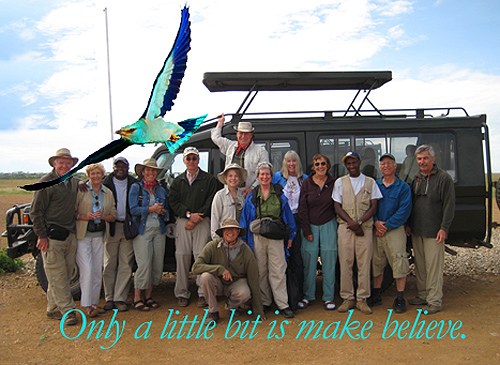
Starting tomorrow I will be on safari in East Africa and blogging four times weekly from the field … I hope. Cell phone and internet reception has improved so much I think it really will be possible. We have an exciting safari ahead of us!

It is also a remarkable collection of people, and I’ll try to give you little snapshots of each of them as the days go bye. But I am already specially indebted to newly weds Kim Fasani and Chris Benchetler, who are taking part of their honeymoon with the rest of us.

What did I say? A honeymoon couple joining a bunch of us who are into planning our Golden Wedding Anniversaries? (As happens from time to time, I do slip into a minor exaggeration.)

More specifically, age rarely matters in my groups. Last year, for instance, I actually guided a 7-year old. (He was traveling with his mother.) More to the point, EWT operates a lot of honeymoon safaris, but not really very many where the honeymoon couple joins a group.

But Kimmy seems so incredibly enthusiastic and eager to get virtually everything out of the trip she possibly can, that when I mentioned my safari was more or less overlapping hers, she (presumably pulling her spouse along) jumped aboard!

Don’t get overly empathetic. The two of them do have enough sense to peel away from the group trip at the end to enjoy a most romantic getaway on a remote beach in Zanzibar. (My heart pines remembering those days!)

And, by the way, they won’t be the first. But they do join a very special group of people I’ve had distinct pleasure over the years guiding and getting to know. Their honeymoon is obviously more than just a place to wipe off rice granules from rented garments. They’ve come to be thrilled and to learn something new.

And actually, honeymooners seem to stay in touch a bit more than others. I’ve now followed the first honeymoon couple I can remember guiding through two Labrador Retrievers, then two kids, several houses and jobs, and now … the kids are in college!

My group this time also includes a couple from New York, from Florida, and several from Ohio, so together with Kimmy and Chris who are from a remote locale in Montana, we have a rather wide segment of America on board. The 12 of us are expecting some extraordinary experiences!

The focus as always is on seeing the wild working its miracles and exercising its inexorable power. Although there has been unusual rains this season in areas where it normally doesn’t rain after June, the dynamic of the dry season still appears firmly in control.

That means the veld is getting stressed out, and that means the predators are in their heyday. Of course it remains to be seen, but I expect we’ll see 75 or more lion, at least one leopard and up to a dozen cheetah.

The climax of the trip is in an area where we expect to find part of the great wildebeest migration, at its northern most point, before the herds begin to slowly reassemble themselves in the southern Serengeti. This is always a dramatic time for the migration, with exciting river crossings.

I’ve already heard from friends that the crocs are pretty full and so the river crossings are proceeding without much ado. When they first wake up begin earlier in the season, they are famished, and carnage reigns. We probably won’t see that, now. The big crocs eat only once or twice a year, when the migration comes and goes. They gorge, then basically go to sleep for months.

I’m especially anxious to see the state of the elephant herds in Tarangire. There are too many elephants and have been for the last 5-10 years. We need signs that the population is stabilizing and not continuing to grow, and Tarangire, where we should see (yes) a thousand or more will have the best indicators.

So stay tuned, folks! It’s possible the blogs might not come quite as regularly, but I promise whenever in range to top up each day’s experiences with as much truth as I can possibly muster!

Overland Samburu is OUTlawed

Overland Samburu is OUTlawed

Just as Russia’s leap into modernity created a powerful mafia, so it now appears that Kenya’s is doing the same. And for travelers this unfortunately means you can no longer travel overland north of Mt. Kenya.

I’ve found myself becoming peculiarly cautious in my golden years, so I reflect when I was a twenty-something year old gallivanting through Idi Amin’s very dangerous Uganda, or even daring to cross the Omo in the presence of desperate, armed thugs. So jungle on, you young’uns, but keep your eyes wide open.

And if you’re one of my clients, I’m afraid we’re staying clear. Of where? Of some of the finest wilderness left in Africa: Samburu and Laikipia, to be precise.

Now there’s still a very safe way to visit these places: fly in. If you fly into the reserve’s airstrip, I’m absolutely confident that you’ll be as safe as the Queen of England shopping at Harrods. But that spectacularly gorgeous drive off Mt. Kenya onto the Great Northern Frontier, or those amazing landscapes between Samburu and Laikipia seen only from the ground … it’s over. At least for the foreseeable future.

This past weekend saw one of the most spectacular, clearly well planned cattle raids ever seen in the history of Kenya. Seven people were killed and scores wounded and a thousand cattle whisked away.

It happened about 50 miles northeast of the Samburu National Park Archer’s Post gate, and about 35 miles north of the nearest lodge in Shaba National Park.

Now admittedly this particular raid is pretty far from tourist areas, but its size got me, and it’s one of a series of raids that’s been increasing in the area. Last year, for instance, there was a gun battle in broad daylight right on the bridge over the Ewaso Nyiro River at Archer’s Post.

This is the only way tourists can enter the area overland.

The weekend raid is about 20 miles from where Joy Adamson was killed by bandits more than three decades ago.

And that’s what gives me perspective. The “Northern Frontier” has always been a lawless land. It’s just too hard to patrol. I remember only 4 years ago having to charter an aircraft for a group of only 11 of us who wanted to drive all of 20 miles from Samburu to a lovely retreat in the Mathews Mountains, because bandits had been sighted on the road we were scheduled to drive.

But bandits stopping cars and taking an occasional goat are way different from what is being reported in today’s modernizing Kenya.

First of all, in order to steal 1000 head of cattle in a single raid, you’ve got to have someone who has a 1000 head of cattle to steal from. That never existed in the days of subsistence herding, where a man with 25 head was a royal chief.

Second, it’s rather hard to conceal 1000 cows. These guys had multiple trucks, using the new Chinese paved road built through the desert to whisk their booty into the markets down south.

According to the police commissioner of the area, law enforcement was outgunned. Shotguns against AK47s.

Recognizing this danger was coming, the Kenyan Government has been aggressively trying to disarm everyone in the area. But according to Member of Parliament from the area in which this giant raid occurred, Abdul Bahari (Isiolo South), “people in Samburu have not been disarmed and even if they have, we have not seen the effect as they seem to have guns during the raids.”

And playing to his constituency as I suppose he has to, a neighboring MP, Adan Keynan (Wajir West) continued during the press conference with a warning to the government.

“We’re giving them seven days, or else we’ll tell our people to protect themselves. We cannot be perpetually talking to a government that does not see, does not hear and does not sense the value of life,” said Mr Keynan.

The drought has something to do with this, of course. It makes the weak, weaker, and it makes the markets more ready to take on stolen goods.

And finally what concerns me most is that the old days’ criminals were very respectful of us tourists. Sometimes, it took a bribe, but nary a hair was mussed. I felt we were respected as distant foreigners interested in a distant land, and part of a movement that in the end everyone living in the area really gained from.

A thousand cattle is a hefty haul. You’d have to have a pretty good tourist season to reach that booty. So I just don’t want to be on that new Chinese road when these guys are in the midst of a heist.

This Just In!

This Just In!

Here’s something really, really important, and I know you’ll think I’m being sarcastic but I’m not. Kenyan judges can’t wear wigs, anymore.

I think this is one of the most wonderful stories of the year.

Kenya has been undergoing a legal transformation the likes of which I really don’t think another country in the world in my life time has accomplished. After approving a new constitution a year ago, Parliament has been madly passing law after law to make the constitution real.

They’ve done away with numerous unnecessary civil servants in the old regime, consolidated the political boundaries of the country, enfranchised gays and other fringe cultures, mandated a third representation in Parliament by women … the list goes on and on.

I’m not saying that everything newly accomplished in this country born of corruption, tribalism and nepotism is beyond reproach, and this isn’t intended to survey the whole process. But I’m truly impressed by the creation of the new judiciary.

Kenya’s old judges were miserably corrupt. The recently appointed and approved judges to the new Supreme Court are mostly fabulous individuals, pretty free of political baggage and ideology. Oh were that day possible here at home!

As hard to believe as it might be, Kenya even considered chief justices that were not Kenyan! Good lord, can you imagine the U.S. considering some extraordinary foreign justice for a position of meter attendant?

And their approval by Parliament was not without a lot of grumbling and backdoors’ maneuvering mostly by one tribe claiming another tribe was not fairly represented. The appointees sat in the wings, like our own Presidential appointments waiting to be confirmed, just like our dozens of judicial appointees waiting for confirmation.

But unlike here at home, they have all been approved!

I’m not sure this is because the existing Members of Parliament have seen the light, or come round to “country first” or are just exhausted. But the bickering stopped, and these stellar and extraordinarily well qualified individuals have all taken their seats on the bench.

And the oft shouted warning by those who opposed them, that they would be massively disruptive to the current culture, legislating from the bench a cultural autocracy … well, these are among Chief Justice’s Willy Mutunga’s first decrees:

– No judge is to be addressed “My Lord” or “My Lady.”
From now on, it’s “Your Honor” or the Swahili version, “Mheshimiwa.”

– No wigs.
Finally trumping its colonial power, Britain, as more hip, “No head gear of any type will be worn except by the kadhis.” The kadhis is a brilliantly conceived lower court to deal with family Muslim issues and the traditional Muslim headgear will obviously be appropriate.

– Robes to be decided later.
The judges’ colloquium gathered after all appointments had been confirmed just couldn’t reach a consensus on this one, yet. Many said that robes instill a feeling of respect. But Deputy Chief Justice Nancy Baraza said many Kenyans say robes instill fear, not respect.

I’ll let you know how this works out.

But how wonderful that social turbulence, tribal infighting, ideological bickering and political gamesmanship seem to be matters of the past.

And they had no problem increasing their debt ceiling, either.

Safety At Ground Level

Safety At Ground Level

The airline you’re going to fly next week isn’t considered among the safest? Should you cancel? And what was that report out this week?

There is enormous confusion over the report widely circulated in the media this week routinely labeled “The World’s Ten Safest Airlines.” The report is an annual one from the Geneva-based Transport Rating Agency (ATRA).

No, I’m not right away listing the ten “safest airlines” because I think for us average travelers it’s a bunch of malarkey. It might have some usefulness for large groups of travelers negotiating a corporate rate structure, or for potential mergers and acquisitions, but for Joes like you and me, forget it.

Here’s why. The analysis was done on only what ATRA calls the “100 most important airlines” without explaining what it meant by “important.”

According to Wikipedia, there are 5,663 airlines in the world. That means the analysis didn’t even consider 5,553. JetBlue, for example, wasn’t considered important enough.

The report is a for-sale report from a profit making consulting firm. It’s sort of like Americans for Progress rating the best Congressmen.

I don’t think ATRA is necessarily political, but it is interested only in the Big Guys. This is because their customers aren’t interested in Ryan Air or Kenya Airways. Or, for that matter, Qatar Airlines, one of the finest carriers in the world.

Click here for what I use to determine if an airline is good or not, the StarRanking. Now admittedly, the star ranking – or quality rank – theoretically doesn’t measure safety. But I think the correlation is obvious. Any business that invests enough to make it noticeably better than its competitors is likely to invest enough to preserve itself well.

A major difference between ATRA and StarRanking is that StarRanking applies no filter of “important airline” to its analysis. Can we even guess what ATRA’s definition of importance is?

In several examples snipped out of its expensive report it’s clear that LARGE means IMPORTANT. If you aren’t among the 100 biggest airlines in the world, you won’t even be considered.

It seems to me that if you want an indication of safety, you find out which airline has had the most crash fatalities. The list of the top 100 fatal airline crashes shows American Airlines right up there with 4 crashes and 55 fatalities, Delta and USAir each had a single crash with more than 130 fatalities, and Air France had two crashes with 358 fatalities.

All four of those airlines are in ATRA’s list of the top ten safest airlines.

OK, I’m playing with statistic a bit. The many airlines with no fatalities whatever are mostly smaller ones and just by that fact have a lower probability of disaster. But there are a few, like Air Jamaica (which has been in business since 1966), Air Seychelles (1985) and Virgin Atlantic (1984) which by both the standards of safety and service would probably win an individual travelers’ loyalty over any of the Big Guys.

The overall winner, by the way, is Pluna Airlines. This little Uruguay carrier has been flying since 1936. No fatalities.

So unless you’re a Fortune 500 or traveler who’s rarely at home, forget about this report. There are better ways to figure this one out.

Yeh for the Apicoplast!

Yeh for the Apicoplast!

Go get ‘um DeRisi. And Yeh upstages the NFL season opener with an end-run over the Apicoplast! Yes! The battle against malaria, the first offense that might just actually win, has begun!

Here it is, are you ready?

“Chemical Rescue of Malaria Parasites Lacking an Apicoplast Defines Organelle Function in Blood-Stage Plasmodium falciparum

For those of you who think you might have a scintilla of a chance of understanding this, it would behoove you to go to the Home Page of “PLOS” in which this article appears.

This is such an incredibly important scientific breakthrough, that this normally complex scientific journal has rearranged its home page since publication yesterday to try to help us lay folk understand.

So will I try, too.

Malaria is the worst parasitic disease of humans today, and as far as we know, has existed for the longest time of any large scale endemic human parasitic disease.

Its effects are devastating. It’s a story of one organism, the malaria parasite, beating up another, human beings.

My own involvement with malaria has been intense. I know I’ve had it twice, once near death, but I’ve probably had it more often than that. My wife was very sick with it once. Early, bad medications helped partially ruin the sight in my right eye.

I’ve held babies in Africa dying of malaria. I’ve had countless employees sick with it.

Probably every single employee manager for me in Africa has had a close relative, like a child, die of malaria.

I’ve had a dozen or so clients who came home with it from safari and were misdiagnosed and then mistreated. I’ve had more clients who seemed to go crazy when using incorrect malarial prophylactics.

Malaria has beaten us up.

I would love to live to see the day when the fight turns. And it may actually happen!

I’m no scientist and most of my understanding comes not from PLOS’ wonderful attempt at a plebian home page, but from the even simpler attempts at explanation.

The best I’ve found comes from the researchers’ own university, Stanford.

It all has to do with the apicoplast!

Well, that’s it, then!

Sort of. Over the last decade, it was discovered that when the malaria is actually in the human blood stream, it swims merrily around with a little “organelle” inside it called an apicoplast. Organelles are sort of like adopted organs of a single-cell organism that were somehow taken from some other single-cell organism.

A long, long time ago. Apparently this happened millions and millions of years ago. We know this from the genetic structure of malaria. As man was increasing his brain size and creating tools to conquer the planet, the joker malaria was searching madly for a better offense.

Somewhere out there, it found an apicoplast and consumed it into itself forever and that was apparently when it became deadly to man.

But we didn’t know why. For the last decade a number of researchers have been trying to create drugs that would specifically target the apicoplast like a nano drone, but to no avail.

We know there have been dozens of drugs starting with quinine that work for a time against malaria. But the parasite, like most diseases, reproduces so quickly that it’s always just a matter of time until natural selection filters out the progeny resistant to the drug, and then the drug becomes useless.

That’s how I got my first case of malaria. We didn’t know it at the time, but the so-called preventative drug was no longer preventative.

But if we could find a drug that specifically targeted the apicoplast? Whoa. That’s like trying to fashion a bullet that doesn’t just hit the bull’s eye, but the right milliquadrant molecule of the bull’s eye.

Struck out on that one.

Alas, genetic research to the rescue. Why not bioengineer a malaria parasite without an apicoplast? They did. But so what?

You can’t exactly go around the world and replace every malaria parasite that’s in someone’s liver with a bioengineered non-apicoplastic parasite and suddenly make them better.

And you’d have to bioengineer your malaria non-apicoplastic guy to be stronger and better than his original cousin, so he could eventually prevail over his weaker apicoplastic cousin.

Oops. Maybe then you’d create a super malaria parasite that with all its history of clever evolution might something else terribly do.

What Ellen Reh and Joseph DeRisi of Stanford did was study exactly what the apicoplast does for our little malaria parasite. And this is the discovery that will get them the Noble Prize.

It creates a single chemical, IPP for short, that is essential to the parasite. Without IPP, the parasite dies.

So what good is that? You can’t go all around the world with microsyringes and remove the IPP from every malevolent little parasite, can you?

No, of course not. But guess what? This IPP doesn’t only keep the parasite alive, it’s also the arsenal that attacks man.

Now a little secondary lesson on vaccines. You know the difference between “live vaccines” and “dead vaccines” and how the live polio vaccine wasn’t such a good idea in the 1950s.

Nor would a live malaria vaccine be any better. Although scientists have tried very hard, no vaccine they’ve produced works quickly enough that the body develops a defense against it before the vaccine prevails and makes the body sick.

So if we engineer millions and billions of malaria parasites without their apicoplast (which Yeh and DeRisi have already done), and though they die remain organic and whole long enough that our body would recognize them as the devils they once were….

Yes, the way a dead vaccine works. The human body then miraculously engineers all these micro molecular weapons that stay in the body long after the freak bioengineered dead non-apicoplastic malaria that provoked the human arsenal has been discarded.

So … that … maybe, when a real apicoplastic malaria sneaks in.. And it doesn’t look all that different from its freak dead cousin that was there a while ago … well, maybe, then:

ZAP!
Where is The Hand of God?

Where is The Hand of God?

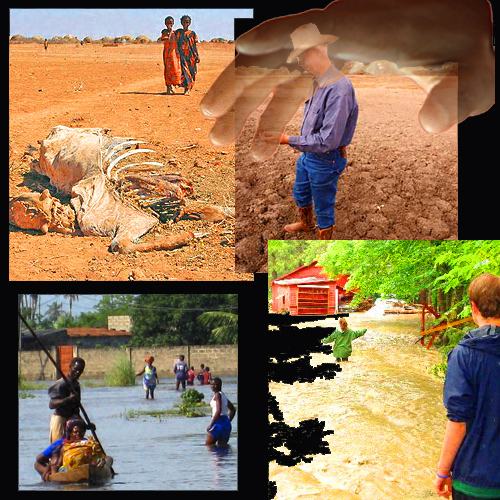
Texas droughts, Vermont floods, Manhattan hurricanes. Dadaab famine, Ewaso floods, Zanzibar typhoons. In America I expect we’ll muddle through and with luck and no feckless economy, we’ll figure it out. I’m not so certain about Africa.

The effects of global warming on East Africa have been severe for the last 5-10 years. The weird way the wildebeest migration is behaving this year in the Serengeti/Mara ecosystem is today’s news (more below) but the intensity of droughts in ridiculously localized areas, often surrounded by floods, has now become so common it hardly makes news, anymore.

And there’s a big difference between the Africans’ outlook on disasters and ours.

Africans don’t get quite as excited as we do. Although malevolent “Acts of God” are increasing it seems to me at an even pace worldwide, they’ve been much more a part of African history than American history. We in the west tended to denigrate the African psyche as fatalistic for shrugging off one famine after another.

But you know, you can grieve for that covered wooden bridge for only so long. So … who to help?

Animals are helping themselves. The huge wildebeest herd moved out of the grassland plains this year right on schedule at the end of May. This was because the weather in the area was right on schedule. The rains which begin with the new year had finally begun to subside.

The pattern over the last century has been like a wet spot on your cement floor drying up: in this case the center of the wet spot is Lake Victoria, and the rains and humidity recede into the lake as the dry season progresses. The wildebeest migration follows this drying spot.

But subside became abrupt in the western part of the ecosystem, in the area known as the western corridor. Before June was out, residents there were calling it another drought.

I’ve noticed in the last decade that the increase in human development which has stressed available resources like potable water exacerbates negative events. Perhaps it was a drought; perhaps it was just there wasn’t enough water to go around, or that domestic stock had nibbled into the park reserve, or that previous logging and erosion had lost a final defense.

A large portion of the original grassland plains herds normally moves into the western corridor in June, and as they did there were wide reports that they were surprised there was no grass, became confused, and began to scatter.

That’s a normal reaction to an abnormal obstacle on their trip.

As the herd sort of regrouped and moved north quicker than it would, many of them were crossing into the Mara by the beginning of July. Then, it started to pour rain, but mostly south of the border, south of the Sand River.

So, the wildebeest turned around and went back into Tanzania. The rains were good for about ten days. By mid-July there were appearances of it being a rainy season in the dry season.

This would never have happened in the normal days of the past so many decades. There would not be this extreme difference between areas which are so close to one another. If the western corridor was in a drought, the northern Serengeti shouldn’t flood. Yet that was almost what happened.

Today the wilde are mostly back in the Mara, and in fact many have moved into the private reserves north of the Mara proper. This is normal. Or at least, what used to be normal. The animals helped themselves; nobody gave them a handout or sign telling them where to travel. Perhaps a tenth of the herd was lost, but that’s life, and mothers don’t even linger over their dead babies.

If somebody’s home was floated away by Irene, do we just take pictures and leave? If millions are dying in Somali, do we just sell tickets to another pop concert?

Earlier this month the Kenyan Wildlife Service (KWS) announced it was starting a number of initiatives to combat climate change. Last week was the first of many scheduled workshops. There’s a lot of sincere interest in doing something, but it’s nearly impossible to imagine if anything at all can be done.

Human populations are increasing and stock grazing comes with that. Oil and other natural resource potentials are drawing Chinese and others with little regards for the environment. There are fewer traditional farmers and herders. I see more Maasai wearing Docker Polo shirts than shukas. Life is changing, and even more noticeable is the veld itself. It’s crusting.

The actual Mara reserves and the great Serengeti grasslands further south seem to be OK for right now. The last several years in particular have been kind to the Serengeti.

But things are changing. Climate change is pounding the earth. Some will be able to move to the new drumbeat. Some won’t.

Tale of Two Countries

Tale of Two Countries

Tanzania Foreign Affairs Minister Bernard Membe explains well.
Anyone want to guess why a bunch of African countries aren’t recognizing the Libyan rebels?

Kenya recognizes the new government in Libya. Tanzania won’t. The split, which cleaves the continent like the Great Rift Valley, divides the strong democracies from the weak ones. Guess which side Tanzania’s on?

Tanzania and 40 of the other 52 countries in the African Union (it would be 53 with Libya) have sheltered under the weak AU position that the Libyan Transitional Council has no democratic legitimacy.

Well … that’s not exactly news.

Nor is it news that quite a few of those 41 countries while pretending democracy at home fall just a wee bit short of true representative government. Twevolution isn’t finished, and I think this split helps show us who’s next.

One of the 41 countries leading this position is a true democracy, South Africa. But President Jacob Zuma fashioned the policy, called the AU meeting over the weekend, and pushed through this donkey position.

Zuma’s motivation are quite different from the hedge lings anxious to follow him. Zuma had been in Libya several times trying to broker a cease-fire and a Kenya type coalition government with his friend, Gaddafi.

Gaddafi is a friend of Zuma’s, because Gaddafi was super rich with few places to dump his money, so he lavished it heavily on many projects in South Africa and elsewhere in the continent. He paid for the building, for example, in which the AU now meets.

But some reports of the sort Zuma constantly refers to are exaggerated. Most of the money went for questionable goals but Zuma is beholden to the fallen dictator for many of the same reasons he seems to be supporting Robert Mugabe all the time: stability.

It’s a terrible policy position that has infected such great nations as … well, us. Zuma knows that most of his neighbors are cutthroats and he fears twevolution spreading all over the place. South Africa literally runs much of Africa. Its giant economy, more than ten times the size of all the rest of the economies on the excluding Arab North Africa (Morocco east through Egypt), has become the main conduit for Chinese investment.

If this wretched disease of freedom starts spreading, well it could be awful for him.

[Little side story: remember all those reports of a southern African plane flying over Tripoli? London’s Daily Mail this weekend claimed it was Robert Mugabe’s private jet offering a free taxi service south. Reports were “vehemently” denied by the Zim government.]

So taking umbrage in Zuma’s duplicity are countries like Tanzania, struggling politically and definitely ready for a twevolution.

Tanzania’s foreign minister explained : Tanzania will not recognize any government that doesn’t “respect the division of power between the executive, legislature and the judiciary.”

Hmm. That is a problem with some Africans, this lack of self-esteem.