Nigeria thumbs its nose at the U.S. and U.K. on gay rights, Japan uses nuclear clean-up funding to hunt whales, 4 more rhinos killed in the lowveld and Durban’s in the bottom of the dirty coal tank. Oh, did I forget that Europe’s coming apart?
The weight of organic and inorganic problems on this, man’s planet, seems so stultifying at the moment that any sense of urgency any single problem might legitimately beget is evaporating like a thin pond of ice in a very cold winter.
The mind suffocates.
Over the last decade or so I’ve looked to Africa as a leading indicator of where the world is going, and it’s often not been promising, but it’s proved pretty accurate. The latest, and perhaps the final reasonable global indicator, was what I called early on twevolution and which later developed into the Arab Spring.
Many have argued it was the logical extension of the end of the Cold War, which was the logical extension of an incomplete resolution of two world wars, which was the logical extension of attempts to dominate the industrial revolution.
But remove the mechanisms of logic as drivers of the inevitable next stage, and the fundamental cause is revealed as ethnicity, or more generally, distrust of others not like you and your family. It’s the old who gets the biggest piece of the pie thing.
So, today, when we’re making 9″ instead of 10″ pies, there is even less than ever, even though the more that used to be we now understand was a fanciful creation of those who already had most. Alas, there really weren’t many 10″ pies: just a lot of TV images of the same few.
So if there’s any good news at all it’s that finally we’re fighting about reality.
Britain, Hungary and the Nordic countries may ultimately be looked upon by history as the diseased parts of the European body that finally took down the whole creature. A dysfunctional and incomplete European Union is worse than no union at all.
Japan and Asia’s intractable obsession with consumption of rare earth forms like tigers and rhinos and whales is destined to lay the planet wasted of such things in just a few years. Then what comes next for them: in place of tigers, rhinos and whales, will they start consuming Inuit, Slavs and transsexuals?
And what is the “brink of destruction” that we seem to push just a bit further away year after year as the world gets hotter and hotter. Ever see the horrible movie Waterworld?
None of this will change, if we as individuals don’t stand up and shout, “We’ll take less!” Any odds on that one?
And that’s one cold, dismal Friday morning on earth in the (is it the?) 21st century.
From India frustrated T-Partyers unable to maneuver the legislative process to eliminate civilization have just discovered a powerful new tactic. Release deadly snakes into IRS offices, guaranteeing at the very least a temporary pause in tax collections.
I have not taken the event more out of context than most T-Party dialogues. The perpetrator was actually protesting a new Indian regulation outlawing traditional snake charmers. And I have no doubt south Georgia T-Partyers will spin this to their warped intellects.
It was only last month that a 22-year old tried to illegally buy a black mamba in the woods of southern Georgia at 2:30 in the morning. Obviously frustrated that he couldn’t find one on Amazon.com he nevertheless found a ready seller. Must happen all the time, but we found out about this one, because the kid got bit.
We’ll never know for sure if he was always a redneck, but he absolutely was when medivaced to a Jacksonville hospital. His life was saved. The snake is loose.
A half dozen times annually some idiot in the U.S. breaks a battery of laws buying or selling an African mamba. For the life of me I can’t figure out why. What kind of imbecile wants to keep such a killer?
Mambas don’t make good pets. I know. I had to sweep them out of my house at the start of the first rains or risk being swept into the next world. I have a hard time understanding people who keep non-venomous snakes as pets, but good grief, why would you want a killer?
Has to be a macho thing. Unless you think you could create a seemingly serendipitous moment serving Assam tea cakes at an afternoon guild party to knock off a maiden aunt. Why else?
Mostly a macho thing. I’ve known several wonderful reptile scientists in my life, and by the time they become real worthy herpetologists, they were no longer macho-driven, but as kids, that’s usually what motivated them. Dares to do-s.
And then there’s the whole matter of it being illegal. You cannot own, sell or buy an African mamba, green or black, in the U.S. without a permit generally reserved for zoos and medical research facilities. So this dare gets even more thrilling, because it’s illegal.
Time and again men and women unable to foster human relationships create them with animals whose only ability to resist is to kill them in return.
I love animals and always have. I expect someone watching me play with my lab/hound mix would ascribe all sorts of human characteristics to the relationship, and undoubtedly while playing or petting or observing, I can’t help but see “Morgan” in human terms.
But I won’t buy a cemetery plot for him. I won’t subscribe to PetMeds while monitoring his blood sugar and I’m even adverse to putting gooey tick repellent on him. He isn’t human. He’s a pet.
Throughout my career in Africa I’ve encountered numerous researchers who cross the rational limit of thinking of animals as humans. The most flagrant examples are those ascribed to elephants: how they return to where close relatives have died, how they sacrifice their own well-being for another individual.
Balderdash. These are human behaviors that while I concede we can never scientifically measure in an animal with the clarity that I suppose, I trust my intuition on this one. I even question whether pain as we humans understand it is anywhere similar to what animals experience.
Critics will contend I’m setting up situations that allow for animal cruelty, but that, too, is balderdash. I have a hard time understanding why people swat flies with such vengeance or unload aerosols into gardens or are amused at young boys firing beebee guns at the nearest squirrel. I have serious questions about the morality of hunting animals for sport.
But to think of an animal as a child, or parent, or human friend, is to diminish the radiance of our own place in the biology of the world. It’s a terrible shortcut for trying to understand the complexities of life and does significantly more injustice to that life form than accepting it for what it is.
And it’s so absolutely clear to me whether it’s an old man, doting spinstress, recluse or young career-minded couple that has traded procreation for a more balanced 401K – all of whom embrace their dog with the ridiculousness of human attractions — are doing so entirely, utterly and selfishly to assuage their own inadequacies, and at the horrible expense of the meaning of that dog, the beauty of its form in the biomass in which we also participate.
There are so many negatives to anthropormorphizing animals, but one overriding one is that whatever faux emotion is created in the human master, it probably decreases that person’s empathy to humans in need. It likely distracts the master from the misery of his servants.
And, then, ultimately the price is paid, in an inevitable and ultimate way.
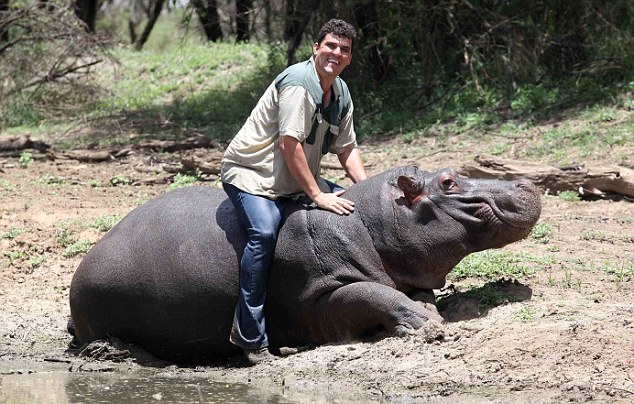
Last month a famous relationship between a hippo and a man came to an end when the hippo killed the man.
The jolly guy, a stellar citizen and former military officer, was a farmer who adopted an estranged baby hippo. (As I once adopted an estranged baby baboon.) He raised it with tender loving care. (As I raised mine.) But when baby turned adult, when the full sense of the creature came to the fore, he couldn’t give way. He claimed again and again, to over a quarter million viewers on YouTube, that everything was just fine.
Marius Els, 41, had no son, no viable human relationship with a child. Why doesn’t matter, but nor should he have tried to create that relationship as a shortcut with an animal. The hippo bit him multiple times, then pulled him into the river and drowned him on November 14.
It’s clear that Kenya’s invasion of Somalia will be lengthy. The army is not moving quickly, there is hardly any action at all, and Kenya seems content to occupy the bit of land they’ve conquered while letting the initially stated objective of Kismayo disappear.
In the end the strategy could work. Al-Shabaab while ruling much of Somalia is not really a very good governing entity: they are fighters not administrators. Kenya and France seem to have laid a siege over the port of Kismayo. Starving al-Shabaab might be the prudent “way out.”
The respected African analysis, Robert Rotberg, said last week he thought the Kenyan slowdown was because of heavy rains. But the emeritus prof has got that a bit wrong; rains in eastern and southern Somalia have abated considerably in the last several weeks. The Kenyans haven’t been stopped by water.
But the rest of Rotberg’s analysis had some compelling aspects to it. “Al-Shabaab’s days as a sustainable and robust fighting force are rapidly coming to an end,” and I agree. He also posits a UN trusteeship for what will “come after” the Kenyan/Ethiopian victory, very much as Southwest Africa was established under South Africa following World War II.
Kenya roared into Somali nearly two months ago, then screeched to a dead stop when it became clear that al-Shabaab was fortifying a city northwest of Kismayo, which could conceivably clench the Kenyan military in a pincer action if they continued to the sea.
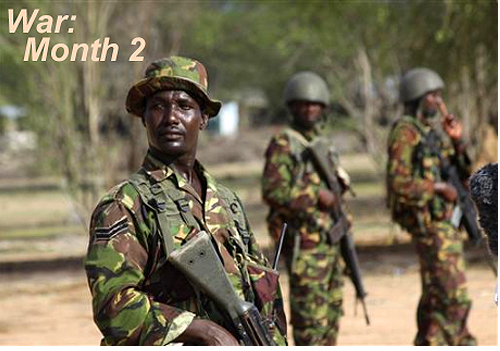
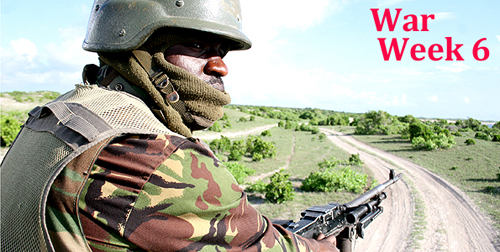
As the war begins its second month, Kenya’s 3-4,000 troops have lost 4 in action, 6 in accidents and ten more wounded. Not bad.
So… Kenya stopped, and there it’s been for some time. In place of fighting a remarkable diplomatic effort by Kenya has laid the ground for their lengthy involvement. First, they reversed the initial displeasure of the puppet government in Mogadishu. Then, they exposed Eritrea as supplying al-Shabaab’s military. And finally, they’ve kept both America with its drones and France with its naval gunships involved.
At home the terrorist threat of al-Shabaab has diminished. The first couple weeks saw grenade attacks in Kenyan churches, bombs in Nairobi bars and a restless Somali population. That’s settled. Personally, I still don’t think it wise to restart tourism in Kenya, but I’m very glad that the threats to the Kenyan population seem to have diminished.
But the war is a terrible drain on Kenyan resources. The country is preparing for its first election after the new constitution. Its shilling is in the tank with no indication it will recover. Economically this war is the last thing Kenya needs.
Kenya believes this effort will, literally, keep al-Shabaab at bay, the bay at Kismayo. And if the siege ultimately works, perhaps Kenya can walk to the seaside without firing a gun. It sounds crazy and beautiful. We’ll just have to wait it out … with the Kenyans.
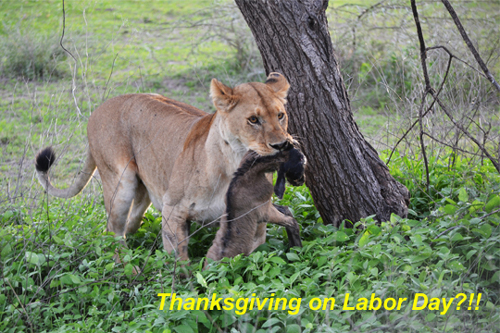
Photo by Sarah Vieth, Ndutu, November 2011Climate change is slowly, steadily changing the ecology of the world’s most spectacular big game wilderness, the Serengeti. For a visitor, it’s nothing short of fantastic. For animals it’s terrifying. For the planet it’s just too complicated yet to say.
The roughly 7000 sq. miles of the Serengeti/Mara/Ngorongoro wilderness is the greatest wildlife area on earth. Said with bias. And the necessary qualifiers are many, of course. But this is classic Africa that seems to get better to the casual visitor year after year.
Historically northern Tanzania’s rains begin towards the end of the year and last (with a noticeable but incomplete interruption in February) for 5-6 months. This year, and last year, they began much much earlier and ended a little earlier.
And, predictably, this sent the wildebeest circling faster. And all of us “experts” are thrilled and surprised. The wilde now seem to spend less time in the Mara in the northern reaches of the migratory route, and more time in the Serengeti. They don’t follow the rains, but they follow the grass the rain grows.
Rain patterns are critical to the great migration, as well as practically everything else in this ecosystem from fields of yellow bidens flowers to the nesting habits of pink-eyelided eagle owls. For all my life until now all of this explosion of life was pretty predictable. Getting harder, now.
I was astounded this morning, for example, to read a blog posted by Bill and Sarah Vieth from Evansville, Indiana, celebrating their 20th wedding anniversary in the Serengeti. They probably had no idea how remarkable was the photo Sarah took when they were in the Ndutu area, which I’ve taken the great liberty of reposting atop this blog.
So what’s so unusual about a lioness bringing back a wildebeest baby to its pride for a slightly late Thanksgiving?
There shouldn’t be baby wildebeest, now. Wildebeest are the predictors of the veld’s health and sustainability because their migration and foaling is … well, at least until now, predictable. Wildebeest babies in Ndutu are born in February. That’s what the books say. That’s what I saw for 35-36 of the last 40 years. This birth, following 8 months of gestation, is maybe two months early.
But alas, it all starts to match if you’re willing to believe that the rain clock in Equatorial Africa is changing. It syncs beautifully with last year’s early end to the rains.
Wildebeest rutting historically occurs as the rains end, and last year they ended early. In fact the news blog posted by the owner of Ndutu last May read: “Lake Ndutu was completely dry by the end of May! It’s the first time in all her years of being here that Aadje has seen the lake dry so soon after the end of the ‘wet season.”
Early December minus eight months equals early April. Remarkable, a shift of 6 weeks to 2 months.
Now, was this just a fluke?
I called Bill. Bill was kind enough to give me permission to post his wife’s photo, and went on at great lengths about what a great trip they just had. And he proved that photo wasn’t a fluke.
When Sarah and he were descending into Ngorongoro crater first thing one morning, they watched one, then two wildebeest births. He excitedly described to me the lurking hyaena and how one of the younguns didn’t make it. But proof positive how early the births are occurring!
Now it isn’t so hunky dory and simply just a shift in the clock. I saw a young wildebeest being born in April this year around Ndutu. In September in the far north of the Serengeti I saw baby wildebeest that couldn’t have been more than three months old. So clearly mother nature’s change of habit is causing some confusion with the wildebeest.
Like men, wilde may be resisting the idea of climate change. I excuse them. Their brains are smaller.
Rains began in the northern Serengeti with a vengeance this August, and while they’ve abated a bit right now, the center and southern part of the ecosystem is near flooded. What I think we’re experiencing is not just a shift to earlier rains, but an extension of the entire rainy season. I think we’ll soon all agree that it rains more and more than half the year on the Serengeti.
Or as one blog puts it, “Short Rains Aren’t so Short!”
That jives with rain patterns all around the planet near the equator. With global warming there is more moisture in the atmosphere. We’ve all heard about the 90-mile wide icebergs calving from the Antarctic. It floats towards Cape Town and melts. Seas rise, yes, but so does the atmosphere which in a warmer state can hold more and more water.
And it dumps conveniently on the equator. The Serengeti.
Wish it were just all that simple, but equatorial meteorology is far more complex than my Chicago television weatherman suggests. We have discernible seasons in the north and south of the world, but the equator doesn’t. Rains in equatorial northern Peru were devastating in the last few years, but hard to predict.
One week is a series of torrential storms; the next week seems like a drought. That’s the basic pattern as you move away from the equator, away from the Serengeti. That’s why the Somali refugee camp at Dadaab had thousands of refugees fleeing a drought 4 months ago, and thousands now fleeing floods.
But closer to the equator the complexity is less stark. Basically, it just rains more; it’s wetter.
So what does this mean to the animals?
Having lived there and visited constantly throughout my adult life, I can say with care that the animal populations are bigger, the viewing more dramatic as tension among predators and competition for food sources increases, but my worry is that it will all come crushing down some day.
You might call it the Animal Bubble.
Things are good for the animals, now. Probably will be for a few years, but just as wildebeest sex lives are getting screwed up (pun intended), massive ecological systems don’t like quick change. The response to quick change is usually to crash.
But right now, a month or more early, the wildebeest have massed at Ndutu and it’s pouring. And for now, they couldn’t do it better at DreamWorks.
When something goes wrong, those with greater resources cope better. So it’s no surprise that Africans are the furious ones and the developed world’s citizens are the most complacent about climate change. Too bad rich tourists heading on safari: you’re about to experience it square on.
I think practically everyone in the world will agree on one climate change outcome: weather is more extreme. Summers are hotter, winters are colder, winds are stronger, rains are heavier, and periods of beautiful calm are often longer. Extremes.
Idiots argue that man has little to do with this, and non-idiot poorly informed believe even if man has little to do with this, there’s little he can do to abate it. Wrong. Wrong, of course. And this dog-headed refusal to accept simple science is found mostly in the developed world, where hotter summers and heavier snows are annoying, but not catastrophic. Yet.
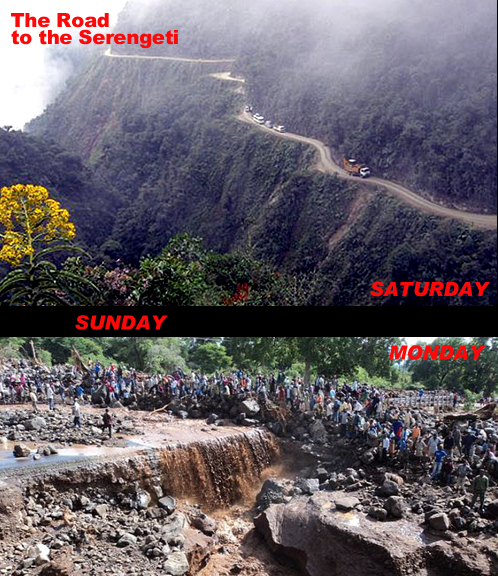
In Tanzania last weekend heavy rains fell once again in the north over the important safari circuit. Three bridges were destroyed, the beautiful Manyara escarpment lost much in a landslide, Serena Manyara Lodge was partially destroyed, a half dozen people were killed and hundreds hurt, and right now you can’t drive normally into the Serengeti from any airport in northern Tanzania.
The rains have laid waste a beautiful paved road – the only one – that links Tanzania’s Manyara, Ngorongoro and Serengeti national parks with the main metropolis of Arusha and Tanzania’s main northern airport. The road was built with Japanese aid money in 2007, completing an already improved gravel road built in 2003.
Before then overland safaris into the Serengeti were much different than they were post last weekend. Either you flew, missing so many beautiful sights along the way, or added a day or two to your itinerary to make sure you could get over the Manyara escarpment.
It’s unclear if Tanzania has the wherewithal today to repair the current mess, which is massive. The very important December holiday season is extremely heavily booked, and I doubt seriously that the roads can be repaired by then. And the greater question looms: you repair it at phenomenal cost, now, and then what about the next heavy rains?
This is happening as the Durban Conference on Climate Change goes on, and on, and on, and on. This is the conference that created the Kyoto Protocol, the nearest and now decaying world treaty to deal with climate change. For the first time in the conference’s 20-year history, no U.S. lawmakers are present.
And the all but dead Kyoto Protocol, which the world’s top polluters the U.S. and China never signed, may get its nail-in-the-coffin as reports circulate that Canada will celebrate the current conference by withdrawing from the treaty.
This particular road is important to tourists, but it’s more important to local commerce, students going to school, farmers preparing fields. It’s not just tourism, of course, that suffers from climate change. Droughts are more frequent and so famine is more frequent. Floods are more frequent, so development is drowned, diseases spread.
Africa can’t cope. And when Africa doesn’t cope big time, the developed world is pulled into the mess as rescuer of last resort at great expense. This is getting boring, it’s happening so often, and nobody seems to have a long enough vision to realize ultimately that the world as a whole – that means us – is hurt by climate change as much if not more than Wall Street banks and housing bubbles.
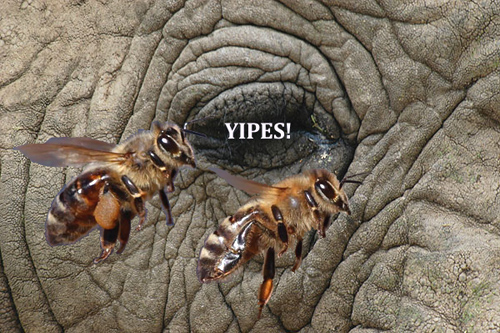
All we had to do is remember Dumbo jumping away in terror from Mickey Mouse. Instead we spent millions digging earthen moats, sprayed juiced pepper along firebreaks of hay, and I proudly discovered meter squares of steel reenforced spiked concrete. All we needed was a bee!
Five years of research has culminated with a global prize to a young British scientist who has proved how easy it is to keep elephants away from .. well, farmland, schools, roads, in fact anything you want!
Lucy King and Save the Elephants resurrected years old research about how terrified elephants are of bees. Then she intricately studied the sounds bees make, proved that was what sent the elephants fleeing, then combined a productive deterrent with a productive agricultural product and bingo, no eles and lots of honey!
Long before King’s research it was common knowledge that eles flee bees. This upper brain memory in Africa is just like our Walt Disney knowledge of how scared they are of mice. Nice cartoon but .. so what? In fact, it was hard to believe and original science to study it seemed fanciful.
But good science doesn’t mind being embarrassed, and King’s and other’s earlier research showed that particularly in times of drought bees cluster around elephant’s eyes and up their trunks, because of the moisture there. People don’t realize that bees need as much water as pollen to make honey.
King’s research was the culmination of many individual research projects over the last five years, and was awarded the coveted “Thesis Prize” by the Convention on Migratory Species at the annual meeting in Norway.
“Her research underlines how working with, rather than against, nature can provide humanity with many of the solutions to the challenges countries and communities face,” said Achim Steiner, executive director of the UN Environment Programme (UNEP).
“Dr King’s work spotlights an intelligent solution to an age-old challenge, while providing further confirmation of the importance of bees to people and a really clever way of conserving the world’s largest land animal for current and future generations.”
King was born in Africa and personally aware of the skyrocketing human/elephant conflict in part an unintended consequence of saving elephants from near extinction. Her work began at Oxford University and the bee studies were her Ph.D. thesis.
It ended in northern Kenya where once all the details of a “bee fence” were engineered, a control study of 34 Turkana villages in a new agricultural area on an elephant migratory route were carefully monitored for elephant incidents.
Seventeen villages were wrapped by newly designed bee hives, and seventeen weren’t. Over a two-year period, the data was striking. Farmland and village domiciles wrapped by beehives went essentially elephant incident free. Unwrapped villages suffered constant incidents.
Originally King and other scientists thought their job had ended a few years ago when they proved that 90% of elephants will flee certain types of bee sounds, mostly those created by the buzzing wings. This sound in turn provokes a very specific elephant alarm call that is not only the sound of a terrified beast running away, but specific enough to cause other elephants in the area to flee as well.
Clearly reproducing the sound was all that was needed. And while that’s technologically easy, it can be expensive and requires maintenance like all fire alarms. Particularly far out in the bush where electricity is erratic.
Boing. Why not do it from the beginning?
Villages now have the added benefit of lots of honey, and the specially engineered beehives designed to increase the longevity of the hive and production of honey are far less expensive and much more durable than electronic sound systems.
Despite all the excitement this isn’t the BEE-all or end-all of elephant deterrents. During periods of drought – which are chronic in elephant land – honey bee populations dive. It might be true that eles get stung more, then, but they also get much less warning since there are far fewer bees making the sounds that scare them away.
So during these frequent periods of low rain bee hive fences lose some of their mojo. King has explained in her research that bees are just one – if the most potent – weapon in a necessary arsenal of elephant deterrence.
Nevertheless, it is clearly the best one so far, and may in fact have a greater application in parts of the world like Asia where human/elephant conflicts are also growing and drought is much less a problem.
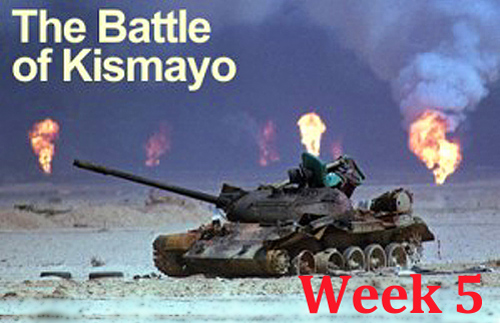
Very little of anything happened last week with Kenya’s invasion of Somalia. Some are beginning to see it as an occupation rather than a specific campaign. Kenyan forces continue to decline engaging al-Shabaab in their fortified towns of Afmadow and Kisamyo.
Kenyans at home who have until now been unwavering in their support are beginning to falter: “In the wake of Operation Linda Nchi, there has been anxiety that there is little action in Somalia… If you are excited by war, the one in Somalia has been disappointing,” a leading Kenyan journalist wrote Sunday.
The 5th week of the war included a flurry of diplomatic activity as well as the invasion of Somali by Ethiopia. I had thought these both positive developments. But many African analysts see it differently.
Tanzanian Evarist Kagaruki of Dar’s main newspaper, The Citizen, claims “there are no signs yet to show that support for Kenya was forthcoming. The whole burden has been left to the Kenyan army [and African Union troops that have been there for a number of years as peacekeepers].”
Kagaruki concludes that the Ethiopian invasion won’t help the Kenyan effort, either. He says that “Ethiopia is not the right “partner” in the adventure” because Somali/Ethiopian enmity is centuries deep. He points out that it was in the wake of the last Ethiopian invasion that al-Shabaab gained so much power.
“It is time Kenya wrapped up the campaign before war fatigue sets in,” was the lead editorial in Sunday’s East African newspaper.
But the military insists the campaign is going as planned. Apparently siege rather that engagement is that plan. Friday military commanders claimed that the last five ships that were at the port of Kismayo had departed, and that the Kenyan air force and Navy would now not allow any others to enter.
Other reports said the Kenyan air force was successfully aggressively bombing al-Shabaab positions.
There have been no more terrorist or revenge attacks in Nairobi, but that isn’t true near the Somali/Kenya border, where multiple attacks and skirmishes have left a number of civilian casualties.
This is clear evidence of the strategy al-Shabaab is employing, a guerilla campaign that is quite content to withdraw from the line of battle into the bushes and hills.
And while increased security in Nairobi and Kenya’s main cities may being helped by many arrests of suspected al-Shabaab sympathizers, the military nature of their detainment is not going over well with the Kenyan population, and certainly not with the hundreds of thousands of ethnic Somali living in Nairobi.
So last week’s glimmer of hopeful excitement is gone.
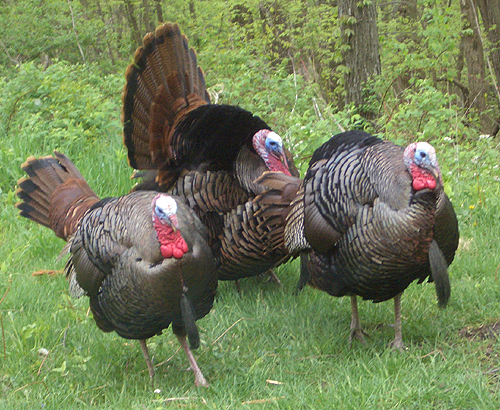
Wild turkeys outside my office in Galena.
One of the hardest things to leave behind when Kathleen and I first moved to Kenya many, many years ago was Thanksgiving.
No matter what your religion or politics, Thanksgiving is a major American holiday, all-American so to speak. And even before a third of our society was obese, it was a day of gluttonous consumption. You were just proving how well off you were, even if you weren’t.
So when we finally got settled in a very remote village 3 days travel from Nairobi we immediately began making plans for Thanksgiving. We sent out messages through the bush grape vine that we wanted two turkeys.
Most people had never heard of turkeys, and it was a great mystery to Jozani, our house boy/translator/money market manager and cook. Although he cooked chicken well for us, he was part Maasai, and fowl was taboo.
He could understand we Mzungu eating chicken. Mzungu had eaten chicken ever since Britain had a king. Many Africans back then accepted without aversion all sorts of habits the white people had carried with them into Africa. So chicken was OK. He often burned to a crisp our chicken, but he cooked it.
So when we first asked him to find a turkey, I’m sure he had no idea what it was, because he enthusiastically immediately replied that of course he could find us two turkeys. Jozani never said no. If he said no or asked further what I meant, either I might get angry with him (he thought) or make his day far too simple. So he said, of course bwana, he would find and cook for us two turkeys for our American holiday of giving thanks.
I’m not sure how many Thanksgivings passed before Jozani announced one morning with great pride that two turkeys had been found and were coming. At rather extraordinary expense. I had completely forgotten about it but apparently I was the only one who had. That same morning on the walk to the school where I taught, every one was asking me when the turkeys would arrive.
In fact a week or so later, two hours before the turkeys actually did arrive, a holiday was declared at school, and the children lined up as they did for morning assembly to greet the turkeys.
It was hard for me to call these fowl turkeys. They were young birds, true, but they looked more like weasels than turkeys. After close inspection I did approve them, paid the king’s chicken ransom, and turned them over to Jozani to rear. I think we had 5 months or so before Jozani had to cook them.
Turkey dinner turkeys are supposed to grow fast, remarkably fast. The wild turkeys that now live outside my office take more than a year to get large, and two years before the Toms are really large, but turkey dinner turkeys can reach massive maturity (12 pounds) in 5 months. What a ridiculous hope.
At first I was going to name them, and to do that, it was necessary to know their gender. Jozani insisted, however, that they had no gender, so we left them unnamed.
They grew, but not as fast as they ate. They became bold and strong and rather offensive, chasing anyone who came into our compound until one day I saw Jozani walking around the house with a large flattened stick.
“What is that for?” I asked him as he was scrambling eggs.
“It is to beat the turkeys, bwana, they are growing rude.”
They were growing rude. They would try to come into the house and peck at the screening when we refused. Jozani didn’t stay the night, and you’d think that a day time bird would go to sleep. But they seemed to freak at the dogs in the area that barked when hyaenas or jackals were in the neighborhood so gobbled the night away.
The time finally came to roast the birds. Jozani was equivocal. He had decided they were wizards incarnate. And of course it’s either impossible or catastrophic to kill a wizard. But we had invited nearly several dozen colleagues in a wide area to celebrate this so important holiday called Thanksgiving. So I let Jozani know that I’d kill the birds if he wouldn’t.
He killed the birds. And sort of defeathered them.
Kathleen spent days making stuff – or more correctly, like Jozani think he was making stuff. Like Stuffing. Which Jozani felt was the epitome of evil. Throwing a chicken in a frying pan was one thing, but “dressing” a fowl and doing such wizardry things as sticking bread and wine in its hollow stomach sack must have seemed extraordinary.
It was a grand holiday evening. Candles which we now use for effect was all we had. The smell of savory rice, good wine that someone had managed to bring up from South Africa, wondrous puddings and breads infused the evening of delight with the merriment of the finest of Thanksgivings.
And as if on queue it began to rain. The start of the rains had been delayed for all sorts of mysterious reasons, and there was concern that it would become a drought. But lo and behold, that late November evening in far western Kenya, the rains arrived just as the two turkeys did.
The rains proved much more successful than the turkeys. They looked OK if a bit shrunken. But the meat had the texture of something already worked into a piece of clothing. There was a not knife to be found capable of slicing it. We set it aside for a later soup.
So everyone was happy. Our guests probably because of the wine and Kathleen’s remarkable savory rice. Jozani because we didn’t eat the wizard. And the world because the rains had come. So though I don’t know to this day where our two Kenyan turkeys came from, nor for that matter where they went (there was never a soup), I know it was because of them that we celebrated Thanksgiving far, far from home.
I started this blog to write about animals. Today, like so many days, it’s about elections and wars. And in this wrap-up blog before our Thanksgiving holiday, the preeminent news is at this very moment in time. Better than I would have a hoped a few moments ago.
It’s so ephemeral. It’s easy to argue that things change so quickly, that news and blog-news is disseminated so instantly, that clearly seeing a trend to events becomes more and more murky. Well, bring it on!
So let me wage a huge gamble about Kenya, Egypt and The Congo – three volatile yet extremely promising societies – which I promise to revisit next week: Last weekend the situation in all three looked nothing short of awful. This morning, at this very instant, it looks different and better.
Kenya’s advancing invasion of Somalia for the first time in six weeks has an optimistic cast. Despite unbelievable clashes in Egypt over the last few days, at this very moment in time the military seems to actually be negotiating away its position to the people, and even in the Heart of Darkness I see glimmers of goodness in the November 28th election in The Congo.
It’s only logical that the Kenyan invasion of Somali begun more than a month ago would fail and strangle the country’s developing economy and polity in the process. And the quick entry, then total abortion of the process which resulted in a Kenyan decampment less than half way to its stated objective, the port of Kismayo, looked threateningly like Kenyan defeat earlier than any could have predicted.
But then chips we didn’t know we’re in the game started to fall into place. The dysfunctional Somali transitional government got in line. Coordination began with African Union forces that have been in the country since its seems the industrial revolution. And last week, Kenya’s sometimes adversary Ethiopia resent troops into the country presumably to fight alongside Kenya.
I am not one to believe wars work very well, but reports this morning suggest that the size of the combined effort by Kenya, Ethiopia and the AU is such that routing al-Shabaab might just be possible.
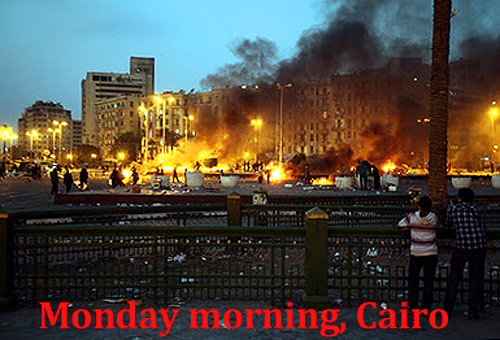
In Egypt all hell broke loose last week following the military’s very ill-advised November 1 edicts setting the final rules for the election process and simultaneously entrenching itself in a cocoon of immunity from civilian authority.
Like so many countries in South America and Asia in the recent past, military autocracies justify themselves as the only cohesion to otherwise dysfunctional and often ethnically divided societies. It is laughably early for me to post this as the meetings are actually in progress in Cairo, at this very instant in time, but my intuition is on the line. I think the military is going to back down.
The poor Congo was crippled in the 1960s at the very moment of its independence, when Belgium and the U.S. teamed up to murder the duly elected first president of the country, Patrice Lamumba, for fear he was a “communist.” That body blow to its polity has seemed to fester rather than heal.
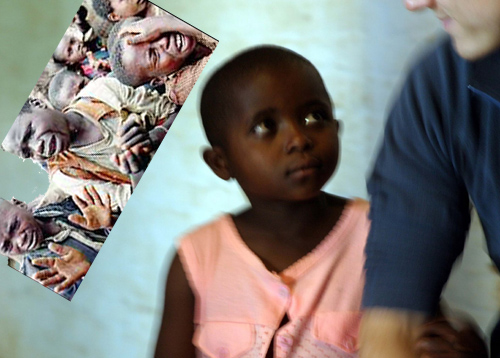
The current president is the son of the “liberator” who forcibly ousted the long-time ruthless dictator, Sesi Seko Mobutu. But Mobutu had held power for so long that throngs of people and institutions depended upon him. Chaos reigned in the eastern Kivu Province, where child soldiers and blackmarketed Star Wars rare metals fueled Dante’s inferno.
But with a little help from its friends, most notably a little acknowledged provision in the Dodd-Frank banking act, the temperature in The Congo has plummeted to near normal highland rain forest levels. The bad guys have fled north. Next Monday’s election might just actually go off well.
If these possibly irresponsible optimistic predictions come true there is an important lesson I for one should learn and could easily forget if not pointed out, now. Trust youth.
It has been us fuddy duddies predicting gloom and doom. We have nothing but history to reference. The rest of our lives would make a very short line.
It’s the youth in Tahrir Square, in Nairobi, and in the jungles of Kivu who have been insisting throughout all the ups and downs in their situations that “we will prevail.” It’s new tour companies that have contacted me from Kivu-Congo, and Nairobi and Cairo.
Tour companies? New tour companies in the midst of fire and smoke?
The political situation in Egypt may be very confusing, but the death-toll now exceeding 35 over this past weekend raises the profile of the current unrest above what it was when the old regime toppled in February. What can we see in the near future?
Weekend demonstrations were nowhere near as large, but just as violent, as earlier in the year. Egypt’s first free elections are scheduled for one week from today. The political parties and individual contestants in that election show no signs of boycotting November 28 or of requesting it be rescheduled, even while they are highly critical of how the election has been arranged.
This makes me believe that if we can get through this troubled week, and if elections are successful, that violence will subside and the political process will move forward. Clearly, though, if anything disrupts a clear and fair outcome, Egypt will take a terrible slide backwards.
There are several different issues galvanizing current protest, and because they’re complicated, the street shout is simply that the current military commander and defacto leader of the country, Mohamed Tantawi, should step down.
This is because he heads in a very dictatorial fashion the council that rules Egypt right now, and that council has promulgated a number of laws and procedures that have alienated large numbers of Egyptians.
The most egregious is Article 9 of the temporary constitution announced November 1. That provision isolates the military as it currently exists from any civilian authority. It guarantees a military budget that can’t be questioned, and it reserves the military’s right to veto any law passed by any government body involving the military.
But there are other issues as well.
Next Monday’s first free elections in Egypt will not be the expected moment of liberation everyone had hoped for. The rules for the election of a representative government became increasingly complicated over the last number of months.
Monday will be the first of three sets of elections, each held in different regions of the country, for the lower house of parliament (similar to our House of Representatives). The last of these lower house elections will not be completed until some time in early January. The military explains this strung-out process as necessary for guaranteeing ballot box monitoring.
The lower house might be seated some time in late January, but since actual law requires a consensus with an upper house (similar to our Senate), that is obviously not possible until the upper house is seated. Elections for the upper house are now scheduled for March. So it is unlikely that any effective government entity will exist before April.
Parliament is charged with promulgating a new constitution and paving the way for elections of a president, tentatively scheduled for a year from now.
But even that has been compromised by military edicts, which right now reserve 80 of the 100 seats in the constitutional convention as appointments. Although not wholly clear, it’s presumed the military would appoint these members. While it remains true that Parliament can accept or reject the convention’s work, the fact that the military has stacked the deck is very contentious.
There are other issues. Following the violence against Coptics recently, the military began a complicated process of vetting candidates for public office, which is intended to guarantee minority representative but at the expense of majority choice.
This obviously won favor with minorities, that therefore tend now to be less critical of the military than the bigger groups like the Muslim Brotherhood. The New York Times called this a “devil’s deal” between the military and minorities who feared the large plurality of the Brotherhood.
And finally one of the most contentious issues of all, which is still being played out, is whether former Mubarak party members can stand for election. Right now they can. But this is a third change of a position by the military since the issue arose many months ago. It is quite similar to what happened with Baath party members in Iraq.
I don’t believe there can be any other plausible authority in Egypt right now than the military. The military sees itself as the guarantor the revolution, and that’s how protestors initially saw them as well. But ruling this highly charged and extremely disparate society has proved challenging.
It’s extremely important to note that despite all the issues dividing the military from those appearing as political contestants, so far none of the main players in next Monday’s elections have called for a boycott.
So there’s a fair chance Monday’s elections will go off free and fair. And if so, and if those expected to win do so, it may be the new freely elected representatives of Egyptian society will simply ignore or otherwise work around the military’s many edicts upholding its supremacy over civilian rule. My sense is that this is what many of the principal contenders currently believe will happen.
That could set up a major confrontation with the military, but some ways down the line, and conceivably a strong enough civilian government would be able to negotiate the military’s position down to an acceptable level before such a confrontation were sparked.
Perhaps by 2013 or 2014 a civilian government could gain enough control of the country’s purse strings, for example, to tame the military.
But if the election outcome is too confused; if there are too many disparate and unallied winners to present any kind of unified civilian government position, then I expect a second violent revolution will arise from the conflict of the military and the then disenfranchised and essentially emasculated electorate.
Following the completion of lower house elections by the New Year, there may be some real signs then as to how the overall situation will play out. But because the process of electing fully the two houses of parliament extends through March, the situation is unlikely to reach any real turning point before then.
So … IF Monday’s elections proceed and appear fair (as I expect, hopefully), AND IF the outcome doesn’t result in an inability to achieve a consensus government (again as I expect, hopefully), AND IF the military does not promulgate any further constraints on the electoral process, we will know in April if Egypt’s current path to democracy is workable.
Little or no advancement by Kenyan troops in Somali this week ended today with reports this morning of 400 new Kenyan soldiers amassing on the border north of Lamu, and a limited movement of the existing forces towards Afmadow.
It’s hard to tell this morning if this heralds a real new military push — which would mean the week which was otherwise one strictly of global diplomacy was successful — or if the Kenyans are simply rattling sabers.
Until this moment the entire week had been quiet. Rains subsided but troops didn’t move. American drones and French naval vessels were completely quiet. It was a week of frantic diplomacy around the world.
And not diplomacy between combatants. Al-Shabaab (al-Qaeda in The Horn) continued to fortify the towns of Afmadow and Kismayo, the objectives of the Kenyan assault. And the Kenyans dug their own trenches.
The diplomacy was between African countries, the U.S. and France. The Kenyan UN ambassador – now clearly seen as more senior than the actual ambassador to the United States – spent a frantic week in Washington courting American generals.
And this morning, Kenyan news sources claimed that the Obama administration had agreed to consider a greater involvement.
The U.S. and France are widely presumed to have participated in the killing of around 50 combatants in weeks three and four with drones flown from a secret base in Ethiopia, and from French naval vessels just off the port of Kismayo. Both the Americans and French denied this, but there’s enough eye witness reports to be credible.
And I believe the silence of American and French guns this week is a reflection of them not wanting to outpace the Kenyans, and for everyone involved to become better coordinated.
In addition to the frantic attempts by the Kenyans to get the Americans and French reinvolved, the Kenyans mastered a situation within Somali that now has all the players opposed to al-Qaeda on the same page. This was not the case in the beginning.
The transitional Somali government, put in place and supported by Ugandan and Burundi soldiers in the capital of Mogadishu, originally criticized the Kenyan invasion. They now accept and support it.
The 8000 Uganda and Burundi soldiers ostensibly a part of an African Union sanction of peace-keeping publicly indicated their efforts were now coordinated with the Kenyans.
And finally, Kenya announced that it had obtained greater support from other African nations and hinted that a larger “peace-keeping” force was in the works. This Kenyan diplomatic success followed Kenya’s decades’ long reversal not to participate in the African peace-keeping forces that have been in Somali on and off since Blackhawk Down.
My view is that the Kenyans plowed into Somalia believing the element of surprise was more important than coordination with the players on the ground and around the world capable of supporting them. Last week they took a step back and began that process.
The 400 new soldiers on Somalia’s souther border does suggest a new chapter may be opening, but my sense is that the Kenyans will not begin until they feel all the players are in place … including the French and Americans.
But the larger question remains. Even if the al-Shabaab forces in Afmadow and Kismayo are displaced or beaten, what then? Are those militants so weak that a military strike can extinguish the movement?
An excellent analysis by Seth Meyers in South Africa’s Business Daily concludes that Kenya will be successful only insofar that “it avoids the mistakes Ethiopia made” in 2006. Ethiopia tried exactly what Kenya is doing, now, in 2006. The Ethiopian army is much larger and arguably much better than Kenya’s, but after five months the Ethiopians retreated with their tale between their legs.
They did “sort of liberate” Mogadishu and led to the 8000 Uganda and Burundi peace-keepers that have ever since fought daily to retain control of parts of Mogadishu. So there was some success. But it was small.
Meyers believes one of the failures of the Ethiopia was that their Sherman putsch was so bloody that Somalis were alienated not liberated, believing that Ethiopia was worse than al-Shabaab. This could explain this week’s hesitations by the Kenyans and numerous television spots in Kenya showing soldiers fraternizing with locals, passing out food to children and participating in school soccer matches.
There is a massive number of out-of-country Somali news media mostly on the internet, reflecting the huge diaspora around the world. Like the transitional government in Mogadishu, many of these are now supporting the Kenyans.
I concur with Meyers that the greatest threat is a prolonged battle for Kismayo. Kismayo is the heart and soul of Somali insurgency, a large functioning port that is essentially the capital of insurgent Somalia. A quick and successful battle by the Kenyans could be the proverbial nail in the coffin for al-Shabaab.
But a prolonged struggle “risks … the unintended effect of forging a dangerous new “alliance of necessity” between criminal and terrorist networks in Somalia” and by that Meyers means the innumerable pirates, clans, bandits and all sorts of other heavily armed bad guys might rally behind al-Shabaab, something that hasn’t yet happened.
I guess I feel more hopeful this week than in the past. I’m especially glad there were no more grenade attacks in Nairobi bars or tourists or aid workers kidnaped. But this could just be the lull in the storm.
Clemantine Wamariya, a 23-year old Yale student and Tutsi who lived through the Rwandan genocide when she was 6 years old, has been appointed by President Obama to the board of the Holocaust Museum. Is this wise?
Ms. Wamariya’s life is a fairy tale story, and I mean her no ill will. In time she may mature into this role thrust upon her and become one of the most vital advocates of justice in the world. But that’s going to be a singular challenge likely greater than her escape from being hacked to death in Rwanda in 1994.
Ms. Wamariya appears a gifted person, so there’s hope. But I am concerned that her unusual prominence displaces the masses to such a degree that she will fall prey to conceptualizing the disaster and ultimately rationalizing it … the American way, so to speak.
Because preserving facts that cannot be altered with time is the first important step to understanding genocide. Look at what a mess we have right now between Turkey and Armenia, between teams of scholars arguing what actually happened.
So fixing reality in time is fundamental to any attempt to analyze and ultimately reverse the evil. Ms. Wamariya cannot do that. She was too little.
Ms. Wamariya was only 6 years old when she escaped the Rwandan genocide. No six-year old anywhere on earth has enough continuous memory of the time to be a true witness. I think it much more likely that she honestly and hopefully rigorously has worked to confirm that what she would have been told by others older than her with her at the time, was true.
Step two is to assess blame. In such massive exterminations as took place in Armenia, Germany, Russia and Rwanda, there is blame enough for virtually everyone who was living at the time. Ms. Wamariya’s capacity for functional analysis might be stellar. It’s hard to know that of a 23-year old.
Step three: prevent its recurrence.
Ms. Wamariya may be the smartest person on earth. She may have an intellect uniquely capable of piloting us away from self-destruction. Her infancy in Rwanda may provide some subconscious authenticity to her reasoning, and that would be invaluable.
But she is not a witness. And she is not yet capable of rigorous analysis. She is a product of Oprah Winfrey. And I for one could nominate many others who I know personally, also nationalized American Watutsis, who would be better for the board. Much older at the time, their memory was mature and remains in tact. Reality is preserved with them. It simply cannot be with Ms. Wamariya.
Her subsequent years in refugee camps before being rescued is that part of her story I’ve been unable to establish completely. All that’s in the record is that she was granted asylum in 2000 and came to Chicago and entered a Christian grade school.
Who brought her? Who picked her out of hundreds of thousands?
That’s the red herring, folks. And this has nothing to do with Ms. Wamariya, nor is it a commentary alone on Ms. Wamariya’s performance since or potential from this point on. But as I’ve often written of the many plagues on Africa, perhaps the greatest was the proselytizing by Christianity.
Livingstone’s famous “3 C’s” – Christianity, Commerce and Civilization – says it all. The old explorer was one of the first to know you needed buzz words to raise money, and those three ideas were interchangeable in the European mind at the time. They remain so, today, particularly among the Christian community.
Christianity as redefined by the world’s superpower elite was an untouchable first principal of how to live life. Commerce is capitalism is the paradigm by which Christians condone greed. Civilization is a presumptive elevation of self-esteem, the notion that I know what is right for you.
This soup of ideas is the perfect formula for genocide.
Christianity as carried into Africa was bad for Africa. It’s one of the most important causes of Africa’s floundering in contrast to Asia’s blooming. But Christianity seems to be an important reason Ms. Wamariya bloomed in America.
From then all it took was an Oprah to find her, nurture her and escort her into prominence.
Today’s Morning Edition on NPR featured the touching story. And it did so with all the American proclivity to redefine the past in a better light. I was annoyed, for example, that Renee Montagne claimed the genocide in Rwanda happened during its “spring.” There is no spring on the equator. There is no universal rebirth as in New York city in April. The contrast is meaningless, but was not intended to be.
Americans are wont to deny that anything is wrong. On the one hand that’s probably a positive component of optimism. But when things do go wrong, Americans more than others retreat into the fantasy that “everything will be ok.”
In my early grade school days, there was a lesson as a common denominator that was carried from grade to grade and after school from aunt to aunt. “Don’t complain, child!” (I guess I did.) And that polemic has its own good and bad inferences, but as I lived in different parts of the world I came to see America more and more as a place where if it weren’t true that things were the best in the world, we had to believe so, anyway.
The appointment of a yet to fully develop Mozart as a custodian of one of the most horrendous moments of mankind’s past may make us feel warm and fuzzy. But it misses the mark by a good decade or more.
There is probably nowhere better on earth to see and learn about volcanoes than Hawaii. But it’s in Africa where you can risk your life to get close!
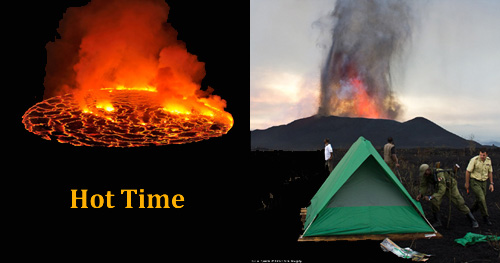
And that’s the important phrase: risk your life. I’m not sure it’s either wise or appropriate no matter who you are, but right now the officials managing a track of Congo national park are organizing trips up to a cliff just above the erupting Nyahamiru.
Nyahamiru – which you’ll find spelled in a variety of ways – is the live brother of the dormant volcanoes lived in by the mountain gorillas in Uganda and Rwanda. It is the western most volcano of this range. And for my entire lifetime it has been a live volcano moving in and out of dormancy about every 10-15 years.
In the days before the Congo wars, we traveled up and down Kivu province with abandon, and there were mountain gorillas in several different places. In Kahuzi-Biega national park literally adjacent Nyahamiru, there are the eastern lowland gorillas, gorilla berengei graueri, lives. Not too long ago Kahuzi-Biega was its own live volcano.
So this is beyond doubt the land of volcanoes. Some of my closest associates in the tour business in the 1970s and 1980s were volcanologists. Together with Hawaii, the volcanoes on the western Rift of Africa (this place) are the most spectacular and interesting in the world.
Which is probably why I’ve never personally climbed one, or a mountain beside one, as currently promoted in Congo tourist literature.
In fact one of the conservateurs (top officials) of the eastern Congo parks is personally inviting us all to join him on the plateau just above the volcano. And people are doing it. And I won’t admit whether I would like to do it or not, but you shouldn’t.
There’s no other place in the world with as loose or nonexistent tourist safety regulations as The Congo, so essentially you can do anything you want. Right now, the Congo’s wildlife sanctuaries are simultaneously its hunting reserves.
So the “Conservateur” of the public land on which sits this giant volcano has invited everyone to come and see it … up close.
This should not be disseminated on college campuses.
The conservateur has found a flat piece of land about 300 feet above the molten lava, and in a position where prevailing winds always carry lava spews in the opposite direction. It’s been given the scientific seal of approval by selected by volcanologist Dario Tedesco who heads the Goma Volcanological Observatory.
I’m not sure this is wise, but then if you’ve even just found yourself in The Congo you’re probably unwise from the getgo.
Here’s what one Scandanavian traveler recently posted on a blog:
“The Nyiragongo is an omnipresent view from the streets of Goma: a smoking giant during the day, a surreal glowing shadow at night. With a group of 7 tourists we started our ascend (sic) through the foothills of the volcano through dense jungle, after about an hour the forest gave way to an old lava flow, which according to our guide originated from the 2002 eruption, which burned down half of Goma.”
You got that last bit, right? Burned down half of Goma.
“After this point the landscape varies between lava flows, jungle and African alpine vegetation. The last leg of the journey is by far the toughest, a 20-30 minute hike up a 45 degree angle mountain mostly consisting of loose scree. But when you get to the crater all your weariness is forgotten, one of the most amazing sights you will ever witness welcomes you with warmth (literally).
“All your senses are stimulated by the loudly boiling, red-hot glowing, warmth radiating and sulfur smelling lava lake, the largest in the world.”
There is a reason that there aren’t too many tourists traveling into The Congo yet. The numbers going in never equal the numbers coming out.
There are more African cocktail table books than of any other continent, and that’s neither a surprise nor news. So it’s no surprise either that one of the newest productions picture books is multi-media, employing every modern IT trick available. Is this the preview of all future picture books on Africa?
The Kalahari Dream by Chris Mercer and Beverly Pervan is certainly good but nothing outstanding for either its pictures or text. But the compelling story is about rescued animals in the Kalahari all of which have happy endings. The couple worked there for seven years, and this is their joyous report.
Movie Book, is how the world is now beginning to characterize it, and if you download to your eBook reading device, it’s a seamless process to link to the more than 100 photos, videos and audio clips complementing the text.
Some day, of course, all books will be like this. I’m delighted it seems to be starting with Africa!
 Nigeria thumbs its nose at the U.S. and U.K. on gay rights, Japan uses nuclear clean-up funding to hunt whales, 4 more rhinos killed in the lowveld and Durban’s in the bottom of the dirty coal tank. Oh, did I forget that Europe’s coming apart?