Cute little loquacious Rat

Cute little loquacious Rat

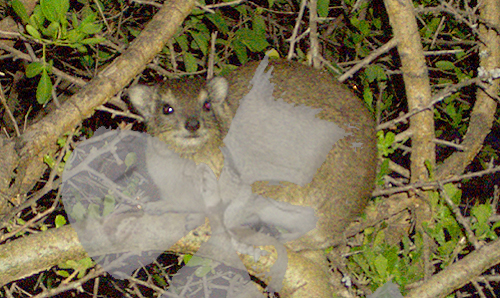
Scientists just discovered that the little furry African rock hyrax is an amazing communicator. So why didn’t he put up a fuss when I told everyone he wasn’t related to the elephant?

One of the best parts of my job as a guide is to drop amazing factoids. Like (1) the distance from Dakar in west Africa to Mombasa in East Africa is greater than the distance from Dakar to New York (3900 vs 4100 miles – use GoogleEarth to confirm); or (2) the entire GDP of Kenya is less than a quarter of the GDP of Atlanta ($70 vs $304 billion); or !!

(3) The little rock hyrax is the closest extant relative to the giant elephant! (By the way, we old hands called them “dassies” rather than hyraxes. Same beast.)

But then several years ago, hanging our heads in abject humiliation we legion of guides had to accede to what Wikipedia summarized all too kindly that “.. not all scientists support the proposal that hyraxes are the “closest” living relative of the elephant.”

Drat.

But DNA to the rescue!

They are close! Not number two, but number four. Dugongs and manatees are numbers 2 and 3.

And now we’ve learned that they might be number one among non-primate little ratty communicators!

Because the social behavior of this little rat is so similar to elephants, and because truly its anatomy (inside and out) is also so like elephants, early taxonomists naturally placed them close together on the evolutionary line. Early taxonomy has a remarkable record in being affirmed by DNA, and that’s what’s now happened.

The common ancestor of the elephant and hyrax was a bit long ago: 60 million years ago, and at that time it was as small as today’s hyrax.

But why hyraxes could retain that size but the new line of eles couldn’t was a mystery. But now we might be getting a clue.

The evolutionary power of hyraxes is concentrated remarkably in its … voice! So while the ele naturally selected itself into being the biggest and most invulnerable mammal to survive meteors and ice ages, the hyrax decided rather than expand its size, it would expand its vocabulary!

“This is something you find very, very rarely amongst mammals,” explained the research scientist, Arik Kershenbaum.

The only other mammals besides primates to communicate so sophisticatedly with sound are bats and whales.

There are more than 50 species of hyrax throughout Africa and the Middle East, and they all talk. But they talk differently, as you would expect, of course. Persians don’t understand Zulu.

But my favorite is the one we hear all the time in the East African highlands. It’s actually called the “tree hyrax” since it spends most of its time, there, eating leaves. At night when it sings, and I kid you not, it sounds like the door of a vaulted castle closing on a maiden screaming as she’s being sucked to death by a vampire.

Rather hard to replicate.

If’d you’d like to understand, I have a safari going there in April …

Trouble in Paradise

Trouble in Paradise

After 4-5 years of impressive political progress throughout the continent, dark clouds form above Africa. The last two days in Kenya haven’t changed my predictions for a peaceful future, but they are worrisome.

I still believe that next year’s March 4 Kenyan election will pass into history as one of the most impressive maturations ever of a young African society into a peaceful world. There has been so much work in Kenya these last five years on a new constitution and public policy that literally tens of thousands (if not hundreds of thousands) of Kenyan citizens have all been deeply and individually vested.

But last week the ugly anemone of ethnicity waved its poisonous tentacles, again. And yesterday as the police tried to stop what they believed was a ratcheting up of ethnic violence their overly violent reaction veered into newly unconstitutional territory that almost perforce thrusts the leading presidential candidate into a death match with his adversary.

Nothing in African politics is simple. You’ve got to be a fan of Shakespeare to be motivated to mine the details for a real understanding.

But after you work through the puzzle, the picture is always the same: ethnic conflict.

Political turbulence and actual coups in Mali and Guinea-Bissau, following potentially as violent events that cooled down in Mauritania and Senegal, are equally complex to what is playing out now in Kenya. But personally I think the stakes in Kenya are much higher.

Kenya’s 2007 political violence set the stage for the rest of Africa’s so-called “spring” or “awakening.” Not just the social mores, the actual software used to organize the rallies in Tahrir Square was written and first used in Kenya in 2007. It’s why I call all this rapid, mostly positive political change in Africa “twevolution” (twitter + revolution).

If Kenya can emerge from this transition new and beautiful, it’s a model for the rest of Africa.

In all the troubled cases in Africa, Kenya in particular, the various ethnic groups are linked to radically different social theories: Raila Odinga, the current prime minister and leading presidential candidate, is a bigger government socialist. His main opponent in public polling, Uhuru Kenyatta, is a smaller government capitalist.

Odinga is Luo. Kenyatta is Kikuyu. That ethnic divide has plagued Kenya since colonial days, and in the same way the Hutus and Watutsis are divided in Rwanda. Raila’s father, Kenya’s first Vice-President, was jailed and tortured by Uhuru’s father, Kenya’s first President.

Ethnic divides around the world throughout history are all the same. Over long periods of time they become wrapped in different religions and political ideologies – which become the tools of their debate in a modern context – but it is the hate the Hatfields have for the McCoys which drives violence.

Less than 20 miles from Nairobi political rallies began several weeks ago, ostensibly for one or another candidate. Several of these were not strictly ethnic, they really were multi-ethnic but highly politically charged. Most were for Raila Odinga. He is the leading candidate and very widely respected throughout the country. He probably commands three-quarters or more of the support of educated Kenyans.

So there was nothing immediately suspicious that some of these rallies were held in a place that 20 years ago was not the multi-ethnic suburb of Nairobi it is, today. It was the heart of Kikuyuland, the home of Jomo Kenyatta, the favorite Kikuyu of the British colonial powers and Kenya’s first dictatorial if beneficent “president for life.”

So on Tuesday when the opposition announced it was going to stage a counter rally in the same place, alarms went off in the public psyche from the desert to the sea.

For one thing the demonstration was announced by a mafia leader, Maina Njenga, who barely escaped jail earlier this year. Njenga is a rabid criminal who is widely considered to have had a major part in the 2007 violence and its lingering aftermaths.

What makes matters more complex is that Uhuru Kenyatta is on trial in The Hague for instigating the violence in 2007.

Even the fact I can say that, “he’s on trial in The Hague,” is absolutely remarkable if unbelievable. Kenyatta and three others have so far submitted to the International Criminal Court’s indictments against them. They are the first accused in the history of the World Court to voluntarily travel back and forth to The Netherlands for a trial that could imprison them for most of their remaining lives.

Any presumptive notion of their public goodness, though, likely belies a much more clever strategy. If Kenyatta actually becomes a candidate (he hasn’t, yet), it would be absurd to think he would continue to succomb to jurisprudence in The Netherlands. Then, what?

The Tuesday gathering that was stopped violently by police was scheduled to have been attended by a number of leaders of several different ethnic groups. It was certainly mostly Kikuyu, but not entirely, and that “not entirely” is what gave it legitimacy.

But the police didn’t see it that way and so banned the meeting, which of course fueled the fire. Tear gas and then ultimately live ammunition were used to stop the rally.

Odinga immediately reacted with indignation, taking the high road. He denounced the police and he has the powers to fire the police leaders if he so chooses.

“Kenyans were yesterday (Wednesday) treated to a spectacle that they thought had been banished from their lives with their new Constitution,” Odinga said in his statement.

“The sight of police officers putting up roadblocks on a major thoroughfare and repeatedly firing rounds of tear gas at hundreds of perfectly peaceful people caused intense alarm,” he added.

Good. Even at his own peril, Odinga is defending the constitution.

Now let’s hope enough other Kenyans do the same. I believe they will.

The Children Are NOT Invisible

The Children Are NOT Invisible

Invisible Children has produced a viral YouTube video that is dangerous. Like other U.S. organizations embracing an African cause they exploit part truths to make a buck.

My young hero, Conor Godfrey, wrote an incredibly balanced and unemotional blog about this that you must reread to understand the facts of the case. That way I can just continue screaming in good conscience.

I’ve written disparagingly about Invisible Children before. Among their most outlandish accomplishments was accepting money from naive high schools in America’s heartland for a cause that no longer existed. IC did this by teasing emotions and grossly ignoring details.

IC’s raison d’etre is to tell the stories of child soldiers who played such unspeakable rolls in mostly Uganda and The Congo in the 1990s, while under the control of a still wanted fugitive, Joseph Kony. That’s true.

But when the Windsor Colorado high school (and presumably others, too) raised money for the effort at the behest of IC, the cause was already over. There have been no child soldiers or Joseph Konys or Joseph Kony wanabees in Uganda since 2006.

IC’s response was to change its website slightly and go on accepting money from lots of naive high schoolers, much less pensioned widows and disabled truck drivers. The teachers, administrators and even local newspaper reporters in Windsor refused to comment on my blog or even talk to me about it.

I am so incensed by this exploitation, and watching the video that’s gone viral on YouTube makes my blood boil. IC is continuing its false cause campaign by generalizing to the point that details be damned!

Of course we all care about children! Can’t criticize the palsy filmmaker Jason Russell for spending two minutes at the beginning of the video showing baby pictures of his son, followed by a minute segment showing the birth of a very white child. Warm us up, so to speak.

The entire video is so tweaked with these generalized but irrelevant emotive gimmicks that I feel I’m watching a drug company commercial on the evening news. Russell’s honey coated commentary belies a very disturbed psyche, someone whose deepest soul is daring pushback against a blind evangelical drive to tell a story … that really isn’t.

The true story, as Conor reviews above, actually has parts with happy endings, not particularly conducive to a charity campaign.

Joseph Kony is a fugitive, probably in the Central African Republic (CAR), not Uganda. He hasn’t been there since he was roundly defeated by the Ugandan military in 2006.

We should presume Kony continues his sadistic ways of conscripting, drugging and brainwashing young children to be killers – the heart and soul of IC’s craven drive for wealth and fame. But we have little hard evidence of a scale anywhere near his robust days in Uganda.

Voice of America reported in March of his redeveloping presence in The Congo near the CAR. But as one of my all-time favorite journalists, New York Times reporter Jeffrey Gettleman explains in his March essay in the New York Review of Books, Kony is involved in only one of “dozens of small-scale, dirty wars” that while absolutely terrible doesn’t begin to achieve the magnitude of murder and destruction Kony leveled on Uganda in the 1990s.

But if IC owns up to the facts it might kill the golden goose.

The warehouse of emotion that IC has harvested from an unwitting American population, much less its cash charity, corrodes to the core the intention of every good person donating to it.

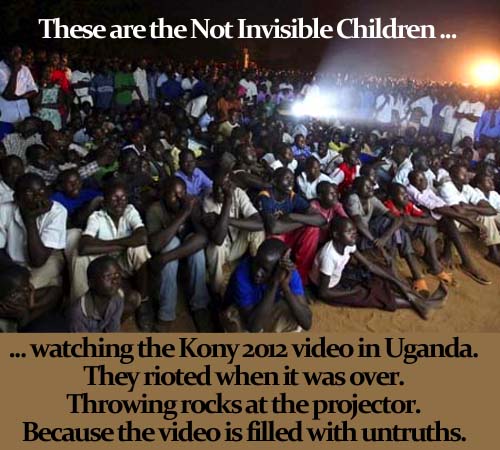
IC is especially being denounced in Uganda, where it all began. Ugandans are proud that they’ve routed Kony, so when the video was shown there last month it nearly caused a riot.

The excellent blog, Upworthy, tells a more sinister fiscal tale about IC in the recent post, “Share This Instead of the New Kony Video”:

IC recently accepted $750,000 from the National Christian Foundation (NCF). The NCF designed then funded the campaign in Uganda to pass a “Kill the Gays Bill” about which I and so many others have written. NCF gives other big sums of money to “The Call” which sends youthful missionaries into “dominions of darkness” like San Francisco to retrieve gays from their purgatory.

Also on NCF’s big recipient list with IC is the Family Research Council and The Fellowship. These mega right-wing organizations are well known and so dangerous, not just to Uganda but America. Just spend a few minutes on Google to build your Darth Vader tome.

This is the recipient pool that IC shares. And its message, methods and racist causes are also the same.

Weep when you watch the video. But let the tears dry before besmirching a check. You’ll realize that your clenched fist is packaged for IC not Kony.

Zulu Kingman Zuma

Zulu Kingman Zuma

More wives and less freedom is the trend in South Africa as President Zuma marries for a fourth time and a draconian government secrecy law moves through the parliaments. There is a chilling connection.

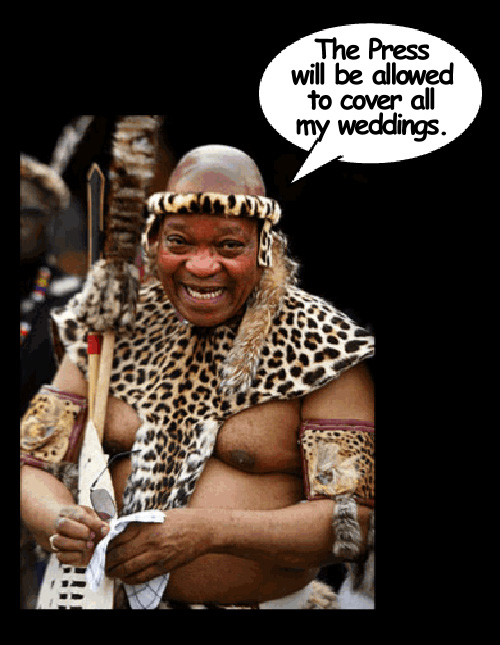
The press is all abuzz with Jacob Zuma’s marriage this coming weekend to a prominent businesswoman with whom he has a 3-year old child. Zuma is 70 and Bongi Ngema-Zuma is 25 years his junior, as are his other wives. He is reported to have more than 20 children.

Zuma’s fun and games with traditional Zulu culture don’t mean much in themselves. He does receive about twice the amount of “presidential spouse allowances” that his predecessors in the presidency took, but technically there is no official position in South Africa – as in the United States, for example – for a “first wife.”

His romantic dalliance is mostly stuff for cartoons. South African family law allows for only one union, but recognizes traditional marriages as well which through private business contracts can then achieve legal equivalency with federal marriage law. It’s not known if Ngema-Zuma or any of his other wives has a contract with him.

I think it fair to say that the vast majority of contemporary Africans think Zuma’s behavior mocks rather than celebrates traditional Zulu customs. “It is ludicrous that things such as this still happen in a world that is changing!” writes Nigerian blogger, Yomi Akinsola.

But I see something more onerous in Zuma’s antics, and I think it fair to call them “antics.” Stripped of Zulu life ways, Zuma’s behavior is not so dissimilar to legions of dominating personalities with multiple sexual partners around the world. The difference is that his is totally above board and validated in current South African society.

Who cares? Lots of people who have tracked the decline of polygamy as societies evolve and prosper. Polygamy as the highlighted folkway Zuma has made it is socially regressive.

And I think intentionally so and it leads to a much more powerful issue. South Africa is slipping back into an apartheid mentality.

The ANC freedom fighters who have controlled the country since 1993, Mandela excepted, sort of anebriated themselves in traditional lifestyles that they – and their parents and grandparents – never engaged in. A sort of mixture of Bronx cheering the old Boers and celebrating majority democracy, flaunting the presumptive apartheid theory that native South Africans were too primitive to run a modern society.

But these guys are having trouble accepting modern democratic principles. They passed a draconian secrecy law last year that is awaiting endorsement by South Africa’s provinces. While not a slam dunk, it’s likely to become law, and then likely to face aggressive court challenges as unconstitutional.

When it becomes law South Africa will attain the unique position of a so-called democratic state controlling the press as much as China does. And there’s a reason that these so-called traditionalist ANC leaders want this.

The press has ferreted out the most scandalous and criminal acts of these old guys imaginable. The list exceeds simply the largess of government no-bid contracts dished out to their families and supporters, to government policies based on the belief that AIDS is not a virus and bribing judges involved in their criminal court cases.

Playing Zulu king is a tactical diversion from these more important issues that vies for column inches in South Africa’s dynamic media and so tends to lessen somewhat the anticipation of horror that passing this legislation naturally evokes.

But even more important than that, regressive legislation identical to apartheid culture would be a hard move over current South African culture … unless “everything old and traditional” suddenly appears good. Sort of mix up the bad of the past with the good of the past and just take the past.

I really don’t think this is a stretch. It’s intellectually offensive when detailed like this, but when streamed through the every day life of South Africa – which by the way is pretty good at the moment – it’s the bitter pill in the coated honey.

Intentional? I don’t think Zuma sat down with his personal coach and asked him how he should behave personally to pass the draconian press law. But with time as his cultural critics tended to line up with his political critics it became rather self-evident.

The Zulu King holds the power of life and death over all his subjects. Zuma’s not quite there, yet, but he’s trying.

Manhood Explodes, Now What?

Manhood Explodes, Now What?

Last week a Zambian infatuated by South African advertisements for Viagra obtained a local herbal alternative. It worked, then killed him. As euphemistically described in Zambia, he exploded his manhood.

Traditional medicines are remarkably important in the developing world. According to a 2003 WHO report, affirmed by a 2008 report, 60% of children with high fever in Africa are treated with herbal remedies that don’t work. The children who survive do not do so because of the herbs.

A year ago I posted a blog about Babu of Tanzania who was an incredible sensation. The President of Tanzania and other officials used him. Patients flew private jets in from Dubai and Johannesburg. His herbal remedy cost 30¢, cured everything from AIDS to gimpy feet, my drivers earned hundreds ferrying people to his remote location, and today he faces jail.

Babu was finally called out when a series of AIDS patients began dying prematurely.

But what is really interesting in current WHO policy is the organization’s focus on the rapidly increasing use of traditional medicine in the developed world. WHO is concerned with the growing, unregulated use of traditional medicine in my native world.

Global Industry Analysis, Inc. suggests the market for such medicines is $25 billion annually in the United States.

The fact doesn’t surprise me; I tried all sorts of things from Maasai shamans to health food stores before finally taking blood pressure pills.

But my conclusions as to why I sought the advice of a few African shamans and then even more U.S. health food stores is apparently skewed. I believed (a) American medicine was too rigid, blindsided by its own success; and (b) American medicine was too expensive.

(An important corollary to “a” was my belief that too many side effects were discounted by American pharmacology. Can any of you repeat even part of the list of near-death side effects a TV spot tries to list if you popped their pill?)

But Dr. Margaret Chan, the Director-General of the World Health Organization, convinced me otherwise about my own druthers. In a recent speech in Beijing, she argued persuasively that my use of traditional alternatives wasn’t because I was poor, but because I was rich; and wasn’t because I feared modern health structures, but because American delivery of health had become so impersonal.

She’s right, you know. I – and probably a lot of you – aren’t thinking about this in the right way. My consultations with African traditional doctors were incredibly personal, time consuming and personally satisfying. The process of discussion was so friendly that I doused the herbal teas with blind faith. (Fortunately, my manhood didn’t explode.)

But it didn’t lower my blood pressure enough, either. Nor did increased exercise, weight loss, flax seed and reproducing my grandmother’s potato soup. 5mg of Lisinopril did. And as much as I love my internist, the session with him wasn’t as friendly, long or satisfying as with Maasai Ole Kinyut.

Dr. Chan absolutely does not call for abandoning traditional medicine. WHO has a long list of projects supporting a wide range of traditional therapies. Perhaps the most exciting one was the 2000-year old Chinese plant, Artemisinin, which in the last decade proved infinitely more effective than western synthetics like Lariam or Malarone for preventing malaria.

Unfortunately, this natural remedy has already lost its effectiveness in Asia and will probably lose it in Africa, soon.

Malaria is a natural super villain. It responds by changing genetically like a virus to its enemies, and this happens much more quickly with natural than synthetic drugs. But studying the molecular makeup of artemisinin and how it once successfully attacked malaria can indeed lead to a synthetic with greater longevity.

Dr. Chan affirmed that nearly half of all public health in China includes successful traditional medicine. She applauds in particular acupuncture and physical regimens like Tai Ji to relieve pain and prevent injury. But she is quick to point out that in China these are highly regulated.

In Zambia, and by the way in America, they aren’t. Watch it, guys.

Failed Saviors

Failed Saviors

Are ecotourism and wildlife conservation in Africa so sacrosanct in the minds of their supporters that they’ve dodged proper regulation or perhaps even swerved off moral pathways?

I obtained with pride a Conde Nast ecotourism award in 2004 for my client, Hoopoe Safaris of Tanzania. But in the decade since then my own ideas about ecotourism and NGO involvement in African conservation have changed.

There are two issues, here. The first is that “ecotourism” is no longer a legitimate marker for good tourism practices in Africa. The second is that wildlife NGOs have grown increasingly callous of the priorities of local populations. So the two are related. Both discount the preeminent interests of local people in the areas where they work.

The common thread that I’ve watch develop over the last decade is that western-driven “charity” or “aid” or “consultation” or “community based tourism” has grown increasingly detached from the people who theoretically will benefit from those efforts.

Even if there aren’t contextual conflicts, disputes about goals or methodology, the ignoring of the local populations’ interests spawns conflict. Imagine what you might feel if a Chinese NGO came into your suburban neighborhood and began research then implementation of plans to cultivate an herbal remedy … like garlic mustard… in the city parks. You would at least expect participation in the discussion, and you would become infuriated if you weren’t consulted.

In the last decade African populations have increased substantially, and their educational levels have grown exponentially. Most of Africa is well linked to the outside world through increased internet and cell phone access. This empowers the local communities to better scrutinize their so-called foreign benefactors.

ECOTOURISM IS A SHAM
The academic community has always been skeptical of ecotourism. A 2007 Harvard study of Tanzania ecotourism concluded that while most such projects seemed legitimate, there was a substantial percentage that weren’t. An analysis by Ohio State University in 2011 of Tanzania ecotourism was much more damning. The report actually named (accused) specific Tanzanian operators that were scamming tourists with the ploy of arguing their products were ecotouristic when they were anything but.

The above studies, and many more referenced within them, are convincing documents that ecotourism if not an outright scam is a very poorly formed idea. The initial theories might be good, but implementation seems impossible. And the Ohio State study in particular described why self-appointed certification authorities weren’t working, either, so that the notion of creating some universal standard is mute.

The UN initially thought otherwise. It promoted ecotourism but has since backed away from the idea. Almost a year ago exactly I posted several blogs citing the growing skepticism with ecotourism throughout the world. Nothing has changed; ecotourism as commonly applied in the marketing of travel is neither honest or good.

Khadija Sharife in the Africa Report summed it perfectly last week in the post’s title, “The Drunken Logic of Ecotourism.”

WILDLIFE NGO ARROGANCE
But in the year since I and many, many others pointed out the disservice that using the marketing ploy, “ecotourism,” does to local peoples, another foreign fixture of African life has emerged as equally unfair and misleading: wildlife NGOs.

It will be harder to convince you of this, I know. The loyalty that the world’s great animal savior organizations command is legend. It’s one thing to suggest that a tour company is scamming you while not serving the local populations well. It’s another to make this claim against the World Wildlife Foundation (WWF) or the African Wildlife Foundation (AWF).

WWF’s long involvement in Africa stands mostly as a fabulous contribution to baseline research and good management of threatened and endangered species. But as with the morphing of the idea of ecotourism into a marketing scam, it could be that WWF’s longevity of success gave it an unwarranted sense of propriety.

Its most serious conflict is in the Rufiji delta, the outskirts of the great Selous game reserve in Tanzania, which has come under increasing scrutiny because of its enormous hydroelectric potential. A much greater controversy actually than the WWF one I describe below is the World Bank’s program for a hydroelectric dam that could seriously disrupt The Selous and Rufiji delta basin.

But the World Bank’s mission to help developing countries grow can quite plausibly include draining a game reserve for additional electricity. Discussions are heated and ongoing, and everyone accepts one important debate is who should make the decision? Professionals weighing the overall value to Tanzanian society, or local people immediately impacted?

Quite unlike the World Bank, WWF skipped this important debate when it began programs to inhibit rice farming on the outskirts of The Selous. Local rice farmers were obviously the first to be impacted, but they were allowed no input into the decisions regarding the project.

The project mission was always suspect to me, but the rapid implementation without adequate consultation with the local population reeks of arrogance. The entire project has now collapsed into all sorts of criminal and unethical consequences. Eight WWF employees have resigned, plus the Tanzania country director, Stephen Mariki.

WWF should be complemented for trying to right the wrong, but the culture that led to their presumption of determining the life ways of local Tanzanian people is the real problem. And that will be a much harder thing to remedy than just abandoning one project. An overhaul in staff is a good start.

The current most egregious wildlife NGO controversy, however, is on no path to reconciliation because the organization, the African Wildlife Foundation (AWF), continues to defend its position.

AWF encapsulates its overall mission in the phrase “heartlands.” Over the last several decades AWF created heartland areas throughout sub-Saharan Africa in which to concentrate its research and assistance. An essential purpose is to create wildlife corridors between established nationally gazetted protected wildlife areas like national parks to increase the potential for biodiversity.

Noble. The problem for some time has been to create these corridors, land must be acquired from private holders. This may have something to do with AWF’s decision to form a close partnership with the Nature Conservancy in 2007.

But what happens when farmers or other landholders don’t want to sell? AWF’s response has been high-handed and infuriated local communities.

In and around their large Manyara ranch holding in Tanzania, AWF negotiated versions of eminent domain with the Tanzanian government that caused enormous friction locally. And now in Kenya their acquisition of land (which they subsequently tried to deed over to a new Kenyan Laikipia National Park) is on track to totally cripple all their good efforts in East Africa.

AWF insists it has been playing by the rules. But two thousand Samburu people don’t care if they were playing by the rules or not; they insist with credibility that they have been displaced against their will.

Unlike WWF, AWF seems to be digging in its heels for a fight that will emasculate it. And if it goes down as I expect it will, so will the reputation and memories of good work that wildlife NGOs have been undertaking for decades in Africa.

Why is AWF resisting an acceptable settlement? AWF is a much younger organization than WWF, and its donor base is much smaller than WWF, much less publicly than individually endowed.

Nature Conservancy is itself a less publicly endowed organization limited to wealthy landowners mostly in Illinois. It could be that these two closely held NGOs feel less vulnerable to public opinion than a more globally funded organization like WWF.

Both these situations — ecotourism as a sham and wildlife NGOs indifferent to local community needs — represent not just outside interference but patent indifference to the preeminent rights of local people. And because that indifference has been so arrogant – dare one say “racist”? – it led these otherwise exemplary organizations into believing they could discount local community interests.

Africa is developing so rapidly I can see incidents of polite refusal, so to speak, of tourist projects and foreign wildlife programs that are put to bed rather easily. The recent controversy in the Kenyan Wildlife Service (KWS) involving the translocation of rhino is a good example of “local populations” politely indicting foreign organizations trying to tell them what to do.

But in heated political arenas, this politeness will be lost. WWF had to back down altogether, fire staff and refund grants. AWF should do the same. When sensibilities are exchanged for political control, foreign tour companies and foreign wildlife NGOs have no hope of prevailing.

Beware, guys. A lot of good has come from your work in the last half century. Don’t blow it.

The Evil King is [almost] Dead!

The Evil King is [almost] Dead!

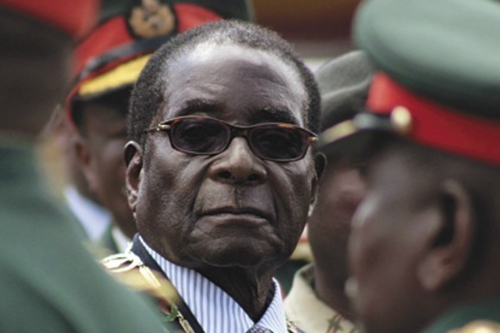
Zimbabwe tyrant Robert Mugabe is near death in Singapore; but what will follow?

Mugabe has been “near death” before, but the reports today are substantial despite an official Zimbabwean government statement castigating foreign journalists for writing “hogwash.”

An important cabinet meeting in Harare last week was surprisingly cut off, his private jet flew to Singapore with literally all his family accompanying him. Sources in Iran, one of his lone allies, yesterday claimed he had turned over power to his equally iniquitous defense minister, Emmerson Mnangagwa.

And yesterday London’s Daily Mail reported from a variety of sources that he was “close to death.”

The web of immorality and culpability for the most torturous human rights abuses, and the bankrupting of a once outstanding African society is a complex and messy one in Zimbabwe. Mugabe’s death will not necessarily mean anything at all changes.

At least not at once. As many as a thousand officials live as millionaires under his protection and that of his close advisers. They are not likely to give this up for power in a country despised by most of the world. Mnangagwa is the likely spider to replace Mugabe over this matrix. And to the extent he can keep the money flowing down the right threads, Zimbabwe will remain an awful place.

As many as a dozen of the thousands of Zimbabwean officials on the take are also likely to be indicted by The World Court in The Hague for crimes against humanity, including of special note his anointed successor, Mnangagwa, who for years controlled the country’s intelligence services.

This inner circle of evil men will likely concede their internal bickering for a government that will be strong and lasting enough to protect them all. A sort of rally round the torture chamber, boys.

So don’t buy your tickets to VicFalls just yet. But all that being said, the “Evil Queen is Dead” syndrome can’t be discounted. This week in a bold move not seen for several years, protestors in Harare dared to stage a demonstration, and spokesmen for opposition movements began to appear on the world media.

Note: the opposition spokesman who appears in the above video carries a similar name to the anointed successor but is not the same person.

Ultimately the day will come when the old man’s regime falls completely. I do wonder what will fill the vacuum. Morgan Tsvangirai, a once fiery and charismatic opposition leader who escaped being crushed to death by agreeing to a fake position of “Prime Minister” in the current government has been totally coopted.

Possibly he could regain some of the old spirit and shepherd the country into a new era, but the few sane Zimbabweans left capable of rectifying this miserable country will no longer accept him as a long-term leader.

Opposition – little as it is right now – is coalescing around the idea of a new constitution, as nascent rebellions are wont to do. But even that seems wimpy, given that Mugabe’s constitution isn’t really so bad. It’s just that he doesn’t follow it… at will.

So “The Evil King” might be dying. But there’s no white king backstage, and the aftermath does not look as rosy as Oz.

The ERA is in Africa

The ERA is in Africa

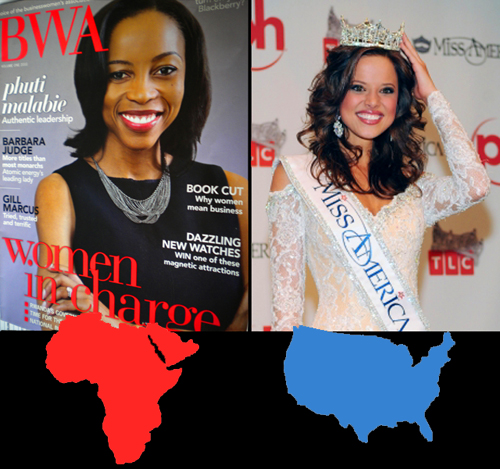
Many societies in Africa are daring to challenge the oppression of women in a way that if even partially successful will leave America in their dust.

Both the young Kenyan and South African constitutions mandate up to a third of public positions be filled by women and many of the other African countries are not far behind. This is government policy that America refuses to adopt: the ERA was past by Congress in 1972 but withered on the vine for wont of enough States ratifying it.

Last year House Republicans barred women from testifying in hearings to examine contraception. Numerous States like Virginia are thumbing their noses at women while forging proudly ahead with obviously unconstitutional acts of total repression against one gender.

You would think we live in some parallel universe with the modern world. European clients who I guide in Africa simply can’t fanthom what’s happening in America. “I consider myself a conservative,” a recent British client told me, “but America is regressing back to the Stone Age.”

Sunday’s Daily Nation newspaper in Nairobi featured a story about a Somali refugee woman who suffers the same kind of oppression that women in Virginia do. It made me realize why Somalia will be so hard to put back together, and why the American poles are fracturing so far apart.

It was published as a true story, but not one ferreted out by a journalist, rather the result of a letter sent to a columnist. First-person stories are often suspicious, but from my experience in Africa this one rings true. And even if it isn’t true, it gives me personally an explanation for the lunacy running through America, today.

“My name is Khadija Hussein,” the letter to Nation columnist Murithi Mutiga began. “I fled the fighting in Hawl-wadaag district of Mogadishu due to the tribal civil war in 2006.”

Khadija explained that her husband was lost in the fighting, that she was pregnant, and she described the difficult 100 km trek to the Kenyan border to escape. The first person she saw over the Kenyan border was a Ugandan businessman, a Christian, who took pity on her. He helped her get to Nairobi, monitored her pregnancy and actually returned to Nairobi when she gave birth.

They then married. When the Somali community in Kenya learned of Khadija’s marriage to an “unclean kaffir” they vowed revenge.

This revenge wasn’t just the threat of throwing acid in Khadija’s face. The power of the extremist Somali culture went all the way to Uganda, where Khadija’s husband’s business was burned to the ground. This was the way Khadija’s kinsmen restored her lost husband’s “honor and dignity.”

“I won’t and can’t separate from my husband even if he is a Christian,” Khadija ends her story.

Honor and dignity. Which side in this story truly has it, and which doesn’t? Clearly Khadija sits atop the moral high ground, but at great peril.

In America it’s the same. Honor, dignity, freedom … these are the words used by Virginia legislators to mandate vaginally intrusive searches of Virginia citizens to enforce a hyped ideology. They are words that meld into little meaning except selfishness so severe morality is twisted upside down: those who refuse honor, dignity and freedom to all but their own powered elite. This is government intrusion so severe it cripples the culture, much less simply being immoral.

The intransigence of belief becomes the essence of evil.

Fortunately for Africa, Somali is widely considered in the “Stone Age” by the youthful politics and governments governing most African society, and that was exactly how columnist Mutiga framed it: Khadija’s story is unique and alarming by the standards of most modern Africa. For America? Where ranks Virginia?

Given given all the extraordinary women in America in the halls of politics to corporate boardrooms, when Forbes magazine chooses its woman of the month as the creator of panty hose, I fear that Virginia will never become the pariah Somalia is in Africa.

Lord of War Behind Bars

Lord of War Behind Bars

One of Africa’s most heinous arms dealers is now in a New York jail for at least 15-20 years. It’s about time. American administrations all the way back to Nixon have avoided prosecuting these terrible men, often because they used them.

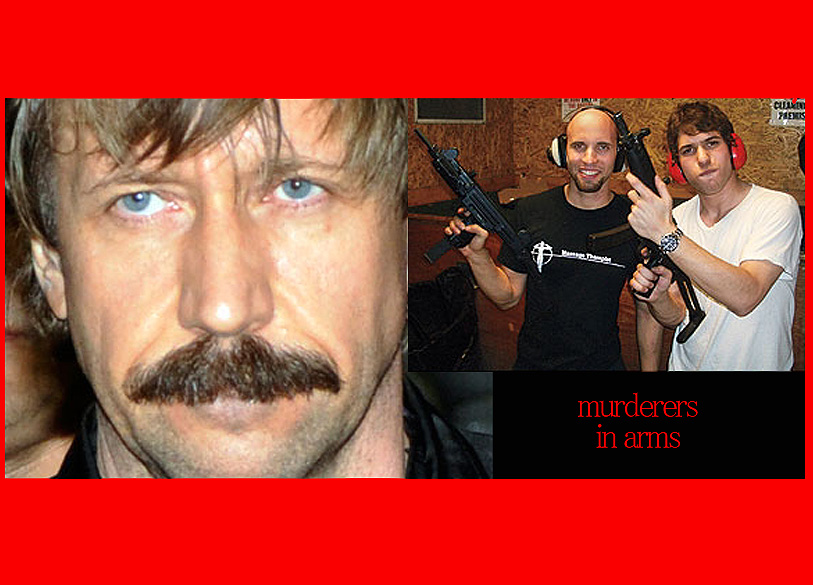
Viktor Bout‘s sentence doesn’t begin to bring justice to the millions killed in Liberia, Angola or Sierra Leone, or to ward off future wars of the sort he tried and failed to start in Tanzania. But it’s a start, and it’s long, long overdue.

You can’t make war without weapons. The buildup of weapons during the Cold War was insane, and it wasn’t just limited to the nuclear arsenal that could destroy earth a hundred times. The inventory of tanks, surface-to-air-missiles, grenade launchers and simple guns that were manufactured in the 1960s and 1970s, is mind boggling.

Even the Federation of American Scientists considers illicit arms dealing one of the planet’s greatest threats.

When the Cold War ended and self-destruction grew less likely, the discarded hardware provided business opportunities for the most callous of men, and much of this wheeling and dealing occurred in or through Africa.

(Indeed, major arms dealing occurred in Africa even before the Cold War ended. Unbeknownst to this then young tour guide, I paid $60 x 14 to get my Lincoln Park Zoo safari members onto a DC3 that appeared like magic landing beside our mud encased vehicles near Zaire’s Ituri Forest in 1985.

We scrambled into the aircraft, grabbed individual ropes hanging above the small port windows and sat in jump seats facing the center of the aircraft which was consumed by a well equipped Armored Personnel Carrier (APC) headed for who knows where well south of where we got off when the plane refueled in Goma.)

But it was the huge inventories of weapons opened to the “free market” after the collapse of the Soviet Union that fueled so much death and destruction in Africa in the 1990s and 2000s.

Click here for a quick list of books documenting the incredible mayhem. Viktor Bout was the model for Nicolas Cage in Lord of War.

Bout’s conviction is a bit dicey in itself as evidenced by the judge’s reluctance to levy anything but the minimum sentence. But it shows the determination of the Obama administration to reverse years of immoral American complicity with arms dealing.

As the judge explained when issuing the minimum sentence, Bout was nabbed in a sting operation, a fictitious setup by US agents pretending to represent Columbian rebels.

He may, in fact, never have dealt in South America before. Africa was his kingdom. So while I can’t fault the judge for levying the minimum sentence, I can certainly applaud the Obama administration for doing whatever necessary to get this man off the street.

America’s complicity with illicit arms dealing is legend. Last year Rolling Stone magazine published an incredible story about two kids in Miami Beach procuring cargo planes of weapons for the Bush administration in Afghanistan from illicit sources in Kyrgyzstan.

What?!

The story of illicit weapons is unbelievable. And it isn’t, as Rolling Stone showed, just a product of funny Russians taking advantage of the implosion of their society. It’s equally American kids pretending to be video soldiers who suddenly emerge from their flat sceens to become actual war mongers.

And more often than not, it’s Africa that suffers most.

You can’t make war without weapons. Apparently, you can’t get weapons without Viktor Bouts and Miami Beach 25-year olds. They should all be in jail.

The Last Countdown Begins

The Last Countdown Begins

The cycle closes: 11 months from today we’ll know if Kenya has been reborn strong, free and welcoming; or if this potential jewel of Africa has fissured irreparably.

March 4, 2013, is the date set for the next Kenyan election. It will be the first national election since December, 2007, when widespread mayhem caused a near revolution with more than 1200 people killed and as many as a quarter million refugees, many who remain unsettled, today.

I believe the sun will rise on Monday, March 6, over a peaceful, prosperous Kenya. The social and physical construction that is so widespread throughout the country, especially its remarkably near-perfect constitution, bodes optimism.

But Kenya isn’t out of the woods, yet. Yesterday, an actual minister in the Kenyan government was arrested for “inciting violence.”

He was protesting the demolition of slum housing in his constituency to make way for Nairobi’s airport expansion. The controversy is part and parcel to the ideological arguments that exploded in the December, 2007, elections: essentially, rich versus poor.

And the named instigators of the December, 2007, violence – which include prominent members of the current government – are scheduled for trial in The Hague almost at exactly the same time as the national election.

Irony of ironies — unbelievable if you don’t follow Kenyan politics — two of the accused say they will be contestants in the presidential election! If they do stand for election, and if their candidacy gains momentum, they may balk the Hague proceedings and all hell could turn loose in Kenya.

As a businessman and trustee of foreigners’ vacations, I won’t send people back to Kenya until the election is over and judged successful and peaceful. But this isn’t just because of significant conundrums in Kenya’s politics. It’s also because of the Kenyan invasion of Somali.

That has led to multiple tourist incidents, including kidnapings and killings, perpetrated by Somali’s al-Shabaab in retaliation for the military action, and by plain old criminals unleashed by redeployment of Kenya’s small security apparatus to the Somali border out of wild and wooly areas like Samburu and Shaba.

The Kenyan invasion went better than I predicted. I admitted as much in this blog. Not everyone concurs, but even those who portend troubled times for Kenya as a result of the continuing occupation can’t ignore many positive facts happening on the ground right now.

Societies often prosper during their wars, but tourism will not. Vacations are after all, vacations; few have principal motivations based on politics. R&R does not include enhanced security at your beach resort.

But if the annoying al-Shabaab attacks in Nairobi and elsewhere cease as the situation in Somalia improves, and if the March 4 election comes off well, then it will be time to return to Kenya.

I expect both. But beware, Kenya. This could be your last chance. There might not be another countdown to peace and prosperity.

On Safari: The Call of The Wild

On Safari: The Call of The Wild

A feral ginger cat on my lap trying to bite off my hand for having left her unstroked during my seven weeks in Africa. Why do I already miss Africa?

Our game viewing was fantastic: wild dogs, lions mating, 7-day old lion cubs and 4-day old cheetah cubs, lion hunts and elephant charges, 8-foot vulture wing feathers grazing our heads, wilde raising dust to the heavens, crocs stalking impala, a 9-foot snake like a flash in the dust, and the blood curdling screams in the night – like a vampire’s door closing on a haunted castle – of the harmless little hyrax.

Why do 90-year old veterans return when their doctors say they shouldn’t? Why do residents of America’s own magnificent wildernesses still pay thousands and suffer 30 hours in multiple aircraft designed to compost human beings into cornflakes to set foot on Africa?

No matter how much we learn about Africa, starting of course with the fact that it’s hardly a single place but the world’s second largest continent replete with virtually every habitat on the planet, it remains the wildest place on earth.

And wild is good. Even though it taxes the visitor, physically and mentally, and there’s nothing subtle about it.

Africa’s challenges are virtually all emergencies, environmental or political or whatever. It seems to me, today, that most westerners recoil from challenges, finding ways to ignore crises: kicking the proverbial can down the street. Africans don’t have that option and western visitors to Africa don’t, either.

So I think of all the varied motivations for the travelers who accompany me on safari, the predominant driver is to experience not so much the specific thrill of a bull elephant’s charge, as of the moment of a true crisis that cannot be ignored.

“The End of the Game”
“The Last Chance To See…”
“A Traditional Boma”
“Urban Chaos”
“Worst Corruption”

All the above are untrue characterizations of Africa, but preeminent perceptions by western travelers nonetheless. It’s the best a foreigner who’s never been can conjure as to why they pay so much, travel so far, suffer so many inconveniences and yet come away thinking in an appropriately hyperbolic way that it’s their “trip of a lifetime.”

Sounds crazy, doesn’t it?

Maybe, but it’s not. Because the feelings that drive the inaccuracies and hyperbole are validated by actual experiences, although in much truer and more brilliant ways.

The end of the game is not nigh, but the intense battle between farmers growing watermelon and Tarangire’s elephants has reached high noon. It’s isn’t the last chance to see huge wild open spaces, but until the Serengeti Highway was nixed by public outcry last year, it could have been.

There are no traditional bomas, anymore, but there are scores of Maasai wallowing in the slums and firing up populist movements igniting Arab Springs all over Africa. There is urban chaos, for sure, but without the pollution of China and guided by a remarkably confident and political youth.

And corruption is no worse than at home, and Africa’s actually doing something about it!

These are extremely exciting revelations to the newbie traveler. You can’t experience them anywhere else on earth.

What a fabulous two safaris I just guided! What fabulous, daring travelers accompanied me! That is Africa at its best: excitement, beauty and insight. What a combination!

Africa 2050

Africa 2050

By Conor Godfrey
On Friday, I tried to provide a bird’s eye view of the U.S.–Africa relationship, with an eye for the civilizational points of contact like religious organizations, the number of Americans traveling to Africa or Africans traveling to the U.S., and state to state interaction over trade, security, etc…

I tried to make clear that, in my opinion, the relationship suffers from malign neglect, and a distortion brought on by an over emphasis on development assistance.

Before I offer some big picture ideas on how the U.S. could increase the intensity of this civilizational interaction, I suppose the first question is why this would be a good thing in the first place?

Why should American’s care about Africa, or Africans about America, more than, say, central Asia, or eastern Europe?

My basic argument is this – Africa will be a prime source of both creation and destruction over the next fifty to one hundred years.

The continent holds approximately one quarter of the world’s states, the youngest and fastest growing population in the world, seven of the world’s top ten fastest growing economies, and likely, as discussed in an earlier post, 50% of the mineral resources that the world needs to continue its upward trajectory.

The next thirty years will see African societies and individuals innovate to overcome mindboggling development obstacles.

Where states and societies fail to do so, their failure will spin off destructive forces that will extend far beyond the continent’s shores.

African innovation also tends toward the truly disruptive as opposed to incremental improvement.

In many developed markets, legacy technology encourages baby step refinements.

Think of how long it has taken mobile money to take off in the United States.

We are just now seeing the first generation of mobile payment processors, while in Africa, mobile payments were achieving wide market penetration in 2007 and 2008 (mainly M-Pesa at that time).

Why? Because there was not an entrenched cash register culture that was ‘good enough.’

Now apply these dynamics to energy and green tech, waste processing, internet and communications technology, whatever; in developed markets, entrenched technology and powerful interest groups stand to lose from truly disruptive innovation, and therefore need to co-opt or squash it.

Africa can leapfrog these legacy systems and launch entirely new industries.

As Europe, Japan, and other traditional allies turn inward to deal with their impending demographic implosions, the U.S. needs to maintain links with the most dynamic, growing societies abroad.

This includes getting their best and brightest to study in the U.S., and linking our firms with the innovation pipeline coming from emerging markets like Africa.

So lets say you believe that the U.S. needs Africa over the next century.

How do the two societies move their anemic relationship currently based on aid, security, and resources to something more robust? People to people and firm to firm.

Number one. Rebrand America in Africa.

For years America has tried to out humanitarian other countries; the foreign policy and media organs have tried to position American companies and the American people as the nicest, most considerate, and development oriented of all potential donors.

There are simply too many hypocritical counterpoints to really make this narrative stick.

Instead, America should focus on quality and creative cache.

The U.S. MUST protect its brand’s image as the best made, highest quality goods on the market.

Perhaps even more importantly, American companies, gear, and people should present themselves as the coolest, most cutting edge, and most interesting of potential partners for Africa.

The iPhone, Facebook, Twitter, GE, Akon and Lady Gaga, the New York Knicks, Pixar, Black Entertainment Television, MIT, and (oddly enough) Chuck Norris are more effective ambassadors for brand America than 80% of our development programs or security partnerships.

The creative and cultural cache represented by this indicative group of people has another advantage—it can reach over, under, and around state governments to connect directly with average citizens.

I suppose you could call this soft power; I would rather call it putting America’s best foot forward.

More practically, our immigration system needs drastic reform.

I could fill Ngorongoro Crater with the stories I’ve heard of entrepreneurial, honest and otherwise fantastic Africans getting denied visas to the U.S.

I understand the need to control the borders, and to be discerning, but if the U.S. wants the best and brightest to build ties in and contribute to the Unites States, then those people need to get here first.

If they come here on student visas, and study something practical and valuable, then let them work here if they want!

As I am running out of space and audience attention, I would end by encouraging the passage of the Increasing American Jobs Through Greater Exports to Africa Act of 2012, and urging the administration to take action on the upcoming expiration of the African Growth and Opportunities Act (hopefully by adding tax incentives for U.S. companies who invest in key sectors in Africa).

Everyone, from readers of this blog, to policy makers, to the U.S. diplomatic corps, needs to start thinking about how to deepen this relationship. If it withers in the shade of current great power politics all parties will lose.

The Ties that Bind Us

The Ties that Bind Us

By Conor Godfrey
Just a few days ago bipartisan sponsors introduced a bill simultaneously into the house and senate that would, if passed, better coordinate all the various organs of U.S. policy on Africa.

by Black Agenda Report

This got me thinking- well, what is U.S. policy on Africa? In fact, more broadly, what does the U.S.–Africa relationship look like now?

Let’s start with official policy, and move into the more nuanced aspects of the relationship.

On a macro level, the only thing resembling a coherent platform for U.S – Africa relations is a trade program known as the African Growth and Opportunities Act, or AGOA for short.

AGOA allows a wide variety of African exports into the U.S. duty free, and in most cases, quota free as well.

Unfortunately, the only real AGOA success lies in textiles and apparel, and this success has been tempered in recent years by the expiration of a law that previously limited textile power houses like Bangladesh and Cambodia from flooding the U.S. market.

The United States also undertakes several major security operations and partnerships in Africa.

These include anti-piracy patrols in the Gulf of Aden, anti-terrorism partnerships in West and East/Central Africa; and, with their check book at least, the U.S. supports peacekeeping and security service training in a number of places.

Most of these programs are run via the U.S.-Africa Command, or Africom, (paradoxically based in Germany), or the 50 U.S. embassies spread all over the continent.

Uncle Sam also makes a (somewhat half-hearted) effort to promote commercial ties via 8 full time U.S. Commercial Service offices on the continent. (fun fact: There are now 54 countries in Africa.)

That leaves, in terms of official policy anyway, development assistance.

The United States Agency for International Development (USAID) maintains programs in 23 African countries, and in 2010, spent ~ 1.6 billion USD on humanitarian and development assistance.

If you have read any of my other posts, you probably know that I am a development aid skeptic.

I meet formally and informally with African business people every day, and I can say that a huge (I am choosing the word “huge” deliberately) percentage of educated African movers and shakers believe that development assistance is the salient characteristic of U.S.–Africa policy, and bash that assistance as paternalistic and unhelpful.

Exceptions abound: most people cannot say enough good things about U.S. led HIV/AIDS interventions and research, and in places where the U.S. can operate freely, its disaster relief and humanitarian assistance is more efficient and impactful then many other donors.

But are security partnerships and development assistance and international trade the basis of a 21st century partnership?

Maybe. Probably. Well, at least a part of it.

But what about people to people connections?

There are approximately 171,000 Americans living in Africa excluding military, (Source.) compared with 1,612,000 in Europe, and about a million in Asia depending on what one counts as Asia.

Conversely, African citizens now number around 1.5 million in the U.S., and migrants of African origin constitute 3.5 percent of all migrants to the U.S.

That number leaves out the 40 million African Americans that form the traditional or historical diaspora in the United States.

The real Africaanswerman makes his living helping Americans experience Africa. But only 3% of the 28,507,000 annual U.S. based international travelers visited Africa in 2010 (Likely inflated by the World Cup in South Africa!)

There are other ties of course; American religious organizations of all stripes have ties in Africa, and we are just starting to see educational institutions partner with African universities.

However, I have been looking into the best international policy graduate schools the U.S. has to offer, and the African offerings are slim.

Options to take major African languages (French, Arabic, and Portuguese aside) are even slimmer. (There are very, very cool Title 6 centers that teach African languages in some undergraduate institutions.)

The picture I am trying to paint is that of a relationship that screams for attention and coherence.

In my next blog on Monday, I will highlight how I think policy makers and thought leaders in American society could build on natural U.S. ties to the continent, and why I think U.S. society would be better off if we did so.

How Rich? This Rich

How Rich? This Rich

By Conor Godfrey
Yesterday Tullow Oil struck black gold off the Kenyan Shore; Canadian and Australian miners seem to announce new gold gold discoveries in Africa all the time.

In fact, it seems like once a month I hear of another “world class” mineral or hydro-carbon discovery in Africa.

I thought it might be fun to dig into just how mineral rich Africa is. Before I get started, let me say a huge thank you to Dr. ABBAS. M. SHARAKY at Cairo University, his research on African geology was immeasurably helpful in terms of understanding why Africa is so mineral rich.

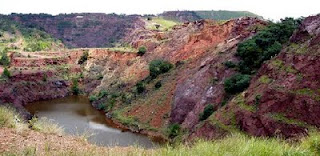
Fun fact– modern day Swaziland hosts the oldest known mining site in the world – scientists believe this mine was operational about 45,000 years ago!

See the picture of Lion’s Cave on the left. Mineral resources have also shaped African history and culture, especially the rise and fall of the great empires in modern day Mali, Ghana, and Egypt. Gold, iron, and other metals have had cultural, commercial, and even cosmetic uses for much of human history on the continent.
Today the African sub-soil is unbelievably, but not inexplicably, rich.

Before writing this, I have sifted through more geological research then I really have the vocabulary to understand, and pulled out some gems that helped me imagine the scope of both known and unknown mineral resources in Africa.

Africa is still undergoing what the field calls “Primary Exploration.”

E.g. preliminary surveys and shallow drilling.

With the very limited knowledge we have of Africa’s subsoil, the continent already holds 30% of the world’s known mineral reserves.

This includes 80% of all platinum, chromium, and tantalum, and almost 50% of the world’s gold, diamond, cobalt, manganese and phosphates, and the plurality of many others, including bauxite and uranium.

Geologists estimate that Africa likely holds more than 50% of the world mineral reserves.
Wow. 20.4% of the world’s land (actual land, not water), with upwards of 50% of the world’s mineral resources.

I guess what I’m trying to say is that catalytic converters, computer chips, cell phones, engagement rings, fertilizer, tin foil, and nuclear submarines would all be a heck of a lot more expensive without African resources.

Why? (spoiler alert, pure creationists will not be happy with this section.) Well, according to Dr. Abbas, Africa has some of the oldest rocks in the world—otherwise known as Precambrian rocks.

These rocks come from the period that covers the formation of the Earth through bacterial life….a mere 4.5 billion years.

Precambrian rocks account for 80% of the world’s industrial metals.

The Kalahari craton geologic formation covers much of Southern Africa, and contains a number of the world’s oldest (therefore Precambrian) rocks.

This formation is what makes South Africa the most mineral rich country in the world; with an estimated 2.5 trillion USD worth of resources under its soil.

To put this in perspective, remember that while Saudi Arabia has just shy of 20% of the world’s proven oil reserves, South Africa has approximately 85% of the world’s platinum, 80% of its manganese, 75% of its chrome, and over 50% of a half dozen more key resources.

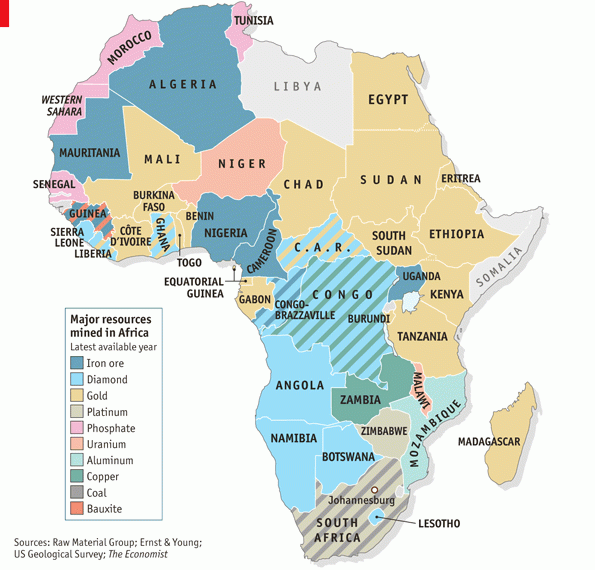
Other parts of Africa have mind boggling concentrations of strategic minerals; the best examples are diamonds in Botswana, copper and cobalt in Zambia and the DRC, tantalum in the DRC, uranium in Namibia and Niger, bauxite in Guinea, and phosphates in Morocco.

Tantalum Mine DRC

Africa is loaded with hydrocarbons.

Nineteen African countries produce significant quantities of oil, and ‘proven’ reserves have been skyrocketing as exploration really gets underway.

Chew on the following statistic: throughout the 80’s and early 90’s, the mining community spent about 10% of their budgets on exploration, but only 1% in Africa.

While this has improved drastically in the 90s and post 2000, African exploration is still grossly underfunded; it currently accounts for 13% of the mining community’s exploration budget but accounts for 30% of the world’s proven reserves.

Currently, Africa has proven reserves of about 210,000 billion barrels – this number is being revised upward on a quarterly basis.

These reserves constitute about 13% of global reserves- the proportion will obviously rise as commercially viable oil continues to be discovered from Mozambique to Ghana to Uganda to Liberia, and relative peace and calm allows the major producers to double down on investment and R&D.
(Source)

Botswana Diamond Mind
Get ready for some 20,000 ft. assumptions.

The developing world’s standard of living is rising- sometimes in fits and starts, and sometimes in long 30-year runs (China).

To be rather blunt, these people, and their governments, want the tin foil, nuclear submarines, green tech, phones, and other IT products that we spoke about earlier.

New discoveries will slow in the rest of the world while they accelerate in Africa over the next 50 years; I for one am very curious to see how this ramifies through world politics.

On Safari : Too Many Elephant

On Safari : Too Many Elephant

20Mar2012: Taken with my little Canon sureshot, 2x.
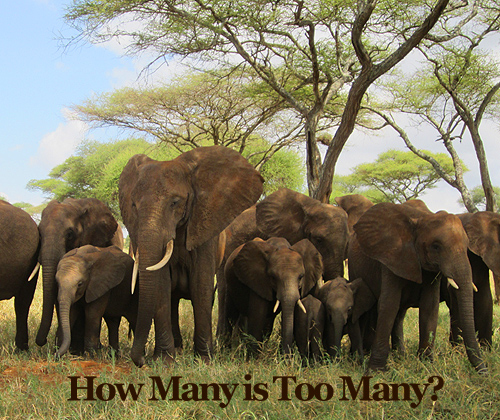
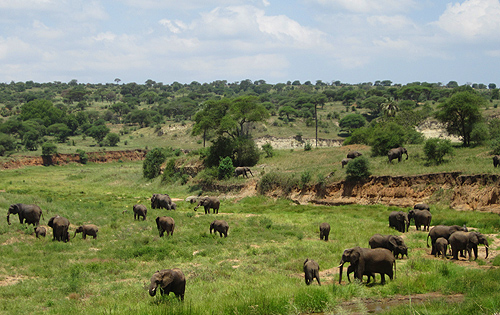
There are too many elephant in Africa and it’s going to cause serious trouble, soon. Our first big game park was Tarangire, and as Kathy Kowalski from Sabula, Iowa, remarked, “It’s like driving by cattle in Iowa.”

When I think back the many years I’ve been doing this, and read the statistics of the early days, it’s an unbelievable story. Elephant fill the veld of the northern half of Tarangire National Park like Thomson’s Gazelle on the southern Serengeti plains.

They’re everywhere. Admittedly this is a bit of a dry year so far. (Perhaps not dry, just late rains.) And that is an added incentive for the ele to come down to the river to dig in the sand. But I’ve seen them almost as dense after the rains were well underway.

And as everyone oohs and ahs over the true majesty of the scenes, here, I can’t help but wonder about the farmers on the perimeter, the school children walking to school, and the oxcart suppliers at the village markets. The future of this part of Tanzania and elephants is colliding like the particles in a nuclear reactor.

Of course we saw a lot more in Tarangire than just ele, especially since we were staying in the southern half of the developed park area at Swala Camp. It’s the only camp in the park in the south, and so there are far fewer people. On many of our game drives there were no vehicles but ours.

Ele researcher Charles Foley has determined that the ele in the north are resident, more habituated and easier to approach. The ele near where we stayed are mostly migrants, more skittish and dangerous, and that seemed very true.

We had breakfast overlooking the exquisite Silale swamp, as I always do, but remarkably this time, no animals. Until we started driving along the swamp road and encountered one of the most beautiful leopard sights I’ve ever seen. She was magnificent: lying on a horizontal baobab tree that was already losing its leaves, in front of a morning grey-blue hazy sky. Couldn’t have asked for better.

I pointed out to my group how massive her biceps and shoulders were and how to compare them to the size of her neck. She compares favorably to a number of lineman in the NFL. By the way, before we left Tarangire, we’d seen 6 leopard. Please don’t spread this around. I have many safaris where no leopards at all are seen.

And we saw lion, on a fascinating and recent kill of a giraffe that had fallen into the pond where the lion had obviously ambushed it. The lion were done eating when we arrived, though still guarding the carcass from afar, and I couldn’t help but laugh trying to imagine these water haters eating their treasure.

The lioness had just brought very young cubs down. They couldn’t have been more than 7-10 days old, and of course, they were unable to get through the water to the carcass. But they seemed to have enjoyed their first introduction in the real world.

We went back to the kill the next two days, and very little changed. The lions were asleep in the grass, the vultures were patiently roosting nearby, a jackal or two was running helter-skelter around, but no food feast going on. These lions will likely not kill again in the normal three days, just come back to this mega-sized prey and feed again until they get tired of old meat.

It let me explain to everyone another of the great myths of the African wild: that whatever is killed is gone, finger snap, bingo, just like that. It’s never like that. Unless it’s 8 lion killing one warthog. Even a regular old zebra is going to take a week or more to disappear. So this giraffe could be around for a month.

(There are exceptions which probably created the myth. The density of predators and carrion eaters in Ngorongoro Crater is so high, that a zebra might disappear in a day or two. But for the vast, vast majority of the African veld, this just isn’t the case.)

So we came from Tarangire to one is rapidly becoming my favorite lodge in East Africa, Gibb’s Farm, and here we are for three marvelous days, exploring Manyara and Ngorongoro, before heading into the greatest wildlife experience on earth, the Serengeti.

Stay tuned.

23Mar2012: East bank, Tarangire River, just down from Matete.