Redistributed Marriage

Redistributed Marriage

We should be incensed by the privileged often American tourist to rural Africa who characterizes want and poverty as some kind of pristine Garden of Eden that should just be left alone.

After her “first visit to Kenya,” a recent American tourist asked in her blog: “The Maasai culture and traditions are pure, so why would you want to change them?”

The question makes me scream: because the Maasai want iPhones, and sleeper posturepedic mattresses, and Brita filters, and slim notebooks and a hope for a better life. Anything wrong with that?

Today, the UN and hundreds of other organizations worldwide, celebrate the Day of the Girl Child which specifically condemns child marriages and which pointedly teases out much of American conservative ambiguities about freedom and individual rights.

Most forced wedlock for girl children occurs in Asia, but a close second is sub-Saharan Africa and specifically in East Africa’s still deeply rural areas.

“Some people sell their daughters at a tender age so they can get food. It’s common but people are silent about it,” a rural Kenyan told Reuters TrustLaw.

The Reuters TrustLaw story interview also described Somali traditions intended to preserve virginity prior to wedlock by arranging very young child marriages.

Now to some that may seem all so noble, right?

Such practices as female circumcision, child marriage and prostitution, and even child slavery are time and again reported in equivocal ways.

“Here’s a troubling fact: 60 million girls world wide are forced into marriage before the age of 18…,” that American tourist wrote in her blog, “But when it comes to cultures that practice child marriages, not everyone agrees that change is a good thing.”

Exactly who is everyone? A few locals you photographed on your $10,000 safari while being completely incapable of speaking to them them in their own language? Might their smiles had something to do with the 200 shillings you gave them for the shot?

I concede there are issues specifically relating to children that teeter on that sharp fence separating individual from human rights and perhaps this contributes to why some Americans believe that poverty and deprivation is fated to “just be left alone.”

Few argue that each child is different, capable of assuming independence at earlier or later ages. The UN and many organizations, though, set 18 years as the first age societies should presume a child is fully able to assume whole responsibility for herself.

Only a few generations ago, that was absurd. My grandmother married at 13 years old, a lost immigrant from Croatia. If she had not married she would likely have died in the mayhem that followed the flow of thousands of immigrants out of Ellis Island.

But that’s the point. That was more than 100 years ago. Although communities in Bangladesh or Mogadishu may not seem much different today than Ellis Island was at the turn of the 20th century, the global awareness of poverty and deprivation has increased enormously.

Fortunately, we all now care more about one another than ever before, if for no other reason than we’ve the tools to see further and deeper, everywhere.

The resilient human spirit, which burns greater in my opinion among the poor and deprived, will find moments in even the most awful situations for satisfaction and happiness. The beautiful nostalgia of my own boyhood may indeed not be so different from that of a successful African businesswoman of her own childhood in a rural hut.

But the effrontery of we privileged to wonder if earlier she might have chosen to remain deprived and under privileged is astounding. I believe it’s evil. It’s racist and the result of greed, a fear that to make things better for others means they will be made worse for ourselves.

Redistribution. Shudder at that word.

And the point there is that redistribution is only the beginning. With more of the world raised from deprivation, the productive capacity will be so remarkably increased that there will be more for all.

So get a grip. Redistribute some of that wealth that got you to Kenya to the poor little Maasai girl who would very much like to visit you in Columbus.
Greyed Out Bird

Greyed Out Bird

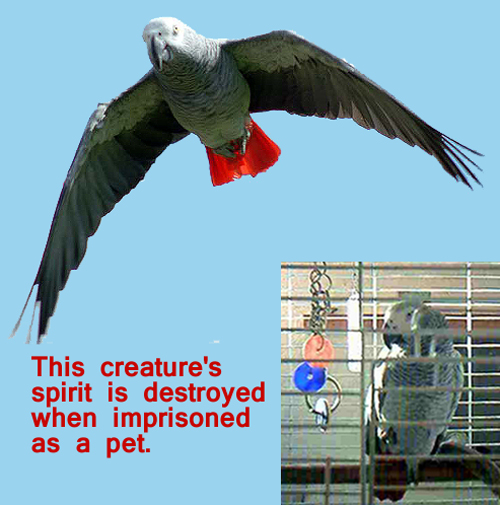
I am a loving pet owner. But I would never imprison a wild animal and then call it a pet. African Grey Parrots belong in the wild, not in a cage.

The majority of African Greys kept in the United States may have actually been born in captivity. In a sense they were manufactured to be pets; they’ve never soared over Africa’s great forests.

But be that as it may, are you sure that your bird was captive bred? And even if it truly was, do you realize that your keeping the bird in a cage is contributing to its extinction in the wild, where it much more truly belongs?

There are many as 30,000 loving owners of the Grey Parrot (Psittacus erithacus) in the United States, which for the first time this year was listed as “vulnerable” by the scientific organization (IUCN) used to determine which animals are in danger of extinction.

If the decline in the African Grey Parrot continues, and if the IUCN ultimately classifies it as “endangered” and if the CITES convention then adopts its recommendation, international trade in the bird would stop.

But the politics involved in this would be extraordinary. So there is real concern that at the point the bird is classified as threatened, it will be too late.

The IUCN explains the rapid decline in Africa’s most famous parrot because “It is one of the most popular avian pets in Europe, the United States, and the Middle East due to its longevity and unparalleled ability to mimic human speech.”

IUCN says that over the last 30 years “a million birds” may have been removed from the wild in Africa. Most of these are removed illegally, although a good portion have been captured on licenses given by corrupt African governments.

The market in the U.S. has existed for decades, but a new and vibrant market in China has also emerged as a result of China’s increased wealth. And unlike the U.S. and Europe, there are no laws in China that restrict the importation of wild birds.

Today, an African Grey Parrot in the U.S. sells for an average of $1,000. Good statistics are not available, but successful breeding of captive African Greys is a very lucrative business. Reputable companies like PetSmart routinely sell them, and eBay and Amazon both offer them.

But since there is no exact certification of what is truly a captive-bred bird, it’s likely today that many are illegal imports.

Many of these birds are smuggled out of Africa through poorly monitored ports like Windhoek, Namibia. Last week the Namibian Avicultural Association adopted new rules to try to stem the flow of illegal birds through the country.

The association claims that bird dealers in the country “do not seem to know that buying a parrot without [proper certification] may represent a bird that has been illegally caught in the wild.”

Like outright poaching, I can sympathize with Africans desperate to make a day’s wage, and capturing birds isn’t as difficult as it seems. On the Windhoek black market as throughout Africa, National Geographic estimates the poacher receives about $30 a bird.

The African middleman who pays the poachers smuggles the birds out of the country in horrible conditions. The majority die in crowded and dirty little containers that may have squashed hundreds of birds. The African middleman likely earns around $50 per bird.

The birds that survive the smuggling are taken by wholesalers in the U.S., Europe and China that launder their origin and sell them to companies like PetSmart. The wholesaler probably makes $300-500 per bird.

So while I can empathize with the poacher, it’s not possible to condone the knowingly illegal work of the middleman.

Ultimately, this horrendous trade will stop only when the market stops. Without a listing by CITES as endangered that’s impossible in places like China.

But at here at home and in Europe, let common sense prevail. Get a dog.

Early Dinosaur in Africa

Early Dinosaur in Africa

Original NatGeo photograph courtesy Erin Fitzgerald; art by Tyler Keillor
One of the first dinosaurs to roam earth lived in southern Africa and the discovery announced last week raises considerably Africa’s evolutionary importance.

It’s common knowledge that man and his broader family of primates arose in Africa, but until now it was thought that the myriad of the earliest land life forms – particularly reptiles and dinosaurs – arose on the western hemisphere.

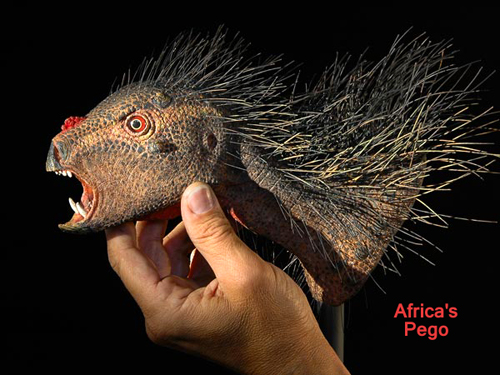
Last week dinosaur guru Paul Sereno of the University of Chicago confirmed that Pegomastax africanus lived in southern Africa about 200 million years ago.

The creature like all of the early dinosaurs at the beginning of their reign was neither large or meat-eating. With a presumed behavior and appearances more like a big reptile, the little parrot-headed creature was less than 2 feet long and hardly the size of a house cat.

It would be another 130-150 million years before the August creatures like Tyrannosaurus Rex ruled the earth, and then for a relatively short dozen million years or so before a giant meteor hit the earth and wiped them out.

But the creatures that attract museum members and figure prominently in child’s play all started much smaller. Large dinosaurs have been found in Africa, but few compared to those in the western hemisphere.

And Pego was actually found in 1983 and then its fossil got filed away in a Harvard cabinet. Sereno was recently combing through old fossils in Cambridge when he discovered this critically important piece that had been considered insignificant at the time.

Pego’s importance aside from its curious own anatomy and significance in filling the many gaps in the early dinosaur evolutionary line is that Africa now provides a similar age range of dinosaur finds that until now has been restricted to the western hemisphere.

Current science suggests the dinosaurs emerged in South America about 230 million years ago. The oldest finds have been in Argentina and they were similar in anatomy and size to Pego. As a species, though, paleontology suggests they exploded in North America around the time Pego lived, and over the next hundred million years or so began to radiate all over the world.

Well, perhaps not. Perhaps Africa provided parallel evolutionary tracts to South America, or perhaps Africa even contributed somehow to the emergence of the grandest beasts in North America.

Speculation might have to be left to us untrained enthusiasts, though. Looking back that far in time reduces the certainty of many presumptions. It’s just harder to know the actual weather, geology, existing full ecosystems than we can with the much later evolutionary story of primates to ourselves.

And the more primitive the life form (however big it might have been) may also mean that its ability to radiate was greater. It might have been easier for a reptile-like creature to have been thrown across the ocean on stick than for a monkey-like creature to have crossed a large lake.

Nonetheless, the great strides palaeontologists like Sereno have made in just this generation are truly mind-boggling. Early earth was much more elaborate show than we might have thought when I was a boy.

And Africa seems to be holding its own through virtually all of its wondrous ages.

Obama/Neanderthal/Romney Debate

Obama/Neanderthal/Romney Debate

Animus in our culture is pervasive and not just in politics. Recent awe-inspiring discoveries about Neanderthals have enraged the Right, once again.

The various emotions I feel following the Obama/Romney debate are complex, but all so similar to the same emotions provoked by the angry outbursts of creationists over new and exciting Neanderthal discoveries.

Harvard and the Max Planck Institute have been meticulously studying the DNA of Neanderthals for several years, now. Discoveries understandably come out allele by allele, and this week they announced a real breakthrough:

Neanderthals interbred with modern humans a lot more than previously thought, and the two sub-species likely lived peaceably side-by-side for tens of thousands of years. The “disappearance” of the Neanderthal was not a wipe-out by a more warring subspecies – us – but likely assimilation by romance.

As much as 4% of modern man’s DNA is Neanderthal, and that’s incredibly significant. Recent studies also confirm that modern Africans carry less Neanderthal genes than non-Africans, and along with other microbiology and genetics, further confirm relatively stable Neanderthal assimilation into our current species, rather than anything more dramatic.

Regrettably, I now concede one of my most powerful stories given during my lecture at Olduvai, where I wow my clients with the notion that we (homo sapiens sapiens) might have eaten the Neanderthals up!

It was a great story and a plausible notion for years, and the wow came not in some Carl Sagan notion of our intrinsic animus but rather that the Neanderthals, while “smarter” (their brain/body ration might be larger), they lacked something “we” had that allowed us to conquer them. For many years that was presumed to be better language.

The possibility that most of our direct African ancestors were capable of a better manipulation of language than Neanderthals has become more contentious over the years, but it’s not yet fallen from complete grace. So until recently it was a wonderful notion that language trumped IQ.

I concede, but there are enough wow moments in the evolution of man that, other than having to redo my lesson plan, I still have full faith in the energy of the lecture!

But not for creationists. The recent discoveries have just angered them, further.

A couple weeks before the Harvard/Planck study was announced, there was new archaeological evidence that Neanderthals were peaceful, and separately, that Neanderthal decorated himself with bird feathers.

That was not so profound from my point of view, but the creationists went ape about it:

“More breaking news from this week about Neanderthal man, they found feathers in his living arrangement and it was not there by accident rather it was there by intelligent design!”

The quote above is from one of the leading creationists. Take a minute to scan all the recent posts under his rubric of “archaeology” and you’ll collect his enormous animus.

You’ll note reference after reference about science’s notion of Neanderthal as an oaf. When quite to the contrary, for years there’s been nothing in scientific discovery to suggest Neanderthal were less smart than us! In fact, if the brain/body weight argument regains traction, it can be plausibly argued they were smarter!

This creationist isn’t a god-fearing man displaying disdain or arrogance about science’s mistakes about the heavens. It’s an animal filled with anger. And it brings me back to the Romney/Obama debate, because the collection of emotions are similar.

Truth matters. In fact it apparently matters so much that it creates anger in those who deny it. And when that anger is sufficiently mobilized by celebration, the dynamic begins to be powered by less, not more, truth.

So just say something again and again that is a lie, or claim you don’t believe something you do (or once did), and you’re right on the same squad as Darth Nader, denying the truth and somehow remarkably gaining energy from doing so.

And at this point rational debate goes to pot. Evil trumps good.

We ought to take some lessons from our early ancestors. There was less animus and more romance than we ever thought possible.

Is this Obama’s secret? But will it win the House?

Zuma is not Jefferson

Zuma is not Jefferson

Tolerant, patient South Africans have basically given their leaders wide berth publicly and privately since Mandala stepped down 15 yeas ago … until now. The current president’s buffoonery and corruption threatens the nation.

Working every day under the threat of massive censorship, South Africa’s still vibrant press has systematically reported both the corruption of its government and bumbling of its leaders. But until now it hasn’t seemed to matter much.

Last week the country went ballistic. Even ardent supporters of the government grew critical and those who defended it either lied or blushed.

News leaked that $22 million dollars (203 million Rand) had been spent to build a new home for the current president, Jacob Zuma. This was not the official residence, but a complex built in Zuma’s rural homeland that is not intended for official use.

Zuma is in trouble for a lot of things, and the ruling ANC party will meet in December to decide whether he should continue as president. The recent mining strikes which became quite violent set on edge many ANC members and lessened Zuma’s ability to stay in command.

The rapid building of a new resort home strikes everyone as what it probably is, a wounded politician trying to collect as much as he can before he’s booted out.

The public works minister lied exactly as Romney lied — no holes barred — claiming that the project was in perfect compliance with the “Ministerial Handbook” or rules of governing in South Africa.

It isn’t. The lie isn’t as boldfaced as Romney saying he won’t enact a $5 trillion tax cut despite his own website to the contrary, but it’s almost as clear:

“Although members can designate a privately-owned residence for use as an official residence at the seat of office, the handbook states that the public works department will only be responsible for making available general cleaning services in private residences used for official purposes,” Faranaaz Parker, a reporter at South Africa’s Mail & Guardian explained.

This is the leader, remember, who proudly displays multiple wives and claims that his extramarital sex with underage girls is both legal, and safe from HIV, because he showers afterwards.

South Africans have tolerated this buffoonery for too long. The patent misuse of public funds to create Zuma’s golden parachute into a resort paradise is a tipping point, and brings into sharp focus the ongoing corruption of the ANC.

That corruption manifests itself principally by the awarding of uncontested government contracts. Several days ago the BBC interviewed a whistle blower who had been fired from the administration of education in Limpopo for revealing that millions of dollars allocated for the purchase of text books had gone missing.

The report caused such a stir including threats against the BBC that yesterday the BBC published an even greater in-depth story further documenting more than $2 billion dollars gone missing in South Africa’s school system.

The textbook scandal might be the one that penetrates the ennui of so many South Africans to their incompetent government. Protests are growing.

But the textbook scandal is only one of many such examples of illegally awarded government contracts.

Perhaps most disturbing is that South Africa’s much revered independent court system is being emasculated:

In one of dozens of similar cases, the Gauteng Provence High Court nullified a $1.1 billion dollar ( 10 billion Rand) government grant in August to middlemen dispensing social security payments. It was a bold move when the judge declared the award “illegal and invalid” but a lot less bold when he refused to “set it aside.” In South African jargon, that means it’s wrong but nothing will change and implementers will not be held accountable.

It is typical of the massive transformation of South Africa’s previously powerful courts into platforms of ANC control.

I don’t know if this latest scandal really is the tipping point of ANC power, and the ANC is being extremely clever by floating the idea they will get rid of Zuma before the control boils over.

But I do know it’s a tipping point for something.

Mission Accomplished Now What

Mission Accomplished Now What

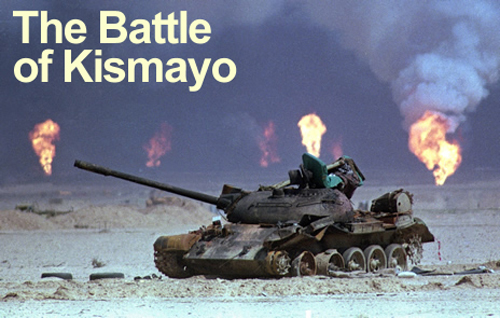
Twelve months ago Kenya invaded Somalia with the expressed goal of taking the city of Kismayu. This past weekend Kismayu fell but there are no celebrations, no parades.

The fall of Kismayu will go down in history as the defeat of al-Qaeda’s first organized state. Until al-Shabaab took Kismayu after the failed Ethiopian invasion of Somalia in 2007, no terrorist organization had a fully fledged government in place.

Over the next five years, Shabaab exerted full administrative control on Somali’s largest port city, estimated at around 200,000 with many modern facilities including a functioning harbor and university. The group imposed Sharia law and imposed a strict if oppressive peace.

Kismayu is the center of pirate activity in the Arabian Gulf and with the fixed taxes Shabaab imposed on the pirates and a burgeoning trade in concrete and fish, and an increasing trade in illicit drunks and weapons, Kismayu became the quintessential Joker’s capital.

It had never happened before. Terrorists had always been in hiding or on the run. By 2009 Shabaab had extended its full authority over at least a third of southern Somali and along all of the Kenyan border. It was now a country only slightly smaller than Britain.

Kenya announced its invasion of Somalia as a response to mounting attacks inside its territory near the shared border, but more because of the growing strain on Kenyan society of the huge Dadaab refugee camp.

The camp is now the largest in the world, and while funded principally by the United Nations, it is a massive and threatening city in the Kenyan desert, larger than all but four of Kenya’s other metropolitan areas. Although there is an undeniable economic benefit to the enormous resources being passed through the country by the United Nations, the net result is probably negative.

When the invasion happened on October 18, 2011, I predicted only bad news. I was wrong. There is much bad news, but there is also some good news.

The Kenyans have suffered many fewer casualties than I expected, principally because their army moved so slowly and carefully, avoiding huge clashes. In fact with time I began to wonder if Kenya had the right formula for modern warfare, actually trumping big powers like us.

But a year ago it was not clear – as it is today – how much the western world, particularly France and the U.S., have been involved. U.S. drones, French warships and even reports of actual special services embedded with the Kenyan troops suggest a massive clandestine effort by the west to assure Kenya’s success.

We know that the Obama administration has deployed special services throughout east and central Africa so it’s likely there are Americans on the ground in Somalia helping the Kenyans. Together with our drones, we’ve probably been involved from the get go.

Such proxy warring is disturbing. It’s unsettling to me, because in theory it means Kenyans are dying to protect me, an American. It’s unsettling because we as Americans (and French, etc.) can now play with fire and not get burned.

The Kenyan mission was very slow and marginally successful day-by-day. African Union Forces which had been deployed in Mogadishu since the earth was created had been totally useless before Kenya began making inroads in the south.

Today, AUF control Mogadishu and a relative peace pervades the city for the first time in a generation. There is no doubt that Kenya’s courage in the south provided peace further north.

There is a new Somalia president, a respected university academic. Aid organizations are returning, and the news Kenya most wants to hear, that soon refugees might be repatriated, is all a collection of very positive news.

But as Jeffrey Gettleman has pointed out again and again, Kismayu freed is the worst Pandora’s Box in Africa.

The warlord society of Somali, empowered by funds and weapons scattered by America’s mousey retreat from Blackhawk Down in 1993, is rivaled only in Afghanistan. These are not people who take kindly to city council zoning rules. There is now a real concern that even the combined military of Kenya, the AUF and newly inaugurated Somali Defense Forces can hold in place what Shabaab did with nothing less than abject terror.

Over the last year terrorist attacks on Kenyan soil have increased exponentially. Tourists have been killed, kidnaped, and grenade attacks on Christian churches have taken hundreds of Kenyan lives, and even Nairobi city has experienced a half dozen terrorist attacks.

None of these were as grand or apparently as carefully planned as the Shabaab attack in Kampala in July, 2010. That attack was specific retribution by al-Shabaab against the Ugandan military, which had been the lead force in the AUF for several years. Kenya was understandably worried it would suffer the same.

It didn’t. Yet the aggregate misery, deaths, injuries and destruction of all the little attacks now exceeds by far the single grand attack in Kampala.

So there are no parades or other celebrations. A milestone, yes, but the story is far from over.

Clash of the Faithful

Clash of the Faithful

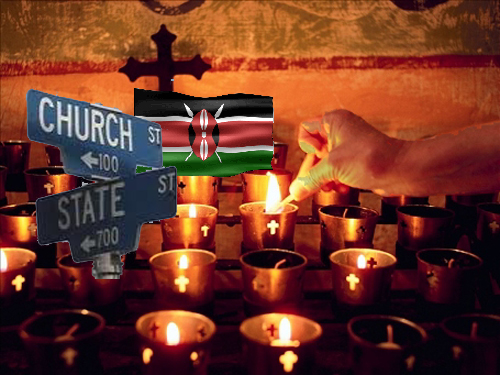
A colonial benchmark is struck in Kenya as Parliament considers banning religious organizations in publically funded schools. The Catholic Church has initiated a massive campaign to counter Parliament’s likely move which I doubt will be successful.

The Education Bill is one of the most striking features of Kenya’s rapid move to implement its new and modern constitution. If successful the bill will effectively wrest the last bit of control religious institutions have on Kenya’s public primary and secondary schools.

Currently up to a quarter of Kenya’s rural primary and secondary schools maintain a religious character as a legacy from colonial times. The state normally places and pays for the teachers and in most cases (but not all) the administration, and the church maintains the infrastructure and controls much of the school day including extra-curricular activities. It is specifically these religious activities that clash with Kenya’s new constitution that Parliament is directed to implement.

Most of these schools are on property owned by the church, and one of the more contentious debates expected is whether the new Kenya will use its modern power of eminent domain to effect ultimate jurisdiction over the existing land and school structures.

Education has been the top priority of every African government since modern governments existed, and regardless of their political and social persuasions, virtually every African country’s education was built on religious foundations.

The British explorer David Livingstone created the sound bite for colonial development in the 1830s: Civilization, Commerce & Christianity. The Three C’s were implemented by a mixture of privately funded missionary work and rapid education funded by the colonial powers.

The two were inseparably intertwined in the 19th Century, whether that was German Lutheranism, British anti-Catholicism or French, Belgium and Portugese Catholicism. Education is expensive, and the colonies had neither a legacy of any type of education or the wherewithal to fund secular educational services.

Besides in the colonial days it was only America that had struck a secular course for its society and America had no African colonies.

When my wife and I first went to Kenya it was to teach. We were hired and paid by the Kenyan government, but assigned to a large 800-student boys boarding school in a remote location in western Kenya that the then Kenyatta government had little interest in supporting. The Catholic Church stepped in, providing almost all of the funds for St. Paul’s Amukura Secondary School and a Headmaster and Assistant Headmaster that were both priests.

The priests essentially ran every component of the school, from sports to curriculum, although a national examination that determined matriculation often governed what the curriculum should be.

The Church, not the government, solicited aid from abroad to fund the schools science laboratories, build and maintain the infrastructure that allowed hundreds of rural boys to board at the school, provide a small dispensary and in many cases scholarships for the most needy.

That has changed significantly over the years, with the government now mandating virtually everything but after-school hours’ programs. Kenya’s rapid development has meant that many boarding schools and the high costs associated with them changed into day schools, but where boarding is still necessary the Church remains the paymaster.

Extracurricular activities, boarding where it continues, and the land on which the schools still sit are the contentious issues before Parliament.

It is the Catholic Church that has the most to lose, and it is pulling no punches in its drive to dissuade Kenyan legislators from further diluting its influence.

If Parliament continues on the track predicted, “…our schools will start producing Godless creatures and the society will be ruined,” Kisii Catholic Bishop Joseph Mairura told reporters this weekend.

The issue is especially sensitive right now as Kenyan Christian churches suffer violent terrorist attacks presumed to be in retaliation for the government’s invasion of parts of Somalia controlled by Islamists.

Public sentiment is charged. The comments left after Sunday’s weekend stories that the leadership of the church is going to fight Parliament’s moves were divisive and angry.

Is a certain Church/State separation the right move for Kenya now at a time of stressed government resources?

It depends on how much faith you have.

While We Moo

While We Moo

Nine countries in Africa have more cell phones per capita than the U.S. and their youthful programmers are creating more creative apps than here at home.

South Africa, Libya, Botswana, the Seychelles, Gabon, Tunisia, Algeria, Morocco and the Congo have a higher per capita cell phone rate than the U.S. In part this is because land lines were never very good in many African countries, but it’s also because the technology of cell towers developed as fast in Africa as in the U.S.

Most European countries also have a higher cell phone per capita than the U.S., but what it means for Africa is that apps that are African specific are appearing in the dozens – sometimes hundreds – every day.

The most widely used cash transfer app in the world, M-Pesa, was first created and launched in Kenya in 2007. Today the app supports 23,000 jobs and has 17 million registered users in just Kenya alone.

But that isn’t even half the story. It was hardly two years that operational control for M-Pesa was ceded by its creators to IBM, which subsequently hired all of that development company’s employees. It was a clever – perhaps necessary way for IBM to avoid difficult worldwide patent contracts, since it is now free to develop the app worldwide.

M-Pesa is simple and complete, and that’s probably why it hit a brick wall in the U.S. Interstate commerce laws, local taxing authorities and most of all, the “cost for the media” (i.e., the price that the app owner wants to command for each use) has bogged down use here and in the rest of the developed world.

GoogleWallet is the closest to M-Pesa, and it’s still cumbersome compared to the beauty of the Kenyan app.

There are many apps as creative and simply beautiful as M-Pesa that Africans have developed, but one very unique app that caught my attention is iCow, and it’s not because I farm.

And that’s the point. Although iCow is most useful to the full-time dairy farmer, there are many Kenyans who are not farmers nevertheless own cows. In the fast paced changing Kenyan culture, professionals working normal 9-to-5 jobs often still own land in rural areas with aspects of farming still undertaken by much of their family.

iCow is a “cow calendar,” remarkable resource for locating vet services and medicines, and a news app that regularly updates the user on the newest science in dairy farming. Most importantly, it tells you when to milk your own unique cow, depending upon its age, feed intake and breed.

A professional in Nairobi recently told the city newspaper that she manages her small dairy farm 150 miles away “through regular [iCow] SMS updates.”

iCow was so successful that it spawned a whole range of other farm apps created and used in Kenya.

Nearly a generation ago we were warned that the “Information Revolution” and “Information Age” would be a pivotal moment in human history.

It’s happening, now.

Truth Matters

Truth Matters

Slips of the tongue in Kenya – like the U.S. – trump any attempt by today’s wimpy journalists to champion truth. Unfortunately contemporary journalism deems what it inaccurately characterizes as “fairness” more important than truth, and the public has had just about enough.

Several days ago a minister in the Kenyan government called for the eviction of “Maasai” from his constituency during an attempt on the street to quell a demonstration that was becoming violent.

Several days ago a candidate for President of the United States derided half the population as moochers incapable of patriotic decisions while he was speaking to financial backers.

Both remarks revealed the true beliefs of their speakers. Both were incendiary, capable of spawning new and troubling events. And to be sure, there were journalists in both countries that so reported and ended their filings there.

But also in both countries there were as many if not more journalists who equivocated the event with the protagonist’s supporters rationalizations. Fortunately, at least this time, the public is having none of it in either country.

Ferdinand Waititu, a minister in the Kenyan government, raced to his constituency just outside the Nairobi airport two days ago to help quell a mounting demonstration protesting the murder of a young man. He was caught on a phone video telling the crowd to evict Maasai and basically laying the blame for the killing on the ethnic Maasai.

Like Romney, the speech was not intentionally secretly taped, it was just taped without prior notification. Its value was not preordained. Its value grew as the truth of the moment evolved in real time.

“Prior notification” was a great trick of gentleman journalists pretending to be fair. In fact, today, we’re probably all being taped all the time by one means or another, either by London MI5 as we sit snoring on a bus or by our children at a family dinner.

And that’s good. The technological revolution can’t equivocate. At least not yet. What it sees is what is, not what’s later spun or previously prepared.

Waititu in Kenya is now under arrest for hate speech. Kenya is approaching a pivotal moment next March as it holds the first national election since the ethnic violence of 2007, and admittedly the government is at least temporarily reigning in some human rights at least until the constitution and new president are in place.

There was nothing criminal in what Romney said, and probably not even hateful. His remarks were dismissive and – by the way – inaccurate, and as a mix portray a pessimistic and egotistical man that most certainly shouldn’t be president of the United States.

But both incidents display how bad currently journalism has become. It takes no rocket scientist to come to the conclusions above about each man’s remarks. But in today’s sick age of preposterous “objectivity” journalism in both countries taxed our time trying to minimize the despicable nature of the “truth.”

It begins with both men apologizing for what they said. Apologies aren’t what they used to be. They used to be shameful admissions and left real scars on those who offered them. And they were mostly considered a pivotal moment for the individual who signaled a change from one way of thinking or doing business to another. And appealing to our better natures, we the public would hopefully then forgive them, give them another chance.

Today apologies are as frequent as press conferences. They seem to have assumed the nature of little more than deflecting interest in the truth. Politicians like Waititu and Romney apologize for a mistaken remark as something insignificant.

Well, thank goodness for the modern age. The Kenyan social media, like the American social media, driven not by equivocating journalists seeking the highest viewership but by the highest morality, will have none of it, anymore.

Truth matters.

Black Gold

Black Gold

As the U.S. and Europe teeter with their economies their investors are turning to Africa where energy companies are growing rich overnight.

Fed up with the failures of austerity in Europe and the even greater failures of politics in the U.S., giant multinationals are directing investment out of their home turfs to Africa. Facilitated especially by new Chinese technologies for deep drilling, huge new reserves of oil and especially natural gas are being discovered almost daily in Africa.

Literally overnight western companies like Tulow, Royal Dutch Shell, Cove Energy, ENI, Galp Energia, the BG Group and Eskom have seen share prices skyrocket with their new African discoveries.

Global analysts think this presages a major shift in geopolitics in the not-so-distant future. Steve Levine of the trendy new quartz.com online business journal thinks that by 2020:

“.. oil prices could average $80 a barrel, Gulf monarchs … could face unrest, Mozambique—yes, Mozambique—could become one of the most important petro-states on the planet, China could more congenially assume a top rung among global powers. And the US could untether itself from some tyrants.”

What I think Levine and others fail to underscore is that we already have a Third World African energy giant, and we have had it for more than a generation, and it’s not doing so well.

Nigeria is a mess, and the $64 trillion dollar question is will that also be the outcome for Tanzania, Kenya, Mozambique, Uganda, Angola and the others.

Nigeria’s oil, gas and other natural reserves rival many states in the Mideast. Civil war, rampant corruption, now Islamic extremism and a failure to develop basic infrastructure have stymied any meaningful development over the last 30 years.

Nigeria’s manifold problems have not just inhibited Nigerian development, but scared off many global energy companies grossly reducing investment and extraction.

Uganda’s new oil finds are suspended while the county battles multinationals in the courts over royalties.

And Tanzania’s new-found energy wealth is tied up in a series of new energy laws that simply can’t get through Parliament. And Kenya – struggling beautifully but ardently to implement a new constitution, hardly has time for such trivialities as trillion dollar oil reserves.

But that, actually, is a reason things might go OK for East Africa. Unlike the now drunken uncle Nigeria, these countries aren’t just waving in outsiders with no requirement except that they lace the doorman’s hand.

The reason for the stall in Tanzania’s multinational contracts is because of the immense new pressure being exerted on its Parliament by … we-the-people. Centered on new energy finds, the power of young legislators and activists around the country to create a fair energy law is unprecedented in this sheepish country whose population until now has jerked its knees whenever its leaders whistled.

And Kenya has become one of the most sophisticated democracies in Africa. Its only delay, truly, is because such heavy lifting as implementing a new and brilliant constitution must come first.

Each country is different, of course, but my take is that African democracies are maturing so fast that they are now fully capable of creating welcoming capitalist environments for these giant multinationals that will ultimately benefit them mightily. Thirty years ago, Nigeria just wasn’t mature enough.

To be sure this is a serious generalization that needs careful parsing. And don’t give it to the multinationals to do; don’t presume that they always know what’s best. Ask BP Shell and the other multinationals that struggle in Nigeria. Many wish they’d never started.

But once invested giant multinational energy companies get caught up in their own ideological web that won’t let the little spider move on even as the web gets torn to shreds. While a few multinationals have left Nigeria and Belarus, most wouldn’t walk away from their huge capital investment, even when the returns weren’t worth it.

This led to all sorts of horrible things. Horrible returns to investors, yes, but corruption and graft on huge scales that to this day continues to stymy Nigeria.

I don’t think that will happen, again. Thanks not to the greed of the multinationals, but to the sophistication of Africa’s young emerging democracies, today.

And I for one think that Kenya and Mozambique will be the leaders and shakers. Tanzania could turn out well, too. Right there are reserves of oil and natural gas that are almost a fifth of the existing reserves in the Mideast.

And if Angola and Uganda throw off their despicable governments – which could indeed happen – then the oil well overflowith.

Delayed With Little Compensation!

Delayed With Little Compensation!

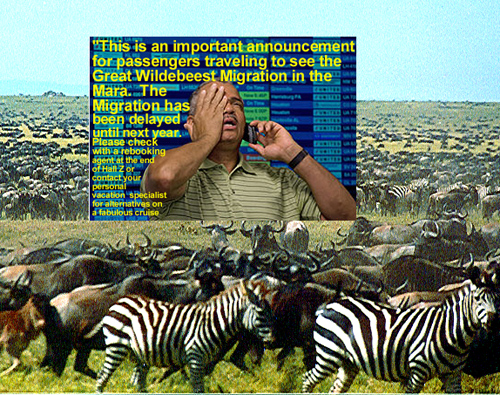
The great wildebeest migration just lost its Kenyan visa.

Normally around a million wildebeest would still be in Kenya’s Maasai Mara at this time of the year. The Mara is the northernmost point in the 1200-mile roundtrip migration, an elliptical circuit that historically remains in the Mara from around July – October.

Not this year.

The herds which zigzagged back and forth at the Kenya/Tanzania border the last half of July finally moved en masse into Kenya around the first of August only to leave hardly a month later. If another decampment from Tanzania doesn’t occur, it will be among the shortest stays in Kenya ever.

The reason this matters so much is that tourists can’t follow the herds across the Tanzanian/Kenyan border. Only animals are allowed. Even if you have all the right visas, authorities on both sides of the border won’t allow you to follow the tracks and roads or cross the bridges used by the wildebeest.

Tourists have been prohibited from traveling between Kenya and Tanzania where the Serengeti and Mara converge since 1979. So it’s been the situation for a very long time. As a result, tourists trying to find the great migration plan their entire vacations on historical patterns that don’t always prevail.

Not even global film crews, which used to have free reign, can today cross the Mara or Sand Rivers to follow the dust of the migrating animals.

Because the wildebeest are historically in the Serengeti for a longer time than they are in the Mara simply because the Serengeti is 20 times as big as the Mara, there are fewer tourists disappointed who plan to see the migration in Tanzania than Kenya. But there have been years when even Tanzanian great migration plans have gone awry.

But this year’s very short stay in Kenya is not as apocalyptic or even as unusual as you’d think listening to Kenyan politicians, today. It’s remarkable how short some people’s memories are.

The great wildebeest migration, like virtually all animal and bird migrations, does not follow inflexible patterns. Migrations are hard-wired into some animal brains, but they are triggered and steered by environmental events.

Mostly by where the food is. The warbler migration that is just about ending where I live near the northern Mississippi river began ridiculously early this year, with blackburnians appearing in late July, easily a month early.

But then they stayed. They just didn’t keep moving south. Why? Because of bugs. We were just ending a drought and with a little bit of new rain, there were suddenly mosquitoes and gnats and tree beetles that had either become dormant or whose life cycles had been slowed waiting for rain.

The same can usually be said of the caribou migration in Alaska, the whale migrations into and out of the nutrient rich northern waters, and … of the wildebeest migration.

In the case of the wildebeest, when the rain is just as plentiful in the northern Serengeti (as it was last year) or just as scarce (as it is this year) in Kenya, there is much more opportunity for grazing in Tanzania than Kenya for the simple reason there is so much more land.

Historically the northern Serengeti dries up completely in July but rains continue to splash the Mara right until October. This year, like last, there was just as much rain in one place as the other.

So contrary to Kenyan politicians who like to find disaster in their teacups, it’s not necessarily because of the Mara’s bad roads or exploding licenses for new tourist camps and lodges, or even because of Maasai poisoning lions or teenagers honking car horns.

Not that the wildebeest like any of that, and to be sure, the Mara would be a better place if all that were remedied.

But until Kenya’s bigwigs figure out a way to turn off the rains in northern Tanzania while turning them on in Kenya, there’s going to be very little they can do.

Is Uganda Safe?

Is Uganda Safe?

John Gilman wrote:
My daughter has an opportunity to travel to Uganda with a group called Sozo Children. Are you familiar with the group? Is Uganda a safe country to visit? Thank you.

Dear John,
I am not familiar with the group.

As my blogs in the last several months have pointed out, I am cautious about travel to Uganda. I would not go there for a vacation, but that is not necessarily an indictment of going there for any other reason. Vacations are supposed to be worry-free and relaxing. I doubt that a mission anywhere in the world could be classified in that context.

It would also depend upon where she was scheduled to go. The areas in and around Kampala and Entebbe and the entire western part of the country I’d consider too unsafe or too close to the most recent ebola outbreaks to travel to right now.

Regards,
Jim Heck

The Science of Ivory

The Science of Ivory

Science rarely trumps politics, but for elephants and other big game it may, soon. And surprisingly, that’s not necessarily good.

Rapid advancements in forensic genetics now empower even Third World countries to determine the origin of virtually any big game animal from a whisker of its hair. The Kenya Wildlife Service recently announced the opening of its modern genetics and forensics laboratory which will be able to do just that.

KWS was answering the clarion call to “bring those poachers to justice!” By swabbing a poached animal site, evidence is acquired that can be matched from suspect’s clothing and tools, at airport check posts and cargo containers.

And the science stretches beyond enforcing poaching laws. Tracking species survival will now be much easier, and recognizing sudden weaknesses as well as strengths in species will allow for better wildlife management.

That’s fascinating, right? Yes, but is it all good news?

Well, ultimately, of course. But the rapidly improving science is a powerful new tool against strengthening the worldwide CITES treaty. (Did I say against?)

The southern Africans for years have been arguing that CITES – which is a worldwide treaty that bans international trade of certain animals (dead or alive) – is too punitive against those countries (like themselves) that have internal mechanisms to prevent illegal poaching. The treaty was born in the mid 1980s as a device to halt the apocalyptic decline of elephants, and it worked beautifully.

Since then it has become a massive powerhouse for global species preservation. Everything from polar bears to certain butterflies and whales have been preserved by the world coming together and agreeing not to allow those animals to be traded in any way.

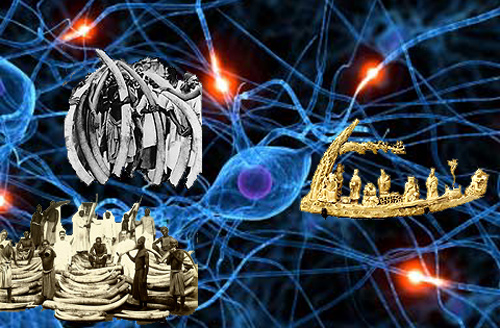
But for years in southern Africa, elephant ivory was a cash cow (or bull, depending). Extremely well run and patrolled parks in southern Africa collected heaps of tusks from elephant that died normally or were intentionally culled. This cache of animal goods, in fact, was for many years the principal source of revenue for the Zimbabwe National Parks.

CITES stopped that. Adjacent to many southern African parks can now be found warehouses of stored elephant tusks and rhino horn. They store it, because some day, they want to sell it. Right now, CITES prevents them from doing so.

CITES came on line powerfully by the end of the 1980s, and shortly thereafter, South Africans began focusing on the promise of forensic science to determine exactly where the ivory came from. South Africans developed some very creative non-genetic, isotopic or chemical methods to determine the origin of confiscated, illegal ivory.

As genetic forensics improved, CITES also did, because both proved so successful. By 2004 South Africans were desperately trying to get the world to use forensic genetics to limit CITES’ reach:

“Being able to track the origin of illicit African elephant ivory could [allow] several southern African countries … to relax the ivory ban because they have stores of ivory and lots of elephants.“

From the getgo few have questioned the southern African claim that they manage poaching well enough. It was known from the early 1980s that the danger to elephants and other big game came mostly from the northern half of the continent.

Why, then, should they be penalized from selling their legitimately harvested ivory and horn?

Because science can’t trump politics. The “free market” however it may be regulated in China is free enough on the global arena.

In 1997, 2000 and again three years ago, CITES caved under the pressure of southern African countries and “carefully” organized the sale of stockpiled ivory in a few highly regulated auctions. Each time the results were stunning:

Poaching increased measurably and substantially.

In other words, once new ivory started trading in Asia legally, black market ivory followed suit.

Although southern African countries aggressively argued that the black market was not related to the auctions, it was a hollow fight. Now, as science progresses, their argument is changing and acquiring greater force:

Genetic science can pinpoint where the ivory comes from. In southern Africans view, there is “legal” ivory and “illegal” ivory, and whether it is at cargo warehouses or jewelers stores, genetic testing devices can separate the legal from illegal trade.

The argument is very similar to the recent argument that appropriate testing can distinguish between legally mined diamonds and blood diamonds. In fact determining the origin of ivory is much easier now with genetic forensics than determining the origin of diamonds.

There’s a very provincial nearly insidious thrust to the southern African argument. I believe in their heart of hearts they know that a market widened by allowing genetic testing to scrutinize increased sales of ivory will ultimately decimate elephant in the north of the continent.

And I believe in their heart of hearts they figure, well that’s OK, we’ll protect them down here. And indeed, they could. So the extinction of the wild elephant might be unlikely… in the south. And to hell with the north. ‘If they can’t get their act together as we have, too bad.’

To be sure it’s a serious sacrifice asking the south to forego legitimate conservation revenue just because the north isn’t as developed as they are. And with the advancements announced of the sort KWS did this month, the south will be ever the more eager to promote its cause.

But it’s the difference between seeing yourself in your narrow little part of the world, and recognizing your role as a global actor.

There’s just no reason that elephant anywhere should be sacrificed to intricate ivory sculptures placed in a glass case. That tradeoff – a living work of art for a dead one – isn’t moral in my view.

There’s little sacrifice to taking the moral road.

China vs. America

China vs. America

China and America are fighting on the streets of Kenya’s third largest town.

Kenya is preparing for its first election since the debacle and violence of 2007. Scheduled for March 4 most Kenyans hope for a peaceful and simple event that will be the crowning achievement in the creation of a new constitution.

But ghosts of the past haunt every Kenyan. The older generation – from which most of the candidates come – is still fiercely tribal. The hope for a peaceful and successful election rests squarely with the youth.

The younger educated generation is truly non-tribal. Most higher secondary education and above is composed of schools with a complete hodgepodge of Kenya’s tribes. The younger business class, the new entertainers and certainly the country’s vibrant media is without any tribal identity. Since more than half the population in Kenya is under 21, even statistics point to a hopeful future.

But in the Lake Victoria town of Kisumu, it is the youth turning tribal and violent. Kisumu is Kenya’s third largest city and its situation is at the intersection of two historically warring tribes, the Luo and Luhya.

Gang violence – not so dissimilar to the same type of gang violence found in America’s larger cities – is not new, but it’s becoming more powerful. In Kisumu the two principal rival gangs call themselves “America” and “China.”

It doesn’t matter which is which, the point is that young and angry Kenyans looking for a fight – perhaps because they are few jobs and little of a future – revert to tribal identities. And in their limited global lexicon they see the two greatest world enemies as China and America.

There is nothing ideological about either group that allies them with either China or America. The commonality is paramount power. Nothing is better or more powerful, richer or stronger, than America and China.

But what strikes me as saddest is that to be adopted by these warring youth gangs the labels have to carry an ultimate component of irreconcilability.

The darker skinned Luo boy may indeed see as much physical difference between the yellow Chinese and the pale-faced American as between himself and the browner Luhya. The languages are much different. The customs are different.

Read the comments that follow this news story about last weekend’s violence. The vitriolic references to “cuts” and “cutting” are referring to the ancient tradition that one tribe circumcised and one tribe didn’t. This is ultimate, primitive animus.

It all seems irreconcilable.

The fact is that the irreconcilability is truly much greater among these young tribal gangs in Kenya than between America and China. I hate to deflate their mutually assumed perfect labels, but America and China may be adversaries but they will never become enemies.

Despite what one of our presidential candidates might some day declare, the world’s two greatest economies are too interdependent upon one another to start a battle. Each is too involved in the other’s lives.

Perhaps these wayward Kenyans can learn from this. Perhaps they can understand arch rivals need not be arch enemies.

High Road and Low Road

High Road and Low Road

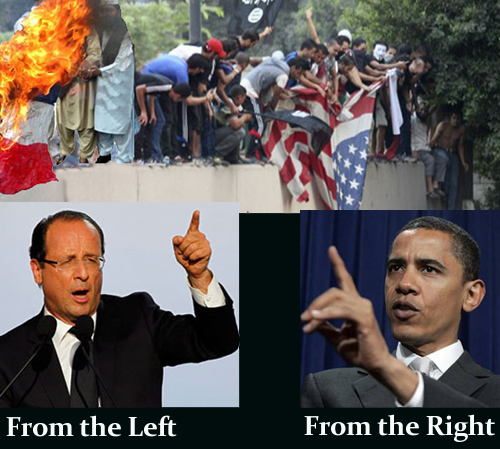
The French president’s push for foreign military intervention in Mali is a true leftist at work and frames Obama as the centrist he is.

French President Francois Hollande’s foreign policy in Africa is nearly identical to Obama, but their methods couldn’t be different.

The new socialist president of France is outspoken and quick to act. In Africa he is pushing for military intervention in many of the hot zones, including against extreme Islamists in Mali. He does not mince his words, either, labeling the Islamists in Mali with “unfathomable stupidity.”

Hollande is referring to Tuareg rebels that now control the historic city of Timbuktu, where reports are filtering out that many of the treasured monuments are being destroyed.

Timbuktu is one of the oldest cities in the interior of north Africa. Its world-famous “library” of ancient texts is an UNESCO World Heritage Site and has been reportedly destroyed. Just before Timbuktu fell from the control of the Mali government, several French were kidnapped and remain so.

So it’s understandable that Hollande will say forceful things, but the man’s wrath at what he considers common sense stupidities is not limited to places where French are held hostage.

He was one of the first to condemn the U.S. consulate attack in Benghazi. He’s one of the staunchest supporters of France’s very controversial rule prohibiting school children from veiling their heads even if they are Muslim. And he is leading the effort to assist the Syrian rebels.

What I find so revealing is how timid and centrist he makes Obama appear in contrast. And as I search for the links of evidence and delve more deeply into Hollande’s simple ideology, I realize it’s not that Obama “appears” to be centrist, Obama is centrist.

Centrist, today, whether in U.S. or worldwide politics is what hardly a decade ago we’d call right. The power of Ronald Reagan and his success in eliminating a huge part of the “socialist” world has manifest itself in extraordinarily powerful and lasting ways.

“Ends Justify Means” was an opprobrium 1960s communist haters placed on world socialists, but typical of far-right and far-left ideologies, they circle about and become each other. Both the communist world and the “free world” embrace ends-justify-means.

What I love about the new African politics producing great constitutions in Kenya and South Africa, for instance, is the utter ignoring of these archaic ideologies. New thinkers, especially in Africa, recognize the old adversaries socialism and free-market democracy are mostly meaningless in today’s interconnected and highly technical world.

And like Hollande, Africans embrace common sense. Ends-justify-means is not common sense, quite the opposite. Its Machiavellian nature means it often trips itself up. Starting a war on a false pretense in Iraq is the ultimate ends-justify-means.

I’m not suggesting Obama will start another war. But here’s the stark difference with someone like Hollande, and you be the judge as to which is better, or more effective:

As radical Islamists flee areas they flourished in only a decade ago – Afghanistan, the Horn of Africa, Yemen and Somalia – they are fleeing to the north of the continent, areas with weak governments and remote locales.

But they’re hugely weakened. The result is a lot of fracturing. Boko Haram, al-Shabaab, al-Ansari are versions of al-Qaeda, but they aren’t al-Qaeda and as best shown in Mali, they often fight one another.

In Mali, today, Tuareg rebels who have through some lone spokesman identified themselves as “Maoists” are actually the ones in control. They have swayed quite a distance from a religious ideology.

In pursuing the fugitives, Obama is relying on drones and secret missions. Hollande is simply straight-forward. He wants to expend no time or energy on deception. He calls for military intervention, he calls the Tuareg stupid and he condemns actions immediately that he sees as immoral.

That’s the difference between a centrist and a socialist, today. Their missions might be the same, but their methods are quite different.