Exactly Why Go Anywhere?

Exactly Why Go Anywhere?

tubing in the sunAs more details emerge from Friday’s deadly terrorist attack in Nairobi, Kenyans are condemning western media for suggesting a holiday in Kenya isn’t safe. Do they have a point?

Two of Kenya’s leading tourism executives blamed western media for scandalizing the situation and argued that tourists on a Kenyan holiday are no more endangered by terrorism than tourists visiting Big Ben.

Before we get into this, let’s review what happened Friday:

Ten people were killed and at least 70 injured by two simultaneous explosions in an open-air market in mid-afternoon in Nairobi.

The first IED exploded around 230p at the periphery of what is called Africa’s largest second-hand clothing market. A few minutes later, a small bus filled with passengers exploded on a street adjacent the market.

The market is located about half-way between the troubled Eastleigh community of northeast Nairobi where so many Somalis live and the Nairobi city center.

Two days previously the British and American governments issued travel warnings urging their citizens to leave the Kenyan coast. Nairobi is about 220 miles inland from the coast.

The British secret service, the SAS, may have tipped off both British and Kenyan authorities that something was going to happen.

“Terror attack chatter” was intercepted by the SAS, according to the report in London’s Sunday Star.

The stern travel warnings that ensued prompted Europe’s mega travel company, TUI, to evacuate its British citizens booked through its subsidiaries, Thomson Holidays and First Choice Holidays, and to cancel its regular charter flights from Europe to the coast through October.

A third large European company, Kuoni, while not evacuating tourists canceled all further holidays on the Kenyan coast through October.

I explained in my blog Friday how the unique aspect of British travel insurance forced TUI into the decision. (Kuoni’s decision was for other reasons.) Hundreds of other European holiday makers booked through other companies were not evacuated and remain on the coast, today.

More than half the tourists who visit East Africa never see an animal. They come for the beautiful coast, and the coast of Kenya is as popular to Europeans for a holiday as the Caribbean is to Americans.

But the coast is heavily Muslim and has been so since the earliest histories. Kenya’s occupation of Somali unleashed the retribution which averages three terrorist attacks monthly, although the vast majority of these have been on or near the Somali border.

But the minority of other attacks have been on the coast, several quite near tourist centers.

In the last year a terrorist attack about once every two months has hit the Nairobi Somali expatriate community as well.

“Terrorism is a global threat and not unique to Kenya, with similar risks evident in Britain,” Jake Grieves-Cook, former head of the Kenyan association of tourist organizations, told the press Saturday.

He went on to detail that “the latest British MI5 and MI6 assessment of the terrorist threat within mainland Britain itself is now rated as ‘substantial’,” implying that a traveler in Britain was under as great a threat as in Kenya.

“This was not an evacuation as reported in the press,” Stefano Cheli, founder and owner of one of Kenya’s most successful upmarket tour companies said today. In a broadcast email to western travel companies, Cheli criticized the western media for suggesting the tourist repatriation was a British government operation rather than a TUI business decision.

Grieves-Cook, by the way, spent a long time in his statement explaining the exceptional good, particularly with regards to the near ending of Indian Ocean piracy, that the Kenyan military occupation of Somali has achieved.

He was almost but not actually saying that tourists owed Kenya an unusual latitude of security for what Kenya had secured for the world.

* * *

Vacations fall into a great variety of different categories. Probably the largest one is “R&R,” a reward for successful hard work. As such, the holiday maker wants as hassle free down time as possible. I think most beachcombers fall into this category.

A safari is a little bit different. I don’t think anyone planning a safari thinks it’s going to be relaxing. Exciting is the predominant theme. In fact, a touch of danger is often presumed, the titillation that is often a part of the motivation for booking. Like a sports holiday, there’s a definite aspect of challenge.

But you train carefully for a specific sport, and you believe – whether it’s true or not – that if you follow the rules the lion won’t eat you.

Terrorism is so successful because it’s just that: surprised fear. Holiday-makers don’t train to evacuate. There are no rules for dodging the bomb.

What’s left, though, is Grieves-Cook argument that Britain is as dangerous as Kenya, and the facts might bear him out.

Tourists killed in Britain’s scores of terrorist incidents, or in 9/11, are likely substantially higher than all the tourists ever killed in Kenya. So why not just trust the Kenyans to keep you as safe as the British?

Aha, that’s the answer and it’s not good for Kenya. Trust.

America and Britain have certainly had their share of terrorist acts, but Americans and Britains believe strongly that their governments have protected them against many, many more.

Why should a tourist trust Kenya when Kenya is unable to protect its own Eastleigh (Nairobi) citizens from a serious attack every two months? Facts aside, westerners are much more likely to trust the British or Americans to keep them safe than Kenyans.

It might not be fair. It might not even be rational. But it is the perception which matters.
Pivot on Kenya

Pivot on Kenya

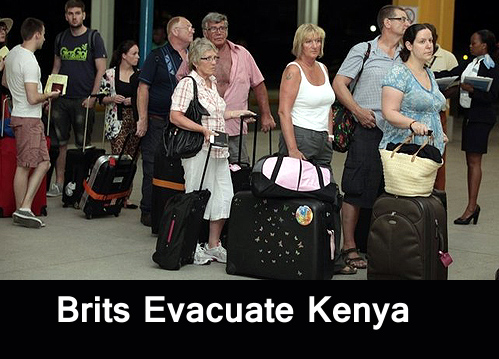
britsevacuatekenyaThe U.S. and Britain have issued specially strong travel warnings on Kenya. British tourists are being evacuated from the Kenyan coast.

Personally this is a stinging disappointment. We have multiple trips to Kenya planned; I was scheduled to be in Nairobi for three days in a couple weeks. There are unique and compelling attractions in Kenya found nowhere else in Africa.

Travel to Kenya’s game parks remains safer than it’s been for years. Simple numbers on not just kidnapping or murder, but even petty theft, are at historical lows in Kenyan game parks, probably lower in fact than in neighboring safari countries with average incidents.

But travel to its coast is now likely dangerous, and the overall perception travelers will now have means that travel to anywhere in Kenya won’t render the magical, super, exciting vacation that a good safari must be.

Vacations are composed of considerable amounts of positive anticipation, not just during the day to day events during the holiday, but even more so in the exciting preparations for it. A Kenyan holiday will now lack this essential ingredient.

The reason for Britain’s particularly harsh move was not triggered by any event. There has been no new significant terrorist incident since January 2, and that I almost didn’t classify as “significant.”

It was an improvised explosive device thrown into a crowded nightclub near the fancy resorts of Kenya’s south coast. But it was very amateurish, and the club was not a place tourists would normally go, anyway.

A half dozen other individual and pretty botched disruptive acts by who knows what kind of deranged or forsaken people has been recorded in places like the Nairobi airport this year, but really these were hardly more than fratboys freaking or disgruntled employees swinging.

The serious last “tourist” attack was on the Westgate Mall last September. As I’ve often written, it was not clear that was targeting tourists, but it could have been. Prior to that we have to go back nearly three years for any specifically tourist targeted attack.

So what prompted the Brit warning?

We don’t know, but it’s not always that the Brits and Americans follow each others’ warnings in lockstep as they did this time. Something’s in the air.

And the unique drama this time that highlighted the warnings is the ongoing evacuation of British tourists from beach resorts by the tour companies that brought them there. No other nationals are being evacuated, including Americans, and here’s why.

Travel Insurance
.

Americans or most Europeans buying travel insurance pay up to 10% of the amount they wish to be covered for, and in the case of Americans, you can’t insure yourself against terrorism despite what some travel insurance companies may claim.

In Britain, the government guarantees the underwriters of travel insurance and it’s extremely affordable. Most Brits don’t buy it for a single trip, but on an annual basis, and the cost is generally around $250 per person per year.

That does cover your trip investment, health and safety and personal belongings against terrorist acts, but only if you abide by the government’s travel advice.

When the government says “Leave Now” – which the Brits did yesterday regarding the Kenyan coast – it means if you stay you’ll be without insurance. Travel companies carrying these passengers then become liable if something happens.

They have no choice but to get their clients out.

From a non-Brit’s point-of-view, however, this is extremely severe. Britain has never issued evacuation advice before. As I said, something’s in the air and the Brits are convinced of it.

And the Americans, who followed suit within hours, believe it, too.

This is catastrophic for the Kenyan tourist industry. Indeed, all the activity now may lead to a prevention of any terrorist act, hopefully. And if so, we’ll never know the reason. We’ll never know if it’s legitimate.

But I trust the Brits and Americans with regards to their travel advice, today. I didn’t always.

Persons contemplating an East African safari should steer clear of Kenya, now.

Travelers already committed to Kenya will have some tough decisions. No one should go to the coast, now, but as I’ve said, the game parks seem very safe. Anxiety will be weighed against losing deposits.

It is a horrible fact in our world, today, that “improvised” terror striking as disparate communities as Boston and Diani Beach can determine not just the fate of holidays but the fate of entire economies.

“Terror” has become part and parcel of our daily lives.

Soldiers At Bay

Soldiers At Bay

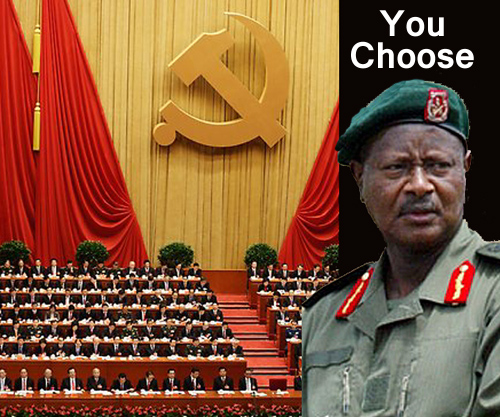
Commie or DespotRevolutionaries make lousy politicians, and that’s why South Sudan is so unstable.

Five theoretically democratic countries in sub-Saharan Africa were born of revolution: Uganda, Zimbabwe, Ethiopia, South Africa and South Sudan.

(Modern Rwanda, which rose from the pyre of the 1994 genocide, never pretended to be democratic. Kenya’s election violence was too short-lived and geographically contained to be considered revolution. And The Congo and Somalia aren’t finished, yet.)

Of the five, South Africa is doing just fine if awkwardly so. Ethiopia is a far, far distant second, and Uganda and Zimbabwe are now lost causes. South Sudan, the newest, is still figuring out its peace land legs and right now, doesn’t look too good.

These five countries provide an excellent study of modern day transition from revolution and suggest what South Sudan must do to succeed.

All five countries sustained a revolution against their previous regime for a generation or more:

South Africa’s ANC was the revolutionary, fighting arm against the Nationalist government that blew up the factories and staged a couple fire bombs while figuring out ways from time to time to close the mines. The ANC is now in control of South Africa’s politics and has been since Independence twenty years ago.

The Ethiopian regime is composed of a segments of rebel groups pursued by the Terror Triumvirate, which assassinated Emperor Haile Selassie in 1974.

The current Ugandan and Zimbabwean regimes consolidated power after violent ousters of repressive regimes (Idi Amin in Uganda and Ian Smith’s UDI in Rhodesia).

The South Sudan is the newest, created from a 2005 peace deal with (north) The Sudan that led to independence in 2011.

All five countries pretend to be democratic and are founded on constitutions based on democracy. Only South Africa is.

Uganda and Zimbabwe are iron-clad dictatorships. Ethiopia is more communist than dictatorship albeit with a pretty wide net of political involvement across various segments of Ethiopian society.

We can predict what might happen to South Sudan based on what happened to the other four.

In all cases, the men (and it’s exclusively men) who shot guns and murdered adversaries of the ancien regime are now the political leaders. As George Washington summed it up when leaving a single term in office, soldiers do not make good democratic leaders.

Foreigners are eager to cast these country’s difficulties as ethnic, and to be sure the internal adversaries are clearly ethnically different. But I think as suggested by Hilary Matfess in an article in Think Africa Press, today, there are other more important reasons.

Once fault lines occur in a society, ethnic groups tend to congeal on one side or the other, and that’s certainly what’s happened in South Sudan. But that doesn’t mean the ethnicity or racism is the actual cause.

Ms. Matfess argues that it’s the constitutional makeup, but I argue that the constitution was made up by soldiers, and that’s the problem.

In a country as diverse, successful and developed as South Africa, soldiering onto the political stage worked well for the ANC, but soldiering into governance is not working so well. Nevertheless in South Africa, autocratic moves by politicians have been checked.

South Africa will do just fine as soon as these old soldiers go, and they are slowly but surely dying or being forced out.

Uganda and Zimbabwe, however, weren’t able to make the transition that I’m sure South Africa has, and both have devolved into despotic regimes.

I see Ethiopia as trying very hard not to slip into a despotic character, and the way it’s trying to do so is by a very restrictive, highly controlled mostly communist system that is forcing the old soldiers to stay at bay. Certainly without this very powerful central authority in Addis, the country would start fighting, again, and one or other of the soldiers would come to power as the despot exactly as Museveni and Mugabe have in Uganda and Zimbabwe.

This is South Sudan’s option, I’m afraid. Lacking the development and diversity that South Africa had historically, South Sudan must figure out “how to keep the old soldiers at bay.”

The only way is by a centrally restrictive “communist” government. All that democracy will do is facilitate war.

This is exactly the opposite of what Ms. Matfess believes, even though I’m using her argument to suggest it. But democracy cannot work until the population is educated enough to engage its mechanisms.

So if The West wants peace in South Sudan, it’s going to have to accept communism.

Now there’s a twist.

Killer Bee Helpful!

Killer Bee Helpful!

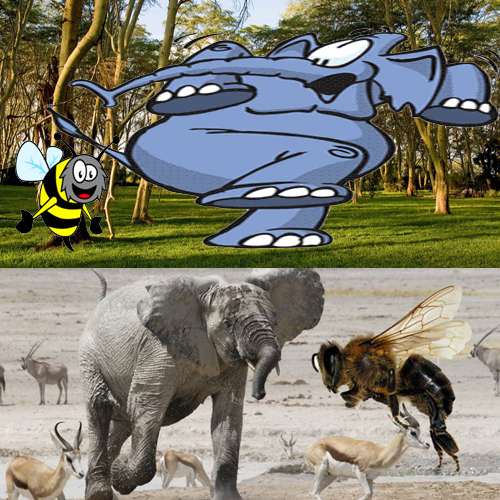
beessaveelesI love this story! African “Killer Bees,” media ingrained mythical honey bees, may be what saves elephants from extinction!

My truck with many conservation organizations today is their scandalous exaggeration of elephant poaching, albeit I stipulate that elephant poaching is a growing problem.

In status quo (which includes increased elephant poaching), elephants are not going extinct.

But if extinction — or even seriously significant decline is postulated, the cause is not poaching. It is the human/animal conflict that is besetting virtually every major African game park on the continent.

Rapidly increasing human populations — particularly agricultural communities around dwindling protected wilderness habitats – is the main cause.

Combined with sluggish economies, massive unemployment, and a growing Asian demand for ivory, the conditions are ripe for increased elephant poaching.

I believe that by minimizing human/elephant conflicts, poaching will decrease.

Despite a couple television specials notwithstanding, elephant poaching isn’t easy. A savvy band of criminals takes considerable risk trying to down a jumbo. Once down the ivory harvest isn’t easy, either.

Many poachers are seriously injured in the hunt, and going to a medical clinic isn’t exactly possible unless the practitioner agrees to overlook the cause of your calve gash, which she isn’t supposed to do.

Many injured poachers get medical assistance from local villagers.

Very special knives and other tools for extracting the full tusk must either be uniquely forged by local blacksmiths or honed by artisans. Again, this requires those tradesmen to “look the other way.”

Community sympathy for poachers facilitates poaching… might be necessary for it to happen at all.

That sympathy comes from two different places:

Foremost are the farmers in those sympathetic communities adjacent wilderness areas who are trying so desperately to grow corn and water melons, two of the favorite foods of wild elephants, today.

Joining them are headmistresses, community leaders and clerics who are incapable of convincing a jumbo not to walk through their building.

Secondly, the sympathy comes from the politico enraged with the government’s inability to compensate farmers and preachers and school boards for their elephant damage, while generously financing more and more upmarket tourist camps.

The threat to elephants is that they live in a place where people no longer want them. Tourism revenue continues to decline as a portion of African countries’ wealth. Agriculture, education and media are now all more important.

So it seems to me that if we can find some wonderful way to keep elephants where they belong, poaching will become harder and harder to accomplish.

We’ve been trying everything:elebarrier

Fences.

Electric fences.

Massive electric fences with big moats.

Pepper spray.

Siren horns.

Air guns.

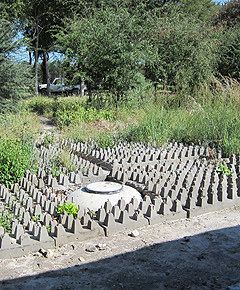
The best ever I’ve found I just experienced a few weeks ago, again, in Botswana’s Nxai Pan National Park: surrounding the toilet and shower complex for the public camp site in the park are a dozen rows of cement blocks fabricated with tiny towers that have a steel rod piercing upwards from the middle.

Elephants really don’t like that. But it’s way, way too expensive for anything but a tourist who has to go.

Alas. African Killer Bees!

Beehives every ten meters linked by special trigger wires, so that when an elephant only lightly touches the wire, the bees are enraged.

Save the Elephants, the University of Oxford and the Disney Worldwide Conservation Fund collaborated on this huge and very successful study.

You see, elephants have bought into the myth that these are “Killer” Bees.

Well, actually, researchers noticed a long time ago that elephants avoided eating their most favorite tree, the acacia, if bees were on the blossoms.

“This was followed by behavioural experiments demonstrating that not only do elephants run from bee sounds, but they also have an alarm call that alerts family members to retreat from a possible bee threat,” project leader Lucy King told AllAfrica.

Hey. Anybody out there can design a chip to scream out an elephant bee alarm?

Boko What?

Boko What?

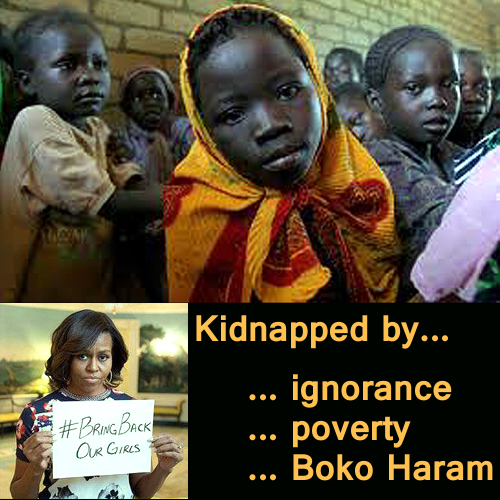
schoolgirlBoko Haram. You need understand little else than the name to understand the situation: “Western Education is Sacrilege.”

‘Boko Haram’ is a Hausa language derivative, which lays blame for the misery in the world upon the educational systems created by the successful, developed world.

Of course there are many in the successful, developed world who agree with this:

In the United States, the number of home schooled primary and secondary school kids increased from 850,000 in 1999 to 1½ million in 2007 (1.7-2.9%).

Boko Haram believes that traditional western social values as evinced by public institutions are wrong. The schoolgirl kidnapping in Nigeria is an expression of moral indignation at gender equality.

Most western homeschoolers also believe women are inferior to men, or in a persistent homeschool jargon, “more godly” if they pursue a subservient relationship to men.

So in a real sense western homeschoolers and Boko Haram are comrades in arms.

What begins with the gender fracture continues into other aspects of society, like money and power.

Boko Haram, like the IRA, the Basques and numerous other ethnic-derived rebel movements, is fighting for a redistribution of wealth and power.

They arise from a portion of Nigerian society, the north and mostly Muslim part, which has benefited hardly at all from the development of the Christian south.

The less people have, the less they have to lose, the more likely they’ll put their life on the line.

Boko Haram, like all rebel groups, can’t survive on its own. Exploiting the undeveloped roads and vast forests of northern Nigeria, they hide not just in the neglected and undeveloped topography but among the millions of people who share a common misery.

Even the barbaric LRA (Lord’s Resistance Army) received sanctuary from communities that felt they were being neglected to the point of desperation.

In a strange but true sense, American homeschoolers have likewise been neglected. And they find themselves not only bereft of basic understandings of and skills for the real world, but generally at the bottom of the economic ladder as a result.

If these movements are successful and ascend to power quickly or suddenly (take the Muslim Brotherhood or the Iranian ayatollahs), they’re unable to evolve more rational and moral positions. Instead, they reenforce the conservative myths around which they first organized themselves.

That’s the real danger to a just society. So what to do? Suppress them with every gun you’ve got? Imprison thousands? Or from the liberal side: spend billions quickly but carelessly to remedy such failings as their education?

Something in between, I suspect. Perhaps the IRA and Basque separatist movements are models. But what they both clearly show is that these “struggles” are long ones. There’s no quick fix.

Africa poses an additional challenge. The cleavage in so many African nations between the educated and well off, and the uneducated and impoverished, is greater than anything Marx could have imagined, or that ever existed in Belfast or the mountains of northeast Spain.

Boko Haram has been around for more than a decade. According to the Council on Foreign Relations, over 10,000 people have died in Boko Haram violence.

The Nigerian school girls have captured the world’s attention, but they are only a fraction of the horror and misery throughout the whole world.

Democracy Secures Misery

Democracy Secures Misery

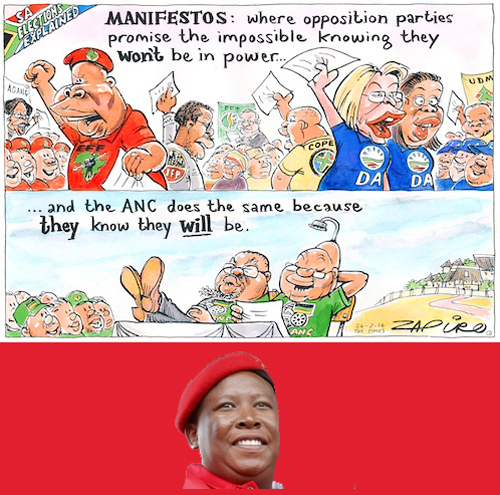
saelectionSouth Africans today “stayed the course” with the bungling ANC in control, but just barely. Change is in the air.

Three weeks ago I predicted that the ANC, which won 70% of the votes cast in 2004, would win less than 60% this time.

With 98% of the votes counted, the ANC has won 62%. Click here for current, updated results.

I was routing for an ANC loss. I wasn’t hoping for any other specific party’s win, because there are so many other parties and the ANC’s main rival, the Democratic Alliance, seems incapable of organizing the wide and disparate opposition to the ANC and so seems destined as a minority voice, forever.

The ANC’s problem is its top heavy leadership, steeped in buffoonery, bribery and bungling. Whether it’s President Zuma’s dozen wives or former President Mbeki’s certainty that AIDS is not a virus, these are the former freedom fighters who obviously never took Civics 101.

Except for Mandela, they lack any skills except survival.

In the 20 years since Independence, and the 12 years since Mandela left taking rational governance with him, the ANC has squandered South Africa’s resources and turned its political hierarchy into the same old self-serving idiots that lead a number of developing African countries.

And that’s the point. South Africa need not be a “developing” country, anymore. It’s rich, prosperous and filled with opportunity. But all this potential has been extirpated by the last two presidents and their cronies in scandal after scandal.

So my 2% mistake in calling the election you can rack up to hope.

Read my recent blog for my explanation as to why South Africans still support the ANC.

The ANC, however, is definitely on the decline. In the province of Gauteng, where Johannesburg and the capital Pretoria are located, the ANC won only 54%. With its mining, banking and other industry, this is South Africa’s most important province.

In the second most important province where Cape Town is located, the ANC won only 34% of the votes. There the Democratic Alliance holds solid control.

What I’m concerned about is that several very radical if incendiary parties, like the one led by Julius Malema, are growing in support. These are radical groups that would significantly alter South Africa’s democracy.

Malema’s EFF (Economic Freedom Fighters Party), showed some significant improvement this year, winning just under 7% of the vote. But it won nearly 13% of the vote in the mining provinces where it commands huge support from the miners.

And the EFF’s first plank is to nationalize the mines and most everything else.

Just as in America, where the evangelical T-Party rose from the ashes of a generation of economic stagnation, so the EFF rose from a generation of poor governance.

It’s unfortunate that “clean government” legitimately can often be associated with authoritarian rule, the beneficent dictator who might feather his own bed but rarely allows others to do so. That’s how I, and I think many hard working South Africans, see Malema.

Nationalization, rapid redistribution of wealth, clamps on lying media, exchange controls … all values some of us hold but which never seem to work too well in practice, particularly in today’s capitalist world.

Yet that is exactly what Malema or incarnations thereof will do to South Africa if the ANC continues its buffoonery and reasonable alternatives like the Democratic Alliance are unable to forge strong alliances.

Bottom line? (1) Disappointment that the ANC showed slightly more support than expected or hoped for. (2) Some hope that the ANC’s dwindling support might be a bucket of cold water dumped on some hot heads. (3) Revolution in the wings.

What I See in the Future of Safaris

What I See in the Future of Safaris

Photographer Acahaya
Africa is a dynamic place: sometimes even violent but always rapidly changing. The end of my two months there gives me fresh perspectives on how best to travel to this amazing continent.

Although I spend about 4-5 months annually in sub-Saharan Africa, the single two-month stretch at the beginning of the year gives me the most holistic perspective.

Basic recommendations I’ve had for years are unchanged:

For the first-timer principally interested in game viewing, East Africa is where to go, hands down. But once you visit the spectacle of East Africa, don’t miss southern Africa! It’s radically different but just as awesome.

For the first-timer whose interests are much broader than just game viewing, southern Africa is the place to begin.

The decline in lion populations is significant and noticeable on a safari to either area. Only a few years ago a ten-day safari to East Africa saw well over 100 lion; a similar trip to southern Africa usually found about twenty. Today, it’s half that in both places.

But the rest of the animals, with some interesting exceptions like topi, are on the increase. And this includes elephant which if all you do is read conservation organization flyers you’d think otherwise. In fact I believe the “elephant problem” is quite simply that there are too many of them.

The great migration in East Africa just gets better and better. In fact it’s improving so much and so quickly I’m getting worried. I wonder if we’re reaching some carrying threshold where the numbers might suddenly tank.

Global warming has significantly effected safari travel. As elsewhere in the world, seasons are now exaggerated: The wet seasons are wetter with much flooding. The dry seasons are drier with devastating droughts. The hot and cold seasons are much hotter and much colder.

To me this means the end of the first wet season (which is also usually one of the hot seasons) is the best time to go, because the exaggerations are minimized. For East Africa this means March and April. For southern Africa this means February and March.

But take this recommendation cautiously: Global warming is happening so fast that I can see this changing even year to year. And the fact remains that an outstanding safari can be done at any time of the year if properly designed.

Prices in southern Africa are increasing. Prices in East Africa are moderating. The demand in southern Africa is on the increase, but tourism in East Africa is decreasing.

I think this has to do with the fact that southern Africa is more stable. For a trip of a similar caliber and level of accommodations, a southern African trip is now about a quarter more expensive than an East African one.

With regards to specific countries, not much as changed except for Kenya. I’ll be returning to Nairobi in about a month to confirm what I have to predict, now.

I believe Kenya is ready, again, to safeguard tourists. It’s been four years since EWT actively promoted Kenya or since I’ve taken by own guided trips, there.

But there has been very significant positive change from a tourist point of view there recently. You may think this crazy if all you do is read the headlines: small grenade and other bombing attacks are actually on a slight increase in and around Nairobi.

But those attacks are directed exclusively at the Somali community, and the attacks of the last five years on tourists were different and have subsided.

Since the Westgate Mall attack last September and the Nairobi airport fire the month before I haven’t been able to find a single, however slight or botched attempt, directed at tourists in Kenya. And it’s not completely certain that tourists figured very much in the calculus of either of those attacks.

The fact there haven’t been any tourist kidnapings or violent robberies or lodge or camp attacks is a significant change from just a few years ago.

Those attacks were by common criminals given free reign when police and other local security personnel were pulled from many tourists areas to aid in the Somali war effort. And in the case of the specific tourist kidnapings around Lamu, those were by Somali terrorists when the October, 2011, war began.

That war is over. (Though the occupation by Kenyan troops continues, which is why the attacks are directed against Somali Kenyans who live mostly in and around Nairobi and on the coast.)

Police and regional security personnel have returned home. Normal policing has started, again, and improved. In fact I worry that the new security procedures put in place by the current government are too draconian. Be that as it may, it means tourists will be safer.

I now see Kenya very much as I saw Britain during the IRA wars. I remember, for example, visiting my daughter in the mid 1990s when she was studying at Oxford.

My subway went dark and out for three hours after the IRA bombed London’s Piccadilly Line. Nobody was hurt as the object of the IRA in those days wasn’t to kill civilians but to make a point.

Today in Kenya the object of the terrorists is to hurt Kenyan civilians of Somali descent. But the exclusion of harming outsiders seems similar to the situation in London 20 years ago.

I will be the first to reverse course if things turn south in Kenya. But there are so many unique attractions in Kenya that when tourist security arrives at the level I believe it has, today, it would be terrible to miss them.

As Kenya improves I grow increasingly vigilant of Tanzania.

Tanzania is wrestling with a new and very contentious constitution, the same issue which spiraled Kenya into unrest in 2007. The most recent attack specifically against tourists was in Zanzibar, so I’m recommending against travel there.

Right now Tanzania excluding Zanzibar remains one of the most secure places for an African holiday. But I’m watching it carefully as the future does not seem as bright as Kenya’s.

Uganda is out. The country now prosecuting its first gay trial is increasingly overseen by a madman. Not yet as bad as Amin, I can see Museveni becoming as bad in just a few years.

Rwanda is an authoritarian state, horrible for its citizens and absolutely as safe for tourists as China today or Russia during the Cold War. And I’m watching The Congo carefully. Things are getting better, there.

Virtually all of southern Africa except Zimbabwe is as secure for the tourist as a visit to most South American countries. Even the security situation for visitors in Madagascar is improving.

As I said, Africa is a dynamic and sometimes violent place. It’s always been so, and it will remain so for some time. Travel to Africa has never been, and isn’t today, a Caribbean cruise.

But I think it’s slowly getting safer. And it remains more exciting than ever. Read my many previous blogs about my just ended safaris and I hope you’ll understand why I think so!

The wild is not just unpredictable, it’s always spiritually rejuvenating. That doesn’t normally characterize a Caribbean cruise!

On Safari: What It Meant

On Safari: What It Meant

safaricomingtoacloseMy Cape/Botswana safari this year tracked nearly exactly my experience for the last eight years running: fabulous Cape touring then moderate though diverse game with several truly exciting experiences, ending at VicFalls.

I really don’t think Cape Town needs much promotion. It’s my second favorite city in the world, absolutely gorgeous, and the historical, cultural and wilderness opportunities I think are unmatched except perhaps by San Francisco.

So if like most Americans your Cape Town experience is augmented by a game viewing experience, that’s what you analyze and compare.

Eastern South Africa (Kruger) is fine for game viewing, but Botswana is much better. Not necessarily for the quantity or variety of game, but for the exceptional scenery and geography, and for the exclusivity.
elelindstrom
Twice in the last four years I’ve watched a wild dog hunt, and that’s breath-taking. Four of the last five years I’ve seen wild dogs. Wild dogs is becoming Botswana’s signature attraction. (By the way, it may also be Kruger’s. There are now a reported 500 dog in Kruger.)

We saw two lion kills, both of buffalo. And really most uniquely of all, our two days in the Okavango Delta and three days in the Pans represented game viewing experiences that simply have no comparisons elsewhere in Africa.

Those of us in the safari business are loathe to compare one area with another, or even compare the same area in different seasons. But I realize this is an important consideration for the consumer, particularly the first-time consumer.

In addition to the extraordinary experience on two separate game drives of two different wild dog families, the week-plus game viewing safari included a dozen lion; hundreds-plus elephant, Cape buffalo and impala; dozens-plus giraffe, zebra, wildebeest, springbok, mongoose, hippo, kudu, lechwe, baboon; and multiple sightings of hyaena, warthog, reedbuck and sassaby.

- Bill Banzhaf
– Bill Banzhaf

We all also saw a wild, reintroduced white rhino.

Certain of us also saw crocodile, sitatunga, monitor lizard, bat-eared fox and eland.

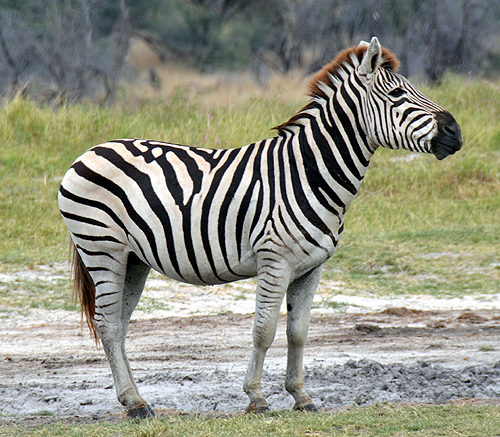
There were some very special sightings as well: Gorgeous, almost super zebra that were red-maned and beige-and-red tailed. With two exceptions, the dozens of times we saw elephant they were all male.

We watched for some time two inter-acting and very large impala families, an extremely curious situation that led some of us to wonder if it were a single super family exchanging harem masters.
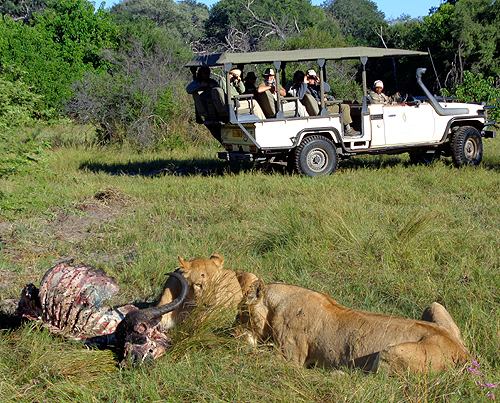
The first lion kill was an extraordinary scene. Somehow the three harassed lionesses with a single vulnerable cub successfully hid their buffalo kill from the rest of the world (except us) keeping vultures, hyaena and competing lions away.

- Bill Banzhaf
– Bill Banzhaf
The weather was perfect for northerners racing from a terrible winter. The hottest days, perhaps touching 90F were in Moremi, where there were also the coldest nights (likely in the lower 50s). But the majority of the days didn’t exceed the mid 80s or sink below the mid 60s. Skies were mostly crystal clear with enough dust for absolutely breath-taking sunsets.

(Note: I actually prefer about a month earlier, when the game viewing is even better. But the temperatures are 5-10 degrees hotter. The dramatic afternoon thunderstorms at that time I consider a real plus.)

- Bill Melville
– Bill Melville

The two extraordinary days in The Delta, with minimal game viewing, gave us the unique experience of a desert in flood and all the beautiful water plants and marsh birds of a special part of the world, of exceptional species like the painted frog, and with opportunities for fishing.

The Pans (Makgadikgadi and Nxai, among many other smaller ones) are equally unique. These are salt pans formed over centuries of heavy water run-off followed by rapid evaporation. So during the rains they are the heart of Botswana’s game viewing, attracting hundreds and thousands of animals.

But year-round the scenery which they define is hard to explain and its stark beauty hard to exaggerate. There is, indeed, a monotony to “starkness” but when properly absorbed it’s spiritual.

Far fewer animals are seen on a Botswana experience than East Africa, although about the same number of species. But the quantity of wildlife in East Africa is so much greater.

When compared with a game viewing experience of similar length in East Africa, this was much more relaxed. Perhaps only half as much time was actually spent game viewing as we would do in East Africa, although the activities were more varied than the vehicle game viewing that dominates an East African experience.

But that needn’t be the case for everyone. East African participants can easily exclude themselves from some game viewing to benefit from the down time that is normally written into a Botswana experience. And enthusiasts in Botswana can with some effort increase their activity time.

On a Botswana safari there is much less interaction with the local people (outside of the staff, of course), in part because there are so few people in the country to begin with. There is virtually no city or town experience of any kind. It is strictly bush.

- Steve Farrand
– Steve Farrand
You fly from camp to camp in Botswana, never drive (with rare and usually down-market exceptions). Most of the time you’re driving from place to place in East Africa, through populated countryside, towns or villages.

But though you fly much more in Botswana than East Africa, the planes in Botswana are much inferior to those in East Africa. That’s a criticism I’ve been leveling at Botswana for years: their planes are configured much too small for the average traveler.

In East Africa your driver/guides meet you at the airport and remain with you until you leave. In Botswana you pick up a new set of driver/guides at each camp.

There are more upmarket accommodations in Botswana (though a good number in East Africa, too) and they are generally better (and more expensive): that usually means larger rooms with more furniture that is also more comfortable. Bathrooms are usually more modern and spacious in Botswana than East Africa. Electricity and wifi is usually more available and reliable in Botswana than East Africa.

The staff and food in both areas is professional and varied, but expect generally better local guides in Botswana than East Africa. On the other hand, guides are very specialized in Botswana, experts in small regions and usually not as familiar with the culture, overall wilderness and current affairs as your guide will be in East Africa.

- Brad Heck
– Brad Heck

Exclusiveness is more likely in Botswana than East Africa. On our safari of 8 days we encountered vehicles other than our own and those of the camp only three times and then very briefly. In Ngorongoro Crater on virtually any day of the year, you’re likely to encounter dozens of other vehicles, sometimes all competing for the best position at the lion kill.

Now having said that, I hasten to add that personally I feel very sensitive about this and usually conduct an East African safari where half or more of the time there are none but my own vehicles. But in a few important places like the crater, that’s impossible to arrange.

Botswana’s scenery is wonderful if mystic. But East Africa’s scenery is more grand and dramatic, from highlands to volcanoes to the expansive plains of the Serengeti.

So the comparison is made but flawed: for your first safari go to East Africa. But once Africa’s taken over your soul, you’ll have to visit Botswana, too!

- Steve Taylor
– Steve Taylor
And, oh by the way, what a wonderful group of travelers I had this time! Remarkably special for me, and something I’ll always remember!

As my two months guiding in Africa comes to an end I’m of course very anxious to get home. But it’s hard to leave the African wilderness.

As a friend and good client, Steve Farrand, said to me, today:

Africa resets your soul. No matter where you’ve been in Africa or where you find yourself next, it’s a spa for the heart and mind.

I think the African wilderness remains so digestible yet unpredictable that you can more easily set aside the nagging responsibilities of the modern world without turning off the inquisitiveness and excitements that earn us success in the modern world.

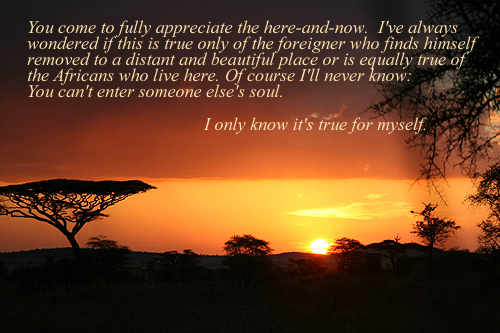
Simply, you come to fully appreciate the here-and-now. I’ve always wondered if this is true only of the foreigner who finds himself removed to a distant and beautiful place or is equally true of the Africans who live here.

Of course I’ll never know: You can’t enter someone else’s soul. I only know it’s true for myself.

- Bill Banzhaf
– Bill Banzhaf

On Safari: Africa’s Magnificent Falls!

On Safari: Africa’s Magnificent Falls!

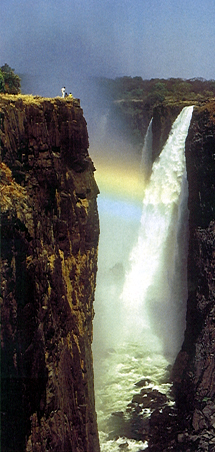
vicfalls.highflood.538.apr11.jimLike Iguassu, Niagra and Angel, Victoria Falls is a stunning creation of nature, a Disney production of Mother Earth, commercialized to be sure yet still a pure wonder.

Imagine an alien world where there is so much water and so many water falls that the prize of a holiday is a piece of highveld Montana. But for us earthlings, sheaves of water tumbling from high rock is so rare that it’s beauty incarnate.

And Victoria Falls couldn’t better fit the description, because it’s likely that visitors here have spent a good amount of their vacation in flat near desert, as we did in the Makgadikgadi and as many others do in the Kalahari, where an errant stream or evaporating pan represents paradise.

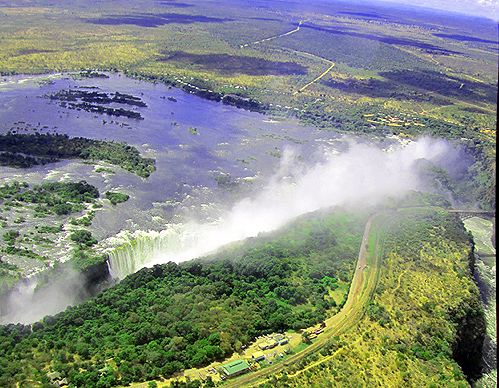
devils.vicfallsThen, suddenly, you find yourself standing in front of a mile of tumbling water! We’re here at high flow. That means well over 100,000 cubic feet of water/second, the most of any falls on earth.

It is neither the highest (that’s Angel) or widest (that’s Iguassu), but because it’s a single curtain of water just over a mile wide and 350′ high it’s usually considered “the biggest.” To be sure it’s the most powerful looking of all the falls. Seen as most of my folks have done, from a helicopter, it’s almost impossible to imagine the amount of falling water.

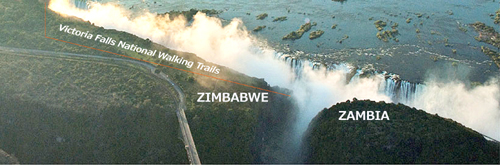
A third of the falls are in Zambia and two-thirds are in Zimbabwe. We’re staying in Zambia, and I haven’t booked any trip to the Zim side since 1999. That’s when the misery of Zimbabwe began, and it’s only gotten worse.

Properly designed, there’s no real personal danger to going to Zimbabwe, but the unpredictable power outages and worse, the unexpected fuel shortages, can terribly disrupt a planned holiday.

But there’s no reason to stay on the Zim side. As I write this most of my folks have walked over the bridge and are spending the day in Zimbabwe and in the prettier and more spectacular Zimbabwean Falls national park.

The only regret I have not staying on the Zim side is not being able to stay at Victoria Falls Hotel, one of my favorite in the world. (My wife and I designed our master bathroom on the VicFalls hotel!)

But my clients have the whole day over there, and they plan to visit the hotel and have a meal or its legendary high tea.

And the accommodations now available on the Zam side are fabulous. We’re staying at a wonderful boutique resort, Tongabezi Lodge, right on the Zambezi River. But there are so many other good options, too.

The Royal Livingstone Hotel was designed to exactly replicate the Victoria Falls Hotel. It does a pretty good job of it, right down to the magnificent dark wood bar. Like the Falls Hotel you can walk down from its backyard to the falls.

All – and actually many more – the activities available from Zimbabwe are available exactly from Zambia. This includes the helicopter touring, river rafting, bungi jumping, microgliding, golf, horseback safaris, fishing (for Tiger Fish!), canoeing or kayaking, elephant back safaris, spas galore, quad biking, discos if you want them … it’s endless. This is a waterfalls resort!

We’ve had a super safari. And while Victoria Falls was only an option, 14 of my 15 people are here, and it’s hard to imagine a better way to relax and remember the exciting times we’ve all enjoyed together!

If ever Zimbabwe rights itself – and I just can’t imagine that happening soon, even if the despot Mugabe dies – Livingstone, Zambia will have so progressed in tourist services beyond Victoria Falls, Zimbabwe, that I think at least for a very long while to come this is the side to stay at.
VicFalls National Park picture

On Safari: Wild Dog Kill!

On Safari: Wild Dog Kill!

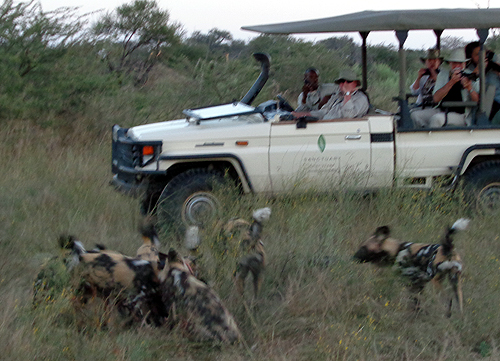
wilddoghunt.apr14.640.chiefs.jimOur final game drive in Botswana ended with a wild dog kill!

The story of wild dogs is one of the most hopeful, positive stories of the African wildernesses! And for us to have experienced it was a totally unexpected bonus to a great safari in Botswana!

We were looking for leopard. In fact, for three hours we were looking in vain for leopard. We had seen all the other Big Five and the driver/guides, especially, were worried that we wouldn’t find numero cinko.

It’s a bane of leading a safari when the trip is winding down and some of the expectations for animal sightings haven’t been met. I’m personally very philosophical about it, and I hope I convey that calm obviousness to my clients, and frankly, I think most of my clients accept it.

But to be sure the bulk of tourists to Africa don’t. They have a checklist to be compared with the friends who recommended they go in the first place, and a competition of successful vacation planning that seems to drive so much American tourism.

And the driver/guides know this well, because they are dependent upon their tips. Find a leopard, and the tip is 50% higher. Maybe it shouldn’t be that way, but that’s the way it is.

And so in my own case it means trying to convey to the driver/guides that my clients aren’t normal; they understand luck in a way a normal tourist might not. With my own drivers in Tanzania I’ve successfully conveyed it, but elsewhere I’ve never wholly achieved that goal.

And so for three hours we bushwacked through Botswana looking for a leopard and seeing nothing else.

Then as the light was falling and no leopard had been found, we raced to the sundowners being set up by one of the three drivers at a pond’s edge.

And as we just came in view of them, I saw the dog.

It was classic. Every wild dog family today is somewhere between 10 and 25 individuals if there are juveniles. The family is composed of the alpha female and male, perhaps several of the males siblings or cousins, and the juveniles.

We arrived on the scene with 9 juvenile dogs strung all over the place and impala snorting and pronking and prancing in every which direction. This is typical. The hunt normally begins at sunrise or sunset (except when there’s a full or almost full moon, then maybe at night, too), and the juveniles are the ones who begin the hunt.

Most all of the time the prey is impala.

And right after beginning the assault, the juveniles get kicked to near smithereens. I immediately saw two juveniles limping. One had his right foreleg dislocated and the other was limping on his right rear leg.

The impala scatter helter skelter freaking out. The alpha female or male then chooses a target individual and chases it up to speeds of 40 mph (twice the speed of an impala) and brings it down. That we didn’t see.

Four out of five attempts are successful. That makes the wild dog the most successful killer on the African veld. (Lions are successful maybe 1/4 or 1/5.)

The alpha adult then lets out a single high-pitched hoot. We didn’t hear that, but we immediately saw the reaction: The 9 juveniles immediately perked up and began running in near formation towards the call of victory.

The alpha female came out of the bush and met them at the edge of a pond and regurgitated a bit of the proof that the impala was down.

They all got instantly hyper, defecating and jumping in the water, raising their tails, prostrating themselves to each other, whining in a hectic, frantic 15 or 20 seconds of celebration before then all running off back to the kill.

We followed through the bush and there the alpha male was eating, but he stopped to let the younger of the family consume what was left of the impala.

Literally in two minutes it was all gone. And it was nearly dark. Likely they would do it all over again before complete darkness, since it was hardly enough, but we had to go.

What an extraordinary way for us to end a fabulous safari in Botswana!

On Safari: Botswana’s Big Game

On Safari: Botswana’s Big Game

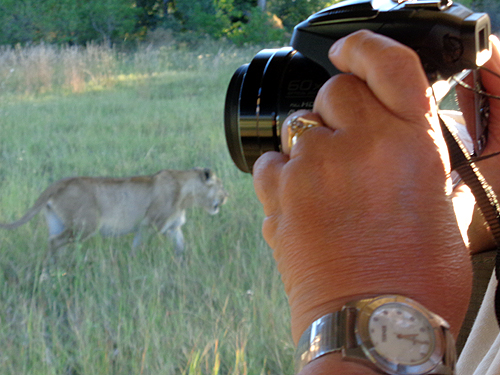
photographingLION.chiefs.640.apr14.jimIt isn’t just game viewing, it’s the extended stories about what you’re seeing that make the wilderness so fascinating.

As expected our best big game viewing in Botswana occurred in the Moremi Game Reserve, for us on Chief’s Island. On our first game drive we encountered a lion kill of a smallish female buffalo.

There were three mature lionesses on the kill with one squealing cub that couldn’t have been more than 2½-3 weeks old. That in itself was interesting, since lion litters are routinely 5-7 cubs of which usually 4 survive for at least a month; plus the fact that normally mothers won’t display their cubs at quite this young an age.

But there was only one cub, and when we arrived all three lionesses were leaving the kill to water, and the poor cub was squealing louder than a pig at slaughter. As the lionesses lumbered through the grass, their distended bellies slowing their gate, the poor cub was jumping madly after them while falling behind.

The mother didn’t seem to care. It was clear which was the mother, since her mammary glands were bursting at the seams: an indication that she’d lost all the others in the litter already, and a further caution that the poor remaining cub could be endangered by her producing too much milk.
BillWatchingEle.Chiefs.640.Apr14.jim
Later she’d try to nurse the cub, but he was as round as balloon and had obviously already had his fill. In such a situation, her glands might infect.

Finally the cub just couldn’t keep up. He turned back into a nearby forest and toned down his whining. The females proceeded to a puddle of a waterhole, probably dug by an elephant, and drank their hearts out.

The cub started to squeal, again, and as the mother got her necessary fill of water, she perked up to listen to him. Either she was sated with water or anxiety, and left the other two lionesses to find her cub and bring him back to the kill.

Several times she tried to pick him up as lions routinely do, but for some reason she’d drop him after just a few short instants. I don’t think it was anything he was doing, because once in his mother’s mouth he went totally limp as cubs are wont to do.

And why she was bringing him back to the kill was another mystery. He was far too young to eat, and the kill was an invitation for battle. The lionesses had carefully buried the intestines in sand to reduce the smell, and they’d pulled the carcass into a bush, but the vultures on the trees were proof their treasure had already been discovered.

At the kill the little tyke rubbed and rolled all over mom, but despite her attempts to get him to nurse, again, he was just too full.

Finally the mother lioness got too nervous and disappeared into the forest with her cub, and the whining stopped.

The background supplied to us by the Chief’s Camp drivers helped enormously to understand exactly what was going on.

The three lionesses were two daughters of one mother, and they had never successfully reared cubs. The daughters were about 4 years old, so that in itself was unusual.

The three were constantly harassed by the males in the area. The current pridemasters, two younger males who we never saw and were reported to be “patrolling” the perimeters of their territory and were unaware of the buffalo kill, had dislodged a single pride master several years ago and killed four of his cubs.

This is common lion behavior: a new pridemaster kills all the cubs of the previous pridemaster.

The current little cub was from the first litter sired by one of the new pridemasters, but one of the guides felt that one of the pridemasters might kill the cub (and might have killed the cub’s siblings already) because he was not the specific one who sired him.

That’s interesting but as far as I know undocumented behavior. Multiple pridemasters are almost always brothers or cousins from the same family, and if the theory of natural selection which explains pridemasters killing cubs really governs behavior, then they would be close enough genetically to accept each other’s progeny.

The first successfully raised litter is always the most challenging for the mother lion. It could be that multiple conditions, including the unnatural floods of the last several years as well as the constant male harassment, just rattled the young mom too much.

On the second day we saw the lionesses finish off the carcass. Killing a buffalo is no small feat even for three lionesses, and their still raw wounds attested to that. But since the pridemasters never found the kill, the females gorged themselves to their hearts content.

We left the scene with the rollie pollie little cub feisty and healthy. But I know his chances of survival aren’t good, given the stress filled scene we’d been so lucky to explore these last few days.
LionKill.chiefs.640.apr14.jim

On Safari: The Okavango Delta

On Safari: The Okavango Delta

BBarrett.OKDelta.Apr14.640.JimGuides make or break a wilderness trip, and this is so much truer in places like the Okavango Delta, which is difficult to truly appreciate without adequate interpretation. Fortunately for us our guide here was outstanding.

Think of the Okavango Delta as similar to the Everglades or Amazon. Of course it’s as different as it is the same as these other wildernesses, but in all three cases the particular feature is a unique biodiversity that isn’t immediately apparent, visually overwhelming because of the density of plants, and at least some of the year with a very uncomfortable climate.

Jungle, in other words.

The Delta is a “jungle” swamp, the outcome of the enormous flow of water coming off Africa’s ridiculously off-center continental divide spilling over the Kalahari Desert. And because the Delta’s flow from year to year can be so radically different, the topographical features are constantly changing. With a few major exceptions like the enormous land mass in the middle of the Delta called “Chief’s Island” the water channels, smaller islands, thousands of lagoons and marshes are in nearly constant flux.

To make things even more complicated, there is no Okavango Delta defined by any wilderness area or natural geography. Moremi Game Reserve includes part of The Delta, but since the Delta changes from year to year, you can’t buy a map of the static Okavango Delta. And as a result, numerous camps and lodges call themselves Delta camps with some abandon, and many visitors to Botswana believe they have visited The Delta when they probably haven’t.

The guide makes or breaks a Delta trip.
We stayed at a real Delta camp, Xugana Lodge. The island on which the lodge is situated is surrounded by water, as you’d expect, and so vehicle game drives aren’t possible. Everything must be done by boat, although there are a few nearby islands where the boats drop folks for walking.

Birders have no problem appreciating the Delta. We have been particularly lucky, catching several migrants that would normally have left by now, such as the Greater Marsh Warbler. But the resident species from the African Fish Eagle to the spectacular Malachite Kingfisher are abundant and relatively easy to find. Truly rare birds like Pell’s Fishing Eagle are becoming so popular that their whereabouts are often known throughout the year.

There are animals in The Delta, to be sure.

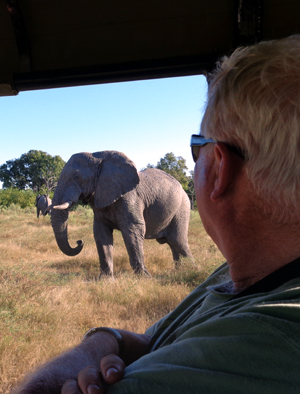
We saw quite a few elephant, which of course seems to be true everywhere, today. But the elephant are essential in cutting out the channels from year to year. As the flow declines in September and October, the elephants choose paths through The Delta that are likely to become next year’s channels.

We also saw the water animals, the red lechwe and puku, two land antelopes that survive at water’s edge. We hope yet to find the rarer sitantunga, an antelope that remains in the water most of its life, has webbed feet and births in a nest of reeds.

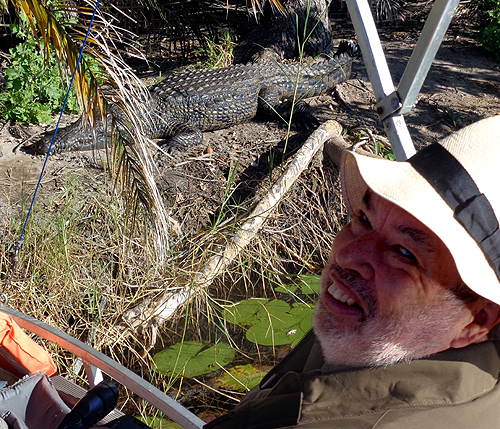
We got remarkably close to a 3-meter long croc that had recently feasted and was deep into dormancy. And hippos are virtually everywhere, sometimes as in our case, right outside our bungalows!

But despite this panoply of bigger game, it is never as abundant or visible as in any more common wilderness reserve like The Pans from which we just came, or to Moremi Game Reserve to which we’re heading tomorrow.

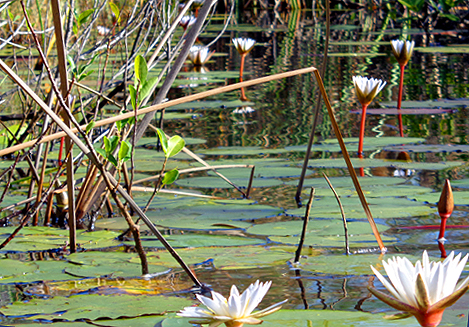
So the essential appreciation comes from learning about the intricacies of this mighty biosphere. Our guide explained at length the flows of The Delta and how that sculpts the landscape from year to year. He taught us about the water lillies, and how the two main species complement each other opening and closing at day and night. We tracked the path of ancient elephants by the unusual stands of palm trees, and most popualr of all, held the half-thumbnail size painted and long-toed frogs, whose voices exceed most normal lake frogs at home.

We caught brim and cat fish and fried them up for dinner! We watched Pied Kingfishers and Fish Eagles dive for their prey. And we enjoyed our sundowners overlooking our own private lagoon, literally miles from the next tourist outpost, providing that essential remoteness that allows the casual visitor to understand the intractable power of the wild.

On to Moremi! Stay tuned!
OKDelta.Apr14.640.jim

On Safari: The Remarkable Pans

On Safari: The Remarkable Pans

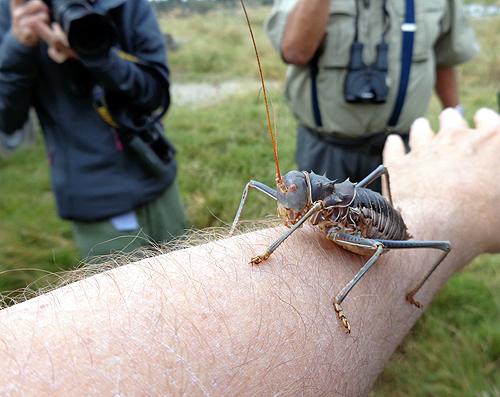
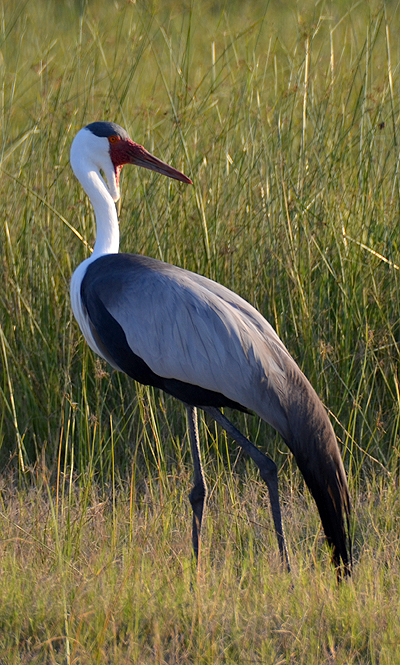
GiantCricket.Botete.Apr14.640.JIMWhat surprising things we saw in the Makgadikgadi Pans! Red maned zebra, giant crickets, wattled cranes, tons of ele, and what’s left of the Botswana migration.

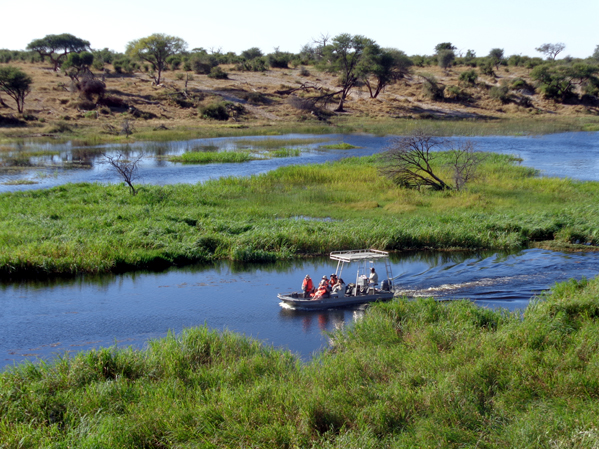
We stayed at a relatively new lodge on the Botete River, a river that had all been lost more than 30 years ago when Lake Ngami dried up.

WattledCrane.Botete.Apr14.640.FarrandBut three years ago it was in full flow once again, as it had been for centuries, and the animals returned!

The Botete defines the southwestern boundary of Makgadikgadi Pans national park. Together with Nxai Pan and a bunch of smaller pans this contiguous area is one of the most unique in the world.

During the heavy rains in the beginning of the year, these pans pool ever so slightly with water. The Kalahari sand soil drains water quickly, though, and without the constant thunderstorms of January and February, the pans are often dry.
BoatingontheBotete.640.Apr14.Jim

At that point they resemble any great sand lake depression found around the world. Their uniqueness comes from the precious sets of grasses and plants that flourish at the perimeter of the pans and bloom in the rains.

This attracts the herbivores and triggers their migration from more wooded areas with more permanent sources of water. But the extraordinary nutrition of these new grasses and plants is just what the zebra and wildebeest need as they prepare to calve.

The destructive veterinary fences erected throughout Botswana in the last half century destroyed most of the herbivore migrations and greatly reduced their numbers. But what’s left now moves between the Kalahari and the Pans, and we caught it on its southern movement from Nxai Pan towards Makgadikgadi Pan, the shift triggered by the end of the rains and the onset of winter.

We saw the migration happening during a long day trip from our camp in the Makgadikgadi north via Baine’s Baobabs into Nxai Pan.

What we saw were dozens of elephant and probably a hundred giraffe all methodically moving south. Zebra are actually supposed to be the bulk of the migration, and we did see dozens but not more. But among those we did see was a striking red-maned zebra with a red-and-beige tail!

I’ve seen unusually colored animals throughout my career, including white and silver haired lions, and even a white wildebeest. But I’ve never seen a primary color variation as with this particular zebra. There was no doubt it was natural, as he had just swum across the Botete and thoroughly soaked himself.

In Nxai Pan we saw the lingerers, good numbers of wildebeest and zebra. They were nibbling at the last of the green grass. We also saw lots of springbok in Nxai that will not migrate, plus a good number of gemsbok.

Botswana, like all of the southern African countries, maintains “boreholes” (well stations with automatic pumps) throughout their national parks. These are specifically designed for the wild animals to help them cope and prosper in the very intensely dry winter of southern Africa.

It’s a wildlife management technique that remains controversial, but the fact is that without these boreholes there would be so few terrestrial herbivore herds left in Botswana, and so many fewer lion families, that big game would be drastically reduced, limited to the Delta, the area’s few natural aquifers and river systems.

Without boreholes, the Pans would of course retain their mystical beauty, but would essentially be without much big game. Whereas what we were lucky enough to see, while not approaching the concentration of East Africa’s herds, was certainly as good or better than anywhere else in southern Africa.

And the remoteness, otherwise untouched and harsh beauty of this fragile area of our planet, is an absolute wonder to behold.

And now, onto The Delta! Stay tuned!
RedZebra1.Apr14.Botete.640.Farrand

On Safari: White Reflections

On Safari: White Reflections

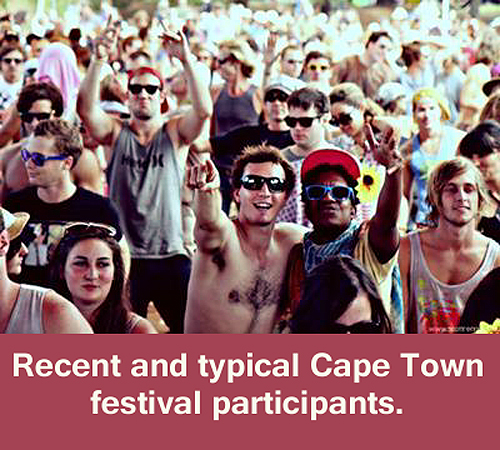
cape-trance-parties-south-africa-21496404What I will remember mostly of our just ended week in The Cape is how white South Africa looks.

I hasten to make no judgment about this right away. But the facts speak for themselves. For a country less than 5% technically Caucasian, easily 80% of every one of our days was populated by whites only.

Now obviously we were tourists and visiting tourist destinations, and in today’s world where we as Americans routinely visit, the overwhelming percentage of tourists are white.

The Waterfront area of Cape Town had a greater diversity as it should since this was a major national holiday weekend. But I dare say it never was a majority of other than white faces.

Television presenters were mostly nonwhite, but television guests were mostly white. The South African business meetings that intersected our own holiday making at the wonderful Lanzerac Hotel in Stellenbosch were nearly all white.

The beautiful beach suburbs and Table Mountain suburbs of Cape Town with their elegant mansions and beautifully manicured lawns are almost exclusively white.

And Stellenbosch itself, until you actually drilled into the college campus, was a town filled with white tourists and residents and even a majority of wait staff and store owners who were white.

It’s less than two weeks before the next important national election, and it’s been twenty years since apartheid ended. On our trips to and from Stellenbosch, the airport and The Cape Peninsula we passed multiple times the “Cape Flats” – an endless, it seemed, sprawl of mostly tin housing.

They were not white.

There were hopeful signs at various points of public housing moving forward, but it was mostly an unbelievably large, sprawling slum.

I am constantly amazed at the patience of the African, of his ability to suffer, and I try to be inspired by the overarching hope that must sustain that patience, because contrary to many detracting commentators, it is not some innate futility of personality. It’s patience.

And it’s forgiveness, as embodied by the great clergyman, Desmond Tutu.

But such humility and spiritual generosity does not alone a progressive society make. This election cycle is different from the previous in the rancor of its competitors and in the threats of those slipping in the polls (like the ANC) to redistribute “white land.”

Ultimately that will happen if social progress isn’t sped up. We listened throughout the week to our older white guides lamenting the departure of their white children who were unable to obtain decent jobs in a South African society currently heavily weighted with affirmative action.

Yet while those children may be gone and the opportunities for nonwhites improved, the visible whiteness of The Cape remains striking and surprising.

History is neither a liar or a fool. The stories of the past are clear, and while the patience of its peoples differs greatly, it will not sit back and wait for promised equality forever.

Whether it means yet higher taxes to speed up national housing, or some painful land redistribution or even more radical wealth distribution through controversial methods like nationalization, South Africa in my view must makes some radical turns to defuse its tinder box.

The explosion may not be imminent, but it is inevitable if its leaders are unable to speed up the process of promised equalization.

Jim and his group spend the next week in Botswana which unlike so much of Africa has very limited internet connectivity. AfricaAnswerman’s blog posts will likely be delayed.

On Safari: Flying High!

On Safari: Flying High!

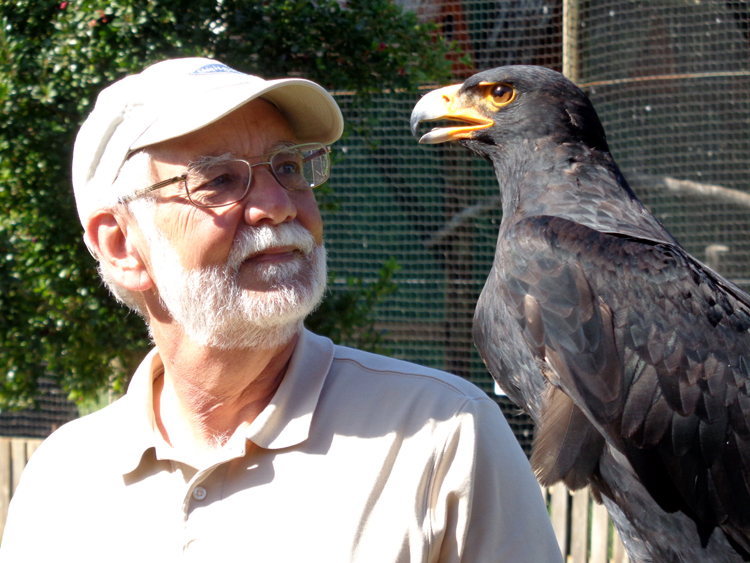
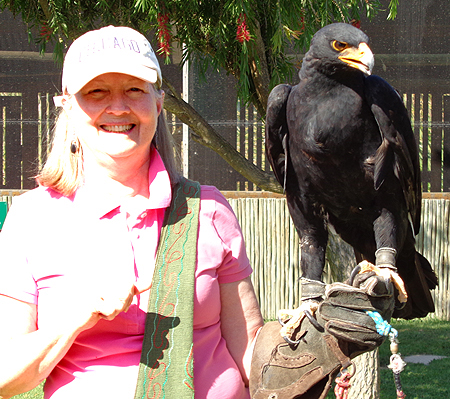
SFarrand&BlackEagle.640.14aprOur several days in and around Stellenbosch ended with exciting “Eagle Encounters” at The Cape’s premiere raptor rehabilitation center.

Everyone got to “let an arm” for great birds to perch on. The center takes in about 400 birds annually, of which a remarkable 65% can be rehabilitated and released into the wild.

NSullivan&BlackEagle.640.14aprThe remainder, most of them house pets, can’t fend for themselves and become part of the public exhibit.

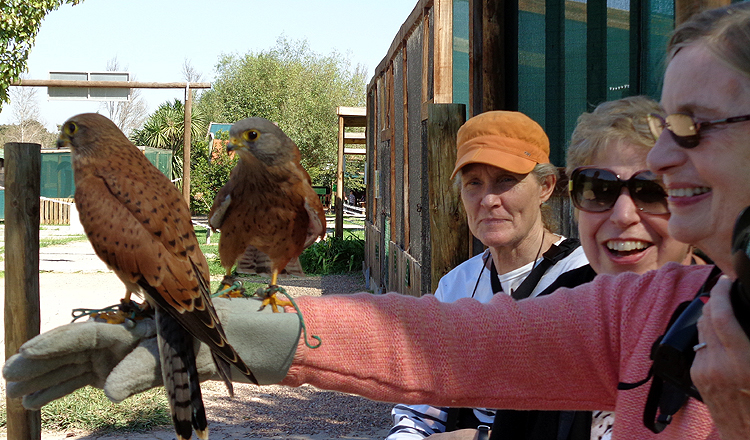
We got a private demonstration of rock kestrels, barn owls, jackal buzzard, the magnificent Black Eagle, and the extremely endangered Cape Vulture.

We were shown how to handle all the birds but the vultures, which are simply too big for an untrained handler.

The “wine country” of The Cape is often poorly defined as, in fact, almost every part of The Cape from the very edge of the city to the Karoo has beautiful wine estates.

Even to refer to the triangle between the wine producing cities of Franschoek, Paarl and Stellenbosch as “the wine country” is also somewhat misleading, because Stellenbosch in particular is considerably more diverse than simply a wine and farming community.

Stellenbosch, in fact, is one of the most historic parts of South Africa and any attempt to understand the country’s complex history would be impossible without understanding Stellenbosch.
joan and john wine tasting
Today the city is principally known as the seat of Afrikaans and as the city of the country’s principal Afrikaans university.

Certainly one of the most conservative if rigid communities in South Africa, a simple glance at the city and university complex proves that diversity is pressing in. I remember hardly twenty years ago seeing a great divide in racial color here: waiters, drivers, even traffic cops were black, but virtually every student, consumer and tourist was white.

That’s changed and today a casual glance into the campus of the University of Stellenbosch reveals a rainbow of people. Unfortunately, this doesn’t continue into the town, where white tourists and white long-term residents seem to dominate the buying part of the equation, with black seeping into only the sellers side.

We enjoyed several days here, staying at the beautiful if near perfect Lanzerac wine estate. We enjoyed several wine tastings in the region and a cellar tour. There are hundreds of wineries in The Cape and the vast majority are very small, producing hardly 50,000 bottles annually. But this smallness translates into an incredible array of wines and also maintains a historic uniqueness from one winery to the next.

The scenery in the area is awesome, with jutting sandstone mountains and perfectly manicured vineyards laid on the semi-arid slopes.
jMiller&rickkestrels