Sick Kids in Dirty Smelly Homes

Sick Kids in Dirty Smelly Homes

indigenuousTourists who want to see a “primitive village” are people who know dangerously little about the outside world.

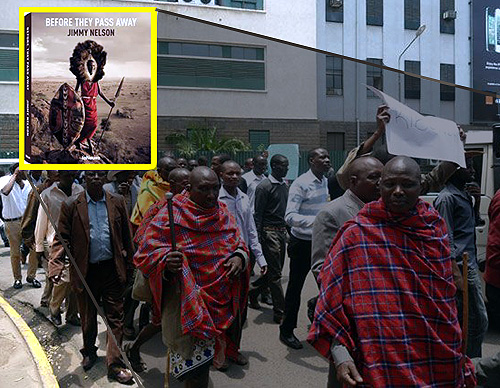
One of the most successful cocktail table books to ever be published that includes much from Africa is Jimmy Nelson’s Before They Pass Away. I’ve had the book since it’s been published and its value just increases daily.

But criticism of the book and its exponential earnings curve has reached a crescendo. Indigenous people around the world are growing more and more incensed the more popular and famous the book becomes.

The unending appearances by Nelson with his original prints, which are routinely now auctioning for more than $150,000, now regularly include indigenous people protesting outside the galleries and bookshops hosting the exhibitions.

The protest campaign is being led by Steven Cory of Survival International. The organization publishes a running critique by indigenous leaders around the world of Nelson’s book.

Cory calls the book “hokum” and “hubristic baloney.” Cory points out that the so-called “primitive people” who still exist are hardly going to “pass away” and in fact are becoming more and more politically powerful.

“If his images look like they come from the 19th century, it’s because they do,” Cory concludes. None of the peoples exist today the way Nelson portrays them: Cory documents that Nelson’s photo shoots are all carefully staged, rearranging reality to what rich westerners want to think about people in remote parts of the world.

The people who make Nelson’s book so valuable, and my clients who insist on seeing Maasai villages, are not by any means bad people. There’s a good motivation and a bad motivation resident in most of these folks’ desires.

The good motivation comes from a self-recognition, an admission if you like, of their global myopia. It’s extremely encouraging that travelers go somewhere blind, worried possibly at how little they know but hungry to know more.

The bad motivation is a deeply set racism. The tourist thinks of herself as so much more intellectual, skilled, trained and educated, than the so-called “primitive person.” She wants to see this “with her own eyes” precisely to validate this lofty presumption about herself.

Unfortunately tourism’s response is so out of whack that the initial, well-meaning desire by good folks is cast aside to the more marketable validation of primitiveness.

So there are hundreds of “villages” that charge excessively high rates that tourists dole out without a blink so that they can see sick kids in smelly, dirty homes. It’s absolutely incredible how fooled tourists can be.

It’s infinitely easier to show a tourist in a half hour a sick kid in a smelly, dirty home, than convey to them how the Maasai Environmental Resource Coalition (MERC) is saving the ecosystem for the whole world or how Twaweza is providing better education to all children in East Africa.

What I’m saying is that there would be many, many fewer sick kids in smelly, dirty homes if there weren’t so many tourists paying to see them.

Or if there weren’t so many people paying so much for Jimmy Nelson’s book.

Devilish Democracy

Devilish Democracy

doublespeakDouble-speak infects more than Republican candidates for president. Take Obama’s undersecretary of State who just called Ethiopia “a young democracy.”

The political art of saying something you don’t believe or not saying something you believe, and then mixing it altogether to avoid responsibility for either position, is little more than a ploy that I think we all get.

For me it’s a turnoff, a reason to criticize and withdraw support. The flipside is just as definitive: it’s why I wish Americans would elect more Senator Warrens and Feingolds.

But politicians do it because it works. They bolster existing support or garner new admirers who apparently “don’t get it” that double-speak is the ploy that entraps them.

Ethiopia has an election scheduled for next month. As with all elections in communist and authoritarian states these are political shams, not real elections. There are no opposition candidates.

It is like the “caucuses” that choose the leaders for most of Chicago’s north shore communities, from mayors to school board presidents. A group of ‘learned leaders’ gets together and chooses single candidates for each position who then run in “an election” without opposition.

Obama’s Undersecretary of State, Wendy Sherman, was captured on video in Addis Ababa recently declaring that “Ethiopia is a democracy that is moving forward in an election that we expect to be free, fair and credible.”

The Washington Post called her remarks, “startling.”

The Global Peace Index ranks Ethiopia 139 of 162 countries analyzed. The index is determined by a country’s “absence of violence.”

Ms. Sherman, undaunted, replied with a letter back to the Post which began, “Ethiopia is a valuable partner in a critical region, from peacekeeping to fighting al-Shabab to pursuing peace in South Sudan. Ethiopia, among the world’s fastest-growing economies…”

Now in fairness to proponents of double-speak, it’s not known exactly what mistake Ms. Sherman made. Did she misspeak when saying Ethiopia was developing a democracy? Or did she not intend that her remarks get home? In other words was this double-speak to build a relationship with a regime that is one the most ruthless on earth?

There is no real election coming up. It will be rubber stamping the current regime with a fraudulent tabulation of presumed voters.

Human Rights Watch explains why there could not possibly be a real election:

“Thirty journalists and opposition members” are in jail for criticizing the government, “security forces responded to protests by Muslim communities with excessive force and arbitrary detentions.

“The Ethiopian government continues to forcibly resettle hundreds of thousands of rural villagers… relocating them through violence and intimidation.”

But guess what? Ethiopia’s doing well, economically. Guess what else? It doesn’t like al-Shabaab or al-Qaeda. More and more economics and the “war against terror” seem to be the sole bases by which societies most admire one other.

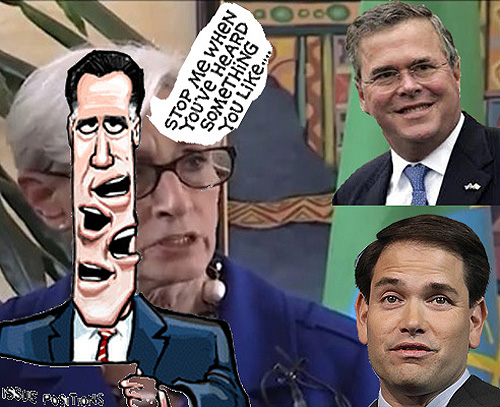
Jeb Bush and Marco Rubio will not say or will not not say whether invading Iraq was right or wrong, but through mastering double-speak they will say everything but. (I’m beginning to wonder if the real reason for the Iraq War was that GW knew without one we would fall into the Great Recession, which we did just as a new president was arriving to stop it.)

Here’s my dilemma with regards to Ethiopia – or China at the bottom of the scale of democracy and human rights – all the way up to the presumed clarion caller, America:

What if the electorate is fooled? What if the electorate is stupid? What if the electorate is illiterate? What if the electorate doesn’t even know what it’s voting for? What if results are misread like in Broward County in 2000?

Democracy can really screw up a good situation. As Ms. Sherman was quick to point out in her reply letter to the Post, Ethiopia is reducing poverty and providing social services to its population at a remarkable rate. Much faster, for example, than democratic Zambia or Liberia.

If suddenly all of China, including half the population that can barely read or write or even understand the native language of the candidates, were allowed to vote, what would happen?

Is democracy more valuable than children’s full stomachs? More valuable than peace?

New Travel Warning

New Travel Warning

APTOPIX_Waco_Shooting-06698-2966In light of yesterday’s events in Texas, the Kenyan Department of State warns Kenyan citizens of the risks of travel to the United States.

Kenyan citizens living in the United States, and those considering travel to America, should be aware of continuing and recently heightened threats from terrorism and the high rate of violent crime in some areas.

Although thousands of Kenyans live and visit the U.S. each year without incident, caution and keen awareness of one’s personal security situation is vitally important. Terrorist acts can include suicide operations like the University of Oklahoma disaster, car bombings as in Times Square, New York; thousands of kidnappings, and attacks on civil aviation.

Militias in the U.S. like the affiliates in Waco, Texas, yesterday, duke it out like Shia and Suni all over the country.

Just this year alone, there have been more violent attacks involving shootings, grenades, or other explosive devices in the United States, killing tens of thousands of people and causing injury to hundreds more, clearly defining America as the most violent nation on earth.

Much involves the ease with which anyone in America can obtain a very destructive weapon. There is no other country in the world which allows such free enterprise in deadly force.

As Kenyans know well, at least two of the 6 attackers of the Westgate Mall attack came from Minneapolis.

The American FBI working with local police forces have disrupted several other terrorist plots throughout the country, which may have prevented additional deaths and injury from terrorist attacks. Although the pursuit of those responsible for previous terrorist activities continues, some of those involved remain at large and still operate in the region.

Ethnic clashes sometimes occur in various parts of America, primarily in America’s south like Ferguson, Missouri, and many parts of Florida which is otherwise considered an important tourist destination; as in Waco.

Keep in mind regarding Texas, that there was no ebola in Kenya recently, but there were several cases in Dallas.

The violent clashes in America are often fueled by disagreements over land or ownership of what militia’s call “turf.” While this violence is not directed at foreigners, ethnic clashes and protests are unpredictable and may affect non-Americans. Kenyan citizens are advised to check conditions and monitor local media reports before traveling to these areas.

Violent and sometimes fatal criminal attacks, including armed carjackings, grenade attacks, home invasions and burglaries, and kidnappings can occur at any time and in any location, particularly in large cities like Chicago which has the highest crime rate in the country, much higher than cities of similar size in other parts of the world.

Kenyan citizens in the U.S. should be extremely vigilant with regard to their personal security, particularly in crowded public places such as clubs, hotels, resorts, shopping centers, restaurants, bus stations, and places of worship. Remain alert in residential areas, at schools, and at outdoor recreational events. Use commonsense precautions at all times, to include the following practices: avoid crowded transportation venues; visit only legitimate businesses and tourist areas only during daylight hours; use well-marked taxis and be sure to lock vehicle doors and keep windows up; lock all lodging doors and windows; carry minimal amounts of cash and credit cards; do not wear jewelry which attracts undue attention; know emergency phone numbers; do not resist or antagonize armed criminals; and always be aware of your surroundings. These measures can help prevent a “wrong place, wrong time” scenario in the event of an attack as well as ensuring that your travel to America is safe and enjoyable.

* * *
There is, of course, no Kenyan “Department of State.” The spoof above was taken directly from the most recent travel warning issued by the U.S. Department of State to U.S. citizens contemplating travel to Kenya: click here.

The Man is Back

The Man is Back

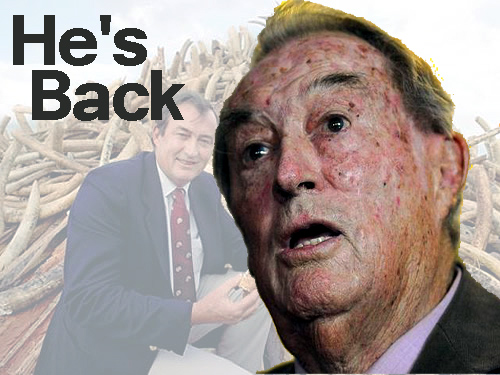
richardleakeybackRichard Leakey is back. Not as the paleontologist. Not as the politician. As head of Kenya’s Wildlife Service. Window dressing at its finest!

Leakey is a very enigmatic character. I immediately disliked him during our first meeting in the late 80s when he was flying high as the architect and czar of the movement that was successfully stopping elephant poaching.

His accomplishments were many and a few years later he would demonstrate some exceptional personal courage when he was nearly assassinated while trying to develop a progressive political party in a country that at the time was being run by an iron-fisted dictator.

But he has had a lot of missteps in a variegated career that spanned science, wildlife administration and raw politics.

That’s his critical flaw: doing too many things, so doing nothing exceptionally.

Last month Kenya’s president, Uhuru Kenyatta, appointed Leakey “Chairman” of the service that he founded almost 30 years ago, the Kenya Wildlife Service.

The position is similar to the chairman of the board of a corporation, so technically Leakey is not supposed to be involved in the actual running of the now massive organization. Local observers, however, think he might have more proactive inclinations.

Nearly fifteen years ago London’s Guardian newspaper asked if “there is any more fight” left in Richard Leakey? Leakey was certainly in the nadir of his many careers then. He was never charismatic like his father, but his public persona had just taken a whipping when he mysteriously resigned from the head of a “dream team” America helped create in Kenya to battle corruption.

His health is reported even worse than when I last met him at the Field Museum in Chicago on the anniversary of his father’s 100th birthday in 2003. Then, he seemed hardly able to talk.

I think Kenyatta appointed Leakey, so soon after a stream of American celebs including Kerry and Clinton visited Kenya, to reconnect with America and the west. Leakey, and his father Louis, are adored in western circles where they had extraordinary success fund raising.

Kenya is in a bit of a slump right now. The vicissitudes of Americans not understanding the ebola situation, the recession in Europe from which the bulk of Kenyan tourists have always come, and the lingering worries about terrorism following the country’s invasion of Somali four years ago have all combined to really challenge an otherwise dynamic economy.

Kenya Airways, which I think is one of the finest if not the finest airline in Africa, came under government scrutiny today for losing more than $100 million dollars last year at a time when most global airlines were making tons of cash.

Relying more and more on outside foreign aid, particularly because of the Somali invasion, Kenya’s internal engines are sputtering and Kenyatta recognizes that only foreign investment will reverse this.

IBM, for example, has yet to fully fund a major Kenyan investment that it announced in 2012.

In my opinion none of this heralds any real crisis but simply demonstrates how susceptible a young emerging nation is to western fears.

“Poaching” is a topic that still commands American attentions. Africans understand much better than westerners that there really isn’t an elephant poaching crisis right now. But westerner’s insatiable need for crisis has narrated a different story, and Leakey is still known as the pivotal character that stopped the real elephant poaching of the 1980s.

Savvy President Kenyatta understands he has to now stroke American psyches. Appointing Leakey is part of this strategy.

Basic Burundi

Basic Burundi

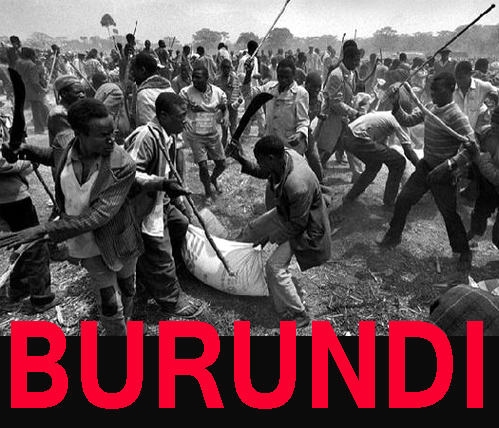
BurundiThe conflict in Burundi, as previously in Rwanda, is ethnic, aggravated by horrific colonial rule and current western disinterest.

Unfortunately my position is more aligned with global right wingers than the left-leaning media, which argues forcefully that this is not an ethnic but a political conflict.

On the surface that’s obvious. The current president, Pierre Nkurunziza, was out of the country when a coup was staged by a demoted military officer, Godefroid Niyombare, and both are Hutus. Like Rwanda, 85% of the population is Hutu, 15% Tutsi.

Niyombare staged the coup after growing unrest in the capital that followed Nkurunziza’s announcement that he would seek a third term as president in upcoming elections.

The constitution restricts individuals to two terms as president. Nkurunziza contends his first term was not really a term, since he came to power on an agreement that ended a 13-year old violent conflict between Hutus and Tutsis. He argues that since only his second term was from an election, he should be given another election chance.

Niyombare was head of the intelligence service when Nkurunziza announced this, and he publicly opposed it. The president then sacked him.

So, yes, on the surface it seems like it’s Hutu against Hutu.

Dig deeper.

The UN announced several days ago that more than 50,000 refugees were fleeing Burundi: 25,004 to Rwanda, 17,696 to Tanzania and “almost 8,000″ to the South Kivu province in the Democratic Republic of the Congo.

Rwanda and Tanzania are considered friendly to Tutsi, and the DRC friendly to Hutu. Check the numbers. The easiest way to flee the country of Burundi is to cross over to the DRC. There are virtually no formalities on the northern route to Uvira, and more than half of the country’s western side is Lake Tanganyika, an easy crossing west to the DRC.

Why, then, so few refugees into the DRC? And so many into Rwanda and Tanzania?

The answer is obvious. Regardless of the political specifications at the surface of the current conflict, the population fears a genocide against Tutsis.

Burundi and Rwanda were originally a single colony of Germany before World War I. Like all the European colonial powers, Germany considered its mandate one of civilizing a primitive population of inferior people.

Africa colonization was aggressively driven by the private German, French, Belgian, and British businesses that were anxious to exploit the continent’s massive natural resources. European governments, however, were very reluctant to do so, but business required an ordered society and business prevailed over their weary governments.

Soon these four great European powers were competing with one another for more control and influence over the African continent, justifying the enormous cost to European electorates as a humanitarian one, creating civilization from barbarians. All the while European businesses were conducting some of the most unimaginable exploitation of people and resources.

This model for development required the colonizers to determine levels of “civilization.” European powers made public pronouncements of which ethnic groups showed more potential or initiative, and/or greater subservience to colonial oppression. In virtually all cases the local ethnic power was accepted in whatever state the European governments found it at the time colonization began.

In the Burundi/Rwanda area, the Tutsi while only 15% of the population were the most educated and most powerful. Tutsi ruled.

Following Germany’s defeat in World War I, the League of Nations divided its massive East African colony between Belgium and Britain.

Britain got what is now Tanzania, and Belgium got what is now Burundi and Rwanda. Belgium governed its area as a single colonial country, Ruandi-Urundi, and soon became the most notorious offender of human rights of the entire colonial period. Read Leopold’s Ghost.

For more than a millennium Hutus and Tutsis shared a single language and most life ways and traditions, and they intermarried frequently. But the Tutsis were always the overlords, and the Hutus were the workers and sometimes, slaves.

For centuries, some suggest two millennia, the minority Tutsi ruled the majority Hutus. More workers were needed than overlords, and whether by design or default as the centuries passed, the population of Hutus grew much faster than Tutsis.

By the time Belgium took over the area after World War I, there were between 5 and 6 times as many Hutu and Tutsi, even though the Tutsi ruled. Some claimed that over the centuries as Tutis numbers declined relative to Hutu, that the Tutsi felt they had to become more and more authoritarian.

World War II ended the colonial era.

Europe had to rebuild itself. There were no resources to continue colonization, despite the continued pressure by businesses to do so. Every colony was put on a fast track for independence.

The easiest way to do this was to further institutionalize the ethnic stratifications that had begun nearly a century before. Belgium decided the best thing to do was to create two countries and encourage the Tutsi to go to one (Burundi) and the Hutu to another (Rwanda).

Burundi was given to a Tutsi clan as a monarchy. In Rwanda, however, Belgium insisted on an election, and guess, what, the Hutus won. (The 1993 genocide changed that and Rwanda has been governed by a single Tutsi dictator ever since.)

But the division was unfair to begin with. Both countries are about the same size, yet the Tutsis were outnumbered by Hutus 5 – 6 to 1. Quite apart from the politics and attempted segregation, it’s not easy to get families and small businesses to leave homelands they’ve occupied for generations.

So essentially ever since independence the area has been in constant turmoil as the Hutu/Tutsi conflict only grows worse, not better. It was historical. It was reenforced and aggravated by colonial policies.

And Bill Clinton’s refusal to intervene and stop the 1993 Rwandan genocide before it was too late recreated the worst of this ethnic divide in the modern era.

I see no end to this ethnic divide. But if Barack Obama recommits the error of Bill Clinton should the situation in Burundi escalate, then once again we will reenforce racism, emasculating the politics that might otherwise be able to mitigate the intense hate.
Fascinating Chance

Fascinating Chance

toolmakingbychanceTools may no longer be as important a marker of humanness as previously thought, confirming my long held belief that tool making is universal among all life forms.

Stony Brook University scientists announced a couple weeks ago that they had found stone tools in northern Kenya as old as 3.3 million years. They called them the “world’s oldest stone tools” and that they predate by almost three-quarters of a million years previously discovered tools.

Since the oldest member of our genus, Homo, was announced in March by scientists working in Ethiopia (at 2.8 million years ago) the newly announced tools must have been used by another species, perhaps an Australopithecine.

Tool making among Australopithecine, a species that dates to more than 4 million years ago, has been claimed before but remains controversial. A major problem with older tool discoveries is that the chance of finding a tool that can be properly dated and also associated with something that had been alive at the same time becomes more and more difficult the older the tool is.

Nevertheless it always seemed intuitive to me that tools were not as important a marker of humanness as was argued.

When it was first demonstrated that chimps use tools, there was a very momentary gasp after which it just seemed like common sense. At what point is something not a “tool?” When a string of Army ants bridges a divide, is that not a tool of the ant species? When an oyster catcher hammers open a mollusk with a remarkably adapted beak, can we not call that beak a tool?

A sea gull can’t flake a rock, but it can drop a mollusk high enough above the ground to crack it open. Isn’t this “tool use?”

In the early days of paleontology finding stone tools represented a real possibility of finding human-like creatures. The only reason Lewis and Mary Leakey toiled for 27 years at Olduvai Gorge searching for a hominid was because they kept finding tools.

They were right.

But the tools that early human-like creatures used may have simply reflected their anatomy and not their brains or their consciousness.

Opposable thumbs, very dexterous hands with the ability to twist a grasp might perforce lead to the creation of a stone flake.

“Just as there were different styles of body shape and bipedal mechanics among early hominins, there were likely different styles of technical traditions,“ the eminent paleontologist John Hawks contends.

It seems to me that tool making is hardly more than a life form’s extension of its anatomy. Just as the evolution of species by natural selection is a simple truth, so should we see early tool use by natural selection.

Neither is capable of modifying their outcomes, and that seems to encumber the understanding of how natural selection might apply to tool use, since tools were modified over time to become better and better.

But that modification need not necessarily be considered consciously proactive by the tool maker or user. It could – I believe it is at its most primitive levels – the same outcome by chance that species modification is.

Just as we – homo sapiens sapiens – have emerged beyond the containments of natural selection (poor eyesight is no longer an impediment to survival, because it can be corrected by our engineering) so ultimately did tool making emerge from a dynamic of chance to one driven by human consciousness.

What we’re all fascinated with is the emergence of human consciousness and certainly the analysis of early tools can assist with this exploration. But the presumption that early tools reflect human consciousness is too sweeping a generalization.

Every creature, large and small, uses or makes tools or employs tool use. It’s just, well … natural.

What if we end Malaria?

What if we end Malaria?

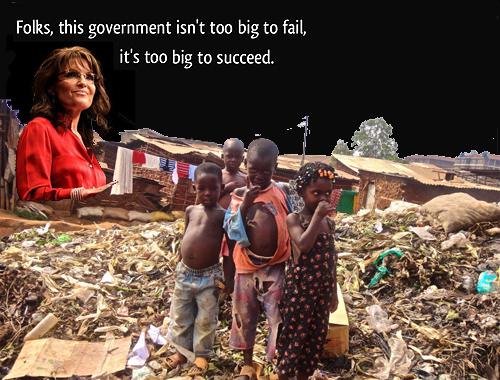
toobigtosucceedThe fight against malaria is going well, but American attitudes will have to change to achieve ultimate success.

Malaria threatens much of the world because there’s no vaccine and its threat increases proportionately with poverty.

But a successful vaccine or other efforts like bednets could actually increase poverty and disease overall.

Malaria was eradicated in most of the western world when sanitation and potable water became government responsibilities. Sanitation and the delivery of potable water reflect less poverty.

Less trash and better managed water reduces mosquitos, which transmit malaria.

The circular relationships of water and trash to malaria means that malaria will be automatically reduced – even eradicated – when better water and trash collection arrive poor communities.

A critical part of the Obama administration’s initiative to reduce malaria understands this, but it is somewhat buried in its presentation to Congress in order to avoid the expected criticism that there is too much government in such initiatives:

“The President’s Malaria Initiative (PMI) works to reduce the burden of malaria while at the same time strengthening host country health systems and workforces,” in my estimation is the key ingredient, but you have to read quite deeply into the report to get to this section. The front of the report is all about nets, spraying and diagnosing, things that Congresspersons can grasp.

“You can’t fight malaria without health care workers,” the somewhat buried part of the President’s plan understands well, because these workers don’t simply instruct people on how to fight malaria, they work on social services like potable water and trash collection.

The American Congress – indeed, the American people – don’t accept the huge efforts required by government to build social institutions like public sanitation. Whenever such efforts are suggested, naysayers point to corruption and lack of private enterprise involvement.

That’s why efforts like the President’s Malaria Initiative have to fool Congress into thinking that American money is not being spent on such grand goals, but on things like nets and spray.

In America all criticism of large scale government involvement finally devolves to the insane belief that government is the problem, not the solution, and this mantra has been insidiously instilled in the American psyche ever since President Reagan said it nearly 35 years ago.

The largest private organization fighting malaria is the Bill & Melinda Gates Foundation. While their efforts are noble, they haven’t achieved a fraction of what government-to-government aid, like the President’s Initiative, has:

Two researchers at Duke University recently concluded that “impressive progress in the fight against malaria” occurs exactly because of a “substantial increase in [government-to-government] funding,” specifically the President’s Initiative.

Private NGOs focus on possible cures like vaccines and inexpensive solutions like bednets because it’s a lot cheaper than developing public health systems.

Yet as they approach success a horrible catastrophe looms: What if the Bill Gates Foundation finds a malaria vaccine? What if enough bednets are distributed to basically reduce malaria substantially?

Many more children will live. And so without improved public health systems many more children will also die. A host of other diseases are on an alarming increase in Africa, like a huge range of gastro-intestinal diarrheas and tuberculosis.

Without delivery of potable water, none of these “children saved from malaria” will be healthy. So while malaria might be reduced substantially, overall public health will decline.

It’s simply a matter of money. Government-to-government aid for reducing malaria last year was $3 billion. Private NGO totals, including the Gates Foundation, was less than half that.

The Duke researchers suggest that $6 billion annually is necessary.

Six billion isn’t very much in western world budgets, but unless it’s used to buy bednets or underwrite specific vaccine developments, legislatures like the American Congress refuse to act, ignoring grander goals like developing public health systems.

Yet that was exactly how malaria was eradicated from the U.S.!

Until the attitude promulgated in America that government is less effective than private initiative changes, the world will not.

Gosh, it’s Google!

Gosh, it’s Google!

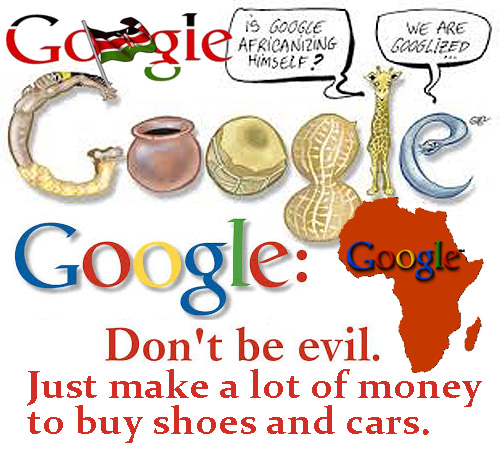
googlemontageA recent interview with the head of Google Kenya highlights Africans’ growing concern about the giant.

Google rules Africa … at least according to a number of studies in South Africa. 94% of South African searches are on Google, and likely more in other countries like Kenya.

In fact, when studies were published several months ago in Kenya that 90% of all Kenyan internet searches were from mobile devices like phones, Google immediately announced it would alter its search algorithms to prioritize websites that were mobile friendly.

Just good business, eh?

Yes, and no sarcasm intended. Google is responding in Africa with the quickness of the times and the speed of its heart and soul, its search.

But the domination of a couple internet companies in the world, like Google and Facebook, begs the “too big to” whatever mantra.

More and more Africans are growing weary not of post-colonial or geopolitical policies that seem to fence them in, but of world giants like Google that dominate their economies, or at least “rule” them.

I’m not talking of the specious criticism and endless suits against Google for being the vehicle of bad information, although in both Europe and Kenya those suits are gaining some traction.

Nor am I talking about the equally endless internecine suits between the world’s internet giants.

Nor even of the fact that Europe now charges Google with being illegally too big!

“Not knowing something is fine, but thinking that you do know when you don’t is foolish,” writes Morten Jerven in African Arguments. Jorten is Associate Professor at the Simon Fraser University.

Jerven argues in a more polite way than I’m now going to summarize, that newly intellectualized African societies are taking Google searches too much for granted. The nuances that blossom real truth are being completely ignored.

Google seems to know this, but its intention is to capitalize on it, not moderate it.

“Life is 80 per cent luck and 20 per cent you taking advantage of this,” the head of Google Kenya told its main newspaper, today.

Thirty-eight year-old Charles Murito took over the reigns of Google Kenya from a predecessor who was fired for “scraping” data from a competing (and client) internet company, that was then allegedly driven into bankruptcy by Google’s actions. No legal determination was ever made.

Murito epitomizes Google’s supremacy, and its unabashed mission that “everything you do is a business. You have to think about it in dollars and cents.”

He’s proud that “I have more pairs [of shoes] than my wife. My shoes, mostly sneakers, always have to match the colour of the T-shirt I am wearing.”

When pressed for his choice of a car, which in Kenya today defines the top businessmen from the strugglers, he replied, “No. I don’t want to talk about material possessions. But I do love cars.”

Google is all business, and it’s a good one.

Perhaps, too good.

Stability at What Price?

Stability at What Price?

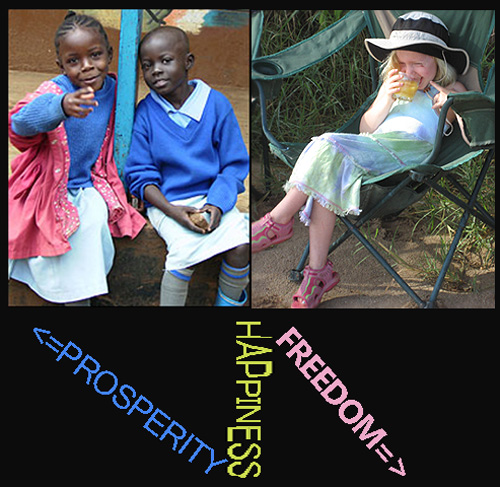
freedomprosperityAre freedom and prosperity at least somewhat mutually exclusive? Why is Africa so stable, today?

There is serious turmoil in Burundi, but in the major hothouses of death and destruction, Nigeria, Somalia and South Sudan, right now there is a remarkable level of peace.

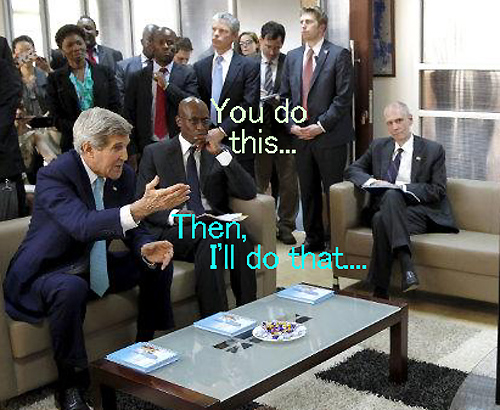
Tuesday, Secretary of State Kerry became the first high American official to visit Somalia since Blackhawk Down in 1993. Kerry justified his visit because Somalia “is turning around.”

There are many wonderful indications to suggest this is true.

There is worrisome fragility in the current Mali government, and troublesome weakness in a number of West African governments probably due to the prolonged ebola outbreak, but governments in North Africa and sub-Saharan Africa (other than Burundi) look strong and stable.
Why?

The answer is becoming clearer and clearer. Very strong military assistance mostly from the U.S. and France has propped up existing governments and laid to waste many areas of terrorism.

The starkest of the stark is Nigeria.

Literally for the last 5 years Nigeria was decimated by Boko Haram, at its worst situation (hardly a few months ago) ceding nearly 20% of its territory to terrorists.

Today Boko Haram is absolutely on the run. The explanation from one of Nigeria’s best media outlets:

“Unlike a year ago, when Nigerian troops would run away from Boko haram militants after running out of ammunition or for possessing inferior weapons, the Nigerian soldiers are now better armed, better equipped and better motivated.”

‘Better equipped’ is the understatement of the decade. The list of new equipment in the hands of Nigerian soldiers is astonishing, particularly when compared to the situation less than a half year ago.

It was not for wont of giving. The western powers were ready, as clearly demonstrated by the current situation, to arm the Nigerian military sufficiently. But a mixture of local politics and western hesitation because of the equivocal politics kept the ammunition in warehouses until now.

Legitimate concerns with protecting human rights were front-and-center in the paradigm that kept the previous Nigerian government of Goodluck Jonathan weak. These have been cast to the crows by the current president Buhari, a former general nearly imprisoned by his own society for human rights’ violations.

Ditto in South Sudan, the more “peaceful” Somali and ever more stable Kenya.

In addition to arming Africa to the teeth, Obama’s militarism these last six years has decimated terrorist cells and American drones have wiped out more than two dozen terrorist leaders.

Media freedom is a great barometer of authoritarian governments, since there has never been a government in the history of mankind that wasn’t vain.

Press freedom is under serious attack in … Nigeria, South Sudan and ever more stable Kenya.

So that’s the reason it’s safer than ever for you to travel to Africa: growingly authoritarian governments infused with western military might.

Regular readers of this blog will know that I’m troubled by this. I’m delighted that Africa is a calmer, safer, more stable place, but troubling if at the expense of freedom and the sanctity of human rights.

It seems that this age-old paradigm is near inviolable. Freedom and prosperity are at least somewhat mutually exclusive.

But wait.

Didn’t we try this, once? Weren’t there horrible South American generals and racist American governments and horribly cruel potentates that ruled the world for a long time not too long ago.

Did things get better? For whom?

Compromises Galore

Compromises Galore

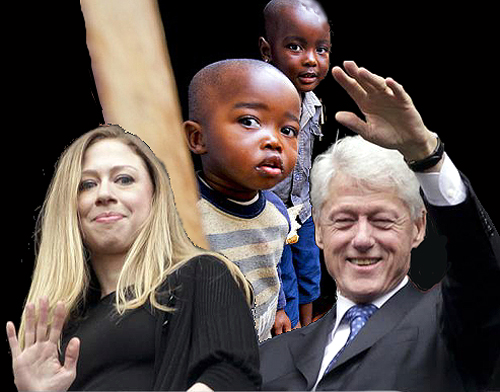
KerryInKenyaBill Clinton, John Kerry, then Barack Obama, a sort of reverse greeting line that heralds the end of frosty relations with Kenya. Let’s call it compromises galore.

Politics is so damn slimy. I know how important Kenya is in Africa. I know how exceptional its youth, in particular, is and how imaginative its culture has become.

I know that in a future world, Kenya will be much more important than it is, today.

If I know it, then Bill Clinton, John Kerry and Barack Obama know it, too. The difference between them and me is that I don’t have to ignore the travesties of human rights that Kenya’s current leaders employed in their rise to power.

Uhuru Kenyatta should not be the head of anything except a mafia, and certainly his vice president, William Ruto shouldn’t be, either.

The two orchestrated horrible violence following the 2008 elections, ironically in part against one another’s followers. When the evidence for this was gathered then meticulously catalogued, and when the individuals supplying the evidence were sequestered under witness protection in Europe, not a man in the world – except them – denied it.

Then one by one the witnesses recounted or disappeared. The evidence dissolved. The two who had been arch enemies from different tribes that historically killed one another struck an alliance and were elected to lead Kenya.

The outcome, today, is that Kenya is prospering when many African countries aren’t. One could argue that the millennial enmity between the Kalenjin (William Ruto, the vice president) and Kikuyu (Uhuru Kenyatta, the President) tribes has been laid to rest.

The War Against Terror has been successful from the point of view of the United States, because the U.S. is much safer, because Kenya became the sacrificial lamb, invading Somali with American might and dollars and taking care of more than a half million refugees.

But Kenya doesn’t mind being the sacrificial lamb because the investment – much of it military – has raised it from the 13th to the 9th largest African economy in only five years.

I think Kissinger called this Realpolitik.

They’re happy. We’re happy. So why am I not happy?

I guess because in today’s world ends do justify the means. The timeline for this dynamic, though, is historically short. The longer a view you take, the less it’s true.

The machinations, manipulations, abject brutality and horror of Kenyatta’s and Ruto’s actions to achieve power have resulted in a more stable, prosperous Kenya and one that may even be tackling the most horrid affliction of emerging cultures, corruption.

Yet in accomplishing these lofty goals some very nefarious means were employed, among which is included sacrificing their own country’s peace and stability for America’s. The sale price was pretty good, though.

So as each level compromises to achieve something good by sacrificing a bit of morality, the ladder down to iniquity is built. It becomes institutionalized.

This logic is where I strike brotherhood with the Far Right… or the Far Left. It’s where compromise is bad.

Ultimately, I guess, it’s a matter of degree – how much you compromise for what ends – a very subjective exercise and who among us can judge whose subjectivity is correct? Me? Kerry? Uhuru? Bush?

Hillary? omg

Coastal Conundrum

Coastal Conundrum

coastaltourismTourism is collapsing in East Africa. It began with terrorism but terrorism is down yet it continues to collapse.

Today you can get breakfast, dinner and a decent sea-view room in Zanzibar for $27.50 per night per person sharing.

These absolutely ridiculous prices can be found for a thousand miles from northern Mozambique to Lamu in Kenya, among some of the finest and most beautiful beach properties in the world.

“Officials on Friday warned that tourism at the Coast was on the verge of collapse with 30,000 to 40,000 staff set to lose their jobs,” Kenya’s main newspaper reported today.

Occupancy at most coastal hotels is hovering around 20% and major properties are closing down weekly.

Kenya and Tanzania’s white sand coral coast is also one of the most pristine in the world. Yes it is suffering the same coral destruction that climate change has foisted on the oceans around the world, but it’s better here, for example, than in most of East Asia.

What’s going on? Should you go?

Well, that’s the problem. Every western government in the world, plus Australia, says, ‘No, you shouldn’t go’ because of potential terrorism.

The northern border of this paradise is Somalia, and real trouble began there when the U.S. invaded Afghanistan in 2002 sending all its most vicious criminals into Somalia.

Things weren’t so bad in the beginning, because it seemed like all the bad stuff happening in Somalia was staying in Somalia.

But then there was the election debacle of 2007 in Kenya with widespread violence that took nearly a half year to settle down. When it finally did, the U.S. began drone strikes in Somalia.

Then in 2011 Kenya, acting as a proxy for Obama’s growing wars against fleeing terrorists, invaded Somalia and all bets for a stable coastal tourism industry were off.

More drones killed more Arabs from Dar to Lamu, internecine warfare among the Arab sects in the coast heated up, prominent Arab leaders were assassinated in Mombasa and Zanzibar, and if ever there had been a stirred up cauldron of discontent and chaos, it was the East African coast.

Didn’t somebody say on TV this weekend that we’ve learned an important lesson from Baltimore? Didn’t someone say that we’ve got to do something more than just add police to stem crime?

Is that why Secretary Kerry is in Kenya, today:

to “discuss ways to more effectively deal with threats posed by the militant group al-Shabab”?

To get permission to fire more drones? To give Kenya more personal armored vehicles?

There haven’t been any serious terrorist incidents for months on the coast. (The Garissa University attack was considerably inland, far from tourist areas.)

But that’s the Catch-22: bring in more tourists and that will attract more terrorists, because terrorist attacks on tourists are always more powerful than local attacks.

I wonder if there were any businessman who invested in Belfast apartments in the late 80s? If so they’re making a killing, today.

The Gift Horse’s Mouth

The Gift Horse’s Mouth

clintontripAfricans are bristling but resigned to the current Clinton safari the same way I’m resigned to a President Hillary. What a dreary day.

The Clinton clan minus Hillary is currently on a 9-day African tour to Kenya, Tanzania, Liberia and Morocco, and they are not getting the reception they had expected.

Like the Bill Gates Foundation, the Clinton Foundation is highly vested in Africa, and so you would think it natural that from time to time the principals would come here.

“O, fellow benighted Africans! Gaze down at the bleeps emanating from your electronic device – a device powered by the marvelous coltan mined on your land. Can you not see the newsflash? Dignitaries, Big Names indeed, have come to our continent in order to help us help them help us,” famous African filmmaker and writer, Richard Poplak, wrote yesterday.

Poplak is white, South African born bred and nurtured, and like most of the intellectuals of all colors on the continent, not particularly happy with the Clintons.

Poplak continues:

“…the Grand Priests of the Clinton Foundation, the givers who give almost as good as they get, [have come] to sniff the cow dung burning in rustic villages, to pat the heads of the doe-eyed children they have kept safe from brand name infectious diseases.

“O, African, behold Chelsea Clinton, future presidential candidate of the Democratic Party… Lynn Forester de Rothschild, the billionaire boss of E.L. Rothschild… [billionaires] Jay and Mindy Jacobs are here!

“O, but Africans, there is more. No one less than Hadeel Ibrahim is here! The daughter of Sudanese-British billionaire mobile phone philanthropist Mo, Hadeel Ibrahim is a great friend of Chelsea’s, and they apparently spent a wonderful thanksgiving together at the Clinton pile in Chappaqua. All has been forgiven since Bill Clinton Cruise Missiled the Al-Shifa pharmaceutical factory in 1998.”

Like the Bill Gates Foundation, the Clinton Foundation is even more heavily invested in Africa. I believe this is Bill’s penance for having “made a mistake” (his own words) when he ordered his United Nations ambassador to vote against increasing the Canadian UN force that could have stopped the 1994 Rwandan genocide.

The problem is, Clinton has piled one mistake on another in Africa. He hugely empowered Ugandan president Museveni when all of us knew that was a mistake. Museveni is now one of Africa’s great dictators, the author of the “kill the gays” bill.

Poplak continues:

“Along for the ride are many other Clinton Foundation donors… professional philanthropists, Silicon Valley whizz-kids and generally outstanding humans. The safari …will culminate in a dazzling conference in Marrakesh, presided over by that famous empowerer of women and long-time Foundation supporter, the King of Morocco.

“And it is equally churlish to think of the Clinton Foundation as a giant corrupt money suck akin to the worst African banana republics: … [The fact that] Bill Clinton seems to have helped a Canadian mining magnate hand over 20% of America’s uranium resources to the Russians while Hillary was leading the state department, does not ipso facto make the outfit rotten.”

But she would be the first woman president!

“And what does it matter to you, O African, that tens of millions of dollars have flowed into Clinton pockets from women’s empowerment centres like the UAE and Saudi Arabia, either for speaking fees or for donations?

“… it may be tempting …to imagine that the Clintons and their Foundationites are using the continent as a theatre set, and we Africans as drooling extras… It is tempting to say that this is all about big money and real politick, because Bill and Hillary Clinton, along with their Chelsea clone, serve power for power’s sake.

“You might wish to say that this all seems so garish and ghastly, millions of dollars blown by a 0.1% cabal on swanning about the continent, billions of the world’s wealth zipping over the African savannah in a legions of Lear Jets.

“But you would just be sour to think that way. Ungrateful. When the beautiful waxed SUVs zip into your village and you smell the $1,500 anti-aging cream on the frozen faces of these Kings, these Gods, remember to thank them with the appropriate deference. Remember to bow and scrape.

“If we don’t look the part, then they don’t get the money.”

Endangered But Thriving

Endangered But Thriving

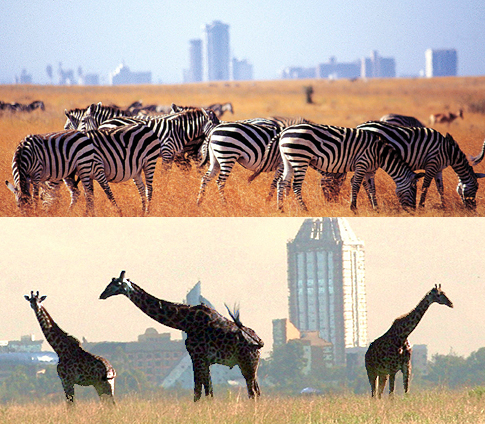
animalsVSdevelopAlthough the numbers of wild animals seen by a typical tourist on safari has grown substantially during my career, the fact is that wild animals in Africa are in a serious decline.

Lion, black rhino, giraffe and elephant are far more numerous in wild reserves than when I began guiding in the 1970s. I believe, for instance, there are too many elephant. Dramatic encounters with all these animals all are more frequent, today, making a safari that much more exciting.

But overall black rhino is near extinction, lion and giraffe have declined by as much as a third, and there is great controversy over whether elephant are threatened.

This may seem like a contradiction, but it isn’t at all.

Parks and reserves in Africa have received more and more efficient protection, especially in the last three to four decades, precisely because tourism brought in large amounts of foreign currency. As tourism grew throughout the 1980s and 1990s, tourist services provided more and more jobs and many tertiary economic benefits to the local communities.

This added protection allowed animals to prosper in ways they couldn’t previously.

Efforts mostly in southern but also in eastern Africa stemmed wild animal disease (bovine sleeping sickness, hoof-and-mouth disease, mange, etc.) often by removing infected wild animals from the population or [in the case of mange] actually treating wild animals.

Intervention in the wild, of the sort which was used to eliminate mange from cheetahs in the Serengeti/Mara ecosystem, is very rare, but significant. A similar effort is ongoing to protect mountain gorillas from measles.

The great veterinary fence constructed in Botswana in the 1980s essentially to reduce hoof-and-mouth disease in the domestic beef industry had obvious effects with the wild animals as well.

While wild animal intervention has been rare, intervention in restoration of threatened habitats has been aggressive. This has included simple routines of burning tall grass to construction of bore holes (wells) to provide constant water.

In populations tending to be inbred, expensive operations to relocate wild animals increased the genetic biodiversity and thus the health of wild animals.

All of the above has led to much healthier and more robust protected areas with strong wild animal populations.

But the story is much different outside these protected areas.

Africa has grown substantially in the last half century, and agricultural needs in particular get the very highest priority. In the past edges of protected wild areas were fluid and poorly determined. Often hunting reserves rounded the perimeter of a national park and the perimeter of the hunting reserve was often unpopulated bush.

That’s no longer the case. As Africa’s populations and industries increase there is a clearer and more exact delineation between the protected parks and reserves and developed areas.

The borders of Arusha National Park are literally farms for maize and beef. There is nothing but a hedge which separates portions of them.

Watermelon and maize farms are cultivated to the very edges of the very wild Tarangire National Park.

Exploding gated housing developments now border important sections of the Mt. Kenya National Park, which is still home to a variety of wild animals.

In the non-reserve and non-park areas wild animals are considered vermin, especially by farmers. So not only is the habitat tensely contained, but leaving the habitat is near certain death.

The overall average of the relatively small amount of protected reserves and parks (under 8%) and the larger wilderness slowly being developed results in the overall decline in wild animal populations.

So yes, “the wild” is contracting considerably even as we successfully make richer and more fulsome the biosphere within that which remains.

From Baltimore to Joburg

From Baltimore to Joburg

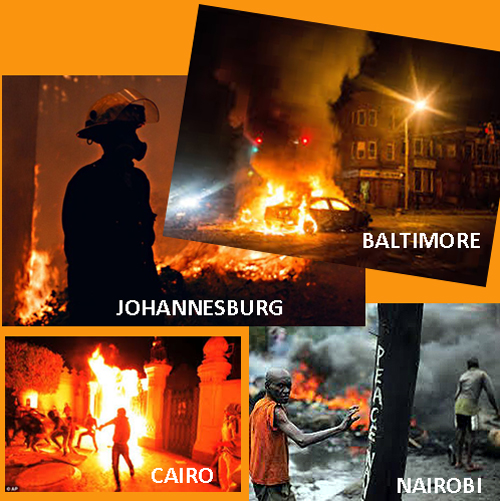
balt2joburgCivil violence in Baltimore, Beijing, Nairobi, Cairo and Johannesburg reflects societies coming apart.

One thing is certain: “We will bring order. We will bring calm. We will bring peace,” the (black) Baltimore mayor vowed last night as national guard troops entered her city.

Then, one of two things happens afterwards: a more democratic Tunisia, South Africa and Kenya; or a more autocratic China and Egypt.

Civil violence is quite distinct from war. It happens from within. Brothers are pitted against brothers. In the beginning new ideas link across disparate social communities. That’s the case today when we find Baltimore mayor, Stephanie Rawlings-Blake, saying things that her opponents consider collaborative with the protestors.

It’s the reason that the World Court indicted the current President of Kenya for fomenting crimes against humanity. It’s the reason Hosni Mubarak lingers in a jail guarded by the men he brought to power.

Civil violence reveals fissures and inconsistencies in social systems that are difficult to reconcile .. even by its leaders. It’s about human rights violations, not border disputes. Groups like ISIS will use civil violence to then start geopolitical warfare, but in the beginning it’s an internal conflict not an external one.

It often devolves into whether “the end justifies the means.” But it’s rarely so clear, much murkier: Is it fair that Uhuru Kenyatta paid youth under-the-table to fight a rival tribe in order to preserve his beneficence that now seems to be very positive in Kenya?

Peace at all costs?

Yes, so far anyway, eventually that’s human history. For the champions of human rights who fight in the streets, it’s a battle against the clock. They have limited time to bend society to their ideas until they’re crushed.

Civil violence is growing around the world, just as it did many times previously in human history. The hours on the clock are growing longer.

We’re entering a period of enlightened conflict, perhaps because of videos transmitted in nanoseconds by watches.

“Thank God for cell phone videos because the truth will come out,” the lawyer for the Freddie Gray family said last night.

Unlike in the past, more of us see and hear the same thing. The media can’t distort it as easily as in the past.

In this new and more volatile world, those of us in privileged situations should take stock:

“The infidels have so much to lose, they can be afraid of even losing their happiness! We,” he said, lifting his eyes to the sky as his mind’s eyes pulsated with a black sun, “We have nothing, so we fear no loss.”

That short excerpt is from my book, Chasm Gorge. It’s the world’s greatest terrorist explaining why he fights to the death.

The difference between those who have less and those who have more will not last in the new world. How much must be given away by us privileged is being determined by the battles being fought right now, from Baltimore to Johannesburg.

There’s no question a redistribution will occur. The question is how will it occur? Democratically or ruthlessly?

How Not To End Kenyan Terrorism

How Not To End Kenyan Terrorism

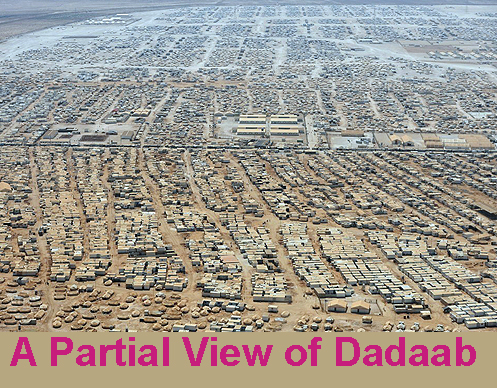
dadaabKenya’s insistence on closing the Dadaab refugee camp will increase terrorism. Tourists and business investors should remain vigilant.

Dadaab is now the largest single refugee camp in the world. There are nearly a half million people in a “camp” operated and maintained by the United Nations.

Imagine if Grand Rapids, New Haven, McAllen or Toledo – each an American city with about a half million population – were a “camp.”

Here’s an equally frightening way to look at it: compared to America’s and Kenya’s total populations, a refugee camp of similar size in America would be 3½ million, the size of Seattle, Minneapolis or San Diego.

The cost of maintaining Dadaab is paid by the United Nations, which in turn gets its funds for this specific project mostly from the U.S. and Britain. It isn’t just putting up tents. There are schools, churches, entertainment centers, telecommunication and power (electricity) facilities, security vehicles and buildings, waste treatment facilities, and potable water facilities in what is essentially a desert.

The cost is staggering, but Kenya insists the cost to its own security is even greater. It wants the UN to close Dadaab and repatriate the half million people – almost exclusively Somalis – to Somalia.

Somalia is doing better than ever. There are fewer violent attacks in Somalia than in Iraq or Afghanistan. Kenya’s argument is that the situation in Somalia is now peaceful enough to close the camp.

Needless to say, there are many who disagree, including probably all of the refugees in the camp. The fact is that life in a UN operated refugee camp is considerably safer, usually healthier, and often with better education opportunities than in many of the towns and villages in northeast Kenya where the camp is located.

It would be one thing if Kenya were making this decision separate from its overall policy towards Somalis in the country. There are more than 4,000,000 ethnic Somalis in Kenya who are legitimate Kenyans, many who have resided here for several generations or more.

Since the Somali invasion by Kenya in October, 2011, Somalis in Kenya have been terribly mistreated. In fact, according to a Kenyan government report four years Somalis have always been discriminated against! The invasion made it worse.

Consider this: a refugee from anywhere, a Libyan fleeing to Italy, or a Guatemalan fleeing to the U.S. or a Somali fleeing to Kenya, these are people who don’t want to fight. They are escaping conflict. They give up whatever and however little they have … for peace and security.

Closing Dadaab will infuriate and radicalize the youth currently living in the camp. Many Somalis in Kenya already have been. The “mastermind” of the Garissa bombing is a youth who grew up in Kenya and graduated from a Kenyan law school with honors.

The rationale Kenya gives to closing Dadaab is that terrorists are bred in the camp who regularly harm Kenya, yet there is to date no evidence of this, and it is simply counter-intuitive to the nature of a refugee.

The truth is that one of the greatest causes of the terrorism Kenya is its treatment of ethnic Somalis living in the country.

The handful of infiltrators that manage to infect every refugee camp in the world is real but so small it’s ludicrous to suppose they wouldn’t infect small towns and villages in Kenya the same way if Dadaab didn’t exist.

In other words, closing Dadaab will not impede this dynamic an iota.

What it will do is increase hostility, mistrust and fire the conflict even further. It’s one of the worst decisions Kenya has ever made.

Jim’s award winning novel, Chasm Gorge, set in Kenya, tells the story of a kidnapping by terrorists of the son of the man who wants to become the President of the United States. The book is available online in e-editions, soft and hard cover, from Amazon, B&N and bookstores around the world.