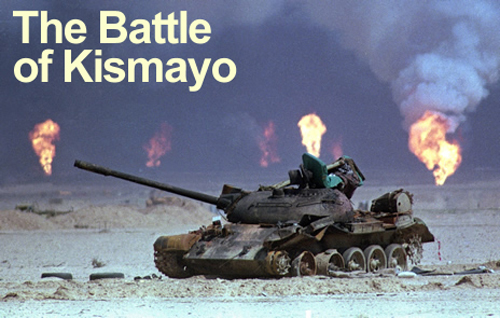
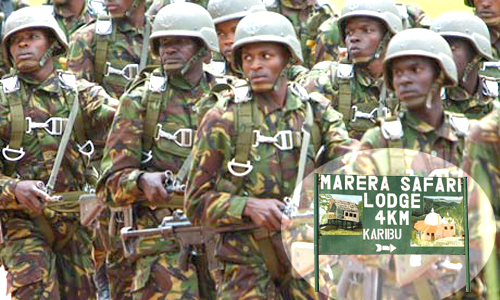
The Kenyans never said how long it would take, but it’s taking too long. And while opinion in Nairobi remains ludicrously supportive analysts outside the country are painting a gloomier and gloomier picture. The Kenyan invasion might have given a terrorist organization its first opportunity to win a conventional war.
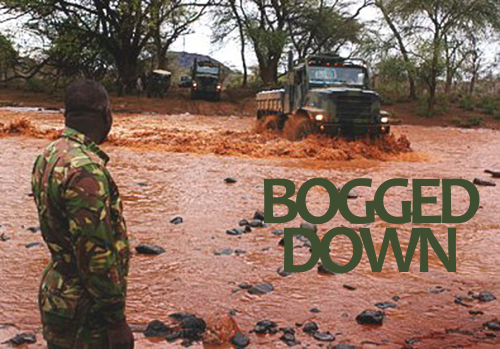
There was little fighting last week. The military commander explained that they were giving civilians time to get themselves out of harm’s way, and pacifying the areas they now control, but analysis suggests otherwise. The heaviest rains have ended, but the roads remain a muddy mess, not easy for military equipment to travel.
Moreover, the Kenyans may have decided that a wave of diplomacy launched by Kenya’s Prime Minister simultaneously pleading for more western help while starting a second if diplomatic war with Eritrea needs some time to develop. The Kenyans accuse Eritrea of supplying weapons to al-Shabaab.
The 2-3,000 Kenyan soldiers (we haven’t been given a firm count yet) are equipped with 1980s military equipment, mostly HumVees and old mini-tanks called “technicals.” The New York Times’ >>> estimates al-Shabaab fighters in Somali at 25-30,000. So that’s ten times the Kenyan forces.
But there are also 8,000 African Union troops supporting the tiny Somali Transitional Counsel’s military, so the true numbers might be around 10,000 invaders to 30,000 locals.
The invaders, though, have the assistance of America and France. America has been very infrequently but significantly sending out drone missile attacks to areas in and around Kismayo. The French Navy has twice bombarded the port. So with this additional support the Kenyans position is probably better than it looks by the numbers.
Reports of al-Shabaab softening its pitches among the local population and kindly asking elders of various clans to allow their sons to join “the resistance,” as well as finally allowing outside aid organizations to distribute food, is an indication al-Shabaab believes it still has influence if not total power.
Or that they are legitimately worried. The Kenyans only real advance last week was from the south, its second front. There a smaller contingent, followed by two miserable Kenyan Navy boats offshore, pushed militants out of southern towns to about 100 km south of Kismayo.
As a result the Kenyans claim to have stopped piracy, indeed all shipping, into and out of Kismayo. (Undoubtedly with the help of rather larger French naval vessels nearby).
But the main force that entered from the west almost 4 weeks ago is stalled. Afmadow 30 km to the north of this main force is where al-Shabaab is concentrating fighters, and Kismayo, 80 km to the southeast remains the objective.
As I said last week, al-Shabaab’s brilliant military move to consolidate Afmadow means the Kenyans could fall victim to a pincer action is they continued onto to Kismayo. This is the real reason they’re stopped. Roads are bad, equipment is old, and they may be overall better outfitted than al-Shabaab, but al-Shabaab currently is winning the war of strategy and has already won the war of numbers.
There’s a lesson it’s taken America a dozen wars in my life time to learn: you can’t win without the locals.
Yesterday was World Responsible Tourism Day, until yesterday in my view one of the greatest tourist scams in my lifetime. But finally yesterday, Cape Town authorities saved the concept from the dustbin. Nevertheless, tourists beware!
WTD began nearly 20 years ago with a mania by tourist companies to be labeled “ecotourism” companies. This was the buzz word. The concept was simple and appealing especially to those of us working in Africa and other wildernesses of the world: tourist service providers promised in no way to compromise the environment, and in better cases, to actually contribute to renewing it.
But with time and increased use of the world’s wildernesses, too many visitors disrupted cheetah hunts, too much trash significantly altered species survival, too many boots unhinged Inca ruins.
From the start it was nothing mroe than a self-serving goal and nowhere as evidently as in Africa. What was particularly offensive about the concept from the getgo was that we had no choice. If we wanted the industry to thrive, we had to preserve its attractions.
The purpose of “ecotourism” was to fool the consumer into thinking it was a strategy of choice not necessity. And it favored the little guys, and that was always a warm and cozy feeling. It was a lot easier for a single standing property to change its sewer system into something greener, than a large chain of established companies. And true to form, the smaller company would then tout its accomplishment mostly by pointing out the deficiencies in its competitors.
But there was no way for the consumer to undertake due diligence. Several organizations tried to become certification organizations, but it never materialized and was evident from the beginning that they were just self-serving organizations looking for a cause.
A number of reputable media companies – mostly international magazines – gave awards, but despite some highly credentialed judges nominees were either received from biased consumers or from the companies themselves.
There has never been and never will be a good way to check the veracity of what an “ecotourism” company claims it is.
Moreover, the cleaver that supposedly severs ecotourism companies from nonconformers just isn’t as neat as you might think. Just as smaller companies can reform their sewer systems faster, larger companies can produce more revenue and jobs faster: theoretically what successful ecotourism is supposed to achieve. This conundrum forces ideas into very specific and opposing sides; there isn’t a good compromise. If you’re for cleaner sewer systems, you’re against more jobs; if you’re for more jobs, you’re against cleaner sewer systems.
Greenies will argue otherwise, and their arguments may be cogent in a longer time view. But business is not wont to project too far into the future; in Africa we work on three-year rates of return. These arguments will be valid only when governments take specific action, essentially regulating and leveling the playing field. That hasn’t happened. There is no Tourism Protection Authority.
Recently the Peruvian government significantly increased tourist fees to its attractions like Machu-Picchu. The stated motive was to reduce tourism numbers to protect the sites of antiquity. But it’s not at all clear this is the true motive. Tourist numbers have been plummeting, train tracks have been covered in avalanches, and it could be that the world economy and global warming is the real advocate here.
And so, alas, ecotourism was on the wane well before the world recession. As early as 2004, hardly a decade after it became fashionable, science was documenting that much ecotourism was simple foolery, and in some cases outright counterproductive. Statistics began to show that ecotourism no longer had a marketing advantage. And that was good.
So by 2010 in a Yale University publication professor Geoffrey Wall simply and neatly explained that ecotourism was too hard to analyze, to soft to measure and basically that the concept was too deficient to be either realistic or useful.
I believe it was as ecotourism was losing stature that the next lofty concept was concocted: Community Based Tourism (CBT). The idea was that local communities that either legally owned or by proximity controlled areas of wilderness tourism should be manifestly involved, and that in their subsequent profit, they would become the best natural trustees of the environmental assets they controlled.
There is something terribly dishonest about this since behind the concept is the manifest need to vacate the ownership or legitimate control of any resource if the owners don’t act environmentally responsible. I think this is an interesting idea and well worth debate. But it was not presented as such, nor debated. It was a single-sided coin that always fell heads-up.
CBT in its best form was intended to convince owners to use their resource in a greener way. Thus Maasai herders would be influenced to build a lodge rather than a wheat farm. The great flaw in this best form was that tourism was never able to achieve the asset wealth that its alternative could. There are a couple exceptions, but in the vast vast majority, this was the case.
Ecotourism and CBT are empty, self-applying, self-rewarding concepts. In the real world, they can’t be evaluated, so they effectively can’t exist except in the minds of the scammers.
This doesn’t mean that to be green in anything – tourism included – isn’t noble and right. Or that to increasingly involve the locally community in projects that take place in their community isn’t a great idea for all parties involved.
What it means is that generally good ideas were hijacked and misshapen into supposed attributes that made one company theoretically better than another. And it worked at first. But with time, common sense prevailed.
There is one concept I feel is worthwhile that has emerged from this mess. “Fair Trading” is an United Nations concept that insists that a higher proportion of the revenues generated by a tourism service are retained by the local community and owners, as opposed to alien middlemen and distributors. This is refinement of CBT, a real metric applied to it.
Unfortunately, it has gained neither the traction nor recognition that ecotourism or CBT did in the beginning. That’s probably because it sounds too much like them.
But it’s definitely something you tourists should consider and ask about.
And that was the one good thing about “World Responsible Tourism Day.” It used the right words. And the Cape Town authorities were asked to usher it onto the world stage in London yesterday, where thank god at last, “ecotourism” and “community based tourism” were replaced by the simple, more general, more honest, good-feeling term, “Responsible.” Right on, Cape Town.
I sit here watching a miserable cold rainy day waiting for snow. Birds (and “sunbirds”) living here in the Midwest have all but gone. But one remarkable bird in southern Africa defies this classic “going and coming” in a most spectacular way!
The southern carmine bee-eater is not only one of the grandest and most beautiful birds in existence, but it defies all notions about what bird migration means. Right now it’s heading south, but in hardly a few months it will head north further than where it started from! Then a few later, west, and finally, east! It zig-zags in a definite way, but why?
Conservationists tend to think of bird migrations as one-way reversibles. In other words, at one season they travel thata-way, and on the other season, they go thata-way backwards! Well that’s mostly true, and it seems to us that the birds are following the weather. We think, for example, that cardinals own fur coats but that little warblers would just freeze to death if they stayed.
Wrong. Temperature has absolutely nothing to do with where a bird wants to be. Birds follow their food. Reductions in temperatures reduce the food supply for many birds, like warblers eating bugs. But cardinals don’t eat bugs; they eat seeds and berries, and they’ve adapted to finding them even in the snow.
The carmine bee-eater’s there-again, back-again migration is linked in the same way. The bird is a specialist: it eats bees and other flying insects, and in southern Africa flying insects – particularly bees – are very much linked to when it rains. And the rain pattern in the southern part of the continent as I often explained is very complex.
And to make matters more extreme, the carmine nests in burrows of sand often on flat sand banks, digging a tunnel up to 6-feet long in which to lay its eggs. You can imagine this would not be an ideal strategy if it were raining.
So breeding occurs at the driest of times, along the great southern rivers like the Zambezi and Kavango, in August and September. There’s no drier time anywhere in southern Africa.
Eggs hatch, chicks emerge, rain comes, bees flourish all up and down the Zambezi as the ground bushes and native flowers in particular bloom presaging honey. But this doesn’t last long, because the rains grow intense, the temperatures rises, and many of the species of plant flower for a very short time and then just blossom out in bushels of thick green foliage.
So now in November the carmines move south. It’s probably started to rain south in South Africa by now, but down there many of the flowering trees like the jacaranda bloom before heavy rains, unlike the bushes along the Zambezi, and this attracts billions of bees.
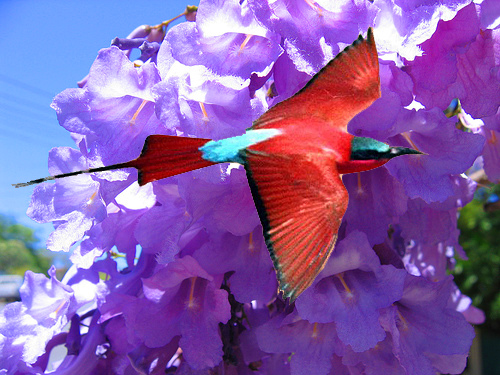
One of the most beautiful sites on earth is the carmine bee-eater flying around a purple jacaranda tree! Its mostly crimson body blends into a deep teal head and underside, and with a sea-faring like deep black bill more normally associated with terns.
OK, so it’s spectacularly beautiful, but that’s not all. Its flight is magical. It’s in the class of birds that, true to name, eat bees and other flying insects. It plucks its prey right out of the air, nabbing that darn honeybee while it’s in flight.
This leads to all sorts of gymnastic swoops and backups, sometimes seeming to turn 180-degrees in midflight. And it seems to use its wings very little, a sort of effortless soaring that with a few facile flaps turns it upside and backwards, or sends it in exactly the opposite direction.
But one of the most amazing things about this bird is its migration. So right now it’s in South Africa with its new fledglings doing a job on the jacaranda. That only lasts a few months, and heavier rains and other factors bring much of South Africa out of bloom by February.
The fledglings are then fully grown. The birds actually maintain social groups even while migrating, and the young boy carmines have stayed with their mom and dad, and the girls have gone off to another group. And they get ready for the big migration as the flowers fall in South Africa.
They now travel long distances, sometimes right up to the equator. That’s nearly 2500 miles. I’ve seen them around Lake Victoria in February and March.
February is the lull in the single rainy season throughout most of East Africa. It’s actually more than a lull in Kenya, where it becomes completely dry, but I’ve only once seen a carmine north of Nairobi, and that was a single so obviously errant bird.
The lull in the heavy rains allows so many plants to bloom! In East Africa it isn’t just bushes but trees as well, and sometimes the many varieties of acacia will actually bloom a second time (most acacia bloom just before the rains begin in December and January).
So, lots of bees.
The rains end earlier in southern Africa than East Africa, so the carmines stick around in East Africa until like the wildebeest they’re forced to move because it gets bone dry. Wildebeest move north; carmines move south.
The carmines have 2-3 months now of little pickings, but there’s enough. Flying insects other than bees become their main diet, and there’s enough to build a new home and have new chicks.
In the end, the carmine has traveled as far as many of the longest distance warblers. It’s just not up and down, but a zig-zag through the remarkable ecology of this magical continent.
It’s clear that a major battle is brewing, but it isn’t at all clear who is going to win. America is worried. Kenyans are growing increasingly anxious. More deaths, including tourists.
The Thursday afternoon killing of a safari vehicle driver in the Shaba Reserve, and the wounding of a Swiss tourist inside, has no clear motive. There is no clear evidence that it is linked to any retribution from those Kenya is fighting in neighboring Somalia.
The safari vehicle was on a routine game drive and was returning to the lodge when several gunmen opened fire. The driver accelerated the vehicle but there was a second batch of gunmen waiting and they pummeled the vehicle with additional gunfire.
The driver was killed, the vehicle rolled over, one tourist was hit by a bullet and one was uninjured. Kenyan Wildlife Service agents at Archer’s Post were first on the scene.
Nevertheless this is exactly the area that I warned was unsafe only a a month ago. Whether these were bandits or ideologue militias doesn’t really matter. Kenya’s rule of law is falling apart as all its resources are funneled to the conflict in Somalia.
Go back and read the hostile comments I suppose understandably left by Kenyans who read that article. But wouldn’t it have now been much better if all had taken heed, and the tourist was now not dead?
Definite links have been established, however, with additional kidnappings around the border area of foreign aid workers, and of a grenade attack on a church in Garissa, a major town not far from the Somali border.
Meanwhile, the Kenyan offensive seems stalled. This is my view, not the view expressed by the Kenyan military, which claims to be on track in its liberation of Kismayo.
The army, though, has not yet even taken Afmadow, a northern town distraction that Kenyans learned was being fortified by al-Shabaab militias, and which they announced they would first have to pacify before continuing the progress towards Kismayo.
In the course of last week, French fired from naval vessels into Kismayo and America launched drone attacks from a base in Ethiopia. Kenya claimed a number of small skirmish victories, but its army does not seem to be moving.
This could be because of new reports of how heavily fortified Kismayo has become. During an African leaders conference last week, Prime Minister Raila Odinga literally pleaded with the west for more assistance.
Meanwhile Kenyan society is growing increasingly anxious with the war.
“The worst case scenario,” writes blogger Abdi Sheikh, is that Kenya gets deeply embroiled in the “conflict for years and disenfranchise both Kenyan Somalis and Somali refugees living in Kenya.”
“Any major mistake will bring the conflict into Kenya,” he goes on, and “may also stir xenophobia against Somalis living in Kenya.”
That may already have happened. Additional police are seen regularly in the densely populated Somali suburb of Eastleigh in Nairobi. New government policies demanding Kenyan Somalis disarm themselves are likely only going to inflame the situation.
Several newspapers reprinted old publications of WikiLeaks documents of American embassy dispatches detailing al-Shabaab recruiting within Kenya.
One thing everyone seems to agree on, which I don’t think is quite as evident as presumed is that “Kenya has taken an action that is irreversible” (Abdi Sheikh). “It has sparked a war with a shadowy group that has no clear frontline. This means those responsible for military action must think carefully not to create new enemies or inflame the conflict further.”
And yet if it isn’t reversible, it may be doomed. Sheikh reminds us, “There has been no foreign military invasion that has ever been successful in Somalia.”
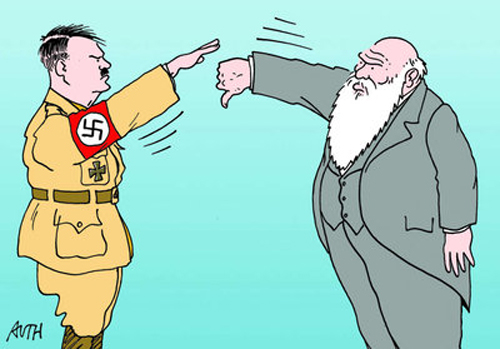
By the Philadelphia Inquirer's Tony Auth.Sometimes I wish American politics would just hang clear of my Africa, but how naive I guess. Evolution is founded in, based in, spectacular in Africa, and it’s increasingly a hot-button issue in current Republican politics. I’m embarrassed to write about this, but the amount of ignorance among potentially very powerful people is flabbergasting and increasingly terrifying.
Herbert Cain hasn’t said, and that’s the point. He’s going to have to, soon. He can’t maintain his lead without addressing these issues which are part and parcel to the beliefs of those who will choose the candidate.
And by the way, Cain has a few other problems at the moment.
Jon Huntsman is the only major Republican candidate to embrace evolution. “To be clear. I believe in evolution and trust scientists on global warming.” Jon Huntsman is also the only major Republic candidate without a chance of winning.
Mitt Romney accepts evolution as science. But his mission to stay afloat in the hurricane season in the Bermuda triangle forces him into multitudes of qualification. “God created the universe” and evolution “created the human body.”
Detailing exactly what he believes would probably wreck his campaign.
Only Newt Gingrich can out hedge Romney. When asked specifically about evolution, he angled his response, “I believe that creation as an act of faith is true, and I believe that science as a mechanical process is true,” Gingrich told reporters in May. “Both can be true.”
And have absolutely nothing to do with one another or evolution.
Rick Perry concedes that “evolution is a theory” but “with gaps in it.” No, there aren’t his kind of gaps in it, but more important, he pulls no punches in terms of what he’ll do if he can: “I am a firm believer [that] intelligent design … should be presented in schools. “
He’s been successful in Texas, where intelligent design has been incorporated into middle school text books and evolution qualified. It’s a huge and horrible story in itself.
Michele Bachmann “supports intelligent design,” and supports it by lying, “There are hundreds and hundreds of scientists, many of them holding Nobel Prizes, who believe in intelligent design.”
Well, of course that’s not true, as is the case with much that Bachmann says day after day as though it’s gospel. (Maybe that’s the problem with her followers: they make up gospel.)
Unequivocally as his best credential Ron Paul states, “There is a theory… of evolution, and I don’t accept it,” Paul said.
Then there’s the bottom of the evolutionary chain, the last link so to speak. Rick Santorum makes the ridiculously untrue, not-even-a-metaphor pandering parallel that belief in evolution means you “are a descendant of a monkey,” and goes on to insist this nonsense is just one of “the many other liberal beliefs [of] Democrats.”
As a Senator from Pennsylvania he proposed the “Santorum Amendment” to the 2001 No Child Left Behind Act that would have forced public schools to offer the creationist perspective in science classes, and to call into question the scientific evidence supporting evolution. That amendment was rejected.
That’s what we got to work with. One reasonable man without a hope who isn’t really a Republican, one man hiding on the run, two ducking and three wackos.
The candidates are driven by the right-wing Christian media, particularly talk radio. And the last few weeks have taken the ridiculous into the abstract sublime. You just won’t believe what right-wing talk radio is discussing these last few weeks with regards to evolution.
The current evolution topic is whether Darwin’s theories of natural selection contributed to Hitler’s Nazi holocaust.
Say what?
And so, therefore, Hitler was not a Christian.
Of course.
I know it’s unbelievable. I actually felt it was better to just not to wade into this, because the threads of logic were so knotted up.
“Nazism was not science-based,” Univ. of Minnesota biologist PZ Myers wrote last week, “Hitler was a true Christian.”
Somehow, whether Hitler was a Christian depends upon whether Christians believe in evolution, but evolution is science and if they don’t, then they aren’t Nazis, either? This is the new litmus test for Republican candidates. Can you phrase it better than me?
This ridiculous dispute became so prominent lately that University of Chicago professor Robert Richards issued a White Paper, “Was Hitler a Darwinian?“ with 45 pages of careful history, heavily annotated, in order to conclude “The only reasonable answer to the question that gives this essay its title is a very loud and unequivocal No!”
And Monday, the respected Philadelphia science journalist, Faye Flam, wrote that serious historians today “agree that any whiff of Darwinism in Hitler’s speech or writing was merely window-dressing.”
But we all know in today’s world that facts and logic don’t mean very much, so why try? We try, because it keeps us sane.
I just hope the election will fall however marginally with the sane.
Photo by John Sullivan in the Maasai MaraRains in Africa bring rebirth unlike anywhere else on earth. I don’t mean things just start to grow again. I mean dead things come back to life!
Admittedly, most of these creatures are just fooling us to believe they’ve returned from the dark side. They aren’t really the same thing, but the children of things that died when the rains last ended. But there are a few true miracle creatures that defy all sorts of normal zoological physiologies.
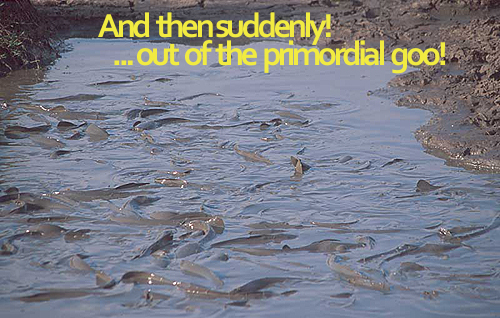
They’re called “mudfish” and … well, for obvious reasons. See the main picture above, although that was taken at the end rather than beginning of the rains. It’s easier to find them like this, captured in wiggling pods as they tried to avoid the marabou stork’s gullet, but before they’ve hibernated for the dry season.
The narrow picture to the right is one of New York’s Metropolitan Museum of Art’s several priceless ancient African sculptures praising mudfish. This one is titled, “Rattle Staff: Hand Holding Mudfish (Ukhurhe)” and can be found in gallery 352. And it’s now — at this time of the year — that they reemerge.
They’re an important but small family of earth’s creatures widely referred to as lungfish. Up to 6′ long, they’re mean predators: They can bite off your finger. They breathe with lungs, not gills. They can walk on land. They’ve been on earth for 100 million years and are the direct descendents of the 450 million year old fossil creatures that first walked fish out of the sea.
AND they can live 100 years BUT they regularly die just as many years as they live.
Say what?
At the end of every dry season, they wallow as in the picture above, frantically trying to discourage predators as their home evaporates. Then one night, they wrap themselves in a self-made mucous cocoon and become desiccated with the mud. Almost all their bodily functions cease.
Unlike bears or caterpillars changing or a 17-year grubbly little cicada in a shell under my oak tree, these creatures actually come to a near complete halt.
Until the rains return.
Those of us who know where to look after the first big rains … we’ll find them! They don’t emerge necessarily altogether like they are above. Usually the water has to be a bit deeper to break their hard cocoon and release them, and at that point they’re wholly under water.
A whole bunch of things in Africa actually behaves like mudfish: Toads, true frogs, salamanders, and dozens of insects and smaller carp-like fish are born, live their cycle, mate and die in a single pool of water.
That’s the difference: those creatures die leaving eggs to carry on their species. But mudfish don’t die, exactly. They, well, come back!
This rebirthing quality gave mudfish a divine character with early Africans. Particularly in the more developed early west African societies mudfish was often considered sacred and often the guardian or guide for a royal personage from this world to the next.
In Benin it was associated with Oba, the king, who had achieved the power of life and death of his subjects because of his divine association with the mudfish. In later more modern times, mudfish were prayed to, and petitioned especially for acts of healing.
In the northern west we often chastise equatorial and sunbird people for not appreciating the “change of seasons.” Well, there’s no snow on the equator, but in the wildernesses still preserved where dams, irrigation and boreholes have not disrupted the normal seasons of rain, change here can be much more dramatic than a leaf turning red.
The meaning of water falling from the sky is much more profound. Things come back to life!
"Storm over the Serengeti" by William Melville. Inset: yesterday in Nairobi.The dry season is definitely over in all of East Africa, the rains have been heavier than usual almost everywhere, the plains are spectacularly green and even here half a world away I can hear the veld sighing relief.
From Nairobi to Dar, the Serengeti to the Mara, Samburu to Tsavo, rain is falling and sometimes although not surprisingly now with the vengeance of global warming.
An incredible 2″ of rain fell in only 3 hours recently on what may be my favorite lodge in all of Africa, Ndutu in the Serengeti! The torrent was just reported by the owner, Aadje Geertsema, and bodes extremely well for upcoming Serengeti safaris.
The start of the rains, the certainty that they will continue and aren’t just a flash in the pan, is one of the most important moments of the entire year in East Africa. Yes, relief, but a certain kind of relief, the kind that unstops all the energies and ideas that you were holding back for fear of a drought.
“After about the third downpour a few weeks ago, the trees, bushes, and grasses shed their thick layers of brown dust and showed their true lush green beauty,” writes a missionary working on Mt. Kilimanjaro.
“The rains have come to the desert!” a volunteer nurse in Kenya’s north writes recently. “Rain brings life. Camels can drink, produce milk, and move again.”
I remember my first year in Africa, 1972. We arrived at the start of Kenya’s mini dry season, the end of its “short rains.”
Note most of East Africa has only a single, long rainy season the first half of the year, but in areas north and east of Nairobi where it rains less, the “February lull” in the long rainy season becomes distinctly a dry season that splits the first half of the year into two seasons: The Short Rains (Nov-Jan) and the Long Rains (Mar-Jun).
So, naturally, I thought this was how Africa was supposed to be: hot, dry and dusty! We hadn’t been working too long before the “Long Rains” came, so the contrast hadn’t much time to rivet my soul one way or the other.
But then the Long Rains stopped, as they do throughout all of East Africa, in June sometime, and at first you don’t think much about it. In fact, it’s so welcomed that you don’t have to continually wipe mud off your shoes before stepping inside and that the trek into the market isn’t a slipslide affair.
Moreover, the end of the Short Rains prompts the sea of grasses and gargantuan bushes to flower and seed, so it’s a strikingly beautiful time. In many places in the Serengeti the bright yellow bidens bidens – a smaller, thinner version of the American dandelion that is more like an aster – covers the plains for miles and miles.
But the welcome end to the mud season and the fields of beautiful flowers doesn’t last very long, and by the end of June the veld is brown, dry and dusty … everywhere. It’s cool in June, cold in July but then by August Mother Nature starts to fidget and grumble. The heat grows quickly. Anything in the road ditches that had found bits of water to grow beautiful wilts and dies.
In the great plains game parks predation reaches its peak and the predators grow fat and sassy. But the rest of the game begins what seems like an interminable struggle to live. Wildebeest like chickadees here at home in late fall foraging the last of the thistle before the frost, race useless from place to place, a glint of green grass in their peripheral version prompting some hope.
Many of the ungulates grow so thin you can see their ribs. Forest creatures do better, because the forest never totally browns out. It’s on the great plains, like the Serengeti, where the bitter reality of no rain cuts so harsh.
And over time, as the game increased and man increased next to it, new struggles developed.
“Eventually the grazing pressures increases,” Aadje explains. Maasai herders and their cows and cattle “clash with lions.” Lions kill their stock; they kill lions. “I suppose these incidents have taken place over many years in the past.” Aadje reflects, “and I am always much relieved for all parties when the first rains arrive.”
As Aadje waits anxiously at the end of the dry season for the rain clouds to form and the Maasai and their herds to leave, I would rest on a termite mound behind our house staring at the sky as if that would create clouds out of a blazeningly pale blue wash bereft of a single speck of anything but the underside of a relentless sun.
Even the birds it seemed had stopped flying. No wind, no breeze, just hot. And then, just when you were about to give up any hope and were certain a drought had begun, I would wake in the mornings to the surprisingly melodious cursing of farmers as they whipped their oxen to pull old plows through rock-hardened soil. They knew.
And then, “The rains have come, anyone got a spare ark?” writes British volunteer Dan Jones of the torrents that fell as if on cue onto Nairobi last week. And Nairobi’s “horrendous traffic gets worse,” power outages increase, football stadiums become swimming pools.
Oh, those poor city folk!
But on the veld, the Maasai return to their traditional grazing grounds, the great herds come into Ndutu and the lions feed on them. Baby impala and wildebeest and gazelle and zebra appear and frolic in the puddles.
In a topsy-turvy world where rain is not good and war is fought in daylight as you sleep, the sum total of the world’s misery explodes, and you prepare for Thanksgiving.
Kenya’s invasion of Somalia will be long and self-destructive unless the west decides to increase its military involvement, or unless Kenya figures out a way to spin failure and go home. For the sake of Kenya, I hope the latter.
The BBC reported today that the Kenyan military chief has conceded that the operation is taking longer than expected. As we well know from our own adventures, this is soldier-talk that the original drawing board was pure fantasy. I said a week ago that we would know today whether the operation was going to achieve some success in a reasonable time or not.
Not.
All we can hope for now is that Kenya will study carefully the history of Ethiopia’s invasion of Somalia five years ago and go home, and hopefully much more quickly than Ethiopia did.
But I doubt that, too. It isn’t just a matter of Kenyan national pride, now, but enough hard evidence emerged last week that we are now certain both France and the U.S. are pushing Kenya hard to do exactly what it’s doing, softening the enemy.
Whether either of those super powers, which are sending occasional missiles from off-shore and drones from secret bases in the area, has a threshold for greater involvement is hard to say. France is never shy about military involvement, but Obama’s reelection could be seriously jeopardized by more overt action.
Today, Kenya’s prime minister told a meeting of African leaders “not to blame foreigners, but ourselves” for the military involvement in Somalia. Hopefully, local Kenyans took that to mean “giving room to the West to intervene.”
The week started miserably when Kenya’s poorly trained air force bombed a refugee camp killing dozens of civilians. “Most of the victims were women and children,” the New York Times Josh Kron reports citing Doctors without Borders.
“Military action risks worsening the effects of famine on the Somali people, and pushing more people ‘beyond the reach of aid agencies’,” the international aid group, Oxfam said Friday.
And while the BBC reported today that good if not better than expected rains “have eased the drought“ that news isn’t welcomed. There are so many displaced persons, no crops that have been planted and no plants to hold the water, that the effect of the rain is erosion and disease.
And within Kenya a “Patriot Act,” similar to our own despicable human rights atrocity, is gaining momentum as Kenyans fear retribution is certain.
It is a very grim story to tell, today. I can’t help feeling that it’s our fault, and by “our” I don’t mean the Democrats and President Obama, I mean western society for a hundred a years of selfishness and greed. There is just so much wealth in the world, we can extract natural resources at just a certain rate. There is limited comfort as a result, and we have reached the point that to maintain a modicum of what we historically achieved, much of the world must squander in abject misery and war.
Yes, to use a favorite nonpartisan political phrase, we are blessed… to be here, rather than there.
From far, far away, Kenya is being sacrificed to quell the war on terror. A young and dynamic, growing country with a tremendous future has been thrown to the wolves.
The war in Somalia is not going well for Kenya. The army advance is bogged down, more aid workers and civilians have been kidnaped or killed and many more injured near the front and by two grenade attacks in Nairobi city. The shilling is tanking and local prices are skyrocketing.
But it may be going well for America. Depending on your point of view, of course.
“Several of the missiles fired at jihadist fighters … on the Somali side of the border seem to have been fired from American drones or submarines,” the respected magazine, the Economist reports.
I want to stop al-Qaeda’s terrorism, who doesn’t? But fighting these endless proxy wars is inhumane. Go ahead, fire the drones, but don’t make Kenya the sacrificial lamb.
From the Kenyan border to the stated objective, the coastal city of Kismayo, the path using existing roads and tracks is about 150 miles. After 40 miles, the Kenyan military got bogged down in mud following heavy rains.
Fighting to that point was minimal. Skirmishes by al-Shabaab supporters and guerillas resulted in random and rapid firing by Kenyan troops. At the crossroads of Bilis Qoqani, 45 rebels ambushed the convoy and in the ensuing battle, the first real encounter between Kenya and al-Shabaab, the militants were routed, 9 killed and several Kenyans wounded.
At that point it was learned that an unexpectedly well organized al-Shabaab force was digging in at the city of Afmadow. This is actually north of the planned assault and now means the Kenyans have to confront the militants there or risk being attacked from their flank if they proceed directly to Kismayo.
So while today they are only about 85 miles from their objective, it looks like they must head north for the great battle at Afmadow, first.
And back at home, things couldn’t be worse for the everyday Kenyan. The city’s main newspaper calls it a “Nightmare.”
The world is surprisingly learning that a significant portion of the prewar Kenyan economy was linked to the port at Kismayo that the Kenyan military is now trying to take over.
“Supplies such as sugar, rice, cooking fat and powdered milk” and “even electronic goods and vehicles” come from Kismayo, even though it is controlled by al-Shabaab. Sugar in Kenya’s northeast today costs four times more than two weeks ago.
In the center of the country in Nairobi, the concern is not so much with sugar as shillings. A year ago the shilling traded at about 65-70 for one U.S. dollar. Today it returned to just under 100 after peaking yesterday at 106.
The median interest on a business loan shot up to 20% today, after the government’s request for a $65 million loan from the IMF was answered with only $25 million.
Tourism is being decimated. If everything ends well and Kenya is the super hero, tourism will rebound rather quickly. But that doesn’t look likely to me. I think we’re in a very long period of declining tourism.
More and more Kenyans are beginning to question the war, as I believe they should. “Let Us Rethink Our Somali Intervention” was the lead editorial in today’s Nairobi Star newspaper.
We all want al-Qaeda’s ruthlessness to stop, most of all Kenyans who have lived with it day in and day out for much of their lives. But violent eradication of an entrenched fighting force is not something Kenya can accomplish. If we as Americans have accomplished it in Iraq (which is very uncertain) look at the effort it took. Kenya cannot undertake that.
Obama knows that. Hillary knows that. But their allegiance is to their home. The sacrificial lamb comes from far, far away.
Hardly had my business to show people big wild animals got off the ground when Peter Beard published his book, End of the Game. Now, I wonder, are there too many wild animals in Africa?
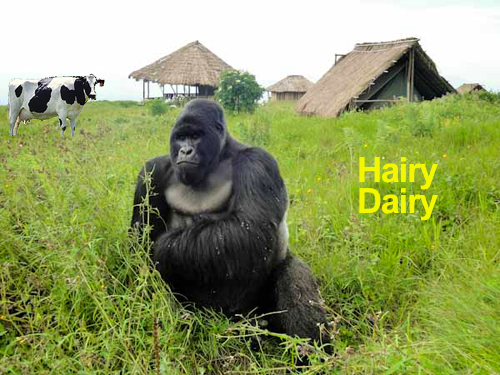
Yesterday we learned that the predictable “bamboo season” in Rwanda’s Parc de Volcan was bringing “as expected” many of the mountain gorillas out of their reserves into adjacent farmer fields. The battle between the cow and the gorilla, though, was not expected.
Researchers following the Urugamba silverback recorded him “charging a nearby cow” last week, although the expected bloody encounter was avoided when he unexpectedly stopped the chase. But cow-gorilla conflicts while troublesome are not what is principally bothering researchers.
Human-gorilla conflicts are escalating throughout the Virunga range, and give every indication that some biological threshold has been reached. The list is long but began horribly documented in 2007 when irate villagers stoned to death a gorilla that had entered their village.
An EWT client was one of the first ever tourists to visit habituated mountain gorillas back in 1979. Then, there were an estimated 280.
Today, the estimates range between 685 to more than 700, approaching a three-fold increase during my lifetime. Similar numbers apply to many animals throughout Africa, including other headliners like elephant and wildebeest.
Researchers are currently painting the human-gorilla conflict as not necessarily something the gorilla needs, but rather something it wants. This is the “bamboo season” as new shoots grow quickly with the onset of the seasonal rains. Gorillas “love” bamboo shoots.
In PdV many of the best and newest bamboo shoots appear first outside the park. The report of the incident between the gorilla and the cow was concluded by the researcher, “There are sure to be many incidents in the coming weeks surrounding the highly anticipated bamboo season. Stay tuned!”
Interestingly, this is exactly opposite to what the researchers in the PdV’s sister and adjoining park in the Democratic Republic of the Congo (DRC), Virunga National Park, claim. There, researchers wait anxiously for the “moment bamboo shoots are available” when their gorillas end raiding farmers’ crops and return inside the park boundaries.
So it sounds to me that there is no particular reason that new bamboo shots are outside rather than inside a park, and probably, in both parks they’re in both places. The human-gorilla conflict is more serious than where new bamboo shoots occur.
The human-gorilla conflict has been seriously documented ever since 2009 when an interagency working group HUGO was formed to deal with it. The name of the group was changed to human-wildlife conflict, in part because as researchers got into the problem they realized the area’s residents while concerned with gorilla conflicts were equally concerned with other burgeoning wildlife in the park, like buffalo.
A foot-high stone barrier is being erected around almost the entire PdV, and this seems to have helped stopped human-buffalo encounters. Near very productive farms alongside Sabyinyo volcano a trench has been cut, which seems to have impeded human-elephant encounters.
But a successful technique to discourage gorillas has not been found. Several years ago the International Gorilla Conservation Program (IGCP) encouraged using drums to scare away the gorillas, but one researcher in 2009 said, “I’m told they enjoy the sound and allegedly start dancing when the drums appear.”
And then this year the DRC gorillas became so familiar at tourist camps and area farms, that researchers began using drums again.
They still don’t dance. But it still doesn’t work.
One of the things that gnaws equally at my conscience and nostalgia is that the growing human-wildlife conflict in Africa is a reflection that years ago the precarious state so much big game found itself was, in fact, a natural if precarious balance with man.
But when man discovered he could make money showing animals to other men, which bought time to deliver a growing compassion as well as a separate understanding that biodiversity is essential to man’s long-term survival, big game became nurtured … developed.
And so, surprise, it prospered.
And so did man.
So the conflicts that existed so long ago that nearly made extinct such animals as the mountain gorilla are only more severe, today. The conflict resolutions are becoming more high tech, more intense and understandably, much more expensive.
And in some cases, such as with gorillas, there don’t seem to be any good conflict resolutions.
Ultimately this growing human-wildlife conflict in Africa will reach a breaking point, and if scientists are unable to stop the rate of growth of these animal populations by benign means before this happens, human policy that understandably favors humans will. And it may not be very pretty, then.
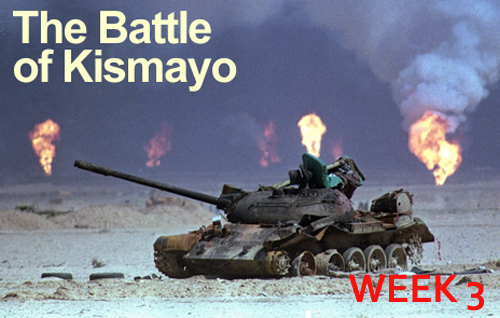
Within a week we’ll know whether the Kenyan invasion of Somalia is the true beginning of the end of al-Qaeda or the start of increased instability and terrorism in Kenya. I’m pretty pessimistic and damn mad. But the outcome of the battle of Kismayo will tell all.
Kismayo is a city. A functioning, wealth-producing large coastal city with a proud university and clean streets. It’s the defacto capital of al-Qaeda in The Horn, the center for terrorist planning, administration and growth.
It’s the only true geopolitical epicenter of terrorists in the world. In Kismayo terrorism leaders don’t hide in caves. They go to work in offices. They collect taxes. They use big computers to concoct strategy, to build internet sites, to train young militants in actual schools, to organize and implement arms deals. This isn’t Wajiristan.
There is remarkable calm in Kenya. In fact, it’s absolutely ridiculous! The rest of the region and much of the world is overwhelmed by news from the front, including the first two Nairobi city bombings as al-Shabaab begins its guerilla war inside Kenya. But one reading the Kenyan newspapers today has a hard time finding any war reports at all!
The country is in denial. The diaspora is in denial. Even if the battle is successful, the effort is likely to bankrupt the country. Tourism is doomed for the forseeable future. Even political stability, so creatively accomplished for the last four years, shows the first stages of unraveling.
I hate making this prediction, and I really want to be proved wrong. But Operation “Linda Nchi” will fail. It will likely fail the same way Ethiopia failed five years ago when western powers propped up its invasion of Mogadishu the same way they are currently propping up Kenya’s of Kismayo.
Ethiopia – with a far more sophisticated army than Kenya’s – marched into Mogadishu and installed a very weak government then rapidly returned home leaving behind a mess that was supposed to be cleaned up by 8-9000 non-Ethiopian African Union soldiers in a few months. It’s been three years. It’s still a mess.
Even though Kenya’s military is far less sophisticated than Ethiopia’s, I think this is the likely outcome, because terrorists survive by running away, never by making a stand. Their success comes in suicide and car bombs, subway attacks and shoe bombers. They don’t do tanks well.
The west seems to think that we’ve got al-Qaeda on the run. It’s true that an arm’s length list of al-Qaeda leaders have been wiped out by American drones and stealth attacks by the Obama administration. The question is, is it enough that Operation “Linda Nchi” is the nail in the coffin, or just the positioning of another sacrificial lamb.
If the latter, Kenya will become rocked by terrorism for years and years. Unless it becomes the horribly ruthless, dictatorial regime of Ethiopia where you need permission to sneeze on the streets of Addis Ababa.
Kenya doesn’t understand — which America maybe finally does – that a ground war against terrorism won’t work.
Defense against terrorism is critical and can be successful. Diplomacy and sanctions against terrorists works. Stealth raids and maybe even drones to kill terrorists might even work, but war doesn’t work. Kenya was managing all of these things masterfully! Until last week.
My friends in tourism in Nairobi are near panic. Bookings are canceling in the droves. And no one in their right mind would suggest a foreign vacationer visit the country, now.
This is so damn sad. For so long Kenya tread the perfect balance with regards to its chaotic terrorist neighbor, Somalia. It refused to join African peacekeepers in Somalia. It tolerated but repelled incessant incursions into its Somalia border towns. And it quietly assisted the big guys by rounding up terrorists on its own soil.
But then the Somalia famine quadrupled the size of the refugee camp in Kenya at Dadaab to a third of a million people, in less than three months; the world economic collapse bludgeoned the shilling, and finally the spat of kidnapings was just too much for this until now adroit and up-and-coming new world to take.
Have you ever heard about that little kitty that was taken far, far away and dropped in a forest but found its way back home? What about an elephant?
Last week the Kenya Wildlife Service completed the first of several phases of relocating 200 jumbos as much as 100 miles from where they were picked up. The controversial and very expensive project is one more attempt to “save” elephants by removing them from angry farmers, school children and people walking to church.
Well, we won’t know for a while. But … a couple don’t like their new diggs very well.
Two were killed in Kisii, a heavily populated city in exactly opposite direction from where they were relocated, and although they were “dispatched” by villagers before wildlife officials could identify them with certainty, there’s every indication they were from the relocated bunch.
Those ele would have walked about 50 miles through (human) enemy territory northwest having just been brought 50 miles southwest to the idyllic and peaceful human unpopulated Maasai Mara in the relocation effort. And frankly, whether they were from the relocated bunch or not, their journey from the nearest open reserve (the Mara) shows how capable they are of navigating human population centers.
And at the end of their journey you don’t hear cute little mews at your backdoor.
Pole pole I’m coming round to thinking ele must be culled. I’m not there yet, and I still viscerally resent the mostly southern African theory of “carrying capacity” and that anything that doesn’t meet the model should be eliminated.
(Not just ele, by the way, but Jacaranda trees, certain flies and spots on windows.)
But the situation in East Africa is growing intolerable, and intolerably expensive. KWS has moved the first 50 tuskers at an expense of about $3,000 per elephant.
That’s huge, especially by African standards.
All sorts of things are being desperately tried now to control this human/elephant conflict, from pepper spray, to scare crows, to moats and bullhorns.
The most effective way is already being used in southern Africa (where they don’t need it as much, because they kill their excess!). The seel-reenforced concrete spike barriers employed in Botswana around its national parks tourist camps work well. The problem is they are extremely expensive, too. Each roughly 4′ x 4′ block costs around $10.
That’s the cost in South Africa. First there would have to be a factory built to produce them in East Africa, or the additional cost of importing them to East Africa.
To surround the northern top cap of the Maasai Mara (the southern border sits on the Serengeti) you’d need more than a half million blocks and that doesn’t even take care of the many river boundaries where they wouldn’t work, the labor to do it, they maintenance and the possible environmental fallout of also impeding other wildlife.
And then, of course as the southern Africans would point out, what happens when the density of elephant is compressed to a level that starts to destroy the Mara ecosystem?
You see. The reason the ele are leaving their splendid protected reserves, is because there are too many of them already.
So any successful barrier or relocation effort could end up being counter-productive.
Three African despots down. Eleven to go. Here’s my list and predictions of when the last of the African dictators will fall.
Is it possible to think of a world without dictators? Can you imagine no Kim Jong Il, the “Stans” with free wifi elections, Hugo sent back to his banana farm or Ahmadinejad retired as a Fox News anchor?
I can’t speak about the rest of the world, but yes, I can imagine an Africa without ruthless despots, and Twevolution is knocking them down the continent from top to bottom. Only a few years ago I would have thought this impossible.
What’s happened in Africa started with this near obsessive demand for education, and over the years I was so critical of all sorts of different African forms of education for all sorts of different reasons. But that all seems so trivial, now. Whatever flawed system might have delivered it, delivered it it did. From Tanzania’s mandated free education in the early years of independence, to more sophisticated forms in Egypt, it worked.
I think I was too focused on what was being taught, the curriculum, rather than just the teaching itself. Teaching young kids – even when forced down their throats or teaching “incorrect” things – obviously instills curiosity.
In my life time, Africa has made the longest journey in education of any part of the world. When I began my career there in the early 1970s, there were vast portions of the continent that didn’t even know there was more to the universe than themselves.
My wife and I brought the first refrigerator into a remote part of western Kenya. Powered by natural gas, it nearly installed me as a local despot myself, or a shaman. When ice cubes were placed on the hands of children, they thought I was burning them to death.
How remarkably different that place in western Kenya is, today, with nascent global call centers and plans for a solar panel industry. What must grandma think?
The second critical component to today’s dramatic political change is the internet.
That’s twevolution. A young Kenyan woman started the whole social networking organization of civil disobedience when Kenya imploded after its last election. Ory Okolloh spearheaded the founding of Ushahidi and is now Google’s Policy Manager for Africa.
But while the internet may be the new “weapon” of revolutionary change, it had a much much greater impact much earlier. I remember before cheap cell phones and easy access to computers in Kenya the dozens and dozens of internet cafes in Nairobi.
And the kids were packed into them like sardines! What were they doing? Playing games? Looking for a job? Or, maybe, learning about the better things in the life… Or, maybe, about the gross injustices that divide the world’s privileged from those who serve the privileged?
There are still pretty bad guys in control of 11 of Africa’s 54 countries. I can imagine every one of them gone in the next decade.
They fall broadly into two categories: 7 zealots and 4 victims. The victims will fall last and perhaps not with more than a thud. But the zealots will tumble into al-Jazeera videos screaming.
The zealots are composed of widely different men whose path to tyranny was varied. But they now share a narcissistic certainty, a near divine belief, that they should rule no matter what. Their countries of Zimbabwe, Sudan, Gambia, Burkina Faso, Cameroon, Equatorial Guinea and Uganda are in various stages of abject servitude.
They are making themselves, their friends and families wealthy often with impunity at the expense of their citizens. They believe so much in their self-conceived right to rule that they often fail to hide their crimes, deluded that they can do no wrong, or perhaps that there are none remotely capable of challenging them.
How wrong Gadhafi was.
These guys go first.
The second batch I even find sympathy for, but they’re on the way out nonetheless. I call them victims because essentially they started as true liberators with extremely lofty ideals and plans, but they got ensnared in societies with the deepest ethnic divisions in the continent, and with a concomitant division of education.
Rwanda, Chad, Eritrea and Ethiopia are today headed by ruthless men who are nonetheless loved by a large segment of their population, the segment from which they were born.
They believe, quite possibly truthfully, that loosening the reigns of dictatorship will bring catastrophe on their entire country as it reverts to the chaos from which they long ago thought they liberated it. These victims at least ostensibly put “country” before “self.” The zealots don’t even have this as a pretense.
That’s Africa. Where education delivered the dreams and the internet facilitated revolutionary change. Will the rest of the world follow suit?
South African Richard Pithouse, Egyptian Gamal Nkrumah, Kenyan Rasna Warah, and Nigerian Rotimi FasanOccupy Wall Street is seen from Africa with a clarity we’re missing here at home. As Africa sees it, American youth’s frontal assault on unbridled capitalism is not going to end quietly.
The “unbridled” is an important distinction from the sister movement of the 1930s which gave rise to an unique version of South African communism that has continued as a political force, there, until today. Back then capitalism was going to fall lock, stock and wall safe. Not now.
South Africans, Nigerians, Egyptians and Kenyans in particular see capitalism as here to stay, but as something that needs to be hugely reigned in, and they see the OCWS as an indication it is really going to happen this time.
There have been only a few placards in Nairobi, and a greater but still smallish response in South Africa’s three main cities, but a massive amount of discussion in the media, there. I think one reason the demonstrations are smaller, is because relative unemployment has not spiked so high as it has here. The discontent relative to before is more intellectual than economic.
And African economies are much more regulated to begin with than ours.
Few Africans are in a better position to compare OCWS with the Arab Spring than Egyptian Gamal Nkrumah. The son of Africa’s first independent president (in Ghana), he married an Egyptian and has lived there permanently for a number of years. Recently Kkrumah asked about OCWS:
“Will this spontaneous outbreak of angst be hijacked and neutered or will it become, like the anger of Egyptians, the backbone of a new social contract?”
Nkrumah isn’t sure. He worries that the established financial system in America is just too hard to crack:
“The game of global finance is as dirty as hell… The international meltdown is a harsh indictment of the global financial system [but] bankers don’t seem to have a conscience and [all] the people [can do] is strike the fear of God into them.”
Nevertheless, my survey of African analysts suggests Nkrumah is in the minority. Although cautious and not suggesting our entire system is going to be revolutionized, most African analysts believe OCWS foreshadows significant change in America.
Everyone knows America with China at its heels controls the world economy. So what happens in America effects everyone, without exception. African’s interest is not simply academic. In fact what happens to the OCWS may have a more immediate effect on the everyday lives of Africans than it does on most Americans.
The very influential young thinktanker in South Africa, Richard Pithouse, has often written that the developing world has been consciously subordinated to us – the developed world – by a brute and unfair force called DEBT. Think about it. Where is most of the gold in the world? South Africa. Where is most of the oil?
But who controls the gold and the oil? Neither South Africans nor Nigerians, but Americans and Europeans.
“Debt,” Pithouse writes “became a key instrument through which the domination of the North was reasserted over the South.”
But that suffering has now come home to roost in America, according to Pithouse. The “servitude of the debtor is increasingly also the condition of [American] home-owners, students and others” who are being made to pay for the financial crisis created by their overlords, the bankers.
At last, Pithouse exclaims, OCWS in America is “a crucial realisation that for too long society has been subordinated to capital.”
“The prevailing capitalist economic system has clearly failed. It has deepened inequality between people and nations and caused much misery. Its excesses must be curbed,” writes , Kenyan analyst Rasna Warah in her article “Is the End of Global Capitalism Nigh?”
She answers her own question with a “Probably Not,” essentially what all the analysts in Africa concede. But she opines that as Africa emerges from the Arab Spring it will invent “a hybrid, more humane capitalist-cum-socialist system … where wealth will … be used to promote the greater good rather than individual and corporate interests.”
The Nigerian analyst and sometimes poet, Rotimi Fasan, compared Wall Street bankers to the worst of his own corrupt Nigerian autocrats. And like many, many writers throughout Africa he wonders if what is happening now “might be the beginning of the West’s version of … the Arab Spring.”
He refers to the west’s “crumbling economies” and cautions that “things may not take that shape immediately. But they might over time. Those who imagine that such eruptions could only happen in Africa of sit-tight leaders” do not fully understand what’s happening.
Which leads me to another dominant theme throughout all of Africa’s reflection on the protest:
Our media is minimizing the demonstrations.
“If these protests were occurring in any other part of the world, Western [media] would be describing them as an ‘American Spring’ that could topple a government,” Warah writes.
Warah and other Africans believe that the American media is part and parcel of the greater problem. “The large [American] media networks are part of the very corporate culture that the protesters are against,” Warah explains to her readers, so naturally they are minimizing the story.
Using last week’s celebrations of Martin Luther King, Pithouse claims that the famous statement that young blacks in the 1950s faced life “as a long and desolate corridor with no exit sign” applies to all American youth, today.
The South African continues: “The time when each generation could expect to live better than their parents has passed. Poverty is rushing into the suburbs. Young people live with their parents into their thirties. Most cannot afford university. Most of the rest leave it with an intolerable debt burden.”
And what does this mean about America to an educated outsider?
“The borders that surround the enclaves of global privilege are shrinking in from the nation state to surround private wealth.”
Wow. Poetic but how insightful. I think Pithouse reflects many many intellectuals from abroad, especially from developing and emerging, youthful nations. They no longer look to America for direction, but for lessons as to why things went so wrong.
“When some people are living like pigs and others have land lying fallow, it is easy enough to see what must be done,” Pithouse says. “But when some people are stuck in a desolate corridor with no exits signs and others have billions in hedge funds, derivatives and all the rest, it … is more complicated. You can’t occupy a hedge fund.”
But OCWS protestors understand that “finance capital is … the collective wealth of humanity. The money controlled by Wall Street was not generated by the unique brilliance, commitment to labour and willingness to assume risk on the part of the financial elite. It was generated by the wars in the Congo and Iraq. It comes from the mines in Johannesburg, the long labour of the men who worked those mines and the equally long labour of the women that kept the homes of the miners in the villages of the Eastern Cape. It comes from the dispossession, exploitation, work and creativity of people around the world.
“That wealth, which has been captured and made private, needs to be made public.”
Pithouse concludes and warns us directly, “When a new politics, a new willingness to resist emerges from the chrysalis of obedience, it will, blinking in the sun, confront the world with no guarantees.”
Beware the thinkers of Africa. They bear the truth of experience.
Today Kenya invaded Somalia. The speed and size of the mission surprised me and I’m sure greatly pleased Leon Panetta. It’s hard to predict the outcome, but one thing strikes me as certain: this is not a time to take a Kenyan safari.
Most news sources reported the Kenyan military operation as a response to a spat of recent kidnapings, and I don’t doubt this has something to do with it. But it could also be a partial excuse for a more globally organized effort against what appears at the moment to be a successful rout of al-Shabaab from Somalia.
The size of the Kenyan excursion is secret, but there were enough eye witness reports on the ground to confirm a major operation. The BBC and AlJazeera (who has a reporter embedded with the Kenyan forces) reported “lines of Kenyan tanks and trucks” and multiple air strikes against an al-Shabaab base about 75 miles inside Somali territory.
Africa Union forces led by Ugandan soldiers in the last several weeks have routed al-Shabaab from the Somali capital of Mogadishu. The BBC reporter Will Ross said these forces were now working in tandem with the Kenyans, moving south from the capital towards the conflict area where the Kenyans are, headed to what could be a pincer action to rid a large portion of Somali of al-Shabaab.
Last week the Obama administration sent 100 Green Berets into Uganda for deployment further west into central Africa. The statement of deployment claimed a mission totally separate from this conflict, but last night on CBS Panetta said the operation was integrated with fighting terror in Africa.
With Obama’s long list of al-Qaeda captures and kills recently, we know that the al-Qaeda/al-Shabaab power has been significantly diminished. Is this their last hurrah? Might the Ugandans, Kenyans and Americans actually be getting rid of these terrorist organizations?
I wish I felt the answer was a definitive yes, but frankly I think rather it’s a hopeful maybe. I’m no expert historian, but I just don’t see ridding any part of the world of anything, unless the people actually living there do it themselves.
And the Somalis haven’t. The parallels with Afghanistan and even Iraq are substantial. I don’t even believe that Iraq will be stable in ten years. And if I’m wrong and it is, then the question becomes was it worth the 20 years of war and investment we made to make it so?
That’s the greater, global question. But for those of us much closer to the situation, our lives and our businesses are immediately effected. Tourism must go on hold in Kenya, now, until we see what happens.
It’s been widely reported that al-Shabaab has now threatened Kenya. Last year al-Shabaab killed more than 70 people in two simultaneous bomb blasts in Kampala sports bars where patrons were watching the World Cup. They specifically threatened such before it happened because of Uganda’s lead role in the African Union forces in Mogadishu, and immediately then took responsibility. The parallel with Kenya can’t be starker.
I don’t think it will happen in Kenya. I think al-Shabaab is too much of a spent force and now too engaged outside Kenya. And Kenyan security is better than Uganda’s. So my visceral concern for my own Kenyan employees and friends is minimal.
But you don’t take a vacation where you have to keep looking over your shoulder. That’s not what a good safari is supposed to be. So while I’m not expecting trouble, the chance is more real than before, and equal if not better alternatives are available elsewhere, particularly in Tanzania.
Until the battles end and the dust settles, Kenya has become too troubled a place for tourists.
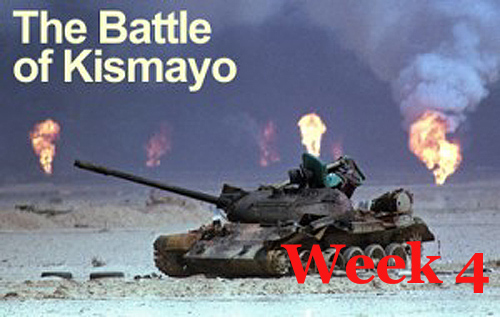 The Kenyans never said how long it would take, but it’s taking too long. And while opinion in Nairobi remains ludicrously supportive analysts outside the country are painting a gloomier and gloomier picture. The Kenyan invasion might have given a terrorist organization its first opportunity to win a conventional war.