You Can’t Befriend Somalia without Training

You Can’t Befriend Somalia without Training

Matthew Wrote:
Jim i want to begin providing aid in somalia, would you recomend Garissa a good
place to live and creat a relationship with somalians?

Matthew –

In your straight-forward email, I sense a dogged commitment and very high moral belief in what you’ve decided to do, so far be it from me to dissuade you. But that’s what I’ve been doing most of my life in Africa.

I have a forty-year view. Individual charity or “missions” are almost always bad. But there are thousands, probably tens of thousands of people exactly like yourself who are successfully helping Africa. They do it with proper training, first, and then by joining some of the outstanding organizations like the Red Cross or Medecins sans frontieres for health issues, or by joining NGOs like USAid or UN agencies. Those groups of people do Africa enormous, untold good.

Good individuals like yourself often help African individuals, but it’s like biofuels here where I live near Iowa. We spend more energy and other resources to make biofuels then we get out of them. Most individual charity work expends more money, human resources, intellectual effort than it produces good. Especially someone as clear-minded as yourself. You belong in the foreign service, not on an individual mission. You probably don’t even know the extent of your own talents, but a good organization will determine that and will maximize your individual effort.

Go back to my blog and navigate to “charity” on the right-hand panel and then read the thumbnails of a dozen blogs I’ve written that explain this more fully.

I’m not telling you not to go. I’m telling you to make a short turn first, to a good organization.

Regards,
Jim Heck

Another Black Day in Kenya

Another Black Day in Kenya

Visitors and citizens alike were horribly killed in Kenya yesterday reflecting a very strained society.

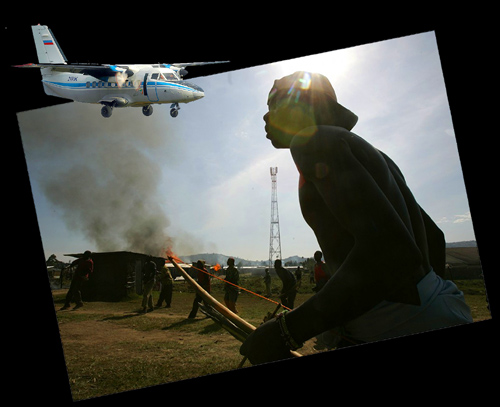
As of this morning four tourists are reported dead with several others still in critical condition after a scheduled flight aboard of Mombasa Air Safari LET aircraft from the Maasai Mara to Mombasa crashed on take-off.

Forty-eight Kenyans were killed in ethnic clashes near the town of Mandera in the arid Tana River region far east of Nairobi.

The two quite different incidents both reflect Kenya’s growing strain as it prepares for critical elections next March.

The Mombasa Air Safari crash was of a Czechoslovakian made, Soviet-styled LET aircraft. LET aircraft (of a variety of different sizes and types) has a horrible safety record with twelve accidents and 424 fatalities just this year alone. It was a cheap aircraft to begin with that became even cheaper with the breakdown of the Soviet Union. Almost like bad weaponry, LET aircraft have been showing up more and more in Africa as lax aircraft regulation mixes with strained economies.

The ethnic clashes which have been mostly reported in the world press as revenge killings by one ethnic group against another for disputes over water resources and range rights is actually only the tip of the story.

Kenya has redistricted itself in preparation for next year’s elections under the new constitution. Multiple smaller districts have been consolidated – as I believe they should – to create a truly more representative parliament.

And one logical outcome pits former established politicians as competitors for a single representative seat. It isn’t just coincidence that this is the case where the ethnic clashes occurred yesterday.

Police have confirmed that villagers have been incited to violence by local politicians vying for a consolidated district under the new constitution.

To a certain extent both these tragedies are isolated. Kenya tourism – indeed more and more of East African tourism as a whole and almost all of southern African tourism – depends upon small aircraft. I’d estimate in East Africa that more than half the tourists take at least one such flight, and likely a quarter take two or more.

The overall safety record for such a massive industry is pretty good. LET aircraft represent a very small proportion of the tourist aircraft, which are predominantly very safe Cessnas. (Unfortunately, there are no actual statistics, although the data is there to compile. So my statements are not evidential, but I believe accurate enough.)

And the ethnic clashes in Mandera which have been picked up in the world press as evidence of Kenya’s overall ethnic strife is nonsense. The new constitution, some pretty harsh laws, four prominent citizens on trial in The Hague for causing ethnic violence in 2007 all point to a Kenyan society righting itself masterfully.

But dead is dead. Another few hurdles for this tough and struggling society.

Leaping out of The Wild

Leaping out of The Wild

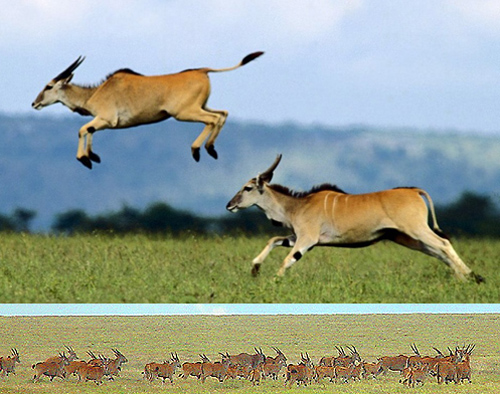
Yesterday eland was photographed in Nairobi National Park. It’s enough to make you believe the wilderness will be preserved!

There is hardly anything as anomalous in the wild as Nairobi National Park. Three of its four sides abut some of the highest low-rise human population densities on earth, including some of its most truculent slums. Its main water source, the Athi River, is fickle and destructive and often terribly polluted.

Yet this biggest of Nairobi’s parks still manages to sustain big game like lion, zebra, hartebeest, impala and eland, the biggest antelope on earth.

Imagine taking the narrowest side of New York’s Central Park and extending it over the Hudson, over (or under) I-90 and eventually into the Jersey forests. That’s what Nairobi National Park is like, a narrow southwest side gingerly extending towards the wilderness near Amboseli past concrete factories, giant warehouses and manicured ranches.

I think of eland as a real indicator species, but not in the traditional sense. Normally an indicator species is a fragile one, an animal or bird that is endangered by shifts in its ecosystem. The eland is different. It’s one of the most adaptable on the big game.

In the wild and seemingly endless plains of the southeast Serengeti, somewhere west of the big Lemuta Kopjes, hundreds of eland in family groups that size roam with the greatest timidity. Though each animal approaches 1600 pounds, they are extraordinary shy.

As we approach within a mile, they start running away, and they’re amazing runners. Almost without moving the rest of their bodies an inch, the legs start trotting as if the rest of the body is resting on a railway car. The feet go quicker and quicker moving the giant animal upwards of 30-35 kph.

Then, one – often the leader – leaps! This giant animal can leap 8-10′ into the air, creating this graceful arch over the plains. Soon they’re all leaping that from a distance looks like a line of boiling and popping cooking oil.

Rarely in the wild do we get within a mile or two.

Yet eland can be domesticated easier than any other antelope! In fact there was a period when Kenyans tried to farm them. The problem was that the meat wasn’t very tasty. But like a wild horse, once captured and fenced the eland becomes nearly a pet.

The eland in Nairobi National Park are very tame and according to one observer, now confined to the park, too weary to leave through the narrow corridor southwest. Technically, they haven’t been captured or fenced since the park is fenced on three sides only. But for all practical purposes they have been fenced by a rapidly growing human society.

So instead of leaping away, they are posing for pictures!

The Nairobi National Park is no San Diego Wild Animal Park. It’s much bigger; it has a much greater diversity of wildlife that benefits or suffers from the radical changes in climate, today; and it actually has far fewer visitors.

But it is absolutely the best, and surprisingly so, of the earlier wild. And the fact that we might have lost the eland’s leap for its presence might just not be so bad.

Malaria Milestone

Malaria Milestone

The greatest of evolutionary battles is between man and his diseases and a recent genetic discovery about malaria gives man a new flank to attack.

Malaria is one of the most intriguing diseases in the world, incredibly complex. It is among the greatest killers in Africa, vying every year as the greatest killer with AIDS and gastrointestinal infections.

Last month researchers at the Centre International de Recherches Médicales de Franceville in Gabon collaborating with French laboratories published an amazing discovery about the genetic makeup of malaria. Their findings could open up an entirely new front for the attack against the disease.

As we learned this past week in Texas, the might of the developed world’s mastery of pesticides has kept malaria and other mosquito born diseases mostly at bay.

Malaria was essentially eradicated from the U.S. by the middle of the last century through extensive use of DDT. Many in the developing world argue for the use of DDT right now in Africa, but control of the substance remains with the developed world that has decided it’s too toxic a pesticide.

That debate is furious but there is strong evidence to suggest DDT might do more harm than good for two very interrelated reasons.

The first is that systematic spraying of the sort that occurred in the U.S. would be too hard to implement in Africa’s most malarial areas, which include sprawling slums and extraordinarily remote wetlands and swamps.

DDT’s toxicity isn’t in dispute: Numerous species of bird, insect and even plants could be eradicated if used. But in light of the terrible plight the sickness strikes every moment in Africa, the world might be willing to lose a few species of bird, insects and plants, but not if the implementation plan is as uncertain as it seems it would be.

Particularly if other remedies for malaria can be found.

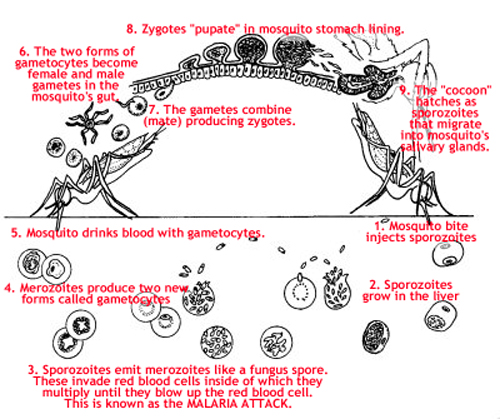
Malaria isn’t just a single thing. It seven different life forms, like caterpillars and cocooned pupas and butterflies, but more than double that butterfly formation. The one form that does us damage is the sporozoite which produces the malaria attack.

But all other six forms have to produce and cycle to produce the sporozoite, and just that amazing transformation in an evolutionary sense is absolutely mind-boggling.

Remember, evolution is chance. Imagine the billions, trillions, godzillions of chance mutations that occured on each of the seven life forms meaning we have a permutation of godzillion to the seventh power (which I think is still godzillion).

Anyway, I hope you catch my drift. This is an amazing evolutionary development arguably as complex as many of the most complex life forms on earth, today.

But consider this after you catch your breath. Each life form’s mutated chance change produced some type of response in the disease’s host. Maybe, like sickle cell anemia, the sporozoites slides off the red blood cell so can’t infect it. Maybe another godzillion defenses (many like sickle cell anemia aren’t ideal) occur.

So there is this back-and-forth over time of the disease and its host (including man) trading punches. To date, malaria has won.

We know that apes and chimps get malaria, too. But we didn’t think until this new research that anything other than creatures in man’s family tree got malaria.

Wrong. The new research reveals that the greater spot-nosed monkey gets malaria. The guy is a primate, but we know from DNA research that he is far away from the line of primates that produced chimps, apes and man.

That means that malaria was doing its dirty work before the homonids line evolved from earlier primate forms. And that means that the malaria had to have evolved in some type of parallel way to homonids, and separately, to the greater spot-nosed monkey.

And that means if we can study the detailed difference between greater spot-nosed monkey’s malaria, and hominin’s (man’s), then we might find the point in the complicated life cycle of the disease that is most vulnerable to attack, the spot that makes human malaria distinctly human.

Perhaps it’s a gene in the human malaria that binds to hemoglobin. We’d have never known to look for that gene (among untold numbers of genes) if it wasn’t pointed out to us because it doesn’t exist in the monkey malaria. It’s very likely that that unique gene is of critical importance to the whole malarial chain of events that we might then be able to interrupt.

Go ahead and scratch your head. Read this wonderful summary about malaria that is better than mine. And then, think about it. It’s incredibly fascinating.

Pop Goes the Weasel

Pop Goes the Weasel

The horrible killing of South African miners yesterday is less news than analysis of not just South Africa’s political legacy, but the whole wide world’s.

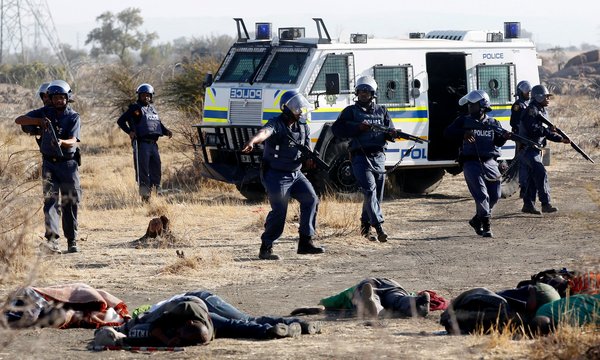
Police conceded that at least 34 admittedly aggressive strikers at a platinum mine in the north of the country were killed when things got out of control. The number is probably higher.

While the protest was ostensibly over wages, the weeks leading to the outburst were more of a battle between two labor organizations, the official union for the mine and a renegade self-styled militant union that is passionately communist.

I use that term with caution but deliberately. Communism in a truer and less autocratic way than adopted by the Soviet Union, for example, has been a significant part of South African politics for more than a century. Its leaders would be considered moderate by the style of historic European communism, more like American communists in the 1920s.

But lately South Africa – and the world – have taken significant right turns, becoming more conservative socially and fiscally. And in many places in the world, such as the U.S. under Bush and a number of European nations under current conservative leadership, it’s been downright dictatorial.

It never seems that way at the time. When America invaded Iraq, my own liberal heroes were behind the invasion. But with time history is revealing what a small number of men, motivated not by facts but ideology, actually made the decision.

It was affirmed by a greater segment of society, but the die had been cast. Society as a whole had neither the guts or power to oppose it. Even our “progressive leaders,” or in the case of South Africa, union leaders appear to capitulate to the rightist dogma.

In South Africa, the mining weasel popped. And it wasn’t pretty Thursday.

Earlier this year South Africa almost nationalized the mines. That, too, is a perennial topic it seems in South Africa, but this time they got closer than ever to doing it, and in fact the renegades have expressly said they hope this violence will make the country revisit the issue.

Nationalization would be a thunderclap in the world. Even as a diehard liberal I think it would be far too serious a jolt. This is because South Africa’s reservoir of gold and other precious minerals is too large. In one fell swoop it would alter the way energy is consumed in the world. Moreover, in South Africa it would empower a currently corrupt political leadership that could be spun out of control with their dizzying new responsibilities.

But nationalization was a real topic because blue collar workers are being shafted, just as they are in the United States, and as they are most of all in places like China. It’s a very hard argument to make, because workers are better off, today, in South Africa and China than they were two decades ago.

At the expense, I might add, of American workers.

But without the long analysis needed (read Chris Hayes’ Twilight of the Elites) the point is not so much that workers are being shafted, but that the capitalistic balloon is busting.

The right side of the balloon is the rich owners radically pulling their salaries and dividends even more to the right. But it can’t be pulled that way without pulling the left side an equal distance “shafting” the poor.

We guys in the middle just tread water and wait for the pop.

South African mine workers aren’t, really, too off-center compared to where they were a decade ago, or compared to many other workers in South Africa, today. But from their central location they see their families over there in the poor left being vastly distanced by the owners and stakeholders getting fabulously rich by the platinum they are pulling out with their hands.

New York Times reporter, Lydia Polgreen, nailed it: “The shooting left a field strewed with bodies and a deepening fault line between the governing African National Congress and a nation that, 18 years after the end of apartheid, is increasingly impatient with deep poverty, rampant unemployment and yawning inequality.”

This is ripe stuff for an explosion. Particularly in a society where workers – especially miners – have a history of activism. It isn’t just that they want higher wages, they’ve actually seen their own country’s politics radically moved by their activism.

The violent confrontation, of course, does not make South Africa’s poor richer. But it did make the rich more poor.

So this isn’t the end of it, folks. Where unions still have some power, like South Africa, there’s going to be more and more labor unrest. Relatively rich countries like South Africa will either ultimately nationalize giant industries like mining, or the global capitalistic gyroscope will reset somehow, reversing the trend of the last half century. The richer will become poorer and the poor will become richer.

I vote for the latter. It will be much less violent.

PETA vs MING

PETA vs MING

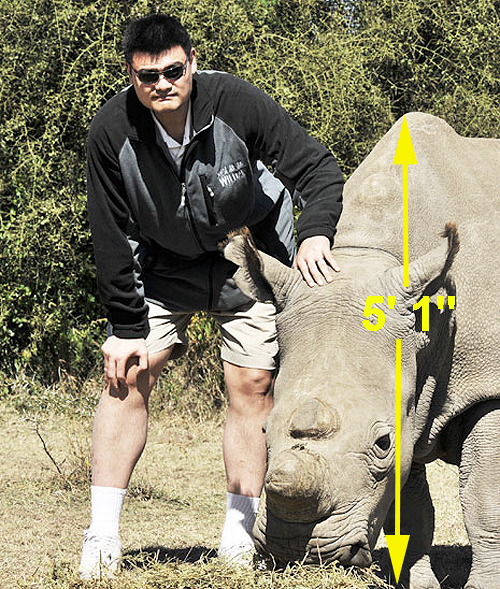
Yao Ming, the former Houston Rockets skyscraper, is trying to do what no Chinaman has done before : sensitize his countrymen to African conservation.

Ming retired as the awkward but successful 7’6″ basketballer last year and has been judiciously investing in a way definitely not characteristic of most sports stars. His current job is filmmaker, but it’s hardly more than a vehicle to deliver an unsavory message to his fellow Chinese: stop consuming animal products.

Ming is well known for his home town generosities and stardom throughout China. Injuries forced an end to his career last year, but injuries that many sports figures would have surgically corrected for a short-term sprint that ends them in a wheelchair when they’re 45.

Ming, instead, walked away from a salary that ESPN claimed would have been $17,686,100 for another 2012 season. Since then his endeavors have included buying a Napa vineyard and starting a wine export business to China, buying and coaching a Chinese basketball team and now, starting a film career.

Ming is currently in Kenya where together with American producer, Jay Cohen, he is producing a wildlife film mostly for Chinese consumption with the rather cliched title, “End of the Wild.”

Bundle this together with his decision to be an ambassador for WildAid and his appointment to a Chinese communist party committee in his hometown, Shanghai, and I think we have a man who is tall enough to bring two worlds together.

Wildlife conservation is not a Chinese passion. In fact, most of Asia has never viewed nature with the same reverence or awe as we cowboys. These older and more established cultures have sort of put nature in a picture frame rather than accepted it as something untamed.

For probably a millennium the unique characteristics of many animal horns and antlers have provided accomplished Asian sculpturers with a media that can be found nowhere else on earth. Ivory is the only natural substance that allows such intricate sculpting.

And similarly for a millennium and probably longer, traditional Asian medicines have relied heavily on rare animal parts: bear feet, rhino horn, rare bird livers.

I think that one of the reasons contemporary wildlife conservation has had such a hard road into Asia is that the most vocal of western conservationists are evangelical ideologues. Not that their foundation that preserving any form of life is not a viable first principle, but it completely ignores or at least leapfrogs the compelling science for animal conservation.

And that ideological position at the level of first principle does nothing but start a fight with opponents who cherish other first principles, like the preeminence of man.

You might call it PETA vs Ming.

More patient science shows us that even the simplest of life forms is so incredibly complicated not even Watson can replicate it. And this means we don’t know everything about it. And this means if we wipe it out, we’ll never know. And this means all sorts of knowledge, and knowledge specifically beneficial to humankind is lost for good.

Once that horror is truly understood there is a reverence for “what is living” that might come full circle to PETA’s mania. But it is the evidential science that will win over the majority of the world to wildlife conservation, not the simpler battle cry.

That’s why Ming’s old hat title of “End of the Wild” may mean something to a Chinese society that is only recently emerging from their cocoon.

Touring in Laikipia

Touring in Laikipia

[email protected]> asked:
When is the best time to see wildlife at Mt. Kenya vicinity? What is the cost of a safari there?

The “Mt. Kenya” area is usually known as “Laikipia” and is an area with abundant wildlife, but also great ranches and several densely populated cities. North of Mt. Kenya and a bit north of Liakipia is Samburu to the west and Shaba to the east, both at the beginning of the great northern frontier, and at this point there are few ranches or populated cities.

You can obtain much more information by googling Laikipia, Samburu or Shaba.

Everyone has their own preferences for when a given area is the best. For me it is just as the rains begin or end, which in this part of East Africa is mid-November through mid-December, March or June.

There is a huge variance in the cost of a safari. An overland camping safari in a big Bedford vehicle where you share the truck with up to 30 other people can cost as little as $100 per person day. Most lodge safaris cost around $400 per person per day. And boutique luxury camps can cost upwards of $800 per person per day.

Regards,
Africaanswerman

Knight of Power

Knight of Power

Yesterday, Egypt crowned a new prince. There is nothing for us as secular outsiders to fear of a powerfully Islamic ruler but a lot for the subjects of this new Egyptian strongman to fear.

After yesterday’s palace shakeup Mohamed Morsi is Egypt’s most powerful man. Yesterday, he emasculated the two most powerful military men who have ruled Egypt since Mubarak stepped down. He replaced them with young Islamists in the military clearly now beholden to him. And he has eliminated at least for the time being any legislature that could challenge him.

What’s left?

Time. The progressives who started the revolution long ago fizzled out in the face of overwhelming Islamic democratic sentiment among voters. Rather than force issues of womens’ rights, habeus corpus, free speech and such, they chose to wait and see how oppressive Morsi and team would be to their progressive ideas.

So far there’s been no chance to rate him; the Big Boys have been fighting for the crown. We don’t know what jewels may have spilled out. But one thing is clear: Morsi is scaring to death Egyptian democrats.

Now that the crown is clearly upon Morsi’s head the world may soon know how draconian or — on the completely other hand — how Islamically permissive Morsi will be. Analysts have been delving into Morsi’s past for a clue.

His many years as a college professor in California give progressives hope. Yet I see a remarkable similarity to the young Muammar Gaddafi who carefully and systematically removed opponents as he patiently came to power in 1966-69.

Morsi, however, is no Gaddafi. The Libyan leader for all his narcissism and greed was for all practical purposes a moderate Islamist perhaps because he was a permissive and pretty immoral individual. Morsi is anything but: his Islamic purity is almost terrifyingly strong.

Morsi’s final blow to his opposition was to effectively sack the military strongman Hussein Tantawi yesterday. He did this by manipulating an effective military coup led by the younger, Islamist officers clearly allied to him. And he did it on the 23rd day of Ramadan, which the Koran labels as the “Night of Power.”

The respected Egyptian analyst, Issandr El Amrani, said immediately afterwards, “It is hard to believe [this] purely coincidental.”

Each night of Ramadan Morsi breaks his own highly publicized fast by a 5-minute radio broadcast that answers what are supposedly random call-in questions by everyday Egyptians. But the highly scripted and professionally edited segments are anything but random.

What progressive Egyptians fear most is that two popular ideologies, democracy and Islam, are in critical ways diametrically opposed. But the questions Morsi allows – quite contrary to the flattering NPR report cited above — are about how many bakeries exist and which potholes will be repaired first.

There is no mention of Egypt’s escalating crime, crumbling military in the troubled Sinai, increasing power outages, escalating unemployment or self-imploding stock exchange.

What seems clear to me is that these big, critical issues have been intentionally ignored while the fog slowly lifted from the palace.

Well, the sky is crystal clear today. There is one man in power. He controls the military. And despite earlier popular attempts to recreate a legislature, he has said that Parliament will not reconvene. Since Egypt’s judiciary is essentially a military creation, this means today that Morsi is president, lawmaker and judge.

Some kings are good. Some kings are bad.

Anything for A Buck!

Anything for A Buck!

Tanzania’s scandals and sheer wastefulness of its bountiful natural resources are legendary. But last month’s incident took the prize.

In addition to the world’s second largest single vein of gold, countless copper and recent rumors of off-shore oil, large deposits of uranium were discovered hardly 100 miles from the port of Dar-es-Salaam last year.

The fact that most of the streaks were in the massive Selous Game Reserve really was incidental. According to the government less than 1% of the reserve would be effected.

Not the Tanzanian government is to be believed about the time the sun rises, but the way the natural resources ministry mismanaged the gold mining near Lake Victoria, which has essentially stalled normal mining, I think gave hope to many environmentalists who simply expected this new discovery will also be bungled.

But uranium has a “security” component to it gold does not. The interest of world powers is acute. No fewer than 26 multinationals (and one Tanzanian) company are now involved.

In approval faster than a speeding bullet, UNESCO who fought tooth and nail to protect a single road from bisecting the Serengeti, approved yet to be revealed mining methodology of the world’s largest protected wilderness, The Selous.

By 2014, optimistic businessmen claim, Tanzania will become the world’s eighth largest producer of uranium.

All to be expected, and despite my sarcasm I have never opposed proper natural resource extraction from Africa and I’ve always countenanced arguments for extracting it from protected wildernesses.

The fact is that the world is energy desperate and Africa is sitting on the golden goose. It’s about time that Africa get its fair share.

And that’s the problem, now. There are so few fair shares of Tanzania’s gold getting back to the local population that it’s a joke.

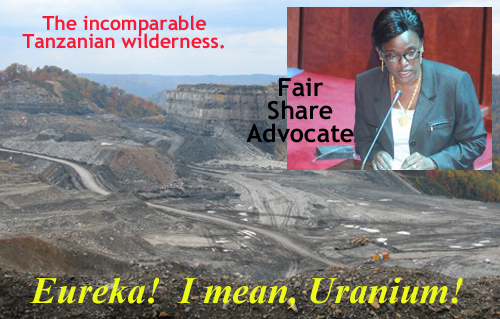
Now, one of the few rational, educated, articulate Tanzanian politicians, the shadow minister of natural resources, Ms. Halima Mdee, has revealed that one of Tanzania’s equally unscrupulous hunting companies, Game Frontiers, has actually sold off the block of Selous given it for hunting to a mining company!

And no one seems to care!

The fact that this violates a tome of Tanzanian law isn’t the point, since most of Tanzanian law is violated one way or the other. It’s just the sheer crassness of this move that’s so infuriating.

What’s more, Ms. Mdee seems to understand that any legal argument is pointless, so she is scolding the government on larger ethical and moral grounds.

“Other than the illegality of the contracts,” Tanzania’s Guardian newspaper reported, “she described what she called ‘unfair’ distribution of disbursed compensations on the part of the hunting company embezzling the villagers share.”

Did you get that?

The way to appeal to either popular consensus or somehow otherwise gain political advantage is to drop altogether the body of law in Tanzania and the rest of the world that disallows a hunting company to farm out a country’s resources, and claim that the local people in and around the hunting block aren’t getting their fair share of the loot from the illicit deal!

Whoa Tanzania. Yes, thank you Ms. Mdee, and by the way how are you doing with the laundry of al-Qaeda’s Somali weapons?

Poopooing Philanthropy

Poopooing Philanthropy

Bill Gates’ “Reinvent the Toilet Fair” in Seattle next week illustrates perfectly the limits of philanthropy and why real generosity must come from governments not individual rich people.

The Gates’ Foundation work to prevent and cure malaria is outstanding. The battle against the disease is perfect for individual philanthropy for two reasons. But most philanthropy, if not the vast majority promulgated by private foundations and individuals is wasteful and destructive.

The first reason the Gates’ Foundation work in malaria is valuable is that global agencies and governments from the developed world dare not tread on the mechanisms of global capitalism. Developing a vaccine, or a super small X-ray machine, or the Mars’ Curiosity, takes enormous capital. It’s the reason cancer drugs are so expensive. The drug company must recover not only the huge initial investment for a successful drug but it must also cover the huge losses of failed drugs.

Governments are capable of making these investments to be sure as are multinational corporations, but developed world interest in eradicating malaria in Africa doesn’t reach the threshold of importance developed world society does place, for example, in Mars’ Curiosity. Whether this is right or wrong isn’t my point. It’s just the case that developed world priorities do not extend to malaria eradication in the developing world.

Last year U.S. aid for developing world disease control and prevention – concentrated principally to fight tuberculosis, AIDS and malaria – was $503 million (from an HHS agency budget of $30.5 billion.) Gates alone has spent nearly four times this amount just on malaria research and prevention.

Because that is how much it takes to develop a malaria vaccine. The disease is among the most complex diseases on earth, a legendary evolutionary battle between man and his greatest nemesis, disease.

Neither will the developed world’s capitalist markets undertake a project to eradicate malaria. A malaria vaccine would not generate enough financial return to warrant the investment. Once malaria was controlled in the developed world — just as with polio more recently — the developed world will not provide the additional capital investment from either governments or markets for control in the less affluent developing world.

So it’s a perfect project for a rich man.

The second important reason malaria control is perfect for western philanthropy is because it’s so political. Malaria was eradicated in the developed world by DDT. The developed world now believes that DDT poses too great an environmental hazard to be used, now.

Whether this is rank fiscal hypocrisy or a cold prioritization of self-interest I’m not certain, but the door to quick eradication of malaria in the developing world, using the only historical method we know, has been slammed shut. DDT manufacturing is mostly controlled by the developed world, but more importantly, the threat of sanctions against developing countries that would dare to use it is real.

But most philanthropy cannot be justified by these two reasons. The vast majority of philanthropy funds projects that societies are fully capable of funding themselves. By that I mean not just through government services supported by taxes but more so by the albeit much smaller capitalist markets in the developing world.

They include almost everything from education to sanitation to energy development. When a philanthropist steps into areas like these it’s usually because of a failing in society’s planning or an oversight by market developers. To that extent pointing these out becomes the greatest justification for philanthropy.

But once pointed out philanthropists should move on and the implementation should be left to society. Society, of course, can’t do everything so it picks and chooses its priorities and that process of choosing is the very essence of a society. It should not be usurped by individuals. The best example is education. There’s no doubt that education is fundamental to almost all other development. Everyone agrees with this.

The components of successful education may be innumerable. There will always be a myriad of ways to better society’s educational efforts. Philanthropy has a major role in discovering society’s failings and to discovering innovative components otherwise overlooked by society.

But once discovered it should be left to that society to implement. Implementing it outside of normal societal mechanisms (such as through individual philanthropy) distorts any social plan and usurps the right of the majority.

Community sewage disposal is as fundamental to organized communities as education is to a workable society as a whole. A multitude of techniques are known, the engineering is fully developed, none of the essential technology is protected by copyright, and it’s fair even for a laymen to conclude there aren’t many alternatives to waste disposal except disposing waste.

So the Gates Foundation’s $42 million grants to “reinvent the toilet” are absurd. Like our own current infatuation with ethanol from corn in gasoline, more energy is being used by the so-called innovation than if we just didn’t do it at all.

The reason Nairobi’s sanitation is so underdeveloped is not because Kenya lacks either the resources or technology to lay appropriate sewers in the city’s ground, but because in part the country’s resources are being used instead to fund a war in Somalia.

I’m not arguing whether the war in Somalia is right or wrong, I’m arguing that Kenya should not assume its expense. The turmoil in Somalia was not caused by Kenya. It was caused by the developed world.

So the problem in poor sanitation in Nairobi is that the world as a whole — including Kenya itself — hasn’t owned up to its social obligations even though it’s fully capable of doing so. And this dynamic is propped up by western philanthropy.

If the Gates’ Foundation is successful in creating a “better toilet” for the developing world it could not possibly be more efficient than community sewage works. But it might indeed discover a device that can produce sanitation for a given few who have the wealth to enjoy it, and then delay even further extending sanitation services to the greater society at large.

In a nutshell it divides the rich from the poor, and it accelerates the dividing.

Frankly, I think even Gates’ officials and associates realize this. A blog widely disseminated in the developed world yesterday by Gates associate Diane Scott was rife with self-deprecation and embarrassment and proves what foolishness is going on. I can just imagine my friends in Nairobi reading this and chuckling madly.

Utopia is not in the cards, I know. But philanthropy in the main delays most utopian visions. Gates should be commended for so much of his work, but this – and most philanthropy in general – is just not right.
Zambian Safari

Zambian Safari

Hi Jim,
Hope all is well with you!
Well, thanks to you and our amazing time in Kenya last year, we are officially addicted to Africa. So much so that we just bid and won on a 6 night safari in Zambia! Friends of ours started a charity several years ago to build schools in southern Africa (check out their site at scaleafrica.org). They held a fundraiser last week and a subsequent online auction had the Zambia safari as a prize.
We are now sorting out the logistics and would love your help for the remainder of the trip if possible. I promise we will be back to Africa again and when we are, we’ll plan that safari in its entirety with you. For this trip, we will have 3 nights at Kapani Lodge (Norman Carr Safaris) and 3 nights at Luangwa River Camp (Robin Pope Safaris). Are you familiar with either? Either before or after the safari leg of our trip, we are thinking we’d like to visit Victoria Falls, but are interested to hear if you have other ideas or recommendations. We have to take the trip before mid-June. Between now and then, what do you think is the best time of year to go? Realistically, we couldn’t make it until January of next year so that leaves us with a window of January-June 2013.
Looking forward to hearing from you!
Katie

Jim’s reply below:

Katie –
Congratulations! And those two camps are outstanding, couldn’t be a better combination. In fact I’ll be in Nkwali with Robin Pope Safaris the end of February guiding a private safari. So that will reveal when I think a good time to go is.

The “high season” for Luangwa and for that matter all of southern Africa is July-October, their winter. But this most expensive and heavily booked time is not better for game viewing or anything else. It’s basically when northern hemisphere people travel. The highest of high season is Christmas. So as you make your decision don’t be put off by what seems to be heavily booked or what is more expensive.

As you can imagine Africa’s summer, its rainy season, is my preferred time. It’s when it’s most beautiful, everything is in bloom, when they day is the longest, when the animals foil and calve, basically everything peaks in summer time. The problem is that in southern Africa summer is deadly hot. That doesn’t bother me so much, but it does both many northerners. Go to either weatherunderground.com or our own NOAA and navigate to climate statistics for the exact figures but essentially it’s over 100F in Luangwa from about mid-November to mid-February. It then (in normal years but it’s been anything but normal recently) declines rapidly so that average highs are in the 90s from mid-Feb to mid-March and then upper eighties until mid-May. The rain shouldn’t deter anyone. It’s good. It may break one or two game drives, but it’s worth the gamble to see the veld in full bloom and the animals at their best. One caveat to that, too. The drier and colder it gets, the better is the viewing for cats. That’s logical. As fodder on the veld reduces, predation increases.

What should you add? VicFalls is a wonder. Your local air fare putting in Livingstone (VicFalls) to an itinerary that includes Mfuwe (Luangwa) will add $5-600. In a normal year, the falls are very hard to see from mid-Jan to the beginning of May because the flow is so strong and the mist so blinding. Other than that, I would just stick to Zambia. There are many wonderful additional camps in places like the Zambezi National Park and Kafue, some of my favorite. And if you have a minimum of 2 weeks on the ground and a bit bigger budget, I’d add a couple camps in Botswana. There would be replication here except for the Okavango Delta, which is so unique. Trouble again is that the local air fare between camps in Botswana and your very east Zambian destination is pretty high. Adding Botswana to the program will add about $12-1400 in air fare.

Hope this helps. Let me know if there’s anything else I can do for you.

Regards,
Jim

Outlaw Cats?

Outlaw Cats?

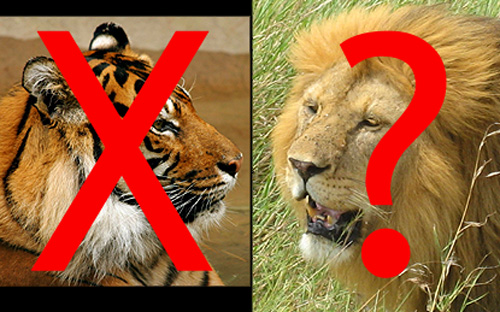
India’s Supreme Court has banned tiger safaris in an attempt to stem their extinction. The decision has enormous implications for wildlife tourism worldwide.

Almost all wildlife tourism featuring wild tigers is in India. (A much smaller industry remains in Nepal, and even smaller in Russia.) Although there is a variety of larger mammals in India’s game reserves, tigers are by far the main attraction for foreign tourists. The decision could doom Indian wildlife tourism to its own extinction.

The Supreme Court’s simple decision on July 24 which “banned all tourism activities in the core areas of tiger reserves” followed an April 3 court directive to individual Indian states for wildlife management plans to protect tigers in face of a rapid decline.

The Court was reacting to the fact most of the States had not submitted any such plans. But the likelihood that the decision could be reversed if the States get their acts together is very small.

Few plans were submitted because nobody knows what to do. There is a decline in big cats worldwide that has miffed researchers. Nobody knows how to stem the decline. Nevertheless, the court will revisit its decision on August 22. Most of us do not expect it to reverse this decision.

In Africa as in India more big cats are being documented as having been poached, or more correctly, killed by owners of stock being molested by the big cats. Clever use of modern poisons lacing meat placed out as bait is the principal tool.

But the rapid decline (in East Africa, the lion population is down to around 9,000 from 30,000 twenty years ago) cannot be attributed to poaching alone.

My own feeling is that the increased urbanization of the developing world combined with confusing but rapid global warming changes is clobbering the top of the wilderness food chain. Ranchers poisoning lions to save their cattle is a symptom of this.

In India the issue is even more confused since a tiger skin is worth so much more on the black market than a lion skin. A male tiger can be more than twice the size of a female lion, its fur is much thicker and arguably more colorful. Though the motivation for a tiger killer might be to save his cows, once killed he has acquired a very valuable item easily black marketed for an extraordinary price.

The actual numbers of larger wild mammals in India as in Africa is actually increasing as wildlife management improves and the remaining habitat for them is better protected. But even though the food source is theoretically then increased for the larger cats, their overall habitat may be more stressed as more animals are squeezed into smaller areas.

This can lead to increased territorial fighting and a more rapid transmission of disease. Recently, for example, it was discovered in East Africa by researcher Craig Parker that some of the lion deaths there were attributed to a disease that was sweeping through the buffalo populations. Lions hunted buffalo and acquired the disease themselves.

India’s corrupt and complicated political system leaves open the possibility the court decision will not be fully implemented or at least not very quickly. Tourists also need to be very alert, now, as officials and business owners in some of India’s 600 so-called wild tiger reserves scramble to maintain business.

Ranthambore is one of the most important reserves, with 52 known wild tigers. There were indications recently that officials were going to move older tigers out of its central reserve into a buffer area that they would enclose, large enough that tourists wouldn’t realize when driving into it that it wasn’t the unfenced and open park.

India’s position has worldwide ramifications. The percentage decline and rate of decline of lions in East Africa is not quite as severe as tigers in India, but it’s severe. And what about polar bears in North America? Or walruses? Or even bears in certain parts of Alaska?

In India at least the highest court has decided that tourism contributes to tiger decline, or at least impedes tiger conservation.

To protect wild animals, should tourists be banned from seeing them?

The Real Terror Within

The Real Terror Within

Terror in travel is a wonderful way for us guides to get our clients into the car on time, and in Africa, snakes seems to be the trick!

In East Africa where I guide there are 42 venomous snakes and every single one is a killer! But now a wonderful assistant professor of biology at Whitman College threatens to diminish my terror trick, but who knows, maybe make snakes a tourist attraction?

Kate Jackson has built the only online database of the snakes of Western and Central Africa. Together with the book completed with venom expert Jean-Philippe Chippaux, it is one of the best field guide toolkits I’ve seen for Africa.

While snakes command the attention of most of us by playing on our abject fear of a miserable death, Jackson’s motivations are considerably more noble. To begin with she is a living example that even the so-called “deadliest” snakes are less so than thought. She herself, has survived cobra and other snake bites.

Snake venom, like honey bee or yellow jacket stings, have a huge variant effect in humans. Generally much more powerful than an insect bite, and always after an agonizing hospitalization, venomous snake bites immediately treated correctly generally don’t kill the victim.

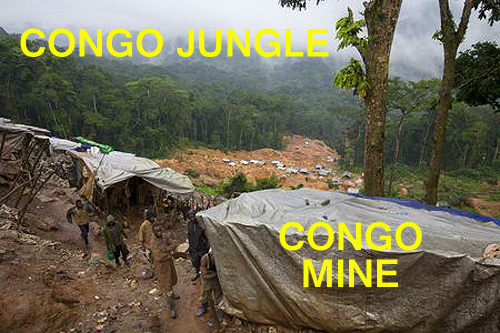
But Jackson’s motivation for exploring the Congo goes way beyond the terror of a snake: “I went to the Congo to try and protect the amphibians and reptiles from the mining.” And in so doing, of course, she will protect humans and their virgin wilderness from mining as well.

The lust for Africa’s natural resources is becoming desperate. (See my blog, yesterday, about Zambian mine workers murdering their Chinese manager.)

In the “green issue” recently published by Whitman’s college online magazine Edward Weinman reported that the Wildlife Conservation Society (WCS) invited Jackson to The Congo to explore a huge area of the west near the Gabon border scheduled for massive mining.

This is something so hard for me to imagine. I was there nearly 20 years ago, looking for lowland gorillas. It was one of the hardest, most extensive expeditions I’ve ever undertaken, and the beauty and intensity of the forest was forever memorable. The notion that this area has so transformed, or will be so transformed, that it will be raped of this pristine character is mind-boggling.

Two mining consortiums, mostly British Zanaga, and Swiss Xtrata have formed a monopoly to mine this area. Both have directors closely linked to the world’s biggest mining company, Rio Tinto. This is clearly considered one of Africa’s most potential areas for mining, and the list of ore goes well beyond coal to diamonds and rare earths.

If left unchecked this mining consortium will wipe away some of the most virgin and pristine areas left in Africa.

Jackson’s work for the WCS is clever and very political. Many mining projects in Africa get their start from the World Bank. They don’t need to, because the mining consortium like the one described above can command capital larger than the Bank can for a given project.

But the Bank overseas so much more than just mineral extraction in developing countries like The Congo. It works closely with the IMF and other UN agencies for local development projects that specific industry companies have no interest in … like hospitals and schools and dams and sustainable agricultural and water projects.

The WCS has a long and successful history of delicately going into a given area designated for mining, doing what we would call here at home an EPA study, and then convincing the World Bank and IMF that wholescale development would be an environmental catastrophe.

The pressure that the Bank can then effect on the country, and its partnership with many other agencies necessary in that country’s development, can force the mining consortiums to compromise in vital ways.

In this particular case, Jackson explains, “We documented the myriad species thriving in this virgin wilderness, not as a means to stop all development, but to instead bargain for a land swap.”

It sounds like Jackson’s work, and those of other scientists, may be successful in protecting a huge area of the Congo from any future development whatever by designating it a national park, in return for a smaller piece given to the mining consortium.

The conflicts in Africa are often much more than just the wars you hear about, or the increasing effects of global warming. They are these more complex issues as well: the Congo will benefit enormously from the mining extraction. It’s hard to argue against this.

But with help from people like Jackson, we might simultaneously be able to preserve just a little bit more of natural Africa from the real terror confronting us: losing the wilderness.

Development for What

Development for What

Rising conflicts between Chinese and Africans in Zambia and Malawi demonstrate that the Chinese do-anything desperation for Africa’s natural resources may be backfiring.

In 2009 China surpassed all other nations to become Africa’s leading trading partner. It is likely the continent’s biggest aid donor as well, although western institutions rating aid argue that the quid-pro-quo of Chinese aid moves it from the category of aid to investment.

I sat recently with three young Chinese men, probably still in their teens or early twenties, as we all waited for a delayed flight from Nairobi to Kampala. Our inability to communicate well was mitigated by the long delay. One of the fascinating things I learned from them was that they were not just excited about their upcoming work gig in Uganda, they were emigrating there!

They held one-way airline tickets from a Chinese construction company, jobs to build a highway in western Uganda, undoubtedly enough sudden cash that together they had just purchased a laptop in duty free, and … no intention to ever return home.

The rest was left to my speculation, but it seemed pretty clear to me that after their contract with the construction company ended, they would set down roots in Uganda and spend the rest of their lives there.

This is hardly new. It is exactly what the British did when they built the East African colony’s infrastructure in the mid 19th Century, except that they imported Indians rather than Scots. At the end of various construction projects, the Indians set down roots and today are as much Kenyan or Tanzanian as a Kikuyu.

The initial motives were identical as well. The British East African Trading Company was proudly a profit-making business which intended to extract as much as it could out of East Africa for the benefit of England. Chinese today are desperate for the natural resources necessary to power its society, lacking in China and flush in Africa.

Later Livingstone’s moral imperatives got entangled in British colonial development, but until that historical point the two capitalistic paths are identical.

What’s different, today, is that social authority derived of a growing embrace of self-determination, and the importance of human rights, are much different than two centuries ago. The British model of buying out local chiefs with bags of beads is quite similar to what the Economist calls “oil for infrastructure.” But the willingness of the local people to enter the deal is much more restrained.

Last week this restraint blew a threshold in Zambia and Malawi.

Mine workers staged a violent protest against their Chinese manager/owners. The Chinese have yet to mature beyond the desperation of need, and many are ruthless paymasters particularly when it comes to mining.

Last year Human Rights Watch documented increasing labor abuse by Chinese managing Zambia’s copper mines. Last week it came to a head when workers struck one mine and then battled security personnel and police, killing one of the principal Chinese managers.

In neighboring Malawi, what appears to be nothing less than a xenophobic vendetta against small Chinese business owners began last week. The government policy will essentially close down hundreds of small, local Chinese businesses in Malawi, developed I presume like the three guys I met waiting for the flight to Kampala want to eventually do in Uganda.

And in a stark 180-degree difference between the British colonial era, the Chinese ambassador to Malawi more or less endorsed the Malawian government’s move. There is little connection left between the homeland and the Chinaman who moved away.

In Dakar last week, Hillary Clinton remarked on these growing tensions and argued rather well that Chinese policy won’t work. “The days of having outsiders come and extract the wealth of Africa for themselves, leaving nothing or very little behind, should be over in the 21st century,” she said.

“Throughout my trip across Africa this week, I will be talking about what that means – about a model of sustainable partnership that adds value, rather than extracts it,” she added.

I’m not sure. I’m sure that Hillary’s admonition is correct, and that the right and moral way for a developed society to act toward a developing one is not the Chinese model. On the other hand, I’m not sure the American model is all that much better. Our “aid” to Africa is fickle, up with Democrats and way down with Republicans. All that Africa is left with is confusion and a certainty that American constancy doesn’t exist.

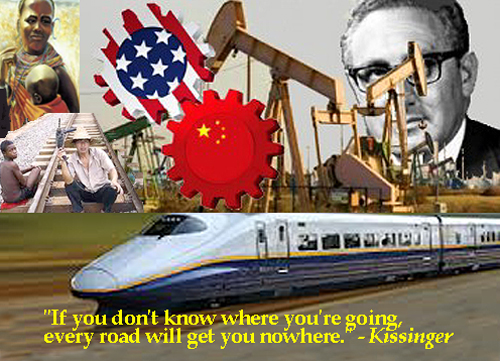
Africa needs infrastructure desperately. China needs oil desperately. There’s great constancy in that.

Delectably Invasive

Delectably Invasive

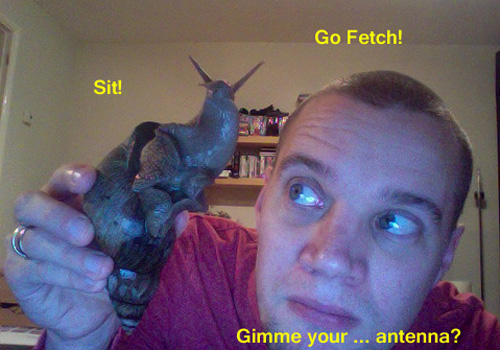
Banned from the U.S. after a recently very expensive eradication program in Florida the Giant African Land Snail is on the return. From the bucolic gardens of Budapest to the Westwood dinnerware of the Upper East Side.

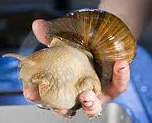
The Giant African Land Snail (Archatina mariginata) is one of the most successful creatures in the animal kingdom. There are more than 50 species and they’re all huge. The largest recorded weighs just under a pound and when stretched out underneath its relatively light shell can extend to nearly a foot.

The great irony about land snails in general is that the vast majority of them are considered pests and many of them are classified as invasive by state agricultural authorities. Yet in an upscale San Francisco restaurant you will probably pay $2 per each of a Helix aspersa in garlic butter.

(In Paris, they’re flesh. I mean fresh.)

Although connoisseurs differ on which snail tastes best, most chefs agree that one fresh snail tastes just about the same as another fresh snail. True, little round ones in shiny black bubble cups are more appetizing than the great giant African land snail stewing in its canister, but they are all fat-free and chocked full of useful vitamins like A and D.

In fact it is the eastern European world which has currently gone snails over ape. Slimy rare animal dealers seem to be headquartered in Budapest, but much of the former Soviet Union has few prohibitions about raising or marketing animals.

Much of the social networking community is linked with slime. There seems to be something very special that really sticks these folks together.

In Africa they aren’t cultivated as pets, yet. They are basically just consumed. And responsible NGOs are using snail’s fast breeding, longevity and adaptability to develop snail farms not just to commercialize a practice that has been traditional for generations in the forest peripheries of Africa, but to provide places like California with their banned substance to eat.

So it’s really not a joke. At an average of over $75/pound when served properly dead, can’t you imagine Whole Foods offering a snail loin special?