America Blows the World Away

America Blows the World Away

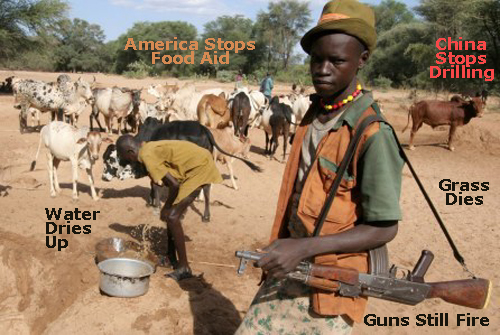
American mostly and some European stimulus in 2009 kept the world going and Africa, in fact, soaring. It’s over, now, and screams of pain begin.

In Kenya which had roared to a near 9% GDP growth, the country’s economy is tumbling. Starvation is on the increase, again. Many diseases like AIDS and TB which had remarkably abated, are increasing … again.

In South Africa where the price of gold struggles to climb higher, fuel prices are soaring contributing to some starvation in poorer communities. And the ongoing Arab Awakening is squeezing the whole continent as tourism and oil production dwindles and America retreats.

Chinese development funds which fired up so much of Africa are dwindling.

In America when things “get bad” we stop going to the movies. In Africa, they stop eating. In America, we get sick. In Africa, they start shooting one another for whatever’s left.

All of this is because of the world economic downturn, and that was caused by American greed, by our failure to regulate ourselves fairly and wisely.

And to be sure a much worst situation was averted because of American last-minute stimulus, as American politicians gritted their teeth and did exactly what they promised never to do: grow government to save the people.

That huge stimulus let us still go to the movies. And it produced a boom economy in Africa, where car sales, for example, skyrocketed.

But it’s over, now.

Americans are going to fewer movies. Africans are beginning to shoot one another, again.

What we don’t realize in America is how seriously we effect the rest of the world. I think in part this is because so many Americans preciously hold to the idea that government is an option, and that we are reducing it.

This is the foundation of our misery, the notion that our government isn’t necessary and mustn’t necessarily be big. First of all, it is big! Even after all the shrinkage that has occurred and will occur, still, the U.S. government is massive. Even take away the wasteful and probably immoral military campaigns abroad, it is still gigantic.

The U.S. economy is 222 times as big as the Kenyan economy.

Yet we have only 8 times as many people. That gives every American, in economic terms, nearly a thirty to one advantage over a Kenyan.

And it means whatever we do has an impact probably 30 times as great as we imagine it does.

The whole world must follow whatever happens in America. We have a choice. They don’t.

The catastrophe of world depression is over, thanks to America. But it was thanks to America that it happened in the first place. And now we’re trying to clean it up.

East Africa is doing it correctly, America is not.

East Africa is increasing its debt to stave a catastrophic tumble into recession.

While America is flirting with an absurd notion not to increase its debt ceiling.

But what Kenya does won’t matter a hoot to Americans. But what America does could save or condemn the new Kenyan economy.

America is not a cowboy roping a single steer for dinner, as many Americans believe. We’re a gigantic, messy megalithic monster of an economy that needs a real tune-up, and one that keeps the brilliance and freedom of that monster moving as nicely as possible.

And a tune-up doesn’t feather the fat cats and starve the needy. Unless it’s a robot devoid of any morality whatever.

And whichever path we choose, we choose it not just for ourselves. We’re imposing the choice on the whole damn world.
Buggiest Place in the Universe!

Buggiest Place in the Universe!

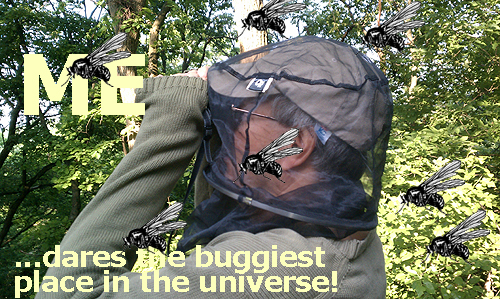
I have been in some of the most uncomfortable, dastardly places on earth. But I just returned from the buggiest place in the universe. Try to guess where this unbelievable, inhumane place is.

Of of the four top worst buggiest places I’ve ever been in, none are in eastern or southern Africa where I spend much of my life. And that’s important, because so many people who are contemplating a safari ask me first and foremost, “What are the bugs like?”

What bugs?! Compared to the four buggiest places I’ve ever been in, my safaris are like being in an air-conditioned hospital.

FOURTH BUGGIEST PLACE ON EARTH:
North of the Brooks Range in Alaska in June. Searching for the great caribou herds, we found black flies. These pesky critters swarm all over the place, and because there’s little wind, it’s like walking through a suspension of underwater gunk.

But we use head nets, and it’s cool enough to cover the rest of your body, and it isn’t constant. There are patches here, and then down river a bit none at all. But when they bite, they seem to insert their entire being into your bicep or drill through the cheek to your upper molar.

THIRD BUGGIEST PLACE ON EARTH:
Lobe River in the Cameroon. I was there one August but apparently the time of year doesn’t matter. This is African jungle at its finest (worst?). This is where you go to find lowland gorillas. Mother Nature here is august and oppressive.

Traveling on long-boats through 105-degree heat, you can’t wait until it rains, and when it rains it’s a deluge and usually the sun still manages to beat the river and jungle like the rays from some alien space ship. And swimming in this torrential sun heated rainstorm are tse-tse like you just can’t imagine.

Tse-tse are called in loose translation by the local Lobe River pygmies “Devil’s Butterflies.” I understand the devil part, but I guess it’s the streaming blood that drips down your limbs from where they bite in the 100% humidity that leads to the notion of butter.

SECOND BUGGIEST PLACE ON EARTH:
Sepik River in Papua-New Guinea in May. Again, season doesn’t seem to matter. The people who live here try to stay up as high as possible with the belief that river mosquitoes can’t fly high, and there is some truth to this. So homes are built on stilts. The higher, the better.

The mosquitoes are so bad that despite the over 100-degree temperatures and humidity so high that what you see through your sunglasses and head net seems like an underwater experience. Good guides point you in correct directions.

The bugs are so relentless that not only do you wear head nets, but literally wrap yourself in zipped up plastic ponchos and jeans strapped at the ankles by tightly fitting boots. The heat and humidity is suffocating, but the unbelievable and incessant buzzing of the mosquito is fair warning that any attempt at aeration is a certain death. It’s like a million miniature saw mills waiting for you to unzip just a little bit.

BUGGIEST PLACE ON EARTH:
Yesterday, and the day before, and the day before that, I was in the buggiest place on earth. It’s my responsibility to walk the dog in the evening. And early Saturday morning I helped the local expert do the USGS bird survey for northwestern Illinois.

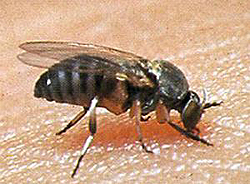
Yes, northwestern Illinois in June. Black flies, known also as turkey gnats or buffalo gnats. Of the four buggiest places on earth, these are the bugs have adorned my face, neck, arms and fingers with long lasting welts.

And this is not just an old man developing new allergies. I have been in probably the dozen buggiest places on earth, and this is, hands down, the buggiest.

The entire midsection of the United States is swarming.

My home town bugs are tiny, humped-back flies (ergo, “Buffalo” gnats) and some people call them turkey gnats but they’re one of more than 255 kinds of horrible bugs in the black fly family.

They are blood suckers “with a hankering for exposed skin on the face, neck and ears that … buzz into your eardrums and mouth, crawl under your sunglasses … looking for just the right spot to bite,” writes Mark Bennett of the Terre Haute, Indiana The Tribune-Star.

Outdoor crews whether landscaping or fixing power lines are in retreat this year.

According to Bennett, the buggers leave “a welt, which swells and itches for days and days.”

Dr. Colleen O’Keefe, a veterinarian with the Illinois Department of Agriculture, told reporters this week that the gnat swarms are now so thick they kill chickens by blocking the birds’ nostrils and asphyxiating them, and if that doesn’t work, by sucking the blood from the birds, and if that doesn’t work, by producing fatal allergic reactions.

Why such an infestation? One good reason seems to be that we’ve cleaned up our rivers. These progressive insects only like to breed in pure, pretty fast moving water. Our battle against pollution is compounded by higher and faster running rivers each spring in this era of Global Warming.

There have been many reports in my home near the Mississippi River of bluebird fledglings dying from repeated bites. Several years ago in southern Indiana and Mississippi there were reports of thousands of farm animals killed.

Right now, today, it is literally impossible to walk outdoors without being swarmed by them.

But I’m told as it gets hotter and hotter, they will go away. That’s hard to imagine, as it’s already 95 today. But apparently as the clean water temperatures in which they breed reach a certain level, they die out…

…until next year.

People use vanilla extract, Absorbine Junior and Victoria Secret skin oils as repellents. I use a head net. The only certain way to avoid them is to go on an African safari.

Student Do-Gooders Beware

Student Do-Gooders Beware

The right way: Cottonwood Institute's many student programs.
Summer is coming and throngs of young people are getting ready to screw up the world. That’s the effect of most volunteer tourism. Here’s why, along with a few stellar exceptions.

During the last fifty years of America’s descent into conservative misery, America’s philanthropy has increased substantially. There’s a good reason for this, and a bad reason for this, and they impact tourism as we never expected they would.

The good reason was because community compassion developed as funding for good social programs was withdrawn. What else could we do? Institutions like museums and zoos, which should be a part of the public domain, became privatized for budgetary reasons. Today we even see public funds withdrawn from any type of arts (and often recreation) programs in public schools!

Fiscal concerns in America trump virtually every other concern except to wage war (in the guise of security). After we bought our ten billionth gun, there just wasn’t any money left for public aid.

We are now ailing as result.

Education is a mess.

In virtually every category America has declined. The most talked about one is health but health and everything else in life declines first and foremost because education declines first. America is now 33rd in the world. The education accomplishments of countries like Russia, Mexico and Brasil outperform us.

The need to do something in the face of government suppression of public services became overwhelming. And public response in terms of charity was good. What was bad was that charity was often not charity, just a ruse and self-disguise. And one of the principal tools for accomplishing that self-deception was tourism.

Frankly, I have serious doubts about philanthropy in general and have written about this before. The current controversy with Three Cups of Tea stands as a perfect example.

The bad effects of so-called voluntourism are acute when it involves children. I love guiding kids on safari, because I love watching their minds open to the vast mysterious of places far away and lifestyles never imagined. But I cringe terribly when they try to plan this in advance.

The number of requests I personally get by misguided parents who want to spend “a day or maybe three depending” on charitable activities when they go on safari drives me insane. It’s counterproductive. It’s a blatant indication of how badly their children are being raised.

One of the world’s finest social psychologists says it much better than me:

IN a research paper specifically addressing youth tourism programs for specially young AIDS orphanages in Africa Prof Linda Richter writes, “Programmes which encourage or allow short-term tourists to take on primary care-giving roles … are misguided for a number of reasons.”

1. They end up costing the orphanage more than the benefits received.
2. The volunteers generally perform badly.
3. Low-skilled volunteers squeeze out local and indigenous workers who not only need the work but could create a long-term benefit to the community since they don’t disappear after a few days.

But the zinger is indelible, long-lasting:

“The formation and dissolution of attachment bonds with successive volunteers is likely to be especially damaging to young children. Unstable attachments and losses experienced by young children with changing caregivers leaves them very vulnerable, and puts them at greatly increased risk for psychosocial problems…”

This is no old tour guide’s biased balderdash.

Professor Linda Richter (PhD) is a Distinguished Research Fellow at the Human Sciences Research Council in South Africa. She’s an Honorary Professor in Psychology and an elected Fellow of the University of KwaZulu-Natal; an Honorary Professor in the Department of Pediatrics and Child Health at the University of the Witwatersrand; a Research Associate in the Department of Psychiatry at the University of Oxford (UK) and has been a Visiting Scholar at Harvard University USA) and Visiting Researcher at the University of Melbourne. That’s only the beginning of her resume.

Prof Richter concludes:

– “Children out of parental care have a right to protection… In particular, they have a right to be protected against repeated broken attachments … exacerbated by care provided by short term volunteers.
-“Welfare authorities must act against voluntourism companies … that exploit misguided international sympathies to make profits at the extent of children’s well-being.
-“Lastly, well-meaning young people should be made aware of the potential consequences of their own involvement in these care settings, be discouraged from taking part in such tourist expeditions…”

It is impossible to provide meaningful assistance FOR ANYTHING in a day “or maybe even three”. You can learn. You can become aware that it is unmeaningful, but you can’t MAKE A DIFFERENCE.

Yet again and again I have parents calling me about the spring break or summer safari, and they want to make sure their kids volunteer for a “day or maybe three.”

This is an unexpected further decline in America’s descent into greed and lack of real community compassion. It’s a way of “feeling good” without really doing anything meaningful. It’s believing you can do something meaningful when it’s impossible to do so.

You go on vacation for R&R and to expand your world view. You help the world afterwards, with that expanded world view. You help the world by getting deeply involved at home, not abroad. You personally have to suffer or benefit from the accomplishments or mistakes that you, yourself, make. That becomes increasingly difficult the further your charity is placed from home.

There are excellent student groups – (important: all not-for-profit and in never linked to commercial tour companies) – that do great work. Note that it is mostly local, and I believe that’s how it should be.

The Cottonwood Institute and Students Today Leaders Forever especially impress me. I bet there are dozens, but the point is there is no way to approach even a modicum of these organizations’ accomplishments on a commercial vacation.

And for adults Earthwatch rules the planet. It’s so good, in fact, that there really aren’t any viable competitors.

In all three cases, and I’m sure many more, volunteerism is not the point. It may be used, and when used creates real benefits as much for the individual (without jeopardizing the situation because of that individuals’ lack of skills) as for the situation itself.

That ultimately, is the only test. And if that standard can’t be met, then the self-styled “volunteer” does more harm to the situation than any benefits that might accrue. Voluntourism does more harm than good. And significantly to the voluntourist him/herself.

Do-Gooders, don’t get on the plane.

Widely Wild Wrongly Written Wildebeest Writings

Widely Wild Wrongly Written Wildebeest Writings

I'm no photographer.
But I took this, this year, with my Cannon SureShot.
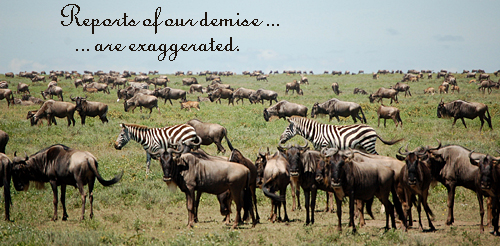
Widely circulated reports about a crash in Kenya’s Maasai Mara wildlife are (1) premature, (2) likely false and (3) infuriating. PS (4) I’m fed up with western news sources about Africa. Unless it’s another apocalypse, it isn’t published.

Many of you truly concerned wildlife enthusiasts have sent me the link to the bad BBC story claiming that Kenya’s best game reserve is in a tailspin. Thank you, but take a powder and lie-down.

The purported “study” by Joseph Ogutu at the University of Hohenheim is the second study by Ogutu on the Mara. His first purported up to 95% of certain animals had disappeared and was uniformly dismissed by scientists worldwide.

I found it interesting this morning that the branch of the university that Ogutu is supposedly registered with, has an “internet problem.” Linking to the Bioinfomatics Unit of the University of Hohenheim cited in the BBC report generates this message [poorly translated from the German]: “Because of maintenance work the Intranet and some other homepages are not available.”

Hmm.

Mara wildlife has declined, and local wildlife censuses have confirmed this, but nowhere near as catastrophic as suggested in Ogutu’s report. Ogutu told the BBC that Mara wildlife had declined by “two-thirds.”

Nonsense.

Here’s the truth. No one knows in any good scientific way. The Kenya Wildlife Service conducts wildlife censuses that are excellent, but KWS has limited jurisdiction in the Mara which is technically controlled by local county counsels. In fact as I’ve decried loudly before, the Mara’s catastrophic problem is management not an apocalyptic reduction in game.

At one point three separate entities were controlling what we call “the Mara” and they didn’t like one another. So it’s literally impossible to conduct uniform studies over the area. And to make matters worse, historically the data is equally terrible.

Ogutu did the worst possible research as a result. He picked and chose segmented area studies over 15 years, none of which were comprehensive of the area as a whole. Moreover, I’m certain in the weeks ahead real scientists will challenge much of his root data.

Ogutu had decided the Mara was in a tailspin even before he did this study. Last year when the area was just recovering from a three-year drought, he claimed half the animals in the Mara were gone by incorrectly citing a continent-wide study
from the United Nations Environment Programme and London Zoological Society which addressed the whole continent, not just the Mara.

There are good studies, particularly from the Frankfurt Zoological Society, on the biomass of the Serengeti and larger Serengeti/Mara ecosystems. There are also good studies on individual species, like lion and elephant and so forth. And unfortunately, we can only surmise by broad intersections of these individual studies what the situation is, in the Mara.

It’s OK.

It’s very threatened, perhaps more so than at any time before. This is mostly because of (1) weather, also closely because of (2) Kenya’s rapidly developing economy leading to human/wild animal conflicts, and interminably (3) the untenable way the poor reserve is managed.

But don’t write it off, yet. Kenyans are remarkably creative these days.

Ogutu is correct that there has been a significant decline in Mara herbivores, particularly with regards to the wildebeest migration. But this is not directly due to cattle grazing encroachment as he claims. It is because of weather. Two dynamics are at play.

First, the Serengeti just below the Mara has been much wetter than normal (as has the Mara) but while areas just immediately to the north and east have been much drier. Global warming at its best on the equator creates these weird and frighteningly small and distinct weather regions.

So while there were floods in the Mara, in adjacent cattle grazing Koiyaki and Lemuk private reserves, it was bone dry. In times of drought cattle tended by cattle owners over compete with wild game.

Second, because the Serengeti has been wetter than normal, the wildebeest have not needed to move into the Mara (the furthest northern part of their migration) with the same regularity as in the past. Historically the Mara was the wettest part of the Serengeti/Mara ecosystem. That definitely is changing. There will be less and less of the migration traveling into the Mara, now, with global warming.

The wildebeest population has remained constant at around 1.5 million animals for more than ten years. Ditto for the third of a million zebra.

So without intending to minimize the real threats existing in the Mara, let’s not exaggerate them, either. I wish Vanity Fair or the New York Review of Books would do a story. There is no new crisis in the Mara. Visitors today will notice little difference from ten years ago, except maybe with regards to the migration.

Rather there is a continuing decade’s long crisis we definitely need to do something about, which cannot exclude global warming. And there is an ever deepening crisis in the way we learn things.

Africans First Walmart Second

Africans First Walmart Second

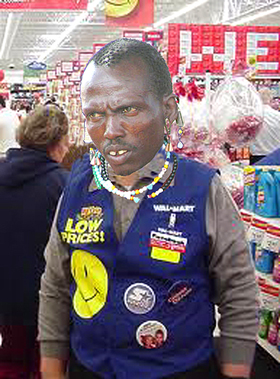
Does Africa need lower prices? You bet! In just a few years there will be Walmarts in virtually every major African city. I think Africa can handle it. So I say, “Bring‘um On!”

Africa’s third largest retailer, Massmart, will be consumed by a $4.6 billion offer from Walmart following initial South African government approval Tuesday. Massmart currently operates in 13 of Africa’s 53 countries, and growing.

Predictably, business interests hailed the merger. Worker interests decried it. The South African government commission which approved the merger is imposing a few restrictions, including maintaining the existing labor/union mechanisms which many had feared wouldn’t survive the merger.

Everyone knows what this means. There is no dispute that Walmart will lower prices, probably boost quality in an African market known for shoddy alternates and outright fakes, as well as lowering wages and reducing other existing worker benefits.

“Can you imagine what [will] happen in Africa, with its extremely vulnerable workforce and inadequate and unenforced labor laws?” Mfonobong Nsehe writes on a Forbes blog consortium.

Everybody knows.

But two-thirds of South Africans support the merger. The reason is simple, and it’s Walmart’s signature: Lower Prices.

And the counter argument is that lower prices mean lower wages mean either depressed economies and/or an increasing gulf between rich and poor. Click here for a great interview of Patrick Craven, a South African union spokesman.

America exports Walmarts, because America is the world’s largest and most fundamental capitalist system, and Walmart is the epitome of what capitalism means. Walmart, in turn, exports human rights abuses when it sources vendors from foreign sweat shops. America champions human rights. Therein the paradox.

If we’re going to live with capitalism then we want its players to be as aggressive as possible so that the system remains dynamic. Healthy capitalism is a bloody thing. And I can’t see impeding Walmart if we’re encouraging Goldman Sachs, or for that matter, Exon/Mobile.

Walmart is not the problem. Walmart has to live under the laws of each country in which it operates, and what that means from the getgo is that advanced industrial societies must take charge of their capitalist development. REGULATION.

Minimum wages and minimum worker benefits must be increased. Affirmative action, particularly with regards to gender, must be dusted off the shelves and reembraced whole-heartedly. Legions of public agencies, from tiny villages to sovereign governments, must not extend tax benefits without ensuring that tax loss doesn’t depress its citizens’ standards of living or increase the gulf between the haves and have-nots.

The consumer and worker must always get the better shake. Business should be seen as serving, not feeding on, consumers and workers.

This is not Walmart’s responsibility. Walmart’s responsibility is to be as mean as possible. That’s how capitalism succeeds.

It’s now up to the African governments. They’re newer and not as beholding to giant capitalist entities as the American government has become, and there is a real possibility they will be able to regulate this behemoth with the same idealism they profess as overall goals of governance.

People First. Walmart Second.

Africa has a chance to get it right. But they dare not model America. We haven’t done so well.

When to go to Botswana

When to go to Botswana

Linda asks: We are going to Kalahari Plains for 2 nights and Okavanga Delta for 5. When is the best time to go? Is late April, early May too cold at night and early morning game drives? Were originally thinking end of Jan but concerned about
rain.

Dear Linda,

You have chosen the perfect time to go! Don’t change! Travelers often get discouraged by measuring “high” and “low” seasons, “dry” and “rainy” seasons, but both metrics are usually a bad way to help you plan your trip. To be sure they should be considered, but should be given far less of importance than normal. Let me explain.

“High” season and “low” season reflect rates that are market driven. It’s more expensive to go in the high season than low season, because more people want to go then and the demand is greater. But that hardly makes it the best time to go. Consider that the highest season throughout the year is the end of December, virtually everywhere, whether you are at the bottom of the world, the top of the world, or on the equator. So it has nothing to do with season or weather, just when people travel. So never get turned off by the fact you’re considering travel during a “low season”, which is exactly your case for your upcoming trip. Being able to travel in a low season means you’ll get better rates and encounter fewer crowds.

When tourism first began in Africa, it was very difficult to travel during any rainy season. This was because there were few tracks, and those that existed were poorly maintained, and because there were not really vehicles made for safari travel per se. So they did really badly in the mud. That changed more than 20 years ago, but the copying of old brochures into new ones didn’t. I actually prefer traveling during the rains practically everywhere in Africa, because the veld is fresher and less dusty, and the landscapes are far more beautiful. It is usually when there are the most baby animals, too, because nature organizes births during times of plenty. There are advantages to the dry season, too, in terms of animal viewing. The veld is more stressed, so predation is easier to encounter. But my personal preference is the “green season.”

As for your particular concern about temperatures, you’ve actually got it upside down! The hottest time in southern Africa (their summer) is from November – March, and the coldest time is (their winter) from May – August. During most of March and April in Botswana, day time temperatures will be in the eighties and night time lows in the lower sixties. So while I think January — your original date — would be fine, it will be quite hot, touching or exceeding 100 F. (Remember that the great site, weatherunderground.com, has fabulous historic weather data, even for places like Botswana, so that you can check out what the weather was like this year on the dates you plan to travel.) June, July and August in Botswana is freezing! Don’t wait until then if you’re worried about temperatures.

One caution. Global warming has increased the wetness of the world all over the planet. The Okavango Delta is flooding more than ever. Some camps were actually flooded out this March, so check carefully before booking. Ask the specific question, what happened to your camp this March?

So you’ve made the right choice! Don’t be dissuaded!

Regards,
Jim

America’s Faces are now Fabulous

America’s Faces are now Fabulous

America’s new ambassador to Kenya is a brilliant appointment that ensures U.S. goals and interests while really helping Kenya move into the new era created by its new constitution. A win-win situation the likes of which were unknown before Obama/Clinton took over world diplomacy.

Like many of Obama’s better civil servants, Maj.-General Jonathan Gration is a disenfranchised Republican. (Best example, Defense Secretary Robert Gates.) Steeped in solid conservative traditions, he quietly moved away from the receding cliff that so many Republicans fell off.

The decline of the solid Republican Party gave Obama a real windfall of good folks. Gration was drafted into the Obama campaign early on as an African policy advisor and became our envoy to the South Sudan, where he did yeoman’s work that seems to be paying off.

Gration just replaced another fabulous ambassador in Kenya, Obama-appointed Michael Rannenberger, who like many diplomats worldwide was forced out because of embarrassing classified remarks exposed by Wikileaks.

And as should be the case of all diplomats, Gration really knows his assignment. He was born in the Congo to missionary parents. His first language was Swahili. He rose in the military as a security/terrorism expert. There can simply be no better replacement for Rannenberger.

During the Bush years diplomats were appointed usually as party favors, literally. TV personalities, big time donors and other celebrities drove the art of diplomacy into the realm of country clubs.

I remember Sam Fox’s appointment to Belgium, a man incapable of tying his shoes much less working in the country that was the center of the EU. And he had almost single-handedly funded the terrible “Swift Boat Veterans for Truth” ad against Sen. Kerry.

That was typical of all of the Bush era appointments. The Republican slide that he oversaw believed international relations were mixed marriages to be avoided.

How wonderful things have changed.

Gration knows that no major policy changes are occurring with his appointment, and I think that both Kenya and those of us at home familiar with Africa are glad with that. Rannenberger was a stellar diplomat who really moved forward anti-corruption efforts as well as the implementation of the new Kenyan constitution.

I’m not familiar enough with the rest of the world, but if this is any indication of Obama/Clinton diplomacy elsewhere, we’re doing extremely well worldwide.

Life’s Winners This Year Are..!

Life’s Winners This Year Are..!

And the winners are! A jumping cockroach, an obscure little deer, an ostracized cricket, and a dragon spider whose web can cover a small Michigan lake!

These four newly discovered life forms all live in Africa, and out of 15-25,000 entrants in the annual Arizona State University list of the “Best New Species on Earth”, they all made the Top Ten.

The six non-Africa winners include a TRex leech, a bacteria that eats rust, a flat fish that hops like a bunny but under water, a fungi that creates greenish yellow light, a mushroom that lives at the bottom of the ocean, and a 7′ lizard that eats fruit.

I often listen to kids deride us old folks for having discovered all the earth, mapped the moon and mars, and generally ended the need for the word, exploration. It sends them into dark television rooms and the disease is called PlayStationitis.

But every year there are thousands – tens of thousands – of new life forms found here right at home on planet earth. In fact, the “little deer” is a duiker that was discovered in a butcher’s stall in Benin! And any random handful of them is easily more colorful and interesting than the animated antagonists of Warlords 2.

Staffers at ASU’s International Institute for Species Exploration work most of the first half of each year filtering the thousands of new species.

“Most are passed over because they do not stand out in a catchy way, or because they did not meet the requirements to be valid names under the codes of nomenclature,” according to Quentin D. Wheeler, ASU Vice President and Founding Director of the Institute. The 40 or 50 that the staffers finally come up with is then turned over to an international committee of scientists to choose the Top Ten.

About Africa’s 2010 winners!

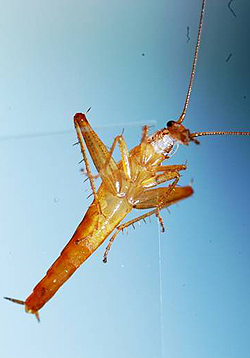
Saltoblattella montistabularis (the jumping cockroach) was found near the Silvermine area of the Cape Peninsula in South Africa, ten minutes from downtown Cape Town. It hops through the air like a grasshopper, but it eats anything in sight and can run as fast as 50 of its body lengths in a second. Yes, no grasshopper.

It’s a tiny little thing hardly a third of an inch long, discovered by Mike Picker, author of a South African insect field guide. It’s not the only jumping cockroach known to us. But the other one is only known to us from the fossil record. It lived with the dinosaurs!

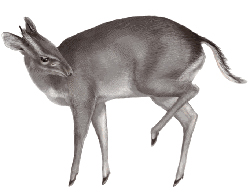
Philantomba walteri is an west African duiker that’s real cute when it’s not being prepared for barbecue. That’s how it was discovered! In a butcher’s stall in the Benin town of Mangiri! It’s a remarkable find, because this is an animal, a real (small dog) sized four-legged mammal, proof that we haven’t finished the grade school text books on basic life on earth.

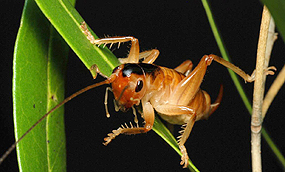
Glomeremus orchidophilus isn’t too disimiliar from your every day ordinary cricket, except that this Reunion Island creature’s main purpose in life is to pollinate an orchid! Most of its fellow orthopteras like locusts and katydids and such eat plants, they don’t help them grow! No wonder it’s been kept under wraps for so long!

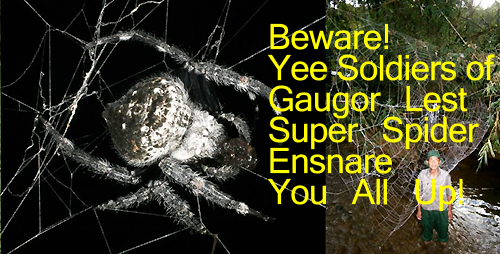
But my favorite is the Madagascar dragon spider whose discovery is so profound it’s been given the common name, “Darwin’s Bark Spider.” (See top picture above.) I was ready for this one.

Last year I traveled with three scientists, a father and two sons all research biologists, and tried desperately to understand their conversations when our safari in Kenya’s Matthews Mountains was interrupted by the web of an orb spider.

Apparently scientists can synthesize the eight different chemical strands produced by most spider’s spinnerets, but they haven’t figured out yet how to weave them into the super strong strand mother nature decorates our forests with. (Thank you, John Cronan and sons.)

This year’s super spider produces the biggest and strongest web known. Webs of this species span lakes more than 75 feet wide and spin a net 30 sq. feet large! Good grief.

But that’s not all. Its silk has a toughness that’s been measured at “520MJ/m3.” I don’t know what that means, either, but according to the documentation this makes it “the toughest biological material ever studied, over ten times stronger than a similarly-sized piece of Kevlar” and twice as strong as any other known spider silk.

Strong.

So there you have it. More mystery, beauty and perplexing awesomeness than an entire library of video games! And it’s all there, right outside.

America & Magic Help The Congo!

America & Magic Help The Congo!

While beating ourselves up over whether Wall Street was too big to fail, the unceremonious application of the Dodd-Frank Act has slowly stopped hundreds of thousands of gruesome murders in Africa, aborted tens of thousands of acts of rape and child kidnapping. The Act has absolutely helped to end one of Africa’s most gruesome multi-generational wars. We really do have something to be proud of.

Technically implementation as regards Section 1502 has not yet even occurred. It is likely to be implemented after August. But the very process of publicizing The Act, requesting comments and holding hearings has so radically altered the economy of Kivu Province, that it appears the war is truly winding down!

Giant world corporations that funded Africa’s longest and most gruesome war have changed their policies. Sony, Intel, Motorola, HP have all publicly adopted new policies that either conform to what they expect the new rules will be, or moved in that direction.

I won’t retell the story or history. But for the full background see my earlier blogs:
Evaporize Goma!
and
We Won!

Essentially your cell phone and your kids’ PlayStations can’t work without minerals previously bought from warlords in Kivu who then used that money to murder, pillage, rape and kidnap Africa’s children to an extent never before seen in history.

The Congo Wars began in the 1980s and have lasted as long as I’ve worked in Africa. They have nearly totally destroyed one of Africa’s most beautiful, magical places. But maybe, maybe there’s just enough magic left to reemerge.

Last month 118 tourists visited Virunga National Park in Kivu Province in the eastern Congo. One of the first and earliest intrepid tourists wrote on the Lonely Planet forum almost a year ago:

“There is a lot of information floating around on different websites saying the Congo is a dangerous place to visit…. At no stage during my time … did I feel unsafe or threatened in any way or form… The villagers we met along the way were the most delightful and happy people you could wish to meet.”

The presumption of peace encouraged many NGOs to increase their assistance. German groups especially began funding the rebuilding of the national parks, in particular, Virunga.

It’s hard for me to imagine that Virunga will ever greet me again with the splendor of my memories there in the late 1970s. The jungle was unbelievably beautiful, and unlike the heat and humidity of the Amazon and Asian “jungles” I’ve visited, this is a highland jungle: cool and spectacular.

Billions of same colored butterflies, friendly and helpful pygmies, unnamed monkeys, okapi, and truly myriads of undiscovered bugs, plants, frogs… I have visited many of the world’s wildest places. This was the most beautiful.

“Last week our team of skillful roof engineers have started on the roof of the main building of the Lodge,” wrote the chief warden on Sunday of the lodge he is building in his new Virunga National Park. He set an ambitious goal of 200 tourists for next month!

And there was massive attendance at a community forum to help with all aspects of the Virunga wildlife region just on Tuesday.

A real sense of normalcy is returning to Kivu. But I’m not quite ready to schedule EWT’s first trip in 35 years to Virunga. The same park warden lauding his new lodge also wrote of ongoing attacks. He calls them “organized land invasions.”

The warlords who took Sony’s money were born during war. They know no other life. And they’ve morphed from international crooks into petty thieves, and as raw bandits they’re very successful.

But I’m watching the situation very carefully. A string of positive remarks from young, intrepid travelers last year seemed to end right around the time of the flawed Rwandan election, which makes sense. Rwanda politics is probably the single greatest factor in the stability of Kivu.

And the disintegration of everything that’s good in neighboring Uganda is more bad news. This week’s bit of trouble in the new South Sudan I don’t consider serious, but it distracts NGOs and other humanitarian organizations from their focus on helping the DRC.

And finally, the DRC has called for Kivu’s first elections this November. Amazing, incredibly gratifying if it’s pulled off well, and the single most hopeful sign I’ll be watching for. We can’t expect 40 years of brutal, sadistic war to end quickly.

But yes, it is ending. And probably the single-most important reason was section 1502 of the Dodd-Frank Act. America, you can truly be proud!

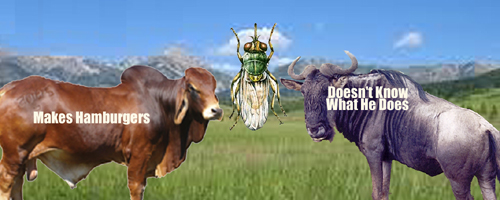
Cows-1 Wildebeest-0

Cows-1 Wildebeest-0

The idiot at the bottom of the hill below my house who poisons squirrels isn’t very sophisticated, but unfortunately, help is on the way for him. New genetic studies are unleveling the playing field and the wilderness — in Africa at least — is set to suffer.

Not everyone longs for a vacant plain on the Serengeti over which to spread their soul. There’s a lot of people who truly believe the human mind is the only center of value, and that it’s more or less self-contained, immune to its surroundings or at least protected from them, depending upon how smart it is.

So you don’t need towering mountains or raging rivers, or awesome polar bears or freakish spring hares to help you work out the meaning of life. All you need is Proust. That’s the epitome of the self-centered human.

And then there’s the Obama Mediator Ecologist (OME), trying futilely to bring diametrically opposing sides together by organizing weekend committees to pull out mustard grass from forest preserves. This is, of course, the ultimate exercise in wasted time, but it fools participants into thinking they don’t have to choose sides.

But the sides are impermeable to one another, no matter how many fools are temporarily dissuaded. It’s not possible to intervene in the wild “a little bit.” You either put a ten-foot, electrified brick wall around the forest preserve and inventory every microbe in the ground, or you let it run wild.

Since putting a ten-foot, electrified brick wall around the forest preserve and managing every microbe therein has been until now completely impractical, the wild has persisted. But scientists on the self-centered human mind team have a new strategy terrifying to the wilderness.

Genetic engineering.

I wasn’t so upset with genetic engineering until the announcement last week in the Proceedings of the National Academy of Science (PNAS) about the discovery of the gene in domestic African cattle which if activated will give it the same protection from the tse-tse fly that wild animals have naturally.

This will be a devastating blow to a number of wildernesses, including the Mara, the Serengeti, Ngorongoro Crater and the Serengeti. Let me explain.

Virtually all of Africa’s remaining great wildernesses are surrounded by farms and many of them by cattle farms. But domestic cattle (at least until now) can be killed by the tse-tse fly which carries bovine trypanosomiasis or “sleeping sickness.” Wild animals are immune.

So while visitors to the national parks will find funny shining blue or black pieces of plastic flapping off trees near their lodging killing tse-tse helter-skelter, wildlife officials actually nurture tse-tse in other areas of the park. Why nurture this gruesomely annoying little pest? Because it’s the best way to patrol the park to keep out domestic stock.

Domestic stock eat an enormously greater amount of vegetation than their wild counterparts, and if allowed run of the wild would essentially starve the naturally wild animals out of the parks.

Tse-tse are easily eradicated, and human sleeping sickness (which is different from bovine sleeping sickness) has been mostly eradicated throughout much of Africa. Despite its awesome proboscis, the tse-tse is one of the dumbest creatures on earth. Flap some brightly colored cloth in the air and it dives into it proboscis deployed.

Spray the brightly colored cloth with pesticide and it becomes the ultimate insect kamikaze. No need for mechanical spraying strategies or search-and-destroy techniques, just advertise, “Come kill yourself! Come kill yourself!” and the tse-tse dumbly complies.

But wildlife officials have carefully not eradicated all the tse-tse. And this, in part, has kept domestic stock outside wildlife parks.

But now, the PNAS scientists have identified the gene that wild animals use to become immune to tse-tse’s package of death. And they’ve identified it currently suppressed in the greater domestic cattle community throughout Africa and are engineering ways to manifest it throughout the industry as a whole.

I’m sure the intentions of the scientists were pure. They were motivated, the report says, by a $5 billion annual loss in cattle production to bovine sleeping sickness.

And as I always remind myself, why should farmers be given any less assistance than the wild? The great wildlife fence in Botswana, which decimated the wildebeest population in the 1980s, did its trick: it protected and helped increase beef farming so important to Botswana’s economy.

So I don’t really know what SHOULD be done. I only know what IS being done, and it seems a relentless effort to assist mankind necessarily at the expense of the great wild.

Getting Ready for the Next One!

Getting Ready for the Next One!

Near the Hilton Hotel, Nairobi.

“Getting ready for the next one!” a Kenyan friend of mine told me this weekend. He sells billboard space.

The weekend’s successful end threw into stark contrast the saner religious leaders in Africa and their woealmostbegone American counterparts. Most modern religious Africans – and there are many, Muslim and Christian and may other denominations – despise hocus pocus. Americans thrive on it.

It’s such a switch from the stereotype of not too long ago where yes the American tourist was anxious to see lions but really wanted pictures of a “village” because all the primitiveness and … well, hocus pocus, of Africa was so thrilling.

Maybe one day it was, but ain’t no more.

Now in all fairness, if you really head into the boondocks, somewhere akin to Backwater, Appalachia, you might certainly find some old woman who knows exactly what part of her dead frog will relieve you of an undesired suitor.

But modern, mostly young African churchgoers have no time for American hocus pocus, (even though with pleasure they take their money).

Harold Camping, the now famous Prophet of Doom, founded and headed Family Radio, an impressive network of 68 radio stations with hundreds of thousands of duped American followers. But what is less known is the many radio stations and other services he funded in Africa.

According to London’s Guardian newspaper Camping spent more than $100 million worldwide of his followers’ money on radio stations, billboards and posters, financed by the sale and swap of radio stations in the U.S.

I snapped a photo of a billboard in Nairobi and an even bigger one in Dar, placed at the most expensive place in all of Dar, the matutu and bus terminal.

Kenyan religious leaders and radio station owners, funded by Camping, distanced themselves from the doomsday prediction long ago. They placed displays ads in newspapers around Kenya starting a year ago when the billboards first appeared. The most common one read:

“We wish to inform our viewers, listeners, partners and well wishers that we are not in any way or form affiliated to the US evangelical Christian broadcaster Harold Camping or family radio.com.”

(Of course that isn’t true. They got their money from Camping. But then obtuseness is a religious art.)

Kenyan religious leaders then went on to say certainly there would be a Judgment Day, but don’t alter your schedule for the first week of June.

There is, of course, a serious side to this so far jocular story. While most Africans like most Americans recognized the ruse for what it was, some didn’t. And those like Camping who were to be the saved ended up the lost. But to be lost in Kenya or other parts of the impoverished world desperate for hope is a much worse situation than Harold Camping likely finds himself in this morning.

And that leads to another less jocular aspect of this story. WHY do Americans surrounded by the best tools in the world to discover truth believe in such incredible nonsense? Why is an American so incredibly gullible?

It’s Monday. A week before vacation stretches before us. We’ll leave that to another day.

A Ton on the Menu

A Ton on the Menu


As Kenyan transforms itself with a new constitution into a modern society the question of what to do with elephants has popped up. Just over there, in the garden.

But the problem is manifestly two-fold: there’s the elephant in the garden, and then there’s the ivory in the airport.

And finally Kenyan lawmakers are having trouble ignoring the problem. (Admittedly they’ve got a lot on their plates in implementing the new constitution before next year’s election.) In the last two months alone more than 330 tusks weighing more than 3 tons representing more than 150 elephants have been seized at Nairobi’s Jomo Kenyatta airport.

All the ivory was headed for Asia, mostly China or Vietnam, and often via Nigeria using diplomatic pouches. Kenya is on to it, though, and not even diplomats are getting through as easily as before.

But the increased black market for ivory belies somewhat the other manifest problem: there are too many elephants.

Believe me if you’re a citrus farmer in Voi, Kenya, you’re likely to welcome a little bit of unmanaged hunting at the outskirts of your plantation.

The very proactive Kenya Wildlife Service (KWS) wants lawmakers to change this. They want new laws that would punish the now by standing farmer, and new authority for themselves to police this.

It’s not going to be easy.

Forcing the hand of until now Kenya’s silent farmers may not be a good idea. Following a successful collaring exercise near Kenya’s elephant, Tsavo National Park, to monitor human-elephant conflict this month, farmers became enraged.

Public officials from parts of Taita-Taveta County claimed that more than 500 elephants were terrorizing them. One elected official, William Ikutu, appeared on Kenyan TV allegedly nursing serious injuries following an elephant attack while working his farm in Mwakitau.

Village Chief Crispus Mnyika said the jumbos had imposed a virtual curfew in five villages, and KWS confirmed that more than 100 acres of farmland had been destroyed.

KWS responded with a major air and ground operation to drive the elephants back to their habitat had started involving aircraft, 4 special vehicles and 50 game rangers. KWS will not say how many millions of shillings the operation cost… for obvious reasons.

So Kenyan legislators are getting it from all sides: from wildlife officials wanting stronger laws and greater authority, to Kenyan citizens who want these pesky beasts out of their lives.

All sorts of things have been tried to separate wild elephants from human populations. Personally, I think outsiders – researchers, especially – have complicated the problem by throwing pennies at the problem, spending resources on nonsense.

Nonsense about chili powdered fences is all the rage, now, and patently doesn’t work. Ridiculous attempts at flimsy electric fences supported by hundreds of thousands of dollars from well meaning but poorly scienced NGOs may be even worse.

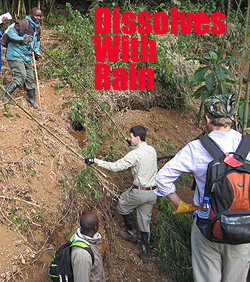
Large trenches that I’ve photographed myself in Uganda and Rwanda seem to work a little bit, but they require incredible maintenance and generally dissolve in the rainy season.

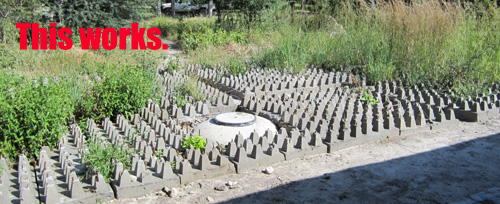
The only certain barrier I’ve ever seen is the one I recently photographed in Botswana’s Nxai Pan National Park: spiked concrete blocks that surround a public ablution unit at a public camp site. But this must be very costly. Imagine ringing a 500-acre farm with a minimum 15-foot periphery of these! (The stride of a big elephant is, yes, 15 feet!)

The daunting problem for Kenyan legislators, now, is to try to find enough resources to try to manage the crisis.

The Kenyan economy is exploding, and it’s not because of tourism. Energy development, IT including mobile phone companies, flower farming, even engineering and now new mining will likely eclipse tourism in just a few years.

The urgency for providing potable water and good sewage for its citizens, and a good business climate for its development, are issues of far greater importance to the average Kenyan and his legislator than protecting wildlife.

So all this begs the question: is there enough money left to protect elephants?

Uganda is Dying

Uganda is Dying


Nairobi's GADO says it best: Museveni is like Idi Amin.

Yesterday the Ugandan Wildlife Authority drastically reduced the fee for visiting mountain gorillas. Yesterday 6th term president Yoweri Museveni lambasted the police for being too soft on demonstrators. Get the connection?

I don’t think people realize how bad it’s getting in Uganda. This is in large part because of the clever dictator’s successfully distracting the world’s media by the admittedly draconian “Kill the Gays Bill”. But this has drawn all the attention away from the much greater and more serious human rights violations affected on all Ugandans, increasingly brutal every day.

For travelers heading there now, don’t be too alarmed. Proceed with caution. Keep your eyes on the “Kill the Gay’s Bill” that like flotsam on a dying reservoir won’t go away. See if Museveni actually imprisons all of his opponents, and keep your attention on that rebel rouser, Kizza Besigye.

And especially, keep reading one of the best blogs in Uganda, Mark Jordahl’s Wild Thoughts from Uganda. And hope that Mark isn’t imprisoned like a lot of other journalists.

Today, Jordahl notes:
“Why does a sitting president, who is no longer a member of the active military, wear fatigues to a swearing in ceremony for Members of Parliament? … Does he want to remind people that he can come down on them, at any time, with the full force of the military?”

For tour companies like EWT, and if as an individual you’re now beginning to plan a safari for the future, scratch Uganda off the list.

The Hide is a great camp in what was one of the best wildlife parks on earth, Zimbabwe’s Hwange National Park. EWT still carries a credit from that camp from our last safari into Zimbabwe in 1999. I’m afraid 2011 has seen our last safari in Uganda.

I can’t remember exactly the straw that broke Zimbabwe’s back for EWT, but I do recall a series of events including growing police brutality that displaced Africa’s beautiful sunsets with red flags: First there was the harassment of journalists. And then the emasculation of other branches of government, starting with Zimbabwe’s until then flamboyant parliament and ultimately killing the judiciary.

And that’s exactly what’s happening, today, in Uganda. It’s a methodically slow and miserable decline.

And the decade which followed EWT’s decision to stop safaris in Zimbabwe didn’t result in any real danger or injury to tourists who still went. But it became increasingly uncomfortable.

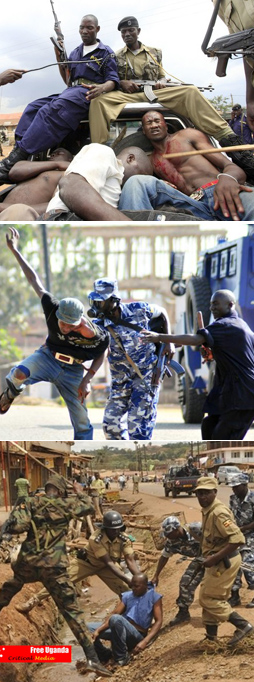
At this stage – NOW in Uganda – expect bloody demonstrations, road blocks, crazed police.

And then as the population is subdued the country’s suffering infuses society like lupus: the growing bellies of malnutrition to the long lines of cars at gas stations. For tourists it’s the possibility that gas for your transfer to the airport won’t be available and brunch will be canceled.

Ultimately tourist attractions do suffer. The boreholes so essential to Hwange and other national parks were neglected. Soldiers shot the animals.

We know well how tourists are immune to internal troubles, whether that be Tibet, Nepal or Madagascar. No sides in an internal conflict want to discourage tourists. In fact, tourists become an indication that “everything’s OK.”

And I’ve always believed that travelers should go wherever they want to, wherever their own clever devices can get them. Whether that be Cuba for an American in the 1990s or South Africa under apartheid.

But go with your eyes wide open. Travelers in the future won’t be going to Uganda to see mountain gorillas. They’ll be going to explore a once great society cut to its knees by a maniac dictator.

As Mark warns today to all of us who still love that place: “Uganda needs to be watched closely.”

Three Men Out

Three Men Out


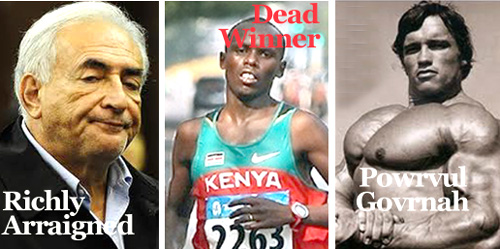
Say what you believe and believe what you say. Without that credo society breaks down. The cants include Schwarzenegger, Strauss-Kahn, and Wanjiru. These three headliners are respectfully American, French and Kenyan.

They are stars: political and commercial, and sports heroes. Wanjiru at the prime age of 24 was the world’s greatest marathon runner, and he killed himself yesterday when his wife found out about his affair.

Nairobi’s Capital FM radio station put it poetically: “[His] existence was intertwined by the sad pointer [of a] tortured genius, choosing to express himself through an excellent natural gift and reckless abandon in equal measure. Enigmas who no one, even himself knew.”

Gimme a break.

Nothing quite as poetic with the Terminator or Emperor Pretender. In fact once you leave dynamic African society, scandals don’t seem to be scandals, anymore.

My greatest personal disappointment was with John Edwards.

I’m a numbers guy. It’s very hard to get a handle on how many committed couples have affairs. It’s just too all-over-the-place. So-called “respected journals” like The Journal of Couple and Relational Therapy say 50%.

But that’s a European group, and I think their main interest is selling their books and therapy.

Although it’s been a decade since any American university studies, that’s what I’d believe: Judith Treas, a sociologist at the University of California-Irvine, concluded 11 % and pronounced, “There isn’t any evidence of an infidelity epidemic.” The numbers were more or less the same as a University of Chicago study in 1994. Michael Kinsey concurred.

And so that leaves me and my cohorts in grey society all quite ordinary, in a grand majority of all the less influential and colorful bodies on earth. Oh, but wait! Zuma! Jacob Zuma!

The President of South Africa makes no bones about his affairs. He doesn’t have to. He just marries them, and right now, they number 12. It poses great difficulties when he travels on State visits. The Maitre D’ doesn’t know who to put on the place card.

I’m not the only person who’s made fun of the President’s polygamy. In South Africa it’s a serious issue. And the fact he doesn’t have to cheat, he just marries again, doesn’t mean the man “Says what he believes and believes what he says.” Zuma’s in a ton of trouble in that regards.

So is sexual infidelity, which breaks the credo, public infidelity? If you lie to your partner, do you lie to your constituency? to your clients? to your business partners? to your children? to your supporters?

Is this just a goofy topic… or a real issue?

National Enquirer readers want to know.

The Sun Rises on Egypt

The Sun Rises on Egypt


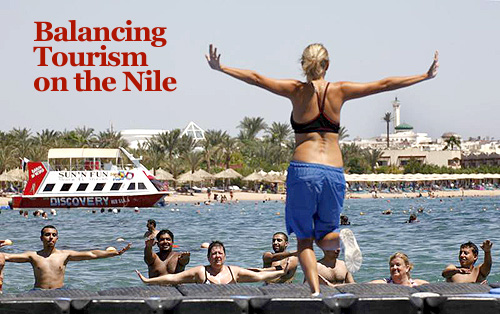
If you’re interested in a good deal in Egypt, time is running out. Good times in Egypt are on the march. But good deals are coming to an end.

Following a press release from Europe’s largest tour company, KUONI, on Friday it rescinded several of its deals in Egypt over the weekend.

KUONI stopped offering multiple night incentives and cash discounts on many of its upmarket properties and cruises in Egypt. Many of these are still available for mid- and down-market products, but top ranked hotels and cruise ships are now back to rack rates.

This and many other indications suggest that unless there’s some serious reversal in the political situation in Egypt, good deals there may be ending.

Tourism is a great barometer – a leading indicator – of a society’s perceived tranquility. I say “perceived” because as tourism skyrocketed in China, it would be hard to argue that areas of Tibet were “tranquil” or that progressive movements were being liberated.

And it’s perception, rather than reality, which drives tourism.

Take the current civil violence between Muslims and Christians in Egypt which broke out, again, this weekend. And last weekend was worse: 12 Copts were killed following a peculiar rumor that they were trying to force a Muslim woman to convert. (There were an estimated 65,000 tourists in Egypt last week.)

But on Christmas Eve before the revolution, 22 Copts were killed in the same type of religious violence. This was the highest of high tourist seasons in Egypt. An estimated one million tourists were in Egypt at the time, and that news story didn’t effect travel there one iota.

Coptic/Muslim violence has been ongoing in Egypt literally for millennia, but the story has rarely percolated into the world press. But Egypt is in the news, now – as it should be. Coptic oppression, like the oppression of women and Muslim activists, will make world headlines, now. And perhaps this new spotlight on problems the country has suffered for a long time will hasten resolution.

I think tourists know this. And the growing numbers of tourism to Egypt suggest it.

Egypt is just a bit smaller than South Africa. Last year’s hosting of the World Cup in South Africa help to boost its annual tourist figures to nearly 9 million. Before the revolution, Egypt welcomed around 12 million visitors annually.

This year South Africa will likely reach 9 million again, and Egypt will fall back to around 6-7 million.

That’s a lot of tourists! A lot LOT more than was expected only a few months, ago. And it’s likely a harbinger of good times to come.

On April 28 the U.S. State Department dropped its travel warning to Egypt, replacing it with a milder travel alert.

The U.S. move followed by about a month similar moves by most European countries.

Is tourism to Egypt as safe, now, as it was last year before the revolution? I think so, particularly if we speak of the main tourist areas like the Nile between Luxor and Aswan. But it’s extremely important to understand the caveat that I’m speaking of reality, not of perception. No, Egypt is not yet perceived as safe a destination by tourists as before the reveolution, even though it may, in fact, be.

But given the numbers trend, it may not be too long before that par, too, is reached.