This week the Huffington Post said the “migration was delayed.” True. It was delayed. About as long as getting stuck in Chicago traffic delays a dinner engagement.
“I can assure you the raingods are smiling,” the owner/manager of Ndutu lodge emailed me this morning. “The animals have streamed back onto the plains!… Everything right now is sprouting, growing and sparkling with life!”
The Huffington piece was written by a very respected conservationist, Carl Pope, Chairman of the Sierra Club.
Pope’s problem is the same as any other tourist who believes they are Robert Burton searching for the source of the Nile. TripAdvisor is full of this nonsense.
“…gazelles are waiting on the southern grasslands, but the short rains failed this December. The million wildebeest that drive the world’s greatest wildlife spectacle have not yet scented enough rain to trust their destinies to the grasslands. The migration, which follows the rain, must also wait for it,” Pope writes.
Poetic but untrue.
I am fan of the Huffington Post and consider myself allied to anyone who calls themself a conservationist. I’m not saying Pope was lying. His mistake – a very serious one – is suggesting that his one brief perspective from one small area puts him in a position to make such gross generalizations.
It was not immediately clear where Pope had been, but I dare say he probably wasn’t there very long and didn’t have a very good guide.
The Serengeti ecosystem is nearly the size of New Jersey, but unlike New Jersey it lies nearly astride the equator. Weather systems are fabulously complex, there, and especially now with global warming.
There can be small pockets of drought surrounded by areas that are flooded. Right now the northern districts of Kenya are suffering another drought. Perhaps he found himself in one such small area in the Serengeti, but the overall Serengeti is just fine, and actually, quite normally fine.
Pope’s assumption in his article that the herds are drawn by the “scent of grass” or sensitivity to rain is uncertain; we don’t know exactly what prompts the migration. Moreover, grass disappears for other reasons than drought. It can be eaten. By cattle as well as wildebeest, a serious ecological battle raging these last few years at the edge of the Serengeti with Maasai range lands.
He also suggested as typical of a casual tourist that the migration is a single thing — entity — that either moves or not. A million animals does not a marching band make! They are often split up all over terra firma.
He said the “gazelles were delayed.” Thomson’s gazelle often don’t migrate. Some do, some don’t. I see literally tens of thousands of Thomson’s gazelle on the totally desiccated plains north of Olduvai at the driest time of the year, July and the first of August. These marvelous creatures don’t need to drink, and they survive quite nicely by eating the roots of grass.
Pope marked his visit in “December.” But the information I have for December was that light rains began over the grassland plains of the Serengeti December 18 and 19, and the following week saw normal rain patterns. This is about 2-3 weeks late, no more. There was then a let up at the end of the year, as is also normal, and now as the Ndutu owner explains, everything is beautifully green.
Blogs posted by other travelers and tour companies suggest that the bulk of the wildebeest moved through the northern part of the Serengeti out of Kenya as early as the end of November/beginning of December. Right on schedule.
Several weeks later, perfectly positioned to profit from the first rains of the season, the herds were mostly divided widely between the Kusini plains to the west and the Gol Kopjes to the east.
This is the real magic of the migration. Until these first rains fall germinating new grass, there is simply no understandable motivation to draw the large herds into the area. Yet they come, year after year after year. Many believe as I do that it is a homing instinct triggered not by “scent of grass” or of rain, but of a lack of grass whence the herds came.
Whatever it is, this wondrous magic is diminished when respectable media like the Huffington Post publish reputable writers like Pope who offer tiny personal experiences as adequate accounts of complex situations, acting like experts when all they are, are poorly guided tourists.
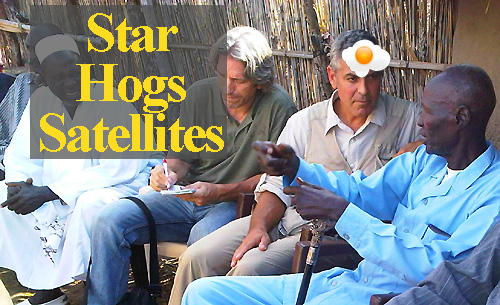
Half way through the referendum election process, the birthing of South Sudan is going well. Folks are voting, militias are firing, and U.S. celebrities have egg on their faces. (Or should I say, posho on their jowls.)
There is fighting along the proposed border near the oil-rich Abyei oil fields, and this should not be discounted but it is not yet significant enough to alter the ongoing referendum and certainly doesn’t presage George Clooney’s warning that a new civil war is about to begin.
The irony at the moment is that the two militias involved, Abyei’s Dinka Ngoc tribe, and the alleged attackers, the Arab Misseriya militia, began fighting not to disrupt the referendum but over who will be allowed to vote in a planned but not yet scheduled future referendum into which country (north or south) the disputed Abyei region should be assimilated.
Right now, neither the Khartoum government or the SPLA (the south’s military) are involved, and UN Peacekeepers are rushing to the scene as mediators. Clooney’s claim has some validity, and that is that the Darfur genocide has been conducted by militias as well, and it’s true that Khartoum often carries out its dirty work through militias.
But it just hasn’t reached the scale of Darfur fighting, not yet. And unlike Darfur, serious fighting in the south before the cease-fire agreement five years ago was mostly between the two armies, not militias.
Perhaps the greatest controversy is whether the presence of George Clooney and his battalion of friends and additional celebrities is good or bad. Read my earlier blog about Clooney and South Sudan.
The excellent NPR reporter, Joshua Keating, wrote rather disparagingly about Clooney, yesterday. His piece is very much worth reading.
The NGOs on the scene are very critical of Clooney. I had to stop reading most of the blogs, because, in fact, they started to become rather juvenile, although Clooney’s made-for-movie macho response is just as bad.
My feeling is that in balance Clooney helps, although as I said in my earlier blogs, I’m very concerned why this is true, and I very much worry that celebritizing a conflict might emasculate its solution. Once it’s no longer glitter and stars, the world could pull back the long-term and methodical support required.
Clooney and friends are probably overdoing it, now. And it’s the height of irresponsibility to warn of a war that at the moment really doesn’t appear likely. At the moment, I hope for the foreseeable future, Clooney has egg on his face in this regards.
And fortunately, for the moment anyway, the greatest heat in the conflict zone seems to be from the overwrought satellites as Clooney & Co. compete with Agence-France Press and World Vision for their use.
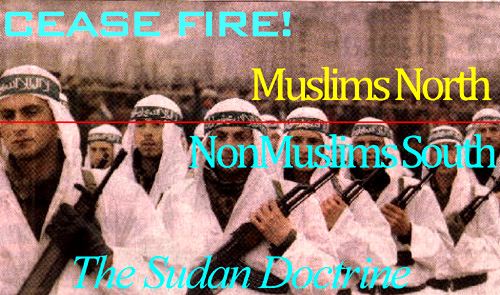
Until now many efforts towards peace in troubled parts of Saharan Africa have focused on fomenting coexistence betweenf Islam and competing religions. What the Sudanese referendum says is that coexistence of Muslim and non-Muslim ideologies won’t work.
When the election in The Sudan ends this weekend and shortly thereafter South Sudan declares itself sovereign, Muslims will be in power the north and non-Muslims in the south. But that’s not the end of it.
I expect a migration is going to begin in both directions between the two entities not so dissimilar to what happened in the Hindi/Muslim breakup of India and Pakistan (later, Bangladesh) after World War II. In fact the Sudanese migration began when it became apparent that the process was going to end in partition. More than 50,000 immigrants already turned up in the south in just the last few months.
This migration won’t be as large as the one following India and Pakistan’s partition, because there aren’t as many people to begin with. But it will be substantial enough to notice. And it will further polarize the individual societies at each end.
In America we often read about the religious competition as between Islam and Christianity, but that’s not the case. The perception comes mostly from the large presence of Christian missionaries and aid societies in The South, but the fact is that the majority of The South is not Christian, despite a half century of Christian proselyting.
Neither do I think it fair to call it “animist” as is often read as much as “Christian”. In fact, the two are often combined. I don’t think it fair-minded to say “animist” because that label carries a ton of derogatory inferences from the colonial era.
The fact is that most southern Sudanese are not religious in any regards by modern standards. They revere their family ancestry and create religious ideologies often unique to very small geopolitical areas.
Christianity is probably the largest single recognized religion in the south, but it is far from being a dominant ideology among the majority of southern Sudanese.
What it is truest to say is that the majority of southern Sudanese characterize themselves as anti-Muslim. And this characterization of oneself as anti-something, rather than something-something, is telling.
It is the basis for the conflict not only in The Sudan, but in Chad, Mali, Spanish Sahara and to a lesser extent elsewhere throughout the Saharan belt of the continent.
Religious ideology always tries to dominate government, even at home in America. Less modern societies are less capable of keeping this motivation at bay in part because emerging societies need forms of government that will be readily and quickly accepted by their people.
Muslim ideology with its male-dominated, polygamous hierarchy fits perfectly into many more traditional African societies. This week a Nairobi newspaper published a feature article on how the well-known and very traditional Maasai tribe was accepting Islam in surprising numbers.
The current president of Sudan, Omar al-Bashir, is a deft survivor of a number of court schemes and military coups, and his current long reign can be linked directly to his decision to make Islam’s Sharia law the law of Sudan in 1983. There’s no question in my mind that this is what has kept him in power since.
And quite unlike a legalistic foundation — even one as entrenched as I feel the U.S. constitution is — the opportunities for amending law in Muslim formulated societies are infinitely less. Some may argue impossible.
This draws a line in the sand, (and in the case of the Sudan, that line goes right through the oil fields). Muslim above the line. Non-Muslim below the line.
There is a huge problem in dividing up the world by religious ideology. It tends to divide not only ideas and faith, but wealth and health. But as with India and Pakistan, the motivation to minimize conflict was a vital one that has been served more or less well, even while they haven’t exactly become bosom buddies.
So if this experiment with The Sudan is successful, which I think it will be “more or less”, then a new formula may emerge for reducing Africa’s troubled conflicts.
Wonder what the hotel manager got for this one?Wikileaks’ cable publication confirmed last week what we already know: that the Obama Administration has reversed the Bush Administration’s questionable bribing policies and that Tanzania has not changed at all: business by bribes still prevails.
Corruption is hardly an African exclusive and hardly less a Tanzanian exclusive, but as countries throughout Africa increasingly move away from it, Tanzania seems to be moving closer towards it.
Tanzania’s mounds of corruption leak themselves, so they’re so enormous and so stunning. They include bribes to high public officials for buying an anti-defense missile system for Dar that was obviously not needed and never installed, and a pile of corrupt deals with its energy ministry which last week erupted again in Texas courts.
Corruption in Tanzania is like a fermented jar of unused jam that finally bursts its seal. Even so the details come slowly, from good local reporting that is usually suppressed by the government.
So it’s refreshing when something straight-forward like a Wikileaks’ cable simply tells the raw story.
Times’ readers may have been more interested in the top of the story about Arab kings’ interior decoration preoccupations of giant aircraft. And although the revelation about Air Tanzania was found pretty far down, it was big news in East Africa.
Not because it was news, but because local news sources could at last report it without fear of government reprisal. And what’s striking is that since the publication on January 3, not one word has been uttered by either Air Tanzania or the government that owns it, about the leak.
In a nutshell Boeing was trying to sell an aircraft or two to the constantly beleaguered, totally mismanaged Air Tanzania. Why not? No one flies Air Tanzania unless there’s absolutely no choice, and even when passengers want to fly Air Tanzania it usually doesn’t.
But the government of Tanzania said it was in the market for new aircraft, simultaneously with a limp wrist effort to find an international investor to turn the miserable company around.
There is a modicum of business truth to this. No investor in their right mind could turn around a company with the state of (or non state of) aircraft currently owned by Air Tanzania.
So Boeing aggressively started the sale.
The compilation by the Times of numerous, separate Wikileaks’ cables shows how aggressively the new Obama administration helps American companies, to the point that a side story to this is that Europeans are claiming some trade agreements might be jeopardized.
But when the Tanzania government showed interest and then told Boeing it better find an agent, and that the agent Boeing better find was a hotel executive in Tanzania, the U.S. embassy in Dar fired off cables more or less warning Boeing about going too far.
That was a major change from the Bush Administration, and Boeing then rightly towed the line:
A Boeing spokesman told the Times, “It is not just a matter of abiding by U.S. law and laws internationally but a general sense of business ethics.”
Air Tanzania bought an Airbus.
It really doesn’t matter if Air Tanzania buys an Airbus or a Space Shuttle, the company will never be solvent, and it’s truly sad that the business oligarchy in Tanzania profits from this.
The last several weeks in Tanzania suggest things might be turning around. That Tanzanians are getting fed up with a closed government notable most for its corruption.
Violence is largely an “American” thing. Not African, not Chinese, although some of the worst violence in mankind’s history has occurred there. But organic violence, violence allowed free reign to grow, is distinctly American.
Rep. Gabrielle Giffords (D-Ariz.) and others murdered in Tucson is why I say this.
If you’re reading this instead of the billions of other blogs about Giffords, it’s because you know my life has been spent in Africa. And when it hasn’t been in Africa, I spend a lot of time talking to other people who aren’t African about how Africa isn’t really as violent, isn’t as murderous, isn’t as corrupt as … well, America.
And here’s why.
First, let’s start with just the ultimate violence: killing. In my lifetime, Americans have been involved (either as the killers or the killed) in killings in the world more than any other nationality.
Add up the Rwanda genocide, the slaughters in the Congo, the political killings throughout China and North Korea, the secret killings in Argentina and Chile, the Balkan slaughters, and the ongoing and endless civil wars in the Horn of Africa.
It still doesn’t equal the involved killings in all the American wars of my lifetime. Likely it doesn’t even add up to the involved killings of the Korean and Vietnam Wars.
In the generation before me, this supreme total wasn’t America’s. It was Europe’s, with the holocaust and the Balkan genocides such as Armenia. (A close second was the prolonged killings of the Stalin regime.)
Not Africa. Not then, not now.
Violence as a true act of self-defense is a bitter morality. But during my lifetime violence in self-defense (WWII) has morphed into violence as preemption.
I don’t think that Giffords’ accused murderer was a sane activist. But he was influenced by the hate and vile (vitriol, as the Puma County Sheriff explains) of the Right.
Fact: Sarah Palin removed her website of “targeted” Congressional seats, where crosshairs were used to designate the Congressional districts the tea party should beat, within hours of the Giffords’ shootings.
Sarah Palin knew it was inflammatory. Removal so quickly was an admission it was wrong to begin with.
A number of other sites came down quickly from the Right as well.
Likely there will always be violence. Poorly brought up, abused, neglected children often turn violent. Abused, neglected, tortured and impoverished adults often turn violent. I believe society should try to rectify all this, but even without doing so, in the past these unhinged people did not direct their violence against Government.
So often it was against women, wives and daughters.
So often it was against other ethnic races, immigrants, other religions, people who aren’t like you. Sometimes it was against animals, or glass because it makes such a clatter shattering. Sometimes it was random.
But in my generation, in America, it’s turned from all of those to… Government.
That’s new. We have never had as many Timothy McVeigh or Jared Lee Loughner wannabees as before. There were some. Nearly one out of every four American presidents has been assassinated. But nowhere near as many Oklahoma Public Buildings, or Maryland State Buildings, or airplanes, or churches… or public officials “targeted in crosshairs” as today.
A junior Congressmen from Idaho didn’t have a body guard when I was child. It didn’t take me two hours to check-in at O’Hare. I wasn’t allowed to bring an unconcealed gun into the Davenport city council meeting, or into my Econ 101 lecture at the University of Iowa as a part of my “right to self-defense.”
Sarah Palin isn’t the cause. She’s just another symptom. She transferred her violence from herself to the public at large. Society couldn’t make her happy. So better than beating a grandchild, she beats Government. There’s a certain bitter-sweet logic to this. And by the very nature of her public scope, she transfers this violence to millions.
We can’t live without Government. We can’t live without Big Government. And we can’t live without Big Government doing a lot more than just “defense.”
Government is Society, Community, the Group of Us. By our neglect of Society, Community, the Group of Us, we have become our own targets. We have become socially suicidal. Americans have put themselves in the Crosshairs.
Sunday is the beginning of the end of one of the most monumental conflicts Africa has ever experience, and Sen. John Kerry was there this week to gently help see it through.
Sen. Kerry arrived in The Sudan on Tuesday and returned home yesterday. Today Jimmy Carter arrived with his wife to monitor the election. Amazingly, there’s very little in American news about this watershed event. There’s not even anything on John Kerry’s own website. But thank goodness he and Jimmy are there.
Kerry has been pivotal in shepherding a half century struggle in southern Sudan to some peaceful conclusion, untangling the mess the British created during the colonial period. His latest carrot to the Sudanese masters in Khartoum was a stunning one: that he could support removing the north from the “States that sponsor terrorism” list if all goes well this week in the South.
There’s no doubt about the outcome of the election which begins Sunday and goes on for a week. The outcome will officially express the will of The South to secede from The North. Everyone knows this and has known it for years. Diplomats have been in training for more than a year. Western donor nations have built the rooms that the new Parliament will use. Even the neutral U.N. has a presence of presumed Peace-Keepers along the contentious potential border with the North.
The question is what happens afterwards.
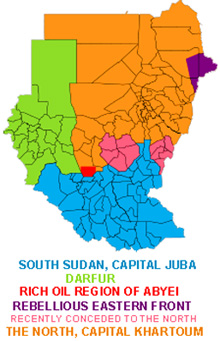
The election calls for formal succession by July. But that means between now and then a number of contentious issues must be resolved that haven’t been, yet. Such as the border line. How much of Sudan’s current $36 billion dollar debt will be assumed by The South. And probably most dangerous of all, who gets the oil.
The proposed dividing line between North and South goes right through Sudan’s most productive oil fields. The irony is that they haven’t produced very well, because for nearly 50 years there’s been shooting going on. In 1981 I was myself given an offer by a giant oil company to help ransom oil workers being held hostage in the area, who were later killed in the fighting.
But as I’ve been saying for some time, I think this is going to happen, and pretty peacefully. And there is such hope in the air at the moment, that there is a nearly giddy presumption the success of next week’s election will spill over with goodness into regions like the troubled Darfur. Sen. Kerry arrived Tuesday.
Here’s an extremely simplified time line of the history of Sudan:
The British annexed The Sudan in 1899. They didn’t really want to because it was considered a desert wasteland, which it looked at the time. But The Nile runs right through the country, and Britain was in a contentious and globally sensitive battle with France over control of Egypt. So with reluctance and little real interest the outposts along the Nile raised Her Majesty’s flags.
Seventeen years later in 1916 with World War I as a backdrop the massive Sultanate of Darfur was absorbed by the British into the hodgepodge of what they called The Sudan. This was a terrible mistake which prevails until today. Darfur was a kingdom relatively progressive by the standards of those days, and distinctly non-Muslim. This defined a religious battle that until then simply hadn’t existed.
The British had almost two decades of training Sudanese in Muslim Khartoum as government officials, and as they wrongly did everywhere, they sent into foreign lands the officials they trained in the African capital city. In Kenya, they sent Kikuyu to Luo. In The Sudan, they sent fanatic Muslims into animistic regions like Darfur. That mistake is still bleeding.
The next generation was relatively peaceful. The colonizers of Africa I believe actually did their best work as “colonizers” in the period of 1920-1940. In part this was because of an enormous emphasis on education, but also in part because of the troubled world economies that resulted in a sort of benign interest in things overseas. World War II changed all that.
The end of WWII left a crippled Britain on the world stage, bankrupt and exhausted. Winston Churchill said it was time to end the colonial era. Not much had happened in the colonies over the last 20 years and there was not much hope anything could. The exit from the era of colonialism was a pragmatic, not a moral one. Independence would save money.
And this driving western motivation, saving money, is a theme that has caused so much havoc in Africa. Just collect as many jobs as you possibly can afford and give them as large a responsibility as possible. Forget the hodgepodge of eons of cultures and societies that you’re instantly integrating: just do it, be done with it, and get out.
Britain had essentially neglected all of The Sudan for a half century. Now it was giving it eight years to reach Independence, a collection of tribes, more than 200 language groups, and viciously antagonistic religions. This wasn’t oil and water, it was refined uranium and explosions of the sun.
Independence was set for 1956. Imagine the millennia of battles between gallant horse-riding knights and primitive tribes over Sharia, Jesus Christ, palm nuts and women, between 200 groups of people who understood nothing about one another except the length of each other’s spears. They were in 8 short years to create a modern nation, with … a single leader.
War broke out in The South in 1955.
The South which lies over the rich agricultural regions of Uganda was populated by non-Muslim tribes from the Lake Victoria region, the same groups of people who would form the country of Uganda in 1963. In fact, that was what they were fighting for in the beginning, to become a part of Uganda, not of The Sudan.
The Sudan was independent according to British prescription for all of two years: 1956 and 1957. The country was being torn asunder. A military coup in 1958 held it together. All vestiges of British idealism about self-government were gone.
In 1962 as Uganda was about to achieve independence, military leaders of the south declared their own country, South Sudan. The world took no notice. I can imagine JFK looking towards Cuba and finding a second to ask his ambassador to Britain how things were going in the former colonials and not listening to an answer that never came.
Britain didn’t like these upstarts disturbing its jet age plans for African independence. No, Britain said to The South, you can’t join Uganda.
And for that matter, Uganda wasn’t really interested, either. No one knew about the oil, yet.
In Khartoum in the North, one military coup after another essentially destroyed the place until a real strongman, Gaafar Mohamed El-Nimeiri, started a holocaust in 1969 of the most brutal and extreme ever known in this part of Africa. When the dust settled (it took two years), Nimeiri was firmly in control and terrified the world.
But he was pragmatic. He wanted to get rid of the distant war in The South, so in 1972 in Addis Ababa, he signed a Peace Agreement with southern rebels that ended the fighting for nearly a decade, giving them autonomous control of their region.
Things might have stayed that way. Except for one unexpected development.
OIL. 1978.
Chevron began building rigs throughout the Sudd region that exactly today will divide the North and South. It’s a swampy, ridiculously hot, horribly unnice area for human beings. Except for a few areas where nomadic tribes did herd hoofed stock, it was a wasteland. But, of course, no more.
For five years Chevron pumped more and more oil out of the region, paying royalties usually to warlords rather than any established government officials. Niemeri watched millions of dollars creeping away.
Most of these bucks crept south, admittedly. They strengthened the “autonomous region” of the south by, well, providing guns. Oil companies have a way of doing this.
Niemeri was now a dictator growing a heart. The Cold War wasn’t over, but it was cooling. He was growing more acceptable to the West. In a move that at the time meant nothing to the west, he declared Sharia law the law of the land, and this essentially empowered him even further. In 1983 he sent troops into the Judd to secure the oil fields.
All hell broke lose.
And the South prevailed. The north lost the battle. And Niemeri was deposed and killed by fellow officers in 1986. After a few insignificant military coups later, the current president, Omar al-Bashir comes to power in 1993.
The battle rages on in The South. The North grows indebted having lost its Cold War patrons. War has now been going on for nearly 50 years. In 1998 Bill Clinton sends a missile into Khartoum and blows up a factory he claimed was making terrorists’ weapons.
The North is further weakened. Lots of leaders are killed and jailed, but Bashir survives another coup and emerges as a peace-maker in 1999, pledging to end the horrible travail Sudanese in The North have experienced for generations.
In 2002 he signs a peace deal with the South. Rebels in Darfur begin fighting, emboldened by Bashir’s apparent concessions in The South. The North is further weakened as it tries desperately to manage the growing war in Darfur.
In 2005 Bashir and John Sarang of The South sign a comprehensive understanding that would lead to an election for succession the second week of January, 2011.
Fiance of opposition candidate, Wilbrod Slaa, challenges police in Arusha.It happened all too quickly. Tanzania’s second largest city erupted in violence Wednesday, three people killed and scores injured. The push for democracy and transparency in Tanzania has exploded faster than even I expected.
Right now Arusha is calm. EWT, in fact, had clients who were in the town today. But the situation remains tense, and the government of Tanzania is acting only in ways that will make it worse.
The Tanzanian government is trying to suppress all news about the affair. Click here for a manual link to YouTube about the demonstration. The reporter, who I can’t identify and doesn’t want to be identified, has requested that YouTube remove all embedding code that would allow it to be dispersed more easily through blogs like these.
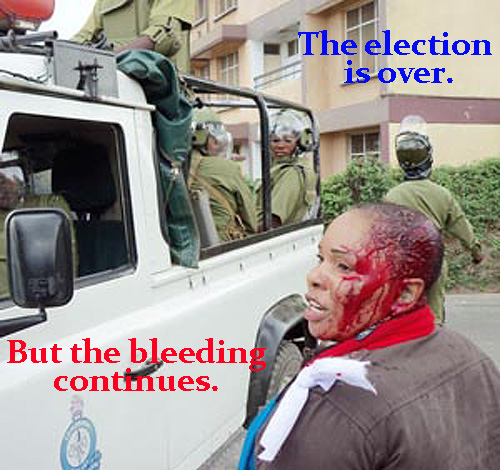
The video captures much of the chaos over most of Wednesday afternoon. It has a clip of the fiance of defeated opposition presidential candidate Wilbrod Slaa, her face bloodied.
The violence began when federal police used tear gas on a rally called to criticize the current government.
The initial battle with tear gas occurred at a large open field where Chadema’s rally (the opposition party) was just starting.
A large anti-riot police vehicle equipped with its tear-gas throwers disturbed the crowd, who had assembled with a police permit. The police claimed the vehicle was there to prevent marchers who were arriving from the central city to join the rally, because while police had granted a permit for the rally, they had denied a permit for the march to the rally.
“Police keep away, this is an official meeting and we have permission to gather here,” shouted Wilbrod Slaa, the defeated Chadema candidate for president of Tanzania who was at the time addressing the rally.
As marchers appeared, the tear gas went off and chaos errupted. Police arrested a number of the leaders in the front of the march, including Godbless Lema, the wildly popular and newly elected MP from Arusha, and (opposition party) Chadema chairman Freeman Mbowe.
As the two high profile politicians were being driven away with 47 others arrested, the crowd exploded: scores of people raced towards the police vehicle throwing rocks. The police responded with more tear gas.
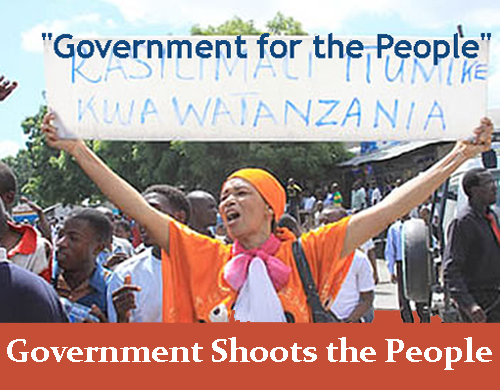
Crowds then formed throughout the city trying to converge on the police station, where it was presumed the leaders were being held. Police used live ammunition against the crowd, there, and the afternoon became one of continuous pitched battles throughout the city between police and demonstrators.
Police confirmed 2 dead and 9 injured but area hospitals suggested 3 dead and injured closer to 100.
Arusha opposition MP Lema is a rebel rouser, and this is not his first brush with the law. He has been in jail twice before during his campaign for Parliament, which he won in the national election the end of November.
The specific issue that ignited yesterday’s violence was a federal government move over the weekend that stacked the Arusha city council with government supporters allowed to vote for mayor, but who did not actually reside in the city.
The real city councilors had boycotted the meeting and claim, therefore, that there was not a quorum sufficient to elect a mayor. But the government ordered the election to continue, and the result is that at least officially, Arusha now has a mayor allied to the government ruling party, a mayor overlording a city that is hugely in the opposition’s camp.
This does not happy days make.
But there were other issues to be discussed at the rally which was never completed: that the presidential election last November was unfair, that the government is corrupt, and a host of lingering accusations that during the November national election campaign the government suppressed all opposition.
I’m not sure how far this is going to go. The opposition in Arusha is incredibly strong and has support from several other larger communities in northern Tanzania like Karatu. But other important areas in northern Tanzania like Moshi, Monduli and Mto-wa-Mbu are firmly on the government’s side.
The blogosphere is cautious, I fear worried that the government is looking over their shoulders. There are numerous references to what has happened in Arusha is like Tiananmen Square, protests in Berlin before the wall went down, and demonstrations in Kenya that led to more transparent government.
Without doubt the police acted wrongly. It remains to be seen if they acted on their own, or are following in lock-step the darkening oligarchy in Dar.
You can no longer buy a ticket on American Airlines through Expedia or Orbitz. Said another way: the big guys are fighting for your money and it doesn’t matter a hoot.
American Airlines is the U.S.’ second largest airline and the world’s third. After the completed merger of United and Continental later this year, it will drop another notch. Don’t lose any sleep over this.
Expedia and Orbitz currently account for about a quarter of all airline bookings made by U.S. travelers. After American’s move this week, that could drop at least temporarily by about half.
And what will happen to your air fares?
They’ll go up.
And what would have happened to your air fares if all of this hadn’t happened?
They’ll go up.
And what will happen if they resolve this, as they certainly will?
Fares will go up.
And how much more or less will fares have gone up depending upon when its resolved or not?
0.
So what’s happening? What’s happening is that Expedia is trying to screw you more than American already has.
The high and mighty morality with which both sides in this Big Guy Fight have evoked is disgusting. Both sides, of course, claim that consumers are the losers and because of the other side. That they are championing competition. This is such balderdash.
Americans (not the airline, but the organic ones) are basically idiots when it comes to buying their airline tickets. They are suckers of the highest standard. Duped by hidden fees and outright fraudulent advertising, they will spend hours on their computer to glean $10 off a $150 fare.
That is not competition in action, it is obsessive-compulsive behavior.
And the winners in this insanity are the airlines and brokers like Expedia who realized that paranoid-driven consumers could be duped by internet games. American spokesman Ryan Mikolasik told the New York Daily News that the impoverished multinational is losing “several hundred million dollars a year” in fees paid online services like Expedia.
That is several hundred million dollars that isn’t being used for fuel, maintaining aircraft, salaries, amortizing loans or advertising, research and development, and it certainly isn’t being used for coffee or tea.
That is SEVERAL HUNDRED MILLION DOLLARS more than flying is worth. But don’t think that if American is successful, that you’re going to get a refund!
American Airlines alone is projected to earn over $400 million. That’s AFTER on-line fees.
Before this tiff Expedia controlled nearly a quarter of the ticket purchase market in the United States. That does not foster competition. Whenever any entity controls that large a segment of such a vital commercial market, competition is stymied not enhanced.
Capitalist principles in the purchase of airline seats were doomed when Jimmy Carter started the process of airline deregulation in the 1980s. That was the mistake that American society made, removing government oversight from a vital service so essential for every day life.
So it’s now chaos, with the Big Guys fighting over who is going to be able to screw us the most. And by the way, it can also flip over and screw the airlines and their employees royally, too. As happened with all the airline bankruptcies.
And I hesitate to point out that more and more mechanical problems are happening, because government oversight in that critical area is also wanting.
So don’t choose sides on this one, dear consumer. It won’t matter a hoot. And for god’s sake, don’t waste your time finding a ten percent deal from New York to Chicago by flying via Houston. You’re killing yourself, shortening your vacation, wasting your resources and foolishly increasing the number of miles flown.
It boils my blood, which I wish they were capable of doing with coffee on short-haul flights, which as you know, they don’t even do that, anymore.
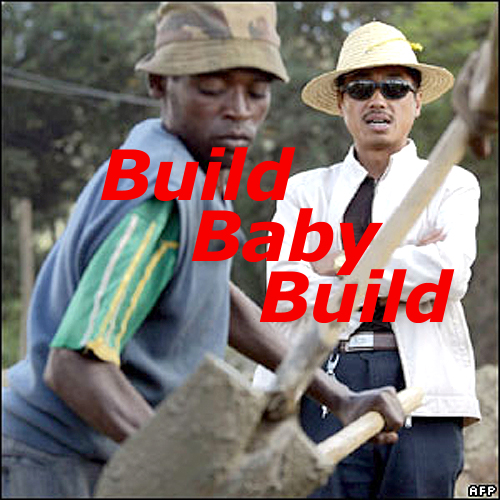
From IPP Media. The Government suppressed most photos.It was a brutal New Years in Tanzania. Courageous protesters started to lay the country’s Road to Democracy but were bulldozed down. This Road is as full of pitfalls as the proposed road in the Serengeti, but this one’s got to be built!
Tanzania’s main city of Dar-es-Salaam – normally in structured chaos with millions of people bustling through overcrowded bus depots and through congested city streets – resembled a ghost town last Tuesday following a repressive response by police to a little demonstration calling for a new constitution.
Shops were shuddered. Streets were empty.
Several hundred activists had decided to ignore a police order banning their demonstration from submitting a new draft constitution to the Justice Minister. The group was hardly larger than a crowded bus stop. But the government responded with enough police, tear gas and even live ammunition to rival the anti-defense missile system that one of its last Prime Ministers tried to buy.
So the demonstration was immediately scattered. But courageous protesters then led police on a cat-and-mouse chase through the city as multiple individuals running in different directions pretended to be the ones with the actual “document” they were trying to deliver.
A draft of a new constitution. Which, presumably, allows peaceful protest.
The air cleared, the tear gas dispersed and the weekend was lazy as normally would be the case on New Years. Except in a complete reversal that made the demonstration seem successful, Tanzania’s president over the weekend agreed to form a commission to review the constitution.
Jakaya Kikwete didn’t say so himself, and that was a mistake. He let an important don of the University of Dar-es-Salaam make the announcement. Dr. Benson Bana said Kikwete had asked him to form a committee to start the process.
It’s all so absurd, frightening and enlightening. Why make the decision, and then relegate it such little importance and issue the announcement during the New Years’ weekend?
Because (1) you have no intention of following through, or (2) the movement is growing so powerful you’re trying to defuse it?
Tanzania has always had a much more authoritarian government than its sister, Kenya, ever since at Independence it fell firmly into the eastern “communist” camp. That was reformed considerably in 1986-1988, but the same political party has remained in control nonetheless.
Politically, (i.e., in their respective original constitutions) there couldn’t be two more different countries than Kenya and Tanzania. Yet for the last generation daily life has been very similar.
I find the greatest difference in education. Tanzanians as a whole are better educated than Kenyans, a result of Tanzania’s historical attention to education, but there are many more very highly educated Kenyans than Tanzanians a result of being able to pay for the Ivy usually abroad.
And that means that Tanzanians are much less tribal than in Kenya, one of the real pitfalls of many African societies trying to emerge into the modern world.
There is much less economic class stratification in Tanzania than Kenya. But as seems to have been proved in history, that produced less wealth overall. There are many, many more rich Kenyans than Tanzanians. (And also, correspondingly, many more very poor Kenyans than Tanzanians.)
Tanzania’s election the end of November was declared fair and free by most outside observers, so the issue is less how democratic this single election was than the way elections as a whole are handled.
It would be unthinkable, for example, if the Kenyan government banned broadcasting political debate between candidates as is the case in Tanzania. In fact, the ruling party in Tanzania even banned its candidates from participating in debates at all – whether they were broadcast or not!
It is, in a nutshell, an excellent example of the difference between a more socialist and a more capitalist society.
And now after a generation or so, the more educated (Tanzanians) know better that they are less rich than some of the less educated neighbors (Kenyans).
So Tanzanians are split right down the spine of morality. The proactive middle class demonstrating Tuesday wants more wealth and believes the way is through more democracy. The plutocracy argues that unshackling society to increase wealth also will increase poverty, or at least the gap between the rich and the poor.
Both are right. But who has the purer motivations?
A policeman firing on an unarmed demonstrator is the answer. One believes in his heart. The other believes in his gun.
*****************************************
Here’s the time line since the end of November election:
Several days before Tanzania’s election in November, the Minister for Constitutional Affairs and Justice Ms Celina Kombani declared the government would not consider altering the constitution.
A day or so later, the newly elected MP from from Arusha, young Godbless Lema, told cheering supporters that a new constitution was needed to “liberate all of us. Otherwise, we will continue guarding our votes at polling stations during each election.”
The next day, December 9, Tanzania’s Chief Justice, Augustino Ramadhani, applauded Lema’s statement and urged the government to consider a new constitution. (Here’s a great irony. Ramadhani made the statement in a speech at the Russian Cultural Center!)
The ball was rolling.
A week later, the government nodded a very little bit. Too many newly elected MPs, even from its own party, were talking about a “new constitution like Kenya.”
Reversing Kombani’s November 28 pronouncement against any new constitution, a high government official, John Tendwa, told a forum in Dar on December 14 that calls for a new constitution were legitimate.
On December 23, steel reeling from a separate election in Zanzibar from which they felt denied real representation, the Muslim organizations in Tanzania came out very strongly in support of Pinda’s statement.
The next day, Tuesday, a ridiculously large police force brutally dispersed several hundred demonstrators.
A few days later, bubbly still effervescing, Kikwete tells a university professor to form a committee to look into the matter.
This is not strong leadership. It’s a wimp wondering where to go.
I see no choice. Tanzania is falling way behind Kenya in all areas: economy, tourism, and perhaps now, even education. Its archaic form of government is stifling the manifestations of its successful process of educating its population.
Tuesday’s demonstration is a sign. Ignore it and the country will head right off the cliff.
When you’re sick inside, the outside looks terrible: 2010 was a year of striking differences between surging Kenya and its backward neighbors. 2011 will be the same.
Socially, culturally and politically, it was a GREAT YEAR for Kenya but a BAD YEAR for its neighbors.
Kenya grew fast, started to implement a radical new constitution, improved tourism even while increasing tourist rates, and deftly participated in major global controversies like the CITES attempt to allow selling ivory and the run-up to the South Sudan election.
But the other countries in East Africa? Terrible. Socially and politically Rwanda, Tanzania and Uganda all took huge steps backwards. Contested or ramrodded elections, scandals of unbelievable corruption, and horrendous attempts to extinguish moves to improve human rights gave this part of East Africa a 20th century dictatorial look.
And the actual bombings in Kampala that killed more than 70 people almost suggest that when your internal body isn’t doing so well, you’re going to be nicked by the viruses from the outside.
For many years Tanzania’s tourism was inching up on Kenya’s, outpacing both growth and development. Last year that was reversed, and one can only suppose that tourism is sinking with the overall quicksand felt throughout the country.
It was a BAD YEAR for wilderness and wildlife. The “mini-drought” is now two years behind us, and so almost anything looks good in comparison, but there were two horrendous trends appearing throughout East Africa last year:
Poaching and Politics.
There’s always been poaching, but nothing like the corporate poaching that successfully kills and transports out of private, fenced and patrolled reserves a black rhino. That happened in both Kenya and South Africa. And in Tanzania, the Serengeti lost 20% of its wild rhinos (1 of 5, that until now were patrolled like a child in a perambulator with the Nanny’s grip fastened.)
And Tanzania in its drive to become Africa’s newest pariah first spearheaded a campaign to reverse CITES sanctions on selling ivory, and then announced it was going to kill the wildebeest migration with a road.
In Uganda, Father Museveni gave the nod to start hunting, again, and let South Africans develop the hunting of the rare sitantunga, even as its wildlife count declines.
And there’s nearly as bad a flipside to this wildlife story: where poaching and politics aren’t screwing things up, elephants are. The population explosion is eroding the population’s confidence everywhere that governments can keep the jumbo out of the farm.
It just doesn’t look good for wildlife in this turbulent and developing era in East Africa.
It’s hard to imagine 2011 can be as bad. And at the risk of jinxing the whole kebab but being true to end-of-year stock taking, I’m going to predict the Serengeti highway won’t happen, at least not completely as planned. And if we can get at least that victory, I guess the battle continues with some hope.
And with that my marker for WILDLIFE below moves from bad to good.
Strictly economically, Kenya is in the stratosphere, leaving its neighbors way behind. Now a lot of this is foreign donors nudging the county towards implementing the new constitution, so you would normally expect that to end next year. But next year is one year before the next election, and it was the last election when everything fell apart, so I feel this outside stimulus is going to continue. And then, there’s China, flooding Kenya with infrastructure money as if it’s taken a page out of Obama 2.0.
Elsewhere in East Africa, including Tanzania and despite recent fossil fuel discoveries, things don’t look so rosy. Tanzania’s debt is massive, Rwanda’s long flirtation with foreign aid is about over, and Uganda is so mired in bad bookkeeping we can only presume the worst.
I’m afraid that 2011 will be worse for Kenya’s neighbors and probably the same for near inebriated Kenya.
Here’s my summary for what it was and what it will be:
East Africa Report
2009
2010
2011
SOCIETY Kenya The Rest
Good Bad
Good Bad
Good Bad
WILDLIFE
Bad
Bad
Good
WEATHER
Bad
Good
Good
TOURISM Kenya The Rest
Bad Bad
Good Bad
Good Bad
ECONOMY Kenya The Rest
Bad Bad
Good Bad
Good Bad
Predictions are just that, based on the here and now. If Tanzania can move swiftly to its own new constitution, if Father Museveni steps down, if Karume disappears and is replaced by a coalition-building young person, then societies throughout East Africa will improve.
And with the society, so will the economy.
East Africa is booming, so many of the stories of 2010 were terrifically good news. But there were the tragedies as well like the Kampala bombings. Below I try to put the year in perspective with my top ten stories for East Africa for 2010.
1. Populace democracy grows.
2. Terrorism grows, as does the battle against it.
3. Huge stop in the mercenary purchases of Coltan.
4. Momentum for peace in the runup to establishing a new South Sudan.
5. Tourism clashes with development, especially with the proposed Serengeti Highway.
6. New discoveries of fossil fuels produces new wealth and a new relationship with China.
7. Gay Rights grow public but loses ground.
8. Rhino poaching becomes corporate.
9. Hot air ballooning’s safety newly questioned in game parks.
10. Newest early man discoveries reconfirm sub-Saharan Africa as the birthplace of man.
#1: POPULACE DEMOCRACY GROWS
Theoretically, all the East African countries have operated as “democracies” except for the torrential years of Idi Amin in Uganda. But the quality of this democracy was never very good.
Tanzania was a one-party state for its first 20 years, and that same party continues to rule although more democratically today. Kenya, Uganda, Rwanda and Burundi experienced one dictator after another, even while democratic elections at regional levels challenged the executive.
But the end of the Cold War destroyed the alliances these developing countries had with super powers. Purse strings were cut, and political cow-towing ended. All of them moved towards a truly more democratic culture.
And in 2010 huge leaps were made in all the countries towards more truly representative government. The most important example by far was the overwhelming passing of the new constitution in Kenya in a national referendum where more than 75% of registered voters participated.
And like the U.S. election which followed shortly thereafter, and like support for national health care in the U.S. and so many other issues (like no tax cuts for the rich), Kenyan politicians dragged their feet right up to the critical moment. They tried and tried, and ultimately failed, to dissuade Kenyans from their fundamental desire to eliminate tribalism in government and more fairly distribute the huge wealth being newly created.
I see this as People vs. Politicians, and in this wonderful case, the People won!
And there was some progress as well in Tanzania’s December election, with the opposition growing and its influence today moving that country towards a more democratic constitution.
(It was not so good in Rwanda or Uganda, where stiff-arm techniques and government manipulation of the electoral process undermined any attempt at real democracy.) But the huge leap forward in Kenya, and the little hop in Tanzania, made this the absolute top story of the year.
#2: TERRORISM GROWS
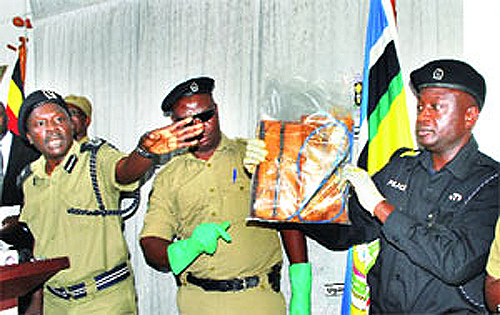
Four smaller bombings in Nairobi’s central business district over the year were eclipsed by two horrible simultaneous bombings in Kampala bars on July 11 while patrons were watching the world cup. Police display an unexploded suicide vest.
Al-Shabaab, Al-Qaeda in Somali, claimed responsibility. And throughout the year Shabaab grew increasingly visible along the Kenyan border as its power in Somali increased.
I’ve written for a long time about how the west has had its collective head in the sand as regards terrorism and Al-Qaeda in particular. Long ago I pointed out that the locus of Al-Qaeda terrorism had moved to the horn from Afghanistan, and this year proved it in spades.
The country with the most to lose and most to gain in this war on terror is Kenya, because of its long shared border with Somalia. And the year also marked a striking increase in the Kenyan government’s war on terror, and with considerable success.
With much more deftness and delicacy than us Kenya has stepped up the battle against Al-Shabaab while pursuing policies aimed at pacifying any overt threats to its security, by such brilliant moves as allowing Omar Bashir into the country and not arresting him (on an international U.N. warrant). As I said in a blog, Kenya Gets It, and the story is therefore a hopeful one.
The Dodd-Frank Act is our victory!The Congo Wars continue but are abating, and in large part because of a little known provision in the Dodd-Frank Wall Street Reform Act which now makes it almost impossible for major corporations in the U.S. to buy the precious metal Coltan on the black market.
A black market which has funded perhaps Africa’s most horrible war for more than a generation. Hundreds of thousands – perhaps millions – have been killed and raped, and more than 20,000 children conscripted into brutal wars, funded by purchases of Coltan and other precious metals by Intel, Sony and Apple.
It certainly wasn’t just this little legislative move. The U.N. peace-keeping force, fabulous diplomatic initiatives by Uganda and a real diplomatic vigilance by the U.S. all were instrumental. But the year ended with the least violence in the region in more than two decades.
#4: SOUTH SUDAN
I may be jumping the gun on this one, because the referendum to create a new country, the South Sudan, is not scheduled to occur before next month. But the runup to the referendum, including the registration process, while labored looks like it’s working.
Allied loosely with the Congo Wars, the civil war between the North and South Sudan had gone on for generations until a brokered peace deal five years ago included the ultimate end to the story: succession of the South into a new country.
The concept is rife with problems, most notably that the division line straddles important oil-producing areas. But in spite of all of this, and many other ups and downs along the way, it looks to me like there will be a South Sudan, and soon. And this year’s new U.N. presence in Juba, donor-construction of roads and airports, all points to the main global players in the controversy also thinking the same.
The creation of a new state out of a near failed one is not the be-all or end-all of the many problems of this massive and powerfully oil-rich area. But it is a giant leap forward.
#5: THE SERENGETI HIGHWAY & TOURISM
Last night NBC news aired a segment on the Serengeti Highway controversy, elevating an East African story into American prime time. Good.
But like so many reports of this controversy, the simplification ran amok. NBC’s reporter Engels claimed the motivation for the road was to facilitate rare earth metals like Coltan (see above) getting into Chinese hands more quickly.
While there may be something to this, it’s definitely not the main reason, which is much more general and harder therefore to fight. As I’ve often written, the highway as planned will be a real boon to the Maasai currently living to the east of the Serengeti, as much if not more than to the Chinese.
And as far as I know, Maasai don’t use Coltan.
Roads bring commerce and may be the single quickest way to develop a region. This region is sorely in need of development and recent Tanzania politics has aligned to the need for this regional development.
The highway is just one of many such issues which came to the fore throughout 2010 in Kenya and Tanzania. Concern that the west is just interested in East Africa as a vacation destination with no regards for the struggle for development, has governed quite a few local elections this year.
The whole concept of tourism may be changing as the debate progresses. I believe very deeply that the Serengeti highway as proposed would hinder rather than help development. But as I’ve pointed out, alternatives are in the works.
And the real story of which the highway story is only a part, is how dramatically different East Africans have begun to view tourists in 2010.
#6: NEW RESOURCE DISCOVERIES ALTER GEOPOLITICS
For years I and other African experts have referred to East Africa as “resource-poor.” Kenya, in particular, had nothing but potash. Boy, did that change this year!
Although only one proven reserve has been announced in Kenya, several have begun production in Uganda and we know many more are to come.
China has announced plans for a pipeline and oil port in northern Kenya at a cost of nearly $16 billion dollars, that’s more than twice the entire annual budget for the Kenya government! Deep earth techniques have matured, and China knows how to use them.
More gold has been found in Tanzania, new coal deposits in Uganda, more precious metals in Rwanda… East Africa is turning into the world’s rare earth commodities market.
A lot of these new discoveries are a result of technology improving: going deeper into the earth. But 2010 freed East Africa from the shackle of being “resource-poor” and that’s a very big deal.
#7: GAY RIGHTS ON THE HOOK
African societies have never embraced gay rights but as they rapidly develop, until now there was none of the gay bashing of the sort the rightest backlash produces in the U.S. U.S. Righties manipulating East Africa.
That changed this year, and in large part because of the meddling of U.S. rightest groups.
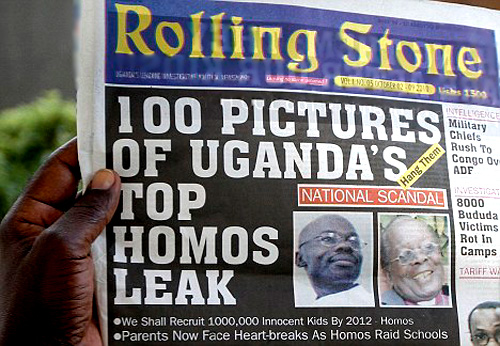
In what appears to now have been a concerted many year effort, support from U.S. righties is leading to a vote in Uganda’s parliament that would make homosexuality a capital offense, and would jail for long terms those who failed to out known gays.
This extreme is not African, it is American. Mostly an insidious attempt by those unable to evince such insanity in their own society to go to some more manipulative place. The story isn’t over as the vote has yet to occur, but it emerged and reached a crescendo this year.
#8: RHINO POACHING EXPLODES
Poaching is a constant problem in wildlife reserves worldwide and Africa in particular. Rhino are particularly vulnerable, and efforts to ensure safe, wild habitats have been decades in the making. Dagger from rhino horn.
This year, they seemed to come apart. It’s not clear if the economic downturn has something to do with this, but the poaching seems to have morphed this year from individual crimes to corporate business plans.
This leap in criminal sophistication must be explained by wealth opportunities that haven’t existed previously. And whether that was the depressing of financial goals caused by the economic downturn, increased wealth in the Horn of Africa where so much of the rhino horn is destined, or reduced law enforcement, we don’t yet know. But 2010 was the sad year that this poaching exploded.
#9: IS HOT AIR BALLOONING SAFE?
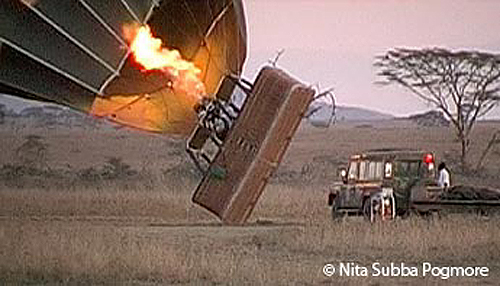
Hot air ballooning in Africa’s two great wildernesses of the Maasai Mara (Kenya) and the Serengeti (Tanzania) has been a staple of exciting options to visiting tourists for nearly 30 years. That might be changing. Is it Safe?
A terrible accident in the Serengeti in early October that killed two passengers and injured others opened a hornet’s nest of new questions.
After working on this story for some time I’ve personally concluded 2010 was the year I learned I should not step into a hot air balloon in East Africa, at least for the time being!
#10: EARLY MAN WONDERS
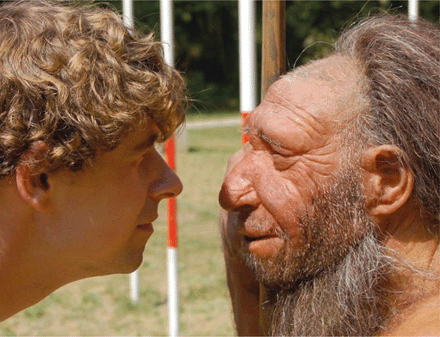
There were not quite as many spectacular discoveries or announcements about early man this year as in years previously, but one really did stand out as outstanding and you might wonder what it has to do with East Africa! Representation by Tomislan Maricic.
DNA testing of Neanderthal proved that early man from Africa didn’t wipe them out after all, but absorbed them into the ever-evolving homin species.
And that absorption, and not massacre, happened outside Africa to be sure. But it finally helps smooth out the story that began in Africa: It’s likely that Neanderthal were earlier migrants from Africa, and absorption was therefore easier, physiologically and biologically.
It’s a wonderful story, and fresh and exciting, unlike the only other major African early man announcement about Ardi which was really a much older story, anyway.
****************
HAPPY NEW YEAR to all my loyal readers, with a giant thank you from me for your attention but especially your wonderful comments throughout the year. See you next year!
For the first time in 40 years, an outbreak of yellow fever has been reported in East Africa, far from any tourist area. Until now tourists’ yellow fever inoculations were political!
That’s right. One of the great irritants of traveling to East Africa in the last 40 years has been the necessity of getting a yellow fever inoculation, when no yellow fever disease was known to exist in East Africa.
The shot is pretty benign for most people and lasts ten years, but it’s expensive. And that’s because, well, there aren’t many areas in the world where yellow fever is a real risk. So the vaccine is rather rare.
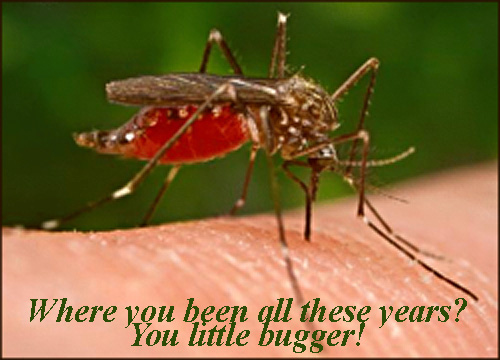
The yellow fever hullabaloo in East Africa began in the late 1960s when an outbreak was reported near Kilimanjaro shortly after Tanganyika and Zanzibar federated into the new Tanzania. Unlike malaria, which is a much more complicated mosquito-born disease, yellow fever is a pretty simple virus carried in the blood of day-flying (rather than malaria night-flying) mosquitoes.
Still itching from their loss of autonomy, Zanzibaris began requiring proof of a yellow fever vaccination for all persons arriving in the country, even from mainland Tanzania of which they were now supposedly a part.
It didn’t matter that the bit of the 1960s outbreak was far, far from Zanzibar. If you didn’t have an inoculation, you had two choices: leave, or let a local official jab you. In those days, neither local officials or jabs were very antiseptic.
Zanzibar has some beautiful beaches, and as the island opened to tourism in the 1980s, a number of safari travelers would end or begin their trip in Zanzibar. Irritated by Zanzibari insistence on having a yellow fever vaccination (decades after the little outbreak was suppressed) mainland Tanzania began requiring the shot. I guess the theory was, if you can’t beat ‘em, join ‘em.
That irritated Kenya. So Kenya, too, started requiring the shot.
From time to time saner minds prevailed, and Kenya and Tanzania dropped the requirement. But they seemed to be dancing separate tunes, and whenever one required it, there was a bit of delay, then the other one did.
Soon fearful that there really was yellow fever, all sorts of countries in southern Africa began requiring the shot if you came from East Africa. Even South Africa! Where the first heart transplant was performed!
(In fairness to South Africa, they figured correctly that if East Africans required the shot, they must have the disease.)
And this little game continues right up to today.
Yes, dear traveler, you need that yellow fever inoculation, because even if right now no one requires it for entry, they might when you actually travel.
And it doesn’t matter a hoot that your chances of contracting yellow fever are less as a tourist in sub-Saharan Africa today than getting meningitis or (amazingly) Rift Valley Fever if you live in the Midwest.
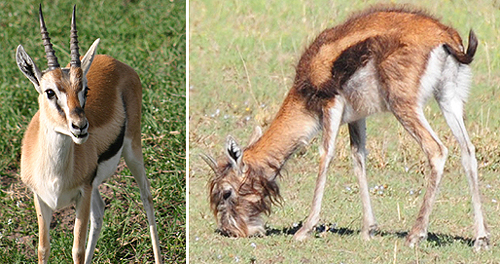
Healthy and diseased female thomson gazelle.
Mutant creatures and animal enigmas will soon be “driving packs of tourists” into Tanzania, according to wildlife officials there. Hmm. Slow news day?
This most recent claim of wild and wooly animal freaks was made by Paschal Shelutete, TANAPA communications officer.
Best diagnosis of the poor bloke Tommie is that she has Cushing’s Disease. The disease is caused by a variety of hormonal or pituary malfunctions and manifests itself differently in humans and animals. In humans the result is often loss of hair, but in animals, it can cause hirsutism, a condition of abnormal hair growth.
The professional level of TANAPA authorities reached new lows this year when they worked to end the current ban on international sales of elephant ivory, and fell in step with the politics driving the Serengeti highway. But this incredible claim by a TANAPA official, wrong on pathology and wrong on geography (his own!) leaves me speechless:
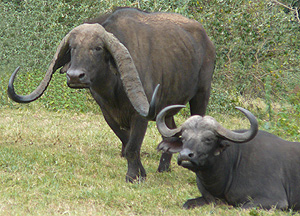
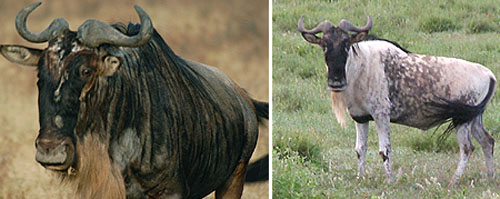
Animal mutations, especially with regards to coloring, are rare but widely known. All the photos you see in this blog I took myself, with tiny little cameras since I’m no photographer. In several cases it’s hardly more than a loss of pigment. In others, like the buffalo in the Aberdare, the weird horn configurations are probably a result of inbreeding.
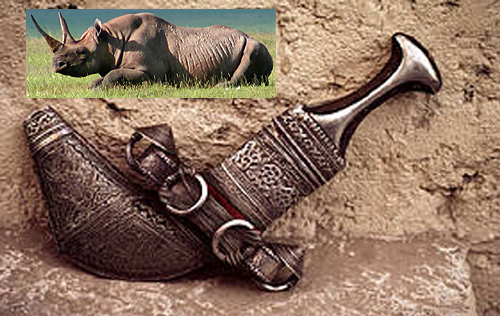
Dagger sold in Sana'a for $15000. The handle is made from rhino horn. The poacher gets $200-1000. Middlemen transporting it to the Horn take about $5000. Skilled carvers take around $2000. Profit in the market more than $7000.Rhino poaching is exceeding even my own direst predictions this year, and I’m trying to understand why.
The Serengeti is one of the world’s largest protected wildernesses, nearly 5000 sq. miles when combined with the adjacent Ngorongoro Conservation Area. There are now only 4 wild rhinos left in this area, after one was found dead this holiday season – it’s horn removed.
This is the most recent of an extraordinary run of killings, most of which were in South Africa where the poaching is more mafia-like, corporate. In East Africa it’s usually individuals working alone.
I wrote about rhino poaching only a few weeks ago but I’m particularly incensed about this loss in the Serengeti. I’ve personally seen poached rhinos several times in northern Tanzania during my career, and try as I have to understand the poor bloke (poacher) just trying to make a buck, the harder it becomes.
Why should I – a foreigner from a distant land – be angry with an impoverished Tanzanian who has tried everything right in his life to get a job and support a family, and just can’t? Who has the daring to kill a dangerous animal? Who has the wherewithal to find the onerous black market?
It’s one thing when you know – as I did in 1998 on the crater floor – that it was a well-paid ranger working in cahoots with the Conservator of the park. But it seems different when it’s a single individual who just can’t get a job and has tried.
So this current surge in poaching I originally linked to the economic downturn. But Africa pulled out of the economic downturn long before we did and has been essentially surging for the last year.
And that’s the key.
Like here at home, the rich are now comfortable with spending their money, again. And it’s the rich to whom the rhino horns go. Mostly to Yemen, but throughout the lower Mideast where rhino horns are prized as much or greater than ivory in Asia.
Like ivory, they carve beautifully and buff even better. Traditionally they were used as dagger handles in male rite de passage ceremonies where Dad gives Butch a special present. Now a days they tend to be made into commercial sculptures and sold like stolen Picassos.
These are the culprits, much more so than the desperate father encouraged to make the actual kill. There’s a real analogy here with the illicit drug market in the U.S. For sure the Mexican mafia are bad guys. But it’s the users of cocaine, not the growers of poppy, who are the real satans.
Important Note: black rhino will not go extinct. They are thriving in private reserves, zoos and small, contained wildernesses like Lake Nakuru. They thrive as they have since appearing on earth because they are big and eat almost anything. They have no predators, except man.
But in the wild, the true open wilderness, their days are numbered. Perhaps it’s time to just come to accept this fact of the modern world. At least until the rich and greedy can be controlled. And that I don’t see happening soon.
Many, many people travel during the holidays. But for me, being home is the best place to be!
Our winter, snowy celebration with a large family begins today. I’ll be back blogging first thing next week!
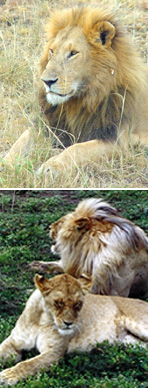
Meanwhile, and especially for my friends in Africa, I thought you’d like to see a few scenes of the wild animals outside my office in Galena, Illinois, seven miles from the great Mississippi River!
 This week the Huffington Post said the “migration was delayed.” True. It was delayed. About as long as getting stuck in Chicago traffic delays a dinner engagement.