We’re taking a long deserved vacation. You know, that thing which gives rise to the travel industry? So enjoy this African music, a new one each day, until Jim returns on July 18!
Happy July 4th!
 Today is America’s Independence Day Holiday! Enjoy!
Music by Ramaintsokely
We’re taking a long deserved vacation. You know, that thing which gives rise to the travel industry? So enjoy this African music, a new one each day, until Jim returns on July 18!
No Room at The Inn
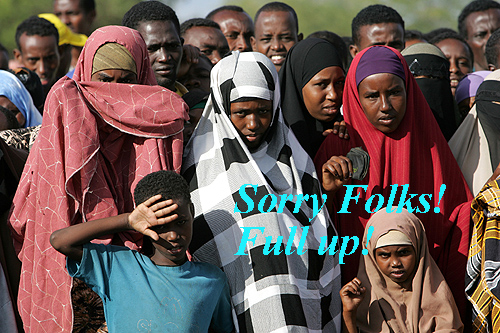 The Kenyan refugee camp at Dadaab, the largest in the world, is full. 1300 new arrivals daily from an increasing conflict in Somali are being refused services, because there’s simply no more room, no more food, no more medicines… the money has run out.
Dadaab became the largest refugee camp in the world several years ago. It lies in far northeastern Kenya along the Somalia border. The refugees have been fleeing a growing conflict between Somali warlords, the weak UN and AU supported Somali government, and al-Shabaab, al-Qaeda in the horn of Africa.
Dadaab is a city in a desert. It was built after Blackhawk Down to house 90,000 refugees as Somalia began to implode. At the end of last year, they were 350,00 refugees living there, and according to Medecins sans Frontiere, there are now 30,000 people in makeshift shelters that can’t be supported by the camp. “There is nowhere for them to stay.”
CARE, Save the Children, and Medecins sans Frontiere all confirm there are 1300 new arrivals daily in the last few weeks.
The terror of the Afghanistan Taliban, of the Cambodian Khymer Rouge, of the Cultural Revolution and the Stalin Scorched Earth Policy has come to Somalia. It’s no longer just a dysfunctional state. It’s a world crisis.
The refugees flee a war relocated from Yemen, which was relocated from Afghanistan, which was relocated from Iraq, hopping around the Horn of Africa staying one step ahead of western vengeance.
I’m not sure the world is ready for this crisis. And separated by 300 miles of desert from populated areas of Kenya, even Kenyans are ignoring it.
The situation is worsened by drought.
The drought is caused by Global Warming. Global Warming is caused by accelerated levels of greenhouse gases from industrialized nations, mostly the U.S. The refugee crisis is caused by the aftermath of Blackhawk Down, a pitiful American retreat from a mess Clinton caused years ago. The inability of aid organizations to cope any longer is caused by western nations cutting back aid, led by the U.S. Aid is being cut back because of the world economic crisis. The world economic crisis was caused by greedy American capitalists.
It all comes back to us in America. And we can’t even seem to repair ourselves.
I have never sensed such despair in my life.
When my wife and I first worked for the United Nations in Paris in the early 1970s, the agencies there were worried sick that by the end of the decade there would be a million refugees for which the UN would be responsible.
Today, the UN High Commission on Refugees takes care of more than 40 million.
That’s one-eighth of the entire population of the United States.
Nineteen American soldiers were killed in Blackhawk Down and 73 wounded. 2996 were killed in 9-11 and about 6000 others were injured. That’s about 9000 westerners killed or wounded in mired religious battles that if they hadn’t occurred would probably not have resulted in the refugee situation found today in Dadaab.
The UN estimates by year’s end there will be 450,000 refugees and wannabe refugees in Dadaab. That’s 50 for every casualty America suffered from Blackhawk Down and 9-11.
Is that enough?
CordaWhatta in my Tutta?
 This dark circular tale starts with a motive of greed so pure that death doesn’t matter, and it ends in a dither of hypocrisies that if not so morbid would be laughable. Yes, we are proud that the EPA is once again doing its job to protect us … but at what cost? At the cost of killing in Kenya?
A U.S. corporation which is banned from selling deadly pesticides in the U.S. continues to profit from the production of that pesticide on license abroad, and from the ultimate sale of that product to East Africans. There in East Africa, it’s killing lions and people.
In 2008 the moment the EPA was released from the strangle-hold of the Bush administration, it began a series of critical restrictions and outright bans on a whole range of dangerous products that had been under production for more than a decade.
One of these was the pesticide Carbofuran which had been first produced in 1992 to combat the infestation of Japanese beatles and other aphids that were specially attacking soybean crops.
It was a dangerous number of years until the EPA regained enough resources under the Obama administration to ban it outright in 2008.
Numerous reports of U.S. farm worker illnesses and deaths from Carbofuran had been documented. But because the EPA and other regulatory agencies had been so emasculated by the Bush Administration, federal documentation was almost nonexistent.
But state documentation was striking. In California alone more than 77 workers were documented with serious Carbofuran illnesses.
FMC Corporation was the main producer of Carbofuran by 2002. It had either filed for most of the patents or bought them from other companies.
As more and more states independently began to restrict the chemical’s use, FMC looked abroad. Even after the EPA formally banned the product in 2008 and the Supreme Court denied FMC’s appeals in 2009, FMC could continue selling the deadly powder abroad.
It did this directly, but that was bad PR and risked further law suits simply from workers who would be packaging it in the U.S. So instead it licensed the product to a number of willing partners, including China’s Jiangsu Hopery Chemical Co., and that’s the company that continues to sell it to East Africa on license from FMC. In Kenya its main distributor is now Juanco Ltd.
In 2009 reports began to service in Kenya of the awful power of the pesticide, and more importantly, that it was available over-the-counter and was obviously not being used to kill aphids on soy beans. There is very little soy bean production in Kenya.
Children died. What was apparent was that the pesticide had been so successfully marketed in Kenya by Jiangsu, and was so relatively cheap, that small farmers were using it for everything possible, even when it was not particularly effective.
But the misuse of Carbofuran in Kenya drew world attention when Wildlife Direct reported that Maasai near the Mara were using Carbofuran to kill lions.
(Irony upon irony, eh? A kid dying doesn’t make local headlines, but Sixty Minutes finds a story when it kills a lion.)
Maasai don’t grow many crops, and certainly no soybeans. But modernizing the tradition of young morani spearing lion that harass their cattle, it’s now easier to do the job with Carbofuran.
Sixty Minutes aired its segment in July, 2009.
FMC Corporation tried to defend itself unsuccessfully. The ruse was outed. Finally, FMC agreed to buyback all the pesticide from individuals and store shelves in Kenya, while simultaneously exporting more product to neighboring Uganda and Tanzania where environmental authorities are far less aggressive than in Kenya.
It also established its licensing with Chinese companies and the Chinese companies found more Kenyan distributors, and very little Carbofuran was bought back, and lots more became available over the counter. Lots and lots more in neighboring Uganda and Tanzania, too.
Only a few weeks ago Wildlife Direct reported more lion kills in the Mara by Carbofuran and extended its claims to wildlife across the country, including many birds.
And now the tale may be twisting back onto itself.
Authorities in the U.S. are now testing Kenyan food imports into the U.S. for traces of Carbofuran, and if found, could ban Kenyan food imports. The U.S. is a huge market for Kenyan tea and coffee.
Americans like to think individual responsibility is all that matters. A video game might instigate a child to become a murderer, but it’s the parents’ responsibilities, not the government, to stop the child from viewing the poison.
But it’s OK to produce the poison in the first place. Just use it responsibly. It’s for aphids.
SERENGETI WATCH OUT OF SYNC
 Contrary to Serengeti Watch’s weekend retraction that the Serengeti Highway had been scrapped, it has been scrapped. SW now needs to be as clear as it’s demanding the Tanzanian government be.
Friday I joined the world, including SW in announcing the Serengeti highway had been scrapped. It has been, but a retraction by SW with an unusually scrupulous reading of the official Tanzanian government announcement does confuse the issue, and this is intentional by the government. Let’s try to work through this.
First, what happened Friday was a Tanzanian government letter sent to UNESCO dated Wednesday got into the media. After the first reading SW sent out an alert to their thousands of members that the highway had been scrapped.
I’m not sure of the actual sequence of reporting, if SW was the first to report this or how exactly SW got a copy of the letter, but within seconds of the SW announcement the world press was reporting it, including the BBC. Before Friday ended in Africa, in fact, foreign correspondents as reputable as the London Telegraph’s Mike Planz were reporting “Wildebeest migration safe after Serengeti road plans scrapped.”
Agence France Presse reported Friday from Paris, where UNESCO is located and to whom the letter was addressed, that UNESCO had confirmed the “Tanzania has stated it will reconsider its North Road project.”
And Sunday, media throughout Africa and the world picked up an Agence France report that as a result of the “reconsideration” UNESCO’s World Heritage Site board of trustees had decided not to list the Serengeti as an endangered World Heritage Site.
Click below for the best resolution I can give you of the Tanzanian government letter to UNESCO.
NoSerHiway_letter_6-22
SW considers the second paragraph of the letter dissimulating. The third paragraph, however, is pretty definitive:
Ezekiel Maige, Tanzanian’s Minister for Natural Resources & Tourism wrote, “…the proposed road will not dissect the Serengeti National Park…”
So, then, what is the “proposed road.”
Maige explains this in the second paragraph as a two-part road divided by the Serengeti itself. The eastern portion will be a new paved road to Loliondo, plus a 58k stretch from Loliondo to the Serengeti’s Klein’s Camp Gate, although that long 58k that will not be paved.
He then continues to remark that a 53k section traversing the Serengeti “will remain gravel road” and continue to be managed by park authorities and presumably, funds “as it currently is.” Where that road ends, at the western Tabora Gate of the park, there would then be a new (or renewed) 12k gravel road to the town of Mugumo, where a new paved road would continue to Lake Victoria.
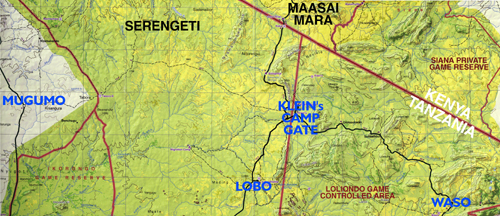
Now the confusion comes because SW doesn’t seem to think that this 53k gravel road through the park exists. After a day’s elation, SW sent out an alert to its supporters claiming “No gravel road exists across this 53 km stretch.”
I’ve driven it many times. See the map above. It’s a horrible road in places, disappears in others, but it has been a designated Serengeti track road for at least the last 50 years.
“WASO” is the actual town to which the new paved road will be built from Mto-wa-Mbu. Maige and others commonly refer to the “Loliondo Road” but Loliondo is the entire district. There is a small political and government headquarters named Loliondo 6.2k east of Waso, but Waso in the main urban center.
The 57.6k gravel road that will be newly built or newly reconstructed but which will remain gravel will be from Waso to the Serengeti’s eastern park gate at Klein’s Camp. 58k on gravel is at the best of times a two-hour trip. This is no thoroughfare.
Maige’s reference to the “existing road” from the eastern to the western side of the park, and which had been generally (not specifically) the blueprint for the originally announced “highway” is the arched track shown above as a broken line that begins a few kilometers south of the Klein’s Camp gate on the main road to Lobo, then moves northwest, then southwest through the neck of the Serengeti to the western gate at Tabora.
Maige then said the existing track from the park gate to the town of Mugumo will be improved, and at Mugumo the paved road will continue to Lake Victoria.
The arched track through the Serengeti is what SW claimed does not exist. Of course it does, and it appears on a number of the last issues of the Frankfurt Zoological Society’s maps of the park. The oldest one I have was published in June, 1970. A 2008 one is republished by Harvey Maps of London and is available for sale to the public.
To improve this existing track will require significant effort. There is nothing in Maige’s announcement to suggest there will be any further upgrading or building of bridges, or anything of the sort, on the 53k track that links Klein’s Camp Gate (east) with Tabora Gate (west). Frankly, I doubt they’ll do a thing.
The existing track just gives up the ghost in huge sections, and a number of new bridges (over the Balanganjwe and Mbalimbali to name two) would have to be built. No small or inexpensive task. It does not seem to jive with Maige’s claim of an “existing road” nor one that would be managed “as it is currently.”
As it is currently, a better Landcruiser than mine would be needed to make the entire journey. I suppose that park rangers on poaching patrol might manage along it, but that’s about it.
So this is the crux of the dissimulation, and I suppose it’s understandable that SW might suspect the government of trying to fool its way into retaining UNESCO World Heritage status while still planning to dissect the Serengeti. But frankly, I don’t even think Tanzanian politicians are that foolish.
Maige said definitively “the proposed road will not dissect the Serengeti” and that’s what the world community and UNESCO is taking at face value.
In fact, were Tanzania to do so, I can imagine nothing but incredible ramifications to the country as a whole, and not just from UNESCO, but the World Bank and the U.S. which has just orchestrated new aid for the country.
Yes, you can argue Maige’s letter is clever dissimulation but in fact it would be considered outright lying to the NGOs and foreign donors on which the country depends for its very existence. There are just too many sentences in that letter that stand as evidence that “the proposed road will not dissect the Serengeti.”
I think the letter is intended as much for local consumption as UNESCO. Like any good Tanzanian politician, Maige will never admit the government has changed its mind. And Tanzanian politicians’ track record of fooling Tanzanians more than outsiders is legend. It’s totally realistic to suppose what the government is doing, here, is leading unsuspecting local supporters of a faster link from Arusha to Lake Victoria down a nonexistent track.
If Tanzania really intended to build a new road, why write this letter in the first place? Do you really think Maige believed he could fool UNESCO, the World Bank and the United States with something like this?
That’s just too unbelievable.
Nothing is ever final in government or politics, whether it be Tanzania or here, and we have every reason to demand a greater clarification from Tanzania. But my money’s still on no new road through the park for the foreseeable future.
Victory in the Serengeti!
Wednesday, the Tanzanian government released a letter to UNESCO’s World Heritage Site office, which had threatened to remove World Heritage Status from the Serengeti if it were bisected by the highway, confirming that a paved west/east road through the neck of the park had been scrapped.
This is not a total victory, but a significant one. Let me explain why it’s not total.
Right now commercial traffic does move through the Serengeti, but it’s laborious. A paved road leads to the entry to the Ngorongoro Conservation Authority (NCA), and it’s then gravel for a long way, 5-6 hours to the Serengeti’s western gate.
What is planned, now, is for a new paved road to the eastern edge of the Serengeti, which will then continue as a new (short) gravel road to the existing gravel thoroughfare that runs roughly from Lobo to the western gate. When completed this “new route” will cut down the existing travel time through the Serengeti from 5-6 hours to about 3-4 hours.
The “new route” will also be significantly easier, as it will be straighter and less hilly than the winding cloud forest road through the NCA. So there will definitely be a new incentive for commercial traffic to increase once the route is completed.
But it is still likely a toss-up for commercial traffic to take this [faster] route rather than start from Arusha in a northwesterly direction on paved roads the whole way. This and the fact all roads within the park will remain unpaved are significant disincentives to commercial travel.
So in this sense it ends at least for the time being nearly two years of the most aggressive efforts by conservationists and scientists worldwide to alter a local country’s management of its sovereign wilderness.
Don’t pop the champagne.
First, this could not have been easy for the Tanzanians to have done. They have backed down. Can anyone imagine Eric Cantor backing down? Some creative spinning and long-term vengeance is in the political forecast.
Second, the real reasons for abandoning the project may not be known for some time, and I believe the main one is economic and strictly so. If I’m right, when the economic situation improves, the issue could reemerge.
Third, there is enough ambiguity in the letter that a flipflop would be easy … at any time.
Certainly there are recent indications that foreign donors – including the United States – engaged in some hard bargaining which may result in greater foreign aid to Tanzania, and likely for the construction of that southern road.
Hillary Clinton was in a specially good bargaining position last week. She was in Dar when the al-Qaeda leader, Mohammed Fazul, was killed in Somalia, and when his passport revealed that the only country which had given him safe haven was Tanzania.
What she told Tanzanian officials about Fazul’s capture is not known, and what was released instead included her reprimand about building a highway through the Serengeti.
Clinton was only the last of a long list of prominent diplomats who opposed the highway. Consortiums of scientists and wildlife organizations presented an impressive array of opposition, too. I remain seriously disappointed that our own American consortium of zoos was unable to get it together to join the impressive team.
An effort to get AZA, the American Association of Zoos and Aquariums, to join the world conservation opposition failed last year.
The first suggestions about the road came in early September, 2009, when East Africa was not yet suffering the world economic depression. What is hard for westerners to understand is that much of the developing world, and East Africa in particular, actually experienced increased growth until virtually this year.
But this year has hit East Africa very hard. Most prominently, the master road-builder China is reassessing its aid to East Africa and the world economic recession means that year after year, now, there is less to give to Africa.
Tanzanian president Kikwete is bound by a net of politics to help the Maasai in Loliondo, just to the east of the Serengeti. He linked this good, ostensible need with a bevy of corrupt components to give it a PR smile.
He can forego the corrupt goals, but the Maasai goal can’t be abandoned. This is the reason the government said, and I knew they would always have to deliver, a paved road up to the eastern edge of the park.
With less aid that will be difficult, now. But I feel that actually takes precedence over the grand scheme of linking Arusha with Mwanza, linking Tanzania’s northern heart to Lake Victoria. The priority must be the road to Loliondo.
So what happens when that is completed, but money runs out for the much more expensive southern road?
It depends. It depends upon how well tourism fairs in this down economic times. It depends upon how well Bilila Lodge (which was in the route of the old proposed highway), in which the president holds personal and substantial stock, does.
It depends upon whether the Grumeti Reserves continue to draw too much water from Lake Victoria. It depends upon whether American hedge fund traders do well enough to build the new Serengeti headquarters as they’ve promised.
It depends upon how prominent the opposition MP from Arusha, Godbless Lema, fairs in the next couple years.
All of these depends reduce to this:
If foreign donors put up the funds and build the southern road before all of the above depends play themselves out, the Serengeti is safe for another decade or two. If they don’t, it all depends.
Genocide in Sudan
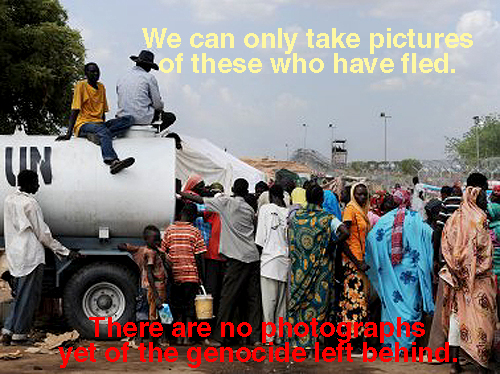 Even as muscled optimism sweeps across Africa and the MiddleEast, I worry that dark history is repeating itself, that the 1994 world-ignored genocide in Rwanda is occurring right now – this very moment – in The Sudan.
The racist North Sudanese government has started a military ethnic cleansing of Nubian peoples in the North Sudan province of Kordofan. The scale is terrifying. And I don’t think any country in the world will stop it.
The North Sudanese are cleverly mining the world’s troubled situations to pursue their evil. Modern aerial bombardment of Nubian huts, modern weapon assassinations even of traditional unarmed women and children, has all the markings of a well-thought out plan of genocide.
Monday the New York Times characterized the fighting as a “rampage” but the way the Times has issued the reports has confused readers and I fear diluted Jeffrey Gettleman’s fantastic reporting.
Mostly by its headlines, but also by the way it has lined its stories on the web, The Times seems to have confused the fighting in North Sudan with the upcoming independence of South Sudan on July 9.
We should all be effected by the genocide now going on, and none more than the new neighbor country to The South, South Sudan. But the way The Times has streamed the story, one could believe that the south’s Independence in two weeks is in direct jeopardy. It isn’t.
The situation in South Sudan actually improved Monday, while the genocide in the North just revved up. Clearly it is the intention of the evil North Sudanese government to take advantage of this confusion.
So let me interrupt the horrible story of the horrible story in the North with a clear review and separation of these two conflicts:
-
Conflict 1: SOUTH SUDAN
Monday, fighting between North and South Sudan forces and their supporting militias finally came to an end with a US-UN brokered ceasefire that will bring 4000 UN peacekeepers into Abyei.
Abyei is literally the spot on the map where huge portions of Sudanese oil comes from, and its sovereignty remains unresolved. It isn’t “on the border” between the two countries, “it is the border,” and both sides claim it.
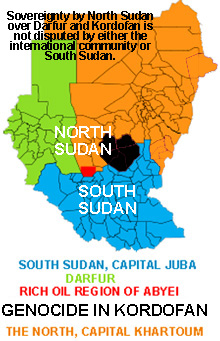 For the time being, the South while not conceding Abyei has more or less retreated from the heavier presence of military and other North Sudanese officials, there. This is wise, or independence on July 9 really could be jeopardized.
But the South’s de facto concession to the North does not conform with the majority of the residents of Abyei or the workers in the oil fields, there, and it will most certainly return as an area of contention again and again. Once UN peacekeepers arrive this week oil production in Abyei could start up, again, and a prolonged status quo would favor the North’s claim to sovereignty there.
But southern officials recognize any movement whatever of the elephant in the china cabinet could wreck entirely their plans for independence in several weeks.
So for the time being, this conflict has ended. It has not gone away. But South Sudan will become independent on July 9 with a host of problems, but none that include fighting right now with The North.
-
Conflict 2: NORTH SUDAN
But even as Abyei settles down if only temporarily, the North Sudan government began a bold if blazoned all-out genocidal war in Kordofan just to the north and east of Abyei, Monday. This is what the Times has been reporting so well, but with headlines and web streaming that confuse it with the South’s upcoming independence.
This conflict in Kordofan has all the markings of a Darfur and could even be worse. It might rival the world’s greatest failing of the last several decades, the unstopped genocide in Rwanda in 1994.
UN press reports estimate that refugees from South Kordofan’s capital Kadugli number 40,000, but the World Council of Churches reported that the number is actually 300,000.
These represent people who have successfully fled the massacre. Do your own math regarding those who didn’t.
The North Sudanese Army has prevented aid workers from reentering the area and has announced that it will shoot down U.N. helicopters that previously had been given permission to bring in humanitarian assistance.
Like President Clinton’s retreat from Blackhawk Down, which led to his timid and delayed entry into Bosnia and his totally abandoning Rwanda in 1994, President Obama is withdrawing forces from Afghanistan to appease a war weary world.
Protests from Syria to Libya seem to be losing steam as conflict presses so heavily on the world.
It is just the time The Joker has been waiting for.
China Builds & West Saves Africa
 NPR’s fabulous story this morning about Kenya and China begs repeating what I’ve been saying for so long: watch China carefully and learn without embarrassment. The world may do better, then.
Frank Langfitt’s reporting on Morning Edition was superb. (And so much better than NPR’s former African correspondent, Ofeibea Quist-Arcton, who has been reduced to the new “West African Correspondent” where she continues to do a bad job, there.)
Langfitt did a yeoman’s job telling a decade’s story in less than 15 minutes. But there were a few things of importance that were neglected.
In May last year I wrote about the “Flame Tree Road“, which was then 8 lanes growing to 11 and is now, as Langfitt reports, 16 at some spots. Last September I wrote about China’s port plans in Kenya, and just a few months ago, Conor Codfrey reported the somewhat jaded views of western businesses about all of this. Two years ago I reported China was suddenly in Kenya looking for oil. Langfitt recapped it all, very well.
China is entirely and pitifully practical. And that is the crux of the difference between her and the west.
The west pontificates at best, fools at worst, and has been doing so for centuries.
The three C’s that governed Livingstone’s life and fund-raising, “Civilization, Commerce and Christianity” more or less governed until just this decade virtually everything the west ever did in Africa. China is also a “C” but like any efficient businessman, they’ve reduced the three C’s to a more productive two: “China & Commerce.”
China’s premise appears in stark relief for those of us who know Africa. Damn Kenya’s dwindling forests, we need the wood to build things. Forget about Kenya’s wetlands, they have no oil. And as for its wildlife, the only good rhino is one without a horn.
Poaching of both elephants and rhinos has increased substantially with the Chinese presence in East Africa, and there have been regular reports of Chinese apprehended in East Africa with poached ivory or rhino horn.
More worldly: Damn the millions under the Yangtze dam, discard the two centuries of Tibetan Buddhism, consider an enemy the enemies of your neighbors and do anything for a quart of oil.
Did I say we can learn from this?
Yes, absolutely. Because this policy reeks of the desperation of perfected capitalism, and that is the world’s economic system. Knowing it doesn’t mean you love it.
Ever since Livingstone’s three C’s, the west has spent enormous resources in trying to justify and work through the inherent contradiction between capitalism and goodness, trying in effect to claim there wasn’t an inherent contradiction. Realpolitik was the west’s first foray into diplomatic reality and succeeded to some extent because its American minister had a thick foreign accent. But Realpolitik has faded recently as Christianity and other ideologies like “hard work” and “marriage” have ascended.
The Chinese just love Glen Beck.
Africans are getting worried now that this pure intention of China is without a soul. Langfitt’s reporting this morning encapsulates in a few minutes volumes of recent articles and endless conversations on Kenyan radio talk shows.
After all, the west gave Kenya its religions. China is giving it its roads. There’s a very interesting future out there.
Ele Kills Zimbabwe Guide
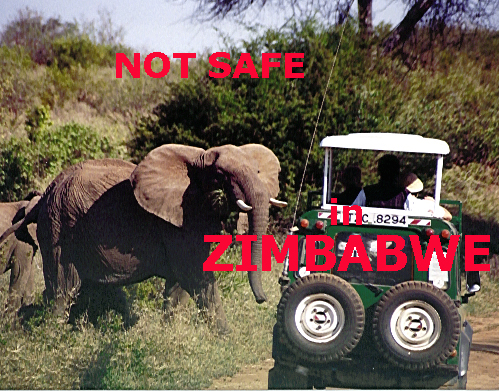 Last week a bull elephant killed an employee within a hundred meters of a popular Victoria Falls hotel, further proof that Zimbabwe is not a safe place to travel.
There have been about a dozen tourists killed by elephant every year in Africa since tourism began in the 1960s, and reporting a single incident is not in itself a good indication of relative safety. And that statistic, a dozen annually, is actually a very good one representing a safety level far higher, for example, than bear killings in our own national parks in America.
But the event last week is unusual. It does not fit the normal pattern of someone doing something wrong, and that is usually why wild animal killings occur, whether here or in Africa.
The man killed was an experienced guide doing everything correctly close to residential areas of Victoria Falls, Zimbabwe. His actions, in fact, were heroic. He placed himself between the tourist he was walking with and the elephant. The tourist remains unnamed but is alive and unhurt.
The account of the incident was not published until this past weekend, and that in itself is curious, although it is hard to extrapolate anything meaningful from that given the situation in Zimbabwe, today.
But taking the account at face value, the head guide at a popular safari lodge at the falls was with a single tourist watching animals at the lodge’s water hole. Many lodges are either built near water holes or cultivate them so that guests can watch animals while relaxing at the lodge.
This particular lodge had built a hide, or small enclosed structure, that allowed guests to get much closer to the water hole. Less common, it’s not necessarily unsafe. According to the single press report duplicated throughout the media, the guide and tourist had finished watching a single, aggressive bull elephant chase other elephants from the hole, when they began their walk back to the lodge.
The report calls the guide extremely experienced, and it is clear from the report that he gave his life for the tourist. It was reported that he fired his gun at the attacking elephant, but was not successful stopping it.
The tourist apparently wishes to remain anonymous, and both the lodge and tour company that owns the lodge, African Albida, will not elaborate further on the single press release issued last week.
I have been in several dicey situations with elephant, and lately I’ve become very cautious continent-wide. Nonetheless, the situation in Zimbabwe is unique, and I think this incident is more evidence that it is simply not safe to travel there.
The wildlife in Zimbabwe is under extraordinary stress, significantly more than in other African countries. This is caused by a combination of the country’s economic and political crises.
It’s been reported for some time that Zimbabwean soldiers, themselves rarely paid, are hunting elephant inside national parks. The normal protection that a national park affords animals normally translates into these animals understanding more or less the boundaries between hunting and non-hunting reserves.
They become more approachable within the non-hunting reserves and many spend their entire lives there, becoming used to vehicles and people. The densities of all animals are significantly higher within a national non-hunting park than outside one.
But once those boundaries are lost – as they have been in Zimbabwe – animals will revert to their best natures, their instincts for survival. It is altogether natural for a big bull elephant in musth to charge anything he can see.
Several years ago unscrupulous mostly hunting safari companies began to find ways themselves to place their clients in areas with higher densities of elephant.
A huge scandal developed in 2009 when an American company then calling it self “Cape to Cairo Safaris” actually advertised on its website that it had permission to shoot up to fifty elephants inside Hwange National Park, Zimbabwe’s largest and most famous national park.
The company has since removed any mention of the offer from its website.
Whenever wild animals are harassed like this, they can no longer be considered “safe to watch” using the practices that have become common with a half century of safari tourism.
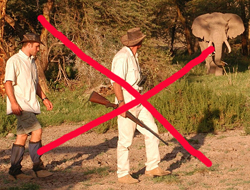 My own opinion goes further in the case of elephants, today. The elephant population – even within good national parks like Kenya and Tanzania – is too large, and this in itself leads to greater stress among the elephants.
I don’t believe anywhere in Africa is any longer safe to walk close to elephants, armed or not. And I insist that in the camps and lodges located among elephants, that they keep them away with careful practices like the use of air guns and electric fences.
But in Zimbabwe it’s a much different story, altogether. Right now, there are no safeguards against the dangers of elephants, there. The only way to be safe wildlife viewing in Zimbabwe is not go there.
Twevolution has come to Uganda
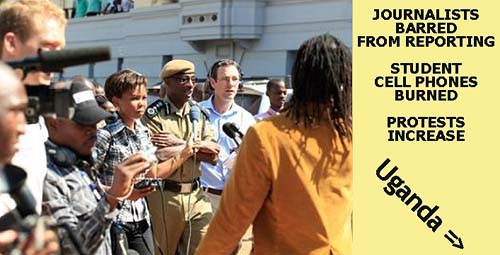 Absolutely nothing can stop Uganda’s slide into the pile of Zimbabwes except the President resigning. The country is mobilizing. The protests need help.
Stopgap measures by the government aren’t working; strikes, closures and demonstrations are increasing faster than I thought they would and my caution about tourists going there is heightened, now. Today school administrators throughout the country began to confiscate and destroy student cell phones, an important way for Ugandan protestors to organize. This will infuriate the population.
It was a very bad week for Uganda. Its currency continues to nosedive. A fight broke out between the technocratic central bank manager and the President. And worst of all, the popular Kizza Besigye who came in second in the presidential election last November was arrested, again, and now journalists have been barred from recording any of the legal proceedings – including his expected trial.
Besigye had just returned from the U.S. where he flew for specialized medical treatment following his brutal beating in Kampala several weeks ago. No sooner had he set foot in the country than he was arrested.
Wednesday, he appeared in court and was given stiff bail. Yesterday he returned to answer charges of illegal assembly and inciting violence, but dozens of journalists were barred from the court room and the judge indicated the entire trial will be held in camera.
Huge crowds then massed in downtown Kampala waiting for him to exit. When he did, the full force of the Ugandan police was brought to bear, including water canons and AK47s firing into the air. Besigye and many of his followers sought refuge in the Yowana Maria Mzee Catholic Church.
Meanwhile with tourism declining and food imports rising, the Ugandan economy is reaching a critical stage. Government bonds could not be sold this week for less than 13.5%, according to the Financial Times.
And following the FT’s widely circulated interview with the central bank governor, more economic pandemonium occurred. Foreign reserves dropped precipitously and the governor called Museveni’s fiscal policies reckless, specifically referring to a scandal where Museveni ordered three-quarters of a billion dollars to be used to buy fighter jets.
FT claims that now “donors including the World Bank, UK and Ireland have reduced or withheld direct support, which makes up 26 per cent of this year’s budget.”
America and other leaders in the democratic world must own up to their own mistakes in these countries, and the greatest one in Uganda was the free reign given the Family and its C Street American legislatures to represent us when in fact all they were doing was turning Uganda onto itself. Many of the legislative initiatives causing problems now in Uganda, including oppression of gays, criminalization of abortion and the reckless embracing of the “free market” were literally written by C Street legislative aids in the U.S.
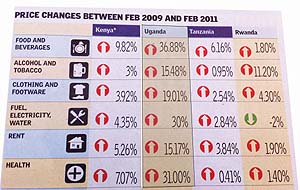
My own blog last month about Uganda created enormous interest and many comments, but it appears clear to me that the tourism industry is now desperate, and my heart goes out to them. But it’s pointless to avoid the truth: Uganda is becoming increasingly hostile to its own citizens and ultimately, to its guests as well.
The 26th comment on that blog was from an executive in Uganda’s tourist industry who wrote almost as much as I did about the country’s many problems, and some I didn’t write about (like the decline in wildlife). But clearly, things are not going well. It takes this kind of courage from within the industry to help the country right itself.
There’s an important point for sounding and resounding the alarm. We’re in a new era, not the era that created the Zimbabwes and CARs. The peoples’ voice can be much more powerful than then, and clearly, the people of Uganda are demanding change that begins with the resignation of Yoweri Museveni.
The task, now, is for America to find constructive ways to assist the vanguard of protest. Twevolution has come to Uganda.
Religious Horror
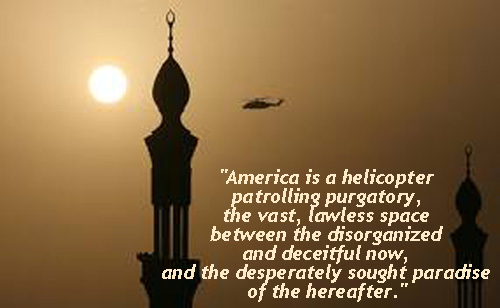 To a young apolitical Iranian woman, America is an army of helicopters ruling purgatory, patrolling the vast, lawless space between the disorganized and deceitful now and the desperately sought paradise. This wondrous insight comes to us thanks to the Zanzibar Film Festival which opens this weekend.
(For a broader summary of the festival, please read my Tuesday blog.)
“Invitation” is a film by Payam Zeinalabedini, an Iranian with a very limited budget. It’s not going to win any technical awards, and as you are carried along by the lilting, beautiful girl’s voice over the film’s haunting music, it becomes hard to “translate” the very poor English subtitles. But please stick with it, and forget the subtitles if you must. It is absolutely a film that every American should watch.
Watch it now, by clicking here, or come back to it, later. It is 30 minutes long and gives us Americans a widely held view of ourselves from the outside.
In a larger sense I think this is why so many Americans love Africa. There is something that we immediately identify with every moment of new experience, whether it be vast Midwest-like plains or thousands of animals. (American’s empathy for animals is legendary.)
And I’d like to think a few clever Iranians understand this, too. Payam’s film has shown in a few other festivals, but its technical merits are wanting. If shown, for example, in Milwaukee or Austin, it would probably fall flat as poorly made propaganda. But the characterization it makes of America will not offend an audience in Africa. And obviously it’s not intended as propaganda, there.
Africa has manipulated America well, for both America and itself, for several generations. Africa knows the good we have, and the bad we seem unable to shake. And because the film really does lack the technical merits of so many of the other entrants in the festival, I have to believe, too, that the Africans running the festival are doing exactly what the Iranians are:
Trying to send us an important message. A post card, if you will, of an essentially apolitical Iranian girl of her journey into Iraq. In a way that won’t evoke our defensiveness before we absorb it. ‘Someone,’ I can imagine them saying to themselves, ‘has to let America know what’s happening.’
Filmed in 2008 it is a story of this young lady making the trek to the holy Shiite shrine in Karbala, Iraq. We never know her name, or the name of her grandmother who she invokes constantly as her mentor and inspiration and the assumed recipient of her remarks.
In fact, throughout the film’s crowded voyage through humanity, no one offers names. At the Iraqi/Iran border where American soldiers finger print and eye scan all pilgrims, names are clearly forged or just made up. Except for imams and holy historical figures, names aren’t used, not even when trying to check into an inn for the night.
The film becomes a documentary of crowds of nameless pilgrims wandering towards the shrine, in a sort of hapless pursuit that things holy must be better.
The Iranian woman narrator has paid an Iraqi tour company for the trip, as have hundreds if not thousands of other Iranians in lines of buses coming out of Tehran. But when the convoy reaches the Iraqi border, the comfortable vacation turns into a horrible expedition.
It’s raining and cold. Compared to Iran’s paved roads, Iraqi’s dirt tracks are terrible. And dangerous. The girl explains that Iraqi security personnel must join the bus groups to guard the continuing journey, because it’s considered so dangerous.
Waning daylight infuses the “second-hand Iraqi” buses bereft of working windows or adequate heaters as the convoy pushes deeper into Iraq. They pass Tikrit, and the narrator turns her camera at Saddam’s palace, but it passes quickly out of view as something no longer meaningful.
It’s dark, cold and still raining, and the colored often neon lights that poke out from villages along the way seem like circuses or game parlors. The narrator remembers the tracer lights of Iraqi aircraft over Tehran during the great wars. She was very little, and she remembers her grandmother telling her to run to the shelter.
Then the tour bus gets stuck in the mud, in the dark, cold and rain. The Iraqi security officer orders them to stay in the bus “And don’t sleep! It’s dangerous!” By the broken English subtitle, she says mournfully, “Grandma, I now know what anxiety for the future means.”
The next day she sees lines and lines of Iraqis walking on the muddy sides of the road to the shrine and feels embarrassed with her fortune. “I am not vengeful,” she begins, invoking the long wars between the two countries, “and I wonder if I should get out and walk with my brothers.”
Americans – which are never shown – are omnipresent, but as if in another dimension, outside real peoples’ realities. At one point, the security officer accompanying her in her bus warns her not to take pictures or use her cell phone, because Americans “have X-rays and we’ll all then get arrested.”
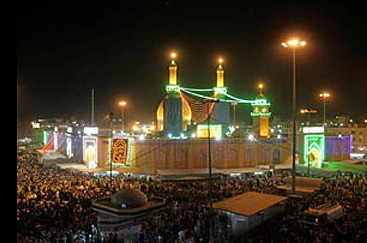 As they approach Karbala in the darkness and drizzle, the sounds of excited pilgrims increase. There is self-flagellation and ominous and aggressive dancing common to this sect of Shiites, unhappy crowds, mixed and uncoordinated singing and shouting. They walk pass dilapidated or bombed out structures as the throngs of people move towards the only lighted structure in the area, a yet distant giant Christmas-lighted mosque and shrine.
They decide to check-in to their inn before going to the mosque. The electricity is erratic and there is no light in the cold, rainy street. Yellow light peeps out from shuttered windows. When they finally locate their presumed overnight lodging, they discover there’s no room for them at the inn. And there’s no representative around from the travel agency that took their money to complain to.
“This is Karbala,” the innmaker intones, “go to Paris, go to the Emirates if you want a room!” The girl remarks they can’t even find an internet café, because there’s no electricity and no computers. She remarks with the first bit of political overtones that this is the country that was supposed to have a nuclear bomb, and they don’t even have working computers!
What she had hoped would be a joyous excursion has become a nightmare. She finds an Iraqi who has the authority to allow her to film inside the shrine, but his laptop doesn’t work so he can’t give her the necessary permit. She finds a laptop from a fellow Iranian traveler, and the official creates a permit using Word.
Suicide bombers have attacked nearby mosques. There are sirens and flashing lights, and suddenly American soldiers who are never shown, though. No one seems to care. “This country is conquered by Americans,” she says as if only realizing it herself, now.
Finally she gets inside the mosque. The light is bright, almost blinding. Most faces turn away from her camera. Those that don’t reveal fear, anger, perhaps terror.
She gets in a line of congested movement towards the shrine, the object of the trek. The orderly movement forward is interrupted by security officials frisking entrants. Inside, she says, “Grandma, perhaps it was your prayers that got me here, but now I’m entrapped among the security Army of Blasphermers.”
“I feel I am supposed to see and hear” inspiration or something religious, and then her voice is drowned out by the sounds of helicopters going around and around, closer and closer, louder and louder.
This is the view of Iraq by a young Iranian. I don’t consider this propaganda, although I think it quite fair to presume the film maker had an agenda in mind. But strip away the commentary and subtitles, and just take the scenes shown for what they are:
A country in endless mourning, restless and lawless, pitifully unfulfilled.
Ready to either implode completely or explode entirely.
An American watching this film must wonder what the hell we’re doing there. We’re not bringing peace, and we’re certainly not bringing prosperity or any measure of happiness. If our national security goal is to impede harm against us, we’re certainly not doing it by making friends. You could not live in Karbala without hating America.
Nevertheless, if this has “kept a lid on terrorism” one wonders if the oppression this thrusts on the peoples of Karbala is fair strategy. In a tit-for-tat body bag game, we’re winning. But one wonders if the game weren’t played at all, if the numbers of dead, injured and unhappy would be infinitely less.
We have turned a once joyful religious trek undertaken for centuries into a modern horror film.
African Doors to the World
 Who will spearhead the social unrest in China? Are women being mentally beaten to death in Iran? These and similar cutting edge issues find their window to the world Thursday, at the Zanzibar Film Festival.
The world’s great film festivals have become institutionalized, perfected as I suppose they should be in celebrating independent and often unrestrained art. After all, that’s why they arose: the mainline industry had abandoned art for commerce. But in maturing so idealistically to technique, the great film festivals have abandoned many cutting edge social issues.
And movies are one of the best ways to broadcast your issue. Africa has a number of film festivals where this is still the case, and none better than this year’s Zanzibar festival.
I list below films from China and Iran that I believe tell a story no one’s listening to, and which presage very important world events. By so doing I don’t mean to minimize the great African films – particularly Swahili language films – which will also be shown.
A Good Catholic Girl, for example, is a remarkable short film from Uganda with two wonderful lead roles about falling in love across religious and ethnic lines. This is now a multi-generational issue, and when explored deeper says much about the ethnic and gender turmoil in Uganda, today.
The Rugged Priest isn’t a very good technical movie from Kenya, but it is a story rarely told yet enacted over and again especially when I first worked in Kenya in the 1970s. It’s also an interesting benchmark for the growing Kenyan film industry, as the movie was a hit in Kenya.
But what the Zanzibar Film Festival provides is a quiet outlet for film makers in places like Iran and China, whose work would likely be suppressed at home, and is either not submitted to the bigger festivals for fear of drawing attention, or just as likely, because they just aren’t technically good enough.
But I doubt any of you won’t feel the same goose bumps I did watching the trailers, and clearly, these raw yet to fully mature young artists are telling us something very important about the near future in their countries.
Just an Hour Ago, and A Beautiful Snowy Day reveal the oppression of women in Iran is so intense that I believe – and I believe the films are suggesting – that the next great unrest will come from women, there.
The Rice Paddy is a Chinese/French entry which is among the most professional productions, and remarkable for its intense portrayal of the migrant worker in China’s rice fields, a group of people today as important in China as the slaves were to cotton farmers in the 1800s in America.
While The Rice Paddy is not subversive as such, clearly in the light of today’s news about Chinese inflation and migrant worker unrest, it presages cracks in China’s social construction that likely will figure prominently in that country’s imminent transformation.
But the enormously powerful Iranian film, The Invitation I feel so important that I’ll be writing a separate blog about it, Thursday, to commemorate the film festival’s opening. Please come back, then!
East Africa’s Dots of Terrorism
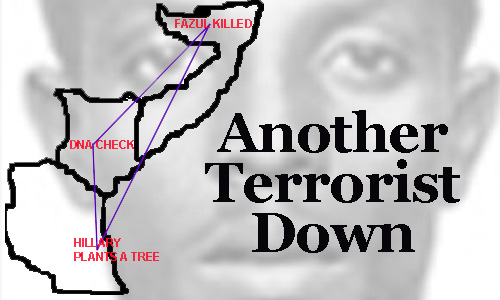 The death of Abdulla Mohamed Fazul last week in Somali was as important to Kenyans as the death of bin Laden himself. It confirms that the Obama administration knows what’s it doing, that Kenya knows what’s it doing, and that Tanzania doesn’t.
Fazul was the avowed mastermind of the 1998 Kenya and Tanzania embassy bombings. He was arrested shortly thereafter in Kenya, but escaped. It was widely presumed, and now confirmed, that he founded and headed Al-Shabaab, al-Qaeda in the Horn of Africa.
Somali is a perfect haven and training ground for terrorism, and like most of the world’s training grounds for terrorism it was first cleared and sowed by Americans. But unlike Afghanistan, where bin Laden was our partner before our nemesis, Somali’s demise was because President Clinton abandoned it after the failed Blackhawk Down mission.
But whether we nurtured terrorism or failed to nip it in the bud when we could have, America’s policies until Obama failed to nail them.
Don’t misunderstand me. Obama is not one of my most favored persons. Domestically I think he’s exchanged the garb of a Badiou for a Mainliner. But events in recent weeks prove that his anti-terrorism strategy is working.
Fazul’s apprehension received limited reporting, because there are so few journalists in Mogadishu. The conduit for the stream of events came from Nairobi’s Daily Nation, and it appeared rather scripted to me.
Presumably Fazul was in a truck filled with everything from medicines to laptops to guns and $40,000 in cash, and made a wrong turn in the city, taking him into a part of the city Al-Shabaab did not control.
Right. I know they don’t have Garmen in Mogadishu, and Google maps is a little behind the times there, but this guy blew up the Nairobi embassy, a few years later blew up a Mombasa hotel, fired a SAM missile at an Israel charter jet landing in Mombasa (admittedly, missing it).
And almost single-handedly Fazul took over 2/3 of what was once the Somali nation, and was remarkably close to taking over Somali’s biggest city and presumed capital, Mogadishu, where Al-Shabaab has been fighting brutally and almost hand-to-hand for nearly 4 years.
He made a wrong turn on a city street? After eluding the world’s posies for 13 years, a $5 million reward, and the scorn of practically every African in the region?
Well, that’s the story fed to the Daily Nation.
I’d tell it differently. Oh and by the way, Hillary just happened to be in East Africa for the event.
And she wasn’t in Kenya to partake of the celebrations, because they really did celebrate in Nairobi. More than 200 Kenyans were killed in the embassy bombing and thousands injured. Read the comments’ section that followed the main on-line story to get a feel to how people there, think.
So unlike Tanzania. And that’s precisely where Hillary was, ostensibly to promote enhancing agricultural development policies. But I bet there were a few staff members accompanying her who weren’t farmers.
Because Tanzania is the problem, still. It has yet to be successfully pried open to greater democracy and transparency, as Kenya. Corruption is a bigger problem than Kenya if simply because the government controls so much of the media we know less about, but what we do know is giant enough.
When Mogadishu authorities announced the story, they refused to let the few reporters there see very much of the evidence against Fazul. His DNA was jetted to Nairobi to confirm it was him, and one picture was given to a Nairobi reporter who said he was shot in the head and breast.
Doesn’t sound like an open battle firefight, does it?
And the one piece of evidence shown to the press was his passport. A fake South African passport with only one visa stamped inside, representing the only country that he has easily passed in and out of in the last 13 years. Any guess?
That’s right, Tanzania.
Which One-in-Three are Dying?
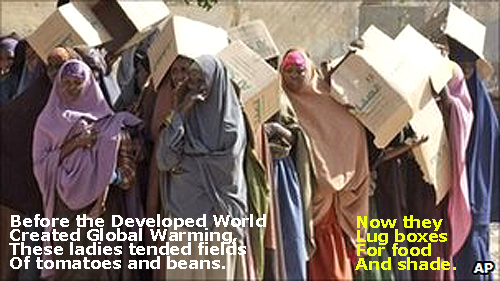 Global warming is slamming East Africa faster than expected even as One-in-Three Americans insist it doesn’t exist.
Never mind that Romney, a likely Republican presidential candidate, agrees that global warming is a man-made phenomenon. Never mind that Americans are asked to pay more and more for food aid in East Africa. Never mind that in our own communities we are feeling weather in ways it’s never been seen before.
One-in-Three Americans doesn’t believe in global warming.
One-in-HowMany believe in the rapture? One-in-HowMany believes David Vitter should remain a Senator but Anthony Weiner should resign as a Congressman? One-in-HowMany still believes Obama was born Where? One-in-HowMany believes a god created the earth in How Many Days?
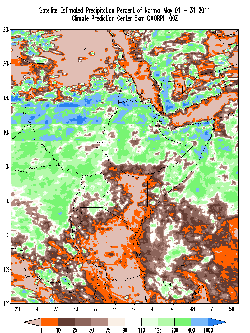
Look at this map prepared by America’s NOA’s Climate Prediction Center of East Africa. (Then go back and fiddle with the linked map of the U.S.)
Now on the one hand I have no idea why I’m using facts, since facts don’t seem to matter much, anymore. On the other hand, if we bloggers didn’t try to use facts all we would be doing is telling jokes. Problem is, One-in-Three Americans thinks facts are jokes.
The East African map is NOA’s satellite data for the percentage of normal rain that fell in East Africa this May. Although even the normal pattern of East African rain is complicated, because of its position on the equator and between a huge lake (Victoria) and a huge ocean (Indian), this map really tells it all.
May is one of the few months in the year in East Africa when a regular, generally continuous rain falls all over this map. In a normal year, this map would be all white, white being no change from normal.
Instead we see deep light brown to red areas of severely little rain to drought, bordered by areas of extreme rain and flooding conditions (green to blue).
The radical demarcations between areas of drought and flood is a symptom of global warming, and we see that in our own country as well. The Mississippi basin is flooding. Arizona is burning away.
This is new. Historically the areas between radical climates were not so close together. This is Global Warming.
The people living in Tucson and Dallas will still be able to buy tomatoes and beans, even though their land is a desiccated mess. The people in Nairobi and Dar-es-Salaam will be able to, too, for the same reason. These developed urban centers receive food distribution from wide areas around the world.
But for the still nearly 70% of Africa’s poorest countries’ populations that remain subsistence farmers, this is an epidemic far greater than AIDS could ever have become.
Countries like Kenya which are pulling out of extreme poverty find themselves conflicted now when creating social policies, because a significant portion of their population remains subsistence farmers but a rapidly larger portion is not.
This rapidly larger portion is learning how to eat and prosper even in times of drought. But they must still stand on the sidelines watching their Tucsons and Dallases starve to death, because their choice is between their own marginal threshold of prosperity or crisis policies to try to save the dying that likely could sink them all.
The Kenyan government recently dispatched a few million shillings to its northern drought areas, enough to buy food for starving people for a few weeks or so. The country’s elite was outraged at the pitiful effort, but the fact is that Kenya unlike America is not choosing between fighting a war abroad or a single payer health system. Kenya must choose between providing electricity to its new factories or feeding its starving millions.
And in countries like Niger and Mali, Eritrea and Ethiopia, where development hasn’t really got off its bump, whole societies are literally being wiped out by Global Warming.
I’m not really sure even if our own Tucsons and Dallases were starving to death that the One-in-Three Americans would care, or that they would even believe it might be true.
But just as the Rapture did not take us away, Global Warming is taking away whole junks of African peoples. And even though One-in-Three Americans might refuse to believe this, two out of three of us know the truth and it’s time to muster our majority.
Compromise with the ignorant and crazy is not compromise, it’s just giving in for nothing in return. Our responsibilities even extend to our own ignorant and crazy, not just far away Africa. It’s for the good of our own ignorant and crazy that we dare not invite them to any table of discussion.
It’s time to make a stand and force action. Don’t be bullied by the One-in-Three. We are the Two-in-Three.