War Games in Africa

War Games in Africa

The Green Beret deployment last week in Uganda reflects an increasingly militaristic Obama policy that like all war endeavors ends up compromising other very important policies, like democracy. Is it working, and why now?

The Obama Administration went out of its way to emphasize that U.S. troops will not operate in Uganda but are simply using it as a staging area to catch the renegade militia leader, Joseph Kony.

Kony is probably in the Central African Republic (CAR).

Apparently there’s not the right airports or staging areas in the new South Sudan, and certainly not in The Congo or CAR to handle even a few (100) soldiers and their equipment. Possibly no easy political entry, either.

Nevertheless, many will think otherwise. Uganda, as I’ve written, is not the most stable place right now. And the bad guys are those in power who will obviously get a boost locally from the arrival of American troops, no matter where they’re supposed to go.

But Obama’s on a roll nailing al-Qaeda and its allies, and last week Uganda led the forces in Somalia which routed al-Shabaab from the capital, Mogadishu.

Kenya, this weekend, moved its troops across the border into Somalia, something I’m sure that America has been encouraging it to do for some time.

So as the saying goes, it’s payback time.

Al-Qaeda is of equal if not more interest to the U.S. than to many countries in East and Central Africa. Those countries’ biggest concern has always been the militias in the eastern Congo and South Sudan, including the old Interhamwe and the newer Lord’s Resistance Army (LRA).

Like al-Qaeda, both those and other lesser militias are on the run. I see this as tit for tat. You (East Africa) help us wipe out al-Qaeda, and we’ll help you wipe out the LRA.

This isn’t just my analysis. The Enough Project and The Long War Journal, among a number of other NGOs heavily involved in the area, postulate the same.

War has an ugly history that way.

The LRA (Lord’s Resistance Army) is a spent but still active guerilla force most famous for its abduction and enslavement of child soldiers. It wrecked havoc in northern Uganda/southern Sudan for nearly 15 years until it was forced out of the area almost ten years ago.

Oh, and by the way, there’s two interesting side stories to note as well.

The first I’m sure the Obama administration is sensitive to, but it’s remarkable so little has reached the world press:

The Obama Administration’s avowed explanation for entering deepest, dark Africa is to hunt down the LRA captain, Joseph Kony, just like they’ve been hunting down al-Qaeda leaders. Interestingly, Kony’s second-in-command was just ordered freed by a Uganda court after being apprehended and put on trial.

Thomas Kowyelo was apprehended by Ugandan military about a year ago. Two weeks ago, a Ugandan Appeals Court ordered his release upholding the agreements that offered amnesty signed in 2006 and 2007. (Kowyelo remains jailed pending a prosecution appeal to Uganda’s Supreme Court.)

Seven years ago a peace agreement was signed between what was left of the LRA and the Ugandan government. This agreement among many good things had a flawed section which awarded undefined “amnesty” to any LRA soldier.

Both Kony and Kowyelo have been indicted by the International Criminal Court (ICC) for crimes against humanity. This technically mandates any country that recognizes the ICC (most of Africa including Uganda) to arrest them and send them to The Hague for trial.

But so far Uganda’s courts have given priority to the peace agreement signed with the LRA over international treaties. Perhaps Obama is worried Uganda will actually catch Kony before he does.

The other side story is a bit more amusing.

I wrote Friday about Michele Bachman’s faith advisor having been deeply involved in clandestine organizing of African militias to kill Kony. He was even jailed in Uganda for illicit arms dealing and other mercenary charges.

The only Republican candidate to criticize the deployment was, you guessed it, Michele Bachmann.
This Mojo Got Real Spirit!

This Mojo Got Real Spirit!

A paid staffer for Michelle Bachmann was imprisoned in Uganda for terrorism and illicit arms deals with Congo rebels linked to the current serious turmoil in Uganda. Did you know about this?!

Last week Peter Waldron convened evangelical Iowa ministers in Des Moines to discuss political strategy to help Bachmann.
Five years ago, according to The Atlantic which broke the story on August 17, he was sent to Uganda’s Luriza Prison convicted of terrorism and illicit arms dealing. My Google pretags and all the media I read about Africa didn’t bring it to my attention.

I do read The Atlantic from time to time, but it took a casual look at a Ugandan’s blog, yesterday, for me to finally learn about it. Obviously I have serious interest in this, but shouldn’t the whole world have serious interest in this!?

There’s a lot more to this story. Fast forward to today: Waldron has tried to turn this normally terminating revelation to his profit. He’s making a movie about himself, and will portray his time in Ugandan prisons as a hero’s suffering for righteous causes.

Holy Smothering Smokes! This is absolutely incredible! I know it’s what the right does all the time, twists bad into good. But this is unbelievable:

Bachmann’s press secretary, Alice Stewart, replied in an email to The Atlantic: ‘We are fortunate to have him [Waldron] on our team and look forward to having him expanding his efforts in several states.’

He’s a mercenary! He’s an arms dealer! He’s a crook and about as bad a guy as you can get!

More. Here’s what the respected Ugandan blogger, Mark Jordahl, said about Waldron two days after the story appeared:

“I happen to know some people who … went to his apartment one evening. The table was covered with pornography, and there were a number of attractive young ladies hanging around. I’m sure he was just talking to them about the evils of pornography.”

And, oh by the way, he’s the Michele Bachmann campaign’s faith advisor. Paid. Still. Today.

Oh-oh, and by the way, after The Atlantic published the story, the website for his movie was shut down. Fortunately, The Atlantic had transcribed the trailer that was on YouTube (which was also taken down):

“Lebanon. Iraq. Syria. Afghanistan. Pakistan. Uganda. India. For over thirty years, his family never knew where he went — never knew what he did. Based on a true story, Dr. Peter Waldron was on a mission. Was he a businessman, a preacher, a spy? Tortured and facing a firing squad, he never broke his oath of silence. What secret was worth the ultimate price?”

A month after being imprisoned for up to life, Waldron was deported from Uganda. According to Waldron, he was freed “thanks to the Bush Administration.”

Now there’s an awful lot to this story we don’t know, and I think it would make a fascinating investigation for some serious journalist. Who were those others arrested, charged and imprisoned with him? All we know so far is that they were Africans involved in the civil war in The Congo. When Waldron was deported, so were they.

Why was he in Uganda in the first place?

One of Waldron’s friends, Dave Racer, told the Uganda Monitor that Waldron “was a friend” of Uganda President Yoweri Museveni.

A friend of the rising dictator, Yoweri Museveni, is just the kind of person who would be whisked out of the country before the opposition got their hands on him and revelations would pour to earth.

But what revelations?

The Atlantic reported local allegations that he was working with Congolese rebel militia members to capture a warlord, Joseph Kony, in order to claim a $1.7 million bounty offered by the International Criminal Court in The Hague.

Here’s my fundamental lesson from all of this. There is a fact or two no one can dispute. Peter Waldron was imprisoned in Uganda for alleged terrorism. Police confiscated lots of money and serious weapons from his home. He was arrested with a group of known foreign (Congolese) rebels. Then, suddenly and in violation of Ugandan law, he was deported.

He tried to champion this and other episodes of his life in a movie the forward publicity of which was then removed from public view when this story broke.

He works for the Michele Bachmann campaign as a faith advisor.

The rest is here say, although I put a lot of personal credibility in my friend and blogger, Mark Jordahl, who reports through another level of here say that Waldron didn’t appear to evening visitors at his home to be that upstanding a guy.

Forget about the here say. Let him tie up all the loose ends of his mysterious tale, or let the woman who professes such high and mighty morality dump him from her campaign.

And presuming neither will happen, the lesson ultimately we learn is that at least in Republican politics nothing matters anymore but pure fantasy.

Good. Lesson learned. But why did this take such effort? Why did The Atlantic story not gain traction in the greater media? Why is Waldron still a Bachmann staffer?

Because Uganda doesn’t mean diddly squat to Americans? Because arms dealing and bounty hunting is good experience for “faith advisers”?

Whoa, that mojo got spirit!

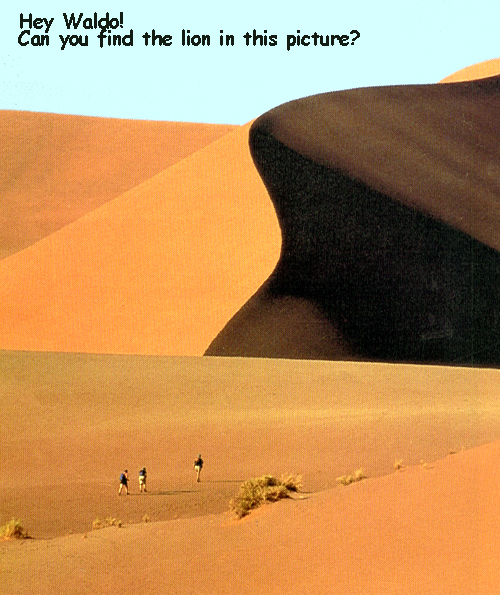
Lion in the Dune?

Lion in the Dune?

No! Because there aren't any!
NPR’s Namibia stories this week distort the overall complexities of human-animal conflicts in Africa as whole. The reporting by Christopher Joyce was an admirable portrayal of one very unusual country’s struggle with wildlife, but when he generalized he was quite wrong.

I hope you listened to the two reports, one on Monday and the other on Tuesday. Read this, then listen to them, again.

Many issues regarding wildlife, hunting and social responsibilities of any country are universal. How to make use in a profitable and sustainable way of these natural resources is an ongoing struggle that I feel is being successfully addressed throughout most of Africa.

But not necessarily the ways Namibia is trying. How Namibia approaches this diminutive national resource is very much different from the rest of “Big Game” Africa. Namibia is a very, very unusual place.

The thrust of Christopher Joyce’s reporting for NPR was that the only way that wildlife can be preserved is by privatizing it. Maybe for Namibia, but dead wrong for Africa and the vast majority of the rest of the world.

A little bit bigger than Alaska, the country is mostly uninhabitable. Nearly half (the western regions that border the Atlantic Ocean) is so dry that some fishermen grow up never seeing rain. Much of this area is the Namib Desert, which is pure sand, and some of the most spectacular dunes on earth are found here.

There is very, very, very little wildlife compared to the rest of sub-Saharan Africa. In fact, compared to practically any other random part of the world. I can’t emphasize this enough, because Namibia is where many outstanding wildlife research projects have occurred recently. Some have even led to major discoveries (about elephant verbalization, for instance). But this may be the case, indeed because the wildlife here is so scarce.

The NPR report itself confirmed there might be 125 lion in the entire country. That is about the same number of lion for this massive 325000 sq. miles as found in tiny 100 sq. mile Ngorongoro Crater in Tanzania. For a similar area in East Africa the size of Namibia there is likely upwards of 50 times as many lion.

And that metric applies pretty well for any other wildlife comparison between Namibia and the main wildlife viewing countries of Africa. The exception could be oryx and springbok, two antelope species which do exceedingly well in very dry environments. But except for these two antelope, Namibia is not a place to go to see wildlife.

The most famous wildlife park in Namibia is Etosha Pan, which is about 7% of the entire country’s land mass (22,000 sq. miles). It’s hard to find an animal census for the park, probably because it’s not very good. The Namibian government claims there are 2500 elephant (dubious) and makes the grandiose claim that, “It is well known that Etosha has the single-largest population of black rhinos in the world, but the actual count is kept secret so that this fact – and the population of rhinos it defines – is never threatened.”

Such unsubstantiated remarks need to be taken with a lot of grains of salt, of which Etosha has a vast supply. Moreover I’m absolutely sure there are many more black rhinos in places like Lewa Downs in Kenya as well as in a number of South African private reserves.

Namibia’s richest wildlife area is the eastern Caprivi Strip, the area squeezed between Botswana and Angola which is hardly 300 sq. miles large. This is where many of the private wildlife reserves Christopher Joyce discussed in his radio reports are located. Interestingly, though, it was not where Christopher Joyce of NPR spent most of his time.

The reserves Joyce reported from may have the least amount of wildlife of any of the collection of private reserves in Namibia, which does make it a compelling story as to how they are trying to exploit the little they have. But I am concerned that at no time did he explain this serious difference between Namibia and the more popular areas for wildlife viewing in Africa: i.e., there is hardly any wildlife in Namibia.

(Joyce spent most of his time on the few reserves on arid, near desert terrains where the provocative topic of hunting was raised. I thought he did a decent job with this topic although he might have considered interviewing the equally if not larger segment of the population in Namibia that opposes hunting. Nevertheless, this is a topic universal to privatization of wildlife reserves throughout the continent.)

The Caprivi is a beautiful, wooded and riverine area with a varied biomass, and what to do with it is a critical issue but keep in mind how small an area this is. It may contain up to three-quarters of all Namibia’s non-desert wildlife, but it is one one-hundredth of the country in size, only one quarter the size of Yosemite National Park.

I hope you see where I’m going with this. To call Namibia an African wildlife destination is really rather stretching it. It has some extraordinarily unusual wildlife, because of its extraordinary desert ecologies, well worth a zoologist’s interest. But to consider it a viable tourist destination for wildlife is a ruse.

Namibia’s attractions are grand, but they do not include wildlife.

And it’s probably precisely this reason that the government wants to develop the little that remains as best they can. Fair enough. And it may, indeed, be true as Joyce suggests that privatization of such a minimal resource is the only way to sustain it…in Namibia.

But this strategy is absolutely not an evidently good one for more normal environments elsewhere in Africa, where the wildlife is more naturally abundant. In fact, it’s a major and often contentious issue in areas that have naturally abundant game. Personally I’m in the camp of folks who do not believe that privatization of important national resources like wildlife is good.

And when Joyce ended his final episode by claiming the people “from all over the world and Africa” were coming to Namibia to learn from their privatization projects, I started to laugh then became rather irritated.

It’s like suggesting farmers are traveling to New York see how to grow corn. There is some corn grown on Long Island, and probably in very creative and interesting ways, but it’s sure no general model.

Private wildlife reserves are flourishing all over Africa, hundreds more than in Namibia, because they have much more wildlife to show off. Now it could be that the particular model for Namibia’s privatization is better, say, than Tanzania’s WMA (Wildlife Management Areas) or South Africa’s private wildlife zoning ordinances, with regards to fairness to the local population or to the wildlife or whatever. But Joyce didn’t explore this.

Namibia’s future is not with wildlife. Its tourism development must — and has, actually, at least until now — feature many other wonderful things before wildlife. Wildlife could be the icing on the cake of a fabulous Skeleton Coast safari, but the cake is substantively without animals.

Moreover, Namibia’s broader economic and social development is not with wildlife. It is squarely with how to divide the special wealth from its rich deposits of uranium, diamonds and a few other minerals; and with the growing conflicts with its rapidly developing indigenous populations like the Ovahimba.

That doesn’t mean we shouldn’t all be fascinated by the story Joyce told. Just put it in perspective, which he should have done but didn’t.

LET IT BE

LET IT BE

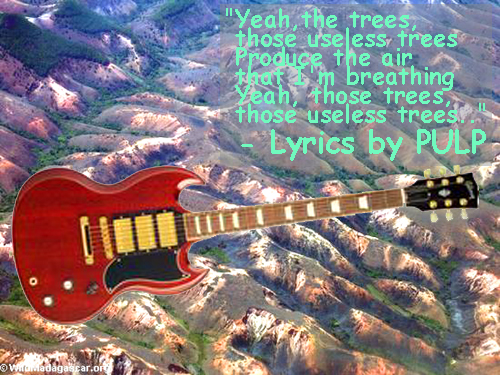
Gibson guitars and an African dictator, a major conservation group, U.S. Fish & Wildlife, and yes you guessed it, the T-Party, are banging out country and western lyrics headed for the Grammys. Dissonance par excellence.

I own (I think, my son took it about 10 years ago) a beautiful Gibson guitar which I played badly for years. Like most pseudo-musicians, my signature sound was volume. And despite repeated attempts to destroy the guitar, it remains in tact. Why? Because of its extraordinary craftsmanship and precious rainforest wood.

True musicians can hear the difference between a guitar they play using rosewood or ebony, and less rare versions of wood like binga.

According to Louisiana guitar maker, Mike Armand, “Different woods allow different tones.”

He says it’s all a matter of the way the wood handles humidity. Obviously wood from high humidity places like … well, say, Madagascar rainforests … handles humidity a lot better than wood grown in Canada.

Turn on your speakers and click here for the sound of a rosewood guitar. Billy D & The Hoodoos, a Portland group, are among many who claim they are worried now about traveling with their instruments over international boundaries.

As they should be. We can’t have it both ways, folks. (Although, read further down, it seems like everyone is trying to on this one.) If you believe that elephant ivory should be confiscated and traders across borders prosecuted, then the same should be true for Madagascar rosewood.

Rosewood (Leguminosae Fabaceae) and elephant (Loxodonta africana) are both found on Appendix I in the CITES treaty. Which means you cannot take those products across international borders.

CITES is that near perfectly functioning, marvelous world treaty that protects endangered species.

The reason is so simple it defies criminality. Wherever those things exist (elephants in Africa; rosewood in Madagascar) they are dying out, or will die out if not protected from commercial harvesting. So … leave it be.

The reason I want you to watch this video is because it was made in 2007 by a respectable conservation organization regarding their project to protect 10 million acres of Madagascar rainforest by 2010.

They failed. In fact, they failed miserably. About the same amount was logged, instead. They failed, because the Madagascar government was taken over by a hipster strongman who prior to siccing military on demonstrators was a young, popular Tana DJ who scratched vinyl with little regards for the tonality of sound. He has approached his current job in the same way.

Madagascar is, ergo, a mess. Mostly a decimated mess of scorched earth.

But it takes two to tango. Somebody’s got to buy the wood. Gibson knowingly violated the law. Why? For two reasons: (1) because rosewood makes such a pretty sound, and (2) they figured they could get away with it. So far they’re right on both counts.

Whether you believe in the whole morality of the CITES convention (as I do), certainly the issue of law is universally compelling. Right now, it’s against the law (worldwide) to buy Madagascar rosewood. And so, let it be. Or, change the law. Or, opt out of the treaty.

So although I have enough music still lingering somewhere deep inside and can definitely tell the difference between Pavarotti and Domingo, and probably even appreciate Billy D’s rosewood grace, if I’m a law abiding citizen, I’ll lobby Billy D not to take his rosewood guitar when he performs in Vancouver.

Gibson broke the law.

But… guess what. Gibson is not being prosecuted. U.S. Fish & Wildlife, which is responsible for preparing the prosecution for any violation of CITES, hasn’t acted on a judge’s instruction in the case, effectively putting the whole case on hold. It’s Fish & Wildlife’s move, and they don’t seem very anxious to do so.

And desperately in search of a political win, the T-Party has now “rallied” to Gibson’s side. I didn’t know Nashville extremists went further than murdering mothers-in-law.

Gibson is not being prosecuted.

Music is a dangerous stage on which to fight politics. But when CITES was adopted by the U.S. under the Reagan administration, Fish & Wildlife actually steamed off ivory keys from priceless pianos sent in or out of the country. Pianists have come to accept this.

Gibson has pursued raw materials with the same abandon as many of its pea-brained singers. Not just Madagascar rosewood, but also Fiji ebony. Both places are run by dictators intent on little more than making a buck for their families, who care not diddly squat about their fragile island ecologies which are ready to disappear.

Both appreciate Gibson’s business. It would make a very good country and western lyric.

After Fish & Wildlife revealed the investigation was taking place of Gibson’s interests in Madagascar, Gibson terminated its relationship with the Fiji devils. But it intends to fight the ban on Madagascar rosewood.

How? On what basis?

Well one successful strategy has been to buy out an otherwise established conservation organization. Yeah, that seems to be working. The Rainforest Alliance has certified Gibson as producing “sustainable products.” This is nonsense. CITES knows better than the Rainforest Alliance, but guess what? Guess who recently gave tens of thousands of dollars to the Rainforest Alliance? Not Hank Williams.

And then another strategy that seems to be working: Get T-Party-ers to scream veiled obscenities at Obama and be covered by FOX. And that fight seems to be working, too. Obama, as the old country and western tune opines, might just be that sheep in wolf’s clothing.

Columbus Day Holiday

Columbus Day Holiday

Today is Columbus Day in the United States, a federal holiday.

All but a handful of states suspend many elective services, schools are closed, all banks in all states must be closed, and there’s no mail delivery. The holiday was proclaimed in 1937 on the 400th anniversary of the arrival of Christopher Columbus into the Americas.

Many large cities, including New York, have huge parades. Over the years the celebration has taken on an ethnic tone, celebrating Italian heritage.

Styles for Africa

Styles for Africa

From Spring 2012 Fashion Shows in New York and Nairobi.
I’m so tired of the incessant charges some of my less appreciative readers make of my understanding of the facts that today I’ll tackle one of my most solid areas of understanding: men’s fashion. In Kenya and the U.S. On safari or off.

Over my many years as a guide, friends and family alike have remarked on one thing I always got right: how to dress for safari. (Admittedly I tend to keep things longer than perhaps I should. I have a blue sweater my mom knitted for me in 1984 that I wear constantly on safari.)

Fashion, particularly for safari, like a safari, is timeless. Safari fashion has not changed much over the years. It’s distinguished by one overriding characteristic reflecting the excitement and magic of safari traveling: it’s expensive.

But of course it must be useful, because a little slip here or there, one two few pockets on your vest, and poof, you’re dust! That’s the greater point: appropriateness costs more:

“Pack fashionable safari style clothing such as bikinis,” Safari Clothing Wear tells us, “because this may be the kind of weather they may probably find at any safari.”

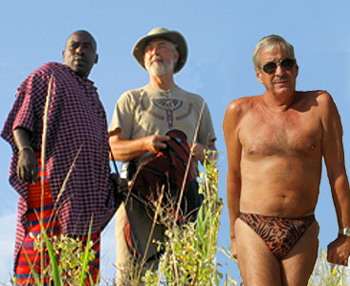
It was so clever of Herb to wear his bikini on that walk with Maasai that we did several years ago. Herb’s confidence in his attire allowed him to actually lead the walk. He strut out ahead of Elai, the Maasai guide, qho was particularly envious, because his shuka was too loose and risked constantly falling off.

Ricky’s two-piece attracted more animals than we normally see in the Aberdares, and everyone was grateful for that!

What’s particularly interesting is that safari style clothing is directed more often to men than to women, and in my opinion, it’s about time. It was back in the 1990s when “being a dork” was about the most horrendous opprobrium anyone dare give you. That was when I decided that I should begin studying safari attire.

It was also when clothiers began concentrating most on men’s safari wear rather than women’s. The Marlboro Man was on his way back!

“The fashion of casual clothing is actually a more important issue for guys,” says SingleGuyAdvisor.com. “Think about it, when was the last time you thought, ‘That purse is ugly.’ But women look at men everyday and think, ‘He looks like a dork. I hope he doesn’t talk to me.’ And that dork might be you.”

Our information manual gives clear recommendations on what to wear on safari, and believe me, you won’t look like a dork!

Colors are very important on safari. Our manual explains how animals are often distracted by brightness coefficients that are too high. One of the problems we have in writing our information manual is that readers often aren’t intelligent enough to know what a brightness coefficient is.

Fortunately, this season is taken care of, because according to AskMen peach and pink are the colors of the season, both of which usually have a low brightness coefficient:

“Peach and pink project calming characteristics, as well as good health.”

And that’s what we need on safari above all, calmness and health.

What is most satisfying about “getting it right” when you, as a man, dress properly for safari, is that you are communing not just with nature, but with the long history of African peoples.

“Some popular types of earrings worn by men are studs and hoops made with metals like gold, platinum, copper, steel and silver,” writes the men’s fashion blogger Anamika S.

Go native.

“There are several references in the Bible also concerning earrings,” she continues. “Wearing earrings in one ear (on the right lobe) is considered as a mark of homosexuality. But this is just a misconception. There are also criminals using this misconception to misguide people. Some parents also think that wearing an earring means that person is becoming a hippie.”

We have banned both hippies and criminals from safari ever since 1983.

So as you can see, a man’s enjoyment on safari is linked part and parcel to his wardrobe. Above all don’t forget the two Bs you’ll need, dude: Binoculars and Bikinis.

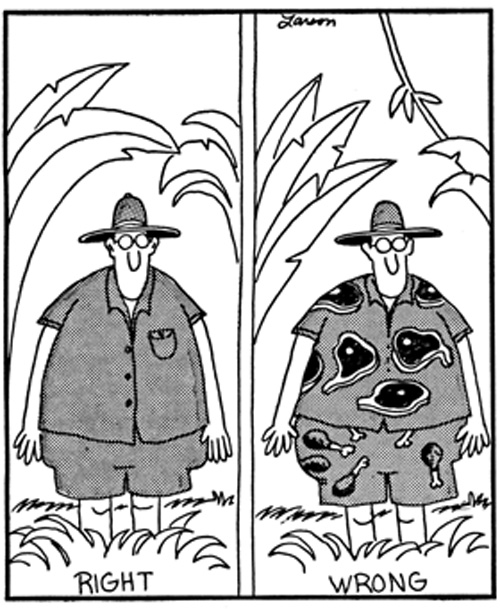
As usual only Gary Larson tells the truth.

Only The Best

Only The Best

Years ago I guided teachers, bankers, students, lawyers and plumbers on safari. Now, I guide bankers, lawyers and brokers. What’s happened? It’s simple. Like so much in life, safaris have become too expensive for the average Joe.

Now to be fair, it was never as easy for a teacher to go on safari as a banker. And unfortunately we never saved the actual demographic data. But I can assure you I really did guide lots of teachers and as a percentage of overall clients they’ve decreased substantially.

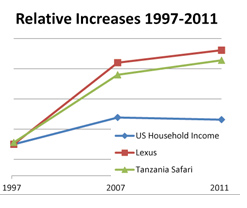
It isn’t just the current economic downturn. It’s a trend, and I decided to find what “in life” has increased as much as a safari’ cost. Answer? Lexus.

Here’s the data for the chart:
1997: US household income, $37005; Lexus: $50000; safari: $320/day

2007: US income, $50150; Lexus: $100000; safari: $600/day

2010: US income, $49550; Lexus: $112000; safari: $660/day

Costs have increased for all sorts of regular reasons like the price of fuel and food. They haven’t increased because salaries of workers have increased, and therein lies the schism. Household income hasn’t increased. There’s less for anything but just getting by.

Now as we all know, that’s not true of the richest of us. The rich are absolutely getting richer, even though as a percentage of the population they’re growing smaller. So our pool of safari travelers, just as the pool of potential Lexus buyers, is decreasing.

The latest proof of this is a white paper being circulated among Kenyan officials that would ban minibuses in national parks.

Minibuses save about 50% of the transport costs over 4-wheel drive vehicles like Landcruisers, and they have been the mainstay of the lower markets. A new minibus is actually a more comfortable ride than a Landcruiser. It lacks the power, of course, and that means it can’t travel as remotely as a Landcruiser, but in parks like Kenya’s Mara that’s not necessary.

But Kenya’s tourism minister, Najib Balala, told a Kenyan newspaper that “Using mini-buses is cheap” and that Kenya had to portray a more upmarket image.

I can’t blame Balala. For years the costs of safari have increased far faster than median income from any of the safari markets. In the last 20 years, American median income has risen hardly at all, whereas the cost of a safari has tripled.

Game Park fees have quadrupled. Lodging costs have doubled. Transport costs have tripled.

But the salaries of drivers, customer relations staff and even managers and hoteliers has hardly moved. Like median income from source markets, those graphs are flat.

So ultimately, who gets these enormous increases?

Well, the government fees for national park entrances are clearly an increased revenue source for those governments. And in places like Kenya and Tanzania, for instance, this piles up directly into the general revenue fund.

But the lodging and transport hikes derived from fuel and construction costs are going to the providers of those things, the owners and stock holders of oil companies, potash mines and manufacturing companies.

And it isn’t just safaris, of course, that I lament. In my life time I’ve watched natural and cultural attractions like national parks, city zoos and opera houses become more and more reserved for the rich and powerful. And the rich and powerful are becoming richer and more powerful even as they become a smaller segment of our society.

My own safaris cost has skyrocketed and I’ll be the first to tell you I’m not the principal one to profit. I’ve watched the cost of good, solid albeit mass tourism lodges like Sopa’s Ngorongoro property in Tanzania increase from $140 per room in 1994 to over $450 per room today. And believe me, the radiators still don’t work!

Yet I can’t consul Sopa or anyone else to do anything differently. The thresholds we have to look at today aren’t the top thresholds but the bottom ones. What?!

That’s right. Balala is exactly right. Prices that look “cheap” detract from selling. If even the product is truly cheap, its chance for selling is greater if it’s priced higher. We are appealing to the rich, no one else anymore.

I’m not blaming anyone. It was probably inevitable in our global economic system. But it’s sad.

Suppressing Slimey Wars

Suppressing Slimey Wars

Big business isn’t exactly winning a lot of awards today for social responsibility, but why has it taken us 20 years to figure this out? Yesterday we learned how a big oil company played war in Africa, killing tens of thousands.

It’s one thing when you choose sides in a war to fight for an idea. But my life time has been beset by wars fought not for ideas but for the power to control natural resources. The old communist adage of the “ends justifying the means” has become a truism as appropriate to rightist politics as leftists.

I’ve written how the Obama Administration through the Dodd-Frank Act has almost single-handedly ended the wars in The Congo over Coltan. With similar dispatch, we now need to stop the endless killing in the Nigerian Delta over oil.

And it appears all it might take is strapping the oil companies into a closed room and nationalizing them. What d’ya think? Sound possible?

The report released yesterday in London documents Shell Oil Company waging war in the Nigerian Delta. Specifics include direct transfer of money to illegal militant organizations, changing sides depending upon who was winning mini civil wars “picking the more powerful group to help protect its oil infrastructure.”

Not good or bad, or capitalistic or socialist, just “who was winning.” To keep the oil flowing. No matter right or wrong. Ends justify the means.

The NGO responsible for the report is Platform. This is no fringe organization. The report was considered so credible it was immediately reprinted by London’s Guardian newspaper and its author immediately interviewed on Canadian Broadcasting, among literally dozens of other media platforms.

But, um, didn’t see much about it in the U.S. In fact, interestingly, the Guardian which closely follows oil company evils in Nigeria didn’t print the story in its U.S. edition.

The paper’s environmental editor, John Vidal, has published award-winning stories including castigating Americans and others for paying so much attention to the BP Oil Spill in the Gulf when the accumulated disaster of oil spills, wars and patent corruption in Nigeria has effected many, many more lives and livelihoods worldwide.

Well, that’s the reason, I guess. America isn’t ready to go to the back shed for a whipping yet, and suggesting such might … well … be counterproductive?

Media, today, is as much a function of ends justifying means as every other sinister component of modern life.

There are many Platforms in the world, daily churning out the truth. In fact, there’s so much truth about the sinister activities of oil companies in Nigeria that it’s heart-breaking it hasn’t prompted action, for instance, embodied in the Dodd-Frank Act regarding Coltan.

Write your Congressman? Buy a Prius? Maybe just add a few foreign media sources to your daily news intake?

Wangari Maathai

Wangari Maathai

Wangari Maathai was known above all for planting trees, and last week she will be cremated since she insisted she not be buried in a wooden coffin. Few people carry such a presence in life that it continues into their death.

Many discounted Maathai’s 2004 Peace Prize as the Nobel Committee’s trend towards politicizing peace, for Maathai was an activist who often put her foot in her mouth, managed to personally offend almost all her opponents, and relentlessly represented the poor against the rich.

She framed the degradation of the global environment as a rich man’s plot against the poor man. But she never wavered in her beliefs, not when she was repeatedly beaten by police, divorced by her husband for being too “unwomanlike” or ultimately kicked out of government because she wouldn’t toe the party line.

She didn’t do well in groups. She was a lone, articulate and very powerful voice. I’ve read an astounding range of the number of trees that she’s been credited with having planted in East Africa, enough to reforest Jamaica. And clearly it was her voice, not her hands, which got each sprout into the ground.

Her foundations faltered and recovered, her short stint as a Member of Parliament caused more divisions in her own party and arguably jeopardized her own causes, and her inability to assume direction from others meant that journalists were cautious about interviewing her.

But her legacy will prove so much more powerful than her remarkably successful Nobel Price Peace life. She’s a woman in a Third World, so a soldier in the legion of radicals that in my life time has created more women in power proportionately in the Third World than in America. She was instrumental in creating the still debated section of the new Kenyan constitution that mandates a third of all elected officials be women.

She’s was scientist, a rare commodity among upcoming individuals in the Third World. She was divorced, something that condemns many Third World professional women to long if not eternal periods of ostracism. She was notably unstylish, wearing pseudo-traditional garments (mainly because they were green) that never fit well.

And most odd of all, she was green. Green is a concept in business and politics and society that is either a hedge or anathema to fast developing Third World governments that dare to cap their steam stacks or scrub their coal mines at the peril of inhibiting growth.

And that principal characteristic of Maathai places her allegiance squarely on the planet as a whole, not just Kenya. This anti-parochialism is far too lacking, today, in America and the rest of the developed world where more and more we see ourselves in smaller and smaller containers.

There’s no one in my sights who replaces Maathai. But my vision is restricted from outside her world. The final judgment of her legacy will be if others in Kenya and The Third World now assume her role. All of us worldwide should hope so.

Volunteering for Mountain Gorillas

Volunteering for Mountain Gorillas

Valerie Fox wrote:
I want to see the Mountain gorillas in Rwanda. Ideally, I would like to volunteer Directly to help them, and see them more than just 1-2 days as is offered one most the tour trips. I am an RN and could volunteer in this capacity in order to stay longer and possibly have a chance to see gorillas more than once. When is best time to go? Who can I contact so I am not paying some tourist company thousands and not directly helping.

Valerie, thanks for your email and I hope you’ll soon find yourself in that wonderland! And please read my blog, today, which was motivated by your request.

I have promised my friends in Rwanda that I won’t refer any such requests unless you can guarantee a half year commitment. If you can, let me know, and then there will be a rigorous vetting process to see if your available experiences and credentials can be of some use.

And as my blog, today, explains, I personally believe that the greatest conservation act that has saved the mountain gorillas is simply the tourists going there.

It’s hard to give you a good “best time” answer, because the weather is changing so dramatically in East and Central Africa as a result of global warming. In the past, the heavy rain months of March-May were best avoided, but this year for example, March was dry and July was extremely wet. The fact is that in a highland rain forest it rains almost all the time, anyway, so anyone traveling there at any time must be prepared for rain. And other than that, note that 56 intrepid travelers go up every single day of the year!

Volunteerism Not Always Good

Volunteerism Not Always Good

I often receive requests by sincere travelers who want to volunteer in Africa. The latest is from an enthusiastic woman who wants to help the mountain gorillas. She doesn’t want to pay “some tourist company thousands and not directly help.” Like many well meaning people, she’s got it very wrong.

Particularly with regards to the mountain gorillas, it’s my opinion that tourists doing nothing more than “paying thousands to tour companies” do as much if not more to help the mountain gorillas than scientists.

Read In the Kingdom of the Gorillas by Bill Weber and Amy Vedder, the two scientists who began the mountain gorilla project in the 1970s. From that book alone (and there are many more) you’ll see that without tourists paying the huge fee to the Rwandan government just for the privilege of seeing the gorillas, plus the funds paid local transporters and hoteliers, it is likely there would be no mountain gorillas left.

The sentiment to volunteer is a hopeful one, to be sure, and shared by many enthusiastic conservationists. And it is typical of caring travelers and crosses well beyond animal conservation into all areas of volunteerism.

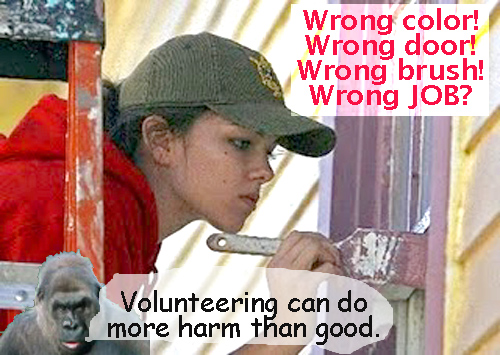
Volunteerism can be good, please don’t mistake me. But there are several negative sides to it which send up serious red flags to the organizations involved.

Casual volunteers usually cause more difficulties than they expect. The most important one is time. Unless you have a half year to dedicate to some project, it’s unlikely you’ll be invited to assist. This is as true for mountain gorilla research at Kinigi as it is for AIDS education in Soweto.

Someone coming for just a month, for example, causes tremendous housekeeping problems such as food and housing (which you cannot try to do yourself).

Integrating the skills of a new team member into the team is as hard for an experienced field researcher as a casual volunteer. It takes careful analysis and if done wrong can compromise the goals of the entire project.

Analyzing your skills by a potential project takes time and money. Mistaking your capabilities, or inappropriately allocating your skills, will cost the project even more time and money. And today, time and money are scarcer than ever.

The mountain gorilla project in particular is not your down-the-street food bank. The people who work there are highly educated, generally postdocs, in highly specific fields. Of course any organization can use someone to paint the walls, but doing that robs part of the high intentions of the project: it takes those types of jobs away from Rwandans.

Remember that a principal goal of practically any aid project, whether it be animal conservation or public health, is to ultimately turn that project over to locals. The first stage of this implementation is turning over the least skilled jobs, something that is almost always the rating of a casual volunteer.

And finally, there is a negative side that is extremely important to me personally that people must try to understand. Volunteering in any sense can coopt one’s support for the grander projects that carry real potential. Projects that are government to government, or foreign aid support of organizations like the Mountain Gorilla Project.

Our first and foremost responsibility as true conservationists and sincere volunteers is to support politics at home that will continue to fund the organizations we support. If you were able to expend energy, for example, in making sure that your political representatives supported USAid projects of the Mountain Gorilla Project, and you and others were successful, you will have achieved a much greater goal in helping the gorillas than anything you could do personally in a short time there.

I am happy and willing to link anyone with trained skills appropriate to projects in Africa with any of a number of organizations, provided you have a half year or more available. Let me know! Otherwise, recognize that it is we paean tourists who have done the greatest good for the mountain gorillas, just by going there and “paying thousands” to the local government and local businesses!

Safari RoundUp

Safari RoundUp

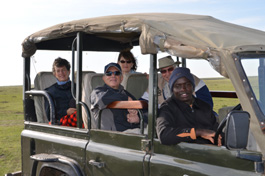
David Heiman, Roger & Ellen Sirlin and Lynn Heiman.
Our 14-day dry season safari in Kenya and Tanzania ended with a beautiful morning in the Mara, hardly a breeze and high wisps of cloud suggesting afternoon rain. The quantity of big animals we’d seen threatened my past records, and like every guide on earth, my greatest wish was that all my clients had a great time.

People who choose to go on a safari do so with a lot more thought and consideration than just a quick hop over to Europe or golf holiday in Arizona. And it isn’t just the money. They know it isn’t a typical vacation of R&R, but a journey that involves a lot of personal energy.

So having already made this decision, no matter what goes wrong – no matter how dusty it might be, or hot, or cold(!), or how long the wait for the charter aircraft, or lodge check-in or delivery of the much needed cold beer, there is a tolerance from virtually every safari traveler probably not to be expected from travelers on a more ordinary trip.

And so it’s sometimes hard for us as guides to really gauge how people feel. They’ll insist they had a great time, but did they really?

Our trip was pretty typical of my designed safaris. It starts off with some pretty good game viewing, and with the least comfortable of the accommodations, and then grows into greater comfort and a slightly slower pace, and then regains superb game viewing towards the end.

But even this formula demands some serious personal effort. To even partially grasp the magnificence of the wild and the fragile political and social systems in which it’s found, there’s a lot of information you’ve got to grasp.

Sue MacDonald, Dave Heiman,
Margy & Roger Gelfenbien, and Alfred.
I always spend time in Nairobi, discussing history and culture, and this time I think the folks were really blown away by the dynamism if over busy-ness of Nairobi. But I’m so optimistic about Kenya at the moment, that I think I conveyed this positive feeling well.

Anyone can bop over to the Mara for a few days and almost always get the Big 5, yes including rhino, now that the rhino rehabilitation projects have proved so successful. And the Mara is one of the most beautiful places on earth.

But to grasp the East African wilds, and how dangerously close they are to self-annihilation, other goals are necessary: like finding the migration or some arcane animal like a serval or ratel. To sense the importance of preserving the wild, you have to stick with some event – like an elephant family on their way through a forest to who knows where, or a lion with a bloody face, or a limping antelope – to recognize the intricacy of everything with one another.

And this takes time. And driving, and believe me, the park roads aren’t like ours at home! There’s a lot of bumping, and swaying and probably heavy handed grasps of the nearest window rail!

But when properly prepared and fully cognizant of what you’re getting into, It think it ends up being one of the most satisfying and memorable of life’s experiences.

I won’t list the animal or bird count on this safari, because so much is dependent upon atypical conditions, but we did very, very well. Personally, my greatest memory will be finding the migration in the northern most reaches of the Serengeti, a month or longer before it was due there.

We were able to see the world changing, climate change at work. We can see how great animals are adapting, and the hazards they are encountering doing so.

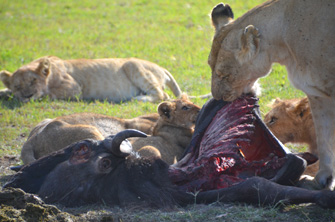
I know that others were mesmerized by the seven kills we found. Many people can’t take these for very long, and I understand that. But certainly one of the most amazing encounters we had this time was seeing a lone hyaena that had just killed a yearling wildebeest.

It was exactly 42 minutes from the time that lone hyaena began to eat, that the entire wilde was essentially gone. Ten other hyaena arrived, jackal nibbled away, vultures cleaned off the last pieces. It was amazing.

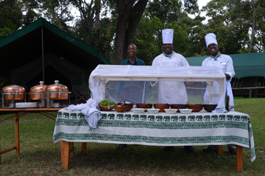
Our camp kitchen staff!
For its speed and efficiency.

Seeing the wild southern elephants of Tarangire was another great memory. Few people go down that far into Tarangire, content with the incredible encounters with the more resident and friendly eles to the north. We were surrounded – literally – by eles that don’t see a lot of people. They were wild, vicious perhaps, and most of all, incredibly powerful.

I had a fabulous time. My clients said so, too, and I hope as they reflect as I am now on the innumerable special moments, their appreciation for the wild and connection with East Africa will be established for the rest of their lives.

Marvel of the Mara

Marvel of the Mara

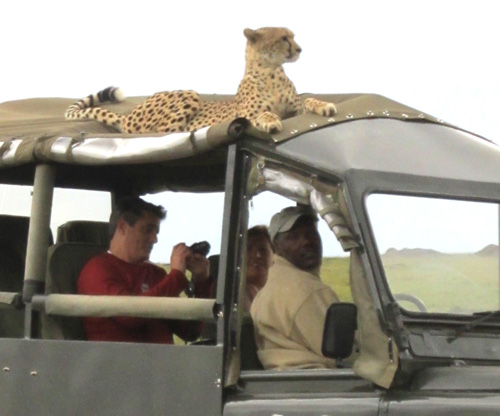
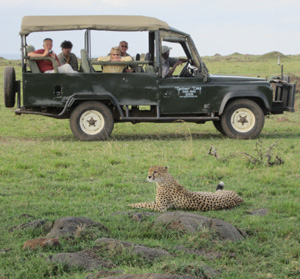
I took this picture yesterday in the Mara. Nine other vehicles were watching with us.
Twenty-seven lion, five cheetah, a rhino, 4 kills (not take-downs), a serval, two leopard (one with a recent kill) and a hyaena kill of a wildebeest. In three days in the Mara. And lots of vehicles. Is this a zoo?

No, of course it isn’t. It is Kenya’s best game park, the Maasai Mara. So we ended our safari with incredible game viewing, and it was expected. But am I showing my clients the wilds of Africa?

The Mara proper is hardly a tenth the size of the Serengeti, sits right on top of it, and is the northernmost venue for the great migration. It has almost 4 times as much accommodation as the Serengeti, despite its much smaller size. So, yes, it can seem busy if crowded compared to the Serengeti.

Ellen Sirlin watching hyaena kill.
But it is busy precisely because the game viewing is always so exceptionally good. The quantitative exponent of game viewing in the Mara is rarely duplicated elsewhere. The dozen or so hyaena around the lion we saw, the 100 vultures plus assorted jackals and storks, was typical of my experiences in the Mara every time I go, and 3 to 4 times the number of animals and birds that would normally be seen on a Serengeti kill. Why?

For two intertwining reasons.

First, the Mara is the wettest part of the Serengeti/Ngrongoro/Mara ecosystem. And wet means more food at every level, and that means more predators and ultimate cleanupers.

Roger Sirlin watching lion eat.

Second, more animals means more visitors and the Mara is probably the most congested game park in East Africa. Lion brush aside your vehicle, vultures clip your canvas rooftop when landing, hippos block the road into your camp and crocodile lay eggs a few feet under your tent.

And rarely are you the only one snapping photos. I try very hard and do often succeed, but if you want to see the rhino, or the cheetah take-down, you’ll be sharing the experience often with 10-20 other vehicles.

Sue MacDonald watching a rhino.
All this visitor activity means that the animals are much more tolerant of people and vehicles than anywhere else I’ve ever been in Africa. Animal tolerance of vehicles surprises all visitors almost everywhere, but the indifference of Mara animals to visitors is almost beyond belief.

But here’s the rub. Remove the visitors, the vehicles, the people, and I think it fair to argue very little of anything else would change.

So are we really experiencing truly wild and natural behaviors?

Yes. For the Mara. It’s as natural as garlic mustard taking over Yosemite or chronic wasting diseases menacing recreational hunting in Wisconsin. What I’m saying is that in the Mara it is a real balance of life as it exists there, today.

It is certainly not the way it was a generation or more ago. And it is certainly not the way it is in most other reserves in East Africa.

Even in the Serengeti, which shares a border with the Mara and several rivers, animals grow more suspicious of human visitors and their vehicles. But even so, these “wilder” behaviors in other East African reserves are far tamer than they were in Africa 50 years ago.

Then, African wildernesses weren’t as protected. People competed with animals for the same turf, and people are more clever. Animals were afraid of people, people would just as likely kill as preserve anything wild, and so wild things were harder to observe, less obvious.

David & Lynn Heiman, Roger & Ellen Sirlin.
In other words, if you want to make wild animals accessible to the casual visitor, a dynamic will begin that will make the animals less suspicious of visitors, and that will bring in more visitors, and that will make the animals even tamer and tamer. I can’t see any way to stop this.

So the complaint I have about this marvel in the Mara is the growing number of other visitors. And as a visitor, you have to decide if you want to see it all, rather easily and quickly, or prefer as I think I do the less congested wilderness.

This dynamic – the marvel of the Mara – has happened only in my life time. It’s something that I feel has been achieved at the loss of “wildness” which is still easily experienced in places like The Selous or the Serengeti.

But nostalgia may have gotten the better of me. Visitors may not seek wildness any more than they seek the remarkable beauty of a lioness cleaning her cubs, or tiny baby warthog racing after mom. And for all those wonderful experiences and so much more, the Mara is the place!

Arusha’s Getty

Arusha’s Getty

Even Arusha has its J. Paul Getty. As we ended the Tanzanian portion of our safari, we visited Cultural Heritage, a tourist landmark that may have done more for northern Tanzanian tourism than the paved road to Manyara.

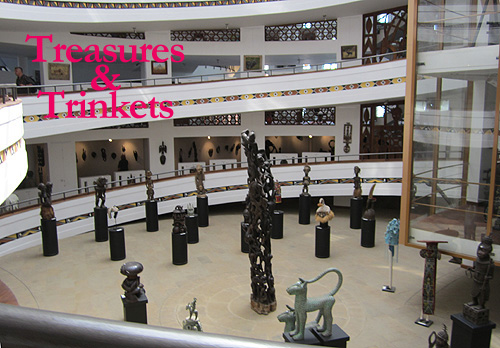
Initially a curio shop, Cultural Heritage has finally fully embraced its name. Yes, you can buy most everything you see, but it has legitimately become an exceptional museum.

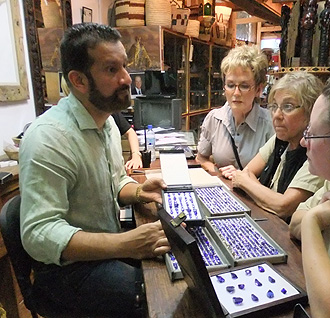
The enormous complex is the brainchild of Saifuddin Khanbhai, mostly known just as Saif. He doesn’t appear as much as he used to, but you’ll never get out of his site. He personally designed this behemoth building, personally welcomed Bill Clinton and a score of other dignitaries, and if he’s around, he still personally negotiates your Tanzanite purchase.

Saif didn’t have the wild life of J. Paul. He’s a devoted Ismaili, in fact a principal liaison with the sect’s religious leaders in Asia. His family traces its Tanzanian roots back to 1836, and the Cultural Heritage complex to 1976.

Then hardly more than curio duka, Saif’s vision for Cultural Heritage was a long time in the making. The first large reopening was in the early 1990s, when the little store became a very big store on the outskirts of the city. It was linked with the growing popularity of Tanzanite, and Saif’s family had interests in at least one of the only 14 mines near Mt. Kilimanjaro.

I can remember countless client purchases that Saif personally negotiated, but the one that sticks out most amazingly was a young Chicago lawyer who after choosing his gems questioned the value of Saif’s offer.

Saif took out a FedEx envelope, bundled up the jewels and put them inside. He handed the package to my client and told him to take it home and have it appraised, and then to either put the check in the envelope or return the gems.

The envelope came back with a check.

Today adjacent a huge store with precious antiques and modern curios, clothing, books and maps and virtually anything at all related to visiting and enjoying Tanzania, there’s also a restaurant and now a mammoth four-story “museum.”

I see Saif as Arusha’s J. Paul Getty. There’s no question he’s out to make a buck, and like Getty he was the brunt of much local gossip when he first began this effort. And like Getty his first and foremost motivation is to make a buck, and an honest one, and in the course of doing so he either wants to or perforce is raising Arusha’s cultural standing.

Much of the collection strikes me as priceless. Some of the deep African masks, chairs, parts of buildings, dhows and doors, musical instruments and ancient beaded work is extraordinarily precious and has been collected from far and wide. I’m a bit turned off, though, by much of the local stuff. Some of the amateur paintings that are displayed are pretty bad, though I do understand his desire to promote local artists.

But get past the local stuff into the heart of Africa and you’ll be absolutely amazed. And there is so much, so unbelievably much for this little city of Arusha, that you can’t help but be overwhelmed.

I’ve seen museum buyers often in the store, and I imagine it takes them hours to sort treasures from trinkets, but I have no doubt the sort is worth the time!

Congratulations, Saif! Arusha owes you big time!

Umbrellas in the Dry Season

Umbrellas in the Dry Season

At home whether it’s raining or not doesn’t mean much. On safari it means a lot to me as the guide. What we do, when we do it, planned months ahead, is predicated on where and when it’s going to rain. That’s now near impossible with global warming.

We were all having drinks tonight before dinner at Swala Camp in Tarangire when the thunderstorms began. Chris Benchetler left the room to try to get photos, and in fact the heaviest rain seemed over. Everyone was scrambling for umbrellas which the manager was fetching from some far away storehouse.

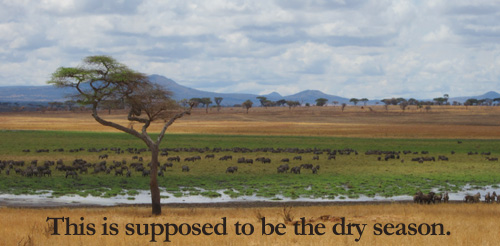
This is supposed to be the driest time of the year. We flew into the Serengeti through a terrible thunderstorm. Where we landed was so dry that your lips cracked even before getting out of the plane. Yet we could see some of the heaviest rain imaginable less than 5 miles away.

And today in Tarangire, in what’s supposed to be the driest time of the year, we got nearly 3 inches of rain in less than two hours. We ate dinner in Swala’s beautiful open-air dining hall with the moisture of heavy rain filling the veld.

I watched black paradise flycatchers doing their mating dance as if it were March! What’s going on? Global warming, and while it may make my job more difficult, I dare not imagine how it’s screwed up Tanzanian farmers.

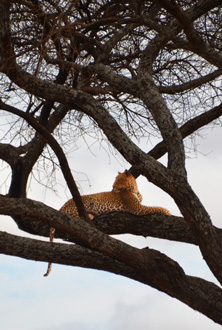
The leopard to left was photographed by Sue MacDonald, today, in Tarangire near the Silale swamp. Before the morning was over, we had seen five leopards, including two 2-month old cubs. Now that was a bonus. Leopard don’t usually like their cubs seen by a dragonfly much less a tourist, although admittedly we were several hundred yards away.

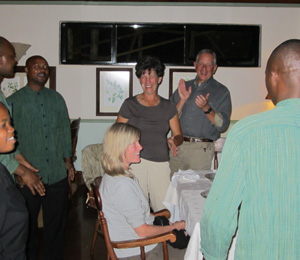
Sue by the way celebrated her 24th birthday with us on our safari (or was it 25?) We had a riproaring evening at Gibb’s Farm with the staff singing Happy Birthday to her. Lynn and David Heiman are joining the chorus!

Gibb’s as always is one of the most favorite stops on safari. The rooms are spectacular by East African standards, more like a fisherman’s cottage in Nantucket than a safari room. The setting in the Ngorongoro highlands reminds many of Tuscany, and the organic food on the farm is stupendous.

Tarangire is known for its ele, and we were certainly not disappointed. I have a long history with ele as you readers of my blog know, and I’m not exaggerating to say that the numbers we saw in Tarangire this time surprised even me.

In the Silale swamp alone we probably saw a thousand. Now by Charles Foley’s latest count, that would mean a quarter of all the ele in Tarangire, and I suppose that’s possible. But it was absolutely magnificent. I wish I could show you a picture, but really no one in our group — including some rather accomplished photographers like Roger Gelfenbein — were capable of giving me a photo that worked.

So you’ll have to let your imaginations soar with this little snapshot I took of Sue, Roger and Ellen Sirlin watching just one jumbo yesterday.