Arusha, Chicago & Kenya

Arusha, Chicago & Kenya

March And Vigil Remember Chicago Student Beaten To Death Near Community CtrCoastal Kenya, Chicago and Arusha suffered terrible acts of violence these past several days, and it leaves us wondering if it’s safe to walk out of the house.

The violence along Kenya’s coast just seems to get worse and worse. Although 28 of the 29 deaths this past weekend occurred outside established tourist areas, one fatality was a Russian tourist in Mombasa town who resisted an attempt to rob him of his wallet.

In Arusha, the hub for Tanzania’s famous tourist industry, a third violent attack this year happened Monday night when an IED was thrown into a popular Indian restaurant in the center of town.

No one was killed but eight people were hurt. The Verma Indian restaurant is attached to a popular city gym and is frequented by Arusha’s more affluent residents, including many foreigners.

In Chicago 16 people were killed and 80 others seriously wounded in gun battles that raged through the city’s south side for most of the weekend.

What are we to make of all this?

The Kenya violence is a continuation of the Muslim/Christian world war, a specific retribution by al-Shabaab for Kenyan occupation of Somalia.

Kenya has suffered three such attacks monthly for more than the last year alone. The Kenyan invasion, encouraged and outfitted by the Obama administration, has done much to pacify Somalia and reduce the terrorism threat to the United States, but at Kenya’s peril.

In Chicago the violence strikes me as a result of increasingly lax gun ownership restrictions. Chicago’s top cop said this to CNN. Of course why there is such anger and frustration that utilizes the available guns is the more profound question, and unlike Africa, it isn’t a Muslim/Christian war.

It’s more akin to a poor/rich war, which in fact could be the explanation for the Arusha bombing last night.

Tanzania has not participated in the war in Somalia, and so unlike Kenya and Uganda which have, Muslim groups have not claimed any responsibility for attacks seen on the Tanzanian mainland.

But the three attacks in Arusha over the past year have been political or religious. A prominent and popular Arusha politician and his wife were hurt at a political rally, and a Catholic church was bombed in a second attack.

Monday’s attack in Arusha targeted what’s considered an expensive restaurant, owned by Indians, in one of the city’s most affluent neighborhoods. Throughout the last several centuries Indians in Africa have often been the brunt of attacks against political systems that favor business and the rich.

This suggests three completely different motivations for the violence in Arusha over the last year.

In the end, the simplest explanation for all the attacks is that weapons are too easily available. The next level of explanation is that identifiable groups of people feel marginalized:

Muslims in Africa. Poor in Africa. Poor in Chicago.

Some believe this in insoluble: that there will always be poor feeling marginalized, that there will always be one or another religions that feel oppressed by other religions.

I disagree. There are not enough poor in Sweden or Denmark or many, many European countries for there to be a problem of rich vs. poor in those countries.

Recent progress in Ireland proves that enmity between religions isn’t eternal. And even when some friction continues, as in Quebec, it rarely if ever becomes violent.

But taking a vacation is different from social activism. I’ve said for some time, now, that I feel the danger to vacationers in Kenya has broken at least the threshold of perception of visitors’ safety, so I can’t recommend traveling there for most people.

But to Chicago or Arusha it’s simply a matter of knowing where and where not to go. Don’t visit Chicago’s south side. Don’t eat in a downtown Arusha restaurant. Those are fairly simple tools for staying as safe as one has ever been.

The point is that this violence so far has not been random: The perpetrators are motivated by ideology, and their footprints are clearly tracked.

Visitors are not the intended targets. Only in Kenya is the violence so widespread that visitors have in fact been victims and this specifically because the focus of much of Kenya’s tourism is the coast where the religious conflict is centered.

There is still good news and bad news, and this is the bad news, today.

Breathtaking Fall

Breathtaking Fall

oldafricafallingfastHow fast and hard is ancient Africa falling? Take a look at Ethiopia.

Ethiopia is the only country in the entire continent of Africa that was never colonized. It was occupied for almost three years by Mussolini during World War II, but save that short episode it has had an indigenous rule since prehistoric times.

In fact, there may be few other societies in the world except parts of China and Japan where this is the case.

Geography is the main reason. The country is bordered by seas, deserts and mountains, effectively walling it from the outer world. This safety and isolation has led to a fascinating indigenous language, musical scale, methods of counting and cultural foundation unlike anything else in the world.

Only Christianity was able to penetrate the closed Ethiopian society, and because it was done so early, Judaism as well worked itself into ancient practices.

The isolation kept Ethiopia ancient throughout most of my life time. But that’s changing, and now changing fast.

And when any society changes as fast as Ethiopia is, there’s turbulence, and given where it’s headed to where it’s been, it’s mind blowing.

The violence of the overthrow of Haile Selassie was unbelievable. The Reign of Terror which followed was one of the most brutal regimes in contemporary history, and the wars with Eritrea and minuscule moves towards democracy have been agonizing.

Today Ethiopia plays with democracy but is one of the most autocratic regimes in Africa. It is also one of the most stable and most productive.

There is only one opposition member of Parliament. There are more local journalists in prison than publish each day in Addis. The current prime minister, Hailemariam Desalegn, succeeded Meles Zenawi who was in power since 1995 until his death in 2012, and between the two of them they have constructed the most powerful totalitarianism in modern times.

The centerpiece of the country’s modernization policy is the ironically named “villagization” of the country, which Human Rights Watch calls “Waiting for Death.” Through massive relocation of its peoples, Ethiopian planners expect to create a more workable, productive society.

“Modern Ethiopia is a paradox,” writes David Smith in London’s Guardian newspaper this weekend. Smith is amazed that only a generation after the famine that killed more than a million people, Ethiopia is now hailed “as an African lion because of stellar economic growth and a burgeoning middle class.”

More millionaires are being created in Ethiopia annually than anywhere else in Africa. Addis Ababa, once a quaint and isolated capital known mostly for its antique silver jewelry, has today skylines with Chinese office skyscrapers and modern highways.

Advancements in agriculture developed here may actually be winning the war against desertification and prompted the IMF and World Bank to underwrite what will become Africa’s largest dam.

The scale of this dam and other feeder dams is destined to produce more electrical power in Ethiopia than exists today in all of sub-Saharan Africa down to South Africa.

And all of this rapid modernization forged by an incredibly repressive government threatens to ignore to the point of not preserving many of the beautiful and unique practices of the ancient world.

I recall traveling to a remote region of Ethiopia in the late 1970s to visit the Mursi people, and I continue to refer to that trip as one of the last I ever made where I felt I truly saw Africa in prehistoric times.

“They know that they are practically finished”, William Davidson of Think Africa Press says regarding the Mursi today.

“Their way of life, their livelihood, their culture, their identity, their values, their religious beliefs – all this is being rubbished by a government which sees them as ‘backwards’ and uncivilised.”

There’s nothing wrong with modernizing Africa. But boosting the speed of development at the expense of human rights is wrong. And doing it so fast that valuable connections with the past are lost forever isn’t particularly enticing either.

What’s the point in farming better turkeys if done at the expense of celebrating Thanksgiving?

Watch Ethiopia. Watch the “brave, new world.”

EWT’s Kathleen Morgan leads a comprehensive trip to Ethiopia late this summer. For information call Kathleen at 800-672-3274 x204.

Zimbabwe: The End is Nigh

Zimbabwe: The End is Nigh

chappatteZimbabwe is on the brink of a new and violent crisis. Stay clear of the Zimbabwean side of Victoria Falls.

The ailing dictator, Robert Mugabe, is in Singapore for medical treatment. Yesterday he issued an unexpected and terrifying statement that all the remaining white farmers “had to go” by August.

There is an element of unusual desperation in the statement which I believe could lead to a series of very violent events.

These may not just involve white farmers. It could indeed be that Mugabe is very sick and is trying to hasten his mad policies before the end.

When he dies, or because it’s known he’s dying, a fight among the ruling elite to succeed him could be violent.

There are somewhere between 4-5000 white farmers who have survived Mugabe’s wrath for the last 14 years since the original 50,000 white farmers were told to leave. They have compromised their land ownership and production capabilities time and again and have lived terrified lives.

Almost weekly there is a brutal killing of white farmers.

It may seem amazing that any white farmers remain at all but it’s important to understand that many of these “hangers-on” as Zimbabwe politicians are apt to call them, were either extremely wealthy to begin with, capable of buying off ministers and police; or had absolutely no connections left anywhere else in the world to go to.

Now, every single one of them must leave.

“There are white farmers who are still on the land and have the protection of some cabinet ministers and politicians as well as traditional leaders,” Mugabe said in his statement from Singapore.

“That should never happen and we will deal with ministers but as for our chiefs we do not want to harass you.

“Chief Charumbira (Fortune and president of chief’s council), you need to help us on this one because we respect you and your members. We do not want trouble.”

To Mugabe the fiscal implication of his dictum – which will finally and totally destroy the tidbits that remain of the agricultural sector – doesn’t matter a hoot. His bankrupt nation survives on aid from South Africa and China. His agriculture minister, Joseph Made, is currently in Iran seeking more assistance.

Poverty, disease and life expectancy are only some of the metrics together with the economy that have exceeded crisis levels in the last decade.

During and just before the Arab Spring there were movements of reform and activism that were surprisingly successful. Large demonstrations which suffered countless killings and injuries forced the government into a new constitution which created the first ever opposition party.

But that party has been cajoled and coopted and is today totally powerless.

Historically Zimbabwe’s wealth was based on tobacco farming and mining, both controlled almost exclusively by the descendants of white settlers and colonists, the first of whom arrived in the 1890s.

The enmity between whites and blacks and among ruling tribes has been profound throughout all of Zimbabwe and Rhodesia’s existence.

By the mid 20th Century whites controlled virtually every aspect of the nation’s economy and wealth, yet they represented less than 6% of the overall population.

Never before or since in Africa has such a small percentage of a society’s ethnic population ruled so exclusively.

Britain hastened independence on its African colonies in the 1960s and tried to engineer a fair political plan that was scheduled to take effect in 1962. Any notion of fairness, of course, would have completely marginalized white control.

So a group of white politicians led by Ian Smith staged a coup and declared independence, and for 18 years whites continued to rule the country.

The civil war which developed was tedious and long, because the whites were so powerful. Finally in 1980 the U.K. and the U.S. brokered an end to the war that resulted in Mugabe coming to power.

He’s never left, and he’s never forgotten. He’s hell bent on retribution that stretches back to precolonial times when the maverick Cecil Rhodes tricked tribal leaders into giving them their territories in 1888.

But Mugabe has proved impotent in replacing the white-dominated economy with anything but aid. Strong sanctions from the west limit Zimbabwe’s growth to be sure, but numbers show that any investment is squandered.

The next chapter in Zimbabwe’s history is very near. And I’m afraid is likely to be very bloody.

GuestPost: New African Species!

GuestPost: New African Species!

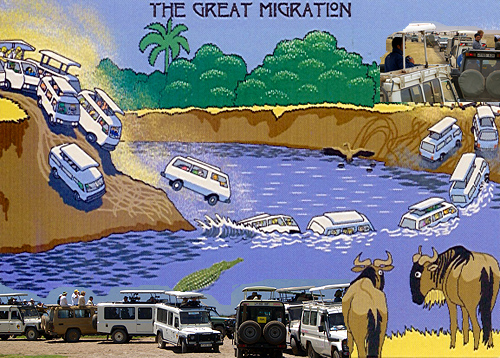
migrationcongestionThanks below to a great client, John Kohnstamm!

The common Toyorangabeast (Toyus rangus touristanus) is an invasive species to East Africa first observed in the mid 1900’s.

Migrating from Northern Europe and East Asia, it was first believed to be one species. On closer examination and exhaustive genetic testing performed by scientist from the Toyus Rangus society of the Invasive species center at the University of Scotland in Edinborough, it was proven that in fact they are two distinct species: Rangus arrogantus, the first to evolve and the much more common Toyus copicatus that didn’t occur until later in the century.

The two are easily identifiable. The Rangus occur in brighter colors, usually white or yellow. They tend to be much more finicky and only present themselves during bright daylight hours. Never at dawn and certainly not at dusk.

The more common Toyus occur in drab colors, usually brown or dull green. They are a more robust creature and are known to have great endurance. Usually present early in the morning and late into dusk they have been observed at great speeds racing from the Ngorongoro crater at sunset.

These beasts tend to migrate with the great migrating herds of East Africa. They occur most densely where predatory animals are present. They nosily come together at these sites where they immediately become quiet and docile.

To the practiced observer, it is easy to hear their calming clicks and oos and ahs that scientist believe is caused by the symbiotic relationship between Toyorangabeast and the predatory animals. The effect is, however only temporary and the Toyorangabeasts become restless and disperse most likely never to come together in the same group again.

Getting Grandma’s Necklace

Getting Grandma’s Necklace

gettinggrandmasnecklaceIf you want to dispose of Grandma’s necklace, you better do it before August.

Last week Fish & Wildlife inched towards final new August regulations on the sale and use of ivory within the U.S. Orchestras were elated, piano vendors were piqued, and the Wall Street Journal was furious.

The Thursday announcement is based on agency findings made the previous month but only published last week.

The Thursday announcement relaxed previously proposed regulations that would have prevented any musical instrument composed of endangered animal products (like ivory piano keys) to be brought into or taken out of the U.S.

At the same time, though, the agency reenforced proposed regulations that will prevent any individual owner of ivory less than a hundred years old from selling or trading it, unless of course if it is part of a musical instrument.

Other petitioners, like museums seeking the ability to produce exhibitions that include foreign works of art (like ivory that are not musical instruments), were not addressed.

In claiming victory for its lobbying, The League of America Orchestras said the adjustment was “in response to urgent appeals from the League.”

At the same time the revised proposed regulations tightened restrictions on the commercial sale of pianos with ivory keys.

“These regulations … place a burden on the piano industry,” a leading blog contended.

And it might be time to quickly sell your grandma’s ivory on eBay. If current regulations hold to August when officially implemented, individual owners of ivory less than a century old will not be able to trade or sell their products.

This effects personal ownership of jewelry, for example, and would restrict an estate from liquidating such ivory items in probate. It would also forbid any commercial transactions, such as selling Grandma’s “newer” ivory necklaces on eBay.

The agency has yet to specify, though, how an old piece of ivory can be certified to be more than a hundred years old, and it’s very likely that most individual owners of old ivory will not have adequate documentation to be certified.

This infuriated the increasingly irrational Wall Street Journal which somehow bundled into its ire Botswana’s ban on hunting as well, concluding that these two actions will hasten elephant extinction.

In sum it looks like the August regulations will be pretty tough, stiffing capitalists (Grandma) while ameliorating socialists (community orchestras).

I like this attitude, but I remain skeptical that it will help solve the “elephant problem.” I worry that the increasingly complex regulations further American political interests while distracting real conservationists from the problem that there are too many elephants in our increasingly developed world.

If I’m right and this tedious and laborious march to August regulations is mostly political if a tad ideological, it’s not so bad in an era of center ring political fighting. But don’t forget that Obama had no qualms about issuing the only waiver ever for a Wisconsin politician to kill and import an endangered rhino.

Extracted from the bare knuckles of American politics, I wish Americans would focus more on the real problem: what to do about a contentious elephant population in a world where there are too many elephants.

Real and profound questions like should elephants be culled or poachers executed are much more important than whether Emily sells Grandma’s necklace.

On Safari: Roundup

On Safari: Roundup

migrationThe Kisiel Family safari ended with great drama this weekend. Here’s what happened and how future safaris might also achieve such success.

The sheer numbers were impressive: 90-95 lions (we had some controversy regarding counting cubs), 4 leopard, 4 cheetah, African Wild Cat (somewhat unusual); thousands of elephant; dozens of thousands of gazelle and antelope; hundreds of giraffe; and possibly more than a hundred thousand wildebeest and zebra.

And there were five or six specifically dramatic events that really made the trip stand out. Why?

I’m afraid the most important answer may be a very simple one: the Kisiel’s arranged a safari that was a third longer than the average. They were on safari for 13 days and nights. The mean today is just around ten days.

That small additional time, in my estimation, is worth far more than it seems. It relieves the pressure on our planning and means that optimizing opportunities is much easier.

Enthusiasm. You’ve got to have enthusiasm to do a safari right, and the Kisiel’s did! Every time I offered a long day or a short day, they chose a long day. Quite simply, this like the length of the overall safari increases our opportunities.

Almost as important was global warming, and that of course, will continue. In the tropics in Africa global warming means far more severe weather, and that means when it rains it rains more. Tanzania’s northern safari circuit is a rainy circuit and so in an ironic way, it benefits from global warming.

(It’s also suffering. Flooding is taking a serious toll: see my blog last year about the destruction of Lake Manyara’s national park entrance.)

Finally, there’s luck. Yes, it’s true to some degree that you make your own luck, and I guess the Kisiel’s are masters!

STAMPEDING BUF
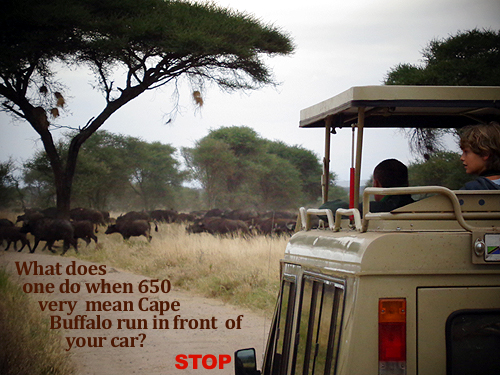
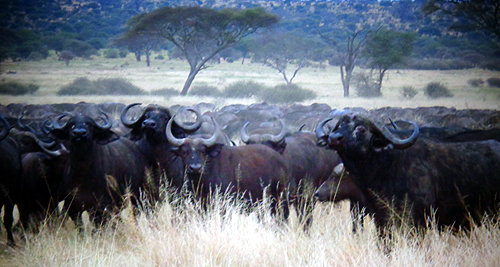
At least 650 literally stampeding African Buffalo stopped our attempted quick exit from Tarangire National Park as they stormed in front of us just before the main road bridge around 9 a.m. one morning.

Buffalo numbers are hard to come by since conservation organizations grew disinterested as their populations increased throughout the last quarter century. But in the last five years or so, populations have stabilized or declined and led to some troubling research about viruses and other diseases the African Buffalo seems to be spreading.

At the beginning of the noticeable decline, lion researcher Craig Packard identified a virus that was weakening if not killing many buffalo (which subsequently led to lions dying that were taking advantage of the weakened population and succombing to the same virus).

Packard’s study inspired other research and more recent findings by the National Institute’s of Health and veterinarian scientists at the University of Pretoria have documented both viral and bacterial infections that seem to be spreading continent-wide among the Buf.

Large groups of buffalo are common because they are a close herding animal. But we have come to presume a large group is around a hundred, and this was six or seven times larger.

In addition to just the great drama of seeing this it motivates us to return to current research to try to determine if this was simply a very rare anomaly or something more meaningful.

FLAMINGO FLYING CARPET
East Africa has both the greater and lesser flamingo, the latter being more pink but considerably smaller. Throughout the continent the lesser flamingo is considered “near-threatened” because of habitat degradation and erosion. (The greater flamingo has a much larger range and considerably greater numbers and is still considered healthy.)

I recall in the 1970s a number of East Africa lakes were completely saturated with lesser flamingoes: Nakuru, Baringo, Elementaita, Bogoria and Manyara in particular.

If you’ve seen the 1985 movie Out of Africa and sat through the credits at the end of the film, you’ll see an unending stream of flamingoes overflown by the camera aircraft.

But flamingo are very sensitive to the alkalinity of the water they require. Their entire food source is a small shrimp that feeds on a certain type of algae. Too much rain or drainage of their lakes alters this sensitive dynamic. Global warming and agricultural development have noticeably impacted what we’ve seen on safari lately.

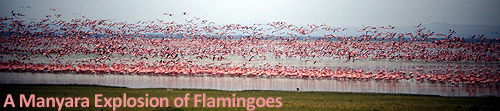
Until this trip! We pulled into the south end of Lake Manyara and witnessed one of the greatest collections of flamingos I can remember since the late 1970s. At one point a mass too large for me to estimate took off coloring nearly our entire field of vision.

This end of Lake Manyara has undergone a radical agricultural transformation in the last ten years that has led to an explosion of rice and sugar cane farming. Because it has so positively transformed the communities here, it was hard to criticize. Has global warming actually balanced out this dynamic, at least in Lake Manyara?

CHEETAH ON CAR
If global warming and the resultant more rain in the highlands is helping Manyara, it may be harming parts of the Serengeti.

Global warming isn’t just more rain as the ice caps melt. It’s also more severe droughts. Really, it’s better to recognize global warming as making weather more severe, rain and drought. And that’s what happened to us in the Serengeti. It was particularly disappointing for me when a completely unusual dust storm in the southeast Serengeti prevented us from visiting the area.

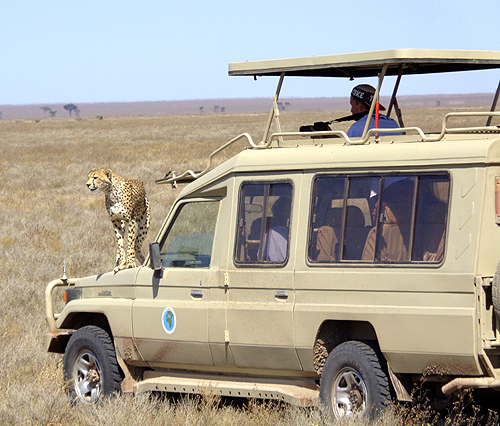
But the karma was with us, and the extra time we had to game drive in the park’s southwest led to a young male cheetah jumping on our car. In the car was Camden Reiss and it was his birthday!

It’s not unusual for cheetah, mostly male, to do this. They want a better view and I believe are among the most inquisitive of the big cats.

THE MIGRATION
Everyone wants to see the migration, of course, and the amount of disinformation in the media and travel industry constantly dumbfounds me.

I’ve written so much about this, rather than link you to a dozen previous blogs simply click the Index tab to the right for the list of posts. Historically at this time of the year the migration would mostly be in Kenya, and in fact Kenyan lodges and hoteliers reported a mass arrival very early this year, in late May.

But when we arrived the central Serengeti about a week ago, bingo!

Now it’s very hard for any first-time visitor to judge if they’ve really seen the migration or not. Even those of us guides with decades of experience struggle with estimating large scenes of animals.

I figured we saw about 20,000 animals, and that was plenty enough to fill the plains in our view. Steve Taylor, guiding for EWT at the same time, reported the same situation when he was in Seronera a couple days before us.

Why? That was simple. There had been unusual rains and the grass was green. Wilde do not hard-wire migrate like birds. They move where there’s food, and there was plenty in and around Seronera.

But it wasn’t over when we moved north! On our last day we saw considerably more wilde and witnessed crocs pulling down two wildebeest from a daring and dramatic file of animals trying to cross the Mara River.

Excitement unbelievable, but for me, confusion, too. Were the Kenyans bluffing?

No. I spoke subsequently to both tourists and hoteliers and I believe the Kenyans, and I believe that the great majority of the migration is in Kenya’s Mara right now.

But the rains have been extraordinary and the population is healthy, and right now a large and visible part of the migration is strung all the way from northern Tanzania back to Seronera in the center of the park. It probably won’t stay much longer, as the rains do seem to be subsiding in the south. But I won’t be surprised if next year’s Frankfurt Zoological Society estimate of the population breaks records.

LION SOCIOLOGY LESSON
On that same day that we saw the river crossing, we also witnessed what to me may be the highlight of the trip. I wouldn’t expect my clients to embrace this conclusion, but this was a very rare and important experience.

We watched first-hand a mother lioness trying to kick out one of her sons from the pride. It’s a long understood part of lion sociology and biology that the mother has to do this before the son gets bigger than she is. Full grown male lions are 50% larger than females.

And there are plenty of documented videos to show it. But I had never personally witnessed it in the wild.

It’s always difficult to predict anything in the wild. But with sufficient time and patience, together with careful planning, most safaris can achieve the wonder and drama that the Kisiel family enjoyed!

Safari Njema!

On Safari: Migration Drama

On Safari: Migration Drama

wildemigrationThe Kisiel family’s last two days on safari featured the great migration at its best, including a croc feast of a wildebeest river crossing.

We expected to find the migration in the north, and we did. We flew from the central Serengeti into the far northern Serengeti landing virtually in sight of the Kenyan border. Although our lovely Kuria Hills tented lodge was a half hour south of here, we spent most of the time game viewing in the north.

Five minutes after we left the airstrip in the Mara Region of northern Tanzania we were skirting the south and west banks of the great Mara river. Crocs so big I call them “dinosaur crocs” were everywhere, waiting for one of the two meals they eat each year.

We saw one monster that John Kohnstamm said was 24 feet long. Close. But on that first day, no wildebeest near the river that we could find. So we headed south to camp through absolutely beautiful Mara grasslands and rolling hills.

That afternoon we saw our first oribi, not something many safaris see. It’s a gorgeous little, somewhat hyper antelope with large black face spots.

We also saw a number of wonderful birds in addition to the common headliners like the lilac breasted roller. Add the gorgeous cliff chat, rosy-breasted lark, perhaps a hundred red-cheeked cordon bleu among many others.

The next morning – the Kisiel Family’s last morning – we packed a picnic lunch and left before dawn.

We stopped on a ridge that looked north into Kenya and waited for the African sunrise. We had flushed out many square-tailed nightjars having listened to their woeful scream in the night. Then about ten minutes before dawn the omnipresent ring-necked dove began to fill the veld from horizon to horizon with its hypnotic song.

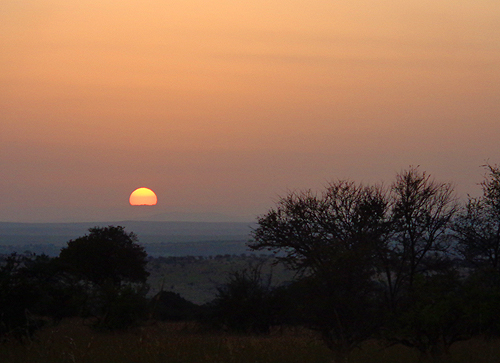
And then a few minutes before sunrise the whole veld exploded with bird song, and Africa’s giant sun peaked up blaring a perfect red-orange orb through the thick morning haze.
one old serengeti tree.690
We traveled all the way past the southern Sand River border of Kenya and began searching along the Sand River. There we saw what will always be one of my most precious safari events.

We were driving somewhat hidden in the heavy bush at the top of the 15-foot embankment of the Sand River, which unlike the Mara, usually has an all sand bottom with good and copious amounts of water flowing under the sand.

But there has been so much rain that there were actual streams in the sand river bottom.

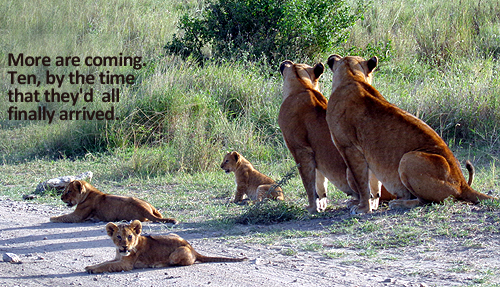
We came upon a lion pride eating a recently killed wildebeest. There were two lionesses with seven cubs in two different litters, plus a young and magnificent pridemaster, plus a slightly younger juvenile male that already was bigger than Mom and was sprouting a wonderful new mane.

What was specially interesting was the fighting that we watched between Mom and this juvenile male. She would not let him eat.

He could easily have whooped her, since he was bigger and stronger, but her motherly instincts knew it was time for him to be kicked out of the pride. Not too long before we had seen two other males about his age, sulking on an anthill starving as a ring of wildebeest surrounded them.

Young males don’t know how to hunt. They have to teach themselves, and if they don’t, they starve. It’s the reason there are more females in the overall lion population than males.

So the juvenile male that had somehow managed to stay with the pride was trying a new tact. But it wasn’t working.

Any move he’d make, even the slowest and most methodical attempt to raise his leg on the embankment to scoot away, and Mom would snarl and attack him. Finally, he slipped away.

We had seen in about twenty minutes what wildlife photographers take years to document.

But believe it or not, the best was yet to come.

Thinking we’d seen it all, sated with experiences, we began to head home along the river. Lo and behold there was a small group of wildebeest and zebra that looked like they were ready to cross the great Mara River.

And below them, to the right and left and side and bottom, were giant crocs waiting. They were steady in the water despite the strong current, or on the embankment, or on the island rocks, just waiting … waiting.

So… we did, too.

Roy Stockwell kept saying to the wilde across the river, “Come ‘on guys, the grass is much sweeter on this side!”

Whether it was Roy or not, they finally came, in a sudden leap from the bank followed by leaps across the great river.

The crocs moved in from every side. One dinosaur sailed straight for a calve and pulled it under and another on the other side took down a yearling.

Both started screaming and the mother of the calve turned around and jumped back in the river, literally pouncing on top of the croc, but it was no use. He took it under and she leaped exhausted back onto the shore.

The larger yearling drew many big crocs as they started vying among themselves for the feast.

Camden Reiss, like many many kids and adults as well, didn’t like what he saw. And it is a terrible moment, and yet when we as the real king of the beasts step back to let nature do her thing, we realize there are as many wonders as catastrophes.

“Can’t get better than this!” Grandpa shouted.

He was right! We were headed home.
serengetisunrise

On Safari: Unexpected Migration

On Safari: Unexpected Migration

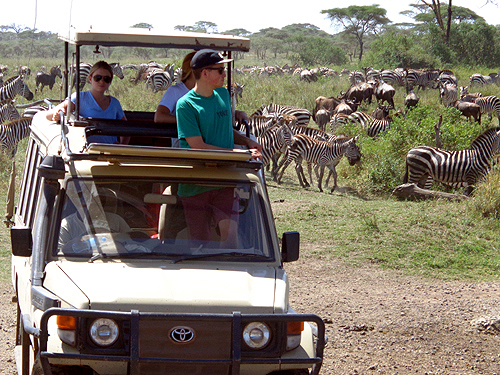
seronerazebraAt Seronera for two days we were engulfed by part of the wildebeest migration, something totally unexpected.

Historically the wildebeest would be much further north by late June/early July, and the reports out of Kenya were that they were. In fact, the crossing of the Sand River from Tanzania to Kenya was reported in early May.

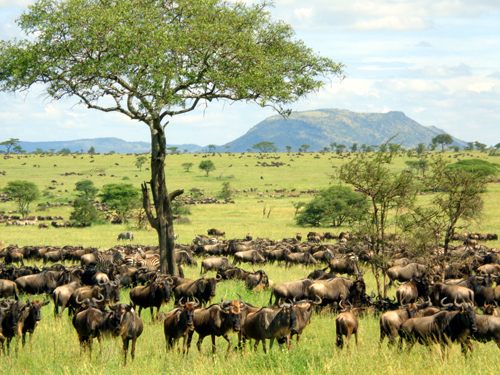
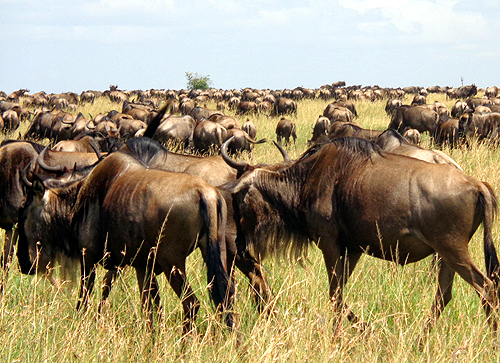
But here we were, 120 miles further south, surrounded by wildebeest and zebra day and night. The saturation of the herds on the veld extended from just south of our camp at the northern end of Rongai, just south of Mawe Meupe and north to the western corridor junction road.

The western portion was bordered by the Moru Kopjes and the eastern portion ended before the Maasai kopjes.

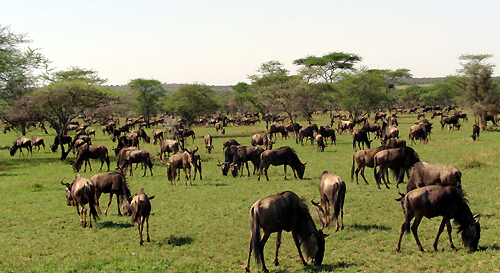
It’s very hard to estimate the numbers but I’d guess between 50,000 and 100,000 animals, or about one-fiftieth to one-twenty-fifth of the entire population of zebra and wildebeest in the Serengeti/Ngorongoro/Mara ecosystem. Where were the others, the 2+ million?

morearecomingAll accounts suggested they were well into Kenya and that they had moved there quickly and densely through the eastern edge of the Serengeti. But numbers like this are hard to grasp, particularly if the veld is the least broken by hills or forests.

In effect that small fraction of the wildebeest was a grand migration for us, and it wasn’t at all expected. Late and heavy rains has made the entire veld from Seronera north green. On our charter flight today to the border with Kenya, there was hardly a piece of land that wasn’t green.

Unlike birds, animal migrations are triggered strictly by food. If the food source is good, as it apparently was for the tale end of the great migration this year, they will linger and stay behind.

During our two days in the area we also saw two dozen lion, a hundred or more elephant, a leopard with a new kill in a tree, countless hyaena and many defassa waterbuck and hartebeest. We traveled south into the Moru Kopjes and saw little game but enjoyed the sacred stories of the Maasai at Ngong Rock and the morani cave paintings.

Seronera has always been an exceptional place for game viewing, but as a tourist you’ll pay handsomely for it, and not in dollars. It’s very crowded. At each sighting of a lion or leopard there could easily be 20 cars.

We have enjoyed a safari so far in remote and beautiful places with good game viewing and very few other cars. But it’s impossible to do this in Seronera, and I personally feel Seronera should not be missed.

The wilderness today in Africa has been saved by tourism. Seronera represents a core of intense game viewing with a multitude of accommodation alternatives. One positive way to look at it is that no one would have the opportunity of visiting any part of the Serengeti if the revenue received from visitors going to Seronera weren’t included.

The Seronera river valley is where we saw a dramatic half hour scene of 3-400 zebra cautiously drinking from the river then exploding out when the least sign of danger was sensed. Only here in the central Serengeti is a river system large enough to attract so many resident animals.

It’s also a reality check. Lion ignore us in the remote Kusini Plains where there’s no other vehicles but our own. But they come from generations of animals that have been habituated to cars, principally in places like Seronera.

So I wouldn’t exclude Seronera from an itinerary, and that attitude is what allowed us to truly experience the great migration when it had neither been expected or promised. That was luck, certainly explained in part by climate change, but mostly by where the extended rains fell.

And it seemed they fell right on our camp just before we arrived!

Stay tuned! On to the great Serengeti North!
seroneramigration

On Safari: Serengeti Dust Storm

On Safari: Serengeti Dust Storm

CheetahOnCarOn safari: Serengeti Dust Storm

A terrific dust storm swooped down from the crater highlands onto the Serengeti aborting our plans to visit a number of sights on the southeastern plains.

One of my personally most favorite days on safari is when we leave Ngorongoro for the Serengeti. Whether it’s during the rainy season when we’ll travel through hundreds of thousands of animals, or the dry season when the dusty plains reveal fascinating secrets, it’s hard to beat.

I normally stop just after the crater rim to demonstrate the symbiotic evolution of the giraffe and the whistling thorn tree, then my exciting lecture on early man at Olduvai Gorge, then the mysterious walking hills of the Shifting Sands.

And then the immense seemingly endless Lemuta plains with views you can’t imagine.

So yesterday we struggled out of the cars on the crater rim walking to a grove of whistling thorns against a gale force wind. It wasn’t just that it was cold, it was so strong.

When we arrived shortly thereafter at Olduvai I knew I’d have to rethink the day. The wind was at least 40mph and the dust was obscuring everything. The gorge and the museum were packed solid with visitors, so we decided to leave early.

At Shifting Sands the dust was so bad that Sophi and Hadley, the two teenage girls, wouldn’t leave the vehicles, and that was my sign that the day had to be replaced.

It wasn’t that I was worried we’d get lost in the dust, but there were no views, and it was near impossible to open your mouth without being filled with dust no matter what direction you turned.

So we turned back to the main road and regrouped. It was tough to give the day up, because the storm ended at the main road, confined it seemed to the eastern half of the Serengeti. But we continued to our lodge at Ndutu, arriving 5 hours early but to a very welcoming staff, clear air and cold beer!

On the impromptu afternoon game drive we saw the Masek pride of lions which included three sets of cubs, the youngest about six weeks old. I really wonder in this start of the dry season if those cubs will make it.

We then watched a puff adder wiggle across the entire lake bed of Masek! It was accompanied by double-banded coursers and an immature augur buzzard I presume making sure it didn’t go astray.

This morning we headed out to find cheetah, and boy did we! Two young adult brothers gave us every angle of pose and then jumped on the car where the kids were! College sophomore Jeffrey was right up there popped through the raised roof to photograph its every whisker!

“Good Godfrey!” Grandpa Mark exclaimed. “It can’t get better than this!”

We then watched a larger female cheetah on a failed hunt of Thompson’s gazelle. Only about 20% of cat hunts are successful, but even so it was exciting.

It’s extremely dry around Ndutu where we currently are. On our trek to Hidden Valley I was surprised there wasn’t a drop of water left. And yet the grasses are still a little bit green. It must be the dry, cold wind.

We now head north for two nights in the central Serengeti before two nights in the far north, where I expect it will be greener and filled with animals. So stay tuned! But I’m leaving internet availability so it may be several extra days before I can let you know what happened.
KidDrivesCar

On Safari: Cold Crater Lions

On Safari: Cold Crater Lions

ColdintheCraterOn Safari: Crater Lions

Like everywhere, Ngorongoro lions are struggling. The 9-11 prides of 100-110 lion have probably shrunk to two-thirds to three-quarters that.

That’s my anecdotal guess and I’m not sure anyone’s done a real count recently. But as we game drove down the Sopa side road from our exclusive camp at Lemala, we immediately encountered a female from the Big Tree pride who was really beaten up.

She had blood on her face and haunches, and often that means nothing more than that she was just at the kill. But the right side of her face was horribly scratched and that meant much more, and her belly wasn’t very full. When she walked she limped.

That was our first lion in the crater. We’d see another 14 before the day was over, including the magnificently maned lion of the Muinge River pride.

All that we saw looked fabulously healthy, with big bellies suggesting we’d arrived one day late to see some action. In fact, one of the Big Tree males lumbered across in front of us into the veld and took our viewing right with him to an earlier kill, as he scattered the hyaena and jackal.

But something was wrong, or perhaps better said, different than before. Traditionally there are many, many more females than males, because of the male’s violent competition with one another and the fact that they’re often kicked out of the pride before they know how to hunt.

But during our Kisiel Family Safari, and consistent with what I’ve been slowly seeing over the last few years, the ratio of males to females is increasing.

Males are 50% bigger and stronger than females, so the obvious conclusion is that something is stressing the environment and the bigger and stronger are out surviving the weaker. Is this somehow related to global warming, or is it as some researchers have suggested more mankind meanness.

There have been more and more documented cases of lion poisoning at the fringes of national parks as the peripheral human populations increase and develop. But while that might explain East African declines, it doesn’t well explain southern African declines where human populations have achieved a more or less balance with the remaining wilderness years ago.

Other researchers like Craig Packard have documented a disease carried by buffalo that weakens the buffalo but doesn’t kill it. But when lions hunt the weakened buffalo and then eat the diseased meat, they die.

We talked a lot about this during our game drives in the crater, because lions really dominated the game viewing. This is pretty natural in the dry season, but even so, I think we had an unusual number of sightings and events.

The crater was cold! My little thermometer said the temperature just outside our tents on the down road from Sopa reached 46F for a low and never got above 60F. In part this was because it was so overcast. Down on the crater floor the sun broke through often and it was much warmer, probably ten degrees warmer.

Despite the cold, though, my family loved their exclusive Lemala camp. Every spacious tent had a propane heater, we had hot water on demand for showers and shaving, and a lovely hot water bottle was stuck into everyone’s wonderful beds!

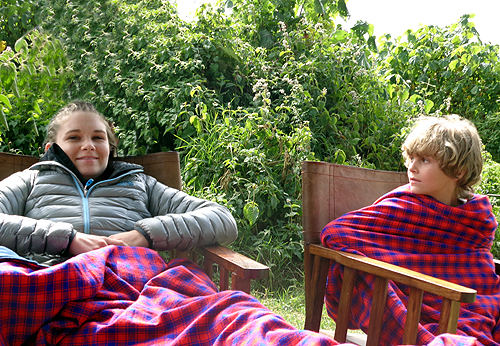
Maasai blankets were everywhere, and everyone used them!

The dry season in the crater begins this way, with very cold temperatures, the coldest of the year. But with sufficient hot chocolate personally delivered to their tent each morning, 8-year old Nick and 11-year old Camden couldn’t have been more pleased!

“It can’t get better than this!” Grandpa Mark exclaimed.

We’ll see.

The view from my tent just below the crater rim.

On Safari: Too Close for Comfort

On Safari: Too Close for Comfort

TooCloseThree leopards, hundreds of elephant, five lion, dozens of giraffe and an unexpectedly large number of zebra featured the Kisiel Family’s first two days on safari.

Tarangire is usually the first game park I take my families to. It’s relatively close to Arusha, never fails to produce the best elephant viewing on the continent regardless of the time of year, and is simply a great introduction to game viewing.

That proved true, again, and it also lets me explain the complex situation that exists with elephant, today.

In my view there are too many elephant. That doesn’t mean there are more elephant than ever, or that there isn’t a serious problem of poaching, but it means that the habitat left to ele today is simply not large enough for them.

This seemed self-evident to me about a decade ago when normal elephant behaviors began to break down, and it was most demonstrable in Tarangire.

In the past elephant families rarely mixed. If there was a water hole or wallow of interest by multiple families, they each too their turn, giving wide berth to the other families.

Every day in Tarangire multiple families are seen together. And there is obvious agitation but ultimate acceptance that multiple families must at least temporarily merge. Although it’s hard to use anecdotal evidence and my observations are no means rigorous science, I definitely believe what I and my clients see every single time I come here is an indication there are too many ele.

And, of course, all you have to do is pull up some of the local chatter and blogs of farmers, clergymen and school teachers who live near ele reserves like Tarangire.

So this is a time throughout East Africa to be particularly cautious about ele.

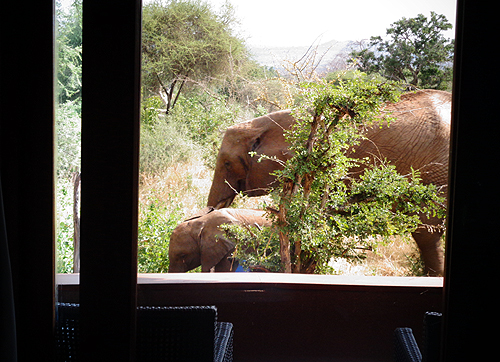
So you can imagine how I felt when the manager and staff of Tarangire Sopa Lodge where we’re staying seemed incapable of keeping three ele from nearly entering reception, playing around with the lawn hose, and walking up and down the balconies of the rooms as if they were checking the serial numbers on the patio windows.

This is courting disaster. And it’s hard to explain this to my clients. The kids, especially, thought it was “cool” and they’re right, it was thrilling and clearly not something you’d expect.

But it’s also dangerous. One security man threw a few rocks at the ele, but no one turned off the water, no one seemed to have a elephant horn (a loud screaming high pressure device that sometimes works) and no one offered or perhaps was trained to shot a blank above their heads.

So they lingered throughout most of the afternoon, making it difficult for me to keep the kids out of their sight.

We had a great time in Tarangire, and I’m glad to say a safe one as well. We had wonderful ele encounters out on the game drives, getting remarkable close to those we judged safe.

But if lodges and camps can’t figure out a way to keep familiarity at bay, disaster is around the next corner.

As she walked past my verandah and over to the verandah where Ryan, Hadley, Sophie and Cam were watching her, I remembered a number of horrible stories about what elephants can do and have done to me and my clients.

/>

On Safari: First Impressions

On Safari: First Impressions

WhatDoFirstDayWhat do kids do the first morning after arriving in Africa at 2 a.m.?

Normally, sleep. In fact sleep so deeply, whether they’ve slept or not on the planes, that they wake up completely disoriented.

But not so my Kisiel Family! Playing the numbers, I slept a little bit more than usual, since I met them on the now very popular Turkish Airlines flight that daily arrives Kilimanjaro at 1:10a.

Immigration and customs is pretty easy at 1:30a at night in Kilimanjaro, and so we were on our way to Serena’s Lake Duluti Lodge hardly a half hour after the plane landed. It was about a 40-minute drive … in the dark … but young Nicholas positioned himself in the front seat, stiffened his back and followed the car’s headlights on the pavement for any trace whatever of lion.

Fortunately for Arusha residents there aren’t any, but that didn’t deter Nicholas from his half-hour vigil.

The two-lane paved road from the airport is fine, with numerous speed bumps so no one feels the least uneasy except that it’s so dark.

Turning off into any of the lodges in the area right around Arusha, though, means the first experience on a very badly kept dirt or gravel road. And that wakes everyone up. Our experience, though, lasted all of a few minutes.

I already had the keys to the room so quickly assembled the 14 in the family, aged from 6 to … well, grandparents’ age … and explained simple things like having to double-flush the toilet and keeping a flashlight at your side at all times because of Arusha’s constant and troubling power outages.

And I sent them to bed telling them not to be scared of the hadada ibis in the morning, whose sunrise call sounds for all the world like Napoleon’s charge at Waterloo.

Three a.m. rarely needs more encouragement for hitting the sack, but it was in the middle of the American/Ghana world cup match. I watched it for 13 seconds before falling asleep.

It’s always a delight sharing my clients’ experiences of their first waking moment in Africa. More and more flights are arriving at night, so there really isn’t a lot of orientation available until after you’ve gone to bed, slept, and then are awakened by the honking of the ibis.

The word most clients use to describe their first lighted scene is “jungle.” It’s not wholly accurate, of course, since it’s much colder than a real jungle. Today we woke up to temperatures in the lower 60s.

That’s because this area around Arusha, the foothills of Africa’s fifth highest mountain, Meru, are a mile high. But looking out over your room’s deck, it does look like a jungle.

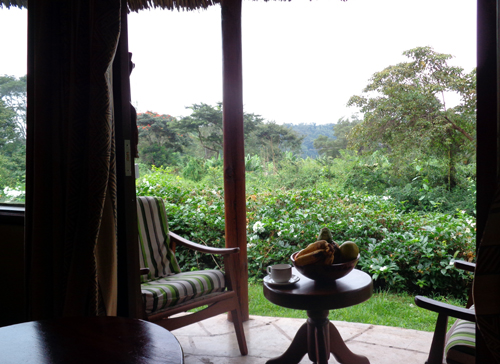
Our particular view is of a beautifully landscaped hedge of hibiscus, bougainvillea, and forget-me-nots, separating the wild and thick bush beyond from the individual rooms.

And that includes lots of wild bananas, massive mango and mahogany trees, a peppering of acacia (we get many, many more of those on the veld) and every once in a while a glimpse of the crater lake Duluti.

I was enjoying my coffee on my deck, trying to delay going too early to the breakfast room since I expected they would all come quite late.

But not most of the Kisiel family! They were down early, eating and enjoying their first morning long before I expected!

On to Tarangire! Stay tuned!

On Safari: America from Afear

On Safari: America from Afear

whichismoreexplosiveI and Kenyans woke this morning to the news of a bloody terrorist attack near Lamu. But what worries us even even more is that the U.S. might restart the Iraqi war.

CNN’s “State of the Union” is the most widely watched American show in Kenya. It comes on live at Sunday dinner time.

So Kenyans who woke the next morning to actual terrorism watched with even greater horror as Sen. Lindsay Graham called for a virtual reverse jihad.

The U.S. Right spent Sunday warning of a “califate” that would be a super threat to the U.S., an ISIS that would rebomb the World Trade Center.

This is utter nonsense. Don’t take the bait, America. What is going on in Iraq is a civil war, not global jihad.

Nairobi’s leading newspaper in its leading editorial this morning claimed the resurgence of war in Iraq “serves as graphic testimony that Western military adventurism in the region not only failed to extinguish the flames of extremism, but might have added fuel to the fire.”

“Stepping into the bloodbath of Iraq would be madness,” was the headline in one of London’s leading Sunday newspapers.

Why are we more afraid of terrorism than driving over a bridge ready to collapse or dying of cancer?

As I wind up my three-day visit to Nairobi I realize how horribly warped American paranoia of terrorism is and yet how impossible it seems to remedy.

Terrorism is increasing. The Rand Corporation’s most recent report shows a 58% increase in significant jihadist groups, a doubling of fighters and a tripling of attacks.

Obama’s own government report, The Country Reports on Terrorism submitted to Congress on April 30 claims terrorist attacks increased by nearly 50% from 6,700 to 9,700 from 2012 to 2013, resulting in 18,000 murders and 33,000 serious injuries.

There’s no reason to doubt these numbers. And here are some more:

The number of homicides in the U.S. averages between 13 and 15,000/year, or roughly 80% the number of worldwide terrorist killings. The number of highway fatalities in the U.S. annually is nearly twice the fatalities caused by worldwide terrorism. The numbers of U.S. homicides or highway fatalities in relation to U.S. fatalities caused by terrorism doesn’t exist, because since the Boston Marathon bomber, there haven’t been any.

What are we afraid of? Or more specifically, why do we fear terrorism more than the highway or the gunman in the classroom?

Kenya has had an unfair share of terrorism fatalities, injuries and damaged economies, because it has been targeted by terrorist groups for its proxy war against al-Shabaab in Somalia, a war that it would not have chosen to do, nor been capable of doing, without serious pressure and military assistance from the west, primarily the U.S. and France.

So as Kenya’s rate of terrorist harm has increased dramatically in just the last few years, France’s and the U.S.’ has declined.

Yet there is a palpabale fear in the U.S. that this is not the case. That fear is the success of terrorism, making its victims’ communities feel threatened out of proportion to the facts.

Imagine if the trillion plus dollars spent on the wars of retribution and against terrorism in Iraq and Afghanistan had been directed instead to America’s leading cause of death, cancer and heart disease, both which average 25 times greater than the worldwide deaths from terrorism.

With that amount of money might we have already achieved a robot car whose driver, even if drunk, would be unable to cause an accident thereby reducing American fatalities, currently 2-3 times worldwide fatalities caused by terrorism?

Clearly it’s not the deaths that bother us. So it’s not the threat of fatalities that must bother us, it’s the challenge to our power. A relatively few deaths caused by terrorism create a proportionately greater fear and insecurity.

DUIs, suicides, cancer, school shootings … we’ve learned to live with and do not seem to threaten our way of life. We must learn to live with terrorism in the same way. As an actual threat, it’s actually much, much less.

Kenyans know this. The country is booming (except for tourism). Everything from Google to IBM to Caterpillar to GM is investing heavily here. The energy of its youth, the rapidly increasing level of education and the imaginative ways difficult problems are being solved is becoming a model for the world.

But the beautiful white sand beaches, among the finest in the world, and in the incomparable wilderness and big game are being abandoned by world travelers.

There has not been a tourist assault death here in more than two years, nor an injury; nor have any foreign investors been bumped off or maimed.

Those are pretty good numbers for any business person. But as explained above, numbers mean little when it comes to scaring people. Terrorism, the wanton killing for ideological reasons, scares people more than potholes on I-80.

So as irrational as it may be that you will choose to visit New York instead of Nairobi, where any way you run the numbers your chances of being killed or hurt are much greater, you’ll feel better doing it.

And that’s why terrorism is so successful. And that’s why it’s more important than ever that we start to educate ourselves to the priorities of need we truly have.

Before terrorism wins against us all.