African Charlie

African Charlie

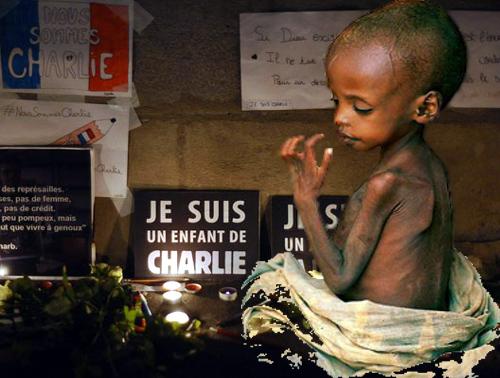
enfantducharliesLast week an unbelievable 2,000 people were killed by terrorists in Nigeria and a believable 17 were killed in France. Are you Charlie?

At the bottom is starvation. At the top is freedom of speech. Sometimes they seem unlinked, too far apart to have any meaning to one another.

But not today. Towards the top are Charlies arguing that without unfettered freedom of speech it’s not worth eating.

Towards the bottom are the jihadists who achieve power by delivering bread at the expense of a word against them.

Progressive Africans are as divided as modern westerners that free speech is so important, but African governments are much less so.

Often African apologists like myself see eating as a prerequisite to doing anything. Richard Dowden, Director of the Royal African Society, wrote today:

“I will not be joining ‘Je Suis Charlie’… these cartoonists did not … care about ordinary sincere believers who would have been deeply hurt by the violent dehumanised images of the founders of the great religions of the world.”

Dowden reminded us that many of Charlie Hebdo’s images “came close to the sort of cartoons that the Nazis drew to depict Jews in the 1930s.”

But Kwendo Opanga writing for Nairobi’s Daily Nation says, “But, somebody please educate me: does killing me and the innocents next to me make my killer a better person and my ghost or spirit a veritable tribute to contrition?”

In developing societies there is still a lot of illiteracy and below that, abject ignorance. In America lying exploits ignorance to manipulate the reigns of power but the checks of truth are powerful, too.

Developing societies have far fewer defenses against lying.

Ruling against South Africa’s Sunday Times attempt to reprint Danish cartoons offensive to Islam, High Court Judge Mohamed Jajbhay explained, “Although freedom of expression is fundamental in our democratic society, it is not a paramount value.”

Jajbhay went on to explain what might be a paramount value, such as human dignity, or … eating.

When hunger and poverty is being reduced, we focus ideas and theories that distinguish humans from other animals. That was the case for much of the last 30 or 40 years.

That 30 or 40 years was a good story… unless you live outside where it’s happened.

The global reduction in poverty came mostly from China and India, little in Africa. There was some stabilization of poverty increases in Africa, but particularly in areas of conflict, poverty increased substantially.

The difference between eating and starving is not well understood by the well fed. Those who eat less in this case know much more: Starving is the fuel of jihad.

Mosul is Iraq’s 3rd largest city and remains in control of jihadists, because of the massive development it was denied by the Baghdad government in the last decade.

That same story plays out again and again throughout Africa. Nigeria’s neglected northeast state is almost entirely today in the hands of jihadists, for the same reason as Mosul.

Cartoons are abstract, food is not. The starving may want as much freedom as those who eat plenty, but they won’t know until they stop starving.

Those with a few morsels in their mouths can dream about a better life. They, too, want the freedom to express themselves, and they grow livid with the understanding that those who denied them their bread have access to so many colored crayons.

Let the ideologues argue about ideas as they munch their croissants and sip their lattes. The real debate is less arrogant, much simpler: bread.
Other Major 2014 Stories

Other Major 2014 Stories

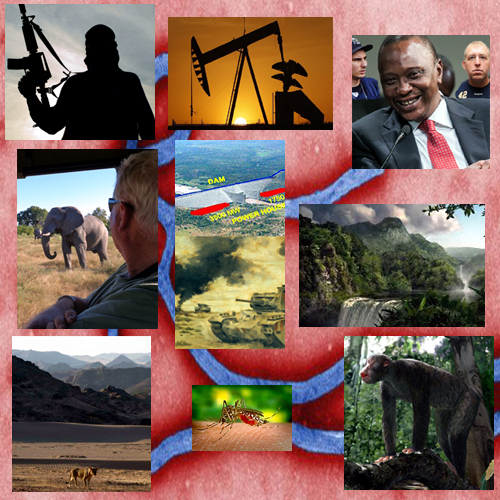
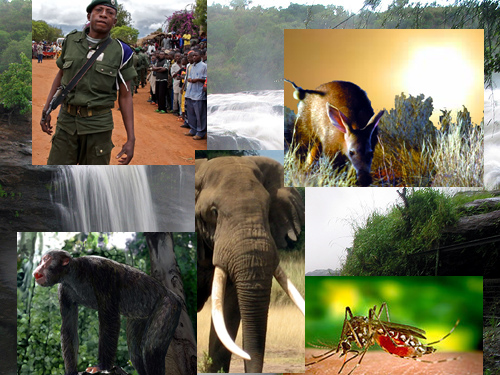
TopTenStoriesTense peace in The Congo, despair with ivory smuggling, ownership of The Nile, more pieces to the early man puzzle and break-through yellow fever research round out 2014’s Top Ten Stories.

[For the summary of all Top Ten Stories in 2014 click here.]

Actual war in The Congo is over: my # 5 Story for 2014. The central government of the DRC in Kinshasa, far far away from the conflict area, won and with massive international assistance peace will ultimately emerge.

For the time being the area is as ravaged as West Africa was and we know what that means. So even as enough peace has settled on the region conservationists are now reappearing to try to save some precious pieces of wilderness, gun battles are common.

But they are not organized, rather individuals who know nothing but war and whose leaders have disappeared. Oil companies are back prospecting, exiled leaders are returning and I believe a vicious conflict of nearly 30 years is truly ending.

Some will argue that increased elephant poaching and ivory smuggling should get greater attention than “just” my #6 Story for 2014, but as readers know, I feel this story has been massively exaggerated.

Elephant poaching is rising, and it’s distressing enough that some aid groups rightly so are withholding assistance until countries – particularly Tanzania – establish firm policy to stop the increase.

On the other hand, I believe there are too many elephants. When more attention is placed on protecting elephants than sustaining the development of the growing populations of increasingly unemployed people around the elephant habitats, the formula is set to increase poaching.

I take strong issue with those who compare today’s crisis with the one in the 1980s and 1990s. Back then it was corporate, global criminal action and the methods of stopping it were much easier than today. Today’s solution requires massive local economic reforms with a new emphasis on sustaining the development of the local communities at which today’s poaching originates.

Hiding in plane sight is one of Africa’s most important issues, potable water. Sub-Saharan Africa has always been a net arid land. Water has always been an issue.

Despite recent finds suggesting massive acquirers may exist below the Sahara itself, east and southern Africa remain dependent on the water sheds of the Great Rift Valley, and a huge percentage of these ultimately flow down The Nile towards Egypt.

When Britain was formulating independence for its many colonies in the area it structured a treaty in the 1950s that has governed the use of The Nile until today. But Ethiopia’s massive new dam, Tanzania’s recent announcements of its own new hydroelectric policy and Uganda’s incompetence at the headwaters at Lake Victoria are all on a terrible collision path.

Egypt has even threatened war, although that seems almost comic. What is not humorous is the fact that contemporary society is draining the Nile fast, and my #7 Story for 2014 is the increasingly dangerous tension in the area as those countries involved seem unable to find a common policy.

Global warming is a global issue and might rightly be considered the world’s most important issue right now. I’ve written often about its effects in Africa, even those immediate ones that have effected me while on safari.

This year, however, scientists have finally concluded that it is global warming more than any other single dynamic that is reducing Africa’s great animal populations and at a rate not seen before.

It isn’t just the big and visible animals, of course, but I felt this the #8 Story of 2014 because it lends much explanation to why we are seeing fewer lions, why birth rates in endangered species are declining in the wild, why nocturnal animals in particular are on the decline, and perhaps even why elephant poaching is so high.

So many foreigners who travel on safari are rich, and most of the rich people of the world are conservative, and most of the conservative people of the world deny global warming. I hope that this connection might serve to change a few minds.

My #9 Story of 2014 is a wonderful discovery by a group of paleontologists working in East Africa on pre-hominin fossils.

For a long time the modest creature proconsul who lived as long as 25 million years ago was thought to be the precursor if not the actual “lca” [least common ancestor] to humans and apes.

The rub was that of the many proconsul fossils found none were from a forest environment where it is known both apes and man originated. This year it changed with new evidence that proconsul did exist in the forest. This may seem an arcane fact to many – it isn’t like a whole new species has been found – but it ties together so many presumptions about early man that it absolutely ranks in the top ten!

Finally, my #10 Story of 2014 is how new genetically overseen medicine has provided striking new opportunities to control one of Africa’s deadliest diseases, yellow fever.

Yellow fever is transmitted like malaria through a mosquito, but intricate new understandings of how it works is leading scientists to completely new methods of treating the disease. These are true break-through determinations and the opportunity at last of curing rather than just controlling yellow fever outbreaks have appeared on the horizon.

There are, of course, many other important stories in 2014, including the continuing rise of dictators, the tedious story of corruption, the buffoonery of South African politics and the increasing disengagement of China from Africa after several decades of intense involvement.

In some ways all important stories are linked to all other important stories and for the casual reader the excitement and intensity of my first top ten, albeit chosen by my own deeper interests, might hopefully lead you to a better understanding of Africa as a whole in 2014.

# 4 : Kenyatta Loosened

# 4 : Kenyatta Loosened

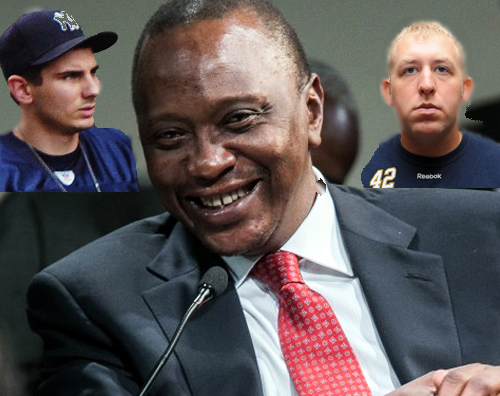
kenyattawilsonpantenaloThe President of Kenya is not quite a wholly free man, but a war criminal is no longer charged, and iniquity has trumped justice.

The dropping of charges against the President of Kenyatta is my # 4 Story for Africa in 2014. [For the summary of all Top Ten Stories in 2014 click here.]

Early last month the International Criminal Court at The Hague dropped all charges against Uhuru Kenyatta, the current President of Kenya, after a 5-year prosecution of crimes against humanity.

Kenyatta is guilty. Whether he should ever have been prosecuted is now another question, but the ICC’s flipflop is as much a statement on the feasibility of global justice as it is on Kenyatta’s culpability.

The President of Kenya, the Vice-President of Kenya and originally four other high officials plus a local journalist were all charged by the ICC for being the key masterminds in the horrible violence that wrecked Kenya following its flawed 2007/2008 national elections.

About 1200 people were slaughtered and equally awful were the near quarter million who were displaced of which more than a 100,000 remain displaced, today.

The agreement brokered by the U.S. and Britain between the warring parties established a coalition government that actually worked well and which mastered a new constitution that at least on paper is nothing short of fabulous.

Part of the agreement required Kenya to bring to justice all those responsible for the violence. A sub-agreement to that required the ICC to step in if Kenya was unable to accomplish this.

So despite all the creativity and work that Kenyans managed in creating a new society, in the end they were unable to bring themselves to charge the son of the first president, Jomo Kenyatta, who was quickly achieving national popularity especially among his ethnic group, the Kikuyu.

So the ICC stepped in as agreed and two years ago had a near irrefutable case against Uhuru Kenyatta and William Ruto, who in the meantime became freely elected as Kenya’s president and vice president.

Drip. Drip. Drip. One by one protected eye witnesses recounted or disappeared. Those who resisted were found murdered. Drip. Drip. Drip. Hard factual evidence began evaporating at The Hague.

No one believes that Kenya has either the power or wizardry to change the past, but it sure seems so. Earlier last month the prosecutor had to drop the case, because … well, there wasn’t one, anymore.

The rules of the ICC allow it to bring charges again, at any time, so technically Kenyatta has not been vindicated. Quite to the contrary, the animus of the ICC towards Kenyatta is palpable. The prosecutor has made no bones about why she dropped the case: it, literally, was stolen from her.

History has already crystalized. Kenyatta and his henchmen funded and orchestrated much of the horrible ethnic violence that followed the 2007/2008 election. In a Shakespearean twist classic to Kenyan mischievousness, most of the violence Kenyatta concocted was against the ethnic group of … Kenya’s vice president.

In a brilliant move several years ago, Kenyatta didn’t simply offer an olive leaf to his arch rival, the man who the ICC charged with being equally murderous against Kenyatta and his clans. Kenyatta offered him the second spot on the national stage.

By the way, charges have yet to be dropped against the Vice President, William Ruto, but everyone knows they will be.

Many in Kenya see this public and power alliance as retribution enough. Many in Kenya believe justice has been served and that it’s no business of a World Court thousands of miles away and culturally so dissident to judge Kenya’s recent past.

In fact, there is a growing movement in Africa to abandon the ICC altogether. The ICC is a complicated but I believe wonderful concept that has yet to win over the greatest world powers like the United States and China.

But for the great majority of the rest of the world it’s working pretty well. It’s had few convictions, but its masterful prosecutions and principle investigations have held many to account and I believe imprinted much of Africa with the need for justice.

So while even I can be convinced by the many Kenyans who believe that this horrible chapter of their history is closing, they leave one page unturned: It was they, the Kenyans, who invited the ICC in.

Kenyans themselves could have closed the book, but they couldn’t. So Kenyans themselves invited the ICC to take over. Then? Kenyans apparently connived and manipulated the witnesses and somehow stole the evidence.

That’s so behind-the-scenes, so Machiavellian, so deceptive that it in my opinion it’s immoral. No justice can come from this.

# 3 : Bust Not Boom

# 3 : Bust Not Boom

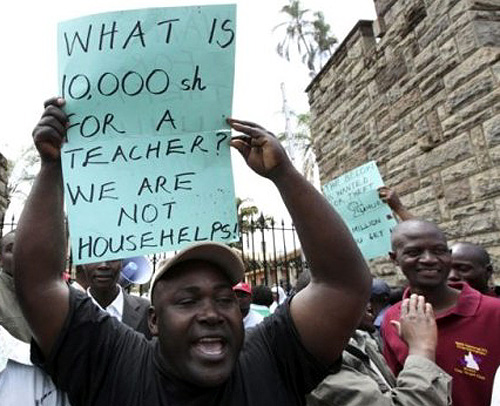
10000shteacherThe terrifying decline in energy prices will set the Third World back a half century, and this is the #3 Story of 2014 in Africa.

This one is hard for Americans to understand and it came quite late in the year. [For the summary of all Top Ten Stories in 2014 click here.]

The decline in energy prices is caused in large part by America’s boom in energy production both at the resource level (oil) and production level (wind and solar). Good thing, right?

What we didn’t realize was how quickly we were outpacing the rest of the world, and global impediments to trade and wealth distribution coral virtually all the benefits in North America.

Look simply to Europe to see how the decline in energy costs seriously threatens a new European recession and at the very least a partial breakup of the Eurozone.

The decline does have some negative effects here, mostly the stock market, but benefits like growth and consumer spending render a net positive.

It’s seriously different in Europe, India and China; and in the Third World it’s nothing less than terrifying.

During the Great Recession, countries like Kenya were proudly expounding that their growth rate year-to-year – which was much higher than the U.S. year-to-year – actually presented a horizon when the countries would achieve economic parity.

Before the Great recession in 2005, Kenya’s overall economy was about .14% of the U.S. That’s right, the U.S. economy was 700 times bigger than Kenya’s.

By last year Kenya had more than doubled its growth vis-a-vis America. America was only 300 times bigger. At this rate it would be only about a half century before Kenya caught up with America.

Many of us didn’t think this was a pipe dream. It seemed like the logical extension of a globalized economy based on capitalism. I’m no economist, but economists made the same mistake I made: we presumed this trend was fixed.

This year proved anything but, and next year will be stultifying. It’s likely that Kenya’s 300 times smaller than the U.S. economy this year will become 400 next year and perhaps return to 2005 by 2016.

Kenya is a perfect example for the entire Third World.

What does this mean?

I might not like capitalism, but I know that political progress, human freedoms and basically overall social happiness are in today’s world linked to an increasing economy. Whether it should be or not, doesn’t matter for this discussion. It just … is.

The Arab Spring can be explained with these metrics. The breakup of the Soviet Union, the expansion of Europe, the growing peace in Asia … all can be explained with these economic metrics. Even today’s possible reversal of the situation in the Ukraine, or the management of Iran’s nuclear threat can be postulated with these metrics.

So, the reverse?

Doesn’t take a rocket scientist to answer: increasing social instability, more war and civil disturbances, more refugees and massive global instability.

From America’s point of view an actuarial could attempt to predict the tipping point: when will America’s profound growth begin to eat itself because the rest of the world’s suffering becomes so profound it somehow effects us?

What a horrible assignment. Yet that’s the question, today, for Americans. And if you’re a Kenyan rather than an American it’s not an assignment worth waiting for.

Today Kenyan teachers are on strike. That in itself is nothing new. Public sector employees often strike in Kenya, especially teachers.

But note the issue, today: a starting salary of Ksh 10,000/month. That’s $111. A decade ago it was twice that, not because the shilling value was different but because the exchange rate – the value vis-a-vis America – was twice as good.

What does a government do when it has no money to pay teachers? The expected oil and gas revenues in Kenya declined by 50% this year while the price of energy doubled.

“The arrest, prosecution, and jailing of [social media bloggers criticizing the current Kenyan regime on] foolish Facebook posts acts as proof of the intolerant and dictatorial regime we are drifting into,” writes Kenyan activist, Gaitho, today.

Hunger. Then, Dictatorship. Then, finally a return to Ignorance. One follows the other as certain as I and my children begin to buy SUVs again because they’re now so affordable.

#2 : Terrorism is Down

#2 : Terrorism is Down

-Terrorism is declining in Africa, my #2 Story of 2014.

Terrorism is an almost meaningless word. At its root is war but differentiated from classic war by tactics of brutality and special cruelty.

Yet as we’ve seen in America this year, not even torture is easily associated with American definitions of terrorism. Conflict becomes terrorism in most people’s minds when they are so frightened that they react impulsively and thereby often become unable to defend themselves properly.

Napoleon at Waterloo or Bush at 9/11:

Scared to death. It’s a tactic that the Davids of the world retain as their most valuable, since today’s Goliath’s are incapable of being defeated by weapons other than fear.

Terrorism in Africa was definitely down in 2014 over recent years. From Mali to Egypt to Uganda to Mozambique, the incidents of terrorism were fewer in number than in 2013.

Readers of this blog will be focused on Kenya, because Americans control the narrative of terrorism in the world, and because Kenya is an African country they know more about than most other African countries.

Kenya has a close association to America. Its new constitution is modeled more by America’s than any single other country in the world. More recently Kenya became America’s proxy in the war in Somalia where Kenya remains the occupier and governor of a very fragile peace.

2013 was a horrible year for terrorism in Kenya. Since the horrible Westgate Mall attack in 2012, the Kenyan government began to react like most western governments when terrorized: clamp down.

Kenya beefed up security, increased military and police forces and began passing draconian laws. Much of this was counseled and paid for by America and undertaken exactly as America did after 9/11.

From my point of view, Kenya is even doing better than America after 9/11, because its reexamination of some of its draconian security laws is happening faster than it did in America.

America’s Patriot Act was enacted in October, 2001 and Obama ended all but 3 of its 10 provisions which will die if not renewed this year. Many persons myself included believe it had limited if any impact on reducing terrorism while greatly inhibiting personal liberties.

Kenya’s version of the Patriot Act was passed last month, but Kenya’s High Court suspended most of its key provisions Friday.

I hope the Kenyan High Court perseveres and strikes the law down for good, and I think there’s a good chance it will.

The Kenyan High Court is much more progressive than America’s Supreme Court. The Kenyan constitution, in fact, is more progressive than America’s.

The reason security has improved in Kenya, and the reason security improved in the U.S. after 9/11, had little to do with draconian new laws that culpable legislators hurried to enact.

The increased security was simply because of increased vigilance that was lacking before 9/11 or the Westgate Mall. We all know now how dismissive the Bush administration was of reports of imminent terrorism. Kenya’s dismissiveness may have been similar but was likely something else: lack of resources.

America and Britain have now beefed up Kenya’s resources, so while the explanation for why Kenya and the U.S. suffered dramatic attacks differs, renewed vigilence was similar in both countries, and given the west’s support, I think Kenya will continue to improve its security.

Should Kenya also put the kibosh on its horrible new security laws it will have also learned from America’s mistakes and will retain citizen liberties in a way America did not.

I think at that point the whole world – including America – will realize that America’s knee-jerk response to 9/11 was counter-productive and that “terrorism” is an eternal threat requiring measured but constant vigilance, not draconian security laws.

It’s fair to extrapolate Kenya’s experience to more or less all of Africa, with the notable exception of Nigeria.

Nigeria has never coalesced into a single republic well. The Biafran War was not a civil war like America’s. It was a much newer conflict of issues of ethnicity, class, privilege and income.

Boko Haram is the newest iteration of this contemporary conflict. There’s no question that its tactics are brutal and extreme, although the kidnaping of the school girls or the executions of young students is not a new technique in African conflicts.

Boko Haram’s ideologies are less global than local. This past weekend powerful Boko Haram forces overran a military base in Nigeria and could have easily taken more territory in neighboring Chad but didn’t.

Boko Haram is on the ascent because the Lagos government is on the decline. Crippled by a falling oil price as much as weak governance, Nigeria’s threat from Boko Haram is a serious internal one that ought not be extrapolated to Africa as a whole.

No conflict, no terrorism, is comforting. But in my long view of Africa, I’d say that things are getting better. More optimistically, Kenya’s chance to reframe how to deal with “terrorism” might be a model for the whole world. Take note, America.

#1 : Ebola

#1 : Ebola

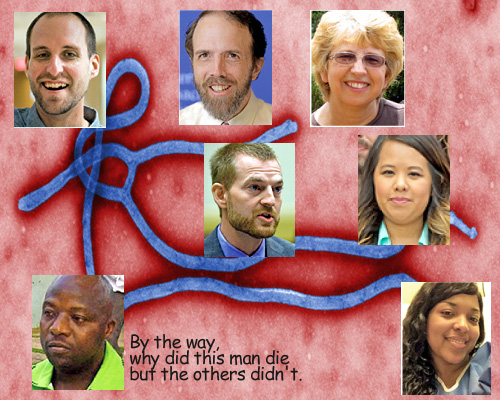
EbolaNbr12015The ebola epidemic is the Number 1 story in Africa for 2014, and for a slew of reasons.

(To see a list of all my Top Ten stories in Africa for 2014, click here.)

The epidemic started in March and will likely continue well into this year, but the spread is slowing and increased public understandings have reduced global fears and improved people’s sensitivities to poverty and war.

Today just under 7,900 people have died of ebola from a known 20,000+ cases in seven countries: Liberia, Guinea, Sierra Leone, Nigeria, the US, Mali and the UK.

The UK’s case occurred just this weekend as a health worker in Glasgow became sick after returning home as a volunteer in West Africa.

Of the nine people who became sick with ebola in the United States, one died; more than 3,400 have died in Liberia and 2,700 in neighboring Sierra Leone; 1,700 in Guinea and eight in neighboring Nigeria.

That makes the U.S. the only country where this specific outbreak has caused a death outside of West Africa. Not Kenya, not Tanzania, not South Africa. Just the U.S.

The public’s control of its initial panic comes from a growing understanding that the disease while extremely serious is not uniquely so.

Had polio, HIV, SARS, MERS or even the current flu epidemic in the U.S. broken out in this part of Africa at this same time, it is likely an epidemic would have occurred just as it did with ebola.

The control of the disease is relatively simple where hardly more than a basic public health infrastructure exists, as was demonstrated in Nigeria. Similarly so in the U.S., where another lesson was learned:

Health care in the U.S. – at least at one hospital in Texas – is not what it’s ranked up to be.

A month ago I wrote ebola’s “Epilogue.”

As explained then, this was not an epilogue to the outbreak in West Africa, which is likely to continue for some time. Rather, it was an epilogue to the irrational concepts of what this outbreak was exactly.

Initially, the world panicked.

Fox News, not exactly your Bible of Reality, reported in late September that there could be more than a million cases as of … today. But note that the Fox report was based, if in a skewed way, on a CDC report.

As school opened this fall, Americans in remote farm country in Nebraska were keeping their kids home.

American movies were taking over American’s minds. American greed for the macabre made it worse. Worldwide racism exacerbated notions that what was happening in West Africa was not the human normal.

In fact, what we learned was that an infectious disease is one of the best long-term indicators of the devastation of war.

Americans know of the wars in West Africa. “Blood Diamond” was released just as the wars there were finally ending. But Americans are hesitant to embrace the magnitude of these wars, just as we are hesitant to embrace the near apocalypse we’ve caused in the Levant.

It is, in fact, that near total devastation of Liberia and Sierra Leone that among so many other horrible outcomes left a densely populated area without any public health care.

Our inability to understand that parts of the world – even in Africa – might actually be better off than us came when South Africa reported it had recently and in past outbreaks adequately treated and totally contained ebola when … in Dallas, they let it walk the street.

Nothing requires public health care as much as an outbreak of an infectious disease. We learned that inside out, I’m afraid, when we first reacted to this outbreak by believing increased monitoring at airports would be valuable.

As predicted and now as proved, it was meaningless.

We learned the power of public health policy when Chris Christie quarantined an incoming health worker, and the fallacies of knee-jerk reactions that were equally meaningless.

America as the single largest economy contributes disproportionately to the health of tourism in Africa, and African companies were spinning like tops trying to figure out what to do when the ebola panic began to effect them.

Never mind that the centers of big game safari travel, in East and southern Africa, were often more distant and cut off from the ebola centers than New York. “Africa is Africa” was the juvenile mantra.

The companies responded with equally juvenile policies that tried to protect their unthreatened backsides, although that lasted only briefly. After I and many others shook Africans back into their senses, it was a simple matter of doing what any good hotelier in San Jose, California, would do if ebola broke out there.

Because, of course, it won’t.

Some tell me I’m too calloused in my blogs about ebola. They’re dead wrong.

Just because I’m as distressed with the level of child poverty or gun homicides in the U.S. or as miffed by Americans’ fear about health care while traveling in the country that performed the first heart transplant doesn’t mean that I underestimate the severity, misery and desperation that ebola causes.

It’s just that I see that same severity, misery and desperation in many places. Like Dallas.

Top Ten 2014 Stories

Top Ten 2014 Stories

TopTen2014Ebola dominated the Top Ten Stories from Africa in 2014, and it remains a difficult learning experience for much of the world.

Come back starting January 2 as I spend a week discussing these stories in greater detail, but today here’s the synopsis:

The #1 Story of 2014 is the horrible disease that since first identified a half century ago emigrated from its common lair in remote jungles and started an epidemic in the disheveled and war-torn metropolises of West Africa.

But the story grew from there into the ignorance about and unmanageable fear that many people worldwide possess of Africa, to our own ineptness in Dallas, to the role of aid and the responsibility of those who live far away. The story’s not over, of course, although the irrational fears that drove it to such prominence seem to be.

The #2 Story of 2014 in Africa is terrorism. Kenya started the year in absolutely terrible shape with three major incidents monthly, but the year ended with reduced troubles and what feels right now like incredible new security. Yet this security is coming at possibly a terrible price for Kenya’s new democracy.

In Nigeria, Mali and Libya especially terrorism retains the high ground plateau it’s held now for several years. Kenya’s success and these countries’ continued failures create an analysis that’s neither obvious or optimistic.

The #3 Story of 2014 is something of a sleeper: The decline in energy prices attributed in large part to America’s new prosperity in oil and gas recovery is a sledge hammer ready to fall on the developing world. The reasons are almost counter intuitive and therefore that much more sinister.

The #4 Story of 2014 is the end of the trial of Uhuru Kenyatta at The Hague. The ICC trial of the President of Kenya, indicted for crimes against humanity, was suspended indefinitely when prosecutor’s evidence and eye witnesses slowly but surely disappeared. It’s an onerous tale with a conflicting morality.

The #5 Story of 2014 is that for all practical purposes the War in the Congo if not actually over is definitely petering out. This was a multi-generational war that only a few years ago seemed impossible to end. It’s a happy, positive story for which America gets much credit.

The #6 Story of 2014 is the increasing conflict between man and beast in Africa, an age-old story that today pits elephants and their tusks against increasingly rapid human development.

The #7 Story is the sudden but very serious conflict among otherwise friendly African states over the water rights to The Nile. This got little press in the world media, but it’s shaking these countries to the core.

The #8 Story is how global warming is causing a decline in Africa’s visible biosphere, its big game. This doesn’t suggest that global warming isn’t the most pressing story for the world as a whole, but rather of one very important and unexpected aspect that is seriously effecting Africa.

The #9 Story is a wonderfully beautiful piece of the prehuman archaeological puzzle at long last fully understood, the fact the proconsul does appear to be the precursor to both apes and humans.

And The #10 Story is also good news: Breakthrough research on yellow fever is likely to lead to new and quicker cures, but remarkably not by eradicating the virus, but genetically managing it once it’s in the liver so that it can’t perform its mischief!

Return to this space starting on January 2 as I discuss these stories in greater detail. Meanwhile, my warmest wishes to all my readers for a happy and prosperous New Year!

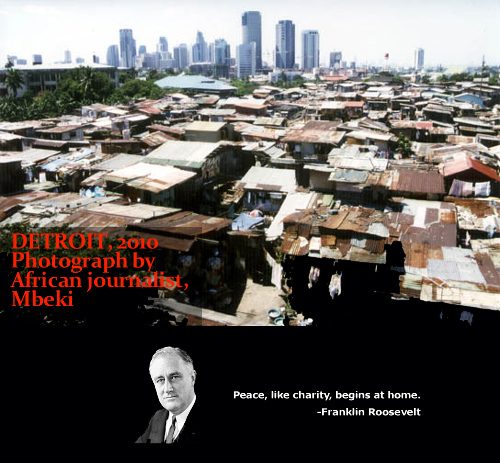
Charity Begins At Home 2014

Charity Begins At Home 2014

charitybeginsathomeCharity begins at home: In my estimation that means creating good government.

At this time of the year I get numerous requests from my generous and truly sensitive clients regarding charities I recommend in Africa. They are often surprised.

There are two reasons I discourage charity, whether to Africa or anywhere.

First, especially in Africa, charity is often a massive con game. There are many excellent not-for-profits doing heart warming work in Africa, but unfortunately there are many, many more that cause more problems than they solve.

Second, charity by its very nature coopts the responsibility that any reasonably moral society should take on its own. So by your act of charity, you are perpetuating the immoralities of your society.

The second reason is a contentious one, I concede. So for those who disagree with me on moral terms, my basic message changes to “stick close to home.” Charity is meaningless if wasted. All it does it make you feel good while possibly doing serious damage.

You must be able to do due diligence before giving, and you must be able to follow up to assess performance. Accountability is much easier the closer to home you get, and of course by “closer to home” I don’t mean simply proximity. You must be familiar with the situation, and you’re much likelier to be familiar with something near to you, geographically, socially and culturally.

Besides, we are rapidly approaching the time when poverty caused disadvantages like illiteracy are greater in parts of America than in the developed world.

I do due diligence in Africa. Good African charities are extremely few in number. They include Catholic Relief, World Vision and Médecins Sans Frontières.

Donations to many other large Africa involved organizations like National Geographic or the World Wildlife Fund are nearly useless. Their projects have become so massive they rely on their endowments to survive, diluting any individual giving to the point of meaninglessness.

Donations to smaller often locally created charities in specific countries, or to smaller church-based foundations, are usually destructive and anti-developmental. They are so mission focused that while they may indeed be helping a small group of people, more often than not they conflict with the greater social and governmental policies of the area.

One of America’s largest youth-based volunteer organizations, DoSomething.org, reports 11 facts about current America that are likely more egregious than in many parts of the developing world.

Consider this. Morning Edition reported today that in clustered communities of 10,000 children in Philadelphia there were only 33 books.

Literacy is difficult to specify, because different parts of the world define it so differently. UNICEF is the best mediator of literacy statistics worldwide, but the problem is that UNICEF does not generate literacy metrics for the United States. But clearly, literacy in that Philadelphia community is not good.

According to UNICEF, Kenya’s literary rate is just above 72%.

Why, then, would you send books to Kenya and not to distressed Philadelphia?

The conundrum of wanting to do good but being unable to do so will only be remedied when we create a society with a government that is trusted and moral.

That should be your greatest goal of the new year, not getting a tax credit.

Christmas Week – No Winter

Christmas Week – No Winter

Galena Main Street usually covered with snow by now.
I met an Australian family in the elevator of a mall in Chicago on Christmas Eve as we were all frantically shopping the sales.

They were so disappointed that there was no snow! In a way, so are we, but the mild temperatures and lack of precipitation makes traveling during the holiday so much easier…

piescookiestree

The week ends with more feasting, as Friday is “leftovers day.” The Christmas feast usually includes turkey and “trimmings.” The trimmings change from family to family but in ours include sweet potatoes (yams), green beans, oyster stuffing, cranberry cornbread, cranberry compote, heaps of white mashed potatoes, lots of turkey gravy and my favorite, rutabaga!

The feast ends with lots of different pies: pumpkin is traditional but in my family the younger generation loves apple, raisin, pecan and cranberry/walnut as well.

Then, when everyone is totally stuffed, out come the holiday cookies!

So the weekend is spent sleeping off the feasts!

Christmas Week – Xmas Eve Shopping

Christmas Week – Xmas Eve Shopping

xmaswindowFor our Christmas week holiday we travel into Chicago for a big family gathering. Many of the normal display windows of the city’s large stores are transformed into holiday scenes like the one photographed above by Chicago blogger Caroline Siede… I enjoy last-minute shopping on Michigan Ave, because as the clock tickets towards the end of Christmas Eve Day, the sales get bigger and bigger!
50percentoff

Christmas Week – Is Warm Good?

Christmas Week – Is Warm Good?

rabbitforestThe Christmas week continues to be unusually mild and that’s good for many of the animals found here. Rabbits, for example, don’t hibernate like bears, and large numbers of them die over the winter. In an unusually warm time like this, many more will survive. That could mean a spring with a lot of jumping cottontails! (caution, of course: Putting the environment out of balance is tricky. With so much more food, coyote populations may also explode and that in turn could reduce deer populations.)

Christmas Week – Green December

Christmas Week – Green December

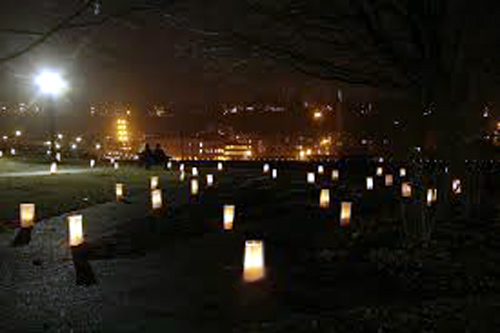
luminariesToday begins the Christmas Week, and for all of late fall and early winter we’ve had unusually mild temperatures and little or no snow. The holiday week actually began this weekend with our little town of Galena brightened at night with “luminaries” or candles in paper boxes… Few of us can remember the last green Christmas, yet the scene below of country near my home suggests that will be the case this year!
Green December

Africans Praise Cuban Initiative

Africans Praise Cuban Initiative

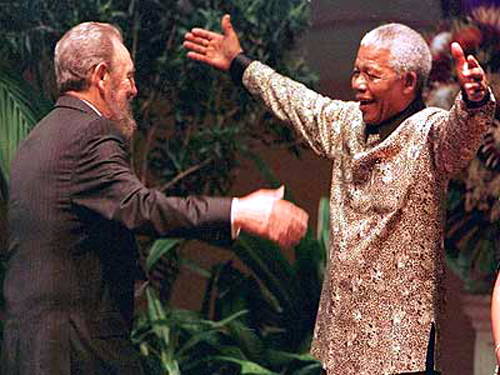
cubafidelmandelaSouth Africans echoed most of the continent yesterday in praising Obama for normalizing relations with Cuba.

In my lifetime Cuba has been active in Africa and seems to have chosen the right sides to support. The current Tanzanian regime, the current South African and Angola regimes, were all receiving aid and support from Cuba when they were considered outcasts by much of the rest of the world.

It was no surprise, then, that the current South African government issued a very positive statement of support for the Obama initiative.

Cuba sent cash, arranged and sometimes housed African revolutionaries and after most independent movements were over, hugely supported public health initiatives.

It seems odd now to hear our own press and officials speak of how small and poor Cuba is. I don’t doubt it. It’s just that few “small and poor” governments figure prominently in aiding and assisting other (possibly even smaller) poor governments.

Cuba’s medical reputation is considered stellar by most African governments. It was among the first to offer AIDS assistance and recently help in fighting the ebola epidemic.

Personally I remember walking shoulder-to-shoulder with Cubans in the 1980s in … you’d never guess, Cape Verde.

In the 1980s South Africa was a strict apartheid regime and Cuba was still fiery and revolutionary. Because the two diametrically opposed regimes were at the very fringes of their ideology, most of the world kept them both at arm’s length.

Cuba was sending money and military equipment to revolutionary movements in places like Angola and The Congo. South Africa was trying desperately to break the United Nations sanctions that were crippling it because of its apartheid policy.

So the two crossed paths, every night about 1 a.m., in the Cape Verde Islands, just off the coast of west Africa.

South African Airways was banned from landing in any other African country, and in those days long-range aircraft couldn’t make the U.S. without refueling. Cape Verde was and is one of the smallest and least developed countries in Africa. South Africa bought them, built them an airport and used it every night to refuel on its way to the U.S.

One airline per day could hardly support the South African investment, so with tacit approval from the communist hating, fascist regime in South Africa, Cape Verde also allowed the airline from Cuba to land to refuel its missions of revolution and contraband into the continent!

And to economize, it only made sense to work as little as possible. So both airlines converged at right around the same time.

And all us passengers got out and stretched our weary legs on these very long flights by walking together in circles in a gym that seconded as the Cape Verde terminal!

I wouldn’t be surprised if I was rubbing shoulders with African revolutionaries, and more to the fantastic point, if some of South Africa’s horrible apartheid officials were doing the same!

So go the ironies of the world and the vagaries of excessive ideologies.

Now, finally, some of this nonsense is coming to an end.

Free Kenyan Collapse?

Free Kenyan Collapse?

Kenya democracy is on the brink of collapse, because … of democracy.

Facing imprisonment if the bill in Parliament he is criticizing is passed, popular Kenyan journalist, Kwame Owino, wrote today that Kenyan society “is bound for a democratic recession, with the possibility that its constitutional journey will come to an abrupt and painful stop.”

At immediate issue is a Security Bill that is so draconian if passed that if will effectively stop debate in the Parliament that passes it.

This afternoon Parliament grew so disruptive that fist-fights broke out, media cameras were smashed and the police ordered to surround the building.

“The changes are retrogressive and their cumulative effect could return Kenya to the police state of the 1980s and 90s and reverse gains made in protecting human rights,” Amnesty International Regional Director told local media.

Human Rights Watch said the Security Bill would “limit the rights of arrested and accused people, and restrict freedoms of expression and assembly.”

The bill’s details include holding “terrorism suspects … without charge for 360 days, compel landlords to provide information about their tenants and punish media organisations for printing material that is “likely to cause fear or alarm”.”

This is not a new development. There are already a series of horrible new laws, particularly against free speech, that this Parliament has already passed.

Bloggers around the country are being brought in by police for “impolite” or “disrespectful” remarks.

One of Kenya’s most political and followed tweeters, Robert Alai, was yesterday released on $2,000 bail and will be tried for having tweeted that Kenyan President Uhuru Kenyatta is an “adolescent president”.

Here’s the thing:

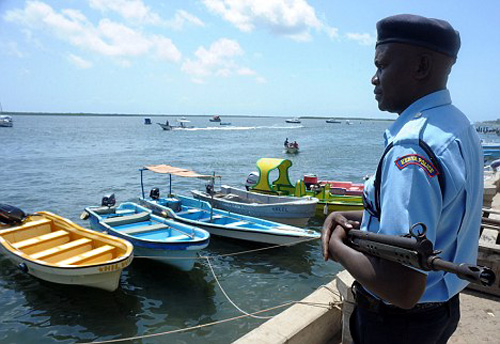
The reason that Kenyatta had the new Security Law introduced (or more correctly, many draconian amendments to the proposed law) is because of terrorism, mostly in Kenya’s far northeastern provinces which are adjacent Somalia.

Kenya with the aid and abetting probably of America invaded Somalia in October, 2011, and remains as an occupier. Somalia has achieved some peace and stability for the first time in more than a generation as a result, but Kenya has suffered terrorist retribution.

Kenyatta’s slow but methodical increase in security measures has seemed to work in stemming what had been a growing increase in terrorism.

Terror attacks in Nairobi, for example, happening last year at nearly one per month, are now rare.

But the cost of this has truly been the democratic rights protected by its fabulous young constitution.

It’s fair to surmise that every new tourist who comes to Kenya because of its new security sends an additional Robert Alai to jail… if the new laws work.

I don’t think they will. They didn’t in America. The Patriot Act did little to protect us. Under the Patriot Act a bevy of new terrorist attempts came to the surface, including the shoe-boot and underwear-pants bombers, the cargo planes and much more.

Not until we backed off draconian measures like the Patriot Act, began ending the wars of retribution in Afghanistan and Iraq, did our own security truly improve. That is if you exclude Sandy-Hook, the Black Knight bombing and maverick terrorists like the Boston Marathon bombers.

My point exactly. What is security? Three thousand people and the exponent of their families were seriously hurt by 9/11. How many in the exponential pool of marathon runners, parents of grade schoolers and movie goers have been hurt by domestic terrorism?

There is real equivalence, here, and the Patriot Act probably did more to increase this aggregate terrorism than it did to reduce it.

Once a power center like a government gets it into their noggin that they should fight terrorism, they begin to think they should fight until they win.

That is the recipe for certain defeat. Terrorism cannot be defeated. It has existed forever and it will forever exist.

European nations are the best examples of how to live with and manage terrorism.

America after 9/11 … and now Kenya, are about the worst examples out there.

Shape up, Kenya. There’s still time.