Ridiculous, Simply

Ridiculous, Simply

carsonstoneageTwo notable attacks this morning, one on the Radisson Blu hotel in Mali and a powerful Nigerian air force offensive against Boko Haram, clarify what terrorism means to many Americans when overlaid Paris.

Up to a dozen masked gunmen driving cars with diplomatic license plates stormed Bamako’s principal expatriate hotel this morning, forced their way in, briefly interrogated a few people who were allowed to leave after reciting sections of the Koran, then rounded up others in what at this moment remains a hostage situation.

Next door, Nigeria’s powerful air force blasted to smithereens “an outdoor gathering” that it claimed was of Boko Haram terrorists in the east of the country.

When these two events play themselves out, over no more time than it took the Paris events to unfold, many more people will have been killed than in Paris, and many more terrorists as well.

And I’ll wage you dollars to donuts it will receive a fraction of the attention, even in this currently charged atmosphere so sensitive to security and terrorism.

Why?

First, because the vast majority (say 90%?) of media consumers take little interest in Africa.

Second, media consumers presume that bad things happen more in Africa than where they live. It’s not as unusual.

Third and most sinister, media consumers impugn African failures at moral governance – a sort of “they got what they deserve.”

I doubt you will disagree with the first reason.

The second is almost a tautology; I think we’ll agree.

I may get resistance to my third from holier-than-thou effetes, but the more honest among us will be unable to completely shed this characterization. We may resist our weakness to believe punishment is both just and a course of remedy, but we must admit to it.

So while it’s not a satisfying analysis and hardly one that naturally leads to any rectification of the problem, it stands solid.

Let’s own the situation and our frailty at grappling with it, and then let’s roll up our sleeves and figure out what to do about.

Here’s when I get mad: When instead of confronting this terribly complex situation head-on, we look for shortcuts out of dealing with it.

Today on PBS’ Morning Edition, the intellectual weakling Steve Inskeep asked his even worse reporter assigned to the Mali attack, the ever confused Ofeibea Quist-Arcton, ‘Is this attack linked to anything more global?’ (I can’t remember the exact words. That’s my characterization: Listen to the link.)

Then in a terribly disappointing followup, the good journalist Renee Montagne asked Gerard Araud, France’s ambassador to the United States, if the Mali attacks were linked to anything globally.

To his eternal credit there was an unnatural radio pause before he answered that he thought the situation was more “local.”

Americans want everything linked to the Joker. They want Syrian refugees to be trained by Him. They want the Syrian Opposition (which yet isn’t organized) to fight Him. They want then “to wipe him out.”

The trouble in the world today is, first it’s not more than it’s probably always been, but second, it’s more deadly because of the geometrically increased number of available weapons, and third: it’s way more complicated than before and if linked to anything singular it’s probably climate change.

I’d love to hear how the Republicans plan on wiping out Climate Change.

There is no Joker. Massive increases in technology allow us to know about so much more of the conflicts in the world than we used to. Huge illogical wars like those in Afghanistan and Iraq coupled with the end of the Cold War have thrown unimaginable amounts of weapons out there to be picked up.

So throw all that on your chess board and stop trying to simplify it.
Africans Speak About Paris

Africans Speak About Paris

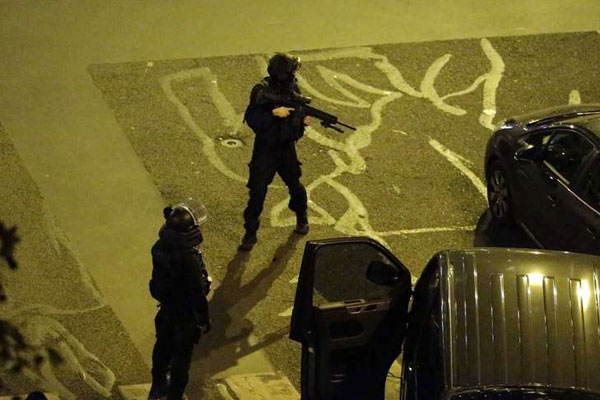
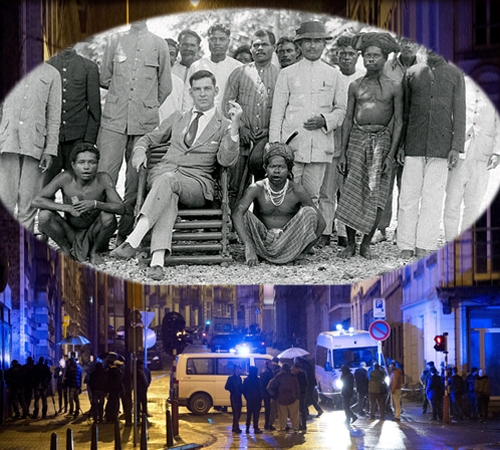
BELGIUM-FRANCE-ATTACKS-POLICEConsider seriously Africans’ reactions to the Paris attacks.

There’s no shortage of empathy in Africa for the victims, nor any support for the barbarism of ISIS. But there’s an understanding of the situation that most Americans lack.

Many more thousands of Africans in Nigeria, Somalia, Mali, Kenya and elsewhere have been barbarously slaughtered by radical Islamists than westerners, with little note in the west. Sidelined by this western arrogance understandable anger animates much African analysis.

In an open letter to Facebook’s Mark Zuckerberg published in one of Nigeria’s main newspapers, writer Jafaar Jafaar politely criticizes the French flags and other gifs that Facebook spread over its platform, worldwide:

“While my heart goes to the French over [the] terrorist attacks… I couldn’t but lash at the folly of Facebook for failure to identify with Nigeria when an estimated 15,000 Nigerians were killed by terrorists in round-the-clock attacks in eight years.

“Sir, I don’t want to believe your bias was informed by the assumed superiority of the races you often identify with.”

Why do westerners pay so much attention to their own suffering at the expense of even the slightest attention to the much greater suffering of Africans?

“Well the simple answer is that to some in the world some lives are more important than others. Western media … has made this abundantly clear,” writes Christopher Charamba for Zimbabwe’s Herald.

I’d say the majority of analysis also lays the blame for the Paris attacks fundamentally on the west itself, for having disrupted Mideast societies for so many years:

The respected author, Charles Onyango-Obbo, recounts almost a thousand years of history in his analysis for Kenya’s Daily Nation this morning.

He reminds readers of the constant exploitation of the world by the powers that be, including the horrible epoch of slavery. Pointing out that the Mideast “is not much bigger than DR Congo and Algeria… mostly desert with relatively few people,” the wars there are all about oil and Israel.

He concludes so appropriately as so many of us have for so many times, that the foolish notion of “wiping out” ISIS or whatever other horrible group might be contesting the region will only ready it for something worse.

This dynamic – fighting to eliminating the bad guys in the Middle East – has been going on for many centuries, but has never ended well for any of the temporary victors. Each time a bad group is eliminated, a worse group arises.

Some in Africa are not as polite as Jafaar, Charamba or Obbo.

A South African Muslim cleric, Farid Esack, told a South African news agency yesterday, “I am sickened … that whenever [western] chickens come home to roost then I must feign horror.

“Stop supporting and funding terror outfits, get out of other people’s lands and continents… abandon your cultural imperialism, destroy your arms industry that provides the weapons that kill hundreds of thousands of others every year.

“The logic is quite simple: When you eat, it’s stupid to expect that no shit will ever come out from your body. Yes, I feel sorry for the victims… But, bloody hell, own it; it’s yours!” he said.

Just as in Nigeria much more attention is paid to Boko Haram attacks in Nigeria than ISIS attacks in Paris, it’s understandable on the one hand that western media – which is predominantly the world media – will focus more on attacks to westerners than Africans.

But the margin of that difference in attention is hard to justify, given the simple numbers of people suffering at the hand of radicals in Africa versus in the west. And Obbo’s astute analysis that this whole mess is a western derivative makes it even less explicable.

We are arrogant. We are forgetful of even recent history. We are small, reactionary thinkers as demonstrated by the lunacy surrounding our fear of accepting Syrian refugees. We should listen to some Africans, rather than just ourselves.

Please Stand Up

Please Stand Up

religiouswingnutsSane Americans need to speak up. Obama has tried to quell our embarrassment by admitting how shameful many of our leaders are acting, but he needs our support.

Calling we Americans out for “knee-jerk right wing reactions” South Africa’s Daily Maverick pointed out for the upteenth time that virtually all the terrorists we know of with for the last multiple years have been home-grown westerners. Not refugees.

Belgian born and bred. French born and bred. American born and bred. Not born and bred in the Middle East.

If you can’t put two and two together, let’s try one and one. A refugee cannot seek asylum from a country he’s born in. That isn’t the law, it’s just grammar.

“Governor Huckabee,” the co-anchor Mike on Morning Joe this morning said, “there have been 794,000 immigrants allowed into the U.S. from the Middle East since 9/11 and not one of them has been arrested for anything. Why should we worry now?”

Huckabee insisted that there “were at least two Syrians” involved in the Paris attack.

The moderator pointed out that we didn’t know that, and that there was only one possibility and that it was unconfirmed so far. “Everyone else was home-grown.”

“How many is too many?” Huckabee retorted before continuing a rant that included prohibiting Episcopalians and Methodists, if they went around shooting people, “but as far I know they don’t.”

I, too, am on the verge of being nuts: I could get to the point where I believed that Mike Huckabees should be arrested and stashed away for inciting hate and inflicting evil. But I’m not there yet.

Facts comfort me: The Obama strategy in the Middle East is actually working. ISIS controls less territory and has fewer trained leaders. That’s one of the reasons we expect more terrorist attacks in the West…

…as their accomplished social media weavers encourage local western citizens into acts of terror, the same way that individuals in the U.S. have been worked up into shooting church citizens and Army soldiers.

It’s the same, and it’s horrible, and it’s racist and shameful of so many Americans like Huckabee to claim the problem is carried with Syrian refugees.

What are we going to do about it? Today, France announced that it would pay all the tuition for all the 109 students who survived the Garissa University terrorist attack in Kenya in April.

We should go a step further: we should pay all the tuition for any student who wants to attend that university.

South Africa’s Daily Maverick concludes today:

“And so it is that tragedy often causes a suspension of logic, and a somewhat ahistorical response. Global terror has a history, and a face that goes far beyond ISIS, Osama Bin-Laden and Al Qaeda. Its faces are those of George Bush, Dick Cheney and Donald Rumsfeld, with shrewd hawkish Condoleeza Rice in the background. It is also the former British Prime Minister, Tony Blair’s recent apology for ‘Iraq war mistakes’.”

Stand up if you aren’t too arthritic and still sane. The right wing response in our country to the tragedy in the Middle East and the refugee crisis is shameful and despicable. I can’t believe the media gives it traction, and that so many people really embrace these lies.

Just remember the Weimar Republic. Remember how all those well-off German citizens dismissed the right wing insurgency as insignificant, because it was so laughable and unbelievable.

Yourself & Terror

Yourself & Terror

018794-01-02“Aren’t you afraid of going to Africa, now?” a friend asked me during the intermission of a play this weekend.

“No more afraid than you must be staying home,” I replied, angry as usual with the question.

Terrorism has been a part of the troubled world for all of history and “No, Bernie; No, Hillary; no, Donald” we can’t get rid of it. We can contain it, but we are doomed to a worse fate if we think we can end it.

That’s what’s brought us to the current tragedy: a misguided notion that invading Iraq would make the world safer. Misguided heaped upon misguided, for our mistake in Vietnam and Russia’s in Afghanistan seemed to have been ignored.

We as Americans are masterful at fooling ourselves, because we have inflated notions of our might and because we can hide so well in our insular communities.

But I reminded that questioner Saturday of the Cold War, and she remembered then how her own family had built an air raid shelter. She began to remember how it was stocked and maintained.

Was that not done out of fear? That’s terrorism’s success: making you afraid: the presumption that some awful inhumanity which you believe or have actually seen happening somewhere else, might strike you.

We’ve got to get Americans to register facts. It takes memory, a bit of studied research and a huge helping of honesty. Terrorism from Timothy McVay to the Mailbox Bomber to 9/11 to the Twin Towers to a hundred or thousand other incidents of terror have all struck at home. Right here. Not Paris. Not Nairobi. Here.

And so they have for all of our history in virtually every part of the world. The information age allows more of us to know about more of these incidents more quickly than in the past; that’s all that’s different.

Play the odds, folks, and your fears should abate. It doesn’t lessen the horror of a beheading or bomb attack or the phenomenal confusion and angst trying to understand a suicide bomber, but it ought to make you less afraid.

And once you’ve got your senses back, then and only then consider how we should deal with the mess. Take a lesson from Sunday morning’s editorial in Nairobi’s newspaper, the Daily Nation:

“As a country that has known only too well the pain that merciless and misguided fanatics can inflict, Kenya obviously stands united with France in this hour of deepest anguish.

“The world must certainly stand together to battle the scourge of terrorism that has taken an even more menacing face in recent years.

“It would not be wise to rush into ever greater confrontation and war guided by justifiable anger.

“Instead, the voices of the peacemakers must come to the table, too.”

Help Lions

Help Lions

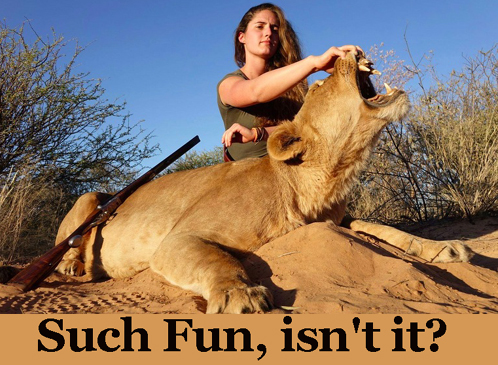
lionhuntingfunIt’s time to ban hunting lion in the wild. You can help.

Lion populations are declining drastically. My post several weeks ago provides some explanation, but I was aghast to discover that lion trophy hunting is increasing and especially from America.

Trophy hunting of lion is only one of the causes for the decline, but it is one that ought to be easily ended. “Recreational” hunting, as it’s often referred to, is appropriately named. People do it for fun.

I can’t imagine how someone considers it “fun” to hasten the decline of a species in trouble. Once I was persuaded that lion hunting in Africa contributed to its conservation, much as today duck hunters claim the same.

Whether that was true in the past or not is now irrelevant, because it definitely is not the case, today. Follow my link above to my earlier article for the scientific corroboration.

Then go to www.huntingreport.com and filter to “lion hunts.” In this morning’s report you’ll find 45 accounts of recent lion trophy hunts in Africa. (The list is actually 65 reports long, but 20 of those are mountain lions in Canada, the U.S. and Argentina.)

Of those reported hunts 15 are in South Africa, 12 in Tanzania, 10 in Zimbabwe, 3 in Namibia and 6 in Burkina Faso.

These are reports voluntarily submitted by individual hunters over the last several year period, so like any social media platform, they don’t necessarily represent an average recreational hunter.

Nevertheless, it’s the only reference we have and it’s very disturbing.

Lion is listed as “endangered” in Burkina Faso by CITES, yet recreational hunters still go there to hunt them. Given today’s science, this is unacceptable.

Legislation is pending in both Canada and the United States which would ban recreational hunters from spending any money in America or using any banks in America that facilitates hunting in Burkina Faso.

Legislation is also possible that would ban the importation of any lion trophy. That is often the most effective way to stop recreational hunting.

But I suggest you lobby your representative to go even further.

Both the EU and the United States are proposing that lions be “listed” by the international treaty that protects endangered species as threatened enough that lion hunting would be stopped or massively restricted.

Although the Obama administration can move unilaterally on this, I don’t think it will. Obama’s record on conservation has been less than stellar, and given the current political climate and upcoming elections, I think that Congress must at least be moved to consider.

Tell your Congressman to support “Fish & Wildlife’s Proposed Legislation to Protect the Lion.” Ask for documentation on his/her actions.

Those of you who have been reading my blog over the years know that my personal position on big game hunting as changed. Originally I was neutral, having had positive experiences in my life time with hunters and hunting organizations that definitely contributed to conservation.

In my view that changed a decade or more ago, and with our current science on the state of the wild and rapid decreasing of our planet’s biodiversity, “recreation” should be an easy thing to eliminate to help save the world.

And lions in particular.

Kenya Backs into The Future

Kenya Backs into The Future

charcoal stockpilesJust as Kenya was doing everything right it arrests a journalist for uncovering corruption, while the Kenyan army that Obama built to route Somali terrorists turns out to be in cahoots with the terrorist leaders!

When will Kenyans stop being on the take?

The government’s interior minister oversaw the arrest Tuesday of a prominent Kenyan journalist who’d uncovered possible corruption in his ministry. The backlash was swift, the journalist was released, the minister comically claimed he hadn’t order the arrest, but the damage was done.

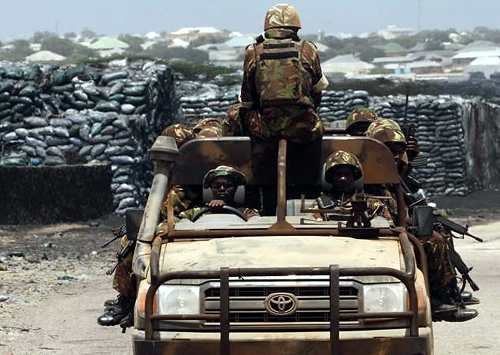
And today another courageous group of Kenyan journalists released a scathing report linking Kenyan occupying forces with the illicit half billion dollar trade in sugar and charcoal that had hugely financed Somali pirates.

Interior Secretary Joseph Nkaissery oversaw the arrest Tuesday of Kenyan journalist John Ngirachu. The journalist had discovered a multi-million dollar hole in Nkaissery’s budget that was unaccounted for.

By the time police brought Ngirachu to the station, the outcry in Kenya was so loud that he was simply kept for a short time and not even interrogated before being released.

Then yesterday, acting as if this was all news to him, Nkaissery ordered the “end to any investigation” by journalists claiming he knew nothing about it.

It’s so lame. Just before the arrest Nkaissery told Reuters that Ngirachu’s reporting was “unacceptable” and “calculated to harm the nation” since it portrayed his ministry as corrupt and that it was a trend by journalists “increasingly taking the shape of a larger plot of economic sabotage.”

So whether the minister then went down a floor and ordered the arrest by his chief of arrests, or whether his chief of arrests knew he would be canned if he didn’t do it on his own, the arrests came swiftly thereafter.

We often scratch our noggin wondering how in the world corrupt politicians think they can get away with it. Well, in Kenya you have to scratch all the way through the scalp to wonder how this guy would think just by denying what he had just said to a worldwide news agency, everything would be fine!

Today Kenyan soldiers are paid well and are well equipped, because of our own dear Obama. I’ve written critically many times about the Obama war effort in Somalia. We Americans built, funded and trained the Kenyans to oust the Somali warlords that had more or less run that evaporating country for nearly 20 years.

And they did a great job.

Now they’re flipping.

According to the Kenyan Journalists’ report, “Eating with the Enemy,” the Kenyan occupying soldiers have struck a deal with what’s left of the al-Shabaab they were supposed to nuke.

They are splitting about $24 million annually through illicit exporting of charcoal to the Arabian peninsula.

Charcoal burning stoves still fire many of the homes in the Arabian peninsula, where there aren’t any forests. Somalia has been deforesting itself for decades to supply them. So this isn’t just an illegal and corrupt act, it’s raping the planet.

But the Kenyan soldier scandal doesn’t stop there. Putting together UN reports with other Kenyan journalist reports, Nancy Agutu of Kenya’s Star wrote today that $400 million is being earned by the Kenyan soldiers and their middlemen back home for the illegal importation of sugar from Somalia.

There are so many angles to this story it’s hard to parse: America once again duped into trying to do good with military means; the ongoing rape of Somalia’s earth even after the war is stopped; the corruption of Kenyan officials high and low; the demand for charcoal in a modern age…

Only one thing is clear. There are some really good, possible heroes among Kenyan journalists.

One of Kenya’s most famous anti-corruption activists, John Githongo, told Reuters recently, “This is the most corrupt Kenya has been since we began measuring corruption in the ’90s.”

Kenya has been working so hard recently to combat crime and corruption, to work through their new constitution, to deal with the Somali crisis at their borders and stem terrorism … that’s it’s simply a crying shame that idiots like this minister and cowboys in the army we built would try to blow their future to smithereens.

Pitiful Profits

Pitiful Profits

zanburndi and religioniZanzibar and Burundi, today, are both tinder boxes rooted in ethnicity ready to explode.

It’s time to stop pretending that both Christianity and Islam, Hutu and Tutsi, or Arab and African are mostly “good.” It’s time to denounce religious ideology and ethnicity as mostly “bad.”

Recent studies about religion reenforce this. “Religion doesn’t work,” a South African newspaper has concluded. “Children of non-religious people are nicer than their religiously raised brethren.” (More on this below.)

Zanzibar’s divide is two-fold: Africans who link their heritage to animism and Christianity versus Arabs dedicated to Islam; and a never successful federation between Zanzibar and Tanganyika nearly a half century ago, which poorly formed modern Tanzania.

Burundi’s divide is wholly tribal: Hutu versus Tutsi, the same divide that led to the Rwandan genocide.

Zanzibar has progressed far more than Burundi has in the modern era. From ancient times the island was the seat of Arab power on the Swahili African coast. Its royal families grew trade with parts of the world as far afield as China.

Its gigantic misstep in history was to become dependent upon the slave trade. That gave the British colonizers a moral platform on which to justify their empire building. (It is, of course, illustrative that British industry – ships in particular – were indispensable in the development of the slave trade.)

Burundi is struggling through the ethnic chasm between Hutu and Tutsi that Rwanda solved by becoming an autocratic if communist state. Smaller than already small Rwanda, it’s nearly lockstep historically.

A “civil” (read “ethnic”) war was ended almost a decade ago with a peace agreement that led to free enough elections and a period of relatively stability. But the democratic mechanisms riveting the government were inevitably seen as threats by one side to the other, and the current man power is so unconstitutionally – nondemocratically.

As everywhere in the world, from Syria to Myanmar to Obama/Netanyahu, ethnic divides easily reenforce themselves with religious ideology.

Obviously I don’t want to give up St. Patty’s Day or Christmas, for that matter. But it’s time to grow up. Black Lives Matter. Intelligent Lives Matter.

A study published last week in Current Biology of 1170 children from a variety of religious backgrounds around the world concluded that children from religious families were less generous and more intolerant and sanctioned physical punishment more than children from non-religious families.

Christian and Muslims scored identically with regards to generosity, both groups are 28% less likely to share than nonreligious children.

The children were tested in seven different cities: Chicago, Cape Town, Toronto, Amman, Izmir, Istanbul and Guangzhou.

Researchers asked the parents to identify their child’s religious orientation: 23.9% were Christian, 43% Muslim, 27.6% not religious, 2.5% Jewish, 1.6% Buddhist, 0.4% Hindu, 0.2% agnostic, and 0.5% something else.

The research funded by the religious John Templeton Foundation used animation, physical games and structured social intercourse with other children in the study to reach these conclusions.

“Consistent with previous studies, in general the children were more likely to share as they got older. But …the negative relation between religiosity and altruism grew stronger with age; children with a longer experience of religion in the household were the least likely to share.”

According to Science Daily the studies “challenge the view that religiosity facilitates prosocial behavior, and call into question whether religion is vital for moral development — suggesting the secularization of moral discourse does not reduce human kindness. In fact, it does just the opposite.”

In a world of diminishing resources, increasing human demand and aggressive global warming, some very tough decisions are going to have to be made.

The Bible and the Koran, like Mao’s Little Red Book or Gaddafi’s slightly larger Green Book, should not be used as references for a solution.

Not Surprising

Not Surprising

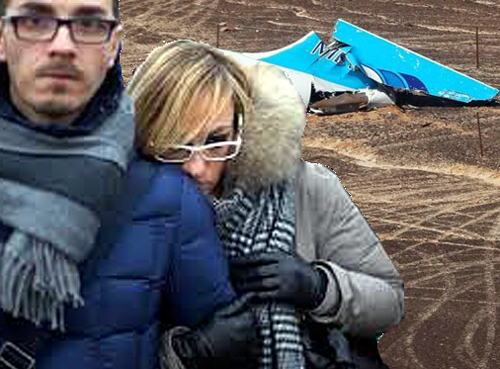
metroTourists have been slaughtered in Egypt for a long time. It’s crazy the way the media paints Metrojet as something new.

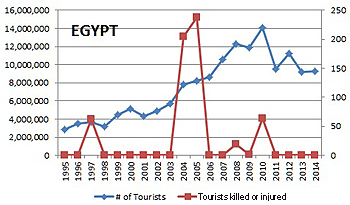
In fact as tourist numbers increased in Egypt in the last 30 years so did terrorist killings: The period of greatest growth in Egyptian tourism, 2006-2008, also saw the largest number of tourists killed and attacked, nearly 500.

We retrieve memories of terrorism very selectively, often for political reasons. No one should be surprised by the terrorist bombing last week in Sharm el-Sheik.

Below is a quick summary hardly exhaustive. My point is that terrorism is a way of life for all of us, now, and it has been for some time.

Traveling on a vacation to an exotic destination is today similar to taking your kids on an interstate road trip. You do everything in your power to be safe, but you know that the statistics are chilling and that it’s possible that through no fault whatever of your own, tragedy can strike.

But you also know that the statistics are in your favor … as they are in Egypt, or London or Kenya or New York, and that road trip’s value to you and your family outweighs the risk.

The more exotic or unusual the adventure, usually that means the greater the risk. But I believe without this desire to travel to the far corners of the world, we’re doomed to a worse future than terrorism can create, one that secularizes the world and makes it even riper for even more terrorism.

All this doesn’t mean that the Sharm el-Sheik tragedy isn’t worthy of news, or isn’t shocking. But let’s keep it in context. Egypt is in the center of the Muslim/Christian – Democracy/Autocracy conflict, today. It’s horrible what happened, but it’s not surprising.

And if you haven’t visited Egypt yet, you must!

* * *
egyptattacksvstouristsTerrorism in Egypt has been happening for millennia. Many of us believe in the current era the attack that began a continued escalation of terrorism against tourists was on on April 18, 1974, when 100 rebels stormed a military college trying to assassinate President Anwar Sadat.

Sadat’s overtures to Israel and ultimate peace treaty galvanized Muslim militants. They’ve never stopped protesting that in Egypt. Virtually every year since has seen violent attacks on tourists.

The Luxor Massacre took place on November 17, 1997, in front of the famous Hatshepsut temple. Six terrorists disguised as security forces simply gunned down the tourists as they filed from their bus.

The fact that the horrible Luxor Massacre was followed by years of increasing tourist growth to Egypt means either that quite a few tourists understand the risks and consider them worth taking, or that they don’t care.

I think it’s the former.

It was in the period of 2004 – 2006 that the numbers of tourist deaths and injuries really escalated, and it was not because of any any single large events like the Luxor Massacre, but rather numerous tourist killings at places like a tea house in Cairo or a beach on the Sinai. Yet this period in particular was the beginning of the fastest growth in tourism Egypt has ever seen.

Rise of The Ignorant

Rise of The Ignorant

FirstGrader1Government politics clashed explosively today with education in Kenya as a court struck down a teachers’ pay raise that had ended a devastating national strike.

Kenya better take a lesson from the U.S.: compromise education and you’ll empower the ignorant. Soon Donald Trump will be running for President of Kenya.

Teachers in Kenya are employees of the federal government rather than state governments as in the U.S. The 5-week long strike which ended in October was therefore nationwide.

The pain of that strike didn’t end with the misery of teachers forfeiting their livelihoods to promote their rights. Kenyan teachers earn 12 times the average national pay, so a huge buying sector of the economy was shut off just as the overall Kenyan economy began to slump.

Ultimately the government agreed to a more than 50% pay increase. The court decision, today, reverses that on the technical grounds that the agency authorizing the increase did so unconstitutionally.

(It’s actually fascinating: the lower Appeals Court effectively reversed a higher Supreme Court ruling. The teachers union is now appealing this lower court ruling back to the higher court. Can’t help but loving this tinkering with government bureaucracy.)

If the pay increase is sustained Kenyan teachers will earn more than 15 times the national average. (In the U.S. a teacher’s salary is almost identical to the national average.)

Why, then, should anyone be worried if Kenyan teachers aren’t awarded this huge increase in pay? …that will stretch even more the disparity between teachers and the common worker in Kenya?

Well, to begin with take a look at the student/teacher ratio. In Kenyan primary schools it’s around 50:1. It’s 25:1 in all of sub-Saharan Africa; the U.N. benchmark is 17:1 and in the U.S. it’s 14:1.

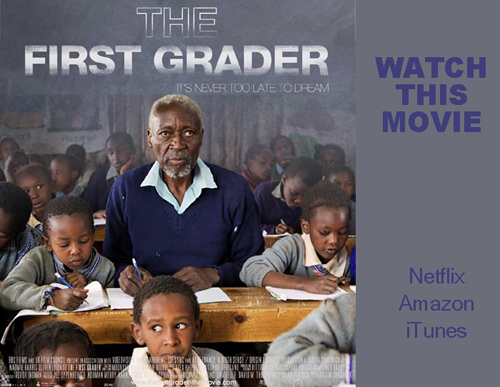
So Kenyan teachers are taking a heavy lift, and this is precisely because overnight a few years ago the country decided to offer free primary education to everybody. (Everyone should watch the amazing movie about this, “First Grader.”)

But statistics like this used cross culturally lose some validity. About the only empirical conclusion evident from this data is that Kenyan teachers are overpaid for working too hard, and U.S. teachers are underpaid for working too little.

I think there’s something important to extract from this.

U.S. institutions of higher learning may be the best in the world. But our primary and secondary schools are a mess, dragged deeper today into our social dustbin by the outrageous licensing of “home” and “community” schooling.

When public education is ignored, as it has been in the U.S. for the last half century, a massive underclass of ignorant people who still benefit from an expanding economy grow more and more powerful.

This underclass pulls down the education system even further: Teachers get paid less, are given fewer resources, perform worse, get paid less still, etc. It’s a spiral into … well, ignorance.

Ignorant people are impressionable and gullible because they aren’t taxed with thinking hard. They’re more likely to jump to conclusions and embrace emotive reactions than question the world. They shoot before looking, because they can’t analyze what they might see.

As the ignorant gain power complex social institutions and infrastructure collapse. You’ve got to be able to think hard to build a bridge or understand welfare or negotiate a nuclear arms deal. Lacking necessary cognitive and intellectual skills the ignorant don’t consider the future as a component of well-being.

The enormous pay difference between an average Kenyan teacher and an average Kenyan worker is definitely cause for concern, but every time Kenyans compromise public education they concede a bit more control of their society and future to the ignorant.

Using the U.S. as the example, that’s not a good idea:

Imagine if when I was a boy I’d heard my parents debating whether they should elect as President Ed Sullivan or Doctor Spock.

Guns & Climate

Guns & Climate

samburugunsMore guns make more war and less guns make less war and the truth is shown clearly today in Kenya’s Samburu district.

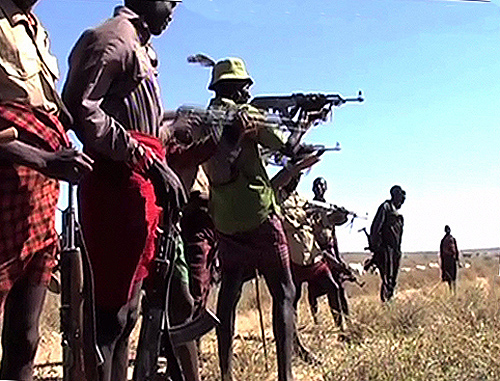
Since the incredible arming of Kenya by the Obama administration for the Somali Invasion four years ago, the number of weapons in northern Kenya has increased by a ridiculous amount. It’s particularly noticeable now that the war is winding down.

Guns don’t wind down.

So all the tens of thousands of unused machine guns and grenades have reached the black market and they’re available for a song.

The Samburu district of Kenya has always had a sort of wild west flavor, including messy cowboy entanglements. For one thing it’s where two historically antagonistic tribes, the Turkana and Samburu, meet.

Both tribes hold creation myths stating that God created cows only for them, so if the other tribe has cows, they must have stolen them. The young warrior class is charged with recovering as much of these stolen goods as possible.

So cattle rustling has existed at least for as long as anyone has written about the area, well back to the 16th and 17th centuries. It’s different, now.

To begin with, there’s more competition. There are more people, so more food and more cows are needed at the same time that climate change is exacerbating the desertification of these northern areas.

So while it used to be pretty much an ethnic conflict between two or three major tribes, today the issue of enough land for grazing is just as important.

The Kenyan government is moving perhaps too quickly to ameliorate this by generating new local revenue from deep-hole oil wells financed by the Chinese.

But the most important difference is how people fight.

Instead of using spears and clubs, the fights are now almost exclusively with very sophisticated guns.

Guess where they might come from? Amazing, isn’t it, that they cost less than fashioning a good spear?

In the most recent cases it appears the warring factions are better armed than the police.

Kenya has a strict firearm policy: it’s not easy as a private citizen to own a gun. But in the Samburu district of Kenya it’s hard to find a Samburu without a gun.

In an attempt to reduce the weaponry, Samburu authorities announced an amnesty several weeks ago for anyone who turned in an illegal firearm. That program expired Tuesday and “no firearms had been surrendered.”

It is, of course, a common argument promoted by arms manufacturers that peace prospers when more people have guns. This presumes that the vast majority of people are good and only use guns to defend themselves.

That argument is about as cogent as the idea that God created all cows for Samburu.

Here for a Refund

Here for a Refund

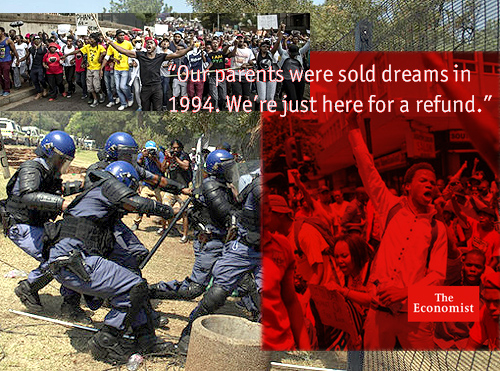
hereforrefundSouth Africa’s student protests just won’t stop. They’re sweeping across the country and are getting serious. Is this the sixties for South Africa?

“Our parents were sold dreams in 1994,” a student leader told the Economist. “We’re here for a refund.”

A third of all South Africans are between 10 and 24 years old, born after the end of apartheid and now attending school at some level subsidized by government.

The protests began about a month ago at the country’s most prestigious science university, Witts, over an announced 10% increase in student tuition. In South Africa all higher universities are funded by the federal government, a similar role to the state governments here.

After two weeks of violent protests, #FeesMustFall resulted in South African President Zuma rescinding all fee increases … for this year.

That barely dampened the moment. Right now protests are continuing at virtually every higher institution in the country, with particularly large and volatile demonstrations in KwaZulu Natal and the Western Cape, but events are changing rapidly.

The country’s most prestigious liberal arts university, UCT (University of Cape Town), was one of the few where classes resumed today following a humiliating apology by its chief executive to students, although small protests continued on campus as well as at Parliament. But in most places in the country, higher education is at a dead stop.

After Zuma announced the rescinding of all fee increases, the protest issues spread like wild fire. “Outsourcing” university workers has now been reversed at the UCT and the Witts CEO has agreed “in principle.”

This is a fundamental issue in South Africa. Several years ago universities discovered huge budget savings if employees previously hired for maintenance, food service, transportation – virtually every industry – were outsourced to large companies.

The universities insisted the large companies hire the existing university employees, which they did, but within a few years benefits, wages and contract negotiations were seriously reduced.

Government subsidies for education based on income are equally under fire, not because students disapprove of the principle, but because it has been so unevenly applied.

The government’s protocol for determining income is rife with corruption and nepotism, often unfairly subsidizing those who are quite affluent while ignoring truly poor students. More interestingly, students are also demanding an end to the notion of minimum performance in secondary schools as a metric for determining subsidies.

What I find so interesting about all of this is that it brings back some deep memories of my own college career which for me was dominated by the anti-War protests.

But as I became more and more involved as a student in those protests, I also became involved in the Civil Rights and Womens movements.

“Trouble had been brewing on campuses for months,” the Economist reports.

The magazine concludes that current protests are congealing into the all-powerful issue of racism, reporting that demonstrators “complain that universities have too few black staff or students. This is true, but largely because, thanks to terrible schools, black South Africans still do much worse in exams than whites, something the ANC has failed to fix.”

Since the end of apartheid the ANC has ruled South Africa, winning election after election, yet it is widely blamed throughout the country for this current and many other predicaments. Zuma’s cavalier flip-flop on fees, which could push the government debt to untenable levels, is typical of the knee-jerking, lack of policy that today characterizes ANC governance.

In the last election the 18-24 year old crowd hardly voted at all.

I don’t think that will be the case the next time around.

Dangerous Dennis

Dangerous Dennis

norwegiansuitShould a paid aid worker in a dangerous part of the world be able to sue his NGO for not protecting him well enough?

Steve Dennis sued his employer, the Norwegian Refugee Council (NRC), for gross negligence that resulted in his kidnapping in 2012. Dennis refused more than a half million dollars out-of-court settlement, and a Norwegian judge will now soon decide the matter.

Dennis and several others were kidnapped from the Dadaab Refugee Camp on the Kenyan/Somali border by Somali insurgents. They were freed four days later by a commando raid of Kenyan and Somalia government forces.

He contends that his PTSD syndrome and continuing physical ailments that resulted from the kidnapping were all preventable had NRC better security procedures in place.

I think this is nuts.

Everyone – even soldiers and aid workers – should have redress through the courts for being abnormally maligned or mistreated, but Dennis was not.

The NRC is one of the most respected NGOs in Africa. The 100+ recommendations the NRC generated from its own internal investigation into Dennis’ kidnapping have all been implemented and are being widely considered by all NGOs in the Dadaab area.

I suspect there is much more to the story than has reached the media.

Just after the actual incident, the then 37-year old Dennis told his home-town Toronto Globe and Mail:

‘[that] he remains committed to aid work despite having just gone through “a very bad long weekend. I’m still going to be engaged somehow. How, I don’t know. For now I think my job is to take a couple months off and then, if I feel good, take a couple more maybe,” he said with a laugh.’

Dadaab is one of the most dangerous refugee camps in the world, and if I know this I imagine that aid workers do, too.

There are about 22 million refugees living in camps around the world, the majority in United Nations’ organized mini-cities. There are nearly a million in Dadaab alone.

The 10,000 UNHCR employees overseeing these facilities are assisted by an estimated 50,000 other aid workers of the sort Steve Dennis was, persons who are actually working in refugee camps. (Altogether there are around a quarter million humanitarian aid workers worldwide.)

Aid workers are characteristically the most dedicated, moral and upstanding individuals you can imagine. I’ve often pondered why these incredibly intelligent and motivated individuals give up traditional lives with usually greater compensation for such hazardous work.

About a year after the July, 2012, incident Dennis began issuing more and more serious allegations and complaints: his mood had obviously changed. In court documents he chalks this up to his PSTD.

Also about a year after the incident, NRC changed CEOs. In a letter introducing himself, Jan Egeland concluded, “And finally. Be careful, take the necessary precautions and wear a seatbelt. We cannot afford to lose any of you.”

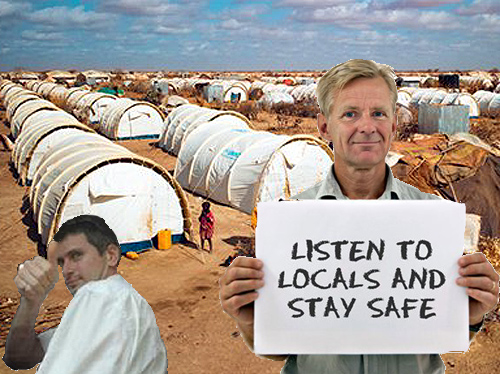
The NRC media arm that issued the letter featured a picture of a smiling, handsome and weathered Egeland holding a large hand-written sign that read, “Listen to Locals And Stay Safe.”

As Dennis’ legal wrangle starting taking shape, he asked the public for $50,000 through FundRazr. The $20,000 that the Guardian newspaper reported he finally raised was apparently sufficient enough to attract ambulance chasers now working on speculation.

I don’t doubt that Dennis suffers from PTSD or that he has other lasting infirmities from his kidnapping. I’m not even sure I approve of the half million dollar settlement NRG offered Dennis, but at the very least it strikes me as incredibly generous.

But if aid organizations are now sued by employees who work in the most dangerous conditions in the world, it would be like soldiers suing the Army for sending them into war!

Norwegians are among the most dedicated aid workers in the world, and Norway among the most committed countries on our planet to making the whole wide world better. So it’s not surprising that they will find fault with themselves.

But I hope the judge notes that Dennis used crowdfunding to attract ambulance chasers. This is not how to save the world.

Life Goes On

Life Goes On

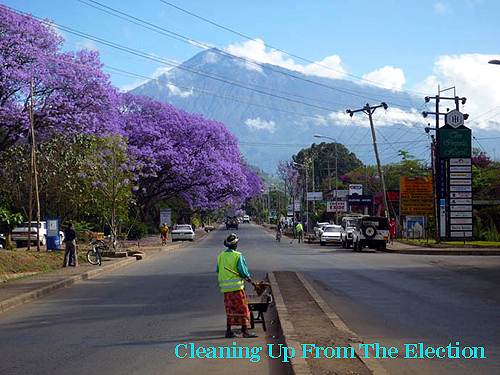
cleaningupfromtheelectionTanzania’s president-elect John Magufuli is the best outcome from an election that was free-and-fair enough. The disgruntled country seems to agree.

The exception is Zanzibar, where tensions are rising. Travelers should avoid Zanzibar now. The rest of the country went back to work, today. There were few celebrations even in the strongholds of the ruling party. Winners seem to know how seriously disappointed the opposition is.

Losers seem to be accepting the outcome.

Zanzibar is different and always has been. The “marriage” of the independent countries of Zanzibar and Tanganyika in 1964 has never been fully accomplished. The island has a very autonomous government, but in the last several cycles the mainland’s ruling CCM party has held power even there.

This year the island opposition claimed the election count was fraudulent, violence erupted and was quickly contained by what seemed to have been a premeditated arrangement between mainland authorities and those supporting the CCM candidates.

Shortly thereafter the Election Commission annulled the election. Today the island is very tense. Almost exclusively Muslim, Friday is normally a rest day. The island, though, is so heavily invested in tourism a normal Friday would have had far more activity than reported today in Stone Town, the island’s only city.

International observers give the election a passing grade without too much enthusiasm because of the Zanzibar annulment. Foreign observers generally concluded several days ago that that was a mistake.

It was an election of surprising switches and previously unimagined allegiances. Tanzania’s Shakespearean politics twisted onto itself creating a contest between two men who had been close friends and colleagues for years, loyal leaders of the CCM with ideologies and policies that were essentially identical.

Since neither had any substantive difference with the other, both let the electorate fashion their difference: the supporters of each claimed only their standard bearer would reduce the enormous corruption of the country which denies so many millions the basic services they need.

Magufuli was a dark horse from the ruling party. His opponent, Edward Lowassa, was expected to be the ruling party’s candidate virtually until Magufuli was chosen instead.

Lowassa comes from the better developed and more rebellious north, so the north was ecstatic when he defected from the ruling party to join Chadema, the main opposition based in the north. Then within days of realigning his allegiances he brought four other opposition parties into a giant opposition to become the first real challenge to CCM’s near 60 years of ruling Tanzania.

Just the simple idea that the ruling party might be undone sent young and educated Tanzanians into the stratospheres of extreme hope. There was no debate over the complicated new constitution, no question about taxes or budget or even schools – which is normally a very important issue, no scrutiny of the fact that Lowassa and Magufuli dropped from the same tree.

No one charged Lowassa with sour grapes for having been dumped by his life-long party. His own scandalous past in that party, his confession to playing a major role in a hundred-million dollar aid scam that resulted in his being fired as prime minister, was hardly mentioned.

Instead, the entire point of the election devolved into nothing more than the possibility that the ruling elite might be defeated, albeit by … one of its own.

Well, it wasn’t. And despite unusually numerous election irregularities, all the outside observers are coming to the conclusion that after serious qualifications to the notion of “free and fair,” the election really does represent the will of the people.

John Magufuli is a good guy. I would have voted for him over Lowassa, simply because to this moment Magufuli remains uncorrupt if complicit with the corruption that suffuses his colleagues. Lowassa is a confessed crook.

Magufuli has worked his way up the ladder of political succession step-by-step over many years. He holds a Ph.D. in chemistry. He’s known for his corruption-busting antics, including hiding in situations to bust unsuspecting corrupt policemen that wander near him unawares.

He comes into office with all the credentials that hopeful Tanzanians actually say they want. But then again so have past presidents like the current one, Jakaya Kikwete. A few years into the role and the glitter is shed, and a poor elected official suddenly has Swiss bank accounts and shares in world hotel chains.

All Tanzania can hope is that this pattern of good guys turning bad might be less easy to do in today’s growing internet world, especially with Tanzania’s youth so currently fired up.

So skeptical but satisfied. Like the country, resigned to what hope remains.

Winter Winner

Winter Winner

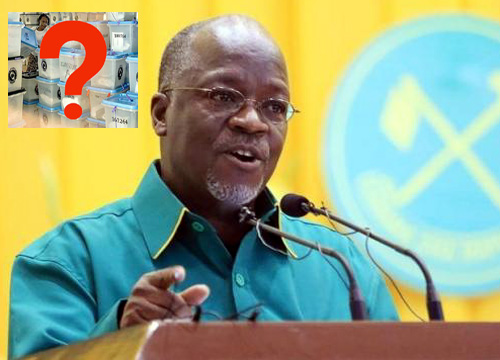
magufuliwinsTanzania’s ruling party’s candidate has won the presidential election, the opposition has rejected the results, and the election in Zanzibar has been annulled.

The Election Commission declared John Magufuli the next president with 67% of the popular vote just as the business day in Tanzania ended.

The country is tenser than ever. The slow live announcement of constituency results was viewed suspiciously by the European Union whose election observers issued a preliminary negative report on the validity of the election.

America expressed “alarm” with the Zanzibar annulment.

Normally a mouthpiece for all East African leaders in power, the EAC (East African Community) commission watching the election said it was “concerned” with the large number of disputes so far filed.

Earlier, the main opposition party UKAWA announced it was rejecting whatever outcome would be announced. German radio opined, “Transparency is crucial. Tanzania, which has been a force for stability and peace for decades, cannot be allowed to descend into chaos.”

Were this Kenya or South Africa, the situation would represent serious potential violence. I don’t think it does in Tanzania.

The opposition was hastily put together, an unlikely amalgam of disparate parties. It is itself fractured, and I just don’t think its leaders are capable of organizing any real protest.

A rerunning of the election in Zanzibar cannot change the presidential outcome. Even if every Zanzibari vote was for the opposition it would move the percentages less than 2%. (Zanzibar’s population is 1.3 million of the country’s 53.6 million.)

Nevertheless, the decision to annul the Zanzibari election squarely places it in the center of any violent reaction that may now develop in the country. The fact that nearly an entire day has now passed since the election was officially annulled there, and that violent reaction and police response has been less than expected…

… suggests to me that the party in power will prevail, that some violence will occur for a rather strung out period, but that within a month Tanzanians will have settled into a terrible disquiet of acceptance.

I have many Tanzanian friends on Facebook. Before the election Facebook and other social media were exploding with election bombast. Today it’s eerily quiet.

Night is descending on a freakishly bleak Tanzania. More tomorrow.

Lesser Lions

Lesser Lions

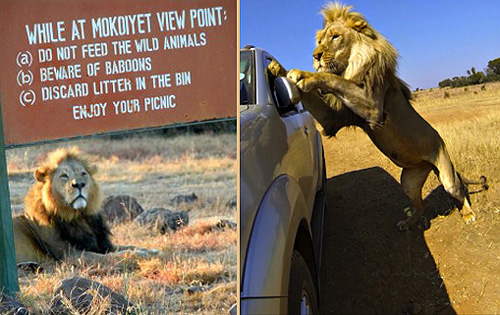
lion under sign NNPLike tigers, truly wild lions in Africa may becoming a thing of the past.

A prestigious group including Africa’s leading lion researcher, Craig Packer, claimed today in a report published with the National Academy of Sciences that lion populations will decline 50% in the next two decades.

I have already seen the decline in East Africa, most notably in Ngorongoro Crater. The report, by the way, claims that the adjacent Serengeti lion population remains healthy and is less likely to decline.

According to a summary by CBS News of the lengthy report, lions “are threatened by widespread habitat loss, depletions in available prey, preemptive killing to protect humans and their livestock along with poaching and poorly regulated sport hunting.”

The most serious decline will be in west and northern Africa, although as much as a third of the sub-Saharan lion population will decline. Sub-Saharan populations are healthier, according to the report, because of adequate protection in Botswana, Namibia, South Africa and Zimbabwe.

The very interesting detail in the report as to what exactly explains southern African countries’ better protections has much to do with fenced-in private reserves, a situation which today is about all that is left for Asian tigers.

Although most of these fenced-in, private reserves are not zoos as such since they are large enough with enough variety of prey game that the lions do not need to be fed, disease and/or injuries are often treated.

The lions in virtually all these cases become very habituated to people. Unwittingly, similar situations can occur in completely unfenced and unmanaged reserves like Nairobi National Park when visitor populations grow unusually large.

Fenced-in reserves and too many visitors change the cats’ behaviors. They begin to tolerate one another more than natural, adapting to a confined if imposed territory. Fewer larger prides, of the sort we see today in Ngorongoro Crater, replace more smaller prides with a net overall decline in numbers.

This usually makes them more dangerous, at least in the initial phases of this recalibration of behavior.

I’ve often written of a similar situation occurring in East Africa with elephants.

It was hardly a decade ago that I would tell clients traveling in the dry season that on a typical ten-day safari they could expect to see more than 125 lion. (A wet season prediction was around 80.)

In my most recent safaris those numbers declined by a third.

In addition to the crater I’ve noticed obvious declines throughout central Tanzania, southern Kenya and the Mara.

It’s likely that part of the “health” of the Serengeti is due to Mara lions moving out of the congested Mara. The Mara and its border of private reserves is also then itself bordered by intense agricultural lands and growing numbers of small towns.

Seeing a tiger in a reserve today in Asia, or a lion in a private, fenced-in reserve in South Africa is in my opinion massively different from those observed in truly wild situations.

The fenced-in lion is usually healthier but not as strong, fatter and not as lean, seemingly more disinterested in everything and more likely to allow approach, or even to approach the observer.

“Saving lions” will not be difficult. There are already too many lions in zoos and euthanization is now regularly used for older and infirmed animals when in years past these animals would have been nursed to health or kept alive for their genes and research potential.

And as with captive lions in zoos, fenced-in lions do extremely well, positively responding to a reduction in their territory when offered an adequate food supply.

So lions will be around for a very long time.

But not necessarily as I would like to remember them.