And it has already happened more than 80 times this year in South Africa alone.
It is also back in the news as the price per oz surpasses that of gold, and the infamous “Groenewald Gang “ comes back up for trial.
When people talk about the Guinean forest disappearing to make room for Cocoa farms—I’m upset, but I understand the calculus of the farmers doing the cutting.
When East African Farmers shoot elephants near their Watermelon farms, or Western U.S. ranchers shoot wolves near their cattle—I get it.
I am frustrated with the seeming inevitability of conflict between human development and species/habitat preservation, but I find it hard to really dislike the people killing animals they view as economically harmful pests.
Rhino poaching is an entirely different affair—this is organized crime.
Night-vision goggles, tranquilizers, helicopters, the whole nine yards.
The actual poachers are often unemployed South Africans and Mozambicans, but they are merely the tip of a multi-million dollar industry.
2010 was a brutal year.
333 Rhinos were killed in South Africa alone, including a number of critically endangered Black Rhinos.
In the first several months of 2011, 81 Rhinos and 9 poachers have already lost their lives.
In response to this dramatic uptick in poaching and violence, the South African government has brought in the heavies—as of April 1st South African military personnel have begun to take over security in South Africa’s famed Kruger National Park.
I tend to think protecting the supply will do little when a kilo of powered Rhino Horn goes for $35,850 on the black market.
More effort should be focused on curbing demand.
As recently as ten years ago the end-market for most illegal Rhino horn was Yemen, where artisans carved intricate jambiya dagger handles.
Studies suggest that Yemeni buyers can no longer compete with Chinese and Vietnamese traditional medicine markets where the vast majority of end users now purchase Rhino Horn and its derivatives.
However, we should all be more understanding; after all, Rhino Horn is the active ingredient in a number of highly effective treatments for cancer, high blood pressure, and impotency.
Wait—no it isn’t.
In fact, the purported medicinal properties of Rhino Horn have been tested over and over and the results are definitive—zip, zero, zilch.
Crushed up fingernails for what ails youRhino Horn is made of “agglutinated hair”—in other words—it is identical to finger nails. Here are links to a few studies for your perusal in case you find yourself reaching for the Rhino Horn powder before bed: Zoological Society of London, pharmacological study, Dr. Raj Amin.
The Chinese government does little to stop the misperceptions.
They even declared traditional Chinese Medicine as a strategic industry, and subsidized the industry to the tune of $130million.
By Conor Godfrey on April 14, 2011
Last week I rounded up a few friends and saw a tremendous concert put on by Acoustic Africa at George Washington University’s Lisner Auditorium.
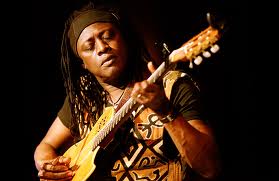
Habib Koite
The show featured three African music powerhouses—Habib Koite, from Mali, whom I have written about before, Afel Bocoum also from Mali, and Oliver Mtukudzi (goes by “tuku”), from Zimbabwe.
These guys—expecially Koite and Tuku—are household names in their regions, and in some parts of Europe, but they often have to play dive bars or cultural centers for 10 bucks a ticket when they hit the U.S. (Language being the major issue for the Malians)
Last time I saw Habib Koite was in Philadelphia at a local arts council for $10. This most recent concert was a step up—they sold out a 400-500 person auditorium at $40-$50 a ticket.
And they were worth every bit of it. I swear there is something about Malian music that makes you remember what is important in life.
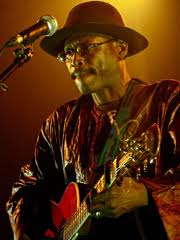
Listen to Afel Bocum play Gomni, a song popularized by his uncle Ali Farka Toure, and tell me that your mind doesn’t drift to a better place. Afel Bocoum
When Afel came to the microphone to play this song he said—“Gomni means happiness in Songhai (language spoken in Northern Mali)…it is very difficult to be happy, even though there is so much to be happy about…so try and be happy for just this one song.”
Well said Afel.
I did not know much about Tuku before the concert, but he did not disappoint either.
The sound from Zim was much closer to the Congolese Rumba, popularized by icons like Papa Wemba, than it was to the guitar driven modern Malian music that often sounds like storytelling set to music.
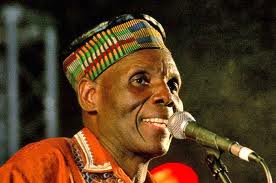
Real experts on Southern African music claim Tuku has a style all to himself. See for yourself.
Oliver MtukudziTuku and his band also taught me a bit about the Zimbabwean thumb piano.
You would be surprised to hear the sound that comes out of this little guy.
If you combined a Malian Balafon (xylophone) with a gong, it would sound something like thumb piano.
My favorite song from Tuku was Neria, about the strength of a woman; for this he turned the lights down low, kicked the Malians off the stage, and poured a hell of a lot of soul into this ballad.
If you listen to one song I link to on this blog—make this it.
And last, but certainly not least—we get to le Maitre, Monsieur Habib Koite.
I have now seen Habib three times and he has never had an off night.
He and Afel jived very well with Tuku on stage, and everyone seemed to be enjoying some genuine pan-African good cheer while they swapped songs and made an effort to sing in each other’s languages (at least for the choruses).
Habib didn’t play too many of my old favorites this time around, but I did enjoy N’Teri, and a bunch of newer songs that I wasn’t familiar with. (I would recommend checking out the Album Afriki if you are looking to buy a Habib CD.)
Habib also just looks and acts the part.
His clothes are stylish takes on traditional gear, his speaks just enough English to make it clear that there is a lot going on inside his head, and he radiates positivity.
Oh—and my favorite part—they went for 2 hours and twenty minutes with no intermission. Lets see U.S. pop icons put in that kind of performance.
The last tour date I can find for Acoustic Africa is actually for this week: Apr 14th 2011, Clarksdale, MS USA.
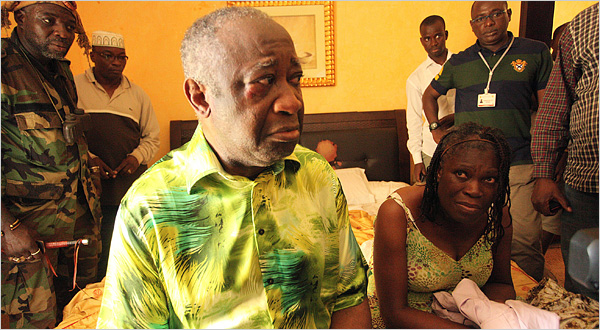
Some combination of French, U.N., and Ivorian forces loyal to President Ouattara captured Laurent Gbagbo in broad daylight at his residence.
The videos and pictures of the arrest show a broken man.
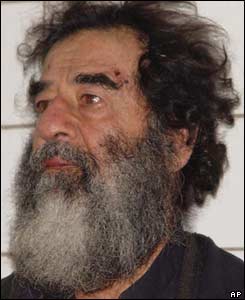
He looks a little better than Saddam did when they pulled him out of the spider hole, but not by much.
Does anyone remember the breakdown of the vote that began this long, murderous process?
In the first round, Gbagbo won a plurality of the votes with ~38% to Outtara’s ~32%.
In the second round, after promising a number of ministerial appointments to major ethnic groups cum political parties, Ouattara won the two-way runoff with ~54 percent of the vote, and this likely included small-scale instances of fraud or intimidation in Ouattara’s Northern strongholds.
Taken together, these two results suggest that 46-49% of the Ivorian population would have preferred that Gbagbo remain president.
Yikes—given the absence of significant political polling and a history of fraud and intimidation, you can see how easily pro-Gbagbo civilians would have felt cheated.
So now Allasane Ouattara will have the pleasure of ruling a country where almost 50% of the population was happy to see him imprisoned in an Abidjan hotel, his forces have been implicated in human rights abuses on their march South, and he is seen by many as a tool of French imperialism thanks to a small dose of truth and an extra large helping of pugnacious Gbagbo’s fear mongering in the weeks leading up to his arrest.
Some triumph…
In the words of Pyrrhus of Epirus—“Another such victory and [Ouattara] will be uttery ruined.”
I have a lot of admiration for the way Ouattara has handled the situation so far—he is making all the right noises about national reconciliation, investigating human rights abuses on both sides, and urging restraint among his partisans.
I also think he needs to quickly distance himself from Paris.
I was not wild about French forces being so deeply involved in Gbgagbo’s arrest. (The French claim they never entered the Presidential residence; Gbagbo’s people claimed it was the French soldiers that actually made the arrest.)
For several decades, the French propped up or toppled West African leaders at will, and whatever the rationale, it doesn’t take a master propagandist to make this look like neo-colonial meddling.
Tiken Jah Fakoly—a super-star Ivorian singer and frequent political commentator had this to say in an interview with Jeune Afrique—“Sarkozy shocked me by saying that Gbagbo and his wife were to leave office within three days. He made a serious error that led many intellectuals to support Laurent Gbagbo. Today’s generation cannot stand this kind of statement that reminds us of when the colonizer or the governor spoke to our parents”. (Find excerpts in English.)
I sympathize with Tiken’s comments, even though I think France’s motives were mostly humanitarian.
Perception is reality, and France should know better.
Ouattara was already battling the perception that he comes from Burkina Faso—the French aid will now add another layer of ‘outsiderness’ to his persona.
I can’t tell whether Ouattara’s prolonged battle has expended or generated political capital, but I certainly do not think he has enough at the moment to make Cote d’Ivoire a functioning, healthy state.
Not yet anyway.
The French can help him bomb Gbagbo into submission, but they sure can’t help him build a country.
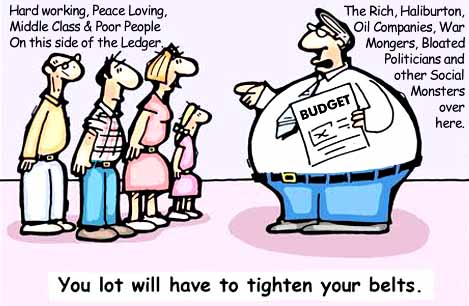
America’s belt tightening vied with the Masters this weekend as the best reality TV show in the world. But now that the entertainment is over, does anyone have the slightest idea what catastrophic nonsense has just occurred?! One tiny example from Africa.
Here’s why I’m so incensed. One: We claim this is a budget battle. The D-Day, though, was the assault on abortion. Two: We claim this is a budget battle. The last week’s negotiation was over $5.3 billion. That’s less than .2% of the $3.2 trillion budget. Three: We claim this is a budget battle. The wars we’re operating are off-limits to discussion, which is about a third of the entire budget.
4,5,6,7, ad infinitum: We claim this is a budget battle.
As my investors have screamed at me for a half century: Raise Revenue!
1001,1002,1003,1004..: We claim this is a budget battle.
Econ 101: You’ve got to spend money to make money.
So now to the promised example in Africa, supplied by a young African wizard, Conor Godfrey, who will be taking over this blog as of tomorrow as I head back on safari.
America’s belt tightening has been going on for a while, and now The U.S. Commercial Service is pulling out of Ghana. This branch of the U.S. government has essentially made money for the U.S. government since its inception, finding really attractive capitalist projects around the world that U.S. companies can exploit.
Ghana’s projected 11-12% growth rate in 2011 obviously did not make the cut.
Writes Conor:
“This bothers me—a lot. How are we pulling out of some of the fastest growing countries in the world in an effort to save money? I have made the case in this space before that Africa offers some of the highest returns on investment in the world, has the most favorable demographics in the world over the next 30 years, and will boast 7/10 of the fastest growing economies in the world over the next decade.
“The National Export Initiative trumpeted by president Obama was supposed to help U.S. companies operate in places just like Ghana!
“We’re even closing down the Commercial Service office in Senegal, our only post in Francophone W. Africa (this is a well sourced rumor).”
Emerging African markets are one of the most rapidly growing consumer niches in the world. They need to buy a lot of stuff from us: agricultural machinery, pharmaceuticals, internet and communication technologies.
Sources inside the USG also told Conor that the Commerce Dept. will not open an office in Angola as had been planned. Cross another one of the fastest growing countries in the world off the list.
This is very shortsighted. The little bit of money this might save is guaranteed to reduce U.S. commercial sales in the short-term, as competitive companies especially from Europe and Asia beat America to the punch.
“I am not some neo-colonial war monger,” Conor explains. “I don’t think the U.S. needs to be commercially colonizing Africa before the scary Chinese get there. I just think that many (not all) African countries are at a point in their development curve where they can participate meaningfully in international commerce, without being relegated to mere consumers of manufactured goods and exporters of raw materials. I want the U.S. to be a real partner for this new Africa—both the continent and the U.S. will reap substantial benefits.”
“This entire episode must be embarrassing for a president that landed in Accra with such fanfare near the beginning of his presidency, claiming to want a new relationship with Africa. Read the full speech here. I would like to think that I am not just one of the many special interest groups that believes their little corner of the budget is the one that really matters. In this case, I swear the numbers speak for themselves.
“Read this essay by the President of the Corporate Council on Africa on the shortsightedness of the government’s cuts.
“Ghana—really?! Who in the U.S. missed that memo about oil, and 12% growth?” Conor asks.
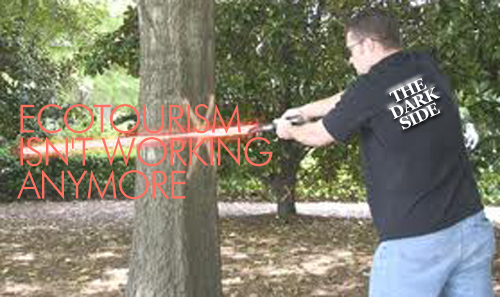
As indigenous people benefit from development, the majority of ecotourism projects are revealed as shams. This is because the local people get smart enough to call a spade, a spade.
I regret I can’t show you verbatim many of the emails I received — offsite — about yesterday’s blog. And I won’t violate confidences other than to say much of the world agrees with me, and by the way, that’s not really news.
But while yesterday was mostly just an appraisal of what today’s ruthless market is doing to ecotourism, there was this incessant desire by many of you to figure out a good way to resuscitate “ecotourism.” Shouldn’t we be doing everything possible to keep it alive? Hasn’t it been good? Even if the market doesn’t like it, isn’t it worth nurturing somehow?
No. While the concept of ecotourism might be lofty, it always had a darker side.
One of the greatest banner failures of the United Nations was its 2002 Year of Ecotourism. As part of that event, the UN funded the first ever world ecotourism conference in May in Quebec City. There were 500 delegates from 84 countries.
It was a contentious and raucous convention. One of the observers at the conference, a group representing the interests of the Akha Peoples of Asia, spoke for the vast majority of indigenous delegates. AKHA reported that “Ecotourism had just opened the doors to more destruction of natural resources and ecosystems; community life in affected areas was seriously disrupted; and in some cases, Indigenous Peoples were forced out of their traditional lands.”
The conference was not what the promoters had hoped it would be. There was not a sunny picture of protagonists standing before a tree that was saved by KUONI. Instead, there was incredible rancor as the more developed of the developing peoples of the world stepped to the podium one by one to denounce “Ecotourism.”
Although gauged in diplomatic language, the outcry from the developed world was too much to ignore. The report slammed African governments in particular for failing to adequately educate and otherwise make aware the exploitation of foreign tourism companies.
“Particular mention was made of commoditisation in tourism in [Africa],” the report boldly exclaimed in opening chapters. Ecotourism had promoted the “degradation of the intrinsic value of cultural items, beliefs, goods, and practices…”
“This trivialisation of culture is demonstrated by the sale of culturally related trinkets,” the report goes on, without the benefit of the creator of the trinket getting a fair price, much less for the payment of a lodge night to stay in the wilderness.
Report after report outlined situations where local people were simply not getting their fair share: That they were “being used” for profitable enterprises whose profits were not being fairly shared with them.
This is the crux of the issue, even today. Why should any of the profits of an ecotourism lodge in Africa end up in the United States? Are there any Africans who are adding to their bank accounts by the proceeds from Canyon Ranch in Arizona?
That conference ended as quickly as the promoters could do so. Not much has followed, although a very important change was manifest. UN agencies by 2003 dropped their former use of the term, “Ecotourism” and replaced it with today’s popular, “Sustainable Tourism.”
This was a crucial admission that ecology was not as important as sustainability. And frankly, I must agree with the important caveat that the two may be miserably intertwined.
To me the final blow to any hope of making ecotourism a viable concept came at the World Parks Congress (WPC), in Durban, South Africa, in September 2003. Conservation International and UNEP introduced their jointly produced study, “Tourism and Biodiversity: Mapping Tourism’s Global Footprint” which essentially concluded that tourism, and ecotourism in all its form in particular, was an “extreme threat” to biodiversity.
We came full circle in just a few years. Unregulated capitalism provided by the developed world to preserve the developing world’s wilderness, jelly coated as “ecotourism,” was now the very thing that threatened that wilderness.
The issue is complicated and global, so I appeal to you not to take from this blog the presumption that I think every project which calls itself ecotourism is bad and counterproductive. But I do believe that the majority if not the vast majority of so-called ecotourism projects are bad and counterproductive.
And almost exclusively so because the profits are not fairly shared. And as the peoples receiving those unfairly small profits used them to educate themselves, to research their situation, they began to realize that while their wilderness might not be being exploited, they were.
Remedies have begun by a lot of good companies. Many “ecofriendly” projects have started to share profits better. But this has made them more and more expensive and less and less attractive to the market.
The market, like capitalism, is cruel. And this is yesterday’s blog. The great ax in ecotourism: it won’t sell.
Ecotourism is dead. From the President of Tanzania, to the much more critical tourism market itself, feather beds and five gallons to flush a toilet have subsumed efficiency and sustainability. Requiescat in pace.
“Community Based Tourism Projects,” “Fair Trade,” “Shared Value Pricing,” and a ton of other phrases to champion a capitalist market in control of its morals, today those lovely little properties and projects are disappearing downwards faster than loose jeans on teen hips.
It all began when the king tried to pretend he really really cared about the slave weeding his rose garden. And it was challenged when the consumer got fed up with allocating her hard won vacation to another cause. And it was finished when the world global crisis left only the rich in the leisure travel market.
I can’t think of a single successful ecotourism property that has been built anywhere in Africa in the last five years, and most that were built prior to that are on the skids. Newly built properties, and the ones that are roaringly successful today are all spas and castles. And there are several reasons why this makes good business.
The foremost is that the mid- and down- travel leisure markets are rapidly shrinking, and by necessity, becoming more and more efficient in delivering their core product: vacations. Any type of exotic or what we used to call “adventure” travel is under heightened pressure just because of how hard it is to get to them and then use them, and these (especially in Africa) were the pillars of ecotourism.
The lower market tiers shrank as all travel shrank in the massive economic downturn, but they never recovered, as the upmarket did. There’s a lot of speculation as to why this is true and if it will ever return, but right now, it’s fact. The midmarket is AWOL.
And there’s another very important reason specific to Africa.
African wilderness is under siege. By development forces like mining and urban development.
Take forests, for example. In Kenya the loss of forests has so drastically impacted in real time the potable water of urban Kenyans that recently a sizable majority of voting Kenyans supported a pretty draconian move by the government to forcibly relocate nearly 40,000 people.
Take elephants. Concerted action by world conservationists to save the elephants began in the mid 1980s. It is a success story without a rival. Not only was a catastrophic slaughter stopped, but wildlife management efforts helped accelerate the recovery.
But to what avail, from the point of view of a young African trying to make a success in the world? To the avail that his farm is being mauled, that his county roads are being destroyed and that his children on a weekend country holiday are in danger?
Take the Serengeti highway, which is just one of many industrial projects currently being plowed through previous grand reserves in order to facilitate rapidly developing industry.
And take the relaxation of environmental standards, which kept the wildernesses healthy. This week Tanzania President Kikwete ridiculed the environmental community for trying to delay mining a 300 million ton soda ash deposit which lies adjacent the Serengeti and will likely at the very least destroy the flamingo populations living on Lake Natron.
“We cannot continue to mourn about our country being poor while our minerals are lying untapped and [while] … our neighbours, Kenya, are doing the same on the other side of the lake,” he said.
Which is true, and is the reason that the Kenyan side has no birds or animals.
“At times I wonder whether those who are opposing this move are really patriotic, because it seems as if they are agents of some people we don’t know,” Kikwete said. Bulls eye.
So with a shrinking wilderness and a shrinking market for it, what to do?
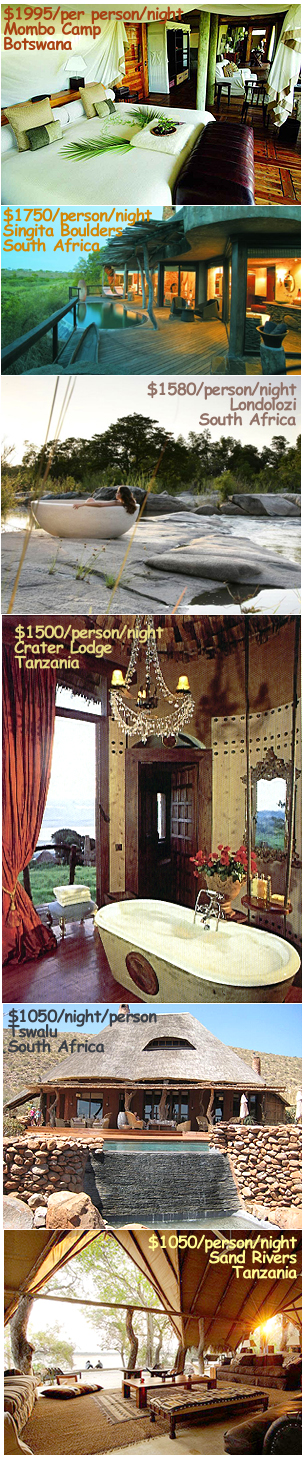
Build Up. As high and expensive as you can get. Be damned the resources consumed to build Versailles! Onwards and upwards! Four Posters! Plunge Pools! Solar Cosmetics!
The upmarket has by definition been primarily interested in comfort and style rather than context. It matters, but less with the upmarket, if the Serengeti road will disrupt the great wildebeest migration. So long as there is still a feather bed at the end of track that has a wildebeest or two, it will be just fine.
Bilila Lodge in the Serengeti is not so dissimilar to an Aman Resort Indonesia or a Canyon Ranch in Arizona. Bilila is a Kempinski property, one of the oldest, most successful European grand hotel chains that exists.
I just stayed at Bilila Kempinski and was truly astounded. The lodge is very remote and made even more so by a single access road that is 35 kilometers long. That’s one impressive driveway.
The public areas resemble any wonderful western spa or upmarket golf lodge, for example, with stylish architecture, spiraling staircases, giant lounge chairs, and lots of glass. The infinity pool is spectacular. Individual rooms are magnificent and huge with tasteful accouterments and the highest quality furniture.
But here’s what really got me: wifi worked better than in any upmarket hotel or lodge I’ve stayed at anywhere, in Nairobi or Dar. The wide-screen TVs had a whole arm’s length of channels, not the 7 or 8 limited ones found in Intercontinentals and Fairmonts in Africa.
Hot water was hot and always so. The air-conditioner not only worked, but well and softly, even when it shouldn’t have (when it was cool out). The telephone by the bed could ring my wife a half world away quicker than reverse when I was in any office in Africa.
The a la carte menus seemed right out of lower Manhattan, and the food was just as good. The boutique didn’t mess around with wood server spoons, but rather trendy canvas art whose price tags usually started at five figures.
Ecotourism is dead, because … it didn’t work. It relied on the generous spirit of middle class travelers willing to donote a little bit of their vacation to a better world order.
Nairobi Pep Rally, but they aren't headed to a basketball game!Loyal, middle-of-the-road Chinese and good ole Americans heartily agree on the doctrine of noninterference in local affairs. How passe. Listen instead to the New Kenyans.
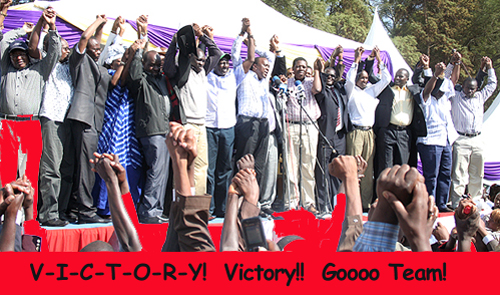
Yesterday in Kenya pep rallies resembling a Final Four sendoff were being held all over the country. There were bands (marching, although not intended to have been), poms poms (well, bunched up flags), cheers (in Kikuyu, Luo and Kalenjin) and lots of camera flashes from lots and lots of enthusiastic supporters.
Is the World Cup still on? Did a Kenyan outshoot Tiger? Did Michael Jordan come out of retirement?
No, no, no no. This is the start of a murder trial.
And the day ended with four prominent Kenyans boarding an international flight to Europe and they were not headed to a basketball court. They were going to a different kind of a court. Criminal.
Six of what had been Kenya’s most powerful men alive are answering summons by the International Court at the Hague that they organized the widespread violence that followed the 2007 elections which left more than 1300 people dead and 150,000 displaced. If found guilty, they could be imprisoned for 25 years.
That could seriously disrupt their campaigns for national office next year.
These are not political underlings. They include the son of the founder of the country, the former head of the national police, the former head of the civil service, the attorney general and a former vice president.
Why are clever politicians submitting to a process that could ruin their lives, that is orchestrated from abroad?
In fairness to the complexities of Kenya, the answer is more complicated than just “it’s the will of the people.” But in fact, it is the will of the (Kenyan) people and in large part because New Kenyans understand that they are inexorably linked to the greater world order. If they want to impact this order, they also have to submit to it.
The United States and China are two of the few countries in the world that do not recognize the International Court. Kenya, and all progressive countries, do.
A poll released yesterday by Synovate showed a whopping 61% of all Kenyans wanted the accused to stand trial at The Hague.
This is the culmination of a very long process that began more than two years ago. The agreement managed by Kofi Annan that ended the violence following the 2007 elections mandated bringing to justice those determined responsible for it. Kenya had a certain time limit to fashion courts internally to do so, and if unable to do so (as proved the case), the International Court was summoned to do so, instead.
Parliament went back and forth on numerous ocassions trying to set up an internal court, but was unable to do so. In part this was because there was no single ethnic group apparently more culpable than another. They were all involved. It was a sort of melting down pot after the 2007 election. Three or four or five ethnic groups were all fighting each other.
Kenyans as a whole (especially the youth) are emerging above their enthnicities and really thinking of themselves as New Kenyans. They want these old rivalies ended. And clearly, they want them ended in line with a World Order evinced at least in part by the World Court.
Hurrahs for Kenya, once again. And anybody up for starting a movement to try someone responsible for creating the myth of WMD?
The rich are getting richer, and the poor are getting poorer, de-dum de-dum, and who the hell cares? I do, a lot. And if you don’t, you’ve been brainwashed.
This year’s Forbes List of the wealthiest people has 1,210 individuals (on a planet of nearly 7 billion) holding 77% of its total wealth ($45 trillion).
Any one of those more than thousand billionaires (most of them are fat, by the way) actually are 2000 times wealthier than all of East Africa combined.
I, and you, should care because of a thousand reasons nicely summed up in one. Like Asia a generation ago, Africa is morphing into a powerhouse. The speed and agility with which this is happening reflects the enormous potential of the caterpillar within.
So I’m not jealous. I’m not screaming I didn’t get my fair share. I still believe in an iota of the goodness of greed, in capitalism contained. But in its infant state, Giant Africa is still compassionate. We want it to stay that way and be a beacon for all society, and we want it to be nurtured and prosper.
Nurturing and Prospering is not in this week’s to-do list.
Since 2005, (and note the economic crash), the world has grown at a tepid 3%. Since 2005, the amount of wealth controlled by the Billionaire Club has quadrupled (that’s 400%).
Now that’s a rich-getting-richer thing that is hard to grasp. Fortunately for East Africa, its ingenuity and geopolitical position on the gyroscope of terrorism has basically shielded it from those five years of downward pressure.
Most of the bulging billionaire syndrome has come at the expense of the vast middle classes of developed societies. Me. You. So for the time being, anyway, Africa’s freedom to grow and save the planet has been more or less shielded from gluttonous greed. Thanks to Me. You.
And what a struggle it’s been! Not only have we had to forego getting a new car or residing our aging homes, but the Billionaire Rich have been hard at work … making war.
Joan Baxter, in this issue of Pambazuka, argues persuasively that the growth of wealth among the few is created by, and requires, world conflict.
Right. You can’t strike it rich unless you strike it down.
Baxter calls this “Disaster Capitalism” and then adds an eulogy: “At least vultures wait until after death to feed on cadavers.”
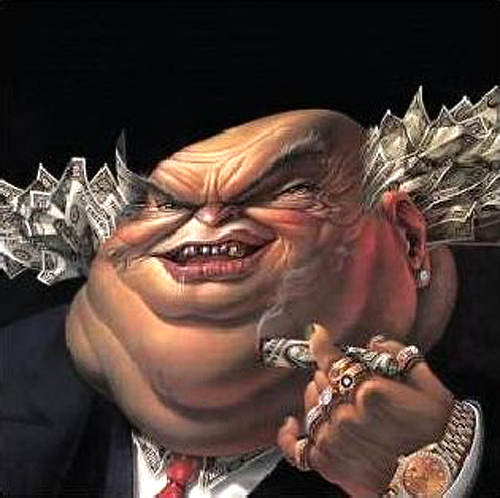
So we have this high school club controlling the world’s economy, whose very essence and continued existence, requires poverty, misery and ultimately war.
I think I read about this somewhere, before. Star Wars? Batman? Spiderman? Was it only in fantasies … until now?
But here’s the positive way of looking at this from the inside out:
Imagine how much faster the world could be improving, how many wars would end, how much misery could be morphed into genius if that grossly unnecessary billionaire wealth were spread over Africa and other promising places. (Exclude Nantucket.)
Intellects now bristle like the hairs on a porcupine. Am I daring to suggest that we simply redistribute this wealth willy nilly.
Well, in the absence of any possible Democratic/Republican new tax code, yes.
Random, wild, irresponsible redistribution of unimaginable amounts of money works. It’s been proven. The U.S. bailouts worked. We saved the billionaires from disappearing.
The NorthPark Shopping Center in Dallas has great lion hunting!Big game hunting in Africa is a sticky issue. In Tanzania it’s worse, an abomination. Last month’s killing of a Tanzanian big game hunter by poachers right adjacent the Serengeti says it all.
I did not know Andre de Kock, the hunter who was murdered, but I have had a few rare run-ins with the company for which he worked, Robin Hurt Safaris (RHS). RHS was founded by Robin Hurt, probably the last of the great waving white hair machos to stroll Africa.
His company’s antics are tucked in secrecy, difficult to confirm. In main this is because many hunting clients don’t want to be known, so the client list is a guarded secret. We are reduced to the undesirable necessity of referring to rumors. Rumors that his client list includes the King of Jordan and Saif Gaddafi.
Bold and irresponsible if I had not myself encountered Arabs pointing AK47s at me on the border of the northeast Serengeti shortly after my cell phone beeped with a message welcoming me to the UAEmirates phone system.
I will never forget having strayed maybe 20 or 22 feet out of the Serengeti trying to find the migration for some clients when a Ford pickup looking for all the world like a Somali militia raced up to us buried in its own dust.
When the dust settled I counted not less than 9 “kids” all armed with AK47s, standing in the back of the truck. Not exactly your Sunday bird shoot with an aspic chicken basket.
We weren’t armed, by the way.
The guns weren’t pointed at us, but the truck was. Robin stepped out in his all too small short shorts to ask what the hell we were doing in “his quadrant.”
He was referring to the Maswa Game Reserve, a hunting reserve adjacent the southwest Serengeti.
February 18 Andre de Kock was hunting with a client in that same Maswa reserve. He stopped to retrieve a blue bag discarded on the veld.
It was filled with ammunition and belonged to poachers who then killed him and wounded some of his staff.
I bear no ill will to de Kock or his family. For all I know his situation was as destined as the poachers, who could be unemployed by a creeping world order that denies gainful employment to the well-trained, and who might have been starving. Although some reports claimed otherwise.
Allegedly, the poachers camp was later found to contain ivory, not something you can eat. Ivory poaching is more sinister, more organized, definitely something I’m less sympathetic to than the bushmeat trade. Pity the Tanzanian government doesn’t share my feelings.
So this is no easy issue. It raises visceral feelings, to be sure, on all sides. And it’s often hard to drill beneath the emotions to careful debate.
This blog is not intended to be careful. You live by the sword. You die by the sword.
Karen wrote: Flying from Boston into Jburg SA the 3rd week in Nov, want to spend few days in SA, week on safari in Serengeti & end in Zanibar (approx 2 weeks total). Specific suggestions what to see/do that time of year? 2 women, 1 college girl & 1 12 year old girl. Need help getting stared. Thanks!
Jim Answers
Karen –
This is a tough one for me to answer. From about the beginning of November through the middle of December, most of sub-Saharan Africa is dry, hot, dusty and at its worst time of the year for game viewing. So let’s start with the truth of the matter: you’re going at the wrong time for game viewing.
But maybe you have no choice. Maybe your “college girl” is going or coming, and so it makes best sense to do it, now.
But, please, forget the Serengeti. The Serengeti is my favorite place in the world, and you want to visit it at its darkest time of the year. Besides, I’ve often said that trying to combine East Africa and southern Africa is a real mistake. It’s a mistake to budget, time and context. Stick with southern Africa.
November is a great time for the whales in Cape Town. The beaches of Mozambique are just as good if not better and cheaper than Zanzibar’s at this time of the year. And if you must do game viewing, try to get on one of the (cheap and exciting) ranger-led walks in Kruger National Park, which I know your kids will really love.
Hope this helps! Sorry to be so discouraging, but the fact is that you’re starting with the wrong idea, and if you adjust it slightly you’re going to have a great experience!
Genius Engineer, World Shaker, Kenyan Evans WadongoPeople just don’t get the social tsunami smashing the world right now. Obama’s Old News! Notwithstanding the media starred war in Libya, societies are changing at the drop of a text message. Billionaire industrialists and fat politicians aren’t the only ones running the show, anymore, in fact their days may be numbered. Meet Evans Wadongo.
Wadongo is currently sharing a world prize with Ted Turner (CNN) and Tim Berners-Lee, the man who in 1989 first made the Internet work. The three are the inaugural winners of the annual Gorbachev Award for “opening up society.”
What did 25-year old Kenyan-born, Kenyan-schooled, still Kenyan resident Wadongo do that elevated him to the table of stars?
He turned dark into light without using fossil fuels or electricity. He’s an engineer. But he didn’t invent gyroscoping drone bombing sensors, or infrared seeking document readers, or nano focused skyscraping beam protectors.
He invented a solar lamp that is cheap and efficient so that hundreds of thousands, maybe millions of poor people can see at night without endangering their health and minuscule budgets with kerosene lamps and fumes.
Do you get it?
A simple, efficient, inexpensive solar lamp is as important as the WorldWide Web and CNN.
Because when the potential of millions of suppressed people is illuminated, the world will change, and I for one, think for better. That’s exactly what’s happening, now.
Whether it’s Wadongo, or Ory Okollah, or Wael Ghonim, the movers and shakers of the world today are increasingly:
1) Kids
2) Optimistic
3) Smart
and above all, 4) Compassionate.
It’s a new world, you old fogies! Not sure how we’re going to deal with these new parameters of life, but we better get ready, because it’s going to be a much different world from the one in which we prospered.
Is it faith that heals?Does unmitigated faith cure, kill, lead or mislead to victory? Ask the tens of thousands of people flocking to a faith healer near the Serengeti. Or ask the ragtag fighters pushing into Sirte. It’s all the same. And who are we to interrupt the jihad?
An endless line of cars, bikes, walkers trekking into a remote mountain location near the Serengeti in Tanzania has caused turmoil in Tanzania’s government, eight traffic fatalities, more than 50 deaths of those waiting for the “miracle cure,” and raised serous questions about the role of traditional medicine in Africa.
It may be hard to believe 76-year old Lutheran pastor, Ambilikile Mwasapile, that he can cure everything from AIDS to diabetes to all forms of cancer for a 30¢ cup of herbal medicine “touched by God”, but nothing seems to deter an unprecedented pilgrimage into the Tanzanian bush.
Tanzania is a very superstitious society, and there are healers and medicine men everywhere. But to my knowledge this is the first time that established, traditional clerics have supported such an individual. Monday, Mwasapile gained support from the Evangelical Lutheran Church in Tanzania (ELCT). Western trained Bishop Thomas Laizer told one of Tanzania’s major newspapers that he would begin raising funds to build a large healing center that could better serve the thousands of people seeking treatment daily.
This ideological breakthrough followed Sunday’s decision by the Tanzanian government to send paramilitary troops into the remote area to stop further lines of cars, trucks and helicopters from visiting “Babu,” as Mwasapile has been affectionately named. The government said this was only a temporary halt. Needed to bring some kind of stability to a pilgrimage clearly getting out of hand.
But the humanitarian move by the government may have backfired. Not only did the established Lutheran church then issue its unequivocal support, but Parliament got uncharacteristically rattled. Member of Parliament Steven Ngonyani told the government “Hands off!” the work of the healer.
“The government …should show its support to him and not break his heart by imposing modern methodologies… What has Tanzania Food and Drug Agency to do with regulating the works of a traditional healer?”
According to Nairobi’s Daily Nation 24,000 people were lined up and waiting for the cup of elixir Saturday night. The BBC said the line of cars, trucks and bicycles was more than 15 miles long.
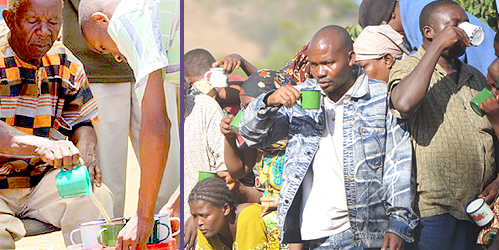
People wait for days to pay Tsh 500 (about 30 U.S. cents) to drink a cup of tea brewed from a root more commonly used as a poison, personally handed to them by Babu himself. In fact, Babu claims that if anyone else brews the tea or hands it out, it won’t work.
There are no hotels or hostels in the area and sanitary conditions are appalling. Businessmen from the cities have set up tent camps offering bottled water and places to sleep at outlandish prices.
The deaths and injuries to those waiting forced the government’s hand. Most of the deaths are of persons who were dying and had been whisked out of traditional hospitals by relatives and transported into this rugged, remote and mountainous area of northern Tanzania.
Reports that all of Tanzania’s main government officials, including President Jakaya Kikwete, as well as officials from Oman and the Emirates had come to take the cure, remain unconfirmed yet strangely undenied as well. And helicopters do arrive regularly with persons who break the queue by paying ten times the normal rate (Tsh 5000, about $3.50).
I cannot find a single published testament that the cure works, despite my own employees in Tanzania recounting many stories of relatives and friends who have been cured of a whole range of disease. But no one will come on record. Neither will the President of Tanzania deny the widely circulated rumor that he’s taken the cure.
On record are physicians decrying the hoax (see YouTube below), but none have so far published their skepticism locally.
The 76-year old cleric has a Facebook page that is – remarkably – well serviced for an old man who is supposed to be handing cups of cure to supplicants for 12 hours a day. All the entries I could translate were requests for the cure; I didn’t find one testament to being cured.
On my safari last week into the Serengeti, we saw trucks and cars stuffed with clearly sick people in an unending journey into this remote wilderness.
Tanzania is a very superstitious place. The most educated Tanzanian remains worried all his life that he’ll be cursed. My Mzungu (white, European) boss for many years in Tanzania regularly visited Maasailand for herbs. Some of the finest tourist lodges in the country refer to themselves as “Spas” dispensing herbal remedies.
The tsunami of optimism breaking over earth at the moment comes not without the turmoil of death and destruction. It is this same dialectic that infuses the thousands of sick people making the pilgrimage to the Serengeti.
Wandering children run over by cars, dying patients left on the side of the road, children “wailing and flailing as they were forced by their mothers to swallow the concoction.”
What the heaven does this mean?
That faith heals?
That people are desperate?
That the spirits rattling the world at the moment are alive and well?
That freedom and democracy will follow the slaughter of Tiananmen Square. That transparent and uncorrupt government will now rule Egypt. That despots like Gaddafi will be replaced by Mahatma Gandhis.
That faith in the struggle is the single most important ingredient to victory?
So far on this blog we’ve discussed the humanitarian crisis in Cote d’Ivoire, and the merits of military intervention.
Our profile would not be complete without discussing the economic context in which all of this occurs.
This is also true in Libya of course: by Libyan nightfall yesterday, the rebels were back in control of two key oil towns and claimed to have found a gulf state buyer for the 100,000 barrels per day of production currently in rebel hands.
But back to Cote d’Ivoire.
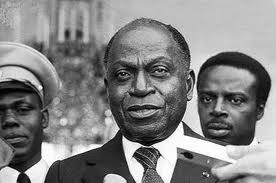
At independence, there was a famous bet between the Kwame Nkrumah and Félix Houphouët-Boigny—the two fathers of independence for Ghana and Cote d’Ivoire respectively. Félix Houphouët-Boigny
They bet on which country would lead West Africa two decades on. Cote d’Ivoire vigorously pursued economic integration with France and allowed capitalism to thrive.
Ghana on the other hand broke most ties with the metropole, and gave the state a much stronger hand in the economy.
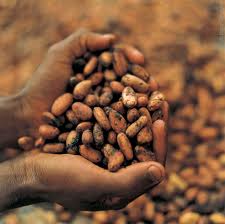
We could write an entire piece on who is ‘winning’ in 2011, but the important thing to note for this piece is that Felix Boigny’s approach allowed cocoa production to soar as French investment and agricultural know-how poured into Cote d’Ivoire.
Cote d’Ivoire exports approximately 40 percent of the world’s cocoa crop, with the West African region, including Ghana (21 percent), Nigeria (5 percent), and Cameron (5 percent), accounting for about 70 percent of international production.
As violence continues to escalate in Cote d’Ivoire, international markets have responded by driving cocoa futures to their highest price in 32 years — $3,586 per metric ton for May delivery.
EU and U.S. sanctions imposed in the aftermath of the disputed November 28th, 2010 election currently forbid companies from conducting business with entities linked to the regime of the intransigent incumbent Laurent Gbabgo.
This includes critical actors in the cocoa industry such as the cocoa regulators and the ports of San Pedro and Abidjan.
On top of these sanctions, President Outtara has attempted to starve his rival of approximately one billion dollars in tax revenue by issuing, and then extending, a ban on cocoa exports.
Taken together, the targeted sanctions and the export ban constitute a virtual embargo on Ivorian cocoa.
The recent extension of the export ban comes at a moment when cocoa shipments from Côte d’Ivoire have all but dried up.
Major cocoa purchasers such as Cargill, ADM, and Barry Callebaut, have either dramatically scaled down operations or stopped exporting completely.
This means that approximately 25 percent of the Ivorian cocoa crop, equivalent to 10 percent of the world’s cocoa crop, is piling up in humid Ivorian warehouses.
Recent estimates suggest that 300,000 tons of cocoa have been stockpiled up-country and an additional 100,000 tons, at the ports.
Ivoirian cocoa is produced in large part by small holder farmers who do not have the funds for proper warehousing, and industry stakeholders fear that the remaining crop will soon spoil if the sanctions remain in place.
Recently less than 5,000 tons of cocoa has been arriving per week at Ivorian ports from farms in the interior, and even that meager flow will likely dry up completely as Ivorian banks shut down operations.
Predictably, the export ban and subsequent banking crisis have exacerbated social tensions in Côte d’Ivoire.
Approximately seven million Ivoirians rely on the cocoa industry for their livelihood. Already thousands of Ivorian farmers have symbolically burned portions of their crop to protest the embargo.
The crisis in Côte d’Ivoire will likely reshape the cocoa industry in ways that even the 2002-2004 civil war did not.
The recent sanctions crippling the Ivorian industry have led to a dramatic upsurge in cocoa being smuggled through Ghana: since the October harvest in Côte d’Ivoire, around 100,000 tons of Ivorian cocoa have left West Africa through Ghana.
The two countries share a 668 km border that runs through the middle of the most productive cocoa regions in both countries.
The Ghanaian government, which fixes the price for cocoa beans, has amplified this trend by raising the price paid to Ghanaian farmers by about 30 percent.
The Ivorian crisis also coincided with a natural increase in Ghanaian production capacity due to better use of pesticides and fertilizers.
This turbulence in the West African cocoa market comes at a time when experts predict a steady increase in demand for cocoa due to the emergence of consumers in India and China. During 2009-10, demand outstripped supply by 82,000 metric tons, according to the International Cocoa Organization.
Volatility in this market will continue, buoyed by uncertainty over the deteriorating quality of the cocoa stockpiling in Ivorian warehouses, and the threat of a price collapse as soon as a solution to the Ivoirian political crisis appears on the horizon.
In the two weeks between October 11 and October 31, 2002, when both sides discussed a truce in the Ivorian civil war, Cocoa prices sank from $2,405 to $2,040 per ton.
The banking crisis precipitated by the political instability and cocoa embargo is the final factor in prolonging the reining instability.
The consensus among analysts is that Mr. Gbagbo needs between $100-150 million per month to pay the military and essential civil service personnel.
His signature is no longer valid at the Regional Central Bank that prints Côte d’Ivoire’s currency, and Côte D’Ivoire missed $30 million in interest payments at the end of January.
Soon Mr. Gbagbo’s financial position will become untenable.
I hate to give Facebook anymore publicity then it already gets, but a post on Online Africa was interesting enough to bring to your attention.
In 2010, Facebook gained its 3 millionth member in South Africa.
That means that Facebook use has been growing at near 25% for at least the last two years. See this post by Eshaam Rabaney for a more detailed breakdown.
Predictably, this growth has been most intense among 18-25 years olds.
However, U.S. readers should remember how quickly Facebook spread from young socialites, to their parents connecting with old friends, and even to the grandparent generation connecting with their tech savvy grandkids.
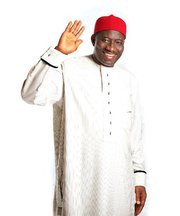
African Presidents are even adopting Facebook! Goodluck Jonathan in Nigeria is particularly active, as are a number of South African politicians.
Scroll to the bottom of this Online Africa post to connect directly to the FB pages of African leaders. I would go ahead and friend all of them with public profiles.
Presidential Facebook Shots:
Lets check out the two latest posts from President Goodluck Jonathan of Nigeria:
“In keeping with promising less and delivering more, I promised revival of our railways. If you live near tracks, you may have noticed that promise is now a reality. Trains are now gradually getting back on tracks. We met a rail service requesting attention and gave it support. It is the same way that we will bring life to every sector in Nigeria with your help. GEJ”
This post received 2498 comments, and 1798 “likes.”
“There are only two types of people in Nigeria: Good or Bad and not Northerners or Southerners.Assess people by their character which they control not by their place of origin which they cannot control. God made us and placed us in the locality where we were born. To discriminate against any human based on place of origin is to question the wisdom of God. And the wisdom of God is beyond the wisdom of man. GEJ”
This post received 3122 comments, and 3201 “likes.”
Embattled Ivorian Laurent Gbagbo has also been rallying the troops on FaceBook.
South Africa is far ahead of the rest of the continent in terms of usage (Egypt excepted), but some other countries are catching up fast—very fast. Ghana’s number of FaceBook users grew by 9.6% from February to March 2010! Morocco (7.6%) Tunisia (7.7), Nigeria (6%), Kenya (2.4%). As internet penetration increases these numbers are likely to increase dramatically. Find all the data here.
So what does this mean to Africa? Is it really important that South African teenagers are even more aware than they already were of the minute details of each other’s lives?
Yes – absolutely.
Anecdotally, the need to get Facebook is in many ways driving internet adoption among the younger generation.
These Internet and communications skills will make young Africans far more competitive in the information economy.
While the primary motivation for adopting Facebook may be social, the commercial implications of this trend are immense.
In more developed markets like the U.S or U.K. Facebook advertising is already drowning out traditional media.
The site is also more then simply a distribution channel.
Modern consumers want to feel a connection with the people behind the products they buy.
Facebook allows companies to post videos introducing potential consumers to their employees, or pictures and profiles that capture the company spirit.
Creating this type of connection with customers is no longer just a nice touch—its required.
The political implications of this type of media have already been discussed in this space, but I can’t resist one parting shot…look here for status updates from Monsieur Mubarak.
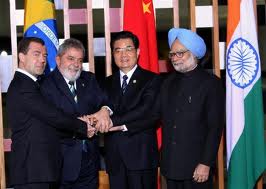
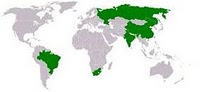
In two weeks, South Africa will be formally accepted into the BRIC grouping of Brazil, Russia, India And China at an economic summit in Beijing.
Just in case you don’t read US weekly—these are the new cool kids on the block.
Gone are the days when the EU was pinnacle of diplomatic achievement.
To be hip now is to be BRIC.
Does South Africa merit this social promotion?
That depends on the criteria.
When Goldman Sacks asset management chairman Jim O’Neil coined the term, he intended it to refer to countries of sufficient size, with favorable demographics, and with an economic environment that would facilitate high growth.
On these measures South Africa does not make the cut.
However …
Terms like these often escape easy categorization.
Do all the European Union member states share a similar cultural or geographic background? (Only if the term “similar” is stretched to the breaking point.)
Does the G20 contain the world’s top 20 economies? (No – South Africa, a G20 member, is actually the 27th largest economy in the world.)
BRIC is no longer merely an economic distinction.
The BRIC club is now a political grouping of countries based loosely on their relative economic influence among developing countries.
In this way, it has the same freedom to act, or to change membership, as any other political-economic grouping, such as the G20, EU, NATO, etc.
The BRIC leadership has shifted its membership criteria away from the founding mantra of large economies experiencing rapid growth to politically important countries whose membership would add value to the BRIC grouping.
This is a well trodden path.
Why did/does the EU extend membership to some of the Balkans?
The Balkans’ economies did not resemble the Western European founding members, nor did the mainly Slavic Balkans’ languages relate to the Germanic or Romance languages spoken in Western Europe.
The EU’s founding members offered membership to select countries in the Balkans in order to encourage the applicants’ respective governments to make the right social and economic choices, and to pacify the zone on traditional Europe’s borders.
Should Turkey be a member of NATO, the North Atlantic Treaty Organization?
Similarly blatant political maneuvering is behind Chinese Foreign Minster Yang Jiechi’s invitation to Jacob Zuma to attend the next BRIC summit.
South Africa’s 50 million people and lackluster 3% growth may lead Jim O’Neil to shoot it down in favor of countries like South Korea, Turkey, Mexico, or Indonesia; but South Africa offers the resource hungry BRIC countries something those other options do not—access.
Access to a continent teeming with ore, industrial metals, and newly minted consumers.
Pundits have been asking the wrong question: they insist on questioning whether or not South Africa merits the BRIC designation based on its size, growth rate, population, etc.
The real question is – does South Africa provide enough value to all four of the current BRIC countries?
That is the ‘merit’ that matters for this lunch table.