Surprise in the Sahel

Surprise in the Sahel

By Conor Godfrey
On the morning of March 22nd Malians woke up to discover that 20 years of stability and progress had been, temporarily at least, hijacked by a group of mutineers turned putschists led by a Captain Amadou Sanogo.

This was a punch in the stomach with no warning.

When I was evacuated from Guinea after a similar Coup in 2009, we traveled north through Upper-Guinea to Bamako, Mali.

On the Guinean side of the border, one gets shaken down every 50 kilometers by aggressive soldiers manning checkpoints on a sorry excuse for a main road.

As soon as you cross to the Malian side of the border, the road quality improves 200%, and the soldiers manning periodic checkpoints are friendly and helpful.

It was like a different planet.

This small anecdote conveys the crux of the sahelian surprise – this landlocked country with minimal assets was successfully bootstrapping itself out of desert poverty.

It was also a poster-child for the fruits of reasonably good governance.

This coup was not the result of long simmering ethnic tension, or gross mismanagement; it was a pseudo-spontaneous overflow of frustration by a group of junior officers and enlisted soldiers in Bamako.

More of an isolated mutiny that got out of control.

The explanations for the coup are all over the news: here and here you can find good articles on the acute causes.

See my previous post on Tuaregs.

Essentially, there has been a full-fledged rebellion in the north of Mali since January, led by a Tuareg outfit known as the Movement for the Liberation of the Azawad (one of many Tuareg campaigns over the last few centuries….they are only called rebellions once there is an actual State to rebel against — I suppose.)
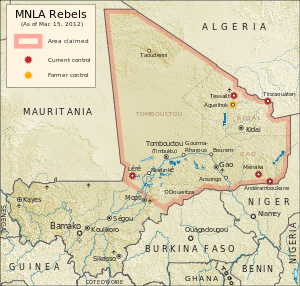
These rebels have inherited military equipment and wherewithal from the Tuaregs that fought alongside Gadhafi, and are essentially outgunning and outmaneuvering the uniformed Malian army.

The junior officers doing much of the fighting (and dying) in the North feel the Malian government has mishandled the rebellion, accusing them of sending poorly armed and equipped soldiers to face hardened and well armed rebels.

This issue is also magnified by the growing resentment of the Southern Malian population (where the overwhelming majority of Malians live) toward the rebellious Tuaregs in the North.

Most Malians are looking for a strong response.

(Whether this constitutes “support” for the coup is difficult to tell: here is a very intriguing set of posts by “Bamako Bruce” claiming widespread disenchantment with the previous government.)

Regardless, if soldiers continue to loot stores and government buildings, nebulous support from some Malian youth will likely evaporate.

I am going to go out on a limb regarding the outcome of this crisis, and I expect you all to write in angry comments if I am wrong…

My prediction is that this is going to blow over.

The coup leaders did not secure the backing of the necessary socio-political elements of Malian society (religious leaders, senior military figures, opposition groups), and now find themselves increasingly isolated.

Malians were enjoying the fruits of democracy (albeit slowly), and have no appetite for violence or prolonged instability.

They are simply pissed off that their government cannot get a handle on the conflict with the Northern rebels.

On that front, the Tuareg rebellion has done so well that there are now signs the rebel leaders want to negotiate from a position of strength and secure more autonomy and other perks before their success triggers the use of overwhelming force by Mali (perhaps financed and armed by international friends).

All of this spells a negotiated solution.

The coup leaders will try to secure a golden parachute by leveraging their ability to prolong the instability, and some of them may get one.

The rightful president of Mali, Mr. Amadou Toure (now either in hiding or under arrest), was due to leave office in weeks anyway, and will likely agree to leave power as scheduled and collect his prize from the Mo Ibrahim Foundation.

He will inevitably promise all sorts of populist goodies on his way out knowing that his successor will have to deliver on them.

This will pave the way for elections that will elect a candidate promising better equipment and training for the army, thus defusing the tension that brought the coup in the first place.

Of course, things could go south quickly as well.

Read this short piece of analysis by a risk consulting group.

While I think that the Executive Analysis scenario is unlikely, there are several points where my more positive projection could break down.

These mainly concern rebel and government choices regarding winding down or scaling up the conflict in the North.

The Malian government may need (strategically or because of popular pressure) to bloody the rebels before negotiating.

After all, the Tuareg rebels have claimed so much land in this campaign that they might be tempted to do so again the next time they are feeling aggrieved or restless.

This scenario could give the military government more time to maneuver, as it will be difficult to respond effectively to the rebellion if everyone is focused on elections.

My views are not necessarily the majority position. A darker prognosis can also be found here at African Arguments.

Mali is headed in the right direction. This, I think, I hope, is just a painful bump.

P.S. The Coup leader received military and intelligence training in the U.S.
On Safari: The Real Maasai

On Safari: The Real Maasai

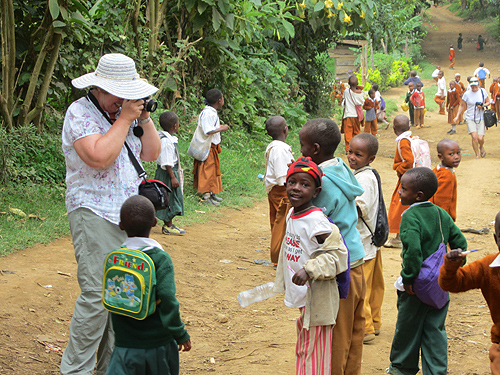
Caroline Barrett meets Maasai school kids.
We’ve had some terrific game viewing, but yesterday was to broaden our experience of Africa: there is so much more than animals.

A vacation, time-off, a holiday – they all evoke images of a breezy, sunny beach, lazing on a hammock swinging softly near a smartly uniformed attendant serving margaritas. That’s not a safari. While there are outfitters who promise exclusivity, rests in the woods with little of a schedule, that’s not what the vast majority of people who come here expect.

They expect above all, wild animals, and there’s no doubt the vast majority of travelers here are animals lovers. And they don’t expect a lazy hammock swinging softly in the breeze. They expect to be roused earlier than normal, herded on schedules into vehicles, and long, long drives over bumpy, dusty roads.

No pain, no gain. In the end the view of the pride of lions with the furry youngsters monkeying around validates the effort. But the effort is considerable, and travelers know that.

So I’ve tried throughout my career to maximize my travelers’ fortitude. And today I think represents a great success. We didn’t start until 9 a.m. Our bumpy ride was but a few kilometers. But the view we got at the end of the day I consider as important as a pride of lion playing.

We spent the day with the “middle class” if you will, of modern Africa.

More than 2/3 of all Maasai in the three countries in which they live are hard working, modern people who live in tight-knit communities that probably remind most of my older visitors of America’s deep south as World War II was ending.

Houses are modest but functional with plumbing and electricity, many in some disrepair for wont of better and expensive maintenance, roads that are horrendous, but communities that take pride in their history, their businesses and above all, their schools.

They are teachers, store owners, taxi drivers, business people and of course, tourism service providers. The Maasai community that we visited on the slopes of Mt. Meru has not lived a nomadic existence herding cows and goats for nearly 200 years.

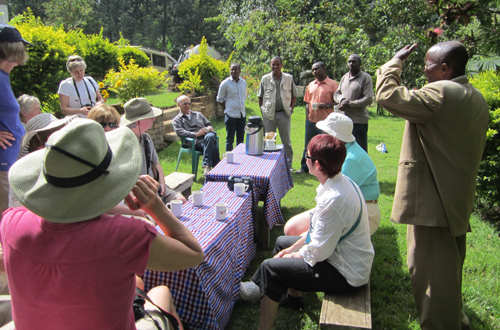
After being briefed by the village chairman whose wife served us coffee and tea in her garden, we were escorted by a young man studying economics in a local college and who spoke excellent English. He explained that there were around 4500 people in the village. “Village” is a political term in modern Tanzania, similar to a town in America.

Phil Lopes studies Mary Critchlow's new necklace.

We saw people working in their farms, women carrying large bundles of wood on their heads, successful men proudly stacking the cement blocks of their better houses and were also escorted to the edge of the village where “traditional houses” existed in a sort of village remembrance of their heritage.

And much of the tour was spent at the primary school. The headmaster brought us into an older class and gave them the opportunity of asking us questions. Among those asked were, “Are you married?”, “How did you get here?”, “Where are you from?”, and “What do you do?”

After each of us explained what we did, the Headmaster asked how many of the classroom of about 50 students would also like to become a such-and-such, an invariably most of the hands were raised enthusiastically.

Until Phil Lopes said he was a politician. There was a pause from the Headmaster until Phil prompted him to ask, “Why don’t you ask how many want to be politicians?”

Enthusiastic laughter and hands-up response.

From Ngeresi village we went into town and had lunch at a local diner, the kind most of the working, modern Maasai in Arusha use for lunch during the work week. The choice of fish, beef, chicken or beans and rice; served with rice, ugali or chapati was unanimously considered a good, solid meal. The cost? $2.10 each.

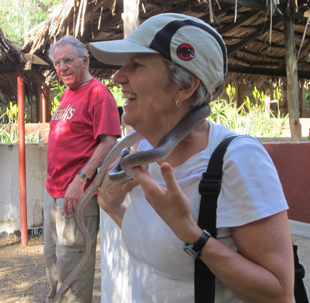
We ended the day at a couple other Arusha area attractions including the Meserani Snake Park, where the Maasai Charles guided us in front of the several dozen snake cages describing how quickly death came from each bite… Well, a lot more actually, like the type of toxic, how bites are treated and why people get bitten.

The Maasai we met and who befriended us today actually call themselves “wa-Meru” rather than Maasai, to distinguish themselves from the traditional (archaic: “primitive”) ways of their ancestors. But their language and their not so distant ancestry is the same, and I have hired Maasai driver/guides here — some of the best I’ve ever had — who herded goats on the distant Serengeti as a young boy calling themselves “Maasai,” and then developed a careers in Arusha town calling themselves “wa-Meru.”

The Vice President of Kenya was a Maasai. The CEO of Kenya Airways is a Maasai. Prominent Maasai fill Africa’s boardrooms. But it isn’t just the most modern and the most primitive. The men driving my clients around Tanzania, explaining the intricacies of acacia dependence on giraffe or the complexity of Tanzania’s new constitution, or discussing the problems of a their children during the teen years of texting – they, too, are Maasai.

It was a long, productive, nonanimal day and I’m now doubly encouraged to give these wonderful clients the finest game viewing in the world. I hope they felt the day worthwhile, a day that might have changed their notion about what a Maasai is.

The Ngeresi Village Chairman briefs my group at his home on Maasai development.
Land Grabs Really a
Proxy for Water Grabs

Land Grabs Really a
Proxy for Water Grabs

By Conor Godfrey

Paolo Bacigalupi is a master science fiction writer, and winner of the Hugo, Nebula, and any other Sci-fi award you can think of.

His blockbuster hit was entitled “The Windup Girl.”

The story imagined a world in the near-mid future where food-crop biodiversity had plunged due to constant genetic tampering in an effort to feed a growing planet with less available water.

Land, original seeds, and calories became the only currencies that mattered.

We are far from that, but sometimes I will read an article on “land grabs” in Africa and think that Mr. Bacigalupi was more of a slight exaggerator than an all-out lunatic.

Everyone wants a piece of the mother continent these days. Not- as you might have heard- just the Chinese.

Even South Africa recently bought tens of thousands of hectares in Guinea!

Other investors are Asian, European and American, as well as private pension funds and a number of Scandinavian and gulf state sovereign wealth funds.

Please read Professor Deborah Brautigam’s piece on some of the gross falsifications surrounding Chinese land grabs.

Anyway, who wouldn’t want in on African land?

First – there is a lot of it.

Africa’s approximately 200 million uncultivated hectares of arable land represent about 60% of the world’s total.

Second- its dirt cheap (pun somewhat intended).

In Europe, land costs about $22,000 per hectare (Germany) annually.

In the land rich United States, it costs about $7,000.

In most of Sub-Saharan Africa, land goes for about $800-1000 per hectare.

I could even afford some!

It also nicely diversifies a more traditional investment portfolio and promises to produce profitably as larger and larger players compete for fewer and fewer available commodities from here on out.

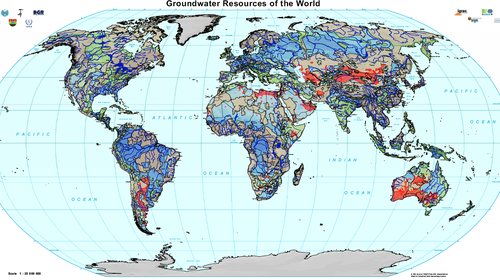
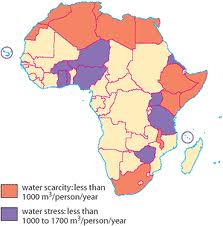
In many ways, the problem is not land; it’s water.

Map by Oakland Institute

Let me quote from a recent study by the Oakland Institute: “If all the 40 million hectares of land that were acquired on the [African] continent in 2009 come under cultivation, a staggering volume of water would be required for irrigation (…) approximately twice the volume of water that was used for agriculture in all of Africa in 2005.”

Yikes.

Some African countries have water to spare in the short term.

Others never had any.

Many pastoral and nomadic communities have negotiated (or fought over) water rights for centuries.

If their governments’ lease their land to commercial producers, they may find access to critical water sources blocked by barbwire plantation fences.

People do not suffer this lightly.

Foreign investors recently gained title to 544,567 hectares of land in Mali along the Niger river.

These new concessions will suck up about two times the entirety of Mali’s water consumption in 2000. As of today the level of the Niger river is already 30% less than in 1980. (source)

The Omo and Nile river systems are similarly fragile.

Modern capitalism still has trouble pricing in environmental externalities and some forms of risk.

Water table depletion poses obvious risks to the environment, but on the flip side, there are reputational and monetary risks for investment projects.

Draining water reserves leads more or less directly to acute political risk, and if the problem is widespread enough, sovereign risk.

Do these investors doubt for a second that a new administration facing acute domestic pressure to stop land grabs would not alter the terms of an existing contract?

Or, do foreign investors really want pictures of displaced villagers circulating among shareholders?

For example – in 2008 three people died in Uganda in riots protesting a land concession. Read this article on unrest in Guinea over an earlier land grab.

I wonder if investors are accurately assessing this types of socio-environmental risk when they sign 100 year leases.

Ironically, when the leases are for a full century, investor incentives align behind environmental and social stewardship, while the local politicians have a much shorter time horizon and might be willing to make fast cash at the expense of a small subset of their citizens.

The more I think about it the more I think our story teller Paolo Bacigalupi should apply for the empty seat at the World Bank.

On Safari in Zanzibar

On Safari in Zanzibar

It’s still too early to return to Kenya, so my migration safari began not in Nairobi but in Zanzibar. We had three wonderful, very hot and fascinating days!

It rather breaks my heart to substitute anything for Kenya, which as a society is so incredibly hopeful and promising. But the tourist incidents recently in the north, the kidnaping of NGOs near the Somali border, and the bombs in Nairobi city — however ineptly undertaken – all prove that the Kenyan invasion last October of Somalia has spawned revenge attacks that in my opinion make a safari in Kenya ill-advised.

And Zanzibar is one of the most fascinating places in Africa, for it was here that literally “it all began” in East Africa. Colonized in the early 16th century by Portugal, then conquered by the Omani Arabs almost two hundred years later, East Africa’s culture, language and much of its difficult politics was fashioned here in the ‘Spice Island.’

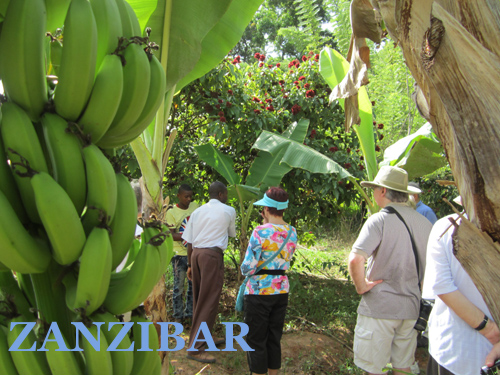
Our first excursion was to see a spice plantation cooperative outside Stone Town. Every spice imaginable is grown here, and it was so remarkable to learn how mace is harvested from the outside of nutmeg, how chilies grow wild, and how almost interminable stripping of the cinnamon tree for its bark does nothing more than promote more bark to grow and more cinnamon to be harvested!

The crown crop is cloves. First planted by the early Omani sultans who realized a business game changer if spices could be harvested less than half the distance from Europe to Indonesia, cloves production continues to be among Zanzibar’s chief sources of foreign reserves.

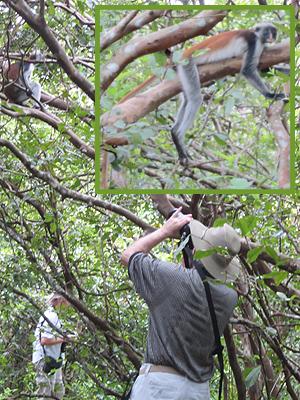
Rich Knapp photographing red colobus.

We then visited the Jozani Forest, Zanzibar’s 20 sq. mile protected wilderness that contains almost 100 species of trees and thousands of unusual plants, flowers, and the main attraction for animal lovers, the Zanzibar red colobus monkey.

The monkey is the last large wild mammal on the island, and its protection is secured principally by the revenue earned by tourists like us coming to see them. And over the years they’ve become remarkably habituated. Multiple times they ran around our feet, swung by our faces, and sat for long minutes giving poses for perfect pictures!

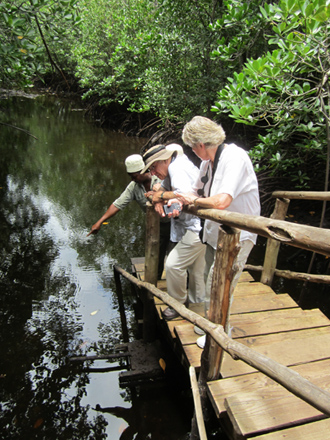
Jozani is also where visitors can learn how important the mangrove forests are to protecting the island. They create a natural barrier to rising tides, tsunamis and typhoons. We were fortunate to go at low tide, when many crabs and fishes could be seen as well, and my compliments to the Zanzibari authorities who constructed the walkway out into the sea through the forest.

Phil & Pam Lopes in mangroves.

The last guided tour we took was a historic walk through Stone Town, its bustling food and fish markets, several of its narrow stone streets and ultimately to the former slave market which became the site of the first Anglican church and is now a museum.

And we ended with a cruise in a dhow at sunset! The “live music” aboard wasn’t exactly Zanzibari or African (Beatles is particularly popular, here), but other than that the opportunity to experience traveling as the early explorers and traders did was a real treat!

On to the great northern circuit! Stay tuned!

All Global Jihadists Come From Somewhere

All Global Jihadists Come From Somewhere

by Conor Godfrey
Media producers and consumers alike tend to analyze current events using the framework provided by the most recent, similar set of events in the past.

How often did you hear the Arab spring compared to the democratization of Eastern Europe last year?

This is neither good nor bad, just somewhat confining.

I think this is happening with Boko Haram now.

Most western readers have probably heard something about these guys.

They are usually described as ‘Islamic jihadists that want to implement Shari’a law in Nigeria.”

We (middle class American readers like me) are used to these buzzwords – jihadist, Shari’a, terrorist- and they evoke a set of dependable associations.

Whether we are talking about people in Indonesia or Pakistan, Iran or Chechnya, these buzz words still conjure up images of Arabic speaking Middle Easterners that want to kill infidel Westerners for reasons that we cannot fully understand.

However, politics are always local.

Nowhere – not even in pork-laden West Virginia—is that more true than Nigeria.

Even the name, Boko Haram, is a local nick name in the local Hausa language (well, the word Boko anyway).

Perhaps the Boko Haram PR guy realized the media would refuse to cover them if they had to pronounce “The Group Committed to Propagating the Prophet’s Teachings and Jihad on the Air.”

While Boko Haram certainly pays homage to the worldwide phenomenon of political Islam, their roots are as local as hot pepper soup and Tuwo_masara.

The group takes historical roots in anti colonial anti missionary activity in the former Sultanate that covered the parts of Northern Nigeria where Boko Haram now operates.

In modern times, the group cut their teeth protesting endemic violence and corruption in the local government and security services.

These grievances became increasingly violent after the founder, Mohammed Yusuf, was tortured to death in police custody in 2002.

These same practices remain rife today! Read this very emotional blog regarding young, alleged Boko Haram militants in custody,

Boko Haram is also both a pawn and a player in a specifically Nigerian regional power dynamic.

The young men that killed themselves driving trucks filled with explosives into the U.N. compound in Abuja certainly had religion on their mind, but the people paying for the training, giving the organization political cover, or using the group as leverage with the Federal government may not be in it to guarantee their place in paradise.

Richard Dowden does a great job here discussing the morass of motives and incentives that could be driving Boko Haram’s activities.

Dowden also notes a tragicomic list of people and organizations that are using the Boko Haram brand for their own purposes—criminal syndicates: an arsonist churchgoer and northern Nigerian politicians are just some of the groups that have use the name of or affiliation with Boko Haram for purely local shenanigans.

Boko Haram itself might also be guilty of brand profiteering – with al-Qaeda.

While some members of Boko Haram certainly feel sympathy toward the pan-jihadist Qaeda platform, others probably see financial and logistical support.

As Boko Haram morphs into an umbrella for a number of different factions and interest groups, it will become increasingly difficult to negotiate a settlement that will stick.

My opinion is that Boko Haram’s main target is still the Nigerian government, and not the foreign crusaders and infidels identified in global jihadist rhetoric.

This means that solving the problem requires solving local triggers – not necessarily taking all of the militants off the field.

(Though that certainly helps if you can avoid making the local population hate you.)

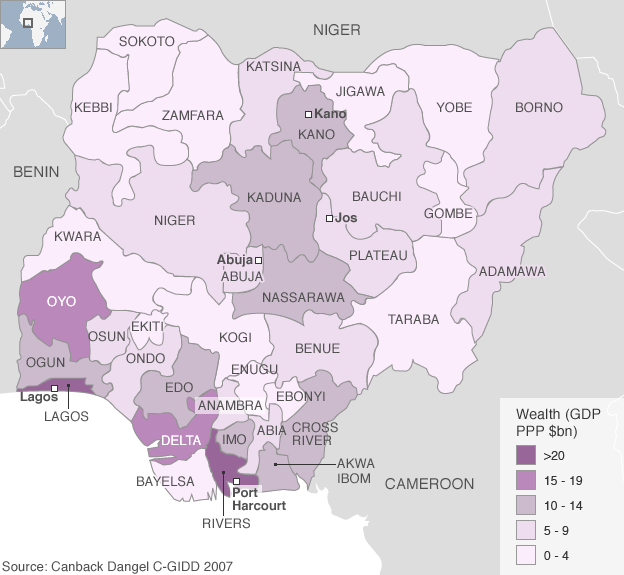
In this case, the local trigger is the massive development gap between Southern and Northern Nigeria that fuels resentment, xenophobia, and radicalism. (see wealth map)

It also means dealing with local flashpoints that feed the anger that in turn feeds Boko Haram – things like conflicts between settlers and so called indigenes, fair policing, and an education system that both moderate Islamists and the government can get behind.

If our mental filing cabinet wants to associate these guys with Middle Eastern jihadists, you can be darn sure that the average Nigerian would like to think of them as foreign too.

But I think societies need to claim the radicals at their margins no matter how unpleasant the thought might be.

These guys are Nigerian, and any global dynamics should be viewed through the local lens first.

On Safari: Wild Dog in Botswana

On Safari: Wild Dog in Botswana

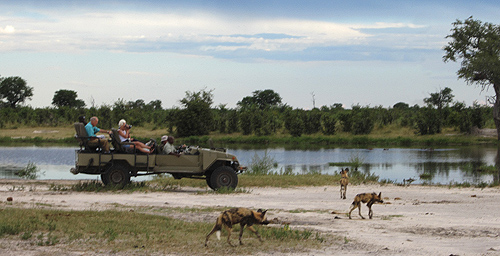
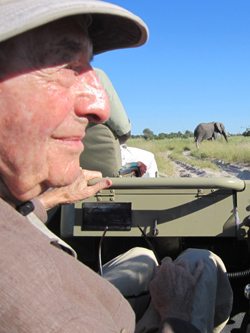
We just completed a fabulous safari in Botswana that believe it or not actually had a first for this safari guide of forty years: a wild dog hunt!

We were hardly ten minutes out game viewing from Lebala Camp in the Linyanti Reserve when our guide said dog had been sighted. We were only ten minutes away, and what a thrill to drive slowly on a road that 11 wild dog siestas were now occupying!

Most of the dog sightings I remember are deep in bush shade or scattered helter-skelter over uneven terrain difficult to view. Here we sat, on flat open country, capable of tracing the beautiful palomino markings of eleven wild dog!

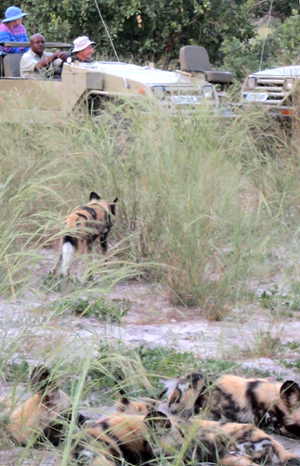
But it got better. The curious hyper greeting behavior that precedes one of their hunts began, and we knew a very rare opportunity was at hand. Sure enough, the alpha male began nervous ear pricking and sniffing in the air. After another short hiatus of rest, the alpha male and female and the only other adult dog, another female, went stomping off with the kids anxiously following.

That’s when it gets interesting and if we weren’t in cars designed for bushwacking it would have been impossible. These were old South African Yuris, the military vehicles used in the Angolan and Caprivi wars. They go anywhere, do anything, although often at the expense of your oscillating body positions.

Still it was hard to follow them. We had three vehicles but none could keep up with the forward adult females. We stuck with the male. Every once in a while he would stop and listen, and we would turn off the engine so as not to distract him. There were impala all over the place.
The other two cars watched the youngsters try to attack a warthog with two piglets. Eight-month old dogs are nearly three-quarters full size, but mama warthog managed to send them fleeing when she challenged them.

When our car lost the alpha male all three vehicles rendez-voused with the pups and soon an adult female came running back to regurgitate, indicating she had killed. Dogs are the only predator that ensures the young eat first. The adult who kills eats only a few internal organs before racing back to feed the pups.

Interestingly, the adult female then laid down as if to rest, with the kids all around her. But then there was a distinctive high pitched dog scream, and the whole bunch went shooting towards it like a bevy of fired canons.

The call was from the alpha female. She had returned a ways, but was waiting for them to take them to the actual kill. We were able to follow. It was remarkable how quickly the impala was dismembered and dispatched. True to form, these are gruesome killers.

Our safari was filled with other exciting moments, especially a number of great elephant encounters in both the Okavango Delta and Linyanti. We had dramatic encounters with lion in the Kalahari, one of my favorite places, and saw the zebra migration in Nxai Pan. We saw over 300 species of birds and 15 larger mammals including roan and sable antelope, as well as the rare sitatunga.

March is a hot time and rainy time in Botswana. The Kalahari had temperatures over 100F, although in most places it was in the mid 80s. But it is precisely because of this that the game viewing was so exceptionally good, in contrast to Botswana’s winter when actually the majority of travelers visit.

And this end of summer is a rainbow of beauty. The veld is still fresh with blossoming wild flowers and the acacias, jackalberries, wild gardenias and even Baobab trees are in full leaf! The great grasses, including the turpentine grass, are fully matured waving seed in the warm breezes. The veld is absolutely at its most beautiful!

But of all our experiences, the wild dog hunt stands out. A first for me!

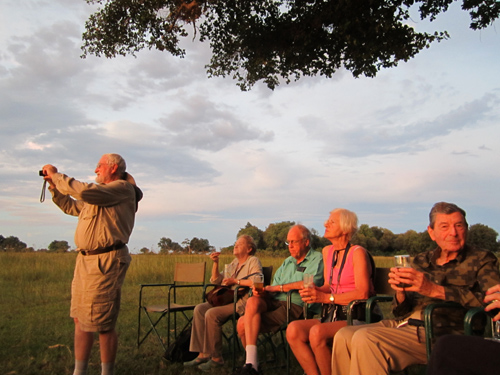
John Donahue, Mary Jane Mortenson, Rich & Ingrid Dubberke & Les Fisher

On Safari: The All Good Cape

On Safari: The All Good Cape

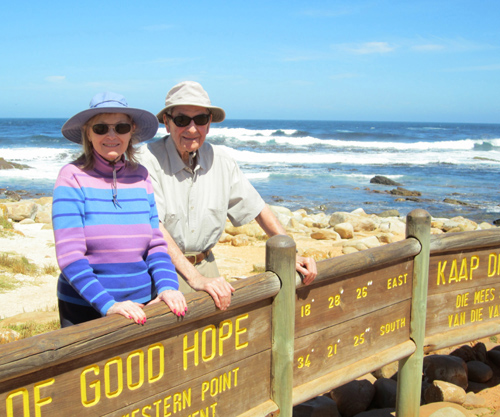
Dr. Lester Fisher, Dir. Emeritus of the Lincoln Park Zoo, with Barbara Shaffer
at the Cape of Good Hope as we began our safari in southern Africa.
I like to begin all southern African safaris in Cape Town, despite it being rather distant from game viewing areas and in spite of its constantly rising costs. As one of the most beautiful cities in the world it portrays so much of what young, modern Africa is becoming.

We spent four nights and five days in The Cape before heading to Botswana for game viewing. It was warm for March, several days in the lower 90s. But fortunately one night of heavy rain turned everything on, like a light switch, and the last of The Cape’s summer flowers and fragrances filled the peninsula.

One day was for the city itself. As with any world class city, I had to pare down the attractions to fit our time. I begin with a walk through the Company Gardens which is laden with history, sated with beauty and ringed with museums.

Nothing exciting was happening in any of the museums except the Slave Lodge, which had a special exhibit about Mandela. The Slave Lodge is one of the more sobering museums in the city, but without some understanding of how slavery affected and was a part of South Africa for so long, you really will never understand the present.

From there we visited what I think has become my favorite Cape Town museum, District Six, but this time I learned how important a guide is, and how fascinating and surprising the experience can be there.

District Six is a “living museum” whose guides are actual persons who were among those evicted from this historic quarter of Cape Town during the most pernicious period of apartheid, the 1960s. Residents who were fourth generation Capetonians were given sometimes less than a week to leave before the home their great-grandparents had built was bulldozed to make into an all-white section of the city.

Prior to the bulldozing, the area was classified as “coloured” meaning it was of mixed races. This could be white and black or Indonesian and Indian, or Malay and white. But it was a close knit, historic, politically dynamic and highly educated community, thrust suddenly into the dustbin of history.

The guides are what make the museum so incredible as they describe not just their lengthy history before the eviction but their lives afterwards and then after the end of apartheid. The story is usually a three-part drama that ends in pretty hopeful and inspiring ways.

But this time the guide we got, a politically active ANC undergrounder at the time he and his family were uprooted from nearly a 100 year history in the community, spent most of his time complaining to we visitors of the current affirmative action policy of the South African government.

Very interesting.

Obviously, the several centuries of apartheid that plagued the Old South Africa is going to take time to remedy, and I doubt there are many who feel that affirmative action is a wrong course of action. But the guide, a District Sixer and therefore a coloured, felt that affirmative action was displacing the opportunities of his family at the expense of blacks. “I’m not anti-black,” he insisted; “I’m just anti black behavior.”

That cliche has rung the world round and been exposed as hyperbole of the greatest sort, and it was a bitter sweet experience for me personally, who has been to the museum so many times, to see this crack in the hopefulness of the New South Africa.

Another day was spent at the Cape of Good Hope, and I can’t remember once before when there was no wind at the top of the Flying Dutchman that overlooks the sea that Dias and de Gama rounded centuries ago. But that was our fortune to be sure! Hardly a breeze, in fact, no clouds and one of the most spectacular views in the world. That day is the day we see the jackass penguins (recently politely renamed “African penguins”) at Boulders, and they’re absolutely some of the funniest things in existence. I like to sneak into the parking lot several blocks from the national park, the “swimming beach” and watch the kids swimming with them!

Another day was spent at Kirstenbosch, with free time to ride up Table Mountain and view the city from Signal Hill. What an amazing place Kirstenbosch is, and how indescribably beautiful. I say that because it isn’t just the gardens themselves which are spectacular, but that incomparable setting below Table Mountain. We nearly cried as our guide was walking us through pastures of bloom and stopped to say hello to an old man who had carried the ashes of wife to a certain point in the gardens that she so loved.

And finally we spent a day in the wine country. You’d be surprised that there really isn’t time to visit more than say two wineries. For one thing, the drive is so spectacular that you don’t want to get off the highway, with the jutting Cederberg mountains framing one beautiful vineyard after another.

I chose vineyards that don’t take tour buses. (We were driving ourselves around in rental cars.) That way you can get incredible attention and detail from the vinter as the wines are described, and real interaction when there are only a small number of people sampling the treasures. I particularly like Rustenberg Winery with its 19th century Victorian garden that is so spectacular as well!

True animal people as we are, part of the day for the wine country was spent at the Eagle Rehabilitation Center associated with the Spier Winery. Nearly half of the Cape Vultures, an endemic species, have been lost to poisoning, and that’s one (but by no means all) of the center’s missions. We got there in time for the 4 pm raptor demonstration and watched a number of beautiful birds flying around, landing on our arms and heads!

The Cape is so wonderful that I just could never see stepping into a game park in southern Africa without first stepping into this wonderland!

USAID’s Annual Letter to Share – I mean – Stake – Holders

USAID’s Annual Letter to Share – I mean – Stake – Holders

By Conor Godfrey

This week the highest USAID cadre, Rajiv Shaw, released his annual (2nd) letter. If this second ‘annual’ letter was intended to mimic a private sector letter to shareholders, than I liked Warren Buffet’s letter to Berkshire Hathaway better, but I do appreciate the attempt.

In his very first paragraph, Rajiv and I essentially break up.

He lauds president Obama’s push to make development assistance a core part of U.S. international strategy, right alongside defense and diplomacy.

“…But the President and Secretary both believe that the development work our staff does is just as vital to our country’s interests and national security as the work of our soldiers and diplomats.“

I confess I do not believe this is true.

In fact, when viewed in this light, it is no wonder that we drown Pakistan and Afghanistan (critical U.S. priorities) in development assistance.

It is possible that this cash actually harms people, and at best, I think it is probably a wash.

Read this NYTimes article about development assistance in Afghanistan and cry.

AID workers in these countries struggle to spend the money that has been allotted to them, and set themselves up for horrendous overbilling and corruption.

There are also two other problems with AID money in places like Afghanistan and Pakistan – one, the local economy can be trashed by the influx of foreign currency, and two, the best and brightest in those communities try and get high paying jobs with AID agencies instead of working in local government or starting businesses.

These thoughts are not new; actually, it is very much in vogue to bash development assistance.

I challenge you to go out and find someone that works in development right now, get them out of the work environment, give them two beers, and ask them what they think of either their specific project of development assistance in general.

They will start with a resume-speech that uses words like capacity building and stakeholders, but it will degenerate into a story of waste and frustration.

There are people out there who work on great projects…but I bet you go through four or five of the scenarios I just mentioned before you get to them.

To avoid being charged with too much complaining and not enough suggesting, here is what I see as the future of development assistance.

1) A clearer distinction between humanitarian relief (floods, fires, droughts, conflicts) and development assistance.

The former (staffed by former soldiers and other logisticians), should be given wide latitude to act preemptively, and should make sure the U.S. is the first on the scene and the most generous when they get there.
The U.S. already does a pretty darn good job here.

The latter, development assistance, needs to be reconceived as a social impact investment fund with a high tolerance for risk.

2) They should take on investment worthy projects that are not attractive to traditional investors because the recipients do not have collateral or other assets. (Like our current Export-Import Bank, but with a much higher appetite for risk, and a bent toward micro projects.)

Better yet, they should invest in LOCAL impact investment funds that have a better handle on vetting projects.

Most importantly, this agency should RETURN MONEY TO THE TREASURY!

Now, that might be too strict when lending to entrepreneurs and businesses at this level, so perhaps the rules should be as follows….

The agency will loan out XXX Million USD per year, but only 15% of the loans could be non-performing at any given time.

If we wanted to get really crazy, the agency could take equity positions in these companies and entrepreneurs.

(Moral Hazard alert here, the business might just expect the agency to do everything.)

Yes- this would immediately take some of the least developed countries off the USAID map.

(You could adjust the rules for least developed countries if necessary.) I think that is ok, because I do not believe what these various groups say they are achieving in those countries anyway.

If you added up the stats that various AID agencies and NGOs give you for some countries, and compound those over all the years this assistance has been given out….the problem(s) would theoretically be solved already.

It is a little like the phenomenon whereby all the purported shards of wood from the Biblical cross add up to seven or eight crosses worth of wood.

Ok I am probably getting carried away.

The biggest weakness in my argument is in health. Many health problems are not ‘investment opportunities.’

(Many are though! Check out my favorite company in this space.)

There are other problems too, but I think they pale in comparison to the waste in the current system.

Mama Africa

Mama Africa

By Conor Godfrey

Over the past week I’ve made it out to Silver Spring, MD, for a few great African films.

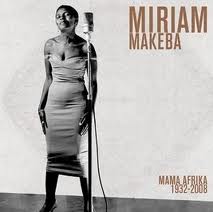
Opening night of the festival featured “Mama Africa” – a cinematic eulogy to the late great South African mega star Miriam Makeba. Find the English language trailer here.

If you don’t dance in your seat I would probably just give up the ghost.

As noted in this Reuters’ review, the worst thing one can say about the film is that it would have been even better had she been alive to comment on her own life.

Miriam was involved with the making of the film up until her death in 2008.

The rest is put together with help from archival footage and interviews with a dozen former band-members, friends and relatives.

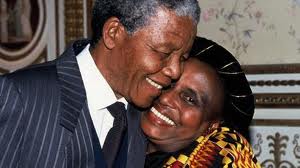
Makeba with Nelson Mandela

In Miriam’s case, this includes many of modern Africa’s founding fathers like Sekou Toure and Julius Nyerere, famous Black panthers like Stokely Carmichael, and world-class musicians from all over the world.

Renown South African Trumpeter Hugh Masekala (Also Miriam’s first husband and lifelong friend) fills in a lot of her early history. (Find an upbeat anti-apartheid track from Hugh here.)

She was born into crushing apartheid township poverty in the 30s, and even spent six months of her first year in jail with her mother who had been sentenced for selling homemade beer.

Her rise was meteoric once discovered.

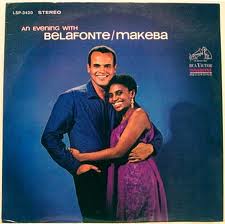
After being caught in the film “Come Back, Africa”, filmed secretly and smuggled out of South Africa by Lionel Rogosin, she was discovered by Mr. Harry Belafonte.

Belafonte went on to introduce her to the greats of the American music scene. She would eventually sing at JFKs birthday, and record with stars like Nina Simone, Desi Gillespie, Paul Simon, and tons of international stars.

She held seven passports and 10 citizenships at the time of her death.

Before the film, I really only knew her mega hits, like “Pata Pata.”

(Or find the song live in concert here.)

During the film, she actually says she wishes that some other song, with more meaning, had become her defining hit.

I suppose there is some irony in the vocal anti-apartheid singer who’s smash hit was, in her words, “a nonsense dance song.”

But there were plenty of more substantive hits as well.

Director Mika Kaurismäki featured songs like the Khosa wedding song “Qongqothwane”, known as the “The Click Song” by English speaking South Africans.

She introduced the song in the movie by saying that “the colonizers have to call it “The Click Song” because they have trouble pronouncing “Qongqothwane” with the right clicks.

One of my favorite pieces of concert footage was “Oxgam.” This particular piece shows her potent smile to good effect.

After all, she essentially had her pick (more like pickS) of husbands wherever she went.

Find the more emotional, slower Makeba in “Khawuleza.”

I also had the pleasure of seeing my old haunts in the Fouta Jallon region of Guinea when the film explored Makeba and her husband Stokley Carmichael‘s exile in Guinea.

After the two wed, all of Makeba’s U.S. dates and deals were cancelled in protest of Stokley’s activism.

At that point, a number of African countries, including Guinea, vied for Africa’s peripatetic daughter to come live with them as she still could not go home to South Africa.

In general, the film was a beautiful tribute to a pan-African hero, a tireless activist for justice in South Africa, and one hell of a voice.

Good luck finding it though – stay tuned here.

Kony is Going Down Whether or Not Kim Karadashian and Justin Bieber Tweet About It

Kony is Going Down Whether or Not Kim Karadashian and Justin Bieber Tweet About It

By Conor Godfrey
At least 10 people emailed me this video in the last 48 hours.

It is about 30 minutes long, and well worth a watch as the video has now entered the mysterious nexus between politics and pop culture.

Check out the hashtag #StopKony on Twitter.

(Beyonce had to ask people to stop tweeting her about it because she was already a supporter.)

I have watched a remarkable number of people turn themselves into LRA experts over the last 24 hours to cash in on the media buzz, so be very careful what you read on this issue.

Here is a good Q&A with some basic facts.

The LRA barbarism is not in dispute.

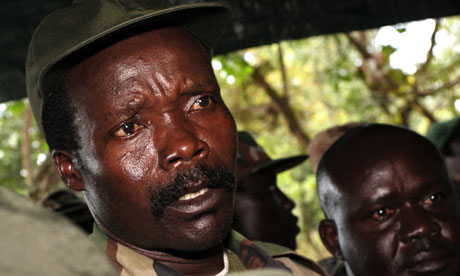
Kony kills, rapes, and abducts people, including many children, and then forces them to do the same.

Whatever ideological motivation there may have been to the Lord’s Resistance Army (LRA) at the outset has dissipated long ago.

There is zero moral ambiguity here… but that does not mean that situation is simple.

First – as Jim reminded readers many moons ago – the LRA is not in Uganda anymore!

See Invisible Children’s Crisis Tracker Map.

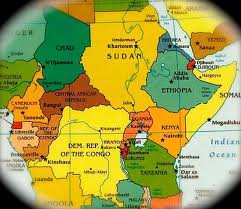
The Ugandan military chased them into neighboring states with far less capacity to deal with the problem– namely the DRC, South Sudan, and the Central African Republic (possibly the three least developed states in the world).

I should note as well that Joseph Kony and the LRA have been on life support for years; experts believe that he has a few hundred core fighters at most.

These die-hards, however, have still inflicted terrible pain and suffering on rural communities in central Africa.

Central Africa is the most fragile sub-region in the world.

A decade ago (98-2003) almost every country in the region was pulled into the brutal war in the DRC, and suspicion still runs very deep on both the government to government and people to people level. (Especially between Uganda and the DRC)

Imagine the Ugandan army trying to track down Kony and the LRA in the DRC when the last time the Ugandan army crossed the border it was as an invading force!

For these reasons, the DRC government has been very cagey about allowing the Ugandan military (and embedded U.S. advisors) to operate in their territory.

You could easily see opposition politicians and op-ed columnists in Kinshasa claiming that the government was letting sworn enemies and imperialists violate their national sovereignty.

This video might unfortunately invite more scrutiny on these delicate political arrangements.

Of course, Kony and his cronies have likely taken advantage of this and slipped from the jungles of the Central African Republic (CAR) where Ugandan soldiers are allowed to operate, into the jungles of the DRC where they are more restricted.

I have seen some analyst’s claim that Kony is in CAR, but most think that the majority of the LRA militants are now in the DRC.

Here is a good account of the failed attempts to kill or capture Kony so far.

They have tried using Guatemalan hit-men, air-strikes, and now U.S. advisors, but Kony’s core loyalists are bush experts and armed to the teeth.

They often retaliate after failed attempts by slaughtering thousands of civilians.

Everyone is now talking about whether the video was a good or bad thing.

I just think it was irrelevant.

The video is not going to make DRC politicians less suspicious of Uganda, or make the Ugandan military and the U.S. advisors work any harder than they already are.
Kony is going down whether or not A-list celebrities tweet about it.

Central African militaries are slowly closing the net over unimaginably large swathes of jungle, and political obstacles have mostly ameliorated over the past few years.

One U.S. advisor was quoted as saying that Kony’s remaining time would be measured in weeks, or maybe in months.

There is bipartisan support in U.S. Congress for taking him off the field and Obama is publicly committed to the mission.

What else do they want? This video may end up triggering millions in donations for the NGO Invisible Children, but their stated political objectives have already been met.

Ugandans are understandably all over the map in their reactions to the video.

Some think the video gave the impression that the war was still in Uganda (there was a 15 second disclaimer in the middle saying the war had moved to neighboring countries), others thought the film should have mentioned the atrocities committed by the Ugandan military, and still others thought it was good that more people now understood what a monster Kony is.

In general – I think that celebrities should stay out of foreign politics.

Unless of course, they would also like to start tweeting about Uganda’s 7% GDP growth rate.

P.S. Here is a pretty good article addressing some of the criticisms of the NGO Invisible Children

P.S. Everyone remember to follow the Africa Answerman on twitter.

The Chinese Presence in Africa Probably Does Not Look like You Think it Does

The Chinese Presence in Africa Probably Does Not Look like You Think it Does

By Conor Godfrey

For quite a long time, I misunderstood the nature of the Chinese tidal wave in Africa.

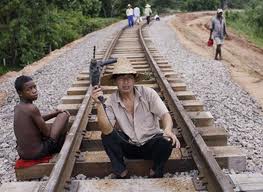
I thought that giant SOEs like SINOPEC and SINOHYDRO, laced with agents from the public security bureau – and the People’s Liberation Army of course, were essentially buying the African subsoil on the cheap where their cash went the farthest – resource rich and infrastructure poor countries with brutal, corrupt, or otherwise unsavory leadership.

Some of this has certainly happened.

However, as the foremost experts have pointed out, repaying loans with commodities is neither new nor confined to China in Africa.

More than forty years ago, China secured a $10 billion dollar loan from Japan by leveraging its domestic resources.

Somehow, oil/commodity secured loans have taken on a nefarious connotation – why?

In most cases, this ensures that something is actually delivered to the host population.

If China uses its leverage to unfairly price-fix the commodity, or overvalues the infrastructure to be provided (as in Angola), then sure, the government and civil society should jump all over it.

While they are at it, however, they should also jump all over the development assistance programs from other partners that skim local talent and spend millions of dollars while leaving precious little behind.

The biggest misconception regarding the Chinese presence in Africa is the make-up of the Chinese diaspora on the continent.

There are probably about 750,000 – 1,000,000 Chinese in Africa – no one has a great estimate.

Many are former day-laborers, farmers, bankrupt shop owners, convicts, and other mother’s sons who took “going global” seriously.

They are not secret agents, nor do they receive concessional financing or other goodies from state owned banks.

They are free-wheeling entrepreneurs with huge appetites for risk and the desire to escape cut throat competition back home in China.

A recent documentary – When China Met Africa does a great job exploring the edges of the African-SINO civilizational collision. Here is a trailer, and here is a review by the always insightful Damien Ma.

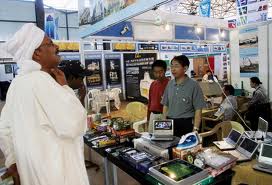
While big State owned enterprises certainly cause some friction, much of the antipathy toward China and Chinese in Africa comes from the success of small-time Chinese traders in local markets. (I’m taking about the private buccaneer types, not big company reps.)

Entrepreneurship is hard, especially in Africa.

Formal capital markets for small to medium sized business barley exist, and the cost of electricity and transport makes manufacturing prohibitively expensive.

(This is changing…look for wave of African manufacturing in 2015.)

However, Chinese entrepreneurs in Africa (the private, buccaneering types) are beating out local suppliers in local markets.

Why? Connections, or Guang Xi, as the Chinese would say.

What do you do if you need a generator fixed in East Africa?

You call a Fundi (loosely, “a guy who knows stuff”).

In the Peace Corps I had a guy for pretty much everything – a money exchange guy, a taxi guy (this guy was a real wildcard), a goat guy, a make-me-a-sweet-Boubou guy, and most importantly, a bad-Muslim who-sells-beer-guy.

The Chinese have fundies too – only theirs own factories in China, trans-ocean transportation firms, and are flush with cash from thirty years of double digit economic growth.

When a Chinese business-person sees an opportunity in Africa, he/she (almost always a he) can usually access the credit, manufacturing capacity, and skills necessary to act on it.

Local entrepreneurs often cannot.

I am not fatalistic about this though – African entrepreneurs have all sorts of linguistic, cultural, and geographic advantages when competing in their own backyard.

Look at how Ethiopia’s footwear industry survived the cheap Chinese shoe onslaught and improved their products because of it.

The African firms that survive the waves of cheap Chinese goods will be stronger and ready to compete globally – bring it on.

Anyway, it helps to remember that China and Africa are not two massive, sentient entities crashing against each other, but rather, millions of individuals and tens of thousands of firms each having their own personal interactions.

Sorry Mr. Kristof – I Don’t Buy It

Sorry Mr. Kristof – I Don’t Buy It

By Conor Godfrey
[Song of the day: This blog is on empathy; more specifically, what elicits it and what doesn’t. Have a listen to this Tiken Jah Fakoly remake of a song you will likely recognize – his version is called “African in Paris.”) For the life of me I cannot find an English translation online, so watch the video unless you speak French (except this rather awful one).]

I have a confession to make. I really, really do not like Nick Kristof’s reporting on Africa.

A few years ago I wrote a piece ridiculing the still common tropes that weasel their way into Western writing about African issues.

This includes stories with one dimensional human characters and three dimensional animals, or articles with such relentlessly negative points of view that all positives are expressed as little points of light in a tunnel of darkness.

Nick Kristof is the unapologetic champion of this type of writing.

The documentary “Reporter” follows Kristof around Africa as he reports on various crises.

Kristof literally (no exaggeration here) walks up to someone in a Congolese village and asks if there is “anyone very sick, maybe someone who lost children…that he could speak to.”

Talk about a selection bias! This drove me nuts.

Imagine if I walked into downtown Anywhere, USA and only spoke with mothers of teenagers that had recently been gunned down in gang violence.

To make matters worse, this mythical me is the most famous journalist reporting on Anywhere, USA, and therefore my thoughts on the health of this city reach policy makers, possible investors, ordinary Americans, and other journalists who then invite me on their syndicated television shows to talk about my horrid and emotional trip to Anywhere.

Professional Africa hands –African and Euro— have been criticizing Kristof for the paternalistic tone of his writing for years.

To his credit, Kristof publicizes their critiques on his blog and attempts (unsuccessfully I think) to address them head on. Read this entry for a recent iteration of the argument.

It goes like this…critics claim that victims in Kristof’s writing are always black and helpless, while the protagonists are often American or European, and “doing” something about the problem.

Kristof responds that he uses that construction to elicit empathy from Western readers who are apt to turn the page if there are no “bridge characters” (Kristof-speak for white people) in this article.

He takes this even farther in his famous op-ed piece Save the Darfur Puppy, (which I actually though was quite clever as a one-off piece – too bad this is his go-to trick).

Apparently, psychological research supports the idea that “bridge characters” and both literal and metaphorical “Darfur Puppies” can build empathy with audiences unfamiliar with the topic of a given article or report.

But I don’t think this type of empathy matters.

That feeling a reader gets after reading a Kristof story about malnutrition in Niger is actually entrenched indifference and superiority masquerading as human connection.

Let’s say for the sake of argument that most Kristof articles painted an accurate picture of life in many African communities (which they do not).

How could middle class America in any way relate/empathize with a severely malnourished mother, or a torture victim, if all these people are to the reader is someone who is malnourished, or someone that has been tortured?

We need to hear about real, complete people, not one dimensional victims.

The brutal truth is that when I read about torture in Syria I feel very little beyond the revulsion conjured up by images of torture.

However, when I read about the excitement of Libyan ex-patriots returning to Libya after decades in exile, or how a young Guinean entrepreneur built a web services firm with nothing, or the difficulty of changing old traditions, even when those traditions are as harmful as genital mutilation, I feel connected to the participants in those stories.

I have felt pride in my community, I have felt the thrill of success in a difficult project, and I understand how hard it is to break ingrained habits.

This is empathy…what Kristof makes you feel is not.

These Guys Are Worse Than Pirates

These Guys Are Worse Than Pirates

By Conor Godfrey
Last week, Greenpeace shadowed an unlicensed 120-foot Russian Trawler off the Senegalese coast.

Ships like these often pull in 250 tons of fish a day by dragging 700 meter nets behind them. Some of them use incredibly damaging bottom trawling and other techniques that increase hauls while destroying marine habitats.

To put the effect of these super trawlers in perspective, allow me to quote a few statistics from the Greenpeace report on illegal fishing published last week:

1. “It would take 56 traditional Mauritanian pirogue boats one year to catch the volume of fish a [super trawler] can capture and process in a single day.”

2. “The amount of fish discarded at sea, dead or dying, during one [super] trawler’s fishing trip at full capacity is the same as the average annual fish consumption of 34,000 people in Mauritania.”

Green Peace struggles to unmask illegal fishing ship off West African Coast
These ships rotate the same license among a number of ships, or more crudely, simply cover up the name of the vessel to prevent anyone from documenting their breach.

In short, bloated European fishing fleets have already overfished their own territorial waters, and are now taking advantage of poor African countries inability to enforce their maritime borders. (Japanese, Korean, Chinese, and Taiwanese companies are all guilty as well.)

The vast majority of these illegally caught fish are ‘fenced’ through Los Palmas in the Canary Islands, owned by Spain, and through a few other ports of convenience where illegally caught fish can enter lucrative European markets.

(The European commission estimates that at least 10% of seafood sold in the E.U. could be illegally caught; other groups put the estimate considerably higher.)

This gets me riled up.

My home away from home in West Africa – Guinea — has the most overfished territorial waters in the world.

The U.K.’s development agency estimated that in 2009 about 110 million USD worth of stock was illegally fished off the Guinean coast.

That might not sound like much to a country such as Portugal or Japan (culprits in the overfishing), but that is serious money to a country that cannot even provide reliable power to its capital city.

The 110 million USD estimate does not even take into account the near permanent damage done to the habitat and reproductive stocks.

So why can’t the next foreign super trawler without a license in Guinean territorial waters be given a warning, then boarded, then confiscated and the crew thrown in Guinean jail until their host country groveled for their release?

Of course – there is the rub.

Guinea (and most of its neighbors) does not even have patrol boats and crews capable of executing that type of interdiction.

(Also, the last thing you want to do is give unruly Guinean soldiers the authority to start shaking down fisherman arbitrarily.)

Of course, some harbor masters, judges, and other gatekeepers in the maritime industry are probably on the take or could be easily paid off at a number of points (giving out licenses, enforcing fines, etc.)

This can also happen legally.

Even though almost all West African fisheries are now in critical condition, many licenses are sold legally for hard-to-turn-down sums.

Some ideas:

1. The U.S., France, and other bi-lateral donors should kill a few of their grossly ineffective aid programs, and spend the money on professionalizing and equipping a local coast guard interdiction team. (Just one small ship would do it.)

If the E.U. is as concerned as they say, then this should be right up their alley.

Most West African countries (excluding Mali and Mauritania and Niger perhaps) could not care less about anti-terrorism, while illegal fishing on the other hand is a hot button domestic political issue.

The local authorities will be ready, willing, and receptive to assist in kicking the bums out of their territorial waters.

*Interesting model: Australia was concerned that other Pacific countries’ lax fisheries enforcement was hurting Australian interests. So the Australian government created a training program along these lines for a number of neighboring countries that has been very successful in curbing illegal maritime activity.

EJFoundation Photograph
2. Lock down Los Palmas in the Canaries.

This is the Sodom and Gomorrah of illegal fishing, and as long as it continues to offer a back door to E.U. markets, I refuse to believe that Spain is at all concerned with the plight of West African fisheries.

3. West African countries might enlist the help of international companies that are also concerned with maritime criminality.

The obvious partner would be the oil companies operating in their territorial waters.

The oil companies might allow host country customs officers to ride on their ships, or use their surveillance helicopters, etc.

This idea needs to be fleshed out, but it seems like a natural partnership.

I get tired of the numerous conspiracy theories that accuse Europe or the U.S. or China of commercially pillaging Africa; most of the less nuanced theories are simply critiques of capitalism.
This fishing business, however, is as clear as day: more developed countries (including some more developed African countries) are plundering poor countries’ fisheries simply because they can.

And they are doing it as fast as possible because someone else will if they don’t, and because they need to do it before these countries get their act together and start enforcing their own laws.

What Political Evolution looks Like –
Invasions Not Included

What Political Evolution looks Like –
Invasions Not Included

By Conor Godfrey
[The daily song: I am going to talk about Senegal, so today the musical shout out goes to Senegal’s virtuoso ( and almost presidential candidate)….Mr. Youssu N’Dour. Here are some free streaming songs/videos from his fan site.]

I believe that political evolution takes generations.

The media cycles in the United States magnify off-hand, irrelevant political utterances and give the impression of a political roller coaster when the real ride is, in fact, considerably smoother and longer.

The increasingly powerful office of the U.S presidency, the role of the U.S. judiciary, party platforms—these things change at the margins relatively frequently, but those small alterations accumulate into major developments over the course of a generation, not one election cycle.

The Arab Spring might seem like a spontaneous combustion—near instant change—but the political culture that provided fertile ground for the sparks of the Arab spring was in the works for decades.

It was the generational divide in Arab countries, the slow but accelerating growth of political Islam, increasing social inequality and other longer term trends that drove the evolution of political culture across the Arab world.

One street protest or one election is just a blip unless political culture has opened up space for the event to reverberate. (There are interesting points to be made here about the role of technology in accelerating political evolution.)

Senegal offers a powerful case study in the slow, steady evolution of political culture. I am more interested by the meta-story and will not get lost in the weeds of the current situation here, but read these excellent articles if you are interested in details of the current exciting election:
Towards a Second Round in Senegal

Senegal’s famous founding politician poet– Leopold Senghor—governed for twenty years before leaving office voluntarily.

Then there was what I will call an “electoral phase;” Senghor’s successor (Abdou Diouf) won mildly rigged elections every five or six years for two decades.

The entire patronage network that kept leaders in power was in Mr. Diouf’s hands. He did not have to resort to massive bribing or brutality to win elections.

Decision makers understood that he controlled access to the trough. However, at that time, a number of other things were changing in Senegal’s political culture.

The people that made their names during the independence period were slowly fading from the scene. Along those same lines, Senegal was getting much younger.

These younger people adopted new technologies and ideas faster than their parents and grandparents.

When 2000 rolled around, technology advances had made vote counting more fair and efficient, and young people were looking for someone to reflect the changes they saw in society.

The patronage networks behind the incumbent (Abdou Diouf) had also seen this writing on the wall and had begun to hedge their bets.

Enter the current president- Abdoulaye Wade- who won in the second round of that 2000 election.

Abdoulaye Wade is now the victim of these same long term trends.

One of his key legal maneuvers to rig the election in his favor (lowering the threshold to win outright in the first round) was blocked by civil society in the form of pressure on politicians from young Senegalese that probably got their first taste of electoral power when they voted in Wade in 2000!

Now the youth on the street are cheering “Degage!” – or “clear out!”

The electoral system has seeped into Senegal’s political culture over the past forty years.

That same culture has, in fits and starts, tolerated a loyal opposition, and adopted the technologies and legal methods necessary to enforce an electoral framework.

This is obviously simplifying generations of political developments in a complex country, but my point is this…

Senegal represents a realistic pace of political evolution.

No matter how the current election turns out, it is obvious that the country’s long term trajectory is headed toward more inclusion and more transparency.

If this election goes poorly, or the military over-reacts and makes mistakes in Casamance, those are likely just blips.

In the same way that one election in Libya or Afghanistan does not mean much at all, even if CNN and Al-Jazeera trip over themselves to see how many synonyms for important and game-changing and critical they can use in one broadcast.

The Desert Speaks –
Tuaregs in the News

The Desert Speaks –
Tuaregs in the News

By Conor Godfrey
(Hello to all Jim’s readers! The actual Answerman is off finding answers in Southern Africa, so I have been asked to amuse and entertain for the better part of March—I will do my upmost.
Jim and I share some interests and opinions, and diverge quite a bit in others, so I hope you enjoy a brief change, and please feel free to leave comments or email me at [email protected] if there is an issue you would like to see covered.)

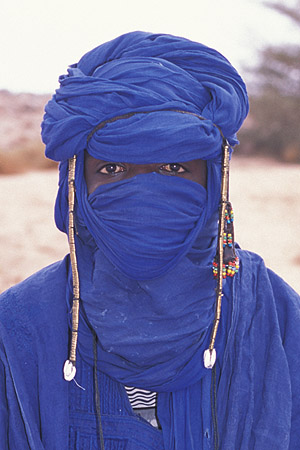
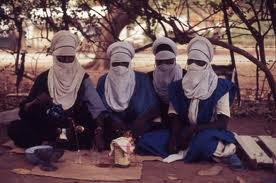
The Blue People, the People of the Veil, the Tuareg: to the people-groups that live south of the great desert, these veiled nomads are known as warriors, slavers, merchants and cattle raiders, and have been doing all of the above ever since the camel was introduced to N. Africa around 0 B.C.

For the last millennia, the Tuaregs have controlled the five most lucrative trade and smuggling routes across the Sahara – after all, the 1.2 million Tuaregs that roam the Sahara are more intimate with the desert than we are with our kitchens and bedrooms.

E.g. We call the sandy expanse from Algeria to the Red Sea the Sahara Desert; the Tuaregs see this as dozens of different deserts, each with its own name depending on its aridity, elevation, vegetation, etc…

This interlocking web of deserts goes by the name “Tinariwen”, in Tamasheq, the main dialect of the Tuareg people.

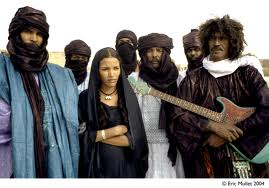
Tinariwen is also the name of a Tuareg band that won the Best World Music Grammy last week.

The band Tinariwen is what I imagine the Sahara Desert would sound like if you gave it an acoustic guitar and a drum.

“Tenere” – the Tamasheq word for the true, deep desert, is the band’s ancestral and spiritual home. Have a listen here.

They were even on the Colbert Report when they were promoting the music Festival au Desert in Timboctu. NPR calls them the best acoustic rock group of the 21st century.

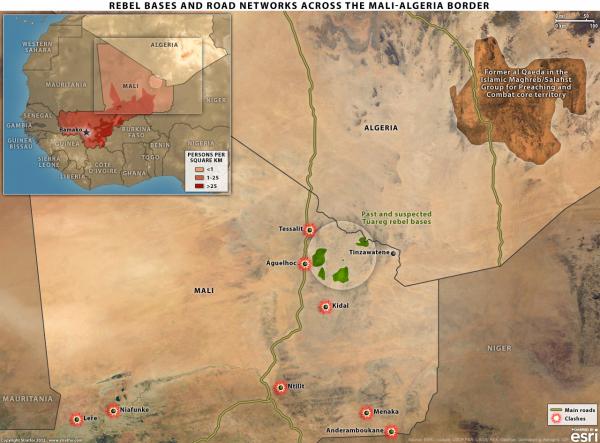
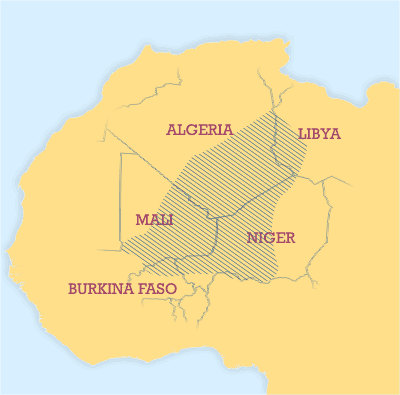
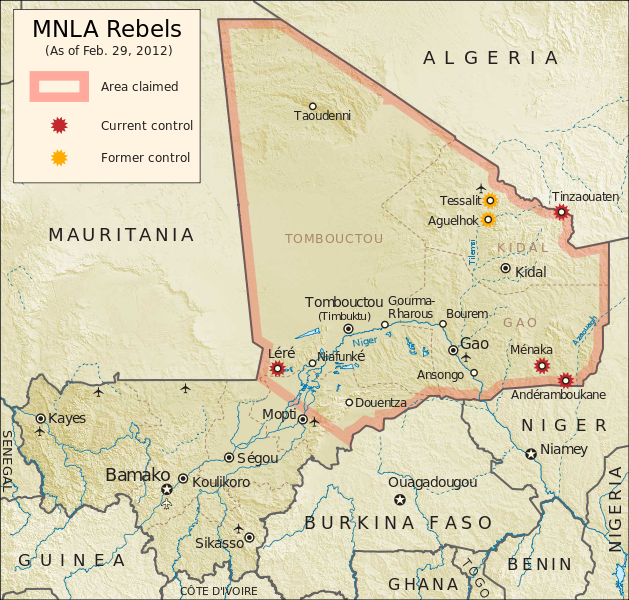
There was, however, another reason the Tuaregs were in the news last week. While Tinariwen was sporting their best Boubous to collect their prize, other Tuaregs were rolling over strategic towns in Northern Mali and skirmishing with the Malian army (See map of conflict on the right.)

The ‘rightness’ and ‘wrongness’ of this conflict (and the other Tuareg rebellions over the last century) is very difficult to parse, and probably immaterial.

When African states in the Sahel gained their independence in the 1960s from, in this case, France, they attempted to assert control

Tuareg Area
over their desert interiors, putting them in conflict with the Tuaregs who refused to acknowledge imaginary lines drawn in the sand (literally)

At the same time, the trans-African trade was increasingly moved by sea, making the two thousand year old caravan routes less and less profitable.

The Tuaregs turned their dessert expertise toward less savory commerce– hostages, drugs, and guns for hire—which put at least some Tuaregs in contact with al-Qaeda and other nefarious groups.

The Tuaregs are NOT Islamic extremists – their brand of nomadic Islam is heavily blended with millennia old animist traditions, and would probably give a hard line Islamist a heart attack.

Tuaregs that do come in contact with al-Qaeda do so for pragmatic, financial reasons.

Also, the various governments abutting the Sahara have every incentive to play up the al-Qaeda – Tuareg link because the U.S. then shells out cash and personnel for military and anti-insurgency training.

(It did not help the Tuareg case that 800 Tuareg warriors fought alongside Moammar Gadhafi’s troops in the recent civil war.)

The Indigo people are a relic of the pre-nation state era; a trans-national people so intimately tied to their land that modern borders are not only unenforceable but totally irrelevant.

Ironically, Tuareg champions are now adopting the modern world’s nationalist rhetoric to express their people’s aspirations.

Malian Tuaregs and some non-Tuaregs have formed the National Movement for the Liberation of Azawad… Azawad being the local name for the Tamasheq speaking regions of Mali, Niger, and Algeria.

The Associated armed group has been renewing the armed struggle for a Tuareg homeland since late January, 2012.

In many ways the Tuaregs have a more coherent cultural and geographic claim to nationhood than many of the modern world’s balkanized republics. Said another way, they are arguably as distinct from their Southern neighbors as the South Sudanese were from their Arab neighbors to the North.

It is difficult to watch some of the last trans-national nomads locked in a losing struggle with the modern world.

As many of the world’s nation states splinter along civilizational lines (Iraq and Syria, Sudan(s), Nigeria, etc… ), and identity politics grows stronger in developed and developing world alike, I wonder the Tuaregs were not simply ahead of their time in thinking that national boundaries were just imaginary lines in the sand.