The Elephant isn’t in The Room

The Elephant isn’t in The Room

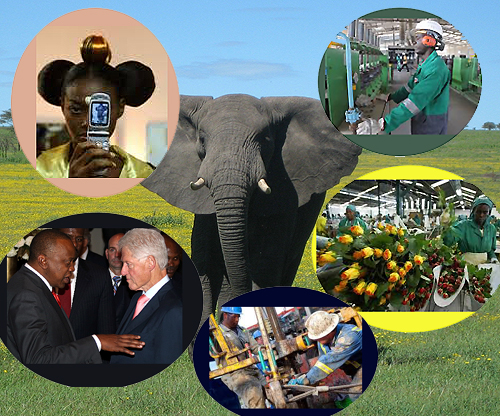
elenotintheroomElephant poaching is less important than jobs, energy, poverty and a host of other domestic African issues and until westerners embrace this, poaching will continue to increase.

At yesterday’s “historic“ African summit in Washington so many meetings and public forums occurred that Washington police had to close some of the city’s main roads, with limo lines moving back and forth causing their own congestion.

Most of the dozens of official gatherings were about trade, ending poverty, honoring former champions of American/African relationships, etc.

Bill Clinton spent twenty minutes speaking to Kenya’s president Uhuru Kenyatta at an event honoring Andrew Young.

Trade and investment trumped all other topics, as they should. The continent is growing by 5.7%. Middle class consumers in Africa will soon approach a half billion in number. China is edging all other players out of opportunities. There’s a lot to talk about.

One of these many formal and countless informal meetings was about elephant poaching. It attracted four African Heads of State, four of the least important movers and shakers on the continent.

NPR, of course, covered it. This is because it’s an issue which resonates with the liberal leaning Americans who need good morning news fixes.

Americans tend to look at the world through myopic lenses that focus their own passions at the exclusion of greater but to them peripheral issues. It’s as true of the liberal as conservative.

And I’ve always pointed out that the liberal/conservationist attitude towards elephant poaching has not just distorted it but distracted our important attention from other issues.

Let me state again: elephant poaching is on the rise and is a serious concern for African conservation, today. But it’s on the rise for reasons other than just that there are bad guys and evil Chinese antique dealers.

Yesterday, for example, the Kenyan Wildlife Service (KWS) did an audit of the 12 elephants that died in the last year in or near Amboseli National Park, Kenya’s most important elephant park.

Four died of natural causes: 33%.

Of the remaining eight, three were due to what officials called “human-wildlife” conflict, which I’ve often discussed: 25%.

I actually think this is the most serious problem, because it’s turning local sentiment against conservation. As Africa develops so rapidly, the conflict with the wilderness increases exponentially as that wilderness is better and better protected.

It’s one thing to have monkeys pinching the cookies you left out for your kids when they come home from school. It’s quite another when the elephant walks through their school or, god forbid, steps on the kids.

The remaining 5 of the 12 elephants were determined to have been “poached.” In other words, intentionally killed for illicit gain: 42%.

The media is rife with explaining and arguing whether the market for ivory or the price given at the source for ivory or corruption among wildlife officials or other bad things is responsible for this poaching.

“Julius Cheptei, the Assistant Director for the Southern Conservation Area, argues that there is a strong link between the swelling cases of poaching and the possibility that people are looking for traditional medication,” according to reporters covering the KWS Amboseli announcement. The reporter continues:

“Given the growing populations and spreading popularity of traditional medicines globally, experts say the demand for these natural remedies is increasing.”

The official continued to explain that often poachers are not interested in the ivory but in the elephant’s “private parts.”

As always, I’m not saying elephant poaching today is not a serious issue, and one report as above does not an issue settle.

I’m just saying, again and again, get a perspective.
Real World Blues

Real World Blues

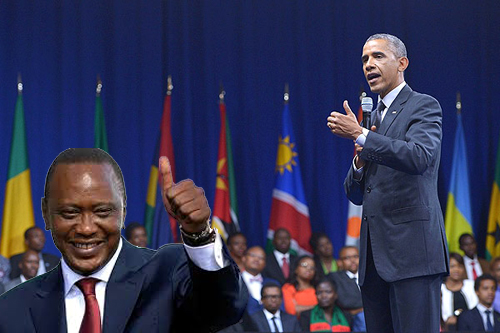
obamasummitThe largest ever gathering of African leaders starts today in Washington at the invitation of President Obama. A year ago this would have been unthinkable.

A year ago Obama would not have arranged this summit; his advisors would have considered it bad politics. But Obama is no longer playing to the vicious racism that has stymied him from Day One.

A year ago President Uhuru Kenyatta would not have been invited: he remains on trial for crimes against humanity at the World Court (ICC). Kenyatta arrived in Washington for the summit yesterday. His court case has faltered and Kenya has prospered.

The guest list at the White House is filled with despots and authoritarians including Equatorial Guinea’s Obiang and Uganda’s Museveni. But with a little help from the White House, their most serious critics are also being heard.

A year ago the Heads of the African Union (AU) states would have rejected a meeting that included a parallel gathering of their most intense critics. The White House encouraged this activist gathering, but also deftly declined to participate and that seems to have satisfied the African Mighty. That’s a diplomatic dosey doe of the most successful sort.

Times are changing, Obama is changing, and I think America is recalibrating. No African leader embodies these changes better than Egypt’s President el-Sisi.

The White House did not invite el-Sisi, yet in my estimation whatever immoralities or crimes he’s committed in his coup against the legitimately elected Muslim Brotherhood Mursi as president last year pale in comparison to Obiang’s or Museveni’s reigns of terror.

But the White House was following a careful script. El-Sisi had been ousted from the AU. Obiang and Museveni remain in good standing with the AU, whether they should or not.

When el-Sisi was reinstated several months ago, the White House then issued an invitation and El-Sisi immediately declined, but with diplomatic nicety sent his Prime Minister and closest confidant, Ibrahim Mehleb.

The only other heads of state not invited have all been ousted by the AU: Zimbabwe, Sudan, Eritrea and the Central African Republic.

America’s recalibration is good and bad. Obama’s administration is reembracing the old diplomat Henry Kissinger’s realpolitik: In contemporary terms you don’t cheer change at the expense of certain stability.

The Arab Spring has proved mostly a failure. In the long view of multiple decades or centuries it may have inched human rights forward, but today human rights in places like Egypt and Morocco and Kenya is more suppressed than before the Arab Spring.

What has improved is social stability and economic growth, and that is the stuff that realpolitik responds to.

America’s obsession with freedom and democracy is very good … for America. But perhaps not right now for Africa, and that’s the paradigm manifest in today’s African summit.

In the last decade, American investment and trade with Africa which had been supreme, has fallen below that of Europe’s and China’s. “The summit agenda is heavily focused on business and trade,” the Guardian’s Washington correspondent says.

China may worry Obama more than any African despot. The Guardian continues:

“China’s trade with Africa rose to $200bn last year – largely made up of Beijing’s imports of oil and minerals, and export of electronics and textiles – more than double the US… Twenty years ago trade between China and Africa was just $6bn.”

The “U.S. Summit Seeks to Play Catch-Up in Africa,” the Washington bureau chief of IPS says.

Egypt is essentially stable, today. So is Kenya. One is governed by a military authority, the other by a man indicted by the ICC for crimes against humanity.

But both countries are essential to U.S. security. Egypt’s current moderating role in the ongoing conflicts in the Mideast, and Kenya’s occupation of Somalia, represent irreplaceable components of American security.

The real world is not always a pretty one.

Libyan Democracy in Action

Libyan Democracy in Action

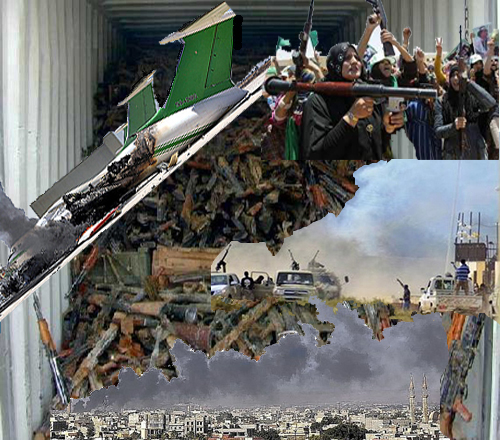
stockpileweaponsThe cocks have come to roost in Libya: yet another example of why instant democracy is a bad idea.

With all the rest of the troubles going on in the world Libya is being neglected if not ignored, and yet the fighting this week in Tripoli rivals almost anything that’s happening right now in Gaza, the Ukraine or Iraq.

The Tripoli airport is in shambles. The tower is down. About 20 commercial jetliners sit idle at wrecked gates or scattered among the tarmac.

“Foreign diplomats, workers flee Libyan chaos by thousands,” the Los Angeles Times reported this morning.

The Philippines is among the dozens of countries evacuating its nationals. This will mean that Libya’s hospitals will collapse.

Thousands of Libyans themselves are also fleeing. Tunisian soldiers killed two trying to stop the crowds surging across the border.

The Washington Post tried to sort out the combatants yesterday and decided that militants, previously from the city of Misrata, are coming out on top. They’ve almost taken over the Tripoli airport.

And it’s not the national Libyan army that’s stopping them. The army has disbanded and many of its highly skilled soldiers – trained by the U.S. and allies – have fled to their respective militias… with their modern weapons. Also supplied by the U.S. and its allies.

The Misratas haven’t taken over the Tripoli airport because several other militant groups led by the Zintanis are in the passenger terminal shooting back.

At the height of the Libyan revolution, Zintanis and Misrata militias fought side-by-side.

And in Benghazi, where the Libyan revolution began three years ago, guess who’s now in control? A former Gaddafi general.

“Towns fight towns; Islamists oppose nationalists; federalists rise up against central government; ex-Gaddafi units clash with former revolutionaries – and everyone has guns, artillery, tanks and missiles, taken from the vast arsenals the deposed dictator had stashed across the country,” Reuters reported yesterday.

After the fall of Gaddafi, western powers led by the U.K., France and Britain stepped in to quickly create democratic institutions. A democratically elected government, fully in place two years ago, was deemed freely and fairly constructed by outside western observers.

The problem is that each individual faction thinks that democracy will immediately get them what they want. The Zintanis, coming from remote Berber mountain villages, felt Gaddafi stole their oil and gave them nothing in return.

The Misratas, more developed and mercantile, fear any kind of religious law and believe their taxes are too high.

Neither grievance has been addressed by the weak existing government, in large part because it has never been able to enforce anything. Too many people have too many weapons.

“Hampered by hypocritical ‘no boots on the grounds’ orders, Western military advisers could do little as Gaddafi’s vast arms stocks were pillaged by all comers,” explains London’s Telegraph’s Mideast correspondent.

Stepping beyond journalism, Richard Spencer then reminded British readers that “I … tried to alert the authorities… to the presence of 100,000 landmines, boxes of Semtex, anti-tank and anti-aircraft missiles lying unguarded in a field and adjacent warehouses in south Tripoli. Nothing was done, and within days they had been pilfered.”

As a columnist for Gulf News Spencer was more explicit:

“The same powers [that topped Gaddafi] seem to have turned a blind eye to a nation whose current sorry state is partly a result of their own faulty policies.”

Which faulty policies? Any of a million that contribute to the toppling of an authoritarian regime replaced by democracy.

I admire the New York Times this morning for warning western countries against abandoning Libya, but the Times analysis is simplistic. This isn’t just a battle between Islamists and non-Islamists: it’s much more complicated than that.

You can’t turn democracy on like a light bulb above the sink. It takes years, often generations to evolve. It’s both the reason that Russia is sliding back into authoritarianism and China is inching towards real democracy. Both of these dramas will likely continue long after I’m gone.

It was the height of absurdity to think that the arsenal of destruction Gaddafi had amassed could be managed by a fledgling democracy. That was the first mistake.

Democracy often works badly. Take our own current state of affairs, although we’ve dealt with ups and downs for so many years I’m hopeful we’ll finally creep out of the irresponsible governing abyss we now found ourselves.

But we demonstrate a certain immaturity if we think that the “help” we gave the Arab Spring revolutionaries would result in anything other than the bloodshed currently playing out. That was the second mistake.

You can’t liberate the oppressed with democracy. It never fills a void. It must be built carefully and that takes a lot more time than American and British election cycles.

Ebola Hell

Ebola Hell

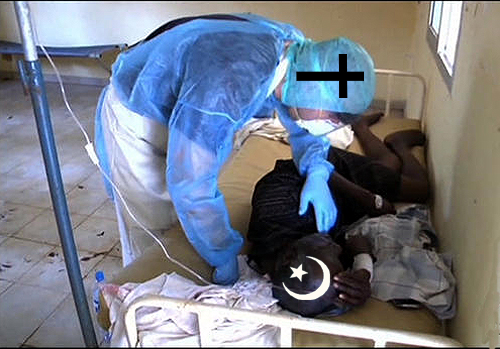
When superstition in the bush becomes religion in the city, all hell breaks loose.
This ebola outbreak is an epidemic, the first of 28 previous outbreaks. It’s much more dangerous and we need to understand why.

There are a number of contributing factors, but I believe the most significant one is the growing enmity and polarization between Christians and non-Christians, Muslims and non-Muslims.

It’s a horrible object lesson of a global society that just isn’t working, anymore.

Of course increased communications and more global interaction from airlines and so forth contribute to the speed of the current spread. But relative to the previous outbreaks something new and very bad has entered the equation, and I think that’s religious hostility.

Until this outbreak, ebola was confined to a tiny core of central Africa composed of only 4 countries: The Congo, Gabon, Sudan and Uganda.

In all those cases the outbreak occurred in heavily forested, rural “jungle” areas with relatively few people. As soon as health workers arrived on the scene, the outbreak was finally contained. Whenever an infected person arrived in an urban area, immediate hospitalization often led to recovery and further containment.

Those outbreaks experienced a 2/3 fatality rate: more than 1500 people died from a reported 2389 cases.

As of this moment 729 people have died and another 1323 remain hospitalized. This is half of all the previous incidents since 1976, and the epidemic is spreading into developed Liberia, Sierra Leone, Guinea and Nigeria.

This is the first time that ebola once out of the jungle has not been contained.

In more urban than rural areas of Sierra Leone, infected persons are escaping from hospitals and refusing treatment.

Massive police action hasn’t been able to stop widespread street demonstrations against the west and its medicine.

Police shot 9 people in Freetown last week during a protest sparked by a former nurse who told the demonstrators that “Ebola was unreal and a gimmick aimed at carrying out cannibalistic rituals.”

In Liberia, the most developed country of the region, harsh government measures closing public institutions, confiscating bush meat and increasing public health monitoring have been met with angry demonstrations.

Following a burial yesterday grieving crowds hunted down and stoned health care workers.

All of this follows a pattern throughout the “almost developed” world that restarted earlier this year with Pakistan’s much publicized increase in polio. The disease was nearly eradicated, but this year polio has reemerged big time in Pakistan.

There’s little doubt that an insurgent campaign by the Taliban and others to prohibit polio vaccination was motivated in large part to the successful effort to find Osama bin-Laden.

Intelligence inside bin-Laden’s compound was obtained by CIA agents acting as bogus polio vaccination workers.

Additionally, Muslim clerics throughout the troubled parts of the world have started again to claim that western attempts at vaccination are really meant to sterilize Muslims.

That terrifying myth seems to have grown now to encompass the efforts to end ebola.

It’s the same horrible paradigm that provokes seniors in America to support ending medicare, or Texans to ban text book references to slavery, or coastal Floridians to vote down shoring up their communities in the advent of global warming, or Georgians to ban immigrants who are the only ones who harvest their peaches.

It’s denial of the truth with actions against one’s own self-interests.

Done with the certainty and conviction of religion, a first principal that will not be compromised.

There is little ideology or religion in Africa’s deep jungles. Survival trumps everything and superstition while intense has never seemed to work terribly against the people who adopted it.

But when superstition in the bush becomes religion in the city, then all hell breaks loose.

On Safari: Prohibitive Costs

On Safari: Prohibitive Costs

GBNP.PercentUse.2013Is it moral or fair that only a tiny percentage of people can experience the Serengeti or Glacier Bay?

The question applies to all great protected areas, where taxpayer resources are used for management.

Devil’s advocates point to the huge tracts of earth still unregulated, open to anyone who dares to enter. Just flying today from Juneau to Seattle, or earlier from Chicago to Fairbanks, reveals uncountable square miles of Mother Earth plastered with nothing but trees, interrupted by giant snow-covered peaks, separated by raging rivers and massive lakes.

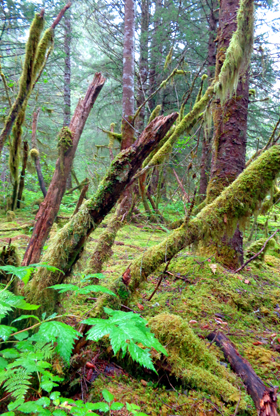
InsideTheRainForest2.GB.670.jul14A lot of Africa is still open land. Anybody can explore these areas, right?

No, it takes more resources to cross Kenya’s northern frontier or transect the Yukon than to visit Samburu or Glacier Bay parks for a day. The great remote and untouched parts of earth aren’t really any more accessible than our protected areas.

Protected areas are generally close to civilization. Glacier Bay is only 50 air miles from Juneau, littered with old mining camps and fishing villages. The Serengeti is only 150 air miles from the crowded half million people of Arusha. Its northern tip, Kenya’s Mara, is only 130 air miles from the 4 million person metropolis of Nairobi.

Preserving original wilderness is a no brainer. The human is no more a creation than a tree. The mysteries that created both are hardly annotated in full. Tampering much less eliminating wildernesses jeopardizes our own survival.

We know that biodiversity is critical to our health. We know that the air we breathe, the food we eat, many of the medicines we use are natural products of the wilderness.

Protecting these so scientists can better understand their ecology should be an unchallenged responsibility.

But what about wilderness as recreation? Or as an educational or spiritual experience for the rest of us common folk? Apparently we’re hard-wired to love wilderness; it’s where many people reboot and become inspired by what we feel is its beauty.
SeaWolfInAction.670.GB.jul14
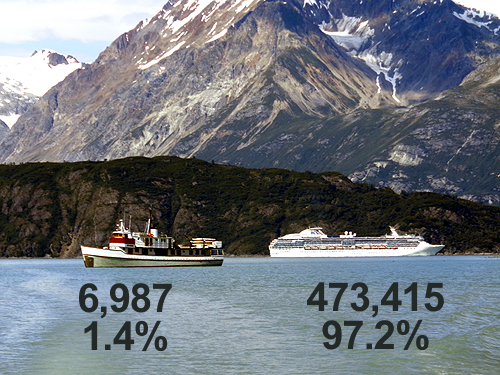
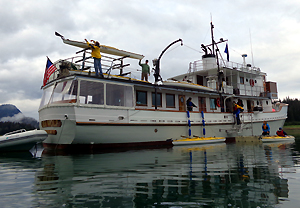
My little camera photo above of the yacht we used last week in Glacier Bay National Park, floating five miles in front of a giant 4000-passenger cruise ship represents the angst but also the success of American national parks.

Our beautiful 12-passenger, six-cabin adventure yacht carried a zodiac, kayaks and a wonderful cook and professional naturalist. The 91-foot, 12-foot draft vessel let us move into the tiny fjords of the park, sit close to calving glaciers and get remarkably close to wildlife.

Our experience thrust us much deeper into the wilderness than the cruise ship passengers that bring more than 97% of the people into the park.

We were immersed in this wonderland. But we represent less than 1½% of the visitors to this 3½ million acres of protected wilderness.

Similarly I think of my own guided safaris into remote wildernesses in Africa.

Over the last decade between 150 – 200,000 people annually visit the Serengeti. But less than a few hundred travel into the remote places I take people, like the Lemuta Plains or southern Manyara.

My guiding obviously provides considerably more depth and insight than for the 97+% of other visitors. Just like our experience now in Glacier Bay.

Does than make me, and my clients, decadent and arrogant? Simply because we can afford to pay so much more?

Yes. You just can’t get around this. You can provide pro-bono services, raise funds for not-for-profits that bring the under-privileged into the wilderness, but in the end the percentages change insignificantly.

One of the most cited critics of national parks, Canadian Lisa Campbell explains:

“White people are much more likely to engage in public parks than people of colour.

“Being able to retreat from the city is a luxury that few working class people of colour have the privilege to afford. On top of this history of exclusion and colonial discourse, National Parks cater to the status quo by providing history from the winner’s perspective, and excluding intercultural dialog.”

But at least in America I think we’re trying to mitigate this exclusivity of the wilderness to the elite. At the turn of the last century, American national parks commissioned a lengthy study to create a fairer mission for the 21st century.

Rethinking the National Parks” concluded a more generous posture to the native Americans who first lived there, and to the rest of Americans who want to visit.

Together with aggressive independent research about First Nation peoples currently residing near but not in Glacier Bay, American National Parks sided with successful court actions that gave some Tlingit peoples new (mostly hunting and harvesting) rights within Glacier Bay National Park.

(Contrast that with recent new forced resettling of Maasai from Serengeti areas, quite against their desires.)

And that 21st Century mission of the National Parks increases access for those who can’t afford the more in-depth experiences or resource rich outfitting by building more roads, reducing some fees and providing more free literature, and – specifically in the case of Glacier Bay where we just visited – increasing large cruise ship availability.

Seven-day cruises are available into the park for just under $800 per person. Princess Cruise’s ships that enter Glacier Bay carry between 2 and 4,000 people. Along with other slightly more expensive lines, these ships represent more than 97% of the visitors annually into Glacier Bay.

Now it’s not quite what we paid for. These larger ships cannot be in the park for longer than 24 hours; we were there for six days. Only two of these larger ships may be in the park at any one time. While in the park, they are controlled by park rangers, not cruise line captains or employees.

Cruise passengers can’t leave their ship; we were often off the yacht as much as on it. Cruise passengers can’t hike or kayak.

There are many critics of this approach. More use jeopardizes wilderness, however regulated that use is. Cruise ships are notorious for running into and killing whales. Just no way you can get around that, either.

But comparing the negatives with the positives, frankly I think our national parks are doing a great job. There are plenty of us out there to scream if that changes. And right now I’m a lot more proud of the situation for all peoples in Glacier Bay than in the Serengeti.
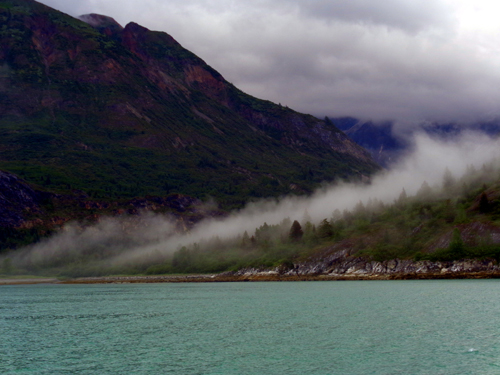
MorningFogLifts.GB.670.Jul14

On Safari: Glacier Bay

On Safari: Glacier Bay

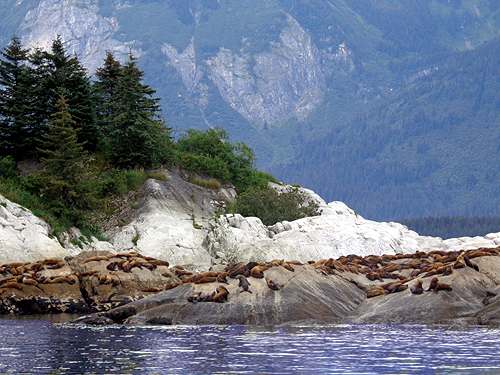
stellarsealions.GB.670.jul14A week intimate cruising within Glacier Bay National Park on our beautiful little yacht reaffirmed all the lofty maxims of the many wonderful people who had the foresight to preserve such a treasure: our souls were refreshed!

My Alaskan safari began with The Far North in Fairbanks in the wide-opened tundras of Denali and ended in the unbelievably lush rain forests of Glacier Bay.

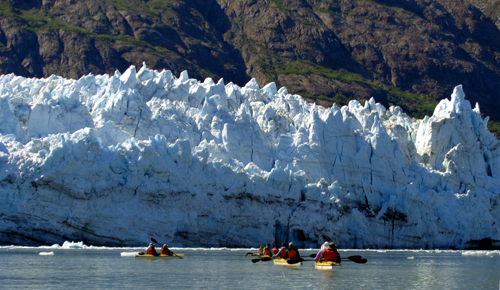
kayakiing.McBride.670.Jul14The six days private cruise began with a splash as we took our first of several kayaks. Over the course of the week we’d kayak in secret little coves among towering mountains, along intertidal cliffs laced with starfish colored like a rainbow, among icebergs crashing down from great glaciers and through literally tens of thousands of seabirds!

I can’t imagine exploring Alaska without a kayak. Even for the uninitiated, it’s simple and safe and our group chose mostly to go in two-man kayaks, although I stuck to a single one. It doesn’t take long to learn to push instead of pull, and once achieved you sail through the waters like a dolphin.

Several of our group even kayaked among humpbacks. Glacier Bay is famous for its whales, and we learned of tails of joy and misery with them. On the path leading to the dock at Bartlett Cove is the skeletal remains of “Snow,” a 40-year old whale killed by a cruise ship. Our leader, Kimberly Owen, told us numerous stories of whales including some spiritual stingers precious to the First Nation Hoonah peoples who inhabit Glacier Bay.
InsideTheRainForest.GB.670.jul14
We probably saw 20 whales or more, including one group of three that just wouldn’t stop breaching! I counted a dozen breaches in less than fifteen minutes!

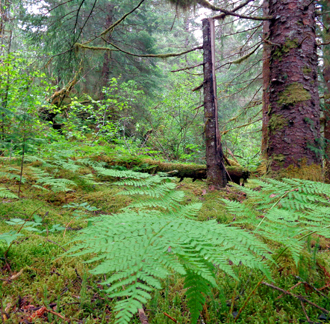
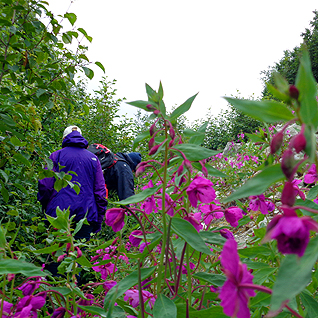
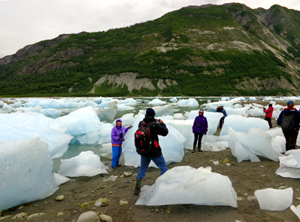
Every day we hiked. Some were longer and harder than others, but everyone made it and returned without sore joints! Hikes were up mountainsides, above glaciers, through rain forests, on beaches and among great pieces of ice!

We saw dozens if not hundreds of fabulous sea otters and learned about their near extinction and recovery, one of the great (and few) stories of successful wildlife reintroduction.

At one haul-out of stellar sea lions, I counted more than 750!

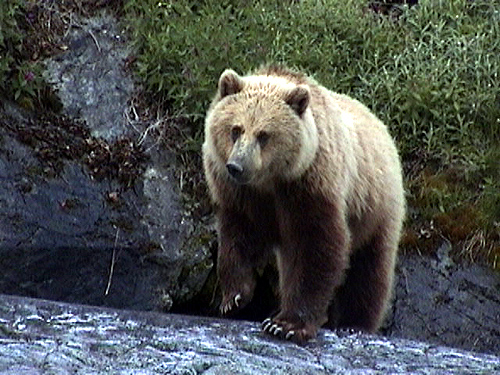
And we saw bears, and experienced the narrative of a four we saw on a beach that included two juveniles that just couldn’t leave Mom even as Mom was laid out on her back nursing a new cub.

Sea birds galore. Tufted and horned puffins. Marbled and Kittlitz murreletz. Even murres! Thousands and thousands of kittiwakes, and many glaucous winged gulls and oyster catchers. And of course many grand eagles. We kayaked under goofy pigeon guillemots that treated us like welcomed guests and sailed among loons and cormorants!hikinginfireweed.GB.670.jul14

But I think the grandest wildlife experience was as we sailed beneath some steep cliffs looking for mountain goats.

We found them, high up but close enough to see clearly even without binocs. They went about the terrifying cliff edges nibbling away, and we watched a little one following mother having just learned that a large percentage are lost to slipping!

Then someone noticed a goat freezing. They’re not hyper but usually constantly on the move, if for no other reason than to maintain constant balance. But this one froze as if we’d taken a picture.

amongtheice.GB.670.Jul14It stared in one direction and we knew something was going on. Following the goat’s line of sight, we then saw a hoary marmot racing onto the top of a rock, standing up and looking towards us, then quickly twisting around and looking away, and then racing to the left, then to the right as if it just couldn’t figure out what to do.

We sailed slowly around the tip of the peninsula and there was a wolf! Obviously what had happened was the marmot saw the wolf and freaked, then the got saw the marmot and froze. It was a wonderful example of how everything is marvelously connected!

Our trip is coming to an end. Stay tuned as we sail into our final hours!

On Safari: The Great One

On Safari: The Great One

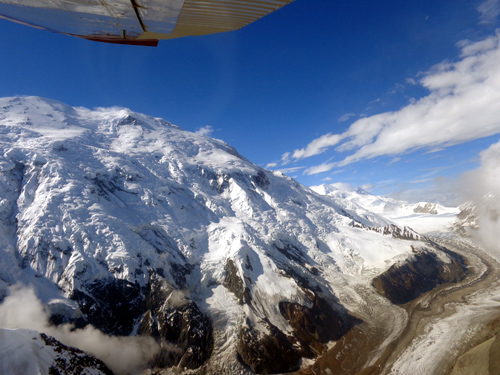
McKinleyToday we picked up three little planes and flew from the northwest side of Mt. McKinley to the southeast side … with our fingers crossed!

And we made it! Pilots say the chances of flightseeing around North America’s largest mountain are about 10%, but I figure they low ball the truth to make many clients feel better. My own experience is about 50%.

InsideCabinCertainly, it’s chancy. But there are backups. And even if you can’t see the mountain, cutting out the return 6-hour drive from the great western lodges to the rail station is worth the price of admission.

Backup Plan A is to simply fly straight east, not tempting the mountain’s own fickle weather, to the rail depot where you pick up the train journey.

Backup Plan B is to do what 90% of all the people who stay at the western lodges do, take the 6-hour bus ride back to the train.

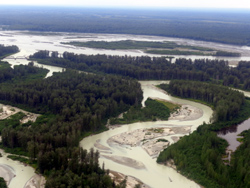
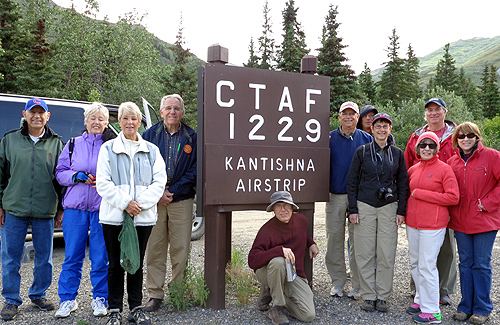
But we lucked out. This group is bringing us a lot of good karma an we were able to fly all the way from Kantishna to Talkeetna, with jaw-dropping, breath-taking flightseeing en route!
OverTalkeetna
Lots of photos were taken, of course, but everyone agreed that you just can’t capture the majesty of this “thing” on film. Example: Sarah Taylor and Becky Krantz were sitting in the back seat of our little single-engine Cessna as we seemed to be crashing into the side of the North Face!

The North Face is over 20,000 feet high and we were planing out around 11,700′. After a bit of a little scream and request through our intercom to the pilot if we were, indeed, crashing, he said we were still 8½ miles away from the rock face!

We flew in and out of Peters Pass and other divisions between the two great peaks of the North and South. We flew along the 11,000′ sheet near vertical Wickersham Wall that only a handful of climbers have even tried.

So we left Kantishna at 1030a and arrived Talkeetna at just before noon. We then had fours before the noon train from Denali arrived, so we wandered this amazing little town, whose ubiquitous bumper sticker reads, “Talkeetna: A Drinking Village with a Climbing Problem.”

RailCarInteriorThis is where all the real climbs of McKinley begin. I used some of my time to wander to the Alaska Mountaineering School, the principal guider and outfitting of professional McKinley climbs.

They were just wrapping up the season. The last few climbers were scheduled to come down today. A total of 1246 climbers tried it this season (AMS outfitted about half of them) and there was a 36% success rate to the summit, better than normal.

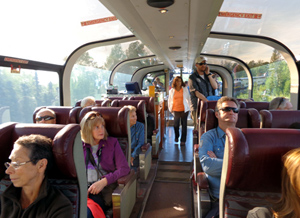
So after visiting Nagley’s General Store and its remarkable antiques set against animal furs, and trying the great Roadhouse ice cream, visiting the Ranger station and little museum, we got on the train to Anchorage for our final moments in the Great North.

Group.KatAir.670.14Jul

Now – on to Glacier Bay! I’m afraid there’s no internet on our luxury yacht in Glacier Bay, so I’ll be silent most of this week. But stay tuned! You’ll get a report as soon as I get a signal!

On Safari: Denali

On Safari: Denali

DenaliCover.670.14julYes you’ll see some wildlife, but Denali National Park impresses with its massiveness, scenery that simply exists nowhere else on earth.

We spent two days in the park, which is what all casual visitors do. Denali attracts the serious backpacker and hiker as well, and I can only imagine what a wonderful adventure that would be, but probably 95% of its million visitors annually are two-nighters who step in and step out rather quickly.

The park is a long, narrow protected wilderness with North America’s largest peak, Mt. McKinley at its far western end. There is a single road that stretches west from the train station at the parks main entrance, about 90 miles west to the tiny town of Kantishna which is just outside the park.

Kantishna was once a roaring mining town, and in fact we would see dozens of small mining operations that still exist when we flew out of Kantishna two days later. But today the town is mainly the service depot for the three lodges that exist on this far western side of the park.

This is where I take my groups. There are only about 300 bednights here, compared to the 3000 bednights at the train depot. This is also where Wonder Lake is, and some of the most magnificent hiking a “casual visitor” can undertake.

Most visitors staying on the eastern side buy a park pass for a day. This allows you to ride the regular park buses between the four ranger stations along the route, where you can disembark and hike as well as enjoy park ranger presentations.

For those of us staying in the west we take a lodge bus that picks us up at the depot and travels across the entire park, making stops at ranger stations and for wildlife. The ride takes about six hours.

No matter what month of the summer that I travel this route: June, July or August, my experience has been pretty much the same with regards to wildlife.

We’ll see a dozen or caribou, usually at several hundred yards. We’ll see 3-5 bears, often much further away, and dozens of dall sheep, but sometimes miles away on a distant rockface. In my many trips here I’ve also seen wolf, wolverine, pica, porcupine and fox, but only a couple times and this is considered rare.

The closest animal seen is the moose, and we saw our requisite couple, although last year I remember a third one practically sticking its nose through our bus window.

Unlike Africa, the buses – whether lodge or park – are all school bus types, not very comfortable and not particularly good for photographing, although their height off the ground is helpful.

So seeing wildlife should not really be an object of your visit to Denali. It doesn’t have to be!

The scenery is well undescribable. The stops at ranger stations where you can go wandering for a few minutes take you into an unbelievable land, a primeval cartoon as I see it. Distances are unfathomable. The sky – even when overcast, which is mostly the case – is spectacular.

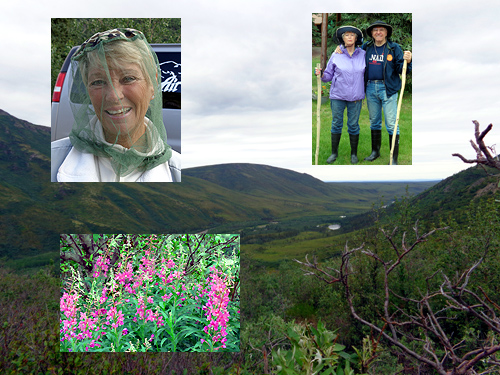
And for our full day at the far western end, most of us went hiking. Excellent guides take small groups in a variety of directions, but wherever you go, however strenuous you wish to make it, the concept of panorama takes on new meaning.

So much of our planet must be like this. I’ve seen it, of course, in the remote parks of Africa and many lucky souls experience in even more remote places like Antarctica. Why this seems beautiful to us is a question that has plagued me all my life, because it is essentially not a quest for understanding as much as an acceptance of the foundation of the definition of what beauty is.

The closer you come to grasping this natural immensity, the more insignificant your person becomes. And frankly, I can’t really think of a better result for any of us.

As is almost always the case, our weather was not sunny and clear. It was heavily overcast and often misty. But it stopped none of us from thrusting ourselves into the wide open spaces and refreshing our souls.

Tomorrow we’ll try to fly around that great mountain! Stay tuned!

On Safari: Mastodon to Muskox

On Safari: Mastodon to Muskox

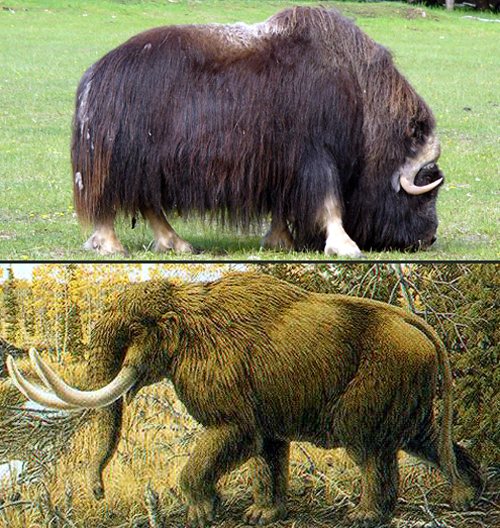
muskoxmastadonThe ecology of Planet Earth’s Far North is mysterious and often perplexing, sometimes hilarious but more often terrifying. Our first full day in Fairbanks introduced us to the remarkable biology of this Far North.

I love to start in Fairbanks, and most of my clients spend a full two nights here, and quite a few, three nights. There’s plenty to do, and it’s an important introduction to the Far North ecology of this remarkable part of the world.

It’s also an active scientific point where climate change is more readily observed and terribly respected. We’re going to Kantishna tomorrow, the west side of Denali national park, where one of the three lodges was washed out by record floods and rain only a few weeks ago.

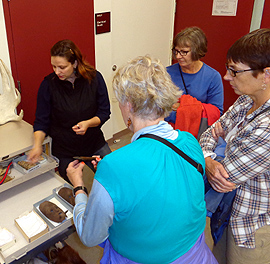
Chief Curator Angela Linn, Pam Lopes, Becky Krantz & Sara Taylor.

Here’s where the ice cap and glaciers are disappearing, where the coastline is eroding fast, where oyster farms are dying because the water’s getting too hot.

Here’s where today I got lost inside the University of Alaska campus because of another sink hole detour (they’ve had three this year), as a result of the permafrost melting.

In addition to the flashy but fun tourist attractions like the Riverboat Discovery, today we went a bit deeper and more academic.

Curator of Collections, Angela Linn, gave us a special behind-the-scenes tour of the University of Alaska’s remarkable collections: more than 1½ million items! We were able to feel mastodon fossils and gaze through security alleys filled with ancient Inuit sleds and snowshoes.

The Museum is a centerpiece of the university, a real research station for anyone doing Far North science. The part which is open to the public, the Museum of the North, is one of the finest and most digestible science museums I’ve ever visited.

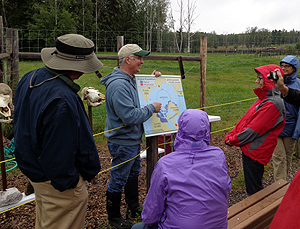
Afterwards Dr. John Blake, the university’s veterinarian and director of its Large Animal Research Station (and 9 other life animal research stations) walked us through the station’s extensive grounds describing the work being done on reindeer, caribou and muskox.

Dr. John Blake describes the muskox habitat.
Reindeer are originally Russian caribou that have been domesticated for a long time. But it was interesting learning about their differing biologies: the reindeer are much more biologically precarious, growing antlers sometimes at the rate of 2″ per day! The mystery is why, and how relatively rapid domestication produces such variance with the wild animal.

Dr. Blake then told us the remarkable story of what may be the most interesting of the Far North animals, the muskox.

Now farmed for its exquisite qiviut wool, the muskox was probably extinct in most of the Arctic by the 1900s, probably a mixture of over hunting and disease. Today there are nearly a half million and many are farmed for their extraordinary wool, a dozen times warmer (more insulating) than sheep’s wool and softer than cashmere.

There are few animals that thrive at -40F and get sick at 50F. That’s the muskox, and needless to say may be as threatened as the polar bear by global warming.

Tomorrow we head into Denali. Stay tuned!

Alaska Like Tanzania?

Alaska Like Tanzania?

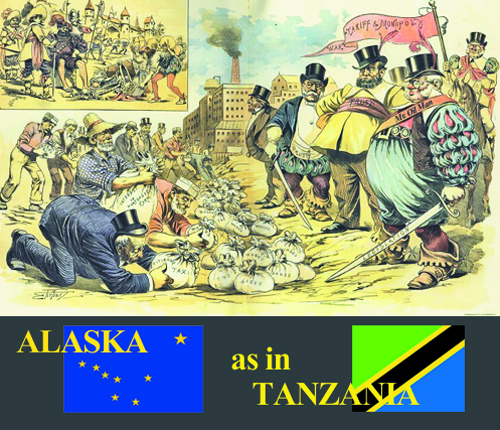
oilforSB21Last week I chastised Tanzania as a singular polity that squanders its natural resource wealth. I was wrong. So is Alaska.

I’m preparing for my once annual Alaskan trip and as always I’m in Fairbanks a few days before my clients arrive. I had no idea how similar it is to Tanzania.

Election mania is everywhere. Billboards, signs, TV ads – I couldn’t understand why compared to my own very political state of Illinois, Alaska seemed so hyped up.

Turns out it isn’t the November election of candidates that’s garnered so much interest. It’s the four referendums forced onto the ballot by grass roots signature campaigns.

Three will be on the general November ballot: legalizing marijuana, raising the minimum wage and banning further mining in certain salmon spawning grounds.

The Big One, though, comes up August 19 and is what made me realize Tanzania doth not stand alone. Ballot Initiative One repeals Senate Bill 21 which has halved the state’s oil tax revenues.

If Tanzania lived up to its IMF optimization, more than three-quarters of its revenue would be from natural resources. Today, 92% of Alaska’s revenue comes from natural resources.

In 2012 the Republican governor Sean Parnell called his predecessor, also Republican Sarah Palin, wrong for reenacting a state tax plan for oil that had been in place for decades. So Parnell, the banks and oil companies, then pushed through a bill in 2013 that reduced the maximum tax (linked to the wholesale oil price) from 75% to 35%.

Now from what we’ve been able to learn mostly from leaks of Tanzania’s strictly secret mining agreements, Tanzania is happy with 3 or 4% and opposition activists in Tanzania are screaming for 15%. So in fairness, the pie graphs aren’t very similar. But here’s the thing:

Alaska has a much, much smaller population and is dependent almost exclusively on mining for state income. And even more important than this, the previous tax plan has worked since the 1970s. Alaskan government, Alaskans who earned on average $1700/month in dividends, and even the big oil companies have been pleased as puddin’ pie.

But as seems to happen everywhere today, Republicans who are so out of touch with their electorate and in the pockets of big money (like oil companies), will do anything to stay in power. They seem to know getting elected on policy isn’t going to work.

Alaska, which has been a poster state for balanced budgets, went $2 billion in the red for the first time, this year. It didn’t even go in the red during the Great Recession!

It went in the red because the Republicans gave half their revenue back to the oil companies!

Here’s the public Republican argument: oil revenues are declining because competition is growing from places like the Dakotas which have virtually no or very little tax on the oil companies.

Here’s the truth: oil revenues have been declining since 1988 as the major oil fields that were first developed in the 1970s mature and dry up. New oil fields are being developed just as fast if not faster in Alaska as in the Dakotas.

Alaska remains the most inexpensive place in the world to develop oil fields.

There is a difference with Tanzania: Tanzania’s revenue due its people is likely being pocketed by politicians. Alaska’s revenue due its people is being given back to the oil companies!

In both cases, I call this stealing. That makes the two polities much more similar than different.

Alaska’s beginning to act like … Tanzania!

The Court Rules

The Court Rules

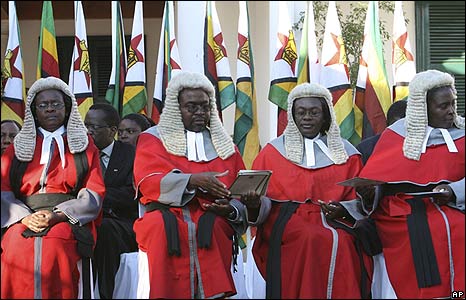
AFricanJudgesDemocracies are hardly well-oiled machines, but African courts – as in the U.S. – are pulling rank and calling all the important shots.

There are a score of new, fresh democracies in Africa in the last generation.

In South Africa, Kenya … but also in Zambia, Malawi, and most of the west African countries, democratic constitutions mostly replaced completely far less democratic ones that were distinguished by very long-serving dictators.

Out of this slow transformation of the continent’s form of governance is emerging a singular outcome: the courts rule.

As to be expected with new constitutions, precedent must be set in the interpretation of complex wording, and that has led to a lot of court rulings regarding personal and press freedom, entitlements and budgetary processes. This is to be expected.

But my interest in this question goes far beyond the obvious.

In Kenya, the courts decided the outcome of the presidential election and continue to decide dozens of elections at lower levels.

While the presidential election was a question over the counting of a very close contest, most of the elections being adjudicated by the Kenyan courts at lower levels are less technical, like whether the victor is fit to serve.

The Kenyan courts are ruling not just who won, but who should win.

In Zambia, the court is about to decide if the powerful President Zata should remain in power because of his health.

South Africa is the most jurisprudence minded on the entire continent. It was here, after all, that the chief and many of the jurists of the supreme court which upheld the immoral laws of apartheid remained the same justices which then systematically dismantled it.

Contrasting the attention and minuscule jurisprudence attending the current South African trial of Oscar Pistorius, South Africa’s Daily Maverick recently claimed that for the vast majority of South Africans the country’s new justice system was “broken beyond imagination.”

Important hearings for bail, sentencing for things like tax arrears and petty crimes, are being summarily dispensed with “not much heed … to the principles of a fair trial.”

While fresher democracies like Kenya are being ruled by the courts from the top down, the Daily Maverick claimed that South Africans are being ruled by the court from the bottom up.

It’s true here, too, at home in the good ole USA.

There’s got to be a correlation here. I think what’s happening is that the courts are filling a power gap.

In a tricameral government where an executive, legislature and the courts are separate but coequal, functioning power is possible when either one is dictatorial or two others at least are working together.

I don’t think even the U.S. Supreme Court can be called dictatorial. There’s no question in my mind that the current high court is the most activist we’ve had in my lifetime, but there’s been enough ambivalence (Obamacare) to suggest it isn’t completely dictatorial.

But because our president has not been forceful, and because our Congress is mired to a halt, the opportunity arises for the court to be proactive.

In fact, this is exactly what’s happening in Africa.

It’s a contentious time, for some further more complicated reason, throughout the world in terms of people coming together to govern.

Perhaps it’s residue from the Great Recession. Perhaps climate change is putting us to sleep.

Whatever the fundamental cause, the activists courts in the U.S. and in Africa, which seem so obstreperous lately might be considered in a slightly better light: at least they’re doing something.

Money Money Everywhere

Money Money Everywhere

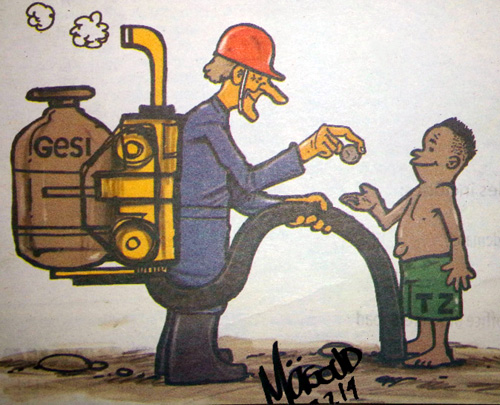
gascartoonHave you ever known anyone who’s sitting on a gold pot that they just can’t figure out how to open? Meet Tanzania.

Africa’s poverty has a real chance of being erased by major recent discoveries of natural resources, and no country has more new discoveries than Tanzania.

I know first-hand how fast Tanzania is developing. We operated a safari in just the last few weeks for a dozen Chinese managers of a new uranium plant in Dar.

Titanium and coltan have also been discovered recently, and Tanzania continues to sit on an unexploited massive vein of gold that is reckoned to be the second largest in the world after South Africa.

And most recently was the discovery of natural gas.

Just a few months ago, the IMF published findings that Tanzania could be earning $5-6 billion annually by the end of the next decade from an estimated 51 trillion cubic feet.

That’s where the good news ends.

Tanzania has botched exploitation of almost all of its natural resources, gold being the best example. Since its discovery near Lake Victoria nearly two decades ago, multiple companies have traded ownership and management, and reasonable production has yet to be attained.

Uranium is the next best example. The Chinese are successfully mining it, but the squandered tax revenue from it, and the corruption involved in the land that was swapped and sold for the mines is unbelievable.

And now there’s natural gas.

Lo and behold some observers think that the successful bidder to start developing the resource, the Norwegian company, Statoil, has ripped the country off royally.

The Production Sharing Agreement that Tanzania signed with Statoil “could [cost the government] hundreds of millions of dollars a year” according to a principal of the East African watchdog organization, Taweza.

It’s truly a mystery why Tanzania, which could be one of the richest countries in Africa, continues to be one of the poorest.

Some suggest corruption, and to be sure there’s a lot of that in Tanzania. Particularly with mineral rights transparency is easy to avoid. There is no legislative committee – as there should be – which oversees mineral right negotiation. It’s the Minister and his cronies.

That would be easily remedied by a better legislature, and it is coming round but terribly slowly.

In a confusing tweet last week Tanzanian opposition politician, Zitto Kabwe said, “not a single developing country that derives the bulk of its export earnings from oil and gas is a democracy.”

Is Kabwe suggesting he must trade his ideology, his outspoken democratic opposition to the current Tanzanian regime, to eliminate poverty? In other words: the current Tanzanian regime portraying itself as a democracy facilities wanton corruption?

Is there a Marxian dialectic here?

I’m not sure but it’s the handful of people like Kabwe who might be able to force Tanzania into some kind of meaningful grappling of its very rich resources.

But don’t pop the champaign just yet.