All Alone

All Alone

rumsfeld's solitaireJust as you sensed an iota of stability settling onto the Middle East another Syrian debacle starts up in Africa.

And for all the same reasons.

South Sudan is exploding. A UN Report issued last week compares what’s happening in the South Sudan to Syria and Iraq.

More than 2.2 million people have fled recent fighting, the UN is taking care of more than 600,000 as refugees, and the vicious war is replete with widespread rape, conscripted child soldiers and already specific personalities being considered for war crimes.

A high UN official told Reuters yesterday that the conflict “was comparable to the conflicts in Syria, Iraq and Yemen.”

And for all the same reasons:

Ruthless dictators were removed and the vacuum of governance was never filled. Instead, rebels of several or more generations who had fought the ruthless dictator and who were unable to consolidate their interests and power, began to fight one another.

Old big weapons procured from the havoc of the end of the Cold War and new big weapons being rapidly manufactured by military/industrial complexes around the world flooded in (in South Sudan’s case, mostly via the Ukraine).

Well-intentioned aid for such things as food and education was diverted by corrupt rebel leaders to buying weapons, and the aid givers seemed helpless to do anything about it… other than stop giving aid.

Famine and disease grows.

Neighbors either have no interest or not enough power to do anything. In several cases, the neighbors are run by ruthless dictators, and the last thing they want to do is get involved and show their colors.

Organized thugs like ISIS and al-Qaeda hover in the wings.

This morning on the world’s most schizoid cable television show, Morning Joe, a contrite, grandfatherly Donald Rumsfeld could not explain what was happening in the world other than to say it will continue. He preferred to discuss his new ap, The Churchill Solitaire Game.

The most fundamental reason for all of this is weapons. The successful empires of the 20th Century are unable to control their military/industrial complexes.

But removing this component now provides opportunities for the crazy suicide bombers, the mega-terrorist, the ultimate Darth Vader.

But own up, folks. We built the weapons, but we also built the Darth Vaders. The weapons came from steel, the bad guys came from want and starvation with a bit of added military training. Charles Dickens knew it two hundred years ago.

So we had two hundred years to do something, and we didn’t.

So what now?

Some say Trump. I say Sanders. Some say Trudeau. Some say Corbyn. We have no choice. We’ve got to move on to something new.

Freedom As You Wish

Freedom As You Wish

dailynationcensorshipThe Daily Nation Doth Protest Too Much and freedom of speech is redefined in Kenya.

January 1st one of the paper’s veteran editorial writers published an editorial summarizing 2015 in Kenya as a debacle wholly the fault of the President. Heavy on hyperbole, Dennis Galava mocked the president by continually introducing each criticism with a legacy term some consider offensive today, ‘Your Excellency’.

More germane: most analysts believe that 2015 was a relatively good year for Kenya.

Several days later Galava was sacked. He told one of South Africa’s most outspoken newspapers that he first learned of his firing by a friend in the Office of the President.

Criticism is OK, sarcasm maybe but mocking is definitely out of the question when it comes to free speech in Kenya.

Several recent laws and increasing government intimidation has slowly but surely clamped a valve on Kenya’s free speech. In line with trends in other emerging modern African countries, it is nevertheless troubling in Kenya where many of us felt the country had become a real champion of free expression.

The management of the Daily Nation claimed Galava was fired for not following established procedures.

The paper refused to comment on Galava’s statement to South Africa’s Daily Maverick that he had filed this editorial in exactly the same way he had filed the previous “100.”

That retort was republished in several other Kenyan media outlets including Nairobi’s most listened to radio station, Capital FM. The Daily Nation stuck to its guns and refused to comment even when asked by these peers in Nairobi.

Finally the paper issued a wimpy editorial several weeks later! Whining while lecturing their readers, the paper conceded public opinion was against them, but “Many of our readers do not seem to know the …purpose of an editorial.”

Hmm. And that purpose is?

“An editorial is the authoritative voice or opinion of the newspaper or news organization, not merely of the person who writes it.” Yes, Ok, anything else?

“Typically, an editorial is an opinion formed as a result of a consensus among senior editors..”

It took a few other platitudes before getting to the nitty gritty:

“It is supposed to be sober and dignified. It expresses an opinion without being opinionated, and it is never an occasion for name-calling.“

Calling the President “Your Excellency” is name-calling?

Kidding aside this is bad news for Kenya. Once the argument that restraints should be placed on media to protect the frailties of emerging societies might have been worthy of debate: My own first significant sacking was for submitting a report to my boss at UNESCO in 1972 arguing that a proposal to fund Sesame Street for the Cuban government was tantamount to funding government propaganda.

But today with an infinite number of portals into the worldwide web it’s pointless to think anyone or anything can control information much less public opinion.

Yes, I believe that media should be polite just as I believe everyone should be polite. But not being polite (once) is not a sufficient reason for a veteran journalist to be summarily sacked.

Galava could have been suspended or reprimanded. A counter editorial — a retraction of sorts — could have been published.

And if his claim that the Office of the President knew he was going to be fired before he did is true, that’s serious censorship.

Kenya is feeling its way into the modern world, and frankly I think doing a very good job this incident excepted. Let’s hope it’s an exception: a very, very rare one. And separately, what a shame that the once glorious Daily Nation is no more.

Time for Odd Bedfellows?

Time for Odd Bedfellows?

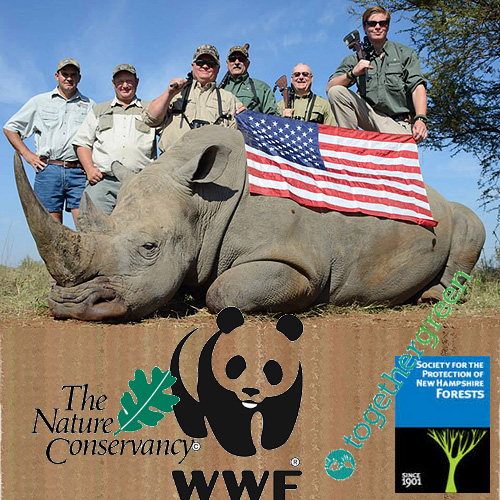
oddbedfellowsHey, conservationists! How about big game trophy hunting to protect national wilderness areas? And will you put your money where mouth is?

Africa’s asking.

I don’t know yet how I’ll answer, but I want to clearly lay out the questions for all of us.

Fact 1: For the first several years running in my entire 40-year career, wildlife numbers are declining slightly.

Droughts and wars have taken serious tolls on East Africa’s wildlife in decades past, but animal populations always rebounded quickly. Unfortunately, good data compilations are still not available since competing NGOs remain provincial and selfish with their data, but my personal sense of what is in the public domain, combined with lots of anecdotal evidence convinces me of this slight decline.

There are two main reasons for this: rapid climate change and increasingly rapid economic development.

“Wildlife in Kenya is in serious trouble with numbers declining at around 3.2% per year while agriculture [is]… increasing at 8% per year at the cost of herbaceous wild habitat,” writes Calvin Cottar of the iconic Cottar tourism family in Kenya.

Fact 2: Also for the last several years, photography tourism – the main support of African wildlife reserves – has declined while big game hunting has increased.

In South Africa, a large consulting firm called the tourism decline “unprecedented” while big game hunting has increased and claimed the tourist industry there was losing 1600 people, 4 jumbo jets, daily compared to only a few years ago.

South Africa is stable and beautiful, and what’s more, has a Rand value against the Euro and dollar that has made vacations there more affordable than ever. So the decline is absolutely not linked to African politics, stability or terrorism, despite those scandalous claims often heard.

Rather, the decline is linked to the global economy, particularly the very poor economy in Europe and the crashing economies of Asia. But even America, with a relatively robust economy and overseas tourism that is soaring more than 5%, showed a whopping 13% decline to Africa in 2014.

America’s case may be slightly anomalous to the rest of the world. We are in an election cycle with heightened concerns about security that are reaching hysterical levels. I’m absolutely convinced that the world as a whole is not deterred traveling to Africa because of “terrorism,” but Americans may be.

Yet given South Africa’s predicament – located far from any terrorism – the conclusion that African politics, stability and “terrorism” is not a significant contributor to the current decline remains reasonable.

Calvin Cottar’s resume claims that his family has been operating safaris for 90 years in Kenya. In his piece in Nairobi Destination Magazine last month, he argues that conservationists have to give strongly in two areas:

First, they’ve got to get financially involved in ways they aren’t. By the way, he’s not only arguing for us foreigners to do this, but Kenyans and African governments as well:

“Payment for Ecosystem Services (PES) – the leasing of land for conservation… involves philanthropic or other entities paying local people for the use of their land … to maintain wildlife.”

Cottar implies a situation which I believe goes too far: a sort of wholesale privatization of wilderness, although he concedes that isn’t politically realistic at the moment. Moreover, he cites numbers which are staggering: “Kenya requires $700 million per year … to secure just our existing wildlife populations and habitats – or 150,000 sq kms of land.”

Yet he insists it will work, because “Our experience in land leasing for PES in the Mara is that it is 100% corruption free.”

Major red flag. Nothing in the world is 100% and when people try to support their positions with such purity, I for one am turned off. Nevertheless, Cottar’s point with regards to PES is taken.

Second, we’ve got to allow hunting, which currently Kenya does not. This is a second article in the digital magazine which follows Cottar’s, and it is attributed to him, so I’m not sure if he simply wanted to duck the radar or if it is from someone else.

Regardless, it is certainly one of the most controversial strategies that exists.

Whether it is Cottar writing the article or someone else, it is a well compiled if somewhat disorganized discussion of the morality and practicality of promoting big game hunting, in the main as a hedge against poaching while generating the funds needed to local conservation:

“And as we grope our way toward wildlife preservation and sustainability, [big game sports hunting] appears to be more of an ally than a foe.”

It’s hard to see a good outcome, here. If overall wildlife statistics are hard to obtain, statistics about hunting are even less clear and generally wildly exaggerated by both sides. But the possibility of rounding up three-quarters of a billion dollars annually to preserve what is still a small part of the current East Africa wilderness seems completely unlikely.

What do you think?

#10 – Prices Far Away

#10 – Prices Far Away

rich safarisFinancial realities are overwhelming African safari vendors whose Life-of-Riley is slowly coming to an end.

Right now safari vendors are falling all over themselves to offer better and better “specials.” It’s the wrong way to do the right thing, and they’re just going to end up in a deeper hole.

My last most important story in Africa for 2015 is how expensive a safari has become. By the way it isn’t just safaris. Packaged and guided programs worldwide are artificially priced too high.

The reasons for this I explain below, but what I want to get to right away is how seriously wrong African vendors are responding.

Five-for-four, four-for-three, six-for-four, two-for-three, and now even two-for-one “specials” is the way African vendors are responding right now. It won’t work.

I’ve been vested in African properties and transport, and I’ve been the “middleman” who packages multiple vendors then resells them. I know the nitty gritty of almost every cost on both sides of the coin, and I know that African investors have really got it wrong today.

The answer isn’t to offer specials, but to recalculate business models and lower profits. This is the only way to survive.

First of all recognize why this is happening. The market for safaris is softer than ever. It’s not entirely the African businessman’s fault. A lot has to do with the weak economies worldwide. Europe has always been the principle consumer of African safaris, and Europe is struggling to perform.

Asia was the new hope only a few years ago for the African safari market. Entire safari chains switched over to serve only rice with menus in Mandarin. That market has all but dried up.

But the common sense thing to do when your market goes soft is to lower prices. African vendors have rarely if ever lowered prices, and that’s their problem. They don’t know how to do it…

Packaged travel – an inclusive vacation that you buy from a single seller and that includes everything you need from transport and accommodations and meals to the guide – until very recently was the only way you could visit the African wilderness.

“Packaging” is expensive, not inherently so but historically so. It reflects a consumer as interested in service as cost. So in the early days, anyway, middlemen like EWT worked hard to provide better service, because that was the selling point.

Service can be premium priced, especially in small markets. It’s why first-class air travel is 8 times as expensive as economy, even though the seats aren’t eight times as big.

The African vendors we packaged got jealous of our high profits: “If “WorldWide Tours” can earn a third of the price, then we should be able to, too!”

By 25 years ago, the business model for African safaris had been set:

Every investor wanted a 50% minimum return on his investment within three years of writing his first check.

After those three years – after the mortgage had been paid off and the returns realized – the absolute minimum was put into maintenance and renewal. If the market declined the strategy was to lay off staff, and … get this, raise prices.

Africa is about the only place on earth where tourism net prices increased from 2007 to 2009.

While the original motivation for African investors’ high profits was copy-catting their resellers, by ten years ago the dynamic had flipped. During the robust global economies of the late 1990s, middlemen — the packagers — lowered their margins because there was so much business sound capitalist principles were in sway: volume.

African safari businessmen should have too, but they didn’t. So as soon as there was some emergence from the Great Recession, middlemen – the packagers – started increasing their profits with the same mantra: “If the vendors can make so much on a single sale, why shouldn’t we?”

The point, of course, is that neither the vendors or the resellers should have been so stupid.

This is upside down capitalism, and as crazy as it sounds it might once have been appropriate for a market that was reactive to politics and other unstable factors like weather that couldn’t be managed.

But that era is over. Travelers today will spring for an African safari in spite of a bevy of travel warnings or classical notions of unstable situations, which as the years go by proved Peter-the-Wolf fantasies. Radical weather has almost become the norm everywhere.

The reason specials won’t work is because in our business we don’t sell cars. We don’t have inventories to get rid of because whole new inventories are on their way.

Travel is a service not a thing. Specials work for things, not services. A consumer ponders and researchers purchasing a service a lot more than when purchasing a thing.

Especially with travel very few consumers buy last-minute, as they do all the time with things. I’d venture to say that 95% of travel to Africa is bought at least six months in advance, and that likely more than 50% is bought a year in advance.

So a special that will expire soon is pointless.

What it does do is seriously endanger the integrity of pricing. No one will believe any more any published price. Everyone will start bargaining and we’ll have one big casino on the veld:

I’ve watched more than one curio vendor put themselves out of business by accepting too low a price.

So to my African colleagues: accept lower profits. And to my potential clients: don’t hold your breath.

(For my summary of all the top 10 stories in Africa in 2015, click here.)

#9 – People Come First

#9 – People Come First

Top photo by Stephen Farrand.
There’s a lot similar between poaching in Africa and robbing 7-11’s in Baltimore.

Poaching and other animal/human conflicts is my #9 most important story in Africa for 2015, because that’s exactly how I’ve always viewed poaching: a human/animal conflict.

Fanatics who give elephants souls and would save a meerkat before a Maasai are finally falling out of favor: Their hyperbolic, inflammatory arguments are fortunately being replaced by science.

But first the news.

Overall, 2015 was not good for African big game, although the Paul Allen elephant census injected some sanity into the elephant hysteria and showed us it isn’t as bad for elephants as many suggested.

For other headliners like rhino and lion, the numbers were grim. Even for the great herds and other ungulates several years of serious climate change seems to be taking its toll.

Until now I’ve taken great pleasure in telling a prospective client that despite all the news about Africa’s declining wilderness and game, that there are three times as many wild animals in Africa compared to when I started in the 1970s.

With such a span of time that may still be true, but telescoping down to just a few year increments, 2015 was definitely worse than 2014 which barely held onto 2013. In fact until around 2010, animal populations (with the exception of elephant and lion) were increasing. Now, it seems the increases have stopped or started to reverse.

What’s happening?

Charlatans would have you believe it’s poaching, and that poaching is evil incarnate.

Much of it is due to poaching. But as I’ve often written, the only evil incarnate may be with the end consumer. If you had any sympathy with Senn Penn’s interview with El Chapo, or understand the social progressive notion that crime is survival, it’s the facilitator – the user, the end consumer – who should be held culpable.

This is especially true at the periphery of wilderness in Africa. These are usually the most rural areas of the continent, yet still heavily populated with people who need food and water and other basic tools for survival.

When development slows or stops, when unexpected and radical climate change repeatedly devastates a rural area, peasants devolve into what those more fortunate than them call criminal behavior.

It’s only criminal if you can survive without doing it.

Lions are being hit very, very hard, because like all carnivores on the periphery of wilderness in developing areas, they eat meat. No bylaws govern their consumption. A cow doesn’t run as fast as a wildebeest.

Lion also suffer from increasing eminent domain. The wilderness is shrinking because Africa is developing. The first animals to suffer from shrinking territory are those that are territorial like lion.

Rhino poaching has morphed from individual kills by desperate folk to organized farms. But while there are a couple areas [only] where rhino are holding their own in the wild, on the whole they’ve been absent from the real wilderness for several decades. (They are doing well in fenced and other protected areas.)

Elephant have been decimated in central Tanzania … by poaching. (Elsewhere, they’re doing OK, thank you.) There’s probably no better example on the whole continent of human/animal conflict, because where the poaching is now (The Selous) is only 50-80 miles from a city of ten million people (Dar-es-Salaam).

Farmers in the west want to shoot wolves because they eat sheep. I wouldn’t dare suggest that a rancher in Morogoro lives a life similar to an American farmer’s, but a comparison still holds true in a relative way: both farmers argue the animal threatens their livelihood, or at least their way of life.

We are much less arrogant refuting the U.S. ranchers’ claim than the Tanzanian’s: it’s unlikely the U.S. rancher and his children will die if they are prevented from shooting wolves. It’s much less certain that the rancher in Morogoro and his family won’t die if he can’t raise his sheep. His next step is poaching.

People and animals, the whole environment are intricately connected. Ignorance may be an excuse but those of us who are not ignorant must be stewards of the less fortunate folks.

But … people come first.

(For my summary of all the top 10 stories in Africa in 2015, click here.)

Martin Luther King

Martin Luther King

MLKDay14Today is one of the most important benchmarks in the American calendar, the Martin Luther King federal holiday.

Yet in America in recent years King’s dreams have retreated into the fog of self-righteousness. His detractors, America’s Right, has rolled back many of the voting freedoms he had fought for a half century ago, assisted by a conservative if vindictive Supreme Court.

King’s supporters were certainly re-energized this past year by a number of horrible police actions against innocent blacks. Yet so far in all but one case, the police who were implicated in the shootings have been exonerated, either discharged by juries or never prosecuted.

Dr. King is ascribed in history — like Ghandi – as a champion of non-violence. But what I most remember of King’s turbulent last days was unbelievable violence. My most vivid memory is as a very young journalist penned under a burning El Stop in downtown Chicago while the city raged in reaction to King’s assassination.

I remember gun fire was a regular sound in my low-rent apartment in Washington, D.C. during the summer of 1968. Or the unending sirens and tear gas around my apartment in Berkeley that fall.

Those days ended in victory for my side. The Vietnam War came to an end. Civil Rights and Voting Rights leaped forward. There is much violence in America, today, but it seems to occur without a cause.

Gun violence in America is horrific, today. The number of guns bought by Americans is at an unbelievable number today: there are now more guns than people.

This is not what Dr. King had in mind. So today we celebrate his 87th birthday, wishing sorely that he were still here to explain.

#8 – Evolutionary Excitement

#8 – Evolutionary Excitement

by InkyBoy
by InkyBoy
My #8 most important story in Africa was the wondrous advancement in evolutionary science the continent provided us in 2015!

Paleontology — especially in Africa — is just simply growing in leaps and bounds. Not too many years ago when it was presumed we (homo sapiens sapiens) evolved in a linear way from just a few creatures that preceded us and followed the apes, enormous attention was applied to finding the gaps, or “missing links” in that line.

That’s all blown away, now. The last few decades have proved so rich with discoveries showing that there were many, perhaps many many species of “early man.” Even the Neanderthals, who were likely not on our own linear evolutionary line, probably had cousins who died out.

So as the universe of potential discovery grows, so does the depth, range and interest of scientists, and that as you can imagine leads to more and more discoveries.

Here are the high points of 2015:

Most important certainly was the announcement of the initial conclusions about Homo Naledi, a new early man species found in South Africa in 2013.

I don’t agree with all the conclusions, particularly that the cave in which the 15 individuals were found was a burial site, but there are many other equally interesting conclusions that come from this remarkable discovery.

First and foremost, the appendages (hands and feet) of the creature were very close to our own, even though the brain size suggested a very primitive and early creature that would, for example, predate both homo erectus and homo habilis.

The individuals were astoundingly complete, at least in terms of what most 2½ million year old fossils normally look like.

And from my layman point of view, the incredible transparency of the discovery, from almost the moment it was found to the invitation to scientists worldwide to analysis the data, marked a real turning point in the until to now bitter infighting common among paleontologists.

Some other important bones discovered included fingers! Million-year old fingers aren’t easy to come by, and the discovery in Olduvai parallels Naledi’s suggestion that our physical traits existed much earlier in the hominin record than previously thought.

In the category of “keeps getting older” scientists also in South Africa found a homo habilis dated to almost 3 million years old. This predates by nearly a half million years the next oldest habilis find and resurrects suggestions this is our own most immediate ancestor.

This was hotly contested, by the way, with another 2015 discovery in Georgia of another homo erectus. The scientists on this site insist this creature is in line for our most immediate ancestor.

Moving away from old bones, there were scores of new tool finds, deeper analysis of existing data and actual field science regarding the dynamics of evolution itself.

Stone tools were very many years presumed to mean the user was an early man. That’s changed as we documented less than mankind, like chimpkind, also uses them.

In 2015 scientists announced finding what they claimed were the oldest fossil stone tools on record, more than 3 million years old. I disagree with their conclusion that this find by itself pushes back “humanness,” but it remains an argument that still carries weight.

One of the hottest topics this decade is trying to figure out why we prevailed and Neanderthals didn’t. Some really clever research suggests at least one of the reasons is that we had … and enjoyed music! (And that the big guy didn’t.)

Some may fear I’m sinking into the arcane, but there was also some really fascinating research on Africa’s cichlid fishes that qualifies the value of natural selection! Cool stuff.

Some people lay on their back and peer into the heavens, wondering what’s out there. I do sometimes as well, but I much prefer peering into the distant past and wondering what marvels of the universe transformed us into what we are, today!

(For my summary of all the top 10 stories in Africa in 2015, click here.)

#6-7 – Pathetic Politicians

#6-7 – Pathetic Politicians

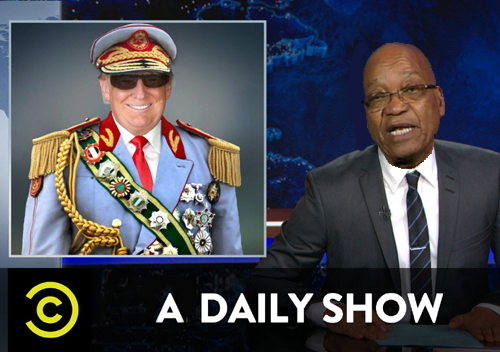
a dailiy showMy #6 and #7 most important stories of 2015 in Africa sort of go together, “Zuma the Clown” and “Trump,” two of the most unimagineable politicians in history, one in South Africa, one in the U.S.

They are inextricably linked by their unique ability to sustain their popularity by maligning their supporters, a sort of SM political love.

Trump really didn’t start hogging the stage until midyear, but ever since then Africa has been almost obsessed with him.

It started with the fascination that in America a crazy, like Marie Le Penne of France, might actually be taken seriously. More analytic observers probed “inner meanings” to suggest this showed both how open democracy was and how strong it would be finally restraining these “crazies.”

While Trump was on his ascendancy, State President Zuma on the other hand was going in the other direction. Problem is that Zuma has been falling for some time, and his hole seems bottomless.

There are few modern leaders in essentially democratic societies who have been mired in such scandal as Jacob Zuma. Normally leaders who reach the point he has – like the Toronto mayor or South Carolina governor, fall pretty quickly.

But Zuma carries with him more than his own folly. He’s a symbol of the anti-apartheid movement, one of the last of the original revolutionaries. To many patriotic South Africans, certifying his collapse would be tantamount to questioning the anti-apartheid movement.

It seems a stretch to me, but I’m not a 50-year old South Africa who felt enormous liberation in the mid 90s.

What these two buffoons have in common is that they are supported by people they dislike if not disdain. Trump has no intention of helping the poor. Zuma seems simply incapable of organizing anything constructive.

Yet it is precisely the poor from which Trump gets his main support, and from the well educated managerial class of South Africa that Zuma get his.

So what else do they have in common?

Public disdain for critics. Almost overnight the two of them have given critics a bad name even while themselves criticizing their detractors with regular sorties of foul language into normally hallowed territories like spouses and other family members.

I think what the two demonstrate is that the whole damn world is fed up with the systems in place and they are about as radical a divergence from existing systems as you can come up with.

Perhaps it’s a social, subconscious frustration that the Arab Spring fizzled out. That’s an awfully hard thesis to construct but on a macro level, I think it’s a reasonable assessment of social perceptions, today.

They lash out at the ruling elite and convince their supporters they aren’t ruling elite, because above all, they lie.

Damned world isn’t it, when that’s the only sure way to success?

(For my summary of all the top 10 stories in Africa in 2015, click here.)

#5 – Trumps Influence

#5 – Trumps Influence

trumpmagufuliLast week the new Tanzanian president, already nicknamed “Bulldozer,” announced he was deporting all illegal workers. It was a direct hit on neighbor Kenya, because much of Tanzania’s professional class comes from Kenya.

The #5 story in Africa for 2015 was the Tanzanian election, and it tells a horrible tale of democracy and may be foretelling the future for the U.S. and worldwide.

Magufuli’s deportation order followed all sorts of other blustering initiatives, including ranting in front of a group of high-profile African businessmen that they would be jailed if they don’t pay their taxes and executive actions slashing the national budget.

Magufuli is an object lesson in democracy. Everything he is doing at the moment is wildly popular in Tanzania: damned if it isn’t legal, or ethical or even moral. It’s … popular.

Consequences? Who knows, it’s popular! The polls say so!

We’re getting a good dose of that lesson right now during our own presidential campaign. Democracy is showing its true colors.

Tanzania’s election last fall was peaceful and certified by all sorts of outside observers as free and fair. But the choice available to the people at the time, Magufuli vs. Lowassa, was not a choice that a lot of the electorate wanted. So goes democracy.

And guess what?! It wasn’t a choice that the power elites wanted or expected!

Sound familiar? Edward Lowassa (Jeb Bush) was the establishment favorite. Instead, Magufuli (Cruz? Trump? Milton Don’tknowyet) became the nominee. Foreshadowing what might happen this summer in the U.S., Lowassa (Jeb Bush) then mounted his own rebel campaign.

Magufuli’s decisive victory stunned everyone, I think even his supporters. But then, there was no jubilation, just depression and tension.

Did the people get what they wanted? If they did, did they know what they wanted? Did they want what they knew they wanted?

End of First Book.

The Beginning of the Second Book opens with Magufuli firing up the team.

Hiding behind trucks in shady parts of Dar to unmask criminals, telling tax evaders he’s going to put them all in jail, far exceeding his executive authority with actions slashing the budget.

Now, deporting “illegals.”

Think he might suggest building a wall?

I don’t think the Second Book is going to end well, but we’ll see. But the first book is done. It shows that the democratic process is not a democratic process. What influences elections in Tanzania might be different than what influences elections in the U.S., but the result is the same.

Influence trumps rational choice.

Stay tuned. Or maybe if you’re an American, take heed. Either way. Keep the message to a sound-bite length.

(For my summary of all the top 10 stories in Africa in 2015, click here.)

#4 – Elephants

#4 – Elephants

eles.tarangireRecently we were besieged by conservation organizations begging for money to stop the otherwise inevitable extinction of elephants.

Fortunately, you didn’t give them anything near what they requested, and fortunately, elephants are not going extinct.

The #4 story of 2015 in Africa is “the elephant story” finally in a balanced, scientific way and much to the chagrin of numerous conservation organizations.

It was very hard for me, a staunch proponent of elephant conservation, to have to argue that other proponents of elephant conservation were screaming fire when there wasn’t any. Yet that is how I spent much of the last 18 months, getting booed.

The release last month of the Paul Allen elephant census has silenced my critics. We now have good numbers, for the first time ever, and elephants are not going extinct.

Poaching is extremely serious, perhaps definitively irreversible in central Tanzania. But practically everywhere else the population is holding its own, or increasing.

The hysteria that many organizations tried to create unsuccessfully was because of all the action that was happening in central Tanzania, which was bad. Beginning with an undercover film by the BBC of ivory dealers in Dar in 2012, to the arrest of a high profile dealer last November (that was actually an election gimmick), I argued continuously that exaggeration is just as bad as neglect.

The Allen census took a long time, but the hysteria abated when the overall numbers for Tanzania were published earlier last year. They ended once and for all the outrageous claims by several organizations that the populations had declined by 60%.

I find little solace in being proved correct, though. Exaggeration unmasked guts credibility. Fox News buying NatGeo isn’t trying to retain NatGeo’s old supporters, but organizations like the WWF and Save the Elephants now have a lot of difficult explaining ahead of them.

Elephant – like lion – are declining in certain places because of a terribly serious conflict between man and beast. Africa is developing. Africa’s wilderness has been preserved mostly for rich foreign tourists.

It’s important that we get back to the crux of the problem: how to demonstrate to local Africans an ultimate benefit from the protection of elephants while simultaneously not inhibiting the development of a modern African society.

That’s a tall order, but one that could never have been tackled in the hysterical atmosphere of the last several years. Now that’s over, let’s get on with it.

(For my summary of all the top 10 stories in Africa in 2015, click here.)

#3 – Justice

#3 – Justice

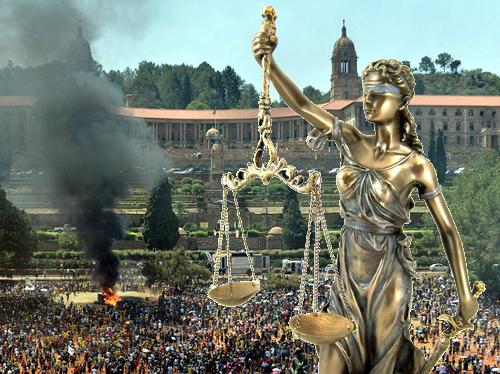
sastudentprotestThe #3 story in Africa is maybe the #3 story in the world: The Power of the People!

In Africa it’s happening in even the most dictatorial regimes. It was unthinkable that public demonstrations would occur in Ethiopia, but throughout December they did, led by youth and student groups.

The Ethiopian protests if removed from the excitement and fear of confrontation are somewhat arcane, almost a dispute over zoning propositions. It would have seemed more likely that such flagrant protests of an extremely dictatorial government would have been of something more substantive, but that isn’t the point.

The point is that the public – the ordinary joes and janes – throughout Africa in 2015 were successful bringing attention to issues of justice that authorities had refused to consider.

In Tanzania rangers enforcing national park regulations reacted “too harshly” to citizen intruders and in the end, four park rangers were arrested! This is so similar to police in America being arrested for excessive force. (Like in nearly every case in America, the police were finally exonerated in court.)

The fact that rangers were arrested, like police in Chicago, is simply because the people – the ordinary joes and janes – protested publicly.

Although the bulk of those I surveyed were peaceful protests, there were violent ones, too. Violence did not seem to matter in terms of the issue being acknowledged by authorities, or of the outcome.

Ultimately a society decides to act on the protests’ issues or to rebuff them, the tip toe dance between stability and freedom. In Baltimore or Johannesburg, authorities cracked down hard, rebuffing them. The outcome was not manifestly effected: protests scored a victory and authorities changed their policies.

In the U.S. we can’t argue that without harsh government crackdowns our society will self-destruct. That is what some African authorities claimed however:

In Zambia a rap artist was jailed for criticizing the president, and in Nigeria out-of-control journalists harangued a visiting Head of State. No slack was extended either side, by either side. The intransigence defined the extremes and both led to popular protests. The singularity here was that both sides claimed that altering their position would lead to an implosion of society.

Separately, African courts began intricate investigations of the limits of things like freedom of speech. When should hate speech be prohibited? African courts also experimented with youthful constitutions that gave professional judges the right to overturn jury verdicts.

These are some of the extremely novel, imaginative perhaps even self-contradicting public conflicts about justice that happened in Africa in 2015, and they reflected how important the issue is to African societies.

Justice is a complex component of a modern society, and a dynamic one. When it isn’t being aired and argued in the public arenas but confined to those in power, we tend to be in times of war and global conflict. I disagree somewhat with the Africans who believe some of these protests herald a fraying apart of their society.

Rather, I think it heralds a period of social reflection (despite some violent components, none of which were lasting). That’s a very, very good thing. Everybody should spend more time debating in aggressive free discourse.

(For my summary of the top 10 stories in Africa in 2015, click here.)

#2 : Climate Change

#2 : Climate Change

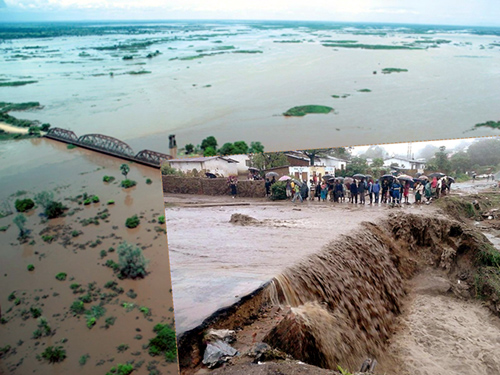
thiswasfarmlandThe most undeniable effect of global warming is the extremity of today’s weather, and nothing hit me harder than the Super Storm in the Serengeti last spring.

We can all recount weather events which we thought were particularly harsh or unusual. But when I took my vehicle to the top of a little hill on the plains in the Maasai Kopjes, it was truly terrifying. Click here to read the account of that awful afternoon.

While that was the most extreme of the extreme, there were similar events on all my safaris last spring, and it was happening throughout the sub-continent.

Global warming has been pummeling sub-Saharan Africa for a number of years, so climate change per se is not the story. The tragedies it’s causing and the attempts to prepare for even worse times are the stories:

You’d think that after years of being depressed, the escalation of coffee prices would be a boon to the highlands of East Africa, and it is … if they can grow it! Coffee is extremely sensitive to temperatures, especially night-time temperatures. The rise of a single degree centigrade is decimating East Africa’s highland coffee plantations.

Inevitably the disruption of the normal climate for people who already live in climate-stressed areas pushes them to a breaking point. One effect is increased conflict, as demonstrated this year in Kenya’s Northern Frontier among tribes who have always had limited resources, but who are now fighting among themselves for what’s left.

Many believe these kinds of incidents will soon combine into a massive, unorganized but global uprising.

Yet Africans are trying to do something about it, and their efforts are definitely part of the reason this is the number 2 story of 2015.

South Africa, which has lots of coal and even nuclear power plants, is investing heavily in mega solar power projects.

I’ve actually written about a number of these massive mega-projects throughout Africa. But there are also thousands of smaller, individual and truly heart-rendering initiatives as with the young entrepreneur Tom Osborn of Kenya.

As the years pass and the rain tumbles doesn’t it seem strange that some still deny climate change? How inconceivable that we would elect people like James Inhofe, and worse, give him a platform for his denial!

Most people right around the world know this is the world’s most pressing single issue. ISIS might topple Mosul, but climate change will topple the Himalayas.

(For my summary of the top 10 stories in Africa in 2015, click here.)

#1 : Terrorism

#1 : Terrorism

NM_14trump5.jpgAfricans have an important skill to teach Americans: how to deal with terrorism.

Thousands were killed this year by terrorists in Nigeria and Mali, and hundreds in Kenya and Somalia. But Nigerians and Malians and Kenyans and Somalis know that things are actually getting better. They are winning the battle against terrorism.

Just as Britain overcame the IRA and Spain overcame the Basque Separatists and Japan overcame the Red Army and Germany overcame Nazism: the solution takes time. It does not include creating impenetrable defenses. Africans successful fight against terrorism includes taking on head-to-head the two most significant causes of terrorism:

Hunger, physical and psychological.

Exclusion, ethnic and economic.

Most Americans when asked who Timothy James McVeigh is don’t even pretend to know. Yet many Americans when asked who presents the greatest threat of terrorism insist with divine certainty that it is Muslims and refugees.

On April 19, 1995, a 27-year old Gulf War veteran, Starpoint (NY) Central High School’s Most Promising Computer Programmer, devout Roman Catholic, registered member of the Republican Party and National Rifle Association, killed 168 Americans and injured another 600 by blowing up a federal building in Oklahoma City. Why?

Because, in his own words, he wanted to inspire a revolution against America’s tyrannical government.

“I’m sorry these people had to lose their lives. But that’s the nature of the beast….Innocents [have to die] to win the war.”

Hundreds followed McVeigh in America as terrorists since 1995. Almost all of them were fully fledged, driver-license endowed, passport eligible home-grown boys – Americans through and through.

McVeigh was Irish American. Hear any calls from Trump to ban Irishmen from entering the U.S.?

Terrorism – which we once incorporated into the phrase, “guerilla warfare” – is nothing new, but seems so, and that may be because it’s finally becoming successful.

Terrorists can’t amass enough fire power to prevail. So their strategy is simple: get inside the shirt of their adversary, inject the heart with fear and make the adversary turn on himself.

Fear uncovers our soul. We run or we fight. We save others at the risk of ourselves or we hide. We can’t masquerade our inner identity when we get afraid – it all shows.

Donald Trump and his frighteningly large number of followers are cowards of the simplest sort. They won’t fight the real battles, so they make up battles that don’t exist, like the religious “clash of civilizations.”

They want to believe they can still gun down their opponents, so they amass huge stockpiles of arms, but in their heart of hearts they’ve been frightened into believing in the near invincibility of terrorists.

So they want to build walls to barricade themselves from the rest of the world, an ultimate defense against the foreign phantom. What irony that future Timothy McVeighs, Americans through-and-through, Christians of the most flowery sort, Republicans and NRA contributors will all be behind the wall together. Easier to blow things up from the inside, isn’t it?

If the wall’s big and strong enough, the blast won’t hurt anybody at all on the outside.

Africans are fighting for ways to fairly redistribute diminishing resources, to find better ways of feeding everybody who’s hungry, to end corruption to make life inclusive for everyone. I don’t doubt that long before America achieves economic inclusiveness, most African nations will.

I’ve written about all these last year. These are tireless, thankless but meaningful battles. How pitiful are the extremists on the right who refuse to take these battles on.

Listen to Africa. Listen to Europe. Listen to Trump and his followers, too, but beware of them: This isn’t just entertainment. They’re standing in front of a white flag.

(For my summary of the top 10 stories in Africa in 2015, click here.)

2015: Transformative in Africa

2015: Transformative in Africa

TopTen2015Events in Africa in 2015 reflected a real maturation from reaction to reflection. There were some horrible things that happened but they had definite silver linings, and there were also many positive, dynamic social movements.

Return in the next several days for a more in-depth discussion of these top events. Below is the summarized list:

#1 TERRORISM
As the year transpired it became clear to westerners that terrorism was no longer centered in Africa. There were horrible terrorism attacks in Nigeria and Mali, particularly. But even though the actual number of human casualties remained higher in Africa than elsewhere in the world, it was Charlie Hebdo and November 13 in Paris that sent cold water down the spines of the western world.

Westerners should have taken their lead from Africans who have never become polarized by terrorism. But westerners didn’t, and Africans noticed it.

One part of The West developed a good, rational understanding that terrorism is no more external than internal. But another good hunk succumbed to terrorism. Fear breeds fear, so when used as a weapon the first strike may be external but the final one will be from within.

#2 CLIMATE CHANGE
All of us can recount that day or week of weather that was “unlike anything before.” But my seeing the super storm in the Serengeti on one of my spring safaris was terrifying. It was as if I were in an alien world.

Yet in the midst of such natural fury it’s easier to empathize with the African farmer who struggles even when things are good, and to understand that few global issues can be as politically transformative as this.

Few things can drive a man to desperation. No water one day followed by flooding the next is one. One type of desperation is suicide bombing.

#3 POPULAR MOVEMENTS
Black Lives Matter and income inequality are no more dynamic movements than journalistic freedom/free speech and income redistribution are in Africa.

This year was notable for popular movements gaining political momentum throughout Africa. This leads to a truly fascinating social dialogue, about justice and equality and the limits of the state.

In South Africa the country experienced the first major implementation of its constitution’s allowance for an appointed high court to overturn a jury’s acquittal. In Kenya popular outrage over press reforms stopped serious restrictions on the freedom of speech.

As in America these movements’ fuel came not from elections but popular uprising.

#4 ELEPHANTS
I felt vindicated this year as public opinion moved way from the commercially (that is, not-for-profit commercialism) crafted notion that elephants were going extinct, and embraced the more nuanced reality of their manageable decline.

Though the false anthropomorphization of an animal still dominated the entertainment industry, critics grew. It’s important especially in Africa that the world realize elephant are no more important than people.

There were some real banger issues, too, as when Tanzania’s ruling party arrested an ivory black-marketeer who had been known for decades, simply to achieve an advantage in its election.

#5 ELECTIONS
Democratic elections are now routine in much of Africa. The major presidential elections in Nigeria and Tanzania were both extremely surprising. In Nigeria the regime was ousted. In Tanzania the regime was sustained.

Yet in both cases the results seem to have been transformative. Nigeria has begun to recapture itself from Boko Haram and in Tanzania actual events suggest that the country’s greatest cancer, corruption, may be under attack.

Does this mean that democracy is more important than its outcome?

#6 ZUMA The CLOWN
While at the bottom of the continent, democracy bottoms out completely: The current president of South Africa is so enmeshed in scandal, so childishly reactive to important national and international affairs, that many are no longer just making fun of him but insisting that he go.

I’ve often written that in a newly democratic nation the chief executive is often something quite unusual. But Jacob Zuma has overstepped the boundaries of a cartoon and may be putting his country in real peril. One indication of this is the plummet of the rand.

#7 TRUMP
My detractors will claim this ridiculous, but it isn’t. Africans have always been intrigued with American politics, even at its tamest, so there’s hardly anything unusual with interest in the opposition’s front runner.

But we need to heed what Africans are saying: There is an acute understanding that Donald Trump is not just a trouble-maker but a very evil force in America.

#8 EVOLUTION
Because we evolved in Africa, Africa will always figure prominently in the discussion of evolution. As technology improves discoveries increase and are more frequent.

Homo naledi may be the greatest discovery of early man in the last fifty years. The American turned South Afrikaner who found it is a wonderfully refreshing personality to percolate up the ranks of paleontological celebrities! His discovery has been presented so transparently, I hope not just the science but his methodology can transform the jealous and conceited way American paleontologists have dominated the science for years.

#9 MAN vs. BEAST
This goes well beyond the specifics of elephant poaching to the new if “modern” battle between the emerging African middle class and the wild animals that live all around them.

Lion poisoning, especially in Kenya’s Maasai Mara, profoundly demonstrates that the only solution – or at least the only path to a solution — is through government not private initiative.

#10 AFRICA TOO EXPENSIVE
Interestingly linked to #9 above the cost of an African vacation for a foreigner has been increasing faster than any vacation in the world, and Africans are about to price themselves out of future markets.