Pretender or Defender

Pretender or Defender

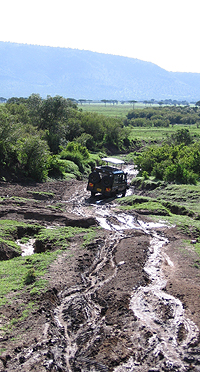
rover.fronviewOnce upon a time going on safari meant two weeks in a Landrover TDI110 “Defender” literally in the bush: no roads.

You found trails, usually elephant paths, and plowed your Landrover TDI110 “Defender” into the wild.
roverdownstream.haley
With roads and government tariffs and mercantile competition and especially, with tourists who are terrified that traveling off roads is what al-Qaeda wants you to, who need room for 30 pounds of cosmetics and hair shampoos, who schedule their spinal epidurals depending on air fare sales, who are allergic to Wonder Bread and need additional room to bring their sleep amnea machine and additional plugs in the cab for their kids’ Xbox …

… the “Defender” has died. “Long live the memory of the Defender!”
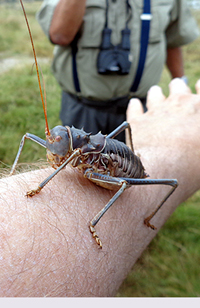
GiantCricket.Botete.Apr14.640.JIM

I still manage to slip real bush into some of my safaris, although I often play it by ear because many of my clients today would have a heart attack if a little cricket jumped on them.

But in the main I don’t. Nobody does. You don’t fork out ten grand to feel like you’re riding a jackhammer.

Once upon a time, we didn’t mind, but no one would tell you that the Defender was comfortable – it wasn’t. But that was a machine! You could drive it up a boulder. (Coming down was the problem.)

The Defender was expensive. Being so tough meant that we constantly challenged it, and so often man the ultimate defeated the machine and the machine had to be fixed. That was difficult: it was soooo expensive.

Even 20 years ago a simple universal joint exceeded most safari’s net costs. And it was hard to explain to clients that it was noble that, in fact, they couldn’t move for a while.

I mark that as the point at which Landrovers began to decline in popularity. It was about 20 years ago and spare parts were so expensive that clients would often get into the car and then not be able to go on safari because it wouldn’t start.

So in comes the New World, that is the new world of automotive mercantilism which in English is “Toyota.”

And shortly after “Toyota” came “Nissan.”

And Defender was overwhelmed by Pretender. They were so cheap. And besides, there were now roads, and the Toyota stretchie does pretty well on roads and it can easily be modified to carry cosmetic cases.

Modified is the key. Yes the Defender could be modified, but it was hard work, because it was thick metal. Toyota’s and Nissan’s metal is a tad better than aluminum foil, and there are a myriad of things you can do with such pliable material: origamy, for instance.

You can also add extra seats and stretch the sides and stretch the length, ergo the nickname “Stretchie.”cutofftops
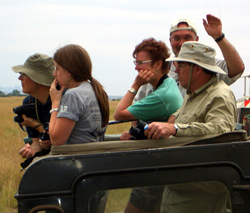
You can cut out the roof then put it back on extenders so people can stand up and pretend they’re on the subway.

You can have all sorts of kinds of seats: pillows and cushions and even ones that warm themselves.

Windows is a problem we’re working on. When a vehicle is changed so much, the preformed window sometimes doesn’t work so well, but not to worry, stand up and look out.

So what has happened to my Defender?

Gwinnett-dealer-img
Landrover is not to be displaced from modern times. It began after World War II, a copy of a military jeep, which farmers needed in Wales to defend themselves against Northumberlers. Ever since that courageous moment of birth, Landrover has evolved with the times.

So today, you’ll find these legendary machines mostly in mall parking lots, because it is today what the Landrover does best, defend its owners against obscurity.

On safari, we’ll make do with the “Pretender.” Bring on that Lacombe! We can handle it!

But ode to awesome, what a machine that was!
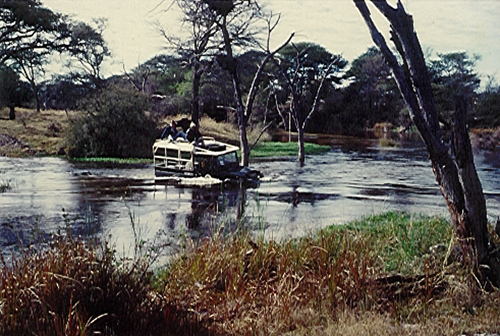
submergedlandrover.botswana

Boom or Bust?

Boom or Bust?

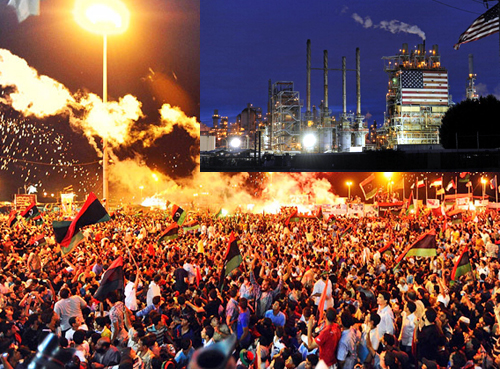
oilboomportendsrevoliutionAn extremely dangerous economic situation portends tremendous global unrest, especially in Africa.

Obama’s energy policy has put American front and center, and while Americans are reaping enormous relief from falling energy prices the developing world is poised to suffer considerably.

That may seem counter intuitive, because energy is needed by everyone. It isn’t only Americans that are benefitting from lower energy prices, is it?

Yes.

Europe, India and China have unique problems restricting them from benefiting from increased global oil and gas production.

Developing countries in Africa have an even more unique situation making it even worse for them:

African governments have long subsidized their citizens’ energy prices, especially gas and oil, because without natural resources and without refineries, a gallon of gas would just be out of the reach of even the most successful truck driver/owner.

So a gallon of petrol in developing Africa has cost $5 to $6/gallon for the last 20 years, regardless of the actual cost to the governments holding that price for their consumers.

But, you may ask, the governments win or lose depending upon the price, right?

Of course, but over the last decade an unexpected factor entered the equation. New technologies allowed a boom in oil and gas exploration in Africa. Reserves previously too difficult to get were unleashed.

Previously considered resource poor, countries like Kenya, Uganda and Tanzania now consider themselves resource rich.

Oil is being pumped from the deserts of Kenya like never before. The government has benefitted much more from the taxes on these natural resource extractions than it has expended to keep the consumer price of oil and gas at stable levels. A net positive increase.

America is unwittingly changing that.

Kenya was ecstatic when 600 million barrels of oil reserves were established in its northern deserts, and this year it celebrated a remarkable 3 million barrels of extraction.

But …

… Texas is right now extracting 3 million barrels of oil every day. This year Texas produced the entire estimated Kenyan reserves in 9 months.

America’s energy boom has crushed world oil prices. Kenya’s tax revenues are plummeting. That’s not even the worst part of the story.

Kenya’s main oil exploration company, Tullow Oil Plc of Britain, announced this week that it was massively reducing its exploration in Kenya. This was a polite way of saying, Goodbye Folks.

The net result of the loss of new revenue over the last ten years against the benefit of reduced energy prices worldwide is a net loss for Kenya and virtually every developing African nation that had recently discovered new oil and gas reserves.

This is a perfect illustration of the gap we talk about so often between the rich and poor. If the rich and poor are equated, and by that I mean subject to identical economic laws and their results, then they benefit or suffer by the same percentages.

If a big society like America grows by 6% annually and a small country like Kenya grows by 6% annually, the difference between them gets bigger and bigger.

When that dynamic is accelerated because the bigger society, America, benefits from a global price reduction in energy (because the net result of cheaper asset value is offset by even greater increases in production), while the smaller society, Kenya, suffers enormously … the gulf widens even more.

No one had predicted the size of the energy boom in America. It’s absolutely unbelievable, and it has widened the gap between America and the rest of the world in near exponential ways.

This is a terrible conundrum that seems out of control. The answer can’t possibly be to restrict production? Isn’t there something inherently correct to presume that if things cost less we’ll all be better off?

If by “we” you mean Americans, absolutely! If the “we” includes Africans, absolutely not. Africans will get poorer more quickly than they ever expected, and I think that will set off another and much greater Arab Spring.

There is a solution to this. It’s a nasty term called redistribution of wealth. It’s even more nasty than Republicans in Congress believe, because I’m not just talking about recalibrating America’s tax code.

This one is about the whole wide world.

Ivory Ends

Ivory Ends

Only ivory can be so minutely and intricately carved yet remain so tough and durable.
There may still be too many elephants in East Africa, but Tanzania is acting so irresponsibly with regards to increased poaching that the scales may soon tip.

This week a group of environmental organizations led by the EIA petitioned the U.S. government to withhold aid from Tanzania until elephant poaching abates.

It’s unlikely that the appeal directed to Secretary of State John Kerry will be seriously considered. Tanzania is on the front-line of the Obama administration’s war on terror, and the “elephant problem” is considered incapable of trumping “homeland security.”

The flaw in this reasoning is simplistic and ultimately fails because our homeland security policy with regards to terrorism is failing.

The explanations for Tanzania’s “elephant problem” also reveal why the country is so incredibly corrupt, why it has grossly mismanaged its treasure of natural resources including oil and gold, and why its powerful oligarchy can with abandon relocate thousands of Maasai to appease a few Dubai hunters.

Recently Dick Cheney agreed that enhanced interrogation techniques were a means to an end and were justified.

Facilitating if not outright supporting Tanzania’s corruption is also a means to an end that the Obama administration apparently feels is distant enough from public understanding to be acceptable.

I’ve often written that the elephant poaching problem is serious but exaggerated. Increasingly this year, though, the situation has grown more troubling. I hesitate to cite specific numbers, because they’re all over the place.

The EIA report looks sound to me, but I’m subsequently infuriated that they introduce it on their website with an ITN video that grossly misstates acceptable numbers. I just wish for once that these good environmental organizations working to save elephants would be more scientific and less evangelical.

London’s Guardian newspaper is probably the best resource in the world for accurate news on current elephant poaching. The Guardian contends that “Chinese demand for ivory is devastating Tanzania’s elephant.”

I agree, but what is missing from the hysteria is the fact that the growing development of Africa has enormously constrained elephant habitat in just the last ten years: not just national parks, but more importantly the vast areas peripheral to the national parks as well as the quasi protected corridors that connect distantly separately massive wildernesses to allow for elephant migrations.

These “corridors” and “donut edges” are often private land or land in trust, and demands for their development have grown exponentially. Farming, mining as well as simple village growth now impinge on what was only a short time ago elephant bush.

The tension between the needs of a growing and developing human population with the enormous amounts of land required for wild elephants is at the highest ever.

Until that tension is squarely addressed, corrupt officials will play god. Local communities engaged in ivory poaching will be given a pass, since the government is inept or incapable of giving them work, instead.

This is the real problem. Distant foreigners’ hearts may break when pictures of poached elephants appear on their TV screen. The world should continue to encourage China’s incremental movements to change a thousand-year culture that covets ivory as no other collectable.

And as the Guardian brilliantly pointed out, the disconnect between westerners’ campaign to stop endangered animal poaching and their allowance that these same animals may be legally hunted and harvested, has to be closed.

So the problem is not as simple as hysteria presents, but the problem is getting worse. It may not be the extinction of elephants that looms any more likely than the end of enough larger wild areas to support families of such a large wild animal in East Africa.

For the first time in my opinion, that is a plausible claim. Whatever the remedies, they certainly do not include ends-justify-means tests of what’s right to do.

Fighting Terror with Terror

Fighting Terror with Terror

futilityofantiterrorLike father, like son: Kenya has now joined its military father, the U.S., using illegal force in failed attempts to fight terrorism.

The Senate committee report released Tuesday is a shame on America that will follow our empire to its ultimate grave, but the extra-judicial killings of 500 detainees by Kenyan security forces is simply mindless.

My novel, Chasm Gorge, explains how a terrorist in Kenya succeeds by provoking America to react with excessive force. That’s exactly what’s happening in Kenya today.

And it’s fair to conclude that because America did it, Kenya does now. America planned, financed and helped managed the Kenyan invasion of Somalia.

The Kenyans are simply doing what their teachers did: Actions speak louder than words.

Yet there are words, too:

The Kenyan operatives told London’s Guardian that “they have received training and intelligence from Britain.” So add Britain to this terrible mix.

Why is this happening? Why did America torture? The evidence is strong that torture doesn’t produce useful intelligence, and even if it did it would be immoral.

Hypothetical cases suggesting that torture could reveal and thereby prevent an ultimate apocalyptic attack are ludicrous. Nothing yet in the human arsenal is more apocalyptic than the immorality of torture.

In today’s world and any future hi-tech world I can imagine, torture does nothing but escalate a conflict. So why pursue such inane policies?

The answer is the same as to why the Kenyans murder their detainees.

Revenge. It’s that simple. Revenge is short-term relief. It’s old testament equalizing. There is, in fact, some logic to revenge if a conflict is considered irresolvable, when compromise at any point is impossible. In this case only one side wins, and revenge is a move on the chess board that allows no draws.

If we truly believe certain conflicts are irresolvable, then as righties for years have argued, pull out all the stops! Let the nukes fall!

Fortunately, we’ve retain enough sanity to avoid doing this yet, which reveals the deeper truth that we are prepared to compromise, but that flies in the logic of revenge.

That’s the devilish duality of the American psyche: whatever our education and intellect tells us battles with our machismo. Our ego is deadly.

Many Americans are beginning to realize this. Terrorism wins when the terrorized over-react in fear, essentially defeating themselves.

When the U.S. spends trillions of dollars in retaliation to 9/11, it loses the battle of 9/11. When in reply to the several thousand soldiers killed in Iraq and Afghanistan battles the U.S. kills and displaces fractions of millions of people, it loses the wars in Iraq and Afghanistan.

We, and now Kenya, are doing exactly what the terrorists want us to do.

And so, we’re both losing. For gods’ sakes, Kenya, learn from your failed teacher.

Fat Children Starving

Fat Children Starving

Comedy conveys reality to Americans today better than straight facts, and last Friday’s ‘The Daily Show’ masterfully presented the real Africa.

Jon Stewart introduced his new correspondent from South Africa, Trevor Noah, who conveyed to Americans a lot more successfully than I and dozens of other bloggers have:

(1) Eric Garner and Michael Brown demonstrate more police brutality in America than in South Africa.

Moreover and more importantly, police brutality in South Africa was once much worse and is now much better, and this is not the case in America.

Noah pointed out that police brutality in South Africa was a construct of apartheid, and that when apartheid ended this brutality began to reverse.

In America, where there’s never been apartheid as such, brutality has remained high if not increased.

(2) There is more ebola in America than South Africa.

True and undeniable, but no matter how many times we say this it’s forgotten until carried in a comedy routine!

Noah said his friends warned him against going to America for fear of contracting ebola, and he replied “just because they had a few cases of ebola there [America] doesn’t mean we should cut off travel, there.”

(3) Americans believe they can “save Africa” by small charity donations. Noah remarked, “for just five cents a day.”

This sarcasm is powerful stuff. It reveals the ignominy of American charities and the naivete of American donors in the much fuller arguments that I and many others have made for years about the mistake of so much American charity.

(4) Americans think almost exclusively that Africa is a vacation destination for big game safaris. While Africans absolutely don’t, of course.

Noah then presented a game, “Spot the Africa” which was phenomenal.

A series of two paneled photographs came up multiple times contrasting Africa with America, and as you can imagine, the horrible ones were America.

This wasn’t just nitpicking. It was real.

Stewart then asked Noah, “You aren’t saying that things in America are worse than in Africa?”

And Noah replies, “No, I’m not saying that, you guys are saying that.”

I’m one of those guys.

And Noah ended with a brilliant observation that knits the reality of sarcasm to the troubled conundrum of American life:

“You know what African mothers warn their children, about, Jon? Be grateful for what you’ve got, because there are fat children starving in Mississippi.”

Lion Realities

Lion Realities

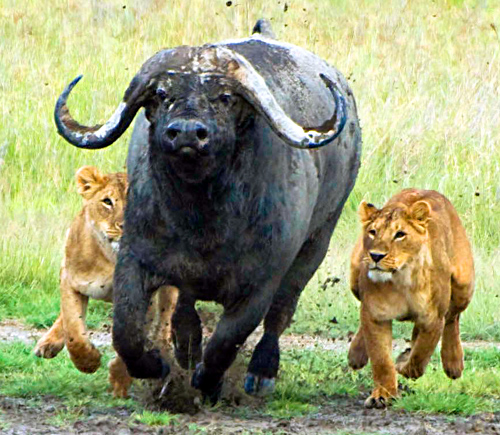
Excellent photo by Rich Mattas on my March Great Migration Safari.
Never ‘in my life’ would I have expected to be concerned about declining lion populations in Africa, but despite grossly misunderstood and badly used statistics, they are definitely in decline.

I always thought of lions, I suppose, like kitty cats: They’re ubiquitous! In fact, they are more of them than my birder friends think there should be, and where I live feral cats likely outnumber deer.

At the top of the food chain, what could possibly threaten lion?

The framing of my question reveals the mistaken notion of trying to figure out what’s happening to a wild animal strictly by what’s happening in the wild.

What threatens lions is development: people, roads, buildings, dams … all the things that make for a modern world.

Development impinges on lions directly, but by also constricting the freedom and growth of lion food – other animals – it’s a doubly whammy.

I’m astounded by the inability of research organizations to get a firm number on lion declines in Africa. It ranges from popular charities like NatGeo’s low balling to many others suggesting twice the number. Either way it’s a serious, rapid decline, but why no consensus on actual numbers?

The best researchers, like Craig Packer of the University of Minnesota, refuse to deal with the issue in the aggregate, assuring me that compiling trusted aggregate numbers is too difficult.

LionAlert was my guide for many years, but they’ve been unable to make a prediction beyond the 35,000 they published for 2012.

NatGeo among many other organizations is appealing to your pocketbook to fund their missions to stem the decline. It’s a waste of money.

Although the actual numbers in decline might not be known, the reasons are.

Craig Packer’s many scholarly articles and popular publications sum it all: His 2004 study in Ngorongoro started the news that lions were in serious decline, building on an earlier 1996 study about how lions were growing increasingly vulnerable to viruses.

By 2005 Packer had the lions in the Serengeti well understood, and it’s really on the basis of this detailed although localized research that I think we can generalize to the continent as a whole.

Subsequent reports and studies would confirm that serious human/animal conflict was the driver of decline, not just building roads.

By 2009 researchers were no longer reticent about blaming the Maasai’s poisoning of lion as a major contribution to decline in East Africa.

Don’t put too much emphasis on that, though, because it’s really all a part of the same problem. Lion attacking livestock occurs not simply because lion have decided it’s easier than pulling down a wildebeest.

It’s as much because there are fewer wildebeest and the lion’s range is declining because of overall human spread.

Maasai poisoning lion is identical to Montana farmers poisoning wolves.

This decline will not stop by contributing to NatGeo, and once again I’m infuriated by so-called conservation organizations driving their general fund with appeals of imminent catastrophe that they claim to know how to stop.

Much better to support the more difficult-to-understand but lasting attempt by Kenya to list lions as an endangered species.

That was set back this summer when efforts to do so were curtailed, in this case mostly by NRA-driven hunting groups that would be most effected immediately. As a result, South Africa – a powerhouse in determining African conservation policy but also one of the last easiest places to arrange a lion hunt – declined to support the listing.

But Kenya battles on and so should we. I can’t suggest that human development be held hostage to protecting lions. But I can definitely tell hunters to go take a walk.

Broken or Manipulated?

Broken or Manipulated?

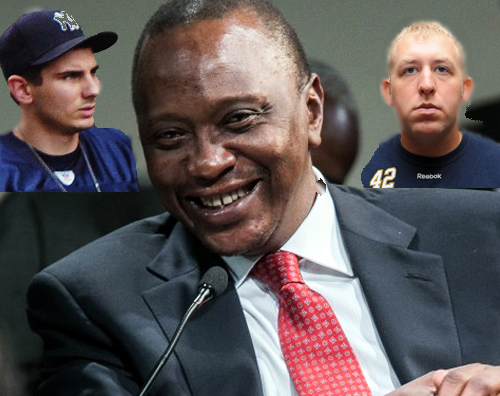
kenyattawilsonpantenaloJustice, fairness, equality – “legally” lost today around the world. Uhuru Kenyatta, Darren Wilson and Daniel Pantaleo are today uncharged, and they should not be. What’s wrong?

Uhuru Kenyatta, the President of Kenya, was indicted for crimes against humanity by the World Court more than a year ago. Today the chief prosecutor dropped all charges.

Darren Wilson and Daniel Pantaleo are white police officers who exceeded their professional protocols while apprehending unarmed black men and killed their victims, but both were released of any charges by local grand juries.

All of this is legal and lawful.

And wrong.

The debating if bickering as to why these major miscarriages of justice occurred will go on for years and ultimately it will be concluded — exactly as it’s understood at this very moment — that modern systems of justice are easily manipulated by those in power.

In Kenyatta’s case, the prosecutor issued a statement blaming the Kenyan government for gross intimidation of witnesses and refusal to cooperate in the search for evidence.

The white police officers were exonerated because of prosecutors’ unusual granular involvements in the deliberations, and law that has become badly interpreted to vindicate virtually anything that a police officer does.

All three men are most likely guilty of the crimes for which they had been considered or in the case of Kenyatta, charged. Without a completed prosecutorial investigation, this certainty will never exist, of course, so we’re forced to speculate if justice was served.

If any of them is truly not guilty, that too will never be known, now. In the public mind it grows more and more impossible that they are innocent.

So justice, whatever it really is, will never exist in these cases.

The only valuable outcome I see is the fact that the world is fast recognizing that these three men are but representatives of a much larger community of possible criminals who escape justice by the manipulation of those in power.

And that power, even in democracies, is apparently absolute.

Many, particularly in Kenya but also here at home, argue that regardless of whether justice was served or not, the outcome is correct.

This is to say that justice is not always the right outcome.

Many, many Kenyans believe that the stability that Kenyatta seems to have achieved among Kenya’s brutally opposed ethnic groups, was worth a couple hundred thousand displaced persons and a thousand deaths.

The argument is that in the absence of Kenyatta’s management of violence following the disputed 2006/7 election that Kenya would have become a failed state mired in unthinkable if barbaric horrors not unlike the situation in Nigeria’s Biafra in the 1960s.

Similarly, Americans believe that police officers can break the law in order to enforce it, provided the overall outcome is a more lawful society.

I disagree. Justice and injustice are mutually exclusive. Manifesting justice does not beget injustice.

There is nothing inherently weakened in the concept of justice if the powerful who find themselves its guardians are themselves punished for injustice. In fact, it strengthens not weakens justice.

No, the explanation is not found in arguments that verge on hyperbole. The explanation is found in the larger masses of society, who are today apathetic or placated if fooled.

There is too little moral indignation than there should be among the societies where these injustices take place, and the powerful recognize this and so take advantage of it.

Justice is not something that was delivered to us by men in wigs 300 years ago, or in the case of Kenya, a convoluted global justice system in its initial stages of infancy.

Justice is there for the taking.

But today not enough people want it.

Corrupted Index

Corrupted Index

giverortakerTransparency International’s corruption index for East Africa is depressing, not wholly accurate and therefore more depressing, and becoming increasingly irrelevant.


The index
was released this week and the analysis of sub-Saharan Africa differs little from last year in the aggregate: Africa is still the most corrupt place in the world, and East Africa is among the worst in Africa.

Notable is that Kenya has dropped even further to the bottom (now below Nigeria) and that Tanzania ranks much higher than I think it should. Also notable and unchanged is the positive rating given Rwanda.

The index is a summary of up to 8 other organization’s assessment of a country’s corruption. Several of these are massive and well known institutions like the World Bank and African Development Fund.

Others, like the Bertelsmann Foundation and Political Risk Services International Country Risk Guide are less well known and I think lack some serious credibility. They are often regionally specialized or carry certain political and ideological biases (mostly towards capitalism and oligarchical democracy).

Nevertheless, I think the index as a general tool works. This year, however, it doesn’t work so well for East Africa.

Before I sound like an apologist for evil, there is no question that Kenya is still seriously corrupt. The most recent, egregious scandal to go public emerged last month when a British court revealed huge bribes paid to Kenyan officials for printing documents like … ballots.

This specific story points perfectly to my criticism of TI’s index.

Britain, listed by the index as lily white at 14th of the 176 countries analyzed, is essentially the facilitator of Kenya’s corruption, listed by the index as the dismally 145th.

In other words, if British printing companies didn’t pay corrupt Kenyan officials, then at least in this case there would be no corruption.

Add to this that in many countries, including Britain and in certain cases in the U.S., paying bribes isn’t illegal.

In still another misleading way, Rwanda is shown as the outstanding 5th best of Africa’s 50 analyzed countries, and that may indeed reflect less bribery for ballots. But Rwanda’s insidious support of militias in The Congo is doing far more to destabilize Africa and the world than Kenya.

The irritation I feel leads ultimately to the definition of corruption. It took an Act of the U.S. Congress (the Dodd-Frank Act), numerous judicial appeals and even global litigation to stop Apple from funding Congo warlords through black market schemes perpetuated by Rwanda.

It took a simple UK court to reveal the three Kenyan idiots who took bribes for a single act of corrupt printing. And then, it stopped.

Which is the more egregious? Well, the first sustained a generation of war and millions of deaths and millions more starved and tortured. The second?

I’m not condoning the second, I’m suggesting that TI’s index can lack relevancy.

I am also mystified at how Tanzania improved so much this year, even though the European governments for the first time ever suspended their aid because of growing evidence of corruption, there.

It would take time, but I think a good Ph.D thesis in economics would reveal that TI’s index is linked to economic performance, which does not reflect clean governance.

So overall I accept TI’s assessment that not much has changed in Africa vis-a-vis the world as a whole as regards corruption and good governance.

But enter the details and we might be discovering a very corrupted analysis.

Ebola Epilogue

Ebola Epilogue

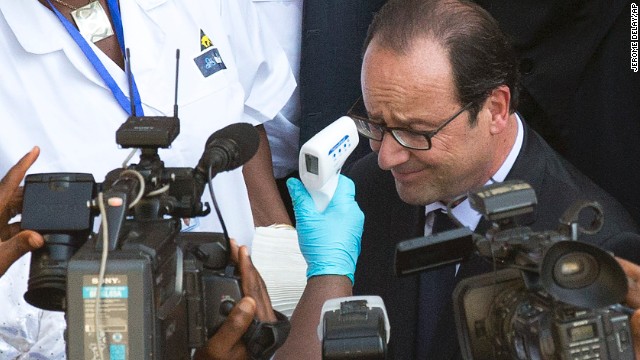
President Hollande of France entering an ebola hospital in West Africa.
The apparent slowing of the spread of ebola in West Africa is almost as worrisome as the outbreak itself.

Many will think I’m crazy to write an epilogue to this story before it really is over, but like so many global crises the ebola epidemic will become forgotten the moment headlines disappear.

We really shouldn’t do this, this time. There are four extremely important lessons to be learned, that right now I hope everyone can understand.

First, the situation today:

There are just under 7,000 reported deaths from ebola, just under 17,000 reported individual infections, and both numbers are likely low because of the difficulty of accurate reporting in the ebola infected areas.

Foreign help is working. ABC reported yesterday two pages of good headlines about ebola in Liberia, including Obama’s troops and hospitals coming online, Chinese hospitals coming online, and the possibility there will be no new cases at all in Liberia.

With all the accelerated research and development of diagnosing and vaccinating against the disease, I predict ebola in West Africa will be contained in the first quarter of next year.

In a demonstration of similar optimism, the President of France visited a hospital in Conakry, Guinea, on Friday. Conakry is an epicenter of the disease.

With an outbreak of this magnitude it’s difficult to imagine it will ever be completely over, since so much of the area retracted into primitiveness as a result of almost two generations of horrible, scathing war.

But I’m willing to take the risk of being premature for wont of not losing public attention. We have four serious lessons to take from this situation:

Lesson 1.
TERROR & RACISM RULES
American culture in recent times craves being terrorized. There could be all sorts of reasons: remnants of 9/11, poor education, the Great Recession … whatever. Whether it’s vampires at the cinema, fear of ISIS or “open borders” or ebola, we crave being threatened.

In all these cases, “The Threatener” is the demon. Imagine, for example, if some horrible virus literally as bad as ebola or worse suddenly broke out in Des Moines. We would not be closing our bridges over the Mississippi or road-blocking I-80.

A virus worse than ebola did break out in America in the 1950s. It was called polio. Some parents did keep their kids out of school, but most didn’t even do that.

Ebola happened in BLACK Africa. All our reactions this time demonstrate racism to the core of our beliefs. Polio in Pittsburgh is god’s will and we will overcome it. Ebola in Africa is the work of the devil.

Lesson 2.
KNEE JERKS precipitate KNEE REPLACEMENTS
America today leads the world in short-term thinking, and that short-term thinking is why we have an ebola epidemic to begin with.

America’s political system is the best example. We fund the government almost from month-to-month. We have no long term social plans.

We cherish quick stock trades; we tutor our third grader just enough to get into fourth grade; we hand out just enough food stamps to take us through winter.

We lay globs of asphalt in cracks rather than pieces of new cement and then get furious when the cracks get bigger the next year.

Our hearts may be in the right place, but our minds are in Pluto. We pass referendum to increase the minimum wage for a long-term benefit to everyone including the shop keeper that gets the extra dough, but then elect politicians who vow to reduce the minimum wage to balance next year’s budget.

Tom Sommerville writing today in African Journalism argues so well that the ebola epidemic today is a result of American-dominated short-term thinking manifest by the IMF and World Bank.

He’s right on, and I’m not going to summarize his thinking, just go to his link above.

Basically, you get what you pay for. America has led the world paying discount prices for a modern planet that needs a bit more quality than we’ve been willing to accept.

It’s so counterproductive! We spend literally millions of dollars to intercept ebola (so far, no one) at our airports who has a temperature, but resist funding Obama’s emergency request to build ebola hospitals! Now how ridiculous is that!

We all know where this is going to lead, don’t we? Didn’t your grandpa give you your first piggy bank? If you neglect the oil change, won’t you have to buy a new car sooner? Come on guys, get real!

Lesson 3.
EXAGGERATION KILLS
I’m probably the greatest offender, admitted, and I am constantly trying to reform myself, so at least I’m ahead of many.

So I can attest first-hand of this horrible American affliction, exaggeration. Texas has to be the biggest place. My kids are always above average, thank you Garrison. My yard has the greenest grass. My pastor is the kindest man. My dog is the sweetest and … my enemy is always the devil incarnate.

Current ebola infection stats are horrible but nowhere near as catastrophic as earlier predicted. Both the CDC and WHO are now loathe to make future predictions, since their earlier ones were so off base.

Those quantitative assessments that earlier suggested “millions” of possible cases from institutions as respected as WHO and the CDC make me wonder if those organizations suffer from the same scientific deficits as Senator Inhofe.

Opponents of realism, of what is right in the world, of what should be done morally and practically, will now use these exaggerated claims to stop funding Obama’s ebola eradication mission, and this will kill hundreds if not thousands of more people than would otherwise be saved.

Lesson 4.
GEOGRAPHY IS DEAD
When I’m working in Nairobi or Johannesburg, I’m just about the same distance from the ebola epicenter as my kids are living in New York.

Every single capitol city in Europe is closer to the ebola center than any city in the U.S.

There are three nonstop flights daily from West Africa to the U.S. (two into JFK and one into Dulles). Daily, there is only one into Johannesburg and no non-stops into East Africa. There are dozens of nonstops daily into European capitols.

It has absolutely astounded me how bad Americans’ knowledge of basic planet geography is. I started work in Africa 40 years ago, and I was astounded then that someone in Chicago thought Dakar was as close to Nairobi as Detroit is to Cleveland.

But that has persisted, and there’s no explanation except poor education.

* * * *

The outbreak of ebola, the messy containment, the lessons that won’t be learned from the situation, are every man’s responsibility, every man on earth.

America cannot yet shed its responsibility as the world’s greatest power, and so it has to assume its greatest responsibility.

Remedies begin at home, of course. They begin with adjusting ourselves to realism and moralism. It’s a very dark time in America right now. Kids, get us out of this!

Music Magic

Music Magic

At a holiday party recently, someone asked me if when I’d been in Africa recently I’d heard any of Africa’s great new music, you know, gospel.

This past weekend was Africa’s continent-wide music video award show which I found particularly interesting since artists and production companies from my neck of the woods, Tanzania and Kenya, did extremely well.

Tanzania and Kenya, compared to South Africa and Nigeria, is like comparing Hot Springs, Arkansas, to Nashville, in terms of financing and production capability. But the continent has been connected for many decades by its music and music competition, and East Africa is emerging with what I think is the greatest creativity.

Earlier in the year, the African music awards which represent the top stars in the industry was held again in South Africa.

I really listened to these closely again, and darn it, I couldn’t find any gospel.

Nigeria continues to dominate the industry. The energy of modern Nigerian pop stars makes me think it would be absolutely impossible — beyond the realm of imagination — to think that Islamic terrorists could ever take over this country.

I’m not being facetious. I’m presenting an entirely better defense against terrorism than what current politicians espouse.

The list of the hundred, even thousand top performers in Africa includes … no gospel music. Boko Haram may have extinguished them, I suppose, but rather I think you might just say … times have changed.

In fact, I remember shortly after Kathleen and I started to work in Kenya in 1972 that the two top music award winners that year in Kenya were the Kenyan Police Band and a church gospel choir.

I’m no music critic, but in listening to a wide range of modern African hits today I’m impressed by their gentler tone than we have in the west.

Most of the themes are ones of individual love lost or pined for, and many of them actually do remix the old dada da-da / dada da-da rhythm of the ancient adungu instrument.

But even that isn’t .. gospel.

Gospel is indeed part of America’s musical heritage.

It really isn’t in Africa. The gospel music that was promoted in colonial times was the music thrust on the oppressed by the overlords. They probably didn’t expect anything else was possible.

They were wrong:

Thanksgiving

Thanksgiving

Today is Thanksgiving in the United States. (Canada celebrates it earlier.) Thanksgiving is one of Canada and the U.S.’ major holiday celebrations, characterized by copious amounts of food featuring seasonal recipes and lots of sweets. The traditional meat served at the feast is turkey.

The two-day holiday originates with the first permanent settlers to the New World, people who called themselves pilgrims fleeing England’s restrictive laws on religion and who arrived the northeast coast of America in between 1620 and 1621.

They faired poorly in the beginning until two local native Americans, Wampanoags of the Algonkian-speaking clans, both of whom spoke English (because one of them had previously traveled to England in 1605) befriended the settlers. The “Indians” taught the pilgrims how to farm and build homesteads, and the summer planting season was so successful that the pilgrims invited the Indians to a “Thanksgiving” harvest dinner in November, 1621.

Click here for much more information about the history and meaning of Thanksgiving by a native American school teacher, who dispels not only the myths about the “primitiveness” of native Americans, but also about the pilgrims’ history and beliefs.

You First, Dear Girl

You First, Dear Girl

Woman JihadistA growing number of women are becoming jihadists, especially in Africa. Why?

London’s Daily Telegraph claimed recently that one of every seven Britains who has traveled to troubled areas to join a jihadist cause is a woman.

Elizabeth Pearson of Kings College points out this is nothing new, although it appears to be growing substantially.

Ms. Pearson also points out that women are increasingly being used as suicide bombers.

Does this just provide a media advantage for jihadist groups, since media is more likely to report on terrorist acts if a woman is involved, as Ms. Pearson suggests?

The families of suicide bombers no matter their gender are often paid substantially, and jihadist leaders also perpetuate what I believe they believe is the myth that suicide in action assures martyrdom.

I actually think the main reason women are becoming more involved in jihadism is more simple. Gender abuse in America – and elsewhere in the western world – has been talked about for a very long time, but not really acted on in ways meaningful enough to reduce it.

If men want women to do something — anywhere in the world — they’re more likely able to persevere than the other way around.

Another more subtle reason may be linked to the definitely new global awareness that’s emerged recently to gender abuse. In this infant stage, this new awareness may have a polarizing effect especially upon many traditional male/female relationships.

The “put-up or shut-up” syndrome may be forcing some women — especially from less modern communities — to make a clear choice of being subservient or rebellious.

Whatever the underlying causes, it’s clear that the male/female “divide” is very easy to exploit by jihadists.

“Jihadist” is not synonymous with “Muslim” and Americans in particular don’t realize this, and this also contributes to why women are becoming increasingly involved in global terrorism.

Terrorism is successful when it clearly and completely divides its adversaries. There are good guys and bad guys, no moderate or indecisive or inconclusive guys.

America and much of the rest of the western world, especially Britain, are perfect places to overlay this ideology, because our societies have become so polarized. (Don’t think that Ted Cruz is anomalous to America. Britain, the Netherlands, France … they all have their Ted Cruz’.)

So-called modern women in Britain or the U.S. may still begin their outing in more traditional communities. Threatened and/or encouraged by liberation all around them, their communities force them into extreme choices: ostracism or submission.

Fleeing as a jihadist captures the rebellion of ostracism while still being entirely submissive. It is the ability to resist innate rights violations by, in fact, becoming a part of them.

Al Arabiya claims that British women are given the most important jihadist roles in Africa “because they [are seen as] the most committed of the foreign female fighters.”

Kamakazism and terrorism in all its forms from jihadists in the Mideast and Africa will not stop until America and its allies grow more circumspect about the real danger that exists from this jihadism.

Vilifying and exaggerating jihadist acts elevate their impact beyond reality then at the same time further divides modern societies into extreme opposites. No middle ground remains for the more traditional woman to find modern sanctuary.

Barbarism is hard to minimize. But until we acknowledge and fully embrace the fact that the barbarism of the terrorists in Nigeria is the same as the barbarism of an NFL player, we will continue encouraging the traditional woman to submit, whether that to be to abuse in an elevator or strapping herself with then detonating a gown of bombs.

Not Enough Eyes

Not Enough Eyes

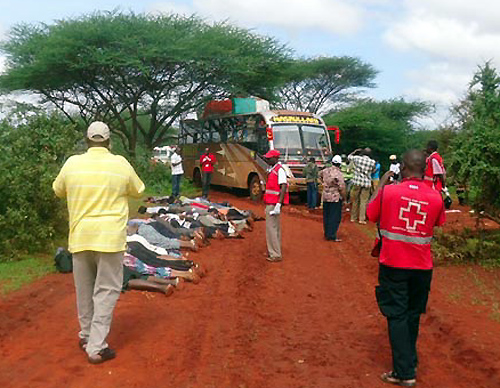
ManderaKenya’s an eye-for-an-eye policy against terrorists is doomed from the start and will only make matters worse.

This weekend poor Kenya suffered still another horrific terrorist attack in its far northeast near the Somalia border.

A commercial bus carrying about 60 people from the town of Mandera to Nairobi was hardly 30 miles from the Somalia border when terrorists apprehended it then murdered almost half those inside who were unable to demonstrate that they were Muslim.

Al-Shabaab claimed responsibility.

This makes 135 similar incidents (although most were far fewer fatalities) so far this year. Almost all of these have been in the very remote northeast corner of the country, although there have been a couple attacks in Nairobi’s Somali suburbs as well.

In my opinion security in the country is definitely improving, although it’s hard to demonstrate this after such an attack as this.

But particularly in Nairobi people are actually relaxing and feeling considerably safer.

“Al-Shabaab can no longer attack in cities like Nairobi because of enhanced security measures,” wrote a former high military official in Kenya’s main newspaper this weekend.

But that same expert went on to demand a change in current government policy and security strategy, arguing for a much tougher stand including very quick and immediate retribution.

And that seems to be exactly what happened Sunday.

In response to the 28 persons killed and single bus destroyed by al-Shabaab, Kenyan officials claimed a raid across the border into Somalia killed more than 100 terrorists, destroyed four vehicles and an armed camp.

Kenya invaded Somali in October, 2011, completing the liberation of most of the country’s main urban areas about a year ago. That has led to the first globally recognized Somali government since 1994, although the government remains very fragile. The capital city of Mogadishu, however, is definitely returning to a semblance of normalcy for the first time in a generation.

Thanks to American drones, many of the al-Shabaab leaders have been killed as well, although new ones appear immediately.

The Kenyan response of tit-for-tat isn’t going to work. It hasn’t worked since the Jewish rebels of Masada were massacred by the Romans in 1 B.C. It isn’t working for Israelis, today.

Tit-for-tat escalates violence; it absolutely has never subdued it. Advocates point to short moments in history, as many contemporary Israeli leaders have done, but five or ten years of tense peace is hardly a demonstration of efficacy.

Ethnic and religious conflict must be seen for what it really is: an easy reflection of more meaningful differences, like those of wealth and opportunity, education and health. Whether it is northern Ireland or the Basque country lazy thinkers want to explain the difficulties by ethnicity or religion.

That’s completely wrong, utterly superficial.

If it weren’t wrong, then it means these conflicts must continue until one side is obliterated altogether. And that’s what drives many of their fighters, this belief that it’s do-or-die and nothing in between.

The real remedy is far more complicated and lengthy to implement. Of course, meanwhile, anxious citizens on the periphery of the actual conflict want quicker resolution.

Unfortunately, there is no quicker resolution, and believing there is only makes matters worse.

New Yellow Fever Research

New Yellow Fever Research

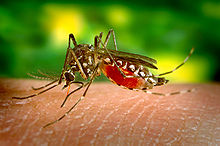
220px-Aedes_aegypti_bloodfeeding_CDC_GathanyNew research on yellow fever could lead to improved vaccines and quick cures.

Yellow fever is a mosquito born disease that is found throughout South America and sub-Saharan Africa. While the disease is actually more deadly than malaria, it has never been as widely a threat.

In part this is because the first stages are not as severe as malaria’s and it’s usually the secondary effects that lead to mortality. These secondary effects can be quite prolonged. As a result it’s possible that many deaths in sub-Saharan Africa are actually from a yellow fever infection while being diagnosed as something else.

Mostly, however, it’s because persons who recover from the disease acquire virtually complete immunity. This is completely unlike malaria. Persons can succomb to malaria multiple times and likely achieve no immunity against a future infection.

The new research is one of the first in-depth studies that carefully looks at how the disease works. It’s complicated and fascinating. Note that the research was done on macaques, although scientists are fairly confident that the dynamics would be the same in all primates.

The virus switches on and switches off a variety of genes while it resides in the liver.

Over time this leads to a variety of pathological events, including liver and other organ failure.

In the past in Africa mosquito-born diseases like malaria and yellow fever were thought to manifest mortality more quickly and more simply.

As most travelers know there is an effective yellow fever vaccine, although it loses significant effectiveness for very young children and older adults. Persons who obtain the inoculation in their young adult years are easily revaccinated every ten years for extremely good protection.

But the vaccine is expensive and has been difficult to disseminate throughout endemic areas. It is a fragile vaccine that requires refrigeration and is a live-virus based vaccine, which means that incorrect storage or administration can actually give the patient the disease rather than the protection.

By studying the genetic trail of the disease’s manifestations, scientists may be able to interrupt organ damage by neutralizing the proteins that switch certain genes on or off.

Travelers to East Africa are particularly sensitive to not just the pathology but the politics of the disease.

Because vaccination throughout sub-Saharan Africa combined with natural immunity has minimized the disease’s effects over the last half century, many areas of sub-Saharan Africa which have not experienced any yellow fever whatever are particularly susceptible should an outbreak occur.

Tanzania, especially, has reacted to yellow fever outbreaks in neighboring countries like Uganda and The Congo by suddenly – without very much if any notice – requiring incoming visitors to have the inoculation … even though Tanzania itself is yellow fever free.

This has put it from time to time at odds with national health authorities like the CDC that recommend against obtaining the vaccination except for visits to countries that actually have disease outbreaks.

Many other countries in Africa, such as South Africa, require evidence of the vaccination if the traveler has been in an effected country within the last six months.

Genetic science is advancing so quickly that doctors are discovering methods of interruption or curing of diseases that before were thought only capable of being prevented with a vaccine, and that may the route of current science towards the management of this curious and powerful disease.

Poached By The Rich

Poached By The Rich

rhinoboatThe escalating poaching of elephants and rhinos will not stop until the increasing gap between rich and poor is stopped.

There is mixed information right now about whether or not the poaching of elephants has slightly slowed, but even so it remains at relatively high levels.

But the poaching of rhino is escalating and is of most serious concern because there are far fewer rhino than elephant.

Indian rhino are a particularly endangered species, and rich Indian consumers are among the Asians who purchase rhino products as medicines.

Kaziranga National Park in India’s Assam is the center of the rhino war in India.

The irony is that until just the last few years the trouble in Assam was not with rhino poaching, but Muslim extremists. I regularly visited Kaziranga in the 1980s before it was often closed to tourists because of this political extremism.

While much of the world is suffering from religious extremism, and while it continues in Assam, rhino poaching is now a bigger issue, there.

Over the last few years efforts to curb both elephant and rhino poaching have been massive, and much of this has been successful. Why, then, does the problem continue?

“Rhino horn is worth more than gold,” explains Jeremy Hance writing for the ecological journal, Mongabay.

An average-sized rhino horn is now worth around $60,000.

The price of rhino horn has never gone down, but the fluctuations in the gold price have meant that there were times – about a decade ago when gold was at historic lows – that rhino horn was more expensive.

But in today’s world, with gold above $1600/ounce, it’s astounding that a natural-product medicine – which is what rhino horn is used for – would command a greater price.

Modern Asian’s use of animal product medicines is just like American’s use of natural products bought at health food stores. Of course there are fanatics, but most of us use them as supplements, not as principal treatments.

The analogy continues to the demographics in the market. Natural product health foods in American generally are used by an increasingly wealthy upper class.

The increasing spread between the rich and the poor gives the rich much more disposable income, and that will increasingly be spent on luxury goods and ancillary and tertiary products … like rhino horn and ivory.

A rich man’s fancies are a market man’s treasure, because the cost of a hobby or a fancy escalates far faster and higher than normal consumables in the market.

The dynamic is double-edged. As the rich get richer, they play more with their fancies and hobbies. At the same time the poor get poorer and more desperate and are willing to attempt risky business like poaching just to survive.

Of course the lack of today’s societies to distribute wealth fairly has much graver outcomes than the extinction of animals, but conservationists understanding of the route cause of their battle may at last force their politics to the fore.

Climate change, health care, a minimum wage and fair earnings – these are all issues that suffer when wealth is unfairly distributed to the powerful rich people of the world.

Add to that, now, the biodiversity of earth.