On Safari : South Africa

On Safari : South Africa

South Africa provides an excellent platform to explain why so many American tourists make bad decisions about their African touring.

Probably most tourists to Africa travel on referral from friends or family. It’s a very small percentage that buy strictly off the internet without vetting what they’ve found with people they know and trust. That’s all well and good but where it goes wrong is when these referrals are from friends or family who have very limited experience.

And the fact is that a single trip, or even two trips to some area, is very limited experience. So you’ve got to guard against personal referrals being …well, too personal.

South Africa is an excellent example of how past travelers get it wrong.

The first is that the best time to go is during America’s summer.

The second is the enormous perception particularly in America that Johannesburg and surroundings are unsafe to visit, and even if they were safe, uninteresting.

The third is that you should avoid the “touristy” places to stay, like the Waterfront in Cape Town or Sandton City north of Johannesburg.

These three entrenched notions are essentially 180 degrees wrong.

I’m currently guiding a small, private group through South African into Botswana and Victoria Falls. We started in Cape Town, they took Rovos Rail and we are now in Johannesburg. It’s South Africa’s summer, and I just checked that the temperature at my home is 2F with a winter storm on its way.

I think before any other information is known, the best time to visit virtually any place outside of the equatorial regions or great deserts is their summer.

The flowers and trees are in bloom, the golf courses are beautiful; surfing, swimming, diving, sailing and everything to do with waters and oceans is at its peak (including some of the finest seafood in the world), outdoor concerts and flea markets are in their hay day, and … it’s comfortable!

South Africa’s winter doesn’t begin to compare to Chicago’s, but it is quite similar to much of the upper south in the United States, like northern Georgia and Tennessee. All the trees lose their leaves. Daylight is diminished. Grass is brown and it’s usually dismal and chilly or cold. Now does that sound like a fun place to be?

And while it’s true that moving north into our safari tomorrow in Botswana increases the temperatures, today’s better camps are so brilliantly constructed – some with air conditioning – that it really isn’t so uncomfortable, now. And this is the time for the best animal viewing!

Two: Time and again you hear so-called “experienced travelers” warning new comers away from places they feel are dangerous, like Lima or St. Petersburg, or … Johannesburg. This is balderdash.

To begin with every city is huge and there are safe parts and unsafe parts, so to lump everything together reveals immediately the silliness of the statement. We are staying in the posh suburb of Sandton. We leave our luggage two floors below reception on the curb to be attended by the porters, we leave our purses in the tour vehicles, we dangle bracelets and necklaces when we go out for a nice dinner.

It’s perfectly safe. And also time-and-again these same naysayers will claim that the “unsafe” city has nothing to offer, anyway.

Like the Apartheid Museum? One of the greatest museums on earth. Or the Cradle of Humankind, which is an exceptional – probably the best – museum complex on earth describing what we know about early man? Or the Sandton museum of the country’s 4 Nobel Laureates? Or absolutely some of the best restaurants and certainly the best shopping complexes anywhere in Africa?

Or jazz and cabaret cafes, theaters, symphonies, multiple festivals at any given time, sports events out the wazoo … in a nutshell, an urban setting difficult to match anywhere on earth.

Three. Avoid the “touristy places.”
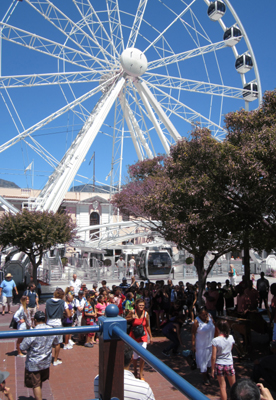
Why, exactly? Aren’t you a tourist? Do you not go to Times Square or the Statue of Liberty or Ground Zero or Disneyland or Hollywood boulevard, or the Miracle Mile, or on and on? That’s what these things are for! This isn’t skid row for the leisure class!

Cape Town’s best hotels are at the Waterfront, a complex not so dissimilar to my Chicago’s Navy Pier. The old hotels in the city and outlying areas like the Mt. Nelson are musty and away from all the good action. The best restaurants, the best shops, the best information centers, the best galleries and some of the best museums – they are in the “tourist areas.”

And this is true I suppose anywhere in the world. No matter how you try, if you aren’t committed to actually living somewhere for a good period of time, the best experience you can have of that place is to for at least part of the time join the crowds.

Tomorrow we head into the bush. It’s remarkable to think our last week has been in anything but. It’s hard for me, an East African freak, to really believe our incredible week is only a few hours airplane ride away from the wilds.

So tune in, again, and I’ll let you know if it was just all a fantasy!
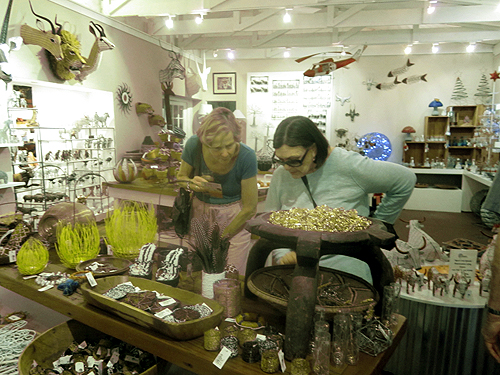
Everything you see in the picture above -- except of course my wonderful friends and clients Sally Downey and Ada Addington -- is made from beads and discarded wire. This is "Streetwires," a fabulous Cape Town artists' coop.

It’s Politics Stupid

It’s Politics Stupid

by Conor Godfrey
Africa needs more intra-regional transport links..

Africa needs more improved water sources.

If only Africa had enough eight-cent vaccines, free elections, power plants, kids toys or TOMS shoes then it would all fall together. Sigh.

How often have you heard these quasi-truisms?

(Quick note: Can’t mention the 6% continental growth rate enough, and TOMS Shoes is one of the worst charity ideas since Scrooge recommended putting poor people in debtor’s prisons in A Christmas Carol.)

I have undoubtedly used such intellectually lazy reasoning myself in moments of confusion or frustration.

Believing that A+B would equal C if only those poor, unfortunate wretches could get their act together defers the substantial effort that would be required to understand more difficult questions, and strokes our sub-conscious bias telling us that we would do better in someone else’s shoes.

The dirty little secret of self-help books, aid industries, and all manner of 12-step plans to success is that everyone already knows 95% of the right answers.

Distributional politics—not misinformation—scuttles good ideas in favor of bad ones. Permit me a few examples.

Why are there so few roads linking secondary cities to each other in Africa, or roads between markets across borders?

Mainly because second tier cities are usually opposition strongholds, and linking them by road or rail would increase the likelihood of an alliance against the group in power.

Why do wealthy African countries consistently fail to meet the demand for electricity?

I doubt anyone believes that leaders don’t understand the relationship between power and economic growth. Of course they do. The problem revolves around who gets what! Who gets the contract, who pays which price for electricity, and which neighborhood/city will have access?

There are dozens of similar examples in the United States.

The most famous example is U.S. government research and academic funding: investing more in a few large projects would yield more break-throughs, but instead, the government spreads ineffectually small amounts to hundreds of organizations to appease political and/or state-based interests.

These political or distributional problems are even more salient in weaker states where sub-sate actors are more powerful.

The best articulation of why politics torpedoes policies that all actors agree would increase aggregate welfare concerns the difference between relative and absolute gains.

(I here begin stealing liberally from the Realist school of thought in international politics, led in its modern incarnation by Kenneth Waltz and Hans Morgenthau.)

Actors care less about large increases in absolute welfare than about gaining small advantages over strategic rivals or adversaries.

After all, if a given policy makes an entire country richer, but makes a competing ethno-regional grouping slightly wealthier than your in-group, then that competing group might use their newfound power to snuff you out. This security-dilemma often forces all actors to pursue sub-optimal policies.

These dynamics, however, do not lend themselves to easy solutions, and therefore we mostly prefer to pretend that African leaders don’t understand how important roads are, or that LSE trained African Foreign Ministers just don’t get how high tariffs distort trade.

If you ever get tired of hearing about the next big thing in development, read through some of the case studies at the Institute For Successful Societies. These are the stories of battle hardened reformers trying to implement the small or large changes that everyone knows their country or community needs.

Nicholas Kristof’s white “transition” characters not included.

President’s Day

President’s Day

The Presidents’ Day Holiday in America, today, is perhaps the least celebrated of the year, and it shows how America like much of Africa is moving away from a powerful executive.

The exceptions validate the rule, so the dozen or so African dictators still in power in places like Uganda, Zimbabwe, Cameroon and Chad, among the most egregious, delineate the old days. As modern African societies emerge and new constitutions are formulated, the chief at the top gets less and less power.

The outstanding example is the “New Kenya.” While the man who will be elected the first president under its new constitution in just a few weeks will be the most powerful man in that country, his powers will be significantly limited compared to the powers of current and former Kenyan presidents.

The “New Kenya” is the wave that is sweeping most of Africa. Modern African societies realize that single personalities – the Grandpa authority – are no longer appropriate as social chief executives.

Ultimately, I believe even America will have to come round to this view. Our president is one of the most powerful social chief executives in the world; probably the most powerful among democratic countries. I think this may have worked well in year’s past when essential U.S. policy was pretty unidirectional.

But today, with radically opposed polarities, the prospect of a strong liberal president being succeeded by a strong conservative, etc., does little to move society in any direction but crazy figure eights.

The new societies – the emerging African societies – are designing and experimenting with better forms of democratic, capitalist government. America will have to follow.

Many government offices are closed, today. Banks are closed. The post office is closed. Some schools are closed and most businesses, like EWT’s, are “technically closed” with the phones not answered. But many workers — perhaps most in America — are at their desks like most any other work day.

Perhaps an affirmation that a strong chief executive shouldn’t be quite so empowered, anymore.

What a Valentine’s Bouquet!

What a Valentine’s Bouquet!

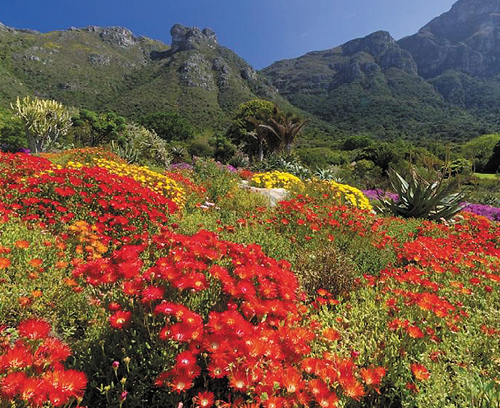
The floral biodiversity of The Cape is greater than the Amazon; in fact it is the most diverse floral system in the world, even though it’s the smallest.

Today and tomorrow we experience this amazing Valentine’s Day bouquet, first by visiting the famous Kirstenbosch botanical gardens as it celebrates its 100th birthday, and tomorrow, by visiting the tip of Africa, The Cape of Good Hope.

In the special care of one of Kirstenbosch’s most famous guides, Andrew Jacobs, we piled into an elongated golf cart and began a comprehensive tour of one of the seven richest and most beautiful gardens in the world.

The day was gorgeous, Table Mountain loomed above us, the Cape Francolin barely moved out of our way and despite the fact this is not a heavy blooming season, we saw an amazing display of our planet’s evolutionary ingenuity.

The Cape is one of the world’s six floral kingdoms. (The other are the Northern Hemisphere, South America, Antarctica, Australia and Africa other than The Cape.)

There are about 8800 unique plant species in an area about the size of the State of Maine, and 69% of the endemic! Both facts are amazing. The density of species diversity is 3 times greater than the next highest kingdom, the Amazon portion of South America.

The reason for this remarkable and concentrated biodiversity has to do with where The Cape is: at the confluence of the world’s coldest and warmest oceans, where jetstreams and ocean currents collide ferociously.

The result is a climate that is mostly dry, but when it rain it rains hard. The result is a plant kingdom that thrives because of considerable moisture but had to learn how to conserve water over very long periods of dryness.

It is mostly a leafless kingdom, with photosynthesis occurring in the stems. What looks like leaves are stemmy reeds, waxy or hairy and almost always pointed and sticky. Butterflies are still needed for pollination, but because there are no leaves for the caterpillars to eat, these butterflies’ caterpillars are carnivorous, eating ants!

Protea and red bush tea are the two stars of the kingdom, both fynbos which is the single largest plant grouping in the kingdom.

One of the best places to see the greatest variety of this kingdom is atop Table Mountain.

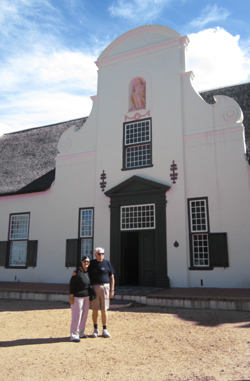
Whitney & Ada Addington in front of the manor house at Groot Constantia.

After our great tour we went to nearby Groot Constantia, South Africa’s first vineyard, and tasted the Sauvignon that has been cultivated here since 1679! The restored houses and stable and excellent orientation center depict the life of Simon van der Stel, one of the first governors of the Cape and generally considered the father of the Boer culture.

It rained this morning! It’s not supposed to rain, now. (How often have you heard your tour guide say this?) But the climate is changing, and fortunately for us, the afternoon was bright and beautiful!

On Safari : The Spectacular Cape

On Safari : The Spectacular Cape

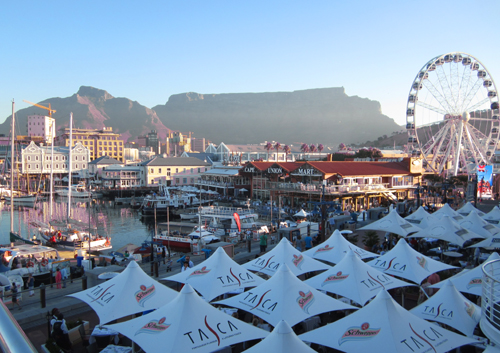
Sunset at the Waterfront. Table Mountain in the background.
Table Mountain is cheeky. It’s one of the main reasons tourists come to Cape Town, but it only lets itself be seen about half the time.

The mountain was truly spectacular for me this morning. I’ve been to Cape Town about a dozen times, but I had yet to take the funicular up the mountain. Mostly this was because I’d always tightly scheduled my time, here, and I knew scheduling in the mountain was iffy.

The main website for the cableway starts on the right top first page with the announcement about whether the mountain is “open” or “closed.” And even that is somewhat misleading, because the tram runs even when the mountain is wrapped in cloud, which is about half the time.

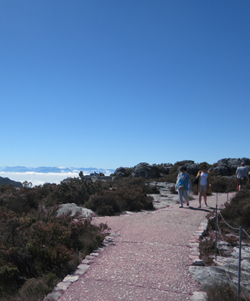
Easy trails once on top.

The mountain closes when the winds get too steep. In fact there’s a very, very loud “hooter” at the top that screams out when the winds are coming in, giving everyone a very short time to get back to the tram or face either staying up top for a long time or taking the 4-hour walk down.

But these last couple days have been so spectacularly clear and wonderful warm in Cape Town, and every morning I’d sit eating my breakfast staring at a perfectly clear mountain top, that I knew it was time.

I got a parking place only about a half kilometer from the tram entrance. That’s not bad, because whenever the mountain is out and especially in the morning every tour guide and tour bus in Cape Town heads for the mountain. It doesn’t matter you were headed to see the penguins or buy trinkets at Market Square or learn about history on a stroll through the Company’s Garden – all that in due course, ma’am. If the mountain’s out, go for it!

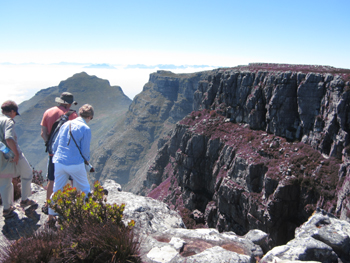
Getting ready to lie down on "Belly Rock." Slightly angled up so you can look over the edge 3000' down!

So it’s crowded, and I was in the beginning of the crowds which shortly after I arrive around 945a had stretched to a waiting line of about 45 minutes. Two cable cars each carrying 65 people go up and down constantly, a journey of just a couple minutes.

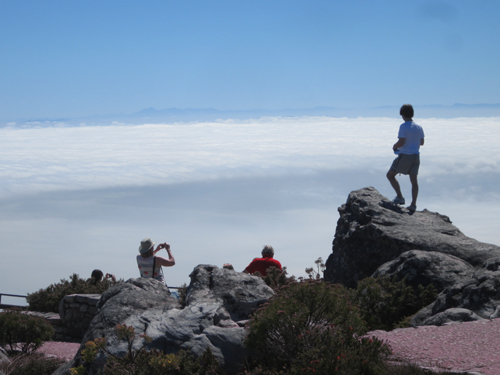
Once a top it’s amazing. And not just the views, but the unusual ecosystem found here includes some remarkable fynbos, reeds, orchids and of course, proteas. The best time for the flowering bouquets is August and September. But I was here in the worst time, February, and it was still beautiful.

The mountain’s geology is equally fascinating dating back 600-800 million years. It’s a unique type of unusually dense sandstone. There are wonderful park trails with good signage and you can spend the day up there or an hour. In an hour you can get the entire panoramic view of both the east into False Bay and towards the Indian Ocean, and west into Table Bay and the Atlantic. On truly clear days you can see Cape Point.

Managing the crowds is becoming difficult. My guide actually caught one Korean chipping off a piece of rock, which of course isn’t allowed. The guide explained that Koreans who worship the “Five Great Massifs” of which Table Mountain is one come with concealed rock hammers to chip away a piece and take it home.

And there little old British ladies, I was also told, who nip away the protea buds! Or steal the orchid seeds!

And there are macho Australians who illegally jump off with unlicensed paragliders!

I felt like Polijimmy.

Our trip’s first stay is on the Waterfront. I really don’t think there’s a better place to stay these days in Cape Town, unless you’d like a good BnB or have more time for a condo or villa along the coast. But for a traditional hotel stay, it’s really the Waterfront. The aged Mt. Nelson is too far away from the action.

Everything is at the Waterfront and don’t be discouraged by its touristy aspect, after all that’s why you’re here, right?! All the adventure touring from whale watching to shark diving to sunset cruising starts from here, the famous aquarium is here, although many of the good sightseeing attractions are a few minutes away in the city.

But 80% of Cape Town’s finest restaurants are here, entertainment is here, and of course all the good shops are here. The management encourages minstrels, new bands and juggling troops, pantomimers and all sorts of performance artists to just set up shop willy nilly.
So along with the amazing aroma of freshly fried calamari you’ll hear creative music at every turn.

My choice of hotel is the Victoria & Alfred, simply because of its location smack dab at the beginning of everything at the Waterfront. Table Bay is too staid for my taste and basically reminds me of an old folks home.

But if my pocket’s full and budget doesn’t matter, I go to the Cape Grace, absolutely one of the most stellar hotels in the world, and only five minutes further away from the action than the V&A. And if my pocket’s tight and hotel ambience is really secondary to anything else, then it’s the Portswood, a truly fine value only minutes away by a well marked walkway.

What a wonderful way to begin an African trip!

The Great Debate in Africa

The Great Debate in Africa

From left to right, Prof. Ole Kiyiapi, Martha Karua, Uhuru Kenyatta, Raila Odinga, Musailia Mudavadi and Peter Kenneth. Not shown are two candidates who won a court appeal from having been disqualified: Mohamed Dida and Paul Muite.
It took them longer to get the babies and kissing spouses onto the stage, but the first ever, quite spectacular Kenyan presidential debate ended very much like most of America’s primary debates:

The crazies looked crazier, the ones who quoted scripture couldn’t quote GDP numbers, every pot called every kettle black, the smart drowned in their own moderation, none seemed to know all the words to the national anthem, the self-appointed media hosts deservedly lost control, and the winners are still winning and the losers are still lost.

Unlike America, though, polling this close to the March 4 election is now banned in Kenya, so it took outsider polls of little repute and no published evidence to proclaim the winners and the losers.

So I will.

The debate lasted 3 hours (see below for my cheat sheet onto YouTube) and I watched it from start to finish after just arriving Cape Town following two days of constant traveling while eating delectable fresh calamari and hake and Cape greens quickly and cheaply bought at the Waterfront’s Pick ‘n Pay, liberally lubricated with a local vineyard cab.

I know. How could anyone sane not watch sunset over Table Mountain because Uhuru Kenyatta was explaining how he would be president while being tried at The Hague for crimes against humanity?

Me. And literally thousands of South Africans, by the way, as local TV (SA2) carried much of the debate and this morning’s talk shows were filled with discussion about it.

The outcome of the Kenyan election is going to effect the entire continent. I really believe that the winners of last night’s debate, Prof. James Kiyiapi and youngster Peter Kenneth, have no chance of winning the election.

Forty million Kenyans watched the eight candidates debate live. It’s unlikely 10% of the voters were moved away from their predetermined vote, which is based on their tribe. But that’s the marvel of Kenya, being able to undo its misery precisely because it’s so pervasive: neither of the two major tribes are large enough to produce a majority.

So the 10% could matter. Although not as you might think.

If none of the 8 candidates gets a majority, which is becoming increasingly likely, then there must be a runoff election. And the losers in the first round will likely make alliances with the winners of the first round. “Endorsements” by those dropping out of the race actually then have a much greater impact than in the American election.

Raila Odinga, a Luo and the current prime minister, remains the favorite of the eight candidates. He is followed closely by Uhuru Kenyatta, a Kikuyu who is under indictment for allegedly having incited the violence that followed the last election in 2007.

The candidates I saw as winners, and I’m sure who were also deemed that by Kenya’s rapidly growing very youthful educated middle class, come from relatively small ethnic groups.

Kiyiapi is a Maasai. Kenneth is a mullato. Kiyiapi is one of the smartest Kenyans I’ve ever listened to, a college professor. Kenneth is quick and witty, and one of Kenya’s most successful and prominent businessmen.

The two were the most articulate. Both knew the facts (few of the remaining did) and both are left-of-center populists who would further tax the rich and redistribute wealth in ways to alleviate poverty.

There was actually not a lot of disagreement among any of the candidates regarding policies, whether that be taxation or redistribution, education or security.

And that’s because the aggrieved poor in a developing country can simply not be ignored. They can’t be ignored out of simple humanity, but also because their numbers are large enough to start a revolution if progress on their behalf does not occur fast enough.

But everyone knows that regardless of what’s said, there are the lefties like Odinga, Kipiyia and Kenneth; and there are the righties like Kenyatta.

And so if I’m right, and if Kenneth and Kipiyia were the winners last night, then in a second round the people watching like me who felt the same are likely to support Odinga over Uhuru.

All I hope is that Kenyatta does not win. He is responsible for the last election violence; he’s a slick and evil man. He will set Kenya back into the times of his father, the first president of the country, when there were only two tenants of governance: nepotism and corruption.

The next and final debate is February 25.

Click here for yesterday’s full debate.

10m35s : The candidates get two minutes each to introduce themselves.

16m00s : The candidates discuss tribalism which quickly devolved into the issue of Kenyatta’s candidacy and position in the current government as deputy prime minister, even while being tried in The Hague for having incited such violence in the last election.

It’s important to note that Kenya could have tried Kenyatta and the five others itself in Kenya with its own justice system, but that Parliament voted not to, defaulting to a treaty provision that then allowed the World Court to hold the trial.

19m48s: Kenyatta’s defense of his candidacy

34m35s: the media host challenges Kenyatta to explain tribal remarks he has made in the current campaign.

At 53m35s Kenyatta contends, “The people have the confidence that I can discharge my duties while clearing my name.”

At 57m30s Odinga quips that it would be hard for Kenyatta to “run a country by Skype from The Hague” which presumes he will be convicted and jailed there.

At the 1hr30m00s mark the moderator gives the floor to Kenyans in the hall for their own questions about security, education and health care.

Familiar?

Yes, but the good stuff was then over. There was little disagreement on the policies the government should take on any of the public questions.

First Time…

First Time…

By Conor Godfrey.
Two days ago the first Malian in history blew himself up in an attempt to kill others.

Americans have become so inured to suicide bombings that this fact may seem tragic but inconsequential.

Most Malians, however, have yet to recover.

This simply does, or did, not happen in the land of Sundiata Keita.

Nowhere in Songhai chants, or Fulani poems, or even marshal Bambara stories do people talk about strapping bombs to their waist and taking innocent lives.

In centuries of warfare between Arab and Bantu, nomad and farmer, Muslim and pagan, such a thing as never happened.

Let us try for one moment to return to our pre-9/11 innocence and feel some shock, and some sympathy for a corner of the world previously uncontaminated by this particular evil.

I remember when the first Boko Haram suicide bomber blew himself up in Nigeria.

My Nigerian friends and colleagues were stunned. It seemed as though they took the attack as an indictment of the culture they thought they knew and understood.

Even mass killings of Muslims and Christians on the Nigerian central plateau did not generate one-tenth the moral outrage of that single suicide bombing.

Inter-communal conflict was something they understood intuitively. This business with bombs was not.

Americans have become unconscious experts at shielding ourselves from the emotive power of a suicide bombing. We have had too.

Erecting effective psychological defenses against suicide bombing requires neutering all the emotional content of a suicide attack.

In silent partnership, the news consumer and the news provider reduce an attack to its purported essentials – the death toll, the mechanics of delivering the bomb, and which group of crazies was claiming responsibility.

In Mali’s virgin case—two deaths, by bicycle, and the Movement for Oneness and Jihad in West Africa (MUJAO).

Why do we wallow in the raw emotionality of a natural disaster, or school shooting, or even an individual suicide, but culturally divorce ourselves from the most heinous and powerful act of violence and protest available to today’s discontents?

I think it remains much easier to homogenize people we don’t understand in far away places by reducing their actions to banalities like numbers of wounded and how the attack took place.

Stop and think about what we’re saying; someone was just willing to die in order to kill!

If we let ourselves feel the tragedy of a homegrown suicide bombing in Mali, we would probably have to ask why the attacker felt strongly enough to blow himself to pieces.

Through this we would learn, to our concernment, that he was not ‘crazy’ in the sense of being insane, and all this introspection might lead us to think more clearly about the blowback from our global war on terror.

These thoughts will of course feel vaguely (and wrongly) treasonous.

It is far easier just to think of Mali or Africa as somewhere used to getting a raw deal.

Maybe somewhere where life comes a little cheaper, and craziness prevails. This is nonsense, but hard to shake if you were raised on the same images and news coverage I was.

Fight the urge to disassociate and dismiss.

The new normal is NOT normal in Mali, and an entire society will need to rebuild its sense of self (or senses of selves) in a world where the tears in the cultural fabric are large enough to permit boys with bombs bent on self-annihilation.

On Safari!

On Safari!

I’m off to Africa! The next 6 weeks I’ll be posting from Cape Town, Johannesburg, the Okavango Delta and the Serengeti, among many other wonderful places in the east and southern parts of the continent.

The next four Mondays will be honored by blogs from the African expert and Wilson scholar, Connor Godfrey. But the remaining three days of postings each week will be from me on safari.

It’s remarkable how fast communications have changed, and how the opportunity for me actually posting material to you from the most remote parts of the Serengeti is now possible. (Fingers crossed!) But the advent of wireless communication literally hopscotched the slothful progress of land line communication throughout the continent.

Today there are more cell phones per capita in Kenya than in the United States. And in Kenya and much of Africa cell phones are used for much more than just talking: data transfer, wire payments and even malaria tracking!

So my ability to keep posting to my blog has been revolutionized in just a few years.

I’ll be guiding several safaris, researching a few new venues and consulting. I’ll be posting first from Cape Town next week, absolutely one of my favorite cities in the world.

It’s been a wonderful stint home during a winter of great amounts of snow and intense cold, and my African friends find it odd that I enjoy that kind of climate. Perhaps it’s the extreme, because in just a few weeks in Botswana the heat and humidity are likely to be pretty intense.

And there’s no question that the extremes distinguishing winter in Chicago are no greater than the extremes of thunderstorming and temperatures in the Okavango. And while I think such experiences are fun and valuable for the moment, they are mounting misery upon those who live there year-round.

How global warming is effecting the veld is something I’ll certainly be reporting on.

Stay tuned! The next blog will be from Cape Town!

Numbers! Atta Boy!

Numbers! Atta Boy!

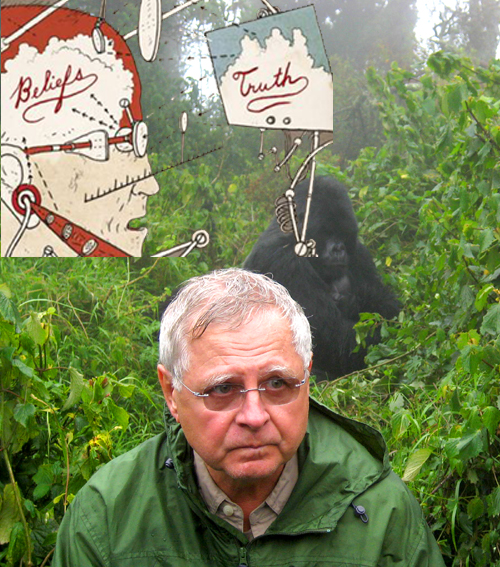
Mother Jones cartoon: "The Science of Why We Don't Believe"
Facts, truth, numbers matter and so sad that public television and radio doesn’t seem to care. Yesterday’s Richard Attenborough’s production on Nature and today’s NPR report on the war in Somalia should both flunk journalism class.

For my news on Somalia I go to sources in Somali and Kenya, and to the diaspora of Somalians mostly in the U.K. For my news on the natural world in Africa I mine the multiple NGOs and excellent science writers world-wide.

For a more global perspective, BBC, Agence France and Reuters are excellent.

But every once in a while I need an American fix. I need the unique perspective that governs my native culture’s perspective on the world, and then I turn to journals like the New York Review of Books, the Atlantic and Science.

And until recently, national public television and radio.

But more and more I find NPR and PBS either pandering to the masses or moving celebrity above facts. It’s particularly true with regards to reporting in Africa, where NPR’s stories have become so superficial that they’ve lost almost all value. And that’s not as bad as when their news is simply dead wrong.

Yesterday evening’s national screening of Sir Richard Attenborough’s memory lane, and this morning’s report by Steve Inskeep from Somalia, are perfect examples.

Both had redeeming components. Attenborough’s compendium of so many years of natural history filming provides us with an incredible chronicle of how global views about conservation have changed. His own mea culpas of his younger days collecting and consuming rare animals was a wonderfully honest admission of that change.

And Inskeep’s wonderfully personal interaction with African troops, allowing them to broadcast their accuity and sensitivities, is strides beyond the staid reporting of foreign bureaus with their latent racism.

But we can’t allow news to carry lies and misinformation, no matter how much other redemption the story may have. In the end, when NPR explains to you that Somalia success is dependent upon western military training, or when Sir Attenborough concludes that mountain gorillas are still threatened, those critically important statements must be substantiated by … the truth, the whole truth, and nothing but the truth.

And they aren’t.

Attenborough’s sloppy use of facts throughout his film was terrible. The worst was when he announced there are now 480 Virunga mountain gorillas left.

There are now 800 Virunga mountain gorillas left. And Attenborough’s factual portrayal of Borneo’s rainforest numbers and the Arctic’s water temperatures and ice cover was also incorrect.

Inskeep’s portrayal of the successful Somalia war as a combined African military force couldn’t be further from the truth. The Somalia war had African peace keeping troops since 2007. And before that the Ethiopians had invaded the country several times.

The African peace keepers for the first four years of their mission were mostly Ugandans, Burundians and a smattering of Nigerians, and they were an abysmal failure.

Did you register that? Abysmal failure.

It was not until the Kenyans decided to unilaterally invade Somalia in October, 2011, that anything began to change. And everything that has changed since has been entirely and only because of the unilateral Kenyan military involvement, and which Kenya announced was publicly not allied to the African peace-keeping force.

And the Kenyans were trained and funded and quite probably directed by the Americans and French.

These are important … facts. The sinister problem is that they might, in fact, not change the overall stories much of either Attenborough’s portrayal of how global views of conservation have changed and positively so, or Inskeep’s contention that routing terrorists in Africa must be by Africans.

But the “overall story” is never the whole story, and the more we try to condense a richly complicated situation into a headline, the less we are actually learning and the more we’re being primed to learn even less the next time around.

“Public” broadcasting is simply becoming too American in America. Acuity and depth is being trumped by what’s considered good entertainment. It’s a shame.

But it’s wrong.

Vested Interest

Vested Interest

With one month to go, President Obama admonished Kenyans to hold a peaceful election. Obama wasn’t just preaching the word. Critical U.S. policy is predicated on a successful Kenyan election outcome.

There was nothing surprising in Obama’s one-month-to-go pep talk. But as I listened to it, I realized it was powered by the deep behind-the-scenes U.S. African foreign policy that has driven so much of African history in the last few years.

The routing of al-Qaeda, the pacification of Somalia, the fugitive chase of the LRA, the massaging of Rwanda hegemony, the less successful use-and-throw-away Uganda geopolitics, the deep skies of drone assassinations – it’s all a remarkable mosaic of clever and intricate U.S. policy.

And Kenya is the linchpin.

Unfortunately, the policy is driven overwhelmingly by Obama’s hunt of terrorists. That’s a fine thing to do, don’t misunderstand me, but developmental imperatives seem to get attention only when the greater objective of wiping out the terrorist prevails.

So that the “war on poverty” is far subservient to the “war on terror.” This is short-term strategy.

Kenya is fundamental to this policy. America rebuilt Kenya’s military and notably the product looks mighty good. Compared, for example, to Mali or Nigeria or Afghanistan, the Kenyan military forged enough independence and local celebrity identity that it functions better than anyone could have imagined only five years ago.

And there seems to be no dichotomy between the military and civilian authorities, as in Pakistan, for example, or Egypt. America has created a fighting arm in Kenya that is totally beholding to its brain.

That’s good, yes. And from Obama’s point of view, more importantly, it’s been effective.

Now comes the election, the ultimate validation of a non-revolutionary society, of a stable politic based on “strong institutions” and “just government.”

No country in the world today can achieve what America did in 2000: institutions so strong they prevailed even while being irrational. That’s what happened when the Supreme Court effectively – with no precedent or authority whatever – wound down the mechanisms of challenge and handed victory almost willy nilly to the man who had lost.

And the defeated graciously walked away to become a billionaire.

That standard is unattainable by any but America. But Kenya can come near enough to validate the policy that sustains that potential. If it doesn’t, Obama policy in Africa will in a blink no longer be validated. If Kenya unhinges itself by Bronx Cheering the very institution on which Obama policy is founded, then everything the U.S. has done in Africa is lost.

Somali could tear apart, again. Militias in the jungles of The Congo would rearm and reform. The Arab Spring could become Arab Hell. Terrorism would be reborn.

It sounds like an exaggeration.

Should the Past Burn Away?

Should the Past Burn Away?

The Mali war has reignited an old debate: should precious artifacts always be returned to the motherland, or should they be kept in safety by the greater, more stable powers of the world?

Yesterday France returned to Nigeria in an elaborate ceremonial handover several confiscations of ancient Nok Arts, prized terra cotta sculptures of Nigerian empires of the 6th century. Over the last several years Yale University has begun a near complete repatriation of the Hiram Bigham artifacts the explorer took from Machu-Picchu in the early 20th century.

And while Paris remains replete with Egyptian artifacts like the obelisk acquired especially during Napoleon’s reign, France is slowly repatriating these, too.

And then comes Mali.

Without ancient artifacts from foreign lands such august institutions as the British Museum would be near meaningless. Chicago’s Field Museum would be emasculated. Taipei’s National Palace Museum would be crushed. And the Louvre – my goodness, Le Louvre, would be nothing more than a home for the Mona Lisa.

But is it right that such national treasures be housed away from the Motherland?

The treasures of Timbuktu rank right up there with the pyramids and Inca kings. In fact, many believe they are the most precious artifacts the world has.

This is because among its mosques and building relics are housed many of the world’s oldest written manuscripts. The oldest registered manuscript – at least before the current war – was dated from 1204. It included texts not just on world religion but astronomy, women’s rights, alchemy and medicine, mathematics and linguistics.

Timbuktu was a natural place for such ancient manuscripts. For several millennia before the modern age it was the crossroads of two major trade routes: the Saharan camel route with the Niger River.

But it was not until the 16th century when the area was arguably at its prime that a famous and wealthy scholar, Mohammed abu Bakr al-Wangari, established a “library” of ancient scrolls and documents. He spent the last 30 years of his life collecting these treasures, and when he died in 1594 they were inherited by his seven sons.

Collection and restoration continued for the centuries thereafter, but without a strong centralized government it was haphazard and often random. Timbuktu’s most prominent families became identified with their libraries of ancient texts.

By the turn of the 20th Century it was estimated that more than a quarter million books, notes, drawings and other relics of the past were being lovingly preserved by literally thousands of Timbuktu’s 100,000 residents.

UNESCO became deeply involved years ago, and in 2005 a huge portion of its cultural restoration budget was dedicated to Timbuktu alone.

But because the manuscripts – the most precious treasures of all – were still legally in the hands of individual families, UNESCO cleverly over the years poured its funds into the remains of ancient mosques and mausoleums. Slowly over time these attracted manuscripts.

Still the vast majority of texts were aggressively retained and often hidden by individual families. In 2005 South Africa convinced many of them to stop burying ancient parchment in the sand whenever trouble arose, and began a library.

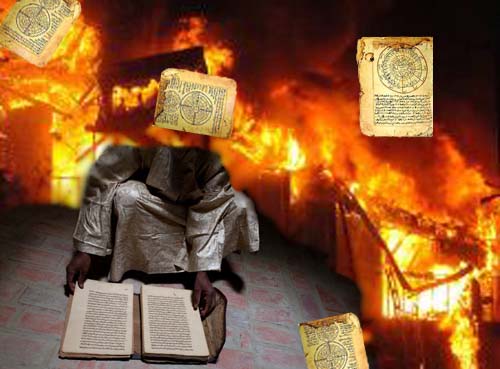
That extraordinary effort went up in flames as the Islamists left Timbuktu last week.

One of the most visible of the many libraries was Timbuktu’s Ahmed Baba Institute for Higher Studies and Islamic Research. When the Islamists first took over Timbuktu, the adroit director managed to convince one of the leaders of the importance of the texts to Islamic law.

Then, over the next months, he smuggled 28,000 of the most precious manuscripts out of the building. When the Islamists left, they burned what was left.

How much has been lost? Inventory is still going on, but the point is that most of these remarkable documents are still in private hands, libraries and collections of various Timbuktu families.

Is it time that such precious relics of humankind be removed to safer places? Or at the very least removed to Bamako and protected there?

Give Peace A Chance

Give Peace A Chance

Conflict in Africa is declining, not only relative to the rest of the world, but historically within the continent itself, and a brilliant University of Wisconsin professor has discovered why.

The truth is counterintuitive to many Americans whose understanding of Africa comes mostly from the nightly news and America’s very distorted and political travel advisories. But Scott Straus has documented the fact, and what’s more critical, explained it.

The University of Wisconsin at Madison is fast developing as one of America’s invaluable resources for everything African. Strauss is young, an associate professor brilliant enough to obtain an endowed chair, concentrating in political science and global issues.

But Madison is rife with many others Africa directed, including one of my favorite, John Hawks, whose exciting blog is one of the most important first sources of breakthrough anthropology and paleontology in Africa.

So it is not surprising that research news about Africa comes from UW-Madison. It is surprising, though, that a young associate professor will dare take on contemporary media alliances as normally disparate as Ted Koppel and Richard Engel.

Koppel suggested on Meet the Press last Sunday that Africa is going nuclear, not necessarily figuratively, and far outpacing the danger of conflicts of the past. Engel suggested on Tuesday’s Nightly News that Africa exceeds Syria or North Korea in terms of potential conflict.

And these represent the liberal media! As far as Fox News is concerned, the only indication at all that evolution might be true is that Africa hasn’t yet.

Media news in short sound bites is how most of America forms its understanding. As Straus explained in an article Monday it takes more than sound bites to reveal the truth.

Straus’ quest to disseminate the truth has been a two-year one. Using the most incontestable data since 1960, he has demonstrated in publications and conferences that conflict in Africa is on the decline. It’s a particularly difficult task right now, and he refers to the northern African conflicts as an “uptick” but when laid into any graph of any length – even just 3 or 4 years – his premise stands.

And as I’ve written recently, many of us do not see this current conflict in northern Africa as lasting very long. (So I hasten to add that doesn’t mean terrorism will be wiped out, or that Egypt won’t boil and bubble for years to come.) But it does mean that from a truly global perspective, it’s wholly rational that the world’s biggest businesses are investing hands over fists in Africa, because even they know: Africa is the place to be in the future.

But even more interesting is Straus’ more delicate conclusions as to why.

Why is there more conflict in Asia, for example, than Africa? Why are wars – when they do happen – more gruesome and often barbaric in the Balkans than Central Africa? Why is North Korea or Iran so much greater a threat than an extremist Islamic Arab Africa?

Three reasons:

1. The End of the Cold War
As I’ve often written Africa was the great pawn in the Cold War. It led to its current stubborn levels of corruption, since the patrons in the East and West lavished immature African societies with tons of money and weapons without requiring accountability. When the Cold War ended, this unfiltered pipeline did as well.

2. Democracy
This is Straus’ weakest point, but if I understand it correctly, he believes that before the advent of multi-party politics, dictators’ control of African countries’ growth, revenue streams and disbursements, were highly targeted ethnically or even just into the coffers of those dictators. The release of the economies of African societies requiring real public stewardship – coincidentally or otherwise with the advent of multi-party democracy – leads to a strong motivation to keep the social peace.

3. China
Like me Straus doesn’t hold China up as a model for how a big power should mentor small ones, but like me he realizes that China’s unique form of foreign policy is good for African peace. “China doesn’t take sides,” Straus says flatly. China takes oil. And it will do anything it can to get it. There’s no deceit, here. Everyone knows the rules of the game, and to be a winner, you have to have peace.

4. Regional Conflict Resolution
I disagree with Straus on this, but fortunately I think the previous three reasons are sufficient enough. Straus argues that regional powers and organizations have been working successfully to reduce conflict: South Africa in Zimbabwe, Kenya in The Sudan and Somalia, Egypt with the Palestinians, the African Union in many places. I don’t. I think these ostensible activities are totally emasculated without big power – mostly western – support and guidance. The signs are hopeful and this may herald the resolution centers of the future, but right now they are still the puppets in the shadow box.

But his last explanation could be stretched into an argument that is equally positive: that the Big Powers are doing better in shepherding conflict resolution in Africa. And with that I totally agree, and especially recently under Obama.

Truth is often so broad and so immutable that it fades like a watermark under the moments of things more exciting and threatening. That’s what much of Africa’s steady progress into the future is like. There was so little interest at all in Africa a generation ago by westerners, all we learned was the bad stuff.

That’s the history we store, miserably inadequate to produce sufficient contrast as a watermark on the abduction of child soldiers and Rwandan genocide. But the persistent and careful work by people like Straus will prevail, and I for one hope he continues to enthusiastically duke it out with the Koppels of the world.

Jump Start

Jump Start

Less Titling, (c) Washington Post
In a much saner way than America, Kenya’s presidential campaign got underway yesterday. Saner, because it will be done and over six weeks after beginning!

This is, of course, the big one folks. Not only will it choose the first truly democratically elected leader of Kenya, under its new and fabulous constitution, as the country’s growth explodes and it winds down its war in Somalia, but it will determine once and for all if Kenya is a safe place.

Safe to invest in. Safe to live in. Safe to visit as a tourist.

It’s that simple, and that breathtakingly important.

Most national elections determine fiscal and economic policy, security issues and legislative agendas. And this one will, too, but the most important question in this election is actually not who wins, but what happens after they do.

The polls are pretty uniform in suggesting that the winner will be Raila Odinga, the current prime minister, as I very much hope will be the case. But few people are concerned with whether the election outcome will be that Odinga wins, more than they are with whether the outcome will be as with the last election in 2007, the country explodes in violence.

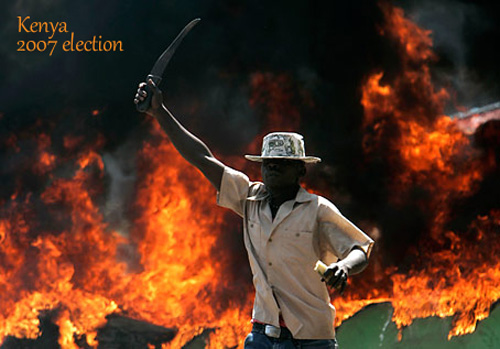
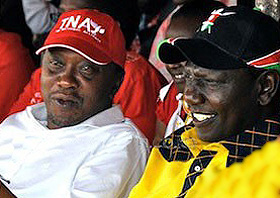
Last time round the country exploded in violence because there were sore losers. Two of those sore losers are running again, one for President (Uhuru Kenyatta) and the other as his running mate (William Ruto).

Uhuru Kenyatta & William Ruto
The two have been indicted by The World Court in the Hague for having incited the violence of 2007, paid to have it continue, and actually organized some of its worst atrocities. Remarkably, they have both traveled to The Hague to answer the charges and – at least until this point – agreed to be tried.

The last election was the first true attempt at national democracy. I remember watching the returns on the internet very much in real time. The problem was that the returns were giving the election to Raila Odinga, who was opposing the sitting president, Mwai Kibaki.

It was blasted deja vu to Gore/Bush. Internet returns suddenly stopped and the media began reporting all sorts of irregularities in the transporting of election ballots to the counting authorities.

The sitting president declared himself the winner. It was ridiculously premature. The rest of the world shook nasty forefingers at Kenya … except for America. President George Bush called up Mwai Kibaki to congratulate him on his victory. It was around 11 p.m. Kenyan time. Kenya media exploded with the announcement.

No other world leader did the same. And the next morning fires started.

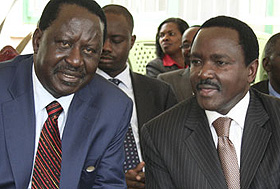
Raila Odinga & Kalonzo Musyoka
When the violence began it was basically the poor of Kenya – found mostly in its slums and who had supported Raila Odinga – against the rich. Which included the police and politicians.

But it quickly degenerated into an ethnic war. Mwai Kibaki is Kikuyu. Raila Odinga is Luo. They are the two largest tribes in Kenya, and while as in Northern Ireland the Catholics are generally the poor when compared to the Protestants, so are the Luo when compared to the Kikuyu. So the battle was forged on grounds long prepared.

Uhuru Kenyatta, who was set to become a major official in the Kibaki government, is also Kikuyu. William Ruto is a Kalenjin, historically an arch enemy of the Kikuyu, but in this case the enemy of my enemy is my friend, and so the Kalenjin allied themselves with the Kikuyu.

Ethnic violence began to tear the country apart.

According to voluminous documents now in The Hague as the trial of Kenyatta and Ruto progresses, those two so-called national leaders planned and fomented the violence.

It took a number of months, Kofi Annan, heavy hands and wallets from the U.S. and Britain to quell the violence and create a power-sharing agreement between Kibaki and Odinga which held until today.

It has been a remarkable recovery. Odinga and Kibaki have actually worked well together, mostly because Odinga despite the details of the power-sharing agreement, always took a backseat to Kibaki.

But under their leadership, the country created a fantastic new constitution and steered towards a path of unexpected economic growth. Kibaki never intended to stand for election this time, and needless to say, that helped enormously.

Kenyans remain very ethnically racist. The younger are much more tolerant than the older, but even the young struggle with ethnic identity. And because there are more than 40 ethnic tribes in Kenya and really more than half dozen greater ethnic coalitions, there is no single ethnic group that can determine a national election.

Odinga probably won last time (as Gore did) and is projected to win this time, because his policies – not his ethnicity – align best with most Kenyans. It is fair to say if he doesn’t win, it has less to do with policy than ethnicity.

Will Kenyans reach into their minds rather than their hearts for how to vote? That, of course, is a separate question from what they will then do if their decision is not validated by the outcome.

Frighteningly Wonderful in Mali

Frighteningly Wonderful in Mali

France’s liberation of Timbuktu and defeat of Malian Islamic revolutionaries is right on schedule and demonstrates perfectly the American/French axis routing world terrorism.

Sunday’s Meet the Press roundtable was in contrast the perfect example of how fooled and even bamboozled old guard American media personalities still are. Andrea Mitchell excepted, the remaining two old men got almost everything wrong:

Ted Koppel who presided over the creation of the War of Terror in the media predicted “we’re entering one of the most dangerous eras this country has ever experienced.”

Wrong.

“I think it’s even bigger and more troubling than that,” pounced Bob Woodward, the man who broke Watergate and was apparently broken by it in return.

I’m making no bones about saying that France’s action will be short-lived, especially by the standards of American foreign involvements, and that it will be generally successful. As I said in earlier blogs, I think this is the end-game for the current era of terrorism. That doesn’t mean the end to terrorism, of course, just the end of the al-Qaeda chapter.

The end-game wasn’t supposed to be quite so publicly bloody, and this is largely because of American missteps in Mali. AFRICOM was the new American African command that set in pace a number of militaristic actions I’m ambivalent about, but which did chase al-Qaeda from Yemen to Somalia to central Africa and finally to North Africa where it was supposed to desiccate in the sand.

This three-year chase fragmented what had been a more structured and organized group of very bad guys. Separately, the Obama drone assassinations took out dozens of terrorist leaders, including of course the Top Gun. Like Sherman plowing through Georgia, death and destruction has been left in the wake, but…

…al-Qaeda is gone, Somalia has been pacified and terrorism has been chased on a long arc from Afghanistan down into east Africa and back up to North Africa … where now the French are pummeling it to death.

It got messy in Mali because Americans don’t speak French right. We trained the Malian army and held it up to public scrutiny as a model for modern African armies (allied, of course, to the west).

But those pesky French-speaking Africans got naughty and staged a coup against what we had also championed as one of Africa’s most stable democracies, and together with a few other events like generations of weapons released from Libya, the current war was precipitated.

Tuaregs have been fighting for independence since the dawn of the camel, and al-Qaeda remnants fleeing America’s silent sweep, pushed north into the southern flowing Libyan arms made uncomfortable but convenient bed fellows. For a while.

It couldn’t last. It didn’t. But it was strong enough long enough to give the French cause to attack. The French don’t dither like Americans. They never have, and their unique forms of morality are the same which continue to celebrate Napoleon’s tomb in the Champs de Mars.

So now what?

North Africa is a mess, but it isn’t the global threat that Afghanistan was. The trouble in Egypt is internal and will last for some time, but it will not spread. French foreign legion will be in Mali for some time, now, but fighting will diminish not spread into Niger or Nigeria as old men American commentators claim.

And the terrorism threat will diminish. The world will be more peaceful.

So why am I so unsettled and near sarcastic?

Because this was all planned. I see everything having happened to a a near perfect specific plan, a covert military mission organized by the Obama administration, cleaned up by the French. The French weren’t supposed to come out of the rafters, but they had to translate for the Americans. That was the only unplanned move. That this all worked and made the world peaceful is good.

That it is covert and so strikingly successful is terrifying.

Apocalypse Masks Extinctions

Apocalypse Masks Extinctions

The media hysteria about the increase in elephant poaching will not help solve the situation, not until facts are presented straight and the public realigns its reaction.

Newsweek’s article published tomorrow, disseminated this weekend by the Daily Beast, is the perfect example.

Margot Kaiser’s lengthy article might be considered detailed if it were not rife with so many inaccuracies.

To begin with she cleaves open the story suggesting few but her have ever seen the insides of the Tanzanian ivory warehouse. Local bloggers have been obtaining pictures of the ivory room for years.

That was the giveaway. Kaiser’s handling of the facts was treacherous, starting with her claims that elephant numbers were now “roughly half of what it was in the late 1970s.” The truth is that it’s impossible to say, because we can’t get good data, but a very good guess is that the numbers are closer to double today what they were during the nadir of elephant poaching in the late 1970s and early 1980s.

Not half, double.

This is a very hard post to write, because elephant poaching is definitely out of hand and has become a global economic problem that is screaming for management. We mostly look to CITES, the excellent world trade treaty that legislates global laws against the sale of ivory. The problem today is enforcement of those global laws.

And that enforcement is not being helped by near hysterical stories like Margot Kaiser’s.

The problem with elephant and rhino poaching today is much different than when elephant really were threatened with extinction in the 1970s and 1980s.

And that’s the first problem. Even if we did absolutely nothing more to enforce laws against the sale of illegal ivory, elephant numbers would increase.

Tanzania has the worst elephant poaching problem in East Africa, today. I have yet to see a reputable NGO with an official number, but the media is passing around 10,000 elephant poached annually in Tanzania.

I doubt that. Charles Foley, the principal elephant researcher in East Africa, recently released his 2012 annual research report in which he states “many thousands of elephants” not tens of thousands are being poached. Moreover, Foley has documented the highest reproductive rate of elephants ever known in Tanzania to date, with upwards of 7% population increases being recorded in the north of the country year-to-year.

Foley’s assessment suggests that elephant numbers are increasing — at least in certain prime elephant habitats — faster than the increase in poaching.

Unlike the 1970s and 1980s, poaching today is mostly individualized, not corporate. It is worth it today to a small band of individuals to risk life and limb for the value they can get for a couple tusks sold on the black market.

Because the Asian market has exploded in demand as the area develops a middle class in old cultures that have revered ivory for millenia.

And at the same time elephant populations are being better conserved, so particularly in well protected areas their numbers are growing … maybe too fast.

Increased market demand combined with a larger supply …. well, you don’t have to be a rocket economist to figure that one out.

Yet the media’s hysteria is unbelievable. I just don’t get it. We need to look at this fascinating and organically destructive dynamic now happening in the world regarding ivory, but not scream at it.

The answer today, unlike in the 1970s and 1980s, is to deal with the market demand, and there are promising developments, particularly in China, as its population becomes educated to the realities of African conservation.

Taobao, China’s Sears, has banned the sale of ivory products, which previously had been a maintstay of their household decorator market.

Americans like everything to be all or nothing, and that’s why calming down this conversation feels so perilous. I don’t want not to investigate and work towards a better balance with regards to elephant in Africa.

I just don’t want you to believe it’s apocalyptic, cataclysmic to the point we have to “act immediately” or lose everything. Today’s elephant problem is going to take a long time to solve because altering the free market takes time.

And that’s one of many points. We have the time, this time. We didn’t in the 1970s.