Happy Halloween, Ebola Sir

Happy Halloween, Ebola Sir

halloweenebolaNot even the outstanding basement haunted house that I so successfully ran when my children were in middle school can begin to achieve the truly absolutely unbelievable fears of ebola stoked by despicable American politicians.

“An epidemic of fear can be as dangerous as an epidemic with a virus.”

Maine health-care providers, led by the executive vice-president of the Medical Association of Maine issued that quote, in response to Maine’s T-Party governor’s abrasive and ignorant actions against a health care hero who just returned from West Africa.

A third-grader banned from attending her Milford, Connecticut grade school because she just returned from a wedding in Nigeria where she was the flower girl, had to get a court order to go back to school.

Louisiana Governor Bobby Jindal sent out letters to recent returnees from West Africa who were planning to attend this weekend’s convention in New Orleans on tropical medicine, advising them they shouldn’t come.

A Strong, Maine, elementary school teacher was ordered into a 21-day quarantine because she just returned from her vacation in Texas!

Not only did parents panic when the principal of the Hazelhurst Middle School in Mississippi returned from vacation in Zambia, so many pulled their kids out of school, it closed!

“Principal Lee Wannik had returned to school a day early from a recent trip to Africa, where the Ebola virus has been spreading fairly rapidly. Principal Wannik has just returned from attending the funeral of his brother in Zambia, Africa. A meeting was held Tuesday, October 14 in the school’s auditorium, to try to calm parents and officials who wanted the principal to leave permanently.”

Zambia is thousands of miles away from the epidemic, further than London, with no viral epidemic outbreak there and no history of ever having had one.

The day after the parents pulled their kids out of school, the rumor spread
that the principal actually had ebola.

Tuesday Nigerian applicants to a community college 60 miles from Dallas showed their rejection letters to the press: Elizabeth Pillans, the Director of International Programs, confirmed that “Navarro College is not accepting international students from countries with confirmed Ebola cases.”

The applicants who revealed the letters are from Nigeria, which is “ebola free.”

The DeKalb County (part of Atlanta) Georgia K-12 school board issued the following statement yesterday:

“…no new students from Ebola-affected West African countries, including Liberia, Sierra Leone, Guinea, and other affected areas in the United States will be enrolled or allowed to attend classes on school campuses without proper medical documentation and approval by the Superintendent.”

Yesterday Dallas County Judge Clay Jenkins, notable for supporting the grieving family of Thomas Duncan who died of ebola there, told the press:

“…my wife who was in tears [was] told that she can’t work in the [school] cafeteria by some other moms because she might have Ebola, because I might have Ebola, therefore my child might have Ebola, [and] maybe they all need to leave school.”

There’s more: London’s very somber and highly respected Guardian Newspaper ran the following headline this week:

“Panic: the dangerous epidemic sweeping an Ebola-fearing US.”

Follow the link above so that you can read how American Airlines flight attendants locked someone in an airline bathroom because she vomited, how a journalism department at Syracuse University disinvited a Pulitzer-Prize winning reporter because he had been in Liberia, and on and on and on.

Let’s stop. Drill down into each of these and you drill into a conservative, often T-Party community. I’m not saying this is wholly restricted to Republicans. My own democratic governor up for re-election is acting just as immature.

But we’ve got to fight back. The gloves need to come off. The divide is clear. We can’t be polite or shy. The more conservative an area is, the more likely it’s been fomenting this hysteria.

I’ll leave it to others to study why. Meanwhile, I’m pleading with you to join me in calling out the brazen fear-mongers wherever you see them.

Fight back. Inject some sanity back into America next Tuesday.

Time’s Up, Pat!

Time’s Up, Pat!

RobertsomTimeUpIt’s funny, but it’s not. Yet is this a turning point? White, racist, evangelical attitudes especially towards Africans might really be changing.

For decades, now, we enlightened ones have snickered at the bad jokes and patently racist attitudes of The Right almost to exhaustion. When allies relented and began inviting “opposing viewpoints” onto pubic forums, many of us wondered if the schism was permanent.

The abhorrence of racism became the stuff of comic strips.

Tuesday night CNN’s Anderson Cooper extended comedy into sarcasm and lambasted racist tele-evangelist Pat Robertson like never before.

Robertson is the star of the Christian Broadcasting Network and he had just answered a question on the popular “700 Club” show about ebola. He warned would-be travelers to Africa against using towels there that will infect you with AIDS.

This isn’t a gaff, it’s a simple reflection of a quintessential racist belief that black is evil.

It was hardly Robertson’s first time at it. Last year he actually claimed that gays in San Francisco wear evil little pointed rings so that when you shake their hand they can infect you with AIDS, which he called “their stuff.”

Apparently the attention to the ebola controversy breaks the threshold of cartoon tolerance of racism. Robertson’s network apologized for this remark the next day, although he never has.

No apology was ever made for the gay ring remark.

What struck me as particularly important this time was how Africa reacted. Like many of us before, Africans tend to shrug off racist attitudes as something held by bumptious uncles. Inured to the point of frustration, the general viewpoint has been that most of these attitudes will die out with the current generation.

In fact Robertson’s remarks got little attention in the African media until Cooper flayed them.

Now, for the third straight day running, it’s the most popular story in the Kenyan media.

Take that link above and scroll down to the local comments. Here are a few of my favorites:

“You can contract the sometimes incurable disease of ignorance if you listen to the likes of 700 club.” – Melissa Wainaina

“Sorry, dear Kenyans, but that’s America (USA). They don’t know there anything about other countries.” – Hanna

“Can one get aids from Towels in America? … This is ignorance and racist mixed into a potent mix.” – cbertmann

The irony is that Pat Robertson probably has a larger following per capita in Kenya than in the U.S. “What is more sad is that this guy has a huge following in Kenya,’ Shazam3535 reminded readers.

That’s because Kenyans are far more religious than Americans. Kenyans are also, in my opinion, far more tribal and therefore actually more racist than Americans, although their racism is black-on-black more than black-on-white.

Racism is racism, though, and it’s heartening reading these comments to recognize what might be a new awareness that religious evangelism provokes if not causes racism.

Are the times really changing?

Perry’s Practicalities

Perry’s Practicalities

killwestafricansWhen tiny incidents like a few ebola cases in Dallas are properly scrutinized by the obsessed media, their exaggeration grows unbelievably large.

The media is obsessed, because the public is obsessed.

Every unnecessary harm should enrage us: including the 10,332 American deaths caused by drunk driving in 2012 (that’s 28+ per day, more than 1 per hour); or the 23,362 homicides that’s 64+ per day, almost 3 per hour).

But DUIs and homicides, much less war fatalities, poverty, infant mortality, industrial accidents and so forth, are not contagious. Is that the difference?

The obsessed public believes itself essentially so good and righteous that they would never be involved in unnecessary harm … unless they caught it?

Or: the obsessed public is so anti-social that nothing matters except individual responsibility? In other words, forget about John Doe or Jane Odhiambo, I shouldn’t get infected with something I didn’t stupidly expose myself to? And to hell with those who have?

I don’t know, but it’s a sad, sad commentary on our American society in general when the focus is so incredibly tiny.

There’s also the possibility that Americans just can’t telescope out. They’ve been so brain washed by the often useless concepts of individual responsibility and self-survival that they can’t think in macro terms.

Right now, folks, if you drive, you’re 10,000 times more likely to be killed by a drunk driver than by contracting ebola. And if you drive and aren’t a health care worker, the stat is mind-boggling: you’re millions of times more likely to be killed by a drunk driver than by contracting ebola.

Did you get a flu shot? If not, the chances you’re going to die of flu this year are in the hundreds of thousands more than that you’re going to get ebola. Even if you live in Dallas.

But people won’t get flu shots, and their Congresspersons (mostly Republican) are getting besieged by phone calls demanding that we stop all air traffic into the areas where ebola is an epidemic.

So they’ll take the same amount of time, maybe more, to ultimately kill more West Africans that would otherwise not die for an infinitesimally virtually nil insurance against they’re own getting ebola.

And then, they’ll be one of the 30,000 American deaths from flu this year. Like seniors voting to end social security, Americans just love to act against their own self-interest if only the media can tell them why.

When life-and-death becomes political, it gets dirty. Wars are dirty. Crime and punishment is dirty. And now the poor and needy have become dirty.

How utterly despicable.

Quarantine Texas

Quarantine Texas

ebolaThe behavior of Americans is contributing to the spread of ebola in war-torn Africa. We’ve got to change.

Inbound airport screening is useless. Reactionary raising of funds “for ebola victims” in schools or churches is abject nonsense.

One of the world’s best virologists said today, “I know that President Obama has raised the whole issue about screening at the airport. It has not worked in the past. It has not worked with influenza, it’s not worked with SARS, MERS. You know, all you do is cause confusion and upset.”

These kinds of knee-jerk responses foil real efforts that could stop the epidemic in parts of West Africa.

First, it distracts real and necessary aid of the sort Obama has sent with our military, so that later an idiotic Congressman can vote against raising the deficit to build hospitals in Liberia because their home-town middle school is already doing something.

Second, it gives all those fear loving Americans a quick fix. Quick fixes don’t work. Even gorilla glue doesn’t live up to its reputation.

Quick fix mentality is why Americans are in such a horrible state, today, socially and morally. It’s why there’s jihadism in the Middle East, and so much poverty and disease in America compared to other industrialized nations.

We are the head of the snake that bites our own tail: Our own regular lives become disrupted by irrational fears.

This is squarely, and clearly, because of individual American reactionism. It all begins at home, not with your Congressperson, so don’t blame her. She’s just reflecting your own irrational fears:

The first warnings about AIDS, the nuclear air raid drills I undertook as a young teenager in remote northwest Arkansas, the police cars guarding the East Dubuque bridge after 9/11, the thousands of people certain that at midnight, December 31, 1999, either their whole world or at least their hard drive would stop.

It doesn’t even have to remind. Americans at this very instant are reacting against themselves: A majority want to bomb Syria and Iraq but that same majority doesn’t believe it will work.

There’s no doubt that irrational ebola fear can be found anywhere in the world where the media has sensationalized it, and that’s where it all begins. Americans, though, believe in their choice of media more than anywhere else in the world, despite their lavish protestations to the contrary.

We Americans tout ourselves for being so generous, but so much of “our giving” is senseless and ultimately useless. Is that really generosity?

It’s likely that now that every American knows that ebola is less of a threat to herself and his community than this year’s flu epidemic ready to begin. It’s likely right now that almost all Americans intellectually accept that their chances of getting ebola are nil.

That it is not very contagious. That it is pretty easily contained in a community with even a half efficient public health system.

Much more importantly, I think most Americans know that if we isolate those three countries in western Africa by stopping air service, for example, that we will not give ourselves more protection yet we will manifestly increase the misery there.

Yet: click here.

Or here.

Or here, of course:

It’s hard for me to not panic against the panic, but I’m trying. Take a deep breath as I’m doing. Let’s remove the exclamation points and get on with our lives. Send your kid to school. Let the airplanes fly to Liberia. Take that vacation as planned.

Tomorrow we’ll talk about how you can do good. Let’s just start today by stopping doing bad.

The Curse of Apathy

The Curse of Apathy

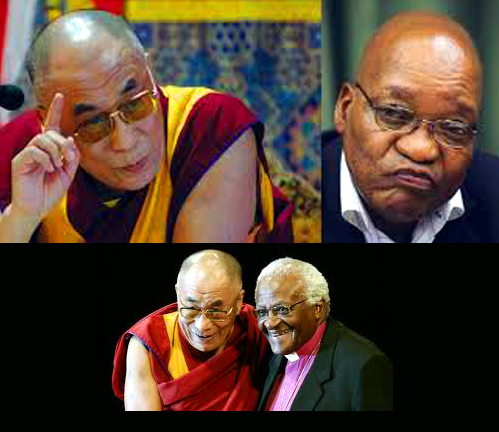
dalai&saIn an incredibly sycophantic move, South Africa’s president Jacob Zuma has denied the Dalai Lama a visa to attend a convention of living Nobel peace prize laureates in Cape Town.

The convention was supposed to begin a week from today, but Late last week the laureates announced they were suspending the October 13 get-together and relocating to a yet unnamed country.

Cape Town Mayor Patricia de Lille said her government “has embarrassed the country.”

The laureates decision not to go to Cape Town followed the South African government’s refusal to elaborate on why the Dalai Lama was not given a visa. Fourteen of the 21 laureates sent a letter to President Jacob Zuma asking him to reverse his decision.

The initial decision to hold the convention in Cape Town, which would have been the first time in Africa, was a coup for the wildly popular Desmond Tutu, himself a Nobel laureate, who was instrumental in ending apartheid.

The ending of apartheid was the reason that Nelson Mandela, and at that time the president of South Africa, Willem de Klerk, shared the 1995 prize.

“I am ashamed to call this lickspittle bunch my government,” Tutu said in a statement.

This is actually the third time that the Dalai Lama has been denied a visa. The last time was for Tutu’s 80th birthday celebration.

China and South Africa have a very close relationship, and interestingly, it is less because of aid and investment than trade. South Africa is China’s leading trade partner in Africa.

China has publicly promised to lobby for more power in the UN Security Council for Africa. Given the political turmoil in Africa’s other powerhouse countries, Egypt and Nigeria, any such aggrandizement would likely benefit South Africa.

China has often snubbed the world prize, as a number of prominent and usually dissident Chinese have been made laureates.

Most Chinese believe it is a political tool, and as such, South Africa’s president’s refusal to embrace it should be seen as strictly political, say the Chinese.

One might also bring up sour grapes. Jacob Zuma is one of the most corrupt and least loved of South Africa’s big man politicians. Many in the country wonder how he has managed to stay in power.

He’s received none of the multitude of accolades and awards that many of his comrades-in-arms against apartheid, like Mandela and Tutu, have.

What perplexes me is how younger South Africans don’t seem to care to the extent I thought they would. Their lives are getting better, however incrementally, but key economic indicators like the spread between the rich and the poor is growing.

I suppose like at home, war fatigue has spilled over into political fatigue. Your average Joe has become exhausted by being fed up.

And so long as things on a day-by-day basis don’t seem to get worse, major if immoral power policies leading to oligarchical control just don’t raise enough ire.

It’s called the curse of apathy.

When Wrong is Right

When Wrong is Right

whenwrongisrightImagine Ray Rice walking into court followed by Eli and Peyton, Adrian Peterson, a few veterans like Mike Ditka and then a couple hundred high rolling NFL fans.

He’d be saying, “Some people think I did something wrong. Maybe I did. But I had to,” or maybe not ‘I had to’, rather “They understand why I did.”

And that understanding spans the gamut from being cuckoo to especially stressed. And in any case, it’s acceptable because, gdi, we need that guy playing the game!

And … he wouldn’t have done it, if he didn’t have to.

And since that “have to” spans the same gamut from being cuckoo to especially stressed, we get in a loop that we can’t get out of.

This is exactly what’s happening with the President of Kenya.

Next week President Uhuru Kenyatta will leave the Nairobi airport surrounded by probably hundreds if not thousands of cheering supporters for The Netherlands, where he’s on trial for crimes against humanity.

Whether World Court officials will allow his entourage to enter the vaulted halls of the ICC with him, he will be accompanied to the portals by at least four other Heads of State, maybe more, and by more than 100 elected Kenyan members of Parliament.

The facts in Kenyatta’s trial have come out in the press, mostly, since important witness after important witness has been so intimated that they’ve dropped out or disappeared. So now the spent prosecutors at the World Court have little facts left to present.

The facts as most of us believe them but which have not been able to justly be presented in court are pretty simple. The national election of 2007 was close. The current head of Kenya’s opposition from its second largest tribe, Raila Odinga, was neck and neck with the then president of Kenya running for reelection, Mwai Kibaki. Kibaki was a Kikuyu, the largest tribe and the tribe of Kenyatta.

Kibaki was old, Kenyatta was young. Kenyatta’s father, Jomo Kenyatta, is the “Father of Kenya” and its first president.

Widespread violence followed the election and the country was brought to its knees. Almost 1500 people were killed in horrific violence and a quarter million displaced, of which dozens of thousands remain so today.

There were absolute differences in ideology clashing, but the violence was tribal.

The settlement forced on Kenya by Britain and the United States was brilliant. Kibaki and Odinga shared power for almost five years. During that time a new and fabulous constitution was adopted.

The settlement required Kenya to determine the cause of the violence and prosecute those responsible. The settlement went further: Kenya had a certain window of time to attain this justice, and if it failed, then the World Court in The Hague would step in to do the task.

Kenya failed. Parliament tried several times to create courts and procedures for this most important attempt at national justice in its history, but at the end of the day, an invitation was sent to the World Court.

The World Court did not really want to do this. No indictment for crimes against humanity had been issued before the court was invited by Kenyans to start searching. Normally, the court issues indictments, as it did in Liberia for example, in response to individual petitioners. There were no individual petitioners with individual grievances from Kenya. The Kenyan Parliament invited The Court to take over, and it said, OK.

When it finished its several years of investigations, fully supported on the ground in Kenya by Kenyans, indictments were issued.

One was against the country’s current Vice President. The other was against Uhuru Kenyatta.

We know from leaked testimony and tapes that Uhuru Kenyatta, then a powerful political leader and Member of Parliament, organized and managed partisans in widespread murder and thuggery of the rival tribe.

This is against the law. It’s a crime against humanity.

But Kenya is doing pretty well, right now. Like all the rest of the world, the happiness and prosperity is happening mostly at the top, but the social fabric is peaceful. An unexpected war in Somalia, thrust upon it mostly by British, French and American interests, is not easy, but Kenya is handling it pretty well.

Skyscrapers are popping up all over. Roads are being built faster and better than in the U.S. Business was booming and is now humming along pretty well.

Even President Obama sat with Uhuru in the White House.

Like Rice, maybe he did do it. But take Rice or Uhuru out of the spotlight, out of their circles of power, and what happens? The team loses, and we just can’t afford that.

Risky Business

Risky Business

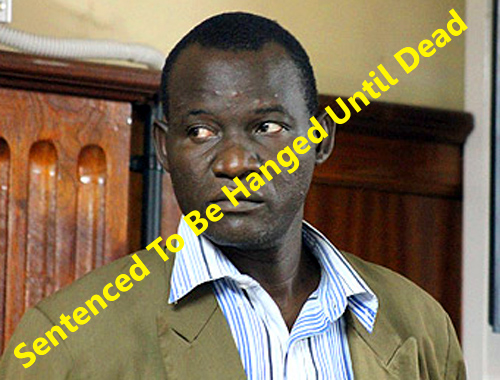
hangedKenya’s first execution in 27 years was ordered yesterday of a 41-year old male nurse for a failed abortion that led to a young woman’s death.

The judge said he had taken into consideration the fact that two lives were lost:

“He has killed two people; a foetus and a mother. The only sentence available in law is the death penalty,” Judge Ombija ruled.

Outsiders don’t realize how incredibly pro-Life the vast majority of law in the developing world is. What is even more ironic, though, is that while developing world law is crystal clear on the issue, these laws are rarely enforced.

Islamic ruled countries generally leave the consequences of a revealed abortion to the family. Those consequences are often crueler if the cultural edict is carried out. The widely interpreted Koranic punishment for adultery is being stoned to death, and generally any woman who seeks an abortion in the Muslim world is considered adulterous.

But it remains unknown and likely vastly underestimated the number of abortions in the Muslim world that are simply swept under the carpet.

In the non-sectarian ruled countries like Kenya abortion is just as illegal, but there are countless numbers of abortions, anyway. Authorities normally don’t enforce the law. Yesterday’s sentence, after all, is the first ever given.

“Our analysis indicates that an estimated 464,690 induced abortions occurred in Kenya in 2012,” Kenya’s own Ministry of Health reported last year. Each one of those if adjudicated would result in a death sentence.

The Kenyan Ministry report also concludes that the mortality rate of these attempted abortions is so high that it is a significant factor in Kenya’s escalating health care costs.

Many other reports circulating in Kenya indicate one of the reasons there are so many abortion attempts is because contraception is either too expensive or frowned upon by cultural and religious leaders.

Kenya law is clear: abortions are illegal. Legislative attempts to change this, including by women activists who lobbied hard to make abortion legal in Kenya’s revised Constitution of 2007, were all soundly defeated by Parliament.

It was, however, a “perfect storm” for 41-year old nurse, Jackson Namunya Tali, who will now become known as either the first or the only abortion provider to have been sentenced to death.

Tali operated one of probably dozens if not hundreds of abortion clinics in shady areas of Nairobi where police rarely appear. He is a fully trained nurse whose pay under the national health system is likely 1/100th of what he earned at his clinic.

He was much more compassionate than most abortion providers who dump their patients out the front door as fast as they can once the procedure is over.

The particular patient in question had complications, and Tali tried to deal with them for more than a week before he personally tried to race the her to the hospital in his own car. She died enroute, and instead of then abandoning her, he himself called the police.

Clearly the man was empathetic, hardly the criminal type that the vast majority of less well trained and less sensitive abortion providers in Kenya are. He seemed generally distressed that his efforts with this woman failed.

His empathy led to his sentence.

This was not big news in Kenya. In fact the major media outlets didn’t even carry it. And the few comments that appeared in the digital world were mostly in support of the judge.

Time To Call Off The Hounds

Time To Call Off The Hounds

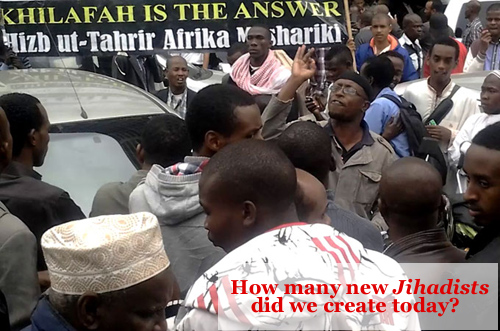
CreatingJihadistsYesterday, hundreds perhaps thousands of new Islamic militants were created in places like Kenya because of America’s bombing in the Levant.

For ten years Arkanuddin Yasin was a little known Islamic preacher in Kenya working for an also little known pan-Islamic political organization called Hizb ut-Tahrir (HT). Yesterday, he and his organization attracted lots more attention by calling on young Muslims throughout Africa to join the fight against the U.S. bombing the Levant.

Kenya has a vibrant, active press. This was not a top news story. Imagine how many more Arkanuddin Yassins there are in Africa much less the rest of the world.

There is a thin line between religious or ideological beliefs and armed revolution. We see it nearly every week at home in America. Cliven Bundy made it onto the national evening news, but there are hundreds more of his kind every single day.

The schism between Islam and Christianity is ancient, but it hasn’t really been elevated to all out war since the end of the Ottoman Empire with World War I. That’s changed. Just as vigilantes on the Texan border have illegally taken over much of the border patrol, there.

It’s not just illegal, but it’s wrong the way ISIS has taken over large swaths of the Levant. It’s not just illegal, but it’s wrong the way Cliven Bundy and the Vigilante Patriots fire their weapons at will.

But the response by the powerful to these groups’ illegal and often immoral actions has made things worse in several ways.

The first mistake by authorities is providing outright support. This is as obviously immoral as the actions the authorities purport to interdict. It includes Saudi princes sending millions if not billions of dollars to jihadists. And in the same vein it includes giving the Vigilante Patriots not-for-profit tax status.

The second mistake is providing tacit support. We learned today that ISIS is earning several millions of dollars daily by selling oil from fields it won in war. Who’s buying this oil? Don’t think it’s so obvious. We know from decades of black market precious metals in Rwanda and The Congo that the principal buyers were Apple and Motorola.

One could argue that poorly managed global capitalism is the second mistake.

The third mistake is over reacting. This occurs in big ways and small ways: It’s the reaction of the U.S. to 9/11 and Kenyan police “roundup” of suspects in Nairobi’s Eastleigh neighborhood following the Westgate bombing.

Overreaction might be understandable but it’s too reactionary to be helpful, and like grade schoolers, we should be taught to contain our emotions. It does nothing but fuel the flames.

There is also the over reaction of getting involved when it’s none of your business. It’s very hard for we Americans to watch someone beheaded on TV without responding, but the fact is that beheadings in Saudi Arabia are common and summary. So how come we’re not bombing Saudia Arabia?

Over reaction is also cowering in fear for no good reason. It’s sending the Dubuque city police to guard the Mississippi river bridge after 9/11. It’s cutting funding for libraries to give the police department armed personnel carriers. It is invading Iraq.

The reason Saudia Arabia, Turkey, Egypt and by the way, Israel, are not fighting alongside the U.S. right now is because their borders haven’t been violated. The reason Iraqis ran from the fight is because there really aren’t Iraqis: Their society has never been formed well enough since we Americans blew it to smithereens.

It’s time to call off the hounds. It’s not an easy thing to do, but how many times do we have to fail trying to do more and ending up making things worse?

Landslides Are Irrevocable

Landslides Are Irrevocable

tiltingmaseruLesotho is a spot of a country surrounded by South Africa. Is it time to wipe the spot out?

There are spot countries all over the world: European potentates (Vatican City, Monaco, San Marino & Liechtenstein); scattered South Seas countries (Marshall Islands, Nauru, Tuvalu, Palau); other scattered sea countries (Seychelles & Maldives); Caribbean beaches (Saint Kitts & Nevis, Andorra, Granada, Barbados, Antiqua & Barbuda), regal airline hubs and tax havens like Luxembourg.

In fact, there are 110 of the 252 countries listed by the U.S. WorldFact book smaller than Lesotho.

South Africa’s other spot, Swaziland, is only half Lesotho’s size. So why am I asking if it’s time to wipe out Lesotho?

Most of the spot countries of the world are either too anemic or too essential to mess with: the Seychelles and Singapore, for instance. Few will protest when most of the Seychelles tiny 90 granite islands sink as the world’s ocean’s rise.

But a lot of Asian billionaires and world banks will tremble if Singapore cracks.

Swaziland tilts ever so slightly into the Singapore camp of countries. Its western border is with South Africa, and its eastern border is with Mozambique. There aren’t any refugees anymore from Mozambique, but if there were, this is the conduit.

Some creative accounting is possible for trucking companies depending upon what particularly taxed goods they’re carrying.

In the old days during the very strict moral laws of apartheid in South Africa, Swaziland was the playground of the debauched with lots of casinos and gentlemen’s clubs. Today’s South African laws are less restrictive, but still more restrictive than the g-string thresholds in Swaziland.

These aren’t all necessarily good reasons for Swaziland to exist, but they are reasons. That’s Lesotho’s problem. It doesn’t have any reasons to exist.

The reason Lesotho is Lesotho, and Swaziland is Swaziland, and neither is a part of South Africa starts with their geography. But Lesotho is surrounded by South Africa. Unlike Swaziland’s geographical situational raison d’etre, Lesotho was left alone because it was too high to get to.

Lesotho is almost entirely above the clouds. It has the highest lowest point of any country in the world, 4,593 feet. The rest of it scraggles upwards to a peak of 11,424 feet high. It’s mostly gravel, limestone and granite mountaintops, with a very few meadows that some unusual sheep live in, and one tiny city, the capital of Maseru, that if lifted down to a reasonable altitude would look something like a sprawling mobile home community near Flagstaff.

There are less than two million people widely scattered among its nooks and crags with a third of the resident population unemployed and the rest, two-thirds, all working for the government.

There are no natural resources, and the country only produces 20% of its food. In fact, Lesotho imports 90% of everything it uses.

Essentially all of its wealth comes from its citizens working in South Africa and sending the money home.

This was all honky dory for the two entities, Lesotho and South Africa, for years. Rather than undertake this extremely undeveloped region that needs so much expensive infrastructure, South Africa preferred to let Lesothoans work in South Africa and avoid many of South African taxes, so that the money could flow up to the mountain tops and keep everybody peaceful and quiet.

They aren’t peaceful and quiet, anymore.

People grow up. They get educated. They learn when they’ve got a raw deal, and technically South Africa has maintained Lesotho as a kingdom to save money.

Several years ago revolution erupted. Basically that meant that the 57-member military/police force took over the palace then the legislature.

South Africa mediated a solution that gave more power to the people. But then only a few weeks ago, baton wielding coupest turned into gun firing takeoverists.

What Lesothoans want is to become absorbed by South Africa. Most outsiders don’t realize this. Like Thomas Friedman, they think that all Lesotho needs are few new restaurants.

This has been going on too long, now. In a country with only 2 million people, 30,000 signed a petition then staged a march in Maseru four years ago demanding annexation by South Africa.

When nobody listened, the men with batons hit the street, and now, men with guns are taking over. What had been a peaceful if placated democracy is now another African dictatorship.

Last week South Africa’s trade unions, far more powerful than trade unions in the U.S., decided it was time to annex Lesotho. (A very high percentage of South Africa’s mine workers come from Lesotho.)

“In reality, Lesotho is in the Free State and so it can be an extension of the Free State, or the 10th province,” one of South Africa’s principal union leaders, Frans Baleni, said last week.

He’s absolutely right. It’s time to wipe out the spot.

BodaBoda Brigade

BodaBoda Brigade

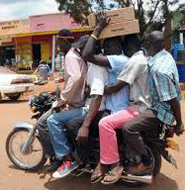
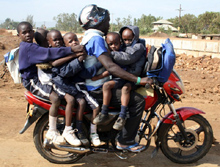
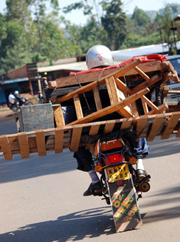
bodabodaBodaBoda means Harley in Swahili and may represent the next East African revolution.

So let me start by saying some of my best friends own Harleys… or did. One of them turned his in for a Kawasaki. And then there’s my niece living in Milwaukee who has managed to grow her business by selling leather items to Harley owners. And good grief, EWT has even operated safaris for Harley packs traveling from Cape to Cairo!
cow-on-a-boda
Kidding aside, the opprobriums attributed Harley owners have more or less died down in my generation. But there was certainly a time when Harley gangs slipped out of James Dean’ book clubs into brigand suburban warfare.

And that’s what’s happening in much of East Africa, today.

Motorcycle use has exploded in East Africa’s cities in just the last few years and the backlash from the ruling classes — all of whom own Mercedes — is astounding.

The menace is called BodaBoda, a Swahili nickname derived from ages ago when small motorcycles were used to ferry travelers between BORDER posts.
sixguys
Often buses taking travelers from a city in one country to a city in another country were unable to cross the border. So these entrepreneurial motorcycle owners would ferry passengers from a bus on one side of the border to a bus on the other side.

Today their role is more indispensable. The car congestion in East Africa’s expanding cities is unbelievable. Rapid highway development just can’t keep up.
SixToSchool
In the safari business we’re now constrained by rush hour. Entire itineraries are designed to allow transit through a city on a Sunday, about the only day that road rage can be avoided.

But local citizens have to deal with this every day, and the fix for the last several years has been to dump your car and get a BodaBoda, instead.

BodaBodas believe they are subject to no laws. So despite the rapid installations of traffic signals in places like Arusha, Tanzania, it matters little to them what color is showing above.
balesboda
They slip through the narrow spaces between miles of stopped traffic.

They make roads wherever they want to. Smaller BodaBodas roar right down the aisles of grocery stores.

As this culture of initial efficiency prevailed a darker side emerged. Police still use cars. Robberies, homicides and all manners of crime are now principally conducted from BodaBodas.

“Boda boda which have brought relief to commuters in poorly accessed suburbs of Arusha have of late been blamed as being behind a series of violent crimes,” writes Arusha’s main newspaper last week.

A third of all road fatalities in Tanzania are now BodaBoda drivers.

In an area increasingly homophobic, courageous women buck their culture by operating BodaBoda taxis.

The Kenyan Upper Class is being rattled. Recently the government announced a number of dramatic “remedies” to the BodaBoda menace:

(1) All women will have to sit side straddle, as proper English did in Victorian times. A woman Kenyan legislator, Caroline Owen, explained that the standard BodaBoda straddle of a bike “was uncultured and deprived women of respect because they expose their bodies to men.”
carryingladder
(2) No BodaBodas will be allowed in Kenyan city centers. Moreover, elsewhere they can’t operate between 11 p.m. and 5 a.m.

(3) Only one passenger besides the driver can be on the BodaBoda at any one time.

Fat Chance. If Kenyan authorities think there’s a security threat from neighboring Somali terrorists, just wait for the BodaBoda to Rise Up. And if road construction isn’t sped up quickly enough, they’ll be plenty of BodaBoda traveling on a single wheel, anyway.

Violence is not Genetic

Violence is not Genetic

chimps fightingA recent study of chimps in Uganda is being misinterpreted to suggest human murder is natural, and sloppy scientists are reenforcing these beliefs.

Chimps have long been known to be murderers and cannibals. While dominance within many species is often violent and considered essential for the social organization of many species, it very rarely extends to murder and except for chimps, to cannibalism.

So scientists have been at odds for years trying to explain this behavior in chimpanzees. Research came to a head about five years ago when scientists carefully documented chimp gangs that persistently (sometimes over ten years) plotted against one another then celebrated territorial victories by eating their foe’s babies.

Anthropology Professor Jill Pruetz believed for many years that this chimp behavior was aberrant, that it would not occur naturally in the wild were it not for some unnatural interference. Most of the colleagues who agreed with her believed that “something else” was human interference.

It could be chimps mocking human behavior (many chimp studies occur near very violent parts of Africa) or humans stressing chimp’s habitat, but it seemed just impossible to ascribe murder and cannibalism to natural behavior.

Pruetz and most of the scientific community have relented based on a just published study in Nature.

The “study says chimpanzees kill their own as a survival strategy, not due to human contact,” summarizes science journalist Monte Morin in yesterday’s L.A. Times.

And as far as I can tell, virtually everyone agrees.

That’s fine. But what’s not fine and in my opinion absolutely horrible is to use this study as an explanation for human violence.

Arizona State professor Joan Silk wrote an opinion article in that same issue of Nature, which she titled, “The evolutionary roots of lethal conflict,” which says it all.

A closer look at Silk’s opinion may be more nuanced than the title, but her title is what was picked up and replayed time and again in the less refined media. Clearly she committed a grievous scientific error in not adding “in chimpanzees” to her title.

There is absolutely nothing scientific or even rational to presume that behavior in chimps explains behavior in humans.

In what I feel is yellow science Silk invited the comparisons.

“The origins and prevalence of human warfare may be echoed in the search for the answer to chimpanzee adaptation,” wrote one scientific blogger yesterday, and it’s a wholly rational conclusion from Silk’s title, whether she intended it or not.

“Peace-loving anti-war activists call war ‘unnatural,’ but our closest animal relatives show that at least a little bloodshed is perfectly natural,” wrote Rebecca Kaplan in Tech Times, yesterday.

And on and on.

Studies of evolutionary behavior cannot extend back 6-10 million years to the separation of the hominin and ape branches of the hominid evolutionary tree. That’s just too long ago.

Behavior changes infinitely more rapidly than DNA. To claim that today’s chimp’s murder-and-cannibalism as a survival tool means that our earliest common ancestor with chimps had that behavior, too, is ludicrous.

And even if the ECA did, it’s impossible to suggest that our behavior today is still manifest by it.

There is no question that war has been used as a survival tool by humankind. But this is not because it’s ingrained in our genes, which is how the current chimp study is being distorted.

Why human violence evolved is certainly an interesting question, but it’s not biological. And what’s even more troubling is how the uneducated reaction to this study devolves from societies to individuals, suggesting all individuals carry a kill instinct.

I am so upset by this race to justify murder and violence. It slips so easily into the contemporary narratives supporting police using excessive force, violence and abuse against the less powerful like spouses and children, and not least of all, the rush back to war.

These are very troubling times, and scientists need to be very careful today. Joan Silk was not.

OnSafari: Dispatch from Ethiopia

OnSafari: Dispatch from Ethiopia

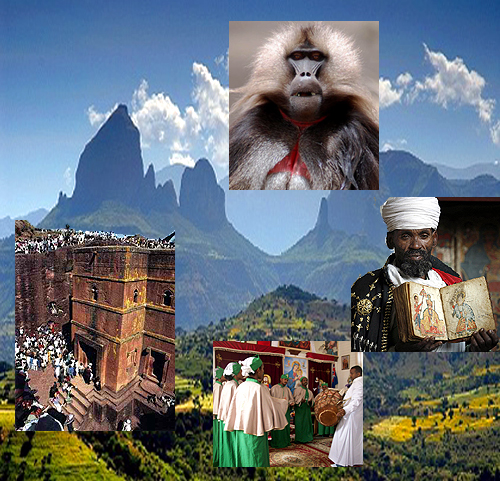
dispatchfromethiopiaBleeding heart baboons, some of the rarest animals on earth and some of the most stunning scenery, together with Africa’s very ancient culture. That was Ethiopia hosted by EWT owner, Kathleen Morgan, completed today.

They then spent two days in the very remote Simien Mountains.

“The Simiens were wonderful. Incredibly beautiful scenery,”Kathleen emailed.

The group had a “wonderful” experience with the Geladas, the rare (although not endangered) “bleeding heart” baboon found only in these mountains. The EWT group basically sat in a field amongst them, taking pictures and watching them interact.

They also saw the endangered walia ibex and perhaps the rarest of all, the Simien Fox!

Few visitors ever see this rarest of the world’s wolves. There are fewer than 400 and, in fact, most of those are actually found in a southern Ethiopian range, the Bale Mountains, so this group was particularly lucky!

There is only one lodge in the Simien. “The lodge is ok, but it was absolutely freezing. The water heater and underfloor heating are charged by solar panels. Only two rooms had hot water, one had warm water, and the others had only cold water. Everyone’s floors were freezing. We had lots of blankets and duvets and hot water bottles! The food was ok,” Kathleen reported.

While there are not safari vehicles in Ethiopia of the sort common in East Africa, it was necessary to use 4-wheel drive Nissans to climb the 11-12,000′ into the high roads of the Simiens which Kathleen described as “awful!”

“Narrow, barely allowing two normal cars to pass, and all this with a steep drop at the edge of the road – thousands of feet down to the bottom of a valley. The drivers were incredible.”

“The drive out of the park and to Axum is stunningly beautiful,” she continued. They stopped to photograph colobus and vervet monkeys on the way. EWT guest Joan Lieb who is a veteran traveler of Africa and wild parts of the world, said the villages along the road were the poorest she had ever seen.

Ethiopia was the only country in Africa never colonized, and so it retains absolutely intact its ancient culture. That culture is eclectic, a mixture of very ancient Christianity and animism.

The common “cultural triangle” begins in the city on the southwest tip of the great Lake Tana, where ancient Coptic island monasteries are still overseen by native priests who speak and write a language, Gheez, that has existed for more than a thousand years.

On the northeast corner of the lake is Gondar, where some of the first European settlements (in this case, Portugese castles and churches) built as 15th and 16th century missionary priests, mostly from Portugal, tried to find the mythical Prester John.

After the Simien Mountains, the group spent two days in Axum. The priests who oversee the Church of St. Mary’s claim to be stewards protecting the Arc of the Covenant. When Kathleen’s group arrived, the choir was singing and chanting with their drums and sistra because it was a holy day.

The EWT group was beckoned forward into the choir area. The women sat off to the side, but they motioned Ed Walbridge over to a bench amidst the singers. They gave Ed a prayer stick (those tall ones you can lean on) and a sistrum. He stood and swayed and paid very close attention and swung his sistrum at all the right times.

“Everyone thought it was wonderful!” Kathleen emailed, although Joan Lieb and Kathleen expressed serious disappointment when the priests brought out a precious 500-year old Bible to show them and seemed not to treat it with the care of an antiquity.

After Axum the cultural tour ends with its climax at Lalibela. In the 13th century the dynasty of kings in Ethiopia changed when the rebel Lalibela successfully came to power, claiming he was actually more closely related to the Queen of Sheba than the previous kings.

In thanks to god he vowed to build a new Jerusalem in Ethiopia. This was Lalibela. It took 32 years and begins at the top of the ground and goes down as far as 80 feet, eleven churches carved out of a single massive sandstone.

The combination of very rare animals, remarkable scenery and ancient culture is not something easily experienced on an African safari, but Ethiopia is the place to do so!

Kill Mom, Sell the Baby

Kill Mom, Sell the Baby

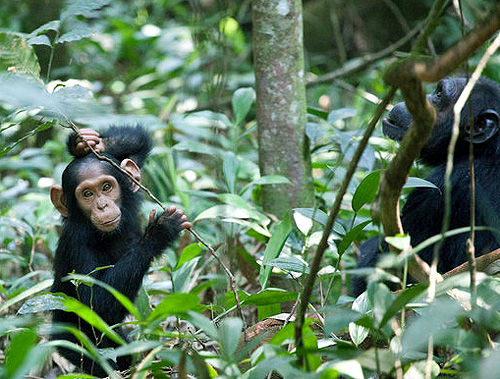
chimpChimps are not as endangered as gorillas, but they are increasingly controversial in developing Africa because they are so human-like.

Most westerners think of chimpanzees as sort of smart dogs. Well, only if the dog is as big as you! That’s right, a full grown chimp averages 5½’ tall and weighs 150 pounds.

This is no monkey.

Chimps are still widespread throughout much of Africa’s great central jungles. But for millennia the jungle peoples, mostly pygmies and settlements at the forest edge, hunted chimps for food. Traditionally chimp meat was an important source of necessary protein.

Babies were never eaten. An adult would be killed and the baby set free, usually to die for being abandoned. As villages and settlements developed, a secondary trade in selling these babies to westerners developed.

Forty years ago in far western Kenya, Kathleen and I had been working for hardly a few weeks when we were offered a baby baboon. I bought and raised it and tried to reintroduce Hamisi into the wild. The baboon’s mother wasn’t killed for food, but because she was raiding a neighbor’s maize garden.

Killing baby anythings seems offensive to most everyone. It was my justification for buying our little baby baboon Hamisi in the first place. But what I didn’t realize then was that a massive trade would develop, a blackmarket in animals like Hamisi, driven by nefarious western and Asian animal traders.

Today there are numerous NGOs across Africa whose mission is to thwart the blackmarket trade in wild African animals. This usually means intercepting the baby taken from the killed mother. And that necessarily means rehabilitating the baby.

One of the more successful organization in the southern edge of chimp habitat is J.A.C.K.. See their video below.

Killing grownup chimps is universally offensive to the developed mind of anyone who has enough food: It approaches cannibalism. Chimps are extremely smart, one of the few animals to actually show emotion, and often mock, taunt, stalk or spy on their human neighbors, the same way people might observe wild animals.

Unlike baboons and gorillas, they don’t raid gardens or kitchens. They’re quite good at finding and in a way nurturing their own food, and they fear humans. I think that their fear is intellectualized very much like human fear is, and very much unlike gorillas and lesser animals that are more reactive.

So I’d venture to suggest that a chimp when coincidentally passing a trader walking through the forest with bananas, that it stops to muse on the consequences of stealing them. A baboon which is much smaller wouldn’t normally challenge a man, but the moment an opportunity arises – the farmer sets down his bag to wipe his brow – the baboon may strike.

The chimp won’t.

Whether this is fanciful or not, the fact remains that chimps don’t raid and pose no threat to humans, other than a reduction of a traditional food source as hunting of them is prohibited.

As Africa develops even rural folks grow more intellectual.

But the need for food is ever present. And the pernicious blackmarket in wild chimps is actually growing. The demand from the west and Asia is strong, as westerners and Asians grow exponentially richer than Africans.

That, today, is one of the major challenges in Africa with regards to chimp conservation. More and more authorities are prohibiting hunting and trading in chimps. Locally authorities justify their action beyond simple conservation – which can be very controversial — although this alternative justification applies more to the lesser primates like monkeys:

Ebola and a number of other viruses, probably like West Nile and flu varieties and possibly even HIV, originated with forest primates, mutated and were transported into the human population through bush meat.

The human/animal conflict is increasingly important throughout Africa as the continent develops so fast. Chimps are at the top of that controversy.

Immoral Exaggeration

Immoral Exaggeration

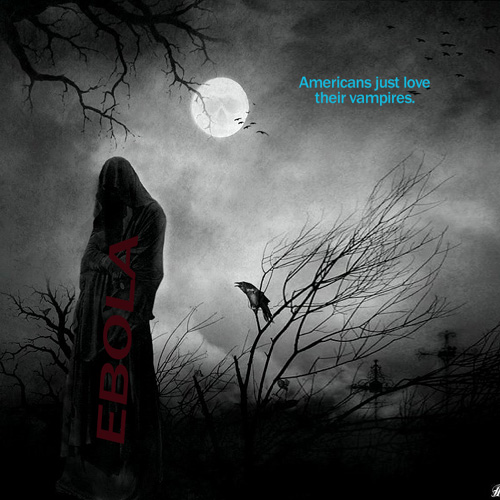
ebolavampireAmericans do not understand the ebola epidemic: They are reacting in the same unthoughtful way they do to unvetted political ads and sound bite media.

The ebola outbreak in West Africa is serious, like a lot of other things, like poverty. In fact, diarrhea, flu and TB kill millions more Africans (and Americans!) annually.

Americans must think think they are protected from those other diseases but vulnerable to ebola.

They’re dead wrong.

A traveler today to Monrovia, Liberia, where the current outbreak is centered is more likely to get diarrhea, salmonella, TB or malaria than ebola. The several hundred patients in ebola clinics in Monrovia have all come from rural areas where even basic medical prevention not to mention simple hygiene and community sewage treatment, doesn’t exist.

The problem is squarely and simply that there aren’t enough treatment centers – which would easily contain the outbreak – to service the growing numbers contracting the disease in the remote bush.

The widely reported half dozen medical workers from developed countries who contracted the disease were all working in these remote areas. In the course of their normal stint in such an area, they expect – as my wife and I did – to contract a number of local diseases.

It has less to do with the disease than the environment in which the disease exists.

Ebola is not spreading in Monrovia, a modern city. That is not to say that Liberia doesn’t need a lot more help than the western world is giving it, because Monrovia is where the Liberian epidemic will end. But it won’t end without the help it needs!

The problem goes well beyond ebola, now. Medical worker assistants like orderlies and kitchen staff and maintenance staff in Monrovia, many of whom are not paid any more relative to medical practitioners than in the U.S., are abandoning their jobs in droves.

That has led to a reduction in overall medical care, including birthing centers and simple malaria and diarrhea recovery clinics. As the entire country gets worse medically overall, every disease – including ebola – grows in potential.

And that is a terrible – horrible – indictment of the developed world. Compare the western world’s response to the Haiti earthquake or Philippines tsunami to Liberia’s current dire need. It has been pitiful, embarrassing and I think immoral.

When ebola came to Atlanta in a chartered aircraft and the patients who contracted the disease in rural Africa were then quarantined, it did not spread. The efforts in the hospital in Atlanta to contain spreading of the virus were little different than for a variety of even more contagious diseases like numerous varieties of staphylococcus.

Antibiotic-resistant TB, which is on a dangerous increase throughout the U.S., is spread through the air – respiration: coughing, sneezing, breathing – one of several more worrisome diseases than ebola in a modern medical setting. Ebola, like HIV, is spread only through body fluids.

The unwarranted American fear to ebola is identical to Americans knee-jerk reactions to 30-second political ads or 2-minute headliner news.

And when that reaction builds, the perpetrators of that media rev it up.

Ebola outranks Ukraine on CNN, because that’s what people want to view. When Democratic Senator Mark Pryor in a political fight of his life wants attention, he talks about ebola!

CNN asked a few days ago, “Are Myths Making the Ebola Outbreak Worse?”

CNN is, unfortunately, concentrating on the growing fear in West African residents. What about the fear that CNN instills in its viewers that translates ultimately into less help from the western world?

What about people in Syria, Iraq, Ukraine much less Ferguson, Missouri, who are getting less attention because ratings demand talking about ebola?

Alright. But what if you’re planning a safari to Africa?

Right now your chances of contracting ebola during a Kenya, Tanzania or southern African safari are probably less than if you holiday in London and infinitely less than if you holiday in Morocco and a lot less than if you holiday in Greece, southern Spain or most of the Mideast.

That’s because the frequency of air travel right now between west and east or southern Africa is so much less than to those other areas I mentioned. London is about 500 miles closer to Monrovia than either Johannesburg or Nairobi. There’s a hugely greater exchange of people between London and Liberia right now than to east or southern Africa.

Moreover, it’s also true because the level of medical facilities in Nairobi is better than Monrovia, so if ebola did break out in Nairobi it would likely be easily contained. And as for South Africa? Remember about a generation ago, the first heart transplant was conducted in South Africa.

The last thing I want to do is minimize the seriousness of this epidemic. But frankly I get rather angry when I realize Americans fear this far, far away epidemic exponentially more than their own TB epidemic in poorer neighborhoods across their own country.

I just can’t figure it out. Is every American a teenage girl obsessed with Twilight?

Something To Hide?

Something To Hide?

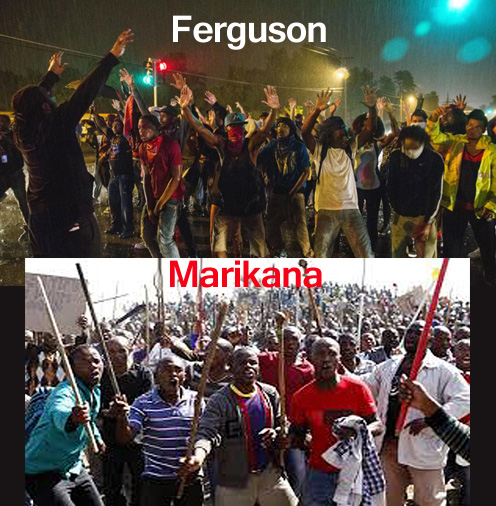
fergusonmarikanaLike few other American news stories the Ferguson unrest is widely reported in the African media. Analysts and reporters alike are essentially claiming that America is “like the pot calling the kettle black.”

It’s hard to dispute. But the killing of Michael Brown will ultimately be judged excessive use of police force, and in my opinion, the policeman will go to jail.

That’s where much of the African perspective fails. Jumping on this event before it plays out allows African analysts to presume we won’t reach the justice in this catastrophe that I think we will.

As is much more often the case in Africa than America.

Nevertheless, the Africans have a valid pinger right now.

The loudest criticism comes from the dictators:

“The changes of story are a maddening example of police obfuscation, racial bias in policing and how television news in particular often undercuts the stories with images that exacerbate racial stereotypes,” writes an American resident Zimbabwean for its mouth-piece newspaper, The Herald.

The day the incident occurred in Ferguson, The Herald and many other newspapers in Africa quickly reported the UN’s interdiction of the police force there:

“The US Government that hypocritically accuses Zimbabwe of alleged human rights abuses has come under fire from the United Nations over the wanton shooting of an 18-year old black man in Missouri that prompted widespread demonstrations.”

This, of course, is hypocrisy on hypocrisy as Zimbabwe is right now about the cruelest society with regards to free speech that exists. But that’s the incredible destruction of hypocrisy: it can be used so easily to support both its ends.

The other great suppressor of democracy, Egypt, was almost as vocal.

Cairo’s newspaper, Aswat Masriya, said that the Ferguson police response has “led to questioning whether the incident reflects a larger trend of local police excesses” in America.

Egypt’s crackdown on dissidents since the end of the Arab Spring has been incredibly tough. “Police excesses” hardly begin to truly report the brutality.

(By the way, the U.S. State Department in its unending attempt to befriend Egypt again, immediately said it “respected” Egypt’s criticism. That, too, was reported in Egypt.)

But dispense with all this hyperbole, however momentarily nonhyperbolic it may be, and there are some very thoughtful and I think valid criticisms coming out of Africa.

“When the overwhelmingly white police department in Ferguson … some of whom are Israeli trained, responded … they brought in equipment first used in the Iraq war,” writes one of my heroes of analysis in Africa, Richard Pithouse, a professor at Rhodes University in South Africa.

Pithouse is echoing many of us Americans who believe local police departments have been militarized, an almost inevitable aftermath of winding down imperial wars abroad.

Pithouse quickly picked up on valid analogies between Ferguson and Gaza, for example:

“Unsurprisingly people in Gaza started sending advice to people in Ferguson via twitter about how to deal with stun grenades, tear gas and all the rest.”

“Just as the same water cannons are used in Gaza, Port-au-Prince and Ferguson, as well as the shack lands of Brazil and South Africa, so too are the same ideological operations repeated,” Pithouse concludes.

His astute analysis repeats what many contemporary historians believe, that immoral colonialism when abandoned abroad will circle around and eventually be applied at home. In other words, the ideology once adopted is impossible to discard.

So when the colony is set free, the colonial power will sic on itself.

I agree with Pithouse, and I think Ferguson is an excellent example. But I’m more optimistic than him. I believe we can learn from, rather than be imprisoned by these historical paradigms.

South Africa recently released an official report on police brutality at the Marikana mine two years ago that was considerably more horrific than Ferguson, today.

Pithouse acknowledges this and bemoans the response of his own government to its own admissions. I think America in this case might do better.

That, of course, remains to be seen.