Becoming Human Becoming Silly

Becoming Human Becoming Silly

Yesterday evening PBS’s NOVA series aired its second of three parts on “Becoming Human.”  Entertaining, yes.  Enlightening? … no.

Those of us passionate about early man would stop all other work to review the newest Far Side cartoon, and not because we didn’t have good, steady work demanding our attention.  It’s just … well, he was so good!

Same with grand productions like NOVA and the BBC.  But in contrast to Far Side and last month’s Discovery Channel production of Ardi (see earlier blogs), NOVA’s “Becoming Human” series doesn’t tell us much new and actually takes a few too many liberties in order to make short sentences.

Much of the footage, in fact, can be found in earlier NOVA productions, especially those about Asian and Indonesian early men.

Part II repeated nearly 10 minutes of footage I originally thought was specific to Part I, and the background music sounds like a single-tracked hominid grinding a street organ.  Another 5-6 minutes came from earlier NOVA footage of the story of Toumai.

Well, so what, eh?  Well… there are a few too many simplicities.  Like the near complete ignoring until the end of Part II of Homo habilis, and prior to the admission that this “human” species preceded erectus (the star of Part II), endless repeating that Homo erectus was the “first human.”

Carefully without saying so, the repetitious and too quick presentation of NOVA’s chart of early man could be easily interpreted as linear rather than branching as it really is.  This unearths a debate that was put to rest a generation ago.

I can’t wait for Part III to clarify that no, Part II didn’t really mean we evolved directly from Homo erectus.

And then there’s the curious way the producers present a not new theory that evolving brain size was an adaptation to climate change.  And how “fast” that climate change was.  (One or two or maybe three hundred thousand years.)   However you cut it this remarkable simplicity can be easily transformed into acceptance of our current climate change crisis.

Here’s how the NYTimes TV critic, Neil Genzlinger, put it:
“Here’s some cheery news: that global warming thing everyone is so worried about is actually going to make us all a lot smarter. Unfortunately, it’s also going to leave us with heads the size of basketballs.”

Genzlinger goes on to positively review the series, but I think he might also be under the spell of big, public TV.

One really good feature almost redeems the entire presentation: the discussions of aging and dating.

Dating is so crucial to early man finds, and both the graphics and explanations especially of the Afar finds were done masterfully.  The explanation of how DNA corruption can pinpoint the time that two species diverge was magnificent.

And for the first time I can recall, the brilliant way scientists study fossilized teeth was described in detail, explaining how a specimen can be aged.  My goodness what a blast it was to hear how dental examination showed Turkana Boy to be 8 not 14 years old, and Lucy to be 3 not 12!

The older ages of Turkana Boy and Lucy that have been presumed for years had been derived from more classic anatomical analysis, specifically in the state of fusion between limbs.  So what the dental analysis shows was that early man was growing up much faster than had previously been speculated by his slowly growing brain.

This is enlightening.  Let’s hope Part III has more of this.  So far, though, Discovery 1 – NOVA 0.

Heifer Charities

Heifer Charities

Heifer may be one of the better charity-direct not-for-profits for Africa, and then again, it might not be.

I am often asked for recommendations of charities serving Africa, and I am often asked specifically about Heifer.  There are actually two “Heifers”, and here are my thoughts and some background.

The Heifer Project International (“Heifer”) was founded in Little Rock, Arkansas, in 1944 by an Arkansan who had just returned from the Spanish Civil War.  Dan West was deeply religious and had been deeply impacted by the terrible and mostly pointless war in Spain.  He grasped upon a Christian biblical maxim that it is better to teach a man to fish, than simply to give him a fish to eat.

Today Heifer is one of the more prominent aid organizations in Africa.  It is on the Forbes Ten Best Charities list and recently received a generous contribution from the Gates Foundation, which is probably the lead NGO in Africa.

For relatively small contributions, the organization buys livestock (sometimes trees and other plants) and gives them to individuals mostly in Africa.  The bulk of the purchases are dairy cows.  The idea is that the individual receiving the gift will learn to tend the animal, harvest its milk, and hopefully breed it.

Because a cow today in Africa averages only $120, the charity has especially appealed to school groups where children are able to actively participate.

The Heifer idea has few direct critics, mostly animal rights groups.  From my point of view, its basic idea is a sound one.

So what’s the problem?  As usual, it’s in the administration of the idea, rather than the idea.

Towards the end of the 1980s Heifer found itself in serious difficulty.  It began requesting upwards of $250 for a cow that then cost about $80.  The problem was with the Arkansas administration and it was remedied, more or less, fairly quickly.

One of the ways the organization remedied the “cost drift” was to start a second organization, the Heifer International Foundation (the “Foundation”).  By separating the actual project funds from the growing needs at administration, Heifer was able to maintain good ratings.

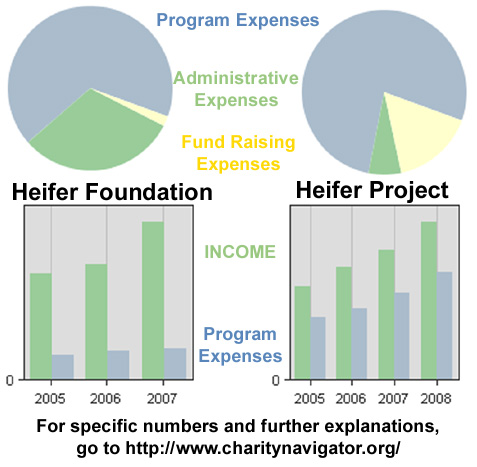
Today, Heifer gets 3 out of 4 stars from the reputable Charity Navigator, similar to the American Red Cross.  More precisely, Navigator rates Heifer at 55.25, the American Red Cross at 54.6.  This is pretty good on the slightly mediocre side.

But the Foundation is another matter.  Navigator rates that as only two stars, a numerical rating of 46.7.  Almost a third of all the funds going into the foundation are used for administrative expenses including salaries.  By then taking on some of the otherwise administrative expenses that would be required to run Heifer, the Foundation takes the hit and lets Heifer get another star.

This is clever, and deceptive.  It should be a warning to those who give that the organization is unable on its own merits to attain what it feels is an acceptable level of accreditation.

Heifer is a very secretive organization, held very tightly.  That’s probably one of the reasons that Forbes and the Gates Foundation like it.

On May 21 of this year, the CEO of Heifer resigned amid a scandal that even until today has not been revealed.  The details are still with a sealed grand jury in Arkansas.  The rumors are that then CEO Janet K. Ginn was forced out of her position by the Heifer board for some sort of plagiarism. That’s all we know as reported in Little Rock newspapers, and it remains an unsubstantiated rumor.  But the Heifer Board has refused to deny it and Ginn’s attorneys are refusing to let her say anything.

It could be something really unrelated to the mission or work of Heifer, but that we won’t know until it goes to trial.  And if Ginn settles, we might never know.

Personally, I come down very hard on attempted charities for Africa.  I have worked and lived there for too long to have come to any conclusion except that things are getting worse in Africa.  So whatever the world has been doing has not been right, or mattered.

What is “right” is a much more complicated issue, but it begins not with a small donation and a checkbook, but with government to government actions.

Governments, ultimately, are accountable.  Heifer seems to be trying to avoid accountability.

HeiferRatings

Obama is losing Kenya

Obama is losing Kenya

The tide of Obamian Mistrust is cresting in Kenya like the El-Nino floods.

Just as at home in the U.S., the lust for change that swept Obama into office is coming to a head in Kenya.  But in Kenya the ramifications are much more immediate than in the U.S.

Last week the World Court at the Hague, in the person of UN Under Secretary Ocampo, announced that it would begin unilaterally to prosecute those responsible for the violence following the 2007 elections.

The Kenyan population was ecstatic. “What took them so damn long?!” shouted a letter writer in last Sunday’s Daily Nation newspaper in Nairobi.

What the letter writer meant was that the trials of those responsible were already to have begun – indeed, already ended!  This according to the agreement that Kenyan leaders signed in February, 2008.

What took them so long was the “diplomatic process.”  More than any other outside player, the U.S. has been actively trying to move Kenya’s leaders to implement the agreement which ended the trouble in December, 2007.

But it’s way too slow for Kenyans:  Just as at home in the U.S., where health care reform is morphing from the hopeful electricity in hundreds of thousands of American youth at rallies when Obama won, to the stuffy hyperbole of thick books about failed revolutions.

If the current political leaders in the U.S. and Kenya think that they can hide behind the umbra of “necessary time”, they are dead wrong and especially in Kenya.

Unlike the U.S. where the citizens are very polarized today — arguably the reason reform is being held up here — in Kenya citizens are united.  They hate their government, despise corruption and speak with unanimous condemnation.

There is not a single poll, single nongovernment group, old or young, which currently supports the government.  There are five Nairobi newspapers all shouting for instant reform.  Not even the old KTV television station — originally set up by the government — now supports the government.

But the U.S. and its institutionalized allies are moving Kenya at the same speed their governor is set at back home.  At home it means simply that reform won’t happen.  In Kenya it will cause massive destruction within the next few years.

Twenty months after an agreement was thrust on the despised Kenyan leadership by a reluctant U.S. and U.K. — which mandated a new constitution and prosecution of those responsible for the horrific violence — little has actually happened.

The U.S. has done everything within the realm of “established diplomacy” to move things along.  And that’s just the problem.  These are not times for established diplomacy.  Established diplomacy led to the Rwandan genocide and is the main reason there were 130,000 displaced persons in Kenya after the 2007 elections.

The U.S.’ most recent move, which I applauded in earlier blogs, was to bar 15 Kenyan leaders from visiting the U.S.  But Secretary Clinton refused to make the names public.

Here’s what Rob Jillo, of Nairobi’s popular Capital FM radio station said about that:

“To the US, I can only say to them that Kenyans feel that your travel bans are a mockery; they should make the name or names of banned individuals public so that Kenyans can hold them accountable and deal with them by naming and shaming them. They should also assist the country in repatriating monies held by these corrupt individuals and anti-reformists in overseas accounts.

“Mr Ranneberger [the U.S. ambassador to Kenya] and lately Mr Johnnie Carson’s [U.S. Under Secretary for Africa] source of irritation has always been the slow nature of reforms in the country. If we want to be in-charge of our destiny then speed up the reforms.”

This is not a time for politeness, in the U.S. or Kenya.  Playing by the old rules in the U.S. simply ensures the status quo and it will be at least a generation before genocide occurs on U.S. soil.  But in Kenya, the trigger is set: December, 2012.

If total and complete reforms are not in place by the next scheduled election, modern Kenya will end in a bloodbath.

Where Terror was Born

Where Terror was Born

As the situation in southern Sudan stabilizes, neighboring Congo-DRC grows more unstable than ever.
kidsoldier.zaire
There is a long and fragile road to travel before next year’s independent referendum in southern Sudan which is likely to create a new and more stable country, but for the time being it looks peaceful.

And so it seems that some of the troublemakers have moved west. Yesterday, the UN reported more than 7,000 refugees fleeing out of the DRC at its northwestern border into Congo-Brazzaville. There has rarely been trouble here, in this area much closer to the capital of Kinshasha than the troubled Kivu province far to the east.

The Congo-DRC, formerly Zaire, never achieved real stability after the CIA assassination of its first democratically elected president, Patrice Lumumba, in 1961. Literally every day since then for nearly a half century this second largest country in Africa has been without a unified government, unstable and at war.

If ever there has been a society whose grandfathers were soldiers for life with children who were soldiers for life with grandchildren who now seem to becoming soldiers for life, it’s the Congo-DRC.

The area of greatest turmoil has until now been the eastern Kivu Province which borders Zambia, Tanzania, Burundi, Rwanda, Uganda and The Sudan. This is because it is so incredibly mineral rich, from precious tungsten to uranium.

These precious metals have come into your cell phone straight from this darkest spot in Africa, and your payments for minutes have bought AK47s, missile launchers and jeeps.

The longest stretch of this northeastern and eastern border is with The Sudan, mineral rich with oil. There’s really been no border here. This black hole on the continent has been the greatest den of iniquity Africa has ever seen.

During infrequent moments of peace in the 1980s when I guided tours through Kivu, I bought charter air flights from mercenary sanction busters flying usually from Israel with light military equipment aboard. Most of the pilots as I remember were from Denver. Most of the military equipment had stamps on them from Seattle.

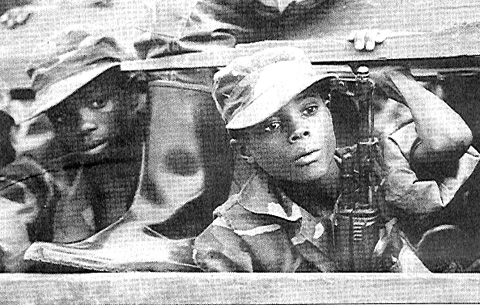
This was the area where the Lords Resistance Army arose, where children were kidnaped and drugged then turned into killers.

It’s pretty far from Darfur, but in that whole long area northwest to Darfur it has been lawless and terrifying for three going on four generations.

Now that a generation of diplomatic efforts might be paying off in The Sudan, the Congo-DRC becomes the last haven for the African rebel with his assorted SAM missiles, refurbished Humvees and millions of rounds of ammunition.

The Congo is becoming a set for Bruce Willis, which is apt since this all started during the early days of the Cold War when America was worried that a democratic process in the Congo was turning communistic. Belgium gave the U.S. an important assist in crowning the terrifying dictator, Mobuto Sesi Seko, after assassinating the election victor, Tshombe, in 1961.

Mobuto held the republic together with terror, but never completely. As he was dying of cancer he was dethroned, and the so-called democracy which replaced him in 1997 has never taken root. Around the developed areas of Kinshasha it is fair to say a more reasonable society has emerged, but in the boondocks of this massive country all hell reigns supreme.

The Belgium parliament apologized a number of years ago and awarded sizable reparations. The U.S. never has apologized.

The moment’s current crisis shows that as peace progresses in The Sudan, the born African rebel is moving next door. And while destruction spreads west through the country like the cancer that eviscerated Mobutu, Kivu remains bloody, with 18,000 ineffective UN peacekeepers.

UN peacekeeping chief Alain Le Roy said Sunday that the U.N. would immediately cease support of the Congolese army’s 213th Brigade in Kivu. Le Roy said the U.N. believed the unit had killed at least 62 civilians in the Lukweti area, some 50 miles northwest of the regional capital of Goma.

This is where I used to guide tours. It’s where there were mountain gorillas, millions if not billions of neon-colored butterflies flitting into beautiful jungles, pygmies and giant waterfalls. Today, a generation later, none of these exist.

Human Rights Watch describes an August attack in Kivu in which it said soldiers decapitated four men and cut off their arms. They then raped 16 women and girls, including a 12-year-old girl, later killing four of them. Researchers also found that many of the more than 500 victims were women, children and the elderly.

Africa was not like this before the white man showed up, despite racist attempts to paint early internecine tribal battles as “wars.” War came with machine guns, not machetes. Most of the world’s weapons in Africa today were manufactured in the U.S., sold through Russia and distributed by Israel.

This is where terror was born. And now we fight it in New York.

Jogging on safari?

Jogging on safari?

From LeslieK463@

Q.    We are a very active couple and want to go on safari, but don’t like the idea of spending the whole time in a vehicle.  Can we jog around sufficiently?  Do most places have a pool?

A.    The short answer to your question is that you should do your safari in South Africa.  The reason for this is that in most of the safari destinations (including most of those in South Africa) the kind of activity you enjoy simply isn’t possible.  You will be most of your time in a car.  But if you go to South Africa, you’ll be able to intersperse a few days on safari with all sorts of other touring which will let you be very active.  Think of a safari in South Africa as similar to visiting Yosemite.  There are many great roads in Yosemite where you can’t get out of the car in order to see the elk and bears, but the next day you can hike in the mountains all day, or take a quick trip into San Francisco.  That exists in South Africa, but in virtually no other country with safaris.

Once on safari, no, you can’t leave the vehicle often.  And no, you can’t jog outside the perimeter of the lodge/camp, and there are plenty of reasons for this.  Read my blog on April 30, 2009: “Elephant Suit”.  But yes, many of the better places have pools.

WEARY of OBAMA

WEARY of OBAMA

Africa is growing weary of “the change” promised by Obama yet to be realized. Here is one reason.

This is really more a story about America than Africa, but one of the reasons I think everyone should develop a passion of things foreign is to learn what the world thinks about us. These perspectives on the other side of the mirror usually reveal a lot about ourselves.

Obama’s election was greeted in Africa with as much euphoria as in the United States. There was a real hope that he would change America’s manhandling foreign policy, be more respectful of the smaller and weaker. Time is running out, and actions are now speaking louder than hopes.

Yesterday, the U.S. House of Representative overwhelmingly slapped the face of the rest of the world. It was nothing more than an insult, and ever the more stinging because it went so unnoticed in the U.S. But in Africa it was literally on the front page of nearly every major newspaper.

By a vote of 344-36, the House condemned the United Nation’s Goldstone Report and specifically asked Obama to vigorously oppose it.

To much of the rest of the world, and to Kenya in particular, this was an important report from a powerful UN body. The report was commissioned by the Security Council after the war last year between Israel and Hamas.

The commission was chaired by Judge Richard Goldstone of South Africa, one of the most respected jurists in Africa. Goldstone was instrumental in South Africa’s Truth and Reconciliation Commission and integral in the development of the UN Tribunal set up to investigate the war crimes in Rwanda.

The report condemned both Israel and Hamas for human rights violations during the war. It could not have been more neutral. It also seems to be completely true and factual.

The House vote came on the same day that Jose Antonio Ocampo, a UN Under-Secretary, announced in Nairobi flanked by Prime Minister Odinga and President Kibaki, that the World Court was going to take matters into its own hands and investigate Kenyans who were accused of crimes against humanity in the 2007 election violence.

According to Fred Abrahams of Human Rights Watch, ”The 344 [House] supporters have apparently not read the report. The 574-page document records violations of the laws of war by Israel, Hamas and other Palestinian armed groups, and concludes that all sides committed war crimes and possible crimes against humanity.”

This unnecessary and effectively pointless action by the House contributes to a feeling around the world – and especially in Africa – that Obama is too weak to change the behemoth of America.

The language of the resolution was offensive, terming the report as “irredeemably biased and unworthy of further consideration or legitimacy.”

The bill, introduced by Reps. Ileana Ros-Lehtinen (R-FL) and Howard Berman (D-CA), the ranking member and chairman, respectively, of the House Foreign Affairs Committee, calls on President Obama and Secretary of State Hillary Clinton “to oppose unequivocally any endorsement or further consideration of the report.”

Ros-Lehtinen and Berman were in Jerusalem a day earlier attending a conference on reinforcing U.S.-Israeli ties.

Of the 36 votes against Wednesday’s resolution, only three came from Republicans.

Speaking with rationality, Rep. Keith Ellison (D-MN), spoke out against the resolution. “This is a mistake. The stance of this Congress will erode U.S. credibility in the post-Obama world, and it will tarnish our commitment to the principle that all nations must be held to the same standards,” he said.

“We stand for the values of democracy, truth and justice. There is no reason for Congress, Israel or any other party to fear an honest judge,” he added. “Richard Goldstone is such a judge, and his report should be studied, not dismissed.”

Those who voted in favor of the resolution were:
Aderholt, Adler (NJ), Akin, Alexander, Altmire, Andrews, Arcuri, Austria, Baca, Bachus, Barrow, Bartlett, Barton (TX), Bean, Berkley, Berman, Berry, Biggert, Bilbray, Bilirakis, Bishop (GA), Bishop (NY), Bishop (UT), Blackburn, Blunt, Boccieri, Boehner, Bonner, Bono Mack, Boozman, Boren, Boswell, Boyd, Brady (TX), Braley (IA), Bright, Broun (GA), Brown (SC), Brown, Corrine, Brown-Waite, Ginny, Buchanan, Burgess, Burton (IN), Butterfield, Buyer, Calvert, Camp, Campbell, Cantor, Cao, Capito, Cardoza, Carnahan, Carney, Carter, Cassidy, Castle, Castor (FL), Chaffetz, Chandler, Childers, Chu, Cleaver, Clyburn, Coble, Coffman (CO), Cohen, Cole, Conaway, Connolly (VA), Costa, Costello, Courtney, Crenshaw, Crowley, Cuellar, Culberson, Cummings, Davis (CA), Davis (IL), DeGette, DeLauro, Dent, Diaz-Balart, L., Diaz-Balart, M., Dicks, Donnelly (IN), Doyle, Dreier, Driehaus, Edwards (TX), Ehlers, Ellsworth, Emerson, Engel, Etheridge, Fallin, Fattah, Flake, Fleming, Forbes, Fortenberry, Foster, Foxx, Frank (MA), Franks (AZ), Frelinghuysen, Fudge, Gallegly, Garrett (NJ), Gerlach, Giffords, Gingrey (GA), Gohmert, Gonzalez, Goodlatte, Granger, Graves, Grayson, Green, Al, Green, Gene, Griffith, Guthrie, Hall (TX), Halvorson, Hare, Harman, Harper, Hastings (FL), Hastings (WA), Heller, Hensarling, Herger, Herseth Sandlin, Higgins, Hill, Himes, Hinojosa, Hodes, Hoekstra, Holden, Hoyer, Hunter, Inglis, Inslee, Israel, Issa, Jackson (IL), Jackson-Lee (TX), Jenkins, Johnson (IL), Johnson, Sam, Jordan (OH), Kagen, Kanjorski, Kennedy, Kildee, Kilroy, Kind, King (IA), King (NY), Kingston, Kirk, Kirkpatrick (AZ), Kissell, Klein (FL), Kline (MN), Kosmas, Kratovil, Lamborn, Lance, Langevin, Larsen (WA), Larson (CT), Latham, LaTourette, Latta, Lee (NY), Levin, Lewis (CA), Lewis (GA), Linder, Lipinski, LoBiondo, Lowey, Lucas, Luetkemeyer, Lummis, Lungren, Daniel E., Mack, Maffei, Maloney, Manzullo, Marchant, Markey (CO), Markey (MA), Marshall, Massa, Matheson, Matsui, McCarthy (CA), McCarthy (NY), McCaul, McClintock, McCotter, McHenry, McIntyre, McKeon, McMahon, McMorris Rodgers, McNerney, Meek (FL), Melancon, Mica, Michaud, Miller (FL), Miller (MI), Miller (NC), Miller, Gary, Minnick, Mitchell, Mollohan, Moore (KS), Moore (WI), Moran (KS), Murphy (CT), Murphy (NY), Murphy, Tim, Murtha, Myrick, Nadler (NY), Napolitano, Neal (MA), Neugebauer, Nye, Oberstar, Olson, Ortiz, Paulsen, Pence, Perlmutter, Perriello, Peters, Peterson, Petri, Pitts, Platts, Poe (TX), Polis (CO), Pomeroy, Posey, Putnam, Quigley, Radanovich, Rangel, Rehberg, Reichert, Reyes, Richardson, Rodriguez, Roe (TN), Rogers (AL), Rogers (KY), Rogers (MI), Rohrabacher, Rooney, Ros-Lehtinen, Roskam, Ross, Rothman (NJ), Roybal-Allard, Royce, Ruppersberger, Rush, Ryan (OH), Ryan (WI), Salazar, Sanchez, Loretta, Sarbanes, Scalise, Schakowsky, Schauer, Schiff, Schmidt, Schock, Schrader, Schwartz, Scott (GA), Scott (VA), Sensenbrenner, Serrano, Sessions, Sestak, Shadegg, Shea-Porter, Sherman, Shimkus, Shuler, Shuster, Simpson, Skelton, Slaughter, Smith (NE), Smith (NJ), Smith (TX), Smith (WA), Space, Spratt, Stearns, Sullivan, Sutton, Tanner, Taylor, Teague, Terry, Thompson (CA), Thompson (MS), Thompson (PA), Thornberry, Tiahrt, Tiberi, Titus, Tonko, Tsongas, Turner, Upton, Van Hollen, Visclosky, Walden, Walz, Wasserman Schultz, Watson, Waxman, Weiner, Westmoreland, Wexler, Whitfield, Wilson (OH), Wilson (SC), Wittman, Wolf, Yarmuth, Young (AK), Young (FL),

Those who voted against the resolution were:
Baird, Baldwin, Blumenauer, Boustany, Capps, Carson (IN), Clarke, Clay, Davis (KY), Dingell, Doggett, Edwards (MD), Ellison, Filner, Grijalva, Hinchey, Johnson, E. B., Kilpatrick (MI), Kucinich, Lee (CA), Lynch, McCollum, McDermott, McGovern, Miller, George, Moran (VA), Olver, Pastor (AZ), Paul, Price (NC), Rahall, Snyder, Stark, Waters, Watt, Woolsey,

Those abstaining:
Abercrombie, Ackerman, Bachmann, Barrett (SC), Boucher, Brady (PA), Capuano, Conyers, Davis (AL), Davis (TN), Deal (GA), Gordon (TN), Gutierrez, Hall (NY), Holt, Meeks (NY), Murphy, Patrick, Nunes, Pallone, Pascrell, Payne, Pingree (ME), Price (GA), Sánchez, Linda T., Sires, Souder, Stupak, Towns, Velazquez, Wamp,
MUGSHOT REVEALED!

MUGSHOT REVEALED!


Kenya’s Attorney General is the first name publicly revealed from the secret U.S. list of the most responsible for Kenya’s violence and instability.

As I reported here last month, Secretary of State Hillary Clinton jetted into Kenya with two other high powered diplomats to warn Kenya that they were dragging their feet on promised reforms, including a new constitution that would facilitate the next election in 2012 and before that, bring to justice those responsible for the deaths and displacements of the 2007 election.

With the imminent arrival of the United Nations Under-Secretary, José Antonio Ocampo, naming the culprits has moved from a parlor game to high politics. Ocampo is widely expected to tell Kenyans that the UN is unilaterally assuming the prosecution of those responsible for the 2007 violence, very much as it did for the Rwandan genocide.

Clinton delivered a series of letters designating 15 unnamed persons in Kenya whose visas would be revoked to the United States, because of their obstruction of reform or presumed culpability in the 2007 catastrophe.

I suggested that Amos Wako was one of them, Kenya’s Attorney General for the last 18 years. Today Wako held a news conference to confirm that he had been so named and that he intended to sue Clinton in American courts.

Wako is obviously running scared, as he should be.

Travel to the United States is not simply for diplomatic purposes. Most of these big shots hold significant property in the United States, send their children and grand children to U.S. universities, and park most of their illicitly gained money with American banks.

Denying a mobster entry into the Deli and forbidding him his pastrami sandwich is about as close as you can get to putting him in jail. None of these idiots wants to remain in Kenya once their antics are disclosed. None of them probably wants to come to the U.S., either, but it will take a couple trips to the U.S. to get their affairs in order.

Now, Wako is barred.

Hopefully, this is going to shake things up a bit in Kenya.

Toxic Golden Goose!

Toxic Golden Goose!

Tanzania is Africa’s 3rd largest producer of gold and important producer of diamonds, but corruption is ruining the industry and the environment. PS: they’ve found uranium.

Yesterday an “inter-faith” nongovernment group near the rich gold, nickel and now uranium mines near Lake Victoria published a report claiming that the Mara River was now toxic with mine effluents.

The group which remains nameless for obvious reasons had taken the matter into its own hands after the government refused to act on a January directive by Parliament to “clean up the mines.”

This was no high school lab experiment. The study was funded and overseen by the Norwegian University of Health Sciences, which lent its name and credibility to the conclusion that the Mara River now carries high concentrations of toxic heavy metals at levels far above World Health Organization (WHO) standards.

The group laid the blame squarely on the Canadian owned North Mara Gold Mine. The Tanzanian government has demurred, so to speak, by admitting that the security at the mine is too lax to protect items like storage tanks and other hardware regularly stolen. The implicit argument is that these items are then poorly handled, allowing for ground water contamination.

(The area of toxicity is down river from the Serengeti National Park, so presumably not a threat to the national parks.)

According to members of the inter-faith committee, the study was conducted in seven villages after the unexplained deaths of 17 heifer cattle and six abortions between May and August.

Friday, notably only a few days before the release of this report, Toronto CEO of Barrick Gold Corporation, Aaron Regent, said that the Tanzania mines would be sold off.

He called the North Mara mine “troubled.”

I think it is troubled by more than toxic metals.

According to the London think-tank, Companies And Markets, Tanzania’s mines should be among the most productive on earth, but instead are falling far short of their economic value.

A 2008 report from the Business & Human Rights Resource Centre estimated that the combined loss to the country over the first seven years of the decade was more than $US400 million!

What?! Mine gold and diamonds and lose a half billion dollars?

The report claimed the loss was a result of low royalty rates, unpaid corporation taxes, and tax evasion by major gold mines.

Regent, on the other hand, insists the Canadian company has paid all taxes and royalties.

So where did one half billion dollars go?

When is the best time for Samburu?

When is the best time for Samburu?

From angie@

Q.    When is the best time to visit Samburu and the northern frontier areas, like Laikipia?

A.    These beautiful areas just west and further north of Mt. Kenya include two actually different ecological zones, and so the answer is just a bit different depending upon which zone you have in mind.

The southern and western portion, commonly referred to as Laikipia, is still at a fairly high altitude, ranging from around 6,000′ (Ol Pejeta) to 4,500′ (Ol Mukutan).  This zone is divided from the much larger which includes Samburu by a steep escarpment, and everything in this much larger zone is much lower, around 2,500′.

Both areas are semi-arid, very similar to much of America’s southwest.  Most of the year it is dry, and when the rains come (late March and again in November), the desert plants like a variety of cactus and heavy-wooded bushes bloom spectacularly and it transforms in a very short time from a sort of brownish, wind-swept area into a vertible Garden of Eden.

So for both zones if you’d like to see the area at its prettiest, and when many of the birds are at their peaks, then travel just after the rains begin, either in late March or mid- to late November.

Animal viewing is great in these areas year round, but it is better during the dry seasons.  This is particularly true of the southern zones, where several important rivers (like the Ewaso Nyiro through Samburu) concentrate huge amounts of game.  But if you are traveling to the southern zone (Samburu, Shaba, Buffalo Springs and the Mathews Mountains) too long into the dry season and even the animals start to disappear, because these rivers dry up.  So for the southern zone for game viewing I recommend December, January and the first half of February; or July and August.

The northern zone is less effected by the dry season because of its higher altitude.  And so for places like Lewa Downs, Sweetwaters, Borana, etc., there is a wider window for good game viewing: December – March, and July – October.

New Malaria Vaccine

New Malaria Vaccine

A malaria vaccine for children will be available by 2015. It’s no magic bullet but a significant step in the continent’s attempt to prevent its second greatest killer.

At a conference today in Nairobi more than 1500 medical specialists were told by scientists from GlaxoSmithKline (GKS) that the clinical trials of their RSS,S children’s malaria vaccine were now sufficiently successful to begin plans for commercial production.

Clinical trials of an earlier version of the vaccine (whose common name is Mosquirix) never achieved an efficacy greater than a 35-49, troubling as much by its variation as under low rating.

But the revised vaccine has reached a consistent 53 efficacy coefficient, which most scientists consider adequate for use in public health initiatives.

(GSK is also the owner/manufacturer of several currently used adult malarial prophylactics, including Malarone. Malarone remains the most widely used malaria preventative by tourists, and according to GSK has a efficacy coefficient of more than 90.)

The vaccine works only with very young children. Those in the worldwide trial groups are between 6 and 12 weeks old. It is a revolutionary vaccine as it is the first ever to target a complex parasite rather than a bacterium or virus.

There are no studies yet published to indicate once protected infants mature whether the vaccine will continue to work. Some skeptical critics fear that the public health burden of malaria will simply shift upwards in the age populations of Africa.

Nevertheless scientist are generally agreed this is a major achievement.

“There is enormous excitement at reaching this milestone,” Dr Joe Cohen, one of Mosquirix’s inventors said in prepared remarks at the Nairobi conference. “Just a few years ago the idea of a malaria vaccine entering final phase three trials would have been unthinkable. It’s a tremendous breakthrough.”

One of every five childhood deaths in Africa is due to malaria. A young child dies of malaria in Africa every 30 seconds. The group of scientists gathering today in Nairobi estimated that more than $12 billion in public health costs will be saved once the vaccine is regularly used.

The vaccine was actually first manufactured more than 20 years ago but has taken 20 years of careful reconstitution to reach an acceptable efficacy coefficient.

According to the World Health Organization:

• There are four types of human malaria: Plasmodium falciparum, Plasmodium vivax, Plasmodium malariae and Plasmodium ovale. More than 90 per cent of cases are caused by falciparum, the most destructive malaria parasite, found mainly in Africa.

• The common first symptoms — fever, headache, chills and vomiting — usually appear 10 to 15 days after a person is infected. If not treated promptly with effective medicines, malaria can cause severe illness and is often fatal

• The disease accounts for about 40 per cent of public health spending in sub-Saharan Africa.

Ban The Ivory Ban?

Ban The Ivory Ban?

The next meeting of CITES in March will be a crucial one. So far only 21 of the treaty’s 175 country signers have joined Kenya to support a ban on further sales of ivory.

Not even Tanzania has yet joined the Kenyan coalition. This is extremely bad news for elephant conservation.

Kenya, the United States and the International Union for Conservation of Nature (IUCN) were the original three creators of CITES, drafting the 1973 world treaty. But it took 16 years of subsequent diplomacy to get the constituent countries to agree to an ivory ban.

During that 16 years, according to the KWS, Kenya’s elephant population fell from 167,000 to less than 16,000: more than a 90% decline. And it was entirely from poaching.

In October, 1989, CITES officially placed elephant in “Appendix I” of the treaty, banning any sale of any elephant product, including of course ivory. That and the aggressive moves by such countries as Kenya saved the world’s dwindling elephant population.

The Kenya Wildlife Service (KWS) made American network news on Saturday, July 18, 1989, when it set to fire a pyre of $1 million worth of confiscated ivory, at the time more than 12 tons.

On July 14 of this year, 2009, KWS officials confiscated an equivalent $1 million worth of banned wildlife products that were connecting through Jomo Kenyatta Airport from Mozambique, addressed to the Xaysavang Trading Export Import Company Limited, Vientiane, Laos.

But this $1 million wasn’t 12 tons as in 1989, but only 600 pounds of ivory and 45 pounds of rhino horn. An expected but unfortunate result of the success of CITES has been to increase the value of such banned products.

“Since Mozambique has no rhinos and few elephants we suspect the trophies were illegally poached from neighboring countries and transported to Maputo by road,” said KWS Director Julius Kipng’etich.

“We will be doing a DNA to determine where the elephants were illegally poached from but it is highly possible it was in Tanzania, Namibia, Zimbabwe or South Africa,” Mr. Kipngetich continued.

None of these countries has yet joined Kenya in support of a continued CITES ban.

Still less than two-thirds the size of the continent-wide population in the 1950s (the Kenyan population stands at 32,000), elephant numbers have increase robustly since the CITES ban. Countries where poaching was little of a problem, like South Africa, want now to be able to sell their huge warehouses of harvested ivory, most of which has come from normal deaths or scientific culls.

In 1997 as poaching seemed to be on the wane, CITES downgraded elephant from “Appendix I” to “Appendix II”. This allows a “limited trade” in ivory. Kenya and other conservationist-oriented countries successfully stalled this implementation with endless proposals to define exactly what “limited trade” would be.

Kenya felt successful under the circumstances, and only five date certain sales subsequently occurred of warehoused ivory, mostly from southern African countries. All were auctions to Asian traders.

But following each of these auctions, conservationists insisted that poaching became resurgent, threatening populations where poaching is still a threat, such as in Kenya.

Then in 2002 came one of the greatest political blows to elephant conservation, and out of the blue, and from one of the original three creators of CITES: the United States.

At the 12th conference of CITES in Santiago, the Bush administration proposed an amendment to the treaty that would further erode its enforcement.

The conference was stunned. In fact even the U.S. delegation to the conference was stunned.

The day before, on November 4, the head of the U.S. delegation, Assistant Secretary of the Interior, Judge Craig Manson, supported the ban strongly in his opening remarks, saying that the United States “remains concerned regarding any resumption in this trade because of potential effects on elephant populations and ongoing monitoring efforts.”

Somebody in Washington was listening. Manson got a call late at night. The next morning he not only reversed his position, but he actually offered an amendment to the treaty which would forbid elephants from ever being placed on Appendix I again!

The outctry was palatable. The European Union was infuriated. Kenya felt snubbed. Manson received 12,000 emails in the course of an hour and left the conference early.

The amendment was not adopted, but without U.S. support to relist elephant into Appendix I (which Manson had personally originally supported), the conference kept elephant in Appendix II.

Controlled sales of warehoused ivory, although very limited, have continued.

The three-year drought that just ended in East Africa has exacerbated the problem even further. KWS documents a “quadrupling” of elephant poaching before the drought ended this month, over the course of 2009.

In part this is because elephant began to wander far and wide from the protected reserves searching for food and water. In part it’s because so many desperate Kenyans had little to eat or drink. (Read my blog, “ANIMALS OR PEOPLE” of October 4). And in no small part it’s because of a new and larger presence of Chinese in Kenya, as that country drills for newly discovered Kenyan oil and builds new roads with a multitude of new workers.

Kenyan authorities earlier this year impounded three tusks and deported three Chinese workers apprehended on the Isiolo/Marsabit road works. Kenya’s commitment to conservation couldn’t have been more forcefully demonstrated. Kenya needs the Chinese oil exploration; it will be a very needed boon to the country.

On hearing of the deportation of the workers, the Chinese government halted development activity in Kenya, including road works and oil drilling, for three months. It has since resumed.

But it is clear how China will vote at the March meeting of CITES in Doha, Qatar in March. And it is clear how Kenya will vote. The Obama administration has yet to announce its position.

DELUGE ARRIVES

DELUGE ARRIVES

The predicted El-Nino rains are beating East Africa and reversing the drought completely, causing mayhem anew.

Nairobi’s Standard newspaper reports now that five people swept away by running waters have been confirmed killed throughout Kenya. Two major bridges, one linking the mainland with Lamu, has been swept away, and major roads into the north are completely gone.

The seriously damaged parts of the country seem to be just outside of the tourist circuit, which is nonetheless getting significant rainfall.

But the flash floods, destroyed bridges and swept away (dirt) roads are in Kenya’s west, coast, north and far north-east. The essential center of the country, the Rift Province, is receiving heavy rainfall, but not a deluge.

In Tanzania the areas around Lake Victoria are getting drenched and heavy rains are falling elsewhere in the north, but not with the vengeance over much of Kenya.

In Uganda, areas around the capital of Kampala and the main airport at Entebbe are soaked, as is the mountainous west.

In any other year, this would be considered a blessing. But what is happening over much of the area is massive erosion and mud slides following three years of little or no rain.

The rains began as I reported two weeks ago, about two weeks early. Normally they would slowly be ending in December in Kenya and Uganda, then moderating but not ending in northern Tanzania.

BA STRIKE?

BA STRIKE?

“Fears are mounting of chaos over the busy Christmas holiday period if BA staff choose to go on strike.” – Sky News, October 28, 2009

British Airways just announced doubling the service from London to Entebbe, adding already to its impressive schedule of 14 flights weekly between Heathrow and East Africa.

All for nuts?

The heaviest season in East Africa is the Christmas season, and today started the official cooling off period after the union of flight attendants and assorted other airline workers announced it was going “to a ballot” recommending a Christmas strike.

The issue is a continuing reduction in flight staff. BA’s 747s into East Africa, for example, now carry 14 flight attendants. The legal limit is 12 by British law, and BA announced this week it would reduce to 13.

This would allow a staff reduction of about 3700 staff across all their routes, or about a 10% reduction.

BA like all the world’s airlines is in a financial crisis. The CEO calls it a “fight for survival” and has employed draconian American techniques like eliminating food on short-haul flights, giving BA the questionable distinction of being the first non-American airline to do so.

TOURISTS KILLED

TOURISTS KILLED

With sadness I must report that two tourists were killed on a Mombasa beach on October 15, but it’s extremely important to keep this in perspective.

The event has attracted enormous worldwide coverage, yet little is known. It’s very important to not jump to too many conclusions.

That isn’t because tourist deaths are not important for all of us to know, but because it represents two of the 120,000 British tourists who have visited Kenya in the last year.

If we consider the British visiting Kenya a virtual city, the percentage who have been murdered is one-tenth the murder rate of my city, Chicago.

It is also much less than the tourist murder rate in such common places as Antigua, Mexico City and even St. Petersburg. In fact two British tourists were murdered in Antigua this summer.

So while the news is very sad, these are the first two tourists reported killed this year in violent crime in Kenya.

The British Foreign Office kept the news quiet for nearly two weeks, as the couple was killed on October 15 in what British officials call a “bungled burglary.”

The statement also repeated a long warning to British beach holiday makers not to walk on the beaches after dark, but no further details were released. The Kenyan police are saying nothing.

So while the details are not yet known, and the reason for withholding the story not yet know, I’d bet that the couple tried to resist, and that led to their murder.

Reports of attempted burglaries that do not end so tragically are rarely reported, because crime in general is so high in Kenya. We learn of them rarely through the news, most often through the grapevine. There are admittedly many thefts and holdups of tourists throughout East Africa each year. But discipline to not resist usually results in little if any violence or injury.

MOB & SNOB

MOB & SNOB

What a day for Kenyan justice! Balance liberty by justifying the release of a murderer with a killer!

Fridays are fun at Kenyan prisons. The weekend is too poorly staffed by prison workers, so Fridays all sorts of fun last-minute stuff must happen.

So today two of Kenya’s most notorious inmates were released.

The last of the blue blood colonials to live in Kenya, Tom Cholmondeley (pronounced, “Chumley”), was released early after serving a manslaughter charge for killing an African who had shot an antelope on his game ranch. He was released early for “good conduct.”

This was the second African that Cholmondeley had shot for killing wild animals on his ranch. He managed to avoid conviction for the first.

And another murderer, Maina Njenga, the feared Mungiki “Chairman” (Kenyan mob), was released from bail after prosecutors were unable to proceed with charges that he had masterminded the murder of 29 people.

Mungiki Spokesman Njuguna Gitau said: “We are very happy because the chairman has been released; he is finally free after suffering for a long time.”

Twenty-one others were released with Njenga. They all skipped trial because of procedural difficulties. You see, they were all being tried in another court for other murders, so the judge decided it was double jeopardy.

Holy Moses.