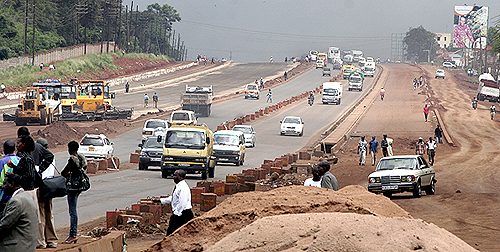
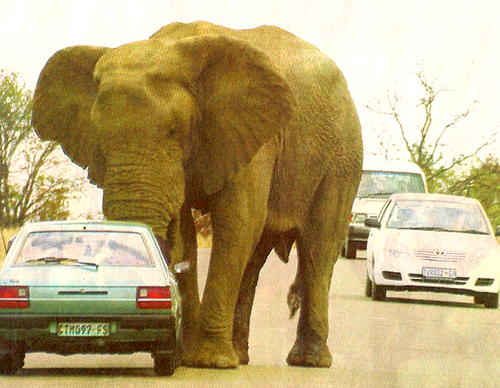
All (12-lane) roads lead to Nairobi.Three years ago China started building roads all over Kenya, including an 8-line highway between Thika and Nairobi. It’s now 30 miles of 12 lanes!
(Stop! Yes, the Kenyan wilderness away from Nairobi is still beautiful and healthy. You still will find lions in the Kenyan wilderness. Not to worry, there.)
In the few short years since the Chinese road building boom started throughout Kenya, the growth of the satellite suburbs has exploded. People saw roads finally being built (rather than the money for cement bloating the pockets of politicians) and began to realize they really could live cheaply outside the city and still work there.
It’s the same dynamic China has been grappling with for nearly two decades of incredible growth. I, for one, can’t understand how on earth it’s going to work, but I’ve heard that China is doing pretty well.
Once all these cars get to the city, what will they do?
Kenya’s main newspaper, The Daily Nation, reports 1000 new cars are being purchased to be used in the city EVERY MONTH.
I’ve written elsewhere how you have to avoid arriving Nairobi’s international airport on any weekday morning, because the traffic is so congested that it takes up to two hours to move a mere 11 miles from the airport to the city center.
That’s not going to change. The great roads that China is building simply feed into the city. There are plans for a ring road to circle away those cars not intending to come into the city, but most of them are trying to get into the city, not around it.
The city center isn’t big enough!
This seems like a massive failure of urban planning. I’ve questioned the Chinese motives, because they are combing Kenya for oil and other business opportunities. But then, again, did anyone see Shanghai recently?
Q. What do you know about south africa? worth seeing? I’m interested in Port Elizabeth up the coast to Durban. I heard there are quaint towns up the coast and that the area has the best of both worlds of Africa… coast, beautiful beaches on one side, and huge game reserves and animals on the other side. Obviously it looks like a huge area and distance between the two. but worth going? cheap? expensive? How’s the crime? Just wondering. a friend of mine wants to go to the area to swim with great whites. and then also to see the big 5. When you have time, I’d love to hear your thoughts.
A. I just watched a news report yesterday evening that said your city, Ryan, is now the murder capital of the world, with more than one homicide per day (468/month). That exceeds any rate in any South African city. Crime is very relative. I’m sure you know how to avoid getting bumped off in Chicago…
The coast east of Port Elizabeth to Durban is nicknamed the Wild Coast and has some of the most spectacular beach and country on the continent, and it reminds me very, very much of the coastline just north of San Francisco from Tomales Bay up to Mendocino. Mostly these are not good beaches for swimming, and the great whites are generally west, not east of Port Elizabeth. Much of the beach is rocky and cliff rock, so spectacular scenery but not good sand beaching. As for game, I know of only one game reserve, Kwando, that has any reputation in this area, and it pales in comparison to some of the other reserves much further east of Durban (Phinda, Hluhluwe and Umfolozi). It’s also very windy and in the hottest of times, cold. Just like San Fran. For more swimmable and sandy beaches you need to go further, east of Durban. Remember as for game, there is nothing you’re going to find anywhere in southern Africa that achieves a tenth of what we just saw in East Africa. And another rejoinder about “big game” in the south. Much of it is on private reserves that are hard to distinguish as such, but what that means is that all the animals have been trucked in, many are fed as in zoos and to some extent many are just like San Diego’s Wild Animal park. The way to tell in South Africa is to use the official South African site: http://www.sanparks.org/
After the kiss, she throws a grenade to the bridesmaids.A large midweek wedding celebration dominated the eastern Congo town of Goma, this week, for the first time in decades. Is the war over, or just getting ready to start, again?
We’ll have to go to our PlayStation3 to find out.
I have a mixture of distant nostalgia and abject fear when I remember my own adventures in Goma. Before Mobutu was gone the Congo (then Zaire) was a secretive and scary place, but once inside the forests were filled with beauty and magic. And that was the problem, you had to be a wizard to get out.
But the end of Mobutu – as horrible as he was – heralded an unprecedented era of barbarism. Mineral-rich Kivu province, the eastern slice of the Congo that lies astride Uganda, Rwanda and Burundi, became a lawless bastion of mercenaries and thugs.
Supported by the west’s desperate need for such absolutely essential things as weapons of mass destruction, Kivu went on the auction block, and the bidders were Sony, Intel, the U.S. Defense Department and a bevy of other moral-less capitalists. They all need Coltan.
According to the U.S. Geological Survey, 80% of the world’s Coltan reserves are in Kivu.
Coltan is a wizard’s brew. When refined it becomes tantalum, and shortly thereafter it becomes camera lenses, cell phones, detailed instruments for surgical implants, wires and filaments in light bulbs that last 100 times longer than tungsten and its alloys are used for jet engines, missiles and all sorts of secret, wizardry things.
I find it so heartening that PlayStation3 now uses more Coltan than the Defense Department.
According to the monitoring group, Towards Freedom, there are 1300 people that die every day in Kivu from bullets or perverse rape. The massacre is a part of the Coltan War. Whoever controls Coltan gets very, very rich.
Those who mine Coltan are abused, mostly children. Those who finally collect for the sales of Coltan often shun dollars for weapon – did you hear that? “Shun Dollars”? What do they want instead?
Guns.
It’s so remarkably convenient. The most sophisticated guns use Coltan. Is this what they call sustainable development?
Eleven years ago the world got antsy with this unusual war for PlayStations, and the UN Security Council sent in 20,000 troops to Kivu to regulate the slaughter and rape. Forget about child labor in the mines, that was beyond their mission.
It has worked a little bit. Enough that there are now weddings in Goma. Enough that the very distant President of the Congo, Joseph Kabila, has asked the UN soldiers to leave. Kabila rules from Kinshasa, more than a thousand miles away over impenetrable jungles and in a world as distant from Kivu as .. Well, as from Leaf Valley, Agar or the other supposedly mythical republics of the PlayStation worlds.
If they go, the modicum of stability in Goma will, well I think the term used in the “Modern Warfare 2 Stimulus Package” for PlayStation is , evaporize.
No pension and biodegradable.An important electricity line has just been laid in western Mozambique, crucial to the development of Mozambique’s big new Limpopo National Park.
Thanks to. Rats.
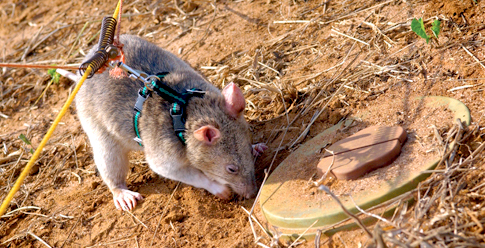
Yes that’s right. Installation had been stalled because of the huge numbers of land mines that remained in the area from the civil war. Land mines are a problem throughout much of troubled Africa, but nowhere as severely as in Mozambique.
An area of about 5000 sq. meters (100m x 50m, roughly the size of three American football fields placed end to end), was known to be full of mines, and there was no other way for the huge electricity grid to go.
The mines were known to be there, because of the skeletal remains found by the pylon diggers in the rectangular area they were to enter. The bones were from years of innocent people irregularly traveling through the remote area.
A pack of rats was let loose, identified the 32 mines in the area which were then dismantled, and the lights are on!
The giant African pouched rat is the work horse. It’s the genius work of a Belgium aid group, Apopo, with the cooperation of several organizations in Tanzania, including the army and Morogoro university where the rats undergo training.
The rat has an especially keen sense of smell. Like white rats, it’s affectionate and not aggressive, more like a bunny than vermin. Apparently it’s also quite intelligent, responding to Pavlovian training as if it were a dog. And, of course, it digs nicely.
What I find especially interesting about Apopo is that its founder and original collaborators were all engineers, those guys who look at a problem through its pieces. Traditional detection mechanisms went for the metal that the exploding powder turned into deadly shrapnel. But land mines are mostly composed of very aromatic powders (gun powder), and it was onto this principal ingredient that the geeks turned their attention.
Rats are cheap, friendly, responsive and biodegradable. AND when they step on a mine, it doesn’t go off!
Now consider this. The chief engineer, Bart Weetjens, is a practicing Zen Buddhist Monk in Belgium. It would take someone as out-of-the-box as this to create this genius scheme.
And guess what. Mines is just the first. The rats have just been trained to detect tuberculosis! Yes, and they will do so with greater success than the difficult X-Rays and chemical tests otherwise used.
iNeck Brace for Long iFlitesLast week Apple Computers filed a patent for a travel app called iTravel.
Where?
That’s something I’ve always wanted to know. I seem to be traveling so much these days if someone could just give me a device or an app for my other devices so that the first device knows where I misplaced the second device, and when it needs an update, then clearly I wouldn’t suffer jetlag so much.
Though I do see a problem with Apple’s strategy.
The app could book airlines, hotels and cars, and would be an extension of iTunes “Concert Ticket +” and would as well provide ticketless check-in using NFC (Near Field Communications) such as retina scanning or fingerprinting.
The main problem is its name. There are already several iTravels: there’s an iTravel Rental Car company in Georgia, there’s an iTravel Alarm Clock and iTravel Neck Art, and a multitude of sites already out there such as iTravel2u and iTravelsmart among many others, and then there’s iTravel Travel, a Project of Travel.
iPod already has an iTravelBag. And inside the iTravelBag for the iPod you can place the iStickUm Notem to remind yourself where you lastum putum your iPoddom.
i41 welcome them iAll. In fact given the trends in the industry I expect we will soon see iAll+.
I was fascinated once listening to a woman from China explain how she uses a computer in Mandarin. There are 5000 basic characters in mandarin and obviously not 5000 keyboard keys. But by typing the English equivalent of the phonetic counterpart of the character, the character then appears. Meaning is achieved when enough characters emerge strung together.
So there is this labor (finger bashing) intensive midstep process of creating meaning through creation of the character phonetically. When I asked her if this isn’t a bit stressful, she raised her left index finger, touched the top of her ear with her right little finger, stuck her elbow out at me and looked slightly up.
i41 wood gate up mixed.
But anything that improves the direction of my travel is much appreciated.
Kristin Shea wrote:
I’m planning a trip to East Africa from the beginning of Sept through end of November this year. I’d like to incorporate seeing the Mountain Gorillas, along with volunteering and sightseeing in Tanzania. Two questions: 1) What is the ideal time to see the gorillas? & 2) Can you recommend any volunteer opportunities in Tanzania or Rwanda? I’m a teacher and would like to lend a hand while back there. Thanks!
A: The mountain gorillas live in the “rain” (intentionally bracketed!) forests of East and central Africa, so it rains a lot. But there are seasons when it rains less than more, and if your schedule permits, that is probably the best time to go. But before I tell you what those seasons are, I think you need to think of what else you’ll be doing, and what your own schedule permits, because even in the season of “less” it could be raining hard! So to the answer: normally it rains most in April, May and from mid-November to mid-December. (Not so this year, by the way. It rained most in March!) The point is that it rains so much, that ought not be as important a consideration as the other things you’re doing… As to volunteering, there are several tour companies which promote volunteering, but I don’t like any of them. What I suggest you do is go to the source. Find a school that offers the discipline that you teach back at home and contact them directly. Finding a school is easy and with that I’ll be happy to help. Send me another email and we’ll get you going!
Kristin wrote back on 14May:
Amahoro has been referred to me and I’ve researched them…They seem great. My concern is that I’m traveling by myself and & I’m wondering if there’s a recommended tour company that would let me join a group. Any thoughts?
Based on your advice, I’m researching direct volunteer opportunities in the Arusha area. There is a hostel there that I’ll use as a back-up plan. If you know of any elementary schools or orphanages that are in need of volunteers, please pass along their info to me. Thank you!!!!
A. Amahoro is a good company, you’re in good hands. I wouldn’t worry about joining a group, because a gorilla trek is by government rules a group of 6-7 people with one guide. So whether you arrive alone or not, you’ll be automatically teamed up for the actual trek.
August and part of September is a school holiday month in most of East Africa and the term that begins in September is a critical exam study month for all children matriculating at the end of the year, so you’re going to find many administrators loathe to take on a volunteer, then. However, there are many private schools that have a slightly different schedule and dozens of orphanages that integrate schooling into their facility. When contacting these people, it’s very important that you sell yourself with your own training and background. This may sound strange, since you’re volunteering, but the fact is that now there may be too many outsiders trying to volunteer these days, so like any position in which you’d like to intern, you have to sound valuable. In the old days, just offering to volunteer was enough; absolutely not so, anymore.
Jim,
Long time since we spoke. My son, Mike is going to Africa and we were talking about malaria meds. When we traveled with you, many years ago, you gave me the name of a med I bought in London as the current US brand caused nightmares. Is that still the case and what do you now suggest is the best?
A: Lariam is the drug you’re recalling, and yes it’s still available and widely prescribed, and yes, I still suggest you look for something else. My own personal experience and that of many colleagues is that it just produces too many side effects. On my last two safaris, in fact, people who were using it reacted so badly both stopped using it in the middle of the safari, which isn’t good. Once you start a malaria prevention regimen, you ought not in the middle stop or switch.
There are other options, but I can’t recommend one over the other because it depends very much upon the medical health history of the person involved. It’s really absolutely something that you should see your personal physician about.
Can't remember. Was he born here?
A single case or two of corruption brought down the Kenyan election. But the recently ended UK election, like the notorious Bush/Gore election, was riveted with irregularities.
Daniel Hannan, a Conservative MP for South East England since 1999, and winner of the Bastiat Award for online journalism, writes in his blog that this week’s UK elections were corrupt and therefore inconclusive.
He posits “how much easier electoral malpractice has become in the United Kingdom than in the two banana republics where I have been an election monitor.”
He claims that “Many people were denied a vote.”
And while Hannan looks from the inside out, there were plenty who saw the same thing from the outside in.
Election monitors from the Commonwealth Countries have been fairly unanimous in criticizing the results as unfair, inconclusive and flawed.
Kenya’s Ababu Namwamba of the election commission told UK newspapers, “The allegations of fraud and of voters being turned away threaten the integrity of the vote, especially in marginal constituencies where candidates have a majority of less than 1,000.
“The number of seats the Tories needed for an absolute majority is not that high — this could have made the difference. One candidate told me that the British system is possibly the most corruptible in the whole world,” Namwamba added.
Marie Marilyn Jalloh, an MP from Sierra Leone, added: “There has to be doubt over the legitimacy of the result… [The UK] system is a recipe for corruption; it was a massive shock when I saw you didn’t need any identification to vote.
In Sierra Leone, as in Kenya, voters must present an identity card corroborated by finger prints.
Even observers from places where elections have not been so contested criticized the process. Lisa Hanna, an MP from Jamaica, said: “I was shocked by the lack of checks.”
I dare say that the difference between Brown, Clegg and Cameron is much less than Gore and Bush, although the British may see that differently. But frankly I feel the difference between Gore and Bush was much greater than between Kibaki and Odinga, the two contentious rivals in the Kenyan election of 2007.
And in all three contests, the results were so close that even isolated acts of corruption or inadvertent irregularities could conclusively effect the outcomes.
What does this mean?
For a moment, let’s presume that some system could be put in place that would assure there were no irregularities … not one.
And let’s also presume that like the Dutch, institutions were in place to make everyone vote (the Dutch give out parking-like tickets to offenders who don’t vote).
It would still be close. Do you think that those who lost would concede so easily?
No, of course not. I happen to have been on the aggrieved side of the Bush/Gore outcome: I believe the world would have been a happier, more peaceful place if the results had better reflected the actual outcome.
But would I have conceded had the results been flipped? Would I have allowed the will of my community to proceed to waging decades of what I considered immoral wars? Or would I have sustained an outcome that I might in my inner conscience known was unfair? In order to “save the world from war.”
Elections work only when both outcomes are at some level acceptable to all sides. When compromise, however stinging, works.
Compromise in the world doesn’t work, today. That means elections won’t work. I’m not sure why, but the whole damn world is too polarized for elections, even incorruptible ones.
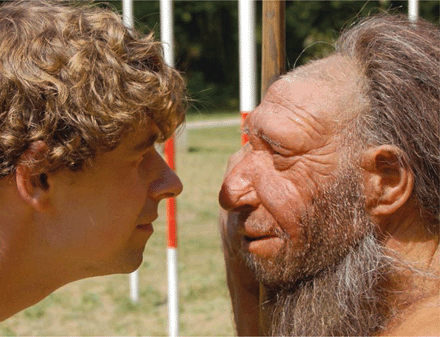
Representation by Tomislan Maricic in SCIENCE.Neandertal weren’t wiped out by us barbaic humans. They’re are one of our great-great-great, great-great-great? or something grandparents!
Between a hundredth and a twenty-fifth of those of us non-Africans is Neandertal! (Modern Africans as a race have little or no Neandertal DNA.)
The report issued today in Science radically changes our view of ourselves. It was only one year ago this week that Sarah Tishkoff of the University of Pennsylvania reported that essentially all people alive today were more or less pure ancestors of a small band of hominins that crossed over from Africa 50,000 years ago.
Not necessarily so.
Quite likely that band prospered, moved north and interbred with another type of hominin, the Neanderthal. Or maybe that band went extinct or was absorbed by a group of hominins already living in Europe that had already interbred with Neandertal!
Maybe… Neandertal and we, homo sapiens, are one and the same species, after all?
This is great, joyous science! How different, for example, it is from the secretive, arrogant paleoanthropology of Ardi announced not too long ago.
This is open to us all, to the world, and it is breath-taking!
At this point I should direct all of you not to the report itself, but to those brilliant and affable scientists who can translate it into terms we can all understand. There are many of these wonderful individuals, but my favorite is the University of Wisconsin’s John Hawks.
Today’s report in Science is probably the most exciting research on close-to-modern hominins ever seen. And not a single element of that report came from the field.
It all came from… DNA.
You remember that the human genome project started in 1990 and took about 13-14 years to complete, and that by 2004 we had a nearly complete working blueprint of our genes.
They did it with Neandertal in about two years. The Max Planck Institute mapped the genome of Neandertal from five species found in Europe from a bone powder weighing less than an aspirin.
To come to the amazing conclusions they did, they had to compare the Neandertal genome not only to our genome, but also to chimp’s.
And by simultaneously looking at the sections of the Neandertal and modern man genome that differ from a modern chimp’s, the most groundbreaking science was achieved: some of us modern humans have more divergence from Neandertal DNA than others. Modern Asians carry more Neandertal DNA than modern Africans.
That means our common modern human ancestors, the guys who previously we thought wiped out the Neandertals when they met them… didn’t. They absorbed them into the population and probably before migrating east to Asia. (There’s no evidence, yet, that Neandertals got themselves to Asia.)
The report also took a first look at some of the genes we now carry that likely came from Neandertals. (It will take much longer, and may never be possible to find them all.) And reexamined genes of importance that we absolutely don’t have from Neandertals.
Why would that be? Why do we carry some of the genes and not others?
Because some worked and some didn’t for evolving us. We’ve known for some time, for example, that really important genes, ones that effect energetics, longevity, and our brain, don’t come from the Neandertal. These are the dynamite genes carried in the mitochondrial DNA that has been available for examination for more than a few years.
Genes relating to our brain functions, stamina and life span didn’t come from Neandertal. It’s a stretch but not entirely unfair to conclude that may be some of the reasons Neandertal went extinct: because they didn’t share these important characteristics with our ancestoral lineage.
And genes relating to diabetes and a few rare diseases did come from Neandertals. As did certain genes relating to “cognition.” But since we still don’t really know how these genes even in modern humans translate into the workings of diabetes, these rare diseases or “cognition”, we don’t of course know how to determine if this was useful or not in our own modern evolution.
There is so much science left to do! And what’s amazing is that this type of science is done mostly in front of a computer screen, not out brushing pumice away from fossils.
And finally one of the most awesome aspects of this science, which continues from the genome project itself, is that it is all PUBLIC. Everything, every discovery, every postulate, every tool and method is on the internet.
It’s there for every cerebral scientist to use to further his own intricate theories, as it’s there for an 8th grader to create a science project.
Kudus to these guys: University of California’s Richard E. Green and a host of others, and Max Plank’s Hernán A. Burbano and a host of others.
Kenya’s President Mwai Kibaki returned from China’s expo with a commitment from the Chinese to build a new Kenyan port on the island of Lamu.
He called China “an important strategic partner.”
Hmm. That’s how Secretary of State just referred to Kenya: a “strategic partner.” Quite a phrase, that.
Kenya is on the threshold of a great decision. In two months the nation will vote YES or NO on a new constitution. Even getting to this point, of getting the Kenyan politicians to create a new constitution that in my opinion works well for the average wananchi was a Herculean task.
If it weren’t for the U.S., the U.K. and the EU, it would never have happened. This frontline of democracy and human rights bribed, cajoled and threatened Kenyan leaders until they finally… at the last minute … created a draft the population can vote on.
In fact when it seemed all was lost, good ole Kofi Annan jetted back into town to push the wayward leaders back on track.
So far, it has cost the consortium of good guys about $11 billion. And this is separate from ongoing initiatives like AIDS and malaria prevention, and separate from the several billion that poured into the country to stabilize it right after the political turbulence that followed the last election.
The west doesn’t want Kenya to fail. Why?
We say we don’t want Kenya to fail, because “Kenya is a strategic partner.” Untangle the myriad of meanings from that and you get to a fundamental core that “Kenya shares our values” which ultimately, of course, means that Kenya is OK with us dominating the world.
I’m not sure we would feel that way if al-Qaeda weren’t sitting next door in Somalia. We don’t seem to be quite as passionate about Senegal.
China, on the other hand, doesn’t give a hoot who is running Kenya or how they’re doing it.
“We don’t need lectures on how to govern ourselves. Lecturing us on issues that deal with governance and transparency is in bad taste,” Raila Odinga, Kenya’s current Prime Minister told Hillary Clinton last year. China never says a word about how Kenya should be governed, and certainly doesn’t care how transparent anything is.
The University of Nairobi’s Joseph Onjala warned Kenya’s leaders in 2007 that their presumption that China’s aid comes without strings attached was naive.
Chinese money is much less than the west’s : about a tenth, although growing substantially year by year. And Chinese aid is nearly all for infrastructure. The west’s aid for such important things like publishing and disseminating the draft constitution, propping up Kenyan development agencies, and unloading tons of consumables like food, is all very important nourishment for a developing society, but it doesn’t last… like a road.
China’s building roads all over the place, now. See my earlier blogs. It’s mind blowing. It’s building a Kenyan railway. They just signed a deal to help build a new port. Build-Baby-Build. Just now it’s transforming a bit: it’s becoming Drill-Baby-Drill.
The west’s aid comes with enormous accountability, a huge reversal from the free-wheeling AID giving of the Cold War era. No accountability whatever to China. Now from an efficiency standpoint, the Chinese would prefer to send their own workers to build the road, which they do, and it gets built. But a lot more cash comes into Kenya to “build the road” than it takes to build the road. And China doesn’t care where it goes.
Yesterday, President Kibaki granted China 6 of the 11 potential oil spots new technology believes might exist in the Kenyan desert. Yesterday, China announced that the world’s deepest oil well (5800 meters: about 18000′ or more than three miles deep!) has been completed in Kenya’s desert. It didn’t say if there was something found way down there.
The west sees Kenya as a strategic partner for its values.
China sees Kenya as a strategic partner for oil.
Do these two “strategic partners” have anything in common? Actually, yes.
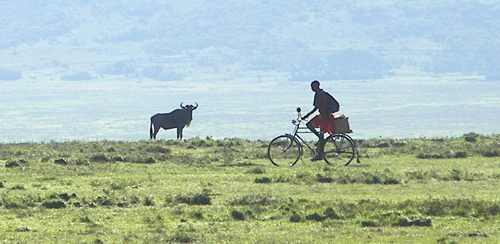
Wildebeest survive, but Maasai must move on.A remarkable study released yesterday by wildlife experts in East Africa that details the effects of the 2007-2009 drought unintentionally and benignly predicts the end of Maasai culture.
Reading way between the numbers of surviving zebra and elephant, I see an imminent end to Maasai pastoralism, the foundation of Maasai culture.
But first to the survey itself, remarkable for its professionalism and swiftness. Led by the Kenyan Wildlife Service, assisted by Tanzanian partners and professional wildlife organizations, it represents one of the finest and most complete ad hoc aerial animal counts I’ve ever seen.
The news was not good, but it was not expected to be better.
Nearly 60% of Maasai domestic stock and almost 50% of wild herbivores were lost in the greater Amboseli/Kilimanjaro/Natron wildlife dispersal area. (Elephant were hardly effected.)
The area studied is one of the most important tourist areas in East Africa. Included is Amboseli National Park, Arusha National Park, the eastern part of the Ngorongoro Conservation Area (NCA) and a number of protected private as well as hunting reserves that form a huge rectangle straddling the Kenyan/Tanzanian border just southeast of the Serengeti.
It is the second most highly visited tourist area (after the Maasai Mara, Serengeti and western NCA).
But tourism is becoming less and less important. There is so much human habitation in and nearby this area: The main Arusha/Nairobi road goes right through the middle. The northern reaches of the Moshi and Arusha municipal areas are found here. The heavy agricultural areas of western Kilimanjaro and Manyara border the study area.
So the modern human/animal pressures are great, but even more importantly, within the majority of the area Maasai pastoralists live freely. There is a dynamic argument going on today in East Africa regarding the efficacy of continuing to presume that Maasai culture will remain traditional enough that large numbers of Maasai can continue to coexist with big game.
I think this survey answers that question with a definitive “No.”
Pastoralists suffered on the same scale as all the wild animals tourists come to see. Nearly 60% of the Maasai’s stock of a quarter million cows and goats was lost. Wild herbivores like wildebeest and zebra will repopulate fairly quickly. Cows and goats can’t, not because their reproductive systems are that much slower, but because their reproduction is essentially managed by the Maasai.
Unlike wild animals that die in areas where there is no grass, a large portion of the surviving Maasai stock herds was nurtured through the drought by supplemental food sources, and not sufficiently so. So the stock herd that survives is much weaker and sicker than the remaining wild animal herds.
With an abundance of grass, now, wild animals are like to have several years of massively reduced infant mortality as the populations refill the ecological holes caused by the drought. Not so with Maasai stock. The over grazing that has plagued Africa’s farm stock dispersal areas for years has taken its toll. There has been massive loss of top soil, enormous erosion and farm stock dispersal areas are not growing grass in the same healthy way the protected wild life areas are.
Moreover, the toll on the Maasai families was severe. As precious as the stock is to a Maasai pastoralist, modern necessities are pressing on his day-to-day responsibilities. School fees. Potable water. Malaria control. Tse-tse eradication.
Addressing these human necessities compromises reinvigorating the farm stock.
What I think this survey shows is that the Maasai pastoralism is no longer sustainable in the climate change era we’ve now entered. For this so-called “drought” – definitely so in the area just under study – was not as wide spread as past droughts. It was more severe in many areas, but it wasn’t as universal. That’s what drought is, today, in a climate change environment.
And that in itself provides opportunity for modern man. And while it’s hard in this short space to explain the chain of events that would lead a Maasai pastoralist to abandon his herding for a bank teller job, that’s exactly what it shows.
I really don’t know if this is good news or bad news. But it is certainly news.
American religious fanatics are in East Africa announcing the end of the world and that the Kenyan draft constitution is blasphemous. What’s wrong? Not enough to do at home?
There’s no better object lesson on the futility of debate in America, today, than the stance taken by religious extremists. You can’t argue something that’s a lie except by calling it a lie, and that ends the discourse.
The result simply divides those listening into those who believe the lie and those who are calling out the lie.
And now these intellectually bereft righties have opened up a new battle front in East Africa. While I doubt it will work, their success in East Africa could be catastrophic. Several American religious groups are funding the “No Campaign” against Kenya’s Draft Constitution.
In July the Kenyan population votes on a referendum for a new constitution. The process of creating this draft constitution has been much more laborious and contentious than Obama’s health care legislation, but it represents a fabulous consensus among Kenya’s very fractured politic.
All the sane governments of the world are praising Kenya and the process that created the draft. The U.S. is pouring in considerable funds to help publish the draft and distribute it among the Kenyan population.
It’s a very fair constitution. Like all big legislation (and this is the biggest) it will be modified and reworked with time. But as a start it’s wonderful and should put an end to the potential for violence in the next election.
A powerful coalition of Kenyan churches opposes the draft and is campaigning for a “No” vote, which will throw the country into turmoil. Their justification? The draft constitution allows abortion.
Article 26 empowers doctors to end a pregnancy if it endangers a woman’s life.
The American-funded campaign in typical American extremist end-all-argument fashion extends the Kenyan churches complaint into a patent lie, claiming that the draft constitution allows “abortion on demand.”
Friday, Jordan Sekulow, head of Pat Robertson’s Center for Law & Justice, told the Associated Press that the draft constitution “..opens the door to abortion on demand.”
(“Tens of thousands of dollars” have already reached Kenya according to Sekulow’s blog on his site. In addition thousands of brochures printed by New York’s National Right-to-Life Committee are today being circulated in Nairobi.)
The American Center for Law and Justice (ACLJ) is a non-governmental public interest law firm founded in 1990 by the controversial televangelist Pat Robertson well-known for claiming that the Haitian earthquake was because the Haitians made a pact with the devil.
ACLJ gets its word out in Kenya particularly through the Christian Broadcast Network, which spends millions to achieve prime broadcast space throughout Africa.
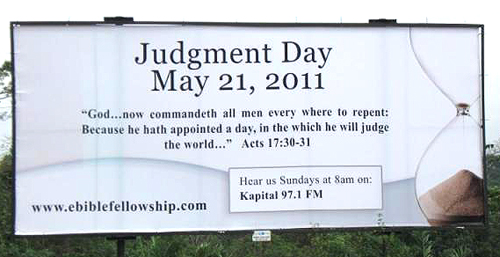
I’ve often wondered why Christian fanatics spend so much energy in Africa. Consider the Electronic Bible Fellowship located in Sharon Hill, Pennsylvania. Their most recent campaign is to alert the world that it is ending on May 21, 2011. Their technique is by erecting billboards. Here is the list of where their seven billboards are located:
Kumasi and Accra (Ghana); Dominican Republic, Addis Ababa, Maseru (Lesotho), Jamaica, and Dar-es-Salaam.
In the U.S. – where they live, or at least where they live until May 21 next year – they only use “moving” billboards – that is, signs on automobiles and RVs.
My brain is just too strained trying to figure this one out. Why do American religious fanatics do crazy things in Africa? I know there’s a reason.
And the best answer I can give right now is in Swahili. Sorry. But really, you don’t have to understand Swahili to laugh at this great Tanzanian comedian and his TV clip about the Dar billboard which eBible erected over a busy bus and matatu station in the center of Dar. Pull the timer button to just over 3 minutes to get to the segment where he “interviews” distraught Dar citizens who work under the billboard.
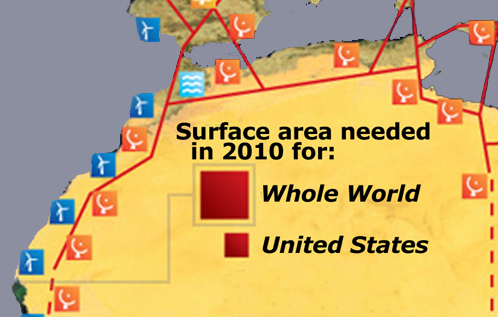
One thirtieth of the Sahara Desert can power the whole world.In 35 years Africa will be the principal source of power for the world, right?
Yes, according to a consortium of African and European governments with considerable capital funding from world companies like Siemens and classified technologies from the German Aerospace Center.
And several days ago, this “pipe dream” notion rocketed to credibility when an important German politician/businessman agreed to become its CEO. Max Schön is Germany’s Warren Buffet, entrepreneur and former President of the German Chapter of the Club of Rome. Tuesday, he agreed to take charge of the not-for-profit DESERTEC.
The secret is not photovoltaic cells, wind turbines, wave captures or nuclear energy, and of course not any new found deposits of fossil fuel.
The secret source of the world’s next generation of energy is CSP: Concentrating Thermal Power plants. Giant mirrors are placed in the deserts of Africa and capture heat to turn salt-water steam turbines. Not only does the world get energy, but Africa gets desalinated water.
European countries are considering an investment of one billion euros.
If for some reason a sand storm or freak cloud interrupts sunshine, the turbines switch over to using either or as a last resort fossil fuels to assure a constant, uninterrupted supply of power.
According to DESERTEC, while the costs are high compared to current power sources, they are much less than solar panels. So backers see this as the logical next step; not solar panels.
Siemens is deeply involved because this company builds the high voltage transmission lines needed to transport the energy from Africa to Europe. Siemens is right now building these special lines in China.
CSP plants aren’t a new idea. They’ve been used at Kramer Junction in California since 1985.
I’ve often remarked that Africa’s time will come when a new source of energy is found. Is this it?
Must we choose between elephants and less traffic congestion?The southern African countries are meeting today in Malawi to decide whether to withdraw from the CITES convention. They almost convinced me to support them, and then, they blew it.
The withdrawal from CITES (Convention on the Trade in Endangered Species) by part of the world where half the elephants live would throw the treaty into turmoil, even though that might not immediately threaten elephants.
I find myself slowly moving into the southern African camp after a life-time of supporting the East Africans. I have little doubt that relaxing the ban on ivory sales will increase poaching, and that will unequivocally negatively impact tourism in East Africa.
But I’ve seen more and more the destruction that elephants are doing, and the pitiful response of NGOs and governments alike to assist with the human sacrifice. More and more, CITES is looking like a Rich Man’s Treaty.
Yes, CITES protects Kenyan tourism. But what does that mean? Is it protecting revenue to develop the country and sustain its environment, or is it more just giving us rich westerners a better vacation?
The withdrawal from CITES was proposed by Botswana. The 15 nations in the trading and tourism organization Botswana is petitioning would be directed to urge their governments to take official action to withdraw, which will take a long time. But if that ultimately happened, CITES would be thrown into turmoil.
I doubt anything except hot air will come out of the convocation, but it makes us realize once again that just protecting elephant without protecting people begs fairness. Elephant protectors argue that the healthier environment and proper management of these jumbo forms of wildlife actually contributes to economic stability. Politicians, farmers and the poor feel significantly otherwise.
With as much coincidence and political adroitness as the Goldman Sachs hearing before a successful Democratic vote to move forward bank regulation in the U.S. Congress, Botswana and Zambian media last week were incessant in reporting about a family of elephant near Sesheke destroying crops and threatening farmers and villagers.
Sesheke is in the triangular border of Namibia, Botswana and Zambia just outside the famous Chobe National Park, which earns more tourism revenue for Botswana than any of its other protected wildernesses. Botswana argues that the human suffering in the area is simply not worth the tourism revenue, or that the tourism revenue won’t suffer that much if elephants are protected less, or both.
Botswana claims that it could earn up to $7 million annually by selling ivory that was simply harvested from naturally dead animals if it withdraws from CITES. Meanwhile, it spends $1 million annually just to manage the stockpile of collected ivory it can’t sell. These are significant amounts for a poor country.
But alas, the southern Africans aren’t doing their cause much justice this time around. The whole meeting grew farcical yesterday when it elected the Zimbabwean Ministry for Tourism its chairman. There hasn’t been any significant tourism in Zimbabwe for years, and nearly everything Zimbabwe does these days destroys tourism and its own development!
So the serious intellectual argument dissolves in farce. My wrenched little conscience starts laughing hysterically.
Ultimately, I just feel that the Africans have the preeminent position in determining not just the morality but the economy of this contentious debate, and I’m ready to give them the benefit of the doubt.
But if they make their spokesman and point man someone from a country with as destitute morality and economy as Zimbabwe, how on earth can I embrace their arguments?
The damn theologians are screwing it up, again. This time in Kenya.
Kenya’s only hope for a peaceful and prosperous future lies in passing the July referendum approving the new constitution. After months of wrangling and horse trading, Kenyan politicians whose differences are much greater than Pope Benedict’s and Joseph Smith’s, have finished the draft. It goes to the people for a YES or a NO in July.
Guess who says NO?
Here’s the list:
.
.
Failed Presidential Candidates;
Demagogues;
Terrorists;
Politicians who will soon be named by the criminal court in the Hague as fomenting the last round of violence in Kenya after the 2007 elections;
and..
.. Kenyan theologians. Why?
Church leaders oppose the fact the Constitution doesn’t outlaw abortion. (Knowing that hot-button issue is alone too flammable, they have also publically opposed the adoption of “kadhi” or local culturally defined magistrate courts that in certain locals have a religious tincture : i.e., Muslim. But their overwhelming gripe is that abortions aren’t outlawed.)
On my safaris I praise African church leaders as instrumental in bringing not only peace but sanity to the continent. I explain that while I’m not religious, without people like Desmond Tutu and much less well known theologians, Africa would be a sinking ship.
But like everywhere in the world, Kenyan theologians have become politicized. It’s truly amazing to me.
Today, there is little difference between Pope Benedict, Representative Stupak or Canon Peter Karanja in Kenya. They have lost their religious mission and are stinging their way into the political process with the vengeance of a scorpion.
What the hell has happened?
I don’t remember as a kid the extreme tension that exists in the world today between the “Church” and “The State.” As a kid, in fact, the only recollections I have were the arcane references to it by my 8th grade history teacher.
And that was in Annie Camp Junior High School in Jonesboro, Arkansas, about as deep into the Bible Belt Belly Hole as you could get.
But the separation of Church & State was simply a given: a fundamental divide that was only mildly inconsistent with our opposition to the other guys in the Cold War.
“Having participated in three meetings with the government, we note with sadness that the greatest hindrance to a resolution of the contentious issues is not legal technicalities but rather the lack of political will,” said a statement read by Karanja, on behalf of 17 Kenyan denominations, yesterday.
He said that the draft consitution “faces a blanket rejection by Christians at the referendum.” And he urged all theologians in the country to preach as much to their parishoners.
If that happens the Church may have saved the sinners contemplating abortion, but they will have doomed the nation and culture of Kenya for decades. Every life they think they will have saved will be paid for handsomely by the mayhem that will wreck the country.