 I love this photo by Sander Glas taken in the Serengeti in 2007 on one of my safaris. I’m on vacation until July 23 when I will guide my last safari of the season in Tanzania. Meanwhile I’m posting some of my favorite safari photos. Although dramatic lion and leopard photos are generally sought by professionals more than their lowly cousin, the cheetah, I actually think the cheetah displays more whims of personality and is actually more photogenic.
OnVacation: Best Photos
 I’m on vacation until July 23 when I guide my last safari of the year in Tanzania. Meanwhile, here are some of my favorite photos taken on my safaris during the last 39 years. This wasn’t really so long ago, less than a decade ago outside Amboseli National Park (in Kenya) on the Tanzanian side of the border. It marks a significant change in the wildlife, tourism and overall environment of East Africa: the start of “too many elephants.” That doesn’t necessarily mean more ele than ever before, just that as East Africa moves into the modern world, scenes like this are harbingers of great difficulty, social and ecological.
OnVacation: Best Photos
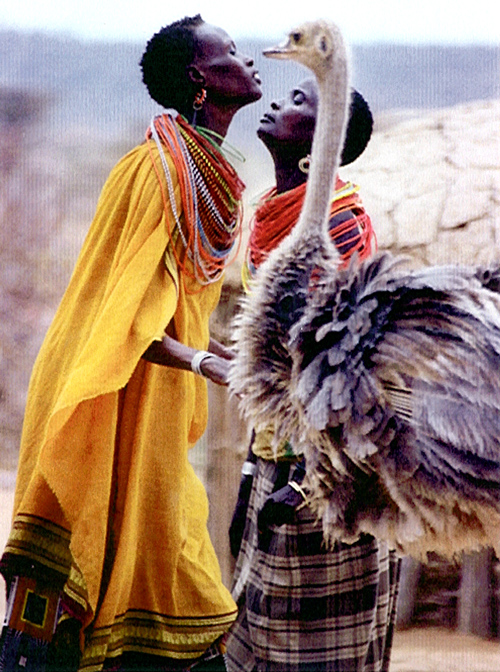 I’m on vacation until July 23 when I guide my last safari of the year in Tanzania; please come back then! Meanwhile, I’m posting some of my favorite photos taken on my safaris over the last 39 years. Scenes like the one above don’t really happen, anymore. This was taken nearly 30 years ago near Archer’s Post in Samburu, Kenya. Many of the people in this area, today, remain poor compared to the rest of modern Kenya, and many will still adorn a few beads and bracelets over tattered dresses and old gym shorts, but except for some “living museums” or lodge staff dressed up in traditional regalia, this is a picture of many years ago.
OnVacation: Best Photos
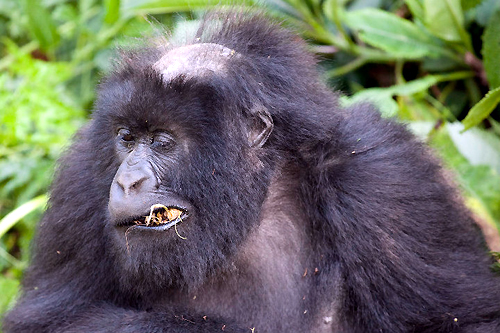 Jim is on vacation until he guides his last safari of the year beginning on July 24. Here are some of his favorite pictures taken on safari with him in Africa. The above shows that even wild mountain gorillas can have a bad day!
OnVacation: Best Photos
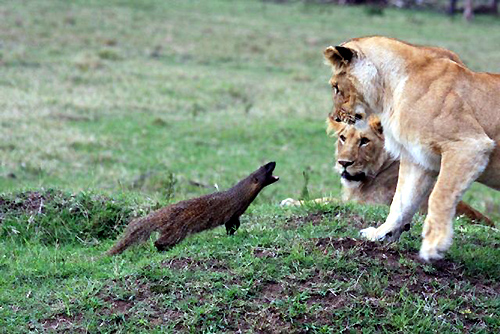 Jim is on vacation until he guides his last safari of the year beginning on July 24. Here are some of his favorite pictures taken on safari with him in Africa. The above shows an Egyptian Mongoose standing down some juvenille lions in Kenya’s Maasai Mara.
OnSafari : With The Family
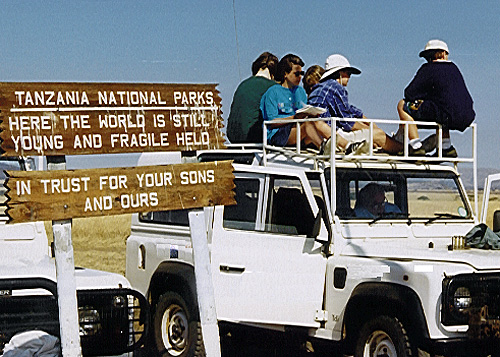 It’s been nearly a decade since I’ve encountered so many families on safari – is the midmarket coming back? Is it time, again, to travel to Africa for a family vacation?
Yes, and yes. For several years, now, I’ve wondered if the midmarket would return. The Great Recession clobbered disposable incomes, especially for families, and it dove-tailed horribly with the election troubles in Kenya then increasing terrorism there after the October, 2011, Somali invasion.
Enough time has passed, now, that our economy is returning to a semblance of normality (even as much of Europe has not) AND terrorism in East Africa is way down.
Family safaris have returned: From Serena to Sopa to lower market family group safaris, the circuit we just completed in Tanzania was jam packed.
I’ll be in Kenya in a few weeks and will be able to assess that as well, especially as the British government has removed its travel warnings on Kenya’s so popular coast.
It’s a definite generalization, but it seems to me that terrorism is moving out of the Third World and back to the western world in some bold attempt by the bad guys to prove they can penetrate western security.
Needless to say, a terrorist incident like occurred on the Tunisian beaches and may have occurred at the Naval Yard yesterday would represent much greater victories for the bad guys than closing a few beach hotels in Kenya.
I think families know this, now, and as their finances stabilize they understand what wonderful memories a family safari creates.
At Rivertrees Country Inn a few weeks ago in Arusha I was talking to one family of a very typical composition: grandfather and grandmother, plus two families of their two children with six grandchildren in total, all under 13 years old.
That is the perfect composition for a family safari, and as I was talking with the adults one of the 9-year olds saddled up to Bibi (Grandma) to tell her that this was the best family vacation he had ever had!
It was only their second day but the colobus monkeys were calling from the ground’s high fig trees and mongoose were scampering over the beautifully landscaped gardens.
Kids love a family safari because of the wildness. Imagine being a kid who lives his day with one rule on top of another. It must be absolutely liberating to experience a situation where his parents are as restricted as she feels: Nobody, not even adults, can walk out there with the lions!
I think, too, like learning languages at an early age facilitates greater language skills as an adult, immersing yourself in the wilderness at a young age primes the spirit not just to be adventuresome but to refresh the natural link every person has with the organic world.
Saying it more simply, it’s one of the few things for which they lower their phones.
By the way, I did discover an interesting drawback to the summer family safaris now returning to East Africa. Once back in the camp or lodge where civilization returns, the enormous drain on the internet system from kids’ phones is causing data congestion.
Gerd, the manager at Gibb’s Farm, is so worried about this that he’s researching software that would clamp the data availability per device, ensuring for example that his own office emails would work normally while ending streaming and photo sharing of his clients.
If that bothers you, imagine how it bothers Africans who have a much greater use of cell phones than Americans.
There are 26 satellites carrying cell phone data over North America. There are only 2 over the entire continent of Africa.
That can’t last for too long. There’s a lot more that Africa needs from the global internet network than Facebook.
My McGrath Family Safari ended yesterday. It was near perfect, and I don’t say that lightly, because such things are avoiding car breakdowns or camp booking glitches in the high season is often a matter of luck, not skill.
So Ngei was with us, I guess! As it was with the many other happy families I encountered so far this season!
OnSafari: The Mara
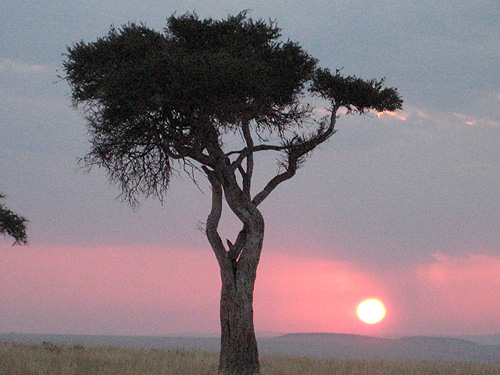 Why spend the time and money to travel north on a Tanzanian safari to the very border of Kenya, and then not cross?
I ended my extremely successful McGrath Family Safari game driving along the great Mara and Sand Rivers, seeing really giant crocs, looking longingly to Kenya. You aren’t allowed to cross over.
Ever since the 1979 dispute between the two countries closed the border, numerous attempts by good politicians on both sides have tried to reopen it to no avail.
Oprah stood where my family had lunch yesterday, peeved to smithereens that she wasn’t allowed to cross a few years ago.
Nobody can. Not even the politicians themselves.
The dispute is now so old that recounting its history is like critiquing a marble statue: Interesting, but it’s not going to change.
We had great game viewing these last two days, including a family of 12 lion in a weeded kopjes, elephant playing along the river, giraffe starting at us as we bumped and hurdled ourselves over really bad roads, and to everyone’s glee, 5 baby rock hyrax popping out of a rock design placed at the edge of our camp’s swimming pool.
But it’s a long … and expensive journey to get here. Obviously we aren’t unusual, because the camp we stayed in, Asilia’s Sayari, is expanding (now 15 tents) and is one of the most expensive and luxurious camps in Tanzania.
The southern (Tanzanian) side of the rivers that make up some of the border with Kenya are filled with camps. We encountered almost as many game viewing vehicles as we did in Tarangire. So clearly, we’re not alone.
The attraction is the allure of the migration. Read my last blog to see how crazy this is! Yet we are all driven by history, and in fact the chances today of seeing the great herds in Tanzania are definitely chances that on every day of the calendar are moving northwards.
But more correctly – and this is my own experience – they aren’t moving as much. It’s wetter, so more grass, and areas previously dust bowls at certain times of the year in Tanzania are no longer.
Personally, I love the Mara. In Kenya it’s called the Maasai Mara. Here it’s called the Mara District. But it’s the Mara, absolutely one of the most beautiful places on earth.
It’s cold at night like Seronera, but it never gets really hot during the day even with clear skies. It rains almost every day of the year except in October and November, which I love because it’s not the least disruptive (it never rains for long) and it’s dramatic and turns the veld into a bouquet.
(P.S. The animals like it, too.)
There are woodlands, but they aren’t as dense as further south, so you can reach a rise in a hill and have vistas that stretch for dozens if not hundreds of miles. It’s a lush carpet of greens: the shining reflective green of grasses and the deep dark fur greens of the trees and few woodlands.
And, of course, the rivers. We spent most of our time up here along the Mara River. It’s a raging, but not very deep river, bubbling over lots of big rocks producing white water and little cascading waterfalls everywhere you look.
Also everywhere you look are hippos, uncountable there are so many, and some of the world’s largest crocodiles. I think the biggest one we saw was probably 14 feet, but I have seen them twice that size!
The birdlife is exceptional. First of all, things are easier to see when the woodlands are thinned out. So, for example, we saw numerous klipspringer, steinbok and reedbuck, and even an oribi! These aren’t rare animals, just difficult to find because of their size, color and stealth.
The same is true for birds. So within a half hour we saw a hoopoe, a pygmy falcon and the pink-eyelidded Verreaux’s Eagle Owl!
But it’s not all good news. Tanzania – at least up here – pays a lot less attention to its wildernesses than Kenya. So there are many, many more tse-tse. There are many fewer tracks that we can use. And most of all …
… Tanzania does not allow off-road driving as the Kenyans do in the Mara. That’s critical. The official Tanzanian position is that it damages the ecosystem, and there is some truth to that.
But it’s a little truth, and the real truth has to do with Tanzanian corruption and lack of resources dedicated to tourist parks. So as Kenya calms down (the British removed their travel warnings on the Kenyan coast last week) I think that I and most of my colleagues will choose to travel to Kenya to see the Mara rather than here.
But the McGraths and all the others we met here this time made absolutely the right decision. The southern Serengeti remains my favorite place, but … the Mara is a close second!
OnSafari: The Migration
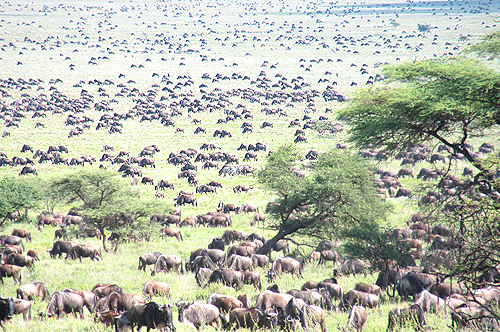 The greatest wildlife spectacle on earth has become unpredictable because of climate change, as awesome as it remains.
Today my McGrath Family Safari left the Moru Kopjes at 7 a.m. and arrived our camp near the Mara River on the Tanzanian side around 5:30p. During that time we saw two enormous groups of wildebeest, despite reports that they were all in Kenya.
From just after the Grumeti River near Seronera to Lobo, a distance of about 25 miles, we drove continuously through wildebeest. I estimated a quarter to a third of a million.
After we arrived at the Kenyan border for lunch, we headed west then north again towards the Mara River. From about the Lemala Camp position on the river to about 10 miles southeast of Kogatende, we saw another 100-150,000.
If my very rough estimations are even slightly correct, it means that we saw – today in Tanzania – from around a quarter to a third of all the wildebeest and zebra known in East Africa.
Is this the migration?
For years and years, 30 of my own career to be exact, the more or less circular migration of the great herds was a given that you get nearly set your watch by. Safaris were appropriately planned several years in advance to intersect the best of the great herds.
The beginning of the year began with the rains that attracted all the herds together on the southern grassland plains. Here they calved – all of them, around the last week of February. There was a minor hiatus in precipitation in February in the south, more in the north, but the rains were continuous until often an abrupt stop in late May or early June.
A few weeks later the herds freaked and started running north. The calves were strong enough by then to do so.
They would sometimes break into three sections, often not, with some going into the western corridor and others sticking to the eastern Serengeti. Then by the end of June, virtually all the wildebeest moved across the great Sand and Mara Rivers into Kenya, where they stayed until October.
It just doesn’t happen that way, anymore. Calving is erratic and occurs almost everywhere on the migration route. This year hardly any calving occurred on the southern plains.
Read my “OnSafari” reports for the last several years. This year we found most of the migration in March where it traditionally would have been in June, and we later found it in April where it traditionally would have been in February.
On the McGrath safari last Wednesday, we left the crater to enter the Serengeti. We visited Olduvai, where it was bone dry and few animals, but by the time we hit the Lemuta Kopjes the plains were covered with wildebeest.
From Lemuta west to the main Serengeti road, we easily saw 100,000 wildebeest. This is an area where traditionally they calve in February. Today is nearly July.
In all these unusual cases, the wildebeest were where the grass was growing, of course because it had rained. The rainy season is now all mixed up. Overall precipitation is greater than normal, but it comes in dangerous torrents followed by mini-droughts.
The wilde are adjusting.
The “migration” was never only wildebeest. It was a third zebra as well, but I’ve also noticed that the zebra are separating from the wilde in ways they didn’t before. For the last several days with the McGraths, for example, we encountered around 20,000 zebra starting at the Simba Kopjes through the top of Seronera and west into Moru.
Zebra, no wilde. (Well, maybe one or two or ten or twenty.) And today with the fractions of millions of wilde we saw, hardly any zebra.
Zebra have different eating habits and preferences than wilde. Perhaps climate change is differentiating these even more.
This is fascinating and perhaps troubling, but nowhere near as troubling as the commercial sites, like herdtracker.com, which claim to tell you where the wilde are.
Today, well, the wilde are everywhere. Large herds literally can be found in the furthest south and furthest north part of the Serengeti. Presumably, too, there are many in Kenya.
Irritated by sites like herdtracker.com motivated by commercial advertising, the Frankfurt Zoological Society is in the beta stage of a much more exact migration locator which will be launched soon as SerengetiTracker.com.
The FZS is radio collaring a number of different wilde which it believes come from different parts of the herd, and these will be tracked by satellite.
This is good, but not even this will be complete.
Meanwhile, my McGrath Family Safari couldn’t be happier. After all, they weren’t supposed to have seen the migration.
OnSafari: Crater
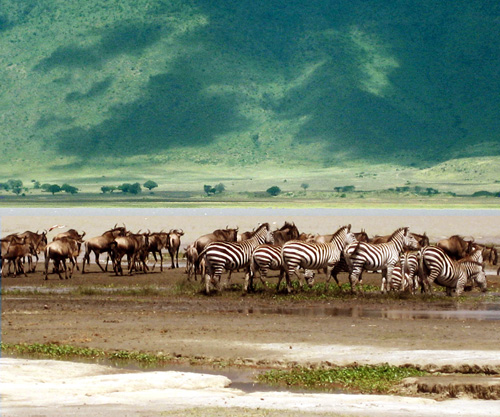 It could be in an unexpected poem, a playground of happy children, the smells of the holidays … or the crater at sunrise. This is when your testy, challenged human spirit inflates with joy despite every reason on earth it shouldn’t, and you know everything is just fine.
This isn’t the best time for game viewing in the crater, although few tourists who come now realize this. There’s probably fewer than 5-6,000 animals from the peak in March and April of more than 20,000.
But all that transitory wildlife is only a part of the crater’s story. The inorganic magnitude of its landscape is unmatched anywhere on earth.
Right now as the rough winds signal that rains won’t return for six months, the thick cloud cover of the season will clear for a few hours in the late morning. This morning we had one of the most crystal clear crater mornings I can remember.
It’s only 12 miles across but it seems like hundreds. You’re constantly recalibrating your depth perception. The crater’s rough edges are still lush green, still sucking the last of the fresh-water rivers sinking down from the highlands. But brown is sweeping the floor as it becomes drier and drier, producing this most marvelous contrast of color.
At first everything is pastel and then the morning explodes and there’s this quilt of primary color.
It was hard today with the wind so strong to hear all the bird song, but whenever the wind died the red-naped lark seemed to be singing from one side to the other. We saw nearly 30 crested crane honking then leaving their long necks outstretched as if still tied to the sound long gone.
When it finally warmed to 50 then 60 and finally 70 degrees, the couple thousand wilde that remained started to blart and a few began prancing around. The zebra started barking and the hippo started grunting and you knew that the ossified night of the cold season was at least for a while banished.
But only for a short while. Day time on the equator is the same twelve hours more or less year round. But the overcast of the dry season reforms by early afternoon, the strong winds that seemed to sweep away the morning chill die, and cold settles down from the thick grey cloud quite early, probably by 3 p.m., and the animals and birds slow down, stop talking.
Everything in the world has to rest. The drama of the crater in March and April is sometimes overwhelming. You can’t separate the screams of the hoops of the hyaena from the screams of the elephants, and cackles of the dozens of vultures on a kill.
The movement and tension among the animals is overstimulating. No one has time to appreciate the enormous canvas painted when the world’s largest volcano self-destructed three million years ago.
Mt. Makarot never moves (you’ll have to wait to see the Shifting Sands for that!) The great forests of the acacia lehai seem undaunted even by this wind. The deep curving crevices sliding down the crater’s sides hold their form, but the grandeur of all this is missed in the mayhem of the wet season animal free-for-all.
This is the time the crater’s sleeping. That’s what it seems like, sleeping and recovering, and as our rover descended around the curves and switchbacks of the trail down it was as if we were navigating into a dream with the privileged skill of shaman. And when we climbed out during the peace of the midday and looked back, the landscape pressed into our memories like the tune you’ll never forget but will never be able to fully recreate.
The wilde have migrated out. The tens of thousands of Abdim stork and thousands of white stork and myriads of other migrants are gone. For some reason today even the eland had disappeared…
Leaving an earth so huge with the tiny little you there twisting about somewhere maybe inconsequential but you think it’s in the middle, trying to comprehend it all. Endless, right? Something forever is rare in our world, but that’s what the crater was expressing today, its implacable eternity.
OnSafari: Dr. Frank
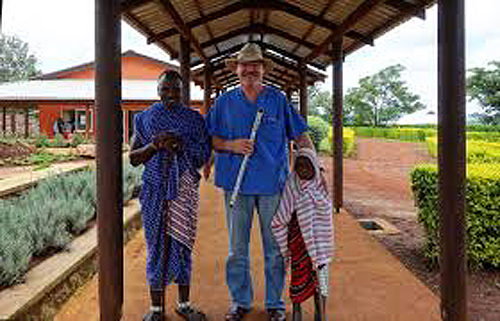 From time to time people get sick on their vacation, I’m sure it’s happened to all of us. It happened to one of my clients today on safari.
It doesn’t happen often and today’s case is a classic example of when it does. Years ago I worried endlessly about the food and water, the cleanliness of the beds and so forth, but those worries ended long, long ago.
The lodges and camps on the safari circuit are probably more hygienic and germ-free than most lodging a person would find in an American city today, so that’s fortunately no longer my concern.
My concern is when we get into remote areas, medical care is limited and when it’s needed – for whatever reason – it’s expensive and time consuming to arrange. The larger upmarket properties like Crater Lodge or the Mt. Kenya Safari Club will have medical staff on duty, often a fully credentialed physician.
But upmarket camps, for example, are just too small to offer this. So remoteness is the key worry.
Our safari left the last vestige of civilization today, as we left the town of Karatu and headed into Ngorongoro Crater for the final week. The further we got from Karatu, the more difficult it would become to arrange adequate medical care.
No one comes on safari not knowing this. In fact it amuses me the numbers of people who presume this is the situation the moment they disembark their airplane in Nairobi or Kilimanjaro, areas with modern hospitals and medical care.
So I suspect most travelers have a very good handle on medical preparations and precautions. I think travel clinics within hospitals often over prescribe and are overly cautious, but from these I know that travelers are usually well prepared.
Proper insurance is also very helpful. It minimizes or completely eliminates the worries of expense that increase the more remote one gets. East Africa has a wonderful network of air medical services for very reliable and quick medivac.
So today as the group prepared to leave I get a knock on my door. The spouse conveys how ill her husband feels. We are at lovely Gibb’s Farm in Karatu. Spouses are usually – not always but usually – the best indication as to the seriousness of a situation.
In this case she seemed more concerned to me than she was letting on or was told to convey to me. So I persuaded the patient to go with me to the excellent FAME clinic at the outskirts of Karatu, and sent the rest of the group on its way as planned.
The clinic is run by a man famous in the area, Dr. Frank. His business card says no more than that, but he is an incredibly generous man, a former cardiac anesthesthesiologist in California. His wife, Susan, and he came on safari more than a decade ago and after a close to critical experience climbing Mt. Kilimanjaro, fell so deeply in love with the area that they decided to radically change their lives.
And the lives of the people of Karatu.
Dr. Frank’s clinic is modern, exceptionally staffed and beautifully efficient. It serves all the people of Karatu with extraordinarily modern medicine. There is a prenatal clinic, an operating room, patient wards and well stocked pharmacy.
And tourists – and NGO expats – can … “break the queue” and this is because the exceptional treatment he has provided them is routinely returned exponentially. FAME clinic is privately funded mostly from the U.S. and mostly from small family foundations.
My client was seen, given a battery of tests and diagnosed by Dr. Frank with a very serious infection, probably in the lungs. He had brought the infection from home was part of the diagnosis and as often happens with those who get sick on vacation, the relaxation that accompanies a vacation is often the entree for the sickness to finally get the attention of the patient.
His infection had also led to dehydration, the illness I see most effecting travelers. So he was put on an IV for four hours and given massive doses of antibiotics and fluids, then released onto his safari with a box load of medications.
He looks better and feels better, but as Dr. Frank explained, it will take some time to fully recover, and Dr. Frank knows better than any physician at home that the safari lodging will be just fine for his rest and recuperation.
FAME clinic helps many, many more people locally than the occasional tourist like mine. But the relationship that’s built with the foreign tourist is what fuels the project.
So we caught up with our group which had climbed Olmoti Volcano today, and tomorrow we head into the crater for a game drive, thankful for the FAME Clinics and Dr. Franks of the world!
OnSafari: Wild is Unpredictable!
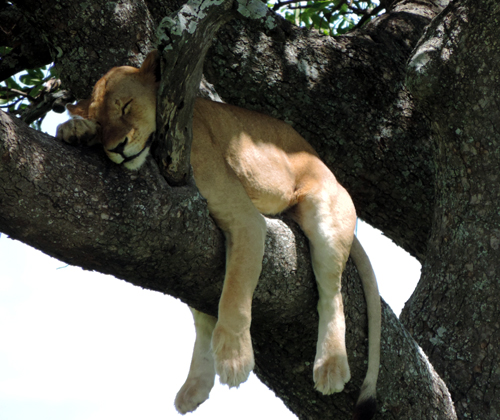 Lions don’t climb, hippos aren’t in Tarangire, vervets hate thorns, and guides know it all. Just a few of the things disproved so far on my safari!
Apologies for the big delays between blogs, but Tanzania is in something of a data congestion at the moment. Reports from businesses in Dar and Arusha are all complaining of the slow internet signal.
It’s not the weather, which is beautiful and quite normal, nor nearby conflicts, because except for distant Burundi there are none. So common wisdom is probably true: there are suddenly just too many people trying to use to few satellites.
Common wisdom, though, would not hold much rank on the McGrath family safari. Today in Lake Manyara National Park we saw two near-adult lions in an acacia tortilis tree sleeping their lives away until we arrived.
They were draped over the branches like wet laundry hung out to dry. We watched them for a while until another car came up at which time one of the lions got nervous and teetered down quite ungracefully.
The last one tolerated 2 or 3 more cars before she finally took to the ground, too. So what’s all this about lions not climbing well?
The truth is that lions will climb trees everywhere, if it’s the right kind of tree: fantastic Manyara is filled with so many different kinds of trees there are plenty with the requisite low horizontal branches that will tempt this largest of the cats.
But you can tell it’s a real balancing act, because they never seem completely comfortable up there. But unlike their many cousins on the savannah, their views on the ground are obscured by Manyara’s thick vegetation, so anything that gives them height gives them comfort.
Manyara was great in several wonderful ways, today! The lake is pretty full, so the hippos are plenty. The wind was down, the morning not too cold, and we first watched for a good long time at least a couple dozen silvery-cheeked hornbills flying around and cackling madly.
This is the largest of the hornbills in Tanzania and true dinosaur looking bird!
Grandma Cindy asked if there were any malachite kingfishers, and a few minutes later as we headed to the platform overlooking the hippo pool, we saw two! Also saw lanner falcon, long-toed plover and a bunch of other stuff.
Manyara is baboon heaven, but otherwise I never expect Manyara to be a memorable animal experience. Yet we added to the lions-in-the-tree, 15 minutes literally immersed in an elephant family of 13, and the truly beautiful lake shore landscapes covered with giraffe, wildebeest and zebra.
I even glanced a klipspringer as we were leaving. Manyara was a much better animal experience today than I would expect.
The last several days in Tarangire were classic. The park is absolutely the best elephant park in all of Africa, and it gave us opportunities to learn to distinguish between healthy elephants, lone elephants, sick elephants … elephants that were agitated, and so forth.
The northern half of the park has the more docile and approachable sedentary elephants, whereas the south half of the park usually has more temperamental and transitory ones. Only this time I felt they were pretty calm in the south.
It could be that just over time the homesteaders are arriving. Or it might be that the transitory folks were just coincidentally absent, giving entry to the over crowded north. Either way it was an astounding experience for us.
That is except for Hakon and Alden on the way to their Tent #1 at Little Oliver’s, unable to do so because the elephant wouldn’t leave the path.
I think the manager, Julie, did exactly the right thing. Took a truck down the path and let the guy know he wasn’t welcome. Far too often camps try to cultivate wild animals, and it never ends up well.
We had a chance this time to visit the far southwestern side of Silale swamp, and that was a real treat. Lemala has put a semi-permanent camp down there and the tracks are being better maintained.
It gave us an opportunity to see larger numbers of Grant’s gazelle and hartebeest. If there is any drawback to Tarangire it has been the uniformity of its wildlife experience: almost exclusively elephant and giraffe. The new tracks in the south now will broaden its appeal.
Finally, too, as we were leaving we stopped at a water hole in the Serengeti Plains. We’d already spent probably hours watching elephant frolicking in water, but here they were frolicking among very angry zebra definitely not pleased with their arrival.
It was a wonderful interaction that ended when the Mommy elephants finally got the youngsters to leave the swimming pool and the zebra came down to drink. A wonderful end for us in this marvelous park.
Stay tuned! We’re on our way to the crater!
OnSafari: Tarangire
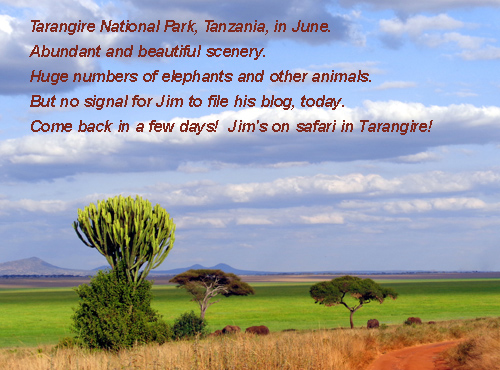 Jim is on safari with the McGrath family and out of contact for a day or so. Please come back to read his dispatches when he reenters internet webspace!
OnSafari: Lost Bags
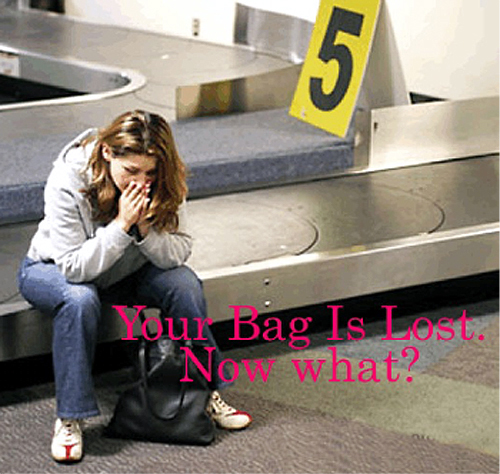 The family I’ll be guiding for the next ten days arrived cheerful and ready to go!
The McGraths/Bumsteads/Farahs come from Washington and Providence, two families with 4 teenagers and grandma McGrath leading the pack! The kids are 13-18, so older than my typical family safaris and I’m looking forward to fewer video games and more conversations!
We’ll see. Stay tuned.
Practically every safari spends the first night in Arusha, and we’ll be at the Lake Duluti Lodge. There are a dozen decent places to stay in the Arusha area, and a second EWT safari led by Steve Taylor is currently down the road at the Serena Lake Duluti Lodge.
Yep, a names travesty, and the excellent company Serena is completely at fault. For years their lodge was named Mountain Village, and I continue to call it that. But some marketing whizz decided lakes are more important than mountains, and the enormous confusion began.
It hurts this very nice Lake Duluti Lodge much more, because this is a stand-alone property and Serena is a chain.
It seems like this year a lot of people have lost luggage, including me. My bag was lost for 3 days before it arrived with a bagtag that included a transfer in Moscow. I didn’t fly to Moscow. I hope it had a good time.
Poor Audrey from Dallas, the sweetest southern belle you can image, was finally reduced to tears in frustration this afternoon because of the extraordinary bureaucratic confusion that attends some baggage transfers, and as a result, she and her daughter are without their bags.
The devil of the internet led Audrey down a primrose path that ended in Hades. She got her frequent flyer ticket on Aadvantage all the way to Nairobi, and then as any of us, booked a connecting flight from Nairobi to Kilimanjaro on some service like Expedia.
Only BA didn’t arrive in time. Her safari company here signed off on a bad combination of airlines, since the connecting airline has no baggage agreement with BA. So she was forced into a late night after an around the world journey last minute decision: make her connecting flight and hope the bags would make it, or miss her connecting flight and try to retrieve the bags in Nairobi.
She made the right decision and lost her bags. It was the last connecting flight of the day.
From my point of view, the woes of travel are often self-inflicted, but because of the awful allure of the internet that you can do everything yourself. Audrey has learned her lesson the hard way, and perhaps the rest of you can learn from Audrey.
My family arrived fully in tact. KLM arrives at night, and it’s nearly an hour’s drive from the airport to the lodge, and that was followed by dinner. The first night on safari ended probably among its latest, but they all seem in excellent spirits!
Stay tuned! We head tomorrow into Tarangire!
OnSafari: Hit The Road Jack!
 What’s the best way to start a vacation? Come early and “power down” or jump right in?
The main reason most travelers give for wanting to “power down” for a couple days before “heading out” is that they consider the travel of getting to the start of their vacation so difficult. The second most important reason is “to adjust to the time zone.” The third most important reason is to pad the trip in case the travel is delayed.
Absolutely ridiculous for the first two. Sensible for the third, but too conservative.
First of all, we’ve all had those horrible, disastrous flights and be real, they are not the norm. The norm is not good, but it’s a known quantity. If you choose the right flights and dedicate a bit more of your precious vacation budget to the flights and better seats, there’ll be no need to compensate for anticipated misery.
Consider a typical safari: In Tanzania the average daily rate today is $500 per day per person and my type of safaris are closer to $1000. So what’s the point in working so hard to save a few hundred dollars on your flights by making additional connections or taking inferior airlines or seats when it will cost you four times that to recover?
Wouldn’t it be better to have an easier journey and be able to start off right away with something unique and memorable, rather than paying for a hammock and wide-screen TV in a hotel that could just as easily be outside Newark?
I have numerous examples, but the best is Nairobi. I love Nairobi. Just as I love New York. I love the excitement, the snarling traffic, the putrefying smells, the stultifying noise, bumping into angry pedestrians, pissing off over-tired hotel clerks, biting into over-cooked fish! That’s the city! Because in between these negative memories is music, art, science and youth that is among the most engaging and inspiring in the world!
But … if you arrive Nairobi during the day on any day but Sunday it will likely take you 90 minutes through stop-and-go traffic to get to a downtown hotel. Now in about that same time you can board another airplane, fly over some of the most serene and dramatic scenery on earth, and be in your open-air villa on a plateau overlooking the endless Laikipia desert landscape, a horizon of warm breezes and immeasurable silence.
Soaking in your footed bathtub. Sipping a Tusker.
Here’s a less dramatic example. Where I am outside Arusha, Tanzania, is far less congested than Nairobi, and it’s about an hour from the airport in northern Tanzania where most travelers arrive.
Why not continue another hour or two (or take a flight of a half hour or less) to some idyllic spot like Gibb’s Farm or Chem Chem Lodge or Little Oliver’s Camp rather than dead-head it here?
To be sure where I am now, Rivertrees Country Inn, is one of the most pleasant of the Arusha area accommodations I know. That’s why I’m here. But it’s only with luck that the few monkeys in the trees will show themselves, the birdlife is modest by Tanzanian standards, and the lamb ragout while very good can’t compete with Fritz & Frites in Galena where I live.
Whereas nothing can compete with the absolute relaxation of a Gibb’s Farm massage, of sundowners at Chem Chem overlooking Lake Manyara or the symphony of early morning bird song floating in from Tarangire at Little Oliver’s.
Power down? Hardly. You’re Power Pausing.
Second Reason: Adjust to the time zone.
“Factor in one day of recovery for every time zone shifted,” according to Travel Tips of USA Today.
Sounds reasonable. So the American’s average 11.1 days on safari will be spent thusly: the first nine days in a Ramada near the airport and the next two point one days on safari.
There are too many suggestions on the internet for dealing with time zone change. Mine? Sleep when you want to. When you wake, read. You won’t want to sleep when on safari, and it won’t kill you to be a little tired.
Third. Pad out the beautifully organized trip in case you’re late.
We’ve got stats for this: A quarter of all flights are late or canceled and this is as true for domestic as international flights. Using such free internet tools as flightstats.com you can survey your potential airlines for their level of reliability.
One in 8 flights results in a serious delay that will disrupt your journey.
So as I see it you can look at this in one of two ways:
First, obsessive American you are with wanting the most out of everything, come a day early: protect yourself.
I prefer the second: play the odds. If only one of your eight vacations is disrupted that means seven go without delay, and that means playing the odds got you a week more vacation for the same investment.
As a professional tour planner, I can assure we better designers save the best for last, anyway. A trip with sequential experiences begins with the least rewarding and ends with the most rewarding. It fits nicely – although is definitely not founded on – the possibility of a disrupted beginning.
I’m not doing a very good job selling this lovely estate where I’m staying, anxious myself to get into the bush. But them’s the facts, Jack:
If you arrive in the day in time to get going, get going!
OnSafari: Tanzanian Election
 All the talk in Arusha is over next month’s choice of a new president of Tanzania. That may confuse you non-communists who think the election is October 25.
The election is October 25. But the president isn’t chosen in the election.
Most African countries have become pretty democratic and that includes Tanzania. On October 25 Tanzania will vote freely for candidates in all levels of government from local to the presidency.
But like South Africa today where the ANC dominates the electorate, the real choice for president isn’t determined in the national election. It’s determined in nominating committees, some open and some closed, assemblies of party faithful (not unlike the American caucuses for primaries) but ultimately by just a handful of party officials.
In Tanzania’s case this will all culminate in mid-July when the ruling CCM party announces its candidate.
The story is then essentially over. There will be opposition candidates, but no coalition among the opposition candidates who are as eager to eat up each other as the main CCM candidate. Since many of these opposition parties are very regional if tribal, CCM is certain to get the largest vote.
There will be plenty of local governments run by opposition parties, and the important town of Arusha is one of those where the opposition party Chadma holds sway. But the power-and-purse held by the national government is exponentially greater than even in the American system, so local government is often tightly beholden to the national paymasters.
So the CCM candidate announced in July will become the winner in the national election. This isn’t a sham as in China or rigged as in Russia. It will be the “free will of the electorate.” It is as truly democratic as the winnowing process of primaries is in America, or the fractured parliamentary campaigns are in Israel.
And it’s simply another example of why democracy is broken … worldwide.
The technological revolution has already given us the tools for a truly democratic construct for choosing leaders. Were unfair influences like biased media and pork barrel legislation and unlimited campaign money prohibited, I expect America would have much different leaders than it does now.
Frankly, I really don’t think there would be many Americans voting for either Jeb Bush or Hillary Clinton in that fairy tale world. In Tanzania and South Africa current politicians would also be shown the door.
But who would be shown in?
That’s the scary part. Would it be a current Pop Star? Somebody with a memorable name?
We are doomed in the truly democratic parts of our planet to vote not for whom we think will be good, but for whom we think will be less bad.
Progress is possible. In South Africa an opposition coalition that could defeat the ANC is a possibility. In Tanzania committee sessions and party leader convocations should be changed to primaries. In America big money should be prohibited and campaigns shortened.
Everywhere in the democratic world, widely publicized debates should be organized and probably overseen by officials from a foreign society altogether in an attempt to achieve fairness!
Because if democracy can’t be made to work in this technologically rich world, then the default is Chinese authoritarianism or the Russian mafia.
So three cheers for Tanzania’s election on October 25! …or July 12 or whatever!