Quick investment in East Africa?

Quick investment in East Africa?

There are incredible deals available for tourist investors in East Africa right now, but everyone is sitting on their hands waiting for a crucial report due out in the next couple weeks.

The world famous Davos meeting of the World Economic Forum (WEF) ended several weeks ago with headliner Bill Gates announcing the “Decade of Vaccines” to help Africa.

But the East Africa tourism industry is still biting its nails waiting for WEF’s 2010 report on the risks of investing in their economies.

WEF considers there are about 130 countries in the world where tourism investment shows the greatest potential. The East African countries have always been in this list, mainly because the return on investment is so high in East Africa… when things go well.

When things don’t go well, well, it’s a bottomless well. We call it “peaks and valleys,” and while that dynamic is unlikely to attract George Soros, it’s great for small investors who gauge the entry and exit points correctly.

This annual report has been a deal-breaker in East Africa in years past. The large Fairmont Hotels chain made their historic investment in Kenya after a positive report. Fickle Sheraton Hotels has been known to buy and sell its management contracts days after the report was issued.

And smaller investors, often from South Africa, have plunged in and out in Spring time right after the reports were issued.

The tourism industry in East Africa is seriously depressed right now. No way but up? This is a situation ripe for the bottom feeder investor, someone with some ready cash to sweep in and collect near bankrupt properties.

Kenya has always been WEF’s best bet in East Africa, except in 2008 which followed the incredibly turbulence of the 2007 elections. But it quickly regained its position as one notch above Tanzania for 2009 (97 in the list; Tanzania was 98; Uganda was 111).

WEF looks to the investment environment more than the investment potential. It’s up to the investor to gauge the potential. But what WEF has consistently said for more than two decades (except for 2008) is that Kenya provides the best investment environment in East Africa.

Part of that might be that Kenya has the largest industry, and also the most accessible. Twice as many tourists visit Kenya annually as Tanzania, but an average week’s trip in Tanzania costs $1600; in Kenya it’s only $800.

(Those figures, by the way, are NOT what the consumer pays, rather the revenue collected locally.)

The difference in large part has to do with Kenya’s large beach vacation industry: half of Kenya’s tourists never leave the beach, and that’s a much less expensive routine.

Nevertheless, Tanzania’s prices have increased much more quickly than Kenya’s in the last three years. That figure alone will discourage an investor who much prefers a gradual but sustainable price increase over the mid-term.

So presuming that both Kenya and Tanzania will hold their own in the 2010 report, what companies in East Africa will investors be looking at?

I’ll discuss that in tomorrow’s blog.
Ivory Jubilee!

Ivory Jubilee!

Officials from CITES were in Dar last week to inventory the ivory stockpile that Tanzania wants to sell. It looks more and more likely that Tanzania will prevail in Doha next month.

The only hope that the momentum for the sale will be derailed is with Tanzania’s tourism minister, Ms. Sharmsa Mwangung.

It’s not that Ms. Mwangung is against the sale, quite to the contrary. But her recent remarks to local journalists might just reveal Tanzania’s true reason for wanting the sale, and it isn’t a nice one.

In one of the most remarkably ridiculous arguments any conservation official could make for selling confiscated ivory Ms. Mwangung, told the East African, that Kenya’s argument that a one-off sale of Tanzania’s stockpile of ivory would increase poaching “does not hold water, because the number of elephants in the country has increased.”

That mind twister defies gravity.. There it goes!

Now being generous and retrieving that argument from the stratosphere before it finds a black hole, it could be that what she means is that poaching is OK for Tanzania, because they’ve got more elephants than they need. So that it doesn’t really matter if poaching increases, because the elephant population is growing fast enough to sustain the illegal culling.

Well… let’s try to tackle that one.

First, she’s right about the numbers. The elephant population has increased considerably in East Africa over the last decade. It’s still below what it was before the rampant poaching of the 1970s, but most would agree it’s pretty healthy. That doesn’t mean it’s too many, though.

But second, she’s wrong about the conclusion. Doing anything to encourage poaching – of anything, not just elephants – is madness. You’re basically telling criminals to get on with it! Support your country! Get us more ivory, there’s plenty of elephants!

Third, she’s ignoring the region as a whole for the selfish interests of Tanzania. That’s bad but understandable, (since it’s what South Africa does practically every day, anyway). Kenya is seriously going to suffer major increased poaching if Tanzania encourages the market.

This is mainly because Kenya shares a 500-mile long porous border with Somali and Ethiopia, easy conduits for the market of illegal ivory.

If Tanzania truly felt it had too many elephants, then like South Africa, Tanzania would officially cull elephants and argue for the sale of that specifically culled stockpiled ivory, not the sale of criminals’ successes!

But unfortunately perhaps, I doubt Ms. Mwangung is really that mercenary. It’s really probably much simpler.

Tanzania’s tourism minister has absolutely no idea what does or doesn’t cause poaching, and similarly, she probably has only one idea of why they should sell ivory: to get money.

And we can take it pretty easily from there. To get money for what? Whether it is gold in Mwanza or unnecessary radar equipment for the capital or unused trash trucks in Dar, large blocks of money tend to never show up in Tanzania where they’re supposed to.

So if we can just have Ms. Mwangung giving a few more press conferences, there’s hope!

World Tourism & World Cup

World Tourism & World Cup

[email protected] asks:

Q. Are toursits coming from USA to TZ increasing after world economy crisis? Is world cup is going to affect tourism in East Africa?
Thanks.

A. The only numbers we have of Americans traveling to Tanzania is provided by the TTB (Tanzania Tourist Board), and we’ve always been skeptical about them; they come out so long after the fact. So the question whether tourism is increasing is a very hard statistical question… My gut feeling is that yes, it is increasing, but very, very slowly.

Unlike the TTB, the South African Tourism board reports numbers accurately and often, and they are quite discouraged by the lack of interest from the United States for the World Cup. The numbers they expected from Europe are proving true, and June and July should be boon years for South African tourism as a result, but ironically, it seems that some Americans who would have been traveling in South Africa are avoiding it because they suspect crowds and other logjams. “Soccer” as we call it at home, just isn’t a big sport, here. So if anything, there could be a boost to East African tourism as a result of Americans diverting from South Africa.

How dirty is Dar?

How dirty is Dar?

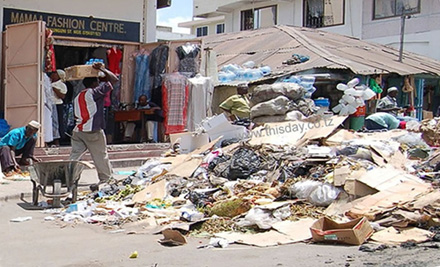
Uncollected garbage outside a "fashion center" in downtown Dar.
Uncollected garbage outside a fashion center in downtown Dar.
Photo by Tanzania's ThisDay.
Africa was agog today with reports that Dar-es-Salaam was the 8th dirtiest city in the world. But are these reports accurate?

No! No! Let me come to the needed rescue of Dar: It is NOT the world’s 8th dirtiest city; it is, in fact, the world’s 12th dirtiest city!

Mercer Health & Sanitation’s Index rated Dar at 40.4. Only three other cities in Africa were rated worse than Dar: Ndjemna (Chad) at #11, Brazzaville (Congo) at #10, and Addis Ababa (Ethiopia) at #6.

No other East African cities came in the top 25, although Nairobi fell into the top 35.

(Multiple African news reports cited a “NYC Consulting Firm” rating of #8 for Dar, but there doesn’t seem to exist an “NYC Consulting Firm.” That list of the world’s dirtiest cities is close to the real Mercer ratings, but not exact.)

Dar is not denying the criticism.

“It is true and I accept that the city of Dar es Salaam is dirty,” Dar es Salaam Regional Commissioner William Lukuvi told This Day an on-line Tanzanian news source. And that’s good, of course.

Dar is the fastest growing city in East Africa. No one is sure about its size, and it’s probably not as big as Nairobi, but closing the gap quickly. It also lacks Nairobi’s sprawling slums, which in an unusual way contributes to the lower Mercer rating.

Nairobi slums have been around for a long time and many NGOs have worked at them, as has the central government. Sewage, bad water, and the diseases that spread as a result, are the main reasons for Mercer’s list of the worst cities. And ironically, the decade and longer attention to the Nairobi slums has actually mitigated what would otherwise be an uncontrollable catastrophe.

Don’t get me wrong. The Nairobi slums are terrible, but the makeshift gullies cut by NGOs and the government does drain human sewage, the main cause of cholera. Last year there was more cholera in Dar than Nairobi.

Dar’s problem is that it is far behind Nairobi in sewage treatment and waste disposal. This is probably because Dar is on the ocean, and it has been common practice to just dump waste into the sea. The practice is now haunting the city, because unlike Nairobi, it has no well-organized sewage disposal.

Dar’s other problem is corruption. Dar’s three municipalities each contract private companies for garbage disposal, but don’t pay them. Instead, they allow the private companies to collect levies however they wish, a completely haphazard and terribly corrupt system.

To his credit, Lukuvi knows this.

“The present system is messed up. You can’t have a contracted company collect garbage and levies at the same time. The municipalities will henceforth be responsible for collecting the levies and paying the companies that are contracted to collect the garbage,” Lukuvi told This Day.

The annual Mercer ratings are important. They corroborate the United Nation’s warning that the greatest threat to the developed world is the lack of clean water.

Of Mercer’s 25 worst cities, 20 are because of a lack of clean water. Only 5 are because of air pollution.

Is Kenya Safe?

Is Kenya Safe?

Safer to be in than Tanzania or Uganda, according to the UN.

The U.N.’s announcement this week that Kenya is now safer for its employees than Tanzania or Uganda sheds new light on how travelers should view government travel warnings.

Not much has changed in the last year in world governments’ advice to their citizens heading on safari. The U.S. and Britain retain a travel warning against Kenya, Canada doesn’t, and Canada and Britain retain a travel warning on Uganda, and the U.S. does not.

The U.S.’ lack of warning on Uganda is political. Ever since Bill Clinton invested so much time and money in Uganda, and more recently when so many U.S. politicians got mired in Uganda’s sticky politics, the U.S. has misrepresented that country’s safety for travelers.

I think Uganda is safe to visit, if you know what you’re doing. As I do for Kenya and Tanzania. But traveling to East Africa for a safari is not as safe as traveling to Branson, Missouri, for a music festival, or to the Loire Valley for wine tasting, and it’s perfectly right of governments to try to explain these distinctions.

After years of trying to figure out these admonitions from a variety of western governments, after years of parsing which are political and which are truly advisory, I think at last there may be a better guide for potential travelers than any government’s specific recommendations.

The United Nations has tens of thousands of employees stationed all over the world. The level of pay – like our own military and foreign service – is determined to a certain extent by how dangerous the UN believes these postings are.

But the UN goes beyond analyzing simple threats to personal safety. It analyzes how easy communication is, what diseases are locally threatening, how likely power interruptions occur, how smoothly complaints and infractions of local law are handled by local authorities, how complete public services are… it even analyzes how enjoyable are local cinemas and theaters, how well stocked is the local grocery store, and how the climate might effect foreigners not used to it. And much more.

It goes on and on, because what the UN realizes is that the “safety” of a foreigner in a foreign place is a “well-being” issue that extends far beyond whether or not al-Qaeda is trying to get you.

And so the UN puts all the countries in the world into 5 categories: A, B, C, D or E.

Get a posting to a country with an “E” rating and you’re going to be paid a lot to maybe get killed. Get a posting to a country with an “A” rating and you’re going to be paid a lot less but will live to spend it all.

Better yet, the UN may divide a country’s rating depending upon what city you’re visiting.

Last week the UN moved Nairobi and Mombasa (Kenya) up from C to B. It kept Arusha and Dar-es-Salaam (Tanzania) and Kampala (Uganda) at C.

That’s exactly how I feel.

C is OK, if you know what you’re doing and how to do it. B takes a little bit less care.

Of the 141 countries in the world that the UN has a permanent presence:
49 are A,
37 are B,
27 are C,
21 are D,
and 7 are E.

Of those 46 are in sub-Sahara Africa:
6 are A,
9 are B,
14 are C,
13 are D,
and 4 are E.

As I’ve said time and again, nobody going on vacation wants to research the safety of where they’re headed. But also as I’ve repeatedly explained, a safari isn’t a “vacation.”

There’s little R&R on safari. A safari traveler is a student, and that’s a wonderful thing. She’s an explorer, lusting for the new and unknown. He doesn’t want a quiet beach in the Carolinas.

So there’s a risk in this, however slight. It takes some guts to want to become smarter, to educate yourself about parts of the world that are foreign to you.

But that doesn’t mean you put yourself in danger. So how best to determine this threshold?

Go first to the UN list. Don’t go if it’s a D or E. If it’s C, then read the detailed travel advisories from your country and others to help you determine if you consider it safe. If Britain, Canada and the U.S. all agree, I think you can take that as a pretty unbiased analysis.

But if they don’t agree, as they don’t in East Africa, it gets a bit tougher. You have to figure out why they don’t agree, and decide who is better to trust.

(Important qualifier: my simple list above is for only the capitals of those countries. Kenya, for instance, gets an “E” for the town of Garissa, which is near the Somali border. So you also need to research your travel by city, beyond the simple capital references given above.)

And finally, I’ll leave you with this travel admonition recently given to travelers from abroad who are considering visiting the United States:

“There is a general threat from terrorism in the United States. Attacks could be indiscriminate, including in places frequented by expatriates and foreign travelers. The US Department of Homeland Security (DHS) has designated the terror alert status of “orange”, or high, for all international and domestic flights in the USA.”

The above admonition comes from Her Majesty’s government of Great Britain.

Giant Pouched Rat Day

Giant Pouched Rat Day

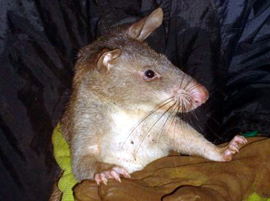
The African Giant Pouched Rat<br>has no shadow to see.
The African Giant Pouched Rat
has no shadow to see.
The closest African relative to the groundhog never appears.

Well, fact-check first. The truly closest relative to the groundhog is the giant forest squirrel (Protoxerus stangeri mayensis) but it may be extinct. I’ve never seen it, no one seems to care very much about it, and the only picture I could find was of a specimen collected in 1842 that is in a drawer of the Field Museum in Chicago.

But the giant pouched rat (Cricetomys gambianus Waterhouse) definitely exists, because I’ve eaten it.

I didn’t roast it, but our guide roasted it on a skewer to attract the pygmies along the Lobe River in the Cameroun that would then trade the skewered roasted giant pouched rat, to guide us to see lowland gorillas. But we, too, needed dinner.

It tasted just as good as the Guinea Pig I ate in Cuzco.

The main difference between an African groundhog-like animal (the Giant Pouched Rat) and an American groundhog-like animal (the Groundhog) is that the African groundhog-like animal does not appear on Oprah.

Nor does the African variety pretend to forecast weather. There is no movie named “Giant Pouched Rat Day” and in fact no movie made by Africans that is that incessantly trivial. African Giant Pouched Rats do not appear on 7 o’clock local television shows during the weatherman section and they do not appear to have a single day of being loved with 364 days trying to escape the landscape exterminator.

The Groundhog’s better common name is Woodchuck. The African Giant Pouched Rat’s better common name is Big Rat.

However, only the Groundhog is capable of reflecting the stir crazy mentality of someone living in the depths of an endless winter.

Bonobos as Peace Makers

Bonobos as Peace Makers

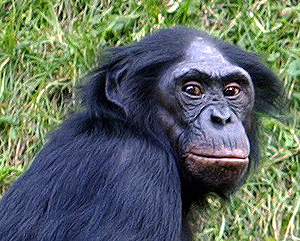
Can this creature bring peace to Africa?
In this so troubled time for East Africa there are some exciting glimmers of hope for societies and conservation.

Stand on any of East Africa’s high mountains and look east to some terrifying developments. Al-Qaeda militia are gathering on Kenya’s borders. The drought in Tsavo decimated the hippo population and spurned the bushmeat trade.

But look west and it’s a different universe. In the Congo, once one of the most turbulent spots on earth, there is a smell of peace, and long-time conservationists have smiles on their faces.

Recently an old friend, John Lukas, General Director of the White Oak Conservation Center, asked me if we might consider restarting tourism to the Congo.

John has maintained an oasis of conservation in that troubled region for nearly 30 years, the Epulu Research Station. His first interest was the rare okapi, found only in the Ituri, but since then his center has expanded and supported a wide array of other research.

Terese and John Hart, probably Africa’s most professional, dedicated long-term field scientists, worked even further away from Epulu’s oasis, among the Congolese pygmies and besieged communities decimated by decades of war.

The Harts raised a family while they researched in the “Heart of Darkness”. They were sometimes out of touch for weeks. In the worst of times, sane conservationists wondered what the hell they thought they could do in a part of Africa that Joseph Conrad had clearly labeled “out of reach”.

Well, they unearthed remarkable science about bonobos and newly discovered primates, and conducted the only good social science of the pygmies bushmeat trade, among so much more. And now, Terese has established promising beginnings to creating what would be Africa’s largest single conservation area, named for the time being as “TL2″.

This oblique, geographical reference to one of the most wondrous, colorful if not magical places on earth is typical of the Hart’s low-key but ever-steady science.

In an email to me over the weekend Terese remarked, “I believe that the situation has been improving for the last several years and with the right engagement tourism is definitely possible.”

Incredible. The last time I took tourists into the Congo was in 1979.

The southern Sudan, where impressed child soldiers created what was called with primitive burlesque, the Lords Resistance Army, there really now is peace after a generation, and a new and massive national park has been created.

I hope to write much more in the coming days about the Sudan’s Boma National Park, and about “TL2″. These incredible areas hold promise not just for the conservation of bongo and bonobo, as well as other extraordinarily rare animals and plants, but the promise of peace to their society.

Rwanda’s gorilla project has proved that the revenue tourists provide can exceed almost any other exploitation of natural wilderness, and if managed properly can lead to increased social development.

It’s not a stand-alone model, but it is remarkable that through the many troubles Rwanda suffered after the gorilla project was started, the health of Parcs de volcans continued to improve, including the size of the mountain gorilla population. Without tourism, this wouldn’t have been possible.

And the health of that single albeit most important conservation project in Rwanda is arguably one of the reasons Rwanda is now stable and prosperous.

Keep your fingers crossed! I’ll be writing more about these exciting areas in the weeks to come.

Victorious fighters of al-Shabaab

Victorious fighters of al-Shabaab

youngsoldiersLess than 24 hours after the UN Security Council approved continued funding of the Somali peace-keeping force, that force may have been routed from the capital by al-Qaeda.

After a night of intense fighting in Mogadishu, the blogosphere is replete with claims that al-Shabaab (al-Qaeda in Somalia) is near to taking over. Reuters was unable to make contact with any of the UN Peace Keepers.

“This fighting was the worst in months,” Mogadishu resident Ahmed Hashi told Reuters.

The world’s recent attention on Yemen as a cauldron for al-Qaeda growth came way too late. And now it seems not even the UN realizes how serious the situation in Somalia is.

This incessant game of catch-up, of pushing the “War Against Terror” from one country to another and always too late, now threatens the legacy of stability the west helped to create in East Africa.

The UN force had been trying to protect the pitifully weak “interim Somali government” which has not even controlled the entire capital city for the last year.

Al-Shabaab on the other hand has slowly established control over a huge portion of the country. In October these mostly foreign fighters took control of large towns near the Kenyan border.

Only the pirate-held area near Kismayu seems out of al-Shabaab’s grasp.

And where are all these weapons coming from? We’re not talking about machetes. There are tanks and missile launchers.

The fighting today reminds me of the 1980s Cold War days when America-backed Somali fought Russia- backed Ethiopia in the useless Ogaden desert that separates the two countries. Thousands of tanks. Thousands and thousands of mortars. Even jet fighters. For a completely useless piece of land.

That legacy left want and destruction then chaos, and at the time most of us didn’t even know that battles which rivaled those of WWII were going on the Horn.

We left want and destruction all over the Horn, proxy battles for the parlor room politics back in Washington and Moscow. The McCarthy hearings were shameful, the Vietnam War apocalyptic to world peace, but the number of Ethiopians and Somalis who were killed in the 1980s fighting for Communism vs. Capitalism and since killed as a result far out numbers the 58,196 names on Washington’s Vietnam Wall.

That was a generation ago. The children born then, now the fighters of al-Shabaab, now know no other life.

State of the World

State of the World

StateofUTonight it’s possible that more viewers outside the United States will watch President Obama’s State of the Union than from his own country.

Brian Williams’ and Katie Couric’s audience shrivels when compared to that of Owen Bennett-Jones, who today ends his BBC World Service specials on America just before airing the State of the Union live around the world.

“Is America really obsessed with God, gays and guns?” Bennett-Jones asks, today, as his final introduction to the world’s most powerful leader’s annual speech.

Yes.

Nairobi’s Capital FM Radio’s Eric Latiff reminded his fellow citizens on the eve of the address that corrupt Kenyan leaders “ will NOT step aside to allow investigations …unless foreigners (read donors) push them out of office.”

Like we do in Ecuador and Honduras, Afghanistan and Iraq, Thailand and Laos, and Rwanda and Uganda as well as Latiff’s Kenya.

We rule mostly by money, but also by arms (which seem to be less effective, today).

So today in Kenya, for instance, the U.S. announced it was withholding around $30 million promised for the country’s education system because of corruption. We also announced continued and increasing travel bans on certain Kenyan officials from entering the U.S. (where most of them store their money).

There is nothing illegal or immediately immoral in these powerful acts, and in Kenya most citizens actually support them. Because as in the U.S. right now, most citizens distrust the bums who have been elected to govern them.

So what we have in the world is distrusted bums governing distrusted bums.

Governing us.

Extend your universe, tonight. Pull up the BBC or Nairobi’s Capital FM. Note how powerful Barack Obama is perceived and whether true or not, how powerful the U.S. Ship of State is. The Ship of State floated by you.

The Monkey & The Butterfly

The Monkey & The Butterfly

Monkey & ButterlyThe 2009 “Year of the Gorilla” ended very beautifully and very sad. The butterflies will just have to wait.

It was a sad coincidence from the start that the YOG planned so long in advance occurred as the world tailspinned into economic collapse. The whole point of these sponsored years is to focus attention and funds into what has been essentially world organized successes.

The success of the mountain gorilla project is legendary. Its foundation rests not on celebrities like the poorly trained and personally dysfunctional Dian Fossey. (Indeed, I strongly believe after her initial success in publicizing the plight of gorillas, she was more responsible for inhibiting development of the project than any other individual.)

Rather, the remarkable success was with the people – kids at the time – who really sacrificed part of their young professional lives to the cause: they were willing to work in the super-nova umbra of Fosey under enormous difficulties.

George Shaller did the science. Bill Weber and Amy Vedder followed him and created this hall-of-fame project that merged gorilla conservation with local development including tourism. And this triad of science and society had no precedent.

It was an amazing beginning, and you can buy their dramatic story from Amazon by clicking here.

The next tier was the grunt field workers cum- or to become scientists and legions of social workers and volunteers and probably primary among them was Craig Sholley. Click here to visit the conservation organization Craig now works for.

So as the heydays of the last decade whirled by with more good news than bad on the conservation front, it made sense to top off the century with the Year of the Gorilla.

Not their fault, Goldman Sachs. So while the various organizations involved have yet to tally the proceeds, the talk on the street is not good. Maybe less than half what was hoped to have been raised was actually realized.

But there are good stories, nonetheless. Researchers, students and volunteers supported by the YOG in Bwindi national park have blazed new trails and new science, and along the way, have even discovered a few new … butterflies.
mass of butterflies
This picture was taken by the volunteer named Douglas Sheil last week in the Bwindi forest. In this montage of several photos are two new species of butterflies.

“We don’t know a huge amount about Bwindi’s butterfly fauna though it appears to be richer than other forests in Uganda,” be blogged.

He then went on to list a few species still lacking confirmation and English names, and basically, took the pictures and left the science.

For others, when funds become available.

Ivory Sink Hole

Ivory Sink Hole

Tanzania conservation authorities have plunged into quicksand and the sink hole could take all of East Africa with it.

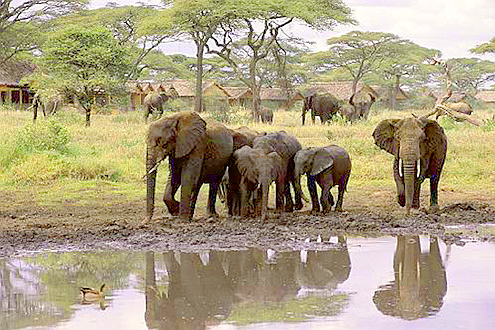
This weekend Tanzania confirmed that it was aggressively trying to convince the 175 members of the Convention on International Trade in Endangered Species (CITES) to approve the sale of elephant ivory.

All the surrounding countries except Zambia strongly condemned the announcement by Director of Wildlife Erasmus Tarimo.

Kenya pointed out this was Tanzania’s worst year for elephant poaching in more than two decades. The announcement also followed a sad report Thursday that 12 rhinos had been poached in what had been considered the poaching-free park of Kruger in South Africa.

The United States has yet to take sides. This is a very troubling matter. The convention opens next month.

The irony is that one of the reasons Tanzania wants sales to be allowed is because it has confiscated so much illegal ivory just this year. Tarimo says the country is warehousing more than 90 tonnes of elephant tusks.

Based on the last such auctioned sale, that could be worth $20 million.

But the cycle of irony is self-perpetuating. If Tanzania gets to sell its ivory, there is likely to be more poaching as the market for ivory widens. Tanzania will confiscate more illegal ivory. Tanzania is discovering a mafia-like way to reap the rewards from what it claims is wrong.

”They (Cites) will track down our record in the past ten years to see history of elephants in the country,” Tarimo said, noting that the species have been increasing over the last ten years.

And you can be certain the Kenyans will highlight the horrible “history of elephant poaching in Tanzania” just this year alone.

All the countries in Africa with elephants hold large stockpiles of ivory, including Kenya. The southern African countries, which have historically managed anti-poaching infinitely better than the rest of the continent, have continually argued for controlled auctioned sales of ivory.

CITES has allowed three such sales, but never from the East African market.

Best game in October

Best game in October

Niki Roberts [email protected] asks:

Q. We are getting mixed messages about where to see the most animals in October.

A. At any time of the year, in any weather condition, there are more animals seen on an East African safari than on any other safari anywhere else in Africa, including all of southern Africa. As a comparison consider that normally on a two-week safari at the best time of the year for southern Africa game viewing (July – September) you will likely see 10-15 lions. At the best time of year for an East African safari (March – June), you’re likely to see 70-80 lion. Similar comparisons exists for most of the other animals as well.

While that is an absolutely true and definitive statement, the statement that March – June is the best time to see animals in East Africa is a little bit more qualified. This is because — unlike southern Africa which is definitively south of the equator and has absolute climate seasons — East Africa lies astride the equator. This means the seasons are not really very different from one another, and it also means that the weather is much more complicated. This is true around the world at the equator because of the confluence of jet streams wirling around against one another.

Rain patterns are pretty well established, though, and that’s what I base my statement on. The rainiest time in all of East Africa is March – June. That’s why it’s the best time for seeing the most animals. This is when they’re fat and sassy and less stressed, meaning more viewable. It’s also the only time of the year when the great wildebeest migration is all in one place at one time: the southern grassland plains of the Serengeti. So in other words, this is the ONLY time during the year that in one view from a mountain top near Lemuta you have the chance to see between 150-200,000 animals, the maximum a wide-horizon view will allow when they’re packed together.

BUT in the wet season predation is much harder — for obvious reasons — so the number of predators that you’ll see easily is often less than what you’d see in the dry season. In October on a two-week safari in East Africa, the number of lion you’re likely to see can double, to over 100.

I prefer the beauty of the wet season: the gorgeousness of the veld, the abundance of game, the large numbers of babies, the abundance of birds (because all the European migrants have joined the African species to increase the total species count to more than 700)and the general state of the veld: much less dust, for instance. Ironically it also coincides with the “low season” so the rates are the cheapest. Low season doesn’t mean it’s a bad time to travel. This is the low season for most places all over the world — it’s just a time that people don’t travel for some reason.

Finally, you may be interested in why you’re confused! Game viewing in East Africa started in Kenya in the late 1950s, early 1960s. Travel was much more difficult then. The cut tracks in the national parks weren’t very well maintained, and the vehicles were pretty bad — mostly minibuses. Imagine traveling through areas of mud with a poor vehicle! (By the way, rainy season is not like London, but like summer in the Midwest: grand, dramatic afternoon thunderstorms with the rest of the day and night beautifully clear.)

Also fortunate for Kenya, the dry season is featured by about a third of the great migration coming into Kenya’s Mara. So it was absolutely true to say, at least in the 1950s and 1960s, that the best time for game viewing was during our summer and fall, during Kenya’s dry season.

But that changed when vehicles changed and parks got better tracks. Today we mostly use Landrovers which have no problem with a bit of mud. The tracks are better, and northern Tanzania is now developed. In the days when the myth of the best game viewing during dry times developed, there wasn’t even a Tarangire National Park and very few roads at all in the Serengeti!

But of course the Kenyan operators are not going to help you explode this myth! The Kenyan’s rainy season is much shorter than in northern Tanzania; Kenya is a much drier place all year long, and so if you accept — as I’m arguing — that the wet season is better for game viewing than the dry season, then the Kenyans are immediately going to be upset.

But those are the facts!

It’s peaceful in Kenyan prisons

It’s peaceful in Kenyan prisons

Friday's Daily Nation cartoon.  The black briefcase carries the name of Kenya's immigration minister.
Friday's Daily Nation cartoon.
The black briefcase carries the name of Kenya's immigration minister.
Today was supposed to be explosive in Kenya as Muslim activitists took to the street. They can’t. They’re mostly behind bars.

Over the last three days Kenyan authorities have arrested up to 2,000 Muslims across the country, most of them jailed for being “illegal immigrants.”

The crackdown followed last Friday’s riots in Nairobi, provoked (according to the government) by Muslim militants backed by al-Qaeda in Somalia (al-Shabaab). The demonstrators were demanding the release of cleric Abdullah al-Faisal, who the government has been trying to deport.

And further government embarrassment, yesterday: After weeks of trying to get commercial airlines to take Faisal out of the country, the government chartered its own Gulfstream jet wihch broke down on the runway before take-off.

As far as we know, Faisal is still in the country. And activist Muslims are still in jail.

By early afternoon today in Kenya all was calm.

Friday during prayers Muslim leaders around the country told their faithful to avoid further demonstrations. A statement read in thousands of mosques from the Supreme Council of Kenya Muslims condemned the police action but called on all Muslims — particularly infuriated youth — to stay at home, today.

Click here for the full statement as reprinted by Kenya’s FM Capital radio.

Officially the government claims that 1200 “illegal immigrants” have been detained. Unofficially, police put the number closer to 2000. Around 400 have already appeared in court.

Among those known detained are refugees from Somali, including two army generals and 11 Members of Parliament that had fled the growing military success of the al-Shabaab militia.

This is not good.

Many of the Somali refugees in Kenya are not radical; in fact, just the opposite. They’ve fled the fighting there because they are targets of the radicals. In all likelihood, they were moderating influences among Kenya’s Muslim community.

Thursday, a widely circulated internet site claiming to be al-Shabaab posted videos of militant jihadists shouting, “God willing we will arrive in Nairobi, we will enter Nairobi, God willing we will enter … when we arrive we will hit, hit until we kill, weapons we have, praise be to God, they are enough.”

But in a telephone interview with Reuters, today, al-Shabaab spokesman, Sheikh Ali Mohamud Rage denied the site was authentic and said the organization had nothing to do with last Friday’s riots in Kenya.

Now, what? And can anybody get that plane off the ground?

Right to Kenya

Right to Kenya

Two mysterious American lawyers are in The Netherlands trying to stop the international trial of Kenyans accused of genocide in the December, 2007 election.

This is an affront to justice and Kenyan society, and there are links to these men with the rightist neo-cons of the former administration. Which makes it even more of an affront to Kenyan’s earnest attempt to move on from that horrible time.

Prof. Max Hilaire and self-proclaimed lawer, William Cohn, appeared before the international court at The Hague expressly to forestall or terminate the Court’s procedures against ten Kenyans accused of crimes against humanity during the turbulence that followed the December, 2007, election.

Kenyans are shocked.

“Kenyans are seeking an end to impunity and to ensure accountability and justice for the over 1,000 Kenyans who lost their lives, the over 300,000 IDPs who lost their homes and the over 5,000 women who were sexually assaulted,” read a statement signed by prominent Nairobi lawyer, Naomi Wagereka.

Wagereka cited recent polls in Kenya indicating that a large majority of Kenyans want the perpetrators of the post election violence tried at the Court in the Hague.

The trial of the accused moved out of Kenya to The Hague when the Kenyan Government was unable to come to terms defining the trial, as was agreed in the political deal that ended the violence in February, 2008.

In that agreement, a time limit was set for the Kenyan Government to create something akin to South Africa’s Truth & Reconciliation Commission to deal with the perpetrators of that violence. The limit was extended several times before the government conceded that the trial should go to the Hague.

The vast majority of Kenyans, and now a consensus among government leaders, were therefore stunned by the news that two unknown Americans were trying to stop the procedings.

The chief prosecutor for the International Criminal Court (ICC) Luis Moreno-Ocampo dismissed the American’s actions as “unfounded”. He told Nairobi’s Standard newspaper that the Americans were simply delaying the procedings.

The two Americans’ brief argues that Kenya’s case does not meet the Court’s threshold of crimes against humanity, and that it is ‘overstretched’ and ‘exaggerated’.

Hilaire is associated with a number of right-wing organizations, particularly the Center for Strategic Studies at the National Defense University, which is often used by Fox News for commentary on defense issues.

He has authored several books, with recurrent themes that criticize the formation of the ICC and challenging the authority of a number of institutions, including the United Nations.

His sidekick, William Cohn, has been repeatedly reported by news sources as reputable as Agence France Presse as a “lawyer from California” but he is not listed with the California Bar Association. Little is known about him.

“One wonders whose interests are these American professors serving,” Kenyan lawyer Wagereka asked local journalists several days ago.

Back on (a wet) Track!

Back on (a wet) Track!

Now at one of my favorite Serengeti lodges, Ndutu.
As we enter the great migration season in Tanzania everyone ready to go (including me) wants to know the state of the veld. Well – dare I suggest it? – it looks… wonderful.

I wanted to say “normal” but normal doesn’t exist, anymore, in these confused eras of global warming. But frankly that’s what 2010 looks to be: right on the charts of normalcy for the last 30 years of climate statistics.

Which makes it very abnormal for the last 3-5 years. So in that context 2010 is on target to produce the finest scenery and best game viewing in the last five years!

Mother Nature broke the 3-year “drought” as you would expect her to: grumbling and shaking off somnambulant neglect with thunderous bursts of rain which in some places, like the western and northern Serengeti, represented some of the most incredible torrents ever seen.

On Christmas Eve 1.5-1.7 inches of rain fell in one day over most of this area. For the month of December the Serengeti/Mara ecosystem experienced nearly 7.0 inches of rain. This is nearly three times “normal”.

The deluge resulted in worries that El-Nino was battering, again, and that soon the world would float away. Didn’t happen… yet, anyway. And western climate prediction centers show a real return to normal patterns for the remainder of the year.

This is my favorite area in the world. From the Talek River in the Mara to the central Steppe of Tanzania, the veld is now a deep, rich green. On the flat prairies of the Serengeti the “wet” wildflowers are all over the place:

Little white flowers looking exactly like their nickname, Tissue Paper Flower, (Cycinium tubulosum) literally cover the veld, almost like snow. Remarkably this year, they’ve even covered the veld as far north as Samburu. Unusual and rarer apricot and red versions have been reported in abundance in the Mara salient.

A bit anxious and not normally so prolific, Kenya’s national flower, The Flame Lily,(Gloriosa superba) is already standing out. (This is one of the reason locals are worried about the deluges continuing; but I think superstition is getting in the way. Lilies are tubers and build up residual nutrient stores during dry times, and these guys are just impatient to get going!)

The wildebeest migration was normal for the first time in years. Last year it lingered in the northern Serengeti (the Mara) almost until January, as the rains further south were light. But this year the great herds were well south of the Sand River by early December… just like scientific papers crunching 30 years of data say they should.

The Ewaso Nyiro River in Samburu, the Tsavo River in Tsavo, the many rivers in the Mara including the Great Mara, the many rivers in the Serengeti, and the two lakes in Ndutu (Masek and Ndutu) are all recovering, looking normal, after spurts and backups throughout December.

Grazers including all the plains antelopes are becoming fat and sassy. Browsers, especially elephant, are still struggling, searching those areas with new growth but relying on grass until it happens. Giraffe are a bit luckier, they can reach the new, high acacia shoots.

An incredible sight was reported in mid-December as Lake Manyara began to refill, and on one day, December 14, literally several hundred thousand flamingos returned. Where had they been?

European migrant birds are down in great numbers. The massive and awesome funnels of tens of thousands of Abdim storks have been seen above the crater.

Nature is balanced, and compared to what most of us felt was a stressful several years now ended, the predators thought otherwise. It was heyday for lion, hyaena, jackal, leopard and cheetah. For them the return to normal times means predation is much harder, and already camps like Governor’s in the Mara are reporting fewer cubs surviving, more internecine fighting.

The yin and yang of the veld. But I for one feel enormously relieved. There is a stress when surveying an African veld that is distressed for lack of rain unlike any other experienced in the modern world. It is a helplessness that pivots the intellect into moments of superstitious hope. That arthritic spiritual response is agonizing, and now — at least for now, it’s gone.