Forest Magic

Forest Magic

We left Semliki very impressed, but I put the chances of it ever recovering to the outstanding game reserve it once was as very low.

Monday night we were dumped on big time by a Ruwenzori thunderstorm when we were still 3k from the lodge and it was getting dark. Our second sundowner in the Semliki forest had been fabulous, and the orange-red sun setting like a perfect orb through the heavy mist of the Ruwenzori was unforgettable.

But even 3k in a thunderstorm in an open vehicle is not nice. Personally, I prefer the closed, top-goes-up vehicles of the sort we mostly have in Kenya and Tanzania. But I have to admit until a rain storm appears, I’m usually in the minority.

So we got to the lodge soaked through and through, but in less than a half hour everyone was back in the lounge, dry and ready for dinner. Steve Taylor, director of the zoo, was in his Sunday pants, and Steven Chaitoff, at 22 yet to be director of anything, was in a towel. But it became one of those memorable times on safari that we’ll never forget, carrying our memories well beyond the wet and rain to the amazing sundowner sunsets and great time in the forests.

If one is to believe the literature of the lodge, Semliki was once the greatest game reserve in East Africa. Quoting an old hunter, there were standard reports of the biggest most beautiful lion in the world. I heard a lion in the night, but I think the chances slim of ever seeing one here.

Semliki’s outstanding characteristic is its virgin forest which supports an avifauna which is really amazing. The lodge says there are 450 species, but our incredibly good guides said it was really closer to 800 if you include the actual Ruwenzori and sliver of Uganda that exists on the west side of some mountains in the Congolese jungles.

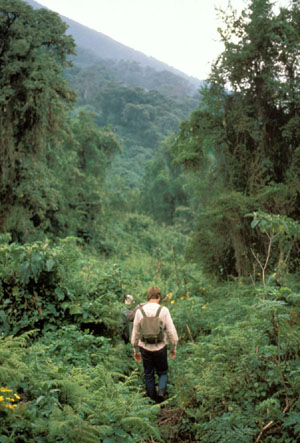
Steve counted 88 species in the two days, which is remarkable, and there were undoubtedly as many more again that we didn’t notice or record seen by our guides. And the forests themselves, mixtures of hardwoods, cactus, ferns, palms and hundreds of epiphytes, is a dream world.

But there’s a main road, heavily used, that cuts the reserve in two, the road from Ft. Portal to Lake Albert, and villages or quasi semi-permanent villages all along the way. There are fuming motorcycles and oil-leaking tankers. It is not the formula for reintroducing big game; it’s just not large enough given that road.

Wednesday morning some of the group went out again, and so more birds, while others went for a walk in the forest with the ranger. Doreen said it was “magical” and Roger was excited about having found chimp nests in an area that isn’t supposed to have habituated chimps. All testimony to the vibrancy of the forest.

After lunch we headed southwest through the city of Ft. Portal to our wonderful Ndali Lodge, where we’ll now be for two nights. It was an easy 2½ hour drive with a short stop in Ft. Portal, a busy, somewhat haphazard town with a deep history that it can’t seem to emerge from.

On the way we encountered – once again, it seems like everywhere – the Chinese building a new highway. And this will be no ordinary road. Everyone always challenges me when I say it will take more than two hours to go from Semliki through Ft. Portal to Ndali. Now they understand.

The roads serpentine on the edge of little mountains like curly hair, sometimes coming back on themselves. It provides spectacular scenery, but every mile the crow flies must be at least two or more on this road!

Tomorrow we begin our chimp trekking in the Kibale Forest.
Both Sides of the Moon

Both Sides of the Moon

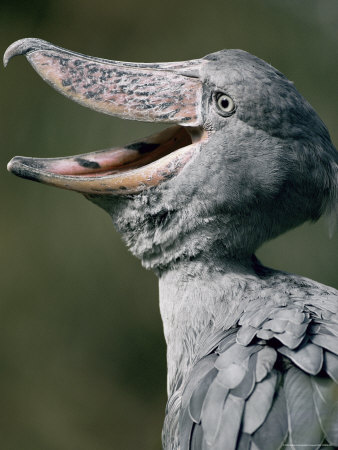
We found the shoebill in Lake Albert.
The Cleveland Zoo safari spent several days in the Semliki Reserve adjacent Lake Albert right on the Mountains of the Moon. We were lucky to see both the dark side and the bright side.

We flew from Entebbe to the Semliki Reserve in one of the few charter planes that exists in Uganda. Unlike Kenya and Tanzania, Uganda’s tourism is very small and its infrastructure still being built. Charter flights is one of the difficulties.

But we managed and collapsed a 7-hour ride into a beautiful one hour flight that headed straight for the Mountains of the Moon, the Ruwenzori mountain range first described by Henry Stanley in 1889. Stanley had been lucky. The reason they are nicknamed “Mountains of the Moon” is because a heavy mist usually covers them except at night, when they can only be seen when the moon is bright enough.

We couldn’t see them any better than most, but we knew they were there. Huge rain storms formed on them and nearly disrupted our first night Sundowner. And when we took our boat trip on Lake Albert, the mist raised for all of a few seconds revealing their awesome size.

We’d gone to Lake Albert to try to find a shoebill stork. There are less than 7000 of these dinosaur like birds left, and almost all of those are in the troubled Sudan. As the shoebill flies, we weren’t too far from there.

Traveling to the village of Ntoroko on the lake, we hired several boats to head towards a swamp peninsula about a half hour from the shore. It was a lovely, very still day, and not too hot. The lake was like glass, pocked throughout with water hyacinth, a growing threat to the area’s fishing industry.

It wasn’t too long before Hope Koncal on the trip spotted the first shoebill. If they’re there, they can’t be missed, but Hope had seen it looming above the lilies and hyacinth from some distance away.

The birds aren’t frightened of people. There are so many fisherman in the area with no interest whatever in them, that an incredible tolerance has been developed in this area.

So we cut the engines and polled to within 15m of the bird as it was hunting. Like all storks, it was very slow moving and deliberate.

Dave Koncal got a video of the bird in an unsuccessful hunt. Unlike most storks which “bite” their prey, the shoebill hooks it with a formidable tooth that drops down on the outside tip of its mandible.

We watched the giant critter try to hook something – but it missed. It’s favorite food here are little crocodiles, but it also eats fish and frogs.

It was an outstanding find and as we headed back I panned my binoculars to a collection of vessels near the town at the shore.

There were several barges and a number of large containers. Later we would see these more closely, along with some of the strangely marked trucks going to and from that jetty.

It was undoubtedly one of the crossing points for Congo contraband, particularly its precious metals like coltan.

Without a formal customs station, I’m sure that the captains of the vessels and drivers of the truck pay some hefty bribes, and from the looks of the village of Ntoroko, some of it was trickling down into the community.

Usually, when I visit fishing villages like Ntoroko there are many malnourished kids. They eat tons of fish, but nothing else. Ntoroko kids looked a lot better.

And so I realized how the recent victory we celebrated in the financial reform act that will ban coltan purchase from the Congo is a two-edged sword. (See my blog last week, “We Won!”)

Sanctioning the mining of Coltan by warlords in the Congo is likely to reduce the war there, and reduce the use of child soldiers and miners. But it may also negatively effect Ntoroko and villages like it, until a wider, more comprehensive solution can be found.

Safaris are not always measured in just successful game viewing.

War on Security

War on Security

Is it safe to travel in Uganda, now?
As we were traveling from the Entebbe (Uganda) airport late last night, the first topic we discussed was “security.” Security against a catastrophic 9-11 is better in Africa than at home.

My first clients, the Pomerantz family, (Roger and Cathy Colt and son, Daniel) remarked first that they had recently been to Egypt where it seemed like security was nonexistent. And I told them a very funny story that just happened to me in Nairobi.

I was at Gate 3 of the Jomo Kenyata? airport, the basement gate, which sends off 3 or 4 late night flights more or less at once, so in a waiting area that is always jammed. To get into this waiting area you have to pass through “security” – a metal detector.

A novice traveler to be sure, a very small (possibly Twa) Ugandan dressed in finest Sunday clothes was having great difficulty getting through the metal detector and to everyone’s irritation was holding up the line.

Each time he tried to go through, the red light beeped and security officials ordered him to return and try, again. He’d empty his pockets. Beep. He took off his belt. Beep. He removed what looked like a medicine ID tag. Beep.

Finally, the security official pointed to his highly, thin-toed black polished shoes. He took them off. Beep.

This time we knew why. He took them off, but he held them in his hands as he walked through for the upteenth time, and of course the detector beeped. The other items he had removed he had carefully placed in several of the big pockets of his Sunday dress coat. Which he didn’t remove. Beep.

The security official, finally realizing only moments after the rest of us did what was going on, laughed uncontrollably and waved the gentleman through. Beep. Last beep, though. No enforced retry.

No threat, either. Some of us get through when we don’t beep. Others – like this gentleman – when it’s just obvious he’s no threat.

Until this month, there was little to terrorize in poverty-stricken, weather forsaken, economically oppressed Africa.

A decade ago it was different. I was in Nairobi on August 10, 1998, when the American embassies in Nairobi and Dar were blown to smithereens. But every American embassy in Africa is now a fortress of unbelievable magnitude. Can’t bomb it, now.

So terrorizing sufficient numbers of westerners has become problematic. And … until recently .. there was no point in terrorizing nonwesterners.

A couple weeks ago more than 70 people were killed in the Kampala bomb blasts. That’s where I am at this moment as I write. But the bombs were meant for westerners. Al-Shabaab (Al-Qaeda in Somalia) expressly said it was targeting Ugandans.

Things have changed.

The Ugandans were targeted because they are the lead in an OAU military peace-keeping force in Somalia that Al-Shabaab is fighting.

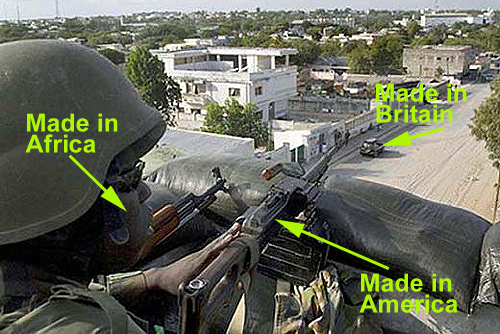
The OAU military force is being exclusively outfitted by the U.S. and the UK.

Clever Obama. Our proxy wars have begun, again.

Huge and terrible wars, with thousands and thousands of casualties and untold destruction occurred during the Reagan years in proxy wars between Ethiopia (Russia) and the Somalia (U.S.).

Russia, despite all its other misfortunes and missteps, has bowed out of these miserable controversies. Our adversary is no longer a Super Power. It’s a terrorism organization. “Cold War” is now the “War on Terror”.

Terror only works when the recipient can be terrified. The Twa walking through the metal detector creates humor. Our military-industrial complex descending on Somali – oh so cleverly – creates terror.

To the jungles of the Gorilla

To the jungles of the Gorilla

As I leave for Africa to guide the Cleveland Zoo to see mountain gorillas, it’s worth repeating what a wonderful success story this is.

When EWT sent its first tourist into Rwanda’s Parcs de volcans in 1979, there were less than 320 mountain gorillas, a dangerously low number. At the time scientists had determined that if the population dipped below 280, it was likely the genetic diversity would not be great enough to sustain a long-term population.

There had been a lot of good science already completed back then, by such people as George Schaller and a bevy of Japanese researchers.

Dian Fossey was not a good researcher. Neither was she a good person. She was a media creation who in the end completed no good science and probably set the science of primates on a reverse track.

There’s no question that her media celebrity, though, helped the cause. Maybe even jump-started it.

But for the truth about early mountain gorilla science and the mountain gorilla program that began in earnest in the 1980s and which saved these great beasts, read In the Kingdom of Gorillas: The Quest to Save Rwanda’s Mountain Gorillas by husband/wife researchers Bill Weber and Amy Vedder. Bill and Amy were technically Dian’s first assistants, but as you will learn from reading their popular book, Dian needed almost more medical attention than the gorillas.

The gorilla project essentially begun by Bill and Amy is what saved these grand beasts. Today there are more than 750, despite a series of wars and natural disasters. It is a healthy, robust albeit still endangered population.

What happened?

Basically the business of tourism saved the gorillas. Today every visitor (and there are 56 daily in Rwanda and up to 42 daily in Uganda) pays $500 for an hour with habituated mountain gorilla families.

The enormous revenue this generated was transparently used first to help the gorillas and their habitat, and then, to help the human populations surrounding the habitats which for centuries had been understandably hostile to the animals.

This seed mountain generated more money. Money from research institutes, tangential organizations and even direct from governments.

The model of the mountain gorilla project is one of the most successful in the tourism/conservation arena…

Next week I’ll be blogging from Uganda and then Rwanda as a group of 12 others joins Cleveland Zoo Director, Steve Taylor, and myself as we explore the jungles for these grand beasts and some of their equally interesting cousins.

I hope you’ll follow us!

The Dominoes Reach Somalia

The Dominoes Reach Somalia

Guns from the UK, Guns from America, and bodies from Africa.
Tuesday Congress gave President Obama additional emergency funding for the war in Afghanistan. But the real new news is that America and Britain are beginning a new war in Somalia.

This was a week where terror succeeded. It began with the Al-Shabaab (Al-Qaeda) bombings in Kampala, which like 9/11 are intended to provoke. Terrorists know they are militarily inferior, but if they can provoke the militarily superior to come to them, they can win.

Nine-Eleven did just that. It provoked the U.S. in a multi-trillion dollar response that hasn’t ended yet, and judging from Obama’s increasingly hawkish ways, won’t end at all soon.

The powers of the world just don’t get it: no matter how powerful you may be, you can’t beat the joker on his own turf.

By diverting resources away from eliminating poverty, or malaria, or child soldiers… despicable culture centers like fiendish jihadism flourish. These weirdos survive on misery. But we can’t try to end poverty, or malaria or child soldiers… because the resources that would be used are being used instead to buy guns.

So the bad guys at whom the guns are pointed and who want the poor to stay poor so that they can be elevated as the poor’s protectors, win.

It’s weirdly impractical, but if we’d just schedule regular drops of thousands of dollar bills over Helmand Province or Basra, rather than delivering guns to shoot one another, there’d be no terrorism left. And it’d probably cost a lot less.

And this enigmatic neurotic dynamic of World Powers has infected every single American administration, Republican or Democrat, since my birth.

And what I worry about, now, is Africa.

Africa has been mostly immune from this aberration of modernism, because only lately has its resources become so important. Yes Zambia had copper, and yes, South Africa had diamonds and gold, and yes Nigeria has oil, but not enough, or too deep, or too cheap, or too hard to get at.

But gold is five times the value it was ten years ago. Oil extraction technology is way superior to what it was before, and the thirst for oil especially from China and the U.S. is unbelievable. Copper is an old element. But Coltan is desperately needed by every cell phone and it’s in The Congo and Rwanda.

So enter Africa into the Modern Age: Prepare for battle.

So America called on the Organization of African Unity (OAU) to beef up its troops last week to fight Al-Shabaab in Somali. The OAU asked America for guns. We’re giving them big time.

Yesterday, Kenya’s security chief, George Saitoti, asked its mother colonizer Britain for “support” in fighting al-Shabaab.

Britain’s new conservative Minister of African Affairs, Henry Bellingham, said he was “delighted” to help.

“Al-Shabaab is a threat to all other countries including the UK (United Kingdom)”, Bellingham said, raising his China teacup to new heights.

Since I was born in 1948 just after World War II, the U.S. has spent more money on wars than any other single service for me or my fellow citizens, if you dare call “war” a service.

Korea, Bay of Pigs, Vietnam, Granada, Panama, Nicaragua, the Balkans, Gulf, Iraq and Afghanistan and that doesn’t count the “Cold War” expense of nuclear armaments or troops and bases in Europe.

Now, it seems, add Somalia.

We Won! Power to YOU!

We Won! Power to YOU!

The Dodd-Frank Act is our victory!
Guess what? We won an important battle: The Wall Street reform act signed by President Obama this week regulates U.S. corporations using Coltan from the Democratic Republic of the Congo (DRC)!

Reread my blog of May 10, “Evaporize Goma!”

There I discussed several of the great horrors of Africa : war, corruption, child soldiers and resource theft. All embodied in one main mineral, Coltan, used by electronic companies and principally to power PlayStation3.

The largest source of Coltan in the world is in the DRC, a lawless, governmentless jungle controlled by warlords who are becoming billionaires by selling Coltan to companies like Sony and Intel.

In a little noticed provision of The Dodd-Frank Act, the commission which must now be created for consumer protection is charged with drawing up rules that will prevent any U.S. corporation from buying any minerals from the DRC unless it can specifically prove that its payments are not being used for …

… war, corruption, child soldiers and resource theft.

Which… is impossible. Every dime paid for minerals that come out of the DRC goes to warlords.

We won. An important, obscure battle that few people noticed but which has such an incredible impact on Africans, particularly children, has finally been won by the power of U.S. capitalist law.

The law regulates “specific minerals obtained from sources in the Democratic Republic of Congo and bordering countries, which include “columbite-tantalite (coltan), cassiterite, gold, wolfamite, or their derivatives” and certain other minerals.”

These are the “conflict minerals” of which Coltan is the leader.

And with the “force of law” we suddenly have all these marvelous U.S. corporations acting as if they never wanted to buy Coltan in the first place:

In June when passage looked likely sneaky guru Steve Jobs announced Apple would never buy Coltan from DRC warlords. (He didn’t say they never had and there is every indication they have.)

Yesterday, Michael J. Holston, executive vice president and general counsel for Hewlett-Packard, said, “We believe this provision will help … reduce the purchase and use of conflict minerals known to fund the ongoing armed conflict in the .. (DRC), and thus help reduce some of the factors that have contributed to the civil war there.”

Right, Michael. HP has intentionally avoided vetting its microprocessor suppliers before now.

So don’t let all this gibberish take away YOUR victory. It was individuals like you, who contacted your Congressmen, organized by a huge coalition of proactive African organizations worldwide. It was a peoples’ battle that overcame the World Transformer Corporation.

We won. And there’s even more. After the U.S., it’s U.K. corporations that are the biggest offenders in the area. Boosted by the new U.S. law, a powerful world advocacy group, Global Witness, announced it would now sue the new Conservative Government to follow the U.S. law!

Now all we have to do is monitor the victory. The commission has 270 days to promulgate the law. And after that, only a U.S. Presidential degree that the conflict in the Congo is over will terminate the law.

Visions of a President Bush insisting there is no climate change or threats of off-shore drilling sets the stage, now, for the new battlefield. But the big engagement is over. We won!

‘NO’ for Violence in Kenya

‘NO’ for Violence in Kenya

Criminal politicians and an old dictator support NO rallies in Kenya.
There’s going to be trouble in Kenya on August 4 and for a few days afterwards, but not as serious as in 2007. Continue on safari, but be vigilant.

A week from Wednesday Kenyans go to the polls for the first time since the violent election of December, 2007. This time they aren’t electing anyone. They’re deciding either YES or NO to a proposed new constitution.

But this time, unlike last time, modern Kenyans and their astute politicians are taking extraordinary preparations to keep peace.

A special commission has been set up by the government to monitor the country’s temperature in the run-up to the referendum.

The National Cohesion and Integration Commission has been active, independent and very useful. They’re also a little bit worried.

Commission member Alice Nderitu yesterday said that the “threat of violence is real.” But she hastened to add, “It’s tense but manageable.”

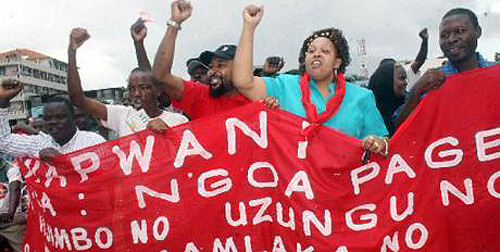
And this time the Kenyan government is buoyed by a Coalition of the World that includes the U.S., the UN and a beautifully created internal Kenyan coalition called “Uwaino.”

The phrase in Swahili used mostly in cooking roughly means blending together, or combining diverse components into something sweet and good.

But the main function of the new organization is to allow Kenyans from around the country to anonymously text any indications of election violence brewing.

Based on nearly 5,000 messages received this weekend, the coalition identified certain areas of the country where tempers are rising.

Those areas are in the west and north, pretty far away from Nairobi and not near any popular tourist areas.

Western and northwestern Kenya are analogous to America’s deep south. Divided ethnically from the rest of Kenya in a similar way that southerners felt disenfranchised from American power centers in the last century, western Kenyans are fearful that their rural, less worldly lifeways will be oppressed by the heavy hand of modern Kenya.

Less educated and less likely to enjoy the benefits of a modern Kenya, people living in places like Kisumu, Kericho up to Eldoret are being ginned up by old leaders like the former President Daniel arap Moi.

Moi, who barely escaped a national tribunal that was going to charge him with a multitude of crimes during his 21-year dictatorship, has been holding NO rallies and focusing on really very small parts of the new constitution that are hot button issues to a less educated electorate.

Abortion and roads, in particular. The new constitution explicitly allows abortion in cases where the mother’s health is in jeopardy (it goes no further; that will be up to subsequent legislatures). And the devolution of power reducing the new President’s powers means that a guy like Moi can’t come in and direct that all new road building be around his home town.

Like at home in America where the real issue (growing health care costs) get subverted by sound-bite absurdities (death panels), Moi is telling his constituents they won’t get any new roads and there will be none to travel to heaven, either.

Ah, democracy by sound-bite.

Uwiano has also identified causes as well. A number of text messages received last weekend identified a little known hate radio broadcast linked to two Members of Parliament, Kiema Kilonzo and Waweru Mburu, both of whom are likely to lose their jobs in a restructured electoral map under the new constitution.

Meanwhile, the government has hired an additional 15,000 national police (who aren’t always themselves the best peacemakers, by the way) and deployed them into areas expecting trouble.

And the U.S. has spent some serious diplomatic capital in this referendum. Vice President Joe Biden was in town last week promoting a “peaceful vote” and the very active U.S. Ambassador Michael Ranneberger has if not crossed the line of neutrality come really close in supporting the YES campaign.

All polling shows the YES will take the day pretty easily. Even the powerful Christian church alliance, which had campaigned for a NO vote, this weekend started to break apart with some very respected clerics coming out full swing for YES.

And notably, the only political leaders supporting the NO vote are those who we now think were responsible for the last round of violence, and who are likely to be prosecuted by the World Court for those crimes. (Education Minister, William Ruto, leads the pack.)

These are powerful men back in their rural constituencies. The fact that Moi is even free is an indication of the power he still wields.

So I doubt this is going to go over as quietly as an election for a Chicago mayor. But I don’t think it will be very disruptive, either.

When Will We Ever Learn?

When Will We Ever Learn?

America in Africa...or...China in Africa?
The U.S. is finally realizing that Somali is the center of the world’s “War on Terror.” And so now we’re all ready to do exactly the wrong thing. Again.

I’ve written often — and spoken in public — about the growing power that Al-Shabaab has in Somalia. Al-Shabaab is Al-Qaeda in The Horn. Western preoccupation with Al-Qaeda in Afghanistan and Iraq has allowed them to spread and regroup into the Horn of Africa.

Al-Shabaab has been fighting along Kenya’s long northeastern border with Somalia for more than three years. Much of this has been hit-and-run, kidnapping and petty theft of food and military equipment, but more and more the gun battles with Kenyans begin to assume real engagement.

Al-Shabaab claimed responsibility for Sunday’s bombings in Kampala. That seemed to do the trick: The U.S. has finally noticed.

First we heard from General William Ward who heads the U.S. Africa Command, that the U.S. would increase its military support to the TFG in Somalia. (Transitional Federal Government).

Then, a much more elaborate policy was detailed by the U.S.’ main diplomat in the region, Johnnie Carson.

I don’t like what I’m hearing.

What I’m hearing is that the U.S. is going to step up its military aid while lecturing a weak and futile puppet Somali government that it “should do more” for its people.

Here are my excerpts from Carson’s interview with All Africa published, today:

“I think [military assistance] is the correct policy… We have provided [Uganda & Burundi soldiers in Somalia] with military equipment… We have supported the training of TFG forces…We have supported specialized training in dealing with improvised explosive devices and training for the protection of ports and airports… There is no question that the TFG has to do more than it’s done in the past….

“We have not done enough on Somalia, which, for far too long, has been the subject of benign neglect by the United States…Given the magnitude of the problems …now is the time for the international community to recognize that this problem will only get worse for all of us if we do not come together to find a solution.”

Military assistance is NOT the correct policy. Providing military equipment and training to Ugandan soldiers who are famous for raping and pillaging in The Congo is NOT the correct policy. The TFG is an useless entity. We should NOT support the TFG.

I like Johnnie Carson, and I more or less like the Obama administration’s overall foreign policy, but they seem stuck in American imperialism. It’s just so dastardly how good guys get corrupted by power. I wonder if we elected Mahatma Ghandi U.S. President if he would then start new wars that we’d lose.

My lifetime has been characterized by failed U.S. wars and failed U.S. policies that I see as contributing to if not outright causing world terrorism.

Military actions will not end terror.

Why can we not learn from history?

Here’s the answer: click here.

Bruton’s formula is not new. Learned men have been espousing active, nonmilitary engagement in troubled parts of the world for decades as the ONLY solution to the world’s instabilities. We just don’t seem to get it.

Military action by a foreign power cannot eradicate a local guerrilla force. Period.

Military support of puppet regimes put in power by outside foreign powers is a black hole. Period.

Puppet regimes don’t last. Period.

And the most salient point is that the cost of military action is dozens if not hundreds of times greater than nonmilitary assistance.

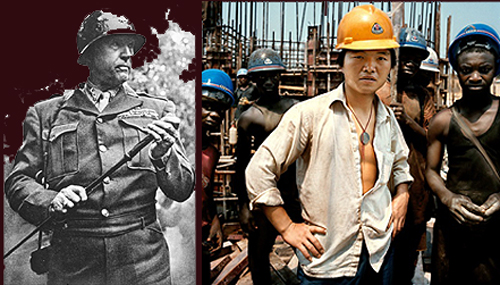
In today’s Africa China’s got it right and America’s got it wrong. China is spending billions on roads, resource development and city planning. The U.S. is, too, but many more billions on military.

China’s spending on African military? 0. Zip. Not a penny.

I don’t mean to frame this as a contest between China and America, I mean to point out that China’s got policy orientation right and is contributing to African development. And that America’s obsession with military will destroy African development.

We must end our roles as policeman, schoolmarm, parent and pastor for the rest of the world. We can perform a role as a benefactor, but no longer as a soldier.

When will we ever learn?

Not Enough Drops to Drink

Not Enough Drops to Drink

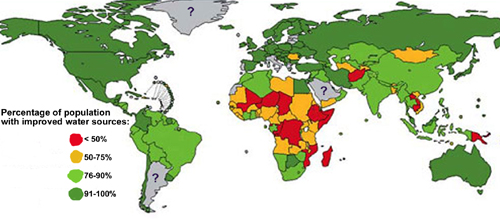
From World Heath Organization (WHO)
This week as summer rains pelted the Midwest major battles for single drops of water were raging in Africa.

We take so much for granted and nothing more necessary to almost every aspect of our lives than potable water. That may be one of Africa’s top problems, if not the single-most urgent need.

All of us who’ve traveled Africa love the picturesque image of a colorfully dressed African woman balancing an equally colorful bucket of water on her head. There must be a thousand million paintings and drawings of this image.

But it is an image we ought not covet. It’s an image of egregious want.

According to Unesco one billion people lack access to improved water supply, the vast majority in Africa. Less than a quarter of the households in Africa have piped water supplies, and only about an eighth of the households in Africa are linked to a sewage system.

This week two completely separate events – one an individual judicial action in Botswana and the other a continent-wide political fight in Uganda – underscore the difficulties Africa is facing obtaining water for its citizens.

At the OAU Conference currently being held in Kampala, Egypt and The Sudan are fighting an East African coalition of countries over use of the Nile.

Egypt could not survive without its hoarding of the waters of the Nile. It is otherwise a desert. Today, there is not a single drop of water entering the Mediterranean from what was once the great Nile outflow. It is dry. Dust. Egypt needs more. More for people’s daily needs and more for growing food.

Prior to giving independence to a number of countries earlier last century, the colonial master, Britain, forced its soon-to-be-freed colonies in East Africa to agree that Egypt and The Sudan would control the Nile.

That 1959 treaty is now coming under fire at the OAU. Uganda, which controls the outflow of the White Nile mostly from Lake Victoria, and Ethiopia, which controls the outflow of the Blue Nile mostly from Lake Tana, have indicated they will abrogate the treaty.

And Kenya and Tanzania, which control large portions of Lake Victoria, have indicated they may do so as well.

East Africa needs lots of water. At the height of the recent drought, more than 5 million Nairobi area residents went on water rationing that averaged running water only every other day. According to East Africa’s Flying Doctors 70% of all the hospital visits in East Africa are caused by contaminated water.

And East Africans point out that the massive Aswan Dam (which Britain opposed being built, but long after having any influence in the region) loses nearly a fifth of all the Nile’s water to evaporation.

The solution presented at the OAU conference by Egypt and The Sudan is terrifying. Egypt is offering to build a canal around the huge Nile wetland known as the Sudd in The Sudan, which would direct Lake Victoria Waters directly into the Nile basin.

This is a temporary solution that could increase the Nile’s output by nearly 50%. But it will drain the Sudd, Africa’s largest wetland. The long-term consequences are mind blowing. We all know the incredible, devastating impact that draining wetlands has on any environment.

But the question is: potable water, now, for people; or a wetland for the future? The East African countries seem ready to accept the Egyptian proposal.

And at the other end of the continent, this week a judge in Botswana ruled that indigenous Bushmen would not be allowed to drill boreholes in their reserve to obtain potable water.

The argument is that in the reserve, as in similar places in Africa (like the Ngorongoro Conservation Area in Tanzania) the Bushmen have been given the right to pursue traditional life styles, but cannot modernize. Drilling a well is modernizing.

But modern Bushmen organizations are arguing that their life needs are paramount, and that denying water in a global climate changing world is a ruthless mandate, especially when Botswana’s meager water sources are being used by country clubs in Gaborone and diamond mines in the Kalahari, the Bushman’s traditional home.

Africa is replete with crises. But there seems none as urgent as this, yet with solutions as evanescent as an evaporating mist.

Church & African State

Church & African State

Kenyan John Cardinal Njue is leading a national boycott of taxes.
The conflict between church and state is an abrasive one in the U.S. as it is in Africa. But even as in Kenya when the church is on the right side, it doesn’t belong in the room.

The nearly three centuries of western religious involvement in Africa has had mixed success. There have definitely been periods where religious activism has helped Africa develop, but in the main I think it has had a negative net effect.

And today in Kenya, Christian activism threatens the finely tuned and arduously developed political movements that are otherwise directing Kenyan society down the right path.

This is such a touchy subject that I feel before explaining the previous statement, I need to highlight the good work that has been done by Christian activism.

Outstanding clerics like South Africa’s Desmond Tutu and Nigerian Cardinal Ekandem played sometimes pivotal roles in the peaceful developments of their societies. And during troubled times, such as Kenya’s 1990 street riots, the churches not only offered sanctuary but sanity to a disturbed society.

I don’t believe that Liberia could have survived as it did resulting in the promising situation found there today without a bevy of Christian religious leaders shoring up the little of sane society that was left after Charles Taylor was forced out.

But right now Christian activism is dangerously far too politicized in Africa, and Kenya provides the best example.

Kenya is holding a referendum for a new constitution in August. This is the end of a lengthy process of reconciliation between two warring political factions which caused the violence that followed the December, 2007, elections.

Those elections were so close, and certainly now proved so fraudulent (on both sides), that a clear winner couldn’t be determined. The slums of Nairobi erupted, and violence overtook much of the country. By the time the smoke settled more than 1300 people had been killed, and more than 150,000 displaced.

But credit to those in charge with serious help from Kofi Annan, Britain and America, the two factions formed a coalition government that works well, today. And part of the agreement required that a new constitution be adopted, which at its core would better regulate and adjudicate elections in the future.

That constitution will certainly pass. The process by which it was written was often tortuous but mostly transparent, and every segment of the Kenyan population contributed.

And now, the Christian church coalition opposes the constitution. And this is not just a tacit opposition, but an aggressive one. Every Sunday pulpit has a ranting cleric telling its parishioners to vote NO.

No matter that a NO vote will disintegrate Kenya. The church is opposed to a section – a small section in the constitution that allows for abortion in certain life-threatening situations. (And secondarily, it is opposed to the establishment of Mahdi courts, Islamic courts, for civil cases in Islamic areas, and when requested by all the litigants.)

Like the American right – which is openly and actively funding the church campaign against the constitution – there is little interest in the wider and much more profound issues like executive power and taxes. They cling to this one moral issue as paramount. Paramount to destruction.

And today, the church announced it would organize the country to not pay taxes, if the current legislature raises its salaries.

Now believe me, the move by the current legislature to raise salaries is patently wrong. The country like the rest of the world is in recession and piling up debt. The new constitution, if passed, will disallow legislatures to set their own salaries as they do, now.

And the current Finance Minister, who must approve by integration the bill in the legislature into his overall budget, appears dead set against doing so. In that regards, it’s a mute issue.

But the churches are ringing the church bells in opposition – what could be properly described as unnecessary opposition.

Church involvement in Kenya is not just irritating because of the positions taken. Recently, a coalition of more than 100 Christian organizations, the Micah Network, announced ”a strong statement that the church has no option but to be fully involved in making a difference to reduce carbon emissions and the impact of climate change on particularly the poor and disadvantaged” and “particularly to be lobbying governments to implement legislation to reduce carbon emissions.”
– (Summarized in a blog published by A Rocha Kenya on July 31.)

Wow. I totally agree. Well, I mean with the thing about climate change.

But NOT when it is framed as a Christian (religious) issue, as was elaborately done here. To embrace this methodology would suggest that unless something has a Christian stamp of approval, it’s not vetted enough, not sufficient to become public policy.

So it’s not just a matter of issue: abortion, on the one hand, or climate change, on the other. Christian organizations have every right to support or oppose public policy, but it is dangerous when that position includes “lobbying governments.”

Government is always acts of compromise. Religion is just the reverse. I’m hardly the first to suggest the two should be separated.

Victor & Still Champion

Victor & Still Champion

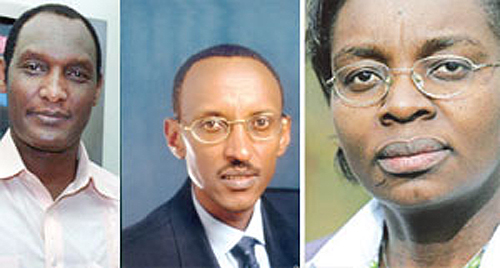
The victor and still champion, Paul Kagame, flanked by the two other candidates.
(Left) Kayumba Nyamwasa who is in exile. And (right) Victoire Ingabire who is in jail.
Rwanda’s national election occurs in 3 weeks. That has nothing to do with who will win.

President Paul Kagame, the leader of Rwanda for the last 16 years, and prior to that, the paramount general of the Tutsi led RPF army that stopped the 1994 genocide, is the winner and champion.

Kagame has imprisoned all his viable opponents. Members of his military – which are really the political and economic controllers of the country – who have dared to criticize him have either been demoted, exiled or killed. Newspapers have shut down or shut up.

This will not be a free election.

Frankly, I don’t know if there should be a free election. If there were, the Hutu-defined factions would win. The government would be in turmoil. Businessmen would flee the country. It would cause an extraordinarily awkward situation with regards to the brutal war going on in the eastern Congo (led by Rwandan exiled Hutu extremists).

And this tiny, currently peaceful country would go to pot.

Obviously no one knows this better than Kagame. Like so many African dictators before him, he has emerged over a good period of time as a leader who has painted himself into a box of eternity.

He has been essentially benevolent and fair. Particularly in the beginning few years after the genocide, he was remarkably tolerant and forgiving. He has adroitly danced on the world stage, criticizing his donors while getting more of their money (including the U.S.). And he has overseen a ravaged and poor country grow into one of Africa’s most successful economies.

Kagame’s life goal has been to reverse the powerful currents that separate his population into two factions that despise one another. Hutus call Tutsis “cockroaches.” Tutsis – now in firm control – are less derogatory about Hutus. Instead, they ignore them, hire them for slave wages and refuse to matriculate them up the political or business ladder.

So Kagame has suffered the biggest failure of his own stated goals: he has not brought together the warring factions that led to the genocide. If anything, he has presided over an increasing gap.

And as I’ve written before, deep down it is not an ethnic divide. And this incredibly unique and confusing aspect muddies the waters even more. Hutu and Tutsi speak the same language. They have intermarried for nearly a millennia. The physical differences of their ancestry are blurred at best.

But there was enough physical difference at the start of the colonial era, that the Belgians could attempt a differentiation, and that reenergized and refined the division that lasts until today. Still, it is less an ethnic divide than a typical political class divide. The rich and powerful against the poor and disenfranchised.

Were it simply ethnic, Kagame’s task would have been easier. But he entered the modern world like any leader, anywhere. It’s not only old scores that have to be settled, it’s .. Poverty.

So yes, Rwanda is safe, and yes, Rwanda is economically prosperous by African standards. But no, it’s not free.

Which is better?

Heaven or Uhuru?

Heaven or Uhuru?

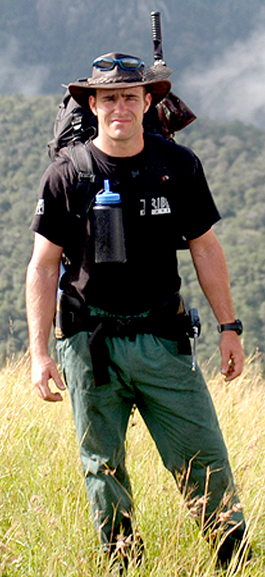
This is not 83-year old George Solt.
It's Ake Lindstrom.
Some people thought he was headed to heaven. But George Solt, 83, made the summit of Kili and came down to tell the world, Wednesday!

Briton George Solt hopes to be inscribed in the Guiness Book of World Records next year after the organization’s extensive verification process. But right now there’s no challenge to his own that he is the oldest man to have summited Mt. Kilimanjaro.

The climb was organized by a good friend and Tanzania’s most experienced and knowledgeable outfitter, Ake Lindstrom, owner/founder of Summits-Africa.

Ake himself belongs in the Guiness book. He was born in Kenya, raised on a sailboat in Khartoum, educated in Britain, plays rugby for the Tanzanian National Rugby league and races absurd looking vehicles in East Africa’s miserable road rallies.

And he has almost single-handedly raised the standards of treatment and pay for the previously maligned porters and occasional workers who are so essential to successful Kilimanjaro climbs.

Ake’s company said that Solt was accompanied by family including three grandchildren, and that the climb was two days longer than the normal Machame ascent. Solt organized the ascent in memory of his wife, who died last year.

My own son, Brad (Ake’s contemporary), was one of the youngest Americans to ascend Mt. Kenya, which is generally considered a more difficult climb though it is 2,000′ lower than Kili. We organize many Kili climbs year after year.

I don’t have current statistics in hand, but at its ‘peak’ the Tanzanian Tourist Board announced at a convention in London in 2007 that 25,000 people would attempt to summit Kili that year. Even if that is a slight exaggeration, it indicates that many more people try to climb Kili each year than any other known mountain.

For one thing it’s basically a walk, with only the last bit requiring any real scrambling. The challenge is the height (low oxygen content at 19,347′) and cold. A more recent challenge with global warming has been massive reductions in glaciers and avalanches.

Four weeks ago I was sitting at the Talkeenta (Alaska) Roadhouse restaurant for breakfast under a handwritten poster plastered on the wall lamenting the deaths of a variety of climbers who had tried to summit McKinley in the last several years.

There are about a dozen deaths on Kili each year, a fraction of the percentage of those who die trying mountains like McKinley.

The irony in climbing Kili is that more than half those who attempt it book the most difficult route: the Marangu 3-day up and 2-day down “Coca-Cola” path. The Tanzanian government has built dormitories to house the large numbers of people using this route. It’s the fastest and cheapest way to tackle the mountain, but also arguably the hardest.

A self-motivated climber can show up at the park gate, pay fees and hire a porter, and attempt the summit via Marangu for under $1000. But no matter his/her fitness, the chance of success doing it this way is hardly 50%.

Several years ago we booked a climb for four American Olympic hurdlers. Three of them didn’t make it.

The tough part for most people comes at around 12,000′. It has more to do with your body’s tolerance to less oxygen than its fitness, although that obviously helps. Many physiologies just can’t handle the altitude.

Ake’s company promotes much slower (and more beautiful) routes than the Coca-Cola Marangu. Perhaps the most popular one is Machame, which is a 5-day up, 2-day down trek. Ake’s staff and guides are all professionally trained. You get the right amount and types of food, oxygen is carried, and most important of all, you go slow.

Kudus for Solt, and great congratulations to Ake!

More Trouble for Uganda?

More Trouble for Uganda?

Police display the unexploded suicide vest found in Kampala.
Ugandan police gave indications, yesterday, that Al-Shabaab plans further bombings in Kampala next week during the OAU conference.

I imagine that several Heads of State who had planned to attend will not, now, or will greatly reduce their stay. In this regard, the Sunday bombings would have achieved their objectives, so further disruption wouldn’t be necessary. But:

Next week is not a time to visit Uganda. Wait until the conference is over July 28.

The OAU is the main body controlling the Somali peacekeeping forces in Mogadishu, and Uganda is the largest single contributor to that force. The OAU mission supports a weak Somali government being contested militarily by Al-Shabaab.

Ugandan police announced the arrest of Wasswa Nsubuga just outside the city yesterday and claim that he was carrying documents describing how to create 19 different types of bombs. He is an Ugandan who two years ago returned from Iraq where he had been working as a security guard. He currently works as a security guard in Kampala for a supermarket.

In his defense, and with credit to the police, Nsubuga explained to the press in a prepared statement that the documents he carried had been given him by his Iraq employer as a way of educating himself of the threats of terrorists.

But there were other Ugandan government actions that also suggested heightened concern as delegates to the OAU begin arriving, Saturday.

Police and military are visible everywhere from Entebbe to Kampala, brandishing large machine guns. Virtually every city hotel now has intense security, with under-body car checks made outside parking areas, and metal detectors being rushed to hotel entries.

Most of the larger shopping centers have also employed new, visible security measures.

But the most visible change has been at the airport at Entebbe. Check-in now takes about 4 hours, with multiple checks by Ugandan government officials followed by private security checks from the individual airlines.

My fingers are crossed for the Ugandans next week. On the one hand, the event now having occurred, it seems unlikely more could happen. But the clear and stated target was the African forces from the OAU now in Somalia, and their annual conference begins Saturday.

Uganda & Terrorism

Uganda & Terrorism

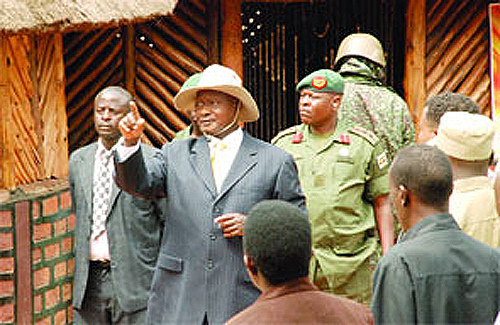
Uganda President Museveni at one of the bomb sites.
The suicide bombings in Kampala Sunday night are not an escalation, but a continuation of the terror the world has always suffered.

In the midst of this recent horror, it’s critical to realize that terrorism is a part of our ordinary lives. Americans have this subconscious absurd notion that there wasn’t terror before 9-11.

Yet we remember with grief and horror:

A generation ago when in one year, 1985, the Achille Lauro cruise ship hijacking and the hijacking of TWA in Cairo. Three years later, the Pan Am disaster over Lockerbie. 1995 was the horrible Oklahoma federal bombing by Timothy McVeigh, followed a year later by the tragic Olympic bombings on July 27 during the summer Olympics in Atlanta. Two years later the twin bombings of our embassies in Nairobi and Dar-es-Salaam. All of these preceded 9/11. And, of course, it didn’t stop: then the Smiley-Face mailbox bomber on May 9, 2002.. On July 7, 2005, the infamous 7-7 city bombings in London when 52 people were killed during rush hour.

And this doesn’t even begin to list the IRA/British terrorism, the terrorism in the Balkans, Palestine, South Africa, the thousands killed in Argentina terror….

What’s the point in this list? This list of hurt and suffering?

There are wicked people out there, and always have been. But modern technology has empowered them in ways never experienced before our own life times. And this isn’t just the technology of weapons; the technology of faster communication is just as important.

Messages transmitted and then acted upon by wicked destruction. This is a late 20th and 21st century phenomenon.

Americans may think they have suffered one of the most grievous of the attacks, but that could be because we just have more of the larger things to attack. The whole world suffers from terrorism.

And right now, Americans’ response is wrong.

You cannot fight terrorism with a military. It just won’t work. Britain’s arduous and troublesome approach to Northern Ireland seems to have worked, but it takes a patience Americans don’t seem to have, and a memory of history most of us were never taught.

And the Argentinian’s solution also seemed to work: and that took a generation. And the South African’s worked: and that took forgiveness.

The solutions to terrorism are patience, forgiveness, sensitivity to why the wicked have become wicked and attempts to remedy the social negligences from which terrorists arise.

That’s a long and tortuous path. But such a hazard if we just think we can resort to the gun.

Bombings in Kampala

Bombings in Kampala

More than 60 people were killed yesterday in two separate bomb attacks in Kampala, a signature Al-Qaeda attack. Curiously, the terrorist organization has not claimed responsibility.

I’ve increasingly written about Al-Shabaab, Al-Qaeda in Somalia, and their increasing power and influence in East Africa. With last week’s peaceful elections in the southern third of Somali known as Somaliland, the Al-Shabaab is consolidating its control of the north-western third outside Mogadishu. Ironically, violence in Somalia is slightly down.

But if the fighting for turf is subsidizing, the fighting for hearts and minds is only growing. The blasts in Kampala, at an Ethiopian bar and the Rugby Sports Club (both packed with guests watching the World Cup), carry all the characteristics of a terrorist organization trying to make a point.

Their point: get out of Somalia.

Uganda and Burundi are the only East African countries that have military forces in Somalia fighting Al-Shabaab. They are a part of a joint UN/African Union force that is doing poorly and has suffered numerous casualties for peace-keepers. The Uganda media is becoming increasingly hostile with the government’s war effort, there.

So all the pointers suggest a premeditated, coordinated attack by Al-Shabaab to get East African forces out of Mogadishu.

Why, then, have they not taken full responsibility?

(1) The nature of terrorism is such that Al-Shabaab may have planted agents in Uganda but without fully knowing their plans. They may simply be waiting for their own confirmation.

(2) The President of Uganda, Yoweri Museveni, is standing for re-election later this year. He has become increasingly authoritarian and has been imprisoning a number of opponents. The biggest attack was at the Rugby Club, frequented almost exclusively by educated and many dissident Ugandans. Regardless of who actually did it, will most certainly quiet to some extent Museveni’s public critics.

(3) Shortly the southern Sudan will be voting for independence from the Republic of Sudan, and the situation just north of Uganda is growing tense. Uganda has been an advocate for southern Sudanese independence. (Uganda President) Museveni has told the Republic of Sudan that if its president comes to Kampala next month for the Organization of African Unity (OAU) meeting, he’ll be arrested. (There is an international warrant on Omar al Bashir for war crimes in Darfur.) Sudan harbors Al-Shabaab.

The horror of what has happened suggests some absurdity in focusing on the perpetrators, but we have been fairly fortunate in the last several years in East Africa to not have suffered these incidents. With some clarity in the days ahead, we may have a clearer understanding if anything new is developing.

Right now, I don’t think so. The evidence is pointing to Al-Shabaab, specifically against Uganda for its soldiers in Somalia, a mission that because of its low international interest has attracted less international security. Thus, more easily accomplished.