France Apologizes, America’s Turn

France Apologizes, America’s Turn

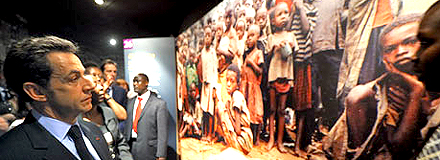
President Sarkozy at Rwanda's Genocide Memorial

Apologizing is hard and noble. It’s America’s turn.

Today, France apologized to Rwanda for its actions that contributed to the Rwandan genocide of 1994. Like the Belgian Parliament’s historic apology to the Congo for its ancient king, Leopold, (which included substantial reparations) these are difficult and noble acts.

“What happened here is unacceptable and …forces the international community… to reflect on the mistakes that prevented it from anticipating and stopping this terrible crime,” French President Nicolas Sarkozy told Reuters today.

It’s now America’s turn; Bill Clinton’s in particular.

The Rwandan genocide of 1994 could have been stopped. Numerous books and hundreds of pages of oath-sworn testimony, not to mention popular films, have documented the neglect of western countries, mostly the U.S. and France, from taking action earlier enough.

The UN general on the ground commanding a pitiful 500 troops saw it all coming. He pleaded with the General Assembly to do something.

The U.S. and France blocked his requests.

The genocide began.

France’s explanation was born of a long colonial involvement in the area. In a nutshell, there have always been little Hutus; they were the aboriginal hunter-gatherers of the area. In about the 6th or 7th centuries, the tall Watutsis (Tutsis) invaded the area.

The Tutsi herders represented about 15% of the population; the Hutus about 85%, but for more than a millennia the Tutsis over lorded the Hutus in a remarkably European feudal system.

During the colonial era France wanted to remedy this. That, too, was noble, but a half century of colonial rule is not enough to change the life ways of thousands of years.

The European colonial era ended not on any noble proposition. It ended because the colonial powers, Europe, were devastated by World War II and could no longer afford their colonies.

Belgium and France were the colonial powers in this region, and they raced to end their involvement with little recognition that all they had done during their occupation was make matters worse between the Hutus and Tutsis.

The first major massacre was 1972. Six more followed before the catastrophic genocide of 1994. Even today in Hutu/Tutsi conflicted Burundi, war rages. Not even Nelson Mandela’s decade long involvement in Burundi has stopped the fighting.

But in Rwanda it could have been stopped. But France ever championing the underdog, talked itself into believing that the event which started the genocide, the missile strike of the Hutu President’s plane returning to Kigali from a peace conference, was a deliberate act of the Tutsi.

Until today, in fact, France contended that the current President Paul Kagame of Rwanda was principally responsible for the missile strike.

He may have been. I don’t think we’ll ever know, several lower judges in France continue to bring charges against Kagame and others. Recently, a Rwanda government official was arrested when she entered Rwanda and charged with events leading to the genocide.

But French President Sarkozy is cutting to the chase. Whether it was Kagame’s gang or not who shot down the plane, France and the U.S. could have stopped the genocide, and they didn’t.

France contended for too many days after the fighting started that it was the Hutus fault, and it blindsided itself to the fact that in the beginning it was the Hutus who were the murderers.

Sarkozy has now admitted all of this. And apologized.

And America?

Well it was different with us. Bill Clinton was burned beyond belief by the defeat of Blackhawk Down in Somalia. We know much less about Africa than France. The one defeat-fits-all syndrome made Clinton believe we could be burned again in Rwanda.

We wouldn’t have been. The UN on the ground could have stopped the genocide. I think that some critics who claim Clinton was just being mean are ridiculous. I think he was just… dumb.

The world is grossly interconnected. We need our leaders to be aware as much of tiny places of trouble like Tblisi and Kigali, as they are fixated on Tehran.

After the genocide, France spent $900 million dollars in helping Rwanda recover. The U.S. spent $1.1 billion. Even from the crass business cost perspective, we both made very bad decisions.

Thank you, France.

And now, America? I wouldn’t hold your breath.

Peaceful Kenyan People Power

Peaceful Kenyan People Power

protesThe coalition government in Kenya was fraying at the seams last week, but a large public demonstration may have stitched it back together.
Wednesday several thousand protesters took to the streets of Nairobi in what many of us feared would be the end of the “Grand Coalition” which has held Kenya together in a fragile alliance since the terrible civil turbulence of early 2008.

How wrong we were.

The police actually protected demonstrators, they didn’t incite them as Nairobi police most often do. The protesters were a major mix of ethnic groups, not just Kikuyu or Luo. They marched through town and even shouted outside the President’s office.

And hardly disturbed the traffic in the city.

After tremendous media coverage, and politicians running to the microphones to lend their support, President Kibaki drew down his latest incendiary move. He agreed to the effective suspension of two ministers in the government which had been ordered by his rival and partner in government, Prime Minister Odinga.

I think this bodes very well for Kenya, but we’re still at an extremely fragile moment. I also think the events of the last several weeks have defined the good man and the bad man. The good man is Prime Minister Raila Odinga. The bad man is President Mwai Kibaki.

Kenyans have moved foward with deliberate and hopeful speed a new constitution which must be put in place before the election cycle for 2012 begins next year. As the details of the compromise began to leak last week, a rift opened up between these two power-sharing behemoths.

As the proposed constitution now stands, it is likely that the cause of the last dispute – the extremely close and fraudulent election between Odinga and Kibaki, could occur all over, again. Previously it was widely hoped that Kibaki would not stand for re-election, or effectively would not attract enough support in the way the electoral process would be implemented.

That changed, corruption in the government (which is endemic on both sides) exploded in the local media with regards to funds for schools and misappropriation of grain stockpiles. Neither is a new issue, but both gained new traction because the “bad guys” are all in the president’s camp.

And in the ever present background are the international trials set to begin momentarily in The Hague against yet to be named government officials accused of crimes against humanity in the violence of 2008.

It all came to a head last week when the Prime Minister suspended two of the ministers (both in the president’s party) pending resolution of corruption charges against them.

Over the weekend the President revoked the Prime Minister’s suspensions.

Monday, the Prime Minister appealed to Kofi Annan, who orchestrated the Grand Coalition in 2008, to return to the country to resolve the dispute.

Tuesday, the people took the streets.

And it was peaceful.

And it worked!

Wednesday, the President agreed that all responsibilities in the offices of the ministers who the Prime Minister suspended would be taken over by their permanent secretaries. An effective suspension.

Peace? Working in Kenya? Congratulations, Kenyan people power!

We’ll have to see where it goes from here. But so far, so good.

Panthers in Tanzania

Panthers in Tanzania

Felix "Pete" O'Neal

Jaguars and mountain lions don’t exist in East Africa, but Black Panthers do.

While some names like Huey Newton, Edlridge Cleaver and Bobby Seale are still recognized in the U.S. with the historic Black Panther Movement, in Tanzania there’s an even more famous panther, Felix “Pete” O’Neal.

Like many panthers, Pete sticks close to his territory, a village (now suburb) of Arusha. He fled there as a fugitive who jumped bail in 1970, and he’s never left. His wife has traveled for him, and recently he hosted an alumni party of sorts for the American Black Panther Party.

But like all hunted cats, he stays in the shadows.

It would be nice to believe his story, that he was completely framed by a racist, viper vengeful FBI. In fact the same FBI that hunted down Pete nailed several of my close friends in the anti-war movement. So I have no doubt that every Dicky Trick in the book was used to get him.

I believe him completely, though, about why he fled bail. He had been convicted of a relatively minor felony of transporting a gun across state lines. As head of the Kansas City Black Panthers, that would have been easy. The state line runs through town.

He was out on bail awaiting a maximum sentence of 4 years when he overheard one of his FBI minders say that the only way he was going to leave jail was in a coffin.

He was a kid; in fact a kid from the bad part of town who had been energized by the 1960s revolution, just like I was. We all really believed in the power of the people, and in fact, we won most battles in the end. (Only to watch the emasculation of progressivism, today, by Obama, but that’s another blog.)

But the most feared institution in America was the FBI, and J-Edgar was known to take the law into his own hands. His henchmen were lynchers. Pete fled, first to Switzerland since that country was still giving asylum to anti-war protestors, and then to Algeria, which was at the time incapable of giving up anything to anyone, and finally to Tanzania in 1970.

Tanzania welcomed nearly 800 Afro-Americans fleeing American oppression. There weren’t many – like Pete – who were actually fleeing the law, rather they were mostly fleeing racism and the draft.

At the time Tanzania was fervently socialist. China and the Soviet Union were paying its bills. The Afro-American community fit right into the socialist, Marxist ideas of Julius Nyerere’s Ujamaa and other communist-like credos.

[Blog Footnote: Mwalimu Nyerere was one of the greatest early African presidents which existed. He bankrupt his country by paying lip service to his East-leaning paymasters, but by so doing he educated the population and broke down ethnic schisms. It’s the reason that today, although Kenya and Tanzania share a lot of failings, Kenya can erupt in ethnic conflicts and Tanzania won’t.]

So the black kids fleeing America fit right in, and despite most of them coming from pretty impoverished backgrounds, they were still rich by Tanzanian standards. They started a number of community projects.

Containers started to arrive Tanzania with books, shovels, building materials, water pumps and all sorts of things to help one village after another start developing. The Afro-American community gained enormous respect from local Tanzanians.

“There was a huge population. It was amazing,” O’Neal recalled recently to the Arusha Times. “There was an excitement here. There were so many African-Americans here and everybody had at least some kind of vague sense of revolution.”

Then, they blew it. It was called the Big Bust.

May 24, 1974: I was back in my village in western Kenya having returned from a probably ill-advised trip into Idi Amin’s Uganda. We had seen some horrible things, there, and the rumor was that Tanzania was getting really fed up with Idi. Everyone was preparing for war.

I was listening to the radio and Kenya (which at the time was no friend of Tanzania) re-reported a Tanzanian broadcasting report that two young African-Americans had been detained in Dar trying to enter the country with guns.

One of the containers that Pete and others were using to develop Tanzanian villages had been laced with guns and ammo. Bad idea.

Tanzanians went ballistic. It was a six ton container filled with predominantly farm implements… but also two guns and a “few” bullets.

The Tanzanians felt double-crossed, and also vulnerable. The U.S. was viciously anti-Tanzanian at the time (because Tanzania was friends with the east, and the friend of your enemy….). It’s uncertain that Nyerere himself agreed, but the official Tanzanian line was that the Afro-Americans were a CIA plot to overthrow Tanzania.

Probably 600 of the 800 Afro-Americans living in the country were jailed and virtually all the others were put under house arrest.

About four months after the initial arrests, no more evidence that the CIA was involved could be presented, and everyone started to be released. Almost all of them went home.

“The exodus started [then],” Pete told the Arusha Times. “And you compact that situation with the war with Idi Amin and the falling economy; by the early 1980s, nearly everybody was ready to leave. ”

Pete O’Neal didn’t. He stayed and literally became Tanzanian. He rarely leaves his little village outside Arusha town, and he’s warmly accepted today by the community.

When asked if he would ever want to return to the U.S., he affirmed that endless legal battles being waged for him in the U.S. continue, but right now, if he set foot in the U.S., the next day would begin a minimum 15-year jail sentence.

“And I’m an old man,” he explains.

MADIBA 20

MADIBA 20

Early MandelaIt’s hard for me to believe that it 20 years ago to the day Nelson Mandela walked out of the Drakenstein Prison after 26 years.

We all mark our lives with significant events. My generation often asks, “Where were you when JFK was shot?” – “Where were you when Apollo landed?”

When Madiba was released I was watching it live on television early morning in Chicago; later in the day I would fly to New York for meetings with the American administration of South African Airways.

Things were not going well for SAA at the time. They shouldn’t have. The American administration was racist to the core; most of their superiors in Joburg were of a like mind, with a few very notable exceptions who I remember fondly.

Mandela’s release was the death bell for their jobs, and I couldn’t have been happier. The two martini lunches were laced with sexist and racist jokes, many about Mandela, and always ended with a somber and inebriated prognosis that the there was going to be a blood bath.

We made good deals in South Africa in the years running up to Mandela, because it had nothing to do with business facts and figures. The management of many South African tourism companies were running scared to death that when Mandela assumed power, all would be lost, and so they were anxious to give away the store for whatever they could get.

Oh, how wrong they were.

In March, 1993, I was in my small shared office in Joburg selling advertising for my guidebook. I couldn’t understand why no one else had come in that morning. It was in Kempton Park, not a particularly nice part of town, but I still decided to walk down the street to see what was going on.

I found a little grocer who was closing his store, at 10 a.m. in the morning! He told me it was THE election day, and that when the tally came in that evening, there would be blood on the streets, so laddy he said, you better get home.

Home was a hotel room in the luxurious Carlton in the middle of beautiful downtown Joburg. My wife wasn’t with me, but the hotel was offering a businessman’s special and that “armed guards will accompany your wife on her day’s shopping.”

So sequestered back in my room I watched SA TV. The election was the last all-white election called by the then President de Klerk asking for the electorate’s final permission to dissemble the final bits of the apartheid state – to prepare for the first true, democratic election of 1994.

Joburg was a ghost town. Everyone – like me – was watching TV in locked hotel rooms and boarded up homes. All the polls, headlined by America’s own “Gallup Poll in South Africa” cited continuously throughout the day, said de Klerk was going to be snubbed. The white electorate was not going to accept a New South Africa. Apartheid would prevail.

That night the results were in: 3 to 1 to support de Klerk’s dissembling of the old South Africa. The streets were quiet. There was no blood bath. It was eerily silent. I suppose the oppressed – if they were primed to revolt – were stunned and confused, perhaps disbelieving.

But it was true.

The next day at the office was the first day of new business for me. There was peace where all the white folks had expected chaos and oblivion. We closed our business shortly thereafter in South Africa. The white folks there just didn’t know what to do.

Back at home the American management of companies like South African Airways began frantically looking for new jobs, even while pretending that they were indispensable.

They weren’t.

The only indispensable person in my life time in South Africa was Nelson Mandela.
MADIBA 20

The Monkey & The Butterfly

The Monkey & The Butterfly

Monkey & ButterlyThe 2009 “Year of the Gorilla” ended very beautifully and very sad. The butterflies will just have to wait.

It was a sad coincidence from the start that the YOG planned so long in advance occurred as the world tailspinned into economic collapse. The whole point of these sponsored years is to focus attention and funds into what has been essentially world organized successes.

The success of the mountain gorilla project is legendary. Its foundation rests not on celebrities like the poorly trained and personally dysfunctional Dian Fossey. (Indeed, I strongly believe after her initial success in publicizing the plight of gorillas, she was more responsible for inhibiting development of the project than any other individual.)

Rather, the remarkable success was with the people – kids at the time – who really sacrificed part of their young professional lives to the cause: they were willing to work in the super-nova umbra of Fosey under enormous difficulties.

George Shaller did the science. Bill Weber and Amy Vedder followed him and created this hall-of-fame project that merged gorilla conservation with local development including tourism. And this triad of science and society had no precedent.

It was an amazing beginning, and you can buy their dramatic story from Amazon by clicking here.

The next tier was the grunt field workers cum- or to become scientists and legions of social workers and volunteers and probably primary among them was Craig Sholley. Click here to visit the conservation organization Craig now works for.

So as the heydays of the last decade whirled by with more good news than bad on the conservation front, it made sense to top off the century with the Year of the Gorilla.

Not their fault, Goldman Sachs. So while the various organizations involved have yet to tally the proceeds, the talk on the street is not good. Maybe less than half what was hoped to have been raised was actually realized.

But there are good stories, nonetheless. Researchers, students and volunteers supported by the YOG in Bwindi national park have blazed new trails and new science, and along the way, have even discovered a few new … butterflies.
mass of butterflies
This picture was taken by the volunteer named Douglas Sheil last week in the Bwindi forest. In this montage of several photos are two new species of butterflies.

“We don’t know a huge amount about Bwindi’s butterfly fauna though it appears to be richer than other forests in Uganda,” be blogged.

He then went on to list a few species still lacking confirmation and English names, and basically, took the pictures and left the science.

For others, when funds become available.

Rwandan Finale?

Rwandan Finale?

The serious rift between Rwanda and France was deeply aggravated by a Rwandan government report released yesterday reconfirming that the 1994 genocide was started by extremist Hutus.

This may not seem like news. The rest of the world has already accepted this. But this begins what I hope is the Last Act in this horrible history.

The April, 1994, genocide was of more than 800,000 Watutsis carried out by Hutus. No denial of this. But France has always contended that rebel Watutsis were responsible for the event which led to their own massacre.

This event was the shooting down of the (Hutu) presidential jet as it began to land in Kigali on April 6, 1994, by a sophisticated air-to-surface missile fired from quite near the airport. Everyone aboard was killed, including the Hutu president of the country.

The U.N., France and Belgium had soldiers in the country because of the growing tensions between the Hutu government and the Watutsis. French soldiers were the first to arrive at the scene of the crash. They walked away with the plane’s flight recorder and have never surrendered it to the Rwandan government or U.N. authorities.

In the day or so immediately after the plane’s being shot down — before the actual slaughter began — The French government sided with the official Hutu government outrage that claimed Watutsi rebels had shot down the plane.

Because of President Clinton’s political fatigue with ‘Blackhawk Down’ in Somali, and because of the French position on who was responsible for shooting down the presidential plane, France and the U.S. blocked efforts by other countries in the U.N. to send more peace-keeping troops to Rwanda.

And so the genocide began unabated.

Rwanda has never forgiven France for using this pretense to stop the U.N. from possibly having beefed up its military mission enough to have stopped the genocide.

France has never forgiven the current Watutsi government in Rwanda for what it considered a gruesome way to come to power: fire the first shot knowing this would provoke the Hutu genocide of your own tribe, and thereby provide justification for the massive retaliation that organized Watutsis rebels mounted from neighboring Uganda.

Most of the world does not believe France. But France has hardened its position over the years. The plane that was shot down on April 6, 1994, was carrying a Hutu president returning from a peace conference with Watutsi rebels. France contends that the deal he had struck with Watutsi politicians would have cut out the massive Watutsi rebel military, headed by Paul Kagume, the current Rwandan president.

France acknowledged the horrible genocide that occurred by Hutu against Watutsi, and France never tried justifying this, of course. But when the huge Watutsi rebel military poured into the country from Uganda where it had been training, and relatively quickly stopped the genocide, France was furious.

“Why had they waited?!” was the basic French contention that the Watutsi military had allowed the genocide of 800,000 of its own tribe, just to justify their military coming to power.

France began massive aid helping the Hutu refugees that began fleeing into neighboring Congo. In the years which followed, many of these Hutu refugee camps became military training centers for the dreaded “Interamwe” which began raids back against the new Rwandan government and continues today to cause havoc in eastern Congo.

The feud deepened recently when French undercover agents in Germany arrested Rose Kabuye, the current Rwandan President Kagume’s chief of protocol. A French magistrate charged her with “complicity in murder in relation to terrorism” over the downing of the plane.

France claims that Kabuye – who was a rebel Watutsi fighter at the time — was personally involved in the plot to shoot down the plane in 1994. The French government refused some international suggestions that the U.N. Rwandan Tribunal be allowed to try the case.

France has always believed the Tribunal was biased. French authorities said that only the French justice system was capable of ultimately resolving the facts.

* * *

I think we can trust the French justice system. The French lawyer for Kabuye believes he will be able to submit the Rwandan government report as evidence to support her case, and that ultimately the long French position will finally be proved wrong, as it has been assumed wrong by the rest of the world for more than 15 years.

I hope so. It isn’t just that the continuation of this ridiculous feud between France and Rwanda is impeding all sorts of local development in the area, it is the terrifying possibility that France is right.

For if France is right, no respectable country could continue to support the current Rwanda regime.

INVICTUS

INVICTUS

If you’ve traveled anywhere in Africa, or love Africa for any reason, go see Invictus and renew your best beliefs about this amazing continent.

One of the deep-seated criticisms born of racism is that however unfair an oppressed people have been treated, they are incapable of acting responsibly. The ingrained presumption is that revenge governs their every motive and will simply flip oppression onto their former oppressors.

It’s why Lincoln hesitated emancipating the slaves and afterwards why freed slaves were denied the right to vote. It’s why we promoted affirmative action and womens’ rights but voted down the ERA. It’s why we praised Guess Who’s Coming to Dinner but while condemning Guess Who’s Coming to Live Next Door.

It’s why Tiger Woods is so much more a bastard than Governor Sanford.

And it may be why the film’s two main actors, playing two of South Africa’s most historic individuals, are American and not South African.

It’s why one of my most favorite critics, Bob Mondello, praised the movie but tried to justify Morgan Freeman and Matt Damon’s assumption of these august South African roles in part by claiming their South African accents were so good.

(How the hell would Mondello know that?! In fact, they weren’t very good accents.)

But racism is so ingrained that a necessary first step to liberation is to acknowledge how deeply it governs the very best of us. And this acknowledgment of the truth is infectious. That’s the story of Invictus.

Released from the international sanctions that had kept this sports nation from participating in the global arena for more than a decade, the white South African’s dearest sports team, the rugby Springboks, were finally allowed on the world stage as a competitor and host to the rugby world cup. The team was composed of a single black man in a country where blacks outnumbered whites at the time by more than 7 to 1. The team colors were the colors of the old flag of apartheid South Africa.

Completely defying the will of his own electorate, Nelson Mandela as the newly inaugurated head of state insisted that these symbols of his own oppression — of apartheid — be supported by all the other oppressed South Africans who brought him to power.

His oft stated “forgiveness” was infectious among his angry colleagues. His unexpected generosity defused the fear and anger among the whites. In the blink of an eye as compared to this country’s long and sad history of oppression, he replaced tons of vengeance with forgiveness and hopefulness.

Two of my favorite actors are Matt Damon and Morgan Freeman. I’m no film critic and often accused of being too enthusiastic where Africa is concerned, but I believe I will be supported by those more professional than I, that the South African actors far surpassed in quality of performance that of Damon and Freeman.

Patrick Lyster and Penny Downie who play Damon’s parents although having a very small role are incredibly good. And the entire body guard staff composed of South African actors could rival any Shakespearean company in the world.

Why, then, Matt Damon and Morgan Freeman, who did not perform as well as the South Africans?

I suppose because part of our ingrained racism would have inhibited this uplifting story from being taken on by Hollywood without Hollywood stars. Slumdog Millionaire is essentially apolitical and challenges few insensibilities; Invictus slams racism with a rugby scrub. So, I guess, thanks to Freeman for producing, Clint Eastwood for directing, and Damon for helping out a bit.

And thanks to South Africa and Nelson Mandella for showing us the way.

BORDER CLOSED

BORDER CLOSED

The border between Tanzania’s Serengeti and Kenya’s Maasai Mara has been closed since 1977. Despite hopeful signs earlier this year, it won’t be opening, soon.

Yesterday, the Tanzania Tourist Board (TBT) announced forcefully in Dar-es-Salaam that the rumors of a Balanganjwe border crossing reopening after more than 30 years were incorrect.

As I reported in June, I spoke with newly redeployed Kenyan border officials at Balanganjwe who had just arrived from Nakuru. The old post and buildings were being refurbished.

The much publicized East African free-trade agreement was signed, sealed and delivered to all the East African countries involved several weeks ago. Tourism was an important part of this agreement, and KATO, the influential association of Kenyan Tour Operators, hosted a news conference with Kenyan Government Tourism Minister Najib Balala, Monday, who “confirmed” that the border would open, soon.

No, says Tanzania. Worried that Balala went way too far the TBT broadcast emails all over the world — to embassies and consulates, to every operator they could find in Africa and elsewhere — saying this just wasn’t true.

“Esteemed clients,” the circular begins, the border will remain closed for “environmental reasons.” The TBT went on to explain that the “fragile ecosystem of the area… cannot be sacrificed for the purpose of shortening the route between Maasai Mara and Serengeti National Park.”

What a joke.

Read my blog of September 17. The Tanzanians, and the TBT in particular, are doing everything possible to avoid environmental concerns in new development plans for the Serengeti.

The business plan of the multimillion dollar new airport and new roads and many new lodges would be seriously undermined if access to the Mara was made easy.

The border originally closed in 1977 during an historic dispute over the ownership of the then East African Airways, which later became Kenya Airways. In the seventies, Kenya was the only prosperous country of the three Britain had hoped would become a single confederated East Africa: Uganda, Tanzania and Kenya.

Uganda was in the bowels of Idi Amin. Tanzania’s socialist experiment while doing wonders for education was not producing a very good bottom line. The seven aircraft of East African Airlines that flew between Nairobi and Europe were jointly owned by the three countries, but only Kenya had the resources to maintain them.

In a lightning quick move the Kenyan government in cahoots with then British Petroleum confiscated the planes when (remarkably) they were all together on the tarmac in Nairobi (not a very wise way to use aircraft). In less than an hour, the Kenyan Supreme Court bankrupt the airline, then let the Kenyan government buy it for what amounted to the debit on the books owed by Tanzania and Uganda (which, of course, Kenya had already covered to keep the airline going).

In retaliation Tanzania closed all borders with Kenya and confiscated all the Kenyan tourists equipment in the country: Landrovers, minibuses, charter aircraft… and tourists. More than 130 tourists were held hostage for several days until Pan Am flew a mercy flight into the country to evacuate them.

Tanzania and Kenya are the best of friends, now. But the move in 1977 provoked a development of a real Tanzania tourist industry, which until that point had been completely dominated by Kenya.

As time passed there just was no reason for Tanzania to give up growing advantages. Tanzania’s wilderness is generally considered better and more exciting than Kenya’s wildernesses, and certainly less crowded.

Kenya gets the heads up for better service and facilities, but Tanzania so far has managed to have the upper hand with lions and wildebeest.

What is so ironic about this is that by invoking “environmental concern” Tanzanian officials are actually paving the way to over development in the Serengeti as I explained in the September 17 blog.

Opening the border would all but kill many of the new expansion plans set for the Serengeti, truly a move consistent with greater “environmental concern.” This sort of sounds like the health insurance industry claiming concern for the health of the U.S.

Nairobi Landing

Nairobi Landing

My Cleveland Zoo safari began with nine people arriving a day early and enjoying Nairobi and environs.

Nairobi’s climate this year has been strange but fortunate. While most of the rest of the country suffers from serious drought, it has rained steadily on the city for nearly 9 months. The last several months have been hardly more than drizzle, but it has brought with it a cold that would normally have been gone by the third week of July.

So it was cold and drizzly. But that didn’t stop anyone from getting right into touring.

After dinner at the excellent Tamarind seafood restaurant, the Wagners and Gilberts were joined by the Chelms and Antonaccis and Cheryl Steris the next morning on an excursion to Karen. It was a Saturday so I figured the traffic would be lighter, but I guess that’s no longer the case.

They did manage to squeeze the three attractions into a long morning: Kazuri Beads, Karen Blixen’s homestead and Giraffe Manor, but a good hunk of that morning was spent driving back and forth from the city.

In the afternoon the Kaspers and Wagners joined us all for my walking tour of Nairobi. The sun came out and we started at the Memorial to the August 7, 1998, bombing of the American embassy. I often start here because of where it’s located, rather than for what it is.

I consider the Memorial a bit too ideological. To begin with, it costs to get into the little park, albeit only Ksh 20/. If you want to use the john, that costs another Ksh 10/. The video, which costs Ksh 100/ to see, is packed with propaganda of how successful America is waging its war against terrorism. That so?

We walk from there down the government street past the Department of Education, Foreign Affairs and finally the Office of the President. This gives me the opportunity to discuss the top-heavy, convoluted and failing Kenyan government, a government which is currently stale-mated by the forced coalition that ended the violence after the last election.

But I don’t blame East Africans or East African culture as much as the failed colonial period. The British thrust a form of government on the East African countries that simply isn’t working; and the world powers entrenched corruption by vapid unaccounted “aid” as they sought favorable alliances during the Cold War.

From there we turn down towards Parliament, past the Kenyatta Memorial and then turn past the Basilica to City Hall. This gives me the opportunity to praise Kenyan youth, who I just wish would somehow own up to the fact that it is they alone who can bring Kenya out of the mess it currently finds itself. This is where the students often rioted.

We enjoyed tea at the Stanley beside the modern version of the Thorn Tree message center, and visited the Exchange Bar with its original 19th Century furnishings. This is the perfect setting to describe the era of White Mischief which defined colonial Kenya as a somewhat renegade somewhat rebel white civilization.

And the few nearby art galleries let me once again praise Kenyan youth, who in places as established as New York and Tokyo are defining contemporary art.

We walked past the city mosque, and I explained how East African societies were becoming more and more Muslim as the western world is perceived to be abandoning them.

I suppose I began my walking tours of Nairobi when it became ridiculously impossible to drive, because of the traffic. But it’s a great way for people adjusting to a new time zone to keep active and learn a lot of new stuff. It’s something I think everyone really enjoyed.

OUT OF AFRICA

OUT OF AFRICA

25 years ago the final shots of the movie that made East Africa famous were just being shot. And today the controversy continues….

The 1985 movie, Out of Africa, was being completed in Naivasha, Kenya, almost exactly 25 years ago. The last scene shot was actually in the middle of the movie, where the lions attacked Isaac Dinesen (Meryl Streep), because director, Sydney Pollack, hadn’t been satisfied with earlier takes.

I remember that wonderful year, 1984. We were all deeply involved in outfitting the movie, since there were so many people there to shoot it. I never learned a number, but it had to be hundreds. There’s never been a movie shot in East Africa before or since with such a large number of people involved.

My movie friends in Kenya tell me that today the technology has improved so dramatically that cameras and lights and booms now replace people. The largest media productions recently have been the BBC’s Big Cats series, and those were mostly “associate producers” who would be scooting around the Mara in tiny Suzuki’s looking for something to shoot.

When it was finally found, the “set team” would be called in, and we would see scaffolding, lights, platforms and giant cranes with moving cameras set up at remarkable speeds, all sometimes to shoot a family of 7 or 8 lion sleeping. It was remarkable, especially how fast it was done.

But 25 years ago, Sydney Pollack was so dissatisfied with the lion attack scene that, according to Meryl Streep (who played Karen) today (in contactmusic.com), he endangered her life to get a better shot!

Streep has always claimed, and the late Pollack has always denied, that he “unleashed” the lions to get a more realistic scene as they were set again on Streep.

The lions by the way came from Los Angeles and were trained as movie lions. But that never mollified Streep, who has always claimed that she was traumatized for life by what she’s often termed a “reckless move.”

It was a great scene!