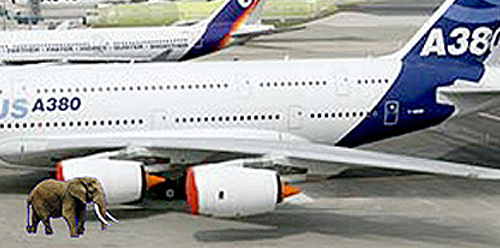
There’s an elephant on the Jomo Kenyatta runway, and everybody thinks it’s a peacock! Cool it. Wait for the real figures, will ya?
Yesterday’s blogosphere was alive with premature (I prefer, preternatural) celebration. The Kenya Tourist Board said preliminary figures show it headed to the “best year ever” in tourism.
Say, again.
Half of Keekorok Lodge closed in the high season?
&Beyond specials for Kichwa falling out of the sky like rain?
Reserve fees increasing 50% to cover last year’s costs?
Slow rebuilding of all the lodges and camps in Samburu?
AND:
The Tanzania Tourist Board just announced this week that it would fall short – far short, 25% short – of its projected 2010 figures for tourism.
What bloggers are miscalculating are visitor arrivals and airline statistics and translating them into tourist arrivals.
Airlines are adding service into Nairobi at around 9%, according to IATA. Visitor numbers are up, even in Tanzania. But airlines and visitors aren’t necessarily tourists.
What’s happening is that gold, oil and oil products, cut flowers, potash to India, and minerals like coltran are up and up. The planes that are headed to Kenya take passengers, but mostly cargo.
Only one other region in the world had a greater increase in airline traffic than Africa: the Middle East.
Guess what, that wasn’t because of tourism, either. It was because of oil and war.
Now gold, oil and oil products, cut flowers, potash to India and minerals like coltran also need salesmen, managers, financial wizards and battalions of consultants. Kenya’s incredible exercise to create a new constitution drew literally thousands of outsiders.
Hillary hasn’t been on safari since she took over Ngorongoro’s Serena Lodge in the 1990s.
But tourism will benefit from all of this. There will be more ways, and likely cheaper ways, to get to safari if airline traffic continues to increase into Nairobi.
(Frankly, I don’t know how on earth Nairobi’s airport can handle any more planes. It’s supposed to be rebuilt, but that’s over 5 years, and right now I worry more that I’m going to crash entering and leaving the gate area, it’s so congested with aircraft.)
Obviously, I would like tourism to increase, and I think we’re on a slow and arduous path to seeing it happen.
But this time around, it’s the Tanzanians, not the Kenyans, who have the right figures. And it’s no peacock under that arriving A380!
I am constantly asked what good charity to support for wildlife conservation in East Africa. Here’s a start.
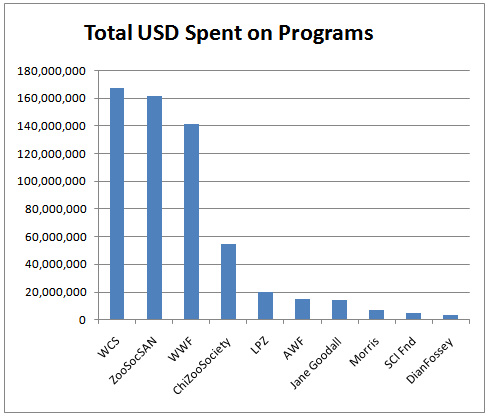
I’ve compiled basic information from ten wildlife charities that is described for you, below, which I personally feel are the best of many good ones.
But first I must restate my theoretical opposition to all charities in East Africa, whether they be for wildlife conservation or poverty eradication. I’ve been around long enough to know things aren’t getting better; they’re getting worse.
A half century of charities has not improved the situation in East Africa. It certainly has helped to reduce the decline, but to improve overall situations we need government to government action. Nothing less.
When governments were aggressively assisting East Africa in the 1970s and early 1980s (for strictly strategic reasons: the Cold War), things began to improve. When the Cold War ended, aggressive assistance ended, and things started to get worse.
Not all the charities in the world combined even begin to approach the impact of a single western government aid agency.
So before you choose a charity to support, look carefully at how you can support your various government agencies if you really want to help improve the situations in East Africa.
Charities provide a critical role in lobbying and focusing government action. They’re often the first responders to emergencies that are not catastrophic but still devastating, and probably most of all, they relieve our guilt: A guilt that I fervently believe we should cultivate until we fully grasp its meaning.
The ten charities are all licensed American not-for-profits, because those are the most likely to generate a tax deduction and the ones which you’ll be able to best research. Yet there are a number of non-American, mostly smaller charities, which are very active in East Africa, as well as a number of stellar individuals. You can find references to those at the bottom of this blog.
One of the immediate things I think you’ll notice is that American zoos are quickly becoming the significant force in wildlife conservation in East Africa. Over the last several decades, zoos in general have begun to adopt the international conservation practices that only a few, like the Bronx, did in the past.
Four of my ten recommendations are American zoos. And what this means is that it is quite likely that your own zoo, although not quite in the league of these, undertakes wildlife conservation activities worthy of your support.
How did I pick these ten?
Mostly from experience. And then through some basic analysis discussed below. But I began with my own encounters with these organizations in East Africa, and I like what they’re doing.
What I don’t like about them, almost every one, is the guarded way that they work independent of one another. As charities achieve success they tend to become exclusive. They covet their data as they covet their donors, and what this means is that resources are wasted and studies unnecessarily duplicated.
The zoos, in fact, are the least offenders. They’re more transparent and open with their data, and they’re most willing to engage in cooperative efforts.
SCI Fnd is supported by hunters. I am not a hunter and do not understand why anyone hunts, but the work that SCI Fnd does, like Ducks Unlimited at home, is worth considering.
Dian Fossey and Jane Goodall were horrible researchers and very bad people. But their success in sensitizing the American public to primate issues in East Africa is unquestionable, and their foundations are now doing the good work that they didn’t do as individuals.
Three organizations work almost exclusively with primates: Jane Goodall, DianFossey and Morris. But I’ve chosen them not for that reason, but because their work extends significantly into the human/animal conflicts that apply to all areas of wildlife conservation.
And finally, WWF. I have a lot of concerns with WWF, most importantly its exclusiveness and real reticence to share data and projects. But WWF is so big (see below) and so experienced that it is by its very definition the default organization. If nothing else tweaks your interest, if you don’t have the time to do some research, a donation to WWF will be well spent.
To show organizational size. Not all funds, of course, go to East Africa conservation.
SO how to choose among these ten?
You should have some simple set of objectives: such as certain animals, or environmental or climate concerns, to guide your research and speed your analysis. After that here are two general parameters you need to put into your mix, that I have obtained from Charity Navigator where you can obtain a wealth of additional information about all the charities discussed.
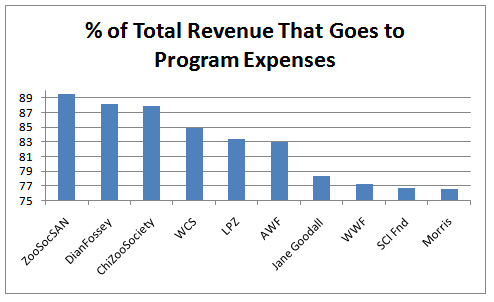
The actual amount of your donation which really gets into the field I believe is critical to vetting the charity’s honesty and real intentions. This is a significant factor, and all the charities discussed have very good ratings.
(All figures shown are for the calendar year ending 2008.)
This shows the organization's efficiency in getting resources to the field.
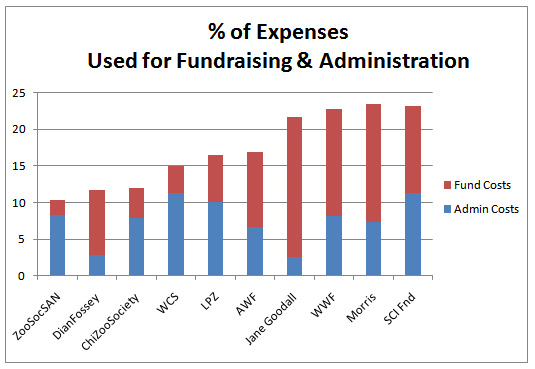
You can look at this another way: how much isn’t spent on administration and fund-raising?
From best to worst, but all are pretty good.
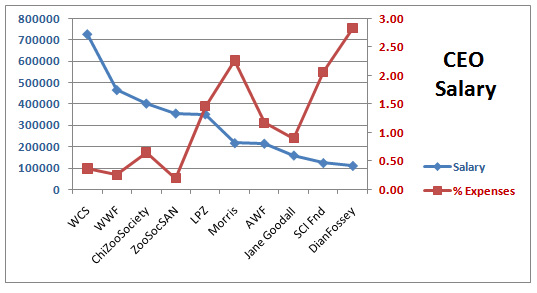
And finally, there is no starker region of the world to demonstrate the injustice of the growing divide between the haves and have-nots as Africa. So I think it fitting to review with a lot of skepticism the compensation that the executive in charge of these organizations receives.
With practically all of them, it’s too much. It’s not sufficient for me to be told that they are simply “responding to the market” to get good people, or that the “private sector gives much more.”
We know the private sector gives much more: it gives way too much more! And I think that organizations founded on altruism, nonprofitism, ought to practice what they preach.
Consider both the raw dollars and the percentage a CEO's salary is of overall expenses.
There are two charities which I really like but are still too young and small to have a track record like those mentioned above. But they might still be worthy of your consideration. Take a look at The International Rhino Foundation, and the Wildlife Conservation Network.
All the above have a worldwide scope; even the primate charities support projects as distant away as Borneo. If you can overlook the tax deduction issues, here are much smaller charities (many in Kenya) with a scope mostly focused on just African wildlife:
Save the Elephants is the foundation set up by the legendary elephant researcher, Ian-Douglas Hamilton, with his wife, Oria. There could hardly be two more selfless individuals in a cause for animal protection.
Wildlife Direct is the brain child of Richard Leakey, a young organization that is growing by leaps and bounds and shows incredible promise.
The William Holden Wildlife Foundation is known mostly by its Animal Orphanage at the Mt. Kenya Safari Club, but in fact is much more critical for financing Kenyan school children’s environmental “camps”, which actually gets young Kenyans into game parks.
The Tusk Trust is currently the darling of Prince William, a British conservation charity with near 95% pass-through of its funds into direct projects in East Africa.
Finally, there are several researchers in East Africa which I think are doing as much if not more important work than entire charities! They are independent and not associated with any single organization.
I hope this helps. But remember, whatever you give, your donation is essentially limited by the size of all these organizations, whose optimum performance (even in consortium) falls far below the threshold of being able to create real, good change in East Africa.
And we need real, good change in East Africa. For that vote Democratic and support progressive international causes by your government and its agencies!
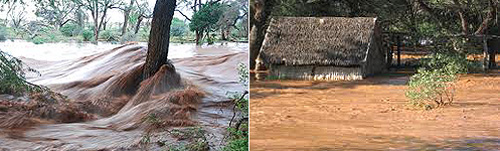
The Samburu River washed away every single camp in March.A year ago we were waiting anxiously for the droughts across Africa to subside. Today the place is flooded.
Extreme climate is nothing new to Africa. But I’m ready to call it a reflection of global warming. And I think it should govern all plans for future safari travel.
I’m writing this as Pakistan is floating away. Siberia almost burned away. Half the farm stock in northern Kenya was killed by a drought two years ago that was followed by another decimation from floods this year.
I just came back from a safari in Uganda and Rwanda. The Ishasha River, which demarcates some of the border between Uganda and The Congo, ripped away part of our camp.
Lake Albert, where we found the prized Shoebill Stork, is being clogged by hyacinths and other aggressive water plants. This is a factor of increasing temperatures.
I reported that the great migration entered Kenya from Tanzania on June 18. It’s gone back! To and fro migration movements are not uncommon, but the unanimity of the herd movement this year definitely is. Unnatural rains in northern Tanzania have been so heavy that the better grasses are now found there, rather than the Mara.
The equatorial regions of Africa encompass some of the most complex weather systems in the world. There are jet streams racing southeast, while others race north, and huge monsoons that shift several times a year.
Stick up a few obstacles like Kilimanjaro, and a few wet places like Lake Victoria, and you have climate chaos. The result is a high altitude wind maelstrom over the equator.
So what to do when planning your safari?
Well, first, recognize that climate data built from years of statistics is no longer as good a prediction for your safari as it was a decade ago. Then:
(1) Avoid river camps.
(2) Consider more comprehensive insurance. There is now insurance that will cover you for “any reason” that you cancel. It’s expensive, but not as expensive as finding out your camp no longer exists!
(3) Do more, rather than less. Yes, that’s right and it sounds strange, but the trend to date has been to slow down the pace of your safari to more comprehensively enjoy a certain area. Well, what if that area is parched to dust?
(4) Go during the margins of seasons, when the seasons are changing. In East Africa, that’s the end of March, the first of June and mid-December. Weather always seems to calm down when a seasonal change begins.
I’ve been reading lately a number of blogs and reports about how global warming might actually be a boon to safari travel:
All in all it’s wetter rather than drier. Even during the horrible mini-drought in East Africa that ended last year, there were great safari places like the Mara that were near normal.
More water means more grass. More grass means more animals.
Hotter temperatures means more bird nesting. In fact, we’ve begun to notice some migrant species which are now remaining in East Africa year round.
Don’t take the above to mean that I don’t think we should aggressively tackle global warming and try to stop it. I do! Every day in Africa I see the devastation and uncertainty in people’s lives and in the fickle mischief that effects the wild.
But your planning of safaris is likely to come sooner than the world’s tackling of global warming!
I really enjoy the blog and following your travels.
You know me, always planning a year in advance, so we have plenty of time to talk about this. The dates have been set by school schedules and FF tickets. We fly into Cape Town, arriving on the morning of July 14 and depart Nairobi late evening on August 1, so we have 18 nights in country. The tentative plan would be to possibly rent a house for 5-6 nights in the south suburbs of Capetown or closer to Hermanus — whale watching, shark diving, penguins, Robbens Island, wine country etc. Head north to the wild coast (and warmer temps), possibly by Premier train (same route as Rovos and the Blue Train but 1/10 of the price!), and then head into Kenya — Joburg to Kisumu via Nairobi (?) to meet up with Lauren. Lauren has her own truck so we will self drive to wherever we go next from Kisumu. She spends her vacations in the Mara — not a bad option 🙂 but I would prefer to take advantage of the
second trip to East Africa by visiting an area where we have not been, so Uganda really looks to be an interesting option — Kibale v Kabarega and Murchison Falls.
All the Best,
A. from Jim:
Whales don’t really get going until the end of July, through November. Shark diving is best from Pt. Elizabeth, a 2- or 3-day drive from CPT or a 1- or 2-day drive from Hermanus, at the east edge of the Garden Route. Penguins, Robben Island and the wine country are all best done from Cape Town. So you’ll have to decide where to rent your house: Cape Town, Hermanus or Pt. Elizabeth, since they are mutually exclusive areas. Now if you decided to drive the Garden Route after Cape Town, you could then hit both Hermanus and Pt. Elizabeth.
…
The Wild Coast is even further east from Pt. Elizabeth, almost to Durban along the coast. The waters of the Indian Ocean do get warmer, but the temperatures on land compared to Cape Town get colder. There are some beautiful wildernesses, here, but they really are wild and best for self-catering drivers; not a lot of lodges, and the game is sparse compared to other parts of the country… There is no train service east from Cape Town further than Pt. Elizabeth, so if you were continuing east into the Wild Coast from there you’re only option is to drive. There are good bus services.
…
You must have a very old guide book. KabeLega is the name that Idi Amin gave to Queen Elizabeth National Park. It was rescinded when he was deposed in 1981… I don’t think I’d recommend you spend any time in Uganda at all, having just as you know returned from there. That’s because I doubt you’ll have enough time to do the chimps in the north all the way down to the gorillas in the south, with all the other things you want to do on this trip. That’s a minimum of 7 days, and more likely 8 or even 9 if you include Murchison Falls. Gorillas are better done in Rwanda, anyway, and that you can nip off in 3 days. So if you can concede doing chimps, then I’d concentrate on a 3-day gorilla trip in Rwanda… You simply will not be excited at all in the game areas of Uganda.
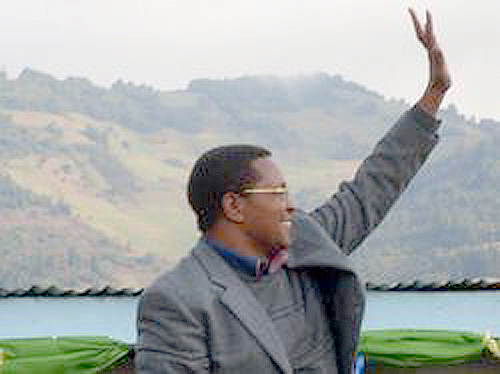
President Kikwete is digging in his heels about building the highway.Your voice against the Serengeti highway has attracted the attention of the most powerful in Tanzania. Unfortunately, he’s digging in his heels.
During an end of July live television speech to the country President Jakaya Kikwete said that “under no circumstances” will the government be deterred from building the road.
Kikwete doesn’t shy from the limelight, but most keen observers seriously doubted he would enter this fray. Whether the road cuts 40-50k through the neck of the Serengeti as planned, or is rerouted on a more lengthy route as we all would prefer, there are going to be very angry people, locally and foreign. Ethics, conservation and the Serengeti aside (be damned!), this is no good place for a politician.
So what’s his motivation?
I think I know, and I think he has a point (that he hasn’t made), and that point isn’t strong enough for him to really push this calamity through…
It’s already widely known that Kikwete is invested in the newest of the Serengeti lodges, the Kempinski Bilila.
If it weren’t for his intervention in the first place, this lodge would never have been built. It had initially failed to get the necessary permits from Tanzania conservation and wildlife authorities. Kikwete intervened.
Counting Bilila, there are ten principal lodges serving the Serengeti.
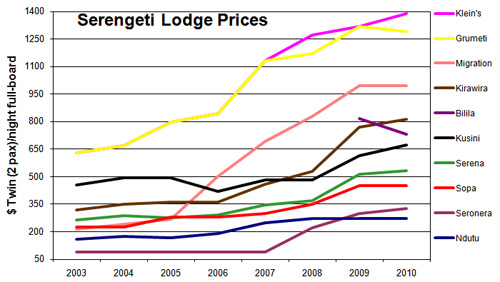
Only one other property, Grumeti, joined Kikwete’s Bilila in the realistic drop in prices from 2009 to 2010. All the other 9 defied market indicators arising from the world recession.
Is Kikwete’s support for the Serengeti highway linked to a belief that the property companies monopolizing the Serengeti are out of touch with markets and need to be forced into greater competition less Tanzania tourism suffer?
Boy, is that giving the fellow the benefit of the doubt! But it’s true. All the other 9 properties have been around for many decades; several of them are approaching the half century mark.
And they all market as if we were in the 14th century. When the good times roll, they raise prices as we would expect. But when a world recession hits, they also raise prices or don’t reduce them. This half-baked theory is “be damned cash flow”, just maintain some modicum of profit.
Before reading on, take a look at the price comparison of the Serengeti Lodges shown just below, then drop down to continue reading. Based on average tour operator contract prices. For retail prices add 20-30%.
Raising prices in a declining market reduces cash flow but profits can be somewhat maintain by cutting off lots of operations.
Like jobs.
As much as a third to a half of Tanzania’s tourism employees in 2006 is currently without work.
Tanzania doesn’t have an unemployment security system. There are no legal inhibitions to just telling someone not to come to work today… or anymore. AND those poor folks collect no compensation from the state once “made redundant.” Tanzania has no safety net for the newly unemployed.
That’s the ouch of the policy, but the fact is that it’s a terribly poor business strategy, anyway. It’s a short-term fix and a long-term disaster.
All the training, operational achievements, marketing strategies suddenly hit a brick wall. And to regain them when things get better isn’t just a matter of rehiring those who were fired. That rarely happens.
Serena Hotels built and integrated a modern and very expensive worldwide reservations system in 2007. It took thousands of hours to implement. They adopted an imaginative “Active Senior” program around the same time with some target marketing.
EWT just used Serena Hotels in Kigali and Kampala. It was a nightmare. I personally was at the check-in desk in Kigali untangling a terrible mess. And they seemed to have dropped their “Active Senior” program, just at the time such a program would reap huge benefits: (If any market niche is immune to the world recession, it’s seniors.)
The much better strategy is to follow capitalist principals of supply and demand. Don’t loose your investment in people’s training or marketing strategies that remain viable, and get enough cash flow to see them through the hard times.
Lower prices.
Unfortunately, unlike pricing, we can’t get occupancy rates as they are closely guarded secrets. But there is much anecdotal evidence to suggest that while Bilila is probably the most luxurious lodge in the Serengeti, when it opened in 2008/2009, it drastically lowered its initial asking prices.
And then Bilila dropped prices from 2009 to 2010, to keep its occupancy constant. Kempinski won’t say, but the best anecdotal evidence we’ve collected suggests Bilila has achieved this strategy.
If true, Bilila is reacting to real market forces and maintaining a constant cash flow by doing nothing else than lowering prices. Whereas all the others are laying off staff, closing portions of their properties and extending off-season closures.
Bilila is new, well run, and managed to the current market. There hasn’t been any new lodge in the Serengeti for more than a decade since the out-of-the-way and hodge-podge configured Mbagaleti was built. Before that it was another ten years earlier when Elewana (luxury branch of Sopa Lodges) purchased and rebuilt Migration Camp.
Frankly, that was just fine by me and many, many others. The exclusiveness of the Serengeti is one of its principal draws.
But Kikwete has a point, even if he hasn’t expressed it. The old dogs controlling the existing lodges in the Serengeti: Serena, Sopa, &Beyond and TAHI, are rutted in savoring their monopolies. As with inflexible pricing, Kikwete may see the whole cartel is inflexible to any new notion, good or bad.
Alright, so I’ve made a point, and perhaps Kikwete has, too. But is it germane to this argument about the Serengeti road?
No.
I returned from Uganda, today, and one of the most glaringly obvious difficulties it has in rebuilding its national park system is that major thoroughfares cut right through their wildernesses.
Queen Elizabeth National Park is essentially bisected by a main road, and there are burgeoning little towns at every stop conceded not to be an actual national park proper. The stress on the area’s wildlife is huge.
The tarmac roads that crisscross the great South African reserve, Kruger, absolutely stunt its wilderness growth. Kruger has one of the lowest ratios of migrating herbivores to the rest of its animal population of any park in Africa.
Herbivores constitute the base of the mammalian food chain. It eventually feeds not just the lions but the gerbils and acacia.
Mr. President Kikwete, if I’ve struck a chord with you, let’s work this out another way. I’d be all for disinvesting the monopolies that currently control the Serengeti: Legislate the right for only a single property company in each unique reserve, for example.
But don’t kill the Serengeti. That’s the worst strategy of all.
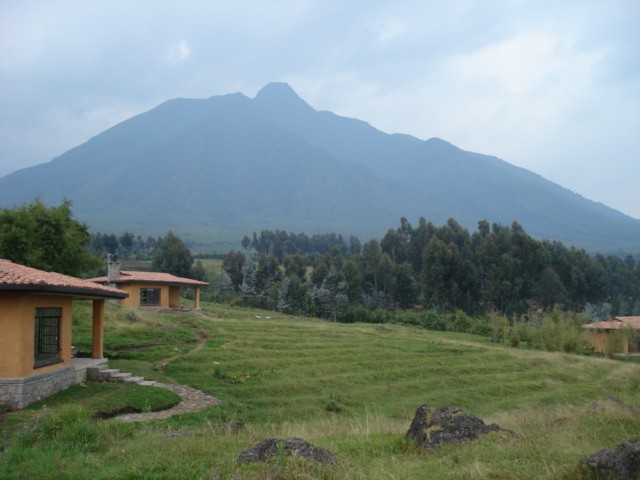
Sabyino volcano behind Sabyinyo Silverback Lodge.After a gala farewell dinner preceded by raucous limericks about the trip, the group began the journey home.
Sarah Taylor summarized the trip during dinner, and I was impressed! From the surprise backstage visit to the Entebbe Zoo, through chimps and lions and gorillas, we covered much of Uganda and a bit of Rwanda.
Of our 13 travelers, only one had not been to Africa before. This is not usually a first-timer’s trip, unless the first-timer is specifically interested in primates or birds. The big game normally associated with an African safari is actually quite limited.
And the primates did not disappoint. Everyone enjoyed two treks for chimps and two treks for mountain gorillas. And the list continued. We saw two species of black-and-white colobus, a subspecies of sykes, red-tailed, grey-cheeked mangabey, red colobus and of course, vervet and baboon.
The exotic bird list is too large to enumerate, but I’ll summarize it this way: the Great Blue Turaco is one of the most sought-after sightings by birders worldwide. It’s as large as a wild turkey, as funky as Groucho Marx, and looks like it just dipped itself in neon-colored paint.
We saw them in several places, but my great joy was when I stepped out of my tent in Ishasha to open the backside flaps and flushed five of them from the tree above me.
We had the chance to compare – as so many potential travelers wish they could – the differences between mountain gorilla trekking in Rwanda and Uganda. I’ll be blogging more about this in the future, but suffice it to say, now, that I think most on this safari would choose Rwanda over Uganda, if both countries in a single trip as we did were not practical.
And everywhere we were impressed with the local guides: from the enthusiasts at Semliki to the guide on the boat on the Kazinga Channel, to the chimp and mountain gorilla guides. Striking a bond with foreigners on short trips is very difficult, but when a deep interest – like conservation – is so dearly shared, the bond forms quickly.
Although we did start with a charter flight, flying from place to place in Uganda and Rwanda is quite difficult and usually impractical. So we drove. And we drove. And we drove. There are certainly rewards to overland travel: you see things locally that fliers miss completely.
But for the most part these roads are pretty bad compared to what today is available in Kenya and Tanzania. So everyone earned boot camp stripes they had never intended to get!
We left outstanding Sabyinyo Silverback Lodge just after 8 a.m. on Saturday morning. By Saturday night everyone was on their way home: to Cleveland, to New York, to Chicago and to Philadelphia.
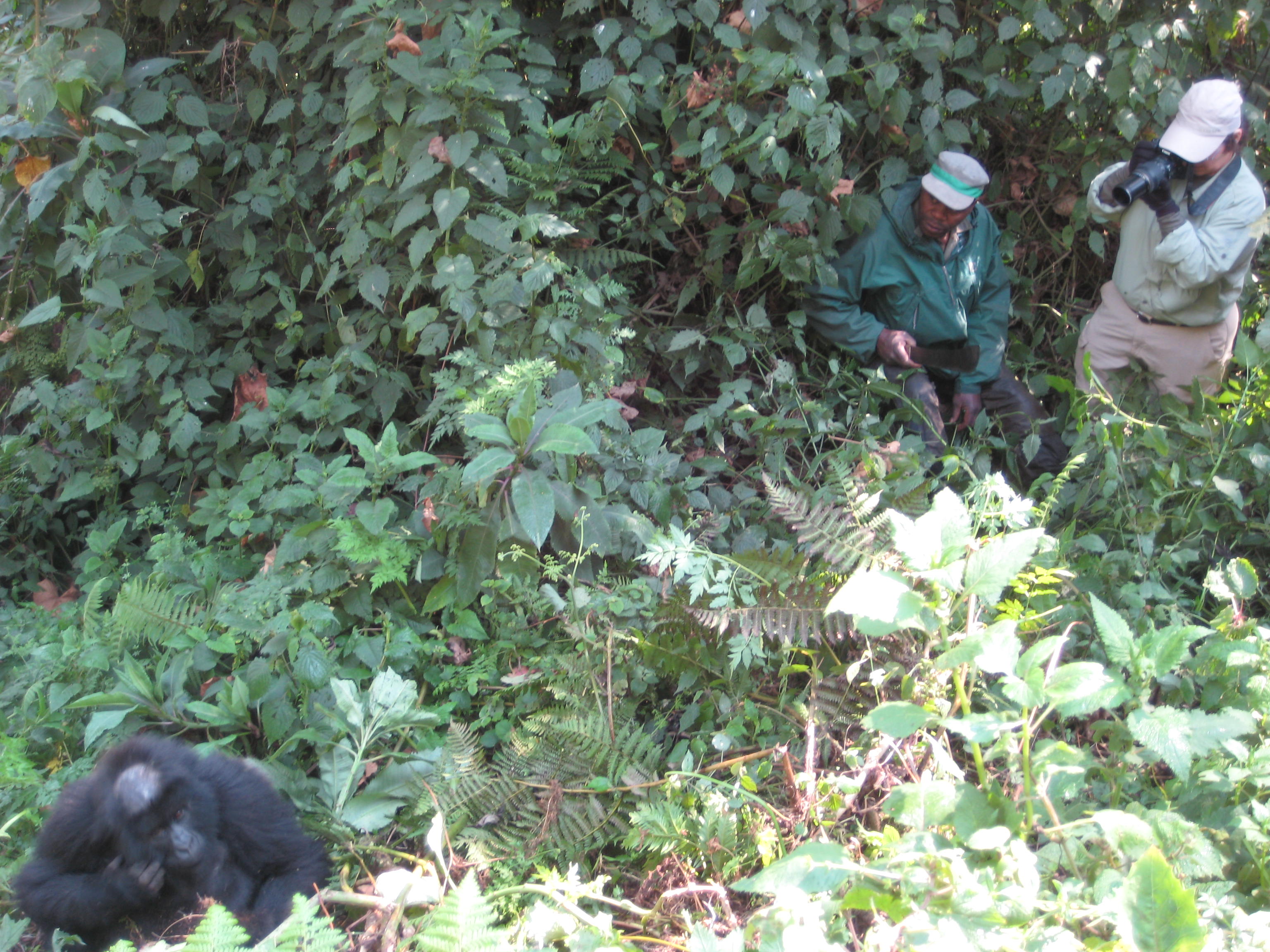
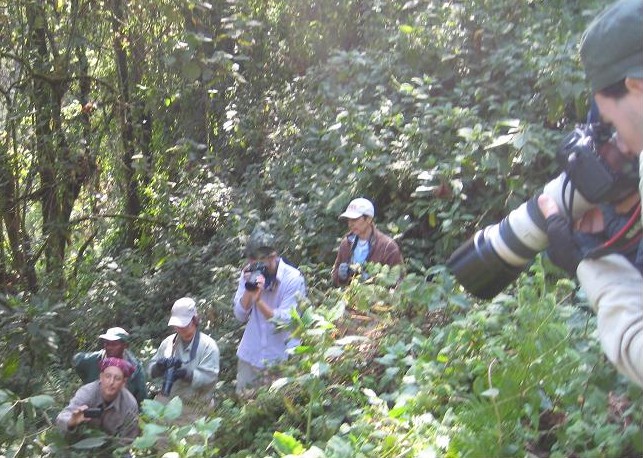
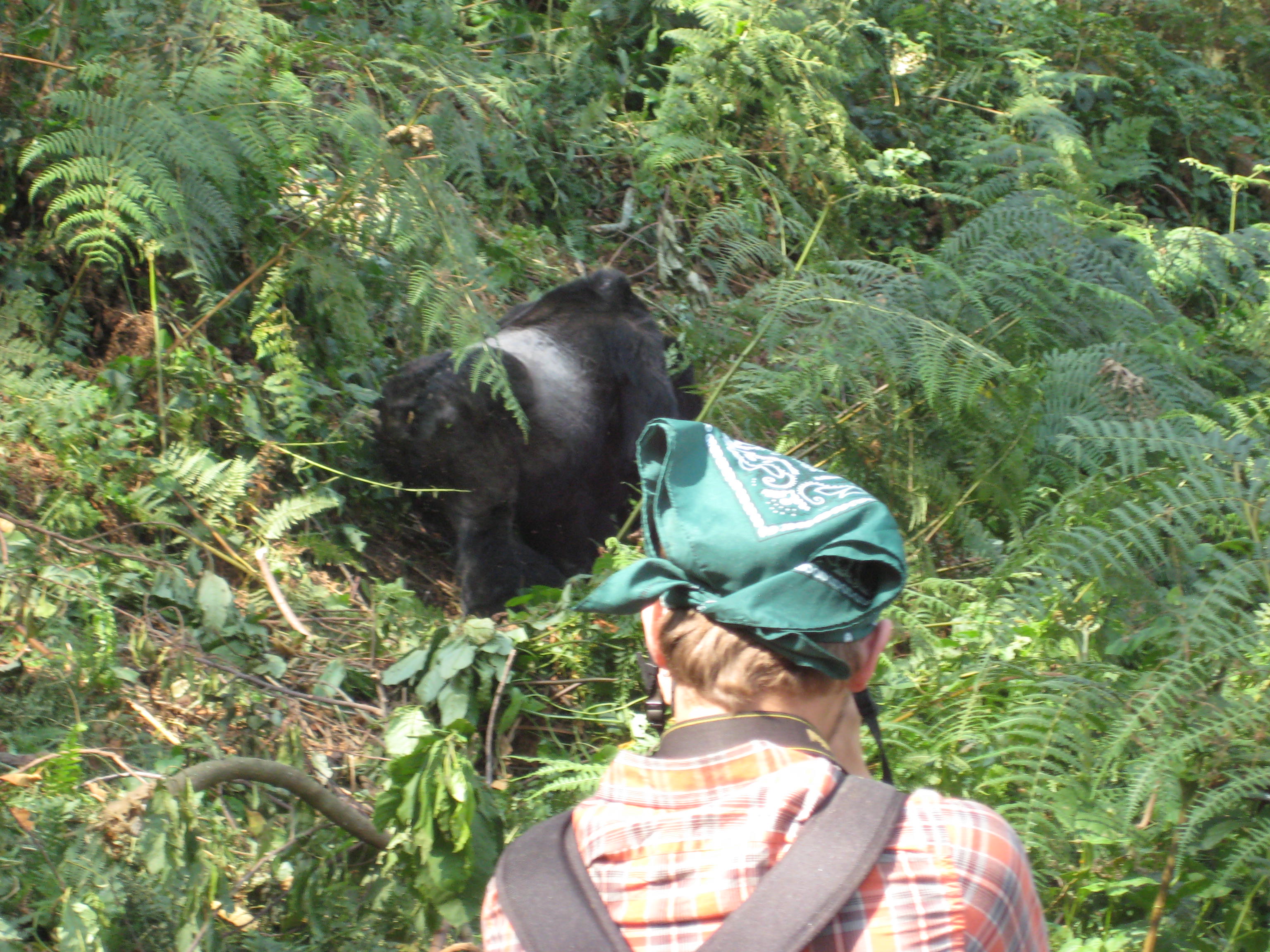
Doreen Yashen photographing Baldy in Parcs de volcans.Sixty-four people with broken legs and open wounds gather at Kinigi headquarters everyday to see 8 mountain gorilla families. We were no different.
I love Parcs de volcans. I love the guides, the organization, the scenery, and most of all I love the artifice we guides bring to the daily planning session with the chief guide to decide which clients will visit which families.
Some families are almost always hard, like Sousa. Some families are almost always easy, like Hilwa.
“Hard” means a trek of an hour or more, and more than once my treks have exceeded four hours. It’s not uncommon to return at dark from a day that begins just after 8:30a.
“Easy” means you’re back at your lodge before lunch.
Right.
Left to right: Bill, Doreen, Alex, Sarah & Stephen
So today I – like every other guide – pleaded in guide pow-wow that I had five people with broken limbs and failing organs. Other guides had brought one-eyed clients, the deaf, and the recently released insane. One guide even claimed his client was 90 years old but knew how to wear cosmetics well.
That over, the implacable chief guide politely began to filter the pool.
Stage one: all those who had trekked yesterday over to the side. These included two women who had been vomiting most of their lives and an old man who couldn’t remember his name.
Stage two was a general separation by age. The 90-year old was excised and presumed 60, and the under fifties with insured ailments were lumped together.
In beautiful African undertones, artifice gave way to smiles and streaks of honesty. My five were assigned to one of the easiest groups, Hilwa, in return for taking moderately hard group, Sabyinyo, for the rest of us eight.
And off we went.
We eight to Sabyinyo saw the largest silverback, Gahonda, and a week-old baby, along with what seemed to be a drunken 5-year old and others in the family of 11. The day was spectacular, the experience as always thrilling, the trek took about 16 minutes, and we were back at the lodge at 11:30a.
The five to Hilwa saw one of the most impressive silverbacks, a year-old kid, and were not the requisite 7 meters from several family members, but more like 7 millimeters. The day was spectacular, their experience particularly thrilling as they scaled 80% inclines, hung from rocks by their fingernails, and tiptoed across a 1″ ledge of the Great Rift Valley.
And the five assigned to the easy group got home at 4 p.m. Haggard is not sufficient to explain their condition. Daniel Pomerantz, a refugee into the group of five from the youth corps, arrived with most of the left leg of his pants trailing his feet.
The low road was the high road and the antics in trying to predetermine which would be which now seemed patently absurd. Cathy Colt and Hope Koncal were turned into champions, their positive and unrelenting attitudes taking them to heights they could never imagine scaling.
It’s really amazing as you sit for that short hour among these monoliths of pre-humanity. You know that they know a lot more than you think. Are they entertaining us? Are they earning their security this way, cognitively? Or, are they just having fun brushing by us and rolling out of trees?
Seeing distant reflections of our humanness in these gentle creatures makes war and aggressive capitalism and obsessions with success seem utterly trivial. They are so simple, so supremely self-confident and so survival savvy that they’ve manipulated us to preserve them.
So all the questions about what they’re doing out there turn back around onto us. It isn’t why are they so fascinating, but why have we dedicated so much of our resources to preserve them?
Is it, maybe, that we want to find the justification for preserving ourselves?
Existentialism aside, you big brutes bested us, today! And I suspect you always will. Left to right: Silverback Gahonda, ZooDirector Steve
The destruction of Bwindi is much more severe than Parcs de volcans.A new road was supposed to be completed from Bwindi into Rwanda by now, and so a year ago that’s how we planned the trip. Oops.
When the new road is completed, it will be hardly a 4-hour journey from Bwindi to Parcs de volcans in Rwanda. In fact, it will be easier for people who want to trek Bwindi to fly in and out of Kigali (Rwanda) rather than Entebbe (Uganda) which is 7 hours minimum away.
But as luck wouldn’t have it, the road isn’t completed. The drive is fabulous for scenery and local culture, but it is one of the most twisting and turning mountainous roads in the world.
We left our lodge at 8 a.m. and didn’t reach the Rwandan border post until 1 p.m. In a sense that doesn’t seem so taxing, but the dust, the twists, and as Alex calculated, the 18k/hour speed did make it tedious.
From the Rwandan border to our Sabyinyo Silverback Lodge was hardly 35 minutes. Rwanda’s roads are much better than those slowly being replaced in southern Uganda.
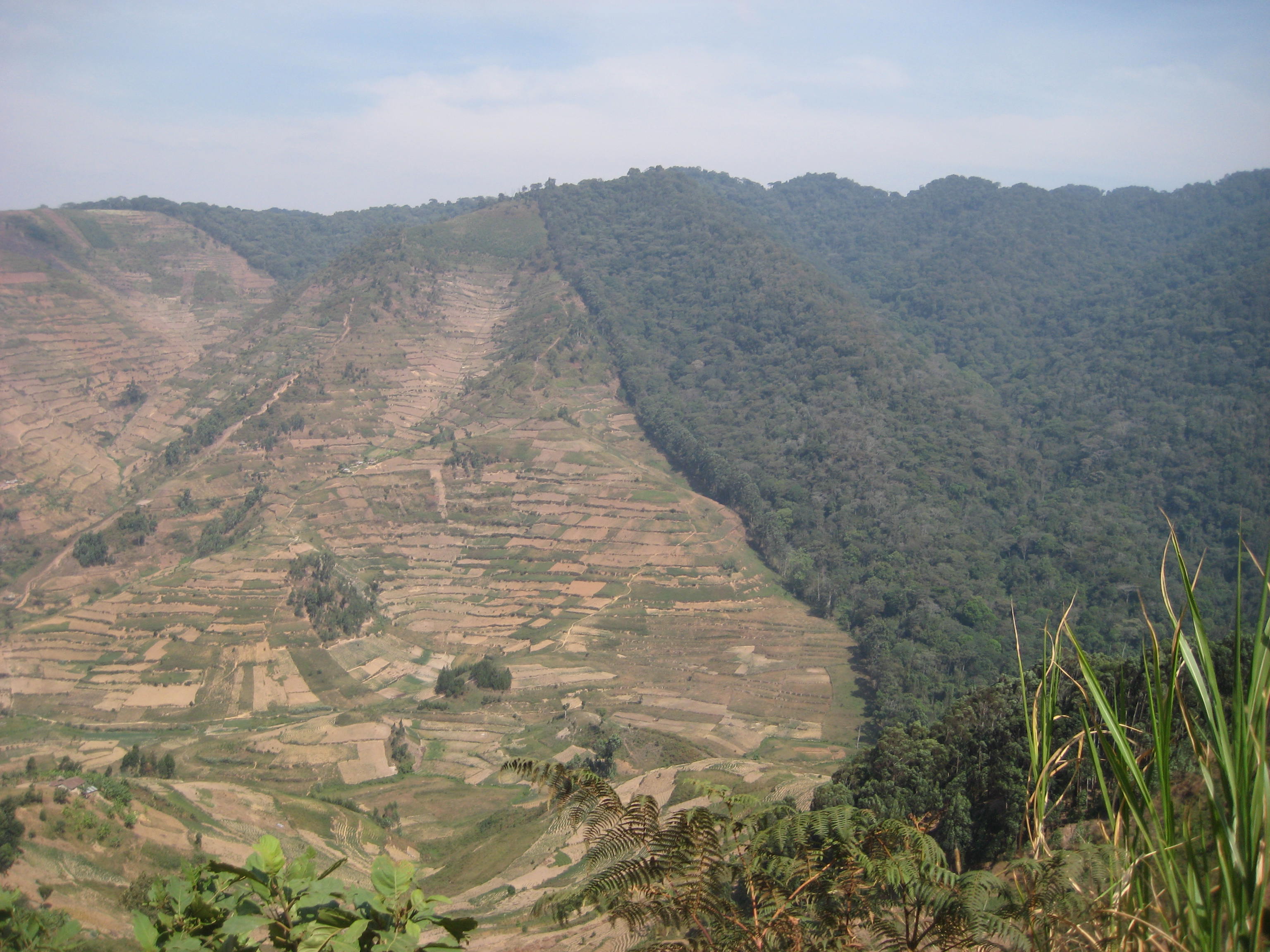
Once in this most beautiful of all Parcs de volcans lodges, I think everyone was pretty happy. And for me, the most striking part of the whole trip was to see how much of the Bwindi Forest has been logged and clear cut.
I’ve come to Bwindi ever since my first trip with my wife, Kathleen Morgan, in 1974. There has been a slow erosion of the forest, but today, it’s unbelievable.
The park roads themselves are usually lined by hillsides that have been cleared for tea and other agriculture.
Far be it for we Americans – the most consumptive of the world’s resources – to criticize Uganda for trying to develop. I won’t, and I’m not. But the twangs of nostalgia and the undeniable regrets of melancholy struck me deeply.
Alex Banzhaf photographing Bwindi's Bitakura silverback.This safari has two scheduled gorilla treks, one in Bwindi (Uganda) and one in Parcs de volcans (Rwanda). Today’s was in Bwindi.
Our group of 13 was divided into three sub-groups. Four people visited the Habinyanja group, and the other two groups visited the Bitakura group (one in the morning and one in the afternoon).
Unlike Rwanda where permits are not group specific, because Bwindi is so spread out (the distance from one gorilla station to another can be 6 hours of tedious driving) permits are issued group-specific.
Habinyanja was closest to where we were staying at Buhoma. So Dave, Hope, Margo and Stephen, left the lodge at 7:30a and drove about 1½ hour to the starting point. Sometimes, Habinyanja can be within ten minutes of Buhoma.
Steve, Sarah, Doreen and Roger were headed to Bitakura. This was presumed to be a 3-hour drive from our lodge, so they started out at 6 a.m. But in fact it took them only about 1¾ hours.
The rest of us didn’t leave the lodge until 9:30a. We had lunch after a three-hour drive, and then started trekking about 1:30p.
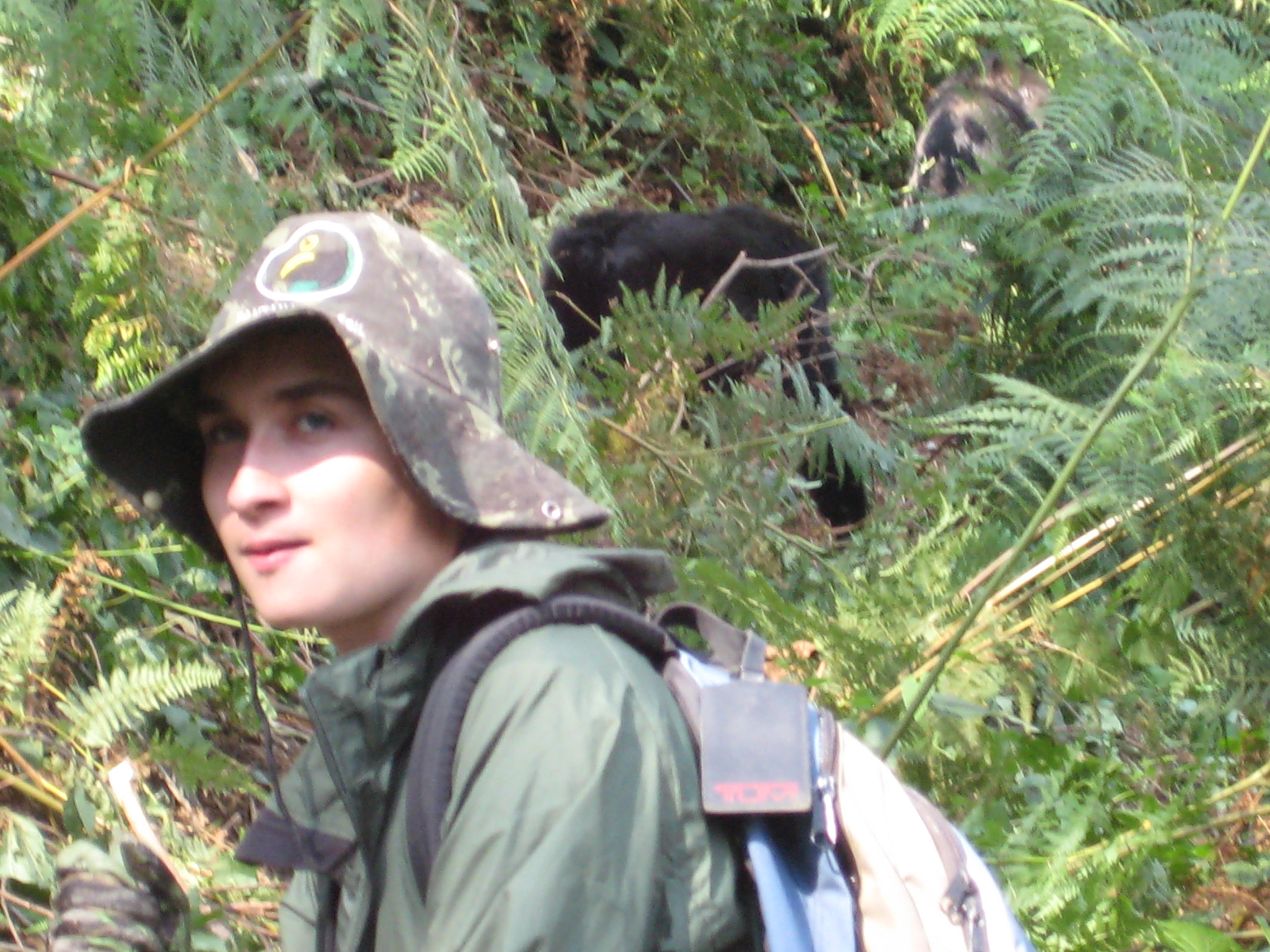
Everyone saw gorillas! The trek I was with was the hardest one: it took us nearly two hours before we found the Bitakura family, but what a prize! We saw all three silverbacks, the one-year old, and number of other family members.
The Habinyanja group proved the easiest trek. They descended from their start point and were with the 18-member family within a half hour. Daniel Pomerantz & silverback.
And in between was the morning excursion to Bitakura. So actually, no trek was excessively long – not even mine. But the Bwindi terrain is often more difficult than the Parcs de volcans terrain, and so in that regards it did seem taxing on some members of the group. But with attentive porters and great guides, it was a super experience for all!
One of the greatest moments of a gorilla safari is when everyone gets back, cleans up, shares some digital photos and endless stories. See my earlier blogs about mountain gorilla trekking: it’s not just a personally rewarding and dramatic experience, but a real part of successful conservation.
Tomorrow, our long trek into Rwanda!
Personal Note: This was my 50th gorilla trek! Somewhat ironic, since I’ve had only 6 of those in Uganda, most of the rest in Rwanda (and 5 in The Congo). I quietly celebrated by sitting on my deck at the lodge and listening to the sounds of Bwindi until I fell asleep.
Sarah Taylor at the Bakorwe Community Group.Particularly in Uganda where charter flying remains in its infancy, a comprehensive safari has to include long drives. Today we traveled from Ishasha to Bwindi.
Forget about asking me how many kilometers we had to travel; that’s useless. Consider that Alex calculated that for much of our safari from today on we were averaging 18k per hour.
So we left Ishasha in two different groups: Steve led four people who wanted still another game drive, and boy what a wonderful decision that was. They saw 8 lion, and together with the three we saw the day before, this has to be a record for Ishasha.
The rest of us left before Steve and crew returned from the game drive. Sarah had discovered a community cooperative that would give a tour of the contemporary village. It took us about an hour to weave through the last of the park to the village.
Bakorwe is located right on the border with Queen Elizabeth National Park (QENP). In fact, a part of the tour is the inspection of the “elephant trench.” This 10k trench, dug 2 meters deep and 3 meters wide, was intended to keep elephant and other wild beasts out of the village.
In the past I’ve written about a number of other attempts in East Africa to protect farms and villages from the growing elephant population, but I actually think based on Bakorwe’s record, this might be the best.
Of course it takes enormous man power, but it seems that once dug, it was remain in tact through terrible rainy seasons for at least three years without too much maintenance.
Our guide, Barnard, was a self-taught man who enjoyed the title of Community Liaison Officer and earned every bit of it. His English was impeccable. He grew up in the village, had to leave school when both his mother and father died so that he could care for his siblings, and was now the spokesman for the village.
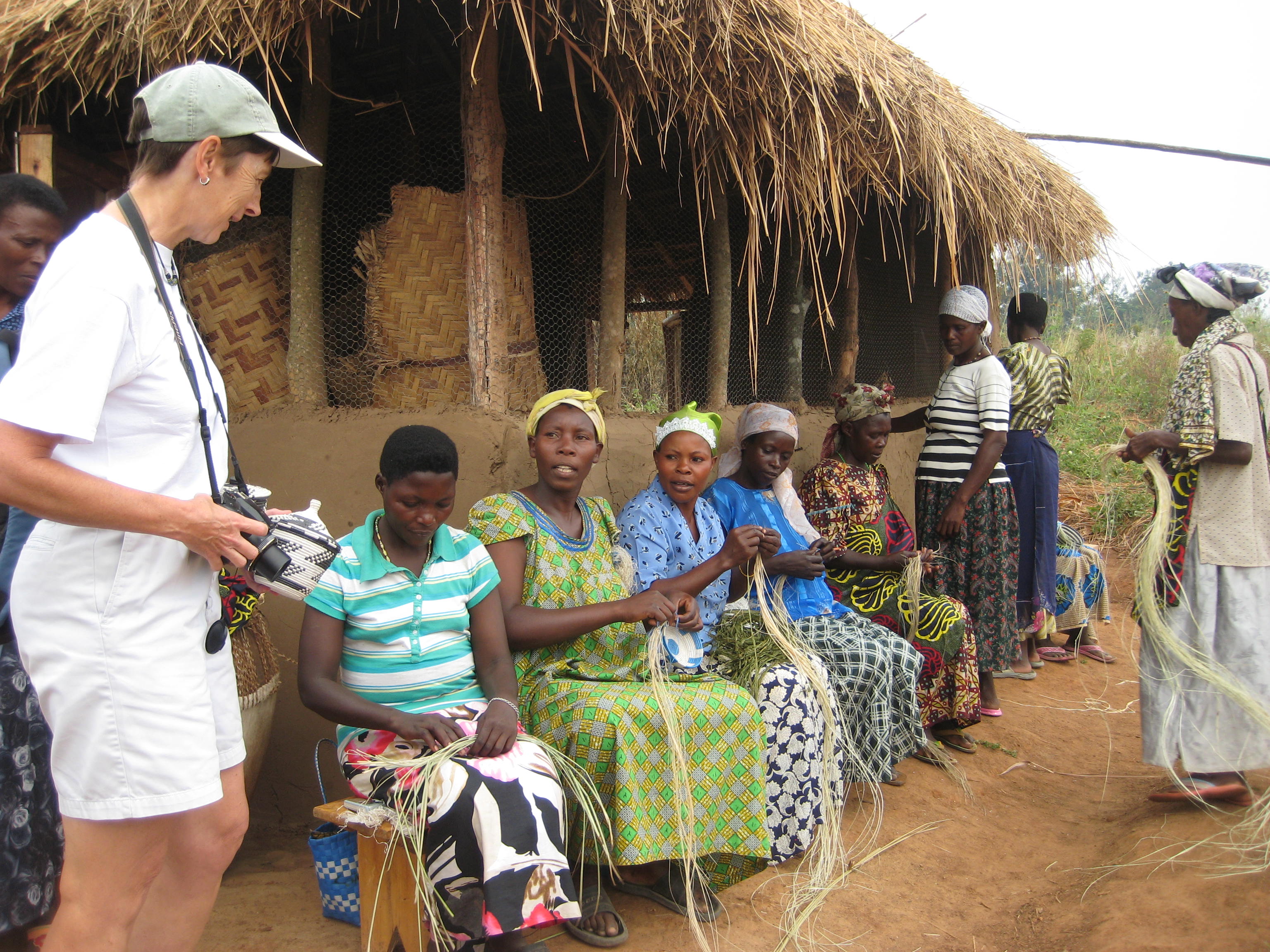
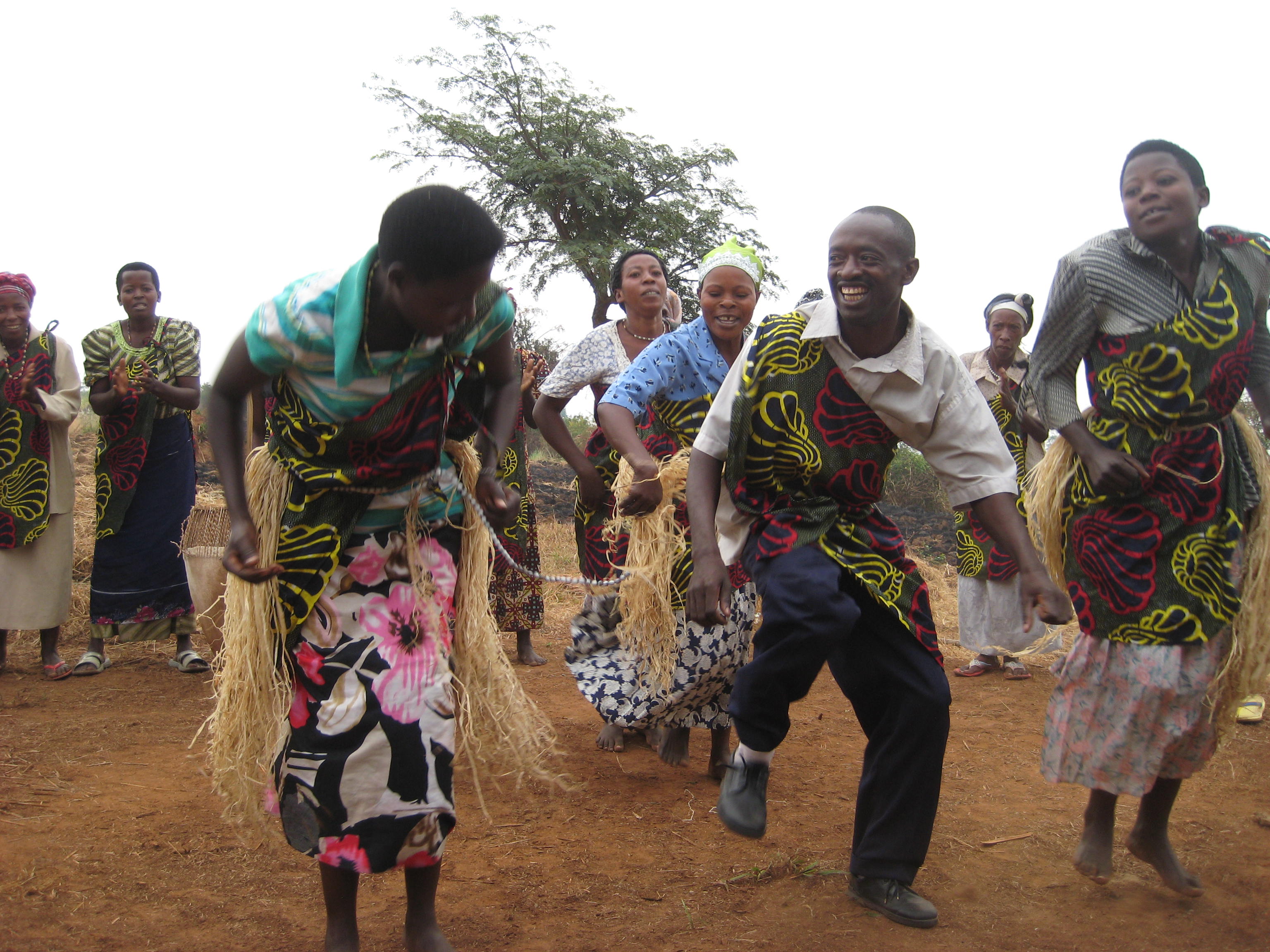
In addition to the elephant trench, we visited a craft center and watched traditional dancing. But the highlight for me was visiting a local healer, who was also a beekeeper. It was absolutely fascinating to see how he created bee-hives from large baskets.
We left the village around 11 a.m. and proceeded towards the Bwindi Impenetrable Forest, making a stop at the Kayonza Tea Factory to buy local Bwindi tea (more about that in subsequent blogs).
And we pulled into our Gorilla Resort Lodge around 1 p.m. after a pretty harrowing but spectacular drive in, around, back and forth through the “Impenetrable Forest.”
In the afternoon, people enjoyed the cute little town of Bwindi, with its internet cafes, coffee shops and local hospital.
Tomorrow, it’s off into the forest! We watched traditional dancing from the Bakorwe Community.
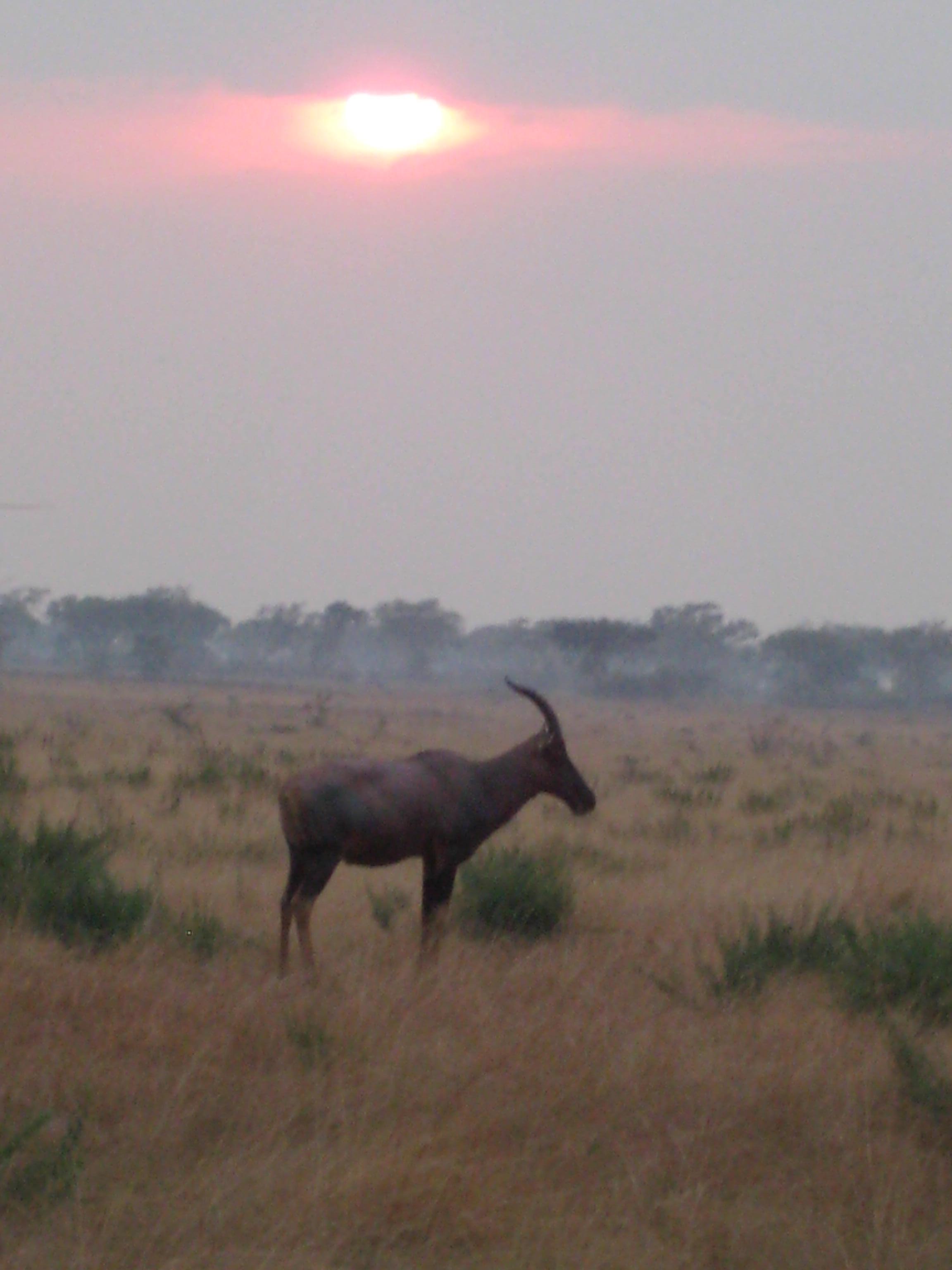
Sunrise in Ishasha.Lions, hyaena, topi, waterbuck, warthog, and of course lots of kob, filled our two days of game viewing in the Ishasha sector of Queen Elizabeth National Park (QENP).
This is the closest it came to rivaling game viewing in Kenya and Tanzania. This group – like the vast majority of travelers – come to Uganda for just a few days to see primates, not for big game. But we wanted a more complete experience, and wanted to see the big game wildernesses.
And Ishasha is the best. The terrain remains unusual, with more non-acacia, deciduous trees more akin to the great rain forests just nearby. There are many more Euphorbia candelabra, and the grasses aren’t as diverse, coarser and fast growing.
But in the little Ishasha area of the southern part of QENP, converging rivers and an active plateau that is sinking, plus the fact that it is adjacent the large Virunga National Park in The Congo, create the conditions for the best big game viewing in the country.
This was Doreen Yashen’s first safari. Everyone else had been multiple times, mostly to Kenya and Tanzania, and expectations were not high. But when we saw our first real herds of non-kob ungulates, topi, it was a real treat for Doreen.
We had seen large families of buffalo further north, but at quite a distance. Uganda is not managing tourism for big game well. All parks exclude off-road driving, which really isn’t necessary given the visitor loads, and has cut very few tracks through the parks, leaving massive distances that can’t be traversed in the park.
Main highways cut parks like QENP in two, with a traffic pattern that certainly discourages movement back and forth in the park. And on the smaller park roads routinely you see workers on bicycles or motorcycles.
These are not conditions conducive for increasing wild animal populations and habituating them to tourists.
But more tracks have been cut in Ishasha and it’s a much smaller place. So we got much closer to the buffalo families.
The highlight was the early morning game drive that started out only a few hundred meters from camp with a hyaena kill of a baby kob. We just saw that at a distance, but then we stayed with the hyaena as they began eating and tearing apart the prey.
And at the end of the morning we watched a mother lion with two cubs skulking about – but never actually hunting – a variety of animals that walked by them. We got our fix on their location by watching a male kob pronking and snorting at them.
And the icing on the cake for Doreen especially came the next morning when a pride of 8 lion including two magnificent black-maned males was found.
Colobus swing in the branches just across the river from our camp, and Great Blue Turaco seem to have held a convention right behind my own tent! I watched five of them at once.
With the improved (mostly Chinese) roads being built all over the country, Ishasha is now less than a half-day drive from Bwindi. This makes it an ideal safari extension to a primate only safari.
Stephen Chaitoff, Daniel & Roger Pomerantz, Cathy Colt and Hope Koncal in Kyambora.Like Alice walking through the Looking Glass, we stepped down into the magical Kyambora Gorge for our second chimp trek.
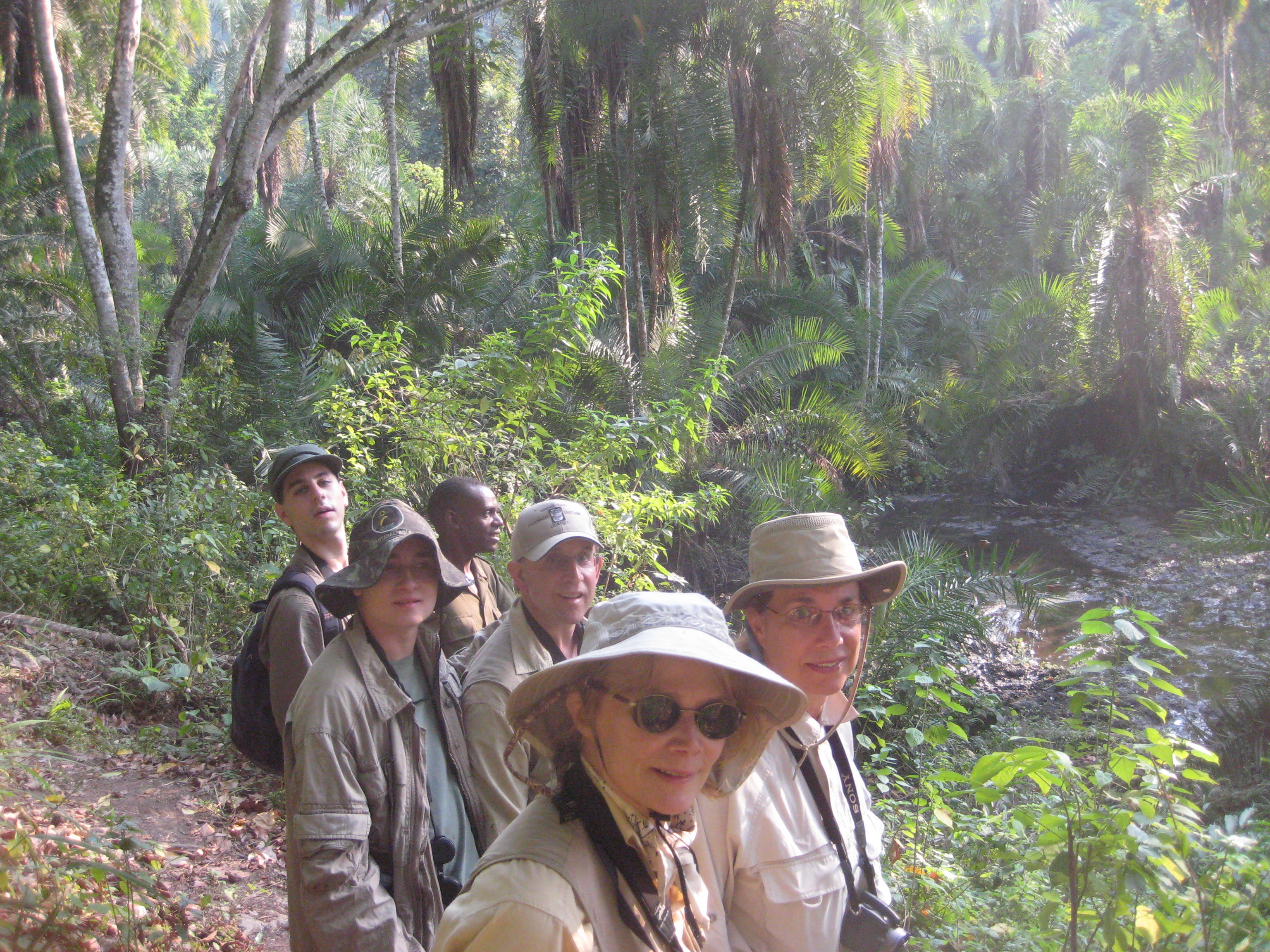
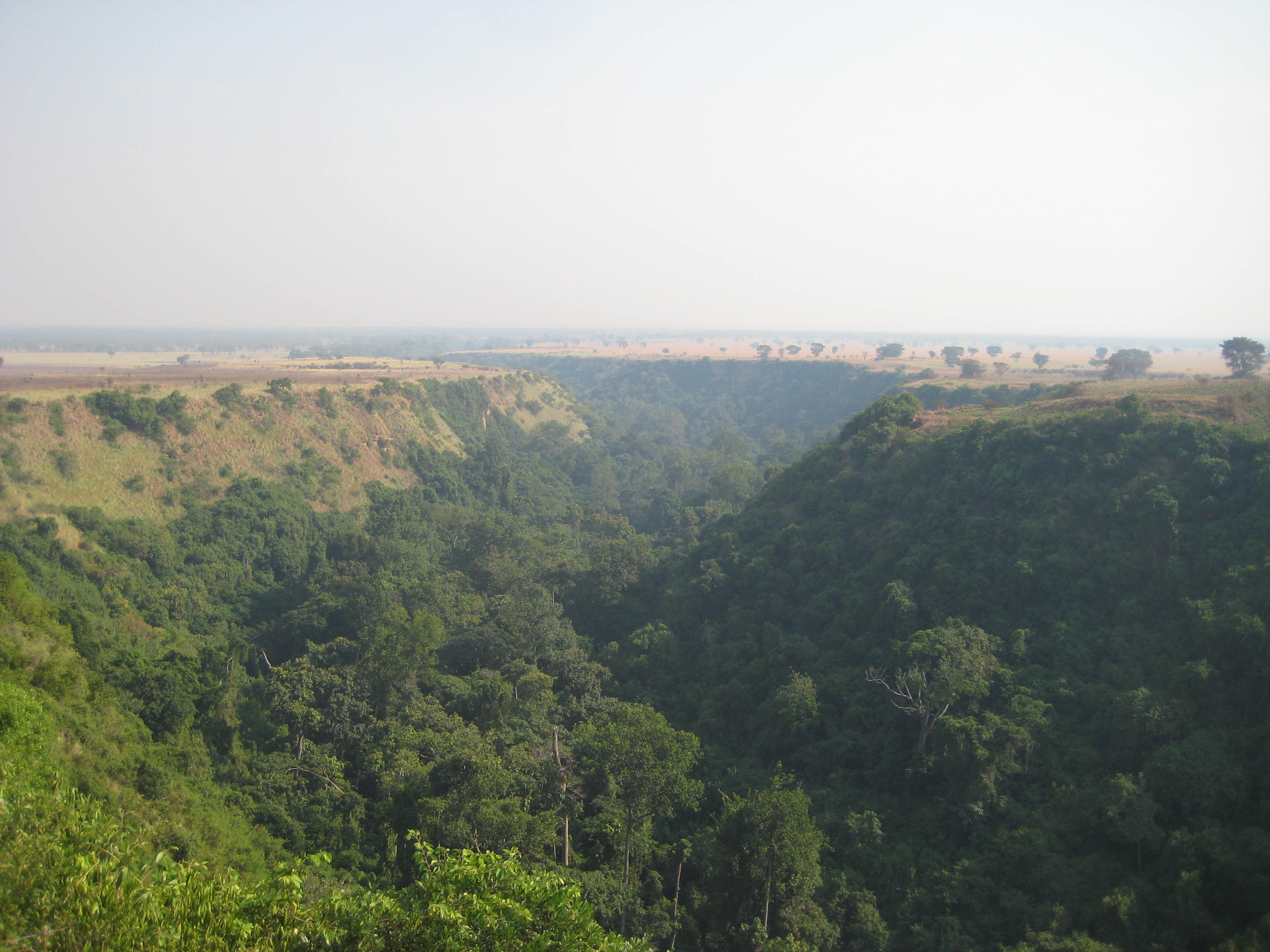
Only 40k from Mweya, Kyambora is a world onto itself. It stretches 21 km into the Kazinga Channel and is at no point more than about 200m wide and often much less, but about 150-200m deep. A stream runs through the bottom into the channel.
The surrounding plateau is typical QENP bush: grasslands with acacia and other trees. But once inside the gorge, the world changes completely. There are rain forest trees like podacoporus which tower above the plateau ceiling, many giant ferns and several types of palms.
It is like suddenly stepping out of one world into a completely different one.
Thirty chimps live in this rather confined area, and there are problems with the gene pool getting too inbred. Recently this has been exacerbated by an unusually high frequency of male babies.
Without too much trouble we all saw Brutus and Hatari, and some of us saw the indiscreet female who had broken the normal rule of not mating until your child is off your back, and who as a result carried a 4-year old on her back and an infant at her breast!
We found the small group of chimps after hardly a ten minute walk once at the gorge bottom. So we decided to continue on the elephant trail just to see more of this beautiful forest. We passed one cycad, the dinosaur of the rain forest, and a multitude of other palms and giant figs. The tinker birds and greenbuls never stopped calling, and every once in a while a huge black-and-white casked hornbill would fly through an opening in the forest looking like a 747. Kyambora Gorge
We ended at a beautiful forest pool that our guide said was frequented by hippo in the rains.
We then ascended the gorge and our guide switched the 7 of us for the other 6 in our group. We learned that as soon as they had descended to the pool, Brutus and Hatari were there waiting to greet them!
The two sneaks had followed us on our walk, absolutely quieter than they usually are! So it wasn’t just we humans walking through the looking glass curious to see the magical creatures on the other side, it was so the magical creatures could observe us!
The experience is not as intense with the chimps as at Kibale, and it’s not intended to be. This is an unusual group in an unusual space, and it was beautiful just to see!
Zoo Director, Steve Taylor, (sitting: Cathy Colt & Daniel Pomerantz), on the Kazinga Channel cruise.Beautiful scenery, weird and abundant localized wildlife, and great fun on the Kazinga Channel headlined our day in Queen Elizabeth National Park.
QENP wraps itself around the Ugandan side of Lake George, and all of Lake Edward, and includes the famous Kazinga Channel which connects the two. Because of the on-again, off-again disturbances in Uganda’s north near the larger Murchison Falls National Park, it has become the most visited non-gorilla national park in Uganda.
When I first visited it with my wife during the Idi Amin years, we found one old and dying buffalo. There wasn’t a single other animal to be found. They had been hunted out by Amin’s soldiers.
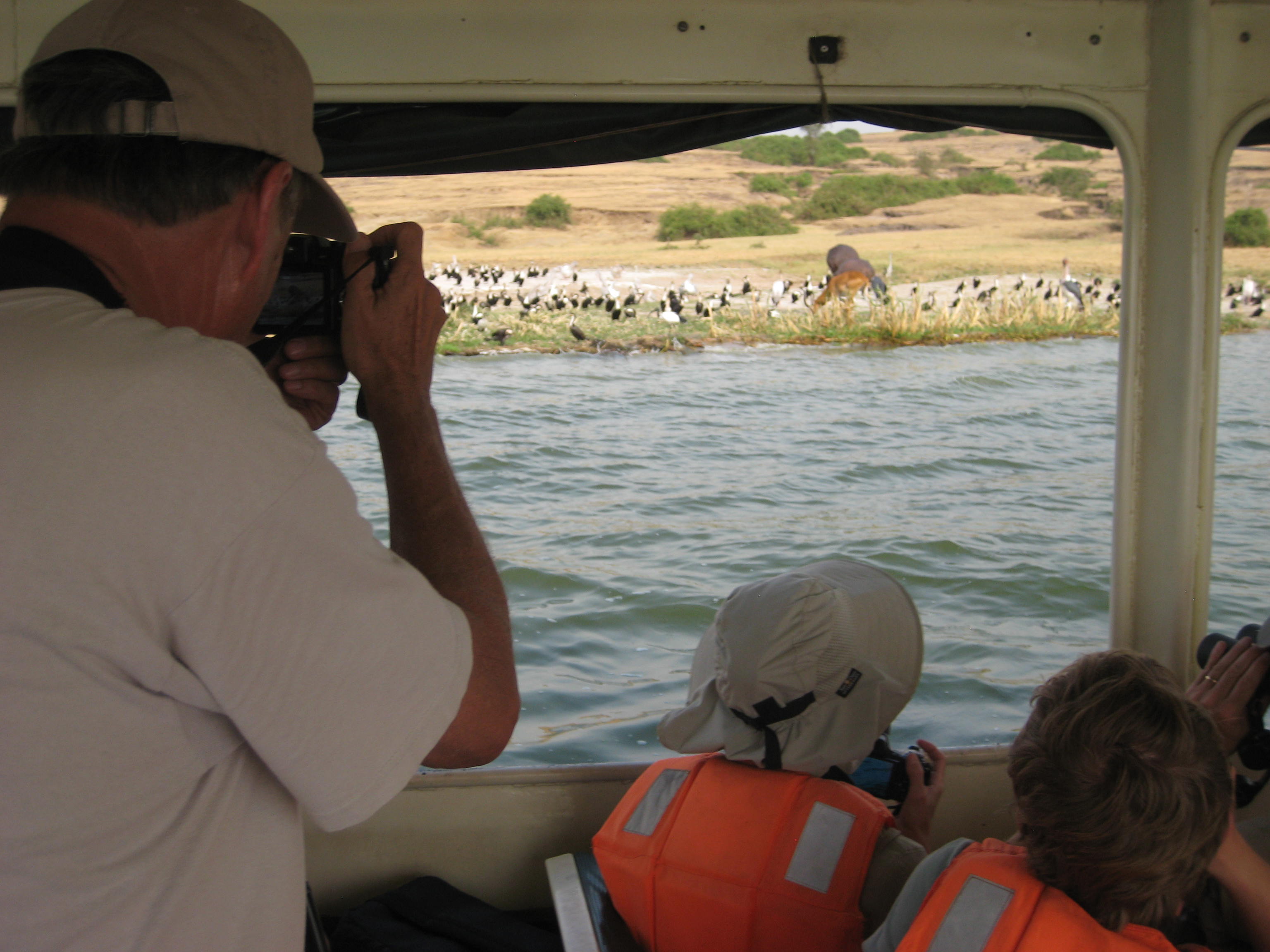
Today the wildlife is coming back. On our early morning game drive and boat cruise in the afternoon on the channel, we saw about 25 elephant, tons of kob, lots of buffalo and hippo, and some waterbuck and warthog.
Along, of course, with many birds. The birdlife was not disturbed during the troubles Uganda has suffered and it remains now, as it was then and before, the richest avifauna area in Africa. The park has more than 650 species during the European winter when more than 100 migrants arrive.
Perched on a peninsula raised nearly 300 feet above the channel, Mweya Lodge where we stayed has become the poster lodge for Uganda. Comfortable, spacious, air-conditioned and totally modern, the staff is as good as most places in Kenya and Tanzania, something unusual for Uganda.
The view from our rooms was gorgeous: we looked northeast along the channel to Lake Edward and with binoculars could watch elephant and buffalo and hippo on the banks.
The early morning game drive would disappoint veteran travelers to Kenya or Tanzania, but it was great fun watching the “kob kourts” – the nickname for the circular territories that male kob create to lure in females for breeding.
Unlike most antelope, there’s no aggression between the males. They simply design their little areas often within 25m of each other, then sit in the middle of them, and wait. We would see groups of 4 or 5 females, like little teenage girls at a concert, flitting about the edges of a territory deciding whether to go in!
But the afternoon channel cruise was the highlight, as it always has been. The northeastern bank of the channel which faces The Congo is a geographically protected area, difficult for even the soldiers during Amin’s years to get to. It became something of a sanctuary that continues, today.
So its biomass is considerable, but unusual. Buffalo, elephant and hippo practically lay on one another, unperturbed. You’d never see that in a more natural situation.
While it was true as our boat guide pointed out that most of these were older individuals, not all of them were. We saw many very tiny hippo babies, and the tolerance that the different species shown one another was a sorry reminder of how horrible most of the wilderness was for Uganda’s wild creatures not too long ago.
And to extend theme even further, a fishing village which had been grandfathered into the park existed smack dab in the middle of the wildlife, towards the end of the channel. We watched boys swimming not 40m from buffalo and hippo. Alex and Bill Banzhaf.
The guide explained that there were confrontations between people and animals that had led to some notable deaths in the past, but nowhere near as I would normally expect. I imagine that the fishermen, like the animals, learned to live together peacefully as an alternative to the troubles on the other side of the channel.
So a very interesting and wildlife filled day! Tomorrow we’re off to more chimps and a more natural part of this large QENP.
Cleveland Zoo Director, Steve Taylor, with wife, Sarah, watching chimps in Kibale.Kibale National Park is the best place in the world to view chimps, and today our expectations were met and exceeded.
The majority of us trekked today, waiting for longer than we expected at park headquarters, for the trek which began around 11 a.m. Aston was our guide, one of the better; he’s been there since 1991.
My first trek in Kibale was in 1995. I’ve trekked three times since and to see the difference is incredible.
It’s quite easy, today. We walked out of the back of the park headquarters down a gorgeous trail filled with magical plants and wondrous butterflies and amazing trees. Less than 20 minutes later we could hear the chimps screaming and a few minutes after that, we were amongst them.
An ordinary trek takes a total of several hours, of which the majority of that time is actually with the chimps. Our family of 30 stayed with us for nearly 70 minutes.
Aston identified many of the individuals, including an old “retired” male, the second and third males in command, and we watched several mothers with babies. In fact we watched one of the mothers making herself a day nest, with the little kid pulling giant leaves around in an obvious and hillarious mimic.
The crazy vocalization of chimps that most everyone would recognize is accentuated in the forest. This is IMA sound and was truly exciting.
Aston would locate a good viewing spot and position us, and then after a while or when the chimps moved, we would, too. But we never moved very much except the one time that Aston screamed, “Run! Run!”
I looked about me to see if some aberrant chimp was descending on us, but in fact it was that we had wondered into a collection of safari ants. Most of us got out with only a few bites, but Hope Koncal spent a long time picking them off.
Aston explained that there are currently 1,140 chimps identified in the park, of which 120 are fully habituated. The habituation process takes a full 5 years, much longer than with mountain gorillas, although they do start bringing in visitors after three years.
You’d never know they once may have run from us, or thrown things at us, or charged us! I really felt it was only the younger ones who had any interest in us at all.
And we encountered many beautiful birds that seemed to sing constantly: the yellow-rumped and spectacled tinkerbirds, several greenbuls and the loud and piercing croaks of the black-and-white casqued hornbill.
Together with the forest setting, those absolutely magnificent trees that seemed to tower into the stratosphere, it was absolutely a day to remember!
The Kenyans dispelled all myths yesterday that they were incapable of stable government. The national referendum for a new constitution passed resoundingly more than 2 to 1.
Although implementation will be arduous, and the time available before the next election poses something of a challenge, it is clear that Kenyans across all spectrums of society want to put the 2007 violence behind them.
The coalition government which has operated so successfully after the Kofi Annan agreement in March, 2008, had unanimously supported the new constitution. Only a handful of renegade politicians, others who will ultimately be prosecuted for the 2007 violence, and church leaders myopically obsessed with tiny provisions regarding abortion campaigned for the “NO” vote.
 There’s an elephant on the Jomo Kenyatta runway, and everybody thinks it’s a peacock! Cool it. Wait for the real figures, will ya?