Poaching increases during tough economic times but is usually limited to elephants and rhino. Looks like giraffe are now being taken, too.
Wildlife officials at Arusha National Park (which is locally fondly called “giraffic park”) reported this weekend that a growing number of giraffe are being seen without tails!
Years ago when I first worked in Africa elephant hair bracelets were all the rage. I even bought them myself in the early 1970s, before elephant poaching had achieved such an insidious level. Later when we began to realize elephant were really threatened, the market turned briefly in the 1980s to giraffe hair bracelets.
I remember thinking at the time that the elephant hair was a poor man’s byproduct of the elephant hunt, but I also remember wondering if giraffe were really hunted, too. Farside cartoon material, of course: “Twili’s Twiga Barbershop”.
At the time there was only one market for giraffe hair bracelets: tourists. And there will always be a small market of tourists insensitive to the horror involved in bringing that hair to market.
Giraffe are fairly tame creatures in national parks, and especially so in Arusha. Around the Momela Gate – where the tailless giraffe are said to live – tourists have reported actually touching young giraffe. The young, especially, would be easy prey for getting their tails snipped off.
But would it really be worth it to the errant poacher? A giraffe kick – even from a youngster – is lethal.
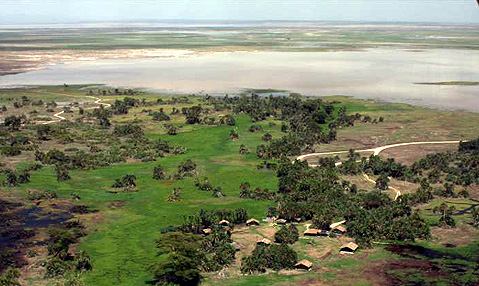
A number of wildlife and health department officials working in the West Kilimanjaro region – the corridor between Kenya’s Amboseli national park and Tanzania’s Arusha national park – have reported whole giraffes being poached… to cure AIDS.
Apparently clever hair-tonic like salesmen are traveling in the more rural areas with concoctions of giraffe bone marrow that has achieved the reputation of being able to cure AIDS.
Tough economic times bring out the worst and the most creatively worst in all of us. So it’s likely that young giraffe aren’t having their tails snipped off – they’re being killed completely.
And so tourists blithely purchasing a giraffe hair bracelet on the streets of Arusha are supporting a much more onerous syndicate than weird tail clippers.
Nairobi is back to normal after a confusing afternoon of city rioting that proved less serious than first reported throughout the world.
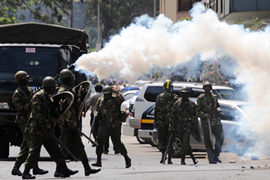
Because the march by about 50 young Muslim youths following Friday prayers at Nairobi’s main mosque was a surprise, news reporters were not on the scene. Virtually all of the reporting came after the shots had been fired that killed between one and five people, possibly including one policeman.
Police were on the scene, and that’s the odd part of the story. Reporters usually follow police. But in this case neither local journalists or Nairobi’s most prominent foreign journalists (the BBC and Reuters) were there.
I was unable to find anyone I know who was there, so the best I can do is piece together what seems most reasonable from widely different reporting:
Wednesday following continued difficulties in getting the unwanted radical Muslim cleric Abdullah Al-Faisal deported from the country, the Muslim Human Rights Forum of Kenya announced that following Friday prayers at Nairobi’s main mosque there would be a parade of supporters across the middle of downtown Nairobi to the President’s Office to deliver a petition demanding the release of the controversial sheikh.
They asked for a permit to march from the police and were denied the permit. They did not – as has happened in the past with contentious groups – then announce the march would go on, anyway.
So a relatively small contingent of police positioned themselves in the parking lane off the main Kenyatta boulevard that cuts into the city from the big airport highway. I don’t know how small, but photographs by Capital FM’s radio station show only a single police van.
When the “small” group of marches left the mosque, which is one block south of the city market and one block east of where the police van was, the police tried to stop them. But there were too few police, so the police retreated and started firing teargas.
Demonstrators temporarily returned to the mosque, where the police followed and then surrounded with increasing numbers arriving from other parts of the city. And large numbers of anti-demonstrators began converging on the scene, especially from the City Market.
The second surge from the mosque was much larger, and this time included more prominently displayed placards and including one black flag reportedly representing Al-Shabaab, which is Al-Qaeda in Somalia and the organization with which Faisal is linked. Several marchers in the lead wore military fatigues and covered their heads with black masks, typical of jihadists.
Police retreated, again, and in the mayhem which ensued shots were fired. Police have not contended that the protestors had guns, so this would mean they shot one of their own.
Before the protestors got one block onto Kenyatta street, the now larger group of anti-demonstrators began attacking the demonstrators with knives and anything they could find lying around in the street. The battle between demonstrators and anti-demonstrators went on through the city for several hours as shops and businesses began to close up. Police had lost entire control of the battle.
One Nairobi newspaper claims that Muslim leaders from the mosque joined police in trying to quell the situation, but were unsuccessful. The Standard reported that several hours into the battle the police simply “became spectators” unable to stop the two factions from fighting.
The first march from the mosque was just after 1:30p. By 4 p.m. most of the fighting had subsided, the city center was a ghost town, and the police and shut off all access into and out of the city center. By 7 p.m. the streets were quiet but deserted, not entirely unusual for a Friday night. (Most of the entertainment areas are outside the city center.)
Kenya National Human Right Commission Vice-Chairman Hassan Omar said, “It was a simple demonstration which has turned ugly because police failed to control the crowd letting hooligans to take lead in the protest.”
Muslim groups claim that five people died and more than 20 were wounded. Police say that only two people died, and that one policeman was seriously wounded with a shot to the neck.
The Standard newspaper says that four people died; the Daily Nation says that one person died, Jeffrey Gettleman of the New York Times reported that three people had died, and the BBC reported that five people had died.
So far, the only person named dead is Ahmed Hassan Abdullahi, 25.
As night fell on Nairobi, Friday, the streets were quiet and five people were confirmed dead.
Below is an edited report from the BBC, but let me first complain bitterly about the NPR report. I love NPR but they continually get Africa wrong. Alone among such giants as the BBC, Reuters and Aljazeera, NPR failed to report that much of the riot was caused when Nairobi citizens started throwing stones against the Muslim demonstrators.
It seems that the police may have then sided with the much larger anti-demonstration crowd and over-reacted. But this would be typical in Nairobi. I remember during the August, 1998, bombing of the embassy. The first public action by Nairobi citizens was to burn the city mosque.
See my earlier blogs this week and last about Al-Faisal, terrorism, etc. Here are excerpts from the BBC:
At least five people have died after Kenyan police opened fire at supporters of a Jamaican-born Muslim cleric notorious for preaching racial hatred.
Faisal is in detention in Nairobi after Kenya failed to deport him.
Kenya wants to expel him citing his “terrorist history”. He was jailed for four years in the UK for soliciting the murder of Jews and Hindus.
Muslim youths began the protest match after Friday prayers at the Jamia Mosque in the centre of Kenya’s capital, Nairobi.
They wanted to present a petition to Immigration Minister Otieno Kajwang and Prime Minister Raila Odinga’s office.
But police had banned the march and intervened.
One banner read: “Release al-Faisal, he is innocent”, reports the AFP news agency.
Some reports suggest that the protesters were waving flags of Somali Islamist group al-Shabab.
Reuters news agency reports that some people joined the security forces in attacking the protesters.
I’ve always been skeptical about almost any type of individual charity for Africa, but billionaire do-gooders are an absolute pain in the ass.
A very close friend asked me to comment on the New Yorker’s December article by Philip Gourevitch, “The Monkey and The Fish.” It’s about Prodigy billionaire Greg Carr who according to the article is single-handedly reclaiming Mozambique’s near destroyed Gorongosa wilderness.
He is not the first untrained rich man to come to Africa to save it. Whether it is King Leopold, Sir Richard Burton or more recently, Paul Tudor Jones, I think it usually ends in disaster for Africa. There are much better ways that rich men who truly care about Africa can help it.
Bill Gates is the best example. And sorry to set the bar so high, as I realize Gates’ wealth is much greater than Carr’s. But my point is that Gates does it the right way: through a carefully created foundation that uses science, business management, and works closely with governments and long established NGO’s.
Carr is not doing such. He and renegades like Paul Tudor Jones make a bunch of money then fall passionately in love with Africa and decide they’ll go out and make everything right. Usually, everything goes terribly wrong.
As it should, frankly. What I find particularly upsetting is that the people who know better than me, scientists and managers at places like the World Wildlife Fund and Frankfurt Zoological Society, are all cowered into complacency, because they want these guys’ money. If they didn’t need it, they’d send them packing.
I have a good example of what they should do, even if they aren’t as rich as Gates.
A man as rich in his time as either Paul Tudor Jones or Greg Carr are today was New Yorker Howard Gilman. He was a good man who had to stay under the radar for a number of reasons: he was gay, he ran an international paper company that, of course, cut down trees, and he had a bickering family.
But he supplied more than 1,000 jobs to people in the Carolinas, was a responsible paper company executive, adopted Mikhail Baryshnikov when he defected from the Soviet Union and was a reliable patron of the arts.
And just as much as Jones or Carr, today, he loved Africa and he loved wildlife.
So he carefully and systematically built up a foundation which today has earned an exemplary reputation of helping Africa and wildlife.
He hired John Lukas from the Bronx Zoo years ago. John built up the White Oak Conservation Center with endowments from the Gilman foundations. John has spent more than twenty years carefully and expertly creating an organization that includes a huge conservancy on the border of Georgia and Florida, an outpost and oasis of wildlife prestige in the belabored Congo, and in the course of his career has done more for animals and Africa than Jones or Carr will ever do in a thousand life times.
Untrained, rich men, aren’t good for Africa. Africa needs outside scientists doing careful baseline research, government-to-government alliances and exchanges of aid, and mature interaction between experienced NGOs like the White Oak center.
Howard Gilman might never have felt the rush that Jones or Carr feel when a big magazine displays them as the saviors of Africa. But I can also assure you that if the next generation even finds their names in any African monograph it will be because of something horrible they did.
But the next generation will know of the Gates Foundation and the Gilman Foundation and White Oak Conservation Center, because what they’ve done, and how they’ve done it, and what will be built on top of their accomplishments will have helped Africa. It already has.
One of Kenya’s prominent newspapers said today that Muslim suicide bombers could be a positive force in Africa.
I’ve printed much of the Daily Nation’s article below. It’s important for westerners who perceive themselves the targets if not actual victims of suicide bombing to learn of these contra opinions. The Nation is one of Kenya’s most conservative newspapers.
A little background is required.
A huge controversy has developed in Kenya over the jailed Muslim cleric, Sheikh Abdullah al-Faisal. See my blog of January 9.
No airline will board Faisal. Kenya can’t afford to charter him back to Jamaica. Surrounding countries, including Tanzania whence he came overland about a month ago, refuse to allow him entry. For the time being, Kenya is stuck with him.
He’s been held without charges either in the airport or in a nearby prison. Muslim groups have become more active in the last few days, assembling a team of lawyers that have begun filing motions in the incredibly convoluted Kenyan court system to try to get him released.
The author of the article below, Charles Onyango-Obbo, is a salaried employee of the newspaper. He is not considered a radical.
There is much in the article with which I agree, but ultimately Onyango’s reasoning must confront a serious moral impediment that means justify the ends, the means in this case being wanton murder, and with that I can’t agree. Nor can I agree with the impoverished morality that suicide carries any sort of virtue whatever, except possibly for the individual who kills himself.
Onyango did not use any of the common arguments often purported in the Muslim world to justify Al-Qaeda type movements and terrorism in particular. He did not, for example, try to justify terror as a way of getting the west to leave the Middle East or other areas where radical Muslims believe they have a more intrinsic right to power.
The reason I find this article so fascinating is that it argues that there is value to terror, even if there is no enemy to practice it on, no oppressor. Onyango states that suicide bombers, for example, create positive dialogue and promote local peace among disparate groups. This is an argument as convoluted as the Kenyan court system.
Perhaps, the newspaper agreed to publish this article, because somehow it thought it would dampen the growing tension in Kenya between Muslim groups lobbying for Faisal’s release and those who fear him.
The motive would be good, but the effect is not. Bad arguments don’t bring peace.
Below are excerpts from Charles Onyango-Obbo’s article in the January 14, 2010, issue of Nairobi’s Daily Nation. Click here for the full article.
[Sheikh Abdullah al-]Faisal’s problems…stem from the suspicion that he might be a religious extremist.
That, in turn, seemed to have been fuelled (sic) by the Christmas incident in which the young Nigerian, Umar Farouk Abdulmutallab, an alleged Al Qaeda operative, botched an attempt to destroy a plane carrying 290 people flying from Amsterdam to Detroit.
… It would seem, after that, suspicion heightened over every radical Islamic preacher.
The acts of people like Abdulmutallab often tar many innocent Muslims, and in some parts of the world, especially the West, Muslim has become synonymous with terrorist. Every other day, you read of stories of areas where Christians are protesting because a Muslim has moved into the neighbourhood.
But looking at suicide bombers acting in the name of radical religion from Africa, one sees more interesting things. It is heartening, in a strange way, to see an African willing to kill others for something other than his tribe, political affiliation, or personal profit.
Abdulmutallab’s action should resonate in Kenya, where following the disputed December 2007 elections, thousands of people were slaughtered and displaced because of their ethnic origin or the political party they supported. Or, better still, Rwanda where in 1994, nearly one million were killed mostly because they were Tutsi…
… Abdulmutallab was … willing to die … by being a suicide bomber. This idea of a most extreme personal sacrifice is not new in Africa, but it is not common either. …It is rare to see people in most African countries going to this extent. Apart from soldiers … we don’t usually put our necks on the line for our countries.
All this is good, for several reasons. First, religion is actually a big idea. If more of us begin to kill only for big ideas, and not small ones like tribe and who you voted for at elections, we shall see a sharp decline in violence in Africa… From Abdulmutallab’s act of terrorism might grow the first true seeds of modern patriotism in Africa.
Finally, before the Jihadists came along, there wasn’t much of a dialogue between Christians and Muslims in Africa, in part because in the countries where Muslims are a minority, they had endured a history of discrimination…
Following the September 11, 2001 terrorist attack on the World Trade Centre in New York … Islam made its biggest effort to explain that terrorism was not in the Qur’an. It found fearful Christians, eager for reassurance, were much more willing to listen than they had been in the past.
… Muslims were energised to defend the honour of their religion against attempts to besmirch all of them… One result in countries like Uganda and Kenya is that they used it to elect more Muslims to Parliament.
Many governments in Christian-dominated countries also sought to do something they had not been serious about — Muslim representation in public life. Muslims moderates, particularly, have flourished…
Entirely by accident, radical Islam-inspired terrorism might turn out to be the best thing to happen to both Islam and the politics of many countries in Africa: It has improved inter-faith dialogue, reduced marginalisation (sic) of Muslims, given them a little more voice, and by forcing countries to rally around something other than their tribes, could do African nationalism endless good.
There have been 236 great white shark attacks on humans recorded since 1876. Oh, sorry, that’s now 237.
That statement above was a part of a lengthy June, 2008, article in the Smithsonian entitled “Forget Jaws, Now it’s . . . Brains!” which also claimed that Great White approaches to humans were mostly out of “curiosity” and that really, they’re quite friendly and intelligent.
Holy Mackerel.
Yesterday, a horrible and gruesome attack by a White Shark at one of Cape Town’s most popular summer beaches was witnessed by dozens of people. A Zimbabwean holiday maker was taken by the shark when he swam out into deeper waters, alone.
Sharks have infested the South African beaches, particularly those from Durban west to Cape Town, for as long as we’ve known about the beaches and sharks. My wife’s parents lived in Durban during World War II and like the 20,000 British pensioners that live there, today, frequented the beach during summer. They claimed whenever they went swimming, there were massive hemp ropes fastened to shore poles so that people attacked had a better chance of being pulled in for rescue.
A third of the world’s Great Whites live off California, another third off Cape Town, and roughly the last third off Melbourne. This is because these are areas of deep, mostly cold ocean waters, the most fecund habitat of the sea.
In the case of South Africa, the world’s coldest ocean, the Atlantic, meets the warmest ocean, the Indian, just east of the Cape. This mix of habitats makes it remarkably nutrient rich.
Great Whites don’t approach the beaches of Australia and America like they do in Cape Town. I know just north of San Francisco I often saw smaller sharks, myself while swimming and living there, but nowhere near as many as in South Africa. At Durban, one of the world’s greatest surfing beaches, there are all sorts of precautions taken against sharks: nets, sensors, paid spotters.
Sharks and South African beaches are a way of life. And the truth is that there are few attacks compared to the hundreds of thousands of swimmers on their beaches throughout the summer – right now.
But even so, I wouldn’t invite one over for dinner. Mackerels are much more conversational.
The current deluge in Kenya is a real human tragedy, and I sympathize with many Kenyans who are furious that their official meteorological department said the rains were going to end, not continue.
I wrote a blog about it on December 11, explaining that data available from satellites which I then published as maps, suggested otherwise: that the end of December and on would be rainy.
So this untrained meteorologist (I love my remote digital indoor/outdoor weather system), did better than the Kenyan Meteorological Department!
But in deference to my colleagues, I felt I should reprint with minimum comment the remarks of Dr. Joseph Othieno which appeared in Nairobi’s Daily Nation newspaper in response to the public outcry against the government’s weather forecasting department.
Uncertainty (sic) is an uncomfortable aspect of life, but one that pushes humanity to act. To overcome it, man has sought various interventions from soothsayers, astrologers, prophets, magicians and scientists to forecast what the future holds.
And NOAA’s special African desk for weather reporting from a stationary satellite above Africa. Try this: http://www.cpc.ncep.noaa.gov/products/african_desk/
In developed countries, extreme weather conditions are accurately predicted to the day, hour, and in magnitude.
Right.
But in developing countries, this has remained a big challenge due to a number of problems that are worsened by public ignorance….
And the weathermen are a part of the public?
Forecasting … is one of the major challenges facing meteorological services… This is worsened by ignorance, technological challenges, complex physical features and lack of appropriate data.
Like how much rain fell?
A major objective of forecasting is to unmask fate and inform the current on timely strategic interventions that will mitigate the adverse events of the predicted phenomenon, by informing policies and supporting the end user of such information to adopt accordingly.
Pursuant to meteor men proclivating outside regular business hours.
It is important for all to understand what weather forecast is all about. A forecast that doesn’t translate into light but heat is useless.
This is the reason it’s darker in winter.
An accurate forecast that induces no action is worse than an inaccurate forecast with action.
Dr. Othieno, I cannot express to you how relieved I am now regarding the future not just of Kenyan meteorological forecasting, but of the country’s destiny in toto, of its unique opportunity to shine as beacon of [hot?] light in the dreaded darkness of Third World science. Did you pass you’re a-levels? Or are you, too, planning to run for Parliament?
African Trust for Elephant's Camp in Amboseli. For three years it has been only a dust-bowl.Wildlife people are happy, social activists are alarmed, and the poor Turkana people believe it’s the end of the earth. El-Nino’s floods have blown up the drought.
From the Serengeti to Tarangire to Tsavo to Samburu to the Mara, the rains are tumbling down. And the last to report torrents – as was to be suspected sitting in the rain shadow of Mt. Kilimanjaro – was Amboseli in late December. And with that report by Harvey Croze of the African Trust for Elephants, we can say definitively that…
It’s raining too much!
“Three inches [of rain] may sound pitiful for those getting inundated with rain and snow in other parts of the world, but in Amboseli that represents almost 20% of the average annual rainfall. In one week!” Croze wrote on January 7.
One of East Africa’s best writers and little known is the wife of the legendary elephant researcher, Ian Douglas-Hamilton. Here’s what Oria Hamilton had to say in her recently circulated Christmas Letter of 2009:
I can finally tell you ‘the drought has ended’ and with it wonderful things have happened. The outlying hills and mountains are dark, as if newly painted against massive white and grey clouds looming above us streaked in sun-setting orange light, and all over the land, green grass, green bushes, green trees can be seen. It has been raining nearly every day since I arrived, the river is flowing, gently and continuously taking all the stress and hardship with it. Today we have food in abundance and water everywhere. The earth is a rich damp dark brown. Nature is extraordinary, ever changing, regenerating, on the move, reproducing – each day racing to catch up for all those desperate dry months. Thousands of little acacias are sprouting all along the river bank and the grass seems to be growing while I look at it. I barely dare to tread on it while I take my walk and this week the ‘lamb tails’, little white flowers, have blossomed and from afar it looks as if it has snowed.”
Normally in Samburu now the rains would have stopped, but they haven’t, and that means that an El-Nino phenomenon is definitely in play. That’s good for the veld, but it’s not so good for the folks whose home it is.
Today Kenya announced nearly $1 billion dollar in combined aid from the Kenyan Government and aid organizations like the Red Cross to serve almost one million newly displaced persons. Between Kenya and Tanzania the death from raging floods was confirmed above 100, today. Roads are being literally washed away, with nothing left after three years of erosive power caused by the drought.
Livestock losses in Kenya’s far north are approaching 90%. And one of the most exceptional stories of this episode comes from the Turkana village of North Horr. In normal years the village gets 2″ of rain annually. The people in the area depend rather on the water systems and aquifers generated by Lake Turkana.
Since the rains began in Turkana in October, the area average that has fallen has been 10″. That’s more than five years worth of rain in three months. It is a desert incapable of dealing with this inundation even at the best of times.
I remember the last real El Nino in 1992-93, so I’m not quite ready to claim that all the drama we’re currently experiencing is completely a global climate change phenomenon. And back then the rains were actually a bit heavier than we’ve so far experienced this year, but the human and animal ramifications were far less severe.
As societies and ecosystems as a whole grow (in size) and develop economically, sudden change of any kind is harder to deal with. And that’s certainly what we’re seeing now in East Africa, and I venture in many other places in the world as well.
So put “able to deal with sudden change” at the top of every responsible world citizen’s most necessary skills. And, this is so hard to say, please Ngei, turn off the taps … at least a little bit.
Activist Member of Parliament in Tanzania decries sorcery being used against her in the current election. This is tongue-in-cheek, but not even google knows this.
A report in one of Dar-es-Salaam’s major newspapers this morning was picked up by literally thousands if not hundreds of thousands of other media, probably for what was presumed as comic relief. Even google.news had it on its front page.
But everybody’s missed the point! It’s a perfect example of how the electronic world can actually invert news completely… or maybe, how savvy techies can manipulate truth in evil ways. Here’s the story.
Ms Beatrice Shelukindo is one of the most outspoken and progressive members of Parliament in Tanzania’s current government. She’s a tireless fighter for reform and brazen whistle blower. She’s been in trouble not a few times with the powers that be.
She and a few other noble souls were responsible for the resignation of Tanzania’s attorney general about a year ago, after uncovering a scheme where Andrew Chenge enriched himself by around a $1 million in kickbacks from the purchase he orchestrated as the country’s chief legal counsel of a radar system the country didn’t need.
She and a few other noble souls helped get the resignation of the country’s PRIME MINISTER for yet to be fully revealed corruption in the country’s electricity companies. And she’s currently embroiled in a controversy with the Richmond Development Company of Houston, Texas, which is supplying gas power to Tanzania. (That is an entire story in itself, by the way. If Shelukindo’s accusations are true, Richmond Development is in violation of American federal law.)
Also recently, she wondered aloud in Parliament if all the nominated district officers around the country were qualified, or just idiot relatives of those in power.
Tanzanian politicians in power don’t like Beatrice.
After Obama’s election, she issued the following statement:
“We pay homage to Democrats for the win but above all I pay tribute to his wife who was around with him throughout the campaigns. We all know that behind every successful man, there is a woman advisor. I also pay homage to Hillary Clinton who, despite the fact that she lost has shown solidarity,“ said Shelukindo. `Tanzania values humanity and democracy, let us emulate the good deeds by Americans,“ Shelukindo concluded.
Why wouldn’t Tanzanians in power like this? Because I and many others believe Tanzanian power centers were ruefully corrupted by the Bush initiative made just before he left office, which was basically Tanzanian accolades for the Bush administration as a quid pro quo for unusual aid.
At the time you may remember it was hard for Bush to find anybody in the world who liked him, so he made a quick trip to Tanzania where he was praised after promising $350 million in new aid. The Obama administration seems to have no compulsion to make good on this.
Beatrice is from a rural area of Tanzania, Kilindi. Here is the entire report from Tanzania’s Citizen newspaper today, filed by journalist Hussein Semdoe:
Kilindi MP Beatrice Shelukindo has expressed fear that some people in her constituency could be playing some witchcraft antics against her.
The outspoken MP, who has declared that she would defend her seat in October election, complained that she encounters bizarre incidents whenever she visits the area. The CCM MP believes the antics are part of dirty tricks employed her potential opponents to defeat her.
She said her car tends to breakdown without any mechanical problem or in case the car is able to move it ends up getting involved in accidents. She made the allegations while addressing voters in different villages in the district.
Speaking at Saunyi and Mswaki villages late last week, Mrs Shelukindo appealed to the witch doctors to endorse her as she had done a lot to bring development in the area.
“I am amazed by what is happening to me these days… whenever I plan a tour of the constituency, my car breaks down. For instance, I was rushing to a meeting in Songe recently when my car broke down,” she said.
“I boarded a passenger bus which also broke down. The second bus I boarded met similar fate and I was late for the important meeting,” she added.
“Witchcraft has no advantage. We should change our mindset and concentrate on development and education,” she lamented.
And so the whole world picked this up to laugh at a developing country and point fun at one of the few, aggressive, valuable MPs in the Tanzanian Parliament.
The truth is not as funny. I really doubt that Beatrice was speaking seriously; much more likely she’s speaking tongue-in-cheek to her own constituents the same way any politician might make fun of themselves. And in any case, why is google.news reporting this when they didn’t report her outing of Houston’s Richmond Development Company?
They’re trying to get rid of Beatrice. And the electronic media’s desperation for news is helping them in spades.
Sheikh Abdullah al-FaisalThe story of a young extremist Islamic cleric in Kenya gives us some insight into how Muslim extremism may be effecting East Africa.
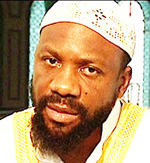
Twenty-six year old Sheikh Abdullah al-Faisal has already spent 4 years in British jails, eight years studying Islam in Saudia Arabia, and tonight is in Kenyan detention since no airline will fly him anywhere.
My disclaimer is mandatory: Christian fanatics in my own country are as responsible – if not more so than Muslims – for the religious tension and the wars they’ve provoked. I take a dim view of organized religion.
Click here to go to Wikipedia’s site to document that more than 90% of the terrorist acts in the last generation were perpetrated by non-Muslims, and before 9/11 there were more Christian acts of violence than Muslim ones.
But at the moment it is the threat of Muslim extremism that is worrisome to East Africa. Somalia is right next door. Christian fanaticism actually is responsible for much of East Africa’s misery, but that seems to be coming to an end in Kenya and Tanzania.
Weirdo Christians running around in white dresses and hoods (that for all the world look like Klu Klux Klanners) of which Kenya’s past dictator Daniel arap Moi was a part, seem to be subsiding.
Once upon a time you had to be a communist AND a Catholic to be a part of Tanzania’s ruling party, the CCM. But that’s been over for some time.
Only Uganda remains in the death-grip of Christian extremism. President Museveni’s proposed death-for-gays bill was spurned by individuals associated with Washington’s “Family”, a weird fanatic Christian group including not but a few prominent politicians like Iowa Senator Chuck Grassley. Museveni is as much a modern-day Christian crusader as there will ever be.
FYI: (Increasing world denunciation of the death-for-gays bill might be working: the Ugandan Parliament seems to be modifying it to “life in prison” rather than death.)
But the power that Al-Shabaab now wields in Somalia, and the growing conflict in Yemen, are battles being won by very extreme Muslims. And today’s story about Faisal may help us understand how vulnerable East Africa is to fanatic Muslim politics.
According to Kenya’s Minister of Immigration, Otieno Kajwang, Faisal was arrested New Year’s Eve in Mombasa on accusations of links to terrorism, ten days after entering Kenya overland from Tanzania.
Kajwang said Faisal had slipped into Kenya through a small border post, explaining that had he used an airport or one of the major border posts where the immigration controls are linked by computer, his name would have shown up on the watch list and he would not have been allowed entry.
“We have fears that it is not in our public interest to allow him to either preach or live here,” Kajwang said.
The immigration minister said that even though the cleric hadn’t committed any crime, “the fact that he is on the international terror watch list said it all.”
“We are walking a tightrope here…we have been attacked by terrorists and it is only right if we seriously defend our borders,” Kajwang said.
Yes, But… The Tanzanians claim he was never in their country.
Sixtus Nyaki, the acting Arusha regional immigration officer, said Friday there was no truth in reports that the radical preacher had entered Kenya from Tanzania.
“I can confirm that the Jamaican preacher has not entered Tanzania,” Nyaki told Tanzania’s The Citizen newspaper.
Well it’s clear Tanzania doesn’t want him, either, but it’s not clear they didn’t have him.
One report in The Coast, a small Mombasa publication, claimed that Faisal’s passport showed that he definitely was in Tanzania and that he entered Tanzania overland from Malawi. There is no indication how he got into Malawi but the paper reported his passport also showed recent stamps from Nigeria, Angola, Mozambique and Swaziland.
Sheikh Abdullah al-Faisal was born to a British Christian Salvation Army couple in St James, Jamaica, where he was christened Trevor William Forrest.
Obviously not impressed with Salvation Armyism he left home at 16 before finishing secondary school, eight years later graduating with a degree in Islamic Studies from an institution in Riyadh, Saudia Arabia.
He then returned to the UK, where indictments from his trial claimed that this then under 20-year-old preacher was urging his audiences to kill Jews, Hindus and Westerners. He was tried and convicted in Britain in 2003 and jailed.
Released after serving his term four years later, he returned to Jamaica where the Islamic Council of Jamaica banned him from preaching. He then went to South Africa where he did preach extensively in mosques, there.
There are many more Muslims in Tanzania than Kenyan, but Tanzanian society is not as open as Kenya’s. All of Tanzania’s media has reported this incident, but none has quoted any Islamic cleric response.
It’s much different in Kenya.
“This is curtailing al Faisal’s freedoms of expression and association in a very discriminative manner that is totally unacceptable,” said Al-Amin Kimathi, the chairman of the Muslim Human Rights Forum (MHRF) in Kenya.
“It follows a pattern we saw throughout last year where Muslim scholars and aid workers were arbitrarily arrested and deported from the country on very flimsy grounds,” Kimathi added.
The Supreme Council of Kenya Muslims chairman, Prof Abdulghafur El-bussaidy, said he knew little about Mr al-Faisal’s visit, but directed journalists to another powerful Kenyan cleric, Sheikh Mohammed Dor, who has recently been nominated to the Kenyan Parliament.
“[Faisal] is an honest man who came into the country legally… he has not done anything wrong,” El-bussaidy told Kenya’s Nation. Dor also dismissed reports that Faisal had called for the killing of non-Muslims.
“I have CDs of his preaching … from what I have seen and heard, you will love him. He only talks about the rights of Muslims but has not in any way called for the killing of anyone. Those are rumours being propagated by the western world.”
“Why is it that it is only in Kenya that he has been arrested, based on malicious information from the West?” Dor asks.
Yes, that’s the question. Why Kenya? Why not Tanzania? And what does this mean?
Why did Kenya act on the likely enhanced terrorism communications that occurred after the Christmas Day incident, and why didn’t Tanzania? Why did clerics in the more Muslim country of Tanzania not react to this, and why did they in Kenya?
It’s an election year in Tanzania. Friday in Dar-es-Salaam, the President of Tanzania addressed all the local diplomats and warned them against making any public statements about the upcoming election. It was a chilling meeting.
In the last Tanzanian elections in 2005 there was widespread violence in Zanzibar. The divide was definitely a religious one: Muslim vs. non-Muslim. The violence in Kenya in 2007 was much more severe, in part because Nairobi is a hundred times bigger than Zanzibar, but the divide there was rich vs. poor. Later an ethnic component would emerge in the Kenya troubles, but it was never religious.
Tanzanian power is apparently as good at silencing its own population as its foreign diplomatic core.
I don’t believe that’s wise. It’s a lot hotter in Tanzania than Kenya. Tightening those bottles of fizzy water only shakes them up and increases their explosive power.
The serious rift between Rwanda and France was deeply aggravated by a Rwandan government report released yesterday reconfirming that the 1994 genocide was started by extremist Hutus.
This may not seem like news. The rest of the world has already accepted this. But this begins what I hope is the Last Act in this horrible history.
The April, 1994, genocide was of more than 800,000 Watutsis carried out by Hutus. No denial of this. But France has always contended that rebel Watutsis were responsible for the event which led to their own massacre.
This event was the shooting down of the (Hutu) presidential jet as it began to land in Kigali on April 6, 1994, by a sophisticated air-to-surface missile fired from quite near the airport. Everyone aboard was killed, including the Hutu president of the country.
The U.N., France and Belgium had soldiers in the country because of the growing tensions between the Hutu government and the Watutsis. French soldiers were the first to arrive at the scene of the crash. They walked away with the plane’s flight recorder and have never surrendered it to the Rwandan government or U.N. authorities.
In the day or so immediately after the plane’s being shot down — before the actual slaughter began — The French government sided with the official Hutu government outrage that claimed Watutsi rebels had shot down the plane.
Because of President Clinton’s political fatigue with ‘Blackhawk Down’ in Somali, and because of the French position on who was responsible for shooting down the presidential plane, France and the U.S. blocked efforts by other countries in the U.N. to send more peace-keeping troops to Rwanda.
And so the genocide began unabated.
Rwanda has never forgiven France for using this pretense to stop the U.N. from possibly having beefed up its military mission enough to have stopped the genocide.
France has never forgiven the current Watutsi government in Rwanda for what it considered a gruesome way to come to power: fire the first shot knowing this would provoke the Hutu genocide of your own tribe, and thereby provide justification for the massive retaliation that organized Watutsis rebels mounted from neighboring Uganda.
Most of the world does not believe France. But France has hardened its position over the years. The plane that was shot down on April 6, 1994, was carrying a Hutu president returning from a peace conference with Watutsi rebels. France contends that the deal he had struck with Watutsi politicians would have cut out the massive Watutsi rebel military, headed by Paul Kagume, the current Rwandan president.
France acknowledged the horrible genocide that occurred by Hutu against Watutsi, and France never tried justifying this, of course. But when the huge Watutsi rebel military poured into the country from Uganda where it had been training, and relatively quickly stopped the genocide, France was furious.
“Why had they waited?!” was the basic French contention that the Watutsi military had allowed the genocide of 800,000 of its own tribe, just to justify their military coming to power.
France began massive aid helping the Hutu refugees that began fleeing into neighboring Congo. In the years which followed, many of these Hutu refugee camps became military training centers for the dreaded “Interamwe” which began raids back against the new Rwandan government and continues today to cause havoc in eastern Congo.
The feud deepened recently when French undercover agents in Germany arrested Rose Kabuye, the current Rwandan President Kagume’s chief of protocol. A French magistrate charged her with “complicity in murder in relation to terrorism” over the downing of the plane.
France claims that Kabuye – who was a rebel Watutsi fighter at the time — was personally involved in the plot to shoot down the plane in 1994. The French government refused some international suggestions that the U.N. Rwandan Tribunal be allowed to try the case.
France has always believed the Tribunal was biased. French authorities said that only the French justice system was capable of ultimately resolving the facts.
* * *
I think we can trust the French justice system. The French lawyer for Kabuye believes he will be able to submit the Rwandan government report as evidence to support her case, and that ultimately the long French position will finally be proved wrong, as it has been assumed wrong by the rest of the world for more than 15 years.
I hope so. It isn’t just that the continuation of this ridiculous feud between France and Rwanda is impeding all sorts of local development in the area, it is the terrifying possibility that France is right.
For if France is right, no respectable country could continue to support the current Rwanda regime.
About 8:15a, Wednesday 10Jan6, airport road into city.
Try not to arrive Nairobi in the morning of any weekday. If you do, you’ll end up a part of this.
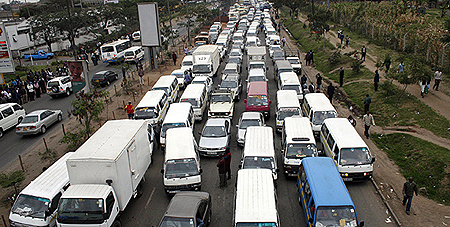
The congestion in Nairobi’s morning weekday (and sometimes, Saturday) traffic has become apoplectic. Traffic it is no longer. From about 630a until 930a it is a frozen sea of smelly metal.
Travelers leaving Jomo Kenyatta Airport for the city or any destination north should expect as much as a 150-minute drive on what in the evening or on Sunday morning would be a 20-minute drive.
Blogging in today’s Daily Nation commuter Samantha Spooner writes:
Another blog that involves cars… but this is the reason this blog is being written – it is where we are spending a huge proportion of our time these days. A blog on ‘stuck in traffic’ is nothing new but the situation has become so absurd that something needs to be written, if for nothing but my sanity.
Previous to Samantha’s post, I had believed that idle remarks on Facebook were how people were curing insanity.
Yesterday an American woman and her infant were killed by an elephant as they walked out of the Castle Forest Lodge near Mt. Kenya.
The name of the woman has not yet been released, but Kenyan authorities said she was the 39-year old wife of a teacher at Nairobi’s International School. The age of the infant was not given.
Reports by Agence France Presse said they were in a small group “casually walking” into the forest, and that the group included her husband who escaped unhurt.
None of the reports has been confirmed by U.S. authorities, but they are likely true.
The Castle Forest Lodge is a downmarket log motel not too far from Serena’s Mountain Lodge, one of Kenya’s five tree hotels. It’s located on the south end of the Mt. Kenya National Park, an area known to have many elephants. Expat workers typical of a U.S. high school teacher frequent the facility. One night with all meals costs $63.
One night with all meals at the nearby Serena Mountain Lodge retails at $260.
I am intentionally implying that the more you pay, the less likely you are to get trampled by an elephant.
The largest group effected by elephant deaths in Africa are not tourists, but Africans in their homes and farms who also do not have the insular experience of a well-run tourist facility. I am not implying that Africans or expats who pay less should be any less protected from elephants than my own Park Avenue clients.
There are some very nasty edges to the make-up of a tourist.
Q. I am writing to inquire about my honeymoon in August & September of 2010. My fiancée and I are very interested in planning a combination safari and beach extension over a 10 day period. More specifically, we’d like to spend four/five days on safari (preferably in Southern Africa – Botswana/) and then spend an additional four/five days in a beach resort to relax.
A. Andy –
First of all, congratulations!
August and September are perfect for a safari in southern Africa, so I’ll get to that in a minute.
Keep in mind that a “safari” in southern Africa usually includes 2 or 3 days in beautiful non-safari places like Cape Town. Southern Africa is more like California than the Congo. Its range of attractions is immense, including one of the world’s most beautiful cities, Cape Town, endlessly beautiful hiking trails and forests, great theaters and museums. So an optimum holiday to southern Africa meshes game viewing with these other “european-like” attractions. If this isn’t what you had in mind because it’s really intense game that you’re after, then I’d direct you to East Africa, instead. Just as a very broad comparison, in a week of best game viewing in southern Africa in August you’re likely to see 10-15 lion. In East Africa, that will be 50-60. But unlike southern Africa, East Africa has few of the other great “european-like” attractions that southern Africa has.
The beach experiences at this time of the year in southern Africa aren’t at their prime. This is southern Africa’s winter. There are islands off Mozambique which will give you a pretty good experience, but starting in about mid-August, the day time temperatures might not get above the lower 70s (although the Indian Ocean is the warmest ocean in the world). There is great variety, though, in mid-August and you could see a day touch 80 but that’s a gamble. Take 5 to 10 degrees off those numbers if you stay in South Africa along its coasts. Now if you are divers or active water sports enthusiasts, this may really not matter. But if all you’re looking for is R&R, then you might rethink this section.
The best beach experiences for August and September are much further north in East Africa: Zanzibar, or off the Kenya or Tanzanian coasts. And keep in mind that there is no beach experience anywhere on the African continent which can compete with our own. I normally point this out to couples when a conflict of interest like this might arise. In other words, the best I could give you at any time of the year anywhere on the continent would probably not meet the experience of our better resorts in the Caribbean or Hawaii.
So if you stick with southern Africa as your venue, you might want to just consider a safari experience that ends for a slightly extended time at a very romantic resort… but not for sunbathing on the beach. For example, there are some very romantic properties at Victoria Falls, as well as actually within game parks. Along the South African coast east of Cape Town (known as the “Garden Route”) there are beautiful and romatic villas and resorts on the sea, but the sea is like northern California in the winter. So you’d certainly be able to beach comb and hike, but not swim. And like in Mendocino, for example, you’d be beaching combing with a nip in the air, probably in your fleece.
For a safari experience August and September are ideal for southern Africa, its winter. The slightly better game viewing is in Botswana and Zambia, near Victoria Falls, but several flights and nearly a day’s journey from Cape Town, so you’re not only investing more time (presuming you start at beautiful Cape Town), but also a larger budget because of the extra flights involved.
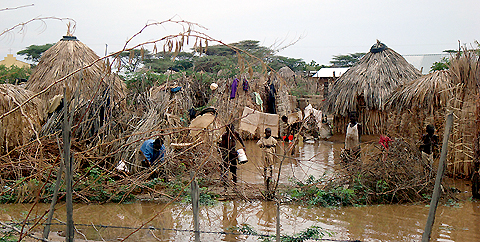
Flooding yesterday in Kenya's Turkana region, an area that rarely gets rain.As predicted very heavy rains are right now slamming East Africa.
And also as predicted, the prolonged three-year dry spell which preceded these downpours created horrible conditions for the areas now in flood. There was little vegetation left to hold things together, and massive erosion is occurring in certain areas.
The hardest hit ironically are areas in Kenya’s north where it normally doesn’t rain at all. Turkana and the far northern frontier is a mess. There aren’t tourist game parks in these areas.
The hardest hit areas in Tanzania are just west of the big city of Dar-es-Salaam, in and around the large metropolis of Morogoro. This is right on the central Tanzania tourist circuit.
Kenya has confirmed 21 dead from flooding, and Tanzania has confirmed 9. Kenya further said that as many as 30,000 people have been displaced from their homes.
The Kenyan Red Cross says that an additional 70,000 people are at risk of losing their homes if the rain doesn’t stop. In Kenya it should have stopped a month ago. Previously the Red Cross had claimed that 3.8 million people in Kenya were seriously effected by the drought which preceded the rains.
Kenyan officials also confirmed that 17 bridges have been washed away and 29 roads damaged by flash flooding.