Them! Is Here Already!

Them! Is Here Already!

Them! is here already!What does an African country do when Bill Gates says eat it or starve?

Most Americans think that the growing concern over what foods are safe is something that only their privileged, developed world has to suffer, that it is somewhat esoteric and – provided, of course that you aren’t culinarily involved – restricted to … nuts. (Peanuts, that is.)

Well, it’s not. In fact the debate over GMO is reaching a crescendo in Africa where scientists, multinationals, governments and NGOs like the Gates Foundation are in a diabolical battle over GM corn.

It is, literally, a matter of life and death.

Mom might wipe her brow when planning a contemporary Thanksgiving dinner at home, today. She might have to source out a natural turkey farmer and find a grocery store that sells gluten-free pie crust. This is all a lot more work than Aunt Evelyn did when the centerpiece of our holiday dinner was a jello salad.

But in Africa the sweat is over whether some people will starve or not, and my take is that GM foods are not the answer. Bill Gates disagrees.

You’ll have to be patient if using the links I’ve incorporated, because everyone is being quite deceptive. No one wants you to hear them shouting. But the uproar is rising and it’s focusing on a single of many ongoing battles:

Monsanto is one of a couple multinationals that is profiting from the development and patenting of GM crop seed, particularly corn (“maize” as it’s called elsewhere). That story is in itself distressing, as farmers who use GM seed can no longer use their own crop seed. They must buy it year after year from Monsanto.

There are literally tens of thousands, perhaps now hundreds of thousands of GM plants and organisms, and Monsanto owns a hunk of them.

One version of maize for which Monsanto had its highest hopes, MON810, whose appropriate brand name of “YieldGard” is all but ignored in the current debate, is the center of the controversy.

MON810 yields a corn that is remarkably drought resistant. It’s widely used in the U.S. and understandably was imagined as drought-plagued Africa’s savior seed.

About a third of Europe’s countries ban MON810. The most recent science from Norway declared MON810 harmful to humans, pigs, mice and butterflies.

An important European Commission (EFSA) that approves or disapproves GM products was given the task of deciding for all of Europe if Norway’s science was valid. On what many argue was a technical fault, the commission approved MON810.

The EFSA decision allowed multinational agribusiness to sue countries like Norway, France, Germany and Poland to reverse these bans, and Monsanto is succeeding in doing so… sort of.

Europe’s political interface is not yet complete, and so recently France “rebanned” MON810 after “reallowing” it. Other nations are likely to follow suit.

I can’t possibly pass judgment on the science. I can’t even figure out how to decide which science is worth reading; it’s all over the place.

The main crusader against GM foods is Prof. Gilles-Eric Séralini whose arguments verge on the hysterical. But his science is widely used by opponents of MON810.

There are many very respected groups whose approach is more measured but forceful, like the “Occupy Monsanto” crowd.

The problem – and it becomes critical in Africa – is who to believe: crusading scientists, respectable citizen groups or government commissions. No one questions that MON810 produces a much higher yield. Africa really needs a lot of corn, fast.

But I take my lead from South Africa, the most rational and developed of African countries.

Shortly after MON810 came to market about 15 years ago, the South Africans banned it. But that didn’t last long, and many anti-GMO activists in South Africa claim their government’s reversal was as a result of U.S. trade pressure.

During its use in the last decade, South African farmers recognized a need for increased pesticides and fertilizers to keep the crop going. Yes, it needed less water and from a business standpoint with the yields it was producing, it was still a good business decision.

Activists argued that the reason MON810 requires more pesticide and fertilizer is because it produces super insects and bacteria.

Late this summer, MON810 created corn was withdrawn from the South African market. It was a combination of public outcry and government regulation.

Moreover, pressured by the South African government, Monsanto agreed to compensate farmers for their unusual pesticide and fertilizer costs needed to bring MON810 corn to harvest.

It’s not clear whether this ban will be sustained nor if alternative Monsanto GM seeds will not just be used, instead. But what is clear is that the leading African country has decided MON810 is bad.

So what now?

Immediately the battle shifted north to less developed countries like Tanzania and Kenya where the seed is still allowed. But it was anything but certain Monsanto would prevail there, either.

In steps charitable giving.

Monsanto, in its ever creative marketing plans, decides to give the Bill Gates foundation free use of MON810.

And it’s an NGO coup for a foundation deeply involved in helping Africa. The cost of MON810 could be absorbed by South Africans, not by Kenyans. Now, Kenyans get it for … free.

And true to form, Kenya is now in the midst of another Shakespearean government scandal in which a quasi government agency banned MON810 before the Gates Foundation announcement, then summarily reversed itself after the announcement and, of course … nobody can say why.

Of course Monsanto dare not publicize its generosity too directly, so it’s being done through a partnership program created by an African foundation that gets most of its money from Gates.

That’s sufficient enough distance to keep Gates out of the maelstrom.

At least for now. Until we think we see a Dreamliner above the Mara cornfields, when it’s actually a monster locust coming in for the kill.
Travel Warning on Chicago

Travel Warning on Chicago

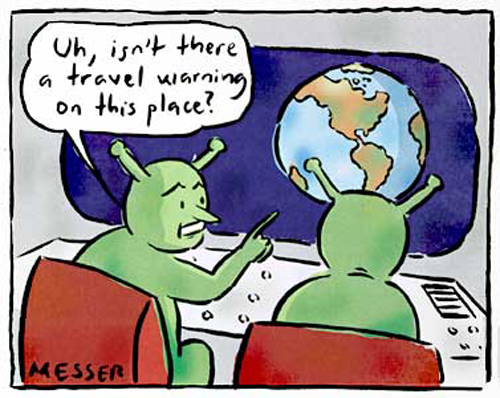
travel warningBefore heading to the Caribbean for world-class big game fishing in Honduras or beautiful beaches in El Salvador, did you check the State Department Travel Warnings? You should.

Both Honduras and El Salvador are much more dangerous than, say, Mexico, according to the State Department. And at last, I agree.

Nineteen African countries are on the U.S. State Department travel warning list. That’s more than half of the 35 countries listed worldwide and a third of all the countries on the African continent. Is this fair?

Yes, it is. And it’s just as “right-on” as last week’s French government warnings to its citizens cautioning them about travel to a number of U.S. cities including Chicago, New York and Washington, D.C., and seven others. I’m not being sarcastic.

For many years I felt that government travel warnings were not fair. In fact, I felt that the warnings by countries like France and the U.S. were sometimes 180 degrees wrong: I fumed, for example, when Kenya was put on the list after a single tourist incident, but Egypt wasn’t after dozens of tourists were killed.

France warned its citizens about travel to South Africa, but said nothing about Haiti, where tourism strife was much greater.

Warnings existed from many countries on travel to Ethiopia, for example, long after conflict had ended. But few warnings were levied on Israel, where bombs were reigning weekly on border areas with Gaza.

It seemed that travel warnings were something other than nice advice for vacationers.

Until the last few years, travel advisories were often political tools used to pressure foreign countries into some policy. Or probably just as likely in the case of the U.S. in particular, the reflection of poorly trained state department officials.

But things have changed, worldwide. Most countries seem to be getting it right.

Slowly and surely under the Obama administration U.S. travel advisories have become imminently fair in my opinion. Under Hillary the professionalism of the State Department took a giant’s step forward from past years. I now regularly refer to the State Department website. We’ve become fair.

As have the French, and that’s an important thing to consider when you decide how much an advisory will effect your own travel.

So when Chicago mayor Rahm Emanuel cut his bitter retort short to the French move with the rude but oblique remark
, “Don’t get me started on the French,” he was tacitly accepted the criticism.

Kenya in particular has been lobbying recently to get the U.S. warning lifted.

That’s not going to happen. The Obama administration has put Israel on the list, as it should be. And so neither Kenya nor Israel will be removed from the list until tensions are reduced there, and from my point of view, that means until they leave the neighboring territories that they occupy.

This is not a political statement, although I realize it could be viewed as one. But Kenya continues to occupy parts of Somalia, as Israel occupies parts of Palestine. The terrorism this spawns is undeniable. Until Kenya and Israel leave the territories they occupy, real danger persists inside their own countries.

Of course there’s more to it when you begin to consider your own travel. While Israel and Kenya may be in very similar situations, Israel is much more capable of managing terrorism than Kenya. Tourists have not been recently harmed in Israel; they have in Kenya.

The French are warning their citizens of traveling to parts of ten of the U.S. major cities because of violent crime. That crime is localized, even in the big rural cities. So if you know where to go and where not to go, your vacation should be safe.

And therein lies the problem for all of us. Knowing where it’s OK and where it’s not. The more foreign the destination is to you, the less you probably you know. The more important your vacation is for you, the less you want to worry about it.

Even the most educationally structured holiday is still supposed to be rest and relaxation. With the great variety of travel options available, today, why “tempt fate?”

If the top of your wish list is to see the great migration and you can only travel during our fall, then there’s only one place you can go to achieve that goal: Kenya. With careful planning, the risks attending a Kenyan visit that are concentrated in certain places in the country and its cities, can be avoided.

Similarly, France is not telling its citizens to not travel to Chicago. It’s telling them to not travel in areas of the city that have a mind-blowing number of homicides.

As Chicago’s Sun-Time newspaper said Saturday, “The French are right.”

Just the Keys to His House

Just the Keys to His House

AminAndSonIn the dark and dangerous hole that Ugandan dictator Museveni has cut out of his country, a new face has emerged to challenge him: the son of Idi Amin.

Yesterday, Hussein Juruga Lumumba, announced his candidacy to become Uganda’s next dictator.

Well, not exactly. What he did was write an open letter to the current dictator, Yoweri Museveni, published in the country’s main newspaper as a lead news story, requesting the Ugandan dictator to return to him the homes and other properties confiscated from his father.

Seemingly benign enough, in the feudal Shakespearean politics of otherwise modern Uganda this is better than Ted Cruz spending a weekend in Iowa.

It appears to be the only letter ever written the current dictator, although anyone else who tried this would likely never write, again.

Let’s stipulate a few things quickly, first.

Uganda would be better without any dictator. Kenya has demonstrated that freed from oppressive politics, a country can bloom, grow incredibly fast, and truly become both an economic and cultural powerhouse for modern Africa.

Ugandans were just as well educated, maybe better than Kenyans. They were the colonial favorite of Britain (that considered Kenya a simple stepping-stone to Uganda), and in the short few years of independence before Uganda slipped into its endless dictators’ cycle, it was forging well ahead of Kenya.

And even during the rest of my lifetime in Africa, even when under the repeated oppressions of horrible leaders, Ugandans wrestled up some wonderful accomplishments, including vanguard research and implementation of many public health initiatives including malaria control.

All that keeps Uganda down is its love affair with dictators.

No credible representative leader has ever made it to any of the top echelons of Ugandan government. Rife with ethnic divides (but so is Kenya), shackled with an urban population that still reveres an ancient monarchy, Uganda just can’t break the habit of being oppressed.

My wife and I lived for two years on the Kenyan/Ugandan border during the height of Amin’s terror. The fear that every sane person felt, no matter how secure they might have been inside Kenya, was horrible.

The two weeks that we spent driving from one end of Uganda to the other during Amin’s regime might have been one of the most foolish things two 25-year olds had ever done. But what we saw and heard and experienced became fundamental to my understanding of Africa thereafter, that the continent’s enormous potential was hamstrung by its inability to shake paganism.

And now, forty years later, it comes back to haunt that poor country.

Times have changed. Hussein Juruga dresses nicely, writes and speaks with the fluency of a privileged child educated in both France and Britain. And lacking any actual job, he lists his occupation as “politician” in his blog.

His resume includes being a “media consultant.” And while it’s difficult to find many in Uganda willing to write Op Eds in the country’s newspapers, Juruga often waxes eloquently therein on the modern media, espousing greater freedoms.

Sounds pretty right on, no? And the country’s main newspaper, arguably the mouthpiece for the current dictator, gives him a glowing recommendation
as a former employee.

But dig into his prolific blog, and you find that’s he’s homophobic and dangerously militaristic, and he avoids ever discussing other current challenges to the current dictator, except his own.

Kizza Besigye and Erias Lukwago, for instance, are the two most prominent dissidents in Uganda and fairly well known outside the country. But Juruga hasn’t mentioned either of them, ever.

But the overriding evidence of Juruga’s intentions is the bone-chilling defense he constantly mounts for his father.

Claiming that all the bad stuff attributed to his father is rumor mongering, Juruga insists the smear campaign “is peddled mostly by individuals who want to access political support and for others to try and maintain political relevance today.”

He argues that it was actually the Tanzanians (whose army ultimately deposed Amin) — not his father — that caused the most misery and destruction in the country.

He admits threatening Giles Foden, the author of The Last King Of Scotland, with a libel suit.

He may be more polished than his father. His power is indisputable, given the public nature of his rages within Uganda’s current clamp on media freedom.

And a simple change, it seems, is all that he wants: Just give him the keys to his house.

Dēmos Gravitas In Spades

Dēmos Gravitas In Spades

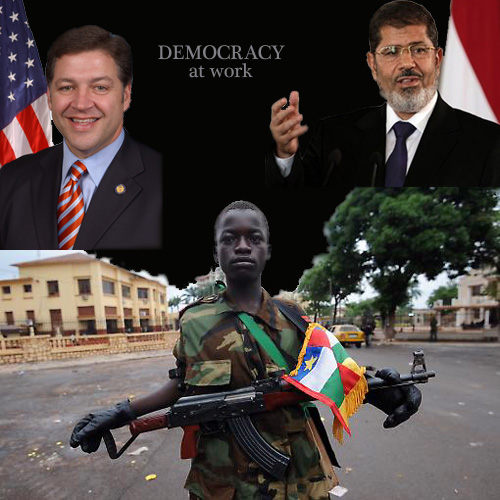
USEgyptCARfailing democracyThe trial of deposed Egyptian president Morsi, the bloodbath looming in the Central African Republic (CAR) and the new tribulations of Pennsylvania Congressman Shuster are all linked by the power and failure of democracy.

I’m not giving up on democracy, yet. But it needs some work. Here are the facts:

EGYPT
If ever there was a “Show Trial” in our lifetime it began today in Egypt, where the deposed president Mohamed Morsi is charged with murder. He and his co-defendants were defiant, shouting until their voices were hoarse. The trial, which carries the death penalty, next convenes on January 8.

CAR
The country of 5 million in the middle of Africa will likely soon be the world’s next site of major genocide. NPR, the BBC and others interviewing UN staff in the country report today that genocide is imminent.

PENNSYLVANIA
Seven term Congressman and committee chair, Bill Shuster, a man about as conservative as you can get, faces a credible challenge from a Pennsylvania T-Party right-winger for having voted to end the government shutdown.

My take on the three ongoing events:

EGYPT: I’m glad Morsi was deposed by the military. He was destroying everything progressive in Egyptian society, defying the constitution including the judiciary, and essentially wrecking vengeance on a society for the long oppressed Muslim Brotherhood of which he was an important leader.

He had not yet quite started “rounding up the Christians” as former military leaders including Mubarak did to Muslims like himself, but he moved modern Egyptian society radically backwards, away from representative governance towards a dictatorship of Muslims that was polarizing society and aggravating the Christian/Muslim cleavage in society.

There was no mechanism in Egypt to get rid of a bad president, and that is the mantra used by progressives in Egypt today to justify the military coup. The irony, of course, is that had there been such a mechanism, Morsi would have prevailed over it since the fairly elected majority of the country and their elected representatives would never have voted to convict.

From far away, though, I feel the generals are going too far. They do not seem to believe that any compromise with the Muslim Brotherhood is possible, and that bodes very badly for the future of Egyptian stability.

CAR: What is happening, today, and going to happen in far worse measure very soon in the CAR is a failure of global institutions precisely because global institutions can’t navigate well the growing enmity between Christians and Muslims.

Note with great importance that in such a deep part of Africa, “Muslim/Christian” is actually a misnomer for any conflict. The ethnic divides, which are at the root of the conflict, existed long before Islam was born and perhaps before Christianity was born.

And as in Rwanda, all these various ethnic groups have lived together and intermarried and even shared languages for generations.

The Banda, Hausa, Fulfulde, Runga and similar ethnic groups in the north of the country, consider themselves “Muslim” especially in the current conflict. This is true even though practicing Muslims of the sort that pray regularly towards Mecca are rare. Many of these tribe were pretty undeveloped, remote jungle villages.

Almost all the rest of the ethnic groups are “Christian,” and they roughly occupy the south of the country and represent about two-thirds of the overall population including the only legitimate city and capital of Bangui. But they have no military support. The French long ago abandoned them.

The Muslims have no state support, either. But as the Obama/Holande alliance to crush al-Qaeda and its affiliates in Africa succeeds, the CAR is where the last guns, missile launchers, grenades and IUDs get dumped, and they are being dumped by fugitive Muslims on those in the CAR who call themselves native Muslims. So the one side is armed, and the other isn’t.

And the way it looks right now, nobody really cares. It seems the general consensus in the world is to just let everyone in the CAR destroy themselves. The UN Special Representative on Genocide said over the weekend, “We are seeing armed groups killing people under the guise of their religion…and decisively I will not exclude the possibility of a genocide occurring.”

PENNSYLVANIA:
Rep. Bill Shuster, like the father before him, represents a very rural part of southern Pennsylvania. Like so many other nonurban areas in America, it has not done well over my lifetime.

Median income has fallen, traditional life ways like independent farming have declined, even health statistics are worse than they were. In a nutshell, a father can no longer presume anything except that his children will be worse off than he was.

The reason for this is clear to me: a redistribution of wealth to the top of the pyramid. A cluster of power at the top oppresses those below with feudal outcomes like Walmart and phony mortgages followed by foreclosures.

But armed with money, the forces in power manipulate these folks to such a degree that they work constantly against their own self-interest. The most poignant example is how school referendum after school referendum is defeated.

Education is compromised to the point that no one in southern rural Pennsylvania has a clue as to why they’re more miserable than their folks. So…

… they blame the government. Add a pinch of “it couldn’t get worse than it already is” and a rather healthy American dose of revolution, and why not just close the government down?

All three of these examples are outcomes of failed democracy. Because all three situations are the result of democratic institutions paving their paths.

Egypt is clear. It was truly a fair and free election that brought Morsi to power.

In the CAR, which suffered ethnic conflict short of genocide for centuries, ethnic conflict is now oiled by the democratic processes of the west that permit if not encourage the sale of arms, by the “democratic choice” of Presidents Obama and Hollande to allow the CAR to be the “fire that burns out,” and the democratic (if highly filibustered) UN Security Council that has decided this spot on the world isn’t worth saving.

And in Pennsylvania it is people manifesting power in such a way that it returns to oppress them.

In each case, the value of self-determination turns against itself and democracy ends up destroying itself. Self-interest is compromised not for the betterment of the whole, but to destroy self-interest.

As I said, I’m not abandoning democracy. But someone with a really good stethoscope needs to take a look at it.

We Need Shrinks not Generals

We Need Shrinks not Generals

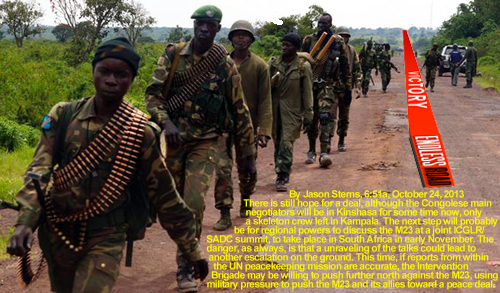
CongoMarchUnder the noise of Snowden, dysfunction of Congress, frantic media and lackluster personality of Obama, the War Against Terrorism is being massively ratcheted up in Africa.

The French Foreign Legion was dispatched last week to the remote deserts of Mali, to support a freely elected government that is being newly challenged by rebel groups in its most outlying cities.

Crack South African troops added to increased United Nations peacekeeping forces and ruthless Congolese government troops newly armed by the west, have been crushing the last of the known rebel groups in the eastern Congo, an area of conflict for nearly a half century.

How’s it going?

Hard. The unspoken but terribly obvious Hollande/Obama alliance to make Africa the last great military battleground against organized terrorism began five years ago in Somalia. American advisers were everywhere in northern Kenya and the port of Mombasa, and French warships were just off the coast of Somalia.

Drones were added and the war begun. Kenya was enlisted as the visible front army and Somalia was “liberated.” Its al-Qaeda affiliates were scattered and what was left of anything organized raced through Uganda into the center of the continent.

The world watched 90 U.S. soldiers chase them across the Uganda.

But Hollande and Obama miscalculated the arsenal of weapons that liberated Libya would make available, and scattered groups in Mali benefited enormously. France’s end-game mission to America’s chasing of the rebels into the center of the continent was to crush them in the Central African Republic (CAR).

But instead, it had to focus on Mali, far northwest of the CAR. So today the CAR is essentially anarchistic. A report published this morning by Amnesty International describes the CAR in the most horrific, barbaric terms. Every civilized person seems to have abandoned the country, making it ripe for organized terrorist control.

Hardly two years ago the focus of visible battles between the west and its proxies, and al-Qaeda and its proxies was in Somalia. Only a few months ago it reemerged in Mali where it persists. And the riffraff, disparate, heavily armed leftovers of a dozen so-called al-Qaeda affiliates or older rebel groups (like the LRA) are now duking it out like barbarians in the CAR.

You cannot eliminate terrorism, Mr. & Monsieur President.

You cannot eliminate unless you had global gun control the likes of which evades my most fanciful dreams. Where there are weapons and the materials for making them, there will be terrorism.

The question is, Are We Safer Now?

Before I give you my opinion, don’t you think it’s important to also ask, Is Africa Safer Now? What right does the west presume in order to use Africa as the backforty into which the wolves are chased and kept at bay?

If the world ever runs out of weapons, we’ll be forced to deal with conflicting ideologies, as well as crazy terrorists, in ways we should develop, now.

Modern force is so omnipresent, as easily mastered by an internet keyboard, that it can’t possibly end conflict, today. It will only interrupt or delay it.

Consider this, first. The conflict in the DRC’s Kivu Province is a half century old. It’s based largely on the same ethnic divisions that caused the Rwandan genocide. Those divisions are festering. The calm in Rwanda is the calm of a benevolent strongman. Once his biceps snap, all hell is going to break loose.

Consider this, second. Organized terrorism is fanatical. Unlike ethnic conflict, terrorism may have no other explanation except the obsession to rule and control.

Both turn men into beasts eager to die – to kill themselves – for reasons they don’t wholly understand. Hypnotic or simply psychotic.

You can’t get them all. We don’t need any more generals. We need shrinks.

Beating The Wrap

Beating The Wrap

beating the wrapWhile the trial of Kenya’s Vice President in The Hague continues it’s increasingly difficult to believe that Kenya’s President will actually show up for his trial on November 9.

The future of the International Criminal Court hangs in the balance, and it’s a bum wrap for a good global institution based on noble ideas.

But western powers are lobbying that the trial of Uhuru Kenyatta, Kenya’s President, either be postponed or that Kenyatta be excused from the proceedings in The Hague, because of the national crisis that followed the Westgate Mall attack.

Pressure particularly from the U.S. seems to be winning the day, and if Kenyatta does attend, it may be only briefly for the opening session. The world’s obsession with security trumps everything, and it seems this simple equation is that “crimes against humanity” are less important or severe than terrorism.

Over the weekend a BBC analyst put it this way:

“Many experts in international law believe that his case reflects the apparently incompatible demands of historical restorative justice versus future global security.”

Those of us who believe – and there are many if not a vast majority of Kenyans – that Kenyatta and Ruto are, in fact, guilty as accused, are not getting much support from the ongoing process of the ICC.

The trial hasn’t gone well for the prosecution. Many witnesses have been dropped, and of the first half dozen on the stand, there were flip-flops and easily rebutted innuendos.

It just hasn’t seemed a very tight prosecution. Moreover, so far all the evidence has been circumstantial. Ruto has been implicated in lots of hocus pocos similar to Free Masonry or other quasi secret organizations. He’s been implicated in funding groups of known thugs and referenced as giving a pass or nodding to illegal actions.

But no witness has accused him of killing anyone or of specifically telling anyone else to kill anyone.

The reason so many mobsters in the U.S. ultimately went to jail was for tax evasion, a strange wrap for murder. But it’s unlikely that the Capones, Genoveses or Salermos would ever have been convicted of crimes against humanity.

The fact of the matter is that Uhuru Kenyatta has probably less blood on his hands than Dick Cheney, or a bunch of top American politicians long since dead and forgotten.

That shouldn’t be a reason for Kenyatta getting pass, it should be a reason for trying Ronald Reagan rather than letting Oliver North go to jail for him.

The World Court is a magnificent idea. And the handful of people it has so far tried and jailed include some of the worst monsters in modern history. But none of them were nationally elected to lead the countries they were accused of previously destroying.

I’m convinced that Ruto and Kenyatta are culpable of the crimes they’re accused of. But The Court has so far not presented an air-tight case, the west (not much less Kenya itself) is now newly worried about terrorism in Kenya, and I’m just not sure that the people of Kenya would not rather have these two men as leaders than jailed criminals.

I’m not saying the country has forgiven them, because it’s still deeply split tribally and socially. But where Kenyans do seem to have come together is that the election process should be considered paramount, even more important than the judicial process.

Kenyatta and Ruto were fairly elected although the contest was phenomenally close. But the country truly seems, from all sides of the aisle, to be rallying around that concept that the election was fair.

And if criminals have been duly elected, they should duly rule. And no one presumes this can be done from a jail.

It’s been true of not but a few of our own top politicians.

BACKGROUND
Kenyatta, Kenya’s president, and its VP William Ruto, have been charged with crimes against humanity by the World Court in The Hague. Ruto’s trial is ongoing. Kenyatta’s is scheduled to begin in two weeks.

Before they won Kenya’s presidential election last March, they were powerful men within political parties that were closely linked to various tribes. When Kenyatta’s party lost the election to Ruto’s party in 2007, horrible violence broke out throughout Kenya.

About 1300 people were killed, some brutally, and anywhere from 180-250,000 people displaced. Many of these displaced persons remain in state-run camps, today.

The peace treaty brokered by the U.S., the U.K. and Kofi Annan worked magnificently and included a provision that the perpetrators of the violence be named and tried.

The Kenyan Parliament, unable to agree on a process for trials, asked the World Court in The Hague to undertake the trials, which is now happening.

Meanwhile, the two arch enemies formed a political alliance and won the election.

Halloween is Early

Halloween is Early

Halloween is EarlyFew commented on Swaziland’s serious law banning flying witches in May, but this week a Zimbabwean newspaper took up the issue as an editorial.

Don’t laugh.

Swazis believe in witches, and the misaligned hill of a country, surrounded by South Africa and still ruled by a monarch, has been neglected by the world and this is the result. Zimbabwe, on the other hand, has had almost as much global attention as climate change, so what’s going on?

First, the facts. Swaziland has one airport, Manzini, at its capital, and until the end of apartheid it was something like an Indian reservation is in the U.S. With unregulated casinos and call-girls, the morally strapped South African used Swazi as an erotic escape.

With the collapse of apartheid in the mid 1990s together with many of its morally constrictive laws, Swazi’s popularity descended rapidly. One could argue it started to reverse itself altogether and revert to the precolonial period.

Recently, South Africa bailed out Swaziland the same way the U.S. bailed out Chase. The country is riddled with scandal and corruption and ruled by a highfalutin king who may, in fact, never be on earth any more than the witches that apparently beset his sovereign land.

The May law goes much further than just banning witches from flying higher than 150 meters above the ground. It also bans toy helicopters and kites. This because a wicked activist protesting the king’s behavior, Hunter Shongwe, was caught with a toy helicopter that had a video camera on it. Drone.

Zimbabwe, on the other hand, has so many awful problems of its own, why would it descend into the unprovable abstract? Exactly. An “editorial” in Zimbabwe is capable of getting its writer hanged or tortured, and there’s just so many things you can say pleasantly about one of Africa’s most ruthless dictators of all time.

So Zimbabwe Standard editorial writer, Leo Igwe, produced this earth shattering opinion that “we should disabuse ourselves of belief in flying witches” and castigated neighbor Swaziland for ”embarrassing” itself.

“Embracing superstitions should call into question a people’s mental state and cause others to question their claim to rationality. Making superstitious claims should reinforce the idea that some human beings are backward, trapped in the pre-modern age and still down the ladder of human civilization, in an unenlightened state.”

Talk about the pot calling the kettle black.

Forgive me, but this got me thinking. You can’t prove there aren’t witches. Well, actually, you sort of can. By aeons of no proof of a flying witch, it’s reasonable to deduce that there aren’t any.

Similarly, by repeated attempts from the American Right to suggest the economy grows by trickle-down economics and then it doesn’t, you can also surmise it won’t work if tried, again.

But Swazis clinging to their superstitions because they haven’t been definitively disproved, and Republicans believing they will create jobs by strangling the government, are ideas grasped by poorly educated folks with an imagination as big as a pea.

And yet it continues. So much so that the Zimbabwes in the world, like the Peter Kings in the Republican Party, decry such foolery to deflect attention from their own short comings.

Witches won’t crash. Economies crash.

Revealing the Terrible Truth

Revealing the Terrible Truth

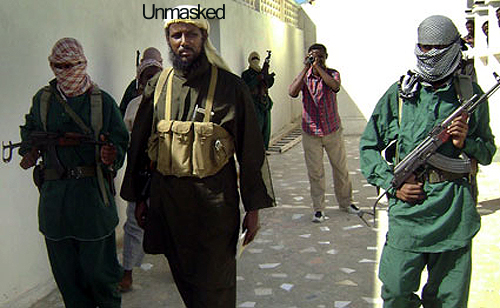
ShabaabfightersThis past weekend’s Navy Seal operations in Libya and Somalia mark a turning point in the Obama Administration’s successes against terrorism in the U.S: the Somali raid in particular has made America more vulnerable now to terrorism.

I’ve not been a particular fan of the five years of growing American military involvement in Africa, but as I’ve written my judgment was suspended because it seemed to be working … for America. It was definitely not working for Africa.

The Westgate Mall attack, and a year before an even great attack on a bar in Kampala, were all announced revenge attacks for military successes ostensibly achieved by Kenya and Ugandan armies.

They were more fundamentally military actions by France and the United States, using Ugandans and Kenyans as their proxies. That fact alone is disturbing. It’s a bitter return to Cold War mentalities on how to resolve conflicts.

But the covert operations, in spite of lots of good professional journalism that unmasked the French and American involvement, seemed to be making America safer as Obama systematically took out his enemies one by one through drones and targeted battles.

But last weekend’s operations, intentionally or not, have been brought into the front of the public conscience, in both the U.S. and Somalia. Five years of covert action seem to be over. It’s now admitted and explained, with scant regards for the sovereignty of African nations.

The New York Times detailed explanation of the Barawe attack followed by the BBC report of the Liby capture mean that either the Obama Administration is no longer capable of keeping a secret, or that journalistic interest has just become too intense.

Either way, the cat is truly out of the bag, now. No longer covert, in my opinion, hardens the terrorists’ resolve and challenges them for a response.

It’s academic whether this change is a result of sequester stressed by a government shutdown, or more conspiratorially an attempt to deflect criticism of Obama in general at a critical time for American politics, or just plain journalism finally catching up with public interest.

You see I don’t believe terrorists are all that aware, so to speak. I don’t think they’re news junkies like us or have any more of a sense of geography of America than Americans do of Africa. I believe, for example, that the Nairobi airport fire was definitely an act of botched terrorism, and that likely most acts terrorists attempt are botched and never heard of.

In part this is because of the West’s increased security, but it’s also because the main terrorist organizations are falling apart.

There is little left of al-Qaeda or al-Shabaab. As we saw several weeks ago in Nairobi that doesn’t mean there won’t be more dramatic terrorist events. It just means that it’s less likely, and unlikely that such events will further the power goals of their organizers.

This will be particularly true if like the Kenyans it’s understood that a response of the sort American organized after 9/11 is counterproductive. And I think most of the world, maybe even America, gets that now.

Terrorists today are unorganized. We’ve learned how transnational they are. We’ve discovered that many are truly deranged and that political or religious aspirations are no longer their principal motivating forces.

That’s why I can’t understand the change from covert to overt action.

The terrorists and their local supporters were as shielded from the truth of American involvement as Americans were. There was less of a chance when operations remained covert that any response would be against America.

But we’ve taken off our boxing gloves and mask. We’ve invited them to fight.

I still think their remaining reach is far more limited than it was before 9/11, for many good and for many bad reasons. But my judgment is no longer suspended about America’s militaristic involvement. I don’t think there’s a possibility of a net good from the type of operations which concluded last weekend in Africa.

No Big Deal … Yet

No Big Deal … Yet

no big dealWhat Africans realize better than Americans is that for the last several years America has had to be run almost like an African dictatorship, as Congress closed itself down.

As a result, most of Africa shrugged off the U.S. government slowdown, today, not considering it very important to world affairs or economies. Still trusting in President Obama.

African newspapers and blogs were replete with excellent reporting filed mostly by Reuters and Agence France Presse. Both services specified all the areas where the slowdown will apply, and very little seems to impact Africa or abroad.

For example, a major concern was the processing of U.S. visas, and that will not be curtailed, since the White House has named foreign embassies and consultants as vital services.

Much of Africa’s media has pointed out how Obama like a beneficial African dictator simply declared most foreign services essential, so they aren’t effected.

The Federal Reserve and most foreign aid agencies will stay open.

Financial markets in India and most of Asia, as well as the U.K. also shrugged off the slowdown.

Only currency and commodity markets seemed to react in Africa, and they actually reacted well.

The ailing South African Rand firmed slightly and the price oil dropped slightly.

South Africa, which is so dependent upon the gold price, seemed to think gold would continue a slow recovery in price after tanking several weeks ago.

So what’s the big deal?

“Just to warn you… we will see yet another deadline on 17 October,” reports the influential FSP Invest from South Africa. The author also said South African markets “generally follow global markets” which will depend on U.S. news, especially this week’s non-farm payroll numbers the government (if the spokesman comes to work) announces Friday.

With Congress in virtual paralysis for some time, the U.S. economy has been driven mostly by fundamentals in place and Obama’s presidential directives that he’s been forced to use.

His recent Presidential Policy Directive (PPD) directed towards Africa to build trade has worked well. This would normally have been a part of legislated trade legislation, but with Congress in paralysis, Obama moved alone.

“More trade between Africa and the U.S.” was the recent headline in South Africa’s online “fin24″ financial newspaper.

Supported by recent figures released by the IMF, the head of DHL in South Africa attributed the increased trade to Obama’s PPD.

Of course, everyone knows it shouldn’t be this way. Or rather, this is the way African dictators work, authoritarian rulers that don’t have democratically elected governments.

Like us?

Child of 9/11

Child of 9/11

fu“While these terrorists have visited unbelievable savagery on us, we must collectively avoid the temptation towards unthinking revenge, the path the US took after 9/11.”

Those remarks published this morning in Nairobi actually made me reflect on our own looming national crises coming up this midnight and again and again right through the end of the year.

The American Right’s paths since 9/11 have been terribly “unthinking,” reflexive and self-destructive to be sure, but also a great misery for us all.

I began to wonder if the stew we’re in right now in America really has its roots in the bad policies which came out of 9/11, and if Kenya will avoid that same destructive path.

Both societies had regular terrorist attacks before these great ones. Kenya, in fact, has suffered as many deaths and injuries as Westgate from nearly three terrorist attacks monthly in the last two years, and more in the single 1998 bombing of the American embassy. American had an almost regular series of attacks starting all the way back to the Achille Lauro and Pan Am 103.

But like 9/11, Westgate was different. The difference with 9/11 in America was its scale. The difference with Westgate was its savagery:

“The killing of young children in cold blood, and the reported acts of torture constitute a new level of barbarity with which terrorism [in Kenya] is usually not associated,” George Kegoro reflected today in Nairobi.

The American Congress made historic, incorrect decisions in the 15 years since 9/11. The loss of national resources wasted in useless wars, and the diversion of attention to our own needs at home combined to produce a vengeful, angry, hard-nosed and “unthinking” America.

And so we arrive at today, where legislators don’t legislate and politicians defined by the political system want to shut it down. They want to eliminate themselves and replace it with nothing.

Like some child incapable of saying, “Sorry,” they lash out at everything.

Self-destruction supreme. Are we punishing ourselves with all the misdeeds of the last one and half decades?

Don’t follow us, Kenya. So far it looks like you won’t.

In fact, lead this angry child into something better. Please.

The Trials Begin

The Trials Begin

TrialBeginsThe opening day in the trial of Kenya’s Deputy President, William Ruto, lifted the curtains from a gruesome, planned ethnic genocide that he allegedly orchestrated with the precision of an all-out war, including purchases of weapons from Uganda and The Sudan.

Accused of “enlisting political collaborators, former military friends, elders and media allies to commit crimes against humanity,” ICC Prosecutor Ms. Fatou Bensouda said she will call 22 witnesses.

Ruto is being tried simultaneously with Joshua Arap Sang, a radio broadcaster, who is specifically accused of using the radio station KASS-FM to mobilize ethnic forces when requested by Ruto.

“The prosecution alleges that the accused William Samoei Ruto and Joshua arap Sang intentionally exploited to their own advantage these deep-seated political, ethnic, social and economic issues during the 2007 electoral campaign.”

The 64-page indictment is a gruesome, detailed description of backdoor meetings, careful organization of weapons and money, and the meticulous assembly of a chain of command the prosecution is now calling “The Network.” Ruto was the alleged head of The Network.

Former ministers in the civilian government, former Army and police generals and commanders, district commissioners and even local youth leaders were all carefully organized into a chain of command with the sole intention of eliminating “unwanted communities,” in particular, the Kikuyu.

The Network was organized well in advance of the 2007/2008 election and would go into action, according to the ICC prosecution, if the election were lost by Ruto. Ruto was part of a coalition of western Kenyan tribes including the Kalenjin and Luo, contesting the reelection of Mwai Kibaki, who was a member of the country’s largest tribe, the Kikuyu.

As I explained yesterday, the Kikuyu and Luo and Kalenjin were historical blood enemies. Also as I’ve written earlier, the ethnic division over many years adopted social and economic characteristics, just as Northern Ireland became Catholic and poor and southern Ireland was protestant and rich; or as Christian Serbs in Bosnia were far better off than Muslims, there.

So the ostensible election of 2007 was almost quintessentially typical of the modern era: the poor, socialists, redistribute-the-wealth group versus the established, rich, capitalists already in power.

Yesterday’s first day of the Ruto trial did make real news. The ICC prosecutor backed off her public suggestions that Ruto explicitly was involved in the ethnic cleansing and painted him more as the backroom organizer, using Kalenjin proverbs and winks of the eye to order attacks.

That is a serious blow to the prosecution in this world court where proof of guilt is a much higher bar to attain than in most other sovereign courts around the world.

The only judgment issued by the Court yesterday was that the other trial of Kenya’s President, Uhuru Kenyatta, will be held on alternating four-week periods with this one, so that the sovereign nation of Kenya is never without a leader.

Remarkable.

And as you’ve guessed, Kenyatta’s trial will be very similar to Ruto’s. The two, now serving together as Kenya’s chief executives, are accused of trying to eliminate each other through ethnic cleansing.

Talk about Team of Rivals…

But at long last things are beginning to make sense, in the extraordinary Kenyan way that makes Shakespearean dramas look like third grade fairy tales.

Presuming Kenyatta’s strategy is similar to Ruto’s, the accused really believe they will prevail as not guilty. And with the ICC backing off the contention they gave explicit orders, for the first time in public, that seems possible.

And if that comes to pass, and if the two leaders of the historical arch enemies that wanted to kill each other, raise a modern Kenya from the ashes, what does that mean?

That like Obama threatening to bomb Syria was all that was needed to eliminate its chemical weapons, that trying to put the two Kenyan leaders in the clinker for the rest of their lives for trying to kill each other makes them friendly nation builders?

How good are these bad guys? Are miracles real?

“Miracles are a retelling in small letters of the very same story which is written across the whole world in letters too large for some of us to see.” – C. S. Lewis

And Now! Live! From The Hague!!!

And Now! Live! From The Hague!!!

CastofStarsIf you were riveted by the O.J. Simpson trial, you’ll want to adjust your cable contract to get NTV-Kenya: “Tomorrow! Live! The World Trial of Kenya’s sitting President and Vice President for Crimes Against Humanity!”

This doesn’t sound real. Neither Steven Spielberg or William Shakespeare could have concocted this one. This isn’t like a revolutionary tribunal. It isn’t Madame DeFarge and her fellow citizen hookers watching the old king hanged.

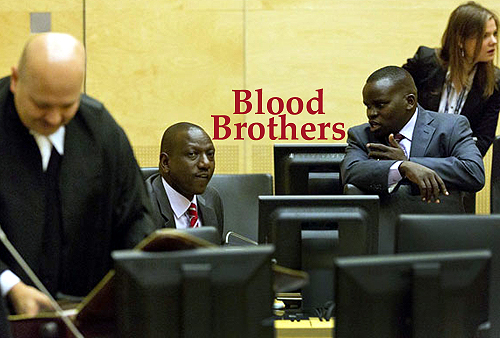
William Ruto, the Deputy (Vice) President of Kenya, flew to The Netherlands yesterday … with, by the way, 100 elected members of the current Kenyan Parliament … to stand trial in The Hague’s International Criminal Court (ICC) which the country of Kenya agrees has the authority to imprison those the ICC finds guilty for up to life.

The President of Kenya, Uhuru Kenyatta, will begin his trial on November 12.

Oh, and by the way, the crux of the charges against Ruto was that he tried to kill Kenyatta’s supporters, and the crux of the charges against Kenyatta is that he tried to kill Ruto’s supporters.

The ICC initially was going to try them (and 4 others) all at the same time, but accommodated a Kenyan request that the country’s two top leaders ought not be out of the country at the same time.

How civil.

The bill to the Kenyan government for participating in this ultimate fiasco is astronomical by Kenyan standards. Just consider today’s expense report: Imagine George Bush flying back and forth in Air Force One (and probably Air Force Two to bring Republican Senators and Congressmen) to Amsterdam to allow himself to answer unpressed indictments by the ICC regarding his War in Iraq.

I thought a review of why we’re here might help you.

The court in question is the World Court, the ICC. Americans don’t know much about it, because America refuses to participate:

THE COURT
As of May 2013, 122 states are parties to the ICC, including all of South America, nearly all of Europe, most of Oceania and roughly half of Africa. Another 31 countries, including Russia, have signed but not ratified the treaty.

The progenitors of the ICC originated more than a century ago and include the Red Cross, when the world tried (and failed) to prosecute those responsible for the Franco-Russian War of 1872. The idea was reborn after World War I and then, again, after World War II. The Nuremberg trials finally prompted the United Nations to embrace the idea.

But having studied it endlessly and virtually created it, the UN was stymied
from setting up The Court by the politics of the Cold War.

In June, 1989, in response to worldwide drug trafficking and the imminent Bosnian War, the world more or less (including no America) got together and formed the court as an entity separate from the UN.

So even without America, China and full Russian participation, the Court has grown to represent world justice. Its famous trials include the wicked men of Bosnia, Liberia and Rwanda. These managers of genocide are now behind bars in Holland.

HOW DID KENYA GET THERE?
The democratic election in Kenya at the end of 2007 was miserably mishandled, almost certainly fraudulent and whatever else, too close to call. It was, however, the first truly free election Kenya had ever had, because the two main contestants for the Presidency were so far apart ideologically.

One was for the poor and socialist. One was for the rich and capitalist. And …

…one was from the country’s largest tribe, the Kikuyu; and the other from its second largest tribe, the Luo, who until that moment had basically spent all their history trying to massacre one another.

And so they did, again. This time with the extremely legitimate pretext of a major election gone awry. Within a month of the election, more than 1300 people had been killed but more importantly, in vicious videoed attacks that devolved into ethnic cleansing.

And even more important than that, really, more than a quarter million people were displaced.

The U.S., Britain and Kofi Annan put Kenya back together. Six months after the catastrophe, the two contestants were sharing power, and things were working out. In fact, they worked out so beautifully that Kenya’s then newly written constitution is really a model for modern governance.

Part of the all-party agreement that put the country back together was to determine who had fomented the violence and to prosecute them … in Kenya. It was almost an afterthought that added to the agreement that if Kenya couldn’t get it together to hold the trials, or to mount the investigation, that if Kenya wanted, the ICC would step in.

That’s what happened. Kenya couldn’t get it together. At first it just seemed like too herculean albeit too expensive a task. So the old Parliament that wrote the new constitution hemmed and hawed, debated and ignored, and finally defaulted to the ICC.

Which was really quite reluctant to take the case on. After all, as horrible as 2007/2008 was to every Kenyan, it was nowhere near as horrible as the cases the ICC had been hearing: like the Hutu massacre of 800,000 Watutsis.

The ICC did its work. Among those to be indicted were the leaders of Kenya’s biggest tribe, the capitalists, Uhuru Kenyatta, son of the founder of the country; and the leader of an influential smaller tribe hated by the Kikuyu and who had supported the socialists, the Kalenjin, William Ruto.

For organizing, financing and managing the slaughter of hundreds and attempted slaughter of hundreds of thousands.

Whoa. Embarrassing, to be sure. Kind of riled Kenyans of similar stripes. Parliament exploded but did nothing. Parliament considered giving immunity to these guys, but didn’t. The trials were set.

Then …

William Ruto and Uhuru Kenyatta filed to contest the election of 2012 after they’d been indicted.

Parliament choked. The Presidential Commission authorizing candidates didn’t know what to do. Parliament said do it. The two men indicted for crimes against humanity became candidates.

And then …

… these two murderous rivals combined to form a single party. The leader of the biggest tribe, Kenyatta, would stand for the presidency. The other guy, William Ruto and former arch enemy, would stand with him for the vice president.

And then …

… they won.

Tomorrow, I speculate on what the hell is going on, or, “How Good can a Bad Guy be?”

Don’t Forget Your Popcorn

Don’t Forget Your Popcorn

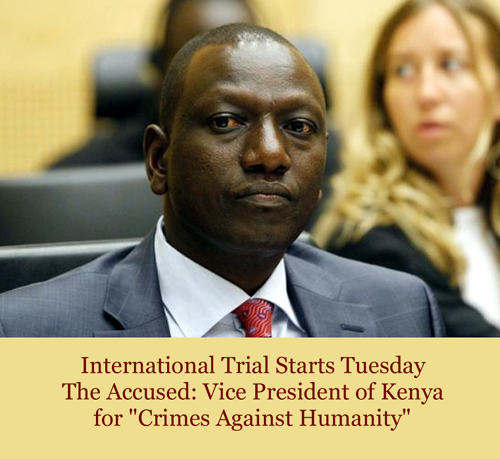
RUTOtrialBeginsTuesday the Vice President of Kenya personally stands on trial in The Hague for crimes against humanity. Two months later, the President will begin his trial, there.

William Ruto, the Deputy President of Kenya, will be accompanied by about 100 recently elected Members of Parliament who obviously support him.

It is, indeed, one of the most curious performances of achieving justice the world has ever seen. A Nairobi commentator put it this way this morning:

“Most international criminal tribunals have been set up as courts of victors to punish the losers,“ explains Luis Franceschi, Dean of Nairobi’s Strathmore Law School, citing the great trials that followed great wars and historic massacres.

This time in Kenya, though, “The accused [are] not past rulers or sitting presidents, but newly elected leaders. We are witnessing one of those uncommon ironies where democracy seems to clash with justice.”

Add to this complexity yesterday’s action by the Kenyan Parliament to withdraw from the International Court that is holding the trials, and you have the kind of governmental and political mess that has stymied Kenya for so long.

There’s more! The International Criminal Court (ICC) is an independent, global judiciary created and supported by 122 sovereign nations. Kenya is one of those. Proposed as a part of the remedial actions taken after World War II to try war criminals, it became a serious global justice tool after opposition to it by Soviet block allies ended with the end of the Cold War in 1989.

The U.S. is one of the few nations to have specifically rejected the Treaty of Rome which formed the ICC. The other two – you guessed it – are Russia and China.

Yesterday in Kenya’s Parliamentary debate, America was invoked time and again as a reason for Kenya to withdraw.

In a finely worded statement the U.S. issued after the Parliamentary debate, undoubtedly hoping no one would read it because of the Syria Crisis and G20 meeting, America urged Kenya “to fulfill its commitments to seek justice for the victims of the 2007-2008 post-election violence.”

This is a major step back from much more severe statements America made earlier, including “severe consequences” to Kenya if action like this were taken.

Kind of hard to tell Kenya to go to trial in The Hague when you intend to ignore your staunchest ally and the rest of the world that are telling you not to bomb Syria.

This is a mess.

It would have been a mess even if the U.S. hadn’t muddled its diplomacy in Kenya or its image abroad, but believe me, that isn’t helping.

There is every indication at the moment that Kenya’s duly elected and pretty popular top two leaders will stand trial in an international court. Last week technicians from Kenya were allowed into the court chambers to hi-tech wire it up, so that people in Kenya could have real time coverage and communications.

The charges against them and three others are that they were the principals in organizing and funding if not actually managing the terrible violence that followed the disputed 2007/08 elections.

More than 1300 people were killed, many horribly, but perhaps more significantly more than a quarter million displaced. The issue of “IDPs” (internally displaced persons) remains a contentious and difficult one in Kenya even today.

The Hague is conducting The Trial because it was asked to by the Kenyan Parliament.

Not the current Parliament. The current Parliament is entirely new, the first one under a wonderful new constitution adopted last year. But the old Parliament that was viced together by Kofi Annan and others who finally brought peace to the country by March, 2008, first accepted that it must hold trials, then wavered, then asked the ICC to take over.

The ICC did so reluctantly and laboriously. But once things got going, they became unstoppable.

Neither the accused current president or vice president held significant power in the coalition government that brought Kenya out of the cauldron of violence into the new light of a really good constitution.

Both were charged by the ICC as being among the main culprits before they even announced they were running for the leaders of the country created by the new constitution.

The old Parliament debated furiously whether as accused they should even be allowed to stand as candidates, and finally decided they could.

Meanwhile, the ICC was rounding up tons of evidence. It takes the ICC years to achieve enough evidence to bring someone to trial, and in this case they did so very quickly. Trial dates were set initially before Kenya’s presidential election.

But it became clear at that time that the two accused were also very popular in Kenya. Negotiations that kept the old Parliament on board with the ICC successfully pushed the trial dates until after the elections.

Then, the accused won by such a slim margin that Kenya’s newly constituted Supreme Court finally had to affirm the razor thin outcome.

As Uhuru Kenyatta, the current president, and William Ruto, the current vice president, solidified their power and control over the country, witnesses that the ICC had assembled for the trial began to withdraw.

Of an original 30 witnesses, there are today less than half that willing to testify. You can imagine why.

And to make this entire blog meaningless, the process of Kenya withdrawing from the Treaty of Rome that it signed fifteen years ago could not possibly conclude before these trials are over.

Sane minds in Kenya implored Parliament not to become “hysterical” and do what they did yesterday, accomplishing essentially nothing but making Kenya look odd at best, juvenile at worse.

I am absolutely fascinated at this whole process. Clearly, Kenyatta and Ruto if convicted are not going to jail. They’d go home, first, and then stay there.

So why go through the antics in the first place?

They believe they can prove innocence. I suppose we should remain open-minded about this. You know, innocent until proven guilty, and all that. And to be sure a guilty verdict in The Hague requires a lot more evidence and certainty than in a normal court.

It is, indeed possible, that despite all the evidence so far assembled against these two men, they could be found not guilty.

Even so, they’re bad guys. We don’t need an international court to sift through the volumes of news reports that have already convicted Kenyatta and Ruto in the international court of public opinion and I believe that judgment has been a fair one. Although the U.S.’ stand is losing credibility, there’s not a single European power willing to engage either of these leaders.

But in the duplicitous world of global power politics, a not guilty verdict from The Hague might make an appointment in Westminster easier to arrange.

Stay tuned.

Stop Elections

Stop Elections

stopelectionsSome may call it growing pains, but Kenyans are having second and third and fourth thoughts about their new constitution.

Invoking “Dream Week,” one of Kenya’s most read analysts wrote this week, “…many will also be thinking of a broken promise. The great new society we were to build has become mired in the same old, tired, dirty, backward politics driven by moneyed ethnic warlords with the support of stupid cheering and jeering masses.”

Amen, brother Macharia Gaitho.

We progressives are just incapable of understanding why everyone isn’t nice. So we build institutions and construct constitutions to promulgate niceness. We support regulations to prevent badness.

Our work is stellar, as is absolutely the case of the Kenyan constitution, and to be sure, the relatively new South African constitution.

Affirmative action is carved in stone until utopia can at least be imagined. Taxing is fabulously progressive. Housing is a guaranteed human right. (And need I mention health care?)

So what is everyone griping about?

“At present what we have is Senate not worth the name, one that would not be missed if it was abolished.”

Amen, Harry Reid.

“Arbitrarily plucking figures out of thin air will not properly address the issue of revenue sharing.”

Wasn’t it Rep. Bachman who claimed that 70% of food stamps funds goes to “salaries and pensions for the bureaucrats” when it is actually less than 5%?

And then her claim was rebroadcast by several Fox news commentators?

But despite the black and white nature of so many issues, today, “A quick and thoroughly unscientific survey tells me that the public right now is not that hungry for a political showdown,” Gaitho concludes.

As do I.

Especially when a new mideast war is right around the corner.

So “we are inured to betrayal, in fact we welcome it and revel in it going by the type of leaders we subject ourselves to.”

It’s a worldwide disease: voting against our self-interest then complaining with the result, either because we’ve been duped or we’re just too exhausted to figure it all out.

The comments to Gaitho’s analysis were charged. Many deduced from what he wrote that the problem was the ethnicity of Kenyan voters. (I’d make a parallel with the “ideology” of American voters.) In KenyaSpeak, today, it’s call the “tyranny of numbers.”

Kazora commented that the “Tyranny of numbers only works against poorly prepared candidates relying on court poets and jesters to bring in the numbers.”

Mkenyamoja13 summarized them all:
“Tyranny of numbers is another name for democracy. If you do not want tyranny of numbers, stop electing leaders.”

That’s the answer. Stop electing.

Black Holes Widening

Black Holes Widening

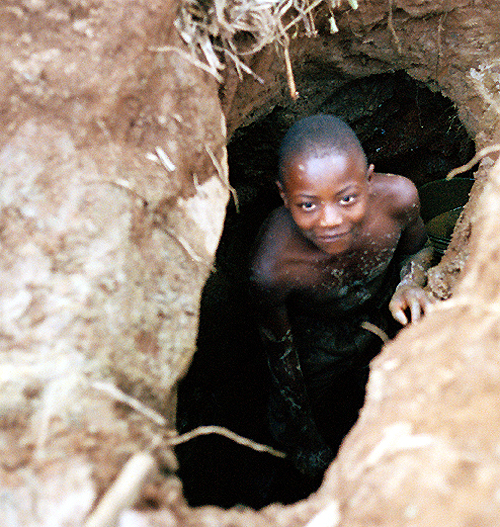
blackHoleEight-year olds – lots of them – are dying agonizing deaths in Tanzania as the government and world turn a blind eye to child gold-mining.

This morning Human Rights Watch issued its long anticipated report on child mining in Tanzania.

Not that we didn’t know there were “thousands” of children involved, that the Tanzanian government has consistently denied a problem, or that unacceptable levels of toxic wastes equal to biochemical weaponry cause the most grief.

I wrote myself about this less than two weeks ago.

I guess we just needed this respectable report to figure out what to do. So what do we do, now, we who are not Tanzanians but love Tanzania no less than children anywhere … what can we do?

Start a petition? Contact your tone-deaf congressmen? Divest yourself of multinationals in Tanzanian mining (see below)? Increase your black-hole tithing? Support NGOs working for better alternatives?

Or own up to the reality that nothing will stop this defamation of humanity except serious redistribution of wealth.

My reading of the 96-page report is a horrifying recognition that the increasing gap between rich and poor is the real cause of this calamity.

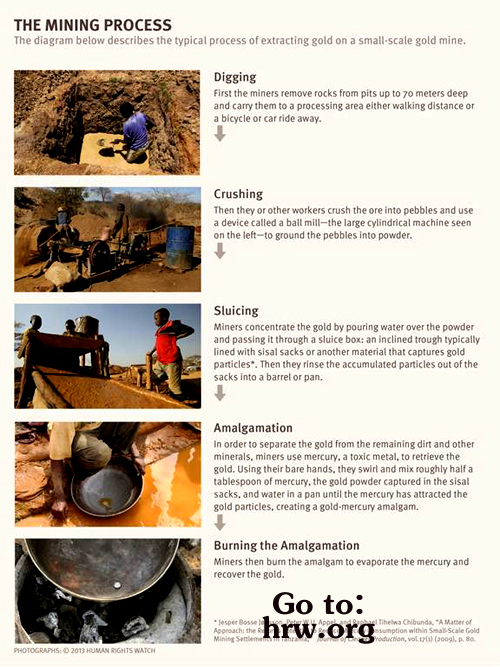
How the hell can you stop a child who is almost always sick with a cold and diarrhea who knows that a pill she can buy for a quarter will make her feel better, from sticking her hands into a plate of liquid mercury, when she knows that there’s a chance of 1 in 6 of pulling out $10?

She knows the mercury is bad. She knows that doing this enough times will make her unendingly sick. But she’s sick, now! She wants to get better!

What on earth will you tell a kid who has no father, whose mother is a prostitute for wealthier miners, who at best eats one meal of porridge a day?

Most of the child laborers interviewed by Human Rights Watch said they used their earnings “for basic necessities such as food, rent, clothes, and school supplies such as exercise books, pens, and uniforms.”

The incredible horror stories in the report of children getting sick from chemicals and hard labor were compounded by many documented cases of sexual abuse, blackmailing and outright physical abuse including murder.

Tanzania has laws on the books against all of this. But … few Tanzanian laws of any kind are regularly enforced: Tanzania is a lawless land where social order is sewn together by bribes and sometimes the goodness of local officials.

Tanzania is now the 4th largest gold producer in the world. The $2.1 billion dollars earned annually contributes 3-5% to the entire GDP of the country.

Ninety percent of this is from large-scale, big-machine, high-tech commercial mining. Roughly three-quarters of the commercial mining in Tanzania is controlled by African Barrick Gold (ABG), a UK held multinational; and AngloGold Ashanti, a South African company. The remaining quarter to a third is held by smaller multinationals, the largest of which are the Australian mining company, Resolute Mining Limited, and the German Currie Rose Resources Inc.

Ten percent, though, comes from this off-the-books, theoretically illegal artisanal mining involving the children.

The artisanal mining is usually pursued on the periphery of the commercial mining in areas the big machines just haven’t gotten to yet, or in areas that the multinationals have determined isn’t rich enough for their interest.

Most of it is surface or near-surface mining, and that’s what lends itself to individual prospectors.

Like mining throughout the ages, there is little guarantee of striking it rich by anybody, but the allure is what keeps the miners going. But in Tanzania, “striking it rich” is phenomenally greater than it is for an Alaskan miner, today; or even those involved in the great western gold rush a century ago.

In Tanzania, a child who finds a gram of gold will be able to sell it, once processed through the toxic mercury process in his pan, for more than $40. In many of the regions in Tanzania where this now occurs, that’s enough to keep a family of five alive, well fed for a month, with some left over for used clothing.

When a child strikes out in the mines, there’s other horrific work. HRW documented children as young as ten earning up to $3 for crushing a pile of rocks, $1.23 for mixing the mercury and gold for another prospector, all of which compounded could earn a kid more than $12/day.

That is roughly what a well groomed doorman, janitor or telephone operator in a safari lodge in Tanzania makes.

The story created here is of a society struggling to be simply clean, healthy and not hungry, putting their lives on the line starting as children, day after day, to reach a goal – a level of existence – in economic terms that is around one one-hundred-thousandth (.001%) of the average earnings ($90,000 annually) of workers for African Barrick Gold living the U.K.

Or one-ten-thousandth (.01%) of the average cost of a gold bracelot. Or should I go down a bit? Do you have any gold earrings? OK. Maybe one-tenth percent of the average cost of your gold earrings? So a thousand chilren work-days in Tanzania equals your gold earrings?

That gap is the problem. Tanzania should be getting a much larger proportion of its gold wealth, and the citizens and children of Tanzanian should be getting a much, much larger proportion of the money its own government earns.

But we know that gap is not getting smaller; it’s getting bigger and bigger as the years drip by. And the children get less and less and sicker and sicker.

Was slavery better?

miningprocess