As Africa Sees The Dream

As Africa Sees The Dream

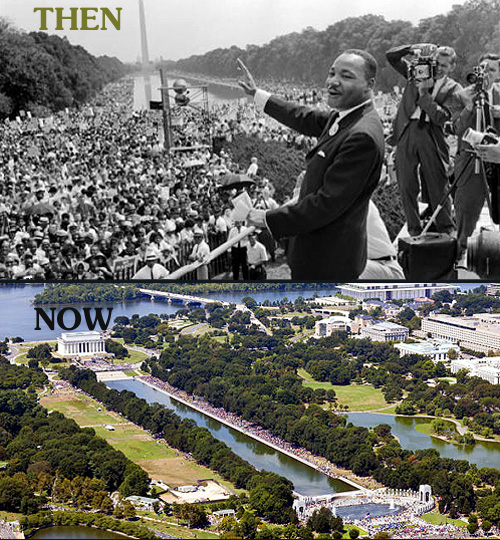
AsAfricaSeesTheDream“Tens of thousands” gathered in Washington, a fraction of the original march fifty years ago. In Africa it was hardly noticed. Why only a sputter, now?

The answer may be the same in Africa as here at home. National spirits have been whipped to death by the Great Global Recession and the Right’s successful control of its recovery.

King’s Legacy when compared to the struggles in Africa seems unfulfilled if now not outright desperate.

Obama’s first election in 2008 was a time when Martin Luther King was evoked almost daily in the African press. Even before Obama’s election, Africans began constructing King’s legacy as leading directly to Obama’s accession:

Kenyan scholar, Jerry Okungu writing on the 40th anniversary of King’s death as Obama’s elections were being excitedly anticipated, called King “first among equals” in civil rights movements for “Americans and indeed the world.

“Many Africans at the time got inspiration from King’s movement as freedom fighters in Africa,” Okungu continued.

But today?

Almost nothing. As Obama has seemed to sputter out, so has the King Legacy:

The more important fiftieth anniversary is being reported and analyzed only as republications of global news services reports.

Searches I made in major newspapers and journals throughout sub-Saharan Africa turned up little to nothing.

Only the Times of South Africa (Live edition) and South Africa’s main television network carried more than a single story.

But those two outlets do provide some explanation for the weak interest throughout Africa:

“Despite big gains politically and in education,” Times Live reports, “far more needs to be done to achieve the colour-blind society that King envisioned.”

In the second filing, Times Live explains that one of the great accomplishments of the 1963 March was the Voting Rights Act, and now, “The future of that law has been called into question [by] the US Supreme Court.”

That same story continues, “[Black American’s] 12.6% seasonally adjusted unemployment rate in July was double the national figure.”

South Africa’s state-owned and largest television network had a correspondent at the rally, and she reported, “Social and economic gaps between whites and African-Americans have only widened over the last five decades.”

She ended her single story filing: “nowhere is [the] commemoration felt more accurately than in Washington DC itself which is still a deeply segregated city.”

South Africa, in particular, is not even a generation from its significant revolution that ended apartheid and created a fabulous new constitution for the modern age.

America is seen as dragging its feet as it bumbles its way socially into the modern age. I don’t think there’s any disrespect at all for Dr. King, quite to the contrary.

But when seen through African eyes – particularly South African – the story of Martin Luther King, Jr., is one at best a tragically unfinished and stretched out story. One, in fact, that is being rolled backwards, not forwards.

Africans are extremely polite and remarkably restrained especially when it comes to criticizing good will that’s just not working.

That, in my opinion, is how enlightened Africans saw this weekend’s march. “A dream is a wish your heart makes” but that the body America can’t quite accomplish.
Must Be Something Better

Must Be Something Better

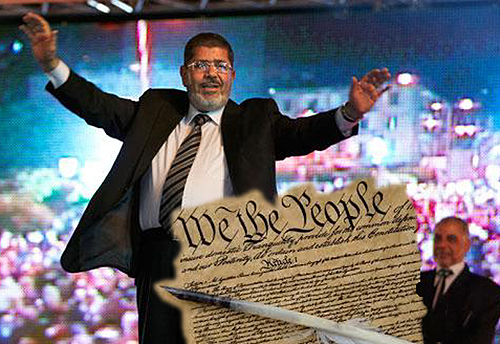
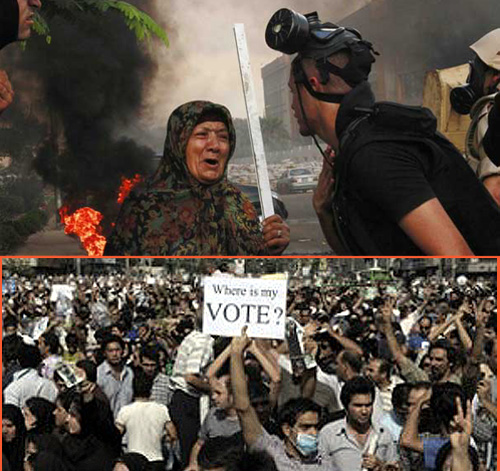
APTOPIX Mideast EgyptThe western world is in denial about Egypt as pundits and politicians alike desperately try to boost the failing image of democracy. It’s time to throw in the towel.

President Obama’s remarks this morning fall short of what I, the New York Times and Washington Post among hordes of others believe should be done: cut off aid. We all hope Obama’s dances of concession and moderation work better with Egypt than with Congress.

Remarkably, the facts are pretty well understood by everyone. Politico has summarized them best.

(1) The Arab Awakening was mostly brave, progressive movements started by intellectuals who believed authoritarian regimes (which had essentially nurtured their own development) were no longer needed and were, in fact, inhibiting better economic growth and social progress.

(2) The success of the Egyptian awakening enfranchised millions previously suppressed.

(3) A truly democratic election in Egypt brought extremists to power. The Egyptian election removed power from secularists and gave it to non-secularists.

(4) Almost a year into the new regime and the original revolutionaries began to experience similar repression to what those now in power had experienced for decades previously.

(5) The original revolutionaries demonstrated through really remarkably large peaceful protests that they wanted to replace the current regime.

(6) The Egyptian Army, equally educated, privileged and intellectualized as the original revolutionaries, agreed and staged a coup.

Democracy by the ballot died in Egypt.

Today is cleanup of hundreds killed and thousands more hurt. Tomorrow, prayer day, could be worse.

So … if the ballot box doesn’t work, use guns? The Egyptian army has a lot more guns than any other faction in Egypt, so ergo, the Egyptian army runs the country.

What if the Egyptian army supported the salafists? Like the Iranian army supports the ayatollahs? Would this globalize the situation sufficiently, so that someone with more guns, like NATO, could prevail?

What is an acceptable justification for undoing the workings of democracy? Promotion of “Human Rights”?

Yes, but who defines these rights? Who determines the limits of eminent domain, conscription, voter registration, and all sorts of other civic responsibilities?

What we are being forced to understand is that there is no such practical thing as democracy. Africa – Egypt in particular – has revealed that to the world.

A wonderfully thoughtful Lebanese explains it best:

Democracy is a goal that will never be attained. Eyad Abu Shakra explains that the times “requires us to be both realistic and honest.”

“Honest” that we don’t care the regime came to power legitmately; it must be replaced. “Realistic” that democracy caused this mess in the first place.

His understandings of so-called democracy will shake western politicians to their core, and so they should: There’s no quick trick to best government and democracy is no better a way than communism or authoritarianism. There’s much fallacious in the concept of democracy:

“History is rife with examples of authoritarian regimes that … came to government through the ballot box. In the U.S., four presidents have been able to enter the White House despite securing less overall votes than their electoral opponents.”

No society – not even the U.S. – operates anything near real democracy. While illiteracy undermines most democratic initiatives in Africa, money does in the U.S.

Shakra believes the Egyptian example is the best example in history to prove how bad democracy can be. In the first round of elections Morsi received less than a quarter of the votes. But by the rules of democracy he was cast in a second round contest with an opponent equally unpopular.

It was an election for most Egyptians of “the lesser of two evils.”

How often have we heard that? Does that kind of situation lead to best government? Of course not. Does it at least give us adequate government? Apparently not in Egypt.

Or throughout the entire Levant, according to Shakra, which “is inclined to intolerance, extremism, exclusion, and trading accusations of apostasy.”

Shakra fails, though, when he cites “true democracy” (which I don’t believe possible), “as incompatible with extremism” which is perhaps true enough.

It’s all summed up, Shakra explains, with Winston Churchill’s witticism:

“The best argument against democracy is a five-minute conversation with the average voter.”

Great. Democracy isn’t very good.

Now, what? Might democracy itself be the “lesser of other evil” forms of government? Not in Egypt. Or in Russia. Or in a superpower that devastated the Middle East with a ten-year war, powered by the democratic convictions of its population and leaders that there were WMD.

There must be something better.

Rest in Chaos

Rest in Chaos

stabilityKeita’s victory in Mali, the dozen high-profile arrests for corruption in Ethiopia, Mugabe’s final reign – all African news of yesterday, and much more suggests a return to the past.

I’ve always believed that economy drives politics worldwide. Since America is the largest and most modern economy, what happens here is now mirrored in some fashion every where else in the world.

In America the response to the economic catastrophe was Barack Obama. I’m not out of sync, here. Obama’s ascendency began well before Lehman Brothers, but looking back I’m convinced that his message of “great change” was a prescient notice of imminent economic collapse.

Obama’s message from the getgo was for a more transparent government, a rebirthing of the middle class, regauging the tax structure (taxing the rich), pulling seriously back from military adventures, enfranchising many of the forgotten and certainly wrapping this altogether was the inevitable redistribution of wealth to some degree.

There was nothing obvious in any of that at the time to suggest global economic collapse was on the way, but hindsight is striking. Nor am I suggesting Obama – or any of us – knew he would be the first U.S. president to be nominated by his party when the economy was raging hot and inaugurated as president when the economy was in free fall.

But he was. And now it seems all so clear. We call it a bubble, now. And I firmly believe the tension of that stretching bubble is what facilitated Obama to win the elections.

And mired in an economic collapse he never imagined, Obama’s revolution collapsed before it began.

Progressive redress of the old regimes replaced the blame game. (I guess we get more polite with time.) So instead of jailing Timothy Geitner we made him Treasury Secretary and had him lead the charge to reform the banks. Briefly, society moved forward with passage of things like Obamacare and the Dodd-Frank Act.

Then, it came to a thunderous stop. In America it was the 2010 elections. In Africa it was a year or two later. Whether America foreshadowed or produced the end to change in Africa, I’m not sure. But the “Arab Spring” or “Africa Awakening” or “Twevolution” or whatever you want to call it is coming to its own thunderous stop.

Old faces are reemerging as saviors of their own old ways:

Uhuru Kenyatta, the son of the founder of independent Kenya, is now president there. Ibrahim Boubacar Keita, a politician nearly as old as the tombs of Timbuktu, became president of troubled Mali yesterday. Robert Mugabe has been entombed as president of Zimbabwe. General Sissi again runs Egypt.

And in more socialist regimes modeled after China in The Sudan and Ethiopia, the inevitable pogroms have begun, the cleansing of the less than completely loyal.

Read any of the comments in any African newspaper’s OpEd page and you’ll see why:

Peace or chaos. I chose the peace because after all … everyone is tired, history, that we never learn from, has it that we will again sit together for the peace that we now take for granted. By the way, that is why when one dies we say Rest In Peace. Not Rest in Chaos.”

This is all a flashback to the 1980s. It is happening in the U.S. and in Africa for the very simple reason that following the horrible trauma of 2007/2008, we all now want stability.

At any cost. At home and abroad in Africa. Spurts of real progressive moments drowned in economic failures that turn the societal direction back around on itself.

History repeats itself, but does it circle always slightly moving on? Like a ring of waves of a skipping stone?

Or do we just sink in the vortex of the maelstrom?

Still Stuck in the Mud

Still Stuck in the Mud

Tremendous new natural resources have been discovered in Tanzania; some say that’s why Obama visited there recently. Isn’t this good news?

Many including myself have lamented African development over the last half century, flipping from feeling totally pessimistic to totally optimistic in the course of a few elections or natural catastrophes.

But always the bugaboo has been the culture of dependency presumed intrinsic to any society deft of natural resources and not yet matured of any of its own technology or innovations.

That has changed dramatically in the last decade with the discovery of so many now extractable resources that were either not known or too deep or complicated to collect in the past.

Almost 20 years ago the world’s second largest gold reserve was discovered in Tanzania near Lake Victoria. And for twenty years we’ve watched the Tanzanians botch one mining deal after another, screw up every national taxing proposal that’s reached the legislature, and kill and main hundreds if not thousands of mine workers.

And now, enormous new natural resources are being discovered in Tanzania almost daily.

The most impressive are new uranium deposits. In fact, such huge reserves have been found that the Tanzanian government quickly created a “Tanzania Atomic Energy Commission.”

(Sad that its website, thrown up in a few days, is better than for the national parks.)

In Arusha recently, President Jakaya Kikwete said, “If all the reserves we have are fully exploited, Tanzania can become the seventh leading uranium producers in the world,” said Kikwete.

Already Mantra Resources and a Russian firm ARMZ have entered into a joint venture to mine uranium. Tanzania has so far confirmed the presence of multiple thick zones of sandstone-hosted uranium mineralization at shallow depths at the “Nyota Prospect” where it is presumed there are 35.9 million pounds of extractable uranium.

That’s a lot.

But there’s more. Coal, and (good grief!), diamonds.

But even more, still:

Unimaginable numbers of deaths and disabilities from the local Tanzanians so far employed to extract these resources. The latest was only several weeks ago. I don’t understand why progressives are livid with the sweat shops supplying Walmart and Nike, but shrug at the horrific deaths and disabilities Tanzanians suffer every single day.

Last week the estates of numerous gold miners who died at the horrendous Barrick Gold mine near Mwanza filed suit for shameful work practices.

Yet there was more support in the media for the mining company than for the miners. Well, I guess it can make sense: After all, gold has declined in value, and the owner of the mines just took a $700 million writeoff on the quarter’s earnings.

Tanzania isn’t handling all of this very well.

I suppose that’s understandable, since the government of Tanzanian doesn’t handle anything very well. But this is, literally, a “gold mine” for the population, if the government can get its act together.

So far, it hasn’t, and it’s incredibly depressing.

Mining licenses are being given out willy nilly at the entire discretion of President Kikwete; there is no vetting process, and currently, there is no national policy regarding taxing or royalties.

Current Tanzanian law, which enshrined local control of local lands (sometimes to a ridiculous extent, see my blogs on WMAs and other big game related lands), is being completely ignored.

Near the capital, Dodoma, a mining company several months ago began digging giant wells without even advising the local community at Bahi Makulo what they were digging for and who they were. An expert has surmised it was Mantra Tanzania, a subsidiary of a Russian mining group.

When confronted by local officials, the management offered a handful of jobs instead of explanations, which were readily accepted. These jobs included handling chemicals that weren’t identified, and without any training.

It’s likely that at least one of the chemicals was mercury. Human Rights Watch has consistently bashed Tanzania for being one of the lone countries that has refused to sign a mercury chemical standard treaty.

Numerous human rights violations by multiple mining companies in Tanzania, and the refusal of the Tanzanian government to enforce its even poor but existing laws, has left the population completely unprotected.

Feeling totally marginalized, many Tanzanians are now desperately trying to mine gold on their own, like the original gold rushers of the 1850s. It’s dangerous and mostly unproductive, and the government is doing nothing to either regulate or discourage it.

It’s a crying shame Tanzania’s been unable to get its act together over the last two decades since Lake Victoria gold was discovered. Now with uranium, diamonds and more, that sadness has turned to desperation.

The Demons of Democracy

The Demons of Democracy

democracyfailesmorsiwinsTwo African elections this week clearly show how democracy fails in societies with powerful chief executives.

Like the U.S. But more about that after discussing Africa.

This week’s elections in Zimbabwe and Mali have failed both their societies, for different reasons, and the result is arguably worse than had there not been elections at all.

In Zimbabwe the rigged election process reaffirmed the country’s despot, Robert Mugabe, and ensures the country will continue to slide into poverty and greater dependency upon its neighbors desperate that it doesn’t totally fail.

It’s interesting that Mugabe and thugs mastered the democratic process so well that despite this week’s travesty of popular expression, observers from as divergent organizations as the African Union and reporters for Reuters gave the process a pass.

It absolutely wasn’t fair. Imagine an election – officially stated – with 99.97% of the rural population voting, and only 68.2% of the urban population voting.

Get it?

What Robert Mugabe has become is an evil despot. This is pretty easily defined as an individual who concentrates power around himself and his thugs, and distributes whatever wealth can be extracted from the country into this small core of individuals.

At the expense of everyone else in the population, even those who supposedly voted for him.

He absolutely does have solid support from Zimbabwe’s poor and rural populations, who are thrown pieces of bread (the land of white farms) just like Marie Antoinette did to stave the French revolution.

And essentially uneducated and untrained, a piece of land is a gold mine, but what it means for the tens of thousands of rural Zimbabweans who have benefitted from this policy, is that they will never have tractors, will never have schools, will never have hospitals or roads or a better life beyond their tiny plot of land.

Yet their ecstacy at this gift from Daddy is profound. And their xenophobia and racism is ripe for plucking. And even so, even with 99.97% of them “voting,” they wouldn’t have been the majority if the more educated urban populations were given their voice.

And, of course, 99.97% of them didn’t vote. Many of them can’t read and there weren’t enough polling stations in the country to handle that number of actual voters. The irregularities in this “election” were profound.

Yet it was “democratic.” Zimbabwe’s urban population rolls were restricted by techniques strikingly similar to dozens of new American voter registration laws. If it’s democracy in Texas, it’s democracy in Zimbabwe.

In Mali – often championed as a model for democracy by westerners – another near perfect election process has resulted in an effective tie. This is something democracy can’t handle. It screwed it up in Bush v. Gore, and it screwed it up in Kenya’s recent election, and now Mali’s future becomes terribly problematic.

Ibrahim Boubacar Keita (IBK), a former prime minister in better times, seems to have received 50.+% of the vote, which would effectively make him the chief executive without a second run-off election.

This, by the way, is the identical situation that occurred in Kenya in March, where the victors were ultimately declared the winners with 50.07% of the vote.

In Mali, the election process was truly fair in my opinion. If there was any fault to the process, it was that the serious opposition from the desert peoples and those involved in the recent insurgency was not voiced. In part, because the insurgency continues and the insurgents didn’t want to participate.

But of the society held together by the French Foreign Legion, a sort of muscular gerrymandering, the elections were remarkably free and transparent.

But now what? Within the margin of error of any scientific study, no one really won, but democracy mandates that someone win. If this were in Europe or Israel, it wouldn’t matter so much, because the chief executive for whom the election was held is not so powerful.

But in executive democracies, where the chief executive like President Obama holds so much power, one of the sides wins and one of the sides loses. Definitively.

And down the road that leads to polarization, friction and radicalization of power blocks that might otherwise be able to compromise.

Had America had a parliamentary democracy rather than an executive presidency, I believe that we would never have gone to war in Iraq and Afghanistan. The challenge of modern democracy is to create workable amalgams of power in societies with large and nearly equally opposing views. That’s not possible in societies with a powerful chief executive.

This is the case as well in Kenya, where ethnicity and corruption is now on the rise after decades of decline, and where Mali is likely now doomed to become a war zone for generations.

Neither Kenya or Mali will be able to traumatize the world as much as America did after Bush v. Gore. But all three examples show how ineffective, perhaps counterproductive, democracy is when the society has a powerful chief executive.

The analysis seems much simpler with Mugabe. When evil masters the process, in this case democracy, the ends justify the means and essentially emasculates the idealists who proclaim the process. Yet on closer reflection it’s clear had Zimbabwe not had a powerful chief executive style government, Mugabe may not have lasted.

The lesson seems starkly obvious to me. Democracy is a bad idea for societies with a powerful chief executive. Parliamentary democracies may be good; presidential democracies are not.

Revealing Egypt

Revealing Egypt

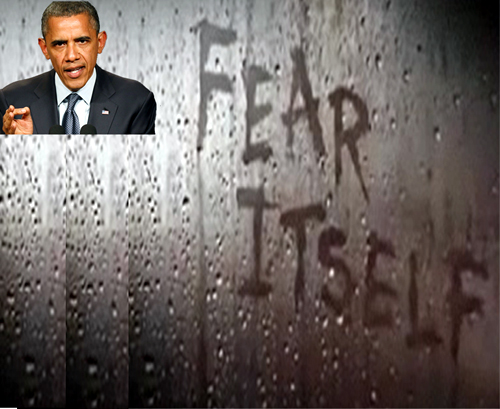
fearitselfThere’s a side to Barack Obama few ever notice. It may be the same side, the same expression of every President since our revolution, but it troubles me gravely in today’s modern, interconnected world.

It’s the obsession with defense.

I’ve written often about how incredibly militaristic Obama is in Africa, as we pursue the War on Terror. Now a study just getting notice but completed nearly two weeks ago by the University of California-Berkeley charges the Obama administration with direct involvement in toppling the Egyptian government of President Morsi.

“… a review of dozens of US federal government documents shows Washington has quietly funded senior Egyptian opposition figures who called for toppling of the country’s now-deposed president Mohamed Morsi,” the study which was published in AlJazeera reveals.

So you see the difficulty: I didn’t support Mohamed Morsi and his undemocratic if authoritarian rule. Ergo, rid the anti-democrat with anti-democratic initiatives?

There is a time in every young and emerging great politician’s career when “example” is held higher than “force”:

“To overcome extremism, we must also be vigilant in upholding the values our troops defend – because there is no force in the world more powerful than the example of America,” young Obama once intoned to America.

Either the questionable if immoral foreign policies of America have now become part of the “values our troops defend” or young Obama has strayed far from his founding principles.

Yes, the Obama Administration’s who-knows-if-they’re-legal policies have calmed today’s troubled waters a little bit. And that’s the point. America’s covert funding of anti-Morsi forces violated Egyptian law and may have violated U.S. law as well.

It would hardly be the first time one country violated another country’s law in the arena of global power. More to that point in a minute.

But violating U.S. law may have become little more than a past time of American administrations obsessed with “security” and “defense.” In my own life time we have everything as pitifully irrelevant as the invasion of Granada to earth-shattering wars in Vietnam and Iraq, and now to the wholesale disregard of human rights in the Administration’s interpretation of the Patriot Act.

You see the intellectual difficulty. What if we are more safe? Who cares about the moral costs?

“The State Department’s programme, dubbed by US officials as a “democracy assistance” initiative, is part of a wider Obama administration effort to try to stop the retreat of pro-Washington secularists,” writes Emad Mekay, the brilliant young Berkeley student who authored the article.

Read the whole article to learn the fascinating and intricate details, almost as clever and carefully orchestrated as spying during the Cold War. And I have nothing against spying or pursuing foreign policy cleverly.

But times have changed.

There is no Cold War. China and America, the world’s two greatest protagonists are so incredibly dependent upon one another that “live-and-let-live” has been reduced to “self preservation.”

All that’s left, really, is the War on Terror. It’s a high-tech version of Bobby Kennedy’s destruction of the mob. There’s nothing illegitimate about it, and more to the point, there’s nothing overly American about it.

The War on Terror actually came a bit later to America than to Britain, Germany, Japan and a host of other countries. We may have been the site of the greatest single terrorist event, but I for one believe that was because of a bumbling administration who failed to see simple warning signs.

It was a failure of that one administration, not a failure of policy.

The blurry edge of legality, particularly in a global perspective, gives enormous latitude to those in power to fiddle with morality.

Obama’s gone too far.

Just Justice

Just Justice

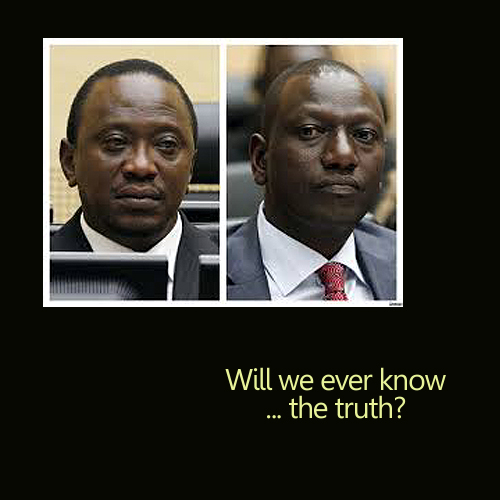
willweeverknowthetruthThe bizarre story of the world trials of Kenya’s leaders grew ever the more bizarre yesterday and when bundled with incidents like Trayvon Martin shows just how fluid, uncertain and perhaps even meaningless justice is.

Whatever else you concluded about the George Zimmerman trial, you must agree that its outcome was based as much on technicalities as “justice.” And by that I mean that Zimmerman shouldn’t have shot Martin, but somehow, he got away with doing just that.

Kenya’s president and vice-president are widely presumed world-wide, by diplomats and journalists and scholars alike, if not directly causing the terrible violence of 2008, certainly encouraging it. They’re widely presumed responsible in some significant measure for the deaths of more than a thousand people and the displacement of a quarter million.

The distinction between “causing” or “encouraging” is the point of the trials. Causing is criminal. Encouraging may not be criminal. And that’s the task assigned to the World Court in The Hague … finally, by the Kenyan Parliament.

But even were a successful trial in The Hague to find both President Uhuru Kenyatta and Vice President William Ruto innocent of “causing” the violence, real democratic societies would not allow them to continue as leaders.

Real democracies do not tolerate leaders whose citizens those leaders allowed to be massacred. Historically they could be seen as having tried to begin a civil war, but if so they lost that war. Kenya is still Kenya, whole if scathed. Jefferson Davis did not become the President after Lincoln. Kenyatta and Ruto shouldn’t be Kenya’s leaders. They are. And they might be for a long time.

Two of innumerable cases worldwide where justice has been lost.

The George Zimmerman trial is over. The just concept of double jeopardy makes it impossible that he be tried for murder or manslaughter, again. But the trials of the Kenyan leaders haven’t even yet begun.

The President’s trial has been rescheduled to begin November 12. The Vice President’s trial has been rescheduled to begin September 10.

The legal manuvering in the World Court has been considerable. The most significant of many unexpected twists and turns are the reduction of the witness list and the adjudication of whether these national leaders need necessarily attend their trials in person.

The former is much more salient to achieving some level of justice than the latter, and besides, who in their right mind believes if found guilty either of the men will resign, take the first plane to Amsterdam and let themselves be incarcerated?

It’s a foregone conclusion that regardless of the outcome of the trials, Uhuru Kenyatta and William Ruto will never be behind bars in The Netherlands.

But many of us would like to know if they really are culpable. We could be wrong, couldn’t we?

Africa is rife with Shakespearean mysteries. Perhaps the defendants’ claims that each and every one of the witnesses against them is either lying or being extorted is true. It seems unlikely, but “beyond a reasonable doubt” is something that only a good court can ascertain.

And that part is becoming less and less likely. Witnesses have been dropping out like flies. The reason given by The Court is that they fear for their security.

There’s every reason to presume this true. Kenya’s most historic murder trial was of the politician Robert Ouko, likely killed in the then Kenyan dictators’ residence. Witness after witness either dropped out of the trial .. or was murdered.

But this time there’s hope we will know. Kenya’s own parliament declined holding trials or other judicial investigations to determine those responsible for the 2008 violence, and so conceded that right legislatively to the World Court in The Hague.

So we want to know. Kenya’s Parliament wants to know. We know whatever the outcome, Kenya’s current leaders will not go to jail, they will avoid that justice to be sure. But that doesn’t mean we don’t want our own theories validated, or shown to be incorrect.

We want justice, at least the first step of discerning the truth. And I can’t imagine why every single Kenya wouldn’t want the same.

What does Egypt Mean?

What does Egypt Mean?

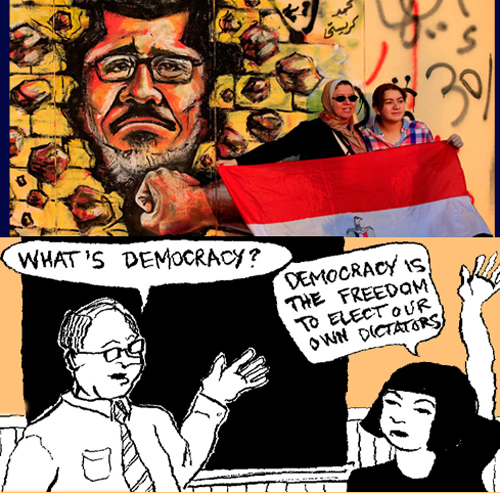
Cartoon reducted from original at chrislittleton.com
Karl Marx proclaimed a successful revolution was the dictatorship of the proletariat. As of today, the Egyptian revolution is the dictatorship of the middle class.

If ever there had been a truly democratic election in Africa – even including South Africa – it was the election of Mohamed Morsi as president of Egypt. The Muslim Brotherhood had trained in western institutions and democracy for years. And they won.

They won because the common Egyptian, the Egyptian of the lower classes, the less educated, the less likely to be employed, the more likely to have been oppressed or even tortured, had the vote. And they voted for the one thing that they had maintained through generations of oppression: their religion.

What’s specially ironic and intellectually stinging is that they were a movement of conservative Islam whose level of violence was low. That isn’t to say it didn’t exist (the horrible murders by the recently appointed Governor of Luxor stands as the example), but compared to Hezbollah, Hamas or the Joker fringes of al-Qaeda, they were choir boys.

Many contend that it was the old dictator, Mubarak, who made them so, crushing them when they misbehaved and rewarding them ever so slightly when they towed the line.

And like African movements across the continent, from the opposition in Zimbabwe to the thrice failed people’s movement in Kenya, they displayed generational patience unfathomable to us in the west. Learning the ropes, so the speak. Patiently waiting to achieve a democratic victory.

But .. All for naught.

The most cogent argument still founded on democracy being used by the supporters of the Egyptian coup is that the Egyptian constitution under Morsi had no feature to allow for impeachment, and that the mass demonstrations of the last several weeks against Morsi were sufficient to constitute impeachment.

Weak.

The second most cogent argument was that while Morsi was elected democratically, he has systematically dismantled government institutions based on democracy and was crafting a dictatorship for himself.

In my opinion this is true. He packed the legislature and tried to emasculate the judiciary, without any constitutional or legislative authority. He started muffling all opposition media. He kept interrupting the otherwise routine schedule of upcoming elections.

In other words, like every dictator before him, he was using democracy to end it.

But what is disingenuous by the opposition is to claim this while suggesting they aren’t now doing the same thing.

The middle class has at least for the moment come to power. This elicits great sympathy from us, because we are the middle class in America. But they did not come to power democratically. And they won’t stay in power democratically. If they remain in power, it will be through a dictatorship of the middle class.

General Sisi and his underlings have indicated there will be new “democratic elections” by the end of the year, and yet another referendum on a yet another “democratic” constitution.

But no sane person believes that Morsi or the Muslin Brotherhood will have much hope of being integrated into this process. They will be excluded.

And the regime will claim they are excluded “because they aren’t democratic.”

We’ve now created the most distinguished non sequitur of democracy: We’ve proved that democracy doesn’t exist.

In America it doesn’t exist because money and other non-issue components drive elections, giving a distinct advantage to the rich. Democracy is supposed to be a debate of ideas, not bank accounts. Yet we see how quickly this gets muddled in America if a democatically achieved idea condones the advantage of money and other non-issue but controlling mechanisms like seniority and filibuster.

So democracy in America disadvantages the poor and weak. Advantage, upper classes. Same as Egypt. And by the way, the mechanism is the same:

In America so-called “democracy” may not be exclusively defined by money, but money is a principal definer. In Egypt democracy is now clearly defined by the military, and for the moment at least, the military and Egyptian middle class are allied.

And what begets the Egyptian military?

About a billion dollars annually from the U.S.

In today’s world, money is power and reigns, whether in the U.S. or Egypt. Those of us in the relative comfort of the middle class are OK with this, because we are rich enough.

But the poor and weak are not OK with this.

In Karl Marx’s time the “proletariat” was the poor and weak but undeniably the largest segment of society. As it remains today in Egypt. But in America today the “middle class” is the largest segment of society.

And in the globally connected world America has now if not imposed at least facilitated the middle class dictatorship in Egypt. Not directly, of course, because we are fooled by our own ideas. But by the very nature of capitalism, by the means by which we defend our own middle class, so must Egypt become.

This paradigm has but a single peaceful and morally correct outcome: that everyone become Middle Class. To the extent America, or Egypt, or Kenya or South Africa – or China – moves rapidly in this direction, there will be peace. To the extent societies don’t move rapidly enough in this direction, or reverse it, there will be war.

All hail the Middle Class. Long Live the Middle Class.

But don’t be hoodwinked by democracy.

On Safari: Obama & The Crater

On Safari: Obama & The Crater

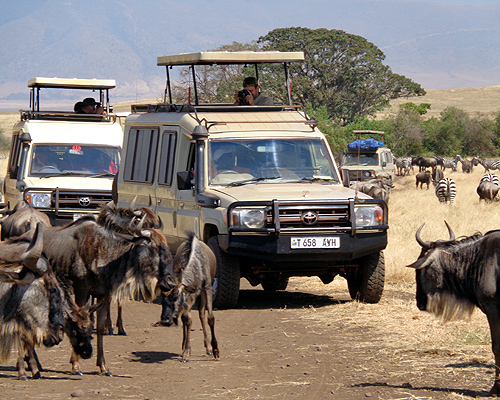
LCinCrater.655.jun13Only a few hours before Obama arrived to cheering throngs in Dar-es-Salaam, a fast cavalcade of fancy SUVs with American diplomatic plates preceded by Tanzanian police vehicles tore through the gates at Ngorongoro where we were waiting to enter.

Nobody tears through the main gate the NCA (Ngorongoro Conservation Authority). At least not until today.

There were literally dozens of people milling around, visiting the interpretative center and the bathrooms, and 20 or more vehicles parked as their drivers were methodically processing entry in the inimical Tanzanian way, which is for far too long.

And then, whiz wham! It happened so fast I can’t even remember how many vehicles there were, but at least 4 American cars and at least as many official Tanzanian ones.

Immediately the entry gate to NCA was all abuzz:

‘No, Obama hasn’t yet arrived!’
‘Maybe it’s Bush, he’s coming too!’
‘I bet it’s Michelle!’

The best we could discern was that it is an advance team for someone. Obama has publically said he won’t be going on safari, but maybe one of the 800 other people in his entourage (almost all except aids and high government officials paying for themselves) will be. Maybe it will be Bush.

I haven’t seen such happy excitement in Tanzania for a long time. Everyone – no matter what their political persuasion – is on cloud nine as the President of the United States, and the first black one at that, visits the country.

I also happened coincidentally to be here when Bush came, and when Hillary and Chelsea actually visited the crater. Nowhere near the excitement of today’s.

It was a surprise for the Felsenthal Family safari, to be sure! I was worried they might close down the crater, which was our objective today, but my head driver assured me they wouldn’t. And then as the rumors settled into something more akin to wild speculation, the notion was that America’s Secretary of Commerce, John Bryson, would be coming in the next few days with his own larger entourage.

All I know is that someone important is coming to the crater.

We had a wonderful day in the crater, although it was disappointing as far as lions go. I usually see 20 or more lions, and we saw only 5. Luck of the wild, of course. But we did see some special things:

Baby hyaena denned rather boldly in a culvert right on the road hardly stirred as we watched them from a few feet away, except to occasionally play with a piece of grass. It’s absolutely amazing how instinct prevails overwhelmingly with the young animal that it wasn’t the least bit disturbed by our vehicles and cameras.

Baby gazelle act often similarly, and baby zebra sleep so soundly you can practically touch them.

We encountered lots of wildebeest and after thinking about it for some time it seemed to me that they were mostly mothers with yearlings … no current babies. That’s rather strange, unless they were late births last year.

Late births might not be strong enough to migrate as the rains end, so they have little options except to remain with their mothers and hope the rains are good enough even in the dry season to provide enough grass.

kidsbuyingcurio.655.jun13The rains last year were good enough, and there seem to be as many yearlings as you would expect to survive from an overall herd the size we saw today in the crater. And of course they would have no current babies because they wouldn’t have participated in last year’s rut.

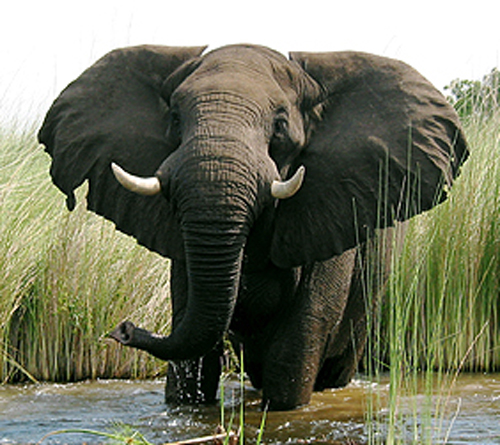
We also got a glimpse of one of the literally handful of great tuskers still alive on the crater floor. Several dozen of them migrated into the crater during the years of heavy poaching and stayed here for the natural protection afforded by the crater.

The tusks we saw were long enough for the tips to cross each other, a truly amazing elephant of days gone bye. Each time I come to the crater I see fewer and fewer of them. Today, only this one.

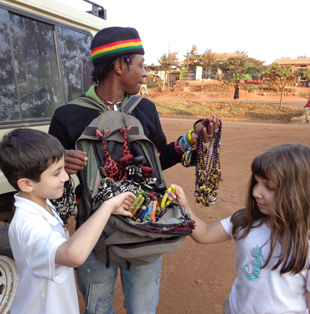
On our way back Abby and Jake bartered with a street vendor in Karatu for some bracelets and wooden animal sculptures. The vendor had a smile that could light the heavens, and a genius way of portraying his wares.

Wearing a backpack in reverse, he stuffed the pockets with all sorts of things and walked around with everything at his fingertips!

Now onto the Serengeti! Stay tuned!

The Cheetah Within

The Cheetah Within

TheCheetahWithinObama turned down a game drive with his family while in Tanzania, Africa’s most famous safari country, because if he went on one his security would have to be beefed up “to carry sniper rifles with high-caliber rounds that could neutralize cheetahs, lions or other animals.”

This little tidbit provided by the Washington Post – if it’s really true – is another indication of how disengaged Obama is from the realities of Africa. If not the whole wide world.

Lions attack people about as often as neutered male Portuguese Water Dogs do. Those few visitors I know of in my 40 years of guiding that have been hurt by lions have generally walked into their opened mouths uninvited.

Most cheetah are actually smaller than neutered male Portuguese Water Dogs and have a hard time injuring anything larger than a small deer. Here’s how you neutralize a cheetah:

I have personally done it multiple times. You shoo them off your Landrover by swiping them with your hat. And I don’t use hard Tilly hats. I prefer the lighter, less hot thin nylon like Columbia.

We guides are not allowed to carry guns when viewing lions and cheetahs “and other animals” because … well, because we don’t want to kill them. The only reason you need a gun in an African big game reserve is if you’re the predator. Defense and safety against the extraordinarily rare big game aggression against visitors is a matter of the same common sense you would use jogging in Washington Park on an “off-leash” day.

Something that apparently Obama is lacking as far as Africa is concerned.

I have often criticized Obama for his humongous militarization of Africa: for his drone policy, for the troops he’s sent into Uganda and Mali and probably elsewhere, and for the enormous weaponry that he has laid over the continent.

Well, now I know another reason why: He’s worried that cheetahs and lions will disrupt his Africom command.

My God, friends, I’m the most progressive person you probably know and I had such high hopes for Obama. I’m enormously grateful to him for shepherding the country through the Great Recession but I’m having a hard time finding other things he’s approached as a modern adult.

And I came to the conclusion some time ago it’s because he’s a wimp. Unable to stomach a real fight, delirious with the religious idiocy that he can bring people together at a time when they’re committed to slashing each other’s throats, he’s retreated into a child’s world of managing imaginary fears.

Experts like Reich and Krugman who know how banking nearly destroyed the world as well as I know how African big game safaris photograph lions, must be seething just as I am, now. Historians like Goodwin and Beschloss who predict a President’s legacy the way I predict the damage a cheetah on my car will do is limited to chewing off my rubber pop-top roof sealing must spend regular moments inside closed rooms screaming.

We progressives and liberals all are about to explode with bent-up frustrations and false hopes for a man who has obviously been subsumed by the paranoias and institutions of an old and dying world inside the beltway:

A man who has lost his simple common senses and lofty ideals which could have cracked out of a culture that relies on veteran councilors and advisors who relied on earlier veteran councilors and advisors who have led this country further and further away from the modern world, miring it in the past.

I’m incensed at the incest of old practices prevailing over new ideas. Of antiquated myths trumping contemporary realities and simple modern truths.

It’s lunacy: Obama’s a young man ruled by old fogies who’ve spent their lives looking over their shoulders. It’s the Cheney clique on Bush all over again. How sad that the result is the same, even though one man was so dumb and the other so smart.

Look friends, I’m not worried that you’ll now be too afraid for me to show you some lions and cheetahs “and other animals.” I’m worried that you’ll be too afraid to go through airport security in order to get here.

Might Obama now arm TSA with “sniper rifles with high-caliber rounds”? Dozens of my own past clients, much less the far more nefarious ordinary travelers in the millions, are much more dangerous than lions and cheetahs “and other animals.”

(I guess that’s it for gun control, eh?)

Game Viewing in Zimbabwe

Game Viewing in Zimbabwe

After a relatively long period during which Zimbabwe’s national parks seemed to be recovering in spite of Robert Mugabe, tourists reported gunfire in the country’s main national park this week.

And — unfortunately — it was not the gun fire of a revolution. The shots came from hunting rifles.

Hwange National Park is Zimbabwe’s most precious big game wilderness. Located in the northwest of the country, it was one of Africa’s primary game reserves throughout the last century.

You need to be cautious when researching it, though, as is true of everything today in Zimbabwe. The link above to Wikipedia is quite dated, with Hwange’s biomass considerably smaller than the library reference suggests, and its ecology far more fragile.

“…the number of animals being snared for food by local people living on the boundary of the Park has increased dramatically,” reports one of Hwange’s most dedicated tourism operators. This because of severe food shortages throughout the country.

That’s only one of three major problems facing Hwange, today.

The second serious problem with Hwange is its very design. Wildlife filmmaker, Aaron Gekoski, documented this recently in his March production, “Grey Matters“.

When Hwange was created in 1928 it was understood there was not enough water for a real wildlife park. So the government built boreholes, water wells, throughout the park and has been pumping water for the wildlife ever since.

This isn’t unique. The same is done in Namibia’s main national park, Etosha, and in a variety of national and private reserves throughout southern Africa.

It works if maintained. But the last Zimbabwe resource that the current dictator cares about is its wildlife, and the boreholes have not been maintained. Fewer than half of the original ones are operating, and as a result, the animals are dying.

But Hwange’s greatest problem, reflected this week as tourists trying to find an elephant in Hwange instead heard it being shot, is the wholesale looting of its biomass, and not just by corrupt government officials, but by private hunting companies.

Soldiers regularly harvest ruminates indiscriminately, sometimes assisting villagers for their bushmeat. While subsistence hunting elicits some understanding from me, Zimbabwe soldiers are well paid.

And without any study or regards to biology or ecology, the government of Zimbabwe is trading animals for political favors.

Last year foreign wildlife investigators confirmed that the government of Zimbabwe had exported at least four small elephants to China. The act was little more than stupid cruelty by the seller and receiver. Four young elephant removed from their families have little chance of surviving, anywhere, much less in a Chinese zoo.

There was such worldwide outrage at this act last year, that the global treaty which governs the trade in international species of which China is a signatory, CITES, banned any further such transactions between Zimbabwe and China.

China is legendary at publicly accepting such restrictions while finding ways to work around them, or to simple illegally ignore them in practice. But the attention this focused on Zim’s dwindling elephant population provoked a real local vigilance that seems ready to expose any subsequent violation.

But while internationally Zimbabwe may be restrained, internally it’s gone bonkers.

One of Zimbabwe’s most important wildlife reserves is the Save Conservancy (pronounced Sav-hey), in the far southeast of the country that was once scheduled to become a part of a trans-national wilderness withn Mozambique and South Africa wildernesses.

Land grabbing has grown from sport to routine in Zimbabwe, and Save is being eaten away as the Mugabe regime parcels it out to its cronies.

And add to this devil’s den of looters professional hunting.

In the old, good days, Zimbabwe was a preferred destination of hunters, and its wilderness was one of the best managed in the world, with hunters and non-hunters in grand alliances that did much to preserve Africa’s game.

That’s changed. This week tourists in Hwange reported hearing gunfire, and not the kind which would excite us all that the regime was under assault. These were the shots from hunting rifles.

We don’t know if the elephants shot were by hunters from the regime, or hunters from abroad.

But the Zimbabwe Conservation Task Force (ZATF), a proactive and somewhat subterranean wildlife NGO, insists that Zimbabwe professional hunters are now regularly harvesting animals technically illegally from national parks and private reserves, with the tacit approval of the Mugabe government:

Arnold Payne, Ken & Tikki Drummond, all of Impala African Safaris, have been named as the principal thieves.

Worse, ZATF says, “It is suspected that some of the hunters … are US citizens.”

The old adage, three strikes and you’re out, is dangerously close to being true in Zimbabwe’s big game wildernesses: subsistence hunting forced by food shortages, an ecological design of national parks that can’t withstand neglect, and now wholesale looting of the biomass.

Hwange and its other sister wildernesses in Zimbabwe which for so many years were the treasures of Africa now teeter on the brink of annihilation.

Democracy Wins Out in Kenya

Democracy Wins Out in Kenya

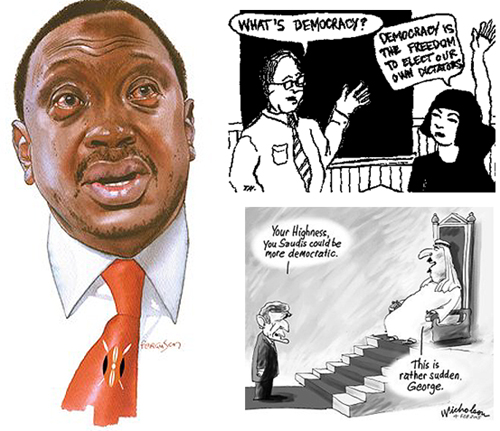
Uhuru Kenyatta drawing by James Ferguson
Reports and analyses are completed, and thoroughly so. No candidate rigged the Kenyan presidential election. It was remarkably free for an emerging democracy.

That doesn’t mean that the man with the most votes won; but we’ll never know that. 1.00% of the votes tallied may be illegitimate; Uhuru Kenyatta won with .07% of the votes. But since there was no rigging, the illegitimate votes could likely have spread out if not randomly, probably at the same percentage the candidates received legitimate votes.

The appeal process was fair if overly constrained by time. The concession by the opponent bringing the appeal was gracious and complete.

The implementation of the new Kenyan constitution looks good, albeit a clique of super loyal elites has been wrapped around the new president, taking advantage of constitutional loopholes that allow the president to appoint his cabinet and inner advisors with little advice or consent.

And Kenya is more peaceful than it’s been in several years. There are dark clouds on the horizon of economics and transparent journalism, but I wager many Kenyans prefer the social overcast to insecurity.

The above conclusions, of which I’m now convinced, are contained in a report issued yesterday by the European Union Election Observation Mission (EU EOM) to Kenya and by a less contextual and deeper historical analysis in the New York Review of Books by Joshua Hammer, Newsweek’s long serving African bureau chief.

The one outstanding issue is the scheduled trials of Kenya’s president and vice-president for crimes against humanity indicted by the International Criminal Court in The Hague (ICC). Will they be convicted? Will the trials even take place, now? And, most obviously and critically, are the charges valid?

I doubt the trials will proceed. This past weekend the Organization of African Unity laid a broadside attack on the ICC. Hammer refers to Bush Administration officials who were instrumental in ending the 2007/2008 violence who believe the charges are weak at best.

The Kenyan legislature refused to organize commissions to discern the guilty for the 2007/2008 violence and as a result of the agreement that ended the violence, ceded the investigations and trials to the ICC.

But now the new Kenyan legislature, packed with supporters of the newly elected leaders, wants to revisit that decision, and the ICC has said it’s open to considering such.

The way I can now see the Kenyan situation is not so dissimilar to my American one, Bush vs. Gore. And though at the time of Bush’s election he was not charged with anything criminal, that has certainly not been the case with many other American politicians:

David Vitter would have been a felon by his own admission had he not waited to so admit before the statue of limitations expired. He was subsequently elected and now serves as Senator from Louisiana.

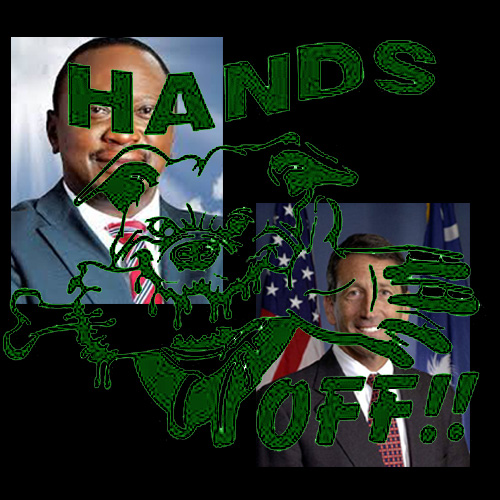
Mark Sanford perjured himself as governor, resigned, and is now the newest representative for South Carolina.

By the way, there were even more important leaders who perjured but prevailed: Bill Clinton (Monica Lewinski), Ronald Reagan (Iran Contra) and George Bush (WMD). And don’t forget Tricky Dick, although most of you reading this probably weren’t born then.

Democracy does not guarantee honest guys get the job. The short list above is a very short list.

What failed in Kenya is what fails here at home: democracy. Imagine – and it’s quite possible to do so – Sarah Palin as America’s vice president or Michelle Bachman as president. More chilling, yet? Bush gets a heart attack and Dick Cheney becomes president.

The situation today in Kenya is much better than those imagined past hypotheticals.

Democracy as practiced by the ancient Greeks might have been better than the Claudius’ which followed, but modern times has seen the astute usually rich politician game the system almost to the point of rendering it useless.

So congratulations President Kenyatta and Vice-President Ruto. You have fully joined the world of democratic leaders.

Tit for That

Tit for That

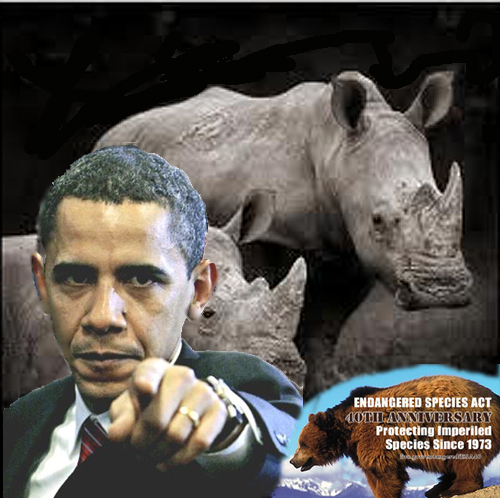
The Obama Administration may have hastened rhino extinction in order to achieve political capital in Wisconsin.

Charity begins at home, and there’s no more powerful example of this than for Americans interested in saving rhinos and no greater reversal in my life time than what the Obama Administration has just done.

For the first time since U.S. laws then international treaties prohibited international commerce of rhino, the Obama Administration has issued a waiver to David Reinke, a big-game hunter from Wisconsin allowing him to import the rhino he shot in Namibia in 2009.

This is the first ever waiver issued by any administration since America’s Endangered Species Act became law in 1973, and may in fact put America in violation of the world-wide CITES treaty of which America was so instrumental in creating.

The action by the U.S. Fish & Wildlife Service has raised numerous eyebrows and not only among wildlife advocates, and occurred right when the European Union enacted even tougher bans on the trade of rhino within EU country borders.

Fish & Wildlife’s explanation is pitiful. It invokes a moral platitude that sport hunting can support conservation, which while sometimes true is absolutely not in the case of any endangered species. And it cites as a positive reason for issuing the waiver the more than quarter million dollars Reinke spent on his rhino hunt in Namibia.

To many of us, this action is patently political: Trade rhino for political capital in the contentious arena of Wisconsin by wooing over a major Republican supporter. This time I’m not only joined by the Huffington Post that suggests as much. So does Scientific American.

Tuesday’s blog about the American Wade Steffen and today’s blog about the American David Reinke and the Obama Administration illustrate how misplaced American support for saving the rhino may be.

Every single save-the-rhino (or save-the-elephant, or save-the-groundhog) group on earth presumes, and correctly so, that commerce of any kind in that animal increases exponentially its black market thereby massively increasing the threat of its extinction.

If Fish & Wildlife argues that Reinke’s quarter million dollars will save the rhino, why not just issue hundreds of waivers each for a quarter million dollars? Or thousands of waivers?

It’s a child’s tease while the Obama Administration plays god with politics. Once a single international transaction of commerce has occurred — as it now has — subsequent transactions become easier and easier.

As my own experience in Africa developed over the years, “charity begins at home” grew increasingly important to me, but in an usually straight-forward manner: Yes, there’s horrible poverty in Africa, but there’s also horrible poverty in America.

What’s worse is that poverty in Africa is declining; poverty in America is growing. I’m an American, not an African. Ought whatever talents or skills I have to mitigate poverty be directed first at home?

But what about saving big-game wilderness, a concern much more African than American?

You have your answer in this blog and my last one, “Dumb Roper Nabbed.”

It doesn’t matter how much money you’ve sent to rhino-saving charities, or how much time or other resources your zoo or conservation society has allocated to rhino protection, your political leader has just reversed much of what you thought you were doing.

Charity begins at home.

NPR Rhino Preview

NPR Rhino Preview

NPR’s series this week on rhino poaching is probably worth paying attention to. Here’s some background before listening today to All Things Considered:

Be cautious. John Burnett’s terrible reporting for NPR on elephant poaching not too long ago set me ablaze. He fouled up the numbers completely, came from the wrong perspectives and reduced a complicated issue to hardly a cartoon.

PBS was just as bad, but had redeeming parts. The February production that included Aiden Hartley going undercover in Dar-es-Salaam to document that trade in illegal ivory was brilliant, but their numbers and back stories that introduced the stealth section were poor if not patently untrue.

So why am I directing you to another American public media production about animal poaching?

Because the synopsis presented over the weekend by reporters Frank Langfitt and Gregory Warner sounds good. Both reporters are more experienced than the reporters assigned to the elephant story.

Because many, many bloggers and experts – not just me – were highly critical of the elephant reporting by NPR and PBS earlier. Some of that noise had to get through.

Because basic facts, which have been buried in scandalization for years, are already out in the story and look good: In the whole summary, I did not hear once any reference to rhino horn being used as an aphrodisiac. It isn’t, but this reference has peppered stories of rhino poaching since time immemorial, a racist and horrible injustice to the bigger story.

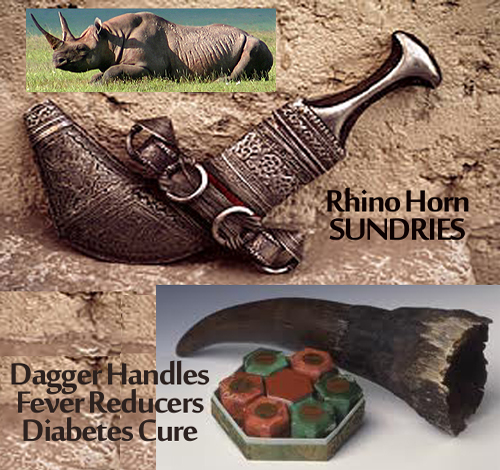
Rhino horn is in demand — as with ivory — in Asia but for medicinal, holistic beliefs in its curative powers. Used for centuries as a fever reducer, newly rich Asians (mostly Vietnamese) buy tiny erasure-size blocks of compressed horn to cure everything from diabetes to hangovers.

For the poacher in East Africa, though, the main market is Yemen, Djibouti, Eritrea and thereabouts, where rich businessmen buy the horn to polish it as a dagger handle.

In the ATC story summary we heard this weekend, Langfitt and Warner conceded that even after poaching there are still enough rhino births annually to continue increasing the population.

(Media that they are, however, they’re unable to avoid teasing us with scandal, claiming that at current rates this will not be the case by 2017. I doubt that.)

And they have drilled into the attempts at real solutions, including horn cutting and controlled rhino farming and harvesting.

So unlike the huge bulk of elephant reporting these last several years which has been terribly incorrect, and of which NPR and PBS have contributed to messing up, this one might be different.

Stay tuned.

The Right Can Do No Wrong

The Right Can Do No Wrong

The tenacity of Rightists that so inhibits U.S. progress is becoming true worldwide, and no better example than the imminent diplomatic earthquake over Kenyan leaders’ indictment by the World Court.

The phrase is not mine, but Richard Dowden’s, one of the world’s most respected African analysts, Director of Britain’s Royal African Society.

Dowden’s brilliant summary and analysis of the Kenyan Mess published today is required reading for anyone who’s trying to understand this incredible “mess.”

And his conclusion is “Right”-on: the minority (in the world as in Kenya) who are “elite … simply do not recognize that they are subject to the law. Politically powerful, exceedingly wealthy and above the law,” people like Kenyatta, Cameron or Limbaugh just ignore legal and social realities, carving a world in their selfish images.

(Read Dowden. I do not intend to quote him out of context, and the quote above he wrote strictly with regards to the Kenyan leaders on trial, but I think it a fair if liberal extraction of his meaning.)

Dowden’s analysis is no more brilliant than his summary, which is a tough nut to crack. Before I further try to summarize Dowden you must have an understanding of the ICC (International Criminal Court) which has indicted the President and Vice-President of Kenya for crimes against humanity.

The U.S. does not recognize the ICC. Nor does China, India and 38 other countries. But the majority of the world does: 122 countries including Canada, Australia, all of South America and almost all of Europe.

Another 28 countries, including Russia, have “signed on” to the ICC Treaty while not yet ratifying it. In so doing they agree to the abide by the treaty (including arresting indicted criminals on behalf of the Treaty who are not their own citizens) without yet allowing prosecution of their own citizens.

The Court was only formed in 2002. There is a much older cousin, the International Court of Justice (ICJ) formed in 1945 and designed strictly to adjudicate disputes between countries. All countries that belong to the UN automatically accept the ICJ.

Both courts are located in The Hague and share some facilities.

In 2007 Kenya blew up after a contentious end-of-year election. About 1300 people were killed and a quarter million displaced (of which more than a 100,000 remain so). The violence threatened Kenya’s relative stability and the west’s toehold in the continent:

Kenya was and probably remains the closest African ally to both Britain and the U.S. Strategically critical to the War on Terror (especially in Somali) and to both countries’ defense posture in the Red Sea (bases and warships in Mombasa), Kenya was the platform on which democracy and western capitalism were and are being promoted by the west onto the continent as a whole.

Britain, the U.S. and recently retired UN Secretary General Kofi Annan formulated a brilliant peace agreement that after a troubling six weeks brought Kenyan society back to peace, resulted in five years of growth and stability and the creation of one of the world’s best, new constitutions.

Part of that lengthy and complicated agreement was that those responsible for the killings and massacres should be brought to trial. The agreement gave Kenya the option of running the trials itself, or if it didn’t want to, allowed the ICC to run them.

Kenya through its parliament decided to wave its right to hold the trial and agreed to cooperate with the ICC.

Lo and behold, guess what the ICC found?

That two of its rising political stars, who recently became the country’s President and Vice President, were principally responsible for the killings and massacre.

Oops.

You know it’s interesting. In the old days what tangled up the west in its own ideology was its support of South American and Mideast dictators who held none of the west’s lofty morals. And these guys often used the west’s weaponry freely given them back on the west!

But now what you have is the west denying its own lofty morals!

David Cameron, Prime Minister of Britain, and Jacob Zuma, President of South Africa, both lead countries who have signed on to the ICC. President Zuma traveled to Nairobi to be an honored guest at Kenyatta’s inauguration.

This week Cameron welcomed indicted Kenyan president Uhuru Kenyatta to a conference about Somali in London.

There was local “outrage” but it didn’t seem to matter.

Today Kenyatta announced in a wildly aggressive press conference that the UN Security Council better vacate his indictment with the ICC.

Also today, Fox Newser Stephen Hayes, given a platform in U.S. News and World Report, says that the ICC should drop the charges against Kenyatta.

I think that says it all. The Right Worldwide is unified, but why? You can argue that Cameron is hamstrung by Kenya’s importance in the Somali situation, and you can argue that Zuma is crazy.

But why would Stephen Hayes take a position?

Because The Right (Kenyatta + Cameron + Zuma + Hayes, let me also add Sanford) are all miserable failures who through “elitism” and (likely unscrupulous) wealth have manipulated elections to become powerful men. And The Right does not unlock its jaw once clamped.

They are all also in minorities, but there seems to be no organized majority to defeat them.

Back to unedited Dowden:

“The fact is that the Kenyan elite … simply do not recognize that they are subject to the law. Politically powerful, exceedingly wealthy and above the law, no state official would dare touch them.”

Equally applied to miscreant U.S. bankers and right-wing U.S. politicians. How many bankers have gone to jail? Or even lost their job? Which man was yesterday elected a Congressman who is indicted for having misused public funds for his affair in South America?

Good grief. They just can’t be gotten rid of. And so what happens when Vice-President Ruto decides not to go to The Hague for his trial on May 28, or when President Kenyatta decides to take a pass on his date of July 9?

Dowden: “a major diplomatic earthquake.”