Outside Threats

Outside Threats

Yesterday’s deadly grenade attack in Arusha isn’t simply an indication of escalating religious tensions in Tanzania, but of the same escalating individual malevolence evident in the Boston massacre.

In neither incident do I believe there is any kind of organized group involvement, despite FOX News, Representative Stephen King or the other crazies on Meet the Press yesterday. Both cases seem to me to be engineered and implemented by wayward souls.

Wayward souls that have access in Boston to deadly technologies from Google searches. Wayward souls in Arusha who can trade a bushel of tomatoes for a grenade at practically any market in Africa.

It’s all the same. Neither is worse or more terrifying than the other. The higher tech move by the Boston duo was more deadly, just because American society is more sophisticated than Tanzanian.

Escalating religious and ideological tensions in America and Tanzania have been evident for years, and I agree with Arusha’s MP Godbless Lema that governments need to proactively address the schisms growing in their societies:

“”Religious fundamentalism is a reality in this country, but the government does nothing,” Lema said angrily outside the church, as police cordoned off the area.

Lema is one of the few honest, aggressive stars of Tanzanian politics. Like the minority of American politicians who want to address the Boston massacre with better schools and counseling and more jobs, rather than creating more fictitious global enemies, Lema knows the media speculation of the cause is absurd.

The ideologically bankrupt in a society will always point to the outside to explain a cancer within.

Since colonial times Tanzania has been one of the most Catholic countries of Africa, a product of King Leopold’s mid 19th Century conference that divided the colonial African world up by religion, so that missionaries didn’t duplicate their work.

One of the greatest historical ironies of Africa was that during the socialist policies of early independent Tanzanian in the 1970s to be a member of the Tanzanian communist party you also had to be a Catholic.

The amalgamation of Zanzibar with mainland Tanganyika in 1964 was like mixing holy water with myrrh. Since time immemorial Zanzibar was ruled by the radical Islamists of Oman, and even though it’s been given considerable autonomy, tensions have never fully eased with the mostly Christian mainland.

In October a respected Sheik in Arusha was hospitalized after an explosive device was set in his home. That was followed by church bombings in Zanzibar.

And so the cycle goes on and on, individual anger and want having found a convenient battle.

The Tanzanian government today arrested five Saudis, conveniently of a Muslim sect that is mostly disliked in Zanzibar, and charged them with terrorism.

Absurd, of course. This was the same Tanzanian government who employs the Arusha police commissioner who took 2½ hours to get to the church that was bombed Sunday morning, a half hour after the Vatican’s emissary attending the ceremony had been whisked out of the country.

The Honorable Lema is right. Governments do little today, in either America or Tanzania, to mend social schisms. Let’s just blame outsiders.
Justice Becalmed, Justice Bedeviled

Justice Becalmed, Justice Bedeviled

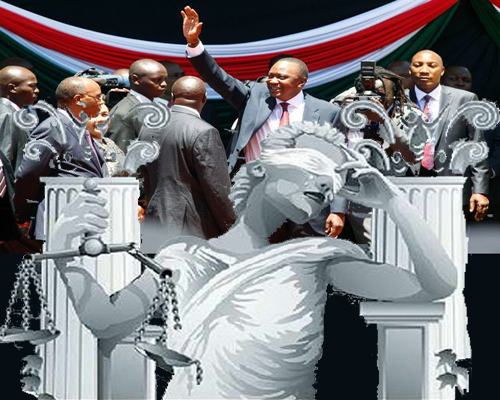
Today’s final detailed explanation by Kenya’s Supreme Court of its decision to affirm the March presidential election makes me doubly angry with Bush vs. Gore.

The clear consensus by much more scholarly analysts who have rushed out their initial impressions is pretty negative, that the detailed decision is “disappointing.”

But quite to the contrary, it helps me understand how insidiously deceptive a political system is where the final say presumably rests with a collection of appointed sage elders with so little obligation to anyone or anything that they can neutrally discern the facts and subsequently convey justice.

Or in other words: Finalismo.

By the way, there was nothing very revealing in the 113 pages, and a little bit for everyone including the critics of democratic methodology and the critics of corruption. I’m no legal scholar, but let me paraphrase the decision this way: don’t rock the boat.

The “rule of law” sounds good, but over America’s much longer history than Kenya we can often find definitive failed justice from the top. And that’s not wholly unexpected since it’s usually the most contentious and/or complicated issues that rise to the top, and it’s just statistically unlikely that the right decision will always be made.

And an incorrect Dred Scott decision foments war. The incorrect decision of our own Supreme Court in Bush vs. Gore arguably paved the way for two prolonged, unbelievably expensive and totally unjust wars.

America has a long enough history that it just seems statistically inevitable that some pretty horrible top court decisions would be made. But this, in effect, was Kenya’s first major decision.

And like America in Bush vs. Gore, the justices’ action put the man who likely lost the election in the winner’s seat: In Kenya by not altering the decision by the election authority (despite massive illegalities) and in America by stopping a recount of votes.

In Kenya it was passive justice; in America it was active justice; but in both it put the wrong man in power, invalidating democracy.

As in Bush vs. Gore, there were plenty of tidbits the justices couldn’t ignore: like the wanton corruption acquiring voting technology and the inability of the corroborating registration system to affirm exactly who had voted.

They even encouraged the Kenyan prosecutors to indict the “tender team” that designed and acquired the voting technologies that massively failed.

Just as the justices in Bush vs. Gore acknowledge that hanging chads if reconciled could alter the outcome.

So I don’t think we can rack this one up to the “statistical” likelihood that all profound decisions will not always be correct. There’s more to it.

In Kenya it means one of two things:

1. The justices were biased towards the flawed outcome, however wrong it was; or

2. The justices felt their meaning for existence was not sufficient enough to alter the status quo.

In America it was clearly Number 1, because they did alter the status quo by stopping the recount. In Kenya it’s hard to say.

But both situations demonstrate how weak the “rule of law” is in Kenya and America towards assuring a just outcome. Because the “rule of law” in both cases wasn’t. Law didn’t rule. Something else did.

And don’t be fooled by rationalists who argue that green is black, that intonation is meaning, that interpretation rather than implementation governed the situations. Legal opinions coming out of the whazoo drown in semantics. Get yourself into that clear air of what’s right and what’s wrong.

I believe that the “rule of law” achieves justice.

There was not “rule of law” in either Kenya or America. In both cases the justice system failed. And not just “statistically” so; intentionally so. Something else prevailed over justice. It’s called…

Power. And unlike the very essence of justice, it has no limits.

Spears & Signatures

Spears & Signatures

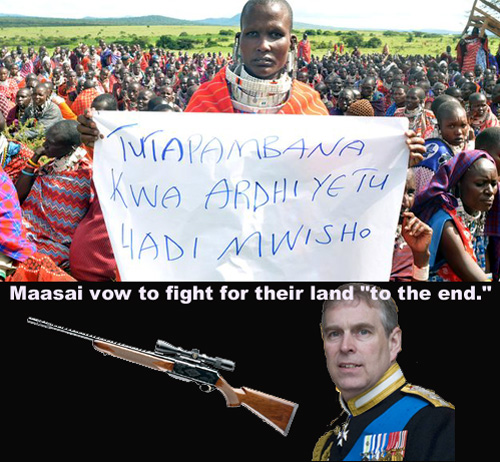
A major fight if not an actual civil war is about to erupt in northern Tanzania, as Maasai prepare to battle government authorities in Loliondo, according to a BBC report this morning.

The dispute is over a Tanzania government decision to evict 30,000 Maasai from traditional grazing lands near the Serengeti National Park so that the area can be leased to a Dubai Hunting Company.

The story was first reported globally by the Christian Science Monitor earlier this month and went viral, mobilizing Maasai throughout the area.

The company, the Ortello Business Corporation (OBC), is a gigantic, jet-setter hunting company that has set up a mini city in northern Tanzania each mid-year for the last 20, for high profile hunting clients including Prince Andrew and most of the royal families of the Emirates and Jordan.

When I move near the area while still in the Serengeti National Park, my Tanzania cell phone beeps then displays the message, “Welcome to the Emirates.” They even bring cell towers.

The Arab operators of the area get free, undisputed access into and out of Tanzania. They have built a private airstrip on which modified 747s land direct from Dubai. Private security disallows anyone – including Tanzanian officials – from crossing their perimeter.

Until now, the under-the-table operation which has undoubtedly made many Tanzanian politicians very rich, has been slow to gain public attention. The Maasai have been battling the operation for years, although until now it’s been seen as the classic hunting/non-hunting battle over wilderness lands.

That changed dramatically when the government announced last year that it was adding about 580 sq. miles to an area still not fully surveyed but presumed to be around the same size. The doubling of the area is particularly aggravating to conservationists, because it would be a closed portal between the hunting area directly into the protected Serengeti National Park.

But more importantly to the Maasai, it means up to 30,000 will be evicted. Some claim as many as 48,000. The evictions more than 20 years ago that first set up the hunting block did not provoke a Maasai outcry.

That was probably because the Maasai were not as educated, not linked into social media and were at the time in their own battles with other Maasai just across the border in Kenya in internecine land disputes.

Until this incident, the controversy was confined mostly to photography safari tourists accidentally entering the Arab-held lands. Tourists at the prestigious &Beyond Klein’s Camp, for instance, would occasionally come across shot animals.

Community Based Tourism companies, including Dorobo, Hoopoe and Kibo Safaris that attempted to establish ventures with the Maasai often ran afoul of the Arabs.

But today it’s quite different. “There is no government in the world that can just let an area so important to conservation to be wasted away by overgrazing,” Khamis Kagasheki, the Minister of Tourism told the press last month.

The public nature of the government’s battle with activist Maasai is new. It seems to me they think they’ll win, either in the arena of public opinion, or against the Maasai spears.

The government is still reeling from the defeat to build the Serengeti Highway.

The characterization of the government action as enhancing conservation by protecting land that is currently being misused (over grazed) I see an indication the government feels that hunting is no longer as anathema to the public as it was just a while ago.

The activist NGO, avaaz, is promoting a world-wide petition with 2 million signatures to convince President Kikwete to nullify the decision. But based on public ministerial statements over the last month, the government will not be moved this time.

Maasai evictions from wilderness lands are not new. Likely the reason for the greatest spectacle on earth, the Great Wildebeest Migration, is that nearly 20,000 Maasai were evicted from the Moru Kopjes in 1972 that is now an essential wildebeest corridor within the Serengeti National Park.

I personally had a very educated and articulate Maasai friend killed in a battle with Tanzanian rangers two decades ago. So battle with the Maasai is not new, either.

But there’s something much different this time. Perhaps global awareness, perhaps the power of the social media – I’m not sure. But I am sure that if the government persists…

..the Maasai will fight.

The Impoverished Kenyans

The Impoverished Kenyans

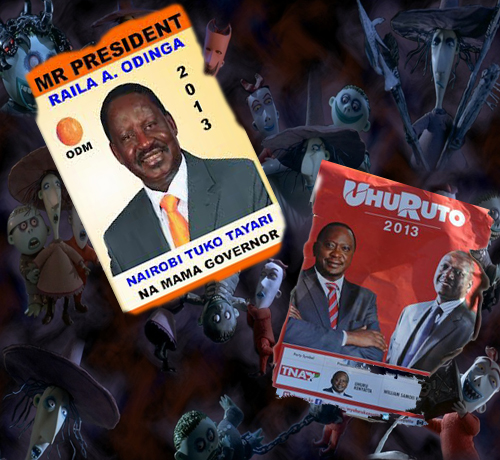
Left: President Uhuru Kenyatta, scheduled to go on trial for crimes against humanity in July. Next in line: Vice-President William Ruto, scheduled to go on trial in May.
Poor Kenya. The world waits to see if the new president and vice-president will travel next month to The Hague to stand trial for crimes against humanity. Kenyans elected these men free and fairly. They chose alleged murders to lead them.

As a businessman in tourism I wait for more signs. As a devoted student of Kenya, I’m depressed and frightened. Like everyone in the world who knows Kenya, we wait with baited breath for the start of the scheduled May and July trials of the Vice-President and President.

Kenyans are polite and on edge. They are proud that they didn’t devolve into violence as during the last election, proud of the new judicial system that validated the election, but on pins and needles waiting like everyone in the world for the next chapter in this country’s history.

That comes next month when Vice-President William Ruto is scheduled to begin his trial for having arranged and financed killer squads following the 2007 elecetion. President Kenyatta’s trial is set to begin in July.

“If the International Criminal Court is right,” writes Daily Nation columnist Makau Mutua, “the two funded death squads to kill, maim, and loot each other’s folks. Mr Ruto only subordinated himself to Mr Kenyatta because he couldn’t win [the national election] on his own.”

Mutua goes on – as many others have – that this unlikely team of arch enemies is together for only one reason: they are both alleged organizers of mass murder.

There’s nothing particularly sensational in this thriller, the Joker elected mayor. It struck me as a storyline that would likely be rejected by Hollywood for being sorely uncreative. The difference, of course, is that this is real.

And the sad part is not the fates of these two men. The sad part is that Kenyans elected them, freely and fairly.

Incredibly, Kenyans couldn’t come up with anyone else. And although it’s true I supported Kenyatta’s principal rival, Raila Odinga, nearly anyone of the other 6 challengers who contested the election would have been infinitely better.

Anyone who watched even a snippet of either of the two election debates would see what great people Kenya has as potential leaders. But none but Uhuru and Raila had the financing (and ethnic support) to be viable candidates.

That was the main reason I (and many, many others) supported Raila: none of the other challengers had a chance, and the outcome proved it. The remaining six challengers got less than 8% of the vote.

Kenya is peaceful. In fact as Somalia improves, Kenya becomes more and more peaceful. Raila has met with Kenyatta. They are photographed laughing together, working to “keep Kenya peaceful.”

I received an email from an owner of a lodge near Mt. Kenya, Sunday, which implores me to write good things about Kenya, to beef up its tourism:

“Would it not be a good idea to now send out a positive email concerning Kenya? It seems to me that people prefer to spread bad news all the time.

“Kenya is an amazing country with lovely people and I am sure if you compared the crime rate with the UK and considered the poverty people combat every day here in Kenya, the UK would not come out looking too rosy itself!”

UK leaders are not accused of crimes against humanity. The Kenyan president and vice-president are.

All Hail The Chief

All Hail The Chief

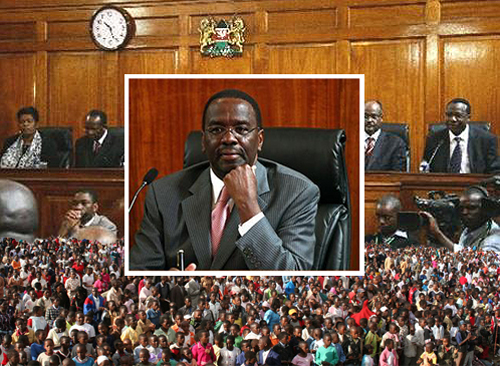
Kenya’s future is in the hands of a man little known outside Kenya: Willy Mutunga. The 65-year old Chief Justice will render his High Court’s decision on the recent election Saturday morning.

The country’s tension is building, its currency is falling, and protests are being prepared not just to follow the court’s decision, but right now to protest strict measures the government has imposed to ban public demonstrations.

But despite all this tension, Willy Mutunga can legitimately claim to have the trust of most Kenyans.

The Chief Justice has a long history of democratic activism, including a long stint in jail under the former dictator, Daniel arap Moi. His choice by Parliament was one of the easiest and least contentious of all appointments mandated by the new constitution.

His demeanor throughout the proceedings contesting the March 4 election has been exemplary. He’s been transparent, ordering live broadcasts of the deliberations.

And he’s given himself and the other five justices of the high court five days of full deliberations to make a decision.

Many would argue that is hardly enough to wade through the hundreds of petitions, reaves of evidence and uncountable allegations flinging between the two camps of president-elect Uhuru Kenyatta and aggrieved challenger, Raila Odinga.

And while that may be true, Mutunga knows all too well that this episode in Kenya must be brought to a conclusion.

Every day that passes without a court decision affirming Kenyatta’s election, confusion and complexity builds. Who is running the government? It’s not clearly known, as the former president Kibaki is dead silent.

Office holders under the last regime, which supposedly has ended, are becoming more and more vocal and partisan. Today, the attorney general petitioned Mutunga to consider that the “government” believes Kenyatta is the president.

If too much time passes whatever is left of the Kenyan government will be replaced by anarchy. Mutunga knows this, so he specifically advised the nation when the decision will be made: Saturday morning.

“I have given most of my life to a better Kenya and if taking it is what will be required to consolidate and secure our democratic gains … that is a price I am not afraid to pay,” Mutunga said recently, revealing the many death threats he’s received.

It may be this widely disseminated statement that has elicited the public trust. Death rates are rampant. Social media is beyond the pale. It is hard to underestimate the vitriol and anger in Kenya, today.

And frankly, I don’t think Mutunga and his court will render a decision on the evidence. The evidence is too voluminous, too contentious, too imperfect. It would take months to determine the ballots that were mismarked or miscounted. This will have be a ruling from the hip.

The ruling will be on whether the election authority which pronounced Kenyatta the victor with less than 10,000 votes of 12.2 million cast should be honored, or whether it should be denied and a new election process started.

The easiest thing to do is simply affirm the outcome. After all, all the parties in the election had expressed unqualified support for the election body which made the call. The Constitution gives this body wide latitudes of decision-making.

But not affirming the outcome seems more rational. Ballot counting was an unqualified mess; all sides agree on this. The .07% margin of victory is therefore a ridiculous conclusion.

But not affirming the outcome requires the court to suggest a remedy, a new election or run-off, all within its power but which then essentially emasculates all the months and years of institutional preparation Kenyans had invested in the election.

I predict the court will rule the election invalid. But I’ve been sorely wrong predicting events associated with this election, and no matter what the court does, Kenya’s greatest challenges are yet to come.

Storm Clouds over Kenya

Storm Clouds over Kenya

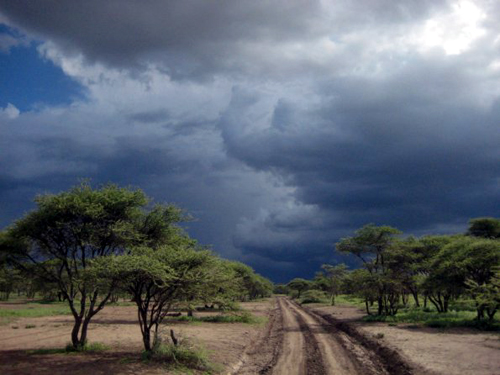
Storm clouds are forming over Kenya. The thunder and lightning and destruction has not yet started, and all of us who love Kenya hope it will not, but the anger is palpable and as a safari broker I must advise all considering Kenya for the moment to stay clear.

My blog yesterday about the election went viral and the hate, death threats, invective and dirty speech publically thrown back at me as comments on the blog and Facebook are chilling.

For the first time ever I changed something that I had written – or rather, photoshopped. I worried that the photoshopped picture was being misconstrued, that I was suggesting that the current election had experienced violence.

It didn’t. There was an incident in Mombasa on election morning that left six dead, but that was it. The rest of the day, and up to this very moment as I write, has been peaceful, and as I wrote on the day after the election, joyously so.

So I have changed yesterday’s blog picture to eliminate the possible connotation otherwise. In Facebook I post twice: once for the full picture and once for the link to the blog. Facebook entries cannot be edited, only removed, so I simply removed the full-size picture. But the other has to remain, so if you wish to see what the picture was that worried me, go to AfricaAnswerman on Facebook.

I do not want to contribute to the growing anger. But as Mwirigi posting the first comment to the respected columnist Macharia Gaitho in today’s Daily Nation says, “I am against any attempt to muzzle free speech. This is how it starts, we have come from a time where it was a crime to imagine the death of the president. Many people have fought long and hard for us to have the ability to express ourselves freely.”

I read Gaitho religiously. He’s an outstanding columnist. Today he says, “The level of malevolent hate, ethnic bigotry, incendiary words and totally criminal incitement [on social media] would put to shame the infamous hate media outlets of the Rwanda Genocide, the newspaper, Kangura, and Radio Télévision Libre Mille-Collines.”

So I am hardly alone. In fact, my few thousands of hits and comments are minuscule compared to the extraordinary traffic on Kenyan sites.

The second comment on Gaitho’s column by Njamba says, “We should differentiate between freedom of speech and abusive and hate speech.” But she continues to incorrectly conclude this means we as individuals can’t come to conclusions or predictions about the future.

And therein Njamba and thousands other Kenyans hit the slippery slope, giving only lip service to free speech by inhibiting it from reasoning to points of view. Unless, of course, it’s their point of view.

“Right now I feel let down,” Gaitho continues today, “and very ashamed to be a Kenyan, for the level of post-election violence assaulting my eyes and ears every day is worse now than it was before and during the elections.”

Words cut ideas. Machetes cut throats. How close are we today to the latter?

My opinion: too close to plan a trip there. As a safari broker professional, I cannot let anyone go to Kenya, now. If the Kenyan Supreme Court invalidates Kenyatta/Ruto winning the election, as I think it will, and calls for a run-off election, all hell could break lose.

Gaitho: “Any time there is bloodshed in Kenya, you will never see Raila Odinga, Uhuru Kenyatta and William Ruto or their families in the line of fire… They will be swilling champagne and cutting business deals in … members’ clubs.

“Their children and grandchildren will not be wielding weapons in the battlegrounds, but will be safely squirreled away in some posh boarding schools in England, Switzerland or South Africa; or if of age, gambling and drinking away a fraction of daddy’s fortune.

“A cursory look at the social media war will indicate that the “principals” are not typing out a single word in anger. They leave that to their rabid followers and hired guns who… will throw all caution to the wind and put their bodies on the line.”

I so hope this doesn’t happen. But how can I feel otherwise, now, than it might?

Africans have an art of patience that far exceeds ours. As travelers and brokers of travel, we now have to be patient. We have to wait before returning to Kenya. We have to wait for a certain peace.

Kenyan Nightmare Continues

Kenyan Nightmare Continues

Kenya is peaceful but disturbed. A famous national analyst Saturday said the country is “on the brink of implosion.” The loser in the presidential election is challenging the results in court, but if he loses the president and vice-president of Kenya will be international criminals indicted for crimes against humanity. This is not acceptable.

“An uncomfortable silence pervades the public sphere,” Godwin Murunga wrote this weekend in Kenya’s largest newspaper, the Daily Nation. “We are afraid of our feelings.”

So the country waits on pins and needles and does so by being quiet. A once robust media discusses fashion and school tests while the Joker and his prime assistant prepare a government of iniquity. A fabulous new constitution sits like an butterfly in a cocoon waiting for a dictator to roast it before it hatches.

And the world holds its breath, so happy there’s not another war or revolution, hoping perhaps beyond hope that the New Kenya will right itself.

But how?

The mistake came long ago when in the many wonderful and difficult things the country was doing to recreate itself, it allowed indicted international criminals to become candidates. What else could it do? Does not democracy revere the right of the accused to be considered innocent until proven guilty?

And, in fact, multiple accused by the World Court in The Hague have been ultimately released or original charges dropped before trial.

But I think the more important fact is that the World Court’s standards for irrefutable evidence is so great – so much more substantial than country courts around the world including the U.S. – that just to be indicted is at the very least reason to prohibit the indicted from assuming national office or responsibility.

Even as a contradiction to democracy and the purity of law that governs it. The interlude between indictment and conviction was the loophole that put Kenya in the mess it finds itself, today.

And that’s the point. So even while people like myself are convinced that Uhuru Kenyatta and William Ruto will be convicted by The World Court, their simple indictment should have prevented Kenya from allowing them to become candidates.

Uhuru Kenyatta and William Ruto, the current president-elect and vice-president-elect, are not nice guys. They are greedy, conniving politicians whose families have looted the poor Kenyan for generations.

Their success was brilliantly created. Singly they couldn’t survive, because they come from tribes that are historical arch enemies. Together they combined their enmity to defeat all that was good in Kenya.

Raila Odinga, the challenger who lost, is not purity incarnate, but he is considerably less corrupt, untainted by scandals, and was not the least bit implicated in engineering the violence of 2007 as the ICC has charged Kenyatta and his running mate, William Ruto, were.

Odinga’s challenge of the outcome of the election in the Kenyan courts is substantial. Kenyatta was declared the winner by less than 8,000 votes of more than 12 million cast. The election was bungled. One of Kenya’s finest analysts called the election “shambolic.”

The list of counting grievances includes districts whose vote tally exceeded the number of people registered there. It includes up to a half million votes that were declared spoiled by incorrect marking, even while the intention of the voter was clear.

It includes thousands of discrepancies between parallel methods of counting that were intended to confirm one another.

It is, in a nutshell, a mess. And it is that mess that even if too complicated to untangle stands as a powerful reason to claim that .07% of the votes cast might not be legitimate.

Yet at the same time peace has been sustained and security prevails, today. “Many Kenyans… have spent the last 5 years trying to avoid a repetition” of the violence of 2007, writes Magnus Taylor, a South African who reported daily from Nairobi on the election. But he adds:

“Kenya is far from being over the nightmare.”

On Safari: Kenya’s Election

On Safari: Kenya’s Election

There were 44 observers from the Carter Center watching the Kenyan election last night but all they observed was joy and glory! As I write this in East Africa the winners are not yet known, although Uhuru Kenyatta has a significant lead for president. But so far only 5 million on an estimated 10 or more million votes have been counted.

I was in Kenya when the polls closed, for just a few hours on my way to guiding my first Great Migration Safari.

The whole world watched as Kenya masterfully pulled off the first national election under its new and fabulous constitution. Final results will be some time in coming, because the constitution mandated that the winners achieve minimum support from all of Kenya’s 47 counties, denying any victory based exclusively on ethnicity.

This means despite Kenyatta’s lead another election between the leaders could well occur within 30 days in order to finalize the results. But based on last night I’m already creating a “Celebrate Kenya Safari” return trip!

Kenya knew that it had to prove to the world that the debacle that followed the last election in 2007 would never happen, again, and that it has truly emerged into the modern world. Moreover, it displayed a transparent democracy I don’t even think America could rival.

It wasn’t perfect, but no election is. In fact, it began ominously with an early morning attack on police poll watchers in the troubled second city of Mombasa, and 4 policemen and 2 poll workers were gunned to death.

The authority governing the election had assured that anyone in line before 5 p.m. would be allowed to vote, no matter how long the line was, and in some places it stretched for nearly a mile. But in Kilifi, north of Mombasa, election authorities ended the process at 5 p.m. even with a long line waiting, because of reports of imminent attack.

The coast remains a troubled area for a number of reasons, most importantly that it’s mostly Muslim and seriously impacted by Kenya’s occupation of neighboring Somalia.

There were long lines in many places, and some polls didn’t close until 10 p.m. In a number of areas poll officials with legislated authority simply kept the polls open even for late comers.

Kenya has more cell phones per capita than the U.S. and a free app was available that voters would use to report irregularities. And needless to say, with 10+ million voters there were many. It will take many weeks to sort them all out, but ???

I’m sure that many tour operators like EWT were waiting with baited breath. We could not restart Kenyan safaris without a positive result, and it was beyond our best hopes.

There were 14.4 million registered voters. In addition to the executive president, the election chooses governors and one senator from each of the new 47 counties, 290 national assemblypersons, 1450 county representatives and 47 “women’s representatives” who have a remarkably unique role in the new constitution.

There were 53 political parties, of which there are 8 major contenders, that fielded 12,752 candidates. The country managed 33, 400 polling places with 6-10 poll workers each, secured by 99,721 security personnel including police and … even rangers from the Kenya Wildlife Service!

Voter ID – a contentious issue in the U.S. – was mandatory, and there were two steps checking it. Approximately 20,000 fraudulent voters were stopped from voting, and although that’s insignificant statistically, it underscored how important Kenya felt legitimate democracy must be.

Elderly, disabled and pregnant women could immediately go to the front of the line. Anyone at all who wished assistance could vote with an assistant who pledged “secrecy” regarding the person’s vote. This is a brilliant addition to a country still not yet at 100% literacy.

Voting machines were high-tech, but there were parallel methods of hand counting when the machines failed, which inevitably some did.

So we won’t know for a while the final outcome, but the start is nothing less than stupendous! In a way, the fact that the process worked is what achieves the real victory.

Mali: The Good, the Bad, and the Ugly

Mali: The Good, the Bad, and the Ugly

by Conor Godfrey

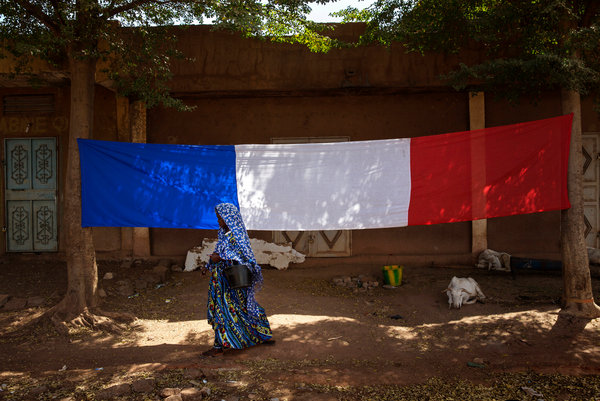
For how long? Photo by New York Times
This is my last blog before turning the reins back over to Jim, so I thought I would sign out with the state of play in Mali, a country near and dear to my heart.

4,000 French troops, along with several hundred Chadians, and smaller contingents from Benin, Burkina Faso, Nigeria, and Senegal, have retaken the three main Northern cities of Timbuktu, Gao, and Kidal, and pushed the main body of insurgents northward into the Adrar des Ifoghas mountains on the border with Algeria.

Estimates put total insurgent numbers, spread among three or four different groups, around 4,000 – 6,000, and French forces report the rebels are well armed and better trained than expected.

The Good:
– The hardcore Islamist leadership is dropping like horses in the Tse-Tse belt. A mess of confirmed and unconfirmed reports claim that French and/or Chadian forces killed two leading figures in the assorted extremist groups currently fighting in Northern Mali.
– These leaders— Mokhtar Belmokhtar and Abdelhamid Abou Zeid—are committed international Jihadis from outside Mali, with long histories of murder and kidnapping. (Disclaimer: Belmoktar’s death remains unconfirmed)

As much as some readers may hate force, or the idea of the French using it in West Africa, I would argue that brute force helps separate the committed jihadis from opportunistic locals.

Joining a rebel movement seems like a much better play when they run your hometown, claim to fight your traditional enemies, or pay the best of any employer in town.

That line of work looks far less attractive when your foreign (likely Algerian or Mauritanian) boss is running for his life through the dessert.

The Bad:
– So far, diverse Northern communities are broadly receptive of the French intervention.

However, this is horrendously complicated and could turn at any moment. A few things you should keep in mind regarding about popular opinion in Mali:

Anti-northern attitudes are hardening in Southern Mali—especially negative feelings toward Tuaregs.

This xenophobia will complicate the post-conflict scenario, as Southern elites will come under serious pressure to punish the North. In the North, communal divisions make coalescing behind moderate representation nigh impossible.

See this great post by Bamako Bruce exploring the historical roots of inter-communal antipathy….

Essentially, the Tuaregs have been slavers for most of the territory’s history, so the former slaves find it rather difficult to see Tuaregs as victims.

The Ugly:
– There is no centrifugal force currently capable of creating a unified, functional Mali. Watch this two-minute Stratfor video on Mali’s geographic challenge.

Nothing has changed.

A military occupation by a superior force can enforce a temporary peace, but not make a state. The French are facing intense domestic pressure to make good on Hollande’s claim that this would be a short term operation, and every French soldier that dies (three so far) makes Mali look more like Iraq to the folks back home.

Optimism…?:
– Sure. But really just for optimism’s sake.

Mali needs representative, viable, and politically palatable representation in the North that can lead a constituent assembly, or at least claim to speak for Northern communities in negotiations with the South.

An armed peace held together by regional forces and or the (proposed) UN Peacekeeping mission might give Northern elites time to bargain over such a coalition.

However, I don’t think any of the current groups would be acceptable to the entire Northern population – the MNLA are too Tuareg centric, and the others are mostly too extreme.

The international community – especially the French – should immediately begin using whatever leverage they have to kick-start the bargaining process before the extremists come get back from the mountains.

Borders and Blood

Borders and Blood

by Conor Godfrey
I’ve been accused of being a relentless Africa booster… this is almost certainly true.

To fight back, however, I am going to offer a scarier version of the continent’s next thirty years that has taken up serious mind share recently.

This idea will hopefully pass muster as a research topic, so I would certainly appreciate your feedback as I am just getting the full proposal together now.

From the late 90s to the present, we have seen tremendous agitation around African intra and inter-state borders.

I would argue that this started with the Ethiopia Eritrea war (1998-2000) and would include the escalation of civilizational conflict inside Nigeria and Mali, the 2006 Ethiopian and the 2012 Kenyan invasions of Somalia, and, of course, the separation of Sudan and South Sudan.

Dozens of conflicts—including many in the DRC—do not make this list because they did or do not fundamentally challenge the status-quo colonial borders.

You can quibble with or add to my list – that is not the point.

Before this decade the Colonial borders exhibited nigh unprecedented durability. Here is a list of African border changes post WW1… 90% of them were trades between colonial powers.

My point (or wild hypothesis if you will) is this… from independence to 2000, most African states did not possess the material capabilities to mount a sustained challenge to the territorial status quo; doing so requires states to centralize political control, neutralize domestic opponents that pose a threat to the state, and have the material resources necessary to take, hold, and administer territory.

As the U.S. knows well, this requires lots and lots of money (not to mention a professional military and a tolerant domestic audience).

For this entire period, states concentrated on papering over the inconsistencies built into their illogical creations, and, if hostile foreign action were required, they relied on cheap and effective proxy militias and other irregular activity rather than large-scale mobilization.

The Council on Foreign relations writes —not totally persuasively in my opinion—that keeping colonial borders gave African leaders “reciprocal insurance” against invasion, and that leaders were more concerned with arguing over who controlled state resources than fighting over borders.

So why are things coming apart at the seams (pun very much intended)?

This could, after all, just be a blip, a decade long aberration on an otherwise century long consolidation along the lines drawn on a cocktail napkin in Europe.

Here is what I think:

1) Differential Growth: The continent is booming, but not everywhere feels the love.

As some countries outpace their neighbors they will be tempted to acquire the military capabilities to favorably alter the territorial status quo.

Colonialism left hundreds of potential territorial flash points, and for the first time since independence, some African states can likely do something about them.

Differential growth also exacerbates tensions within countries.

As globally connected and well endowed regions grow faster than other provinces inside the same country, resentments build and fuel long simmering separatist ambitions.

This narrative plays itself out most visibly today in Mali, Nigeria, and Cote d’Ivoire, and to a lesser extent in Kenya and Uganda.

2) Resources: As mentioned in this post, Africa is massively under prospected and companies are racing to catch up.

A powerful country may have let unfavorable borders lie when no rents could be extracted from the disputed territory, but what happens when billions of dollars of oil and gas hang on a few lousy kilometers, and investing in a miniscule navy would be sufficient to enforce a fait accompli on the border?

There are a number of possible mitigating factors—colonial withdrawal, regional integration, economic integration, etc… — but I will save those for some future post.

This is worth getting right. I would hate to see a decade of phenomenal growth and progress undone in an orgy of territorial revisionism, and reasonable precautions could help stop spirals of security competition before they begin.

President’s Day

President’s Day

The Presidents’ Day Holiday in America, today, is perhaps the least celebrated of the year, and it shows how America like much of Africa is moving away from a powerful executive.

The exceptions validate the rule, so the dozen or so African dictators still in power in places like Uganda, Zimbabwe, Cameroon and Chad, among the most egregious, delineate the old days. As modern African societies emerge and new constitutions are formulated, the chief at the top gets less and less power.

The outstanding example is the “New Kenya.” While the man who will be elected the first president under its new constitution in just a few weeks will be the most powerful man in that country, his powers will be significantly limited compared to the powers of current and former Kenyan presidents.

The “New Kenya” is the wave that is sweeping most of Africa. Modern African societies realize that single personalities – the Grandpa authority – are no longer appropriate as social chief executives.

Ultimately, I believe even America will have to come round to this view. Our president is one of the most powerful social chief executives in the world; probably the most powerful among democratic countries. I think this may have worked well in year’s past when essential U.S. policy was pretty unidirectional.

But today, with radically opposed polarities, the prospect of a strong liberal president being succeeded by a strong conservative, etc., does little to move society in any direction but crazy figure eights.

The new societies – the emerging African societies – are designing and experimenting with better forms of democratic, capitalist government. America will have to follow.

Many government offices are closed, today. Banks are closed. The post office is closed. Some schools are closed and most businesses, like EWT’s, are “technically closed” with the phones not answered. But many workers — perhaps most in America — are at their desks like most any other work day.

Perhaps an affirmation that a strong chief executive shouldn’t be quite so empowered, anymore.

First Time…

First Time…

By Conor Godfrey.
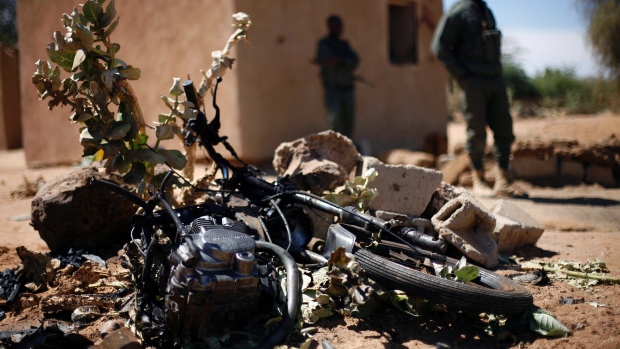
Two days ago the first Malian in history blew himself up in an attempt to kill others.

Americans have become so inured to suicide bombings that this fact may seem tragic but inconsequential.

Most Malians, however, have yet to recover.

This simply does, or did, not happen in the land of Sundiata Keita.

Nowhere in Songhai chants, or Fulani poems, or even marshal Bambara stories do people talk about strapping bombs to their waist and taking innocent lives.

In centuries of warfare between Arab and Bantu, nomad and farmer, Muslim and pagan, such a thing as never happened.

Let us try for one moment to return to our pre-9/11 innocence and feel some shock, and some sympathy for a corner of the world previously uncontaminated by this particular evil.

I remember when the first Boko Haram suicide bomber blew himself up in Nigeria.

My Nigerian friends and colleagues were stunned. It seemed as though they took the attack as an indictment of the culture they thought they knew and understood.

Even mass killings of Muslims and Christians on the Nigerian central plateau did not generate one-tenth the moral outrage of that single suicide bombing.

Inter-communal conflict was something they understood intuitively. This business with bombs was not.

Americans have become unconscious experts at shielding ourselves from the emotive power of a suicide bombing. We have had too.

Erecting effective psychological defenses against suicide bombing requires neutering all the emotional content of a suicide attack.

In silent partnership, the news consumer and the news provider reduce an attack to its purported essentials – the death toll, the mechanics of delivering the bomb, and which group of crazies was claiming responsibility.

In Mali’s virgin case—two deaths, by bicycle, and the Movement for Oneness and Jihad in West Africa (MUJAO).

Why do we wallow in the raw emotionality of a natural disaster, or school shooting, or even an individual suicide, but culturally divorce ourselves from the most heinous and powerful act of violence and protest available to today’s discontents?

I think it remains much easier to homogenize people we don’t understand in far away places by reducing their actions to banalities like numbers of wounded and how the attack took place.

Stop and think about what we’re saying; someone was just willing to die in order to kill!

If we let ourselves feel the tragedy of a homegrown suicide bombing in Mali, we would probably have to ask why the attacker felt strongly enough to blow himself to pieces.

Through this we would learn, to our concernment, that he was not ‘crazy’ in the sense of being insane, and all this introspection might lead us to think more clearly about the blowback from our global war on terror.

These thoughts will of course feel vaguely (and wrongly) treasonous.

It is far easier just to think of Mali or Africa as somewhere used to getting a raw deal.

Maybe somewhere where life comes a little cheaper, and craziness prevails. This is nonsense, but hard to shake if you were raised on the same images and news coverage I was.

Fight the urge to disassociate and dismiss.

The new normal is NOT normal in Mali, and an entire society will need to rebuild its sense of self (or senses of selves) in a world where the tears in the cultural fabric are large enough to permit boys with bombs bent on self-annihilation.

Vested Interest

Vested Interest

With one month to go, President Obama admonished Kenyans to hold a peaceful election. Obama wasn’t just preaching the word. Critical U.S. policy is predicated on a successful Kenyan election outcome.

There was nothing surprising in Obama’s one-month-to-go pep talk. But as I listened to it, I realized it was powered by the deep behind-the-scenes U.S. African foreign policy that has driven so much of African history in the last few years.

The routing of al-Qaeda, the pacification of Somalia, the fugitive chase of the LRA, the massaging of Rwanda hegemony, the less successful use-and-throw-away Uganda geopolitics, the deep skies of drone assassinations – it’s all a remarkable mosaic of clever and intricate U.S. policy.

And Kenya is the linchpin.

Unfortunately, the policy is driven overwhelmingly by Obama’s hunt of terrorists. That’s a fine thing to do, don’t misunderstand me, but developmental imperatives seem to get attention only when the greater objective of wiping out the terrorist prevails.

So that the “war on poverty” is far subservient to the “war on terror.” This is short-term strategy.

Kenya is fundamental to this policy. America rebuilt Kenya’s military and notably the product looks mighty good. Compared, for example, to Mali or Nigeria or Afghanistan, the Kenyan military forged enough independence and local celebrity identity that it functions better than anyone could have imagined only five years ago.

And there seems to be no dichotomy between the military and civilian authorities, as in Pakistan, for example, or Egypt. America has created a fighting arm in Kenya that is totally beholding to its brain.

That’s good, yes. And from Obama’s point of view, more importantly, it’s been effective.

Now comes the election, the ultimate validation of a non-revolutionary society, of a stable politic based on “strong institutions” and “just government.”

No country in the world today can achieve what America did in 2000: institutions so strong they prevailed even while being irrational. That’s what happened when the Supreme Court effectively – with no precedent or authority whatever – wound down the mechanisms of challenge and handed victory almost willy nilly to the man who had lost.

And the defeated graciously walked away to become a billionaire.

That standard is unattainable by any but America. But Kenya can come near enough to validate the policy that sustains that potential. If it doesn’t, Obama policy in Africa will in a blink no longer be validated. If Kenya unhinges itself by Bronx Cheering the very institution on which Obama policy is founded, then everything the U.S. has done in Africa is lost.

Somali could tear apart, again. Militias in the jungles of The Congo would rearm and reform. The Arab Spring could become Arab Hell. Terrorism would be reborn.

It sounds like an exaggeration.

Jump Start

Jump Start

Less Titling, (c) Washington Post
In a much saner way than America, Kenya’s presidential campaign got underway yesterday. Saner, because it will be done and over six weeks after beginning!

This is, of course, the big one folks. Not only will it choose the first truly democratically elected leader of Kenya, under its new and fabulous constitution, as the country’s growth explodes and it winds down its war in Somalia, but it will determine once and for all if Kenya is a safe place.

Safe to invest in. Safe to live in. Safe to visit as a tourist.

It’s that simple, and that breathtakingly important.

Most national elections determine fiscal and economic policy, security issues and legislative agendas. And this one will, too, but the most important question in this election is actually not who wins, but what happens after they do.

The polls are pretty uniform in suggesting that the winner will be Raila Odinga, the current prime minister, as I very much hope will be the case. But few people are concerned with whether the election outcome will be that Odinga wins, more than they are with whether the outcome will be as with the last election in 2007, the country explodes in violence.

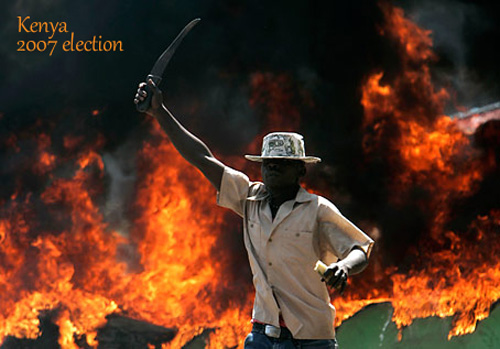
Last time round the country exploded in violence because there were sore losers. Two of those sore losers are running again, one for President (Uhuru Kenyatta) and the other as his running mate (William Ruto).

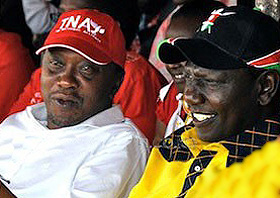
Uhuru Kenyatta & William Ruto
The two have been indicted by The World Court in the Hague for having incited the violence of 2007, paid to have it continue, and actually organized some of its worst atrocities. Remarkably, they have both traveled to The Hague to answer the charges and – at least until this point – agreed to be tried.

The last election was the first true attempt at national democracy. I remember watching the returns on the internet very much in real time. The problem was that the returns were giving the election to Raila Odinga, who was opposing the sitting president, Mwai Kibaki.

It was blasted deja vu to Gore/Bush. Internet returns suddenly stopped and the media began reporting all sorts of irregularities in the transporting of election ballots to the counting authorities.

The sitting president declared himself the winner. It was ridiculously premature. The rest of the world shook nasty forefingers at Kenya … except for America. President George Bush called up Mwai Kibaki to congratulate him on his victory. It was around 11 p.m. Kenyan time. Kenya media exploded with the announcement.

No other world leader did the same. And the next morning fires started.

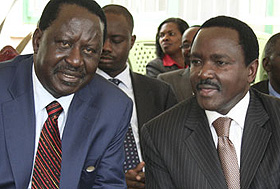
Raila Odinga & Kalonzo Musyoka
When the violence began it was basically the poor of Kenya – found mostly in its slums and who had supported Raila Odinga – against the rich. Which included the police and politicians.

But it quickly degenerated into an ethnic war. Mwai Kibaki is Kikuyu. Raila Odinga is Luo. They are the two largest tribes in Kenya, and while as in Northern Ireland the Catholics are generally the poor when compared to the Protestants, so are the Luo when compared to the Kikuyu. So the battle was forged on grounds long prepared.

Uhuru Kenyatta, who was set to become a major official in the Kibaki government, is also Kikuyu. William Ruto is a Kalenjin, historically an arch enemy of the Kikuyu, but in this case the enemy of my enemy is my friend, and so the Kalenjin allied themselves with the Kikuyu.

Ethnic violence began to tear the country apart.

According to voluminous documents now in The Hague as the trial of Kenyatta and Ruto progresses, those two so-called national leaders planned and fomented the violence.

It took a number of months, Kofi Annan, heavy hands and wallets from the U.S. and Britain to quell the violence and create a power-sharing agreement between Kibaki and Odinga which held until today.

It has been a remarkable recovery. Odinga and Kibaki have actually worked well together, mostly because Odinga despite the details of the power-sharing agreement, always took a backseat to Kibaki.

But under their leadership, the country created a fantastic new constitution and steered towards a path of unexpected economic growth. Kibaki never intended to stand for election this time, and needless to say, that helped enormously.

Kenyans remain very ethnically racist. The younger are much more tolerant than the older, but even the young struggle with ethnic identity. And because there are more than 40 ethnic tribes in Kenya and really more than half dozen greater ethnic coalitions, there is no single ethnic group that can determine a national election.

Odinga probably won last time (as Gore did) and is projected to win this time, because his policies – not his ethnicity – align best with most Kenyans. It is fair to say if he doesn’t win, it has less to do with policy than ethnicity.

Will Kenyans reach into their minds rather than their hearts for how to vote? That, of course, is a separate question from what they will then do if their decision is not validated by the outcome.

Frighteningly Wonderful in Mali

Frighteningly Wonderful in Mali

France’s liberation of Timbuktu and defeat of Malian Islamic revolutionaries is right on schedule and demonstrates perfectly the American/French axis routing world terrorism.

Sunday’s Meet the Press roundtable was in contrast the perfect example of how fooled and even bamboozled old guard American media personalities still are. Andrea Mitchell excepted, the remaining two old men got almost everything wrong:

Ted Koppel who presided over the creation of the War of Terror in the media predicted “we’re entering one of the most dangerous eras this country has ever experienced.”

Wrong.

“I think it’s even bigger and more troubling than that,” pounced Bob Woodward, the man who broke Watergate and was apparently broken by it in return.

I’m making no bones about saying that France’s action will be short-lived, especially by the standards of American foreign involvements, and that it will be generally successful. As I said in earlier blogs, I think this is the end-game for the current era of terrorism. That doesn’t mean the end to terrorism, of course, just the end of the al-Qaeda chapter.

The end-game wasn’t supposed to be quite so publicly bloody, and this is largely because of American missteps in Mali. AFRICOM was the new American African command that set in pace a number of militaristic actions I’m ambivalent about, but which did chase al-Qaeda from Yemen to Somalia to central Africa and finally to North Africa where it was supposed to desiccate in the sand.

This three-year chase fragmented what had been a more structured and organized group of very bad guys. Separately, the Obama drone assassinations took out dozens of terrorist leaders, including of course the Top Gun. Like Sherman plowing through Georgia, death and destruction has been left in the wake, but…

…al-Qaeda is gone, Somalia has been pacified and terrorism has been chased on a long arc from Afghanistan down into east Africa and back up to North Africa … where now the French are pummeling it to death.

It got messy in Mali because Americans don’t speak French right. We trained the Malian army and held it up to public scrutiny as a model for modern African armies (allied, of course, to the west).

But those pesky French-speaking Africans got naughty and staged a coup against what we had also championed as one of Africa’s most stable democracies, and together with a few other events like generations of weapons released from Libya, the current war was precipitated.

Tuaregs have been fighting for independence since the dawn of the camel, and al-Qaeda remnants fleeing America’s silent sweep, pushed north into the southern flowing Libyan arms made uncomfortable but convenient bed fellows. For a while.

It couldn’t last. It didn’t. But it was strong enough long enough to give the French cause to attack. The French don’t dither like Americans. They never have, and their unique forms of morality are the same which continue to celebrate Napoleon’s tomb in the Champs de Mars.

So now what?

North Africa is a mess, but it isn’t the global threat that Afghanistan was. The trouble in Egypt is internal and will last for some time, but it will not spread. French foreign legion will be in Mali for some time, now, but fighting will diminish not spread into Niger or Nigeria as old men American commentators claim.

And the terrorism threat will diminish. The world will be more peaceful.

So why am I so unsettled and near sarcastic?

Because this was all planned. I see everything having happened to a a near perfect specific plan, a covert military mission organized by the Obama administration, cleaned up by the French. The French weren’t supposed to come out of the rafters, but they had to translate for the Americans. That was the only unplanned move. That this all worked and made the world peaceful is good.

That it is covert and so strikingly successful is terrifying.