Konza of Kajiado

Konza of Kajiado

Ground breaking my eye, what happened 35 miles from Nairobi yesterday was nothing less than the Big Bang.

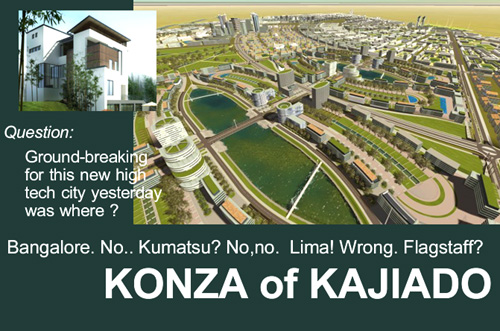
“Kenya’s Silicon Valley” they call it: 37,000 luxury homes and apartments, 70 acres of high-tech complexes, highways and public tennis and golf courts, several universities, high speed rail to Nairobi, 4-lane superhighways, buried electricity and fibre optics.

I know I sound like a very old man, but I can’t believe it. “Konza City” was born yesterday, and if it stays on track, by 2020 it will rival the most advanced tech cities in India and create more than 200,000 new high-skilled tech jobs.

Not only will it have call centers that we all know and hate so well serving us as likely as Proschnik in St. Petersburg, but it will have dynamic research facilities building on Kenya’s promising lead in expensive cell phone technologies, as well as medical and agricultural research facilities.

Its developers champion “green technology” and so there will be considerable solar polar.

The Kenyan’s call it a technopolis. The World Bank has funded the $330 million high speed railway that will connect the area to Nairobi, and planning is already well underway. The first rails will be laid in 2014.

But private investors are contributing up to $1 billion to a variety of areas, from private home construction to tech factories to malls. Already smaller Nairobi investors are vying for placement for car shops and grocery stores. $1 billion dollars in Kenya is easily equivalent to $100 billion in America.

More than 250 global companies have already pledged involvement, including Huawei, Samsung, RIM, and Danish Technologie.

The estimated private plus public investment that will have been spent by 2020 is expected to exceed $10 billion, which is an equivalent $1 trillion in the U.S.

I am astounded, and I admit somewhat skeptical. But I was equally skeptical only ten years ago regarding what Kenyan planned to do by today. Today its highways are reducing country-wide congestion, its education system has leaped forward, and a variety of new technologies are performing very well.

But Kenya has to get its political act together to truly manifest this dream. It has to at least achieve the level of transparency and accountability that exists today in India, or in a completely different fashion, the stability and control of a China.

Right now neither of those directions are certain. I’m encouraged that multinationals like Samsung are willing to invest heavily, but this dream will take multiple Samsungs.

The troubles confronting Kenya this minute are formidable, starting with the yet completed pacification of its neighbor, Somalia, to the still top-heavy and corrupt political leadership.

But it is getting better, and the election on March 4 will tell us a lot about whether dreams like Konza are real dreams or pipe dreams.

Voodo & Algebra

Voodo & Algebra

No time for nostalgia in Africa: The continent’s development is so fast, its demographic so young, kids are spinning like tops. It’s fabulous and scary.

We old folk simply get dizzy. Kids like dizzy. And we old folks should be very careful about criticizing this seemingly directionless enthusiasm. When the top finally stops spinning it’s going to land somewhere with a very loud thump.

Richard Engel of NBC news expressed it in a most dire fashion Sunday on Meet the Press when he said that African youth — and youth in general in the developing world — are looking away from America towards China.

He’s right. In fact I thought almost everything Engel said on Meet the Press was right, and he got clobbered by my age-peers for saying so, or just ignored. But Engel is right on. Democracy is just a tool in the basket of social organization, and right now, it’s not the most attractive one to African kids.

Imagine if you were a just cognizant self-aware Kenyan teenager when Bush invaded Iraq, your main city of Nairobi was a massive jumble of stick buildings and sewered-over roads, your school hardly had pencils and all you and your buddies could afford were pirated CDs of MnM from China.

And today your city of Nairobi has skyscrapers and 8-lane highways, thanks to the Chinese who all you had to give them was your oil; your school has computers and you have a Smartphone, thanks to the Chinese who all you have to give them was your oil; and you’ve started your own rap group that will be performing next month at the famous music festival in Zanzibar.

Thanks to spnsorship from the Chinese who are funding the electricity in Stone Town, and all the Tanzanians had to give them was their gold.

Well, before you grow old enough to analyze all this, who would you be thanking?

Engel is right. America and the west has disengaged, not intentionally not because Obama and Hillary aren’t doing infinitely better than Bush or Condoleezza, but because youth moves faster, and today, Africa is youth.

Social organization is only one thing.

Cultural organization is equally fascinating.

Eighteen-year-old Adrien Adandé of Benin is a decent enough high school student. But after turning in his history term paper and the school bell rings, he chooses rather than join his buddies in the locker room to gear up for the school’s winning soccer team, he’ll do voodoo.

“My friends tease me and call me a fetishist,” he explains. “Others keep away from me, fearing I might harm them with my amulets. But I stand by what I do. I can combine my studies and my vocation perfectly.”

We often look back at our own youth and marvel at how things have changed. Nostalgia often gets the better of us, and we pine for the past, and the past is uniformly slower, more tranquil and seemingly less demanding of our energies.

Imagine African youth, today. They aren’t even old enough yet really to look very far back, but every second backwards is like an epoch in time. The transformation is too fast for nostalgia. Cultural takes time to form.

Radio Nederlands quoted a 23-year-old Benin philosophy student who explains Adrien’s voodoo as a means for youth to anchor themselves: “With globalization [and] the expansion of the so-called revealed religions… young people have turned away from” modern culture.

The “Market” understands. The “Market” moves faster than governments.

One of the most suddenly successful marketing and media firms in Africa is Instant Grass, which is devoted to helping vendors sell to youth. But its reports – free from its site – outdo western university Ph.D. studies on what is happening to youth, today, in the developing world.

“The rise of the Internet and mass media has also confused identity further with Western/African-American culture having a strong influence. The reaction of African youth is to create an eclectic culture that embraces both MTV and traditional practices and thinking that flits effortlessly between the two.”

Ergo, voodoo and algebra.

This is an absolutely astoundingly colorful and awesome dynamic to watch. And I truly believe the outcome will be positive. There is simply too little egocentrism in African youth, today, to result in limits to personal freedom. Dictators are gone.

But be prepared for something that isn’t necessarily the democracy of America. And there’s nothing at all wrong with that.

King, Racism & Obama II

King, Racism & Obama II

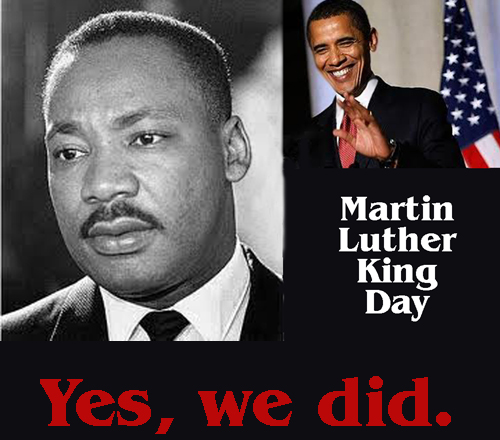
Today is one of the most important benchmarks in the American calendar, the Martin Luther King federal holiday. When I look back a year, I see progress towards greater social justice all over the world.

It isn’t uniform, of course. What’s transpiring in north Africa seems at this moment a step backwards. The misguided South African ruling party toys with national catastrophe. Central Africa is more turbulent than ever, and the entrenched and wicked leaders in Uganda and Rwanda seem hell-bent on those countries’ global isolation and backwardness.

Dr. King was the most profound proponent of radical change by and strictly by non-violence. That means his version of social change must come either within the existing system or through non-violent civil disobedience.

It is hard to imagine how Mali, Uganda or the eastern Congo will be moved forward by non-violence.

But even during Dr. King’s days civil disobedience was not without violence. Was the threatened doctors’ and nurses’ strike in Kenya to be non-violent? Technically, yes, but thousands would have died. The many various teacher strikes throughout Africa this year were all non-violent per se, but children denied their only substantial meal of the day became sick.

What I most remember of King’s turbulent last days was unbelievable violence. My most vivid memory is as a very young journalist penned under a burning El Stop in downtown Chicago while the city raged in reaction to King’s assassination.

I remember gun fire was a regular sound in my low-rent apartment in Washington, D.C. during the summer of 1968. Or the unending sirens and tear gas around my apartment in Berkeley that fall.

King is duly revered for radically changing American society with non-violence. Yet what I remember most is fire, bullets and ambulances.

Today President Obama is inaugurated for the second time. Our first African American President, some of whose relatives still reside in Kenya. The racist opposition to him remains strong. Powerful white elected representatives in Congress still engage in racial slurs and oppose him simply because he’s not white.

During his first term he battled mounting opposition to reverse his election on the grounds he wasn’t a native born American, despite his native State of Hawaii publishing nearly a million official copies of his birth certificate.

The horrible individual gun violence which has occurred in America during his first term, in cities like my native Chicago, and in horrific incidents like Sandy Hook and Aurora is due certainly in part — perhaps large part — to the growing ethnic and social divides that cleave America apart.

King’s philosophy of non-violence, like Gandhi’s and to a much lesser but significant extent Mandela’s, were not eras of no violence. There was incredible violence, and this violence — as with the sizzling El Stop that nearly fell on me — will be blazoned in our memories forever. But with time we’re able to reflect that that violence was the reaction to those heroes’ methodical, unswerving actions for a freer, fairer society.

And that the victims of that violence, whether a young student protestor clobbered by a policeman’s baton or an innocent six-year old school child gunned down by a madman embodying the evil of his society, are the heroic soldiers in a more just war than those who fire on enemies to wear medals.

Today, my President is black. My Attorney General is black. Dozens of colleagues, friends, employees and clients are yellow and orange and black, and this compared to my father’s generation would have been all but unbelievable. The world has changed for the better.

Happy Birthday, Martin! You’d have been 84, today!

Line Up Punctures the Big Top

Line Up Punctures the Big Top

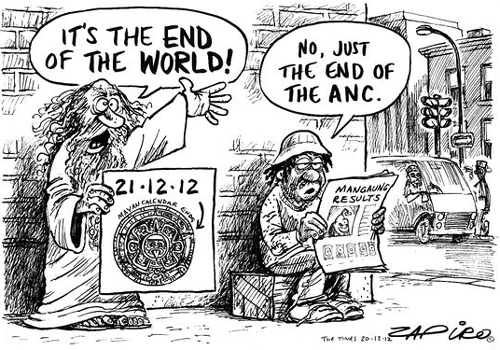
Much like China’s communist party convention, South Africa’s ANC convention that ends tomorrow was supposed to determine who runs the country for as long as the next decade.

South Africa’s African National Congress has run South Africa since the end of apartheid with its standard bearer and first president, Nelson Mandela. The ANC’s history goes back much further than Mandela, though, well back into South Africa’s racist history. And quite often the ANC vied with the much more radical communist party of South Africa for political control.

And it usually won. Nevertheless, over its century of existence the ANC was decidedly leftist and especially recently just before the end of apartheid. Its structural models are larger Chinese, its leaders having been trained in Tanzania by Chinese functionaries.

I think it’s a good model for a developing society, and it’s a model that societies thrust into democracy mode too early often collapse back into; ergo, Egypt. Democracy can’t work unless a good portion of the electorate vote their conscience and a good portion of that have a rational understanding of their own self-interest.

If you don’t know why there’s a drought, and you don’t know how much a pump costs or have any idea how it’s made, and have no clue as to what an aquifer or reservoir is, as a farmer you have no ways to guarantee your own security.

And easier than understanding global warming, or market economy or hydrology, is to find someone who looks nice and claims to know all these things, your neighborhood dictator, who can assume a softer image by pretending to be a cleric or other type of grandfatherly godhead. Stalin was affectionately referred to as Grandpa.

The ANC was traditionally a collection of South Africa’s most prestigious black intellectuals and its central committee, like communist parties everywhere, was the helm of the ship.

And when the ship became the state, so did the ANC. Although an election for president of South Africa happens regularly just like here at home, the choice of the ANC candidates is made at their convention, and since Mandela and the mid-90s, whoever the convention nominates wins nationally.

And that convention is anything but democratic. It has all the bells and whistles of democracy, including women’s groups and youth group’s and worker’s groups, but all these groups are carefully fashioned by the central committee and it’s basically just a reenforcing loop of a small group of powerful men.

All this works more or less tidily provided …

… the guy at the top is sane.

South Africa’s current president is a wacko. In a mature democracy, we tolerate wackos at the top with moderate difficulty, like George Bush, II. It gets harder to do so when their understudy, Dick Cheney, is even more a wacko, but democracy is not as top-heavy as more socialist forms of government, and you don’t have to drill down too far to get to people like Colin Powell and and the legions of good civil servants.

The problem in a top-heavy system like South Africa’s is that it there is no working grass roots. There is no Colin Powell under whom serve a lot of hard-working, dedicated citizens. What you see at the top is what you get at the bottom. And so these last few years in South Africa have been a mess.

While the rest of Africa was growing gangbusters, South Africa was muttering along. Social goals like housing for millions of displaced poor fell decades behind schedule. Labor strife, particularly in its crucial mining sector, continues to be near catastrophically violent.

And the personality of the current president is…. well, wacko. He has multiple wives, believes he can protect himself against AIDS by showering well after sex, unapologetically has pilfered public funds and then publically ranted against cartoonists who portrayed him as unsaintly for doing so.

He’s escaped numerous prosecutions for malfeasance and criminal misuse of federal funds only to flaunt his accusers by building personal mansions with public funds. And the with this top-heavy system, it means that corruption and clowning now occur on a daily basis in the smallest municipality.

And this week the ANC nominated Jacob Zuma to be president, again.

What a joke. But here’s the rub.

A good portion of the South African electorate is democracy savvy. And already local governments in Cape Town and a few other cities have thrown off their ANC shackles.

Maybe, South Africa is ready for democracy.

Better Than Democracy

Better Than Democracy

What if they don’t want “freedom”? What if they want a benevolent dictator operating in a framework of Sharia law? Is such liberty to be denied?

The Egyptian diaspora begins voting on a proposed constitution Saturday. A week later, those in Egypt will vote and within two weeks Egypt will likely have a new constitution.

The proposed constitution looks a lot like the old one under Mubarak with one notable difference: the elected president is limited to two 4-year terms.

The powerful role of the military, the judicial process, the suppression of women (tantamount by notably saying nothing about them and referring to citizen rights as the “right of men” and founding law on Sharia), the legislative process and internal geopolitical map are all carbon copies of the Mubarak years.

In addition to the limited terms of an elected president, the effective control that current president Mursi has on the military actually seems greater than Mubarak’s.

Amnesty International who I support strongly is livid. In their article published last week they described with vengeance case by case of Tahrir Square protestors injured by tear gas canisters dated March 2012 and sold to Egyptian police by Americans.

The article ends, “One thing is certain: the protesters will not accept a return to rule by decree, or accept a constitution written by a committee that doesn’t speak for them.“

Is the filibuster more important than one-man, one-vote? What if the protesters are not the majority?

I don’t want to get too philosophical, but we are at least breaching philological meanings of democracy and it strikes me as remarkably parallel to Harry Reid’s current conversations about Senate rules.

Amnesty, Human Rights Watch and other champions of human rights are unanimous that democracy is not as important as their own missions to protect basic human rights.

So that means that protecting basic human rights is more important than freedom, democracy or liberty, right? Do you ascribe to that?

I do: democracy is not always the best mechanism for achieving the most important goals of protecting human rights. And right now in Egypt, we have the greatest example I could ever have concocted to prove this.

Democracy brought both Hitler and Mussolini to power. It enshrined racism in America’s south for nearly a century. Democracy protected torture under Bush; it freed the thug Nixon; it allows even today Peronists to destroy Argentina.

And right now in front of our eyes democracy is crushing the marginal advances in human rights protections that Egypt has made the last generation.

Because that’s what the majority of Egyptians want. That’s the manifestation of democracy.

Are the majority of Egyptians bad? Let’s phrase that more acceptably: is what the majority of Egyptians feel they want as government bad?

Yes. Because, we say with arrogant displeasure, they are either too dumb and uneducated, too coopted by an oppressed civilization, or too immoral to protect human rights.

No! say the protestors in Tahrir Square and herein lies a great test of democracy. The liberals who wish to protect human rights in Egypt as in the U.S. may be in the majority, but they have never coalesced into succeeding well in a democratic system.

Some argue, now, that the incredibly fractured Mursi opposition will coalesce, because if they don’t, they’ll be crushed.

In America a similar argument has proceeded throughout my life regarding the many different directions and movements that have continually had difficulty coalescing into the Democratic Party. Maybe America’s democracy is mature enough that it works for us, today, from time to time.

But in Egypt? I don’t think so. The same self-destructive motive that governs any older American to vote Republican and diminish his rights under Medicare and Social Security, or for any woman to vote to promulgate law to govern her pregnancy, is identical to the majority of Egyptians today who are equally self-destructive, willing to sacrifice their basic free will for something else.

What else?

Probably security. Probably promises of economic advancement. Maybe just more cash.

It happens here, too.

Democracy is sloppy and as society moves into the instantaneous informational age that makes sneaky theory less long-lived, it may be out of date.

Human rights is more important than one-man, one-vote. Egypt does not seem to believe this. And so…

… are human rights so important that they should be protected from without? How far do we go and remain morally correct? Are we a global community first? Or do we dare to accept our brother’s immorality because there is something even more precious than human rights?

Self-determination. Because we are uncertain of the inviolability of our own morality? Because … we might be wrong?

No More Grains of Rice

No More Grains of Rice

Susan Rice’s performance on the Sunday Talk Shows incorrectly explaining the Benghazi attacks is a perfect example of how she has historically allowed political considerations to trump more important foreign policy or human rights considerations in Africa.

She’s been acting like this for years. She seems incapable of intricate analysis and quiet diplomacy. She’s no engineer of foreign policy. She’s a cheerleader. Africans don’t like it. I don’t like it. Americans should not make her the Secretary of State.

Her list of failures in Africa is impressive: Blackhawk Down followed by the Rwandan genocide followed by the East African embassy bombings followed by the escalating instability of Darfur followed by the poorly created South Sudan and most recently, the mishandling of the growing violence in Kivu and Goma.

There are more, but these are the main ones.

Contrary to the Huffington Post that I usually love, there were plenty of warnings that the Kenyan embassy was going to be attacked in 1998.

An Egyptian agent, or double agent initially set up by the FBI gave warnings of the attack on East African embassies about nine months before it happened. The details were published long ago by the New York Times.

After years of further investigations, Frontline organized all the evidence in a way that was resounding proof that plenty of warning had been given, warning that had been ignored. At the time, Susan Rice was advising President Clinton on African affairs and had to have been involved in the decision (or lack of decision) to do something about the intelligence.

Today in Nairobi the “August 7 Memorial Park” stands as America’s remembrance of the bombing and in particular remembrance of the 238 Kenyans who were killed. I’ve visited the memorial often and it includes a short movie that also describes a workman who came into the embassy hours before the bombing and tried to warn everyone to leave, but who was ignored.

The memorial has had a website for years: memorialparkkenya.org. The URL is confirmed by Google. But the website no longer works… for some reason.

I was in Nairobi and heard the bomb go off. It is a day I will never forget, and I will never forget what I’ve learned about it, even if websites die.

But worse than the 1998 bombing was the 1994 genocide in Rwanda. The U.S. and France are specifically responsible for having allowed the genocide to happen by their actions blocking the Security Council from sending in more peace-keeping troops as desperately requested by the Canadian General at the time.

France refused to increase peace-keeping because of a complex historical feud with Belgium and France’s blind support of the Hutu who at the time were plotting the genocide but had been seriously repressed by the existing Rwandan regime.

Clinton backed France because of his being burned by BlackHawk Down. It was a cowardly response, and one for which he has since apologized.

There is a wealth of literature on this. The two best are the movie “Hotel Rwanda“ and the book, “We Wish to Inform You That Tomorrow We Will be Killed With Our Families.”

According to a former President of GenocideWatch, Dr. Gregory Stanton of Woodrow Wilson Center for International Scholars:

“The U.S. government was forewarned of the impending genocide. Communications were sent by cable, e-mail, and secure telephone… [But] Policy makers in Washington, D.C., especially Anthony Lake, Dick Clarke and Susan Rice at the National Security Council… did not want the U.S. to get involved in another African “civil war.”

The decision to “not get involved” hooked America into a mind-boggling expensive refugee and human rights initiative, followed by billions for Rwanda aid that continues today. But beyond the expense, we’re talking of at least a million lives lost.

The guilt of supporting Rwanda is something Susan Rice knows deeply and is deeply entrenched in. As the DRC Congo/Goma crisis deepened this fall, she specifically in her capacity as UN ambassador engineered multiple softenings of European led initiatives to impose sanctions on Rwanda to restrain its wanton support of the turbulence there.

A few weeks ago, America began reversing this overly cautious policy. It was terribly wrong in the beginning and has certainly led to more violence than was necessary.

Perhaps the best example of Rice’s inability to perform more than a political role was her performance in The Sudan, including Darfur and the creation of South Sudan.

The secession of South Sudan from the greater Sudan is overall a diplomatic victory for the world and most certainly a good move for the citizens there. It took more than 20 years and involved a serious civil war that the U.S. was deeply involved in.

But the creation of the new state was poorly done. Two years after independence, South Sudan is still mired in military difficulties with the north in a modern way, and with several ethnic groups in ways reminiscent of William of Orange. The untold oil wealth is not being mined because of this instability and a refugee problem within the country has grown severe.

Rice must shoulder much of the blame. She consistently created PR moments, sound bites and veneers of western institutions neglecting the much more difficult and intricate process of creating social institutions.

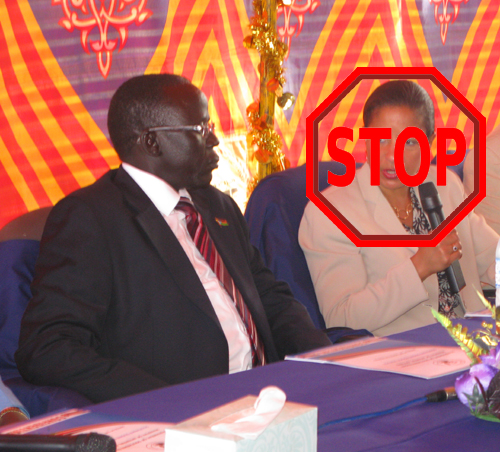
At a critical juncture in the negotiations that were leading to the two-country solution in The Sudan, Rice actually organized a rally of blurry-eye Juba citizens hurriedly rounded up for something more akin to an American political rally.

As reported by Matthew Russell Lee of InterCity Press who was traveling with Rice at the time:

“‘Are you ready to protect your country?’ [Rice shouted to the small crowd.]
Yes!
‘Are you ready for independence?’
Yes! … Another diplomat … would later call it a “political rally” and deem Susan Rice’s organization of the Juba leg as inappropriate.”

Rice has never displayed the insight or vision of a Hillary Clinton. She is schooled in American bureaucracy where she has percolated through the ranks and become one of its best soldiers.

One of Obama’s most serious failings is his inability to freshen up government. Rice like Geithner and others in his close circle, are old boys/girls who have rarely lived on the outside. While you might say the same of Hillary Clinton, it could be that rising to the top as fast as she did insulated Hillary from the strictures of soldiering Rice has not liberated herself from.

I’ve come to believe that Obama chooses people like Rice and Geithner not completely from a lack of his own personal courage, but because he very deeply believes in the American government status quo. He eloquently describes government’s ups and downs, but he sees overall America as on the right path.

I’m more radical. I’d like a visionary who shakes up government and doesn’t rely exclusively on old people with old ideas to join him at the helm. Africa has changed so quickly and so radically in my lifetime, I don’t think someone schooled and processed through American bureaucracy for her entire life is how we as Americans should be represented to Africa.

“Susan Rice’s chances of succeeding Clinton as secretary of state look slim,” writes a respected South African analyst.

And he, and I, think that’s just the way it should be.
Goma Solution

Goma Solution

Starve Rwandan and Ugandan dictators of any aid, significantly beef up the UN peace-keepers in Goma, allow the “Arab Spring” to develop and let the chips fall where they may.

That’s my solution for the Goma catastrophe.

It surprised me that Goma has stayed in the news. I’m not sure why, as the current crisis is probably less severe than multiple other ones in the past.

But suddenly there are Congressmen, movie celebrities and evening nightly news casts all talking about the catastrophe of Goma. Yesterday morning NPR featured a story and that was followed by an excellent hour of OnPoint featuring a Goma resident as panelist who writes the blog I have closely followed for several years.

This is so surprising but too overwhelming to explain. Anyway, we’ve got the attention that has been lacking for nearly 20 years.

Goma in particular and the Kivu province in eastern Congo of which it is the only large city has been an ungovernable cauldron of unspeakable violence, bubbling with untold natural resource riches, for more than two decades. The question is – and always has been – how to achieve the peace to release its mind-boggling riches.

While technically a part of the country of the Democratic Republic of the Congo (DRC), not since the ruthless and crazed dictator Mobutu has the DRC effectively governed, there. The city and the province are controlled alternatively by thugs, crazies on drugs, and ruthless militias all competing for the vast wealth under its soil.

The UN has had a peace-keeping force in Goma almost continuously since the Rwandan genocide. It’s had some success, but as demonstrated last week when a tiny militia of only 1500 rolled into Goma, the UN force is too weak to provide real security.

There are three players in Goma’s world, each with their own story:

RWANDA
Susan Rice is an important component in “what to do with Goma” and it’s not good news for her. I’ve never liked Susan Rice. My feelings probably originate with the fact she was Clinton’s closest adviser on African affairs, and she shares blame for much of what is happening, now.

Clinton could have prevented, at least for a time, the Rwandan genocide of 1994 but he specifically refused to do so. He has since apologized. Rice has been less forthcoming, although she was the person advising him. The presumption is that she concurred with if not crafted the decision.

The genocide and its aftermath resulted in more than a million Rwandan Hutus fleeing into Goma and Kivu. There they stayed, prospered as warlords and gangs that later became known as the Interahamwe soon posing a real threat to the Tutsi in control of the Rwandan government.

American guilt has never been so expensive. The amount of money the U.S. poured into Rwanda is absolutely mind-boggling. The stated mission was to provide security for Rwandans, especially from the Interahamwe, and to create a life style that has proved truly the envy of any African anywhere in east or central Africa.

But all this has happened at extraordinary cost, and there is no strategic need for America to do this, and the result has been to create a western country-oasis in central Africa.

No other country in Africa has fiber optic cable laid to its most remote locales. No other has a satellite “Museum of Photographic Arts.” No other African country offers a completely free 12 years of primary and secondary education to virtually every child.

The quality of medical care in Kigali hospitals rivals South Africa. Every Rwandan family is guaranteed at least one cow. The government intends that every single school child get a free laptop, with 32000 having been distributed before this year.

This is not a typical African country. It is a construct of western guilt. And it has created a monster:

Paul Kagame as president has imprisoned and assassinated every whisper of opposition. To him Goma and Kivu become a threat to him if they grow stable, as they will most certainly be ruled mostly by Hutus and at the very least provide sanctuary and training for his enemies.

From Kagame’s point of view, the only alternative to promulgating instability in Kivu is to give it to him lock, stock and barrel.

UGANDA
Uganda is the thug in the triad. Uganda’s western border is much longer with Kivu than little Rwanda. The Mountains of the Moon separate the two, but they are hardly a buffer to the experienced militia of the area, in fact they provide sanctuary.

Uganda like Rwanda has benefitted from the black-marketeering of rare earths in Kivu, and the current ruthless dictator president, Museveni, is a Tutsi. It’s abhorrent to him that his neighbor be ruled even moderately by a Hutu. And even more abhorrent that he be cut out of such rich black market rewards.

American support of the Museveni regime is even more embarrassing and immoral than its support for the Rwandan regime. I’ve written tomes on the horrible history of American involvement in Uganda’s repressive regime.

THE CONGO (DRC)
It’s ironic that the legitimate governing authority is the least important of the triad. The DRC has become an incredibly corrupt country. The president stacked the last election’s ballot boxes in almost comic ways yet succeeded. But the world recognizes the DRC as the legitimate governing authority, and so anything the world does will have to include it.

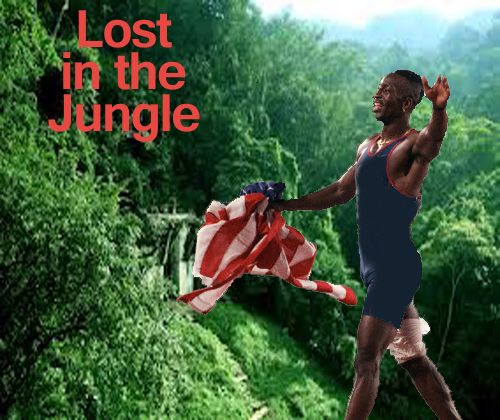
The U.S. is adrift in the jungle, still guilt ridden and not acting properly. The worst of American history is repeating itself. We are creating colonial proxies for our incorrectly presumed interests, regardless of the legitimacy of those powers and their history of human rights abuses.

We are propping up Museveni in Uganda and Kagame in Rwanda the same way we propped up the Shah of Iran and the Contras of Nicaragua. Will we never learn?

And with regards to Goma it paints us into an untenable position of broker between dictators. The actual people of Kivu, the students of Goma, the radio stations and attempts at free press, have no faith in America.

It is time to let the chips fall where they may, but our responsibility to redeem our malevolent past means we must first reduce Rwanda and Uganda to a natural state, a state without American blood money.

I don’t doubt that in the 4-5 years this will take that the turbulence in Goma and Kivu will escalate, and that absent the paymaster, Rwanda could teeter on new genocide. We can counter the worst of this by putting all our own chips in the UN basket, by considerably beefing up the UN forces and giving them a more aggressive mandate to maintain peace.

But it’s time to stop trying to master puppets whose strings slip from our hands with our tears. We are so terribly terribly sorry.

Better the Beast You Know

Better the Beast You Know

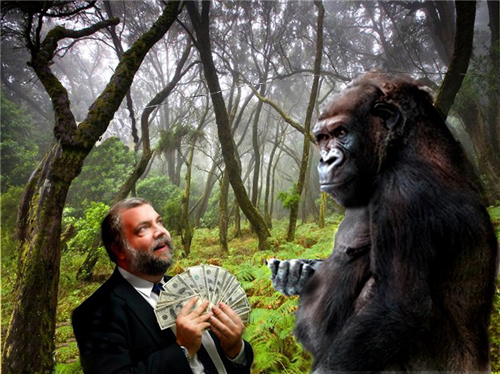
"Gorilla Taxes": original construct by pborgbarthet at worth1000.com
The second greatest conservation success story in my lifetime may be out of control. Mountain gorilla populations may be prospering because so are bribes and corruption.

The first mountain gorilla trek I brokered was in June, 1979. At the time Dian Fossey reigned on Karisoke volcano with no aplomb and great madness. But science had arrived and the population count was reliably put at 285.

That is a dangerously low number for any life form.

Last week a consortium of field biologists announced the current mountain gorilla count is right around 800. “Right around” is the euphemistic scientific phrase that means “we can’t get an exact count in The DRC Congo because there’s a war there.”

Nevertheless, the number is fabulous. The population of this awesome beast is not going extinct, at least not right now. And really the sole reason is tourism.

Mountain gorillas live in two places near to one another: Bwindi Forest almost entirely within Uganda, and the much larger Virunga Mountains (which is actually the highland forests connecting seven dormant volcanoes) which is mostly in Rwanda but a bit in Uganda and a bit more also in The DRC Congo.

Bwindi is separated from the Virungas by a 50 kilometer long forest corridor that gorillas likely could use to migrate, although little field science has confirmed this.

Three years ago when guiding a prominent American zoo group I experienced first-hand how a large portion of Bwindi “tourism” works: illegally. It had been often reported before, but this was my first personal experience. Years before, when Uganda tourism was not yet mature, I had a similar experience with my daughter that was actually far more dangerous. This zoo experience was not dangerous, it was simply corrupt.

I knew what we were doing from the getgo. Most tourists do not. A blog I found posted by an enthusiastic traveler last March is a perfect example of a tourist who doesn’t realize she’s engaging in the black market, and it’s a perfect blow-by-blow description of just such an experience.

I’m not want to extol the virtues of capitalism, but the dynamic is a perfect indicator in this case. In Rwanda’s Parc de Volcans, where mountain gorilla trekking has merged art, science and commerce to near perfection, the cost of seeing a mountain gorilla for an hour is $750. In Uganda’s Bwindi, permits are currently going for under $350.

It happens usually with “walk-in” tourists or tourists who have booked too late for a legitimate permit. Real gorilla permits are controlled in Uganda in a very nepotistic way: a mix of officials playing strictly by the rules and demanding full nonrefundable payment at the time of reserving, or by holding a few residual permits in reserve that are allocated to relatives and friends in the tourist industry.

This means that if you book your trek through a reputable local ground handler far enough in advance, you’re probably playing by the rules. In my case three years ago, my choice of a “reputable operator” was flawed.

For a number of years I had relied on a small but extremely dignified man who had deep connections with the Ugandan government which gave me singular but above-board benefits. He had a heart attack only weeks before we arrived, long after we had fully paid him, and his tourist company fell into the control of his far less reputable nephew.

What the disreputable operators do is bribe soldiers or rangers to “guide” tourists to gorilla families that are not yet fully habituated, so to gorilla families that are not yet “on the list” to be visited. At a serious discount to the official permit price.

There are eight habituated gorilla families in Bwindi and nine (soon ten) in Rwanda’s Parc de volcans. With a maximum of 6-8 tourists allowed per family visit, that caps legal permits at right around 125 daily. The demand is far greater than this. It also means that only a fraction of the mountain gorillas alive today are a part of habituated groups. Most are wild animals ripe for exploitation.

Legitimate permits are usually sold out a year in advance. Walk-in tourists usually don’t have the funds, they are generally savvy on the internet, and they know that someone in Kampala will sell them a permit for much less. That wasn’t my unique situation of course, three years ago, but it’s the case most of the time.

There is danger in any black market, and in this one it’s physical as well as the risk that you won’t see gorillas at all. The physical danger comes from approaching a powerful wild animal before it wants you to. “Charging” very rarely happens with habituated gorillas, but you’ll note in the blog I’ve chosen above that this was central to her tourist experience. It’s not a good thing.

But missing the experience altogether is as great a risk. The chance of not encountering a gorilla family on a legitimate non-black market experience is today next to nil. But trekking to non-habituated families usually means it’s much longer, more difficult and easily aborted if weather turns bad. It also means the so-called “guide” probably knows how to shoot better than commune with a gorilla.

Ugandan society at large is much more corrupt than Rwanda, and the shenanigans in Bwindi is pretty typical of the whole range of Ugandan society from permits required to starting a business to parading in public.

The iron fist government in Rwanda, for which I have an equal tome of criticism of a different kind, is insurance that black marketeering of gorilla permits there won’t happen.

Nuff said? Almost, but there’s more. I can’t figure out if the Ugandan official response to the black marketeering was good or bad. That government response was to lower the official permit price to what the black market was commanding, $350.

(In my personal experience three years ago with eight other people, I discovered that the “guide” was given only $150 per person. We had of course paid $500 – the official rate at the time – so there was quite a profit in the capitalist chain that one morning.)

Lowering the price to the black market level is creative, but my assumption is that the black marketers will simply go lower still. Whatever the case, official Uganda is now considering raising the official price back to $500. This remains $250 below the Rwandan level.

What we have happening with mountain gorilla trekking in Uganda is a dangerously unregulated market, because official Ugandan control of Bwindi has been lost to racketeers and corrupt rangers. And I don’t think official fiddling with the price will stop it.

The free-for-all capitalism of Bwindi has led to all sorts of tourist attractions linked directly to less and less good science and wildlife management. Gorillas regularly wander into tourist lodge areas there, for example, something the Rwandans understand is neither good or safe.

Yet the fact is that the mountain gorilla population in Bwindi seems to be increasing faster than in the Virungas. Is ecology linked to an unfettered free market?

According to Uganda’s Minister of tourism, “’This result confirms beyond reasonable doubt that Uganda’s conservation efforts are paying off.”

Or something else.

Animal Lover

Animal Lover

Hillary Clinton’s anti-poaching campaign isn’t much about saving elephants. Five days ago Clinton began a relentless assault on poaching in Africa, each day calling for increased anti-poaching efforts.

Yesterday in Australia she veered the topic away from the more weighty subject of Australia’s role in the world to antipoaching, as America’s acting ambassador in Nairobi opened a fat wallet to the Kenya Wildlife Service.

I think it all well and good that we Americans support Kenyan anti-poaching efforts instead of paying down the deficit or increasing funds for green energy.

Really?

No. And that’s not the point. Anti-poaching is not normally in the portfolio of America’s Secretary of State. Remember Hamas and Israel are bombing each other, Iran is boiling hot, and New York is floating away.

There’s more to Hillary’s campaign than to save animals.

In September the outstanding Africa correspondent for the New York Times in Africa, Jeffrey Gettleman, reported that terrorists on the run (probably from Obama’s special forces) were slaughtering animals and selling them for their operational funds.

Obama had earlier through the Dodd-Frank Act and other clever means dried up the main source of African terrorist funds: Those black dollar bills in the millions if not billions were amassed through Rwanda’s brokering of black market precious metals like coltan which Apple, Intel and Sony need to make things like Xbox, Droids and iPads.

Unable to sell coltan on the black market, more sophisticated terrorist groups started to call in the favors from the Rwandan government, that had depended upon their trouble-making in the DRC to complement their own draconian police measures at home against Hutus.

So the U.S. and France quietly started to squeeze Rwanda by unmasking its decade-old support for DRC terrorist groups as if it were news. It worked. New and sharper eyes from the United Nation began to monitor Rwanda in The Congo closely and after a few diplomatic swipes back and forth, Rwanda started to close the vaults.

Further afield funding for the central African terrorists was available from the big guys in Yemen and Somalia. More difficult but possible. Until Obama quietly nudged then aggressively supported the Kenyans who bombed the hell out of the banks (and everything else) in Kismayo until the city fell in October.

What’s left? Well, we had to get the election out of the way. And then:

Elephants.

China’s growing influence in Africa has been going on for nearly two decades, and right now there are Chinaman everywhere in Africa. They come to build roads and dams, to manage hydroelectric plants and all to help China get oil. But in their spare time they broker illegal ivory.

This rather incidental avocation has been growing for years, and of course will never reach the level of brokering illegal coltan or funneling in laundered millions from Saudia through the Kismayo National Bank.

But it’s all that’s left.

War on terror going well (if secretly).
Sources of terror funding drying up (as Kismayo, Somali, the bank deposit for the continent, falls to the Kenyans).
New Chinese leadership announced (at elaborate parties using ivory decanters).
America’s presidential election finally over.

Hillary announces an anti-poaching campaign.

I’m not making light of this. Just sense.

Beach Bums

Beach Bums

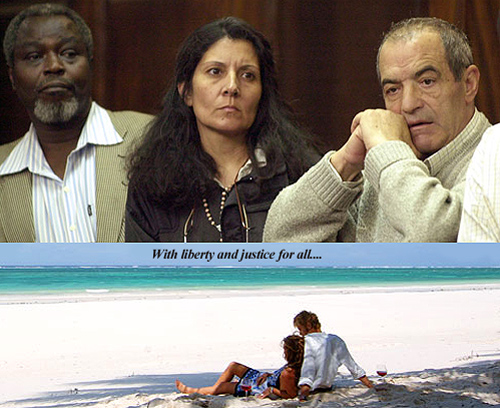
Angelo Ricci, a member of Kenya's Italian community, listens as a Kenyan judge acquits him of any crime for having 2,500 pounds of cocaine in his beach resort cabin. (AP)
Don’t feel sorry for the harassed billionaires of the world; they’ve found a place to hide from those nasty journalists linking them to blood money, laundering and drugs: the incomparably beautiful beaches of Malindi, Kenya.

This summer Brian Dabbs writing for The Atlantic unmasked the Italian cartel in Malindi, Kenya, that uses “Eden” as a likely place to headquarter a global mafia increasingly on the run from Europe.

Ten days ago Silvio Berlusconi joined billionaire friend and equally maligned Flavio Briatore in Malindi, Kenya, where they remain today cloaked in a secret “billionaires retreat” with much younger women, and many believe this is a don convention to divvy up the Joker’s World.

They are “holidaying” at the Lion in the Sun Resort, owned by Briatore, and which TripAdvisor ranks as #6 of 17 resorts in Malindi. E-Travel calls it a HotSpot hotel. (No mention in either TripAdvisor or E-Travel about money laundering or the drug trade.)

Berlusconi is the deposed and disgraced former Italian prime minister and now convicted felon. Briatore has a longer list of accomplishments including conviction for fixing Formula 1 racing.

When Italian billionaires convene like this in Malindi (this is hardly the first time), the Kenyan Post newspaper puts out this clarion call: “Nairobi ladies, there is a cash cow in Malindi, better hurry up!”

Two things really bother me about this.

Most troubling is that while Italian mafia, drugs and global crime is not news for Malindi, it is growing worse just as Kenya is about to turn a new page next March with its first election under a new and fabulous constitution.

While I see an increasing transparency and honesty with Kenyan politicians as a whole, the crew in Malindi has been totally corrupted by the Italian criminals.

Dabbs interviewed several Kenyans, including the local police boss, who essentially confirmed that they turn a blind eye to all the criminal goings-on among the Italian billionaires. Even local judges have acquitted the cartel of cocaine trafficking that excellent Kenyan investigators had all but proved.

Add to this the growing political instability of the coast, where a new political force called the “MRC” (Mombasa Republican Counsel” is increasingly linked to terrorism and many warriors fleeing Somalia, and you have all the ingredients for mob reign.

And secondly, travel tools used by so many people are doing nothing but white washing this horrible situation. It’s an incredible travesty, from my point of view a crime of its own:

Online travel portals like TripAdvisor, E-Travel, Luxist and get this, Conde Nast’s OnLine Tatler awarded it the Best Life Changing Spa – Tatler Spa Award Winner 2010. You can say that, again. And you won’t find that link leading you to Conde Nast or Tatler, because they’ve since discharged their noble duty of killing that award without explaining why.

But I guess the occasional legitimate guest Lion in the Sun gets irritates Briatore, anyway. He’s building a new exclusive “billionaire’s condominium” in Malindi, claims that half the units are already sold and that “For this project, I will choose who will come here.”

I guess that won’t be any clients I have.

Look Out! Peace & Prosperity!

Look Out! Peace & Prosperity!

Watch out! A period of political stability is looming, and with it economic stability. From South Africa to Kenya to Egypt and across the pond to the U.S. tranquility looms large for a while, perhaps the rest of the decade.

I guess it’s the end of the Great Recession. Like a patient recovering from a near life-threatening disease, the initial feeling of weakness is actually relaxation more than a loss of a power. The juices are strong, again, and confidence is returning..

The Arab Spring has settled into what extreme progressives like myself fear is ennui and may be, but whatever it is, nothing much more is going to change from what we see this morning. And coasting along for a while isn’t such a bad notion, really.

With all the potential turbulence in the Mideast, it struck me that Egypt’s Hamas, the Muslim Brotherhood, the current regime, was one of the first to congratulate President Obama on his reelection with unnecessary gusto:

The politically allied Ahram Online said that President Mursi “hailed” Obama for his reelection. In polispeak that’s pretty strong stuff. I think it means more than just don’t twist the $2 billion life line.

And there’s no question that if Obama’s policies in Iran don’t lead to positive movement, the errant child of Israel, the perfectly bilingual Netanhayu, could pull the trigger. But even he seemed remarkably humbled by recent events. Or maybe more correctly, the tiger’s been caged.

Whichever it is, the tension meter in the Israel/Iran war zone plummeted last week.

I think the area cooled in large part because of clever Mursi of Egypt. Mursi has all his life worked in the background and we criticized him on his democratic assumption of national political office for continuing to do so. But his messages are pretty consistent: no more war. Perhaps even heavy handed: no more protests.

Mursi is not want to restrict his ideology to The Nile. He wants peace in the whole area and he has begun to coalesce his Shia partners in a way that compliments western sanctions against Iran’s crazy Shiites. His efforts are truly masterful and little known because he prefers the shadows.

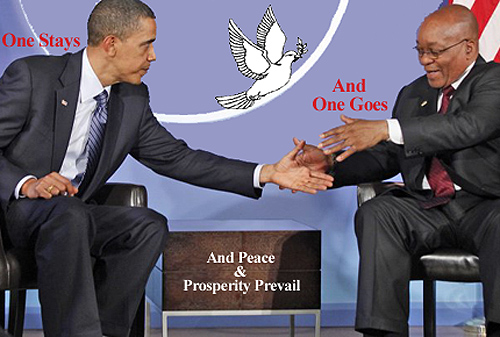
In South Africa I think the circus which has been its politics for the last decade or so is coming to an end. President Zuma’s long theater of the absurd comes under public review when the ANC convenes next month to decide if he should continue as leader.

It’s one thing to be a dancing bear, and quite another to chase the audience out of the tent. Zuma’s multiple wives (I think for PR purposes alone), his absurd pronouncements about AIDs, his annoying suits against critics and most recently, his gross mishandling of the country’s growing labor unrest has cooked his goose.

South Africa’s doing well, more so when compared to the west and less so when compared to nearer South America but sure enough that Zuma’s incredible even public graft is likely over. Watch the December conference carefully, but I think it will herald in a new, better and more stable political regime in South Africa.

And all pivots March 4 on Kenya, and I will be in Nairobi if briefly, and I expect to hear the olive thrushes not bazookas going off. It’s been a laborious often agonizing process as this remarkable country rereates itself from the devastation of its 2007 violence.

But recreated they have, and while Kenyan politics is forever unknown until the day it happens, the man in waiting to be the next President ever since his unimaginable concession five years ago of his legitimate election as President back then, will likely be Kenya’s next leader. And its first leader of the “New Era.”

New Era, indeed. In America we won’t slip off the fiscal cliff, or if we do it will be short-lived and not significant. This doesn’t mean not without drama. I heard this morning that Dancing With Stars is critically losing viewers, and my 7-1 Chicago Bears forgot last night how to play in the cold and sleet. We need drama in America, and I’m sure the fiscal cliff will step to the fore.

But some of the most radical thinkers in America before the election are remarkably sanguine if subdued right now. That means for the time being the fire’s gone. And maybe, that’s not so bad.

But when it’s all said and done, which will be in a very short time, we’ll all recognize that we were the patients who almost died but didn’t, and whose juices are now flowing stronger than ever.

The Big Election Day

The Big Election Day

Today is America’s Big Election Day. This blog is for my African friends and readers, many of whom are involved in crafting new, dynamic constitutions.

Every four years America holds its largest election. This includes for the president; all House of Representatives; most state, county and city representatives including elected judges. It excludes officials whose terms are scattered including two-thirds of the Senate, half of the state governors and a few other positions.

But by far and wide, this four year cycle is “The Big Election.” The first Big Election I voted in was in 1968. I’ve voted in every election since then; this will be my 11th Big Election.

Who gets to vote, when and how, have been issues that America has addressed and redressed for centuries, and we still don’t have it right. In America’s earlier days – in fact for the country’s first 150 years if not longer – there really was no “One man, one vote.”

Most election regulations have always been left to the individual States to decide, and historically voting laws have disenfranchised many citizens in many States. For our entire history, individual states have tried and often succeeded in suppressing the vote of people traditionally unable to secure power, like Afro-Americans.

Voting suppression was effected by requiring special taxes or demonstrations of income, by proof of secure employment and other means. The suppression always effected the least powerful and tended to keep those in power for longer.

My first Big Election in 1968 was the first election in the nation governed by the Voting Rights Act (VRA), federal legislation that for the first time regulated and tried to homogenize the various States’ laws.

The VRA helped enormously to stop voter suppression, and freer voting occurred right until this very election. This time, though, a barrage of Republican state legislatures changed state laws again suppressing the vote of the poor, disenfranchised, disabled and elderly. These are all constituencies that normally support Democrats.

Successful court challenges have been made against most of these, but not all of them. Last-minute rules, such as that promulgated Friday by the Secretary of State of Ohio, may not allow for enough time for a court challenge before today’s voting.

So it remains to be seen what effect this incredible reversal of nearly a half century of improved voter enfranchisement will do. If the election is close for any of the races in the states with these voting regulation controversies in play, then the results could be delayed for some time until the court challenges are complete.

And in many cases – the Pennsylvania “billboard controversy” is a good example – illegal regulations that the court ultimately vacated were in place for a long enough time to still effect the outcome.

No political party or power can impede the growing transparency of our elections. The free access of the internet and the explosion of media outlets, more journalists and infinitely more blogs, has assured that very little if anything can be kept secret. If someone is cheating, it will be revealed.

But that radical freedom is not without its own disadvantage. It means that the sometimes truly infuriating right of anyone to lie in a political campaign and promulgate that lie without legal redress is guaranteed. Any politician can say anything, can make the most outrageous and mendacious charges against her opponent without fear of any retribution.

The argument that prevails against interdicting such behavior is the argument of transparency. As with someone cheating – if someone is lying – it will be revealed.

The problem is that the revealing takes energy, intellect and time. And a large portion of the American electorate doesn’t have any of that. A large portion of the electorate is easily fooled, even as we work tirelessly for them to be able to cast their ill-advised ballot. That’s one critical curse of democracy: that many people will vote against their best own self-interest.

Egypt, Tunisia, Kenya and likely Tanzania are all crafting new societies based on democratic elections. Lacking America’s long history of democracy can be a benefit in this modern age. Learn from our mistakes, and perhaps we can learn from your accomplishments.

Is Macaque Murder a Felony?

Is Macaque Murder a Felony?

Sandy didn’t just blow the covers off buildings: It’s whipped up an ongoing debate over using animals for medical research.

Two radical animal rights groups, PETA in the U.S, and BUAV in the U.K., are in Sandy’s wake charging that the loss of medical research animals in the storm was cruel and preventable.

PETA has filed suit against New York University (NYU) for the drowning of 10,000 white rats during the storm, that were being used mostly for melanoma research. And BUAV has resurrected a campaign against Mauritius macaque breeding farms that ship mostly to American and UK medical research organizations, as Sandy delayed many shipments.

Only from the perspective of an intensely committed animal rights activist can such attention be garnished in the wake of this super storm. Most of the world’s attention is as it should be focused on people. But this is also the foundation of the argument about medical research.

Most of us countenance the use of animals in medical research. But those who don’t are extremely vocal, a sort of battalion of armed Albert Schweitzers as much a non sequitur as that may seem. And Sandy has given them another public moment.

NYU’s activities will draw less attention than the breeding farms in Africa’s Mauritius, where the long-tailed macaques are bred in pretty horrendous conditions not unlike some early chicken farms in the U.S., and then exported often before being weaned to laboratories around the world for biomedical research.

Cornell scientists proved more than five years ago that the macaque – particularly the rhesus macaque – carries genes and chromosomes remarkably similar to us. Not as similar as chimps, of course, but chimps for medical research in the U.S. is essentially over.

Intense campaigns against chimp research for years achieved significant success last December when the NIH ceased funding any research that used chimps. The decision was fully implemented by this September and technically now, there is no government sponsored medical research that uses chimps in the U.S.

This has left many scientists angry. Drug and nutritional research, many research programs – especially with cancer, Parkinson’s disease and kidney diseases – have essentially come to a halt. The counter arguments are deeply scientific as well and hard to understand, but basically claim that chemical research (test tube analysis) can be just as insightful as watching what happens to an actual living chimp.

It’s also very hard to know being a layman if the decision to remove chimps from medical research is more scientific or more political. In America’s culture, today, the twain rarely meet.

Be that as it may, the next most likely human creature available for research is the macaque, and the easiest place to get them is from the breeding farms in Mauritius.

Purists argue that a living thing is a living thing, whether that be a human baby, chimpanzee, long-tailed macaque or white rat. And that whatever prescripts exist against murder of one should apply to all.

I disagree. There is a big difference between a white rat and a baby boy. If we can do something – as horrible as it might portend – to white rats that will prolong or make better the lives of baby boys, we should.

Regulating that statement is beyond us laymen. It’s for scientists … and politicians. No one would argue that if a good alternative existed it would be given priority. But defining the alternative is technical science… and artful politics.

But there is much less of a difference between a baby boy and a baby macaque.

Or is there? And how do we know? What exactly do we presume? Do we pretend to believe we can understand what a macaque thinks about us?

That’s why it’s so easy to just lump all living creatures together, because that’s easy to know. It’s alive or it isn’t. No EKG, no IQ … just a heartbeat.

The answer is not the easy way out. That much I believe for certain. I’m neither trained or talented enough to parse the barriers dividing humans from macaques, but I trust men out there who are.

Kenyan Thoughts on Obama

Kenyan Thoughts on Obama

Should Obama lose so he can save the world? A prominent Nairobi commentator argued that if Obama loses the election he can then join past leaders like Clinton to better influence the world.

Charles Obbo writing in today’s Daily Nation explained that if Obama wins, the growing conflicts in Iran, Syria and Mali will turn nasty and “the US president will have to enter the fray on the side of Israel – and alienate two-thirds of the world.”

This and economic conflicts with China and America’s penchant for shooting before talking could all destroy Obama’s current trajectory to become “the only person of colour” to join the “non-state do-good” club of Clinton, Carter and (Bill) Gates.

(Interestingly, Obbo dismisses Kofi Annan as “still developing his voice” and explains that Nelson Mandela and Desmond Tutu are too enfeebled.)

I was struck by the analysis that Obbo thinks someone can influence world affairs more as an individual than as President of the United States. I don’t mean to pat my own American chest here, but both Clinton and Carter left imprints on the world during their very short times as president that they’ll never be able to duplicate as private citizens.

I think it likely there was an ulterior motive creeping into Obbo’s commentary. Many Africans – and particularly Kenyans – are disappointed that Obama didn’t pay them more attention during his first term.

The reader Yvonne in replying to Obbo pried it out clearly: “He is a leader of the free world not just Africa. Kenyans forget that he had .. an economy on the brink of collapse and two wars that he had just inherited.”

Normally an oped in Kenya’s main newspaper, the Daily Nation, draws a handful of comments from the readers. This morning when I looked there were more than 50. The majority took issue with Obbo on a number of counts.

Several gave Obbo the Bronx Cheer, pridefully arguing that neither Obama or the “non-state do-good” club were needed.

Leo Tamutu says, “We don’t need foreigners to do charity in Africa. We have thousands of Kenyan Billionaires to do us pride in charity… To wish Obama loses to Romney so that he can divert his attention to helping Africa is pathetic.”

A number of readers ticked off the now well-known litany of reasons Romney would be a disaster. Alex Njinu sums it up for many: “No way, Romney is helpless, hopeless and pathetic.”

Symore Themoose says, “Romney … spells trouble, war all across the world. Republicans own and run weapon factories, and markets for their goods come first.”

Michael chided Obbo, “Yes, let Obama think about his reputation. Not the global catastrophe at stake.. I’m sure Romney, who thinks Syria is how Iran gets to the sea, understands foreign policy completely.”

Kiwanuka Nsereko believes Obama is the only candidate good for women throughout the world:

“Whether Obama will be a state actor and give the brown-black people a voice does not matter,” she begins. “What is pivotal is for him to … sustain the voice of women, which is in danger of being eroded by the right wing wackos. Saving the women voice, in the USA, will have the domino effect of providing hope for women around the world.”

But I found one comment which was incredibly insightful and really reflects my own deeply held view about this election:

Gabbe O’k speaking especially to the many Kenyans who believe Obama lost interest in them explains, “Obama had to distance himself from Africa to even have a chance for the second term… Republicans were waiting to brand him an outsider caring for African affairs… Right now his biggest disadvantage is being half black because most jungus cannot stand another 4 years of a black president… If he were white this could have been a landslide.”

Yet it’s interesting that Obbo – a man who I greatly respect and who sees the world generally with the same vision I have – believes that a U.S. president loses much of the power of individual good just by being President. I haven’t come to believe that … yet.

Folks, these are all remarks from Kenya, not from Columbus or Miami. But they represent as much if not more insight into America than Americans have themselves.

Take umbrage, guys.

Weather Sandy or the Serengeti

Weather Sandy or the Serengeti

The capacity for denial in America’s current lemming-like culture makes Africa seem like the real Super Power and we Midwesterners hoakies from Padokie. Super Storm Sandy = Global Warming. When will Americans learn?

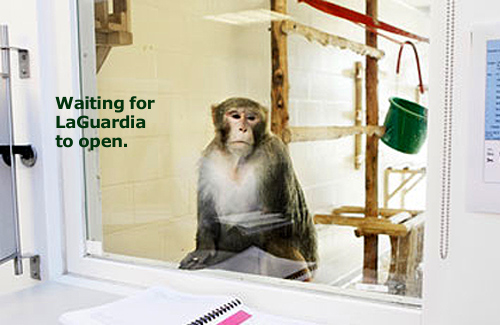
Four times weekly starting about 5 a.m. CDT I access the internet to write this blog. This morning, half my links are down. So is the stock exchange. So is LaGuardia airport. And clients we have returning from a safari, half-way around the world, are stuck because their flight is canceled! Because of Sandy!

Because of GLOBAL WARMING.

The storms over the Serengeti are legendary, and I’ve often wondered if my own and other Midwestern fascination with the Serengeti is because we at least share turbulent weather.

As a child in tornado alley in northeast Arkansas I stood with my two younger siblings in the frame of a door watching hopefully as tornadoes passed us bye. That frame was destroyed by a tornado several years after we moved on.

In the Serengeti I’ve had camps blown down, had vehicles ground to a halt on a granite boulder by blinding rain and will always remember a TWA pilot who as a client pointed up to the sky and exclaimed, “That is an altocumulus standing lenticular!”

He exclaimed that the magnitude of that storm would flip a 747 like a dead leaf by a leaf blower.

But times have changed. These tumultuous events are no longer memories of the extreme. Extreme weather is normal, now. Quickly and more forcefully it’s happened than even we staunch heralds of global warming predicted.

A terrible storm whether in Africa or here is no longer unusual. Kenya’s northern frontier is exhausted by drought following floods following drought. The Zambezi River is flooding villages one year then practically turning off the next. South Africa’s breadbasket is being torn apart by desert winds.

And at home we just suffered the hottest year on record along the upper middle Mississippi, and drought was formidable. And this followed a year of incredible flooding. In our little corner of northwest Illinois in my little village several people were killed by floods. No one remembers that happening before.

For the past few years I’ve tried desperately to understand why so many Americans refuse the science of global warming and so many Africans don’t.

Unlike terrorism, the world’s experts know how to impede the coming apocalypse: reduce CO2 and other gas emissions. But because the developing world is developing so fast (thankfully) they proportionately produce more of these gases. The developed world has agreed that the developing world needs to be compensated for reducing their emissions.

So sort of a free ride, eh?

And a sacrifice for those already developed. Yes, that’s probably it. That’s probably why Americans who are the most developed in the world refuse to believe the obvious, and Africans among the least developed in the world, embrace it wholeheartedly.

But you know, if even that cynical view is correct, it’s no different than an old man lending a couple bills to a young lad who fetches his mail each day.

Because if we stop looking at ourselves as competing counties for the river’s stream and stop gerrymandering ourselves for a slight advantage for our portfolios, and start to realize that air blows right across immigration fences, then we’ll realize that this is a challenge that the world together can solve.

But my god it has to begin by simply acknowledging science. Recently several scientists in Italy were jailed for failing to adequately warn a village of an impending earthquake.

Perhaps we should consider jailing the crazies in Alabama who think global warming is a hoax?