NPR White Elephant

NPR White Elephant

NPR’s reporting yesterday on elephant poaching in East Africa disappointed those of us who know East Africa and cherish its wildlife.

In addition to simple inaccuracies, my main criticism was that the two stories filed by John Burnett were grossly narrow, cherry picking scandalous components while ignoring an essential bigger picture for cheap and trivial stuff that gets quicker attention.

The increase in elephant poaching in East Africa, most severely but not exclusively in Tanzania, has been on the rise for 4-5 years. It’s not new and it’s not suddenly greater than a few months or years before.

Burnett’s lead story suggested it was something relatively new and newly urgent, and so he neatly avoided the essential and more complex history of what has actually been happening.

This is my sixteenth blog about elephant poaching since March. Simply type “elephant” in the search box to the right for those stories. Journalists from Reuters, the New York Times and AFP have filed just as many over that same period.

This is because as Burnett said poaching is increasing almost as rapidly as in the catastrophic years of the 1970s-80s when 95% of Kenya’s elephants were wiped out and nearly 60% of Tanzania’s. It has not reached that level — nowhere near that level — and many other factors are considerably different.

Let’s start with the numbers, because Burnett has some quite wrong. I tread very cautiously and with some hesitation, because the last thing I want to do is reduce concern for a very serious East African problem.

As I’ve written again and again, the “elephant problem” is central to East Africa’s wilderness and economy. Poaching is absolutely one of the most serious problems facing East African society. But we do our cause harm with untruths.

“Perhaps 70,000 to 80,000 elephants roam” Tanzania Burnett claims.

On January 15, 2011, The 5-year Tanzania Elephant Management Plan spear-headed by such prominent and widely respected researchers as Charles Foley put Tanzania’s elephant population at around 110,000.

How many elephant have actually been poached since then, augmented by a record number of births due to good rains, is hard to estimate accurately, but the overall population is certainly higher than Burnett speculates.

Burnett says that the 70-80,000 number is “perhaps a quarter” of the continent’s population (280-320,000). This is widely inaccurate. Most recent estimates are very much higher. The International Union for the Conservation of Nature puts the continent’s total number at 472-690,000.

Burnett quotes a former conservationist in Tanzania as saying that 30 elephants daily are being poached. Using a conservative estimate that each elephant killed carries at least 100 pounds in total ivory from two tusks, that would mean there was more than 500 tons of ivory poached out of Tanzania each year, and that’s ludicrous.

Shippers of the most creative sort could not conceal even a fraction of that.

These are not minor inaccuracies. The “carrying capacity” of any environment for managed big game depends on precise numbers, not widely speculated ones. Burnett’s high-balling his numbers might enhance the urgency of his report, but it distracts us from possible solutions.

I wonder if as in our politics and grocery shopping, Americans just can’t be mobilized without exaggeration. It’s a sad commentary that NPR has fallen into this trap.

Burnett’s second story was better. He interviewed a poacher.

The story demonstrates that quite unlike the 1970-80s corporate poaching with Sikorsky helicopters using everything from AK47s to bazookas and then chartered ocean liners, some of the poaching today is an individual criminal phenomenon. And like so much crime everywhere in the world, its principal motivation is poverty.

That makes it much less effective and much harder to remedy.

Burnett rightly puts the onus for poaching on Asian market demand that we all agree has been sparked by economic growth in China. The evidence for this is overwhelming. But I’m very disappointed he didn’t describe the exciting new efforts by Chinese and Chinese surrogates to change this behavior.

It means that even the villain knows he’s a villain, and that’s a real start.

Finally, Burnett totally ignored one of the essential if perhaps not the central cause of poaching, today: There are too many elephants.

There are too many elephants not just in Tanzania, but throughout Africa and even in Asia.

This fact is hard to digest. It doesn’t mean there are more elephants than there once were. But for the existing diminished habitat, and in terms of human/elephant conflict, there are simply too many.

And that’s the real problem. It means poachers often get a pass because local officials actually appreciate what they’re doing, because farms are saved and school buildings don’t have to be rebuilt so often.

You won’t hear this from an elephant researcher standing over a carcass recently poached. And you won’t get a Tanzanian official to say as much to a westerner writing an article about poaching. It takes a more cautious and deliberate reporter than Burnett.

The story of elephants, their majesty, their near decimation in the 1970-80s, and now their perplexingly big problem in rapidly developing African societies is one of the most important stories in East Africa, today. It represents almost all of East Africa’s problems and probably contains some of their solutions. It’s as much historical as contemporary.

But jigging up the story with exaggeration while neglecting central facts won’t help. It needs as much attention from Rachel Maddow as the Tea Party.
The Clothes Stink

The Clothes Stink

By Zapiro, South Africa's most famous cartoonist
The U.S. election dominates much of the media of Africa. Should it matter to American voters what a South African diplomat thinks? Does it really matter to a Kenyan businessman if Obama wins or not?

Yes and yes, but unfortunately that’s almost beside the point. I for one have become so weary about the election that my greatest wish is that it be over. I’m not sure if I or any of my many fellow Americans regardless of their politics cares much about what the world thinks, anymore.

We just want one less week in October.

No place on earth has an election cycle as long and drawn out as America’s. No other democracy spends a fraction of what the U.S. spends on elections. So towards the end nothing really matters but getting it out of sight and out of mind.

That’s not a very healthy attitude.

“The selection of a leader for the US might be in some respects more important for other societies than for America,” writes the respected diplomat, Richard Falk, in South Africa.

Writing today in South Africa, a Jamaican-born Tanzanian activist now teaching in the U.S. writes, “The US … massive debt, devalued dollar and unchecked political and economic power of the banks threaten the entire humanity.”

Quoting Newt Gingrich he concludes, “This will be the most important election in the United States since 1860.”

Perhaps, or perhaps not for us in America. But it’s certainly true for the rest of the world.

My nonscientific survey of Africa suggests that Africans believe they will have a much more difficult and threatened existence if Romney wins. The most attention being paid to the American election is in Kenya.

That’s understandable because Kenya is in the thralls of its own contentious election, and one that is much more significant to their country than ours is today in America. It will be Kenya’s first election under a radical new constitution, and the tension is extraordinarily high; the potential for violence is real.

Writing in Nairobi’s digital newspaper, Njoroge Kinuthia recently said “this democracy thing baffles and befuddles.”

Her analysis of some Kenyan politicians is exactly mine of Romney: “They fight and change” positions “like clothes.

“When they stink– [the clothes are] discarded like dirty rags for convenience… That’s why politicians keep hopping like grasshoppers. That’s our brand of democracy, folks.”

Kenya is deeply behind Obama, but for reasons that would disinterest most Americans. Principally it was because of how the Obama administration — and mostly Hillary Clinton –helped the country dig out of the mire of violence and political chaos of 2008. And then there’s the “distant relationship thing.” You’d be surprised how many Obama relatives have popped up in Kenya.

Kenya built its new constitution heavily with American-like government institutions. It will be tried and seriously tested for the first time in national elections on March 4. Perhaps that’s why Kinuthia seems to have as much ennui as myself. Perhaps it’s the institutions, not the players, which is to blame.

North Africa is solidly Obama, but “begrudgingly so” as explained so clearly by the Reuters correspondent in Beirut. North Africans are very disappointed that Obama fell so far behind in his promises to reduce the Israeli/Palestinian conflict.

But be that as it may, Romney is “too keen to project U.S. military might.” In the part of the world where most of today’s wars are being fought, this is the preeminent concern. And there is very wide consensus across the continent that wars will increase worldwide if Romney gets elected.

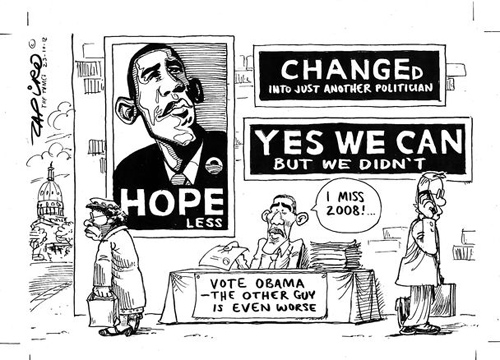
The cartoon that appears above is from South Africa’s most famous political cartoonist, a man who like myself is extremely progressive. His cartoon is exactly how I feel.

And of course it ignores the fact that Obama’s inability to achieve his goals is in huge part the fault of the intransigent Congress.

But we focus our democracies so heavily on the executive that we won’t countenance their failure as a leader except as their own personal failure. It’s what the candidates themselves project! They speak as if they alone can determine governmental outcomes.

(Or even more laughably, that they alone can “bring together” the intransigent polarized divisions that have to make the laws they sign.)

Published in the South African blog RAIN, the UN Special Rapporteur on Palestinian human rights, Richard Falk wrote two days ago, “When Obama actually won the presidency, it was one of the most exciting political moments in my lifetime.”

But it was downhill from that point, Falk writes. He believes that heavily racist America is to blame. He believes that redneck Americans were so polarized by Obama’s victory that it “gave rise to an Islamophobic surge that revived the mood of fear and paranoia that followed … the 9/11 attacks.”

(See Gary Wills in this issue of the New York Review of Books for a similar analysis.)

And now, Falk argues, Obama supporters like himself frustrated with the President’s inability to manifest his agenda risk losing to a “dangerous alternative,” because their support for Obama is no longer enthusiastic.

Baffles and befuddles. Right on.

Falk’s conclusion is sadly mine as well:

“The stakes in the presidential election have been reversed – the upcoming election is more about fear than hope.”

So trembling I will drop my vote into the ballet box as an inverse image of a mushroom cloud explodes over Iran.

Zap Zanzibar

Zap Zanzibar

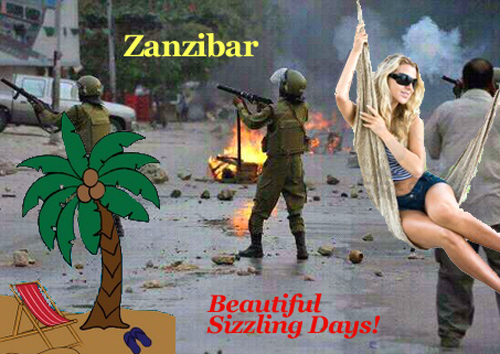
Last night Pres. Obama and Gov. Romney argued whether al-Qaeda was on the run. It is, and it’s central to why Zanzibar is exploding, now.

Yesterday tear gas filled Stone Town as mostly young radicals protested the indictment of a popular extremist sheik who was then held without bail.

The unrest in Zanzibar began last week. There was also significant violence in mainland Tanzania’s largest city, Dar-es-Salaam. Many media reports claimed this was Zanzibar’s “Arab Spring.”

It’s not. Unlike in northern Africa these demonstrations will not succeed in toppling the Tanzanian government. Also unlike in northern Africa, the vast majority of Tanzanians are critical of the Islamic violence.

Mainland Tanzania has shackled Zanzibar ever since the federation in 1964 and most Tanzanians look down on Zanzibaris. This has not been a helpful attitude, in the past and especially now as unrest grows on the island. Be that as it may, the significant point is that mainland Tanzanians are in the vast majority.

But there could be a period now measured in months of unrest not significant enough to stop tourists coming to see lions but enough to seriously effect the beach business. This is because the trouble that’s brewing is on the coast.

And that’s because the coast is where East Africa’s Muslim population is, and much of it has been highly radicalized over just the last few years.

Americans who think of East Africa as big game country don’t understand that more than half of the tourists to East Africa never see an animal larger than a monkey. The extraordinarily beautiful coral coast which extends virtually all the way south of Somalia through Mozambique is East Africa’s real tourist treasure, not wild animals.

Europeans especially use East Africa the same way Americans use the Caribbean, for sun ‘n sand vacations, usually of a week long, and usually transported by charter aircraft that practically land next to your beach view hotel room. There you stay, vegging out on margaritas and reggae bands.

Trouble on the coast is not new. In November, 2002, the Israeli Paradise Beach Hotel was mostly destroyed by a terrorist bomb and a ground-to-air missile narrowly missed an El Al jumbo jet taking off from Mombasa, Kenya.

There has been nothing as dramatic until this year. There had been numerous incidents of small grenade bombs in local bars and several incidents of tourist harassment in the last decade. But none of these critically dissuaded tourists from flooding to Kenya’s beaches almost exclusively from Europe.

But all that changed with the successful Kenyan invasion of Somali just to the north of Kenya. As Kenyan soldiers routed Somali terrorists, the coast began to heat up in much more generic ways that has seriously effected tourism. Tourists were kidnaped and publicly ransomed by terrorists, and virtually all the main beach hotels began to institute extremely strict security procedures.

Then last month, just as the Kenyan forces were about to oust al-Shabaab (al-Qaeda in Somali) from its last great stronghold of Kismayo, all sorts of political turbulence erupted in both Mombasa in Kenya and Zanzibar in Tanzania.

It struck me as an obvious consequence of the successful military action in Somalia. Rebels were running for cover, and the East Africa coast with its radical Muslims provides that, and what assets and hardware they could run with began funneling through East Africa.

Kenya is in the thralls of the last legislation implementing its new constitution before March elections. Suddenly there was a newly reborn political movement in Mombasa that called itself the Mombasa Republican Congress. Its agenda was nothing less than independence from Kenya.

The independent movement in Zanzibar which has been a perennial cause every since federation with the mainland in 1964, suddenly blossomed with new and fancy leaflets, new cars for its leaders and new megaphones for its Friday prayers.

While ostensibly completely separate political movements, the timing of both the emergence of the MRC and the makeover of the Zanzibar autonomy movement struck me as anything but coincidental. Money, methods and Islamic madness was coming from the north.

And then the tinderbox exploded in both Kenya and Zanzibar. Last month the principal radical cleric was killed in a car drive-by gangster-like shooting. And last week, Tanzanian police started rounding up radical clerics. Each incident, though separated by nearly a month, resulted in violent protests.

As I write this blog today Mombasa is calm following the Kenyan government’s very tough actions which involved dozens of arrests and the closing of theoretically unregistered Muslim organizations. The Kenyan President charged Mombasa radicals to “surrender or face arrest.”

But Zanzibar is not calm, today, and depending very much upon what the Tanzanian government now does with its radical Muslims, it may not be calm for a long while. And now what happens in one place is likely to effect the other.

As far as I can see, which is all along the exquisitely beautiful coral coast from Somali to the Mozambique border, this outstanding Indian Ocean venue won’t be a place to vegge out for some time.

When and will all of this calm down?

It depends upon how quickly the Somali mop-up occurs, how peacefully and completely the March Kenyan elections go, and how placated Zanzibari successionists will feel as Tanzania flirts with the idea of a new constitution.

March is the key date. After the March 4 Kenyan elections we’ll have a much clearer picture on which to predict what the coast will look like over the next year.

Until then. Leave your flippers at home. Concentrate on the binocs.

Old Man or Best Loser?

Old Man or Best Loser?

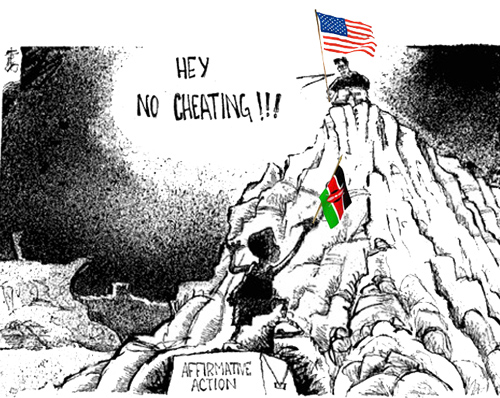
Our Supreme Court considers reigning in contentious affirmative action policies just as Kenya implements the policy in an extreme way.

Last week CNN reported that “race-conscious admissions” as a policy for determining university admission “appeared to be in trouble.” The report filed by Bill Mears suggested that Anthony Kennedy’s swing vote on the conservative court could preserve the general policy while striking down the specific plan from the University of Texas under particular review.

However broad or narrow this particular decision might be, there is no question that affirmative action in the U.S. is in decline, even as there is near unanimity among academics as well as commercial managers that policies which create diversity are over time very beneficial to everyone.

America stepped into affirmative action gingerly and took a long time to fully embrace it. That has lasted about a decade or slightly longer, and it now seems as though we’re gingerly stepping away from it.

Kenya on the other hand is going from a society almost exclusively managed by men to a forced society where at least one-third of the country’s power elite must be women in the course of a single election.

Although the debate and legislation has been confined to the make-up of Kenya’s government, there is little doubt that a one-third female Kenyan government will if not actually legislate rules for the private sector will certainly powerfully effect it.

Unlike the possibly too careful approach by America, I’m worried that Kenya’s might be too uncareful. The new constitution now being implemented is the driving force. The problem is that this very difficult section, which mandates the one-third rule, has only now begun to be addressed, less than five months before the next election.

Most legislators and public commentators promote the obvious way, which has become known as the “best loser rule.” When, for example, less than a third of the new legislature elected is female, then some of the duly elected male winners will be somehow automatically replaced by women closest to having won.

But how this metric will be calculated remains to be determined. Which district will be the sacrificial lamb and which female candidates will then be elevated? Will it be determined by actual votes or percentages or pro-rata?

The complexity of the issue is so great some argue it is too great to solve before March, when the next election occurs. Seventy, or one-fifth of the new National Assembly, will be appointed. This unappointed one-fifth was intended to be reserved for noncompetitive leaders like wise diplomats or career unionists who are appointed by the executive and National Assembly.

One argument suggests all seventy should be reserved for women, but then what if the gender level is still not achieved?

That’s probably a bad idea, since the unappointed legislators is itself contentious, a holdover from Kenya’s former constitution intended above all to achieve stability after a close election by allowing the narrowly won to beef up their control. Plus if applied in its purest, the appointments of legislators would themselves have to follow the affirmative action rule which was must be applied on its flipside, too: there can’t be more than a two-thirds gender dominance.

The issues in the Supreme Court University of Texas affirmation action case are no less or more complex than Kenya’s gender rule. But the scope of each is hugely different. And it represents the level of risk each society is now willing or not willing to take.

In the global arena today, America moves like an old man afraid of falling. Kenya jumps with abandon like a kid on a trampoline. The risks of failing govern America. The passion for more Olympians governs Kenya.

Fight For The Present

Fight For The Present

Acting as a true global, singular power, the UN has vowed military action if rebels holding most of Mali don’t surrender.

This is an astounding world development and I’m even more astounded about how little press it’s being given in the United States. America likes to portray the United Nations as a leftist thorn in its side and The Right in America sees it as a communist ploy.

But late Friday the Security Council acted unanimously at their Six thousandth, eight-hundred and forty-sixth meeting which lasted a deliberative 23 minutes. The conflicted communists of China, the gangsters of Russia, the existentialists of France and every one the 15 non-permanent members including the pitiful Pakistani and the angry Azerbs said “Go to war!”

And they all looked up from their down-turned heads at the American representative, Susan Rice, to ask for money for ammunition, which we will likely provide.

So exactly what has created the first global crusade since the Balkans?

Al-Qaeda.

Western moralists forever seeking validation of their soul are arguing that the cold-hearted Asians have been convinced to act because single mothers with bastard children in the African deserts are being stoned to death by the extreme Islamists.

True, but not the reason for consensus.

Eastern equivocators argue the west has finally given up its moral pandering for the practical possibility of stability by supporting the doesn’t-matter-they’re corrupt but effective leaders of what is left of a Mali government in Bamako which at best resembles a quiche not cooked long enough.

True, but neither is this the reason for world consensus.

And Azerbaijan argued that it will pave the way for a less strident Eurovision Song Contest.

That was uncertain, but neither is it the reason.

The reason such disparate polities have reached consensus to go to war against the rebels in Mali is because this is the first time in history that a globally organized power, originally stateless, is about to become stated.

Al-Qaeda has been in retreat for a while, and especially since the assassination of bin Laden and so many others of its leaders. But it is a pure ideological movement. It is the American Republican Congress at an even greater extreme: compromise is out of the question. It is the New Hampshire state motto with “free” replaced with “right” and right as defined by extremism so acute that first principals are reduced to three or four-word sentences.

There is no question that al-Qaeda will fight to the last man standing. In their convoluted retreat from Tora Bora they have left a world in disarray which in many regards resembles the Taliban world of the 1980s, turning back the global ideological moderation of the 1990s and putting everybody on edge.

They’ve been whipped in Afghanistan, blown out of Yemen, are being scrubbed out of Somali and recently slithered through the Central African jungles finally regrouping in the African desert. Their deft manipulation of several rebel (and mostly ethnically based) groups in northern Mali which has plagued the area for perhaps a century has been absolutely amazing.

Like what they might even now be trying to do in Syria, what is left of al-Qaeda fed on the experience of their organization of the basest of human inclinations – greed, racism, egocentrism – to knock down and take over Mali rebel groups that had been making trouble for generations but never really succeeding.

So now they control a piece of world real estate the size of France. Much of the world cared less for the last year, even as some of the world’s greatest treasures in Timbuktu were being bulldozed into desert sand.

Not enough sentiment was mustered against stoning girls for showing their lips, either, but then the Security Council member, Pakistan, knows all about that.

But as what is left of the colonial construction known as the government of Mali erodes with each desert breeze, al-Qaeda is poised to actually assume the right to a seat in a global auditorium right next to North Korea and Belarus. Were they to deign such publicity.

Thus, unanimity among the members. All hail the United Nations.

You get my sand drift? When a threat to the status quo of an existing state is demonstrated by an erstwhile stateless entity, it will be squashed out, regardless of that entity’s or its target’s ideologies. It matters not right or wrong.

Not incompetence or torture or lying and deceit or sucking the life out of the poor or machine gunning all protesters or mushroom clouds over melting ice caps. Just a simple little demonstration that a king can, in fact, be displaced by knaves.

What a wonderful calculus for change.

The Democratic Challenge

The Democratic Challenge

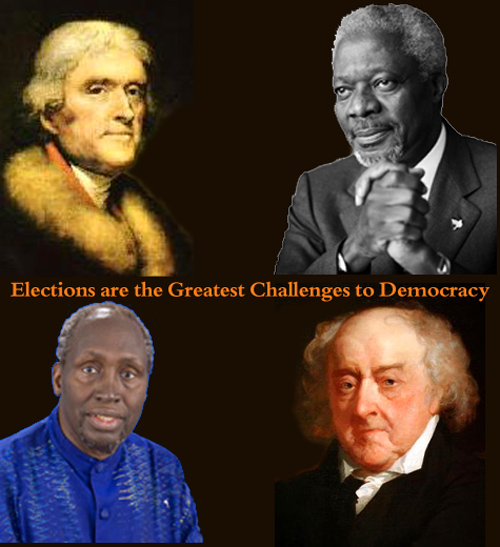
Two of Africa’s wisest old men have echoed the same cautions that America’s founders gave a young democracy about its elections. Beware: Bad elections are the greatest threats to democracy.

Yesterday Kofi Annan and Ngugi wa’Thiongo focused on the upcoming Kenyan elections as a marker for world democracy and reflected on America’s distortion of elections as something to be avoided by younger countries.

Annan is a well-known world figure, one of the most prominent Secretary Generals the United Nations has ever had. Like Jimmy Carter who remained remarkably active after leaving office, Annan’s role in global negotiations has never ceased. In fact, it was Annan who led the Kenyans out of the mire of the violence following their last election in 2007.

Ngugi has adopted America as his home after a career as a professor at Yale and New York universities. He is currently the Distinguished Professor of English and Comparative Literature at the Univ. of California in Irvine. Until 2004 he lived intermittently between Kenya and the U.S., and in Kenya is heralded as a famous revolutionary and writer.

What Americans obsessed with their own election need to know is that huge new parts of the world, especially in Africa, are adopting democracy and America’s form of democracy to govern their young societies.

This is a major change from hardly a generation ago when just as many new countries were adopting forms of Chinese communism or heavily top-down managed socialism. It’s a testament of course to the end of the Cold War, but also of the preeminence of capitalism in the global economy.

Old countries like China might be able to fiddle with capitalism and not disrupt their mechanisms for governing, but new countries can’t. The power of the economy is so critical with emerging countries that it often trumps other moral and social issues.

A case in point was Ngugi’s violent condemnation yesterday of Kenya’s decision to use English as the predominant language for governance. Ngugi is Kikuyu, the main tribe in Kenya and was imprisoned as a freedom fighter under the British. He is himself a master of the English language but he has written scholarly novels in Kikuyu, and he believes preserving multiple languages is critical to an advanced society.

It is something of the inverse argument in America as to whether Latinos should be validated by a greater use of Spanish in government.

Arguing that the current Kenyan leaders are “child abusers” for denying “mother tongues” Ngugi says, “To have a mother tongue … and add other languages … is empowerment. But to know all the other languages and not one’s own is enslavement.

“The post-colonial government and the entire [Kenyan] elite have chosen enslavement over empowerment,” he concludes.

The problem, of course, is that the violence that followed the 2007 elections turned ethnic. It is completely understandable that current politicians wishing to avoid anything much beyond a dull election want to steer clear of languages that are specifically ethnic.

In America as in Kenya when one person speaks a language that another person doesn’t understand, enormous suspicions arise, conjecture becomes almost as credible as fact-checking, and literally all hell can break lose. Unlike in Canada or Belgium where multilingual democracy flourishes, in most of the world multiple languages breed distrust.

(N.B. What puzzles many in the Kenyan situation, though, is why English was chosen rather than Swahili. Swahili belongs to no specific tribe and so is clearly universal among East Africans. The problem is that Swahili is a lingua franca and suffers thereby from a sore lack of precision. Tanzania tried to use Swahili as the formal language for many years, slowly giving way to English. It’s near impossible in Swahili to say succinctly, “Federal zoning regulations with regards to clean and safe landfills will preempt county council laws with regards to individual ownership.”)

(N.B. continued: Swahili in my view, by the way, is one of man’s most wondrous cultural achievements of the last several centuries, creating poetry of nearly every statement while maintaining a universal morality far superior to many popular western notions about right and wrong. But that’s another blog, and in this case I think Ngugi is wrong.)

Annan didn’t mention language, but in virtually everything else the two scholars said yesterday there was agreement.

Annan who is Ghanian was in Kenya yesterday. He referred to his fears that money is buying power in Kenya, as in the world over. “The infusion of money in politics … threatens to hollow out democracy,” Annan told CNN in September.

Annan understands the importance of capitalism in the world, today, but he also sees it as a threat to democracy. Many of us wait expectantly for his treatise on how the twain should ever meet, but for the time being I suppose we should presume he simply wants aggressive regulation.

In Kenya today he sees a brazen challenge to its young democracy by its rich leaders. Four of Kenya’s richest men and political leaders, including the son of the first president Jomo Kenyatta, are on trial in The Hague for inciting the violence of 2007.

Yet two of them, Uhuru Kenyatta and William Ruto, are running for president. (Not yet officially, but in Kenya “officially” comes quite close to the actual election.)

Annan sees this occurring not because the Kenyan people want it to, but because these individuals are so powerful, and because they are so rich.

Ngugi concurs: “Unregulated money in politics undermines …confidence in democracy… The explosive growth in campaign expenditures … strengthens fears that wealth buys political influence.”

American politicans’ penchant for personal stories about their early impoverishment is mostly malarkey or at best irrelevant to their current control of wealth. The vast majority of successful American politicians are rich. The cost of entering politics defies many startups. Over $1 billion will be spent by candidates and their surrogates in the current U.S. election.

Both men see the poor, the less privileged, the disabled and geographically disenfranchised as likely a majority of African voters that can be deftly ignored in a modern election:

Ngugi: “Too often, women, young people, minorities and other marginalized groups are not given a full opportunity to exercise their democratic rights.”

Democracy is today widely popular throughout new African countries and embraced as the best way to protect and govern themselves. But the messages that Ngugi and Annan delivered yesterday to a promising young African country resonant here at home just as much.

Democracy is never achieved; it’s simply strived for. America has used democracy for nearly two and a half centuries, yet the corrupting power of money, the difficulties of implementing democracy to a multi-lingual population, and the ease with which the underprivileged can be disenfranchised are threats as great today as they were in the 18th century.

Nor any greater a threat in Kenya than here.

Obama/Neanderthal/Romney Debate

Obama/Neanderthal/Romney Debate

Animus in our culture is pervasive and not just in politics. Recent awe-inspiring discoveries about Neanderthals have enraged the Right, once again.

The various emotions I feel following the Obama/Romney debate are complex, but all so similar to the same emotions provoked by the angry outbursts of creationists over new and exciting Neanderthal discoveries.

Harvard and the Max Planck Institute have been meticulously studying the DNA of Neanderthals for several years, now. Discoveries understandably come out allele by allele, and this week they announced a real breakthrough:

Neanderthals interbred with modern humans a lot more than previously thought, and the two sub-species likely lived peaceably side-by-side for tens of thousands of years. The “disappearance” of the Neanderthal was not a wipe-out by a more warring subspecies – us – but likely assimilation by romance.

As much as 4% of modern man’s DNA is Neanderthal, and that’s incredibly significant. Recent studies also confirm that modern Africans carry less Neanderthal genes than non-Africans, and along with other microbiology and genetics, further confirm relatively stable Neanderthal assimilation into our current species, rather than anything more dramatic.

Regrettably, I now concede one of my most powerful stories given during my lecture at Olduvai, where I wow my clients with the notion that we (homo sapiens sapiens) might have eaten the Neanderthals up!

It was a great story and a plausible notion for years, and the wow came not in some Carl Sagan notion of our intrinsic animus but rather that the Neanderthals, while “smarter” (their brain/body ration might be larger), they lacked something “we” had that allowed us to conquer them. For many years that was presumed to be better language.

The possibility that most of our direct African ancestors were capable of a better manipulation of language than Neanderthals has become more contentious over the years, but it’s not yet fallen from complete grace. So until recently it was a wonderful notion that language trumped IQ.

I concede, but there are enough wow moments in the evolution of man that, other than having to redo my lesson plan, I still have full faith in the energy of the lecture!

But not for creationists. The recent discoveries have just angered them, further.

A couple weeks before the Harvard/Planck study was announced, there was new archaeological evidence that Neanderthals were peaceful, and separately, that Neanderthal decorated himself with bird feathers.

That was not so profound from my point of view, but the creationists went ape about it:

“More breaking news from this week about Neanderthal man, they found feathers in his living arrangement and it was not there by accident rather it was there by intelligent design!”

The quote above is from one of the leading creationists. Take a minute to scan all the recent posts under his rubric of “archaeology” and you’ll collect his enormous animus.

You’ll note reference after reference about science’s notion of Neanderthal as an oaf. When quite to the contrary, for years there’s been nothing in scientific discovery to suggest Neanderthal were less smart than us! In fact, if the brain/body weight argument regains traction, it can be plausibly argued they were smarter!

This creationist isn’t a god-fearing man displaying disdain or arrogance about science’s mistakes about the heavens. It’s an animal filled with anger. And it brings me back to the Romney/Obama debate, because the collection of emotions are similar.

Truth matters. In fact it apparently matters so much that it creates anger in those who deny it. And when that anger is sufficiently mobilized by celebration, the dynamic begins to be powered by less, not more, truth.

So just say something again and again that is a lie, or claim you don’t believe something you do (or once did), and you’re right on the same squad as Darth Nader, denying the truth and somehow remarkably gaining energy from doing so.

And at this point rational debate goes to pot. Evil trumps good.

We ought to take some lessons from our early ancestors. There was less animus and more romance than we ever thought possible.

Is this Obama’s secret? But will it win the House?

Zuma is not Jefferson

Zuma is not Jefferson

Tolerant, patient South Africans have basically given their leaders wide berth publicly and privately since Mandala stepped down 15 yeas ago … until now. The current president’s buffoonery and corruption threatens the nation.

Working every day under the threat of massive censorship, South Africa’s still vibrant press has systematically reported both the corruption of its government and bumbling of its leaders. But until now it hasn’t seemed to matter much.

Last week the country went ballistic. Even ardent supporters of the government grew critical and those who defended it either lied or blushed.

News leaked that $22 million dollars (203 million Rand) had been spent to build a new home for the current president, Jacob Zuma. This was not the official residence, but a complex built in Zuma’s rural homeland that is not intended for official use.

Zuma is in trouble for a lot of things, and the ruling ANC party will meet in December to decide whether he should continue as president. The recent mining strikes which became quite violent set on edge many ANC members and lessened Zuma’s ability to stay in command.

The rapid building of a new resort home strikes everyone as what it probably is, a wounded politician trying to collect as much as he can before he’s booted out.

The public works minister lied exactly as Romney lied — no holes barred — claiming that the project was in perfect compliance with the “Ministerial Handbook” or rules of governing in South Africa.

It isn’t. The lie isn’t as boldfaced as Romney saying he won’t enact a $5 trillion tax cut despite his own website to the contrary, but it’s almost as clear:

“Although members can designate a privately-owned residence for use as an official residence at the seat of office, the handbook states that the public works department will only be responsible for making available general cleaning services in private residences used for official purposes,” Faranaaz Parker, a reporter at South Africa’s Mail & Guardian explained.

This is the leader, remember, who proudly displays multiple wives and claims that his extramarital sex with underage girls is both legal, and safe from HIV, because he showers afterwards.

South Africans have tolerated this buffoonery for too long. The patent misuse of public funds to create Zuma’s golden parachute into a resort paradise is a tipping point, and brings into sharp focus the ongoing corruption of the ANC.

That corruption manifests itself principally by the awarding of uncontested government contracts. Several days ago the BBC interviewed a whistle blower who had been fired from the administration of education in Limpopo for revealing that millions of dollars allocated for the purchase of text books had gone missing.

The report caused such a stir including threats against the BBC that yesterday the BBC published an even greater in-depth story further documenting more than $2 billion dollars gone missing in South Africa’s school system.

The textbook scandal might be the one that penetrates the ennui of so many South Africans to their incompetent government. Protests are growing.

But the textbook scandal is only one of many such examples of illegally awarded government contracts.

Perhaps most disturbing is that South Africa’s much revered independent court system is being emasculated:

In one of dozens of similar cases, the Gauteng Provence High Court nullified a $1.1 billion dollar ( 10 billion Rand) government grant in August to middlemen dispensing social security payments. It was a bold move when the judge declared the award “illegal and invalid” but a lot less bold when he refused to “set it aside.” In South African jargon, that means it’s wrong but nothing will change and implementers will not be held accountable.

It is typical of the massive transformation of South Africa’s previously powerful courts into platforms of ANC control.

I don’t know if this latest scandal really is the tipping point of ANC power, and the ANC is being extremely clever by floating the idea they will get rid of Zuma before the control boils over.

But I do know it’s a tipping point for something.

Truth Matters

Truth Matters

Slips of the tongue in Kenya – like the U.S. – trump any attempt by today’s wimpy journalists to champion truth. Unfortunately contemporary journalism deems what it inaccurately characterizes as “fairness” more important than truth, and the public has had just about enough.

Several days ago a minister in the Kenyan government called for the eviction of “Maasai” from his constituency during an attempt on the street to quell a demonstration that was becoming violent.

Several days ago a candidate for President of the United States derided half the population as moochers incapable of patriotic decisions while he was speaking to financial backers.

Both remarks revealed the true beliefs of their speakers. Both were incendiary, capable of spawning new and troubling events. And to be sure, there were journalists in both countries that so reported and ended their filings there.

But also in both countries there were as many if not more journalists who equivocated the event with the protagonist’s supporters rationalizations. Fortunately, at least this time, the public is having none of it in either country.

Ferdinand Waititu, a minister in the Kenyan government, raced to his constituency just outside the Nairobi airport two days ago to help quell a mounting demonstration protesting the murder of a young man. He was caught on a phone video telling the crowd to evict Maasai and basically laying the blame for the killing on the ethnic Maasai.

Like Romney, the speech was not intentionally secretly taped, it was just taped without prior notification. Its value was not preordained. Its value grew as the truth of the moment evolved in real time.

“Prior notification” was a great trick of gentleman journalists pretending to be fair. In fact, today, we’re probably all being taped all the time by one means or another, either by London MI5 as we sit snoring on a bus or by our children at a family dinner.

And that’s good. The technological revolution can’t equivocate. At least not yet. What it sees is what is, not what’s later spun or previously prepared.

Waititu in Kenya is now under arrest for hate speech. Kenya is approaching a pivotal moment next March as it holds the first national election since the ethnic violence of 2007, and admittedly the government is at least temporarily reigning in some human rights at least until the constitution and new president are in place.

There was nothing criminal in what Romney said, and probably not even hateful. His remarks were dismissive and – by the way – inaccurate, and as a mix portray a pessimistic and egotistical man that most certainly shouldn’t be president of the United States.

But both incidents display how bad currently journalism has become. It takes no rocket scientist to come to the conclusions above about each man’s remarks. But in today’s sick age of preposterous “objectivity” journalism in both countries taxed our time trying to minimize the despicable nature of the “truth.”

It begins with both men apologizing for what they said. Apologies aren’t what they used to be. They used to be shameful admissions and left real scars on those who offered them. And they were mostly considered a pivotal moment for the individual who signaled a change from one way of thinking or doing business to another. And appealing to our better natures, we the public would hopefully then forgive them, give them another chance.

Today apologies are as frequent as press conferences. They seem to have assumed the nature of little more than deflecting interest in the truth. Politicians like Waititu and Romney apologize for a mistaken remark as something insignificant.

Well, thank goodness for the modern age. The Kenyan social media, like the American social media, driven not by equivocating journalists seeking the highest viewership but by the highest morality, will have none of it, anymore.

Truth matters.

The Science of Ivory

The Science of Ivory

Science rarely trumps politics, but for elephants and other big game it may, soon. And surprisingly, that’s not necessarily good.

Rapid advancements in forensic genetics now empower even Third World countries to determine the origin of virtually any big game animal from a whisker of its hair. The Kenya Wildlife Service recently announced the opening of its modern genetics and forensics laboratory which will be able to do just that.

KWS was answering the clarion call to “bring those poachers to justice!” By swabbing a poached animal site, evidence is acquired that can be matched from suspect’s clothing and tools, at airport check posts and cargo containers.

And the science stretches beyond enforcing poaching laws. Tracking species survival will now be much easier, and recognizing sudden weaknesses as well as strengths in species will allow for better wildlife management.

That’s fascinating, right? Yes, but is it all good news?

Well, ultimately, of course. But the rapidly improving science is a powerful new tool against strengthening the worldwide CITES treaty. (Did I say against?)

The southern Africans for years have been arguing that CITES – which is a worldwide treaty that bans international trade of certain animals (dead or alive) – is too punitive against those countries (like themselves) that have internal mechanisms to prevent illegal poaching. The treaty was born in the mid 1980s as a device to halt the apocalyptic decline of elephants, and it worked beautifully.

Since then it has become a massive powerhouse for global species preservation. Everything from polar bears to certain butterflies and whales have been preserved by the world coming together and agreeing not to allow those animals to be traded in any way.

But for years in southern Africa, elephant ivory was a cash cow (or bull, depending). Extremely well run and patrolled parks in southern Africa collected heaps of tusks from elephant that died normally or were intentionally culled. This cache of animal goods, in fact, was for many years the principal source of revenue for the Zimbabwe National Parks.

CITES stopped that. Adjacent to many southern African parks can now be found warehouses of stored elephant tusks and rhino horn. They store it, because some day, they want to sell it. Right now, CITES prevents them from doing so.

CITES came on line powerfully by the end of the 1980s, and shortly thereafter, South Africans began focusing on the promise of forensic science to determine exactly where the ivory came from. South Africans developed some very creative non-genetic, isotopic or chemical methods to determine the origin of confiscated, illegal ivory.

As genetic forensics improved, CITES also did, because both proved so successful. By 2004 South Africans were desperately trying to get the world to use forensic genetics to limit CITES’ reach:

“Being able to track the origin of illicit African elephant ivory could [allow] several southern African countries … to relax the ivory ban because they have stores of ivory and lots of elephants.“

From the getgo few have questioned the southern African claim that they manage poaching well enough. It was known from the early 1980s that the danger to elephants and other big game came mostly from the northern half of the continent.

Why, then, should they be penalized from selling their legitimately harvested ivory and horn?

Because science can’t trump politics. The “free market” however it may be regulated in China is free enough on the global arena.

In 1997, 2000 and again three years ago, CITES caved under the pressure of southern African countries and “carefully” organized the sale of stockpiled ivory in a few highly regulated auctions. Each time the results were stunning:

Poaching increased measurably and substantially.

In other words, once new ivory started trading in Asia legally, black market ivory followed suit.

Although southern African countries aggressively argued that the black market was not related to the auctions, it was a hollow fight. Now, as science progresses, their argument is changing and acquiring greater force:

Genetic science can pinpoint where the ivory comes from. In southern Africans view, there is “legal” ivory and “illegal” ivory, and whether it is at cargo warehouses or jewelers stores, genetic testing devices can separate the legal from illegal trade.

The argument is very similar to the recent argument that appropriate testing can distinguish between legally mined diamonds and blood diamonds. In fact determining the origin of ivory is much easier now with genetic forensics than determining the origin of diamonds.

There’s a very provincial nearly insidious thrust to the southern African argument. I believe in their heart of hearts they know that a market widened by allowing genetic testing to scrutinize increased sales of ivory will ultimately decimate elephant in the north of the continent.

And I believe in their heart of hearts they figure, well that’s OK, we’ll protect them down here. And indeed, they could. So the extinction of the wild elephant might be unlikely… in the south. And to hell with the north. ‘If they can’t get their act together as we have, too bad.’

To be sure it’s a serious sacrifice asking the south to forego legitimate conservation revenue just because the north isn’t as developed as they are. And with the advancements announced of the sort KWS did this month, the south will be ever the more eager to promote its cause.

But it’s the difference between seeing yourself in your narrow little part of the world, and recognizing your role as a global actor.

There’s just no reason that elephant anywhere should be sacrificed to intricate ivory sculptures placed in a glass case. That tradeoff – a living work of art for a dead one – isn’t moral in my view.

There’s little sacrifice to taking the moral road.

To Preserve & Protect

To Preserve & Protect

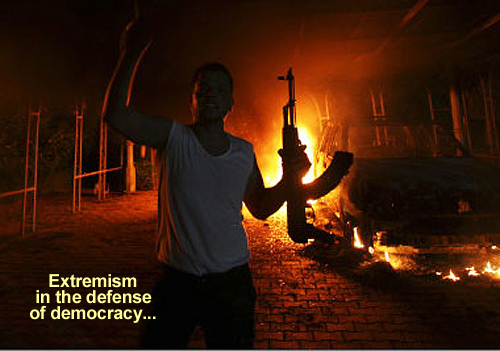
African unrest this week and Tuesday’s attack in Libya are profound indications that democracy is as nuclear as uranium.

The attack of America’s Benghazi consulate was likely coordinated by an al-Qaeda affiliate to mark the 9-11 anniversary. But were the growing protests prior to that just coincidence? Even more eery, was the film by a mysterious American extremist posted on YouTube castigating Mohamed coincidental?

Conspiracy is a nasty game but there are some dangerous fingerprints on that video. The maker has disappeared. New and technologically immature Afghanistan was able to block it from being seen by its population, but vastly more savvy Egypt didn’t.

And much more to the point, how does such symbolism evoke such violence?

The same way white pointed hats in the older South played judge and jury in a single night. Or the way presidential candidates threaten bureaucrats with summary lynching. Or the way Rush Limbaugh raises the blood pressure of 5 million brainwashed Americans every day.

Democracy is not just the freedom to choose your leaders, but the freedom to choose bad and evil leaders, and even the freedom to choose war mongers and genocide organizers. Evil is evil in part because it fools the good into thinking it’s something else.

That’s what’s happening with the growing crowds of protestors in the Mideast, now, throngs of desperate people looking for a fight, anything to blame their misery on.

When strongmen held Egypt and Libya at bay, just as strongmen today in Uganda or Zimbabwe, dissent of any kind is eliminated. Yet these dictators are often tolerated by the world and held to some mythical threshold of human rights violations, some trigger line of so much blood spilled.

We forgive without question their mercenary capitalism that allows them to achieve untold wealth at the expense of their poor. But we kick into action when slow death is replaced by quicker, more violent deaths. And perhaps there’s no other way. We can’t be everyone’s brother’s keeper.

But our mistake is the belief we are ourselves immune to such folly. We, too, are fooled. We, too, are impoverished by our elite leaders.

Consider this. The arsenal of weapons including shoulder-fired missile grenades that blew up our Benghazi consulate are available right now for you to buy on eBay, and while the vast majority of the world forbids their ownership by private citizens, you can receive them legally by UPS in Colorado and Texas.

Democracy, like conspiracy, is a nasty game. It doesn’t always turn out the way you’d like.

Education Needed on This

Education Needed on This

Teacher strikes in Africa and around the world mark a critical point in the global recession.

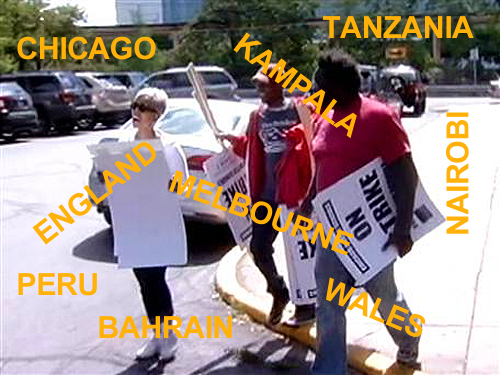
In Kenya the country’s entire educator workforce is on strike, from primary school through university. Last month’s teacher strike in Tanzania has been suspended only temporarily, and in Uganda teachers are poised to walk off the job in the next few weeks.

But there are also actions or looming actions in England and Wales, Australia and of course in my home city of Chicago. Teachers are also threatening work action in Peru and South Africa. Teacher leaders have been jailed in Bahrain which could once again destabilize that city-state.

What’s going on? There’s just too many educator work actions in too many widely different places to suggest anything like coincidence.

The Chicago strike is not about pay; the Kenya strike is about pay; and from the Mideast to Asia the range of issues is as wide as the geography. But in the end it is all about the bottom line. It’s all about the cost of education and the widely presumed notion that it isn’t working well.

I have no idea if education is working well in London or Sydney or Bahrain, and I’m pretty convinced it’s not working as well as it should in Chicago or Nairobi. But actually when you stand back from the globe and look at the turmoil, not even that seems to be the point!

Education is among the last of public services to be hurt by a global recession. When an industrial plant closes, usually a sizeable chunk of the workforce is let go all at once. Not so with education. You can’t close schools wholesale. Instead you inch up the class size, reduce the scope of services and month after month squeeze the teachers for a little bit more.

If the squeeze goes on for long enough it pops. And that’s what’s happening, now.

Conservatives around the world see this as an opportunity to trim excess and improve delivery. Progressives see just the opposite, an attempt to balance a wider social imbalance on an already stressed system.

But that’s not the point of this blog.

When such diverse societies in so many places in the world begin battles with their educators over such a range of issues, it means that globally society is really being stressed to new and maybe dangerous points.

There is a way out of this. And put aside for a minute the enormously different issues from one school system to another across the world. Education distress worldwide is an indicator that in sum the global recession isn’t easing; it’s getting worse.

There are models to turn this around: In France, China, Australia and the U.S., stimulus is being exercised. It’s important to note how different is the extremely conservative politics and society of Australia compared to the socialist politics and society of France; and how different the U.S. and China are in so many ways.

Yet these four countries have all used or are using now stimulus, and they are all much better off than countries like Britain and Peru which have opted for austerity.

The laws of economics trump all other laws.

Many African countries are on the cusp of having to make the decision about stimulus or austerity, because when the developed world tanked into recession, they actually benefited for a few years. Their decisions about stimulus vs. austerity are only now being legislated.

They should take heed carefully. The U.S. did it correctly; Britain did not. If we can get enough of the world to realize this and follow suit, then the education wars won’t be followed by wars in health care, civil and national defense.

No More Mali than Madagascar

No More Mali than Madagascar

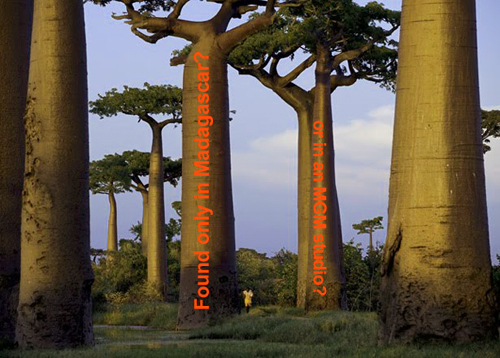
The increasing destruction of Madagascar’s environment is no less critical to mankind than the destruction of libraries and temples in Mali.

Two scientific studies completed last month now confirm that the incredible rate of Madagascar deforestation is so severe now that the runoff erosion is “smothering local coral reefs.” This is the first time that the well reported rape of Madagascar’s biomass now extends into the oceans.

Westerners know Madagascar for its lemurs, and that is a perfect “mediator” species of the country’s serious political ailments. I coin this phrase, “mediator” species, because lemurs haven’t suffered nearly as much as a species as the vast majority of Madagascar’s reptiles, other animals, plants and birds.

I think this is because much of the Malagasy population is educated and its politicians are as cunning as they are violent, and they all know that if lemurs start to decline the way trees have, that much more attention would be focused on the country’s horrible politics.

Consider this: 98% of all of Madagascar’s land mammals are endemic like lemurs, found nowhere else. Add to this 92% of its reptiles, 68% of its 9000 plant species and two-fifths of its breeding bird population – all endemic. All seriously threatened.

Madagascar’s problem, like Afghanistan’s and Mali’s, is political. I would be the first to point out an economic or forest-human conflict, and much in the press and even the academic media suggests this.

It’s not true. The rape of Madagascar’s biomass has not produced any short-term economic benefit to its population, because the proceeds from the sale and destruction principally of its forests have been siphoned off by corrupt officials and foreign companies. It isn’t trickle down economics; it’s trickle away economics.

The little that remains of the country’s polity and corruptible government does everything in its power to protect lemurs. But little to protect anything else. I wrote earlier how global capitalism has now found numerous insidious ways to exploit the last of precious, endemic Madagascar.

And Madagascar’s Shakespearean if As-The-World-Turns incendiary politics never becomes quite violent enough to attract world attention, either, even though it is starting to destabilize the entire society and keep tourists away. Much of the political shenanigans, in fact, is comical. I wouldn’t be surprised if the warring opponents are in cahoots to reap rosewood profits.

It’s time the world attends to Madagascar, the same way it “attends to” Afghanistan and Mali. Mankind is as much the marvels of the planet as the marvels of human history.

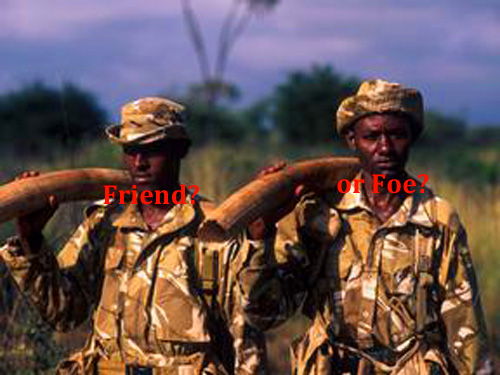
Elephant Friends or Human Foes?

Elephant Friends or Human Foes?

The Times article about escalating elephant poaching rebroadcast by NPR this morning needs more discussion, especially if you’re a sympathetic American.

Jeffrey Gettleman described in exquisite detail typical of his outstanding reporting the rapid increase in elephant poaching in remote places like The Congo.

It was an excellent piece of journalism, mainly because Gettleman pulled no punches. He let others explain his conclusion that the culprits are existing governments and renegade militias, and that the problem wouldn’t exist if China weren’t getting rich.

Unfortunately Americans often don’t read that far into an article, and when reduced by the NPR report this morning, some of these very important conclusions were terribly skimmed over.

I often feel ashamed as an American of our knee-jerk reactions to animal cruelty, for example, when it prompts us to greater action than people cruelty in Africa. And this is the perfect example.

Read Gettleman through to the end, don’t listen to NPR, and then think about it carefully.

Elephants today are nowhere near as threatened as they were in the 1980s when selling ivory in most parts of the world was legal. Then the only impediment to wiping out the species was the impoverished and usually corrupt African government that made it illegal to steal ivory from their wilderness.

But once out, the free market reigned most cruelly. And it was easy to get out. The wife of the president of Kenya, the country that suffered the most rapid decline in elephants, was a kingpin in the market. And there were no extradition treaties for ivory.

Ivory has been considered an exceptionally precious commodity in Asia for literally thousands of years, and that hadn’t changed in the 1980s and hasn’t changed, now. It’s an exceptional media that allows intricate sculpture yet holds its form through unusual strength and goes through subtle and beautiful color changes with age.

Like so much in nature, it is so much more beautiful than anything synthetic.

Tanzanian researcher Charles Foley also argues that the OPEC oil crisis of the 1980s prompted Mideasterners to cache their funds in durable commodities like ivory, and to be sure, many of the poaching syndicates were ultimately traced to the Mideast. That was the middleman to Asia.

The problem wasn’t solved until the world came together and created a global treaty that banned the sale of ivory, CITES. It is that treaty still in force today that is no longer functioning.

And the reasons it’s no longer functioning reveal a deep human neglect that is much more profound than neglecting to protect an animal. There are two equally culpable parties: China and The West.

CHINA’s BLAME
Hillary Clinton is today in China making the case for the first: CITES was successful because China and all of Asia (at the time, critically important Hong Kong) was on board. Today, China is ignoring CITES.

And the market for ivory in China is unbelievable. There are literally hundreds of thousands if not millions more rich Chinese than existed in the 1980s, and as their own economy falters and the world seems momentarily less secure, their passion for ivory has renewed geometrically.

In the 1980s ivory rose to $100/kilo. Today in China carved ivory trades as high as $1000/ounce.

When there is such an incredible demand, where an ounce of a product that comes in 100-pound tusks is greater than the average annual income of an African living in central Africa jungles, imagine the temptation to kill the thing.

China’s inability to curb its effete greed, its inability to develop an art culture that doesn’t lay waste a living thing, is essential to understanding this dilemma.

WEST’s BLAME
The West’s culpability derives mostly from its obsession with terrorism and it is a sweet-and-sour story to be sure.

To our credit America is eking away much of the under-the-table and immoral politics of our past history with Africa, and so is much of Europe. The new Dodd-Frank regulations of how American corporations can obtain precious earth metals from Africa has strangled many African warlords. Reparations by several European countries for the most patent sins of colonialism has reversed a century of denial.

But our continued military involvement in Africa, escalated by Obama especially in Somalia and the central African region, has in its military successes turned warlords and militias on the run into elephant killers.

Starved of precious metals like coltan, turned tail by increasing military losses, African guerillas like the remnants of the Lord’s Resistance Army are now fueling their dwindling operations with the ivory trade. And with the market so ready, it’s an easy call for them.

And worse, the ostensible victors in these military skirmishes, especially the Ugandans, have now been documented by Gettleman of using the military equipment given to them by America to slaughter elephants.

I have no doubt that Obama and his advisers believe that the military successes in central Africa and Somalia are worth the loss of elephant.

So do I.

And that’s the profound understanding you’ve got to acquire from this complicated story. Be patient. Condemn the elephant slaughter, support Hillary in stiff arming China to return with fervor to CITES, but don’t do anything else.

Don’t send a new $100 to Save the Elephants, because you believe the organization which does fantastically good work in Kenya can save an elephant from the Lord’s Resistance Army in central Africa selling to a fanatical China. It can’t.

What will impede the current slaughter is reducing terrorism, making China adhere to CITES, reducing the market value of ivory to something fathomable vis-a-vis an African’s annual wage. And these solutions aren’t easy ones and there is no better way to effect them than to support an American foreign policy on the right track for the first time in a generation.

Nor will elephant poaching be stopped by more guns in anti-poaching, as Gettleman brilliantly reports. It will stop in stages as man’s inhumanity to man stops. It will stop as slowly as greed is reversed and compassion grows.

And plausibly, that might never happen. But if we lose central African elephants we might gain an equally valuable lesson: no animal will be saved in this world, before man saves himself.

African Perspective on Romney

African Perspective on Romney

No surprise that Africans don’t like Mitt Romney. But what is surprising is that they take Obama’s reelection as a given. Romney is not considered a serious candidate.

Or possibly Obama is considered invincible, and those of us at home know this is really not the case. But why do Africans think so?

The birther issue reborn a few days ago, Romney’s callous remarks about his ancestors owning slaves as reason he understands black people, and last night’s clumsy if crude endorsement by Clint Eastwood are all the types of news stories that quickly make it into the African press.

And frankly, those Romney snippets don’t portray a serious candidacy but one so far on the fringes it can appeal to only a very small group of people.

That’s, of course, where Africans are wrong, as is much of the world. Americans are credited with superior everything – superior economy, superior entertainment and superior government. But that, too, is wrong. And Romney’s appeal – however limited foreigners might think it – clearly appeals to a large portion of America.

In my opinion, it isn’t an America foreigners can’t know, it’s one they choose not to know.

There’s so much angst in the world right now, the notion that there is not a shining beacon on the hill is just something an African, for instance, would rather not believe.

The South African press in particular has been covering the election campaign quite extensively. The issue of most interest this week got little attention in the American media.

A reporter for Yahoo News, David Chalian, was caught unawares on a live webcast in conjunction with ABC News at the Republican Convention. As Hurricane Isaac approached New Orleans he remarked to a guest at his side, “Feel free to say, ‘They’re not concerned at all. They are happy to have a party with black people drowning.'”

Chalian was immediately fired by Yahoo, and that has stirred widespread disbelief that the American system is so unforgiving of impoliteness, particularly when the impoliteness happens to be true.

In a comment left after a South African report of the incident, ‘Pointman’ summed up all the other many comments that today flood South African newspapers about the story:

“The journo was most probably right. Remember the Republican party’s response to Katrina and the flooding in New Orleans- all those Black people (and whites too) stranded after the inundation and no help anywhere for days.”

“I agree,” then commented ‘Cocolucho.’ “The republicans only seem to care about bible wielding whites and no one else, which is funny cos they are such hypocrites.”

“Most White Americans including those that fired him,” added ‘Tsatsatsa’ “share the very same sentiments.”

“Americans are racist,” declared ‘DJ-Winner.’ “They go as far as calling that country a safety heaven. Safety heaven, my foot.”

‘MommaC’ said, “Shouldn’t have been fired for telling the truth.”

The comments are flooding the South African press, today. They are essentially dismissing the seriousness of people who really still question Obama’s nationality, who take Romney’s remarks about women and ancestors and abortion with hardly a grain of salt, and who would fire a reporter for what he thought was an offline remark which also happened to be true.

They are dismissing the Romney candidacy as no real threat.

Don’t be so sure.